2015
UNIVERSIDADE DE LISBOA
FACULDADE DE CIÊNCIAS
DEPARTAMENTO DE BIOLOGIA ANIMAL
Morphological and Behavioural Variation in Ants:
Comparing species, castes and individuals
Mestrado em Biologia Evolutiva e do Desenvolvimento
Andreia Filipa Eusébio Vincent Teixeira
Dissertação orientada por:
Patrícia Beldade | Instituto Gulbenkian de Ciência
2015
UNIVERSIDADE DE LISBOA
FACULDADE DE CIÊNCIAS
DEPARTAMENTO DE BIOLOGIA ANIMAL
Morphological and Behavioural Variation in Ants:
Comparing species, castes and individuals
Mestrado em Biologia Evolutiva e do Desenvolvimento
Andreia Filipa Eusébio Vincent Teixeira
Dissertação orientada por:
Patrícia Beldade | Instituto Gulbenkian de Ciência
First I would like to thank Patrícia for her patience throughout this year that I spent in her lab. I would like to thank Roberto for all the teaching and discussion about this amazing non-model organism and also for encouraging me to pursue what I want as a scientist. Thank you for showing me the museum specimens’ utility and its importance for science. And especially for making me want to keep my own insect collection!
Also want to thank professor Élio for his precious time spent on teaching me how to design degenerated primers and answering to (sometimes not so) useful questions.
And thank Sara Magalhães for all the support and advice in this final effort.
I want also to thank to all VDS lab for all the support and for teaching me how to work as part of a team.
To all Evo-Devo community at the IGC for providing me the most inspiring year that I could ever had.
I want to thank all my friends for their enormous patience and support during a very complicated year, and also apologize for the lack of attention. To Mariana and Miguel for every laugh they pulled out of me. To Melinho that always remembered me what I can do and above all what I should do. To Vasco for remembering me that not only scientists-wannabe have a difficult life. To Barateiro for all the hugs and loud discussions, not only about science.
To my dearest friend Gonçalo that have always been an example and always had the time to ask how I was doing, even being 16000km and 9 hours in time zone away.
In last I would like to thank my two musketeers for the companionship during this troubled journey. Thanks to Ana Catarina and Ana Sofia for all the laughs, brain-farts and late hours spent (not only) at that institute (not always) working.
Especially to Ana Sofia that listened to me so many times, even when she doesn’t want to. Honestly I don’t know what to say.
In last I what to thank my heroine Filomena, my sweet grandmother that always supported me and helped me to accomplish my objectives and finish this long journey. And to my grandfather Augusto, that unfortunately won’t be able to see me closing this chapter of my life. I wish you were here.
Abstract
Environment plays a fundamental role in living organisms’ adaptation and selection. Developmental plasticity allows individuals to sense the surrounding environment and produce different phenotypes in response to biotic and abiotic cues. Individuals are exposed to these cues during larval phase and transduce it to shape and size adaptations in the adult. Social insects are a good (non-)model organism to study developmental plasticity since they present dramatic castes differences. The reason behind ants’ ecological success is division of labour and each colony is divided in groups according to specific tasks, like reproduction and colony defence. Morphology appeared early as a caste defining factor, but soon age and physiology were included in the list. Extreme dimorphism between queens and workers demonstrated that morphology and behaviour should not be considered independent traits and species whose worker caste is divided in sub-castes highlighted that more attention should be paid to within caste variation and specializations. Morphology is determined by growth during development and thus regulated by juvenile hormone and ecdysone, which together can reprogram metamorphosis timing. In this work we compare species, castes and individuals morphology and can have an overview of how much variation is found between and within groups. Within worker castes we performed a detailed analysis on morphology and behaviour and found some task division signatures, even in monomorphic castes. Finally we simulated environmental cues by manipulating endogenous hormonal levels and to know if a monomorphic species is able to produce intermediate phenotypes when exposed to the same conditions as dimorphic species. Our morphometric analysis demonstrated that we could find more differences between than within castes, and also allowed us to suggest the existence of more caste-related traits in contrast with other more species-related. Intra-caste analysis suggested the existence of task-specific behavioural groups within monomorphic colonies. Hormonal manipulation results were affected by the nature of compounds used and also by the absence of a specific dosage-response curve for species used. However we could also address some colony specificity in the response to treatments, and differential sensibility to these.
Key words: behavioural castes, caste determination, developmental plasticity, juvenile hormone, monomorphic.
Resumo
A morfologia afecta todos os aspectos do ciclo de vida de um organismo. Há uma relação muito próxima entre o tamanho e forma de um determinado indivíduo e o comportamento que este adquire num determinado ambiente. O comportamento de cada indivíduo vai também afectar e moldar o ambiente em que este é seleccionado, tornando todas estas interacções mais complexas. Contudo alguns indivíduos conseguem ajustar o seu desenvolvimento e fenótipo ao ambiente em que se encontram, e esta plasticidade fenotípica permite que um indivíduo, a partir de um genoma, possa produzir diferentes fenótipos de acordo com os estímulos a que é exposto.
Os estímulos ambientais que provocam alterações no fenótipo do adulto só poderão ser efectivos se acontecerem em períodos de tempo específico durante o desenvolvimento, em que o indivíduo é capaz de sentir e traduzir o que se passa no ambiente envolvente e activar uma via que produz o fenótipo mais adequado. Estes estímulos podem ser bióticos, como a presença ou ausência de predadores para as Daphnia e a densidade populacional para os gafanhotos; ou abióticos, como a temperatura em Byciclus e a nutrição na produção de castas em insectos sociais.
Os Hymenoptera são um grupo maioritariamente constituído por insectos sociais, e foi a sua enorme diversidade morfológica e comportamental que permitiu a sua adaptação a vários nichos ecológicos. Um dos factores que mais contribuiu para o sucesso ecológico deste grupo foi a divisão de tarefas, isto é, cada grupo de indivíduos dentro de uma colónia especializar-se-á numa determinada tarefa, defesa, forrageio ou responsespecializar-se-áveis por cuidar das larvas, por exemplo. Este grupo ao qual pertencem as vespas, abelhas, térmitas e formigas tem sido muito útil para perceber como é que esta divisão de tarefas causou o aparecimento de castas. As formigas têm um sistema haplo-diplóide de determinação de sexo, em que todos os ovos fertilizados são diplóides e por isso originam fêmeas, enquanto os ovos não fertilizados são haplóides e originarão machos. Para além do comportamento e sazonalidade que se encontram associados a cada sexo, as formigas apresentam castas e, por vezes, sub-castas, o que as torna um modelo adequado para responder a questões relacionadas com plasticidade e de que forma esta pode ser moldada durante o desenvolvimento.
As colónias são quase sempre constituídas por fêmeas, produzidas por rainhas fertilizadas, e um dos típicos exemplos do sistema de castas é a diferença de fenótipos que podemos encontrar entre as rainhas e as obreiras. Ao serem responsáveis por tarefas tão distintas, que envolvem um consumo energético tão diferente, estes indivíduos permitiram que a selecção actuasse sobre os fenótipos que melhor se adequavam a cada função. No entanto sabendo
que as fêmeas são geneticamente idênticas podemos afirmar que o desenvolvimento larvar é o períodos-chave para que o indivíduo identifique os estímulos que o rodeiam e produza o fenótipo que melhor se adapta ao ambiente.
As alterações ao desenvolvimento são induzidas pela nutrição, e no caso das formigas sabemos que o que provoca esta alteração é a quantidade de comida que as larvas recebem. A nutrição vai afectar os níveis hormonais endógenos, neste caso em particular da hormona juvenil, e uma das consequências é a alteração do limite de peso crítico necessário para que o indivíduo sofra metamorfose. As manipulações hormonais em larvas de insectos sociais foram o primeiro passo para compreender como é que estes sinais são interpretados pelo indivíduo e quais são os processos envolvidos na produção de fenótipos tão distintos. O período larvar está dividido em cinco estádios: primeiro, segundo e terceiro estádios larvares, pré-pupa e pupa; e é no final deste período que a metamorfose ocorre. A determinação de castas ocorre nas fases iniciais, enquanto as especializações associadas a sub-castas de obreiras são determinadas nas fases mais tardias.
As sub-castas também terão surgido em resposta à selecção, produzindo morfologias ou secreções particulares de acordo com a função mais necessária à colónia. Isto conduziu à classificação da espécies de acordo com a variação que podemos encontrar em tamanho e forma dentro da casta das obreiras, podendo estas serem classificadas como monomórficas, dimórficas ou polimórficas. As espécies monomórficas apresentam uma ligeira variação em tamanho entre os indivíduos; as dimórficas apresentam fenótipos muito distintos, considerados como unidades discretas em resposta a um determinado gradiente ambiental; e as polimórficas têm uma distribuição muito ampla de tamanho e forma dos indivíduos ao longo desse mesmo gradiente. É importante perceber qual o grau de plasticidade associado a cada um destes casos e se os fenótipos produzidos se devem à não exposição a determinados estímulos ou se o genoma foi seleccionado para responder apenas quando necessário. Será que diferentes graus de dimorfismo se devem a diferentes sensibilidades aos estímulos ambientais?
Para respondermos a este tipo de questões devemos primeiro focar-nos na caracterização detalhada, morfológica e comportamental, das espécies, castas e colónias. Estudos anteriores demonstraram que o tamanho e forma dos indivíduos são influenciados não só pelo ambiente mas também pela colónia em que estes se inserem. Isto relembra a importância de estudos descritivos e comparativos no que respeita à compreensão das bases evolutivas.
Neste estudo fazemos uma comparação morfológica detalhada entre espécies, castas, colónias e indivíduos, aprofundando os conhecimentos relativamente à variação que pode ser encontrada e associada a cada um destes níveis de organização. No entanto sabemos também
que a divisão de tarefas e de castas depende não só da fisiologia do indivíduo em fase larvar mas também em fase adulta. Para além das habituais castas morfológicas podemos também referir castas comportamentais, que podem ser ou não dependentes da idade dos indivíduos. O nosso grupo de espécies analisadas incluiu indivíduos com uma casta de obreiras monomórfica disponíveis em laboratório, Aphaenogaster senilis, e por isso analisámos em maior detalhe a sua morfologia e comportamento na tentativa de encontrar possíveis sub-grupos associados à divisão de tarefas. A relação entre a distribuição preferencial dos indivíduos e a sua complexa rede de interacções já se demonstrou fundamental para a organização das colónias, por isso usámos como indicador de divisão de tarefas a localização dos indivíduos na colónia. Verificámos que embora seja possível encontrar algumas diferenças morfológicas entre indivíduos que se encontram fora e dentro do formigueiro, é relativamente ao comportamento que se pode sugerir uma real divisão de tarefas nesta espécie. Mostramos que há uma forte tendência para que indivíduos encontrados fora do formigueiro se mantenham lá, sendo os possíveis responsáveis pelo forrageio e recolha de comida para a colónia.
Outra questão importante é a capacidade de espécies monomórficas responderem a um gradiente de estímulos ambientais que afecte os indivíduos em diferentes fases do período larvar. Poderão alterações em fases mais tardias resultar no surgimento de fenótipos ou características intermédias entre as típicas castas? Manipulámos directamente os níveis da hormona juvenil nas larvas de A. senilis e os nossos resultados demonstram uma ausência de resposta por parte dos indivíduos. No entanto, a elevada taxa de mortalidade associada aos nossos tratamentos, a ausência de curvas de dosagem para os compostos utilizados e a incerteza acerca da efectividade das nossas manipulações representam possíveis problemas e dificultam explicações para os nossos resultados.
Este trabalho demonstra a importância que os trabalhos descritivos e comparativos continuam a ter, bem como a relevância que o estudo da morfologia e comportamento dos organismos mantêm numa era que favorece visões mais abrangentes e questões mais gerais, tendo como base a genómica e a epigenética. Compreender a história natural dos nossos organismos modelo, e principalmente dos nossos organismos não-modelo, continua a ser fundamental para completar e integrar o que nos permitem concluir trabalhos com uma base molecular.
Palavras-chave: castas comportamentais, determinação de castas, hormona juvenil, monomórfica, plasticidade fenotípica.
8
Table of contents
Introduction ... 9
Materials and Methods ... 13
Results and Discussion ... 17
Morphological variation between species, castes and colonies ... 17
Inter-specific variation ... 18
Intra-specific variation ... 20
Lasius sp. ... 20
Messor barbarus ... 21
Aphaenogaster senilis ... 22
Morphological and behavioural intra-caste variation ... 22
Morphological analysis ... 23
Behavioural analysis ... 24
Hormonal manipulation effects ... 26
Survival effect ... 27
Developmental time ... 29
Induced morphological variation... 29
Final Remarks and Future Perspectives ... 34
Bibliography ... 36
Annex 1 ... 38
Support material – Tables, schemes and images ... 38
Annex 2 ... 42
Statistical analysis summary ... 42
Annex 3 ... 43
9
Introduction
Body shape and size are crucial properties of multicellular organisms. They both condition and reflect modes of life and affect a series of other traits, including behavioural and life-history traits. They are also highly diversified, with sometimes very extreme variation both within and between species. Size and shape evolve in response to various selective pressures [1-5]. The evolutionary potential of these traits is translated from an intricate relationship between morphology, behaviour and environment [5]. Often an organism’s morphology influences its behavioural repertoire and can itself affect the environment where individuals are selected. These changes in the environment can, in turn, lead to morphological specializations and behaviour adjustments. Morphological studies lost some attention along the years and are constantly being replaced by detailed analysis at the molecular level, including genetic and epigenetic characterizations. It is unfortunate that many recent studies seem to overlook the importance of morphological descriptions that keep up with the detail and sophistication of molecular analysis that is now standard [6].
Like is typical of quantitative traits, variation in body shape and size depends both on genetic and environmental factors and on the interactions between them [3, 7]. Especially in insects we can find several examples of how the external environment can influence shape and size. Environmental factors that affect the development of body shape and size can be biotic or abiotic, and include nutrition as a prime example [7]. In dung beetles, for example, nutrition during larval development affects adult body and male horn size, as well as reproductive strategies [8]. Phenotypic plasticity is a phenomenon through which the same genotype can produce different phenotypes in response to external environmental cues and it is very common in nature. Numerous studies reported examples where organismal developmental trajectories and outcomes are affected by various external environmental factors, including temperature, presence or absence of predators, population density and nutrition, as referred
[9]
.
Social insects, ants in particular, have long been prime examples in evolutionary and developmental studies, including in relation to behavioural and morphological traits. Even Charles Darwin looked for the existence of fertile and sterile groups within species as a test for his theory [10]. Ants’ ecological dominance in terrestrial ecosystems and extreme evolutionary diversification contrasts with the difficulties inherent to not being classical lab models with limited analytical tools and resources [11]. Targets of many biological questions regarding social insects’ biology still care for an answer.
10 Ants have a haplo-diploid sex determination system, where all diploid eggs develop into females and haploid eggs develop into males [11]. Generally only queens have structural and behavioural support to fertilization, which includes numerous ovarioles, spermatheca – to store sperm – and wings, used in conspicuous mating flights. Consequently, generally, only queens are able to produce diploid eggs. Haploid eggs can be laid by queens and/or workers, depending on the species of ants. Some species have workers with reproductive potential, called gamergates, which are responsible by haploid eggs production [12].
Ants and other social insects are characterized by a complex social organization with division of labour between different groups of individuals within colonies, each one with particular morphology and function, called castes. Queens are generally winged and ensure the colony reproduction, while workers are responsible for colony maintenance, including tasks such as foraging, cleaning and brood care [11]. Queens and workers typically differ in total body size, albeit not as dramatically in all species, and differ also in body shape [11, 13]. Particularly, differences in thoracic organization have been described and associated to the specialized tasks of each caste. In queens we observe an enlarged T2, where the muscles that power the wings are inserted, in relation to T1 and T3. Workers, on the other hand have a relatively enlarged first thoracic segment, T1, where the muscles that power head movements are [5]. Moreover, queens of different species can be separated based on T1/T2 ratios in a manner that associates with whether queens do or not forage when establishing new colonies [5]. Aside striking differences between queens and workers, in many ants there are also sub-groups or sub-castes of workers with distinct morphologies associated with distinct functions in the colony life. A good example are some Pheidole species where minor and major workers have extremely different phenotypes, and further sub-division of major in soldiers or super-soldiers, castes produced specifically for colony defence [14,15]. On the other hand Pogonomyrmex, Solenopsis and Messor are characterized by extensive size and shape variation within the worker caste and thus classified as polymorphic species [16-19]. This wide range of variation is opposite to what was described for species with discrete castes, where variation presents modest values [20]. Some ants’ species can even present intermediate characteristics or inter-castes, presenting individuals with a “hybrid phenotype” between queen and worker
[21]
.
Worker polymorphisms have been used in allometry studies to better understand how growth rates can differ between body parts. For example, in Solenopsis species worker size increases with increasing colony size, but some body parts grow disproportionally [18, 20]. These differential growth rates within single individuals will allow morphological differentiation, later resulting in function specializations and division of labour within workers [16]. While division of
11 labour is associated to morphological specializations of castes and sub-castes, the latter is not strictly necessary for the former. Studies have found that even morphologically monomorphic castes can still have behavioural and functionally specialized sub-groups [10, 16]. For example, morphologically monomorphic sub-castes include temporal castes, in which different tasks are ensured by individuals of different ages [22]. This seems to be more common among Hymenoptera than morphological castes. Age polyethism has been described in many species and usually entails that younger workers are responsible for feeding and nursing and spend most of the time inside the nest, while older workers are responsible for foraging outside the nest [10, 22]. Aside temporal castes, morphologically monomorphic division of labour can also be associated to glandular morphology or secretory products and levels [22]. Examples of such “physiological castes” include specialized pathfinders in Pharaoh ants (Monomorium pharaonic) and specialized brood-care workers in ponerine ants (Ectatomma tuberculatum) [22,
23]
. Finally, in some cases complex patterns and networks of group interactions within a colony can also contribute to some hierarchic division of labour that does not associate with morphologically distinct sub-castes [24].
Although the lack of information on sociometry and sociogenesis is considerably high and evolutionary origin of castes and sub-castes remains a topic of discussion, much has been discovered regarding developmental plasticity in social insects [25]. Several studies demonstrated that castes are a product of differential feeding and consequential different pathways activated during development in response to internal hormonal levels [14, 26-27]. Ants are holometabolous insects and their development is divided in three larval instars corresponding to the growth phase before metamorphosis [26]. After eclosion body size remains unchangeable throughout adulthood [10, 26]. It is the quantity and/or quality of nutrition during the larval phase that determines body size and also caste differentiation. Nutrition determines caste formation mediated by juvenile hormone levels and DNA methylation [27-29]. Most studies underlying DNA methylation and changes in expression were developed in honeybees but some recent works confirmed an important role of caste-specific methylomes in ants [28]. It is known that nutrition directly impacts hormone endogenous levels
[26]
. Larval neurosecretory system translates endocrine dynamics to specific developmental time points and thresholds defining the minimal conditions required to undergo metamorphosis [14, 26]. Juvenile phase maintenance is sustained by juvenile hormone while larvae – pupa – adult transformations are held by ecdysone. JH is produced in corpora allata, near the brain, and it will be the responsible for developmental time delay, being thus involved in developmental switches needed for caste determination [30-32]. These developmental switches can occur earlier or later in development having different effects on phenotypes and
12 it depends on the species. Lab studies that artificially lead to increase (using methoprene, a JH analogue) or decrease (using precocene) of JH levels, independently of nutrition, have allowed characterization of the sensitive time points and threshold levels [14, 26]. Precocene will affect corpora allata cells and decrease JH secretion, meaning that when applied it will induce precocious metamorphosis and consequently miniature versions of adult insects [33]. Specifically precocene II was proved to be effective on Solenopsis invicta dealation process, which means it is interfering also with adult individual maturation processes naturally induced by JH [34]. Environmentally-induced caste determination, between queens and workers, occurs during first and second larval instar and sub-castes are determined in late larval instars, usually after individuals were already determined as workers. Only well-fed larvae are able to develop into queens, since high nutrient intake induces corpora allata to secrete more JH [26]. Reprogramming in late larval instars will allow individuals to grow more and for longer periods, and will allow them to allocate resources to specific structures breaking the default worker developmental program [26].
Many studies focused on characterizing the morphology and underlying development of different castes and sub-castes of ants. Much less attention has been given to intra-caste differences and to plasticity in males. Here we propose to understand not only how morphology changes both in size and shape across species with different ecologies but also to analyse in detail the morphological and behavioural variation present within castes and colonies. Using different species, each one displaying a different dimorphism degree, will also allow us to better understand morphological variation according to organizational system with emphasis on monomorphic species. We will also perform hormonal manipulation experiments to adress monomorphic species response to artificial environmental gradients and preliminary observations of haploid genomes response to similar cues.
13
Materials and methods
Biological material
We focused on three ant species with different degrees of female plasticity, reflected also in extent of queen-worker size dimorphism: Aphaenogaster senilis, with a monomorphic worker caste; Messor barbarus representing a stronger queen-worker size dimorphism and polymorphic worker caste; and Lasius sp. also with a strong queen-worker size dimorphism but with a monomorphic worker caste. All colonies were collected in the vicinity of the host institution (Oeiras, Portugal – see Annex 1, Table S1). For A. senilis, we maintained colonies in the laboratory, while for the other two species wild-caught individuals were collected and immediately analysed. We analysed queen and worker morphology for all three species, and did experiments in female larvae for A. senilis (Annex 1, Table S1).
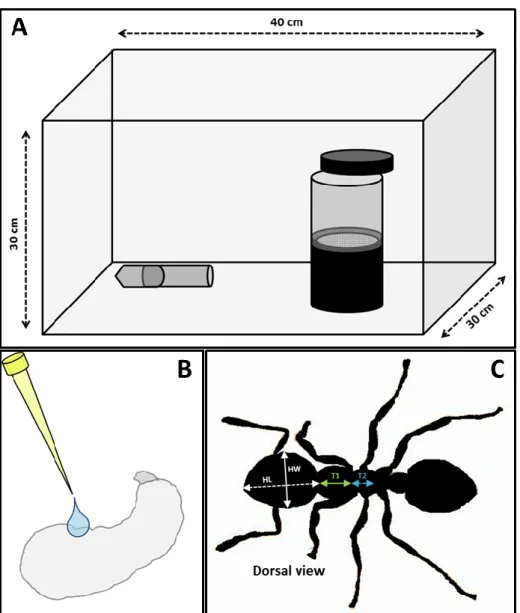
All A. senilis lab colonies were kept in incubators under controlled conditions, 27°C, 60% humidity and a 12:12 hours of light:dark cycle. Colonies were feed with frozen Drosophila and pieces of orange each two days, with sugar cubes and water provided ad libitum. They were placed in plastic boxes of 40 x 30 x 30cm and the boxes inside “walls” were covered with fluon, to prevent ants being able to escape. Each box contained a nest simulator with two compartments of cylindrical shape (10 x 6cm each one) both made of dark material to provide darkness and separated from each other by a grid. The ants with their larvae were on the top compartment, from which they could access the outside for foraging, and the bottom compartment was kept full of water to provide high humidity (scheme on Fig. S1A, Annex 1). A. senilis colonies were kept in queen-right and/or queen-less status to control larvae production. Queen-less colonies were either obtained from the field or generated in the lab by splitting field-collected queen-right colonies in two groups with the approximate same number of workers, one with the queen laying fertilized eggs that will develop to be diploid larvae and later adult females, and one without a queen or juveniles where workers were able to lay unfertilized eggs that will produce haploid larvae and adult males.
Morphological measurements
We measured a series of morphological traits to assess differences between species, castes, colonies and individuals (un-manipulated individuals) and between hormonal treatments (only for females). We measured different body parts and traits for each we expected differences between castes and species. We measured the length of the first (T1) and second (T2) thoracic lengths and the total thorax length for each individual, known to distinguish queens from
14 workers as well as different type of queens [5]. We measured length and width of heads to assess size and shape (length/width) of this structure. Detailed information about measurements and traits used can be found on Table 2, below. Unfortunately, we could not always measure all traits in all individuals. Measurements were done with ImageJ 1.48v on photographs taken of body parts of individual ants. For image acquisition we used a JVC digital camera mounted on a Leica MZ16 microscope and magnification was adjusted not only to specific structures but also depending on the species we measured. Detailed information about measurements and figures illustrating the correct structure/body positioning for imaging can also be found in Annex 1, fig. S1 C and fig. S2 A-C.
Behavioural assays
To test for potential task division between workers of a species with a monomorphic worker caste, we tracked the location of individuals found inside and outside the nest in three of our lab queen-right colonies of A. senilis. In each colony we marked 10-15 individuals found inside or outside the nest with a different colour dot applied with a toothpick to the dorsal side of the first thoracic segment: silver for individuals inside the nest and green for individuals outside the nest. To discard any possible ink effects on colony behaviour, all individuals were marked at the same time, returned to the original colony and observed in regular intervals of 15 minutes during 2 hours before starting behavioural observations. Ink effects were discarded based on observation of unchanged behaviour in marked individuals and no rejection by the rest of the colony (non-marked individuals). We observed 20 to 30 marked individuals during four consecutive days for day period observations and during one day for night period Table 2 – Detailed information about measured traits, analysed species and total number of individuals measured for each trait (queens and workers from different colonies). A – A. senilis, M – M. barbarus and L – Lasius sp.; colour code correspondent to colours used on Fig.1.
15 observations. Day period observations were done in the afternoon, and we did five observations per day in 1 hour intervals. In night period we did four observations divided in 30 minutes intervals. During the observations we took note of the individuals’ location within the colony by counting number of green and silver dots seen outside the nest (to avoid disturbances caused by opening a nest). To correct for total number of individuals we also counted and removed green and silver-marked dead individuals.
Hormonal manipulations
We did manipulations of JH hormones on A. senilis diploid larvae (produced by fertilized queens and isolated from our queen-right colonies).
For the JH manipulation experiments we staged larvae by size as well as morphology and size of their mandibles and hairs [35-37]. We decided to manipulate individuals only on second larval instar (L2) once it has been described as the stage limit for larvae bipotency – able to produce a worker or a queen development [38].
Three treatments were done by topically applying 1µl of one of three different solutions to each larva abdominal part (see scheme on Fig. S1 B, Annex 1 [15]. The three treatments corresponded to: 1) control (CTR) with application of acetone, the organic solvent where the other compounds were dissolved; 2) a JH- treatment with application of precocene II (Santa Cruz Biotechnology), an antagonist of juvenile hormone that have a cytotoxic effect on corpora allata cells decreasing JH production [26]; and 3) a JH+ treatment with application of methoprene (Sigma-Aldrich), a JH agonist that mimic the original molecule and is able to activate JH-mediated pathways, reprogramming critical size and delaying metamorphosis timing [15]. Both methoprene and precocene II were dissolved on acetone to a range of concentrations, but we only obtained adult individuals from two of the concentrations used, one for each compound. In JH+ treatment we applied a 5µg/µl concentration, reported as effective concentration in production of major workers in Pheidole bicarinata, for example [15]; and in JH- treatment we opted for a 2µg/µl concentration, considered appropriate after experiments where higher concentration of precocene II inhibits dealation in adults in Solenopsis invicta, correspondent to a delay on reproductive maturation process [34].
In each manipulation round, we collected larvae from one of our colonies, selected those of the target stage and split them into three groups with the approximate same number of larvae, one per treatment. After the treatment, the larvae of each group were transferred into separate small plastic boxes (20 x 20 x 7cm), with 20 workers from the same source colony and left to develop until adulthood.
16 After eclosion adults were kept in 70% ethanol for measurements.
Data analysis
All analyses were performed with R, version 3.2.2. For all analyses, residuals of the models have been tested for normality using Shapiro-Wilk (alpha = 0.05), and equality of variances using Levene’s test. When comparing variances between groups we can quantify the difference between groups. This data together with distribution plots for each trait allow us to suggest which group presents more or less variation for that specific trait. We used Levene’s test to know if we can group colonies when comparing species, based on their homogeneity of variances. All Levene’s test results are summarized in Table S3. In the first part of results, relative to morphological variation within species, and between castes and colonies, we used Kruskal-Wallis test for all traits, after finding some of them that did not meet normal distribution assumption. We used simple models to test each trait within species (trait~colony or trait~caste) and between workers of different species. Unbalanced samples do not allow us to compare every group of individuals in inter-species comparisons, so we selected three groups of workers with approximate same number of individuals and tested each trait in function of species (trait~species). For A. senilis we tested whether traits differed between workers found inside versus outside the nest (trait~location) for both colonies (A1 and A2) using Wilcoxon test.
Behavioural data showed normal distribution and was analysed using ANOVA (analysis of variance) to test effect of colour – correspondent to their location when marked – on their “preferential” location during observation. For our statistical analysis we compared the probability of finding a specific group of individuals outside, testing a general linear model (location~observation+colony*colour) and analysing deviance for each period of the day separately.
Hormonal manipulations comparisons depended on trait. Pearson’s Chi-squared test was used to test mortality differences between colonies. Developmental time and morphological traits were tested for possible effects of treatment, colony and their interaction (trait~colony*treatment) using ANOVA. When significant differences were found, we used Tukey’s post-hoc pairwise comparisons to establish which groups differed from each other. For each group of individuals, in this specific case each treatment within colonies, different letters indicate pairwise comparisons that revealed statistically significant differences.
17
Results and Discussion
Morphological variation between species, castes and colonies
To better understand the morphological variation between ant groups we decided to start with comparisons between species, castes and colonies. In this first figure panel we wanted to highlight the differences found in size and shape between and within the three species used, between and within castes from each of these species and also between colonies and individuals within castes. We should mention that numerical labels used to distinguish colonies in different results topics are merely informative to each one of them and does not always correspond to true colonies ID; these can be found on Annex 1, Table S1.
We should underlie that our Y axis changes its range depending on each trait. In annex 1 we present some of the images used for each trait measurement, and you can confirm that we are not expecting the same scale for every trait across castes and species.
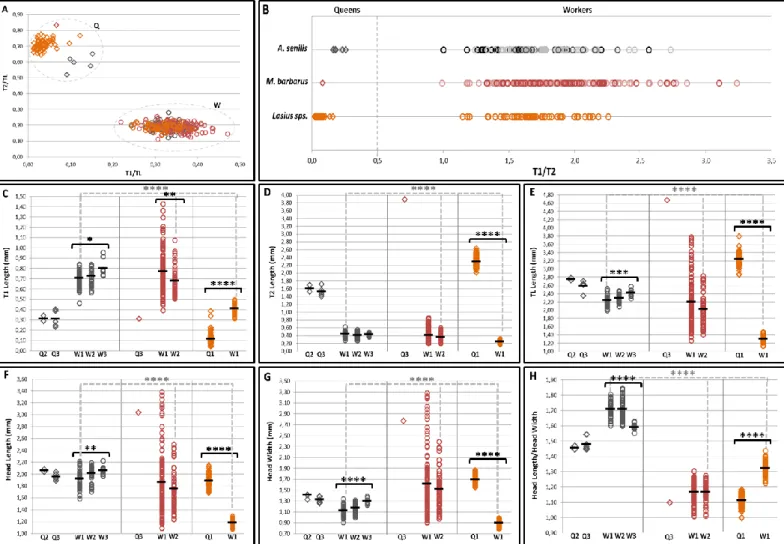
Fig. 1 – Morphological differences between species, castes, colonies and individuals. A) Comparison between first (T1) and second (T2) thoracic segment proportions relative to total thorax length (TL), each colour represents species and different symbols represents queens and workers, ◊ and ○ respectively; B) Proportion of T1 relative to T2, for queens and workers from different species, slight colour variation in castes represents individuals from different colonies, correspondence
18
between colours and species maintained for every figure in the panel. C-E) Thoracic structures variation, C) T1 variation, D) T2 variation and E) TL variation across individuals, where ◊ and ○ represents queens and workers, respectively. F-H) Head size and shape variation, F) head length variation, G) head width variation and H) head length/head width across individuals. From C-H) Q and W represents the different castes and the following numbers represent each colony. All traits were measured in mm. Only significant statistical differences are represented, for colonies within (black line) and between (grey dashed line) species; p-value<0.05 *, p-value<0.01 **, p-value<0.001 *** and p-value<0.0001 ****.
Inter-specific variation
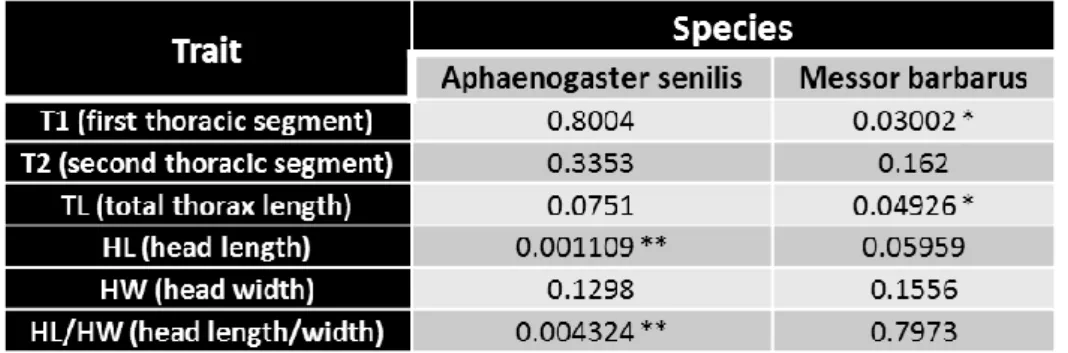
Figure 1A and 1B are relative to thoracic segments and were used to understand how first, T1, and second, T2, thoracic segments can be related and how their proportions change, not only between castes but also between species. It has been shown that thorax size and shape are adaptive traits, responsive to caste-specific functions but also to species ecology [5]. Knowing that queens can be separated in two types according to foraging activity we represented our data on fig. 1A, enabling distinction between different queen types across species. Proportions of first and second thoracic segments relative to individuals’ total thorax length – T1/TL and T2/TL ratios – allowed the division of individuals in two groups. We can observe it specifically between queen castes, with Aphaenogaster senilis in one group and Messor barbarus and Lasius sp. in a second group. As demonstrated in Keller et al. we expected that our three species queens fall in the “reduced T1” queen category, according to their ecology and colony foundation type. However we can see sub-division within this group and A. senilis fall somewhere in a “less reduced” T1 queen category, where the investment between neck strength and flight musculature is balanced, while the other two species insert in the typical “reduced T1” type of queens, investing in flight and storage musculature. This modest position for A. senilis could be explained by their apparently primitive condition, characteristic of species where queens are close to workers in size and the groups are similar in some traits [16]. Distribution and analysis of T1/TL (H(2)T1/TL = 8.42, p-value = 0.0148) and T2/TL in workers,
compared between three worker groups, suggests that thoracic architecture and proportions are not only caste-specific but also species-specific, in accordance to what was verified in queens. This can be related to highly conserved tasks and associated behaviour in workers, independent from their species [5].
In fig. 1B we emphasize the distinction observed between castes thoracic structures, and as expected we can observe a clear distinction in thorax shape due to first thoracic segment size relative to second thoracic segment size, represented by T1/T2 proportion. Queens have a bigger T2, where wings and respective flight muscles are included [5], while workers present an enlarged T1 as a consequence of more developed neck muscles also required for their caste-specific tasks [5]. This figure also highlights differences in proportion of these thoracic segments
19 between colonies within the same species. Both queens and workers were collected from various colonies. In fig. 1 each colour represents one species and each colour variants represents different colonies from the same species.
Independently of the sample size for each colony we can suggest that distributions of thoracic proportions of workers are similar. Although some groups reveal a wider range of distribution and we found significant differences in T1/T2 (H(2)T1/T2 = 8.42, p-value = 0.0149) between the
same three worker groups previously used, the general interval is maintained independently of the species. The differences found are probably due to the specific groups used for statistical analysis. As expected we can observe differences in T1/T2 ratios across species queens in the same figure. Relative to species we can say that Lasius queens have a much smaller T1 in relation to their T2 size, while Aphaenogaster presents a bigger T1 when compared with T2 size, somehow presenting a thorax more similar to what we can call a worker-like phenotype. The unbalanced sample for Messor does not allow us to conclude anything about their queen phenotype and behaviour, but we can hypothesize by looking to figure 1B that it could have an intermediate position in relation to T1 and T2 size.
To understand how much of this variation can be attributed to species differences, and for this we analysed three workers groups chosen due to their similar sample size, one belonging to each species. The significant differences found for homogeneity of variances (Table S2) did not allow us to group different colonies. The further analysis included head traits once it is known to be an informative morphological structure about caste and sub-caste specificity. We only represented statistical significant differences in the respective figures. We found differences for all head-related traits, both in size (H(2)HL = 103.23, p-value < 0.0001; H(2)HW = 106.71,
p-value < 0.0001) and shape (H(2)HL/HW = 122.77, p-value < 0.0001). Thoracic traits revealed
significant differences for TL (H(2)TL = 102.49, p-value < 0.0001), T1 (H(2)T1 = 100.1, p-value <
0.0001) and T2 (H(2)T2 = 79.923, p-value < 0.0001) length across the three groups of workers.
For this analysis we also tested the three ratios represented on fig. 1A and 1B, and only found significant differences for T1/TL (H(2) = 8.4204, value = 0.0148) and T1/T2 (H(2) = 8.4171, p-value = 0.0148). These results can seem contradictory to data in figure 1A, where apparently all the workers fall in a big group with similar thoracic proportions, independently of species, and also to what we observe in figure 1B where we can’t point out differences in T1/T2 worker proportions. However it could be the case that differences found for these three specific groups may not be confirmed using all the individuals represented, or using bigger samples. Increase of individuals for each sample considered could also result in decrease of variation in thoracic proportions for each species, and our analysis can classify the differences found as non-significant. Unfortunately we are unable to take any conclusion in relation to queens, but
20 we would expect to find differences in this group. This expectation is again related not only to our information in figure A1, but also justified by previous works where has been shown that queens thorax morphology is dependent on colony funding behaviour and trade-offs that these individuals found between ground and flight behaviours associated [5].
Intra-specific variation
After comparisons in relation to thoracic structure and shape variation across species and castes we tried to get some insight on how each trait behaves individually and how much variation can we find within each caste and colony. For this we used the same three traits above –T1, T2 and TL – and added three head-related traits for analysis. We analysed head length and width for size variation, and head length/head width for variation in shape.
Lasius sp.
For Lasius we used individuals from one single colony to compare castes, and as expected we confirmed the extreme dimorphism present between workers and queens. We can also notice these extreme size differences by looking at untreated images on Annex 1, Fig. 3. Statistical analysis demonstrated significant differences for all traits compared between castes and for almost all of them we could find a considerably different level of variation. The analysis of variance revealed a statistically significant effect of caste for all traits. We found significant differences for T2 length (H(1)T2 = 87.796, p-value < 0.0001), as expected due to their
differences in size, and also for T1 length (H(1)T1 = 86.332, p-value < 0.0001) and for TL (H(1)TL =
87.79, p-value <0.0001). Thoracic proportions analysed, T1/T2 (H(1)T1/T2 = 87.787, p-value <
0.0001), T1/TL ((H(1)T1/TL = 87.787, p-value < 0.0001) and T2/TL ((H(1)T1/TL = 87.787, p-value <
0.0001) also revealed significant differences between workers and queens, as expected. In relation to head traits we could also confirm the dimorphism expected between workers and queens. Both head length (H(1)HL = 87.791, p < 0.0001) and head width (H(1)HW = 87.795, p <
0.0001) revealed significant differences between castes. Significant differences were also found for head shape between castes (H(1)HL/HW = 87.787, p < 0.0001) and revealed a tendency
for queens head to be square-shaped (HL/HW = 1.113 ± 0.039, n = 70) while workers show a more elongated, barrel-like head shape (HL/HW = 1.324 ± 0.045, n = 51). This last suggestion is made assuming a squared shape when HL/HW present values near 1, and elongated shape when HL/HW is relatively higher than 1.
21
Messor barbarus
We considered only worker caste for comparisons between M. barbarus individuals due to a very unbalanced sample for Messor queen caste, represented only by one individual. For the two colonies used for traits comparisons we found significant differences for first thoracic segment length (H(1)T1 = 8.1525, p-value = 0.0043), which can be influenced by original colony
size. Although represented just by one individual, Messor queen head data stands out when compared with the other species queens for its smaller size in relation to bigger workers head. This is common on polymorphic species and especially on species like this [16]. Other important factor missing in our analysis is the real size of the colony. It is known that bigger colonies will present higher mean size for workers, but we could not assess that information since our sample only represents a little part of a wild colony [25].
To complete our Messor barbarus analysis we should have collected more individuals from different colonies and analysed other morphological traits in order to better understand how allometry and/or isometry are contributing to size and shape variation in a polymorphic species. Other thing that could be affecting our analysis is the age of the colony. It has been described that polymorphic species colonies start their worker force by producing a considerable amount of small workers and only later in life they start producing major workers and, when possible, specializing workers in particular functions [20]. However the major part of the information in polymorphic species is about Solenopsis invicta and some Pogonomyrmex species, and we have no evidence that Messor, although being a seed-harvester species, would morphologically behave similarly to any of those.
What we can tell by looking to the worker groups represented, even with different sample sizes – W1 with 123 and W2 with 47 individuals –, is that we can see a wider range of size distribution for colony W1 (fig. 2C-2H). Individuals from both colonies were collected in the wild and we cannot address foraging preferences to any worker size. We can only ensure that the collection was unbiased and if the colonies were the same age we should find the same size distribution, which means an equal representation of minor and major workers, according to predictions referred above. Consequently we can suggest that colony W1 was founded previously to W2 and this can be affecting our results. To solve this we should have used laboratory reared colonies or follow wild colonies for longer periods and expand our sociometry and sociogenesis information on this species and in particular about the location where they have been excavated [25].
22
Aphaenogaster senilis
Again we proceed to comparisons between colonies for worker caste, since it was the only with considerable sample sizes. Queen individuals were used as an indication about what we could expect from queens’ phenotype variation. In this specific case workers and queens represented by colony number 3 actually belong to our colony A3 in Table S1.
This species shows significant differences between colonies for all measured traits, both thorax (H(2)T1 = 7.9361, p-value = 0.0189; H(2)TL = 17.02, p-value = 0.0002) and head-related (H(2)HL =
10.47, p-value = 0.0053; H(2)HW = 26.441, p-value < 0.0001; H(2)HL/HW = 21.683, p-value <
0.0001), with exception for second thoracic segment length (H(2)T2 = 2.3612, p-value = 0.3071).
Although we could think that these differences were due to the laboratory reared individuals, from colony 1 (W1 group) and colony 2 (W2 group), being compared to wild-caught ones from colony 3 (W3 group), our statistical analysis shows that the differences found were not only caused by W3 group individuals.
Looking to queens and workers data, we can suggest that there are more differences in thoracic traits than in head traits between castes, with the exception for head shape that also reveals significant differences. Head shape in A. senilis shows a similar variation to what were found between Lasius castes, and again workers have more barrel-shape heads (HL/HW = 1.698 ± 0.066, n = 91) while queens show a more square-shaped head (HL/HW = 1.472 ± 0.034, n = 7). Stronger differences found in thoracic traits are supported by previous studies, where mesothorax was described as the principal allometric growth-center between workers and queens [16]. In order to better classify Aphaenogaster senilis an allometric analysis would be useful since the size similarity between workers and queens has been suggested as a primitive character, as already referred [16].
Morphological and behavioural intra-caste variation
After recognizing important differences between colonies we tried to understand the origin of these differences, especially if we could find any pattern associated with intra-caste morphological variation. Could these differences be due to our sample collection? Or are they associated with individuals’ preferential location in the nest? Is the morphological specialization according to function limited to polymorphic, seed-harvester species [17]?
It is already known that in the Hymenoptera there are different strategies to respond to one of the most remarkable features of eusociality – the division of labour [10]. Ants accomplished that dividing their tasks through different castes, and these castes can be morphological, physiological or behavioural [22].
23
Morphological analysis
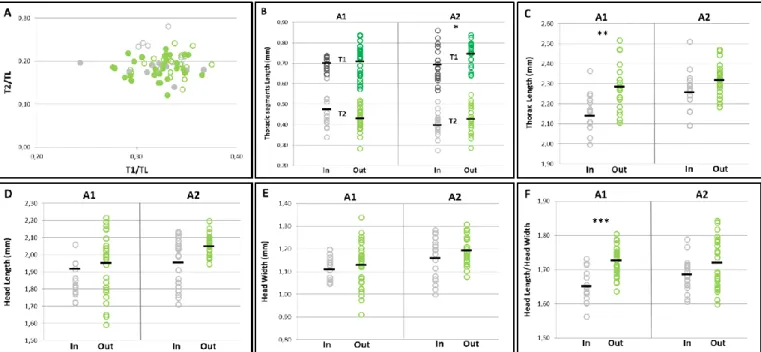
Fig. 2 – Morphological differences between workers found in versus outside of nest. A) Comparison between first (T1) and second (T2) thoracic segment proportions relative to total thorax length (TL), each colour represents individuals’ location/where they were found and marked, grey – inside/green – outside. Empty circles represent A1 (from
Aphaenogaster colony 1) individuals and filled circles represent A2 (Aphaenogaster colony 2) individuals. B) Thoracic
segments variation for A1 and A2, inside and outside the nest. T1 represented in dark grey (inside) and green (outside), T2 represented in light grey (inside) and green (outside); C) Total thorax length (TL) variation between inside and outside individuals for A1 and A2. D-F) Head size and shape variation, D) head length variation, E) head width variation and F) head length/head width across individuals. Both colonies and colour codes are maintained in all figures. Black lines represent the mean for each group of individuals and only significant statistical differences are represented; p-value<0.05 *, p-value<0.01 **, p-value<0.001 *** and p-value<0.0001 ****. All traits were measured in mm.
First we tried to confirm that our model species Aphaenogaster senilis is morphologically monomorphic. We collected individuals from two colonies of A. senilis kept in the lab and sampled them from two different locations inside our colony maintenance boxes, inside and outside the nest. Using the same traits that were used before for inter and intra-caste comparisons, we wanted to know if there is some selective pressure for a specific body shape and/or size prevail according to a specific function. According to previous studies our expectations will be that inside individuals should be responsible for nursing and outside individuals should be responsible for foraging [10, 24]. These specific group functions have already been described for several species, and gave rise to specific morphological and behavioural adaptations throughout ants’ evolutionary history [10].
Using the same type of graphic used on fig. 1 to highlight possible intra-caste subgroups based on their thoracic proportions and after our statistical analysis using Wilcoxon test, we can conclude that there are no differences between individuals from different locations in both
24 colonies, A1 and A2, respectively represented by empty and filled symbols. Apparently there are no morphological differences between different individuals’ preferential location within the nest. Preferential location is here referred as the place where individual spend most part of their time, probably according to their function in the colony, and it is not correspondent to any demonstrated preference. As we did before both thoracic and head traits were analysed, and size and shape seem to be maintained across locations. When testing for a location effect we found some differences in A1 and A2, but none of these were maintained in both colonies. Individuals from A2 showed differences in T1 length (W = 126, p-value = 0.0333) and individuals from A1 showed differences in TL (W = 29, p-value = 0.003) and head shape (W = 34, p-value = 0.0008). Although we could not find significant differences for all traits and across colonies, when the difference appears it is caused by an increase in size of the individuals found outside the nest. However these differences can be caused by some bias, once there is a confounding effect associated with inside-nest individuals’ collection. Each time the nest was opened we can try to be quick enough to pick individuals staying inside and avoid picking any other individual that moved from the outside to the inside of the nest. In general these results corresponded to our expectations, showing little morphological variation between individuals from the same caste.
Behavioural analysis
Aphaenogaster senilis does not seem to have distinct morphological groups, but they could present behavioural groups. To test the existence of behavioural castes in this monomorphic species we maintained the two colonies used before in the experiments – A1 and A2 – and added a third one – A3 – available in the lab at the time, also useful to provide some robustness to our behavioural experiments. We should underlie that this A3 colony is an informative code for this behavioural assay, but it corresponds to colony A4 (Annex 1, Table S1).
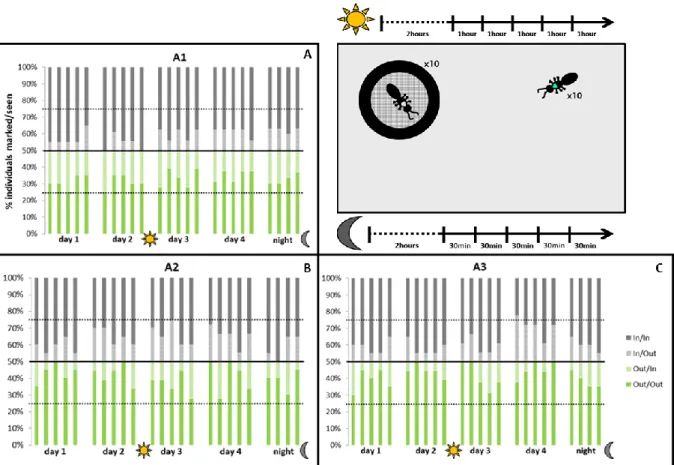
For each colony we marked 10-15 individuals outside the nest with green painting and 10-15 individuals inside the nest with silver painting, and during four days and one night counted the number of individuals found at each location. Our null hypothesis was the absence of behavioural castes, where all individuals distributed randomly within the colony, without any preferential location associated with sub-groups and specific division of tasks. In fig. 3 below, lines representing 50% determine exactly half of the individuals marked, 50% on top is relative to silver marked individuals and 50% below represents green marked ones. The 25% and 75% dashed lines represent 50% of individuals that corresponds to a particular colour and are used
25 to follow their behavioural dynamic. If individuals within a colony distributed randomly we would observe light columns constantly crossing these dashed lines, meaning that individuals could usually be found in a “wrong” location.
Fig. 3 – Behavioural differences between workers found in versus outside of nest. A-C) Each figure is relative to behavioural observations in one Aphaenogaster colony. Grey represents percentage of individuals marked inside nest and green represents individuals marked outside the nest. Outside individuals are represented from 0-50%, half marked in green; inside individuals are represented from 50-100%. Dark color percentages represent individuals observed where they were marked and light color percentages represent individuals observed in different locations from where they were marked. Black lines mark 50%, which we defined as representation limit for each location group, and black dashed lines mark 25% and 75%, which we expected to be the behavioural variation limit for each group if behavioural groups are maintained. We followed three colonies during four days in day period and one day on night period (highlighted by sun and moon symbols). A) Behavioural variation between workers groups from A1 (Aphaenogaster colony 1), B) behavioural variation between workers groups from A2 (Aphaenogaster colony 2), and C) behavioural variation between workers groups from A3 (Aphaenogaster colony 3). Scheme on top right position summarize our experimental design.
What we can conclude, during our short period of observations, is that the individuals show fidelity to their group location and possibly to the specific tasks of their group. Individuals marked in green spent most of their time outside, correspondent to the dark green proportion always above 25%, and the same is true for individuals marked in silver, where the majority spent their time inside. We corrected for the total number of individuals marked in each colour at the end of each day of observations. During the day period we found significant differences
26 in relation to the colour found outside (F(1, 96) = 368.14, p-value < 0.0001), meaning that
individuals’ distribution is really being affected by the group where they first belong. We also found differences between colonies (F(2, 97) = 12.71, p-value = 0.0017) and these differences tell
us that although individuals present a tendency to maintain their supposed behavioural groups, the probability of finding the individuals’ in the right place can change across colonies. Once more we should be careful with the results because these differences can be caused by some bias introduced by our collection and labelling.
Although our results can suggest the existence of behavioural castes we could not provide any information about the supposed relationship between individuals’ tasks and their location. Extended observation time is needed to improve our conclusions about this topic. It would be important to balance number of observations between different periods of the day since it is known that circadian rhythms could have strong influence in ants’ behaviour [24]. Different techniques like video tracking could help us on getting detailed information about behavioural specializations within colonies and it will allow us to follow specific individuals and their activity for months.
Hormonal manipulation effects
The follow up to previous questions was to understand the degree of phenotypic plasticity that is present in Aphaenogaster senilis and to explore in detail intra-caste variation in response to hormonal manipulations. We wanted to know what could be involved in shaping the reaction norms for monomorphic workers. Reaction norms are usually associated to discrete phenotypes in dimorphic ant species or sub-castes [7]. Not only morphological aspects of an individual but also its life history traits were shown to be affected by a variety of environmental cues [10, 15]. As referred, juvenile hormone is responsible for castes and sub-castes determination [15, 26]. We manipulated internal levels of JH, using methoprene treatment to increase endogenous JH levels [26] and precocene II treatments to decrease them [33]. We measured not only the phenotypic effect of the treatment on the adults but also the impact of these on life history traits.
During this experiment several external factors influenced and limited our manipulations, and it was the case of low reproduction rates in our colonies, loss of individuals and long periods required for queen-less colonies to lay eggs. Although we are not able to find any good explanation for low egg laying rates in our queen-right colonies maintained in artificial conditions during four years, the possible explanation for such low reproduction rates in queen-less colonies is apparently easy. As referred above A. senilis has gamergates and being
27 responsible for part of colony reproductive potential also results in conflicts between potentially laying workers. These conflicts are easily associated with our artificial new colony foundation and it has been described that a queen-less colony – orphaned or originated by fission – will need a period of 12 weeks to produce their first male pupae, due to policing behaviour. During this period all eggs and larvae produced will be destroyed by other workers
[37-39]
.
Our experiments thus included trials with queen-less colonies founded by fission from our original queen-right colonies, and hormonal manipulation events on male larvae, but as referred the policing and destruction of our manipulated male larvae could have been the reason why it never reached a sufficient number of individuals to proceed with the experiment.
Survival effect
Fig. 4 – Survival rates across hormonal treatments for diploid larvae. A1 (Aphaenogaster colony 1) and A2 (Aphaenogaster colony 2) were the colonies used for manipulations, and JH-, CTR and JH+ represents the three applied treatments, with precocene II, acetone and methoprene, respectively. Each bar represents the percentage of total manipulated diploid larvae, light grey for manipulated individuals that did not eclosed and dark grey for manipulated individuals that completed development (n inside bars).
Our manipulations resulted in extremely low survival rates to all treatments, control included, and also considerable differences in survival between the two colonies tested. All survival values specifically associated with colony, treatment and round, are represented in Table 2, below. Although we could find some differences associated with colony and round, our main interest was to understand how each treatment and/or compound can affect survival, which will influence the number of adult individuals measured, and in consequence all final conclusions. Grouping the total of individuals manipulated in both colonies we get 53% of
28 survival for our control treatment, with acetone only, and 32% and 18% for JH- and JH+, respectively. Based on these results we can conclude that control treatment have the higher percentage of survival. This is probably correlated with the use of the other compounds as pesticides. The concentrations used for each one of these compounds were previously described, and the same methoprene concentration as already been used in Wheeler and Nijhout experiments. A similar protocol was used in individuals from Pheidole bicarinata species and treatments with methoprene induced an increase in production of major workers
[14]
. Precocene II concentration was an adapted version from previous experiments on Solenopsis invicta dealation, where compound efficacy as anti-JH treatment was confirmed [34]. Although the concentration tested on Solenopsis was higher than ours, we preferred to use lower dosages, due to pesticide nature of the compound. We also tested other concentrations, increasing precocene II and decreasing methoprene concentrations, in response to the unexpected survival rates we obtained, but these changes either maintained or decreased survival levels. The correct way to test this would be to draw a specific dosage-response curve for our species, Aphaenogaster senilis. Although JH+ treatment had always the lowest survival rate, the control and JH- treatments survival values changed across colonies. One factor that could be contributing to these differences is unbalanced number of manipulation events/rounds, once we have three rounds for colony A1 and only two rounds for colony A2. These unbalanced samples are consequence of differential reproduction rates for each colony, which decreased the number of larvae available from each colony and limit their use for each manipulation event.
Table 2 – Summary of the number of individuals used from each colony in each treatment, and respective percentages of survival. In brackets you can find numbers and percentages associated with each round/event of manipulation, presented in chronological order.
29
Developmental time
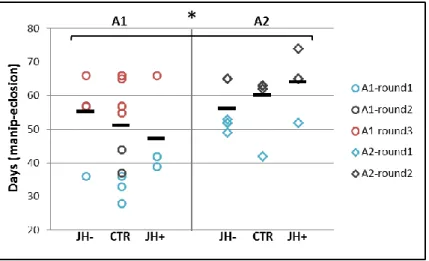
Fig. 5 – Hormonal treatments effects on developmental time in diploid larvae. We measured developmental time counting from manipulation day until day of eclosion for each individual. Different symbols represent different colonies, and different colors represent different manipulation events – rounds. JH-, CTR and JH+ are three letter codes to represent three applied treatments, with precocene II, acetone and methoprene, respectively. Black lines represent the mean for each group of individuals and only significant statistical differences are represented; value<0.05 *, value<0.01 **, p-value<0.001 *** and p-value<0.0001 ****.
We should recall that our experimental results only include females and the first trait for which we have specific expectations according to treatment is developmental time. Previous studies reported that higher levels of JH would increase growth and delay metamorphosis [26]. According to our treatments, we expected maintenance in developmental time for control individuals, and an increase and decrease of time for JH+ and JH- treatment respectively. Statistical analysis revealed no treatment effect on developmental time (F(2, 0.7) = 0.003, p-value
= 0,997) and we could conclude that there are intrinsic and significant differences in developmental time across colonies, as represented on fig. 5 above (F(1, 619) = 5.6652, p-value =
0.0223). In the same figure we can also see a tendency inversion on treatment effect across colonies. Developmental time seems to decrease in response to increasing JH levels on A1 and seems to do the opposite on A2. Our primary expectations coincide with what was observed in A2, but the low number of individuals can also influence tendencies found. We could also notice a round effect.
Induced morphological variation
The second aim of our hormonal manipulations was to understand how these different hormonal levels will affect the adult phenotype. We used only second instar individuals for manipulations, and a more careful classification of individuals could have been useful once the