SHORT COMMUNICATION
New occurrences of Corallium spp.
(Octocorallia,
_Coralliidae)
in
_the
_Central
_Northeast
_Atlantic
ÍRIS SAMPAIO, OSCAR OCAÑA, F. TEMPERA, A. BRAGA‐HENRIQUES, V. MATOS
& F.M. PORTEIRO
Sampaio, Í., O. Ocaña, F. Tempera, A. Braga-Henriques, V. Matos & F.M. Porteiro 2009. New occurrences of Corallium spp. (Octocorallia, Coralliidae)in the CentralNortheastAtlantic. Arquipélago. Life and Marine Sciences 26: 73-78.
Corallium niobe Bayer, 1964 and Corallium tricolor (Johnson, 1899) are reported as new
records from the central Northeast Atlantic. C. niobe was caught in the Azores and
C. tricolor on the slope of the Irving Seamount (South Azores Seamounts). The presence of Corallium johnsoni Gray, 1860 in Azorean waters is confirmed. The sub-tropical
Macaronesian islands and seamounts appear to be an important hot-spot for Corallium spp. Most colonies have been collected on seamounts and island slopes around Madeira, Canaries, Azores and the Cape Verde archipelagos. In the Azores most of these corals live below the normal depth of commercial fishing operations and are unlikely to be severely impacted by this activity.
Íris Sampaio (e-mail: [email protected]), Filipe M. Porteiro, Andreia Braga-Henriques & Valentina Matos, Departamento de Oceanografia e Pescas, Universidade dos Açores, PT-9901-862, Horta, Açores, Portugal; Fernando Tempera, Centro do IMAR da Universidade dos Açores, PT-9901-862 Horta, Açores, Portugal; Oscar Ocaña, Fundación Museo del Mar, Autoridad Portuaria de Ceuta, Muelle Cañonero, ES-51001 Ceuta.
INTRODUCTION
The family Coralliidae includes ca. 25 species of the genus Corallium Cuvier, 1797. Corallium species occur in the Indo-Pacific (3 sp.), Western, Central and Eastern Tropical Pacific (6, 6 and 3 sp., respectively), Indian (1 sp.) and in the Atlantic Ocean (6 sp.), at depths from 7 to 2405 m (Grigg 1974; Weinberg 1976; Bayer & Cairns 2003; CITES 2007). Seven species of this genus were removed to the genus Paracorallium Bayer & Cairns, 2003. Therefore, some of the Corallium species referred to here might belong to the new genus, thus changing the distribution of these two genera. In the Atlantic, all but C. medea Bayer, 1964 are reported to live in some restricted areas
Johnson, 1899, C. tricolor Johnson, 1899 and C.
rubrum (Linnaeus, 1758) (Johnson 1899; Bayer
1964; Carpine & Grasshoff 1985; Altuna Prados & López-González 2003; Bayer & Cairns 2003; Brito & Ocaña 2004). Corallium niobe also occur in the western Atlantic. Except the well-known C.
rubrum, all the other species in the northeast
Atlantic are deep-water animals rarely collected and with poorly known distributions.
This contribution revises the distribution of some Corallium species in the Northeast Atlantic, giving new occurrences for three species in the region.
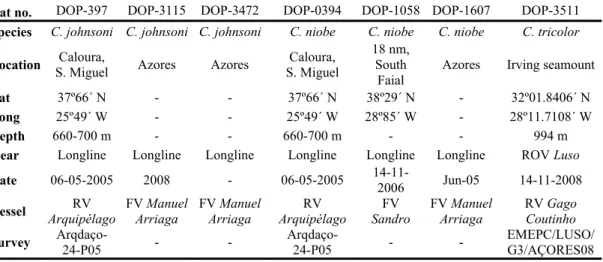
fishery surveys carried out by the Department of Oceanography and Fisheries of the University of the Azores (DOP/UAz) (Table 1, Fig. 1). Four colonies were in a private collection and had no data about their capture. Nevertheless we know that they were caught at seamounts around the Azores islands. One colony was collected during the expedition EMEPC/LUSO/G3/AÇORES08, by the Portuguese ROV Luso, on board the R/V
Almirante Gago Coutinho, at the Irving seamount
(32º01 N, 28º11 W; dive 19, 14 November 2008. This gave us the opportunity to describe the habitat where the colony was found. The species were identified following Bayer (1964) and Brito & Ocaña (2004). The material is deposited at DOP/UAz reference collection (COLETA). RESULTS
Corallium johnsoni Gray, 1860
This species was described based on a specimen caught at Madeira. It was reported in the Azores by Thomson (1927), based on several fragments (see revision by Carpine & Grasshoff 1985) caught at 919 m depth, off Ponta Delgada (37.7º_N, 25.97º W), during the Campaigns of Prince Albert of Monaco (station 3144). Three new specimens confirm the presence of the
species in the Azorean waters (Table 1, Fig. 1). The species is also known from Portugal (Thomson 1927; Carpine & Grasshoff 1985) and from the European slope off Ireland (Stephens 1909) at 1241 m depth. Fuller et al. (2008) report it in the Northwest Atlantic off Canada, without additional comments.
Corallium johnsoni is similar to Paragorgia johnsoni Gray, 1862; it has a white creamy
cortex, a white axis, double clubs with smooth heads, and the polyps are orange or yellow. Corallium niobe Bayer, 1964
The holotype of this species was caught off Florida (659-677 m depth). Later Grasshoff (1982a, b, 1986, 1989), Carpine & Grasshoff (1985) and Brito & Ocaña (2004) studied material from the Northeast Atlantic, namely from Biscay Bay, Portugal, Morocco, Canaries (Lanzarote) and Cape Verde, caught between 500 and 1534 m depth.
Carpine & Grasshoff (1985) noted that
C. johnsoni of Thomson (1927) from Cape Verde,
Morocco and part of the material caught off Portugal were indeed C. niobe. Hartmann-Schröder (1985) describes the association between C. niobe and a polychaete (Polynoe
caeciliae); the specimen was caught between
Morocco and the Canary islands. Table 1. Data of Coralliidae specimens at the DOP/UAz reference collection (July 2009).
Cat no. DOP-397 DOP-3115 DOP-3472 DOP-0394 DOP-1058 DOP-1607 DOP-3511
Species C. johnsoni C. johnsoni C. johnsoni C. niobe C. niobe C. niobe C. tricolor
Location S. Miguel Caloura, Azores Azores S. Miguel Caloura,
18 nm, South
Faial Azores Irving seamount
Lat 37º66´ N - - 37º66´ N 38º29´ N - 32º01.8406´ N
Long 25º49´ W - - 25º49´ W 28º85´ W - 28º11.7108´ W
Depth 660-700 m - - 660-700 m - - 994 m
Gear Longline Longline Longline Longline Longline Longline ROV Luso
Date 06-05-2005 2008 - 06-05-2005 14-11-2006 Jun-05 14-11-2008
Vessel Arquipélago RV FV Manuel Arriaga FV Manuel Arriaga Arquipélago RV Sandro FV FV Manuel Arriaga RV Gago Coutinho
Fig. 1. a), b), c) Corallium johnsoni; d), e), f) Corallium niobe; g) Corallium tricolor
The three colonies reported here, constitute the first record of this species in the Azorean waters (Table 1, Fig. 1). Two of these colonies had Cirripedia and the undescribed Amphianthus species attached to their axis.
Corallium tricolor (Johnson, 1899)
This species was first found at Madeira and named as Pleurocorallium tricolor. Later it has
Cape Verde Islands (Grasshoff 1986). Brito & Ocaña (2004) confirm the presence of the species in Canary Islands. C. tricolor has been caught between 598 and 1090 m depth.
Corallium tricolor was observed (ROV Luso)
and caught at 985 m on the Irving Seamount slope (Table 1, Fig. 1). This is the first report of the species in the central Northeast Atlantic. The sample was found living on a crust of carbonate
and several other cold-water corals (i.e. Acanella
arbuscula (Johnson, 1862), Chrysogorgia quadruplex Thomson, 1927, Madrepora oculata
Linnaeus, 1758 and Pliobothrus symmetricus Pourtalès, 1871 were observed in low densities at the same spot. Some ophiurids and colonies of
Desmophyllum cristagalli Milne Edwards &
Haime, 1848 were attached to the colony studied. DISCUSSION
The North Atlantic is the best studied oceanic basin concerning deep-water benthic organisms (Mironov & Gebruk 2006). Nevertheless, even in this region, data about the distribution of many cold water coral species are still scarce. This lack of information may result from: 1) the absence of sampling in most deep-sea areas; 2) difficulties with identification of the species sampled or in collections; or 3) they may simply be naturally rare across their distribution range. On a global scale little information about species of Corallium spp. without commercial value probably results from a combination of these three factors.
Despite the relatively high sampling effort in the Central North Atlantic, i.e. around the Azores and on the Great Meteor Seamounts complex, only several fragments (see Carpine & Grasshoff 1985) of Corallium johnsoni had been reported from these waters by Thomson (1927) (see for instance Studer 1901; Tixier-Durivault & d’Hondt 1974; Grasshoff 1981, 1985; without records of Corallium). The additional specimens of this species studied by us confirm this record in the Azores, being those of C. tricolor and C.
niobe new for the area (see Bayer & Cairns 2003;
Mironov & Krylova 2006).
Most Corallium species live in restricted geographical areas. The Western and Central Pacific (from Japan to northern Philippines and Hawaii) and the Northeast Atlantic are hot-spots for these gorgonians. Corallium rubrum in the Mediterranean and other seven species from the Western Pacific and Hawaii form large aggregations in the upper bathyal (to 500 m), and support local fisheries (Parrish & Baco 2007). However, and as far as we know, all the
Corallium species living in the Northeast Atlantic
(except C. rubrum) occur in low abundances well
below 600 m on seamounts and islands slopes of Cape Verde, Canaries, Madeira and Azores archipelagos, and continental slopes off Morocco and Portugal (Johnson 1899; Thomson 1927; Carpine & Grasshoff 1985; Grasshoff 1986; Altuna Prados & López-González 2003; Brito & Ocaña 2004). Outside this subtropical belt, there are records from off Ireland and the Bay of Biscay (Stephens 1909; Bayer 1964; Grasshoff 1982b, 1986; CITES 2007). Apparently, these species do not aggregate, are uncommon throughout the area, and their biology is virtually unknown. In the western Atlantic the genus is less diversified, and according to Watling & Auster (2005) only two species are known from that region: the amphiatlantic C. niobe and C. medea, which is restricted to the American slopes. In this context, the Macaronesian deep-sea rocky bottoms emerge as a probable radiation center for these species. Nevertheless, as exploration of deep-sea environments goes on, it is expected that more colonies of Corallium will be discovered inside and outside this region. A biogeographic study of this gorgonian genus is limited by the scarcity of the existing data. The scrutinizing of the phylogenetic relationships between these corals species, will give important information to interpret their actual distribution patterns.
As for other cold water corals, Corallium spp. are highly sensitive to anthropogenic distur-bances: they have slow growth rates, relatively late maturity, long life spans, and limited dispersal potential (CITES 2007). The commercial exploitation of Corallium spp. in the Mediterranean, Western Pacific and Hawaii, showed to be unsustainable, and countries like USA, are calling for their protection (namely under CITES 2007; Grigg 1993). All but one colony studied by us was caught accidentally by long-lines, while fishing for bottom finfish in seamounts and island slopes. However, the long-line fishery in the Azores operates mainly above 600 m depth (Silva & Pinho 2007), which is the upper limit of the vertical distribution of the species known to live in the area. Therefore, it seems that Corallium species from the central Northeast Atlantic are less affected by fisheries, than the other coral species that live in shallower depth horizons (Sampaio et al. 2008, 2009).
ACKNOWLEDGEMENTS
The authors would like to thank Jorge Gonçalves, for granting access to the specimens of C. niobe and C. johnsoni. Professor Pinto de Abreu for the invitation to participate in the EMEPC/LUSO/ G3/AÇORES08 geological campaign. Gregory Berke for his generous help in correcting the English writing and Emmanuel Arand for photographs of specimens. We also wish to thank Professor Álvaro Altuna-Prados for comments on the manuscript. CORALFISH (FP7 ENV/2007/ 1/213144): Assessment of the interaction between corals, fish and fisheries, in order to develop monitoring and predictive modelling tools for ecosystem based management in the deep waters of Europe and beyond [http://eu-fp7-coralfish.net/]. CORAZON (PTDC/MAR/72169/ 2006): Mid-depth benthic communities of con-servation importance in the Azores: cold-water coral ecosystems; supported by the FCT.
REFERENCES
Altuna-Prados, A. & P. López-González 2003. Antozoos (Cnidarios) citados en el ámbito íbero-balear. Proyecto Fauna Ibérica, Museo Nacional de Ciencias Naturales, Madrid [Internet]. Available from: http://www.fauna-iberica.mncn.csic.es/ faunaib/Antozoos.pdf (cited 27 June 2009). Bayer, F.M. 1964. The genus Corallium (Gorgonacea:
Scleraxonia) in the Western North Atlantic Ocean.
Bulletin of Marine Science of the Gulf and Caribbean 14(3): 465-478
Bayer, F.M. & S.D. Cairns 2003. A new genus of the scleraxonian family Coralliidae (Octocorallia: Gorgonacea). Proceedings of the Biological Society
of Washington 116(1): 222-228.
Brito, A. & O. Ocaña 2004. Corales de Las Islas
Canarias. Francisco Lemos Editor. La Laguna.
477 pp.
Carpine, C. & M. Grasshoff 1985. Catalogue critique des Octocoralliaires des collections du Musée océanographique de Monaco I. Gorgonaires et Pennatulaires. Bulletin de l´Institut
Océano-graphique 73, nº 1435: 1-72.
CITES 2007. Consideration of Proposals for Amendment of Appendices I and II – CoP14 Prop. XX. Fourteenth meeting of the Conference of the
Kenchington 2008. Vulnerable Marine Ecosystems Dominated by Deep-Water Corals and Sponges in the NAFO Convention Area. NAFO SCR Doc. 08/22.
Grasshoff, M. 1981. Gorgonaria und Pennatularia (Cnidaria: Anthozoa) vom Mittelatlantischen Rücken SW der Azoren. Steenstrupia 7: 213-230. [In German]
Grasshoff, M. 1982a. Die Gorgonaria, Pennatularia, und Antipatharia des Tiefwassers der Biskaya (Cnidaria, Anthozoa). I. – Allgemeiner Teil.
Bulletin_du_Muséum national d’Histoire naturelle,
4e sér., 3 (A) 3: 731-766. [In German]
Grasshoff, M. 1982b. Die Gorgonaria, Pennatularia, und Antipatharia des Tiefwassers der Biskaya (Cnidaria, Anthozoa). II. – Taxonomischer Teil.
Bulletin_du_Muséum national d’Histoire naturelle,
4e sér., 3 (A) 4: 941-978. [In German]
Grasshoff, M. 1985. Die Gorgonaria und Antipatharia der Grossen Meteor- Bank und der Josephine-Bank. (Cnidaria: Anthozoa). Senckenbergiana
Maritima 17: 65-87. [In German]
Grasshoff, M. 1986. Die Gorgonaria der Expeditionen von__“Travailleur” 1880-1882 und “Talisman” 1883 (Cnidaria, Anthozoa). Bulletin du Muséum
national d’Histoire naturelle, Paris, (4) 8 (A 1):
9-38.
Grasshoff, M. 1989. Die Meerenge von Gibraltar als Faunen-Barriere: Die Gorgonaria, Pennatularia und Antipatharia der Balgim-Expedition (Cnidaria: Anthozoa). Senckenbergiana Maritima 20: 201-223.
Grigg, R.W. 1974. Distribution and Abundance of Precious Corals in Hawaii. Proceedings Second
International Symposium on Coral Reefs 2:
233-240.
Grigg, R.W. 1993. Precious Coral Fisheries of Hawaii and the U.S. Pacific Islands – Fisheries of Hawaii and U.S. – Associated Pacific Islands. Marine
Fisheries Review 55: 50-60.
Hartmann-Schröder, G. 1985. Polynoe caeciliae Fauvel (Polynoidae), ein mit korallen assoziierter polychaet. Mitteilungen aus dem Hamburgischen Zoologischen Museum und Institut, 82: 31-35. [In German]
Johnson, J.Y. 1899. Notes on the Corallidae of Madeira, with descriptions of two new species.
Proceedings of the general meetings for scientific business of the Zoological Society of London 1899:
57-63, pls. 5-7.
Mironov, A.N. & A.V. Gebruk 2006. Introduction. Pp. 4-5 in: Mironov, A.N., A.V. Gebruk & A.J. Southward (Eds). Biogeography of the North
Mironov, A.N. & E.M. Krylova 2006. Origin of the fauna of the Meteor Seamounts, north-eastern Atlantic. Pp. 22-57 in: Mironov, A.N., A.V. Gebruk & A.J. Southward (Eds). Biogeography of
the North Atlantic seamounts. KMK Scientific
Press, Moscow. 196 pp.
Parrish, F.A. & A.R. Baco. 2007. State of deep coral ecosystems in the U. S. Pacific Islands region: Hawaii and the U. S. Pacific Territories. Pp. 155– 194 in: Lumsden, S.E., T.F. Horigan, A.W. Bruckner & G. Dorr (Eds). The state of deep coral
ecosystems of the United States. NOAA Technical
Memorandum CRCP-3.
Sampaio, Í., A. Braga-Henriques & F.M. Porteiro 2008. Vulnerability of deep-water corals of the Azores to the demersal fisheries. Pp. 181 in XV Simpósio de
Estudos de Biologia Marinha: Programa e Livro de
Resumos. Funchal, Madeira. 225 pp.
Sampaio, Í., F.M. Porteiro, A. Braga-Henriques, D. Catarino, F. Tempera, V. Matos & O. Ocaña 2009. Azorean Deep-water coral communities as perceived from bottom long-line fishery surveys.
ICES International Symposium «Issues Confronting the Deep Oceans», Horta, Azores
Portugal. 101 pp.
Silva, H.M. & M.R. Pinho 2007. Exploitation, management and conservation: Small-scale fishing on seamounts. Pp. 333-399 in: Pitcher, T.J., T. Morato, J.B. Paul, M.R. Clark, N. Haggan & R.S. Santos (Eds). Seamounts: Ecology, Fisheries
&_Conservation.Blackwell_Publishing, UK._527_pp.
Stephens, J. 1909. Alcyonarian and madreporarian corals of the Irish coasts with description of a new species of Stachyodes by Professor S.J. Hickson, F.R.S. Scientific Investigations-Fisheries Ireland 1907(5): 1-28.
Studer, Th. 1901. Alcyonaires provenant des campagnes de l’Hirondelle (1886-88). Résultats des Campagnes
scientifiques du Prince Albert Ier de Monaco 20:
1-64, pls. 1-11.
Thomson, J.A. 1927. Alcyonaires provenant des campagnes scientifiques du Prince Albert Ier de Monaco. Résultats des Campagnes scientifiques du Prince Albert Ier de Monaco 73: 77 pp.
Tixier-Durivault, A. & M-J. D´Hondt 1974. Les octocoralliaires de la campagne Biaçores. Bulletin
du Muséum National d´Histoire Naturelle, Paris
(Série 3) 252: 1361-1433.
Watling, L. & P. Auster 2005. Distribution of deep-water Alcyonacea off the Northeast Coast of the United States. Pp. 279-296 in: Freiwald, A. & R.J. Murray (Eds). Cold-Water Corals and Ecosystems.
Proceedings of the Second Deep-Sea Coral Symposium, Springer-Verlag Berlin Heidelberg,
Erlangen-Germany. 1243 pp.
Weinberg, S. 1976. Revision of the common Octocorallia of the Mediterranean circalittoral. I. Gorgonacea. Beaufortia 24: 63-104.
Accepted 7 December 2009. .