UNIVERSIDADE DE LISBOA
FACULDADE DE PSICOLOGIA
A STUDY OF RESILIENCE AND COPING IN A
RECENTLY CREATED COMPANY IN PORTUGAL
Catarina Dagmar dos Santos Marques Ferrão Leal
MESTRADO INTEGRADO EM PSICOLOGIA
Secção de Psicologia Clínica e da Saúde / Núcleo de Psicologia Clínica Sistémica
UNIVERSIDADE DE LISBOA
FACULDADE DE PSICOLOGIA
A STUDY OF RESILIENCE AND COPING IN A RECENTLY
CREATED COMPANY IN PORTUGAL
Catarina Dagmar dos Santos Marques Ferrão Leal
Dissertação Orientada pela Professora Doutora Maria Teresa Ribeiro
MESTRADO INTEGRADO EM PSICOLOGIA
Secção de Psicologia Clínica e da Saúde / Núcleo de Psicologia Clínica Sistémica
“You become responsible forever for what you have tamed” “Tu Tornaste Responsável para sempre por tudo aquilo que cativas” Antoine de Saint-Exupéry, 1943
Index
Acknowledgments……….……….……… I Resumo……….……….……….. II Abstract……….……….……….. III Introduction……….……….……… IV 1. Related work……….……….………..11.1 Systemic Intervention in Crisis……….……….………. 1
1.2 Resilience: Concepts and Theories……….……….……….1
1.2.1 Resilience as protective factors……….……….1
1.2.2 Resilience as an adaptive process……….………... 2
1.2.3 Resilience and its functioning: Positivity and adversity……….………. 3
1.2.4 Heterogeneity of Resilience: Flexible and Pragmatic coping……….… …………... 4
1.3 Theoretical models of coping……….……….5
1.3.1 Coping and focus on the individual……….………...5
1.4 Evaluating Resilience……….……….……….……….………….. 6
1.5 The Richardson’s Resilience Model……….……….……….……….. 7
2. Method……….……….……… 9
2.1 State of the art……….……….……… 9
2.2 Start-up question……….……….……… 9
2.3 Conceptual map……….……….………. 10
2.4 Investigation Purpose and Research Questions……….……… 11
2.4.1 Main Purpose……….……….……….. 11 2.4.2 Specific Purposes……….……….………….…………. 11 2.4.3 Investigation Questions……….……….………. 11 2.5 Methodological strategies……….……….………. 12 2.5.1 Sample Characterization……….……….……….. 12 2.6 Measures……….……….……….… 15 2.6.1 Focus Group……….……….……… 15 2.6.2 Socio-demographic Questionnaire……….……….…….. 15 2.6.3 CD-RISC……….……….……….. 16 2.6.4 COPE……….……….………... 17 2.6.5 BDI ……….……….………... 19 3. Results……….……….……… 20 3.1 Qualitative results……….……….……….………. 20 3.1.1 Focus Group……….……….……… 20
3.1.2 Socio-demographic questionnaire open-ended questions……….23
3.2 Quantitative results……….……….…… 25
3.2.1 Descriptive analysis according to the psychosocial behaviour variables……… 25
3.2.2 Correlations between the socio-demographic variables and the psychosocial functioning variables……… 27
4. Results Discussion ……….……….……….. 29
4.1 Concerning the psychosocial functioning of the employees……… ………. 29
4.1.1 Coping……….………... 29
4.1.3 Depression………. 30
4.2 Open ended questions……….30
4.3 Comparisons between variables……… 31
4.4 Relation between resilience and depression………31
5. Conclusion………..……….……….……... 32 5.1 Conclusions………... 32 5.1.1 Contributions………... 33 5.2 Limitations………... 33 5.3 Future Research………... 33 6. References ……….……….………... 35 Annexes
Acknowledgements
I would like to express my sincere gratitude to my advisor Professor Maria Teresa Ribeiro for the continuous support of my Master study and related research, for her patience, motivation, and immense knowledge. Her guidance helped me in all the time of research and writing of this thesis. I could not have imagined having a better advisor and mentor for my Master study.
My sincere thanks also goes to Humanpersi Managers Artur Nunes and Maria João Marques who provided me with an opportunity to join their team as a Consultant, and to access, explore and create my Thesis Project. Without their precious support it would not have been possible to conduct this research. Furthermore, I would like to thank the HR Manager and HR Director of the Shared Services Company, for their insightful openness, and availability that made possible for me to engage with my investigation. Also a great thanks to all the Employees that answered my questionnaire, without you my project wouldn’t have been possible.
I would also like to thank my fellow Humanpersi colleagues Inês Lemos, Ricardo Felizardo and Sofia Carreiras for the motivation, for the patience held, for the laughs and fun of the after 6pm moods, always relieving me and helping in my tasks, so that I could get more time to work on my thesis. Thank you for the knowledge and all the fun we have had in the last year.
Thank you to all the Teachers that inspired me during my Psychology Degree, it was an honour and great privilege to learn from you all.
Thank you to my fellow Sci-fi Lx Board colleagues, for the investment in culture and science, for the brainstorming meetings, for the team work and the opportunity to join you all with the challenge of being this project HR Manager.
Also, I thank my friends Rita Otero, Joana Almeida, Joana Nogueira, Luisa Jesus, Mitsue Tanaka Vanessa Ferreira, Gonçalo Lopes, for always being there for me, for our adventures and all the support and experiences that made me as I am. In particular, I am grateful to Gonçalo Cardoso Lopes for enlightening and inspiring me into the research world.
Thank you my love for the last 10 years and the next 50 years, for being by my side and for always believing me.
And because I want so, thank you Effannéll my beloved pet cat, for all the company, the warmth and nights unslept by my side during the writing of this thesis, and the ones studying for my Psychology degree.
Last but not the least, I would like to thank all my family but especially my parents and to my brother and sister for supporting me spiritually throughout writing this thesis and my life in general. Personally, my brother João Miguel who is an Angel looking from above, whom one of his last requests before dying was to be strong and finish my Master Degree.
Resumo
O presente estudo tem como principal objetivo estudar o desempenho psicossocial de uma amostra de 135 colaboradores pertencentes a uma realidade de 250 colaboradores que presentemente compõe uma empresa de serviços partilhados criada em Portugal.
Pretende-se focar o estudo ao nível do funcionamento psicossocial dos colaboradores, em especifico da resiliência, das estratégias de coping criadas de forma a conseguirem lidar com o ambiente instável e desafiante de uma empresa acabada de criar, onde tudo é novo: das equipas às chefias
Dada a natureza qualitativa e quantitativa da análise que se pretendeu fazer, na recolha de dados foi proposta a utilização de um focus-group. um questionário socio-demográfico com algumas questões de resposta aberta e uma bateria de 3 testes, nomeadamente, a Escala de Resiliência de Connor e Davidson (CD-RISC), o Inventário de Depressão de Beck (BDI), e o Inventário de Coping de Carver, Scheier & Weintraub (COPE).
Para responder às questões deste estudo, relacionaram-se os testes mencionados com um conjunto de variáveis socio-demográficas como: idade, género, emprego, estatuto familiar, educação, hobbies, entre outros. Uma vez obtidos os dados quantitativos foram analisados através do software Statistical Package for Social Sciences (IBM SPSS Statistics) 20.0 em OSX para Mac.
Palavras chave: Resiliência, estratégias de Coping, variáveis sócio-demográficas, Crise ecómica portuguesa, Start Ups, novas oportunidades, empowerment
Abstract
The current study has the main propose of investigating the psychosocial performance of a sample of 135 employees out of a reality of 250 individuals from a recently created Shared Services company in Portugal.
The main objective of this research is to focus on the resilience of these professionals, more specifically on coping strategies created to deal with the unstable and challenging environment of a recently created company, where everything is created from scratch: from the teams, to the lead personnel and to check the hypothesis considered.
To answer these matters, we intend to relate the quantitative variables from the Test Assortment, with a set of socio-demographic variables from the questionnaire: age, gender, job, family status, education, beliefs, hobbies and qualitative data from the open ended questions as well as the information from the focus group. The quantitative data was analyzed in the Statistical Package for Social Sciences software (IBM SPSS Statistics) 20.0 and on OSX for Mac.
Key-Words: Resilience, Coping strategies, Socio-demographic variables, Portuguese Economic Crisis, Start Ups, New Opportunities, Empowerment.
Introduction
It doesn’t mater where or when Men are, there will always be adversity and confrontation. Its something natural in the life cycle, but depending where you are, this adversity can have a different meaning and different impact. But mostly it will be the same. Since always, Man is confronted with loss, exposure, emotional and physical difficulties and other situations. Through this confrontation, Man develops ways to deal with these situations. Each individual has its own way to do so, and each individual can react differently from others to the same situation. (Bonanno, 2005).
1. Related Work
1.1 Systemic Intervention in Crisis
Anderson and Goolishian (1988) argue that the complexity of a conversation is based on a group of very fragile conditions: the moment in which the conversation takes place, the relationship between the participants, the knowledge that every person has about the situation and the notion of comprehension and respect. The place where the first meeting takes place can also be relevant. Several systemic therapists practiceoutside of their office, meeting with their clients in different locations. Wherever the conversation takes place, the psychologist should always pay attention to how the situation is described or contextualized by the client.
1.2 Resilience: Concepts and Theories
Resilience is the concept used to describe the capacity that an individual has to deal with changes, challenges and recover (bounce back) from a difficult moment, the ability to keep the balance facing stress (Bonnano, 2004) and positively adapting to adversity (Luthar, Cicchetti & Becker).
A resilient individual is capable of recognizing and managing his own feelings and understand other people’s feelings, as well as having a sense of independence and self-valuation. Resilience allows an individual to build and maintain positive relationships and mutual respect with other individuals, solve problems and take informed decisions, as well as granting the ability of creating objectives to achieve in the future.
The history of resilience is long and controversial in regards to its meaning. Dutton and Greene (2010) consider three different approaches for the definition of resilience: they define it as protective factor, which include biological and personality characteristics, as well as cultural factors and community characteristics; they also define it as an adaptation process, which involves auto-improvement, positive cognitive evaluations, practices of coping and spirituality; and, finally, as positive outcomes (i.e. when missing symptoms) following adverse situations.
1.2.1 Resilience as protective factors
Resilience has been understood as a matter of character, disposition or protective aptitude when exposed to adverse events.
Several individual factors of personality have been identified as being protective when facing acute or chronic adverse situations, many of these cases are related with extrovert characteristics as, for example, resistance (Kobasa, 1979). According to the revision undertaken by Agaibi and Wilson
(2005), resistance leads to better results after exposure to stress, as the individuals with this capacity evaluate risk situations as being less distressful, besides being more confident, and they are, therefore, more capable of using an active coping and include social support. Still, according to these authors, the “locus of control”, the altruism, self-esteem and ego defines are connected to the capacity of resilience. Resilience has also been connected to individual biological factors, as there are several potential associations between both, which include the emotional reactivity, the hemispheric asymmetry, the neuroendocrine and immunological systems, amongst other examples. Stein, Campbell-Sills and Gelernter (2009), demarcate emotional resilience as the capacity of keeping healthy and stable levels of psychological functioning following stress and trauma, considering the hypothesis that genetic factors provide protection against adversity, although no genetic factor has definitely been specifically identified.
A series of social and cultural factors have also been associated to resilience, including sex, age, race, ethnicity, social support groups and previous trauma history.
Norris and Stevens (2007) discuss the adaptive capacities from the community underlying the “community resilience”, including credible sources of information and effective communication; the community competence, economic development and collective communication about the trauma, and mechanisms to increase the natural social support from relatives and friends (to promote connection). 1.2.2 Resilience as an adaptive process
As an adaptive process, Resilience is defined as “a dynamic process that encompasses positive adaptation in the context of significant adversity” (Luthar, Cicchetti and Becker, 2000). This demonstrates that resilience, defined as an adaptive process, presupposes a positive outcome. It is not clear that the process should be considered as being resilience just if it leads to positive results, or if it could be demonstrated as resilience based on the “effort”, i.e. if the result can be relatively absolute. The importance of the dynamic quality of resilience as adaptation stands out, reflecting the stream of efforts to recover the equilibrium after being exposed to adversities.
In some cases, even where there is no psychopathological evidence, different physiologic responses happen in those that were exposed to adverse events, when compared with individuals that were not exposed (New et al) 2009, can indicate invisible vulnerabilities.
Yehuda et al. (2006) suggest two processes that are not necessarily exclusive of resilience. The first process is described as the presence of certain factors that operate to resist the development of
recovering from adverse results. The second process suggests that factors related with resilience develop an exposure to a next risk, in a way that certain mechanisms are mobilized in response to sufferers. These authors suggest that the implications of examining parallel processes that include both psychological and biological responses as adaptive process to a stressful environment, which facilitates enduring in the short and long term, allowing people to be survivors and not victims. Just as it happened in a figurative way with the Portuguese Economical Crisis, having its worst period in 2012 and that still has its repercussions nowadays.
These questions illustrate the capacity of the resilience’s processes and the associated results. Resilience as the process of adaptation after adversity or risk exposure has been operationalized in several ways, i.e., as a self-enhancement, positive cognitive evaluation, optimism, styles of coping and spirituality. From an integrative perspective, resilience has been conceptualized not only as one, but as a cascade of protective processes (Egeland, Carlson and Sroufe, 1993; Roisman, 2005) which can be operated in response to some adversity forms, but not for others (Dutton and Greene, 2010).
This approach to the comprehension of resilience mechanisms suggest an ecologic model to explain the variation in the adaptation from an individual in response to adversities, in different points in time. The notion of processes in cascade can explain more adequately the variance of resilience between individuals, i.e., different individuals use different sequences and configurations of processes in response to similar types of victimizing. This approach can explain why apparently contradictory mechanisms (active coping vs repressive) can be both associated to positive outcomes.
1.2.3 Resilience and its functioning: Positivity and adversity
Recovery can occur in diverse domains, such as mental and physical health, personal relationships, cognitive functions, cognitive and affective processes, biological indicators, among others.
Masten, Best and Garmezy (1990) consider three types of resilient individuals: those who showed exemplary results after adversity; those that will not demonstrate an exceptional functioning but showed a positive evolution, and those whom the adversity was initially followed by a negative consequence, having, however, recovered the adaptive functioning over time.
Measuring resilience as an adaptation requires one to know something about the previous “status” of an individual, before being exposed to the adverse event. Therefore, distinguishing the recovery from the maintenancerequires a longitudinal perspective. However, there are not many longitudinal studies related to resilience (Dutton and Greene, 2010).
Physical health, education or academic performance, interpersonal functioning, labour functioning and the involvement with criminal justice are types of functioning associated with resilience and stress found in the literature (Hoge, Auchterlonie & Milliken, 2006; McGloin & Widom, 2001; Wright et al, 2005). Bonanno (2005) defines resilience as the maintenance of the normal functioning over time, distinguishing it from a recovery path which is defined as a decreasing of the normal standard of functioning and an eventual return to normal levels. Roisman (2005), however, defying the limited definition given by Bonanno, proposed resilience as a “family of course of live patterns” which includes recovery after a period of stress (Dutton and Greene, 2010).
Hence, in a general way, it can be said that the definition of the concept of resilience requires an individual to obtain a positive adaptation, besides being or having been exposed to an adversity situation (Kaplan, 1999). The term “adversity” may represent a constellation of several risk factors (like living in poverty) or a specific life situation (a relative’s death).
Adversity can be objectively defined by measuring instruments or, subjectively, by each individual’s perception (Luthar, Cicchetti and Becker, 2000; Luthar and Cushing, 1999; Kaplan, 1999). Summarizing, in order to identify resilience and create research and promotion programs development, it is suggested that the definition of adversity specifies the nature of the risk, if it is subjective or objective, and the existing relationship between adversity and positive adaptation.
1.2.4 Heterogeneity of Resilience: Flexible and Pragmatic coping
At a general level, many of the characteristics that promote a healthy development should also promote resilience on an adult. These include not only situational factors like support relationships but also individual factors, as well as the capacity from an individual of adapting with flexibility to challenges (Block and Block, 1980).
Resilience during childhood is normally understood as a response to corrosive environments, like poverty or consecutive abuse. Resilience in an adult is frequently seen as a matter of usually dealing with a potentially isolated and/or brief traumatic event. The key point of the question is the fact that, while corrosive environments demand adaptation solutions in the long term, isolated events demand usually a more pragmatic form of coping, i.e. a “whatever is necessary” approach that may involve strategies and behaviours that are less efficient or even seen as difficulties to adapt different contexts. For example, a considerable research testifies the benefits of expressing negative emotions for the person’s health.
While the majority of abandoned resistant individuals (bereaved) expresses, at least, some negative emotions while speaking about their loss, they express less negative emotions and more positive emotions than other people going through the same situation (Bonanno and Keltner, 1997), minimizing in this way the impact of the loss, while increasing the continuous contact with the support provided by important people in their social network. Another example of pragmatic coping is illustrated by the trace of self-improvement, the tendency for auto-bios in perception and attribution, such as in the case where their own qualities are overestimated. People with the predisposition to be auto-biased tend to be narcissistic and to evoke negative reactions on other people however, they also possess a high self-esteem and they can deal (cope) well with potential isolated traumas (Bonanno, 2005).
The “auto-enhancers” are capable of keeping high levels of functioning in the majority of cases. (Bonanno, 2005).
1.3 Theoretical models of coping
The theoretical models of coping related to daily stress have stressed ever more the notion that individuals bring risk as well as resilience factors to stressful events and their everyday life's happenings (Almeida, 2005; Lazarus, 1999; Lazarus & Folkman, 1984; Zautra, 2003). Thus, it is important to understand how the different risk factors and resilience influence the processes of coping throughout daily life, which is essential to explain the great inter-individual variability on the answers of individuals to stressful events (Lazarus, 1999; Lazarus & Folkman, 1984).
1.3.1 Coping and Focus on the individual
The vision that mood influences the variance of coping has been formulated by various concepts that, at times, are similar to the basic notion of resilience, although the term isn't specifically used. For example, Kobasa, Maddi and Kahn (1981) proposed the concept of "solidity" to refer to a specific set of characteristics that contribute to a person's resistance to stress. In a similar way the "sense of coherence" by Antonovsky (1987) can be seen as a global temperament of personality, serving as a resource to a person's resistance to problems and responsibilities. Although these concepts differ of "resilience", even in the conceptualization of the personality traits which exemplify the guiding idea that the personality characteristics of the individual are what allows him to overcome adversity (Leipold and Greve, 2009).
This perspective sounds convincing, taking into account that it explains the reason of, in the same conditions, some people being resistant and others not. However, it also reveals that building resilience as representing a personal trait that allows some people to have success in life in a danger situation,
can be misleading. In the first place, a person-centred approach assumes the risk of overestimating the role of external factors (situation, context). The focus centred on a person presents the risk of focusing on the individual's attributes as a decisive aspect and as such, it increases the risk for neglecting the nature of the interactive development coping processes. In second place, and most important, explanations about dispositions do not usually offer an explanation of the event, but a description of it (Greve, 2005).
In contrast, it can be argued that the concept of resilience denotes the simple fact of an individual's stability or his rapid recovery or growth under significantly adverse conditions (Lepold and Greve, 2009). Thus, resilience is defined by the success of the involved processes of coping, taking into account the circumstances (Leipold and Greve, 2009). The development consists in successfully overcoming life's challenges and a successful coping can be recognized exactly with the "place" where overcoming future problems (i.e. development) can still be possible, if not even easier (Leipold and Greve, 2009).
Greve and Staudinger (2006) proposed a conceptualization of resilience as a constellation: the adjustment between an individual's resources (skills, competences, and even attributes), social conditions (i.e., social support), and the challenge or problem of development (i.e., the obstacles, the deficits, the losses). This vision implies a hierarchical differentiation between resilience and coping, and assumes that this last concept is seen as a set of individual processes which result in dynamic interaction with the components and, under some circumstances, in resilience.
Coping, on the other hand, is seen nowadays as a process (in opposition to a characteristic or competence), from where individuals manage the threatening quests laid by their path (Lazarus and Folkman, 1984).
1.4 Evaluating Resilience
The concept of resilience comes from the different strategies that individuals use to adapt to every challenge in their environment, including the different perceptions of what is stressful, such as the different tendencies to search or avoid being exposed to potential stressors to their environment. Block (1951), developed a continuous concept of the resilience of the self Individuals with low self resilience and heightened self control have been named by "super-controlled", while the ones with low self resilience and low self control have been named as "sub-controlled".
An alternative approach to the evaluation of resilience is the Five-Factor Model (Cattel, 1946; Eysenck, 1947; Fiske, 1949; Tellegen, 1985) and the dimensions of the Big Five, neuroticism, extroversion,
kindness, conscientiousness and openness to experiences (McCrae & Costa, 1985). Robins, John, Caspi, Moffitt and Stouthamber-Loeber (1996) researched the relation between the Five Factor model (Costa & McCrae, 1992) and the Resilient/Super-controlled/Sub-controlled. Using the items of the Big Five extracted from CCQ set (Block & Block, 1980), the authors discovered that the resilient type was characterized by a score above average in all five dimensions (with the neuroticism as an inverted item). This constellation was later confirmed in several studies (Torgersen & Vollrath, 2006).
Since in most cases, resilience is a characteristic previous to the potentially traumatic event, it is important to mention the Psychological Well Being, since it appears to be one of the individual's elements of resilience generation.
A construct on psychology which focuses on the biological basis of behaviour is temperament. Temperament is defined as stable and continuous, which has impact on an individual's thoughts, feelings and behaviours and appears in the first years of life (Buss & Plomin, 1984).
1.5 The Richardson’s Resilience Model
Even if many models and concepts have been developed when it comes to investigation in the area of resilience it is important to highlight the Richardson’s Resilience Model with basis on the belief that resilience is “a strength inside everyone, that leads us to search for personal achievement, altruism, wisdom and being in harmony with a spiritual source of strength” (Richardson, 2002, p.313).
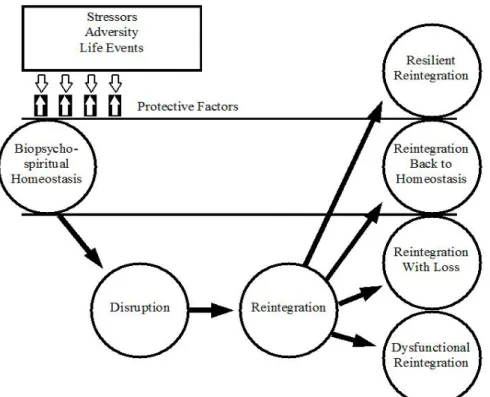
This theory refers itself as a homeostatic balance that allows us to adapt (body, mind and soul) to current life circumstances, as this balance is disturbed by stressors and adverse events as well as other expected or not expected life events, which means that our ability to adapt and deal with them is induced by resilient qualities and resilient reintegration (Wald et al, 2006).
Looking at the Richardson’s Resilience Model (Figure 1), the qualities are represented by arrows which are pointing up, representing the ones keeping homeostasis. Though when a disruptive event happens in life this can be perceived as having negative or positive consequences, as well as presenting emotional and evaluative responses (Richardson, 2002).
Wald et al (2006) refer that the process of reintegration can lead to one out of four consequences: resilient reintegration, where adaptation points to a superior level of homeostasis, return to the homeostasis of origin, in an effort to overcome a disruptive situation, recovery with loss, establishment of an inferior level of homeostasis and finally a dysfunctional state where non-adaptive strategies (such as auto-destructive behaviours) are used to deal with the stressor.
Figure 1. Richardson’s Resilience Model
For the author, resilience can be seen as a consequence of successful coping abilities (Richardson, 2002). According to the author, a disruptive situation is necessary to access the components of resilience because the bio psychosocial homeostasis is not enough to grow or perfect. Nonetheless, the simple linear model reflects only an event while related to a particular part, relation or experience; there are multiple disruptive or re-integrative growth opportunities that can be found occurring at the same time. For example, integrating a new job, in a new company, with a multicultural environment, and that is ready open its doors to 250 new employees. This is a very challenging reality, such as everyone will be adjusting to the new job.
This opportunity made possible the idea of creating such a research in an organization using a systemic approach with vision and an integrated results-focused approach, aimed at bringing about the sustainable enhancement of the performance of the new employees, what better way to start than the beginning, consulting and supporting every moment, studding their stressors and helping in the creation of new coping strategies to deal with adversity as well as reintegrating afterwards.
2. Method
2.1. State of the Art
This research is an exploratory study that implies quantitative and qualitative research. It fits within the scope of organizational and clinical psychology research in resilience stress and coping psychology. This investigation is based on a sample of adults from both genders that are part of a recently created company in Portugal that was formed less than 2 years ago but that has been growing until now. As a new company recruiting multicultural professionals from different areas of interest, new challenges also came in line.
Given the new challenges, a focus group was set up, with a set of key questions that would help to better understand the employee’s motivations, as well as their daily job challenges.
This is an exploratory study consisting of 135 subjects, where qualitative and quantitative methodologies will be combined, allowing for the correlation of socio demographic variables with psycho-social functioning variables.
This study contains a Focus Group, a socio-demographic questionnaire with both qualitative and quantitative data, and 3 Tests: COPE, CD-RISC and BDI. The focus group and questionnaires have a GAP of 6 months.
2.2. Start-up Question
The start-up question for this research is divided in 2 different questions:
§ When it comes to the reality of a recently created company are there differences in the psychosocial functioning of Individuals on their first jobs compared with the ones with professional experience?
§ How and what social-demographic variables correlate with the employees psychosocial functioning?
2.3 Conceptual Map
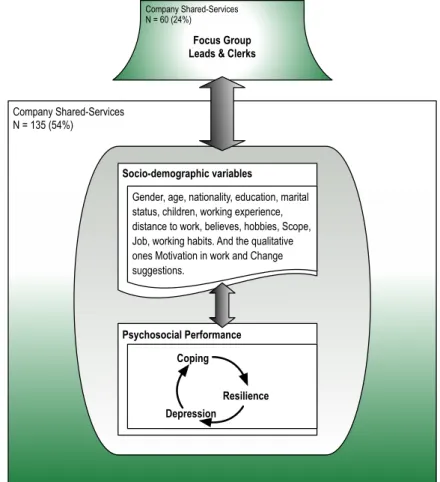
The Conceptual Map (Figure 2) considers 2 moments of information collection. The first moment was a Focus Groups with a representative number of Clerks and Leads (N=60) where some information was gathered in order to know better the employees as well as their needs. The collected information was important to support the research.
After 6 Months, and with the support of the company Human Resources the questionnaire and the tests was sent by email to all the 250 employees and 135 (About 54%) responded anonymously via Google questionnaires. The socio-demographic questionnaires used for this study have the following variables: Gender, age, nationality, education, marital status, children, working experience, distance to work, believes, and Job. Also, there are open-ended questions such as Hobbies, the best of working in the company and suggestions of change. In what concerns to the the psychosocial performance, the tests evaluate Resilience (CD-RISC), Coping (COPE) and Depression (BDI).
The arrows connecting each and every moment of interaction indicate the relation between each variable and construct, and also allows to study the comparisons and correlations between the focus group, the socio-demographic variables and the psychosocial functioning of the individuals.
Figure 2. The conceptual map of the Research
Company Shared-Services N = 135 (54%)
Focus Group Leads & Clerks
Psychosocial Performance
Company Shared-Services N = 60 (24%)
Socio-demographic variables
Gender, age, nationality, education, marital status, children, working experience, distance to work, believes, hobbies, Scope, Job, working habits. And the qualitative ones Motivation in work and Change suggestions.
Resilience Depression
2.4 Investigation Purpose and Research Questions
2.4.1 Main Purpose
This study has the main propose of researching the psychosocial performance of a significant sample of employees from a recently created shared services company in Portugal considering that young employees are inserted in a multicultural challenging environment.
2.4.2 Specific Purposes
The main aims considered to specify the research for this study are:
§ Focus on the resilience of the young professional, researching the correlation between the coping strategies of the young professionals and the resilience competencies developed to deal with new challenges;
§ Coping strategies and adaptation mechanisms developed to deal with the stress of an unknown, new and not yet stable environment;
§ Understand if the company environment and mind-set promotes professional desirability; § Find solutions to avoid turnover and to improve the employee’s empowerment.
2.4.3 Investigation questions
Considering the exploratory and comparative research done in this study several questions are pondered between the extended list of variables collected:
1. What are the resilience signs and coping strategies developed and shown by the individuals? 2. Will there exist any relation between the socio demographic variables and the psychosocial
performance of the individuals?
3. Are there any relations between the resilience of these individuals and the coping strategies to handle routine and repetitive activities situations?
4. Working in an open space, is it a stress factor or a resilience potential?
5. How do different teams relate to similar issues, like pressure, stress or monotonous tasks? 6. How does the relation between the team leaders and the employees influence working results
in the company services?
7. How does the psychosocial performance relate with the socio-demographic variables?
8. Do socio-demographic variables such as hobbies or religion relate with the development of coping strategies and resilience in this sample?
2.5 Methodological strategies
Since this thesis is exploratory it was important to mainly follow a quantitative research approach while enriching it with qualitative data. Firstly, a Focus Group was applied to better understand the needs of the company, and 6 months after a semi-structured questionnaire was applied to obtain the socio-demographic data and qualitative methodology was used to obtain not only the social-socio-demographic data, but also important aspects as Hobbies, Motivating and Suggestions of Change that could only be obtained through open-ended questions allowing more exploratory research.
In what concerns to the focus group a personalized meeting was arranged in 5 sessions during an entire day, but given the availability of the clerks the method chosen to obtain the answers for the question set was Google Questionnaires, as it was already a tool in use at the company.
To investigate the psychosocial performance, 3 questionnaires were applied, the first - Beck Depression Inventory (Aaron T. Beck, 1961) to evaluate the presence or not of depressive symptomology; secondly the CD-RISC (Connor & Davidson, 2003) to measure the signs of resilience, and the COPE (Carver, Scheier & Weintraub, 1989) with the aim to evaluate the styles and strategies of coping (Pais Ribeiro; Rodrigues, 2004)
2.5.1 Sample Characterization
To better characterize the sample it is important to refer that 135 out of 250 employees of the company participated in the study (a percentage of 54%). This sample belongs to 110 Clerks, 6 Senior Clerks, 13 Leads, 4 Managers and finally 2 Directors.
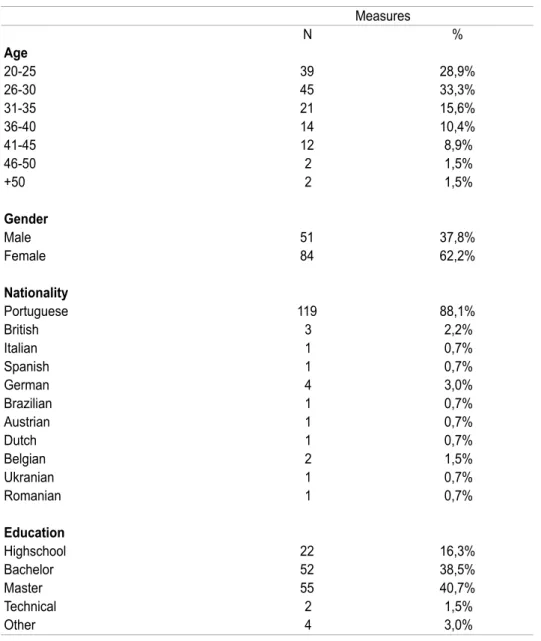
According to (Table 1) the sample of 135 Individuals (119 are Portuguese and 16 from other nationalities. For the Gender 51 (37,8%) are Male and 84 (62,2%) Female. In these 28,9% (39 individuals) are between 20 and 25 years old and 33,3% (45 individuals) between 26 and 30, corresponding together to more than 50% of the sample. When it comes to Education, most of the participants (107) have a Degree, forming a percentage of 79,2% - 55 with Master Studies (40,7%) and 52 with Bachelor (38,5%).
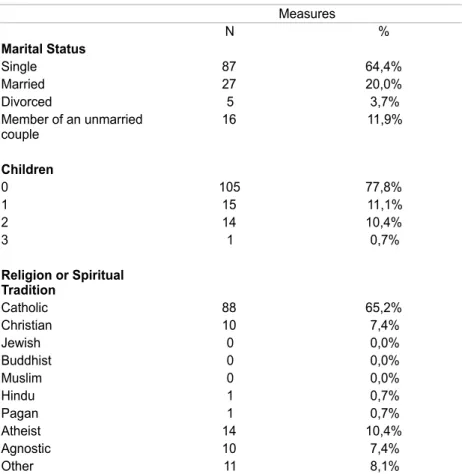
For the family constitution (Table 2) most of the participants (87) are single (64,4%) and 105 (77,8%) don’t have any children. As for the Beliefs, 74% are catholic, with most considering themselves to have a Religion (111 individuals) and 17,8% are Non Believers, considering themselves as Atheists or Agnostics (24 individuals).
Table 1 - Socio-demographic Sample Description
Measures N % Age 20-25 39 28,9% 26-30 45 33,3% 31-35 21 15,6% 36-40 14 10,4% 41-45 12 8,9% 46-50 2 1,5% +50 2 1,5% Gender Male 51 37,8% Female 84 62,2% Nationality Portuguese 119 88,1% British 3 2,2% Italian 1 0,7% Spanish 1 0,7% German 4 3,0% Brazilian 1 0,7% Austrian 1 0,7% Dutch 1 0,7% Belgian 2 1,5% Ukranian 1 0,7% Romanian 1 0,7% Education Highschool 22 16,3% Bachelor 52 38,5% Master 55 40,7% Technical 2 1,5% Other 4 3,0%
According to Table 3 Most of the participants are working as Clerks 110 in 135 Employees (81,5%) and 25 in 135 (18,5%) in Management or Leading Positions. Most employees live more then 10km from work, and speak English in their daily activities, as this is the Company’s Official Language.
Table 2 - Family Status and Religion
Measures N % Marital Status Single 87 64,4% Married 27 20,0% Divorced 5 3,7% Member of an unmarried couple 16 11,9% Children 0 105 77,8% 1 15 11,1% 2 14 10,4% 3 1 0,7% Religion or Spiritual Tradition Catholic 88 65,2% Christian 10 7,4% Jewish 0 0,0% Buddhist 0 0,0% Muslim 0 0,0% Hindu 1 0,7% Pagan 1 0,7% Atheist 14 10,4% Agnostic 10 7,4% Other 11 8,1%
2.6 Measures
In this section, the qualitative and quantitative instruments are described. Presented first is the Focus Group, which helped to establish the necessities for the creation of the Socio-demographic Questionnaire.
Due to the lack of free time from the part of the employees, the socio-demographic questionnaire was created with only a few open ended questions, coupled with a battery of tests (CD-RISC, BDI and COPE) which together, could be answered in less then 20 minutes.
2.6.1 Focus Group
On 13 October 2014 5 Focus Group sessions were held with twelve employees each, for a total of sixty employees, in order to gather the perceptions of employees regarding the company.
A content analysis of the information collected during the sessions was conducted, where the perceptions with higher consensus were selected.
Based on this analysis of information, it was possible to group the perceptions of participants in three clusters: Communication (1), Leadership (2). and Culture and Climate (3). The perceived positives (strengths) and negatives (areas for improvement) of the employees were identified for each of the clusters. The leading causes that generate dissatisfaction among the employees will be identified, so that an action plan can be proposed and implemented over the identified areas for improvement. 2.6.2 Socio-demographic Questionnaire
The socio-demographic questionnaire (Annex 1) used in this investigation was created considering the information found interesting and relevant to the study. The questionnaire consisted of: socio-demographic variables, psychosocial variables and personal variables. For the socio-socio-demographic variables the relevant information regarding age, gender, and marital status was considered.
For the psychosocial information, questions were asked about the children, other dependent and finally for the personal variables there were questions about educational qualification, working status and religion.
Regarding the open ended questions which were added to the questionnaire, they focused on different aspects, such as the employee’s hobbies, what they like the most in the company and what they would change in it.
2.6.3 CD-RISC
According to Connor and Davidson (2003), the CD-RISC was developed as a brief self-rated assessment (meaning a valid and reliable measure) to quantify resilience, to establish reference values for resilience in the general population and in clinical samples and as a clinical measure to evaluate treatment response.
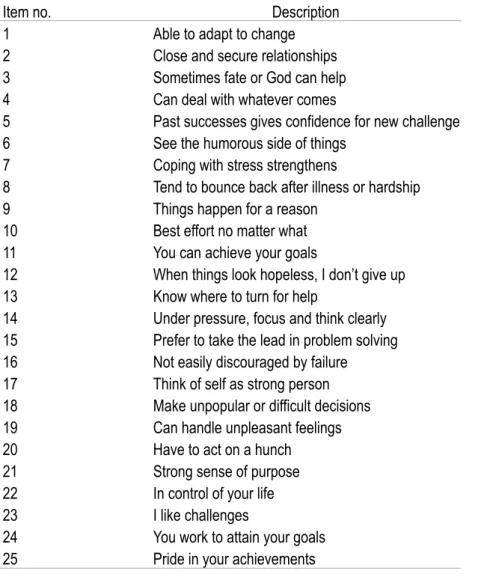
The CD-RISC scale (Connor & Davidson, 2003), consists of a self-evaluation measure of 25 items (Table 4), each one of them being classified by a five-point scale (0-4) as follows: not true at all (0), rarely true (1), sometimes true (2), often true (3), and true nearly all of the 17 time (4). The total score ranges from 0-100, the highest results being associated with the highest resilience.
The CD-RISC possesses very solid psychometric properties (0,893 Cronbach’s Alpha) which allows the distinction between individuals which are more or less resilient (Connor & Davidson, 2003).
Table 4 - Content of the Connor-Davidson Resilience Scale
Item no. Description
1 Able to adapt to change
2 Close and secure relationships
3 Sometimes fate or God can help
4 Can deal with whatever comes
5 Past successes gives confidence for new challenge
6 See the humorous side of things
7 Coping with stress strengthens
8 Tend to bounce back after illness or hardship
9 Things happen for a reason
10 Best effort no matter what
11 You can achieve your goals
12 When things look hopeless, I don’t give up
13 Know where to turn for help
14 Under pressure, focus and think clearly 15 Prefer to take the lead in problem solving 16 Not easily discouraged by failure 17 Think of self as strong person 18 Make unpopular or difficult decisions
19 Can handle unpleasant feelings
20 Have to act on a hunch
21 Strong sense of purpose
22 In control of your life
23 I like challenges
24 You work to attain your goals
Through the use of this scale, the authors confirm that resilience is measurable and is also influenced by the mental state of the individual (people with mental illnesses have lower levels of resilience compared to the general population); it is a scale that can be very useful when it comes to clinical practice and research (Connor & Davidson, 2003; Wald et al, 2006; Ahern, Kiehl, Sole & Byers, 2006). The CD-RISC has been tested in the general population and in clinical samples and demonstrates good psychometric properties and also good internal consistency and test- retest reliability (see Table 5 and 6), also demonstrating validity when compared with other measures of stress and hardiness (Connor & Davidson, 2003).
Determining the prevalence of resilience in the adult population is difficult due to the term’s subjective and diverse definitions. The 25-item Connor-Davidson Resilience Scale (CD-RISC) is commonly used to estimate resilience in a population. The total score ranges from 0-100, with higher scores indicating greater resilience.
2.6.4 COPE
The COPE Inventory (Carver, Scheier & Weintraub, 1989) was developed to assess a broad range of coping responses, several of which had an explicit basis in theory. The inventory includes some responses that are expected to be dysfunctional, as well as some that are expected to be functional. It also includes at least 2 pairs of polar-opposite tendencies. These were included because each scale is unipolar (the absence of this response does not imply the presence of its opposite), and because we think people engage in a wide range of coping during a given period, including both of each pair of opposites.
The items have been used in at least 3 formats. One is a "dispositional" or trait-like version in which respondents report the extent to which they usually do the things listed, when they are stressed. A
Table 5 - Cronbach’s Alpha from CD-RISC
Connor and Davidson (2003) Company Sample
CD-RISC 0,89 0,89
Table 6 - Internal Consistency of the sample’s CD-RISC
Cronbach’s Alpha Minimum MaximumInter-item Correlation Mean
second is a time-limited version in which respondents indicate the degree to which they actually did have each response during a particular period in the past. The third is a time-limited version in which respondents indicate the degree to which they have been having each response during a period up to the present. The formats differ in their verb forms: the dispositional format is present tense, the situational-past format is past tense, the third format is present tense progressive (I am ...) or present perfect (I have been ...).
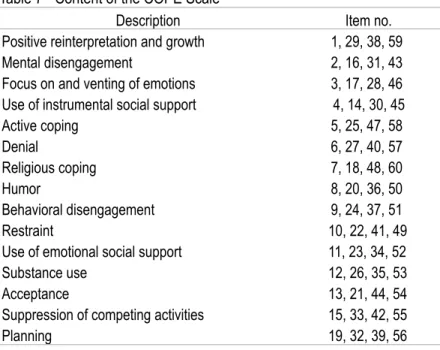
COPE Inventory is a multidimensional coping inventory to assess the different ways in which people respond to stress (Table 7). Five scales containing four items each measure conceptually distinct aspects of problem-focused coping (active coping, planning, suppression of competing activities, restraint coping, seeking of instrumental social support); five scales measure aspects of what might be viewed as emotion-focused coping (seeking of emotional social support, positive reinterpretation, acceptance, denial, turning to religion); and three scales measuring coping responses that arguably are less useful (focus on and venting of emotions, behavioural disengagement, mental disengagement).
Concerning the 15 scales of COPE there is an averaged Cronbach's alpha of 0.79 but the range may vary from 0.37 to 0.93. For this study the Cronbach´s Alfa is 0.90 (Table 8) showing greater consistency.
Table 7 - Content of the COPE Scale
Description Item no.
Positive reinterpretation and growth 1, 29, 38, 59
Mental disengagement 2, 16, 31, 43
Focus on and venting of emotions 3, 17, 28, 46 Use of instrumental social support 4, 14, 30, 45
Active coping 5, 25, 47, 58 Denial 6, 27, 40, 57 Religious coping 7, 18, 48, 60 Humor 8, 20, 36, 50 Behavioral disengagement 9, 24, 37, 51 Restraint 10, 22, 41, 49
Use of emotional social support 11, 23, 34, 52
Substance use 12, 26, 35, 53
Acceptance 13, 21, 44, 54
Suppression of competing activities 15, 33, 42, 55
Planning 19, 32, 39, 56
Table 8 - Cronbach’s Alpha from COPE
Carver, C.S. (1989) Company Sample
2.6.5 BDI
According to McDowell (2006), the BDI was created and revised by Aaron T. Beck in (1961 and 1996), by the time another version of the BDI (the BDI II) appeared, even thought the one used in this study is the first version as it was lined with the objectives.
BDI evaluates twenty-one depressive symptoms, with a high consistency of 0,90 (Table 11 and 12) fifteen of which cover emotions, four cover behaviour changes and six cover somatic symptoms; each symptom is evaluated in a scale of four intensity points and the results are summed up to make up a result between 0 to 63 – the higher the results the more severe depression is according to the following scale: 0-9 Not Depressed; 10-20 Mild Depression; 20-30 Moderate Depression and 30-63 Severe Depression (Ribeiro, 2010).
According to Beck and Steer (1984), the symptoms and attitudes are (1) Mood; (2) Pessimism; (3) Sense of Failure; (4) Lack of Satisfaction; (5) Guilt Feelings; (6) Sense of Punishment; (7) Self-dislike; (8) Self accusations;(9) Suicidal Wishes; (10) Crying; (11) Irritability; (12) Social Withdrawal; (13) Indecisiveness; (14) Distortion of Body Image; (15) Work Inhibition; (16) Sleep Disturbance; (17) Fatigability; (18) Loss of Appetite; (19) Weight Loss; (20) Somatic Preoccupation; and (21) Loss of Libido.
Table 9 - Internal Consistency of the sample’s COPE
Cronbach’s Alpha Minimum MaximumInter-item Correlation Mean
COPE 0,898 -0,306 0,902 0,124
Table 10 - Cronbach’s Alpha from BDI
Beck (1961) Company Sample
BDI 0,88 0,90
Table 11 - Internal Consistency of the sample’s BDI
Cronbach’s Alpha Minimum MaximumInter-item Correlation Mean
3 – Results
In this section the qualitative and quantitative results obtained from this study will be presented and explained as well as compared, so that the objectives and general questions asked for this study may be answered.
To analyze the data collected on Google Questionnaires, Microsoft Excel (Office 365) and the Statistical Package for Social Sciences 22.0 Software (IBM SPSS) for Macintosh were used. These softwares were used to calculate the data on the socio-demographic questionnaire and in the battery of tests - COPE BDI and CD-RISC.
For the focus group and the open questions in the socio-demographic questionnaire, a content analysis was made, as well as an analysis over Numbers for Mac (OSX iWorks).
3.1 Qualitative Analysis
3.1.1 Focus Group
Given the fact that the Shared Services Company is a new organization employing several inexperienced people in an open space working environment, the organization is currently in a period of adjustment, both in terms of processes and people.
3.1.1.1 Main Conclusions for Clerks
Following are listed the strengths and possible areas of improvement previously identified and complemented by a brief description of the causes that lead to this perception by the employees. Relatively to what the participants identified as the most satisfactory points of the Company, these are mostly related to the cluster of Culture and Clime with the following standing out:
§ Ability to establish an easy interpersonal relation between colleagues and leads - this aspect is often mentioned and transmits the perception to the collaborators that there is a very positive and cooperative work environment at the Company.
§ Multicultural environment - mentioned as very positive by the collaborators, by allowing contact with a big diversity of cultures and experience sharing;
§ Shared Services Company as a start-up - the premature context the employees are inserted in is a motivational factor to them, by allowing the integration and development of an organisation since its inception;
and a greater ease of integration not just on the teams, but also on the whole of the organisation; § Context with the potential of improvement - by being a start-up and a company that operates at an international level, it is viewed as an opportunity for the employees to develop a long term professional career.
Relatively to the areas of improvement, they will be presented by cluster, since it’s important their causes are properly identified and analyzed, in order to develop corrective actions.
3.1.1.2 Leadership
Leaders focused on the operational trend over two main factors: § Current instability at the organizational processes; § Need of developing leadership skills by Team Leaders;
This is a shared perception by Teams and Leads. Moreover, from the Leads perspective, the focus on the operational component results from: lack of experience of the teams; lack of experience of the leads, who are still learning, and the difficulty of handling new processes that differ from country to country. The heightened guidance of the Leads for the operational component impacts their ability to develop a global view of the organization and the understanding of the impact of its results and be able to pass on this perspective to the teams.
3.1.1.2.1 Leadership Skills
This cause can be observed based on how the Leads manage the teams and how they handle certain topics, e.g. the Leads find challenging the development of strategies that allow to strengthen and motivate the teams; another cause mentioned during the Focus Group was the necessity Leads felt for their teams to learn the behaviors and values wanted and expected of them by the organization. The Leads do not see this situation as their responsibility, but that of the Company.
Another point that also leads to this cause, is the fact the Leads Team is formed by people with little experience on team management, who find themselves still developing the necessary skills for successful leadership and team management.
3.1.1.2.2 Perception of the Leads regarding their role
Based on commentaries during the Focus Group, it was possible to identify that it was not yet clear to the Leads what their role is relating to management and team formation.
component coupled with the need to develop leadership skills reflecting on an unaccountability of the Leads in regards to their role to the newest members of the Company.
Consequently, the problems are also frequently associated with external causes, such as: the teams are mainly constituted of people with no professional experience in such an organization; different countries have different processes and the Leads find it challenging to manage the teams because they are still learning.
3.1.1.3 Communication
3.1.1.3.1 Information Flow
• The sharing of information in the company is still a work in progress. This perception is shared by the Leads and their teams. From the viewpoint of the teams, there is still the perception of the need for more formal moments with the Leads, with feedback regarding their performance and achieved results.
3.1.1.3.2 Informal Communication
§ During the Focus Group, it was possible to infer that informal communication surges as the most commonly used form of communication inside the Company.
§ Informal communication is used not just to obtain information regarding a certain topic internal to the organization, but also for obtaining critical information required for the daily tasks.
§ The preference for informal communication mostly results from the lack of knowledge of the collaborators regarding what means of formal communications they can use; additionally, the information arriving from the top is not formally communicated, which subsequently fosters the need of informal communication as a means of obtaining the required information.
§ Consequently, communication is based in a strong emotional component which potentiates attitudes of greater reactivity, feelings of insecurity and potential conflicts.
3.1.1.3.3 Horizontal Communication
§ At the team level, this cause was identified by the perception of, when the need to solicit information from a colleague of another team surges, it is necessary to produce a significant time investment in identifying the colleague they can and should direct his inquiries, often using all available resources to communicate with said colleague (e.g.: e-mail, physically finding him, asking colleagues, etc.).
lack of a shared view regarding team management and the values that should be passed. 3.1.2 Socio-demographic questionnaire open-ended questions
Concerning the open-ended questions in the socio-demographic questionnaires, “What is the most
motivating aspect of working in the Company?”, “What would you like to change in the Company?” and
Hobbies, 130 out of 135 answered these questions, referring interesting facts and suggestions that may generate creative solutions and lead to improvement in different clusters.
3.1.2.1 Hobbies Analysis
When asked about their hobbies the employees showed interest in hobbies that fit 3 main clusters: Culture, Leisure and Sport (Figure 5), being that cultural activities were mentioned with a frequency of 78, Leisure Activities by 89, and Sports by 118.
From the analysis of all the the different hobbies mentioned the ones that are more consensual is Music, Traveling, Cinema/Movies, Hangouts, Reading, General Sports and Gym. Each of these hobbies was mentioned between 10 and 40 times.
Hobbies can be turned into great motivation activities (Figure 6) to help employees cope with everyday routine, and some of the mentioned ones can be very usefully to the company.
3.1.2.2 The most Motivating aspects of working in The Company
Some motivation aspects of working in the Company mentioned by the employees:
“The opportunity to grow up in the company, my colleagues team and the facilities.”, “To be able to be part of a new project and help this company grow”, “Multicultural environment, multi-tasking, opportunity to learn tasks from different areas”, “Challenging the processes aiming to improve quality and performance”, “The constant challenge”, “Obtaining visible results and causing a constructive impact on the business.”, “Constant challenges due to direct interaction with Customers and managing big accounts with influence in the company Cash Flow”, ”Be part of a fantastic team looking at 2014 and proudly say we have achieved the objectives”.
Some aspects of improvement mentioned by the employees:
“The mind-set of the team. From being task-oriented to service-oriented”, “Input some kind of objectives to get the possibility to increase salary”, “The layout of the office”, “More activities (team building)”, “Summer schedule”, “communication between departments”, “HR organization”, “An increased sense of belonging”, “Voluntary interaction between teams/individuals appear to be rare unless if these interact regularly”.
3.2. Quantitative Results
A descriptive analysis was elaborated to characterize the sample according to its psychosocial variables – coping, resilience and depression – according to their mean, median, standard deviation, minimum and maximum values.
3.2.1. Descriptive analysis according to the psychosocial behavior variables: resilience, coping and depression
Resilience: CD-RISC
According to the results shown in Table 12, we can see through the results (Mean=70,10) that the Company’s Employees are quite Resilient. By further examining the frequency of results in Table 13, we can observe that the lower values are composed of a single 25, with the remaining distribution having high results (with a Maximum of 92).
Table 12- Descriptive Statistics for CD-RISC
N Mean Median Standard Deviation Minimum Maximum
CD-RISC 135 70,10 70,00 12,136 25 92
Table 13 - Frequency of results for CD-RISC
Frequency Percentage Cumulative Percentage
25 1 0,7% 0,7% 41-55 16 11,9% 12,6% 56-70 51 37,8% 50,4% 71-85 53 39,3% 89,6% 86-100 14 10,4% 100,0% Total 135 100,0%
Coping: COPE
To evaluate the Employee’s coping strategies, the COPE test was presented (Table 14).
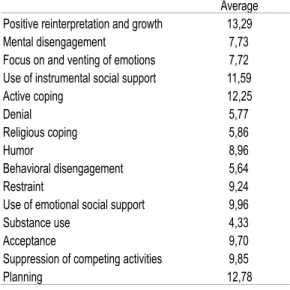
By examining the Average for COPE’s 15 Scales (Table 15), several coping characteristics are easily highlighted, more specifically: Positive Reinterpretation and Growth, Use of Instrumental Social Support, Active Coping, Use of Emotional Social Support and Planning. These coping strategies show that Employees are handling the daily routines and molding to the company.
Depression: BDI
To evaluate the presence of symptomatology, the BDI tests were used. By looking at Table 16, we can see that the Mean Value is quite low (Mean=4,71), consisting of a Minimum of 0 and a Maximum of 39. By further inspecting Table 17, we can clearly see that most of the Employees (85,9%) do not show any signs of depression.
Table 14 - Descriptive Statistics for COPE
N Mean Median Standard
Deviation Minimum Maximum
COPE 135 134,66 137 18,250 72 181
Table 15 - Average for COPE’s 15 Scales
Average Positive reinterpretation and growth 13,29
Mental disengagement 7,73
Focus on and venting of emotions 7,72 Use of instrumental social support 11,59
Active coping 12,25 Denial 5,77 Religious coping 5,86 Humor 8,96 Behavioral disengagement 5,64 Restraint 9,24
Use of emotional social support 9,96
Substance use 4,33
Acceptance 9,70
Suppression of competing activities 9,85
Planning 12,78
Table 16 - Descriptive Statistics for BDI
N Mean Median Standard
Deviation Minimum Maximum
3.2.2. Correlations between the socio-demographic variables and the psychosocial functioning variables
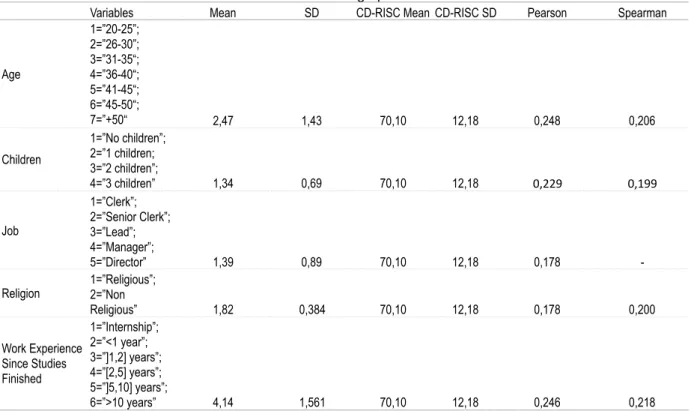
This following section presents some of the results were the strongest correlations were found when using either Pearson or Spearman’s correlation with the help of SPSS. Table 18, presents the correlations between CD-RISC and socio-demographic, highlighting the most significative correlations found.
By examining the possible correlations between the socio-demographic variables and CD-RISC of Table 18, we can observe there is a positive correlation between the Age and Resilience, with younger adults (between 26 and 35 years old) becoming more resilient with age. Likewise, employees with longer working experience also show more resilience.
Table 17 - Frequency of results for BDI
Frequency Percentage Cumulative Percentage
0-10 116 85,9% 85,9% 11-16 10 7,4% 93,3% 17-20 6 4,4% 97,8% 21-30 2 1,5% 99,3% 31-40 1 0,7% 100,0% Total 135 100,0%
Table 18 - Correlations between CD-RISC and socio-demographic variables
Variables Mean SD CD-RISC Mean CD-RISC SD Pearson Spearman Age 1=”20-25”; 2=”26-30”; 3=”31-35“; 4=”36-40“; 5=”41-45“; 6=”45-50“; 7=”+50“ 2,47 1,43 70,10 12,18 0,248 0,206 Children 1=”No children”; 2=”1 children; 3=”2 children”; 4=”3 children” 1,34 0,69 70,10 12,18 0,229 0,199 Job 1=”Clerk”; 2=”Senior Clerk”; 3=”Lead”; 4=”Manager”; 5=”Director” 1,39 0,89 70,10 12,18 0,178 -Religion 1=”Religious”; 2=”Non
Religious” 1,82 0,384 70,10 12,18 0,178 0,200 Work Experience Since Studies Finished 1=”Internship”; 2=”<1 year”; 3=”]1,2] years”; 4=”[2,5] years”; 5=”]5,10] years”; 6=”>10 years” 4,14 1,561 70,10 12,18 0,246 0,218
Concerning Job Position, employees with higher responsibility also present some levels of higher resilience. Finally, regarding family life, religion and having children also provide better resilience mechanisms to the employees.
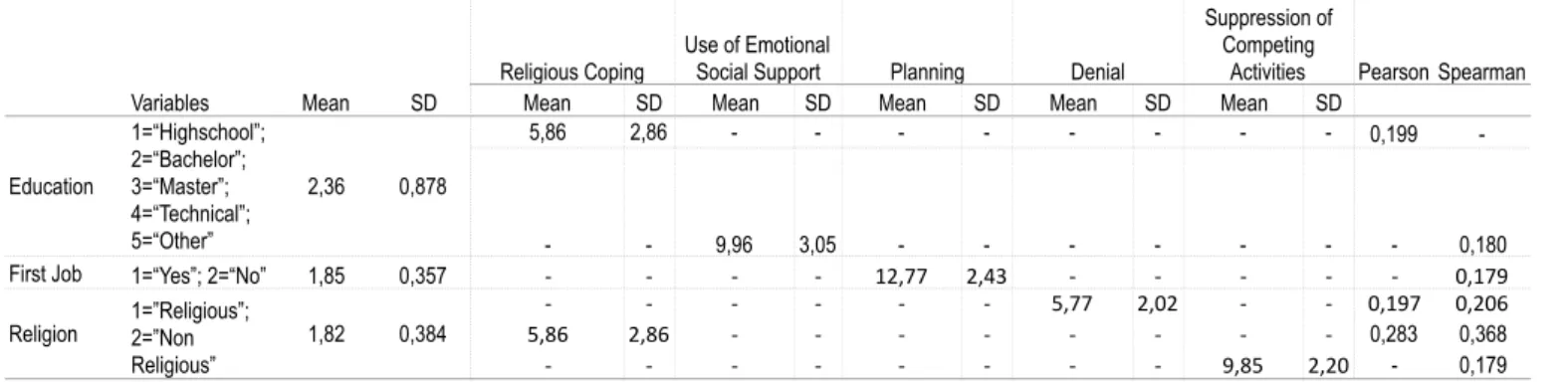
The second table, Table 19, presents the identified positive correlations between the socio-demographic variables and COPE Scales. Positive correlations were for Education with Religious Coping and Use of Emotional Social Support. Additionally, Employees that have previous working experience (i.e. this Company is not their first job) also present higher coping mechanisms.
Finally, employees that are religious show a higher correlation in regards to Religious Coping (with a Pearson’s value of 0,283 and Spearman value of 0,368).
Table 19 - Correlations between COPE Scales and socio-demographic variables
Variables Mean SD
Religious Coping Use of Emotional Social Support Planning Denial
Suppression of Competing
Activities Pearson Spearman
Mean SD Mean SD Mean SD Mean SD Mean SD
Education 1=“Highschool”; 2=“Bachelor”; 3=“Master”; 4=“Technical”; 5=“Other” 2,36 0,878 5,86 2,86 - - - 0,199 -- - 9,96 3,05 - - - 0,180
First Job 1=“Yes”; 2=“No” 1,85 0,357 - - - - 12,77 2,43 - - - 0,179
Religion 1=”Religious”; 2=”Non Religious”
1,82 0,384
- - - 5,77 2,02 - - 0,197 0,206
5,86 2,86 - - - 0,283 0,368
4 - Results discussion
In this section the qualitative and quantitative data obtained from the results is going to be discussed and corroborated with the methodological theory.
4.1. Concerning the psychosocial functioning of the employees
4.1.1. Coping
Considering the obtained results for the COPE test it is visible that employs adapt, readapt and grow professionally everyday, reinterpreting themselves in new functions, many times different from their academic studies, showing active coping and planning their everyday.
Finding coping strategies to everyday challenges is another sign of psychosocial well functioning. 4.1.2. Resilience
Considering the obtained results for the CD-RISC test a relatively high level of Resilience is visible, such as the ones verified by Richardson in the the general population and in the Primary-care outpatients allowing employees to show a stable psychosocial functioning, integrating confidently the daily challenges, and reintegrating them back. According to Richardson’s Resilience Model (Figure 1). It is interesting to find such a strong resilience in the company population, since it presents mainly monotonous tasks, and regarding the fact that everyday most of the employees deal with pressure and are exposed to challenging goals, complaining management, cash collection, between other tasks classified as more defiant and that may cause burnout signs in professionals.
But contradicting Schaufeli, W., & Bakker, A. (2004) findings, the employees show engagement in the tasks, not giving up easily and aiming to become better professionals. It is also visible that the company employees are proud of their goal achievements.
Curiously, regarding the Resilience correlation results concerning family, employees with no children have a disperse Resilience. However, when considering employees with children, the ones with two (or more) children presented higher resilience values then the families with a single child.
4.1.3. Depression
The results presented in the BDI analysis shows that most employees don’t show signs of depression, and only a few show mostly mild to moderate levels of depression.
The results shown by this tool indicates that most employees are very conscientious of their actual situation and are still getting used to their new job, have great humanity and emotional connection with each other, are exposed to tiredness due to their lack of working experience as many of them just finished their studies, or have never been part of such a big company with a defined structure. Another curious item revealed for this subject was the changing of eating habits, perhaps due to a new lifestyle as well as the social desirability that is always higher, working in an office, in an open space, in a challenging young company.
Still concerning the Depression scale, the values are extremely low considering that less then 15% of the employees show signs of mild to medium depression.
4.2. Open ended questions
After analyzing the open ended questions such as hobbies, the best in the company and the suggestions for change made by the employees, significant information was added to the research, such as suggestions for extra work activities that may be provided by the company as motivation for the employees.
Still concerning the employee’s hobbies, and what they value the most in their work, several interesting ideas may be able to become activities that improve useful behaviors such as teamwork, responsibility and engagement.
The most motivating aspects of working to the Company, are the multicultural environment, the team work, being able to learn and be challenged every day. Also mentioned by the employees several times, was being able to work for a big Multinational Company.
Concerning the changes desired by the employees towards the Company, they want to improve the communication between all the employees and the company, by making the passage of information more transparent and efficient.
A representative number of employees enjoy the conditions of the company, but the lack of public transportation to the location, as well as the layout inflexibility of the office space are general pain points.