Faculdade de Ci ncias
ê
Susana de Oliveira Braga da Silva França
Doutoramento em Biologia
Especialidade de Biologia Marinha e Aquacultura
2011
Spatial and temporal variation of
fish assemblages in estuarine systems:
habitat use, dependence and connectivity
Faculdade de Ci ncias
ê
Doutoramento em Biologia
Especialidade de Biologia Marinha e Aquacultura
2011
Spatial and temporal variation of
fish assemblages in estuarine systems:
habitat use, dependence and connectivity
Departamento de Biologia Animal
Tese orientada por
Professora Catedrática Maria José Costa
Professor Auxiliar com Agregação Henrique Nogueira Cabral
Doctoral dissertation in Biology
(specialization in Marine Biology and Aquaculture) presented to the University of Lisboa
Dissertação apresentada à Universidade de Lisboa para obtenção do grau de doutor
(especialidade Biologia Marinha e Aquacultura)
Susana de Oliveira Braga da Silva França
ABSTRACT AND KEY-WORDS 7
RESUMO E PALAVRAS-CHAVE 9
RESUMO ALARGADO 11
LIST OF PAPERS 15
CHAPTER 1 17
General introduction 19
Aims and importance of the thesis 22
Thesis outline 23
CHAPTER 2 29
Inter- and intra-estuarine fish assemblage variability patterns along the
Portuguese coast
CHAPTER 3 53
Assessing habitat specific fish assemblages in estuaries along the Portuguese coast
CHAPTER 4 77
A stable isotope approach to fish habitat use patterns within estuaries
CHAPTER 5 103
Assessing food web dynamics and relative importance of organic matter sources in two Portuguese estuaries: a stable isotope approach
CHAPTER 6 127
Vulnerability assessment of estuarine habitats and relationship with structural and functional use by fish assemblages
CHAPTER 7 147
Predicting fish assemblages properties within estuaries: influence of habitat type and other environmental variables
CHAPTER 8 169
General discussion 171
Final remarks 175
Abstract
Estuarine habitats are unique components of coastal areas, vital throughout the life history of many ecologically and economically important fish species. The present study aimed to determine the structural and functional roles of several estuarine habitats for fish assemblages, using a multi-tool approach, based on sampling surveys conducted in the main estuaries of the Portuguese coast. When assessing fish species variability at different scales, factors varying at larger scales, as well as environmental heterogeneity within systems, affected species-environment relationships and each estuary’s role was strongly related with the dominant saline zone. Fish assemblage structure was also analysed at habitat level and shown to vary with latitude and between habitats amongst and within estuaries. No single habitat type was exclusively selected by all species, but some were more associated with certain habitat types revealing the importance of these areas for the whole estuary functioning. A stable isotope approach showed no clear pattern of dependence of fish species to certain habitats. Connectivity between distant estuarine areas was low as fish species take advantage of movement of carbon between adjacent habitats in the areas they occupy. Stable isotopes also showed that fish used mostly saltmarsh-derived organic matter as nutritional sources, which is transferred to higher trophic levels through benthic pathways. Habitat loss constitutes a major threat to estuarine functioning and in the case of Portuguese estuaries, nutrient input and changes in river flow were the main factors accounting for potential habitat loss. Several of the most threatened habitats presented critical functional and ecological roles for important fish species. Variables such as salinity and temperature were important in determining fish species richness and abundance in estuarine habitats, as were often retained in the predictive models built. The effect of habitat was significant in larger estuaries, where habitat heterogeneity is defined in clearer mosaics.
Resumo
Os habitats estuarinos constituem componentes únicos das áreas costeiras, desempenhando funções vitais para as espécies de peixes que os utilizam. No presente trabalho analisou-se o papel estrutural e funcional dos habitats estuarinos para as associações de peixes, considerando diferentes abordagens metodológicas, e com base em campanhas de amostragem realizadas nos principais estuários da costa Portuguesa. Na análise da variabilidade das associações de peixes a diferentes escalas, tanto factores que variam entre estuários, como a heterogeneidade ambiental de cada estuário afectaram as relações entre espécies de peixes e o ambiente, e a função do estuário está fortemente relacionada com a área salina dominante. A estrutura das associações de peixes ao nível do habitat variou com a latitude e entre habitats, dentro de e entre cada estuário. Algumas espécies de peixes foram particularmente associadas a determinados habitats, demonstrando a importância destes no funcionamento do estuário. Utilizando isótopos estáveis demonstrou-se que não existe um padrão de dependência das espécies de peixes em relação a determinados habitats. A conectividade entre áreas distantes no estuário foi baixa, já que os indivíduos tiram vantagem do movimento de carbono entre habitats adjacentes. A mesma técnica demonstrou que os peixes usam maioritariamente matéria orgânica originária das zonas de sapal, que é transferida para níveis tróficos superiores pela via bentónica. A perda de habitat constitui uma ameaça ao funcionamento dos estuários e, nos sistemas da costa Portuguesa, são particularmente importantes na potencial perda de habitat o aumento de nutrientes e as alterações no caudal fluvial. Alguns dos habitats ameaçados desempenham papéis ecológicos e funcionais cruciais para muitas espécies de peixes. A salinidade e a temperatura foram importantes na determinação da variação da riqueza específica de peixes e abundâncias nos habitats estuarinos, sendo o habitat fundamental nos estuários maiores, onde a heterogeneidade de habitats é definida em mosaicos claros.
Palavras-chave: estuário; habitats estuarinos; associações de peixes; isótopos estáveis; modelação
Resumo alargado
Os sistemas estuarinos estão entre os ecossistemas mais produtivos e valiosos do planeta e o papel que desempenham como área de viveiro para algumas espécies de peixes é amplamente conhecido. São sistemas dinâmicos e complexos, tipicamente compostos por um mosaico de diferentes tipos de habitat. No entanto, o conhecimento sobre importância dos habitats estuarinos na dinâmica destes sistemas é ainda incipiente. Tem sido demonstrado que as funções ecológicas que um estuário desempenha, como por exemplo a função de viveiro, variam consoante os tipos de habitat estuarino disponíveis, não existindo muitos estudos sobre o grau de dependência em relação aos mesmos. A quantificação da conectividade entre habitats (dentro de um mesmo estuário e entre estuários) e questões relativas às escalas de variabilidade, espaciais ou temporais, carecem igualmente de desenvolvimento em estudos de ecologia estuarina. Todos estes conceitos são de extrema importância para o conhecimento e preservação da biodiversidade e funcionamento dos estuários, e representam elementos fundamentais para o desenvolvimento de ferramentas preditivas dos efeitos da perda e degradação de habitat. Neste contexto, o presente estudo tem como objectivo determinar a importância estrutural e funcional dos diferentes habitats, presentes nos principais estuários da costa Portuguesa, para as associações de peixes que utilizam estes estuários. Este objectivo será cumprido através da utilização de diferentes metodologias, numa perspectiva integradora. A presente tese é composta por oito capítulos, seis dos quais correspondem a artigos científicos, produzidos para responder directamente aos objectivos propostos, que estão publicados ou em revisão em revistas internacionais com arbitragem científica, incluídas no Science Citation Index. Estes capítulos são precedidos de um capítulo de introdução geral e seguidos de um capítulo de discussão geral e considerações finais.
Na introdução geral, Capítulo 1, foi realizado um enquadramento teórico do tema da presente tese, nomeadamente no que diz respeito: às funções ecológicas que os sistemas estuarinos desempenham, com ênfase na função de viveiro; na forte pressão antropogénica a que estão sujeitos e nos aspectos que podem contribuir para um maior conhecimento do papel dos diferentes habitats estuarinos no funcionamento global do ecossistema e sua dinâmica.
A variabilidade inter- e intra-estuarina das associações de peixes ao longo de nove sistemas estuarinos da costa Portuguesa foi explorada no Capítulo 2. A variação destas associações foi analisada a diferentes escalas espaciais, considerando todos os estuários amostrados, através do uso de modelos lineares generalizados. A variação espacial da estrutura das associações de peixes foi definida em parte por factores que actuam a escalas espaciais maiores (i.e. entre estuários), assim como pela heterogeneidade ambiental
intra-estuarina. Por outro lado, o papel funcional atribuído a cada estuário apresentou-se maioritariamente relacionado com a área do gradiente salino dominante.
O padrão de uso do habitat pelas associações de peixes foi igualmente explorado, nos mesmos estuários, no Capítulo 3. Para tal, os habitats estuarinos foram mapeados com recurso a um Sistema de Informação Geográfica (considerando nove tipos de habitat) e as associações de peixes a eles associadas foram descritas com base em diferentes métricas de comunidade, estruturais e funcionais. Foram encontradas diferenças nas associações de peixes com a latitude e entre habitats tanto inter- como intra-estuarinas. Algumas das espécies de peixes foram associadas a habitats em particular, o que evidencia a sua importância para o funcionamento global do ecossistema estuarino.
A dependência de espécies de peixes relativamente a habitats estuarinos, constitui uma medida importante do uso funcional dos habitats. No Capítulo 4, através da análise de isótopos estáveis, foi feita uma avaliação do grau de dependência e conectividade entre habitats para algumas espécies de peixes em dois estuários da costa Portuguesa (Tejo e Mira). Os resultados revelaram que não existe um padrão claro de uso dos diferentes tipos de habitats pelas diferentes espécies. O movimento de carbono a escalas menores, entre habitats adjacentes, foi evidente. Por outro lado, a conectividade de indivíduos entre áreas distantes dentro do estuário foi baixa, principalmente para espécies bentónicas, indicando que estes podem beneficiar do movimento de carbono que ocorre a pequenas escalas, não necessitando dispender energia em migrações intra-estuarinas.
No Capítulo 5, e ainda com recurso à análise de isótopos estáveis, foi estimada a contribuição relativa de várias fontes nutricionais para a base da cadeia trófica nos estuários do Tejo e do Mira. O foco foi sobre o suporte nutricional de algumas das espécies de peixes mais abundantes, que usam estes estuários em permanência ou de forma oportunista, com recurso ao modelo IsoSource. As relações tróficas entre os principais produtores e consumidores foram identificadas, bem como as diferenças espaciais e sazonais nestas teias tróficas. A maior parte das espécies de peixes parece usar a matéria orgânica com origem no sapal, sendo esta transferida para níveis tróficos superiores através de vias bentónicas. Os níveis tróficos das diferentes espécies de peixes variaram a diferentes escalas: inter-específica, espacial e temporal, indicando a flexibilidade das espécies no que diz respeito à partilha de recursos e aproveitamento de picos de densidades de presas.
Sendo a perda e degradação de habitat uma das maiores ameaças ao funcionamento dos estuários, no Capítulo 6 foi determinada a vulnerabilidade dos habitats presentes nos estuários da costa Portuguesa face a diferentes ameaças que poderão conduzir à perda de habitat. Esta caracterização foi feita com recurso à avaliação de peritos. Simultaneamente, foi determinado o papel funcional e estrutural destes habitats para as associações de peixes. O aumento da entrada de nutrientes nos estuários e as alterações nos caudais fluviais foram consideradas as ameaças com maior impacto na potencial perda de habitats estuarinos. As plataformas intertidais foram identificadas como os habitats mais vulneráveis a estas ameaças e consequentemente mais susceptíveis à perda de área e degradação. Alguns dos habitats mais
vulneráveis desempenham funções muito importantes, nomeadamente, como zonas de viveiro para algumas espécies, e deverão ser objecto prioritário de conservação.
Dada a importância de alargar o conhecimento sobre a distribuição das diferentes espécies de peixes e tendo em vista a gestão ambiental destes ecossistemas, o desenvolvimento de modelos preditivos tem tido uma marcada evolução. No Capítulo 7 foram desenvolvidos modelos aditivos generalizados para vários estuários da costa portuguesa, relacionando a riqueza específica e abundância em diferentes habitats estuarinos com as características ambientais dos habitats. Os modelos explicaram grande parte da variação observada, e apesar das diferentes combinações de variáveis preditivas nos modelos finais para os estuários, a temperatura e salinidade foram incluidas na maioria dos modelos. O tipo de habitat revelou-se importante para a estrutura da comunidade sobretudo nos estuários de maiores dimensões, onde os diferentes habitats ocupam áreas maiores formando verdadeiros mosaicos. Os modelos construídos tiveram um sucesso preditivo bastante elevado quando aplicados a dados diferentes daqueles com que foram construídos, reforçando a sua robustez e aplicação futura, nomeadamente para a previsão de alterações no sistema (por exemplo, decorrendo de alterações climáticas). Esta abordagem preditiva pode ser considerada uma ferramenta de gestão de grande utilidade, com especial contributo para a identificação das variáveis ambientais-chave que determinam a resposta das comunidades ictíicas.
Por fim, no Capítulo 8 é apresentada uma discussão geral que engloba as principais conclusões dos capítulos anteriores, e onde se realiza uma breve análise comparativa com estudos prévios. São igualmente tecidas considerações finais acerca da relevância do presente estudo para o conhecimento geral sobre o papel desempenhado pelos diferentes habitas estuarinos, sendo sugeridos trabalhos futuros para o seu aprofundamento através de diferentes ferramentas e metodologias.
L
IST OF PAPERSThis thesis is comprised by the papers listed below, each corresponding to a Chapter, from 2 to 7. The author of this thesis is the first author in all papers and was responsible for conception and design of the work, field surveys, sample collection and processing, laboratory analytical procedures, data analysis and manuscript writing of all the papers. Remaining authors collaborated in some or several of these procedures. All papers published or in press were included with the publishers’ agreement.
CHAPTER 2: Inter- and intra-estuarine fish assemblage variability patterns along the Portuguese coast
Susana França, Maria José Costa, Henrique N Cabral
Published in Estuarine, Coastal and Shelf Science (2011) 91: 262-271 doi:10.1016/j.ecss.2010.10.035
CHAPTER 3: Assessing habitat specific fish assemblages in estuaries along the Portuguese coast
Susana França, Maria José Costa, Henrique N Cabral
Published in Estuarine, Coastal and Shelf Science (2009) 83: 1-12 doi:10.1016/j.ecss.2009.03.013
CHAPTER 4: A stable isotope approach to fish habitat use patterns within estuaries
Susana França, Rita P Vasconcelos, Vanessa F Fonseca, Cristina Máguas, Maria José Costa,, Henrique N Cabral
In review in Marine and Freshwater Research
CHAPTER 5:Assessing food web dynamics and relative importance of organic matter sources in two Portuguese estuaries: a stable isotope approach
Susana França, Rita P Vasconcelos, Susanne E Tanner, Cristina Máguas, Maria José Costa, Henrique N Cabral
In review in Marine Environmental Research
CHAPTER 6: Vulnerability assessment of estuarine habitats and relationship with structural and functional use by fish assemblages
Costa, Henrique N Cabral In review in Ecological Indicators
CHAPTER 7: Predicting fish assemblages properties within estuaries: influence of habitat type
and other environmental variables
Susana França, Rita P Vasconcelos, Vanessa F Fonseca, Susanne E Tanner, Patrick Reis-Santos, Maria José Costa and Henrique N Cabral
C
HAPTER
1
General introduction
Aims and importance of the thesis
Thesis outline
General introduction
Aims and importance of the thesis
Thesis outline
General introduction
Estuaries have long been recognized as one of the most biologically productive and valuable natural ecosystems in the world, playing a crucial role in maintaining biodiversity in aquatic systems, particularly for fish (Costanza et al. 1997; Beck et al. 2001). They have long been regarded as important habitats for fish, where species may benefit from the high food availability, provided by these systems’ productivity, as well as from the low predation pressure within those areas, which emphasizes their potential as feeding grounds and refuge for fish, comparatively with other coastal systems (Miller 1985). Thus, estuarine systems are notably known for providing nursery grounds for juveniles as well as overwintering areas or migration routes, and naturally supporting large abundances of fish (Jenkins et al. 1998).
In contrast with their ecological importance, estuaries are amongst the most modified and threatened aquatic environments (Blaber et al. 2000). Numerous anthropogenic perturbations, such as land reclamation, drainage of waste, industrial and agricultural activities, shipping and dredging, affect estuarine environments worldwide, contributing to habitat alteration and changes in the structure and dynamics of biotic communities, which may compromise an estuary’s global functioning, viability and health (Kennish 2002; Vasconcelos et al. 2007).
Communities of fish inhabiting these systems present a relatively low species diversity but high abundance of some dominant species, mainly because species living in such environments need to tolerate their typical fluctuating environmental conditions (Mathieson et al. 2000; Magurran and Henderson 2003).
In order to better understand the functioning, internal and hierarchical structure of estuarine fish assemblages, the use of functional guilds has been proposed as an alternative to the traditional analysis of taxonomic community (Elliott and Dewailly 1995; Mathieson et al. 2000; Franco et al. 2008). The assignment of each taxa to a set of functional guilds allows a description of fish assemblages in terms of ecological, reproductive, vertical zonation, habitat and dietary preferences (Mathieson et al. 2000). Elliott and Dewailly (1995) first introduced the concept of classifying fish species in functional guilds, as a result of a comparison of the structure and composition of fish assemblages in estuaries throughout European Atlantic coasts. The authors identified a typical European Atlantic estuarine fish assemblage and showed that regardless of the location within that geographic area, patterns of fish ecological use of estuarine systems are similar and can be grouped in the following categories: estuarine resident, marine adventitious, diadromous migrant, marine seasonal migrant (which use
estuaries as nursery grounds) and freshwater adventitious species (Elliott and Dewailly 1995). More recently, Elliott et al. (2007) reviewed the guild approach by categorizing fish species worldwide, and standardized concepts used and their applications. A specific guild classification was also derived from this one, in order to apply the fish guild approach to European temperate estuaries (Franco et al. 2008).
As transition areas, estuaries are unarguably more complex than other coastal ecosystems, with highly inter-related processes between physical, chemical and biological components (Molles 1999; Elliott et al. 2002). Estuarine fish communities have been studied notably well worldwide, and generally in European estuaries communities are largely structured by temperature, salinity and substratum (Henderson 1989; Hamerlynck et al. 1993). For instance the timing of fish migrations from/to adjacent aquatic ecosystems seems to be related mainly with temperature and results in clear seasonal trends within the fish community. On the other hand, the salinity gradient, which varies with typical hydrodynamic fluctuations of freshwater flow and seawater intrusion, and different substratum types determine primarily the spatial distribution of fish communities within estuarine waters (Thiel et al. 1995; Maes et al. 1998; Whitfield 1999; Kimmerer 2002). Many of these factors are focused at particular spatial scales and produce characteristic patterns of faunal distribution (Azovsky 2000). Assessing the pattern and extent of the variability of these processes as well as the scales at which they operate is of great importance to understand the structure and function of estuarine fish communities (Sheaves 2006).
Most studies on estuaries focus on the systems as a whole or on their salinity gradient (Barlletta et al. 2005; Martino and Able 2003; Costa et al. 2007; Sosa-Lopez et al. 2007). Nonetheless, when assessing the structural and functional importance of estuaries it is noteworthy that they consist of a complex mosaic of many distinctive habitat types that do not exist in isolation (Pihl et al. 2002). These different habitats present physical, chemical and biological links between them, both temporally and spatially, established by proximity or at distance promoted by tidal flow (Rozas and Zimmerman 2000; Elliott and Hemingway 2002).
The relationship between the distribution of organisms and habitats provides an initial insight into the types of ecological processes that regulate populations and assemblages. Habitat use by individuals of a given species may be associated with size- or age-specific habitat preferences and the spatial availability of suitable habitats (Able and Fahay 1998). The selection of a specific habitat within an estuary may be related to its availability and structural complexity, the prey and predator fields, physical transport processes and local environmental conditions (Blaber and Blaber 1980).
The relative value of some of the most productive habitats such as tidal flats, saltmarshes, seagrass beds, oyster reefs and mangrove, commonly present in shallow estuarine areas, have been estimated in numerous studies through nekton density patterns (Rozas and Minello 1998). A common assumption of these comparisons is that high animal densities (facilitated by either active selection or higher survival rates relative to other habitats) indicate high habitat quality and preferred habitat (Sogard and Able 1991; Rozas and Minello 1998; Minello 2003).
Fluctuations in environmental conditions among other factors must be taken into account when determining spatial or temporal variability in habitat use. Recent investigations over larger spatial scales have found both intra- and inter-estuarine differences in fish abundance in different habitat types (Elliott and Hemingway 2002). Comprehensive observations in multiple estuaries may be necessary to adequately determine habitat use patterns (Goldberg et al. 2002).
Most studies focusing on fish assemblages in estuarine habitats compare, e.g. fish densities, between vegetated and non-vegetated habitats (Sogard and Able 1991; Sheridan 1992) and have generally found significantly higher species richness and densities of fish and invertebrates in vegetated areas, regardless of the type of vegetation considered (Connolly 1994; Gray et al. 1996; Catellanos and Rozas 2001). While density patterns provide insight on habitat value, functional relationships also need to be examined (Heck et al. 1995). For most estuarine species, the functional role of different habitats and the links between them are complex and not well known (Miller and Skilleter 2006). Many estuarine fishes use a variety of habitat types as putative nursery grounds throughout their ranges and may use several types in a single location (Rozas and Minello 1998; Rozas and Zimmerman 2000).
Understanding whether and how communities differ among these habitats and the movement of individuals among them (connectivity) is crucial to determine habitat value and species dependence on them. However, knowledge of fish movement patterns within estuaries constitutes a missing link in our understanding of the community dynamics as few studies have addressed this topic. These complex patterns may include obligatory movement among habitats (in species that must recruit to estuaries to survive) or facultative (involving active selection of a specific habitat type) (Polis et al. 1996). This knowledge is critically important namely for predicting the consequences of habitat loss and environmental degradation at the level of biodiversity and ecosystem structure and functioning (Connolly et al. 2005).
Extremely productive estuarine habitats such as seagrass meadows, marshes and mangrove forests may act as important nursery areas for several fish and invertebrate species, contributing with higher recruitment to adult stocks (Beck et al. 2001). Consequently, understanding this movement between juvenile and adult habitats is fundamental to the study of population dynamics, management of fish stocks, design of marine protected areas and determining whether populations are open or closed, thus contributing for effective conservation and management strategies (Gillanders 2005).
Quantifying rates of exchange of marine organisms is one of the most difficult measures in ecology and has been inferred predominantly from temporal and spatial abundance estimates, coupled with analysis of size-frequency distributions and various tagging methods (Gillanders 2003). More recently, vast improvements in technology allowed researchers to interpret biological markers such as stable isotopes, genetic markers and otolith microchemistry, and consequently to track and infer individual’s movements and their connectivity between habitats (Beck et al. 2001; Gillanders et al. 2001).
integrative record of the food that has been assimilated by fish (Peterson and Fry 1987; Le Loc´h et al. 2008). This technique allows estimating trophic position of different estuarine organisms, capturing simultaneously complex trophic interactions and track energy from multiple estuarine pathways, and different estuarine compartments (Deegan and Garritt 1997; Post 2002; Melville and Connolly 2003; Doi et al. 2005). Thus, food web analysis has been used to examine structure, dynamics and functioning of estuaries worldwide (Garcia et al. 2007; Pasquaud et al. 2008). Moreover this approach can provide evidence on which estuarine habitats tend to display a high degree of primary productivity, contributing with nutrients to higher trophic levels (Alfaro et al. 2006).
Until recently, estuarine management strategies did not take into account important ecosystem functions, and were mainly based on economical interests. Nowadays, estuarine management tries to incorporate the functioning of the ecosystem. This, however, requires knowledge of the functional processes and structure of communities in estuaries. The use of ecological models to identify habitats critical for survival of estuarine species is also of great importance because they indicate some of the parameters that might be related to habitat suitability; and in addition they provide a useful first step toward the design of studies to define and measure the effects of specific environmental variables on fitness components (Niklitscheka and Secor 2005).
Aims and importance of the thesis
The present study aims to determine the importance as well as the structural and functional role for fish assemblages of several habitats present in the main estuaries of the Portuguese coast. This main objective will be addressed through a comprehensively applied multi-tool approach.
According to Pihl et al. (2002) there are up to nine habitat types in European estuaries: tidal freshwater, reed beds, saltmarsh, intertidal soft substratum, intertidal hard substratum, subtidal soft substratum, subtidal hard substratum, subtidal seagrass beds and biogenic reefs. Saltmarsh, intertidal soft substratum (mudflat) and subtidal soft substratum habitats were identified as the most common and representative estuarine habitats present in the analysed Portuguese estuaries, and most chapters of this thesis focus on these three habitats.
Spatial and temporal variation patterns of habitat use by fish assemblages within and among these estuarine systems represented one of the main aspects explored. This evaluation was based upon observed fish distribution and sets of hypotheses aimed at explaining the dependence of this distribution in view of environmental parameters, mainly water quality and physical features (Wang et al. 1998). However, these distributions represent integrated responses which may also relate to anthropogenic and natural impacts, including overfishing, habitat degradation, regime shifts, recruitment cycles and multispecies interactions (e.g. competition and predation).
After identifying the most representative habitats present in the selected estuaries from the Portuguese coast, the functional role they play in the whole functioning of the estuary needs to
be assessed. One of the most important aspects to be measured is the dependence of fish species on these habitats and if they are able to move between them. This is a vital step, which combined with the information about habitat’s vulnerability to major human impacts, namely in terms of habitat loss, will indicate species viability and ability to explore new habitats, if the present ones tend to be continuously degraded.
The combination of all this information should allow ranking these habitats according to their functional value, and should also greatly contribute to knowledge on the scale of energy transfer between adjacent habitats which may be useful in evaluating the areas where priority management is necessary. Furthermore, assessing these relationships is extremely useful, because there is a growing interest in determining how human-induced change in ecosystem structure will affect ecosystem services (Costanza 1997). Nowadays it is becoming clearer that ecological research needs to find a common ground with other decisive areas of natural resource management. Therefore, different ecosystem services may help to provide a clearer focus for the formulation of appropriate conservation and management policies.
Thesis outline
This thesis comprises six scientific papers published or in review in peer reviewed international journals. Each paper corresponds to a chapter.
Inter- and intra-estuarine variability of fish assemblages along the nine most representative estuarine systems of the Portuguese coast was evaluated in Chapter 2. Although a high inter-estuarine variability of fish communities has been previously observed in the analysed estuaries, the specific scales of variability of these assemblages were evaluated for the first time, through a multiple estuary comprehensive approach.
The spatial patterns of habitat use by fish assemblages within and among nine of the main estuarine systems along the Portuguese coast are explored in Chapter 3. Estuarine habitats were mapped and the associated fish assemblages were described based on several community descriptors. The evidence of common links between similar habitats in different estuaries and species’ ecological guilds was discussed.
Fish species specific habitat use or dependence may constitute an important measure of the functional value of estuarine habitats. In Chapter 4, a stable isotope approach was used to evaluate to which degree the association between certain fish species and different habitat types occurred in two important estuaries of the Portuguese coast: Tejo and Mira. The degree of connectivity of fish species among the same habitats is also analyzed.
In Chapter 5, a stable isotope approach was also used to estimate the relative contribution of the most important dietary sources contributing to the base of food webs of the Mira and Tejo estuaries, which will provide nutritional support for some of the most abundant fish species in these estuaries. Additionally, trophic interactions among dominant producers and consumers were identified, as well as spatial and seasonal differences in these estuaries’ food web dynamics.
estuaries, namely in terms of habitat loss and degradation, was assessed through expert judgement in chapter 6. Simultaneously the structural and functional use of these habitats by fish communities was determined. This approach provided a combined assessment of the vulnerability of estuarine habitats and their value for different fish species and ecological guilds inhabiting them.
In chapter 7, a model was developed for each of five main Portuguese estuaries, relating the variations of fish species richness and fish densities in the most representative estuarine habitats, with variations in several environment variables and habitat physical characteristics.
In the final chapter, a general discussion of the major results from the different studies is presented. The main conclusions regarding the functional value of estuarine habitats to different fish assemblages are presented, including future research perspectives.
Literature cited
Able KW, Fahay MP (1998) The First Year in the Life of Estuarine Fishes in the Middle Atlantic Bight. Rutgers University Press, New Brunswick, NJ, 342pp.
Azovsky AI (2000) Concept of scale in marine ecology: linking the words or the worlds? Web Ecology 1, 28-34.
Barletta M, Barletta-Bergan A, Saint-Paul U, Hubold G (2005) The role of salinity in structuring the fish assemblages in a tropical estuary. J Fish Biol 66: 45-72.
Beck MW, Heck KL, Able KW, Childers DL, Eggleston DB, Gillanders BM, Halpern B, Hays CG, Hoshino K, Minello TJ, Orth RJ, Sheridan PF, Weinstein MP (2001) The identification, conservation, and management of estuarine and marine nurseries for fish and invertebrates. BioScience 51: 633-641 Blaber SJM, Blaber TG (1998) Factors affecting the distribution of juvenile estuarine and inshore fish. J
Fish Biol 17: 143-162.
Blaber SJM, Cyrus DP, Albaret JJ, Ching CV, Day JW, Elliott M, et al. (2000) Effects of fishing on the structure and functioning of estuarine and nearshore ecosystems. ICES J Mar. 57: 590-602.
Castellanos DL, Rozas LP (2001) Nekton use of submerged aquatic vegetation, marsh, and shallow unvegetated bottom in the Atchafalaya River Delta, a Louisiana tidal freshwater ecosystem. Estuaries 24: 184-197.
Connolly RM (1994) A comparison of fish assemblages from seagrass and unvegetated areas of a southern Australian estuary. Aust J Mar Fresh Res 45: 1033-1044.
Connolly RM, Gorman D, Guest MA (2005) Movement of carbon among estuarine habitats and its assimilation by invertebrates. Oecologia 144: 684-691.
Costa MJ, Vasconcelos R, Costa JL, Cabral HN (2007) River flow influence on the fish community of the Tagus estuary (Portugal). Hydrobiologia 587: 113-123.
Costanza R, dArge R, deGroot R, Farber S, Grasso M, Hannon B, Limburg K, Naeem S, ONeill RV, Paruelo J, Raskin RG, Sutton P, van den Belt M (1997) The value of the world's ecosystem services and natural capital. Nature 387(6630):253-260.
Deegan LA, Garritt RH (1997) Evidence for spatial variability in estuarine food webs. Mar Ecol Progr Ser 147: 31-47.
Doi H, Matsumasa M, Toya T, Satoh N, Mizota C, Maki Y, Kikuchi E (2005) Spatial shifts in food sources for macrozoobenthos in an estuarine ecosystem: carbon and nitrogen stable isotope analyses. Est Coast Shelf Sci 64: 316-322.
management: an example for offshore wind power. Mar Pollut Bull 44: III-VII.
Elliott M, Dewailly F (1995) The structure and components of European estuarine fish assemblages. Neth J Aq Ecol 29: 397-417.
Elliott M, Hemingway KL (2002) Fishes in Estuaries. Blackwell Science.
Elliott M, Whitfield AK, Potter IC, Blaber SJM, Cyrus DP, Nordlie FG, Harrison TD (2008) The guild approach to categorizing estuarine fish assemblages: a global review. Fish Fisher 8: 241-268.
Franco A, Elliott M, Franzoi P, Torricelli P (2008) Life strategies of fishes in European estuaries: the functional guild approach. Mar Ecol Prog Ser 354: 219-228.
Garcia AM, Hoeinghaus DJ, Vieira JP, Winemiller KO (2007) Isotopic variation of fishes in freshwater and estuarine zones of a large subtropical coastal lagoon. Est Coast Shelf Sci 73: 399-408.
Gillanders BM, Ferrell DJ, Andrew NL (2001) Estimates of movement and life-history parameters of yellowtail kingfish (Seriola lalandi): How useful are data from a cooperative tagging programme? Mar Freshw Res 52: 179-192.
Gillanders BM, Able KW, Brown J, Eggleston DB, Sheridan PF (2003) Evidence of connectivity between juvenile and adult habitats for mobile marine fauna: an important component of nurseries. Mar Ecol Prog Ser 247: 281-295.
Gillanders BM (2005) Using elemental chemistry of fish otoliths to determine connectivity between estuarine and coastal habitats. Est Coast Shelf Sci 64: 47-57.
Goldberg R, Phelan B, Pereira J, Hagan S, Clark P, Bejda A, Calabrese A, Studholme S, Able K (2002) Variability in habitat use by young-of-the-year winter flounder, Pseudopleuronectes americanus, in three northeastern U.S. estuaries. Estuaries 25: 215-226.
Gray CA, McElligott DJ, Chick RC (1996) Intra and inter-estuary differences in assemblages of fishes associated with shallow seagrass and bare sand. Mar Fresh Res 47: 723-735.
Hamerlynck O, Hostens K, Arellano RV, Mees J, Van Damme PA (1993) The mobile epibenthic fauna of soft bottoms in the Dutch Delta (south-west Netherlands); spatial structure. Neth J Aquat Ecol 27,
343-358.
Heck KL, Able KW, Roman CT, Fahay MP (1995) Composition, abundance, biomass and production of macrofauna in a New England estuary: comparisons among eelgrass meadows and other nursery habitats. Estuaries 18: 379-389.
Henderson PA (1989) On the structure of the inshore fish community of England and Wales. J Mar Biol Assoc U.K. 69: 145-163.
Jenkins GP, Wheatley MJ (1998) The influence of habitat structure on nearshore fish assemblages in a southern Australian embayment: comparison of shallow seagrass, reef-algal and unvegetated sand habitats, with emphasis on their importance to recruitment. J Exp Mar Biol Ecol 221: 147-172.
Kennish MJ (2002) Environmental threats and environmental future of estuaries. Environ Conserv 29: 78-107.
Kimmerer WJ (2002) Effects of freshwater flow on abundance of estuarine organisms: physical effects or trophic linkages? Mar Ecol Progr Ser 243: 39-55.
Le Loc’h, F, Hily,C, Grall J (2008) Benthic community and food web structure on the continental shelf of the Bay of Biscay (North Eastern Atlantic) revealed by stable isotopes analysis. J Mar Syst 72: 17-34. Maes J, Van Damme PA, Taillieu A, Ollevier F (1998) Fish communities along an oxygen-poor salinity
gradient (Zeeschelde Estuary, Belgium). J Fish Biol 52: 534-546.
Magurran AE, Henderson PA (2003) Explaining the excess of rare species in natural species abundance distributions. Nature 442: 714-716.
estuary. Est Coast Shelf Sci 56: 967-985.
Mathieson S, Cattrijsse A, Costa MJ, Drake P, Elliott M, Gardner J, Marchand J (2000) Fish assemblages of European tidal marshes: a comparison based on species, families and functional guilds. Mar Ecol Progr Ser 204: 225-242.
Melville AJ, Connolly RM (2003) Spatial analysis of stable isotope data to determine primary sources of nutrition for fish. Oecologia 136: 499-507.
Miller JM, Crowder LB, Moser LM (1985) Migration and utilization of estuarine nurseries by juvenile fishes: an evolutionary perspective. Cont Mar Sci 27: 338-352.
Miller SJ, Skilleter GA (2006) Temporal variation in habitat use by nekton in a subtropical estuarine system. J Exp Biol Ecol 337: 82-95.
Minello TJ, Able KW, Weinstein MP, Hays CG (2003) Salt marshes as nurseries for nekton: testing hypotheses on density, growth and survival through meta-analysis. Mar Ecol Progr Ser 246: 39-59. Molles Jr MC (1999) Ecology: Concepts and Applications. 1st Ed. McGraw-Hill, United States of America,
509pp.
Niklitschek EJ, Secor DH (2005) Modeling spatial and temporal variation of suitable nursery habitats for Atlantic sturgeon in the Chesapeake Bay. Est Coast Shelf Sci 64:135-147.
Pasquaud S, Elie P, Jeantet C, Billy I, Martinez P, Girardin M (2008) A preliminary investigation of the fish food web in the Gironde estuary, France, using dietary and stable isotope analyses. Est Coast Shelf Sci 78: 267-279.
Peterson BJ, Fry B (1987) Stable isotopes in ecosystems studies. Ann Rev Ecol Syst 18: 293-320. Post DM (2002) Using stable isotopes to estimate trophic position: models, methods, and assumptions.
Ecology 83: 703-718.
Pihl L, Cattrijsse A, Codling I, Mathieson S, McLusky DS, Roberts C (2002) Habitat use by fishes in estuaries and other brackish areas, in: Elliott, M., Hemingway, K.L. (Eds.), Fishes in Estuaries. Blackwell Science.
Polis GA, Holt R, Menge BA, Winemiller KO (1996) Time, space, and life history: influences on food webs. In: Polis GA, Winemiller KO (Eds), Food Webs: Integration of Patterns and Dynamics. Chapman and Hall, New York, 435-460.
Rozas LP, Minello TJ (1998) Nekton use of salt marsh, seagrass, and non-vegetated habitats in a south Texas (USA) estuary. Bull Mar Sci 63: 481-501.
Rozas LP, Zimmerman RJ (2000) Smale-scale patterns of nekton use among marsh and adjacent shallow nonvegetated areas of the Galveston bay estuary, Texas (USA). Mar Ecol Progr Ser 193: 217-239. Sheaves M (2006) Scale-dependent variation in composition of fish fauna among sandy tropical estuarine
embayments. Mar Ecol Progr Ser 310: 173-184.
Sheridan PS (1992) Comparative habitat utilization by estuarine macrofauna within the mangrove ecosystem of Rookery Bay, Florida. Bull Mar Sci 50: 21-39.
Sogard SM, Able KW (1991) A comparison of eelgrass, sea lettuce macroalgae, and marsh creeks as habitats for epibenthic fishes and decapods. Est Coast Shelf Sci 33: 501-519.
Sosa-Lopez A, Mouillot D, Ramos-Miranda J, Flores-Hernandez D, Do Chi T (2007) Fish species richness decreases with salinity in tropical coastal lagoons. J Biogeogr 34: 52-61.
Thiel R, Sepulveda A, Kafemann R, Nellen W (1995) Environmental factors as forces structuring the fish community of the Elbe estuary. J Fish Biol 46: 47-69.
Vasconcelos RP, Reis-Santos P, Fonseca V, Maia A, Ruano M, França S, Vinagre C, Costa MJ, Cabral HN (2007) Assessing anthropogenic pressures on estuarine fish nurseries along the Portuguese coast: A multi-metric index and conceptual approach. Sci Total Environ 274: 199-215.
Wang L., Lyons J, Kanehl P (1998) Development and evaluation of a habitat rating system for low-gradient Wisconsin streams. N Am J Fish Manag 18: 775-785.
Whitfield AK (1999) Ichthyofaunal assemblages in estuaries: a South African case study. Rev Fish Biol Fisher 9: 151-186.
C
HAPTER
2
Inter- and intra-estuarine fish assemblage variability patterns along the Portuguese coast Susana Françaa, Maria José Costaa,b, Henrique N Cabrala,b
a
Centro de Oceanografia, Faculdade de Ciências da Universidade de Lisboa, Campo Grande, 1749-016 Lisboa, Portugal
b
Departamento de Biologia Animal, Faculdade de Ciências da Universidade de Lisboa, Campo Grande, 1749-016 Lisboa, Portugal
Inter- and intra-estuarine fish assemblage variability patterns along the
Portuguese coast
Abstract: Estuaries along the Portuguese coast differ considerably in terms of their structure, geomorphologic and hydrologic characteristics. They play an important ecological role for different fish species, namely acting as important nursery areas. The fish assemblages of nine estuaries of the Portuguese coast were investigated in order to evaluate their main inter- and intra-estuarine variability patterns. Fish sampling surveys were conducted in May and July 2006, covering the full estuarine gradient. The different saline areas in each estuary were mapped using a Geographic Information System and fish assemblages’ were described and compared using a functional guilds approach. Generalized linear models were used to relate fish species richness to geomorphologic, hydrologic and environmental characteristics of the estuaries considered and correspondence analyses were performed to evaluate similarities in fish assemblages’ structure. At a large scale, river flow was the most important factor explaining the variability in species richness in estuaries along the Portuguese coast. At a regional scale, different abiotic factors explained the occurrence and abundance of fish species in the estuaries. Nonetheless, the overall role of the estuary was strongly related with the dominant saline zone within each estuary.
Key-words: estuaries; fish assemblages; ecological guilds; oligohaline; mesohaline; polyhaline; GLM; Portugal
1. Introduction
The importance of assessing which factors influence the number of species and their abundance patterns in an assemblage has been a central aim in studies of community ecology (Sosa-Lopez and Mouillot 2007). The effect of sampling scale on the observed patterns of community structure may be a confounding factor and is taken into account in many of these studies (Wiens 1989; Levin 1992). This topic of scale has received some attention in freshwater (Kennard et al. 2007; Wilson and Xenopoulos 2008) and marine fish studies (Rose and Leggett, 1990; White and Warner, 2007). Contrarily, and despite the widely and commonly recognized value of estuarine ecosystems (Costanza et al. 1997), studies on estuarine fish community and their abundance patterns rarely deal explicitly with issues of scale (Bacheler et al. 2009).
Major biological and physical processes are focused at particular spatial scales and produce characteristic patterns of faunal distribution (Azovsky 2000). In order to understand the structure and function of estuarine fish communities it is of great importance to consider the pattern and extent of the variability of these processes and assess the scales at which they operate (Sheaves 2006). Such knowledge is crucial for determining if management measures can be applied at a regional level or whether estuaries must be managed on a case by case basis (Sheaves 2006).
Many factors have been proposed as responsible for determining estuarine fish assemblages’ structure and composition and these may occur at different scales and in various ways: at a global scale fish species richness and abundance may be strongly influenced by
factors such as the latitudinal gradient, size of the estuary, habitat diversity and estuarine mouth configuration (Pease 1999; Hillebrand 2004; Ley 2005; Harrison and Whitfield 2006; Nicolas et al. 2010); while at a regional scale other factors may have a more pronounced impact on species distribution and abundance patterns namely salinity, temperature, habitat type or river flow (Thiel et al. 1995; Marshall and Elliott 1998; França et al. 2009; Vasconcelos et al. 2010).
Estuaries along the Portuguese coast differ considerably in terms of their structure, geomorphologic and hydrologic characteristics (Cabral et al. 2007). These systems play an acknowledge role as nursery areas for several commercially important fish species (Cabral et al. 2007; Leitão et al. 2007; Pombo et al. 2007; Vasconcelos et al. 2010, Vinagre et al. 2010). Although a high inter-estuarine variability has been observed along the Portuguese coast in estuarine fish communities (Pombo and Rebelo 2002; Veiga et al. 2006; Leitão et al. 2007), there has been no investigation of scale specific variability of these faunas. Most studies of Portuguese estuarine fish communities have concentrated on single estuaries, and when multiple estuaries were addressed, a single scale was included (Cabral et al. 2007; França et al. 2009).
The present study aims to evaluate the inter- and intra-estuarine variability of fish assemblages along the most representative estuarine systems of the Portuguese coast and whether there is a characteristic scale of variability in fish assemblages’ composition.
2. Materials and methods 2.1. Study area
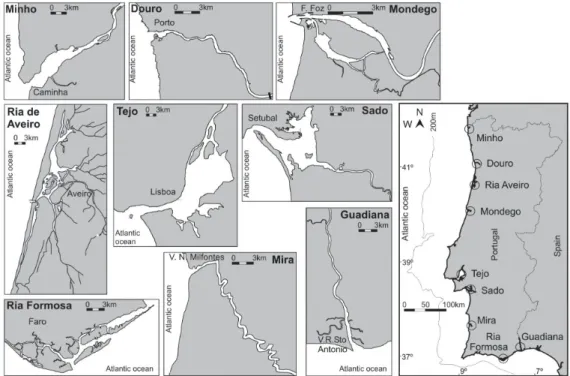
Nine estuarine systems located in the Portuguese coast were sampled: Minho, Douro, Ria de Aveiro, Mondego, Tejo, Sado, Mira, Ria Formosa and Guadiana (Fig. 1).
These systems differ considerably in their geomorphologic and hydrologic characteristics (Table 1), as well as in the level and type of anthropogenic pressures they are subjected to (Vasconcelos et al. 2007). Briefly, the Tejo and the Sado estuaries are the largest systems, while the Mira estuary has the smallest area (5 km2). Ria de Aveiro and Ria Formosa are shallow coastal lagoon systems with large intertidal areas. Mean depth varies between 1 and 6 m, which indicates that shallow areas predominate in all estuaries. River flow varies strongly: the Minho, Douro and Tejo have mean flow values higher than 300 m3s-1, contrasting with the low freshwater flow into estuaries such as the Mira and Ria Formosa.
2.2. Sampling surveys
The fish assemblages of the nine estuarine systems were sampled in May and July 2006 (each month constitutes a temporal replicate). The spring and summer months were chosen as they have been reported to present the highest number of estuarine fish species and abundances in these systems (Vasconcelos et al. 2010). Sampling covered the whole estuarine salinity gradient through the oligohaline (0.5 - 5), mesohaline (5 - 18) and polyhaline (18 - 30) areas.
Figure 1. Estuarine systems sampled in the Portuguese coast.
Sampling took place during the night, using a beam trawl (2 m wide beam, tickler chain, net with 5 mm mesh in the cod end). A GPS was used to record geographic coordinates at the beginning and end of each tow. Trawls were towed at a constant speed, had a standard duration of 10 min and covered a mean area of 862 m2. Ten replicate tows were made per site during ebb tide. All fish caught were stored and transported on ice to the laboratory and preserved frozen. Subsequently, individual fish were identified, counted, measured (total length with 1 mm precision) and weighted (wet weight with 0.001 g precision).
At the beginning of each trawl, salinity, dissolved oxygen (%) and temperature (ºC) were measured with a multi parameter probe (WTW). Depth (m) was also registered. In each sampled area three replicates of sediment were collected using a Van Veen grab (0.05 m2) for the determination of mean percentage of mud in the sediment (percentage of dry sediment not retained in a 0.063 mm calibrated sieve), and additional three replicate samples were collected for determination of the mean density of the most abundant taxonomic groups of macrozoobenthos (individuals retained in a 0.5 mm calibrated sieve): Annelida, Arthropoda and Mollusca. These groups’ densities represent an adequate measure of prey availability as they constitute the main prey for the most abundant estuarine fish species (Stoner et al., 2001; Nicolas et al., 2007) (see Vasconcelos et al. 2010).
Estuary maps combined with data on salinity from literature and from previous studies were used to map the limits of three saline zones (oligohaline, mesohaline and polyhaline). Within each estuary, the area of each saline zone was determined using ArcGIS 9 (ESRI Inc.).The percentage of intertidal areas in each estuary and the presence of other habitat types (mudflat, saltmarsh, seagrass and subtidal channels) were obtained from França et al. (2009). The relative distance to the estuary’s mouth (from 0 at the estuary’s mouth to 1 at the most distant site) was determined in ArcGIS 9 (ESRI Inc.).
Table 1. Main geomorphologic and hydrologic characteristics in several estuarine systems along the
Portuguese coast.
2.3. Data analysis
Fish species’ density and biomass were determined individually for each tow and expressed in individuals.1000 m-2 and g.1000 m-2, respectively. Root (1967) defined guild as a group of species that exploit the same class of environmental resources in a similar way. In the present study, each fish species was classified into a functional guild according to Elliott and Dewailly (1995). The ecological guilds considered truly estuarine resident species (ER), marine adventitious visitors (MA), diadromous (catadromous/anadromous) migrants (CA), marine seasonal migrants (MS), marine juvenile migrants (“nursery” species) (MJ) and freshwater adventitious visitors (FW). The proportion of each guild was calculated according to species number and the number of individuals from each species.
Generalized linear models (GLM) were conducted in R software (R Development Core Team 2005), to investigate: (1) the variation of fish species richness throughout the nine estuaries, in relation to their main geomorphologic and hydrologic characteristics, using as predictors: total estuarine area (m2), mean annual river flow (m3 s-1), mean depth (m), residence time (days), volume (106 m3), anthropogenic pressure index (according to Vasconcelos et al., 2007), percentage of intertidal area, latitude, percentage of oligohaline area, percentage of mesohaline area and percentage of polyhaline area and; (2) the variation of fish species richness within each estuary in response to a set of predictor environmental variables measured locally and important characteristics of the system. Each tow corresponded to a sample in the analysis and the predictors used were: dissolved oxygen (%), salinity, temperature (ºC), depth (m), and percentage of mud in the sediment, distance to the estuary’s mouth, prey density and habitat type (mudflat, saltmarsh, seagrass and subtidal channels). As some of the hydrologic and geomorphology characteristics of the estuaries were highly correlated (r >0.80), not all were used in the analyses.
GLM are an extension of linear models which allow the incorporation of non-normal distributions of the response variable and transformations of the dependent variables to linearity (McCullagh and Nelder 1989). A gamma distribution (only positive densities) with a log link function was used to model the non-zero catches. The GLM was built with an additive
Estuaries Total area (km2) River flow (m3.s-1) Mean depth (m) Residence time (days) Volume (106 m3) Latitude (ºN) Intertidal area (%) Minho 23 300 3 2 70 41.9 9 Douro 10 450 4 2 59 41.1 11 Ria de Aveiro 74 40 2 17 84 40.6 87 Mondego 10 79 2 3 22 40.1 64 Tejo 320 300 5 25 1900 38.7 40 Sado 180 40 6 30 500 38.5 44 Mira 5 3 4 15 27 37.7 42 Ria Formosa 91 2 1 2 92 37.0 81 Guadiana 20 80 3 12 100 37.2 24
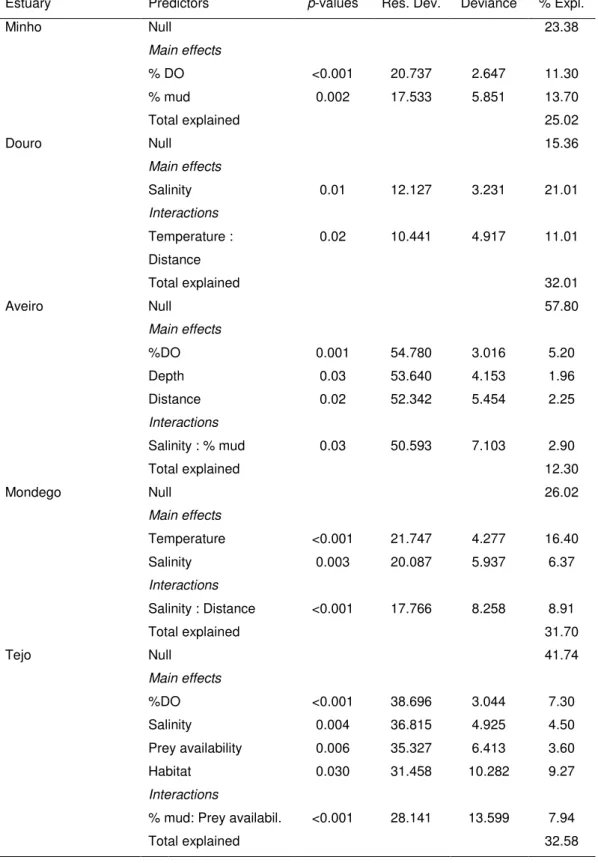
significant predictors were added to the model to determine the residual deviance, the percentage explained by each predictor and the total percentage of the deviance explained by the model. The final model was fitted only with the significant variables. A significance level of 0.05 was considered in all test procedures. Percentage of total deviance explained and relative contribution of each factor were evaluated for each model.
In order to investigate the distribution patterns of species in the areas and estuaries considered, a correspondence analysis was performed with fish abundance and biomass data of the most abundant species, using CANOCO 4.5 software (Ter Braak and Šmilauer 2002).
3. Results
3.1. Estuarine characterisation and fish assemblages
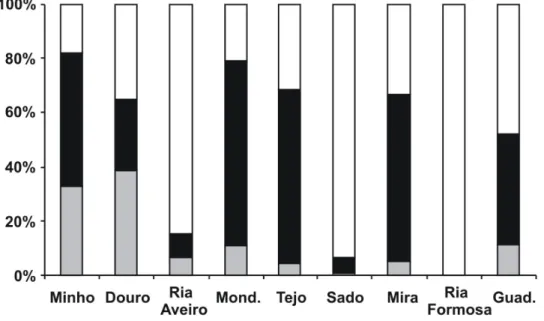
The proportion of each saline area varied considerably among estuaries (Fig. 2). The Douro estuary presented the largest oligohaline area of all the estuaries studied. The mesohaline area was dominant in the Minho, Mondego, Tejo and Mira estuaries, while for the Ria de Aveiro, Sado and Ria Formosa estuaries, the polyhaline area comprised almost the total area of the estuary (Fig. 2).
Figure 2. Proportion of each saline area in the estuaries sampled along the Portuguese coast ( -
polyhaline; - mesohaline; - oligohaline).
A total of 71 fish species were caught in the nine estuarine systems although density was dominated by only a few. The occurrence, density and biomass of the several different fish species varied markedly amongst estuaries (Table 2). Only three species occurred in all nine estuaries: Pomatoschistus microps, Pomatoschistus minutus and Dicentrarchus labrax. Nevertheless species like Atherina sp., Diplodus sargus, Diplodus vulgaris, Gobius niger, Liza
ramada, Solea senegalensis and Solea solea were present at least in seven estuaries. Certain
species such as Platichthys flesus were mainly caught in northern estuaries and contrarily species such as Halobatrachus didactylus were caught only in southern estuaries. The most
Table 2. Fish species found in the nine estuarine systems sampled along the Portuguese coast: ecological guilds (EG), mean density (D) (individuals.1000 m-2) and mean biomass (B) (g.1000 m-2).
Species EG Minho Douro Ria Aveiro Mondego Tejo Sado Mira Ria Formosa Guadiana
D B D B D B D B D B D B D B D B D B
Alosa alosa (Aalo) CA - - - 0.04 0.06 - - - -
Anguilla anguilla (Aang) CA 1.64 35.09 0.18 20.58 0.61 35.09 0.74 51.34 - - 0.05 1.00 0.13 7.21 0.64 22.71 0.03 11.45
Aphia minuta (Amin) ER - - - 0.4 0.48 - - 0.03 0.02 - - - -
Argyrosomus regius (Areg) MA - - - 0.76 2.46 - - - -
Arnoglossus laterna (Alat) MA 0.07 0.22 - - - 0.21 3.66 - -
Atherina sp. (Ath) MJ 0.17 0.67 - - 0.03 0.10 0.68 0.38 0.09 0.15 0.91 1.49 2.48 1.90 0.45 0.54 0.14 0.12
Barbus sp. (Bar) FW - - 0.08 129.10 - - 0.02 35.95 0.13 - 0.03 62.71 - - - - 0.19 146.90
Bothus podas (Bpod) MA - - - 0.01 <0.01 - - - -
Callionymus lyra (Clyr) MA - - - - 0.06 0.99 - - - - 0.6 0.55 - - - -
Callionymus maculatus(Cmac) MA - - - - 0.53 6.12 - - - - 0.04 0.09 - - - -
Callionymus reticulatus (Cret) MA - - - 0.05 0.04 - - - -
Chelidonichthys lucernus (Cluc) MA 0.04 0.04 0.30 5.38 0.02 0.44 0.02 3.51 - - - - 0.02 0.37 - - - -
Cobitis paludica (Cpal) FW 0.03 0.001 - - - -
Conger conger (Ccon) MA - - - 0.06 0.10 - - 0.03 3.64 - - - -
Dentex dentex (Dden) MA - - - 0.04 0.17
Dicentrarchus labrax (Dlab) MJ 0.03 0.22 0.82 20.49 0.69 28.48 2.53 29.28 1.98 7.76 0.01 0.21 0.43 8.70 0.10 51.28 0.24 10.16
Diplodus annularis ( Dann) MJ - - - 22.22 16.37 - -
Diplodus bellottii ( Dbel) MJ - - - - 0.01 0.06 - - 0.42 5.68 9.05 31.51 - - 4.56 15.38 0.16 0.05
Diplodus puntazzo (Dpun) MJ - - - 0.02 0.64 0.16 2.65 0.44 26.7
Diplodus sargus (Dsar) MJ - - - - 0.05 0.12 0.43 8.49 0.02 0.01 0.11 2.17 4.96 8.11 3.95 8.10 0.24 13.68
Diplodus sp.(Dip) MJ - - - 0.12 <0.01 - - - - 0.01 <0.01 1.32 11.17 0.02 <0.01
Diplodus vulgaris (Dvul) MJ - - - - 0.75 2.59 8.85 21.7 0.05 0.30 5.06 62.98 4.25 20.47 87.41 73.37 2.07 14.01
Echiichthys vipera (Evip) MS 4.24 50.07 1.04 14.66 - - 0.06 0.19 - - - - 0.03 - - - - -
Engraulis encrasicolus (Eenc) MS - - - 0.05 0.51 0.18 0.01 2.52 8.20 0.43 0.53 - - - -
Species
EG Minho Douro Ria Aveiro Mondego TEjo Sado Mira Ria Formosa Guadiana
D B D B D B D B D B D B D B D B D B
Gobius niger (Gnig) ER - - 0.03 0.10 0.82 9.38 1.39 16.73 0.33 0.96 9.03 44.44 1.02 5.89 3.80 10.91 4.62 22.36
Gobius paganellus (Gpag) ER - - - 0.11 8.92 - -
Halobatrachus didactylus ( Hdid) ER - - - 0.34 47.38 11.26 414.4 2.59 59.25 4.69 93.48 4.70 246.5
Hippocampus hippocampus (Hhip) MA - - - 0.34 19.41 0.04 0.16
Hippocampus ramulosus (Hram) ER - - - 0.67 <0.01 - -
Hippocampus sp.(Hipp) ER - - - 0.27 - - - 0.54 <0.01 0.07 <0.01
Lipophrys pholis (Lpho) MA - - - 0.33 0.05 - -
Liza aurata (Laur) MS - - - - 0.01 0.09 - - 0.15 23.79 0.10 8.99 - - 0.03 10.90 - -
Liza ramada (Lram) CA 0.03 0.04 0.04 2.28 0.18 4.35 5.37 172.5 0.16 58.77 0.22 15.14 0.37 4.00 - - 0.10 42.59
Liza sp. (Liza) CA - - - 0.17 10.17 - - 0.28 0.001 - - - -
Monochirus hispidus (Mhis) MA - - - 5.76 57.39 - - 0.23 4.43 - -
Mullus barbatus (Mbar) MA - - 0.05 0.08 0.01 0.03 0.38 0.80 - - 0.03 0.11 0.31 0.39 0.08 1.30 0.44 4.03
Mullus surmuletus (Msur) MA - - 0.02 0.02 - - 0.12 - 0.02 0.28 0.07 0.01 - - 0.18 7.04 0.12 0.91
Nerophis ophidian (Noph) ER - - - 0.04 - - - 0.63 0.02 - -
Pagrus pagrus (Ppag) MS - - - - 0.34 0.46 0.04 0.17 0.01 0.01 0.14 0.70 - - - -
Platichtys flesus (Pfle) MJ 2.40 45.62 12.4 1056.60 0.24 5.52 2.74 10.28 - - - -
Pomatoschistus microps (Pmic) ER 1.45 0.53 0.82 0.42 2.81 0.99 2.88 0.87 117,2 32.07 19.57 8.68 6.83 1.90 0.59 0,08 34.1 11.1
Pomatoschistus minutus (Pmin) ER 0.37 0.06 0.18 0.11 0.55 0.39 1.31 1.14 18.42 7.03 0.67 0.35 0.57 0.21 0.22 0.24 0.80 0.34
Pomatoschistus sp. (Pom) ER - - - 0.09 0.09 - -
Raja clavata (Rcla) MA - - - 0.05 13.27 - -
Raja undulata (Rund) MA - - - 0.03 67.22 - - 0.05 1.15 - -
Salmo trutta (Stru) CA 0.02 1.35 - - - -
Sardina pilchardus (Spil) MS - - - - 0.24 0.13 - - 0.09 0.34 - - 0.03 0.08 - - - -
Sarpa salpa (Ssal) MS - - - 0.03 0.49 - - 6.8 13.75 - -
Scophthalmus rhombus (Srho) MJ 0.14 1.91 - - - - 0.24 3.55 - - - -
Scorpaena notata (Snot) MA - - - 0.02 - - - 0.45 - 0.03 -
Scorpaena porcus (Spor) MA - - - 2.40 - 0.02 -
Solea lascaris (Slas) MA - - - 0.04 0.12 - - - -
Species
EG
Minho Douro Aveiro Mondego Tejo Sado Mira Ria Formosa Guadiana
D B D B D B D B D B D B D B D B D B
Solea senegalensis (Ssen) MJ - - 0.12 14.07 0.56 4.46 0.15 1.25 0.44 13.36 1.60 20.51 0.18 7.55 0.07 1.91 0.04 1.67
Solea solea ( Ssol) MJ 0.34 13.48 0.69 40.80 0.94 23.76 9.59 73.37 0.52 4.79 0.61 10.31 5.49 30.09 - - 1.06 16.44
Solea sp. (Sol) MJ - - - 1.64 <0.01 - - - -
Sparidae n.i. (Spar) MJ - - - 0.03 0.001
Sparus aurata (Saur) MA - - - 0.34 7.29 0.01 0.27 0.14 3.79 - - 0.32 3.34 - -
Spondyliosoma cantharus (Scan) MJ - - - - 0.05 0.06 1.14 3.75 - - 0.53 6.40 2.73 1.19 6.03 13.88 0.07 0.05
Symphodus bailloni (Sbai) MA - - - - 0.53 7.17 0.39 11.06 0.01 0.14 0.03 0.90 0.07 0.31 6.11 36.64 - -
Symphodus cinereus (Scin) MA - - - 0.09 0.95 - - 3.76 19.54 - -
Symphodus sp.(Symp) MA - - - 0.53 22.73 0.03 <0.01
Synaptura lusitanica (Slus) MA - - - 0.02 12.74
Syngnathus abaster (Saba) ER - - - - 1.43 1.66 - - - 0.39 0.14 - -.
Syngnathus acus (Sacu) ER 0.09 0.16 0.04 <0.01 1.10 2.55 - - 0.24 1.68 - - - - 0.54 2.03 0.10 1.08
Syngnathus sp. (Syng) ER 0.04 <0.01 - - - - 0.04 0.62 - - - 0.12 - 0.05 -
Syngnathus typhle (Styp) ER - - - - 0.02 <0.01 - - 0.06 <0.01 0.01 0.01 0.04 0.08 1.68 6.11 - -
Torpedo torpedo (Ttor) MA - - - 0.14 19.26 0.11 8.85 - - - -
Trachurus trachurus (Ttra) MA - - 0.05 0.61 - - - 0.01 0.04 - - - -
Umbrina canarinensis (Ucan) MA - - - 0.10 0.23
Species TOTAL 11.1 149.5 16.86 1176.2 12.58 134.9 41.57 465.1 142.0 207.8 69.09 854.6 33.18 167.9 162.8 496.6 50.1 583.5
Species number 16 16 25 30 25 34 26 40 32