Shaving as a Subscription
Analysis of Portuguese male consumers interest on
buying razors and blades by subscription
Pedro Martins
Dissertation written under the supervision of Miguel Fontes Rita
Dissertation submitted in partial fulfilment of requirements for the MSc in
Management with specialization in Strategic Marketing, at the
3
Title: Shaving as a Subscription – Analysis of Portuguese male consumers interest on
buying razors and blades by subscription
Author: Pedro Martins
Abstract: Men’s grooming market has been growing significantly, mostly because men
are increasingly concerned about their appearance. This self-image consciousness made this market evolve and present today a large variety of products specifically designed for men. The old razors and blades category still represents a big slice of this market and continues being dominated by Gillette. However, new players have recently entered the shaving market with a subscription service that delivers razors and blades to consumers’ homes at a lower price. This concept has proven to be a huge success and revolutionized the US market. This study intends to explore the interest of Portuguese male consumers in this service, firstly by identifying the main advantages and disadvantages consumers may have, then their possible interest and the predictors of that interest, and finally by addressing their loyalty to the brands they use. For this purpose, past literature on this topic and related subjects were reviewed, 14 qualitative interviews were conducted, as well as an online survey with a sample of 110 participants. Findings showed that the main benefit for consumers was paying less, whereas the main drawbacks were the possibility of having the product damaged when delivered or delivered to the wrong address. The majority of respondents were interested in subscribing and their reaction to the concept and confidence about the product’s quality were key determinants. Additionally, results exhibited high levels of loyalty from shaving consumers. The final assessment is that these services have a good probability to succeed in Portugal.
Keywords: subscription, razors-and-blades, male grooming, shaving subscriptions,
4
Título: Barbear por Subscrição - Análise do interesse dos consumidores portugueses na
compra de lâminas de barbear por subscrição.
Autor: Pedro Martins
Resumo: O mercado de cuidados masculinos tem crescido de forma significativa, muito
suportado pela crescente preocupação com a aparência. Esta consciência com a própria imagem fez este mercado crescer e apresentar hoje uma enorme variedade de produtos destinados aos homens. A categoria de lâminas de barbear continua a representar grande parcela deste mercado e a ser dominada pela Gillette. Contudo, novos players entraram recentemente no mercado de barbear com um serviço de subscrição que entrega em casa dos consumidores lâminas a um preço inferior, tendo registado um grande sucesso e revolucionado o mercado americano. Esta tese pretende analisar o interesse dos consumidores portugueses neste serviço, primeiro através da identificação das principais vantagens e desvantagens que os consumidores possam ter, depois explorando o seu possível interesse em subscrever e os fatores determinantes para tal e finalmente tentando entender a lealdade dos consumidores. Com este propósito, a literatura relativa a este tópico foi revista, 14 entrevistas qualitativas e um questionário com uma amostra de 110 participantes foram realizados. Os resultados mostram que a principal vantagem é pagar menos e as desvantagens a possibilidade de o produto estar danificado aquando da entrega ou ser entregue noutra morada. A maior parte dos participantes mostrou interesse em subscrever e a sua reação ao conceito e a segurança sobre a qualidade do produto foram os fatores determinantes. Adicionalmente, os resultados mostraram que os consumidores portugueses são bastante leais às suas marcas. De um modo geral, prevê-se que estes serviços tenham uma boa probabilidade de sucesso em Portugal.
Palavras chave: subscrição, lâminas de barbear, cuidado masculino, produtos de beleza
masculinos, barbear por subscrição, serviço
5
Acknowledgements
I’m kindly thankful for all the precious support I received over these last four months. No doubt this was not a one-person job, and for that I would like to specially thank:
Miguel Fontes Rita, my dissertation tutor, not only for his guidance and criticism that were crucial to define my thesis path, but also for his honesty at every moment and his friendly positive attitude that made every meeting we had to be a good time. It was a pleasure, Miguel.
My family, for always being there to help and for the interest they kept on my thesis until the very end that encourage me to keep going.
Finally, I thank all people/friends that participated in my research, in both, the interviews and the online survey. Without them it would be impossible to answer to any research question and to conclude my work.
6
Table of Contents
Chapter 1: Introduction... 8
1.1 Background ... 8
1.2 Problem Statement and Research Questions ... 9
1.3 Managerial and Academic Relevance ... 10
1.4 Dissertation Structure ... 10
Chapter 2: Literature Review ... 11
2.1 Razor and Blades Model ... 11
2.2 Subscription Business Model ... 11
2.3 Razor Blades Subscription ... 12
2.4 Subscription Boxes ... 13
2.5 Shaving Subscriptions ... 14
2.5.1 Main Players ... 14
2.5.2 How much can costumers save? ... 17
2.5.3 Who is taking the opportunity? ... 18
2.5.4 There is more to shave ... 19
2.6 Portuguese Shaving Situation ... 20
2.7 Loyalty and Inertia ... 21
Chapter 3: Methodology ... 23 3.1 Research Method ... 23 3.2 Research Instruments ... 23 3.2.1 Qualitative Data... 23 3.2.2 Quantitative Data ... 26 3.2.3 Measurement Scales ... 28
Chapter 4: Analysis and Results ... 29
4.1 Data Collection ... 29
4.2 Sample Characterization ... 29
4.3 Descriptive Statistics ... 29
4.3.1 Shaving Habits ... 29
4.3.2 Disposable blades attributes importance and satisfaction ... 30
4.3.3 Shaving as a Subscription ... 31
4.4 Inferential Statistics ... 32
Chapter 5: Conclusion, Limitations and Future Research ... 36
5.1 Conclusion ... 36
7
References ... 39
Appendices ... 44
List of Tables
Table 1: Shaving subscription plans offered by the top 5 brands in US (4-pack cartridges) ..…15Table 2: Gillette Walmart prices vs Subscription plans in US (4-pack cartridges) …………....18
Table 3: Shaving subscription costumers generation demographics in US……….18
Table 4: Disposable blades prices in the brick-and-mortar Portuguese market (4-pack cartridges) ………..……21
Table 5: Average price per blade PT vs US ………21
Table 6: Mean, standard deviations and ANOVA repeated measures on variable “concept feature’s relevance” ……….……32
Table 7: Means and standard deviations on variable “worry about concept possible disadvantages” ……….…33
Table 8: Binomial Test on variable “interest in subscribing” ……….………33
Table 9: Logistic regression results for dependent variable “interest in subscribing”…...…..…34
Table 10: Binomial test for variable “purchased a different brand” ………...……35
Table 11: One-sample t-test statistics for variables “in case there are promotions on other brands that not mine, I feel tempted to buy” and “I’m loyal to the brand I use” ………35
Table 12: Sample characterization (N = 110) ………..52
Table 13: Product attributes importance ……….…….52
Table 14: Disposable blades attributes satisfaction ……….53
Table 15: Disposable blades shaving statements ……….……53
Table 16: Concept features’ relevance ………54
Table 17: Worry about concept possible disadvantages ……….54
Table 18: Concept Statements ……….……55
Table 19: Max price difference ………...55
Table 20: Interest in subscribing ……….55
List of Figures
Figure 1: Monthly willingness to pay based on shaving frequency in US ………..448
Chapter 1: Introduction
1.1 Background
Traditionally, aesthetic appearance has most of the times been related to women in western societies (Elsner, 2002). In recent years, this notion has not only been losing its strength, but also recent studies found that men are even slightly more concerned than women regarding their appearance (Cheng et al., 2010). Originated in 1994 by Mark Simpson, the term metrosexual is used frequently nowadays to describe a city man who is conscious of his appearance and is willing to spend money and time on it. This self-image consciousness is found to have a significant and positive relationship towards the consumption of male grooming products (Cheng et al., 2010).
Consequently, men’s grooming market has been growing significantly, being estimated to be worth around US$60,7 billion in 2020, a value US$13,5bn higher than the 2015 market value (Euromonitor 2016). This fast-pace market that once was essentially composed of shampoos, deodorants and shaving utilities, has now a much more complex and wider product line, with moisturizers, facial cleansers, anti-agers, etc., all directed to men.
Nevertheless, some categories have always been dominated by some players since the beginning. This is the case of men’s shaving (Tellis and Golder, 1996), valued at US$14,9bn in 2015 and expected to reach US$18,1bn by 2020, representing 30% of total grooming sales (Euromonitor 2016). Shaving products have always been dominated by Protector & Gamble’s brand Gillette that in 2016 had 54% of U.S. market share (P&G Annual Report 2017), followed by its old rivals Schick (15%) and Bic (7%).
But the old razor and blades market appears to be finally changing, and Gillette is now being threatened by new players. Online sellers have turned Gillette’s U.S. market share down six straight years from 70% in 2010 to 54% in 2016 (Terlep, 2017) with their subscription boxes approach.
Subscription business models are taking over brick-and-mortar stores and changing consumer’s attitude and behaviour towards traditional shopping (Reinartz, 2016). The concept was born in 1500 by the hands of European map publishers that would distribute
9
to their costumers updated versions of their maps, which were expanded as new territories were conquered (Rudolph et al., 2017).
Today this concept has evolved to its latest stage of subscription boxes, in other words, subscription-based online services (SOS) (Woo and Ramkumar, 2017). SOS’s refer to an e-business which delivers on a regular basis a box of goods directly to consumer’s home for a periodically fee. There were approximately two thousand subscription box retailers in the USA that generated over $5bn revenue in 2014 (Pike, 2016). These retailers are responding to a variety of consumer needs from apparel, to beauty products, to groceries and so on, which have woken up massive retailers, such as Amazon, Target and Walmart, that started to implement their own subscription boxes.
These boxes are acting as true game changers, even in traditional games where all seemed to be stuck in time and there were no substantial changes. With a simple subscription approach of delivering blades and razors at a lower price directly to costumer homes’, companies such as Dollar Shave Club and Harry’s, are revolutionizing the way consumers shop for their shaving needs and making a strong impact to this market (Fulgoni, 2018). What back then where only small start-ups with a different idea, are now becoming giants in the shaving online arena and examples that are encouraging others to enter this market with similar strategies. How far can they go?
1.2 Problem Statement and Research Questions
The aim of this research is to assess the interest of Portuguese male consumers on buying razors and blades through online subscriptions, using the example of companies that have been doing this successfully. These findings may help to understand the main benefits and barriers consumers have about this service, along with their attitudes, perceptions and purchase intentions. The following research questions will be addressed:
RQ1: What are the main drivers in buying razors and blades through subscription? RQ2: What are the main barriers in buying razors and blades through subscription? RQ3: Are consumers interested in subscribing?
RQ4: What are the predictors that increase the probability of subscription? RQ5: Are consumers loyal to shaving brands?
10
In the first two questions the objective is to understand the importance consumers’ give to the possible advantages and disadvantages of the service and consequently discover their main drivers and barriers. Research questions 3 and 4, aim to know if Portuguese consumers are interested in subscribing to the service and to predict the determinant factors (socio-demographic, attitudinal or behavioural) related to their interest. The last research question intends to discover if consumers are loyal to the brands they use, in order to understand how hard, it could be for them to change their usual brand for a different one with a subscription service.
1.3 Managerial and Academic Relevance
From a managerial point of view, this study would be of great importance to razor and blades companies who might want to implement their shaving subscription services in Portugal, since not only consumer’s perceptions, shaving routines, preferences and satisfaction regarding the existing shaving products and shaving subscriptions were analysed, but also price comparisons (US vs PT) were done. Moreover, this research may serve as a market testing example to be applied in other countries.
Regarding the academic relevance, this study adds to the scarce research there is on this topic (shaving as a subscription) and introduces to the Portuguese market a new distribution channel of a product they already know. It contributes with first reactions and insights to this service and it also develops the existing literature on Portuguese male shavers’ behaviour and loyalty.
1.4 Dissertation Structure
This thesis is composed of 5 chapters: chapter 1 includes some background on the topic and introduces the problem statement and research questions. The second chapter involves all the literature review done related to the different aspects of the topic. The third chapter describes the methodology used in research. On chapter 4 results are analysed and presented in order to answer to the research questions. Finally, chapter 5 concludes the main insights, states the study limitations and presents suggestions for future research.
11
Chapter 2: Literature Review
2.1 Razor and Blades Model
The famous razor and blades model follows a simple strategy which is to sacrifice returns on the razor handle in order to derive the bulk of profit from the replaceable blades (Picker, 2010). This is the reason behind blade cartridges high prices for such a simple product, but it wasn’t always like this.
It was in 1903 that King Gillett introduced an expensive safety razor with low-priced disposable blades. Before that men used straight razors or expensive disposable safety razors (Tellis and Golder, 1996). Gillette disposable blades became very popular and successful in part due to the US government continuous blade orders for the army during both World Wars and the few competitive threats since the product was patented, meaning no other company could attach a razor handle to a disposable blade if not Gillette itself (Picker, 2010).
From 1904 to 1921 Gillette patents ensured a clear path for the company, that set an initial price of $5 for the razor and a set of blades, which back then was equivalent to a premium product like the iPod (Picker, 2010). The razor and blades model we know today, only appeared after the patents expired with the entry of other players to the disposable blade market, and it is widely used today in many industries, such as cell phones, inkjet printers, coffee machines or video games (Matzler et al., 2013).
2.2 Subscription Business Model
Subscription services have been evolving along the years, in the 17th century they were mostly attached to information products, such as books and magazines. With the start of digitalization, these were re-born and linked to digital goods, as multimedia streaming services, like Spotify and Netflix (Rudolph et al., 2017). Currently, these are taking on the World of consumer goods through box subscriptions, delivering at consumers’ homes products from all sorts of categories such as underwear (e.g. MeUndies), groceries (e.g. Blue Apron) and razors (e.g. Harry’s) (Reinartz, 2016).
12
Rudolph and colleagues (2017) defined three types of subscription models and their corresponding value propositions: i) predefined subscriptions that ship common products – increase convenience; ii) curated subscriptions that ship products within a category selected according to consumers preferences – reduce choice complexity; and iii) surprise subscriptions that ship boxes with products within a category that cannot be controlled by consumers – stimulate inspiration.
Where is this trend coming from? Atif (2002) found that the “five most common reasons to buy online are the reduction of shopping time, time flexibility, less physical effort, saving of aggravation and the opportunity to engage in impulse buying or directly responding to an advertisement”, these factors relate to convenience, that is a strong motivator for consumers to shop online, since consumers regard offline shopping as inconvenient (Chiang and Dholakia, 2003). On the other side, Thompson (2002) concluded after a survey on Singapore internet users that the main obstacles consumers find to online buying are the difficulty to judge a product’s or service’s quality and not feeling comfortable or secure on giving their credit card information through the internet.
2.3 Razor Blades Subscription
Taking on Rudolph and colleagues (2017) subscription types, razor and blades belong to the predefined type, where costumers guarantee access to everyday items necessary to fulfil regular needs, such as shaving. The key is in convenience and “handing over control to consumers”, allowing them to adjust their subscription in terms of product offer, frequency and shipped amount whenever they want and feel the need to.
When developing purchase intentions, store environment can be a critical factor by providing significant cues (Chao and Schor, 1998). Elements such as music level and type, colours, lights, shape and scent, they all affect consumers perceptions and behaviours in stores (Loo-Lee et al., 2005), but also store layout and architecture have influence in this decision (Baker et al.,1992). Bearing this in mind, some companies and retailers already have their special corner for men’s grooming. Can this be a handicap for the blade and razor subscription model? Levin et al. (2003) stated that these handicaps are greater in some products, typically in those with a “high touch” need (e.g. apparel), and inferior in others, with a “low-touch” need (e.g. airline tickets). Lynch and colleagues (2001) had the same reasoning, where “high-touch” products are the ones that the
13
consumer has the need to touch or to experience before buying, in contrast with “low-touch” products that are standardized and do not require examination to assess their quality.
Following this logic, razors and blades seem to belong to the “low-touch” category, although traditionally men from all over the globe go to retail stores to buy them. Now that new businesses have agitated this market, Gillette looks to have stepped into the innovator’s dilemma (Christensen, 1997) of putting too much emphasis on customers’ current needs and failing to adopt new technology or business models (this is the case) that will meet future and unstated costumers’ needs.
2.4 Subscription Boxes
Data collected from the US, UK and Australia showed that subscription box shoppers tend to have around 25 to 39 years old, an income slightly above average (6%-11%) and are typically female (56%-58%) (Fetto, 2016). In a recent study where all participants were a member of some subscription box service, more than half of the respondents said they would be willing to pay between $10-$25 subscription fee for a box (Lee et al., 2017). Moreover, product quality and product uniqueness were found to be significant predictors of costumers’ attitude towards subscription boxes, whereas price assortment and product surprise were found to be not significant.
As for those who are not members of any subscription box service, Woo and Ramkumar (2017) discovered that consumers who seek utilitarian purposes, such as convenience, will have positive attitudes towards fashion and beauty subscription-based online services, that will lead to purchase intention. Subscription models add great value to the consumer in terms of convenience, thus generating utilitarian benefits, which can significantly increase consumer’s positive attitude to these services (Childers et al., 2001). Also, consumers who seek to gain those benefits tend to choose for shopping alternatives which help achieve such goals (To, Liao, & Lin, 2007). This supports Wang et al. (2004) study results which showed that convenience, essentiality and usage frequency are the top three factors that differentiate willing-to-pay from unwilling-to-pay groups, along with added value, perceived quality and perceived fairness. Only security concerns where found not to be significant.
14
These studies appear to perfectly represent the value proposition of razor and blades subscription services, where customers can get the value of having essentially the same product as they would in any major competitor, at a much lower price and delivered to their door, hence the convenience of not having to make a trip to the store every time they need blades, especially because of the waiting time it takes for the store employee to get the cartridges that usually are locked in glass cabinets. This situation happens because blades are one of the most frequently shoplifted consumer items (15-20% of Gillette’s blades are stolen between manufacturer and point of sale), since they have a small size, are easily concealable and expensive (Datta, 2016).
2.5 Shaving Subscriptions
2.5.1 Main Players
Dollar Shave Club was the first company to stand up against the shaving industry in 2011 with this “new” business model, being today the biggest player in the online market with a share of 52,4%. Harry’s started two years later and after ten months raised a $122.5M investment that was used to buy a 93-year-old German razor-blades factory and build a team of more than 600 engineers, designers, craftsmen and chemists, being the third player in the market with a 9,4% stake, just after Gillette (21,2%) who launched their subscription service in 2017, after realizing the strong impact these two start-ups were making (Livsey, 2017). Then there is Dorco (4,8%), the South Korean market leader who is also Dollar Shave Club’s blades outsource and Schick (3,7%), who is owned by Edgewell Personal Care and also sells in Europe under the Wilkinson Sword brand name (Statista, 2016). Other brands are also trying to compete in this tough market, not only in the US, but also in Europe where Dollar Shave Club and Harry’s are already present and trying to spread this subscription fever on consumers. Each one of these top players have specific subscription offers:
- Dollar Shave Club offers two plans: “The Executive”, four 6-blade cartridges for $9 and “The 4X”, four 4-blade cartridges for $6. They ship to the US, Canada, UK and Australia on a monthly basis or every other month according to consumer’s preferences (Dollar Shave Club, October 2018).
15
- Gillett offers two plans: “Mach3”, four 3-blade cartridges for $10 and “Fusion Proshield” four 5-blade cartridges for $20. Additionally, costumers have every 4th order
for free when they choose to subscribe, if not, they can reorder anytime via mobile message or email. They ship only to the US and deliver every 1 to 6 months (Gillette on Demand, October 2018).
- Harry’s has a trial set that is mandatory before subscribing, it includes the “Truman handle”, a five-blade cartridge, a foaming shave gel and a travel blade cover for $5,15 (you only pay delivery). Then their plans consist on 5-blade cartridges that are sold in packs of 4, 8 and 16, for $9,79, $19,58 and $37,86 respectively. Besides “Truman”, they sell “Winston” individually, a designer razor where you can engrave your initials for $23,50. They ship the US and UK for every 2 to 5 months (Harry’s, October 2018). - Dorco offers three plans: “Signature”, four 3-blade cartridges for $5,10; “All-rounder”, four 4-blade cartridges for $6.40 and “Super Six”, four 6-blade cartridges for $7,78. They ship to the US and UK for every 1 to 3 months (Dorco, October 2018).
- Schick offers one plan: “Hydro Sense”, four 5-blade cartridges for $15,49. They ship to the US for every 2, 4 or 6 months (Schick, October 2018).
Brands 3 Blades 4 Blades 5 Blades 6 Blades Avg per Blade
Dollar Shave C - $6 - $9 $0,38
Gillette $10 - $20 - $0,92
Harry’s - - $9,79 - $0,49
Dorco $5,10 $6,40 - $7,78 $0,57
Schick - - $15,49 - $0,77
Table 1: Shaving subscription plans offered by the top 5 brands in US (4-pack cartridges)
It’s clear to see that Dollar Shave Club is the cheapest seller (average per blade is $0,38), whereas the two oldest players, Gillette and Schick, keep being the most expensive ones also in subscriptions (averages per blade are $0,92 and $0,77, respectively). Dorco presents the highest product variety in number of blades, whilst Harry’s keeps a solid bet in the crowded 5-blade segment with their authentic razor which is the most affordable option within the segment.
16
Apart from product assortment, price distinctions and delivery periodicities that differentiate each brand, there are some similarities related to the service that they share. In addition to razors and blades, these subscription boxes always try to sell complement products to the shaving segment, such as shaving gels, post shave-balms, and also to the beauty section, such as shower gels, hair clays and face washers. By bundling complementary products, these companies not only increase their average revenue per user, but also create on consumers a higher purchase intent than if they bundled unrelated products (Harlam et al., 1995). Furthermore, Dolan (1987) concluded that consumers are more likely to buy products in a bundle than they would be to buy them separately. This finding is supported by Kahneman and Tversky’s prospect theory (1979) which states that consumers utility functions are concave in gains and convex in losses, meaning that the loss function is steeper than the gain function so that losses hurt more than gains help. Thus, consumers view the bundle option as a set of distinct gains (products) for one loss only (bundle price) and find it more appealing, instead of viewing each individual product gain for its corresponding individual loss.
Moreover, most shaving subscriptions boxes can be cancelled at any time and costumers can have their money back if they are not happy with the product (usually have a 30-day 100% money back guarantee). This mix of trust with no strings attached is of great importance to consumers because one of the main drivers of their satisfaction in using self-service technologies (as subscriptions) is the ability to bail out when they feel the need to (cancel anytime), without facing any consequent charges (money back guarantee) (Meuter et al., 2000).
Lastly, the majority of these brands offer customers the razor handle for free with the first box and don’t charge any shipping costs. Whereas the razor handle offer is a traditional strategy used by shaving players to lock-in consumers to their disposable blades, which don’t fit in other brands handles (Picker, 2010), the strategy of free shipping is used to generate trial and reinforce costumer’s satisfaction on the delivery service value proposition vs traditional retail, given that the costumer is not even paying for the convenience factor, hence increases the service relative advantage towards other alternatives, which is another determinant driver of consumer satisfaction according to Meuter and colleagues (2000).
17
All marketing aspects regarding the blades (e.g. ultra-sharp, exceptional precision, energy strip) and the handles (e.g. non-slip, ergonomic profile) were ignored in this analysis to make it clearer and objective. The same goes for all first order discounts that are used by most of the players and typically in subscription markets where firms offer switchers an initial price below cost, hopping that later they are able to recover that marketing investment from non-switchers (Taylor, 1999). Moreover, Gillett’s “Sensor 3” subscription plan was put aside, since it’s about disposable razors and thus correspond to a different segment than the disposable blades above presented.
2.5.2 How much can costumers save?
Archaeological and artistic records indicate that men have been shaving their faces since primitive times at least. Today, it is a daily routine for most North American males, who over the course of their lifetimes spend about four months shaving. Given this high usage frequency and the expensive prices blade cartridges are sold in the market, it is no surprise that men also spend around $80M a year on razors and near $1bn on replacement blades (Retallack, 1999). With the appearance of shaving subscription services that cut middlemen agents who impose their margins, such as wholesalers and retailers, and sell directly to the end-consumer, men may have here an opportunity to save some significant costs. What’s the value of such an opportunity?
To compare prices, Walmart, the biggest retailer in the US, will be used as pricing reference for Gillette 3-blade and 5-blade four cartridges pack (the only blade segments they sell by subscription). The 3-blade pack sells for an average price of $8 and the 5-blade pack for $20.
If we cross this information with the subscription prices from the above analysis, we can infer that a 3-blade Gillett costumer can save around $2,9 per pack of four cartridges if he chooses to subscribe to Dorco’s. While a 5-blade Gillette costumer can save around $10,21 per pack of four cartridges if he chooses to subscribe to Harry’s.
18
Brands 3 Blades 5 Blades
Gillette (Walmart) $8 $20 Saving
Harry’s - $9,79 $10,21 Dorco $5,10 - $2,9 Schick - $15,49 $4,51
Table 2: Gillette Walmart prices vs Subscription plans in US (4-pack cartridges)
A large survey done in Italy, Spain, France, UK and Germany showed that the average number of times a person shaves per week is five, usually matching to the working days of the week (van Herk, Poortinga and Verhallen, 2004). Hypothetically, in a situation where a man would use 4 cartridges a month, one per week, for the 3-blade he would be saving $35 a year and for the 5-blade he would save nearly $123. In case a man uses 2 cartridges a month, one every two weeks, he could save $62 a year with the 5-blade Harry’s subscription offer. It looks like a great deal for shaving consumers, considering that these firms are simplifying their life’s by delivering the blades directly to their home, while saving their money to do so.
2.5.3 Who is taking the opportunity?
Sales data from 2014 to June 2016 shows that Millennials (born between 1981-1996) and Generation X (1965-1980) are the ones that most subscribe to shaving plans, followed by Baby Boomers (1946-1964) and Silent generation (1928-1945).
Brands Millennials (%) Generation X (%) Baby Boomers (%) Silent (%)
Dollar Shave C 39 31 25 5
Gillette 36 33 26 5
Harry’s 29 28 36 7
Dorco 32 34 28 6
Schick 40 32 23 5
Table 3: Shaving subscription costumers generation demographics in US
Although there isn’t much research done regarding the source of growth of these new companies, Michael Dubin, founder of Dollar Shave Club, in a highly effective viral
19
advertisement on YouTube (Fulgoni and Lipsman, 2017), that reached 4,75M views on the first three months and got 12K people to subscribe in the first 48 hours (Pullen, 2012), made it sound very clear who the shaving subscription service costumer would be like: “Each razor has stainless steel blades and an aloe Vera lubricating strip and a pivot head so gentle a toddler could use it. And do you like spending $20/month on brand name razors? $19 go to Roger Federer! I’m good at tennis. And do you think your razor needs a vibrating handle, a flashlight, a back-scratcher, and ten blades? Your handsome-ass grandfather had one blade and polio. Stop paying for shaving tech you don’t need and stop forgetting to buy your blades every month” (Dollar Shave Club, 2012). Jeff and Andy, Harry’s founders, followed the same reasoning: “we were tired of overpaying for overdesigned razors, and of standing around waiting for the person in the drugstore to unlock the cases so they could actually buy them.” (Harry’s. 2018).
In a nutshell, the shaving club costumer type is expected to be the one who seeks a good price-quality ratio, is tired of paying a high price due to marketing costs and non-need tech/design features and values the convenience of not having to worry about re-stocking his blades.
2.5.4 There is more to shave
Notwithstanding the huge growth and success of these new shaving clubs, data shows that this subscription market is not being fully exploited (Campbell, 2018), particularly by the cheapest brands such as Dollar Shave Club that could be making a much higher profit. The reason behind this is the existence of consumer surplus - this concepted was popularized by Alfred Marshall (1936) who defined it as the difference between the price a consumer pays for a product and the price he would be willing to pay for that product rather than do without it.
In a survey done in the US that involved 6.441 people who were current, former, or prospective customers of Dollar Shave Club and Gillette subscription service, Campbell (2018) found that these companies were actually “letting a lot of money on the table”, even the expensive Gillett itself.
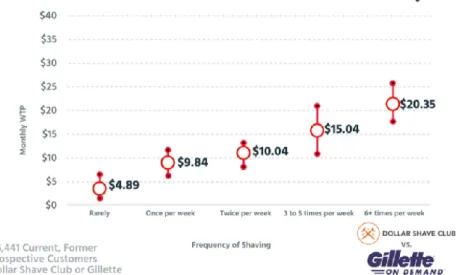
When observing monthly willingness to pay based on shaving frequency (Figure 1), he found that costumers are willing to pay a much higher price for these services than they
20
are now paying, even for people who only shave once per week that in average would pay $9,84 monthly (a higher offer than Dollar Shave Club’s 4-blade for $6). The higher the shaving frequency is, the more a consumer is willing to pay. Since the average person usually shaves 5 times per week (van Herk, Poortinga and Verhallen, 2004) and his willingness to pay for a subscription service is around $15,04 (Campbell, 2018), these companies are missing a lot of value they could get from their customers. Only Harry’s offer ($15,49) is close to this value in the 5-blade segment, others are offering fairly bellow price options.
Moreover, one could think these companies are pricing low as a strategy to get young consumers, but data shows otherwise (Figure 2). Younger consumers aged 18 to 24 and 25 to 34 are the ones with the highest monthly willingness to pay, $13,08 and $14,59 respectively. Once again, these prices are higher than 75% of the top subscription brands’ offerings.
2.6 Portuguese Shaving Situation
In 2017, shaving, fragrances and toiletries continued to be the biggest segments in terms of value regarding men’s grooming category that registered a general positive growth. Yet, this category has not achieved its full potential. As expected, Gillett maintains its leading position in this market where it has a positive reputation among consumers and is heavily advertised (Euromonitor, 2016).
Portuguese consumers take grooming seriously, according to a study done by L’Oréal: 75% of Portuguese man use beauty products and 89% have an active role in its searching and shopping. Regarding loyalty, 39% always buy from the same brand and 55% have their usual brand but try others occasionally, meaning Portuguese are very loyal. Furthermore, 47% of men search for information while in-store, 24% trough recommendations and 23% in the internet (Silva, 2018). This is an optimistic indicator regarding their possible attitude towards subscription boxes, since this attitude is positively influenced by word-of-mouth and therefore will influence customers’ purchase intention for theses boxes (Lee et al., 2017).
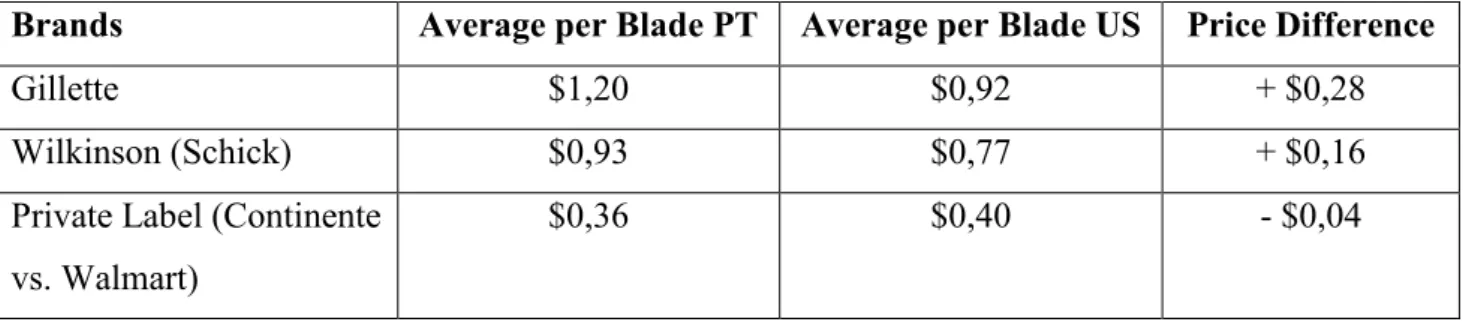
Regarding Portuguese market prices for blades, if we look at four-pack blade cartridges, using Continente (biggest Portuguese retailer) as reference, we can see that blades in
21
Portugal are much more expensive than in the US (on average $0,22 more per blade), with the exception of private labels. Knowing this, the opportunity for a company such as Dollar Shave Club to launch its shaving subscription plans in Portugal, after their proven success in the US, appears to be very reasonable in terms of potential costs saving. Hypothetically, a 4-blade Portuguese Gillett consumer would save near $14 per pack if he had the option to choose for DSC’s 4-blade razor ($6). Using the same reasoning as above (4 cartridges a month, one per week), in a year he would be saving $168.
Brands 2 Blades 3 Blades 4 Blades 5 Blades
Gillette $9,24 $14,43 $19,97 - Wilkinson - $11,01 $15,00 $16,73 Private Label - $4,25 $5,76 -
Table 4: Disposable blades prices in the brick-and-mortar Portuguese market (4-pack cartridges)
Brands Average per Blade PT Average per Blade US Price Difference
Gillette $1,20 $0,92 + $0,28
Wilkinson (Schick) $0,93 $0,77 + $0,16 Private Label (Continente
vs. Walmart)
$0,36 $0,40 - $0,04
Table 5: Average price per blade PT vs US
2.7 Loyalty and Inertia
Many definitions exist regarding satisfaction, loyalty and their correlation. For instance, satisfaction has been defined as an “evaluation of the perceived discrepancy between prior expectations (...) and the actual performance of the product" (Tse and Wilton, 1988). While loyalty is generally defined as the repeated purchase of the same brand product or products (Tellis, 1988). In a stronger description, Newman and Werbel (1973) defined loyal customers as those who rebought a brand, considered only that brand and did not seek for information on other brands. Nevertheless, these definitions only judged
22
consumer’s actual behaviour, putting apart the psychological aspects that might take part of loyalty.
Developing switching costs is a common strategy to increase loyalty in a market (Dick and Basu, 1994), Porter (1980) defined this concept as the “onetime costs facing the buyer of switching from one supplier's product to another”. These appear in various consumer choice settings, such as when consumers need to make elemental purchases integral to an overall system, which is the case of razor companies that make handles to fit only with their respective disposable blades (Dubé et al., 2009).
Not only can these costs be monetary, but may also be psychological in nature, as when, for no obvious economically rational reason, consumers keep purchasing the same products merely from habit or loyalty (Klemperer, 1987). This is believed to happen due to the phenomenon of “cognitive dissonance”, in which the conventional example is the person who smokes cigarettes knowing that smoking is unhealthy. We can do an analogy to razors and blades, where a person keeps buying Gillette’s blades every month whilst knowing they are expensive and overpriced.
Monetary and psychological switching costs lead to an observational form of inertia in consumer purchases (Farrell and Klemperer, 2007), why are costumers not looking for better alternatives, if any? Dick and Basu (1994) suggested a reasoning for this behaviour using the example of a consumer who has already paid membership fee to a health club, this individual is less likely to search for information about other clubs, especially if he’s a heavy user. This means that monetary switching costs reduce search motivation, particularly when there is a strong relative attitude-repeat patronage.
Oliver (1999) identified four different loyalty stages where a consumer might be situated: cognitive, if he is loyal to information such as price or features, affective, if he is loyal because he likes the product, conative, if he is loyal to an intention or commitment, and action, if he is loyal to action inertia, where there is a commitment to repurchase, so much that behaviour is guided in some already auto-guided manner. This last stage might be the one where most shaving consumers are at.
23
Chapter 3: Methodology
3.1 Research Method
Concept testing refers to a procedure designed to assess consumers’ reactions to a new product concept before it goes to market (Wind, 1973). In the pragmatic World of marketing research this is crucial step for most new products and services or expansions to new markets, given their possible heterogeneity. Wind (1973) claims that there are three main points any concept testing should answer:
• Consumer Reaction: what is the size of the potential market, which attributes are the most important regarding their reaction to the concept.
• Market Segments: how many exist, what are their characteristics (socioeconomic, demographic, psychographic and product or brand usage patterns) and reactions. • Competitive Setting: what is the most desirable positioning for the concept vs
other available options.
Considering this, the first two research questions concern the “Consumer Reaction”, third and fourth question are related to “Market Segments” and the last one has to do with the “Competitive Setting”.
In order to do this concept testing, a qualitative study was done initially as exploratory research to understand Portuguese consumers’ opinions, motivations and attitudes towards shaving subscription services and the possible differences that might exist from the literature review which is mainly based on the US market. Afterwards, a quantitative approach was used to quantify the insights collected from the qualitative study and transform these into usable statistics from a larger population.
3.2 Research Instruments
3.2.1 Qualitative Data
In order to get a first grasp on Portuguese consumers opinions, semi-structured in-depth interviews were done. This method was chosen since it allows a better understanding of each interviewee personal thoughts and judgements, especially if the topic is new to them
24
(as in this case) and does not let opinions be influenced by other participants, as in focus groups method.
For this purpose, 14 interviews were conducted. These lasted between 15 to 20 minutes depending on the conversation flow with each interviewee. As sales data exhibited that Millennials and Generation X represent more than 50% of shaving subscribers (Stanton, 2018), participants selection criteria was based on their age: 7 were Millennials, 5 - Generation X and 2 - Baby Boomers.
Three main topics were addressed, each one with its own set of questions, yet not all questions were made, and additional ones emerged from the different dialogs. The introductory topic was about the razor and blades market, the objective was to explore consumers’ knowledge and views about existing brands, prices, quality, technology and their buying behaviour. The second topic presented the subscription business model broadly, general questions were asked to get consumers’ perception of the model, its pros and cons and usage in Portugal. Additionally, “subscription boxes” concept was also introduced in the end of the topic. The last topic merged the first two and introduced participants to the idea of shaving as a subscription, the goal was to get their first impressions and possible reasons to subscribe or not.
General Insights
Regarding the first topic (razor and blades market), most interviewees’ familiarity about it is related to Gillette. They see Gillette as the main shaving brand and as the standard for a good quality shave. Some even refer Gillette to express the fact that they shave with disposable blades and not with electric shavers or other, as if there was only one brand in this market - “I don’t know other Gillette brands, besides Gillette the brand itself”. But why is this? The main reason for most is because the brand is the market leader and thus considered to be “the best”, alongside with all the marketing (TV advertisements in particular) around it that positively influence consumers purchase behaviour. Moreover, for the majority their first shave was with a Gillette razor and since then they never changed, this shows how crucial the first purchase is in this market and serves also as a determinant factor for not looking for other alternatives – “why would I change if I have been using Gillette for so long?”. About cartridges prices, the general idea is that these are expensive, even for consumers who don’t shave so regularly (as they are adopting a new beard style or using electric shavers). Because of these high prices consumers think
25
that new technology improvements, as adding an extra blade, don’t make sense, even though advertisings make them believe they could get a better shave. The product is viewed as a cyclical one for those who currently shave. Consumers feel they are used to a brand and even though some have the consciousness they are locked in the razors and blade model, they don’t mind and are satisfied with it. In the end, 86% of the participants said that after the 1st purchase (which normally involves choosing the razor and the
number of blades), blade cartridges would be a product they would prefer much more to buy online than in traditional retail shops.
With respect to subscription models, most participants had previous knowledge on what a subscription consists and 71% were currently subscribing to a service, mainly digital subscriptions (e.g. Spotify and Netflix), but also more traditional subscriptions (e.g. gym memberships). In a general manner, convenience was the main word around subscription services and it was described as “not having to worry about something because others will for you”, “having the minimum work possible with the maximum benefit” or “having what I want, when I want it”. On the downside, few participants refer that they were afraid that some of these services would take money from their bank accounts in cases where they would have no money left (credit). “Subscription Boxes” was not a strange term for most, since it is something that participants related to groceries home delivery, that is already being done by Portuguese retailers (e.g. Continente) for some time now. However, besides groceries, the general idea is that for other products it will take some time for Portuguese consumers to adhere at first, since there is always some scepticism about it, but with time, learning and trying, it will be something present in our everyday future.
In the last and main topic of the interview, participants were introduced to the idea of shaving as a subscription. First impressions were good, particularly on younger consumers (Millennials and Generation X) that thought it was “brilliant” and “something that’s been missing”. Only 1 out of the 14 interviewees had heard before about this service, proving this is something really new for most and thus must be well explained. The service was specially understood by most as something that makes sense, that brings a high utility and advantages to the subscriber. The mentioned advantages were the price and the convivence of not having to worry about re-stocking and going to the store, being the latter the most crucial go-driver for 85% of the interviewees. The main disadvantage was common to all: the uncertainty about the product quality. This becomes a bigger
26
problem given the a priori lower quality judgment most consumers said they would be doing when comparing the low price these subscription blades cost versus their current brands. When asked how this situation could be overcome, free try-outs or even the presence of some merchandising action near a retail store would give consumers more confidence towards these shaving clubs. Regarding their price sensibility, 71% of respondents stated that the difference between what they pay on average versus what they could pay in subscription could be much lower that they would still be interested (an average 0,5$ blade price increase wouldn’t make a difference). Furthermore, this could also help reducing the low-price bad-quality judgement. Adding complement products to their blade cartridges delivery was something well perceived if they were to subscribe, since it increases the convenience factor. This bathroom hygiene pack idea was compared by an interviewee to Spotify and Netflix, were costumers subscribe to a pack of millions of songs and movies and not just one song or movie, so in his words: “what is the sense of receiving blades at home, if after I have to buy the shaving gel and after-shave?”. In sum, the majority of the interviewees seemed to be eager to test these shaving subscriptions. Only the older consumers, who are deeply rooted in their routines, and those who are opting for a beard style, in which they use electric shavers, showed less interested, but still thought the idea to make sense.
3.2.2 Quantitative Data
In order to collect data from a large audience with a low administrative cost and in a short time period, online survey was the research method chosen. In addition to the mentioned advantages, this method also facilitates post-analysis since data is directly loaded in the data analysis software (Ilieva et al., 2002), which was SPSS v.24 - Statistical Package for
the Social Sciences. Qualtrics was the software used for this purpose and afterwards the
survey was distributed through Facebook and WhatsApp groups only to Portuguese male consumers.
The questionnaire (appendix 2) was composed of 22 questions and divided into four sections: demographics, shaving habits, product attributes importance and satisfaction and shaving as a subscription, similarly to the interview guide logic. The majority of survey questions were based on the literature and also on insights from the interviews.
27
The survey started with 3 questions regarding demographics: age, education and current professional activity. These would later allow to cross-information with other questions and create market segments that will be useful to answer research questions 3 and 4. Section two of the survey had 7 questions related to shaving habits. The first question asked how they shave their beard (or not) and all participants who did not answer “with disposable blades (e.g. Gillette)” were directed to the last section of the survey, since the subscription service is only related to disposable blade cartridges and thus section two was only related to those. Shaving habits questions included priority when shaving (e.g. quality or time), frequency, duration, number of shavings with one disposable cartridge, selected brand and if they had once selected other brand than their usual one when shopping.
Then participants’ opinion about some product attributes and current satisfaction with those were asked (section 3). Disposable blades attributes (price, number of blades, ease of use, design and quality) importance was questioned, as well as their satisfaction with each attribute and overall. These attributes were chosen based on Yankelovich and Meer past research (2006). The last question of this section had several statements (e.g. “I always try to have the latest/more advanced model”) from which participants had to select their level of agreement.
The last section started with an introductory text to what is a subscription first and after described the shaving as a subscription service. The first two questions asked for first reaction and if the participant had heard before about the concept. Afterwards, participants were asked about their opinion on the concept features (e.g. home delivery), specifically how much they find them relevant and what are they afraid of (e.g. late delivery), this information helped answering to research questions 1 and 2. Subsequently, in order to access price sensitivity, which regards research question 4, a simple text comparing the current average price per blade in the Portuguese market vs the correspondent average price on subscription services was shown. Participants were then asked if they thought the price difference was sufficient for them to feel attracted. Those who said they were attracted, were then asked by how much could this difference shorten and still maintain their interest, the others were directed to the last question of the survey that asked if they were interested or not in subscribing to the service.
28
3.2.3 Measurement Scales
In the construction of this survey, Likert and bipolar scales were used in different question types. For specific questions related with product attributes, concept features and general statements, 5-point Likert scales were used with different point labels: importance (Q11) – “1= unimportant; 5= very important”, satisfaction (Q12) – “1= unsatisfied; 5= very satisfied”, agreement (Q14, Q19) – “1= totally disagree; 5= totally agree”, relevance (Q17) – “1= irrelevant; 5= very relevant” and worry (Q18) – “1= very worry; 5= unworried”. Bipolar scales (5-point) were used for general questions, such as the overall level of satisfaction with disposable cartridges (Q13) – “1= unsatisfied; 5= very satisfied”, the reaction to the shaving subscription concept (Q15) – “1= very bad; 5= very good” and the interest in subscribing (Q22) – “1= not interested; 5= very interested”.
The statistical analysis involved measures of descriptive statistics (absolute and relative frequencies, means and respective standard deviations) and inferential statistics. The significance level to reject the null hypothesis was fixed at (α) ≤ .05. Spearman correlation coefficient was used, also the t student test for independent and paired samples, ANOVA repeated measures, binomial test, logistic regression and the chi-square test of independence with Mont Carlo simulation.
29
Chapter 4: Analysis and Results
4.1 Data Collection
Data was collected between the 14th and the 27th of November 2018. The survey was
pre-tested by 5 participants who did not participate in the final study. A total of 128 surveys were started and 110 were fully completed, resulting in an 86% completion rate which is acceptable for this study’s purpose.
4.2 Sample Characterization
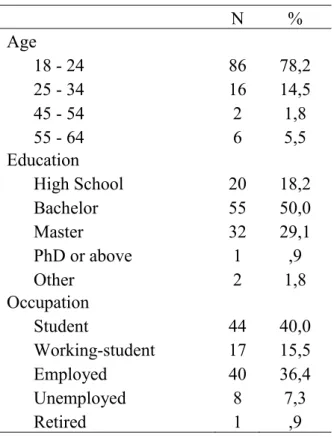
The sample (table 12) is composed of 110 Portuguese males, as nationality and gender were the only restrictions. In terms of age, there is a clear dominance of respondents aged between 18-24 (78,2%), followed by those aged between 25-34 (14,5%). Although more than 90% of the sample is aged bellow 34-years-old, they belong to the Millennials generation in which are the main shaving subscribers according to literature (Stanton, 2018). Regarding education, the majority of the sample is highly educated, having 50,0% completed a bachelor’s degree and 29,1% a master’s level. Lastly, concerning occupation, there is a balance between students and employees: 40,0% are students and 36,4% are employed, whilst 15,5% are studying and working at the same time.
4.3 Descriptive Statistics
4.3.1 Shaving Habits
From the sample of 110 participants, 37,3% use disposable blade cartridges to shave their beards, more than half use electric shavers (55,5%) and the rest either uses a safety razor (4,5%) or doesn’t shave at all (2,7%).
As of those who shave with disposable blades, 61,0% have time as their priority, meaning they want the quickest and most effective shave possible, whilst 39,0% look to have the best possible shave in terms of quality. Regarding frequency, most shave between 2 to 3 times a week (41,5%) or once a week (31,7%), which is a lower frequency than the usual 5 days a week literature suggests (van Herk, Poortinga and Verhallen, 2004) Concerning
30
the average shaving time, for most this is a task usually done under 5 minutes (39,0%) or 10 minutes maximum (34,1%). As to how many shaves one can have with a single disposable cartridge before having the need to change it, 10 to 20 shaves was the main answer (39,0%), but balanced with 1 to 10 shaves (34,1%).
Whereas to which brand participants usually buy, as expected from the literature and the interviews, Gillette assumes a dominant position with 95,1%, followed by Private Labels with 4,9%, leaving no room left for Wilkinson Sword or other brands. This dominant position is reinforced with the fact that 70,7% of the sample have never tried to buy other brand than their typical one (having the usual one available in store). This confirms with the studied literature on switching costs (Dick and Basu, 1994).
4.3.2 Disposable blades attributes importance and satisfaction
Quality was highlighted as the most important attribute for participants with a mean of 4,37 out of 5, followed by price (3,90), ease of use (3,85), number of blades (3,46), brand (3,46) and design (2,71), which was considered as less important (table 13). In terms of their current satisfaction with the attributes (table 14), quality also comes first as the most satisfied attribute with a mean of 3,93, followed closely by ease of use (3,80). The other attributes (design, number of blades and price) presented indifferent values. Since price was regarded as the second most important attribute for participants, it should have a better value for consumers to be satisfied. Overall, respondents were mainly indifferent with the existing offer in disposable blades, but more inclined to be satisfied (3,76). Regarding the statements which participants had to select their agreement level (table 15), four are worth to mention. The first is “Gillette is the ‘standard’ of quality”, this statement had the highest mean of 4,05, meaning most participants strongly agree. Then we have “in case there are promotions on other brands that not mine, I feel tempted to buy” and “I’m loyal to the brand I use”, the first had a very low value of 2,80, whereas the second had the second highest value of 3,80, this shows consistency in participants answers and also reinforces the idea of loyalty explored above. Last of all, “the current price I pay for a pack of cartridges is fair” registered the lowest value of 2,63. If we relate this with the above fact that respondents are not satisfied nor unsatisfied relative to cartridges prices, this suggests that although they think they are not paying a fair price, they can’t or won’t do anything to change that, thus staying indifferent as it is their overall satisfaction.
31
4.3.3 Shaving as a Subscription
First reactions to the concept were positive, with 62,7% of the sample considering it “good” or “very good”. Only 15,5% had a “bad” or “very bad” reaction and others find it indifferent (21,8%). Regarding its novelty, 78,2% had never heard about it, thus confirming what the interviews suggested.
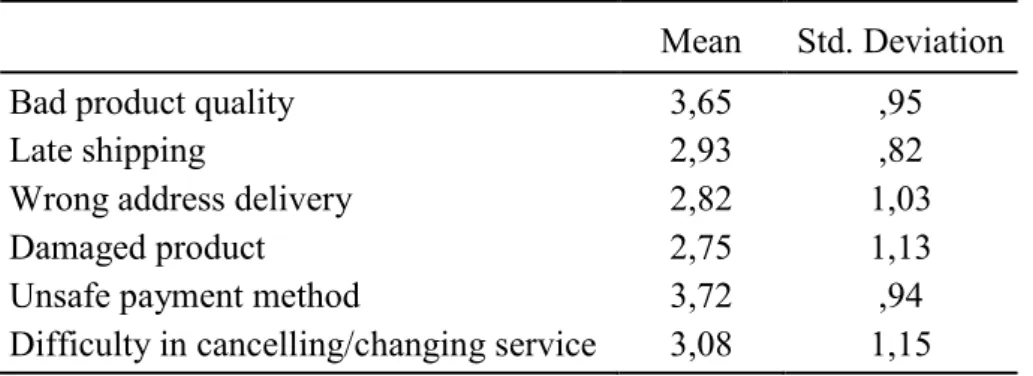
With respect to what features are more relevant to participants (table 16), all aspects were considered relevant. Paying less had the highest mean (4,25), followed by free shipping (4,25), not having to worry about blades stock (3,91) and having the product home delivered (3,66). This contrasts to what interviews insights suggested that convenience features (the last two) were more important for consumers than price-related ones (the first two). On the other hand, results show that the main concerns participants have with the service is the possibility of having the product damaged after being delivered (2,75) or having it delivered to the wrong address (2,82), although both events didn’t have very low values, meaning it’s not a general worry all participants have (table 17).
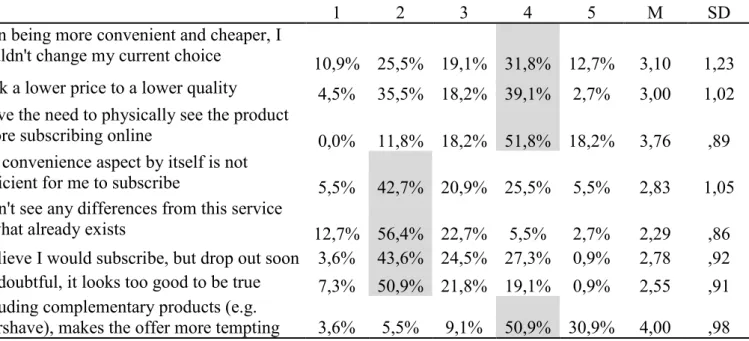
From the statements question (table 18), participants disagreed with the following: “I don’t see any differences from this service to what already exists” (2,29) and “I’m doubtful, it looks too good to be true” (2,55), which means that they can recognize this service as something new in their market and also believe in its value. On the other side, the higher levels of agreement came from: “I have the need to physically see the product before subscribing online” (3,76) and “Including complementary products (e.g. aftershave) makes the offer more tempting” (4,00), this checks with the literature on bundling complementary products (Harlam et al., 1995), but doesn’t coincide with the idea that disposable blades belong to the “low-touch” products category, meaning consumers don’t have the need to experience before buying (Lynch and colleagues, 2001) Regarding the average price per blade these subscription services practice compared to Portugal, 85,5% of the sample agreed that the 47% price discount they could have by subscribing, is much more than sufficient to keep them interested. As for how much could this discount shorten and still maintain their interest (table 19), the majority said between 40%-47% (39,4%) or 40%-30% (30,9%).
Concerning the last question about their interest in subscribing (table 20), the 2,97 mean suggests that the average of the sample is neither interested nor disinterested in
32
subscribing. If we look at frequencies, 30,9% of participants were “not interested” or “little interested”, while 40,0% were “interested” or “very interested”, proving there are more people interested in subscribing than otherwise.
4.4 Inferential Statistics
RQ1: What are the main drivers in buying razors and blades through subscription? The driver considered to be the most relevant was “Paying less” (4,35) and the less relevant “Home delivery” (3,66), although the latter is also considered relevant since its average is significantly superior to the scale’s midpoint (3 – indifferent), as the one sample T-Test shows: t(109) = 6,265, p = ,001. From the ANOVA Repeated Measures we infer that the differences between the drivers’ means are statistically significant, F(3, 327) = 21,692, p = ,001. Paired comparison tests indicate that, apart from the difference in “Paying less” vs “Free shipping”, all other drivers’ differences are statistically significant (p < ,05).
Mean SD F Home delivery 3,66 1,11 21,692***
Not having to worry about having blades or not 3,91 ,90
Paying less 4,35 ,74
Free shipping 4,25 ,86
Legend: 1 – not relevant, 5 – very relevant
*** p ≤ ,001
Table 6: Mean, standard deviations and ANOVA repeated measures on variable “concept feature’s relevance”
33
RQ2: What are the main barriers in buying razors and blades through subscription? The main barriers to razors and blades subscription are the dimensions with the value inferior to the scale’s midpoint, those are the possibilities of “Late shipping” (2,93), “Wrong address delivery” (2,82) and “Damaged product” (2,75). While comparing with the scale’s midpoint (3 – indifferent), variable “Late shipping” is not significantly different from 3 (p = ,355), “Wrong address delivery” and “Damaged product” are statistically significant (p = ,068 and p = ,025. respectively). Between variables “Damaged product” and “Wrong address delivery” the difference is not significant, t(109) = ,651 , p = ,516. Therefore, we cannot select a single main barrier between these two variables but consider both as the main ones.
Mean Std. Deviation Bad product quality 3,65 ,95 Late shipping 2,93 ,82 Wrong address delivery 2,82 1,03 Damaged product 2,75 1,13 Unsafe payment method 3,72 ,94 Difficulty in cancelling/changing service 3,08 1,15
Legend: 1 – very worried, 5 – not worried
Table 7: Means and standard deviations on variable “worry about concept possible disadvantages”
RQ3: Are consumers interested in subscribing?
The proportion of the sample who is interested in subscribing is 56,4%, this proportion is significantly superior from the one of those who don’t want to subscribe, as shown through the binomial test, p = ,015.
Category N Observed
Prop. Test Prop.
Sig. Interest in subscribing Group 1 No 34 ,436 ,564 ,015* Group 2 Yes 44 ,564 Total 78** 1,000 * p ≤ ,05
** 34 of the respondents were indifferent to subscribing or not Table 8: Binomial Test on variable “interest in subscribing”
34
RQ4: What are the predictors that increase the probability of subscription?
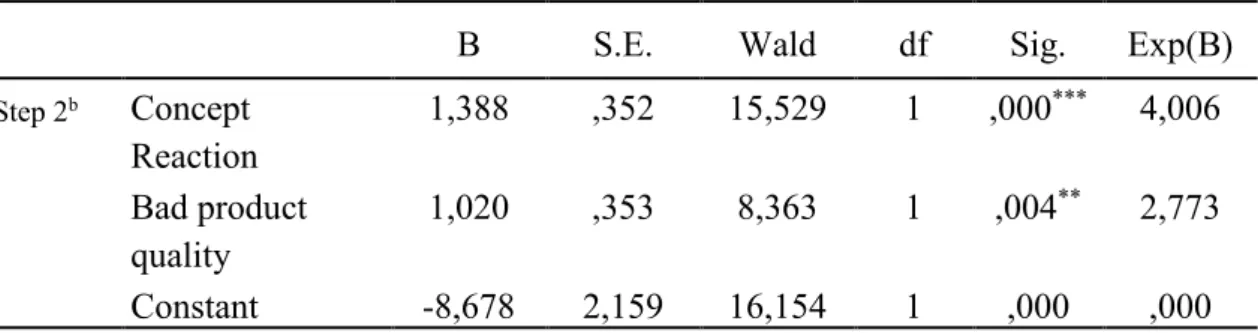
To answer this question a logistic regression with forward stepwise method was used with the variable “interest in subscribing” as dependent variable and as independent variables: the sociodemographic factors (“age”, “education” and “occupation”), disposable blades attributes’ importance (“price”, “number of blades”, “ease of use”, “design”, “quality” and “brand”) and overall satisfaction, the concept features’ relevance (“home delivery”, “not having to worry about having blades or not”, “paying less” and “free shipping”), the worry about possible disadvantages (“bad product quality”, “late shipping”, “wrong address delivery”, “damaged product”, “unsafe payment” and “difficulty in cancelling/changing the service”) and concept reaction. The final model explains 46,1% (Nagelkerke R Square) of the “interest in subscribing” and identifies variables “concept reaction” (b = 1,338. p = ,001) and “bad product quality” (b = 1,020. p = ,004) as significant estimators of the dependent variable. Therefore, as the regression coefficients are positive, this means that the better the concept reaction and the less worried consumers are about the product quality, the higher is the probability of subscribing.
B S.E. Wald df Sig. Exp(B)
Step 2b Concept Reaction 1,388 ,352 15,529 1 ,000*** 4,006 Bad product quality 1,020 ,353 8,363 1 ,004** 2,773 Constant -8,678 2,159 16,154 1 ,000 ,000 **p ≤ ,01 ***p ≤ ,001
35
RQ5: Are consumers loyal to shaving brands?
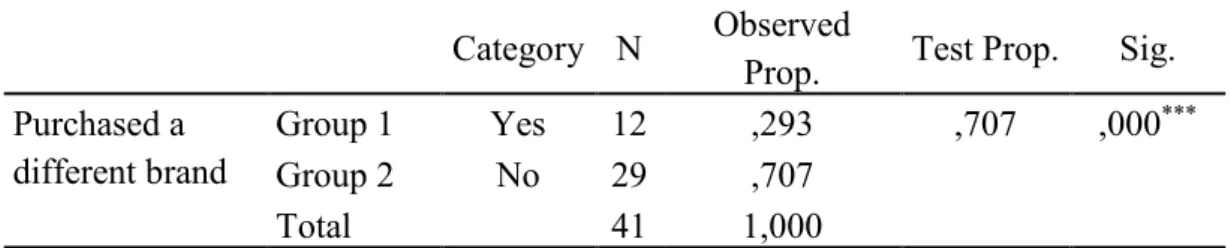
The proportion of the sample who haven’t purchased a different brand (while having their usual one available in-store) is 70,7%, this proportion is significantly superior to the one of those who tried other brands (29,3%), as exhibited by the binomial test, p = ,001.
Category N Observed
Prop. Test Prop. Sig. Purchased a different brand Group 1 Yes 12 ,293 ,707 ,000*** Group 2 No 29 ,707 Total 41 1,000 *** p ≤ ,001
Table 10: Binomial test for variable “purchased a different brand”
Moreover, regarding statement “In case there are promotions on other brands that not mine, I feel tempted to buy” the average of the answers is below 3 (indifference point), but not statistically significant (t(40) = -1,185. p = ,243), which mean respondents do not disagree with the statement. Whereas in statement “I’m loyal to the brand I use”, the average value of 3,80 is significantly superior to the scale’s midpoint (t(40) = 5,257. p = ,001). Hence, from the analysis of these three questions we can conclude that
Portuguese male consumers who shave with disposable blades are in fact loyal to their shaving brands.
Mean SD Sig. In case there are promotions on other
brands that not mine, I feel tempted to buy
2,80 1,05 ,243
I'm loyal to the brand I use 3,80 ,980 ,001***
*** p ≤ ,001
Table 11: One-sample t-test statistics for variables “in case there are promotions on other brands that not mine, I feel tempted to buy” and “I’m loyal to the brand I use”