APPLICATION OF BACTERIAL CELLULOSE CONSERVATION OF
MINIMALLY PROCESSED FRUITS
APLICAÇÃO DE CELULOSE BACTERIANA NA CONSERVAÇÃO DE
FRUTAS MINIMAMENTE PROCESSADAS
DeniseMilléo Almeida1, Rosilene Aparecida Prestes2, Adenise Lorenci Woiciechowski3, Gilvan Wosiacki4
1,3
Federal University of Paraná - Curitiba – Brazil [email protected]; [email protected] 2,4
State University of Ponta Grossa – Ponta Grossa – Brazil [email protected]; [email protected]
Abstract
The consumer by fresh food such as fruits has increased in the last decades and the minimally processed has come to attend this demand. The focus of this paper is to evaluate the application of celluloses biofilm in the conservation of minimally processed fruits. It was followed a (2 x 5) factorial design, with two treatments (with and without cellulose) and five periods of storage (0, 48, 96, 144 and 192h). Strawberries cv. Festival (intact) and apples (four sliced) cv. Gala were used as samples for the biofilm application. The output variable were the fruit mass, the total titratable acidity (ATT), soluble solids total (SST), the relation SST/ATT, pH, firmness, phenolic compounds and vitamin C. Strawberries test as compared with the control kept the fresh mass until 120h, decrease were observed in SST (5.8%), pH (1.5%), firmness (18.4%), vitamin C (2.2%) and increase in the concentration of phenolic compounds (3.4%). Apples test compared to the control show decrease in weight loss (10.5%), increase in ATT (15.6%) of SST (8.1%), TSS / TTA (6.7%), firmness (18.8%) and vitamin C (22.2%). The bacterial cellulose was efficient maintaining quality of the strawberries and apples in the quality attributes of fresh mass, ATT, SST, firmness and vitamin C, as a natural preservative. The application of bacterial cellulose biofilm offers using potential in fruits minimally processed, kept by combine methods (biofilm and cooling), maintaining the quality by physical and chemical stability of the products.
Key-words: strawberry; apple; bacterial cellulose; quality.
1. Introduction
The consumers demand for fresh and convenient food has increased greatly in the last decades. In this scene appears minimally processed food, which binds practicality and convenience, providing save time in the food preparation (GARCIA, 2009; SANTANA, 2008). In this process, the fruits and vegetables are perishable and show fast quality degradation, due mainly to the mechanical stress in the tissue surface, causing by the selection, cleaning, wash, peeling, cut, sanitization, drying and packing operations (MORETTI, 2007).
Universidade Tecnológica Federal do Paraná - UTFPR Campus Ponta Grossa - Paraná - Brasil ISSN: 1981-3686/ v. 05, n. 01: p. 356-366, 2011
D.O.I: 10.3895/S1981-36862011000100011
Revista Brasileira de Tecnologia
Agroindustrial
357
Revista Brasileira de Tecnologia Agroindustrial
The different alternative treatments postharvest has been used in the microorganism control, as well as, in the delay or prevention of the fruits maturity. The application of this films and covers has a promise use in the market by the numerous vantages that it shows. These aspects refer to the biodegradable characteristics, addictives incorporation, delayed water loss, lower cost, and a modified atmosphere in the inner product; delayed in the fruits maturity, decrease in the disease incidence and in superficial abrasion during handling (CHITARRA and CHITARRA, 2005).
Microbial polysaccharides show as new perspectives to enhance the barrier improving the mechanical properties of biofilm. Produced by the Acetobacter xyllinum, cellulose has permeability to liquids and gas, high chemical purity, crystallinity, high tension force, elasticity, durability, biodegradability, nontoxic and non-allergic. In the food area, it can be applied as an addictive, emulsifier, dietary fiber and edible preservative, a barrier against the bacterial growth (MATEOS, 2007; PACHECO, 2004).
This paper has the objective to evaluate the application of celluloses biofilm in the conservation of minimally processed fruits.
2. Material and Methods
Material
Bacterial cellulose obtained in the fermentative process with the Acetobacter xylinum (ATCC 23769), strawberry cv. Festival and apple cv. Gala were used as perishable food, from the state of Paraná – Brazil).
Methods
Figure 1 – Fruits coated with bacterial cellulose: (a) strawberry (b) apple
(a) (b)
358
Revista Brasileira de Tecnologia Agroindustrial
The bacterial cellulose pellicle was heated in boiling water during 10 min, following
successive washes, treatment with NaOH 0.1 mol.l-1 at 90 ºC by 30min (WU and LIA, 2008), and
after exhaustive washing was pressed to remove excess water. Sanitized fruit was treated with 150
mg l-1 sodium hypochlorite during 15 min and after rinsing with tap water and drying at room
temperature with circulating air during one hour. To completely coat the strawberries (intact) and apple (four slices) a 0.02 mm thickness pellicle was used cover occur in all the extension (Figure 1 a and b, respectively).
Evaluation of the bacterial cellulose pellicle efficiency
The output variables use to evaluate the biofilm efficiency were as follows:
Mass – The gravimetric difference between initial and final weight, expressed as percentage. Total Titratable Acidity (TTA) – The among of acid determined by titration with NaOH 0,1 mol.l-1 until pH 8.33, with results expressed in mg.l-1 of citric acid and mg.l-1 of malic acid to strawberry and apple, respectively.
Soluble Solids Total (SST) – Determined according to the refratometry index with the measure made in a refractometer (ABBE 2 WAJ- 970139 – São Paulo, Brazil), calibrated with distilled water and corrected for temperature of 20ºC, and scaling as Brix degree (ºBrix).
Ratio SST/ATT – The ratio is a pure number.
pH - The pH was measured with the digital pHmeter bench (Pec-2MP, Tecnal Company – São Paulo, Brazil), directly submerged into the juice.
Firmness – It was measured with the penetrometer bench (Penetrometer tester mod FT 011 – Wagner Instruments Company, Greenwich, Connecticut state, United States of America – USA), with steal tip of diameter of 8mm to the strawberry and 6 mm to the apple, calibrated before the tests. Two measures in each fruit, at the equatorial region, were done and the results, expressed in Kgf.
Phenolic Compounds – They were quantified with Folin-Ciocalteau method (SINGLETON
and ROSSI, 1965) expressed as catechin in mg.l-1.
Vitamin C – The content of vitamin C was determined by the Tillmans (DCFI) method (COX and
PEARSON, 1962), being the results expressed as ascorbic acid, mg.l-1 of the fruit
Data analysis
The statistical design with a set of 10 runs from the factorial 2 x 5 totally andomized, being two treatments (with and without cover) and five storage times (0, 48, 96, 144, 192 hours), with three repetitions. The data were submitted to ANOVA at 95% of probability.
359
Revista Brasileira de Tecnologia Agroindustrial
3. Results and Discussion
Significant differences in the values of average mass loss, between the treatments and during the storage period, on both fruits, were observed. The F test corroborates with the values of probability (P) and shows statistical significance in the variable storage time for predictive purposes. The mass loss showed a linear relationship tendency with the storage time in both treatments and fruits. When the strawberries loose 6% of their weight in the trees they are no longer marketable (MALGARIM et al. 2006). In this aspect it was checked that strawberries cover with bacterial cellulose were efficient in the reduction of the weight loss, with average values of 5.7% until the 120h as compared with the blank (without biofilm coat) that could be stored only until 48h because at 96h they have lost 7.3%±1.2, being without commercial appeal. In the case of Apples, the runs without coating showed almost the same figures as strawberries, of 13.5%, but the runs with coating the averaged value or 10.57% is higher than the 8.l0% found for strawberries at the end of the experiment (Figure 2).
Figure 2 – Weight loss in strawberries cv. Festival e apple cv. Gala minimally processed, with and without bacterial cellulose, kept at 7 ºC±2 ºC in 90%±5% of relative humidity (RH).
The cover shape promoted significant changes (p≤0.05) in the total titratable acidity medium values, between the strawberries treatments and storage time. In the apples there were not a
significant statistically changes (p≥0.05) in any variables. The test F confirms the values of P and
shows significance in predictive purposes only between the strawberry treatments. Strawberries cover with the bacterial cellulose pellicle showed variation from 0.36% to 0.58% of citric acid,
360
Revista Brasileira de Tecnologia Agroindustrial
during the storage period, indicating that it was under the acidity of 0.5% until the 144h, possibly fruits still unripe. For the samples without cover, the content was from 0.50% to 0.82%, inside the range found for the ripe strawberries that can change between 0.5% and 2.3% of citric acid (PELAYO et al., 2003; CORDENUNSI et al., 2003). The apple, with and without bacterial cellulose cover, shows variation of 0.22% at 0.25%, respectively, in the concentration of malic acid during storage. Apples without cover had a variation of 0.19 to 0.29%, values in agreement with
Instruction Normative nº 1 of 2000 (BRASIL, 2000) that requires an acidity minimum of 0.15%.
The coated apple shows smallest variation percentage, 15.6% regarding to that without biofilm, with 54%, during the storage period (Figure 3).
Figure 3 – Total Titratable Acidity (ATT) in strawberries cv. Festival e apple cv. Gala minimally processed, with and without bacterial cellulose, kept at 7 ºC±2 ºC in 90%±5% relative humidity (RH).
In the coated apple with there was found the smallest oscillation, ca 8.1%, and the
non-coated apples was 9.9%, during the storage period (Figure 4).
Figure 4 – Total Soluble solids (SST) in strawberries cv. Festival e apple cv. Gala minimally processed, with and without bacterial cellulose, kept at7 ºC±2 ºC in 90%±5% relative humidity (RH).
361
Revista Brasileira de Tecnologia Agroindustrial
The medium value in the SST content shows that, both in strawberries and apples, there were significant differences (p ≤ 0.05) between the treatments, however, during the storage period this factor does not show any change (p ≥ 0.05). The test F corroborates with the values of P and shows statistical significance to the predictive results to the treatment variable, in both fruits. Strawberries with bacterial cellulose cover shows reduction of 5.8% in the SST content, meanwhile the strawberries without the cover shows increase of 33.9%. According to Chitarra and Chitarra (2005), the metabolic processes concerning ripening influence directly the total solid soluble amount, probably because of the dissociation of some molecules and structural enzymes and shows the highest soluble solids contents.
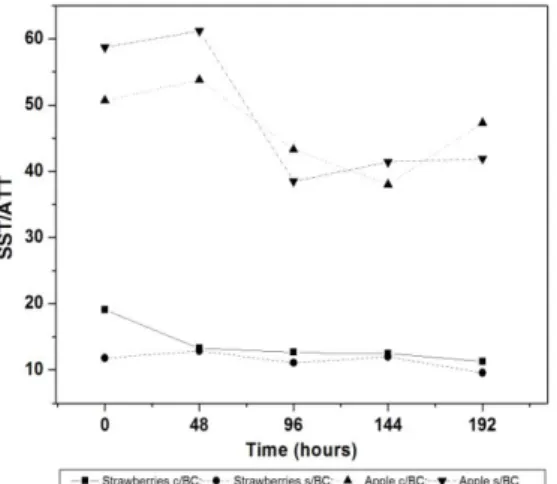
It was observed significant differences (p≤0.05) in the medium values of the SST/ATT ratio between the treatments, for both fruits but during the storage period, this factor does not show any change (p ≥ 0.05). The test F corroborates with the values of P and shows statistical significance to the predictive results to the treatment variable, in both fruits. In strawberries, with and without biofilm, the SST/ATT decrease 40.8% and 18.6%, respectively (Figure 5). This might happen because of the low acidity found in the coated strawberries during the storage, leading to a wrong interpretation of the taste equilibrium. In apples, with and without biofilm, the SST/ATT showed decreases of 6.7% and 28.6%, respectively, during the storage. These values were close to that found by RIZZON et al. (2005), in cultivars Gala, Golden, Delicious and Fuji.
Figure 5 – Relation between total soluble solids and total titratable acidity in in strawberries cv. Festival e apple cv. Gala minimally processed, with and without bacterial cellulose, kept at 7 ºC±2 ºC in 90%±5% relative humidity (RH).
The pH average values showed significant differences (p ≤ 0.05) in the strawberries and apples in both treatments but the storage time showed statistical significance (p ≤ 0.05) only for the former. The F test corroborates with the P values and showed significance to the predictive ends in
362
Revista Brasileira de Tecnologia Agroindustrial
the time variable to strawberries and in the apples treatments form. The coated strawberries have pH lower than that found in the pseudo fruits without cover, with initial values of 3.28 and 3.55, what can be explained by the biofilm pH interference of 3.02, under the fruit pH. During storage, coated strawberries do lower pH, 1.52% in relation to the pseudo fruits without cover, 14.3%. In apples with and without bacterial cellulose, the pH showed reduction of 4.48% and 1.8%, respectively, so the cellulose pellicle promoted higher pH reduction (Figure 6).
Figure 6 – Evolution of the pH in strawberries cv. Festival e apple cv. Gala minimally processed, with and without bacterial cellulose, kept at 7 ºC±2 ºC in 90%±5% relative humidity (RH).
It was observed significant differences (p≤0.05) in the average values of firmness, between the treatments and the storage times, in both fruits. The F test corroborates with the P values and shows statistical differences to the predictive ends in the two variables and analyzed fruits. Strawberries with bacterial cellulose pellicle showed higher firmness, obtained reduction of 18.4%. In these, without cover, the decline was at 46.3%, during the storage. In apple, with bacterial cellulose and without cellulose, the reduction was at 18.8% and 43%, respective, during the storage period (Figure 7, p.363). This fact suggests that the bacterial cellulose pellicle has been an important factor to delay the dehydration and senescence process of the fruits and, also indicates higher mechanical protection.
In strawberries and apples there were significant differences (p ≤ 0.05) between the treatments, in the average values of the phenolic compounds contents. However, during the storage time, this factor do not showed any changes (p ≥ 0.05). The F test corroborates with the P values and shows significant statistical difference to the predictive ends only for the form of treatment variable, to both fruits. In the strawberries with bacterial cellulose, the variation of the phenolic compounds promoted 3.4% increase. In the pseudo fruits, without cover, the increase was at 4.7% in the storage time.
363
Revista Brasileira de Tecnologia Agroindustrial
Figure 7 – Evolution of the firmness in strawberries cv. Festival e apple cv. Gala minimally processed, with and without bacterial cellulose, kept at 7 ºC±2 ºC in 90%±5% relative humidity (RH).
In apples, with or without bacterial cellulose had an increase of 47.6% and reduction of 13.1% during the storage period (Figure 8). The bacterial cellulose showed opposite trend between the studied fruits, providing lower increases in the phenolic compounds concentration in the strawberries. The raise can be explained by the induction of the phenolic compounds biosynthesis with the purpose of forming a defense against the stress caused in the process that were submitted the fruits, besides the probable microorganisms attack during storage. According to Moretti (2007), the first physiological responses to stress, caused by the minimum process in the vegetable, are the transient increases in the ethylene evolution and respiratory activity elevation, which can be interconnected with the metabolisms induction in the phenolic compounds and with the tissue healing process.
Figure 8 – Evolution of the phenolic compounds in strawberries cv. Festival e apple cv. Gala minimally processed, with and without bacterial cellulose, kept at 7 ºC±2 ºC in 90%±5% relative humidity (RH)
364
Revista Brasileira de Tecnologia Agroindustrial
The cover shape promoted significant changes (p ≤ 0.05) in the vitamin C average values, between the treatments and the storage time, in both fruits. The F test confirms the P values and shows significance to the predictive ends only to the variable time, in apples. In strawberries, with and without bacterial cellulose cover, the vitamin C content showed reductions of 27% and 34%, respectively, in the storage period. With and without bacterial cellulose, apples showed reduction of 22.2% and 26.3%, during the storage time (Figure 9). The reduction might had happened due to the high enzyme ascorbic acid oxidase activity postharvest, involved in antioxidant reactions that process during the fruits senescence (ISLAN et al., 1993) and due to the vegetables lower capacity to synthesize acid during this period (AGIUS, 2003). Another factor is the occurrence of the oxidation process, when the fruits were exposed to products that contained halogens in your molecule (WRIGHT and KADER, 1997), such as the hypochlorite salts used in the sanitization process. It can be also associate to the organic acids degradation, such as ascorbic acid, during the natural process of maturation and senescence (GARCIA et al., 1998) and, due to the handling during the fruits sanitization, drying, and cover process. The reduction in the ascorbic acid content was also verified by CALEGARO et al. (2002), MALGARIM (2005) and NUNES et al. (2006).
Figure 9 – Evolution of the vitamin C in strawberries cv. Festival e apple cv. Gala minimally processed, with and without bacterial cellulose, kept at 7ºC±2ºC in 90%±5% relative humidity (RH).
4. Conclusion
The bacterial cellulose film was efficient in maintaining the quality of the strawberry cv. Festival and apples cv. Gala minimally processed, in the characteristics of mass loss, soluble solids total, firmness and vitamin C. The lower pH and phenolic compounds variation was verified in coated strawberries and the ratio SST/ATT shows lower oscillation in apples cover with bacterial cellulose.
365
Revista Brasileira de Tecnologia Agroindustrial
The application of bacterial cellulose biofilm offers using potential in fruits minimally processed, kept by combine methods (biofilm and cooling), maintaining the quality by physical and chemical stability of the products.
Acknowledgements
The authors thank the State University of Ponta Grossa, Technological Federal of Paraná and the Federal of Paraná for the operational infrastructure and to the CNPq for the scholarships awarded.
Resumo
O consumo por alimentos frescos como frutas tem aumentado nas últimas décadas e as minimamente processadas tem vindo a atender essa demanda. O foco deste trabalho é avaliar a aplicação de biofilme de celulose na conservação de frutas minimamente processadas. Foi seguido delineamento fatorial (2 x 5), com dois tratamentos (com e sem celulose) e cinco períodos de armazenamento (0, 48, 96, 144 e 192h). Morangos cv. Festival (intacto) e maçãs (quatro fatias) cv. Gala foram utilizados como amostras para a aplicação do biofilme. As variáveis de saída foram massa dos frutos, acidez total titulável (ATT), sólidos solúveis totais (SST), relação SST / ATT, pH, firmeza, compostos fenólicos e vitamina C. Os morangos testados foram comparados com o controle, mantido a massa fresca até 120h, diminuição foi observada em SST (5,8%), pH (1,5%), firmeza (18,4%), vitamina C (2,2%) e aumento na concentração de compostos fenólicos (3,4%). Maçãs testadas em comparação com o controle mostraram diminuição na perda de peso (10,5%), aumento na ATT (15,6%) de SST (8,1%), relação SST / ATT (6,7%), firmeza (18,8%) e vitamina C (22,2 %). A celulose bacteriana foi eficiente na manutenção da qualidade dos morangos e maçãs nos atributos de qualidade da massa fresca, ATT, SST, firmeza e vitamina C, como um conservante natural. A aplicação de biofilme de celulose bacteriana oferece potencial de uso nas frutas minimamente processadas, mantidas por métodos combinados (biofilme e refrigeração), mantendo a qualidade pela estabilidade física e química dos produtos.
Palavras-chave: morango; maçã, celulose bacteriana; qualidade
References
AGIUS F.; GONZÁLEZ-LAMONTHE, R.; CABALLERO J. L.; MUNÕZ-BLANCO, J.; BOTELLA, M. A.; VALPUESTA, V. Engineering increased vitamin C levels in plants by overexpression of a D-galacturonic acid reductase. Nature Biotechnology, v. 21, n. 2, p. 177-181, 2003. D.O.I:10.1038/nbt777
BRASIL. Instrução Normativa nº 1, de 7 jan. 2000, do Ministério da Agricultura. Diário Oficial da União, Brasília, n. 6, 10 jan. 2000. Seção I, p. 54-58.
CALEGARO, J. M.; PEZZI, E.; BENDER, R. J. Utilização de atmosfera modificada na conservação de morangos em pós-colheita. Pesquisa Agropecuária Brasileira, Brasília, v. 37, n. 8, p1- 6, 2002.
CORDENUNSI, B.R.; NASCIMENTO, J.R.O.; LAJOLO, F.M. Physico-chemical changes related to quality of Five strawberry fruit cultivars during cool-storage. Food Chemistry,v. 83, n.2, p.167-173, 2003. D.O.I:10.1016/S0308-8146(03)00059-1
366
Revista Brasileira de Tecnologia Agroindustrial
COX, H.E.; PEARSON, D. — The chemical analysis of foods. London, Churchill, 1962. pp. 309
CHITARRA, M.I.F.; CHITARRA, A.B. Pós-colheita de frutas e hortaliças: fisiologia e manuseio. 2ª.edição Lavras: UFLA, 2005.
GARCIA, M. A.; MARTINO, M. N.; ZARITZKY, N. E. Plasticized Starch-Based Coatings to Improve Strawberry (Fragaria x Ananassa) Quality and Stability. Journal of Agricultural and Food Chemistry, v. 46, p. 3758-3767, 1998. D.O.I:10.1016/S0308-8146(03)00059-1
GARCIA, L. C. Aplicação de coberturas comestíveis em morangos minimamente processados. Campinas, 2009, Dissertação (Mestre em Engenharia de Alimentos). Universidade Estadual de Campinas.
ISLAN, M. N.; COLON, T. VARGAS, T. Effects of prolonged solar exposure on the vitamin C contents of tropical fruits. Food Chemistry, v 48, p.75-78, 1993. D.O.I.:10.1016/0308-8146(93)90224-4
MALGARIM, M. B.; CANTILLANO, R. F. F.; COUTINHO, E. F. Sistemas e condições de colheita e armazenamento na qualidade de morangos cv. Camarosa. Revista Brasileira de Fruticultura, v. 28, n.2, 2006. D.O.I.:10.1590/S0100-29452006000200007
MALGARIM, M. B. Tratamentos pré e pós-colheita em citros, pêssego e morango produzidos no Rio Grande do Sul. Pelotas, 2005, 121f. Tese (Doutorado em Fruticultura de Clima Temperado) - Faculdade de Agronomia Eliseu Maciel. Universidade Federal de Pelotas.
MATEOS, S. B. Pele descartável. 2007. Disponível em:
<http://www.cni.org.br/produtos/diversos/src/rev44_tecnologia.pdf> Acesso em 07/05/2010.
MORETTI, C. L. Panorama do Processamento Mínimo de Hortaliças. In: MORETTI, C. L. (Ed.). Manual de Processamento Mínimo de Frutas e Hortaliças, SEBRAE, Brasília, p.27-40, 2007.
NUNES, M. C. N. BRECHT J. K., MORAIS A. M. M. B e SARGENT, SA. Physicochemical changes during strawberry development in the Field compared with those that occur in harvested fruit during storage. Journal of
Science Food Agriculture, v. 86, p. 180-190, 2006. D.O.I.:10.1002/jsfa.2314
PACHECO, Juan Luis Chávez; YEE, Suri Martinez; ZENTELLA, Martha Contreras; MARVÁN, Edgardo Escamilla. Celulosa Bacteriana en Gluconacetobacter xylinum: Biosíntesis y Aplicaciones. Revista Especializada en Ciencias Químico-Biológicas, vol.7, n.1, p. 18-25. 2004.
PELAYO, C.; EBELER, A.E.; KADER, A.A. Postharvest life and flavor quality of three strawberry cultivars kept at 5ºC in air or air + 20KPa CO2. Postharvest Biology and Technology, v. 27, p. 171-183, 2003.
D.O.I.:10.1016/S0925-5214(02)00059-5
RIZZON, L. A.; BERNARDI, J. MIELI, A. Caracterísitcas analíticas dos sucos de maçã Gala, Golden Delicious e Fuji.
Ciência e Tecnologia de Alimentos, v. 25, n.4, p.750-756, 2005. D.O.I.:10.1590/S0101-20612005000400020
SANTANA, A. OKAMOTTO, P.T.; BARBOZA, L.C.; FIGUEIREDO, L. C; GRACIOSO, F.; ROSSITER, R.; PAULA, J.; MAYANA, P.; GALLUCCI, L.; MAURICIO, M.; GIDRA, G.; CUNHA, R.D. Hortaliças minimamente processadas. Estudos de mercado SEBRAE/ESPM 2008. Relatório completo. Série Mercado. p.1-174, 2008.
SINGLETON, V. L.; ROSSI, J.A. Jr. Colorimetry of total phenolics with phosphomolybdic-phosphotungstic acid reagents. American Journal Enology Viticulture, v.16, p.144-158, 1965.
WRIGHT, K. P.; KADER, A. A. Effect of slicing and controlled-atmosphere storage on the ascorbate content and quality of strawberries and persimmons. Postharvest Biology and Technology, v. 10, n. 1, p. 39-48, 1997. D.O.I.:10.1016/S0925-5214(96)00061-0
WU, Sheng-Chi; LIA, Ying-Ke. Application of bacterial cellulose pellets in enzyme immobilization. Journal of
Molecular Catalysis B: Enzymatic, v. 54, p.103-108, 2008. D.O.I.:10.1016/j.molcatb.2007.12.021