Postural Patterns in the First Year of Life - Contributions of Maternal Physical Activity in the Pregnancy Period
Marco BATISTA1,2; Samuel HONÓRIO1,2; João SERRANO1,2; Helena MESQUITA1,3,4; Ana RIBEIRO1; João PETRICA1,2
(1) Department of Sports and Well Being, Instituto Politécnico de Castelo Branco, Castelo Branco, Portugal. SHERU (Sport, Health and Exercise Research Unit)
(3) Department of Sports and Well Being, Instituto Politécnico de Castelo Branco, Castelo Branco, Portugal. iACT (Centro de Investigação em Inclusão e Acessibilidade em Ação)
(4) Department of Sports and Well Being, Instituto Politécnico de Castelo Branco, Castelo Branco, Portugal. Centro de Estudos de Educação Especial
ABSTRACT
BACKGROUD: The study objective was intended to verify whether the practice of maternal physical activity during the pregnancy period could be assumed as a contribution to the acquisition of postural patterns in the child during its first year of life. METHODS: A transversal and descriptive study was carried where we recorded the developments observed in a sample of 80 portuguese children, according to the habits and type of physical activity of the mothers. Statistical descriptive and inferential test were performed. RESULTS: The results were clearly positive in terms of temporal gains of neck tonic control, and also in the acquisition of an erect position. CONCLUSIONS: Despite the average values aren’t statistical significant we have observed indicators that the maternal physical activity during pregnancy apparently is a factor that can favour the child's motor development in their first year of life, particularly in the acquisition of postural patterns.
Key words:
Motor development; postural patterns; physical activity; pregnancy
Introduction
Embryonic development and fetal life, as well as what goes on inside the mother's belly during the intra-uterine period, are areas that have fascinated and intrigued humans since the earliest.
Preyer, in 1885 defended the idea that the fetal movements began as early as the twelfth week of gestation, these being only responses to stimuli received from the outside. This author believed these fetal movements performed in the maternal womb were similar to movements that new-born Was doing in the outside (Sá, 2001). Despite the dependence on the mother's body, babies are competent long before the time of their birth. They are “gifted” with a neuropsychological organization that makes them fit, preceding any experience, any kind of learning, to perceive, process and structure information coming from that environment (Cyrulnik, 1989).
The fetus, around the second month of pregnancy can already perform movements and reflexes, suggesting tonic and postural adjustments arising also from external stimulation. All these advances of sensations and experiences assist in the modelling of body and brain development (Mennella & Beauchamp, 1996). With regard to physical activity by the mother Carpenter et al. (1988) states that "moderate exercise does not seem to endanger the fetus of health women. A pregnant woman can go jogging, cycling, swimming or playing tennis. The realization of physical activity during pregnancy prevents constipation and improves breathing, circulation, muscle tone and elasticity of the skin contributing to a healthier and comfortable pregnancy and therefore makes the childbirth easier and safer (Buchholz, 1998).
As mentioned above, the fetus is influenced at all levels, including when the mother practices exercise. For that reason, when it is born it will possibly become more active, which can be seen in a more evident way in the first year of life. The practice of
physical activity during pregnancy and its influence on motor development is the factor to consider in this investigation, focusing on only the first year of the child 's life because it is in this period that occur the first manifestations at a motor development level, specifically the acquisition of postural and locomotor patterns. We aim therefore to know whether the practice of maternal physical activity in the pregnancy period influences the motor development of the child in the first year of life.
Material and Methods
Sample
We have observed the development records of 80 portuguese children according to the habits and type of physical activity of their mothers. Of all children observed 70% live in cities and 30% in villages, having been born mainly between the 39th and 40th weeks of pregnancy, containing children born at 28 weeks of pregnancy as a minimum and as the 42 weeks as maximum. Of these children, 70% were born of normal labour and 30% of caesarean, with 61.3% of the mothers attending to classes for childbirth preparation. Most of the mothers had a high school level of education, 62.5% had intellectual professions, 37.5% manual labour professions, and 20% had a bachelor’s degree. Most children had a weight in the range of 3 to 3.999 kg and heights between 40 and 49 cm (55%) and between 50 and 59 cm (41.3%). Regarding the maternal practice of physical activity during pregnancy, 58.7% did not practice anything and 35% indicated the practice of group gymnastics, swimming, water aerobics or other activities, registering the lack of response in 6.3 % of the mothers.
Procedures
For the implementation of this research project it was essential to use data collection instruments. We used a survey for mothers who had already a child with one year of life completed to gain insight related to the level of motor development of their baby. The achievement of these investigations represents an adaptation of the engagement frame according Fonseca (1989), Gessel (1979) and Eckert (1993). The applied surveys aimed to evaluate the level of motor development of postural and locomotor patterns of the baby. Regarding the postural patterns, these are related to the maintenance of the head, with the seated position and the erect position. As for the locomotor patterns, they are related to the ability of movement and motion capacity up to the gait. The statistical software SPSS version 21.0 was used for the treatment of the collected data. We proceeded to the descriptive analysis of the means and standard deviation of the variables under study. To evaluate the characteristics of the data, we verified the normality, randomness and homogeneity assumptions for the comparison of means with parametric and non-parametric tests.
Results
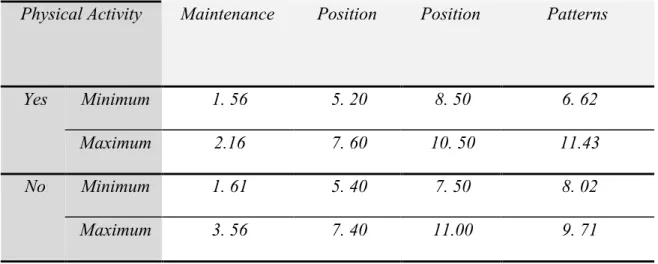
Table 1 shows the minimum and maximum values of the sample according to the variable practice of physical activity during pregnancy, looking slightly anticipated time value on the patterns of head maintenance, sitting position and locomotor patterns.
Table 1 - Minimum and Maximum values according to the variable of practice physical activity
Practice of
Variables
Physical Activity
Maintenance Position Position Patterns
Yes Minimum 1. 56 5. 20 8. 50 6. 62
Maximum 2.16 7. 60 10. 50 11.43
No Minimum 1. 61 5. 40 7. 50 8. 02
Maximum 3. 56 7. 40 11.00 9. 71
In table 1 we find that there are indicators to suggest that the average on the children whose mothers presented the practice of physical activity have achieved contributions to acquire temporal gains regarding the acquisition of postural and locomotor patterns. We emphasize that the practice of swimming was apparently the more favourable contribution for the acquisition of postural and locomotor patterns.
Table 2 – Mean, standard deviation and statistical significance values of the variable of practice of physical activity.
Physical Activity Practice Yes No Sig.
Head Maintenance 2.08 ± 0.36 2.28 ± 0.91 0.38 Sitting Position 6.00 ± 0.41 6.05 ± 0.60 0.92 Erect Position 9.55 ± 0.73 10.25 ± 1.39 0.13 Locomotive Patterns 8:50 ± 0.47 8.50 ± 0.20 0.99 * Sig. α ≤ 0:05
Although the mean values showed slight temporal gains, no significant differences were observed between the groups under analysis.
Results
Regarding mothers who practiced maternal physical activity, it’s observable that in the head maintenance postural pattern the minimum value of 1.56 appears as a gain, it is usually acquired at three months (Eckert, 1993). Also, mothers who practiced physical activity, regarding to seating position, these values indicate that there were gains on this acquisition, because we observe a minimum value of 5.20 and the maximum value of 7.60, once usually the baby perform this position fits until they reach eight months. Concerning the erect position, we can say that the minimum value (8.50) is in line with a time of ten months, (Eckert, 1993). The minimum value of 6.62 and the maximum value 11,43 are within the fourteen months parameter (Eckert, 1993) in terms of locomotor patterns acquisition. Given the presented values of mothers who do not practice physical activity we can see that the minimum value of 1.61 and the maximum value of 3.56 are within the stipulated time of three months for the acquisition of head maintenance, the same happens in the seated position, i.e., the minimum value of 5.40 and the maximum value of 7.40 does not differ significantly in relation to the stipulated time of eight months for this acquisition (Eckert, 1993). The minimum value of 7.50 concerning the erect position is within the time interval of ten months (Eckert, 1993), but the same does not happen in maximum value of 11.00. According to the locomotor patterns the minimum value of 8,02 and the maximum value of 8.71, are complying with the agreed acquisition time of fourteen months (Eckert, 1993).
Conclusions
Given our aim goal of whether the practice of maternal physical activity in the pregnancy period influences the child's motor development in the first year of life, apparently the results were acceptable once its observable a gain in time regarding the acquisition of postural and locomotor patterns, although without significant differences in relation to the group of mothers that indicated the practice of physical activity. These results are encouraging for the development of other studies with wider samples assuming a methodological replication or a modification and control of variables such as volume, intensity and practice types.
REFERENCES
Buchholz, S. Gimnasia para embarazadas. Preparación al parto, Resperación, Gimnasia de posparto (4ª ed.). Barcelona: Editorial Paidotribo. 1998
Carpenter, M., Sady, S., Hoegsberg, B., Sady, M., Haydon, B., Cullinane, E, Coustan, D. & Thompson, P. Fetal heart rate response to maternal exertion. Journal of the American Medical Association, 1988. 259, 3006-3009.
Cyrulnik, B. Sob o signo do afecto. Lisboa: Rolo & Filhos – Artes Gráficas. 1989.
Eckert, H. Desenvolvimento Motor (3ª ed.). São Paulo: Editora Manole. 1993 Fonseca, V. Desenvolvimento Humano. Da filogénese à ontogénese da motricidade. Lisboa: Editorial Notícias. 1989
Gesell, A. A criança dos 0 aos 5 anos. O Bebé e a Criança na Cultura dos nossos Dias. Lisboa: Publicações Dom Quixote. 1979
preferences. In E. D. Capaldi (Ed.), Why we eat what we eat: The psychology of eating (83-112). Washington, DC: American Psychological Association. 1966