11-ketotestosterone in African cichlids
Katharina Hirschenhauser1,5), Adelino V.M. Canário2), Albert F.H. Ros3), Michael Taborsky4) & Rui F. Oliveira3)
(1Konrad Lorenz Research Station Gruenau, University of Vienna, Austria;2Centro de Ciências do Mar, Universidade do Algarve, Faro, Portugal;3Unidade de Investigação em Eco-Etología, Instituto Superior de Psicologia Aplicada, Lisbon, Portugal;4Konrad Lorenz
Institute for Ethology (KLIVV), Vienna and Department of Behavioural Ecology, Zoological Institute, University of Bern, Switzerland)
Summary
We previously investigated the androgen responsiveness of males to simulated partner and territory intrusions in five African cichlid species (Neolamprologus pulcher, Lamprologus
callipterus, Tropheus moorii, Pseudosimochromis curvifrons, Oreochromis mossambicus;
Hirschenhauser et al., 2004). Here we re-analysed data on 11-ketotestosterone (11-KT) levels in holding water to compare the free (presumably from the gills) and conjugated (presumably from urine and faeces) 11-KT fractions. We sampled (i) pre-test baseline control levels from individual males in social isolation and (ii) response levels released after social interactions, either with an ovulating female or a male territory intruder. In four out of five species, con-jugated metabolites contributed to the observed total 11-KT responses in water during social context, which was particularly apparent in peak responsive individuals exposed to male in-truders. Thus, in water from males sampled in isolation immunoreactive 11-KT seemed to derive both from gills and urine, whereas the urinary 11-KT component apparently increased in the social context, particularly when a male was challenged by a same-sex intruder. These results suggest that (i) the social context may affect urine release patterns of males and (ii) 11-KT data acquired by using fish-holding water may not simply reflect the passive transmission of steroid hormones via the gills.
Keywords: androgen responses, conjugated metabolites, non-invasive methods, gill diffusion,
steroid excretion, urine, challenge, cichlid.
5)Corresponding author’s e-mail address: [email protected]
© Koninklijke Brill NV, Leiden, 2008 Behaviour 145, 1367-1388
Introduction
In male vertebrates, sexual and agonistic behaviour is regulated by sex steroids, in particular by androgens such as testosterone. In turn, male sexual and agonistic behaviour and the social environment may feed back on cir-culating androgen levels (Oliveira, 2004; Hirschenhauser & Oliveira, 2006). Furthermore, androgens may be viewed as the physiological mediator of a trade-off between investing in male–male competition and aggressiveness, or in paternal care. In teleosts and birds the timing and duration of phases with seasonally elevated androgen levels seem to vary with the mating pattern, i.e., males from monogamous and biparental species show typically larger androgen responses of shorter durations than males from species that are polygynous and do not show paternal care (‘challenge hypothesis’: Wing-field et al., 1990; Oliveira et al., 2001; Hirschenhauser et al., 2003, 2004). In a previous study, we tested the predictions of the ‘challenge hypothe-sis’ in fish (Hirschenhauser et al., 2004). The simulated territorial intruder paradigm using ‘live decoys’ as it is typically used in experiments with birds (Wingfield & Wada, 1989) was adapted to test a comparable situ-ation with different species of cichlid fish. We studied the Mozambique tilapia (Tilapiini: Oreochromis mossambicus) and two pairs of closely related species with different mating strategies (Lamprologini: Neolamprologus pul-cher, Lamprologus callipterus and Tropheini: Tropheus moori, Pseudosi-mochromis curvifrons). We focused on 11-ketotestosterone (11-KT), the ma-jor biologically active androgen in male teleosts (Kime, 1993; Borg, 1994). Baseline (in social isolation) and response 11-KT levels were measured in focal males on four consecutive days after confrontation with different social stimuli, i.e., interaction with an ovulating female followed by in-teraction with an additional male territorial intruder. Control males were kept in social isolation and went through the same four-day sampling rou-tine.
Due to the small size of the species used, sequential blood sampling was not possible and a repeated design experiment to assess the response of the same individual to different social contexts was only possible by measuring steroids in fish-holding water (Scott & Sorensen, 1994; Greenwood et al., 2001; Hirschenhauser et al., 2002; Oliveira et al., 2003; Scott & Ellis, 2007; Scott et al., 2008, this issue). We did not only measure free 11-KT, but also its sulphated and glucuronidated metabolites. The patterns obtained using
‘total 11-KT’ (i.e., the sum of separate measurements of free, sulphated and glucuronidated 11-KT fractions) confirmed in cichlids the predictions of the ‘challenge hypothesis’, which had previously been tested only with bird examples, at both intraspecific and interspecific levels (Hirschenhauser et al., 2004). In short, after courting a female, males from promiscuous species showed elevated 11-KT levels, while 11-KT levels in males from monogamous and pair-bonding species were lower and less responsive to courtship interactions. In contrast, the males of all species tested responded with increased 11-KT release to the additional challenge with a territorial intruder.
Meanwhile the question has been raised whether there is any advantage in measuring the conjugated steroid fraction in water (as opposed to free steroids alone) and whether additional information could be revealed by analysing the three fractions separately (Scott & Ellis, 2007). The free (more hydrophobic) steroid fraction in water samples has been shown to be mostly due to passive (i.e., continuous) diffusion via the gill epithelia and appears to correlate with steroid concentrations in plasma in several species (Carassius auratus: Stacey et al., 1989; Oncorhynchus mykiss: Vermeirssen & Scott, 1996; Ellis et al., 2005; Dentex dentex: Greenwood et al., 2001; Salmo salar: Ellis et al., 2007; Gasterosteus aculeatus: Sebire et al., 2007; for details see Scott et al., 2008, this issue). The conjugated (more hydrophilic) fractions in water, on the other hand, seem to predominantly derive from active excretion mediated by specific vehicles (such as sulphates in urine, and glucuronides in bile) rather than from passive diffusion through biological membranes (Scott & Ellis, 2007; Scott et al., 2008, this issue). The 11-KT conjugates excreted via urine may derive from constant glomerular filtration (urine production) for clearing the system in order to quickly reconstitute responsiveness in future encounters. Different 11-KT levels would then reflect variation of activity along the hypothalamo-pituitary-gonads axis. Since sulphated and glucuronidated 11-KT originate from the conjugation of free 11-KT, the measurement of ‘total 11-KT’ probably represents an integrative estimate of systemic levels for the duration of the interval sampled. Alternatively, 11-KT conjugates in the water may result from active micturation in response to a specific stimulus (even if it is a by-product; Almeida et al., 2005). The urination behaviour might, thus, introduce additional components of variation on top of systemic androgen levels as determined, for instance, in control males (social isolation) in comparison with males confronted with
social stimuli. Also the time window reflected in a sample may be variable, for example up to several hours longer if the sampled fish actively retained urine (Scott et al., 2008, this issue).
There may be circumstances where a high ratio of conjugated to free steroids in the water may be expected, and vice versa. For example, in the Mozambique tilapia the total volume of urine released varies with social context — with more frequent urine pulses in males when pre-ovulatory fe-males were present and in dominant fe-males during interactions with other males (Almeida et al., 2005; Barata et al., 2007). In theory, the holding water from such males should contain a higher ratio of conjugated to free 11-KT than that from non-interacting males. The aim of the current pa-per is, therefore, to re-analyse the 11-KT measures obtained from water in our previous study separately as ‘free’ and ‘conjugated’ 11-KT. These ex-periments were designed to test the predictions of the ‘challenge hypothe-sis’ in five cichlid species with a simulated intrusion protocol. The exper-imental protocol allowed comparisons between social isolation and social stimulation, and between different stimuli that elicit courtship or territor-ial aggression. If the contribution of conjugated compounds to 11-KT mea-sures from water depends on social context, we predict a different propor-tion of free and conjugated 11-KT metabolites in water samples from the socially stimulated test males than from the socially isolated control males (which went through the same four-day sampling procedures). The present re-analysis may help to identify (interspecific differences of) urination be-haviour in response to social stimuli. Neither free nor conjugated 11-KT seem to have any pheromonal activity in the cichlids that have been stud-ied so far (Frade et al., 2002; Sorensen & Stacey, 2004) although the ol-factory system of Haplochromis burtoni males is sensitive to testosterone-17ß-sulphate (Cole & Stacey, 2006). To examine the basic assumption of the passive versus active modes of excretion of free 11-KT and its metabolites, we also present measurements of water blanks and urine of a sixth cichlid species, the St. Peter’s fish (Sarotherodon galilaeus) plus the relationship between 11-KT levels in urine and plasma samples from the same individ-uals. Revisiting the original question, we ask whether the extra information derived from measuring conjugated steroids in the water justifies the extra lab costs.
Material and methods Experimental set-up
The experiments were performed in 100 × 40 × 40 cm tanks at a water temperature of 26◦C for Lamprologini and Tropheini and at 28◦C for the tilapia. All fish were kept at a 13 : 11 h light : dark regime and standard food (tetramin flakes, frozen daphnia and artemia larvae) was provided in the morning and immediately after water sampling. Whenever we isolated focal males we took the entire group out of the home tanks simultaneously, and in the end put them back as one group after all focal males had been sampled. Within dyads of focal and intruder males fish of similar size were chosen.
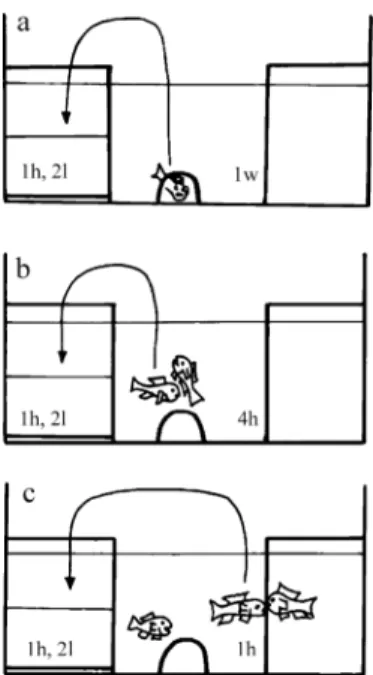
Individual fish were placed into a 20× 20 cm glass sampling container filled with 2 l of blank water for exactly 1 h. The blank water was taken from a large and covered ‘pool tank’, which was refilled after each of the four-day test periods. All glass material used was previously rinsed with alcohol and distilled water to avoid contamination. The sampling container was maintained inside the focal male’s territory throughout the experiment and freshly refilled in the mornings before the different tests were initiated. The focal male was allowed to acclimatize to the test tank and the provided spawning substrate (flower pot halves for O. mossambicus and N. pulcher, snail shells for L. callipterus) for one week, during which period he was kept in social isolation (without visual or chemical contact with conspecifics). After this week the male was sampled for his baseline 11-KT level in water (first day). The next day an ovulatory female (pharmacologically induced ovulation, details in Hirschenhauser et al., 2002, 2004) was placed into the focal male’s tank, the individuals were allowed to interact for 4 h, after which the male was sampled for its 11-KT level in response to the ‘female stimulus’ (second day). On the third day the focal male, which was still together with his female (post-spawning condition), was confronted with a male territorial intruder placed inside a presentation container to avoid injuries. This presentation container was inside the focal male’s tank at all times and had the same size as the sampling container but an open bottom to allow chemical communication. After 1 h of intensive fighting towards the glass walls of the presentation container (with the female serving as audience; Figure 1) the focal male was sampled for the 11-KT response level to the ‘male intruder stimulus’ (third day). The intruder male was removed
Figure 1. Sketch of the experimental set-up of the simulated partner and territory intruder experiments. Sampling (left) and presentation (right) containers were part of the focal male’s territory (tank) at all times of the experiment. (a) Focal male in social isolation for 1 week; (b) interaction with an ovulating female for 4 h; (c) fighting with a territorial intruder through
the glass of the presentation container for 1 h.
after the focal male had been placed into the sampling container. Another sample was taken when the male and its female had been interacting in the same tank for another 24 h (fourth day) to check for the time the 11-KT response to the male intruder stimulus persisted. Each water sample was collected between 1400 and 1500 h to avoid an influence of diurnal variation of steroid hormone levels, and social stimuli, therefore, were timed accordingly (1000–1400 h female stimulus; 1300–1400 h male intruder). Control males went through the same treatments and schedules but never had contact with any conspecific throughout the acclimatization week and the four test days. We had four parallel experimental tanks for testing three socially stimulated males and one control male simultaneously during each four-day test procedure (with the exception of L. callipterus see below).
The males of all species readily responded to the experimental presenta-tions and were very active during both, partner and territorial intruder ex-periments. In the case of L. callipterus a snail shell was presented in the
territory already during the week of acclimatisation prior to the tests. All of these large territorial males seemed to accept the shell as a breeding sub-strate and initiated courtship almost immediately when an ovulating female was presented. Eggs were found inside the shells after the experiment was finished. Similar immediate courtship activity was observed in males of N. pulcher and the Tropheini, which was expressed by impressive colour and quiver displays.
Animals
N. pulcher were kept as family groups, with one territorial pair and up to 18 male and female helpers of all sizes (Oliveira et al., 2003; see Duftner et al., 2007 for species status; see Grantner & Taborsky, 1998 for holding condi-tions and Taborsky & Limberger, 1981; Balshine et al., 2001 for information on the social system). Here the focal male (N = 12) was removed from the group for the duration of the experiment (11 days). For the ‘female stimulus’ we took the female breeder from the same family group: i.e., the focal male’s pre-test partner. Control males and male intruders were taken from a large tank containing an aggregation of non-breeding conspecifics. L. callipterus males and females (N = 8) came from tanks containing only one sex. A con-trol male (N = 1) and seven of the eight previously tested focal males acted as ‘intruder males’ for this species (see Schütz & Taborsky, 2000 for holding conditions and Sato, 1994; Sato et al., 2004 for information on the mating system). T. moori and P. curvifrons were kept in two separated compart-ments of a large mixed species ring-tank before being tested (see Taborsky & Foerster, 2004 for holding conditions and Nishida & Yanagisawa, 1991; Kuwamura, 1987 for information on the mating systems). To initiate the ex-periment with these two species we simultaneously caught all individuals of the respective species and kept the focal males (N = 13), intruder and con-trol males (N = 20 T. moori and 19 P. curvifrons, respectively) in separate tanks to avoid the ‘dear enemy effect’ (Fisher, 1954; Temeles, 1994). Also the females (N = 13 in both species) were caught and kept as a female-only group until they were used in the tests. This schedule did not allow for the same interval between removal from the ring-tank and start of the acclima-tisation week. However, sequential removal of only a fraction of the males from the group would have caused intensive dominance reorganizations and escalating conflicts in the groups. Therefore, we removed and returned all
individuals simultaneously. The Lamprologini and Tropheini species were sampled from a local stock bred at the Konrad Lorenz Institute for Ethology (KLIVV) in Vienna, Austria. O. mossambicus were sampled from mixed-sex group tanks with up to 15 individuals at the Instituto Superior de Psicologia Aplicada in Lisbon, Portugal (see Oliveira et al., 1996 for holding condi-tions and Bruton & Boltt, 1975 for information on the mating system). Con-trol males (N = 6) were never taken from the same tank as the focal male (N = 16) and acted as ‘intruder males’ after the control days’ samplings were complete.
11-KT measurements from fish-holding water
A total of 329 water samples from focal and control males were run through C18 columns. Following elution with ethanol, the free, sulphate and glu-curonide factions of 11-KT were extracted following the procedures de-scribed by Scott & Canário (1992) and Oliveira et al. (1996). In summary, free steroids were extracted with diethyl ether, and sulphates and glu-curonides hydrolysed in succession (sulphates chemically, glucuronidates enzymatically) to release the free steroids, which in turn were extracted sep-arately with diethyl ether. We calculated the sum of all three fractions (free, sulphated and glucuronidated), i.e., the total amounts of the steroid con-tained in each sample (‘total 11-KT’). To standardize for the five differently sized species tested all 11-KT measures from water samples were corrected for body mass, and a 1-h sampling period (i.e., pg 11-KT/g/h). We used a radioimmunoassay to measure 11-KT (Kime, 1993). The assay specificity, intra- and inter-assay variability are described in detail in Hirschenhauser et al. (2004).
11-KT in blank water and urine
To check for the accuracy of the employed extractions and assays, we compared the contribution of the 11-KT fractions (free, sulphated and glu-curonidated) in samples of blank pool water and in pure urine samples. We repeatedly tested blank water samples (N = 9) from Vienna pool water to control for immunoreactivity in the sampling medium. Even though no fish had been inside these samples we present the 11-KT measures of these sam-ples corrected for the average body mass of all species used to keep the scale comparable with measures from fish-holding water. The urine samples were
collected from another tilapia species, Sarotherodon galilaeus (N = 103 males) held as mixed-sex groups in large indoor concrete ponds at the Lake Kinneret Experimental Station for Aquaculture (Ministry of Agriculture, De-partment of Fisheries, Israel). The fish received natural light (14 : 10 h) and the water temperature ranged between 24 and 29◦C (Ros et al., 2003). Imme-diately after capture (between 1000 h and 1200 h), fish were anaesthetized with MS-222 (tricaine methanesulfonate, Sigma-Aldrich; dilution 1 : 104) and from every male: (a) a urine sample was collected by gently pressing the urine bladder at the abdomen of the fish. The released urine was col-lected in 1.5 ml Eppendorf tubes; (b) a 0.3 ml blood sample was drawn from the caudal vasculature using a heparinized 1 ml medical syringe fitted with a 25 gauge hypodermic needle (N = 94 males). Blood and urine were kept on ice until return to the laboratory (up to 30 min). The blood samples were centrifuged at 3000 rpm for 10 min at 26◦C and plasma was collected by aspiration. In an additional attempt to analytically validate the stability of urinary compounds in water, we sampled urine from male O. mossambicus and S. galilaeus in the lab (N = 5 and 7, respectively) and split each urine sample in halves. One half was stored immediately at−20◦C while the other half was diluted and incubated in 1 l of blank water at room temperature. Af-ter 2 h both the frozen sample and the urine–waAf-ter dilution were run through C18-columns and assayed for 11-KT. All biological samples in this study (i.e., fish water, urine and plasma) were kept frozen at −20◦C until further processing in the lab (see Oliveira et al., 1996).
Statistical analyses
Geometric mean and peak immunoreactivity in response to either test situa-tion were calculated for each of the five species based on the three extracted 11-KT fractions (free, sulphated and glucuronidated) and compared with the ‘total 11-KT’ as described in Hirschenhauser et al. (2004). Comparisons tween 11-KT levels in response to the different test situations, as well as be-tween the three fractions measured from the same water samples were tested with non-parametric Friedman rank-ANOVAs and Wilcoxon matched-pairs signed-ranks tests. Pearson’s correlation coefficients served to determine the relationships between 11-KT measures in S. galilaeus, i.e., between urine and plasma samples taken from the same individuals, as well as between urine and urine diluted in water.
Results
11-KT in blank water and in urine
Immunoreactivity in blank water samples (N = 9) was 64.3 ± 9.1 pg 11-KT, which corresponded to 3.1± 0.4 pg 11-KT/g fish when corrected for the average body mass of all tested fish. In the blank water the assay detected mainly unconjugated (‘free’) immunoreactive compounds (57% of the ‘to-tal 11-KT’) and minor contributions of sulphate and glucuronide fractions (20.5% and 22.0%, respectively).
In pure urine samples of male S. galilaeus, conjugates contributed 62% to ‘total 11-KT’, of which 40% were sulphated. This confirms that the sul-phated metabolites may be regarded as indicators of urinary steroid secre-tion. Note that similar to the sulphated metabolites, free 11-KT contributed 38% to the ‘total 11-KT’ in urine of S. galilaeus (Figure 2a). Correlations between urine and plasma KT levels were positive for both free urine 11-KT (r = 0.44; N = 94; p < 0.0001) and ‘total urine 11-KT’ (r = 0.40; N = 94; p < 0.0001; Figure 2b). A test of the stability of urinary 11-KT compounds kept for 2 h in water suggested a linear relationship between 11-KT compounds from urine kept in water and urine frozen immediately (‘total 11-KT’ O. mossambicus: r = 0.98; N = 5; p = 0.003; S. galilaeus: r = 0.98; N = 7; p < 0.0001). Hence, in S. galilaeus systemic 11-KT levels in the plasma were reflected in ‘total 11-KT’ excreted via urine, and in both tilapia species urinary 11-KT remained well detectable in water samples. Social context and excreted 11-KT compounds in water
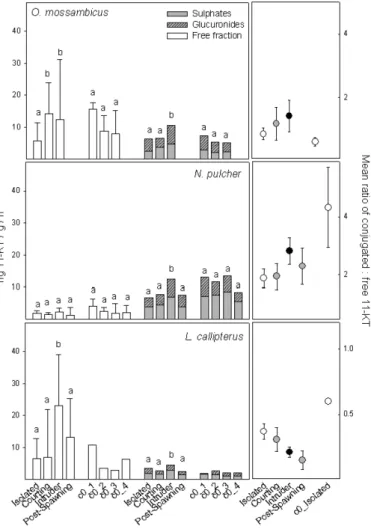
The response patterns to our stimuli based on the free 11-KT differed from the response patterns observed for ‘total 11-KT’. With exception of N. pulcher, free 11-KT increased after either interaction with a female (O. mossambicus) or a male (L. callipterus, T. moorii) or both social stim-uli (P. curvifrons), indicating a systemic androgen response (Figure 3). In contrast, conjugated 11-KT was particularly high after the ‘male intruder stimulus’ in four of the five tested species (Figure 3), which may indicate an effect of the social context on active excretion and, thus, on urination behav-iour. Control males of all tested species had non-significant four-day patterns whether based on free or conjugated 11-KT data (Figure 3). Thus, overall the observed patterns confirmed that social context may be a factor for systemic
Figure 2. (a) Mean+ SE fractions of free and conjugated 11-KT in urine samples from males of an additional cichlid species, Sarotherodon galilaeus (N = 94). (b) Scatterplots and regression lines between 11-KT from plasma and urine samples of the same individuals. Data were log-transformed to satisfy the assumption of normal distribution. Filled dots and dotted line show the relationship between plasma 11-KT and the conjugated 11-KT urine fraction (sulphates and glucuronides: r = 0.25, p = 0.017), which is non-significant when controlling for both variables’ correlation with ‘total 11-KT’ (partial correlation: r= −0.21, p = 0.42), open dots and hatched line are based on the free fraction of the urine, the solid
line shows the regression between 11-KT in plasma and ‘total 11-KT’ in urine.
androgen responses; however, increased urination may have contributed sig-nificantly to ‘total 11-KT’. Two species, N. pulcher and P. curvifrons, showed an exceptionally high proportion of conjugated 11-KT, even in the absence of social stimuli in the control males (Figure 3).
We also analysed how the ratio of free to conjugated 11-KT changed in the water samples to check for similarity of the patterns of free and conjugated 11-KT, and to find out whether conjugated androgen levels from urinary
ori-Figure 3. Patterns of 11-KT in fish-holding water during the four experimental days in the five species tested: social isolation (A, first day), courting (B, second day), male intruder (C, third day), and ‘post-spawning’ after 24 h interaction with the female (D, fourth day, not available from O. mossambicus). Patterns based on free 11-KT fraction (open bars) are plotted separately from the conjugated 11-KT fractions (shaded bars). Within the conjugated fraction mean levels of sulphated (open) and glucuronidated (hatched) 11-KT metabolites are depicted. Bars show geometric means (+75th percentiles). Different letters indicate signifi-cant differences between test situations based on Wilcoxon signed-ranks tests: O.
mossambi-cus (N = 16): free 11-KT, A–B: Z = −2.7, p = 0.006; B–C: Z = −1.8, NS; conjugated
11-KT, A–B: Z= −0.5, NS; B–C: Z = −2.5, p = 0.011. N. pulcher (N = 12): free 11-KT, A–B: Z = −1.2, NS; B–C: Z = −0.9, NS; C–D: Z = 0.9, NS; conjugated 11-KT, A–B:
Figure 3. (Continued). L. callipterus (N = 8): free 11-KT, A–B: Z = −1.3, NS; B–C: Z = −2.5, p = 0.012; C–D: Z = −2.2, p = 0.028; conjugated 11-KT, A–B: Z = −0.4, NS; B–C: Z= −2.4, p = 0.017; C–D: Z = −2.0, p = 0.043. T. moori (N = 13): free 11-KT, A–B: Z = −1.7, NS; B–C: Z = −3.0, p = 0.003; C–D: Z = −2.3, p = 0.023; conjugated 11-KT, χ2 = 3.9, df = 3, NS. P. curvifrons (N = 13): free 11-KT, A–B: Z = −2.3, p = 0.022; B–C: Z = −2.7, p = 0.006; C–D: Z = −2.9, p = 0.003; conjugated 11-KT, A–B: Z = −1.4, NS; B–C: Z = −2.7, p = 0.006; C–D: Z = −2.0, p= 0.050. Control males of all species tested went through the same four-days procedure as the experimental males but in the absence of any social stimulus. Friedman rank ANOVAs:
O. mossambicus (N = 6, df = 2): free 11-KT, χ2= 3.0, NS; conjugated 11-KT, χ2 = 1.0,
NS. N. pulcher (N = 7, df = 3): free 11-KT, χ2 = 6.9, NS; conjugated 11-KT, χ2 = 0.9, NS. T. moori (N = 7, df = 3): free 11-KT, χ2 = 7.3, NS; conjugated 11-KT, χ2 = 4.7, NS. P. curvifrons (N = 6, df = 2): free 11-KT, χ2= 3.6, NS; conjugated 11-KT, χ2= 2.3, NS. In L. callipterus only one control male was available. Right panels of each plot show the mean± SE ratios of urine excretion/release via gill epithelia (conjugated 11-KT metabolites divided by levels of free 11-KT) during each test situation and in the control males (mean over the three/four days sampled in social isolation). ‘c0_1’ to ‘c0_4’ indicate control males
tested on day 1 to day 4.
gin corresponded to specific social contexts or were randomly expressed in each test situation. These comparisons revealed that in at least three of the five species we found high proportions of conjugated 11-KT, i.e., urine-born
compounds even in the (socially isolated) control males (Figure 3; N. pul-cher, P. curvifrons, T. moorii), as also in the one control male sampled for L. callipterus. Only control males from O. mossambicus had smaller ratios of conjugated to free 11-KT than the males tested in a social context. The con-tribution of conjugated (excretory) 11-KT also varied between the different social stimuli, but not consistently throughout the tested species (Figure 3). For example, males from the two Tropheini species had more conjugated metabolites in the water when they met an ovulatory female. In both species the proportion of conjugates was not affected by the interaction with a ter-ritorial intruder, however, and only in T. moorii the fraction of conjugated 11-KT was high during post-spawning (day 4). In contrast to the Tropheini, males from N. pulcher and O. mossambicus had higher proportions of con-jugated 11-KT after the territorial intrusion than when isolated or courting a female. In N. pulcher the ratio of conjugated to free 11-KT was intermedi-ate after removal of the intruder (post-spawning). Despite of their large body size (compared with the smaller N. pulcher) L. callipterus males had the lowest of all observed ratios of conjugated to free steroid, which additionally decreased throughout successive sampling days (Figure 3). Thus, rather than a general pattern for all species tested, the proportion of conjugated steroid to the free steroid level (i.e., affected by urination behaviour during water sampling) varied between species with some species being more responsive to the social context than others.
We also expressed the conjugated 11-KT from urinary origin as a percent-age of the ‘total 11-KT’. Based on the means± SE of the proportion there seemed to be no difference between isolated and socially stimulated males (Table 1). However, there was considerable variation between test males with coefficients of variation ranging from 65% in O. mossambicus to 18% in N. pulcher. Therefore, we compared the conjugated 11-KT from individuals showing peak urinary 11-KT responses within each species between isolated and social context water samples. In all species sampled, the peak responsive individuals had higher proportions of conjugated 11-KT in the water among the males tested in social context than among the isolated control males (Ta-ble 1). This suggests that peak 11-KT measures in water may result from release via urine on top of systemic androgen levels.
Finally, when comparing the pattern across the five tested species in-creased proportions of conjugated 11-KT seem to explain peak responsive
Table 1. Proportions of urinary compounds in ‘total KT’ measures from water of socially isolated control males and males tested in social context. Mean response and peak responsive individuals of the five species tested expressed as % conjugated KT metabolites (sulphates and glucuronides) of ‘total KT’ in water. The water was sampled during four consecutive days
(three days in O. mossambicus) from control and test males.
Species Conjugated KT Coefficient of Conjugated KT metabolites from variation between metabolites from ‘total KT’, mean males (%) ‘total KT’, peak response± SE (%) response (individual) (%) Isolated Social Isolated Social Isolated Social (controls) context (controls) context (controls) context± SE2
O. mossambicus 30.4± 2.8 37.5± 6.1 22 65 41.5 88.5± 0.9(2)
N. pulcher 73.9± 2.99 64.2 ± 3.4 10 18 84.7 86.5± 0.7(2)
L. callipterus 27.31 14.9± 2.8 – 49 27.31 37.2± 5.1(2)
T. moorii 28.7± 4.2 24.2± 3.5 39 51 41.4 62.6± 8.0(3)
P. curvifrons 44.0± 8.0 31.0± 4.4 44 47 67.3 74.9±10.9(3)
1L. callipterus: only one control individual was available.
2Mean % conjugated KT from ‘total KT’ of peak KT responses per test situation (peak re-sponsive individuals; numbers in parentheses indicate how many different individuals con-tributed to the peak responses during the three social context test situations).
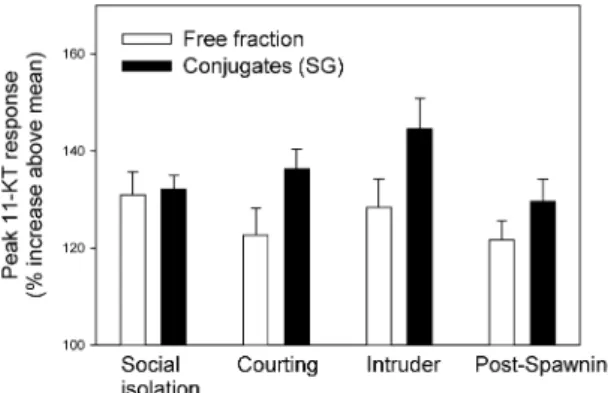
individuals (in each test situation) rather than increased levels of free 11-KT. Because the range of 11-KT content in the water samples also varied between the species (mean coefficient of variation = 41%) we translated the peak 11-KT levels into percent increase above the species-specific mean 11-KT level (Figure 4). Once more, these proportional patterns indicated a non-random difference between free and conjugated compounds released in social context: across the five tested species the conjugated fraction of 11-KT was particularly raised after the ‘male intruder stimulus’ (Figure 4).
Discussion
The routes of steroid excretion in fish are not well understood. This is an unfortunate deficit because from the excretion pathways we may deduce underlying physiological mechanisms of fish communication, and response patterns of fish to social and environmental stimuli. Therefore, the use of
Figure 4. Peak responses to the different social stimuli (test situations) as % increase above species mean 11-KT level+ standard error (N = 5 species). Open bars show peak responses based on the free 11-KT fraction in fish-holding water and variation was not significant throughout the four-day test period (Friedman matched ranks test: χ2 = 6.0; N = 4; df= 3; NS). In contrast, peak 11-KT responses presumably based on excretion (filled bars; conjugated fractions, i.e., sulphated + glucuronidated) were higher in response to the territory
intruder than with a female or in isolation (χ2= 9.3; N = 4; df = 3; P = 0.026).
minimally intrusive methods to analyse steroid hormones in fish, such as steroid hormone measurements from holding water can be potentially ben-eficial for physiological and behavioural experiments. In this context, the decision as to whether one should consider only active forms of steroid hor-mones or include metabolites is scientifically and economically relevant. Our data demonstrate that the patterns of ‘total 11-KT’ in fish water, which in-clude free and conjugated steroids somewhat differ from patterns based on the free 11-KT fraction alone. While the free fraction seems to reflect sys-temic circulating 11-KT levels diffusing continuously through the gill ep-ithelia (Sebire et al., 2007), the conjugated fractions contain urinary (and faecal) components and their rate of release may be affected by social inter-actions. Nevertheless, in S. galilaeus, for example, up to 40% of ‘total 11-KT’ in urine can be free, and both free and ‘total 11-11-KT’ levels from urine correlated with plasma 11-KT levels, thus supporting the notion of passive diffusion, e.g., at the glomerular capillaries. In addition, because urinary 11-KT artificially added to blank water remained reliably detectable, we assume that analytically also ‘total 11-KT’ measures from fish-holding water may be representative of circulating androgen levels.
The analyses of the patterns based on conjugated metabolite measure-ments indicated that the social context affected the observed variation of 11-KT (Figures 3 and 4). This suggests that in addition to the variation of
circulating gonadal androgen levels as a function of the social environment (Wingfield et al., 1990; Oliveira, 2004), urination behaviour also varied in response to specific social stimuli. The ‘male intruder stimulus’ was partic-ularly effective not only as reflected in peak levels of systemic 11-KT but specifically in modifying the urinary (conjugated) 11-KT fraction, whereas courting or post-spawning interactions with a female resulted in conjugated 11-KT water levels similar to those measured during social isolation (Fig-ure 3). Therefore, we argue that ‘total 11-KT’ meas(Fig-urements in fish holding water as reported in Hirschenhauser et al. (2004) probably reflect changes in urine release rates on top of systemic androgen variation.
The decision to measure free or ‘total steroid’ in a study should, thus, depend on the focal question under study, i.e., whether baseline levels are of primary interest, or whether the focus is rather on hormonal responses to a behavioural interaction or a social stimulus. The sampling procedure should be chosen in line with this consideration: for example, a fish individually placed in a dark beaker is socially isolated, lacks a signal receiver and would not be expected to send urinary signals (although this may also depend on the species). Accordingly, measuring conjugates from individuals sampled in isolation may not provide relevant information. However, if the focal question is on short-term responses to specific stimuli, as for example in the serial ‘challenge hypothesis’ tests (Hirschenhauser et al., 2004), it may be beneficial to include conjugates in the analysis and a sampling procedure inside the tank (territory) rather than an ‘external’ beaker. Ultimately, an a priori validation of free and conjugated steroids produced is recommended before starting large scale sample collections (see Scott et al., 2008: this issue).
There could be several physiological functions of the excretion of large amounts of steroids and steroid conjugates. First, it could be a way of clear-ing the circulatory system in order to restore systemic baseline androgen levels to optimise the response to further challenges, and to reduce exposure to high androgen levels. Although surprisingly little experimental work has been done on this subject, there is evidence that continuously elevated an-drogen levels may keep the male in a state of agonistic and energetic arousal (Andrew & Rogers, 1972; Ros et al., 2002, 2004; Wingfield, 2005). While this proactive motivational state may render the animal more successful in responding to agonistic challenges, it might also increase the chance of suf-fering injuries (Moss et al., 1994; Oliveira, 2004; Reed et al., 2006; Kool-haas et al., 2007). Moreover the allocation of both metabolic resources and
time might trade-off with other costly physiological (immunocompetence, Folstad & Karter, 1992) or behavioural traits (parental care, Wingfield et al., 1990; Ketterson et al., 1992; Hirschenhauser & Oliveira, 2006). Cur-rently, we have no indication of whether this ‘steroid clearance’ is the re-sult of an active excretion or rather a continuous passive process in fish and may occur through different mechanisms (Barata et al., 2007). Alternatively, a social function of urine release might be important as has recently been documented in Mozambique tilapia (Almeida et al., 2005; Miranda et al., 2005; Barata et al., 2007), which suggests that adaptive functions may have shaped these physiological mechanisms. Particularly our water samples from Mozambique tilapia males documented increased levels of conjugated 11-KT fractions, i.e., urine released compounds, after the male intruder stimu-lus. This suggests that in this social context urination behaviour may have added steroid compounds to the systemic, circulating levels even though we cannot provide detailed information on the time-course of free and conju-gated 11-KT releases.
What may be the cause of interspecific variation in the proportion of con-jugated 11-KT metabolites to the presence of a male intruder? For example, in L. callipterus and T. moorii we observed only minor or no difference in conjugated 11-KT levels between different test situations (Figure 3) despite of intense behavioural performance. Perhaps in these species urination con-sistently occurred during all phases of the experiment, rather than after a stimulus presentation only. Exceptions exist as some species (for example, N. pulcher) seem to urinate more actively than others (Table 1). The diversity of responses (hormonal and behavioural, including urination behaviour) and sensitivities between species may relate to their diverging and complex so-cial systems and mating strategies, which provides promising opportunities for future research.
In conclusion, when the aim is to study short-term responses to a be-havioural interaction or social stimulus, social context matters for the an-drogen response we measure, especially as the fish-holding water contains androgens excreted actively via the urine. A uniform protocol for measur-ing steroids from water would be desirable to allow comparisons between species and to draw general conclusions. However, we advocate that using the free fraction alone may put at risk the registration of existing but yet unknown functions of sex steroids. Therefore, before the physiology of a
species and its patterns of steroid secretion and excretion are fully under-stood we suggest that the various steroid fractions should be obtained and the best relationship between each fraction and the variable under study should be investigated.
Acknowledgements
We acknowledge the late L.A. Carneiro for his precious assistance in all laboratory routines, for discussions and for being there. We thank E. Couto, F. Bratter and F. Schachinger for technical assistance, B. Taborsky for allowing us to work with the Tropheini species and the KLIVV in Vienna for the hospitality while running the experiments. We also thank E.N. Barata, P. Hubbard, E. Möstl, R. Palme, A.P. Scott and the anonymous reviewers for constructive comments. N. Werner (Tel Aviv University, Israel) and T. Ezer (Experimen-tal Station for Aquaculture, Israel) provided the facilities for the work with Sarotherodon
galilaeus. This study was funded by a research grant from the Portuguese Fundação para a
Ciência e a Tecnología (PRAXIS XXI/P/BIA/10251/98). KH was supported by a postdoc-toral grant from PFCT (PRAXIS XXI/BPD/20142/99). MT is supported by the SNF-grant 3100A0-105626.
References
Almeida, O.G., Miranda, A., Frade, P., Hubbard, P.C., Barata, E.N. & Canário, A.V.M. (2005). Urine as a social signal in the Mozambique tilapia (Oreochromis
mossambi-cus). — Chem. Senses 30: i309-i310.
Andrew, R.J. & Rogers, L.J. (1972). Testosterone, search behaviour and persistence. — Nature 237: 343-345.
Balshine, S., Leach, B., Neat, F., Reid, H., Taborsky, M. & Werner, N. (2001). Correlates of group size in a cooperatively breeding cichlid fish. — Behav. Ecol. Sociobiol. 50: 134-140.
Barata, E.N., Hubbard, P.C., Almeida, O.G., Mirando, A. & Canário, A.V.M. (2007). Male urine signals social rank in the Mozambique tilapia (Oreochromis mossambicus, Peters 1852). — BMC Biol. 5: 54.
Borg, B. (1994). Androgens in teleost fish. — Comp. Biochem. Physiol. 109C: 219-245. Bruton, M.N. & Boltt, R.E. (1975). Aspects of the biology of Tilapia mossambica (Pisces:
Cichlidae) in a natural freshwater lake (Lake Sibaya, South Africa). — J. Fish Biol. 7: 423-445.
Cole, T.B. & Stacey, N.E. (2006). Olfactory responses to steroids in an African mouth-brooding cichlid, Haplochromis burtoni (Günther). — J. Fish Biol. 68: 661-680. Duftner, N., Sefe, K.M., Koblmüller, S., Salzburger, W., Taborsky, M. &
Sturm-bauer, C. (2007). Parallel evolution of facial stripe patterns in the Neolamprologus
brichardi/pulcher species complex endemic to Lake Tanganyika. — Mol. Phylogen.
Evol. 45: 706-715.
Ellis, T., James, J.D. & Scott, A.P. (2005). Branchial release of free cortisol and melatonin by rainbow trout. — J. Fish Biol. 67: 535-540.
Ellis, T., James, J.D., Sundh, H., Fridell, F., Sundell, K. & Scott, A.P. (2007). Non-invasive measurement of cortisol and melatonin in tanks stocked with seawater Atlantic salmon. — Aquaculture 272: 698-706.
Fisher, J.B. (1954). Evolution and bird sociality. — In: Evolution as a process (Huxley, J., Hardy, A.C. & Ford, E.B., eds). Allen & Unwin, London, p. 71-83.
Folstad, I. & Karter, A.J. (1992). Parasites, bright males, and the immunocompetence handi-cap. — Am. Nat. 139: 603-622.
Frade, P., Hubbard, P.C., Barata, E.N. & Canário, A.V.M. (2002). Olfactory sensitivity of the Mozambique tilapia to conspecific odours. — J. Fish Biol. 61: 1239-1254.
Grantner, A. & Taborsky, M. (1998). The metabolic rates associated with resting, and with the performance of agonistic, submissive and digging behaviours in the cichlid fish
Neolamprologus pulcher (Pisces: Cichlidae). — J. Comp. Physiol. B 168: 427-433.
Greenwood, L.N., Scott, A.P., Vermeirssen, E.L.M., Mylonas, C.C. & Pavlidis, M. (2001). Plasma steroids in mature common dentex (Dentex dentex) stimulated with a gonadotropin-releasing hormone agonist. — Gen. Comp. Endocrinol. 123: 1-12. Hirschenhauser, K. & Oliveira, R.F. (2006). Social modulation of androgens in male
verte-brates: meta-analyses of the challenge hypothesis. — Anim. Behav. 71: 265-277. Hirschenhauser, K., Ros, A.F.H., Carneiro, L.A., Oliveira, T., Silva, A., Canário, A.V.M. &
Oliveira, R.F. (2002). Non-invasive hormone assessment from fish-holding water. — Adv. Ethol. 37: 139.
Hirschenhauser, K., Taborsky, M., Oliveira, T., Canário, A.V.M. & Oliveira, R.F. (2004). A test for the ‘challenge hypothesis’ in cichlid fish: simulated partner and territory intruder experiments. — Anim. Behav. 68: 741-750.
Hirschenhauser, K., Winkler, H. & Oliveira, R.F. (2003). Comparative analyses of male androgen responsiveness to social environment in birds: the effects of mating system and paternal incubation. — Horm. Behav. 43: 508-519.
Ketterson, E.D., Nolan Jr., V., Wolf, L. & Ziegenfus, C. (1992). Testosterone and avian life histories: effects of experimentally elevated testosterone on behavior and correlates of fitness in the dark-eyed junco (Junco hyemalis). — Am. Nat. 140: 980-999.
Kime, D. (1993). ‘Classical’ and ‘non-classical’ reproductive steroids in fish. — Rev. Fish Biol. Fisheries 3: 160-180.
Koolhaas, J.M., de Boer, S.F., Buwalda, B. & van Reenen, K. (2007). Individual variation in coping with stress: a multidimensional approach of ultimate and proximate mecha-nisms. — Brain Behav. Evol. 70: 218-226.
Kuwamura, T. (1987). Male mating territory and sneaking in a maternal mouthbrooder,
Pseudosimochromis curvifrons (Pisces; Cichlidae). — J. Ethol. 5: 203-206.
Miranda, A., Almeida, O.G., Hubbard, P.C., Barata, E.N. & Canário, A.V.M. (2005). Olfac-tory discrimination of female reproductive status by male tilapia (Oreochromis
mossam-bicus). — J. Exp. Biol. 208: 2037-2043.
Moss, R., Parr, R. & Lambin, X. (1994). Effects of testosterone on breeding density, breeding success and survival in red grouse. — Proc. Roy. Soc. Lond. B 258: 175-180.
Nishida, M. & Yanagisawa, Y. (1991). The social and mating system of the maternal mouth-brooder Tropheus moorii (Cichlidae) in lake Tanganyika. — Jap. J. Ichthyol. 38: 271-282.
Oliveira, R.F. (2004). Social modulation of androgens in vertebrates: mechanisms and func-tion. — Adv. Study Behav. 34: 165-239.
Oliveira, R.F., Almada, V.C. & Canario, A.V.M. (1996). Social modulation of sex steroid concentrations in the urine of male cichlid fish (Oreochromis mossambicus). — Horm. Behav. 30: 2-12.
Oliveira, R.F., Hirschenhauser, K., Canário, A.V.M. & Taborsky, M. (2003). Androgen levels of reproductive competitors in a cooperatively breeding cichlid. — J. Fish Biol. 63: 1615-1620.
Oliveira, R.F., Ros, A.F.H., Hirschenhauser, K. & Canário, A.V.M. (2001). Androgens and mating systems in fish: intra- and interspecific analyses. — In: Perspectives in com-parative endocrinology: unity and diversity (Goos, H.J., Rastogi, R.K., Vaudry, H. & Pierantoni, R., eds). Monduzzi, Sorrento, p. 203-215.
Reed, W.L., Clark, M.E., Parker, P.G., Raouf, S.A., Arguedas, N., Monk, D.S., Snajdr, E., Nolan Jr., V. & Ketterson, E.D. (2006). Physiological effects on demography: experi-mental study of testosterone’s effects on fitness. — Am. Nat. 167: 667-683.
Ros, A.F.H., Becker, K., Canario, A.V.M. & Oliveira, R.F. (2004). Androgen levels and energy metabolism in Oreochromis mossambicus. — J. Fish Biol. 65: 895-905. Ros, A.F.H., Canario, A.V.M., Couto, E., Zeilstra, I. & Oliveira, R.F. (2003). Endocrine
corre-lates of intra-specific variation in the mating system of the St. Peter’s fish (Sarotherodon
galilaeus). — Horm. Behav. 44: 365-373.
Ros, A.F.H., Dieleman, S.J. & Groothuis, T.G.G. (2002). Social stimuli, testosterone, and aggression in gull chicks: support for the challenge hypothesis. — Horm. Behav. 41: 334-342.
Sato, T. (1994). Active accumulation of spawning substrate: a determinant of extreme polyg-yny in a shell-brooding cichlid fish. — Anim. Behav. 48: 669-678.
Sato, T., Hirose, M., Taborsky, M. & Kimura, S. (1994). Size-dependent male alternative reproductive tactics in the shell-brooding cichlid fish Lamprologus callipterus in Lake Tanganyika. — Ethology 110: 49-62.
Schütz, D. & Taborsky, M. (2000). Giant males or dwarf females: what determines the extreme sexual size dimorphism in Lamprologus callipterus? — J. Fish Biol. 57: 1254-1265.
Scott, A.P. & Canário, A.V.M. (1992). 17α,20ß-Dihydroxy-4-pregnen-3-one-20-sulphate: a major new metabolite of the teleost oocyte maturation-inducing steroid. — Gen. Comp. Endocrinol. 85: 91-100.
Scott, A.P. & Ellis, T. (2007). Measurement of fish steroids in water — a review. — Gen. Comp. Endocrinol. 153: 392-400.
Scott, A.P., Hirschenhauser, K., Bender, N., Oliveira, R.F., Earley, R.L., Sebire, M., Ellis, T., Pavlidis, M., Hubbard, P.C., Huertas, M. & Canário, A.V.M. (2008). Non-invasive measurement of steroids in fish-holding water: important considerations when applying the procedure to behaviour studies. — Behaviour 145: 1307-1328.
Scott, A.P. & Sorensen, P.W. (1994). Time course and release of pheromonally active gonadal steroids and their conjugates by ovulatory goldfish. — Gen. Comp. Endocrinol. 96: 309-323.
Sebire, M., Katsiadaki, I. & Scott, A.P. (2007). Non-invasive measurement of 11-ketotestosterone, cortisol and androstenedione in male three-spined stickleback
(Gas-terosteus aculeatus). — Gen. Comp. Endocrinol. 152: 30-38.
Sorensen, P.W. & Stacey, N.E. (2004). Brief review of fish pheromones and discussion of their possible uses in the control of non-indigenous teleost fishes. — NZ J. Mar. Freshwater Res. 38: 399-417.
Stacey, N.E., Sorensen, P.W., Van der Kraak, G.J. & Dulka, J.G. (1989). Direct evidence that 17α,20β-dihydroxy-4-pregnen-3-one functions as a goldfish primer pheromone: pre-ovulatory release is closely associated with male endocrine responses. — Gen. Comp. Endocrinol. 75: 62-70.
Taborsky, M. & Foerster, K. (2004). Female mouthbrooders adjust incubation duration to perceived risk of predation. — Anim. Behav. 68: 1275-1281.
Taborsky, M. & Limberger, D. (1981). Helpers in fish. — Behav. Ecol. Sociobiol. 8: 143-145. Temeles, E.J. (1994). The role of neighbours in territorial systems: when are they ‘dear
enemies’? — Anim. Behav. 47: 339-350.
Vermeirssen, E.L.M. & Scott, A.P. (1996). Excretion of free and conjugated steroids in rain-bow trout (Oncorhynchus mykiss): evidence for branchial excretion of the maturation-inducing steroid, 17a-20ß-dihydroxy-4-pregnen-3-one. — Gen. Comp. Endocrinol. 101: 180-194.
Wingfield, J.C. (2005). A continuing saga: the role of testosterone in aggression. — Horm. Behav. 48: 253-255.
Wingfield, J.C., Hegner, R.E., Dufty Jr., A.M. & Ball, G.F. (1990). The ‘challenge hypothe-sis’: theoretical implications for patterns of testosterone secretion, mating systems, and breeding strategies. — Am. Nat. 136: 829-846.
Wingfield, J.C. & Wada, M. (1989). Changes in plasma levels of testosterone during male– male interactions in the song sparrow, Melospiza melodia: time course and specificity of response. — J. Comp. Physiol. A 166: 189-194.