Who Gets What? The Interactive Effect of MPs’
Sex in Committee Assignments in Portugal
Ana Espı´rito-Santo1,* and Edalina Rodrigues Sanches21Department of Political Science and Public Policies, ISCTE – University Institute of Lisbon (ISCTE-IUL) and Centre for
Sociological Studies and Research (CIES-IUL), Lisbon, Portugal
2Instituto de Cieˆncias Sociais, Universidade de Lisboa, Lisbon, Portugal
* Correspondence: [email protected]
This article investigates the role of key individual-level factors, namely expertise, seniority and preferences in women’s assignments to legislative committees. It focuses on Portugal and draws on biographical data on MPs in five elections until 2009 and interviews with 20 legislators in 2014. The results show that female and male MPs have a similar probability of being appointed to powerful and eco-nomic issue committees, but female MPs are more likely to be appointed to social issue committees regardless of expertise and seniority. Although this outcome might be the product of their own preferences, it is influenced by embedded gender norms.
Keywords: Committee assignment, Expertise, Seniority, Preferences, Portugal, Women
1. Introduction
Parliamentary committees create opportunities for legislative efficiency and pro-ductivity; they are therefore one of the most significant internal organisational features of modern parliaments (Strøm, 1998, p. 24). Many factors influence appointments to legislative committees, namely national regulations, party-level factors such as internal organisational characteristics and party size, and MPs’ characteristics, e.g. personal preferences, areas of expertise, seniority and incum-bency. But is the MPs’ sex also of relevance?
Political institutions, including parliaments and political parties, are not gen-der neutral; they are gengen-dered. This means that constructions of masculinity and femininity are intertwined in their daily culture (Kenny, 2013, p. 37). Moreover, as a result of the historic exclusion of women, gender norms in political
#The Author(s) 2019. Published by Oxford University Press on behalf of the Hansard Society; all rights reserved.
institutions are mainly masculine, i.e. a deeply embedded culture of masculinity pervades politics, rewarding codes of masculinity and disallowing codes of femi-ninity (Lovenduski, 2005). Therefore, the increase in women’s descriptive politi-cal representation in most countries’ legislatures in the last decades, due largely to the international trend towards adopting gender quotas, is probably not reflected in a more balanced distribution of power between women and men. This article helps shed light on this discussion by looking at committee nominations.
An appointment to a highly prestigious committee is an institutionally valu-able resource for MPs (Friedman, 1996, p. 74); it is both a way of gaining power and prestige (Cox and McCubbins, 2005) and also crucial for influencing policy-making (Friedman, 1996;Pansardi and Vercesi, 2017). Thus, not only can we ar-gue that women and men should be present among political elites in roughly equal numbers on the grounds of fairness (Dovi, 2007, p. 308), but the physical presence of traditionally under-represented groups (such as ethnic minorities, people with disabilities or women) in a committee might make a difference in terms of policy (Phillips, 1995;Mansbridge, 1999) and hence contribute to im-proving democratic deliberation (Dovi, 2007, p. 309).
This article has two main objectives. The first is to understand whether women have been over- or under-represented in different kinds of committees. As politi-cal institutions are not gender neutral, it is likely that pre-existing gender norms interact with individual-level factors considered crucial to committee member-ship, namely expertise, seniority and preferences (Leston-Bandeira, 2004;Strøm, 1998;Yordanova, 2009;Whitaker, 2018). Therefore, the second objective of this article is to explore whether these individual level factors are equally relevant for the committee assignments of women and men.1
Although a consistent body of research suggests there is a bias against female candidates in committee appointments (Thomas, 1994;Towns, 2003;Diaz, 2005; Heath et al., 2005;Schwindt-Bayer, 2010), more recent scholarship has shown signs of change (Baekgaard and Kjaer, 2012;O’Brien, 2012;Kerevel and Atkeson, 2013;Barnes, 2014). This study contributes to this debate by examining commit-tee assignments in Portugal, which is a relevant case study for four reasons. First, although committees are not enforced by the constitution, in line with the inter-national trend (Strøm, 1998, p. 24), they play a crucial role both in passing legis-lation and exercising political control (i.e. supervising) (Ribeiro and Cid, 2008, p. 98). Moreover, committees have become increasingly significant ( Leston-Bandeira, 2004, p. 46). Secondly, Portugal has witnessed marked changes in the
1Incorporating an adequate conception of gender into quantitative work remains a huge challenge (Lovenduski, 2016, p. 523). Although this research also suffers from this constraint, and in some parts we employ a dichotomous variable of sex, we have integrated a gender perspective as much as possible into our analysis and reflections.
presence of women in political power, namely in the national parliament, in re-cent decades. Whereas only 5% of the MPs were women at the start of the demo-cratic regime in 1976, the figure has now (September 2018) risen to 34.8%, slightly higher than the European average (27.7%). Moreover, the adoption of legislative gender quotas (Parity Law) in 2006 (seeEspı´rito-Santo, 2018for more details on the law) makes Portugal a relevant case study to examine the patterns of committee appointment before and after a quota law. Thirdly, to our knowl-edge, this is the first study on Portugal focusing on the role of MPs’ sex in com-mittee assignments and one of the first to look empirically into comcom-mittee appointments (see Fernandes, 2016 for appointments to committee chairs). Fourthly, ‘much remains unknown about how committee assignments happen and with what causes’ (Martin and Mickler, 2019, p. 78) but we do know that ‘the assignment process is structured by country-specific patterns’ (2019, p. 86). Hence, information on an unexplored case study such as Portugal furthers the understanding of the mechanisms behind committee appointments and, hence, the power relations within legislatures.
This article uses quantitative and qualitative data collected within two differ-ent projects offering complemdiffer-entary insights on committee appointmdiffer-ents. The first is an original and rich dataset with background biographical data and com-mittee assignments for the candidates elected to the Portuguese National Parliament (Assembleia da Repu´blica) in five elections until 2009. The second is a set of 20 interviews conducted in 2014 with MPs from all parties represented in parliament at the time.
The remainder of the article is structured as follows. After presenting the theo-retical hypotheses on committee appointments, a description is given of the Portuguese context. The following sections explain the data and variables employed in the empirical analysis and provide the main results. Lastly, we dis-cuss the main findings and suggest further avenues for research.
2. The role of MPs’ sex in committee assignments
The initial research on committee appointments focused on the US Congress (e.g.Cox and McCubbins, 1993;Gilligan and Krehbiel, 1990), and studies on the European Parliament (Whitaker, 2018; Yordanova, 2009) and national legisla-tures outside the US (e.g. Ciftci et al., 2008; Mickler, 2018a, 2018b) appeared much later. This explains why most of the latter research follows the so-called congressional framework of legislative organisation (Martin and Mickler, 2019), comprising distributive theory, informational theory and partisan theory.
The usefulness of this important framework is however limited when the research centres on the role of MPs’ sex in committee appointments. The flourishing re-search on this topic has focused on two key questions (Baekgaard and Kjaer, 2012).
The first is descriptive and aims to depict the distribution of women and men across different committees. Prestige is often used to rank committees, and most research on the role of MPs’ sex in appointments finds an uneven distribution of women and men across committees. Women are often overrepresented in social issue com-mittees and those dealing with equality, and underrepresented in powerful commit-tees and those representing issues that are traditionally ‘men’s’ domains (Thomas, 1994;Friedman, 1996;Towns, 2003;Diaz, 2005;Heath et al., 2005;Schwindt-Bayer, 2010;Kerevel and Atkeson, 2013; Bolzendahl, 2014;Pansardi and Vercesi, 2017). Given that this pattern is even found in Denmark, one of the most advanced coun-tries in terms of gender equality in politics, we expect to find similar disparities in most other settings (as argued byBaekgaard and Kjaer, 2012, p. 480). Thus, our first theoretical expectation is:
Women are overrepresented in social issue committees and underrepre-sented in powerful committees and committees that deal with issues that are traditionally ‘men’s’ domains (Hypothesis 1: H1).
The second key question addresses the determinants of women’s appoint-ments to legislative committees. When examining this issue, it is useful to identify the main explanatory factors and observe whether the differences between women and men remain once we control for these factors. If so, there are grounds to believe that there is gender discrimination. A systematic literature review empha-sises expertise, seniority and preferences as the three main determinants for committee assignments.
Specialisation is one of the greatest benefits of legislative committees: ‘legisla-tors benefit from their familiarity with the substance and procedures they en-counter in their respective committees, compared with the legislative agenda as a whole’, enabling economies of operation (Strøm, 1998, pp. 24–25). Committee members are important for shaping party policy (Friedman, 1996;Pansardi and Vercesi, 2017) and therefore party leaders value committee members with exper-tise in relevant policy areas (Ciftci et al., 2008;Mickler 2018a,2018b). It is perti-nent to note the differences between women and men in expertise: female MPs are more likely to have careers in education, while men are more likely to come from business backgrounds (Thomas, 1994).
The role of seniority in committee appointments is less consensual. While the number of legislative periods an MP has served has no effect on nomination to important committees in Ireland (Mickler, 2018b, p. 129) and Germany (Mickler, 2018a), in other national legislatures, such as Turkey (Ciftci et al., 2008) and the USA (Cox and McCubbins, 1993), seniority is relevant. Literature on the relationship between incumbency and the sex of MPs appointed to com-mittees observes that women’s marginalisation is largely explained by
incumbency (Kerevel and Atkeson, 2013, p. 990). Similarly,Barnes’ (2014)study of Argentina shows that the differences in committee appointments are explained by the fact that women are more often newcomers than men.
Self-selection to certain committees is mainly important in the case of the USA, but also cannot be ignored in settings where political parties play a more determi-nant role. It has been often argued that party leaders take MPs’ individual preferen-ces into account when appointing them to legislative committees (Thomas, 1994; Leston-Bandeira, 2004, p. 44;Carroll, 2008;Schwindt-Bayer, 2010;Baekgaard and Kjaer, 2012;Raymond and Holt, 2019; Whitaker, 2018); one cited exception is Ireland, where MPs are usually not requested to express their preferences (Mickler, 2018b). Although the preferred committees of female and male MPs tend to be dif-ferent (Baekgaard and Kjaer, 2012), women legislators are not more likely to be dis-satisfied with their committee appointment (Carroll, 2008, p. 148).
In addition, the expertise and seniority of male and female MPs are unlikely to be perceived and valued in the same way by party leaders. In fact, given that fe-male politicians are still stereotyped (Herrnson et al., 2003), that political institu-tions in general are profoundly gendered (Kenny, 2013) and political parties tend to be ‘institutionally sexist’ organisations (Lovenduski, 2005), we should expect these key individual-level factors to be overlooked in some cases and exacerbated in others. More specifically, we anticipate that:
• More men (than women) without expertise are appointed to ‘powerful com-mittees’ and to committees dealing with issues that are traditionally ‘men’s’ domains, and more women (than men) without expertise are appointed to so-cial issue committees (Hypothesis 2: H2);
• Male MPs that are not newcomers (i.e. seniors) are less often appointed to so-cial issue committees and more often appointed to powerful committees, when compared to their female counterparts (Hypothesis 3: H3).
The impact of the growing number of female MPs in parliament has recently warranted some attention in the literature, but the findings are not straightforward. While some studies argue that it accentuates differences between sexes as it means women are more likely to be appointed to social issue committees (Towns, 2003; Heath et al., 2005;Barnes, 2014), others find it has no effect at all (Carroll, 2008; Kerevel and Atkeson, 2013). Thus, the adoption of a gender quota will be taken into consideration when analysing H3 as it often implies a surge in female newcomers.
In light of the above mentioned literature, our expectation on preferences is that the parties strive to appoint MPs to their preferred committee. Therefore, our last hypothesis poses that:
Female and male MPs tend to sit on their preferred committee(s) (Hypothesis 4: H4).
3. Legislative committees in Portugal
Since the transition to democracy, the Portuguese National Parliament has been elected through a closed-list proportional representation (CLPR) system. Under this system, the parties are the key organisational units both outside and within the legislature (Braga da Cruz, 1988; Leston-Bandeira, 2004; Leston-Bandeira, 2009;Fernandes, 2016). Parties determine the lists of candidates, albeit with vary-ing degrees of inclusiveness (Sanches and Razzuoli, 2017), and voters can only choose one list over the others. Whether a candidate is elected largely depends on the party’s performance and on her/his position on the list, thus making intra-party competition crucial (Braga da Cruz, 1988; Fernandes, 2016). If elected, most candidates stay within their party’s parliamentary group (PG); however, they can sit as independents if they abandon their original PG (Leston-Bandeira, 2004, p. 40).
According to the Portuguese Constitution, MPs represent the whole nation and not their constituencies; as a result, the central role in parliament is played by PGs rather than individual MPs (Leston-Bandeira, 2004, p. 41). Despite their lack of autonomy in this framework (Opello, 1986;Braga da Cruz 1988), individual MPs find ways of expressing ‘disagreement with the party’ (Leston-Bandeira, 2009), and they sometimes represent their constituency’s interests in parliament (Leston-Bandeira, 2004, pp. 130–133;Fernandes, 2016;Fernandes et al., 2018). Moreover, the 2007 Reform of Parliament has enhanced the role, visibility and working conditions of individual MPs in parliamentary activity (Leston-Bandeira and Tibu´rcio, 2012). MPs can now ‘head the bills they propose themselves rather than through their parliamentary group leader’, their work has become more visi-ble and accessivisi-ble to citizens via the parliament’s website, and the Statute of Deputies now establishes that MPs should have an individual office, assistant, email and webpage (Leston-Bandeira and Tibu´rcio, 2012, p. 390).
Along with the plenary, the specialised standing committees (Comiss~oes espe-cializadas permanentes)2perform the parliament’s main activities. Between 1983 and 2009, considerable changes were made to the role and importance given to committees. Until 1983, all legislative proceedings took place (as a rule) in the plenary and committees had little autonomous competence; however, the compe-tences and time attributed to plenary debates has since been reduced while the committees’ role in the legislative proceedings has been enhanced considerably (Leston-Bandeira, 2004, p. 46). For instance, between 1985 and 1988, committees were given the right to meet at the same time as the plenary (previously forbid-den), the second reading of each bill and hence the discussion and vote on its
2In addition to specialised standing committees, there are special committees. Our dataset is only com-posed of standing committees.
individual articles was ascribed to them (previously this had to be done in the ple-nary) and they were given the power to conduct studies, undertake parliamentary auditions and request the testimony of any citizen (Leston-Bandeira, 2004, p. 48). Currently, there is no limit to the number of specialised standing committees in each legislature (there was a limit of 14 up until 2007). The number and their specific competences are decided on at the beginning of each legislature and result from the political negotiation between all parties represented in parliament (Ribeiro and Cid, 2008, p. 108). Traditionally, there are 12 standing committees and, like other European democracies, standing committees have a significant overlap with the ministerial jurisdictions (Leston-Bandeira, 2004, p. 43; Fernandes, 2016, p. 115).
3.1 Committee appointment
All formal rules on committee appointment are set out in the Rules of Procedure of the Portuguese National Parliament, entitled Regimento da Assembleia da Repu´blica [RAR]3. Contrary to what happens in other parliaments worldwide, the committees in the Portuguese National Parliament do not have a fixed number of members; they can vary from one legislature to another (Article 29, paragraph 4) but, on average, they have between 19 and 21 members (Ribeiro and Cid, 2008, p. 113).
According to the RAR, the PGs are responsible for the appointment of their MPs to parliamentary committees (Article 30, paragraph 1) and since 2007 each MP can only be a full member of one committee (Article 30, paragraph 3). The one exception to this rule is when it is necessary to appoint MPs of small parties to more than one committee in order to guarantee that the composition of par-liamentary committees is proportional to each party’s share of the seats in parlia-ment, which constitutes another rule (Article 29, paragraph 1).
The RAR rules in relation to independent MPs are particularly interesting. In a process similar to that of Ireland (Mickler, 2018b, p. 123), independent MPs are first asked to indicate the committees they would like to join; after hearing from the leaders of all PGs, the President of the Assembly then designates the indepen-dent MPs to a committee(s), trying to meet their preferences whenever possible (Article 30, paragraph 7). The RAR does not specify any rule on how the PG should appoint their MPs to committees. However, the fact that preferences are formally taken into account for independent MPs is in keeping with the findings of the few existing studies on the informal aspects of this process within PGs.
3http://www.parlamento.pt/legislacao/documents/legislacao_anotada/regimentoar_simples.pdf (accessed 21 September 2018).
To our knowledge, no previous research has been conducted specifically to understand committee appointment in Portugal. However, two related studies touch upon this topic and make noteworthy suggestions. Drawing on interviews with sixteen Portuguese political actors, Leston-Bandeira observes, without fur-ther development, that MPs’ preferences and expertise are taken into account when they are appointed by PGs to committees (Leston-Bandeira, 2004, p. 43). Another related piece of research uses a dataset including all MPs serving in the Portuguese Parliament between 2005 and 2011 and concludes that parties rely on ex ante biographical information, such as incumbency, to select committee chairs and party coordinators, and on ex-post mechanisms, such as positions in the party structure, to nominate party coordinators. However, the characteristics of these two positions are different from those of an ordinary committee member. Therefore, a comprehensive account of how MPs are appointed to committees is clearly lacking.
4. Data and models
Two kinds of data were employed to test the hypotheses presented in this study. An original and rich dataset of biographical background data and information on committee membership of MPs of the Portuguese National Parliament was used for H1, H2 and H3. This dataset (Espı´rito-Santo and Sanches, 2012), assembled within the framework of the project Collaborative Research: Electoral Systems and Party Personnel: The Consequences of Reform and Non-Reform, covers five parliamentary elections in 1983, 1995, 2002, 2005 and 20094and includes infor-mation on all elected candidates for a total of 1170 observations. Following a common classification of committees employed in the literature focusing on the role of MPs’ sex in committee appointments (Heath et al., 2005, p. 421;Kerevel and Atkeson, 2013, p. 984;Barnes, 2014, p. 11),5we created three categories of committees based on the kinds of issue they address: social and women’s issues committees (SWIC), economic issue committees (EIC) and powerful committees
4Collecting comprehensive biographical data in the framework of the project meant that only a hand-ful of elections could be included. The selection made by the team sought to allow comparability with the other cases included in the project while encompassing contextual variation. The starting point was the 1983 election, which came after the 1982 constitutional amendment, often seen as a marker of Portugal democratic consolidation (Costa, 2010). The following elections capture different governing formulas including minority (Socialist Party: 1995, 2005, 2009) and coalition governments (Social Democratic Party and Democratic Social Centre-Popular Party: 2002). This choice further helps to de-pict the characteristics of the parliament before and after the adoption of gender quotas in 2006. 5However, some studies use other classifications of committees (Friedman, 1996; Diaz, 2005;
(PC). SWIC cover the following areas: health, education, culture, youth, equality and the status of women. They are usually considered ‘soft’ committees, in con-trast to EIC which are also referred to in the literature as ‘hard’ committees. The latter include economic, finance and budget issues. PC are the most prestigious committees and comprise foreign affairs, national defence and constitutional issues; they are also known as ‘high policy’committees. In the Portuguese National Parliament, committees are named by their rank order of importance: first committee, second committee, etc, hence, PC are usually the first three com-mittees of each legislature. PC are usually the first three comcom-mittees of each legis-lature. We added distributive committees (DC) to the three previous types of committee; DC deal with agriculture, fisheries, public works, local power, envi-ronment and territory planning. According to distributive theories, parties will seek to secure votes by awarding particularistic benefits to key constituencies (Pekkanen et al., 2006, p. 189). This is particularly the case in open-list systems in which the personal vote and constituency links are fostered, but much less so in closed-list systems like that of Portugal; moreover, DC are less visible and presti-gious when compared to committees dealing with high policy and economic issues. Although we have no clear expectation as to whether MPs’ sex is impor-tant to their nomination to these committees, we believe this is a good opportu-nity to clarify the matter. For a full description of how committees were classified seeSupplementary Table S1.
The dependent variable is whether an MP is or is not a full member of each kind of committee (1¼ yes; 0 ¼ no). Until 2007, MPs were able to serve in up to two committees (Ribeiro and Cid, 2008, p. 114); thus, membership in commit-tees was not mutually exclusive. Since 2007, MPs can only sit on one committee unless it is necessary to guarantee proportional representation of all PGs; this means that in smaller PGs the same MP might sit on up to three committees (RAR, Article 29, paragraph 6). Given these specificities, we estimated probit regressions which, by examining one committee at a time, allow us to tackle the is-sue of dual membership. Furthermore, all models include robust standard errors clustered at the election year due to the hierarchical structure of the data.
The models estimated included three key independent variables: Female (1¼ woman; 0¼ man); Newcomer (1 ¼ MP is newly elected; 0 ¼ MP has served in a prior legislature), and Expertise (1¼ MP has both the educational and the professional expertise required for the post; 0¼ otherwise). Four variables mea-sure expertise for each type of committee: expertise for EIC implies that the MP has a degree and professional career in economics and management; expertise for PC implies s/he has a degree in law and public administration and has had a ca-reer as lawyer, judge or senior government official; expertise for DC means that the MP has studied and worked in areas related to engineering, mathematics, ar-chitecture, etc.; and finally expertise for SWIC includes an educational and
professional background broadly related to health, social and human sciences (full description inSupplementary Table S2). Expertise and Newcomer entered the first model alone as controls (H1) and then interacted with Female, so as to test the theoretical assumptions under H2 and H3.
In addition, several explanatory variables put forward by literature on com-mittee appointment were added as controls. At the individual level, we included Position on the list as top-ranked MPs are more likely to be assigned to high-policy committees in proportional closed-list electoral systems (Riera and Cantu´, 2018, p. 530). At the party level, we considered: Party size (number of MPs the party has in the house), Governing party (1¼ yes, 0 ¼ no) and Left-wing party (1¼ if the party is leftist; 0 ¼if the party is rightist6). Party size was included since Party size was included since the number of MPs a party has in the parliament might influence crucial decisions in terms of committee assignment. Governing party matters as it has been shown that women in the governing party are less likely to be restricted to women’s and social issue committees than female legisla-tors in the opposition (Heath et al., 2005, p. 430). Party ideology and its relation-ship to gender bias have also been vastly addressed in the literature. A consensual finding is that left-wing parties are usually more associated with the election of women to parliaments than right-wing parties (Kittilson, 1999, p. 87;Lovenduski and Norris, 1993, p. 320 ). However, when looking specifically at committee appointments, the results do not always go in the expected direction (Carroll, 2008, p. 145;Pansardi and Vercesi, 2017, p. 74). Finally, at the chamber level, we consider the percentage of Women in chamber (measured as the percentage of seats held by women).
For H4, we rely on semi-structured face-to-face interviews with 20 MPs (14 fe-male and 6 fe-male) from all political parties represented in parliament, conducted between July and September 2014 within the project Mulh(j)er e Poder: Women’s Political Representation in Portugal and Spain (see Supplementary Table S3for more details on the interviewees). Despite the time lag between the interviews and the biographical data, these interviews are meaningful, particularly because Portugal has a very high legislative turnover (Matland and Studlar, 2004). In fact, 14 out of the 20 interviewees are part of our datasets although they are obviously sitting in a different legislature. Furthermore, the qualitative data that results from the interviews provide valuable insights on the informal rules that cannot be obtained through quantitative research. Nevertheless, we recognise
6Leftist parties are: Socialist Party (PS), Left Bloc (BE), Portuguese Communist Party (PCP), Ecologist Party ‘The Greens’ (PEV), Social Democratic Independent Action (ADSI), Portuguese Democratic Movement—Democratic Electoral Commission (MDP/CDE) and Leftist Union for the Socialist Democracy (UEDS); rightist parties are: Democratic Social Centre-Popular Party (CDS-PP), Social Democratic Party (PSD) and Popular Monarchist Party (PPM).
that a proper test of the relevance of MPs’ committee preferences entails data on all MPs included in our dataset so that a similar analysis can be made to the one performed for the previous two individual level-factors. However, as this data could not be collected, we decided to proceed with an exploratory analysis of H4 based on the refereed interviews. It should also be noted that the interview script focused on the broader legislative activities of MPs and that only the questions concerning committees are relevant to this article.
5. Determinants of women’s committee appointments
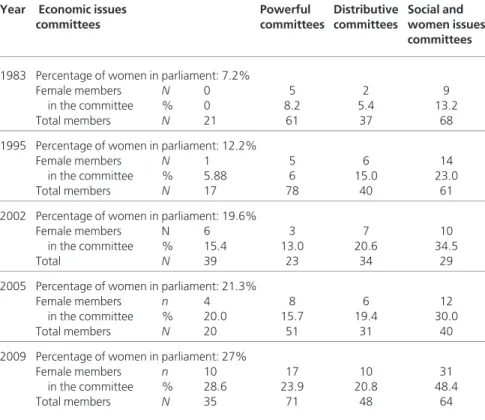
The number of women in the Portuguese National Parliament has risen steadily. However, little is known about the legislative committees to which women are more likely to be appointed once in parliament. If appointment strategies were gender neutral, then the proportion of women in each legislative committee would mirror the percentage of women in parliament. Our expectation under H1 is that women are overrepresented in SWIC and underrepresented in committees dealing with high policy and economic issues (PC and EIC). The descriptive statistics presented inTable 1give partial support to this expectation. In fact, women are systematically
Table 1 Percentage of female MPs across different legislative committees by year Year Economic issues
committees Powerful committees Distributive committees Social and women issues committees 1983 Percentage of women in parliament: 7.2%
Female members in the committee
N 0 5 2 9
% 0 8.2 5.4 13.2
Total members N 21 61 37 68
1995 Percentage of women in parliament: 12.2% Female members
in the committee
N 1 5 6 14
% 5.88 6 15.0 23.0
Total members N 17 78 40 61
2002 Percentage of women in parliament: 19.6% Female members
in the committee
N 6 3 7 10
% 15.4 13.0 20.6 34.5
Total N 39 23 34 29
2005 Percentage of women in parliament: 21.3% Female members
in the committee
n 4 8 6 12
% 20.0 15.7 19.4 30.0
Total members N 20 51 31 40
2009 Percentage of women in parliament: 27% Female members
in the committee
n 10 17 10 31
% 28.6 23.9 20.8 48.4
overrepresented in SWIC in all years and particularly 2009 when there are over 20% more women in SWIC vis-a-vis the percentage of women in parliament. Although the results also show that women are underrepresented in PC and EIC, this has gradually decreased and, notably, mainly in the latter. DC follows a more irregular pattern, with women’s underrepresentation becoming more evident since 2005.
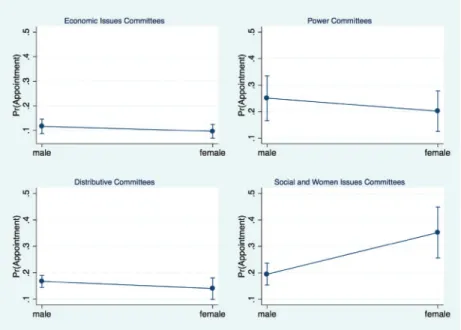
The Supplementary Table S4 presents the results of the regression analysis conducted to effectively test H1. Overall, the preliminary findings are confirmed: female MPs are appointed to SWIC much more often than to any other commit-tee type, even after controlling for seniority and expertise. As the predicted mar-gin plots indicate (Figure 1), with all variables centred at their mean, the probability of a female MP being appointed to SWIC is 35% (vis-a-vis 20% for male MPs). For PC and EIC, there is also a distinction between women and men in the expected direction but the differences in predicted margins are not signifi-cant because the confidence intervals overlap. Therefore, H1 is partially con-firmed: although there is an overrepresentation of women in SWIC, there is no significant underrepresentation of female MPs in the other committees.
Before examining the next hypothesis, we will briefly report the results for the control variables at the individual level. Expertise stands out as a key individual-level factor: MPs with the required expertise for the post are likely to be
Figure 1. Predictive margins of being appointed to different types of legislative committee according to MPs sex.
appointed to the committee that best matches their professional and educational background. We also find that newcomer MPs have a significantly higher proba-bility of being appointed to SWIC and to DC, whereas seniority is an asset for ap-pointment to the most prestigious committees (no significant effect found for EIC). Position on the list only follows our expectation for appointments to SWIC; MPs at the bottom of the list are more likely to be appointed to this type of com-mittee. Finally, the remaining party and chamber variables display little and non-systematic effects on committee assignment.
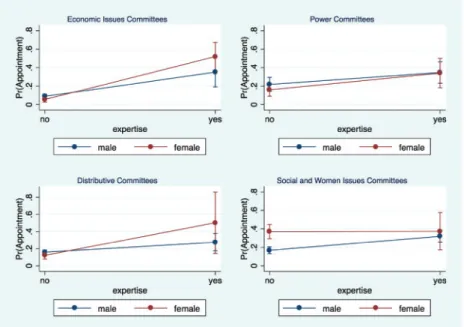
As can be seen inSupplementary Table S5, women frequently have educa-tional and occupaeduca-tional backgrounds related to social issues, while men are more often specialised in areas related to PC and EIC, thus confirming that women and men also differ in their area of expertise in Portugal (see for exam-ple, Thomas, 1994). Our goal under H2 is to test whether more men (than women) without expertise are assigned to EIC and PC, and more women (than men) without expertise are appointed to SWIC. The statistical results only offer partial confirmation for H2 (Supplementary Table S6). On the one hand, as expected, the predicted margins (Figure 2) show that female MPs with no expertise in social issues are almost twice as likely to be appointed to SWIC as male MPs: a female MP with no expertise in social issues has a 32%
Figure 2. Predicted margins of being appointed to different committees according to MPs sex and expertise.
predicted probability of being appointed to SWIC vis-a`-vis 17% for male MPs. Furthermore, the flat line of female SWIC members’ reveals that the relevant expertise actually has no bearing on women’s appointment to SWIC; this sug-gests that whereas it is enough in some cases to be female to ensure appoint-ment to that committee, it is an asset for men to have expertise in the area. On the other hand, female and male MPs with expertise have the same probability of being appointed to EIC, DC and even PC, and those without expertise (irre-spective of sex) have a lower probably of appointment.
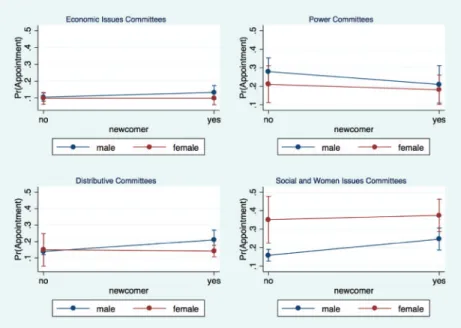
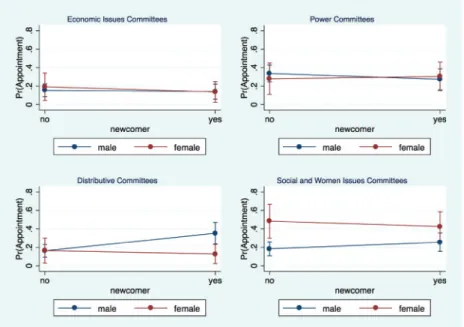
The next hypothesis (H3) contends that male MPs that are not newcomers (i.e. seniors) are less often appointed to social issue committees and more often assigned to powerful committees, when compared to their female counterparts. It additionally explores any changes in this pattern after the introduction of the 2006 quota law in Portugal. It should first be noted that the percentage of female newcomers exceeds that of men in every legislature analysed (seeSupplementary Table S7). The results of the regression analysis (seeSupplementary Table S8), shown inFigure 3, partially support our expectations. As in all previous hypothe-ses, we only find significant differences in the appointments to SWIC: as antici-pated, male MPs tend to be appointed to SWIC significantly less once they have
Figure 3. Predicted margins of being appointed to different committees according to MPs sex and to whether she/he is a newcomer.
gained parliamentary experience, while female MPs remain strongly represented in this committee whether they are newcomers or more experienced legislators.
Moreover, although over 50% of female MPs were newcomers in the first legislature after the approval of the quota law (2009),7 there were no visible changes in the probability of female newcomers being assigned to SWIC (see Figure 4, andSupplementary Table S9). This finding suggests that, like Mexico (Kerevel and Atkeson, 2013), the implementation of quotas in Portugal did not increase women’s marginalisation. The increase in the percentage of women on SWIC in 2009 relative to previous legislatures that can be seen in Table 1, is due to the fact that there were more female parliamentarians in that year than ever before. The pattern of committee assignment remains the same. Observation of more post-2009 legislatures would allow us to confirm whether these findings hold.
Taken together, the results do not sustain a narrative of strong female mar-ginalisation across different committee types: female and male MPs have the same probability of being appointed to EIC, PC or DC (Figure 1), and wom-en’s expertise and seniority are valued by party leaders for these nominations
Figure 4. Predicted margins of being appointed to different committees according to MPs sex and to whether she/he is a newcomer (model for 2009).
Note: Predicted margins with 95% CIs, with all variables centred at their mean.
in the same way as men’s (Figures 2and3). Nevertheless, our results do show that women tend to be appointed to SWIC more frequently (Figure 1 and Table 1) and that, unlike men, women’s nominations to SWIC do not depend on either expertise (Figure 2) or their experience in the legislature (Figure 3). However, it remains unclear whether female MPs are pushed into those com-mittees by party leaders or if this reflects their preferences. Thus, our final hy-pothesis (H4), seeks to qualitatively explore whether MPs are placed in their committee(s) of choice.
The interviews with MPs reveal that the overall feeling is that the appointment process takes place ‘naturally’ and ‘logically’.8Decisions are made within each PG and usually involve a negotiation process that is more or less flexible and consen-sual. The wishes, preferences and professional experience of the MPs are usually taken into account regardless of sex.9The following statement is a clear illustra-tion of this: ‘at the beginning of the legislature all MPs are asked to indicate their preferences. The party then tries to assign the MPs to their first or second option whenever possible. The MPs’ preferences, profile, and what they feel more confi-dent doing are taken into account’.10
However, some differences can be seen across PGs. While some decision mak-ing processes look more party-centred and less determined by MPs’ preferences,11 others appear to be guided more by the MPs’ wishes who seem to ‘get the com-mittee they asked for’12; in line with results of previous studies (Whitaker, 2018). Overall, whether it is party leadership or the MPs themselves that influence the decision-making process, the MPs interviewed evaluated the appointment pro-cess very positively; their satisfaction with the allotted committee13is demon-strated by the following statements: ‘sometimes I cannot even believe that I am paid to do what I do!’;14‘I was assigned to all the committees I’d chosen [and I am] very, very satisfied with the committees I got’15; ‘I was appointed to all the
8Interviewees No. 2, 8 and 11.
9Interviewees No. 1, 2, 3, 4, 16 and 18.
10Interviewee No. 16.
11Interviewees No. 8, 9, 10, 11 and 12.
12Interviewees No. 5, 6, 7, 13, 17 and 19.
13Interviewees No. 1, 3, 4, 6, 13, 20 and more neutral for 2, 10 and 11.
14Interviewee No. 6.
committees I asked for’.16The MPs also highlight the fact that the committees they got matches their interests and their career background: ‘I would say yes, the domains covered [by the committee] interest me a lot’17; ‘I chose the committees based on my professional background. I have been a teacher for 32 years and I am currently part of the Education Committee’.18
MPs’ sex does not seem to be a key individual-level factor except in one case, reported by a female interviewee,19of a female MP who was substituted against her will in the defence committee by a male peer. However, according to the same interviewee, these are uncommon situations.
Our interviewees’ overall perception that they were assigned to their preferred committee indicates that women’s overrepresentation in SWIC is at least in part due to preference although one episode suggests a tendency to push women into more social issue committees.
6. Conclusions
Committee memberships are both scarce and valuable resources for MPs in a leg-islative chamber (Heath et al., 2005). By choosing reliable committee members, leaders can indirectly control the party’s long-range policy positions (Strøm, 1998, p. 40); therefore, some MPs might be in a better position than others to be appointed to their preferred committee. Who the committee’s members are is a relevant issue not only in terms of the question of justice but also because they can potentially influence policy outcomes. The Portuguese case corroborates re-cent scholarship indicating signs of change and a relative equilibrium between women and men in committee assignments (Baekgaard and Kjaer, 2012;O’Brien, 2012;Kerevel and Atkeson, 2013;Barnes, 2014). In fact, MPs’ sex is almost irrele-vant for nomination to the most prestigious committees and those linked to tra-ditionally ‘male’ domains. However, it is significant in the case of appointments to social issue committees where women are systematically overrepresented; in fact, this trend has been increasing as the percentage of the chamber occupied by women rises.
The justifications given for the differences between women and men in SWIC appointments vary. Some argue that it is largely due to demand factors and that women are marginalised (Heath et al., 2005;Schwindt-Bayer, 2010), while others
16Interviewees No. 20.
17Interviewees No. 3.
18Interviewees No. 18.
explain it with supply factors, namely women’s expertise and a greater preference for committees dealing with these issues than men (Thomas, 1994;Carroll, 2008; Schwindt-Bayer, 2010;Baekgaard and Kjaer, 2012). Our research suggests that al-though both explanations are relevant, supply-side factors are the most important as we explain below.
Starting with supply-side factors, we observed that women have the right ex-pertise for SWIC and are newcomers more often than men. Since both exex-pertise and seniority are key explanatory variables for committee appointment, we would expect the differences between women and men in SWIC assignments to vanish once we control for these two factors. Nevertheless, this is not the case. Due to limitations in our data, we could not include committee preferences in the same model as expertise and seniority. The exploratory analysis we conducted on the basis of interviews with MPs reveals that the MPs interviewed, irrespective of sex, tend to be appointed to their preferred committee. Hence, if we could include committee preference in the same model, the differences between women and men in SWIC appointments would certainly be smaller. However, our results in-dicate these supply-side factors do not tell the full story.
The analysis of the interaction between MPs’ sex with expertise and seniority addresses an important aspect of the demand-side explanation that, to our knowledge, was hitherto unexplored. It sheds light on how party leaders value MPs’ characteristics as a function of gender and test the innovative hypothesis that expertise and seniority are not valued in the same way for male and female MPs. The findings suggest that in Portugal this is indeed the case for SWIC but not for PC. In fact, all senior MPs with the appropriate expertise have the same probability of being nominated to the most powerful committees, irrespective of sex.
However, women are appointed to SWIC even if they are not experts in a re-lated area and regardless of whether they are newcomers or more experienced legislators. In sharp contrast, the right expertise is indispensable for a man to be appointed to a SWIC committee and senior male MPs are appointed to SWIC significantly less than senior female MPs. This leads us to believe that the stereo-types of female and male politicians (Herrnson et al., 2003) are still influential. As it was not possible to make a similar analysis for MPs’ preferences, we cannot say whether the MPs’ sex affects the consideration given to preferences by party lead-ers. Notwithstanding, as the MPs interviewed do not report signs of marginaliza-tion,20 the observed difference in SWIC appointments is more likely to be the product of self-selection by female legislators than of direct marginalisation by party leaders.
20Although this result should be confirmed through a survey applied to a representative sample of legislators.
This emphasis on supply-driven factors must be considered with caution since the gender norms embedded in political institutions (and in society) shape the dynamics of both demand and supply factors (Kenny, 2013, p. 13) and hence the MPs’ expertise and preferences are themselves also influenced by these norms (Lovenduski, 2005;Kenny, 2013).
This case study is of relevance both to confirm and generate hypotheses. It pla-ces Portugal in the broader comparative literature on women’s assignments to committees and observes some trends described in previous research. More specifi-cally, even though committee appointments are not gender neutral, there are signs of change (Baekgaard and Kjaer, 2012;O’Brien, 2012;Kerevel and Atkeson, 2013; Barnes, 2014) and neither the growing percentage of women in the legislature nor the implementation of gender quotas have had negative consequences (Kerevel and Atkeson, 2013). Moreover, this study confirms that although the emphasis on party control over the electoral mandate typically given in CLPR systems is also found in Portugal, MPs’ preferences are taken into consideration; it thus supports prior re-search highlighting the fact that individual MPs are increasingly relevant in Portugal (Leston-Bandeira, 2004;Fernandes, 2016;Fernandes et al., 2018).
This article introduces a promising avenue of research in women’s committee appointments by suggesting that party leaders do not always perceive the charac-teristics of male and female MPs, e.g. expertise and seniority, in the same way and that this has important consequences for gender balance. Incorporating the inter-action between individual-level characteristics and MP’s sex when explaining committee appointments might reveal that previous studies attributed excessive weight to supply-side factors, e.g. women’s incumbency disadvantage and com-mittee preferences. In fact, the inequality observed in comcom-mittee assignments might be partly explained by political actors’ tendency to place more (less) em-phasis on some women’s characteristics over others, and this is a demand-side factor. Given the dominance of case studies in this field, future research would also benefit from comparing committee appointments in countries with similar levels of female representation in parliament and similar institutional designs.
Supplementary data
Supplementary dataare available at Parliamentry Affairs online.
Acknowledgements
A previous version of this article was presented at the 111th Annual Meeting APSA 2015 (San Francisco, USA, 3–6 September 2015). We would like to thank Matthew Shugart and Kaare Strøm for valuable suggestions and Rachel Evans for revising the English.
Funding
This article was supported by the National Science Foundation, USA through SES-0751662 (Ellis Krauss and Matthew S. Shugart co-PIs) and SES-0751436 (Robert Pekkanen, PI); by the Fundac¸~ao para a Cieˆncia e Tecnologia, Portugal, through PTDC/IVC-CPO/4088/2012 (Nina Wiesehomeier, PI) and through stra-tegic project number UID/SOC/50.013/2013.
Conflict of interest
The authors declare no conflicts of interest.
References
Barnes, T. D. (2014) ‘Women’s Representation and Legislative Committee Appointments: The Case of the Argentine Provinces’, Revista Uruguaya de Ciencia Polı´tica, 23, 135–163.
Baekgaard, M. and Kjaer, U. (2012) ‘The Gendered Division of Labor in Assignments to Political Committees: Discrimination or Self-Selection in Danish Local Politics?’, Politics & Gender, 8, 465–482.
Bolzendahl, C. (2014) ‘Opportunities and Expectations: The Gendered Organization of Legislative Committees in Germany, Sweden, and the United States’, Gender & Society, 28, 847–876.
Braga da Cruz, M. (1988) ‘Sobre o Parlamento Portugueˆs: Partidarizac¸~ao Parlamentar e Parlamentarizac¸~ao Partida´ria’, Ana´lise Social, XXIV, 97–125.
Carroll, S. (2008) ‘Committee Assignments: Discrimination or Choice?’ In Reingold, B. (ed.) Legislative Women: Getting Elected, Getting Ahead, CO, Lynne Rienner, pp. 135–156.
Ciftci, S., Forrest, W. and Tekin, Y. (2008) ‘Committee Assignments in a Nascent Party System: The Case of the Turkish Grand National Assembly’, International Political Science Review, 29, 303–324.
Costa Pinto, A. (2010) ‘Coping with the Double Legacy of Authoritarianism and Revolution in Portuguese Democracy’, South European Society and Politics, 15, 395–412.
Cox, G. W. and McCubbins, M. D. (1993) Legislative Leviathan: Party Government in the House, Oakland, University of California Press.
Cox, G. W. and McCubbins, M. D. (2005) Setting the Agenda: Responsible Party Government in the U.S. House of Representatives, New York, Cambridge University Press.
Diaz, M. M. (2005) Representing Women? Female Legislators in West European Parliaments, Colchester, ECPR Press.
Dovi, S. (2007) ‘Theorizing Women’s Representation in the United States’, Politics & Gender, 3, 297–319.
Espı´rito-Santo, A. (2018) ‘From Electoral to Corporate Board Quotas: The Case of Portugal’. In Lepinard, E. and Rubio-Marı´n, Ruth (eds) Transforming Gender Citizenship; The Irresistible Rise of Gender Quotas in Europe, Cambridge, Cambridge University Press, pp. 216–244.
Espı´rito-Santo, A. and Sanches, E. R. (2012) ‘Party Personnel Dataset: Portugal’, collected under the auspices of the US NSF-funded project, ‘Collaborative Research: Electoral Systems and Party Personnel: The Consequences of Reform and Non-Reform’, awarded to the University of California, San Diego (SES-0751662, Matthew S. Shugart, PI, and Ellis Krauss, Co-PI) and the University of Washington (SES-0751436, Robert Pekkanen, PI).
Fernandes, J. (2016) ‘Intra-party Delegation in the Portuguese Legislature: Assigning Committee Chairs and Party Coordination Positions’, The Journal of Legislative Studies, 22, 108–128.
Fernandes, J. M., Leston-Banderia, C. and Schwemmer, C. (2018) ‘Election proximity and representation focus in party-constrained environments’, Party Politics, 24, 674–685. Friedman, S. (1996) ‘House Committee Assignments of Women and Minority
Newcomers, 1965–1994’, Legislative Studies Quarterly, 21, 73–81.
Gilligan, T. W. and Krehbiel, K. (1990) ‘Organization of Informative Committees by a Rational Legislature’, American Journal of Political Science, 34, 531–564.
Heath, R. M., Schwindt-Bayer, L. A. and Taylor-Robinson, M. M. (2005) ‘Women on the Sidelines: Women’s Representation on Committees in Latin American Legislatures’, American Journal of Political Science, 49, 420–436.
Herrnson, P. S., Lay, J. C., and Stokes, A. K. (2003) ‘Women Running “as Women”: Candidate Gender, Campaign Issues, and Voter-Targeting Strategies’, The Journal of Politics, 65, 244–255.
Kenny, M. (2013) ‘Gender and Political Recruitment: Theorizing Institutional Change’, Basingstoke, Palgrave.
Kerevel, Y. and Atkeson, L. R. (2013) ‘Explaining the Marginalization of Women in Legislative Institutions’, Journal of Politics, 75, 980–992.
Kittilson, M. (1999) ‘Women’s representation in parliament: The role of political parties’, Party Politics, 5, 79–98.
Leston-Bandeira, C. (2004) From Legislation to Legitimation: The Role of the Portuguese Parliament, London and New York, Routledge.
Leston-Bandeira, C. (2009) ‘Dissent in a Party-Based Parliament: The Portuguese Case’, Party Politics, 15, 695–713.
Leston-Bandeira, C. and Tibu´rcio, T. (2012) ‘Developing Links despite the Parties – Parliament and Citizens in Portugal’, The Journal of Legislative Studies, 18, 384–402. Lovenduski, J. (2005) Feminizing Politics, Cambridge, Polity Press.
Lovenduski, J. (2016) ‘The Supply and Demand Model of Candidate Selection: Some Reflections’, Government and Opposition, 51, 513–528.
Lovenduski, J. and Norris, P. (1993) Gender and Party Politics, London, Sage.
Mansbridge, J. (1999) ‘Should Blacks Represent Backs and Women Represent Women? A Contigent “Yes”’, The Journal of Politics, 61, 628–657.
Martin, S. and Mickler, T. A. (2019) ‘Committee Assignments: Theories, Causes and Consequences’, Parliamentary Affairs, 72, 77–98.
Matland, R. E. and Studlar, D. (2004) ‘Determinants of Legislative Turnover: A Cross-National Analysis’, British Journal of Political Science, 34, 87–108.
Mickler, T. A. (2018a) ‘Who Gets What and Why? Committee Assignments in the German Bundestag’, West European Politics, 41, 517–539.
Mickler, T. A. (2018b) ‘Not so Random after All? – Revisiting Committee Assignments in Da´il E´ireann’, Irish Political Studies, 33, 112–135.
O’Brien, D. Z. (2012) ‘Gender and Select Committee Elections in the British House of Commons’, Politics & Gender, 8, 178–204.
Opello, W. C. (1986) ‘Portugal’s Parliament: An Organizational Analysis of Legislative Performance’, Legislative Studies Quarterly, 11, 291–319.
Pansardi, P. and Vercesi, M. (2017) ‘Party Gate-Keeping and Women’s Appointment to Parliamentary Committees: Evidence from the Italian Case’, Parliamentary Affairs, 70, 62–83.
Pekkanen, R., Nyblade, B. and Krauss, E. (2006) ‘Electoral Incentives in Mixed-member Systems: Party, posts, and Zombie Politicians in Japan’, American Political Science Review, 100, 183–193.
Phillips, A. (1995) The Politics of Presence, Oxford, Clarendon Press.
Raymond, C. D. and Holt, J. (2019) ‘Constituency Preferences and Assignment to Agriculture Committees’, Parliamentary Affairs, 71, 141–161.
Ribeiro, C. and Cid, N. M. (2008) ‘As Comiss~oes Parlamentares’. In Varga, A. and Valente, P. (eds) Parlamento na Pra´tica, Lisbon, Assembleia da Repu´blica.
Riera, P. and Cantu´, F. (2018) ‘Determinants of Legislative Committee Membership in Proportional Representation Systems’, Party Politics, 24, 524–535.
Sanches, E. R. and Razzuoli, I. (2017) ‘A Democracia Intrapartida´ria em Portugal: Uma Ana´lise Comparada das Percec¸~oes dos Militantes do BE, CDS-PP, LIVRE, PS e PSD’. In Lisi, M. and Espı´rito Santo, P. Do Militantes e Activismo Nos Partidos Polı´ticos. Portugal em Perspectiva Comparada, Lisbon, Imprensa de Cieˆncias Sociais, pp. 187–212. Schwindt-Bayer, L. A. (2010) ‘Taking Charge: Leadership and Committees’. In
Schwindt-Bayer, L. A. Political Power and Women’s Representation in Latin America, Oxford, Oxford University Press, 104–130.
Strøm, K. (1998) ‘Parliamentary Committees in European Democracies’, The Journal of Legislative Studies, 4, 21–59.
Thomas, S. (1994) How Women Legislate, Oxford, Oxford University Press.
Towns, A. (2003) ‘Understanding the Effects of Larger Ratios of Women in National Legislatures: Proportions and Gender Differentiation in Sweden and Norway’, Women & Politics, 25, 1–29.
Whitaker, R. (2018) ‘A Case of ‘You Can Always Get What You Want’? Committee Assignments in the European Parliament’, Parliamentary Affairs, doi: 10.1093/pa/ gsy010. Accessed 19 March 2018.
Yordanova, N. (2009) ‘The Rationale behind Committee Assignment in the European Parliament’, European Union Politics, 10, 253–280.