
Understanding the general role of the microRNAs in Drosophila wing development
59
0
0
Texto
(2) Universidade de Lisboa Faculdade de Ciências Departamento de Biologia Animal. Understanding the general role of the microRNAs in Drosophila wing development Ana Patrícia de Almeida Ferreira Dissertação de mestrado orientada por: Doutor Marco Milán – Institute for Research in Biomedicine, Barcelona Doutor Rui Gomes – Faculdade de Ciências da Universidade de Lisboa, Lisboa. MESTRADO EM BIOLOGIA EVOLUTIVA E DO DESENVOLVIMENTO. 2009.
(3) . TABLE OF CONTENTS ACKNOWLEDGMENTS ................................................................................................................. 3 I. . SUMÁRIO ................................................................................................................................. 4 . II. ABSTRACT .............................................................................................................................. 7 III. INTRODUCTION ...................................................................................................................... 8 3.1 Biogenesis of the microRNAs ............................................................................................ 8 3.2 Regulation of miRNAs biogenesis .................................................................................. 10 3.3 Mode of Action of the microRNAs .................................................................................. 12 3.4 miRNAs and growth control ............................................................................................. 13 3.5 Drosophila wing imaginal disc ......................................................................................... 14 3.5.1 Growth control in the wing disc ................................................................................. 16 3.5.2 Wing imaginal disc patterning ................................................................................... 18 Subdivision notum versus wing ............................................................................ 19 Wing hinge patterning ............................................................................................ 19 IV. AIM OF THE PROJECT ....................................................................................................... 21 V. MATERIALS AND METHODS ............................................................................................ 22 5.1 DROSOPHILA STRAINS ................................................................................................. 22 5.1.1 Fly husbandry .............................................................................................................. 22 5.1.2 Mutant alleles and transgenic lines .......................................................................... 22 5.2 GENETICS ......................................................................................................................... 22 5.2.1 The UAS-Gal4 System ............................................................................................... 22 5.2.2 Genetic mosaic analysis ............................................................................................ 23 5.2.3 Mitotic recombination.................................................................................................. 24 5.2.4 Minute technique ......................................................................................................... 24 5.2.5 Mosaic analysis with a repressive cell marker (MARCM) ..................................... 25 5.3 IMMUNOHISTOCHEMISTRY ......................................................................................... 26 5.4 IN SITU HYBRIDIZATION ............................................................................................... 27 5.5 TUNEL ................................................................................................................................ 27 5.6 IMAGE ACQUISITION AND ANALYSIS ....................................................................... 27 5.6.1 Quantification of cell and tissue growth parameters in adult wings and wing discs ......................................................................................................................................... 27 1 . .
(4) VI. RESULTS ............................................................................................................................... 29 6.1 Reduced growth in the absence of Dcr-1 ...................................................................... 29 6.2 Dcr-1 regulates E2F activity and Dap protein levels .................................................... 31 6.3 dMyc levels are regulated by Dcr-1 activity ................................................................... 33 6.4 Contribution of dMyc to growth and E2F activity defects caused by Dcr-1 depletion ...................................................................................................................................................... 37 6.5 A role of bantam miRNA in reducing Mei-P26 and Dap protein levels ..................... 37 VII. DISCUSSION ......................................................................................................................... 41 VIII. CONCLUDING REMARKS ................................................................................................. 45 IX. REFERENCES ....................................................................................................................... 46 X. ANNEXES ............................................................................................................................... 51 . 2 . .
(5) . ACKNOWLEDGMENTS I want to thank everyone that made this thesis possible: First of all, to my supervisor Marco, for giving me the change to be part of such a wonderful project and lab, for guiding, teaching and supporting me. To all the members of the Development and Growth Control lab for making me feel part of their “familia”. A very special thanks to Héctor, without him this work would not have been possible. I thank him for the scientific discussions and specially for his patience in teaching and helping me all the time that I needed. To Duarte, for teaching me how to deal with flies, for being available to answer whatever I needed and for the Portuguese discussions. All the people that I worked with in the lab for the help and for the great environment created. I thank: Héctor Herranz, Duarte Mesquita, Lara Barrio, Isabelle Becam, Andrés Dekanty, Neus Rafel Berge, Georgina Sorrosal, Lidia Pérez Daniel Olivieri, Dorien Hermkens, Melissa Cizeron, Ulla-Maj Fiúza, Florencia Tevy and Laura Boulan. I thank to professor Rui Gomes, for guide and support. To Isadora Monteiro, João Picão, Pedro Simões and Soraia Gonçalves for sharing with me so many great moments. Without their friendship, support and laugh it would have been very difficult. I thank all my friends, for the joy and happiness they bring to my life. Finally, to my parents and sister for the constant love and support that made possible to me to get till here.. 3 . .
(6) . I.. SUMÁRIO. Pequenos RNAs não-codificantes têm vindo a ser implicados na regulação de genes e genomas a sensivelmente todos os níveis genómicos. Pequenos RNAs podem ser categorizados nas seguintes três classes: siRNAs (do inglês short interfering RNAs), piRNAs (do inglês piwi-interacting RNAs) e microRNAs, a melhor compreendida entre as três. Desde a sua descoberta em 1993, em Caenorhabditis elegans, que os microRNAs (miRNAs) se tornaram numa área com um extremo interesse devido às suas potencialidades em vários processos na biologia do desenvolvimento, tornando-se cada vez mais apetecível e competitiva. Como consequência, têm vindo a sofrer um exponencial e exaustivo estudo com vista à compreensão da sua biogénese, função e regulação. MicroRNAs são endógenos, curtos (~20-23 nucleótidos), RNAs nãocodificantes de cadeia simples que reprimem transcritos alvos através da ligação à sua 3´UTR, conferindo assim um novo nível de regulação pós-transcricional. A transcrição dos microRNAs é mediada quer pela RNA polimerase II, quer pela RNA polimerase III, originando transcritos primários de miRNAs (pri-miRNA). Estes têm vários kilobases de comprimento e são caracterizados por terem muitos ‘stem-loops’. A maturação dos microRNAs começa com a clivagem ao nível do ‘stem’ da estrutura ‘hairpin’, libertando um pequeno ‘hairpin’, o pré-miRNA, que tem cerca de 70 nucleótidos de comprimento. O complexo microprocessador, que em Drosophila tem cerca de 500 kDa, é o responsável por esta etapa, que ocorre no núcleo. Este complexo é formado pela proteína RNase tipo III Drosha juntamente com o seu cofactor Pasha (DGCR8 em humanos). Seguidamente, os pré-miRNAs são exportados para o citoplasma por um membro da família dos receptores nucleares de transporte, a proteína Exportin 5 (EXP5). O último passo na maturação dos microRNAs é realizado no citoplasma pela enzima Dicer. Os pré-miRNAs são clivados perto do ‘loop’ terminal, libertando duplexes de miRNAs com cerca de 22 nucleótidos de comprimento. Assim, durante a maturação dos microRNAs, Drosha predetermina as sequências maduras dos miRNAs pois gera uma extremidade, enquanto que Dicer cria a outra extremidade através da medição de 22 nucleótidos a partir da ponta pré-existente. Dicer é uma proteína extremamente conservada que pode ser encontrada em praticamente todos os organismos eucarióticos. Em Drosophila melanogaster existem dois isotipos desta enzima – Dicer1 (Dcr-1), que é fundamental para a biogénese dos microRNAs, e Dicer2 que funciona na produção de siRNA. Dcr-1 favorece ligações a hélices com emparelhamento imperfeito, de modo a processá-las. Dicer contém um putativo domínio helicase, um domínio DUF283, um domínio PAZ (Piwi4 . .
(7) Argonaute-Zwille), dois domínios tandem RNase-III e um domínio dsRBD (do inglês double stranded) de ligação a RNAs de dupla cadeia. Sabe-se que o domínio PAZ permite a interacção com a extremidade 3’ que resulta da clivagem por parte de Drosha. Dicer1 requer Loquacious (LOQS), que contém domínios de ligação a RNAs de cadeia dupla, para o processamento de pré-miRNAs. Depois da clivagem por parte de Dicer, a duplex de RNA resultante é carregada numa proteína Argonaute (Ago) de modo a originar o complexo effector RISC (do inglês RNAinduced silencing complex). Juntamente com LOQS e AGO1, Dcr-1 forma o complexo RLC (do inglês RISC loading complex). Uma das cadeias do duplex permanece na proteína Ago como o miRNA maduro (miRNA), enquanto que a complementar é degradada (miRNA*). O modo como qual das cadeias é seleccionada para agir como miRNA é ainda desconhecido. miRNAs ligam-se, por emparelhamento imperfeito da sua região 5’ (em inglês seed region), a múltiplas cópias de sítios de ligação presentes na região 3´UTR (do inglês 3’ untranslated region) do RNA mensageiro (mRNA) dos genes alvos. A complementaridade entre o miRNA e o mRNA alvo é determinante do mecanismo regulatório. Enquanto que complementaridade perfeita leva à clivagem do mRNA alvo,. falhas nessa mesma. complementaridade origina repressão da tradução do mRNA. O controlo preciso dos níveis de miRNAs é crucial para manter as funções celulares em homeostasia e a desregulação de miRNAs associada a doenças humanas, como cancro, já foi reportada. Casos em que miRNAs são produzidos sob o controlo dos seus próprios alvos que regulam têm sido documentados. Este tipo de ‘feedbacks’ podem, de certo modo, transmitir robustez ao sistema, face a uma eventual situação de ‘stress’. Tendo em consideração que a enzima Dicer é uma peça essencial na biogénese e função dos microRNAs, possíveis efeitos da sua ausência reflectem funções colectivas de múltiplos miRNAs que são expressos durante o desenvolvimento. Tem sido demonstrado que a perda de dcr-1 causa defeitos na manutenção das células estaminais nos ovários de Drosophila e nestas células foi também observado um atraso na transição da fase G1 para a fase S do ciclo celular. Para além de terem sido envolvidos na regulação do ciclo celular, também já foram implicados no controlo do crescimento celular. Os principais efectores que medeiam a actividade de Dcr-1 nestes processos não foram ainda identificados. O disco imaginal de Drosophila, uma monocamada epitelial que surge como um grupo de 30‐40 células que proliferam durante os três estádios larvares até atingir um tamanho final de cerca de 50.000 células, é uma sistema extremamente apropriado para a análise, a nível celular, do papel dos miRNAs num epitélio proliferativo e identificar os seus efectores. De modo a atingir esse objectivo, a actividade de Dcr-1 foi afectada, utilizando 5 . .
(8) para esse efeito dois alelos mutantes para esta enzima, bem como RNA de interferência (RNAi) para a mesma. A diminuição da actividade de Dcr-1 teve efeito ao nível da taxa de crescimento do primórdio da asa de Drosophila, um epitélio altamente proliferativo. Células mutantes para dcr-1, ou com reduzida actividade de dcr-1, mostraram ser mais pequenas comparativamente a células normais e originaram alas mais pequenas. Além disso, células mutantes para dcr-1 demonstraram ser susceptíveis a competição por células com crescimento mais rápido in vivo e a maquinaria dos microRNAs mostrou ser capaz de promover a transição da fase G1 para a fase S do ciclo celular. Os dados obtidos apresentam evidência de que o miRNA bantam e o proto-oncogene dMyc contribuem para a actividade de Dcr-1 nestes processos. Na ausência de Dcr-1, os níveis de dMyc são reduzidos, afectando alvos como E2F, CycE e Dap que estão envolvidos no controlo do ciclo celular. Foi aqui demonstrado que os níveis proteicos de dMyc são regulados pela actividade de Dcr-1 através de um duplo mecanismo de repressão mediado pela proteína Mei-P26, que pertence à família TRIM-NHL. dMyc contribui para a actividade de Dcr-1 regulando o crescimento, tanto ao nível do tecido bem como ao nível da célula, e também a actividade de E2F (proteína envolvida no ciclo celular). Neste sistema, tanto Mei-P26 como Dacapo (inibidor da transição da fase G1 para a fase S, reprimindo a CycE) são alvos directos de bantam. Estes resultados mostram que a via dos microRNAs é necessária, num epitélio altamente proliferativo, para manter os níveis de dMyc suficientes de modo a atingir o crescimento apropriado do tecido. PALAVRAS-CHAVE: microRNA, Dacapo, bantam, controlo de crescimento, Drosophila, ciclo celular, disco imaginal da asa . 6 . .
(9) . II. . ABSTRACT. MicroRNAs (miRNAs) are short (~20-23 nucleotides long), endogenous, single-stranded non-coding RNAs that have been shown to repress target transcripts, by binding to their 3’ UTR, and thus conferring a new level of post-transcriptional regulation. Since 1993, the first description of a miRNA, it has became a very exciting area in research, leading to a crescent implication of these small RNAs in a large range of processes. They have been implicated in cell cycle regulation and in some cases show to have a role in tissue growth control. Dicer-1 (Dcr-1) is a double-stranded RNaseIII essential for miRNA biogenesis, therefore impairing its activity offers a way to access the role of the pathway in a particular biological process. The wing imaginal disc offers a great model to access this issue in a highly proliferative epithelium. Adult cells lacking dcr-1, or with reduced Dcr-1 activity, were smaller than normal cells and gave rise to smaller wings. dcr-1 mutants cells showed evidence of being susceptible to competition by faster growing cells in vivo and the miRNA machinery was shown to promote G1-S transition. The results obtained also present evidence that the bantam miRNA and the dMyc proto-oncogene contribute to the activity of Dcr-1 in these processes. dMyc protein levels are regulated by the activity of Dcr-1 through a double repression mechanism mediated by the TRIM-NHL protein MeiP26. dMyc contributes to the activity of Dcr-1 in regulating cell and tissue growth and E2F activity. Mei-P26 and the p21/Dacapo CDK inhibitor are direct targets of bantam in this system. These results define a frame in which the miRNA pathway is required, in a highly proliferative epithelium, to maintain sufficient levels of dMyc in order to achieve proper tissue growth.. KEYWORDS: microRNA, Dacapo, bantam, growth control, Drosophila, cell cycle, wing imaginal disc. . . 7 . .
(10) . III.. INTRODUCTION. During the last centuries, gene regulation has been shown to have a huge importance in a batch of aspects in biology, in which physiology and development are included. Regardless of the importance of the gene regulation at the transcriptional level in development, the relevance of post-transcriptional gene regulation has considerably increased during the last years. Small non coding RNAs regulating genes and genomes have been identified at almost all levels of genome function, including chromatin structure, chromosome segregation, transcription, RNA processing, RNA stability as well as translation. Small RNAs can be categorized in the following three classes: short interfering RNAs (siRNAs), piwi-interacting RNAs (piRNAs) and microRNAs, the best understood among the three. However, the boundaries of these categories are becoming very difficult to discriminate, as new non-canonical small RNAs are discovered. Three aspects separate piRNAs from the other two classes: while the distribution of the miRNAs and siRNAs is broad in both phylogenetic and physiological terms, piRNAs are only found in animals and act typically in the germline; piRNAs appear from single-stranded precursors while the other two classes are precede from double-stranded antecedents1; piRNAs associate with Piwi effector proteins, whereas miRNAs and siRNAs bind to Argonaute proteins2. What distinguish miRNAs from siRNAs subsist in three aspects, most of them concerning their biogenesis, and not their function. In the first place, miRNAs are endogenous products, derived from the genome of the own organism, whereas siRNAs are thought to be exogenous, derived from virus, transposon or transgene. Secondly, miRNAs are processed from stem-loop precursors with incomplete double-stranded character, while siRNAs are excised twice, by the same enzyme, from long, fully complementary doublestranded RNAs (dsRNAs)3. Another important difference between these two types of small RNAs is that miRNAs bind to the target by imperfect complementarity at multiple sites, although siRNAs habitually form a perfect duplex with their targets at only one site4.. 3.1 Biogenesis of the microRNAs MicroRNAs (miRNAs) are short (~20-23 nucleotides long), endogenous, single-stranded non-coding RNAs5 that have been shown to repress6 as well as activate7 target transcripts, thus conferring a new level of post-transcriptional regulation. miRNAs were first described in the worm Caenorhabditis elegans during the early 1990s8. Since then, a huge effort has been made in order to understand their biogenesis, function and regulation. 8 . .
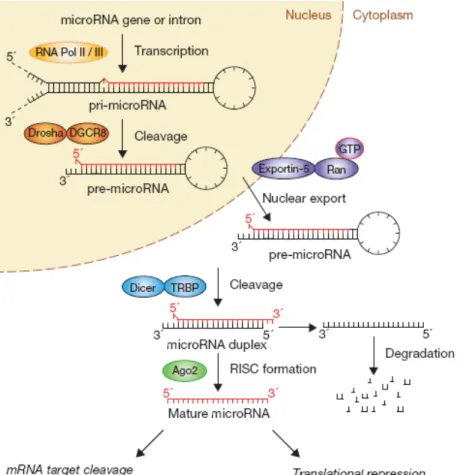
(11) The majority of miRNAs are produced individually from separated units, however some of them are produced from transcription units that make more than one product5. The transcription of miRNAs is mediated by either RNA polymerase II or RNA polymerase III into primary miRNA transcripts (pri-miRNAs)9,10 (Fig. 1). The pri-miRNAs are usually several kilobases long and are characterized for having stemloop structures11. MicroRNAs maturation starts with the cleavage at the stem of the hairpin structure, releasing a small hairpin, the pre-miRNA (~70 nucleotides)12. This step takes place in the nucleus by the Microprocessor complex, which has ~500 kDa in D. melanogaster13, formed by the RNase III-type protein Drosha14 together with the cofactor Pasha protein (DiGeorge syndrome critical region gene 8 (DGCR8) in humans)15 (Fig. 1). A typical metazoan pri-miRNA consists of a ~33 base pairs (bp) stem, a terminal loop and flanking ssRNA segments. DGCR8 interacts with pri-miRNAs through the ssRNA segments and the ~33 bp stem, and assists Drosha to cleave the substrate ~11 bp away from the ssRNA-dsRNA junction16. It was recently shown that Drosha can cleave, not only pri-miRNAs, but also mRNAs that contain longer hairpins17. Drosha negatively regulates its own cofactor, DGCR8, by cleaving the hairpins in the second exon of the DGCR8 mRNA17. After processing in the nucleus, pre-miRNAs are exported to the cytoplasm by a member of the nuclear transport receptor family, Exportin-5 (EXP5) (Fig. 1)18. EXP5 promotes the release of pre-miRNAs from Drosha in the nucleus, as the level of RanGTP is high, then in the cytoplasm, where the RanGTP level is low, it releases the pre-miRNAs for further processing. It is known that EXP5 recognizes the >14-bp dsRNA stem along with a short 3´overhang (1-8nt)19. The last step in the maturation of the microRNAs is performed in the cytoplasm by the enzyme Dicer. The pre-miRNAs are cleaved near the terminal loop, releasing ~22 nt miRNAs duplexes20 (Fig. 1). Therefore, during the maturation process Drosha predetermines mature miRNAs sequences by generating one end, while Dicer creates the other end by measuring ~22 nt from the pre-existing terminus11. Dicer is an extremely conserved protein that can be found in almost all eukaryotic organisms11. In Drosophila melanogaster there are two isotypes of this enzyme – Dicer-1 (Dcr-1), that is required for miRNAs biogenesis, and Dicer-2, that functions in siRNA production. While Dcr-1 favors binding to imperfectly paired helices, participating in the pre-miRNAs processing, Dcr-2 prefers dsRNA with perfect complementary in order to process them21. Dicer contains a putative helicase domain, a DUF283 domain, a PAZ (Piwi-Argonaute-Zwille) domain, two tandem RNase-III domains and a dsRNA-binding domain (dsRBD)22. It is known that the PAZ domain allows the interaction with the 2-nucleotide 3´overhangs that result from. 9 . .
(12) Drosha cleavage23. D. melanogaster Dicer-1 requires Loquacious (LOQS), which have dsRNA-binding domains (dsRBDs), for pre-miRNA processing24 (Fig. 1). After Dicer cleavage, the RNA duplex is loaded into an Argonaute (Ago) protein in order to give rise to a ribonucleoprotein effector complex, the RISC, mediating post-transcriptional gene silencing25. The evolutionary conserved Argonaute (AGO) proteins are defined by having a Piwi domain and a PAZ domain26, demonstrated to bind characteristically to 2 nucleotides 3’ overhangs typically generated by Dicer-like enzymes27. Others proteins have been identified as RISC-associated proteins, but whether they are RISC core components or only accessory proteins to provide functional specificity has not been clarified yet4. Altogether with LOQS and AGO1, Dcr-1 composes the RISC loading complex (RLC)28. One strand of the duplex remains in Ago as a mature miRNA (guide strand or miRNA), while the other (passenger strand or miRNA*) is degraded11 (Fig. 1). The way of determinate which of the strand is going to be selected to act as miRNA is not well known, nevertheless studies in the miRNA precursors indicated that the determination is related with the relative thermodynamic stability of the two ends of the duplex29. However some hairpins produce miRNAs from both strands at comparable frequencies11. Studies have shown that removal of the passenger strand of siRNA and of some miRNA duplexes is responsibility of the endonucleolytic enzymatic activity (slicer activity) of Ago protein30. However, as the majority of miRNAs have central mismatches, and as some Ago proteins do not have slicer activity, an helicase is thought to mediate unwinding and removal of the unselected strand of the miRNA duplex11. In D. melanogaster, the determination of small RNA sorting is based in the structure of the precursor31. While miRNAs duplexes with mismatches are preferentially sorted in AGO1, perfectly matching siRNAs duplexes are loaded into AGO211.. 3.2 Regulation of miRNAs biogenesis Studies on expression profiles indicate that miRNAs are under control of developmental and/or tissue specific signaling32. Precise control of miRNA levels is crucial to maintain normal cellular functions and deregulation of miRNA have been shown to be associated with human diseases, such as cancer33. Transcription is one point of regulation in miRNAs biogenesis, given the fact that both RNA polymerases are regulated in a different way and recognize specific promoter and terminator elements, this provides a broad range of regulatory options10. Several Pol IIassociated transcription factors are involved in transcriptional control of miRNAs genes, namely tumour suppressors and oncogenes. The tumour suppressor p53 have been shown to activate one family of miRNAs34, whereas the oncogenic protein MYC 10 . .
(13) transactivates or represses miRNAs that are involved in the cell cycle and apoptosis35. There are reported cases in which the epigenetic control, namely DNA methylation, also contributes to miRNA gene regulation36.. Figure 1 – miRNAs biogenesis pathway. Canonical microRNAs genes are transcribed by RNA polymerase II / III (Pol II / III) to generate the primary transcripts (pri-miRNAs). The initiation step (cropping) is mediated by the Drosha-DGCR8 (Pasha in D. melanogaster) complex, generating ~70 nucleotides pre-miRNAs. A premiRNA has a short stem and a ~2-nt 3’ overhang that is recognized by the Exportin-5-Ran-GTP, which translocates it to the cytoplasm. Then, the cytoplasmic RNase III Dicer, together with TRBP (LOQS in Drosophila), catalyzes the second processing step (dicing) to produce miRNAs duplexes. In flies, Dicer-1 and AGO1 (Ago2 in the scheme) mediate the assembly of the miRNA duplex into the RISC. One strand of the duplex, the mature miRNA, remains on the Ago protein, while the other strand is send to degradation. (Adapted from Ref. 25). The number of miRNAs controlled at post-transcriptional level is increasing, although the mechanisms of such regulation are yet poorly understood. All steps of miRNA maturation are possible points for post-transcriptional regulation. Nuclear RNA-binding proteins with influence in miRNA processing through specific interactions with pri-miRNAs were described37. For example, the RNA-binding protein LIN28 has been shown to have a role in suppression of let-7 biogenesis38. The mechanisms proposed for this suppression include blockage of Drosha processing, interference with Dicer processing and terminal uridylation of pre-let-7. Another possibility for regulation is the turnover of miRNA, taking 11 . .
(14) into account that RNA decay enzymes might target not only mature miRNAs, but also the precursors (pri-mRNAs and pre-miRNAs)39. The RNA editing can also change the target specificity of the miRNA if it occurs in miRNA sequences40. miRNA biogenesis has been shown to be controlled by multiple levels of feedback loops involving the biogenesis factors, the miRNAs themselves and their targets. It has been shown that Drosha and Dicer are controlled by single negative feedbacks to maintain homeostasis of miRNA production17,41. Another studies have shown that double-negative feedback control is frequently used as an effective genetic switch of a specific miRNA during a particular stage of development38. Cases in which miRNAs genes are produced under the control of the targets that they regulated have also been documented42.. 3.3 Mode of Action of the microRNAs miRNAs typically bind, through their 5´ end, to their multiple copies of binding sites present in the 3’-untranslated regions (UTR) of the target messenger RNA by imperfect base pairing43 (Fig. 2). Despite of the mismatches, a mean aspect of the recognition step involves Watson-Crick base pairing of miRNA seed region (nucleotides 2-8)2.. Figure 2 – Base-pairing between microRNA and target mRNA. The seed sequence (2 to 8 bases) of the 5’ end of the microRNA (shown by an arrow) make almost perfect base-pairing within the 3’ UTR sequences of the target gene (dotted region). (Adapted from Ref. 43). One key determinant of the regulatory mechanism is the degree of miRNA-mRNA complementarity. While perfect match consent to Ago-catalyzed cleavage of the mRNA strand, central mismatches encourage repression of mRNA translation by the Ago protein (Fig. 1). Similar to let-7 in worms44, in flies, the anti-apoptotic miRNA bantam, binds to the 3’UTR of its targets and negatively regulate their translation45. Although in animal kingdom the majority of miRNAs repress target translation, some cases of miRNA-mRNA interactions are accompanied by a reduction in mRNA abundance because of deadenylation, decapping, and exonucleolytic digestion of the mRNA leading to an increase in mRNA degradation46. As example, mir-196 directs mRNA cleavage of its target, Hoxb847. In order to try to explain why there are some targets that are degraded 12 . .
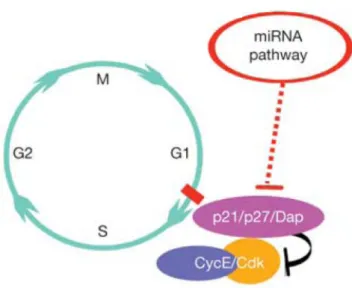
(15) and others not, it has been proposed that the nature, position and amount of mismatches between the miRNA and the mRNA could have responsibility in triggering or degradation or translation arrest48. 3.4 miRNAs and growth control Most of the miRNAs characterized so far seem to regulate aspects of development. MicroRNAs have been implicated in cell cycle regulation49,50,51,52,53,54 and in some cases were shown to have a role in tissue and cell growth control35,45,55,56. In Drosophila the first microRNA associated with growth control, named bantam, was shown to generate smaller flies in loss-of-function situations57. The wings of bantam mutants were characterized by having fewer, but normal sized cells57. Later, it was shown that, besides the role of bantam in tissue growth by stimulating cell proliferation, it was also involved in the prevention of cell death blocking hid-induced apoptosis45. Afterward, evidence was published that the Hippo pathway regulates bantam to control tissue growth, namely cell proliferation and apoptosis, in Drosophila58. Mutations in Dicer disrupt the miRNAs due to the role of this enzyme in their biogenesis and cause diverse developmental defects already documented in C. elegans, A. thaliana, zebrafish and mice. Because Dicer is an essential piece in miRNA biogenesis and function, the defects certainly reflect the collective functions of multiple miRNAs that are expressed during early development. Loss of dcr-1 causes defects in Drosophila and vertebrate stem cell maintenance and a delay in G1-S transition is also observed in these cells50,59,60. It was proposed that miRNAs are essential to bypass the G1-S transition checkpoint by repressing, directly, its inhibitor Dacapo (Dap) in Drosophila61,62. Dacapo, the Drosophila p21/p27 (Cdkn1a/Cdkn1b) ortholog, is a CDK inhibitor, that traps the Cyclin E/CDK2 complex in a stable but inactive form63,. 64. (Fig. 3). Dacapo was. 65. documented to have miRNA binding sites in the 3’ UTR . This checkpoint is also inhibited by the Retinoblastoma family proteins, Rbf1 and Rbf2, which interact and negatively regulate E2F activity. E2F proteins are necessary for a homeostatic mechanism that coordinates the rates of G1-S and G2-M progression and that allows cells to accelerate progression during G2 when progression through G1 is retarded, or vice versa, probably by targeting Cyclin E66. It was suggested that, miRNA- and Dap-based cell cycle regulation, in the ovarian stem cells, might be under the control of the Insulin (InR) signaling pathway, showing a crosstalk between intrinsic and extrinsic regulators in division control53. Moreover, in ovarian stem cells, a binding partner of Argonaute-1, the TRIM-NHL protein Mei-P2667, was shown to inhibit the microRNA pathway, restricting. 13 . .
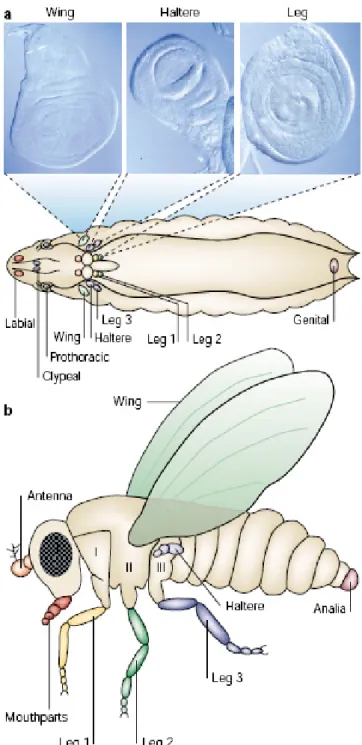
(16) growth and proliferation68. Furthermore, in the developing mouse limb, loss of dcr-1 leads to growth deficiencies69.. Figure 3 – Cell cycle. The miRNA pathway modulates the cell cycle of the stem cells by repressing p21/Dap and thus affecting the G1-S transition. (Adapted from Ref. 50). The majors effectors mediating the activity of Dcr-1 in these processes have not been identified so far. The wing imaginal disc of Drosophila is an extremely appropriate system to analyze, at a cellular level, the role of miRNAs in a proliferative epithelium and identify such effectors. Since Dcr-1 is a crucial component in miRNAs biogenesis, impairing its activity offers a way to access the role of microRNAs in a particular biological process.. 3.5 Drosophila wing imaginal disc The appendages of Drosophila have proven to be ideal models for the investigation of a vast range of aspects of limb development, namely cell and tissue growth. Like the appendages of vertebrates, they develop as outgrowths of the body wall that are initially inside the larva. Drosophila developing adult tissues are sac‐like structures, called imaginal discs, that will give rise namely to wings, legs and eyes of the adult fly (imago) (Fig. 4). The wing primordium is a continuous epithelial monolayer that arises from the late embryonic ectoderm as a group of 30‐40 cells and proliferates during the three larval stages to reach a final size of around 50.000 cells70. This growth happens in 5 days of continued division (cell proliferation) and the control of tissue size is intrinsic to the disc70. As Drosophila undergoes complete metamorphosis the primordium extends along its proximal-distal axis by turning inside out through the lumen (appendages come outside of 14 . .
(17) the body wall after disc eversion)71. In particular, wing imaginal discs have been used for the analysis of combinatorial effects, of many conserved signaling molecules, in the specification of positional values for differentiation and growth.. Figure 4 – Imaginal disc and the structures they give rise to. (a) A third-larva instar showing the position of the imaginal discs (colored according to the adult structure that they will develop into). Wing, haltere and leg disc photographs are shown. (b) Body of an adult fly indicating the various appendages. Mouthparts and analia are also considered appendages. Appendages are segment specific structures; the second thoracic segment develops a wing in dorsal and the second leg in the ventral region, while in the third segment a haltere and the third leg appear. (Adapted from Ref. 72). The greater part of the wing disc consists of a columnar epithelium, that will give rise to most adult cuticular structures, covered by a squamous epithelium named the peripodial 15 . .
(18) membrane. After disc eversion, the luminal face forms the external surface of the adult structures. The outmost region of the disc constitutes the thoracic structures (notum and pleura), the next ‘ring’ will make the wing hinge and the central pouch gives rise to the wing blade73 (Fig. 5).. Figure 5 – Fate determination along the proximal-distal axis. This determination is believed to result from complex interactions between the anterior-posterior and dorso-ventral morphogen-mediated signaling, leading to the specification of the wing blade, the wing hinge and the notum, that will give rise to the adult hemithorax. (Adapted from Ref. 74). 3.5.1 Growth control in the wing disc During the growth and development of most organs, a multitude of cellular processes are orchestrated to give rise to an organ of proper size, pattern and proportion. Specifically, rates of cell growth and cell division are coordinated so that cell size does not change much over time. Cell growth (increase in cell mass), cell division, cell proliferation (increase in cell number) and also cell death all play important roles in morphogenesis and growth of Drosophila. Namely, the morphogenetic patterning mechanisms that specify cell fate across a field of cells must take into consideration the increasing size of the field. Moreover, cell movements, such as migration, must also deal with this increasing in the size of the field and must be coordinated with demands placed on the cytoskeleton by the mitotic apparatus of dividing cells. Each imaginal disc has a distinctive shape and size, indicating that its growth has been regulated before the onset of its morphogenesis75. In the Drosophila wing disc, cell growth can be uncoupled from cell division. When cell division is slowed or blocked, cells continue to accumulate mass, and hence increase in size76. Cell division rates do not 16 . .
(19) drive growth, however it is unclear whether the converse is true and cell growth is sufficient to drive cell division77. The rate of cellular growth is determined by the identity of a particular organ, the position of a cell within this organ and its interactions with neighboring cells76. In addition to cell proliferation, apoptosis, that takes place through local cell‐cell interactions, also provides a mechanism for the generation of cell territories with continuous positional values, relevant to size and shape developmental control78. Genes involved in many aspects of growth at the organism and tissue levels can be divided in two distinct classes: the first one includes genes that control synthesis of proteins and other metabolic processes, affecting both the rate of growth and the organ final size (these genes respond to extrinsic signals like environmental cues); the second class comprises genes that determine identity, pattern, structure and final size of imaginal discs, although their effect on growth rates is not so clear (disc intrinsic signals)76. Therefore, developmental programs must be sufficiently robust and flexible to allow for changes in the size of a developing organ or organism, whether over developmental time, through evolution, or in response to external cues. Understanding how growth is controlled and how it is integrated with other cellular processes is of critical importance to the developmental biology field. One known signaling pathway that regulate these processes, in response to growth factors and nutrients, is the Insulin/PI3K/TOR pathway. When the pathway is inactive it causes a strongly decrease in cell and organ size, and the other way around. FoxO is a target of the pathway, that is downregulated when the pathway is active79. The well known Hippo (Hpo) pathway controls organ size by coordinately regulation of cell growth, proliferation and apoptosis. The pathway consists of a cascade of kinases, starting with Hpo, that leads to the transcriptional control of many targets. The pathway nuclear effector Yorkie (Yki), a transcriptional coactivator, is upstream of the targets. This pathway has a variety of target genes, including the cell cycle regulator Cyclin E and the cell death inhibitor Diap1. Expanded (Ex), an upstream regulator of Hpo, functions as an adaptor protein that links transmembrane proteins to the cytoskeleton or cytoskeleton-associated proteins80. Myc protein have been described to have functions in a wide range of fields, including cell biology, cell cycle, apoptosis, development, signal transduction, transcriptional and posttranscriptional regulatory mechanisms, non-coding RNAs, stem cell biology and cancer81. dMyc protein contain a C-terminal basic-helix-loop-helix-zipper (bHLHZ) which mediates DNA-binding and dimerization82. This regions allows for its heterodimerization with the protein Max, leading to DNA binding and consequently stimulating transcription83. Within the N-terminal is a short motif called Myc-box II (MBII), essential for most biological functions of dMyc. The antagonist of the Myc’s ‘network’ is dMnt, that was shown to also 17 . .
(20) bind dMax82. dMyc has been proven to be a master regulator of growth, since mutations in dMyc lead to a decrease in cell size, body size and viability. Many of these defects are also characteristic of mutations in genes encoding ribosomal proteins (the Minute class of mutations) and other components of ribosome biogenesis82. dMyc mutants also showed a small increase in the fraction of cells in the G1 phase of the cell cycle. On the other hand, overexpressing dMyc increased cell size by promoting G1-S transition and thus accelerating cellular growth83. All these growth defects in dMyc mutant cells caused these cells to become subject to cell competition when surrounded by normal cells in the Drosophila wing. Cell competition is a phenomenon in which slowly growing cells are eliminated from the epithelium83. This occurrence was first described in Minutes, a class of mutations with similar phenotypes of dMyc mutants, including developmental delay and small body size84. Cells lost in competition die by apoptosis, but how the apoptotic program is initiated is not clear85. Therefore, cell competition might contribute to a sizecontrol mechanism. For example, although dMyc overexpressing clones in the developing wing proliferate more than wild type cells, they do not change the final size of the adult wing. Overgrowth is prevented because the competitive elimination of wild type cells compensates for the increased growth of dMyc-expressing cells82. Overall, the conclusion is that dMyc is strongly required in vivo for cellular growth, and that it acts in a dosesensitive manner.. 3.5.2 Wing imaginal disc patterning The establishment of the three major axes and the definition of compartments of the appendages takes place during imaginal disc development. The primordium receives the patterning. cues. needed. to. generate. an. anterior‐posterior,. dorsal‐ventral. and. proximal‐distal axes. Diffusible signals termed morphogens86 provide cells within the epithelium with positional information87. Distinct properties, like differences in adhesion88, make anterior and posterior cells immiscible populations and thus defining a compartment boundary, the A-P boundary89. This has been shown after, given a growth advantage to some cells, observe that they still cannot cross the boundary, subsequently remaining within their compartment71. Compartments are defined as subdomains of a tissue that are separated by a boundary of cell lineage restriction with organizing activity, that pattern the surrounding tissue and divide up tissues in terms of cell fate/identity71. Early in larval development, an invaginating cell cluster that constitutes the leg and wing common precursor, inherits the stripe pattern of Engrailed (En) and Wingless (Wg) expression from the anterior-posterior (A-P) boundary of an embryonic parasegment. The wing disc derives from the dorsal part of this common precursor, therefore taking with you 18 . .
(21) a portion of the En stripe that will specify the posterior compartment of the wing, but not the Wg expression90. Subdivision notum versus wing. The first step in wing development is to define the region where the wing will form. During second larval instar, 24-48h after hatching, wg starts to be expressed in the ventral region. This wg expression is controlled by the Hh signaling pathway, which is also required to establish the A-P organizing center91. On the other hand, the formation of the notum region is dependent on the activity of the EGFR pathway, where activation of the pathway is done by the protein Vein92. wg suppresses Vein expression in the ventral region, restricting Vein expression to the dorsal part of the disc. Vein is also capable of suppressing wg expression in this dorsal region92. This antagonist relationship between these two pathways leads to the division of the disc into notum and wing regions.. Wing hinge patterning. As explained above, the first subdivision in the wing primordium is between an anterior (A) and a posterior (P) compartment, innate from the embryonic ectoderm, by the restricted expression and activity of the homeodomain protein Engrailed in P cells89,. 93. . hedgehog. 93. (hh) expression, promoted in P cells by En , acts as a short-range morphogen to specify decapentaplegic (dpp) expression in a narrow stripe of cells adjacent to the A-P boundary91(Fig. 8). Dpp is a member of the TGF-β family and operates in a concentration dependent manner to promote patterning, inducing target genes like spalt (sal), optomotor-blind (omb) and vestigial (vg)94,. 95. . Besides giving genetic positional values. along the medial-to-lateral wing, the Dpp activity gradient seems to indirectly promote wing growth96, being counterbalanced by the brinker transcriptional repressor, which is expressed in a complementary lateral-to-medial fashion, being itself repressed by Dpp activity97. The important contribution of Dpp signaling to the proximal-distal patterning of the wing disc is further completed by intersection of signals coming from the dorsal-ventral (D-V) boundary of the wing disc. During the early stages of larval development, when the disc consists of 100 cells, the D-V boundary is established as a result of apterous (ap) expression in the dorsal region of the disc92,. 98. (Fig. 6). This is a consequence of the. antagonist relationship between EGFR and Wg signaling explained above. Ap, through a complex regulation of the Notch ligands Serrate and Delta, is able to activate Notch at the D-V boundary99. Afterward, Notch directly activates transcription of genes at the D-V boundary, such as wg and cut, which restrict expression of Notch ligands, fine-tuning Notch activity to a narrow stripe of cells100. 19 . .
(22) . Figure 6 – Territorial subdivision of the imaginal wing disc. (a) The first subdivision between anterior (A) and posterior (P) is defined by Engrailed in the P compartment. Signaling from posterior to anterior cells by Hedgehog (Hh) causes A cells near the boundary to express Dpp, which diffuses into both compartments, acting as a morphogen and inducing activation of distinct targets in diverse domains. The second subdivision is along the proximal-distal axis and carried out by three signaling pathways. In the first, Wingless (Wg) is expressed in the distal part of the disc, defining the wing primordium by activating wing-specific genes. Second, by downregulating EGFR signaling, that becomes restricted to the proximal region, defines the notum through activation of the Iroquois complex (Iro-C). In the third, Dpp, that in early stages is only active in distal regions, confines Iro-C expression to the proximal part. (b) A dorsal-ventral subdivision is achieved by the expression of Apterous (Ap) in D compartment (comprises the notum and the dorsal part of the wing). In the third instar, Dpp subdivides the notum into lateral and medial domains by activating pannier (pnr). Pnr represses Iro-C and provides identity to the medial notum. The lateral notum is defined by the continuing expression of Iro-C. (Adapted from Ref. 101). In addition, in the wing blade, scalloped (sc) and vestigial (vg) are activated by combination of Notch, Wg and Dpp signaling102, providing the organizer functions of the DV boundary. Functions that include promoting growth along the proximal-distal axis103, and specifying a gradient of cell-affinities that discriminates the blade from the hinge104. In the end, this complex circuit of signaling molecules seems to drive the establishment and maintenance of region specific cell architecture, giving rise to a wing properly patterned.. 20 . .
(23) . IV. AIM OF THE PROJECT The importance of the microRNAs, as post-transcriptional regulators, in developmental processes is increasing exponentially nowadays. In Drosophila most studies in this area have been reported in ovarian and neural stem cells. The fact that the wing disc is a highly proliferative epithelium makes it an excellent model to analyze the general role of microRNAs. As principal aim of this project, we wanted to characterize the phenotype of depletion of Dicer-1 in a proliferative epithelium. Understand its consequences both at the level of adult structures, as at an early phase in development by looking at wing imaginal discs. Once characterize, identify which are the effectors mediating the role of miRNAs in wing disc development. In addition, investigate whether bantam miRNA, by itself or acting redundantly with other miRNAs, has a role in the wing and concretely if is targeting the effectors of the miRNA machinery on its all.. 21 . .
(24) . V.. MATERIALS AND METHODS. 5.1 DROSOPHILA STRAINS. 5.1.1 Fly husbandry All fly stocks were raised at 25ºC, according to standard conditions105. Crosses were cultured in small vials containing a yeast-glucose-agar medium.. 5.1.2 Mutant alleles and transgenic lines The mutant alleles for Dicer-1 utilized in this work were the dcr-1Q1147X and dcr-1d102 E2F1 responsive element dMyc. 107. 106. 50. .. 83. , in order to monitor E2F activity ; UAS-dMyc, hs-dMyc ; tub-. 1. ; bantam , UAS-bantam-GFP, bantam sensor (JB20)45; UAS-CycE108, UAS-mei-. P26RNAi-7553, UAS-mei-P26RNAi-106754, UAS-dMycRNAi, UAS-dcr-1RNAi (Vienna Drosophila RNAi Center); hs-bantam68; dap4 and Rbfsls15; en-gal4, ptc-gal4, UAS-GFP and other stocks are described in Flybase.. 5.2 GENETICS. 5.2.1 The UAS-Gal4 System Expression of UAS constructs was performed using the Gal4 system at 29ºC, unless mentioned otherwise. Gal4 protein is a yeast transcription factor, identified in Saccharomyces cerevisiae, that regulates the Gal genes in the metabolism of glucose. Gal4 gene has been cloned in a variety of organisms, such as Drosophila, and is used in genetic manipulation of genes. UAS sequences, promoter sequences containing a consensus binding site for activating Gal factors, have been introduced in eukaryotic expression vectors and thus allowing the production of transgenic constructs that are conditionally expressed upon the control of the Gal4109. Therefore, in Drosophila, a parental stock carrying a Gal4 line can be cross to another stock with a UAS-construct, and as a result, expression of the later is driven under the pattern of expression of the Gal4 in the progeny109 (Fig. 1). Several well characterized enhancer sequences have been trapped by the Gal4 coding gene to yield spatio-temporal specific drivers of gene expression110. The Gal4 drivers used in this work are represented in Table 1.. 22 . .
(25) Table 1 – Gal4 drivers used for this work.. Gal-4 drivers. Spatio-temporal domain of activity in the wing disc. engrailed-Gal4 (en-Gal4). From end of embryogenesis to end of larval stage in the posterior compartment. patched-Gal4 (ptc-Gal4). From the early embryogenesis to end of larval stage along the A-P boundary. engrailed-gal4 or patched-gal4 virgins were crossed with males carrying different UAS transgenes and allowed to lay eggs for 24 hours at 25ºC. Resulting larvae developed at 29ºC until adulthood (temperature maximal for Gal4 activity109).. Figure 1 – Gal4-UAS system in Drosophila. When females carrying the UAS construct (UAS-GFP) are mated to males that carry a Gal4 driver, progeny containing both elements are produced. The presence of Gal4 in an alternating segmental pattern in the depicted embryos then drives expression of the UAS element in the corresponding pattern (central panel). (Adapted from Ref. 108). 5.2.2 Genetic mosaic analysis Genetic mosaic techniques, crucial for our current understanding of many developmental processes in Drosophila, are those that induce genetic changes in a subset of cells in an individual organism. Such techniques are very important since they provide a way of examining homozygous situations that would be embryonic lethal if applied to the entire 23 . .
(26) organism. Another advantage is that genetic mosaics juxtapose wild type (control) and genetically modified cells, and this can be used to test the cell-autonomy of a mutant phenotype.. 5.2.3 Mitotic recombination The FLP/FRT system was used to generate mitotic clones. The Flipase (FLP) recombinase belongs to the family of integrases from S. cerevisiae. Members of this family are known to direct site-specific recombination of two DNA strands in cis, which occurs through the recognition of Flipase Recombination Target (FRT) sites111. Several stocks have been generated with FRTs inserted close to the centromere of each chromosome, through the p-element insertion, as well as a transgene encoding FLP driven by the hsp70 heat-shock inducible promoter (hs-FLPase)112. So, if a fly have two FRTs in the equivalent position in both chromosomes, heat-shock induced expression of the FLPase can cause recombination between the two sites. As a result, in a heterozygous setup, recombination between nonsister chromatids results in the generation of a daughter cell homozygous for the mutation distal to the FRT site. Succeeding cell division of this homozygous mutant cell give rise to a mutant clone that can be analyzed phenotypically. On the other hand, from the same mitotic recombination event, a wild type homozygous sibling cell is generated, giving rise to the twin spot of the mutant clone. Usually, the wild type FRT chromatid contains a cell marker, such as GFP, under control of a ubiquitous promoter, or the lacZ gene under the control of armadillo. This permits the generation of negatively marked mutant clones (Fig. 2). The following genotypes were used to generate loss-of-function clones by the classic FLP/FRT system in order to analyze twin/clone: hs-FLP/+; FRT82 dcrQ1147X/FR82 UbiGFP, hs-FLP/+; FRT82 dcrQ1147X/FR82 arm-lacZ, hs-FLP/+; FRT82 dcrd102/FR82 Ubi-GFP; hs-FLP/+; FRT82 dcrd102/FR82 arm-lacZ and hs-FLP/+; bantam-sensor-GFP; FRT82 dcrQ1147X/FR82 arm-lacZ. Larvae were grown at 25ºC, treated for 45 minutes at 37ºC during early second instar and dissected 72 hours later. Mutant cells were marked by the absence of GFP or lacZ (antibody to β-gal) expression.. 5.2.4 Minute technique The FLP/FRT system was combined with the Minute technique (Minute mutations are defective in ribosomal proteins, and in heterozygous conditions induce a delay in growth rates84) to induce clones covering large areas of the wing. These clones were wild type for the Minute mutation and had a growth advantage over the neighboring Minute/+ 24 . .
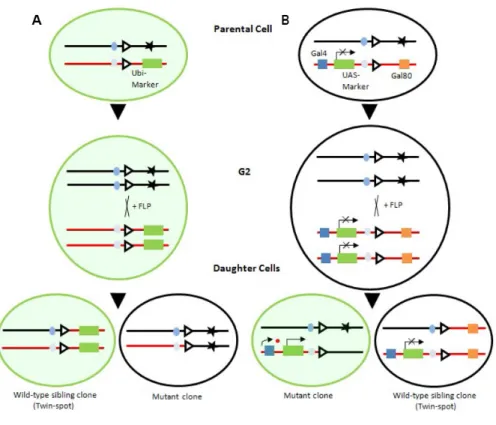
(27) heterozygous wing cells. This technique can also increase the chances that a mutant clone survives. As mutant clones in imaginal discs are often lost because of a phenomenon called cell competition, where abnormal slow-growing cells are eliminated in some way by the surrounding wild type cells, giving the clone a growth advantage using the Minute technique often rescues it112. Minute clones in adult wings were generated in the following genotype: hs-FLP; FRT 82 P(forked+) M(3)95A2/FRT82 dcr-1Q1147X. Larvae were grown at 25ºC, treated for 15 minutes at 37ºC during early second instar and developed back at 25ºC until adulthood. Mutant cells were marked by the absence of the P(forked+) rescue construct. Minute clones in wing imaginal discs were generated in the following genotypes: hs-FLP/+; FRT82 dcrQ1147X/FR82 M(3)95A2 Ubi-GFP, hs-FLP/+; FRT82 dcrQ1147X/FR82 M(3)95A2 arm-lacZ, hs-FLP/+; FRT82 dcrd102/FR82 M(3)95A2 Ubi-GFP, hs-FLP/+; FRT82 /FR82 M(3)95A2 Ubi-GFP, hs-FLP/+; FRT82 /FR82 M(3)95A2 arm-lacZ, hs-FLP; M(3L) ubi-GFP FRT80B/ban∆1 FRT80B. Larvae were grown at 25˚C, treated for 3 minutes at 37˚C during first instar and dissected 96 hours later. The heat-shock treatment was short to reduce the frequency of clones per wing and avoid fusion of clones. Mutant cells were marked by the absence of GFP or β-gal.. 5.2.5 Mosaic analysis with a repressive cell marker (MARCM) The MARCM technique is used to generate positively marked loss-of-function clones simultaneously expressing diverse transgenes in those clones113. This technique makes combined use of Gal4 together with its repressor Gal80, arranged in a manner such that, FLP-mediated mitotic recombination causes genetic loss of Gal80 and the associated derepression of Gal4. Such de-repression can be set to happen in a mutant clone in a way that allows the expression of a certain UAS-marker, like UAS-GFP (Fig. 2)113. The following genotypes were used to generate MARCM clones: hs-FLP tub-Gal4 UASGFP; UAS-dMyc/+; FRT82 dcrQ1147X / FRT82 Gal80, hs-FLP tub-Gal4 UAS-GFP;; FRT82 dcrQ1147X / FRT82 Gal80 and hs-FLP tub-Gal4 UAS-GFP; UAS-CycE/+; FRT82 dcrQ1147X / FRT82 Gal80. Larvae were grown at 25ºC, treated for 45 minutes at 37ºC during first instar and dissected 96 h later. Mutant cells were marked by the presence of GFP.. 25 . .
(28) . Figure 2 – Genetic mosaic techniques. (A) Mitotic recombination induced by the FLP recombinase during the cell cycle G2 stage results in the loss of heterozigosity at the locus coding for the mutation (black star) and a ubiquitously expressed cell marker (green box). As a consequence, one of the daughter cells will become the precursor of the mutant clone, while the other will become the complementary wild type population (twin spot) positively marked with a cell marker, such as GFP. (B) In the MARCM technique, Gal80 represses the expression of the UAS-construct (green box), such as UAS-GFP, but loss of heterozigosity at the Gal80 locus, as induced by FLP mediated mitotic recombination, results in the expression of the construct in the homozygous mutant clone.. 5.3 IMMUNOHISTOCHEMISTRY Third larvae instar imaginal discs were dissected in PBS and fixed in 4% formaldehyde in PBS, for 20 minutes at room temperature. Larvae were then washed and permeabilized in PBT (PBS 1x, 0,2% Triton X-100) 3 times, 10 minutes each. Afterwards they were blocked in BBT (PBS 1x, 5mM NaCl, 0,2% Triton X-100, Bovine Serum Albumin - BSA) for 45 minutes and incubated with the primary antibody in BBT overnight at 4ºC. Then, larvae were blocked in BBT 3 times, 15 minutes each, and incubated in the dark with the secondary antibody (and/or DAPI) diluted in BBT for 1 hour and 30 minutes at room temperature. Next, they were washed 4 times, 15 minutes each, in PBT and mounted in mounting medium (nPG 50% in EtOH, PBS 10x, Glycerol anhydrous, pH 8,5/9). For the treatment of imaginal discs with MG-132, a proteosome inhibitor, en-gal; UASmei-P26 third instar wing discs were cultured in cl-8 cell medium containing 40μM MG132 (experimental discs) or an equal volume of DMSO (control discs) for three hours before fixation and staining. 26 . .
(29) The primary antibodies used were: Guinea-pig anti-dMyc114 (1:100); rabbit anti-Mei-P2668 (1:250); mouse anti-Dap63 (1:25); rabbit anti-CycE (1:50), rabbit anti-CycB (1:100) and mouse anti-PCNA (1:50; Santa Cruz Biotechnology); mouse anti-CycB (1:100; described in the Developmental Studies Hybridoma Bank) and rabbit anti-βgal (1:100; Cappel). The secondary antibodies used were made in Goat (1:200; Molecular Probes). To mark the nuclei DAPI (1:200) staining was performed.. 5.4 IN SITU HYBRIDIZATION Third larvae instar imaginal discs were dissected in PBS and fixed, first in 4% formaldehyde in PBS and then in 4% formaldehyde in PBT for 20 minutes each fixation step at room temperature. Antisense Digoxigenin-labeled RNA probes of dMyc were used and in situ hybridization was performed as described in Ref. 115.. 5.5 TUNEL To visualize dead cells in the wing imaginal discs TUNEL staining, which labels fragmented DNA in dying cells, was carried out as described in Ref.. 116. , using an in situ. cell death detection kit (Roche).. 5.6 IMAGE ACQUISITION AND ANALYSIS Fluorescent images were obtained on a Leica TCS SP2 confocal microscope, in situ and adult wings images were acquired on a Nikon Elipse E600 by ACT 2007® software. Further image processing was achieved with Adobe Photoshop 7.0® software.. 5.6.1 Quantification of cell and tissue growth parameters in adult wings and wing discs dcr-1RNAi expression: Flies were collected in SH (1 Glycerol: 5 EtOH) overnight and mounted, at least ten adult wings per genotype, in Fauré medium (H2O, Glycerin, Chloral Hydrate, Arabic rubber). Size of the engrailed and patched domains was measured using Image J Software® (NIH, USA). Cell density in these domains and in the neighboring ones was measured as the number of hairs (each wing cell differentiates a hair) per defined area. Using the Adobe Photoshop 7.0® software the following areas were used to measure cell densities: (1) two conserved regions between veins L4 and L5 (engrailed domain) and veins L3 and L4 (neighboring tissue) in the engrailed-gal4 experiments and 27 . .
(30) (2) two conserved regions between veins L3 and L4 (patched domain) and veins L4 and L5 (neighboring tissue) in the patched-gal4 experiments. Final area and cell density values were normalized as a percent of the control engrailed-gal4, UAS-GFP or patchedgal4, UAS-GFP (Fig. 3).. Figure 3 – The several veins of a Drosophila adult wing.. dcr-1 twin/clone size analysis: in hs-FLP/+; FRT82 dcrQ1147X/FR82 arm-lacZ and hs-FLP/+; FRT82 dcrd102/FR82 arm-lacZ, clone and twin size was measure using Image J Software® (NIH, USA) and the values were presented in arbitrary units. dcr-1 Minute(+) clones frequency and size analysis: in hs-FLP/+; FRT82 dcrQ1147X/FR82 Minute(3R)w124 Ubi-GFP and hs-FLP/+; FRT82 /FR82 Minute(3R)w124 Ubi-GFP larvae, clone and cell frequency was measured. Cells were counted by the nuclei stained by DAPI. Also clone size was calculated using Image J Software® (NIH, USA). Values were normalized as a percent of the size of the wild type Minute(+) clones. dcr-1 clones expressing dMyc or CycE (MARCM clones): in hs-FLP tub-Gal4 UAS-GFP;; FRT82 arm-lacZ / FRT82 Gal80; hs-FLP tub-Gal4 UAS-GFP; UAS-dMyc/+; FRT82 dcrQ1147X / FRT82 Gal80; and hs-FLP tub-Gal4 UAS-GFP;; FRT82 dcrQ1147X / FRT82 Gal80, frequency of clones and cells was achieved. Moreover, size of the clones (in number of cells) in the wing pouch region was measured. Using Microsoft-Excel Software®, average values and the corresponding standard deviations were calculated and t-test analysis was carried out.. 28 . .
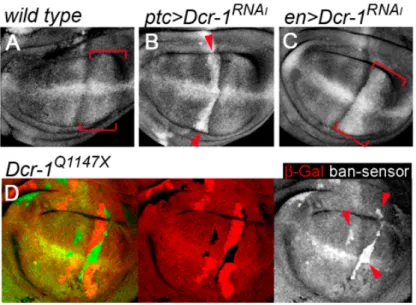
(31) . VI. RESULTS. 6.1 Reduced growth in the absence of Dcr-1 Making use of the UAS-Gal4 system, a RNAi construct of dcr-1 (dcr-1RNAi) was expressed in specific territories within the developing wing, in order to reduce Dcr-1 activity. To test whether dcr-1RNAi expression was able to significantly down-regulate miRNA levels in wing cells, we monitored the activity levels of bantam miRNA, known to be required for wing growth45. To monitor its activity we used a bantam sensor that expresses GFP under the control of an ubiquitously active tubulin promoter and has two perfect bantam target sites in the 3’ UTR45. Expression of dcr-1RNAi in wing cells induced a reduction in bantam activity (upregulation of the sensor) comparing to wild type (Fig. 1A-C). Nevertheless, the magnitude of this effect was less than the one observed in clones of cells mutant for a null allele of dcr-1, the dcr-1Q1147X allele21 (Fig. 1D). This demonstrates that, dcr-1RNAi expression leads to an intermediate condition where Dcr-1 activity and miRNA levels are reduced, but not eliminated.. Figure 1 – Dcr-1 activity quantification. (A) Wild type disc labeled to visualize expression of the bantam RNAi in the sensor (white). (B, C) Expression of the bantam sensor (white) in wing discs expressing dcr-1 patched (B, red arrowheads) or engrailed (C, red brackets) domains. Note in B and C increased expression of bantam sensor in the ptc and en domain when compared with wild type in A. (D) Wing disc with clones of cells lacking Dcr-1 activity marked by the absence of β-gal (red) and labeled in order to see expression of the bantam sensor (green). Genotype: hs-FLP; bantam-sensor-GFP/+; FRT 82 lacZ /FRT82 dcr-1Q1147X. Clones were induced 72 hours before dissection. Note increased expression of bantam sensor in mutant cells (red arrowheads).. 29 . .
(32) Expression of dcr-1RNAi caused an autonomous decrease in cell size in the adult wing (higher cell density in the directly affected domain) (Fig. 2C and D; see also Sup Table1). Consequently, the tissue size in dcr-1RNAi expression domain is also decreased (Fig. 2A, B and E; see also Table S1). All these effects were completely rescued by co-expression of a dcr-1 construct (Fig. 2B, C and E). Decreasing the amount of dcr-1 by 50% (dcr-1Q1147X in heterozygosis) enhanced the size effects already seen with dcr-1RNAi expression (Fig. 2E).. Figure 2 – Reduced cell growth in the absence of Dcr-1 activity. (A-C) Histograms plotting the size (A, B) and the cell density values (C) of the ptc and en domains expressing the transgenes. Values were normalized as a percent of the control GFP-expressing wings. Error bars indicate standard error. Only adult males were analyzed. (A) In ptc>dcr-1RNAi, a significant decrease in the size of the ptc domain was observed when -5 RNAi , a significant decrease in the size of the en compared to ptc>GFP wings (p<10 ). (B, C) In en>dcr-1 -7 domain was observed when compared to en>GFP wings (p<10 ), and a significant increase in cell density -3 was observed (p<10 ). Co-expression of dcr-1 rescued tissue size (p<10-10) and cell size (p<10-2) defects. RNAi =75±5,1 (n=12); en>GFP=100±5,7 Tissue size values: ptc>GFP=100±8,4 (n of wings=10); ptc>dcr-1 RNAi RNAi (n=12); en>dcr-1 =75±5,1 (n=10); en>dcr-1 >dcr-1=110±5,8 (n=12). Cell density values: en>GFP=100±7,6 (n=10); en>dcr-1RNAi=123±9,4 (n=10); en>dcr-1RNAi>dcr-1=95±2,6 (n=10). (D) en>dcr-1RNAi RNAi ) and adult wing cells. The red line labels the boundary between anterior cells (do not express dcr-1 RNAi posterior cells (do express dcr-1 ). Note the reduced size of posterior cells. (E) Images of adult wings expressing GFP or dcr-1RNAi in the ptc or en domains (labeled in blue), a wing co-expressing dcr-1 in the en domain and a wing with a dcr-1 mutant background (dcr-1Q1147X) in which en>dcr-1RNAi was expressed.. 30 . .
(33) To further study the requirement of Dcr-1 in tissue growth, clones of dcr-1Q1147X mutant cells in the wing primordium were induced and compared in size with their wild type twin spots (Fig. 3A and B). In dcr-1Q1147X clones analyzed 72 hours after induction, Dcr-1 activity was reduced, monitored by the reduced activity of bantam microRNA (Fig. 1D). These clones were smaller than their corresponding wild type twin clones ((Fig. 3B), see also Ref. 117, 118). Cell size defects were also observed in clones of dcr-1 mutant cells (dcr1Q1147X, Fig. 3C). With another allele of dcr-1, dcr-1d102, clones of mutant cells gave similar results in terms of clone size (Fig. 3A). It is noticeable that these mutant clones usually were broken (Fig. 3D), pointing to a possible engulfment from wild type cells, typical in cell competition situations. After 96 hours of induction many clones were eliminated from the wing disc (Fig. 3E), 31,5% of the wild-type twin clones were lacking their corresponding dcr-1 mutant clones (n of twin clones = 4,1; n of dcr-1 clones = 2,4; n of discs = 10). In order to check if these mutant clones were dying, a TUNEL staining was carried out. Most of dcr-1 mutant clones were positive for the staining (Fig. 3F). All of these observations described above suggested that dcr-1 mutant cells were being eliminated through cell competition, a process by which slower growing cells are detected and removed by apoptosis107,84,85,119,120. With the purpose of confirm this hypothesis, we used the Minute technique to generate clones of mutant cells with a relative growth advantage when comparing with the wild type cells (mutants for Minute). In a Minute/+ background, dcr-1 mutant clones were recovered at the same frequency as wild type control clones, 96 hours after induction (n clones/wing disc [dcr-1 M(+)] = 3,2, n clones = 32; n clones/wing disc [M(+)] = 3, n clones = 30) rescuing the cell competition phenotype seen in FRT clones. Despite that, clones were still smaller that wild type control clones (Fig. 3G and H). Altogether, these results indicate that activity of Dcr-1 is required for cell and tissue growth.. 6.2 Dcr-1 regulates E2F activity and Dap protein levels Given the fact that, in Drosophila and Vertebrate stem cells it has been reported that the lost of dcr-1 causes a delay in G1-S transition50,59,60, we analyzed the cell cycle profile in mutant cells of the wing disc by staining against some cell cycle markers (Fig. 4 and Fig. S1). Once more, the Minute technique was used to generate bigger dcr-1Q1147X mutant clones in order to become possible a greater visualization of the effect. In cells mutant for dcr-1, as well as cells expressing dcr-1RNAi, expression of Cyclin B (CycB) protein, which accumulates during the G2 phase of the cell cycle121, was reduced (Fig. 4A and B) when compared to wild type expression (Fig. S1 D and J).. 31 . .
(34) . Figure 3 – Dcr-1 and cell competition. (A, B) Imaginal discs with clones of cells, induced 72 hours before dissection, lacking dcr-1 activity marked by the absence of GFP (white). Note reduced size of the mutant clones (in black) when compared with the control wild type twins (in white). The corresponding graphics plotting the relative sizes (clone areas in arbitrary units) of individual pairs of dcr-1-/- clones (black bars) and dcr-1+/+ d102 (A) and dcr-1Q1147X (B). Genotypes: hstwins (grey bars). Two different alleles of dcr-1 were used: dcr-1 Q1147X FLP; FRT 82 Ubi-GFP/FRT82 dcr-1 , and hs-FLP; FRT 82 Ubi-GFP/FRT82 dcr-1d102. (C) Adult wings with clones of cells lacking dcr-1 activity. The mutant tissue in adult wings (genotype: hs-FLP; FRT 82 P(forked+) M(3)95A2/FRT82 dcr-1Q1147X) was marked by the absence of the P(forked+) rescue construct. In the left image, the red bar labels the mutant bristles and blue arrows label the wild type bristles. The red line in the right image labels the boundary between wild type and mutant tissue. Wild type and M(3)95A2/+ adult wings show a similar cell size122. (D-F) Wing discs with clones of cells lacking dcr-1 activity marked by the absence of GFP (white in D and E, green in F), induced 72 hours (D, F) or 96 hours (E) before dissection. Note mutant clones tend to break (red arrowheads in D) and enter apoptosis (labeled by TUNEL staining in red, F) 72 hours after induction and are frequently lost from the epithelium 96 hours after induction (E). (G) Wing discs with clones of cells lacking dcr-1 activity (right panels) or wild type for dcr-1 (left panels) and generated with the Minute technique to give clone cells a growth advantage. Clones were labeled by the absence of GFP expression (white) and induced 96 hours before dissection. The genotypes were: hs-FLP; FRT 82 Ubi-GFP Q1147X ; and hs-FLP; FRT 82 Ubi-GFP M(3)95A2/FRT82. (H) Histogram plotting the size M(3)95A2/FRT82 dcr-1 of dcr-1 (n clones= 21) and wild type Minute(+) clones (n = 18) induced 96 hours before dissection. Clone size was normalized as a percent of the wild type Minute (+) clone size. Error bars indicate standard error. The difference between both genotypes was statistically significant (p<10-8).. 32 . .
(35) Cyclin E (CycE) protein, which accumulates during the G1 phase108 was increased (Fig. 4C and D) when compared to the wild type situation (Fig. S1 B and H). Wild type control clones generated in a Minute heterozygous background did not show any change in CycB and CycE levels (Fig. S1 H and J). These results point towards a delay in G1-S transition in the cell cycle when dcr-1 is absent. Consistently, Dap, a inhibitor of the G1-S transition checkpoint63,64, is increased in cells with reduced Dcr-1 activity (Fig. 4I and J) compared to wild type (Fig. S1 E). Concerning E2F activity, we checked expression of the dE2F1responsive reporter ORC1-GFP106 and also expression of a dE2F target, PCNA. We observed a decreased in the reporter levels (Fig. 4E and F) as well as in PCNA protein levels (Fig. 4G and H) when compared to wild type expression (Fig. S1 F, G and I). Overall, E2F activity is reduced in cells lacking Dcr-1 activity. PCNA protein levels were not changed in control wild-type clones generated in a Minute heterozygous background (Fig. S1 I). These results suggest that microRNAs, by increasing E2F activity and limiting Dap expression, promote cell division. Some cell cycle regulators, such as Dap, Rbf and CycE, have been stated to not exert a direct effect on tissue growth in wing discs and adult wings77 (see also Table S1). With the aim of verifying if this also occurs in a reduced miRNAs activity condition, we analyzed if increasing CycE or reducing Dap or Rbf proteins cells we could overcome the consequences of dcr-1 depletion. In all the three situations, cell size was rescued (decreased cell density) (Fig. 4M) and the size of the wing territory was increased (Fig. 4K and L), overcoming the effect of decreased Dcr-1 activity. All the results described above raise the possibility that the influence of cell cycle regulators on tissue and cell growth could be somehow modulated by the microRNA pathway. Despite the fact that coexpressing cell cycle regulators like CycE was sufficient to rescue tissue and cell size in adult wings (Fig. 4K, L and M), the effects of reduced clonal recovery rate and size caused by the impairment of Dcr-1 activity were not overcome by expression of CycE (compare Fig. S2 A with Fig. 6B, C and E). These results suggest that the miRNA machinery have an impact on the activity of a more general growth regulator than those involved in the cell cycle.. 6.3 dMyc levels are regulated by Dcr-1 activity The proto-oncogene dMyc is known to regulate aspects like cell growth, tissue growth and G1-S transition and moreover differences in dMyc expression induce cell competition in Drosophila83,85,107. Taking that into account, and also the fact that reduced dMyc expression levels leads to phenotypes that remind some aspects of reduced Dcr-1 activity 33 . .
Imagem

+7




Documentos relacionados