1 Comprehensive Health Research Centre (CHRC), University of Evora, Évora, Portugal
Measuring Attitudes Towards Motorcycle Helmet Use in Laos
Margarida Sim-Sim
1*, Maria Bule
2, Isabel Bico
2, Vanmaika Vang
3, Phonemany
Phomvilay
3, Gnord Maypaokha
3, and Dalasouk Khamlun
4Abstract
This paper examinesattitude towards use of motorcycle helmet in Laos. A quantitative approach using the survey questionnaire method was adopted to assess this attitude. A total of 257 university students in Vientiane, Laos was interviewed. Forward translation, backward translation, and cognitive debriefing were carried out. Factor analysis of the principal components was also performed. The four-factor solution was used to explain the 58.867% of total variance. The correlation between items showed values between .01 and .566. The total item correlation values were between .129 and .566. Cronbach alpha coefficient was .764 for overall scale and between .801 and .601 on the four factors. Spearman Brown prediction formula was used to test psychometric properties and reliability of the items. A total of 17 items were considered reliable, such as such as susceptibility, trafficability, safety and usability, in determining overall attitudes of Laotians in using motorcycle helmet. These can be used in future research.
Keywords
Helmet use; psychometric properties; attitudes; Laotians
Introduction
The use of two or three wheeled motorcycles has increased in Latin America, Africa and Asia (Ichikawa, Nakahara, Phommachanh, Mayxay & Kimura, 2015; Slesak, Inthalath, Wilder-Smith & Barennes, 2015; UN, 2016; WHO, 2015). It is a very popular mode of transport among the youth (Ichikawa et al., 2015; Peltzer & Pengpid, 2014; Tongklao, Jaruratanasirikul & Sriplung, 2016). The lack of protective gear, specifically the helmet, is the main cause of road fatality involving the youth (WHO, 2015). Wearing helmets reduce spinal cord injuries in the event of an accident (Crompton et al., 2011) but studies reveal many riders and co-riders do not use them (Fong et al., 2015; Ichikawa et al., 2015; Peltzer & Pengpid, 2014) and therefore, educational programs are necessary (Ichikawa et al., 2015; WHO, 2015). These awareness programs could counter predispositions and increase favorable attitudes (Adams, Drake, Dang & Le-Hinds, 2014; Akaateba, Yakubu & Akanbang, 2015) towards helmet use. Many research findings suggest that youths place a low value on helmet use (Akaateba et al., 2015; Haqverdi, Seyedabrishami & Groeger, 2015). These negative attitudes are relate to the riders’ feeling of invulnerability, low threat perception, and the belief that helmets reduced their safety (Germeni, Lionis, Davou & Th Petridou, 2009; Haqverdi et al., 2015).
Attitudes are temporal, sensitive to education and training, and are modifiable. They are a consistent predisposition towards something, someone, a situation or an abstract idea (Wood
& Fabrigar, 2012). About 75% of accidents in Laos involve motorcycles (The World Bank, 2017). Almost 90% of motorcye riders in Laos do not wear helmets compared with those in Thailand (44-56%) and Vietnam (10-70%) (Peltzer & Pengpid, 2014). The use of the helmet among young Laotians is low (Ichikawa et al., 2015; Peltzer & Pengpid, 2014; Slesak et al., 2015), yet, no literature has examined the reasons as well as assess this attitude.
The assessment of attitudes toward helmet use in Laos requires culturally appropriate instruments. There are specific instruments to assess attitudes toward helmet. Some are based on behavior theories (Aghamolaei, Tavafian & Madani, 2011; Shruthi, Meundi & Sushma, 2019). Some are appropriate in a collective context, such as a classroom (Ross, Ross, Rahman & Cataldo, 2010) while other instruments require brief answers, and are appropriate for a public setting (Mwakapasa & Outwater, 2012) such as a university campus. An example is the Attitude Towards Helmet Use - ATHU scale (ATHUS) - an application that can be used in an academic context (Mwakapasa & Outwater, 2012). The ATHUS was considered because of its brevity and its questions are relevant to university students. There is no published literature validating the use of this tool in Laos. The present study therefore is aimed at describing and validating the Laotian version of the ATHUS and to assess its psychometric properties in a study of attitudes towards helmet use among students at National University of Laos (NUOL).
Methods
This study used a questionnaire method to assess attitudes towards helmet use in Laos. Data was analysis using ATHUS which was adapted to suit the local and cultural context. The questionnaire was designed to obtain the following data: a) socio-demographic (age, gender, maritalstatus), b) means of transport to the university (pedestrian, car, bus, driver of a motorcycle, passenger of a motorcycle, and travel time), c) self-reported helmet use (never, sometimes, always) and d) ATHUS.The survey was conducted in one university - National Unviersity of Laos (NUOL). Th e NUOL was selected because a) it is an academic institution which accepts foreign professors via an inter-university exchange program, b) easy accessibility and logistics, and c) limited financial resources to conduct a larger study.
ATHUS
The ATHUS was developed to assess attitudes toward the use of motorcycles helmets, specifically. It is a self-administered instrument with 17 items measured using a Likert-type scale with five ratings (ranging from 1 = completely disagree to 5 = completely agree). Items phrased negatively are inverted. The highest average score corresponds to more favorable attitudes (Mwakapasa & Outwater, 2012). Completion time is approximately eight minutes. The original instrument was first developed by Mwakapasa and Outwater in 2012 in Dar es Salaam in Tanzania. They conducted a study on a sample of 273 commercial motorcyclists. Despite a positive attitude towards helmet use, most of the respondents were not consistent in their use of the helmet. The Cronbach’s alpha coefficient was .720.
The current study developed two new items (items 3 and 5) which involved million riders. This is important because helmet use by co-riders is very low throughout Asia (Peltzer & Pengpid, 2014). The current scale now has 19 items.
The ATHUS contains a) transcultural perspective of semantics (Beaton, Bombardier, Guillemin & Ferraz, 2000) and b) psychometric analysis (Almeida & Freire, 2017; Bryman &
Cramer, 2011; Dancey & Reidy, 2019; Kline, 2015). The psychometric analysis considers: 1) construct validity through the Principal Component Analysis (PCA); 2) internal consistency with Cronbach’s alpha coefficient; 3) descriptive statistics for the items; and 4) stability bipartite clustering coefficient.
The authors of ATHUS were contacted (Hays, Weech-Maldonado, Teresi, Wallace & Stewart, 2018; Mwakapasa & Outwater, 2012) for feeback on its adapted form. The current authors were granted permission to use ATHUS via Research.net platform.
Transcultural perspective of semantics
The process of adapting the tool was modelled after a previous study (Beaton et al., 2000). In Stage 1, the forward translation from English to Laotian was completed by a linguist who has a doctorate degree (T1) and a health technician (T2). Both are Laotians and are fluent in English and Laotian. In Stage 2, based on the forward translations by T1 and T2, a synthesis of the tool was created to obtain a common translation (T12). In Stage 3, a backward translation was completed by a bilingual professor of nursing (BT1). In Stage 4, the forward translation and backward translation were reviewed by a Professor of Health Sciences from a different university in Vientiane who analyzed the semantic and conceptual equivalence of the variables. The corrections were related to orthographic errors in Laotian. In stage 5, a Laotian pre-test version was distributed to 10 Laotian nursing students, followed by cognitive debriefing (Almeida & Freire, 2017; Beaton et al., 2000).
Participants
The sample size was calculated as 10 to 20 times the number of variables (Hair, Black, Babin & Anderson, 2014) and finally 300 questionnaires were distributed after taking into account dropout rates and incomplete answers. The inclusion criteria were those: a) aged 18 years and above, b) studyingat NUOL, c) fluent in Laotian and a reasonable comprehension of English. International students were excluded from the sample. A convenience sampling method was adopted and carried out at the canteen in Dongdok Campus.
The participants therefore are all university students to test their attitude towards use of motorcycle helmets. Attitudes take time to develop, but they are stable (Wood & Fabrigar, 2012), and during adolescence (read youth), risky behaviors are common (Peltzer & Pengpid, 2014; Pitaktong et al., 2004). There has been a steady increase in use of motorcycles by youth (Wada et al., 2017) and the current study surveyed students who both owned and did not own a motorcycle.
Data collection
Students from Dongdok Campus, NUOL, were recruited as respondents to study their attitude towards use of motorcycle helmets. Two hundred and eighty-eight questionnaires were collected and 11 were eliminated due to incomplete answers (i.e., 10.5%). Two hundred fifty-seven participants completed the questionnaires.
The consent form and questionnaireswere in Laotian to cater to students who were not fluent in English.
Analysis procedure
Data was analyzed using SPSS IBM®, version 24. p<0.05 was assumed as the critical significance value. Descriptive and inferential statistics were utilized.
Ethical Principles
The research proposal was submitted to Ethics Board of Research in Human Health and Well-being of the University of Évora and was approved (registration: GD/16331/P1). Verbal permission for the survey was granted at a meeting with the Dean of NUOL in January 2018. National and International ethics norms for research were adhered to.
Results
The respondents were aged between 18 and 28 years (mean = 20.91; S.D. = 2.18), 111 were men (43.2%) and 146 were women (56.8%). With the exception of 4 who did not provide their marital status, all were single (n = 253; 99.6%). The mode of transport from home to the university, and helmet use by students who are riders, drivers, passengers or co-riders are described in Table 1.
Table 1: Means of transport and helmet use by gender. Vientiane, Laos - 2018 Variable categories Male n (%) Sex Female n (%) Total n (%)
Means of transport to school
Pedestrian 19 (17.1) 31 (21.2) 50 (19.5)
Car 13 (11.7) 13 (8.9) 26 (10.1)
Bus 14 (12.6) 4 (2.7) 18 (7.0) Motorcycle driver 62 (55.9) 96 (65.8) 158 (61.5) Motorcycle passenger 3 (2.7) 2 (1.4) 5 (1.9) Helmet usage of students who are
drivers/passengers
Never 14 (21.5) 21 (21.4) 35 (21.5)
Occasionally 9 (13.8) 9 (9.2) 18 (11.0) Always 42 (64.6) 68 (69.4) 163 (67.5)
Total 65 98 110
Tool adaptation process
This study followed the recommended criteria for tool adaptation based on a previous study (Beaton et al., 2000), as explained in previous section. Face validity was achieved.
Individual study of the ATHUS items
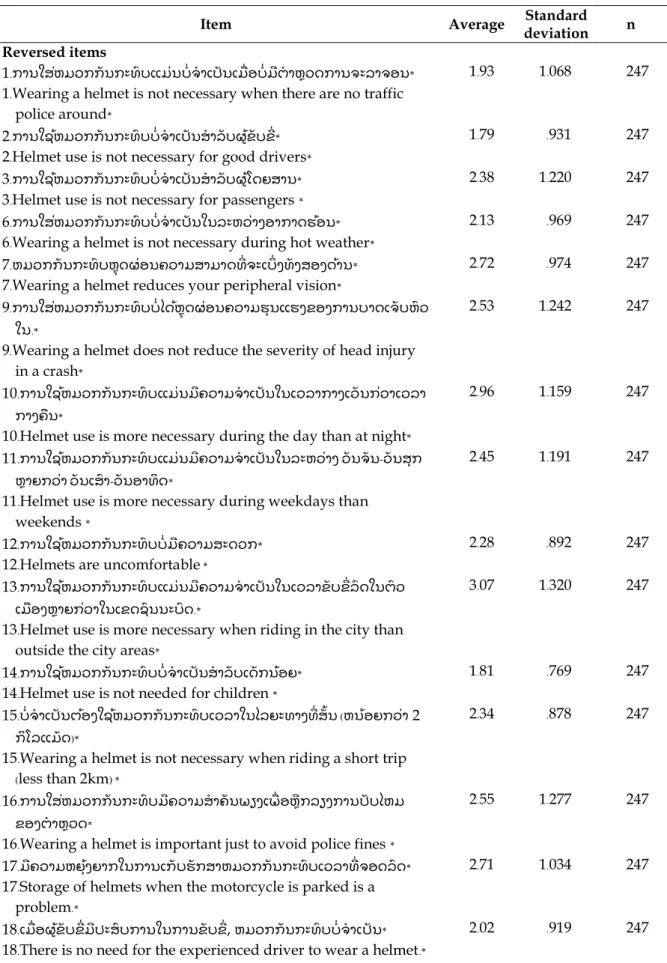
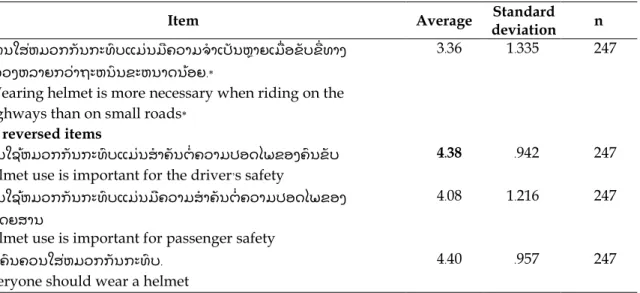
The individual questionnaire items in both English and Laotian as well as the measures of central tendency are described in Table 2. The highest average score was obtained on item 8: “Everyone should wear a helmet” (mean = 4.40; S.D. = .957), item 4: “Helmet use is important for driver’s safety” (mean = 4.38; S.D. = .942) and item 5: “Helmet use is important for passenger’s safety”.
Table 2: Central tendency measures for the items on the Attitude Towards Helmet
Use Scale. Vientiane, Laos - 2018
Item Average deviation Standard n
Reversed items
1.ການໃສ່ຫມວກກັນກະທົບແມ່ນບໍ່ຈໍາເປັນເມ ່ອບໍ່ມີຕໍາຫຼວດການຈະລາຈອນ* 1.93 1.068 247
1.Wearing a helmet is not necessary when there are no traffic police around*
2.ການໃຊ້ຫມວກກັນກະທົບບໍ່ຈໍາເປັນສໍາລັບຜ ້ຂັບຂີ່* 1.79 .931 247
2.Helmet use is not necessary for good drivers*
3.ການໃຊ້ຫມວກກັນກະທົບບໍ່ຈໍາເປັນສໍາລັບຜ ້ໂດຍສານ* 2.38 1.220 247
3.Helmet use is not necessary for passengers *
6.ການໃສ່ຫມວກກັນກະທົບບໍ່ຈໍາເປັນໃນລະຫວ່າງອາກາດຮ້ອນ* 2.13 .969 247
6.Wearing a helmet is not necessary during hot weather*
7.ຫມວກກັນກະທົບຫຼຼຸດຜ່ອນຄວາມສາມາດທີ່ຈະເບ ່ງທັງສອງດ້ານ* 2.72 .974 247
7.Wearing a helmet reduces your peripheral vision*
9.ການໃສ່ຫມວກກັນກະທົບບໍ່ໄດ້ຫຼຼຸດຜ່ອນຄວາມຮຼຸນແຮງຂອງການບາດເຈັບຫົວ ໃນ.*
2.53 1.242 247
9.Wearing a helmet does not reduce the severity of head injury in a crash*
10.ການໃຊ້ຫມວກກັນກະທົບແມ່ນມີຄວາມຈໍາເປັນໃນເວລາກາງເວັນກ່ວາເວລາ ກາງຄ ນ*
2.96 1.159 247
10.Helmet use is more necessary during the day than at night* 11.ການໃຊ້ຫມວກກັນກະທົບແມ່ນມີຄວາມຈໍາເປັນໃນລະຫວ່າງ ວັນຈັນ-ວັນສຼຸກ
ຫຼາຍກວ່າ ວັນເສົາ-ວັນອາທ ດ*
2.45 1.191 247
11.Helmet use is more necessary during weekdays than weekends *
12.ການໃຊ້ຫມວກກັນກະທົບບໍ່ມີຄວາມສະດວກ* 2.28 .892 247
12.Helmets are uncomfortable *
13.ການໃຊ້ຫມວກກັນກະທົບແມ່ນມີຄວາມຈໍາເປັນໃນເວລາຂັບຂີ່ລົດໃນຕົວ ເມ ອງຫຼາຍກ່ວາໃນເຂດຊົນນະບົດ.*
3.07 1.320 247
13.Helmet use is more necessary when riding in the city than outside the city areas*
14.ການໃຊ້ຫມວກກັນກະທົບບໍ່ຈໍາເປັນສໍາລັບເດັກນ້ອຍ* 1.81 .769 247
14.Helmet use is not needed for children *
15.ບໍ່ຈໍາເປັນຕ້ອງໃຊ້ຫມວກກັນກະທົບເວລາໃນໄລຍະທາງທີ່ສັ້ນ (ຫນ້ອຍກວ່າ 2 ກ ໂລແມັດ)*
2.34 .878 247
15.Wearing a helmet is not necessary when riding a short trip (less than 2km) *
16.ການໃສ່ຫມວກກັນກະທົບມີຄວາມສໍາຄັນພຽງເພ ່ອຫຼີກລຽງການປັບໄຫມ ຂອງຕໍາຫຼວດ*
2.55 1.277 247
16.Wearing a helmet is important just to avoid police fines *
17.ມີຄວາມຫຍຼຸ້ງຍາກໃນການເກັບຮັກສາຫມວກກັນກະທົບເວລາທີ່ຈອດລົດ* 2.71 1.034 247
17.Storage of helmets when the motorcycle is parked is a problem.*
18.ເມ ່ອຜ ້ຂັບຂີ່ມີປະສົບການໃນການຂັບຂີ່, ຫມວກກັນກະທົບບໍ່ຈໍາເປັນ* 2.02 .919 247
Item Average deviation Standard n 19.ການໃສ່ຫມວກກັນກະທົບແມ່ນມີຄວາມຈໍາເປັນຫຼາຍເມ ່ອຂັບຂີ່ທາງ
ຫລວງຫລາຍກວ່າຖະຫນົນຂະຫນາດນ້ອຍ.*
3.36 1.335 247
19.Wearing helmet is more necessary when riding on the highways than on small roads*
Not reversed items
4.ການໃຊ້ຫມວກກັນກະທົບແມ່ນສໍາຄັນຕໍ່ຄວາມປອດໄພຂອງຄົນຂັບ 4.38 .942 247
4.Helmet use is important for the driver’s safety
5.ການໃຊ້ຫມວກກັນກະທົບແມ່ນມີຄວາມສໍາຄັນຕໍ່ຄວາມປອດໄພຂອງ ຜ ້ໂດຍສານ
4.08 1.216 247
5.Helmet use is important for passenger safety
8.ທຼຸກຄົນຄວນໃສ່ຫມວກກັນກະທົບ. 4.40 .957 247
8.Everyone should wear a helmet
*Reversed items
Psychometric characteristics of ATHUS
The psychometric analysis follows the guidelines of Almeida and Freire (2017). The Kaiser-Meyer-Olkin (KMO) measure was adopted to determine sample adequacy and results showed KMO = .737. In addition, the communalities ranged between .438 and .772. Bartlett’s test of sphericity was X2= 1,663.953 (df = 171); p = .000. Once statistical significance was achieved, we
proceeded to Principal Component Analysis (PCA).
Construct validity
The PCA was used to identify theoretical constructs. Considering Eigenvalues greater than 1 (Guttman-Kaiser’s criterion), there were 5 factors that explain 60.936% of the variance. The Scree plot (i.e., Cattell’s criterion) (Bryman & Cramer, 2011) suggests 3 or 4 factors.
A new Principal Component Analysis (PCA) was performed with varimax rotation. The Scree plot continued with 3 or 4 factors (Figure 1).
It obtained an explained variance of 47.719% and 54.911%, respectively (not shown in the table). Factors weighing 0.4 or greater were withdrawn (Almeida & Freire, 2017). The 3-factor model demonstrated a factorial weight varying between .420 and .803. The 4-factor model showed a factorial weight varying from .405 to .826. Items 3 and 15 on both models presented a factorial weight below .40. In the 3-factor model, items 2 and 13 had representation in more than one factor. In the 4-factor model items 11 and 16 were represented in 2 factors.
After removing items 3 and 15, a third Principal Component Analysis (PCA) with varimax rotation was performed. The KMO value was .740. Communalities varied between .365 and .811. Bartlett’s sphericity was X2= 1,509.476 (df = 136); p = .000. Rotation was forced to 3 and to
4 factors, retaining those with a weight of .40 or greater. The explained variance of the 3-factor and 4-factor models was 50.960% and 58.867% respectively (table 3).
Table 3: Third PCA with 3 and 4 factors with Varimax rotation showing factorial
weights
Wearing Helmet (WH) Component Component
1 2 3 4 1 2 3 Item 5 .848 -.815 Item 4 .823 -.694 Item 8 .628 -.589 Item 2* .809 .615 .529 Item 1* .820 .562 .524 Item 14* .440 .534 Item 18* .650 .520 .471 Item 6* .591 .507 Item 9* .594 .479 Item 11* .571 .616 .849 Item 10* .509 .665 Item 19* .722 Item 13* .812 .557 Item 17* .773 .776 Item 7* .712 .650 Item 16* .413 .525 .627 Item 12* .443 .522 *Reversed items
Extraction Method: Principal Component Analysis. Rotation Method: Varimax with Kaiser Normalization. a. Rotation converged in 5 iterations.
The 3-factor model presents factorial weights between .479 and .845. All factors except one (item 9) weighed > .50. The 4-factor model showed factorial weights between .440 and .848, except for two items (item 14 and item 12), all weighed > .50.
Internal Consistency Reliability
Internal consistency was analyzed separately for both models. The 3-factor model, with 16 items, had a Cronbach’s alpha coefficient for a total scale of .771. The first factor had a Cronbach’s alpha coefficient of .787, the second .718 and the third .601. The 4-factor model, with 17 items, presented a Cronbach’s alpha coefficient of .764 for the total scale. In terms of internal consistency, according to the item organization of the PCA, the first factor had a
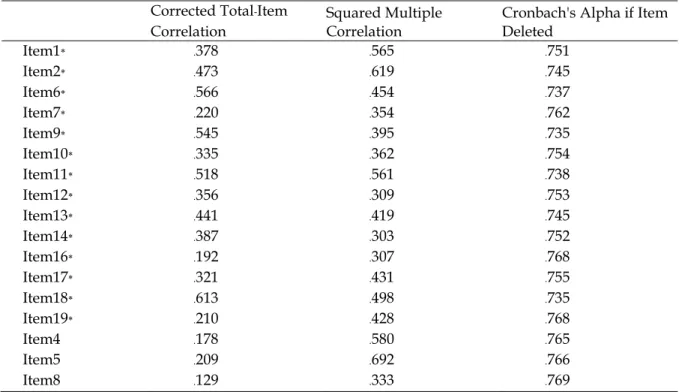
coefficient of .801, the second .721, the third .764 and the fourth .601. The 3-factor model was abandoned. In the 4-factor model the total item correlations varied from .129 (item 8) to .613 (item 18) as shown in Table 4. The correlation between items varied between .010 and .693.
Table 4: Internal Consistency Statistics for 4-factor model. Vientiane, Laos - 2018 Corrected Total-Item
Correlation
Squared Multiple Correlation
Cronbach's Alpha if Item Deleted Item1* .378 .565 .751 Item2* .473 .619 .745 Item6* .566 .454 .737 Item7* .220 .354 .762 Item9* .545 .395 .735 Item10* .335 .362 .754 Item11* .518 .561 .738 Item12* .356 .309 .753 Item13* .441 .419 .745 Item14* .387 .303 .752 Item16* .192 .307 .768 Item17* .321 .431 .755 Item18* .613 .498 .735 Item19* .210 .428 .768 Item4 .178 .580 .765 Item5 .209 .692 .766 Item8 .129 .333 .769 *Reversed items
With respect to the sub-scales, the organization of the factorial weights and the item’s semantic content of items suggest: a) the first factor with the items 1, 2, 6, 9, 14, 18, b) the second factor with the items 10, 11, 13, 19, c) the third factor with items 4, 5, 8, d) the fourth factor with items 7, 12, 16 and 17.
The reliability was also assessed through bi-partition coefficient (i.e., split-half). By determining the correlation value between both halves, it was possible to estimate the correlation coefficient for the total scale. According to the algorithm rcSB = 2 rx y/(1 +rx y)
(Bryman & Cramer, 2011), a coefficient of .753 was obtained, and correction reached a value of .859.
Descriptive statistics of the ATHUS in the current study
Distribution normality was observed through the z asymmetry test (z = Skew/SEskewness) and
kurtosis (z = Excess Kurtosis/SEexcesskurtosis), obtaining the values z = 1.48 and z = -1.075, which
assumes distribution normality (Kim, 2013). The average ATHUS score was 3.66 (S.D. = .496) with a minimum of 2.35 and maximum of 4.82.
Discussion
A total of 32.5% of participants in this study reported inconsistency in helmet use either as riders or co-riders (Wada et al., 2017). Findings of this study are consistent with those of others
that poor attitude towards helmet use is a public health concern (Crompton et al., 2011; Fong et al., 2015). In Laos, where motorcycles are involved in 70% of traffic accidents (WHO, 2016), wearing helmets can save lives by reduce risk of death and severe injuries by about 40% and 70% respectively (WHO, 2015). Careful attention was paid to the cultural adaptation of the instrument (Beaton et al., 2000) and which produced strong face validity. The first translation (T1 and T2) and the synthesis (T12) were aimed to produce an accessible and colloquial language, given the sample’s demographics. The existence of multiple dialects in Laos necessitated extra care in the development of the questionnaire. Only one of the two backward translations (Beaton et al., 2000) was done as the researchers were not able to find anyone the level of English fluency required (this was mainly due to time constraints). Participants underwent cognitive debriefing. The linguistic validation was essential to confirm the accuracy of the instrument and thus, quality of the research (Almeida & Freire, 2017; Beaton et al., 2000).
ATHUS Properties
The sample size was deemed adequate and the assumptions were preserved (Hair et al., 2014). Based on Principal Component Analysis (PCA), the goal of the research was achieved, as the KMO test (i.e., greater than .50) and Bartlett (p = .000) produced satisfactory results (Moreira, 2009).
Construct validity
The study’s interest in exploring the dimensions of ATHUS stemmed from the fact that in the original study, the author did not explore the possibility of scale multi-dimensionality (Mwakapasa & Outwater, 2012). In exploring it, the joint interpretation of the Guttman-Kaiser criterion and the Scree plot for the Cattell criterion (Bryman & Cramer, 2011) led to hesitation between the three-factor and four-factor models. Choosing the four factors seemed adequate as higher numbers are preferable in case of doubts (Moreira, 2009). This decision not to restrict factors allows improvement of the instrument in the future.
The choice of Varimax rotation as the orthogonal rotation method contributed to maximizing the variance and to define independent factors (Dancey & Reidy, 2019). The number of variables for each factor was minimized, simplifying interpretation. In the Varimax rotation of the PCA, saturation above .40, led to purging of some items which had lost their representativeness. Since there is no consensus on the cut off point for saturation - some authors recommend .50 (Moreira, 2009) while others .30 or .40 (Almeida & Freire, 2017; Dancey & Reidy, 2019)- this study used .40 as the cut-off point. In fact, had the study chosen .30, there would be better representation of the factorial load on several factors and if it had chosen .50, some items would have been lost, reducing the conceptual interpretation capacity of the construct. The purging of two items reflects a conservative stance, respecting the original author’s intellectual property. With the addition of the two items (3 and 5), this version of ATHUS resembled the original author’s formulation, but while item 5 was retained in the varimax rotation, item 3 was rejected due to its factorial weight. The introduction of new items to existing instruments is permissible (Finn & Kayande, 2004), and while the introduction of these two items amplifies the heterogeneity of the factors, it can improve the interpretation of the phenomenon and increase the transcultural scope of the study. In Laos, even though helmet use is obligatory (Wada et al., 2017), (i.e., Lao PDR: Law on land traffic n.02/AS, 8th April 2000; n.188/PM, 3rd July 2007), few recognize its necessity (Ichikawa et al., 2015; Slesak et al., 2015; Wada et al., 2017) which is consistent with the results of this study. The fact that item 5 was kept points to the fact that Laotians can distinguish between the
indicators “necessity” and “safety”. Other studies support thier finding that Laotions in general do not feel the necessity to use helmet (Wada et al., 2017), while others show safety is an important concern (Fong et al., 2015). Such results reveal inconsistency between belief and behavior, because if safety is the goal, helmet use is a must.
Internal Consistency
Reliability was assessed using Cronbach’s alpha coefficient. In the final four-factor model, alpha values of the total scale, and of the second and third factors (.764, .721 and .765, respectively) show reasonable consistency, while the first factor (.801) was good and the fourth (.601) was poor (Almeida & Freire, 2017; Dancey & Reidy, 2019). Although the Cronbach’s alpha value was not high in all subscales, it is acceptable. Since the purpose of the study was exploratory, alpha values between .6 and .8 were acceptable (Almeida & Freire, 2017; Dancey & Reidy, 2019).
The total item correlations were below .613 and above .20, except for 3 items. In a conservative approach, the items with low values were kept because they are close to the cut-off point (Kline, 2015). This is not a detriment to the statistical interpretation.The values of the inter-item correlations found in the study, ranging from .100 to .716, met the criteria. Other researchers (Bryman & Cramer, 2011; Dancey & Reidy, 2019) maintain that in an exploratory study, the .20 cut is acceptable but it should not exceed .80. This study used a more conservative approach, and although it had the limitations in terms of its low values, the original idea for the use of the tool was preserved.
In the subscales, organization of the items suggested the following constructs: a) the first factor conveyed the idea of “Susceptibility”, wherein the participants evaluated helmet use according to perceived vulnerability or invulnerability to injury; b) the second factor conveyed the idea of “Trafficability”, wherein the participant calculated the need to use helmet from perceived navigability and constraint of the road; c) the third factor conveyed the idea of “Safety”, wherein the motorcyclist evaluated the need for the helmet to comply with the rules and be aware of risks; d) the fourth factor was “Usability” wherein the participant recognized and evaluated the functions of the helmet. Deriving constructs from the subscales is a creative intellectual activity oriented to the underlying sense of the items, and this is determined by the psychometric organization related to the respondents and their culture. It is important inter-item and total-item correlations are carefully observed, since higher coefficients transmit greater homogeneity and lead to greater internal consistency of the items.
The evaluation of reliability by split-half test allowed observing the tendency of the participants’ answers, sparing a second application of the questionnaire. Although parallel or re-test forms are common ways to assess temporal stability, a second gathering of these participants was impossible, and so, the accuracy of the ATHUS was evaluated through a split-half test with Spearman-Brown test. The two halves were correlated with satisfactory coefficients via random entry of the items (Almeida & Freire, 2017; Dancey & Reidy, 2019) and, hence, the two parts were shown to be equivalent. Time interval related-bias, due to possible resulting memory changes or memorized responses (Almeida & Freire, 2017; Moreira, 2009), was thus avoided.
Normality
Given ATHUS assessment required modification of the initial pool of variables, normality of the distribution after studying the psychometric properties was analyzed. The asymmetry and kurtosis data showed normal distribution. There is no gold standard to assess the normality of the distribution and formal tests (Shapiro-Wilk and Kolmogorov-Smirnov) which have
some limitations (Kim, 2013). By opting for the asymmetry and kurtosis evaluation, since the z values are accessible through SPSS, we can also observe if the values for rejection of the null hypothesis agree with the size of the sample. For medium size samples (50 < n < 300), the distribution is non-normal if the absolute value of z is above 3.29 (Kim, 2013). In the present case, both values of asymmetry and kurtosis fell short. Normality was an expected result, competing for the interpretation of the Central Limit Theorem.
Conclusion
The ATHUS is an instrument used to measure the attitude of motorcyclists in using helmet to protect themselves against cranial traumas in the event of an accident. The results of the psychometric properties of the study were satisfactory. Factoriality and internal consistency tests were more robust for a final 4-factor solution. Findings showed a contradictory attitude of motorcyclists who felt though safety on the road was important, they did not think weaering helmet to protect themselves was necessary. The current study offers a possibility for further empirical research in examining the attitudes of other groups, such as professional motorcyclists, those who use the motorcycle to ferry their children, urban and rural residents, non-resident tourists, and drivers and passengers among others. Reliable information about attitudes can support the campaign to urge use of helmets among the wider population and ultimately, it may contribute to a reduction in the severity of injuries and deaths on the road. The current study underlines safety concerns in Laos related to motorcycle use and its findings offer an important contribution to research in this field. Further empirical research in this area is important as WHO reports more than a million injuries and deaths due to motorcycle accidents. Even though the study results affirm the adequacy of the adapted instrument, a revalidation is important, considering the limitations of the current study.
Limitations
The study limitation was the data was not retested. However, the split-half test with Spearman-Brown correction validated the analysis (Moreira, 2009). Other study limitation is the type of sample, once it was a convenient process for data collection, and as a non-probability sample, the results only regard these participants. The lack of proficiency in English was also a limitation.
Acknowledgment
We gratefully acknowledge the contributions of Professor Vicki Aaberg, (Ph.D.), Associate Professor of Nursing at Seattle Pacific University who assisted us in articulating our thoughts well in English.
References
Adams, C., Drake, C., Dang, M., & Le-Hinds, N. (2014). Optimization of injury prevention outreach for helmet safety. J Trauma Nurs, 21(3), 133-138. doi:10.1097/jtn.0000000000000047
Aghamolaei, T., Tavafian, S.S., & Madani, A. (2011). Prediction of helmet use among Iranian motorcycle drivers: an application of the health belief model and the theory of planned behavior. Traffic
Injury Prevention, 12(3), 239-243. doi:10.1080/15389588.2011.557757
Akaateba, M.A., Yakubu, I., & Akanbang, B.A.A. (2015). Correlates and barriers associated with motorcycle helmet use in Wa, Ghana. Traffic Injury Prevention, 16(8), 809-817.
doi:10.1080/15389588.2015.1024833
Almeida, L., & Freire, T. (2017). Metodologia da Investigação em Psicologia e Educação (5ª ed.). [Methodology of Research in Psychology and Education. 5th. ed)]. Lisboa: Psiquilíbrios
Beaton, D.E., Bombardier, C., Guillemin, F., & Ferraz, M.B. (2000). Guidelines for the process of cross-cultural adaptation of self-report measures. Spine (Phila Pa 1976), 25(24), 3186-3191.
Bryman, A., & Cramer, D. (2011). Quantitative data analysis with IBM SPSS 17, 18 & 19: A guide for social
scientists. London: Routledge.
Crompton, J.G., Bone, C., Oyetunji, T., Pollack, K.M., Bolorunduro, O., Villegas, C., . . . Haider, A.H. (2011). Motorcycle helmets associated with lower risk of cervical spine injury: debunking the myth. J Am Coll Surg, 212(3), 295-300. doi:10.1016/j.jamcollsurg.2010.09.032
Dancey, C., & Reidy, J. (2019). Estatística sem Matemática para a Psicologia (7th ed.). [ Statistics without Mathematics for Psychology]. Porto Alegre: Penso Editora.
Finn, A., & Kayande, U. (2004). Scale modification: alternative approaches and their consequences.
Journal of Retailing, 80(1), 37. doi:10.1016/j.jretai.2004.01.003
Fong, M.C., Measelle, J.R., Dwyer, J.L., Taylor, Y.K., Mobasser, A., Strong, T.M., . . . Lianosay, B. (2015). Rates of motorcycle helmet use and reasons for non-use among adults and children in Luang Prabang, Lao People's Democratic Republic. BMC Public Health, 15(1), 1-6. doi:10.1186/s12889-015-2304-2
Germeni, E., Lionis, C., Davou, B., & Th Petridou, E. (2009). Understanding reasons for non-compliance in motorcycle helmet use among adolescents in Greece. Injury Prevention, 15(1), 19.
doi:10.1136/ip.2008.019356
Hair, J.F., Black, W.C., Babin, B.J., & Anderson, R.E. (2014). [Multivariate data analysis.] (7th ed.). Upper Saddle River: Edition, Pearson Education..
Haqverdi, M.Q., Seyedabrishami, S., & Groeger, J.A. (2015). Identifying psychological and socio-economic factors affecting motorcycle helmet use. Accident Analysis & Prevention, 85, 102-110. doi:https://doi.org/10.1016/j.aap.2015.09.007
Hays, R.D., Weech-Maldonado, R., Teresi, J.A., Wallace, S.P., & Stewart, A.L. (2018). Commentary: Copyright restrictions versus open access to survey instruments. Med Care, 56(2), 107-110. doi:10.1097/mlr.0000000000000857
Ichikawa, M., Nakahara, S., Phommachanh, S., Mayxay, M., & Kimura, A. (2015). Roadside observation of secondary school students' commuting to school in Vientiane, Laos. International Journal of
Injury Control & Safety Promotion, 22(2), 111-115. doi:10.1080/17457300.2013.843570
Kim, H.Y. (2013). Statistical notes for clinical researchers: assessing normal distribution (2) using
skewness and kurtosis. Restorative dentistry & endodontics, 38(1), 52-54. doi:10.5395/rde.2013.38.1.52 Kline, P. (2015). A handbook of test construction (Psychology revivals). London: Taylor & Francis Ltd. Moreira, J.M. (2009). Questionários: teoria e prática. [Questionnaires: theory and practice] Coimbra:
Almedina.
Mwakapasa, E., & Outwater, A. (2012). Attitudes towards and practice of helmet use among commercial motorcyclists in Dar Es Salaam region, Tanzania. Injury Prevention, 18(Suppl 1), A194.
Peltzer, K., & Pengpid, S. (2014). Helmet use and associated factors among motorcyclists in the Association of Southeast Asia Nations: Prevalence and effect of interventions. African Safety
Pitaktong, U., Manopaiboon, C., Kilmarx, P.H., Jeeyapant, S., Jenkins, R., Tappero, J., . . . van Griensven, F. (2004). Motorcycle helmet use and related risk behaviors among adolescents and young adults in Northern Thailand. Southeast Asian J Trop Med Public Health, 35(1), 232-241.
Ross, T.P., Ross, L.T., Rahman, A., & Cataldo, S. (2010). The bicycle helmet attitudes scale: Using the health belief model to predict helmet use among undergraduates. Journal of American College
Health, 59(1), 29-36.
Shruthi, M.N., Meundi, A.D., & Sushma, D. (2019). Determinants of helmet use among health-care providers in urban India: Leveraging the theory of planned behavior. Journal of education and
health promotion, 8, 24-24. doi:10.4103/jehp.jehp_182_18
Slesak, G., Inthalath, S., Wilder-Smith, A., & Barennes, H. (2015). Road traffic injuries in northern Laos: trends and risk factors of an underreported public health problem. Trop Med Int Health, 20(11), 1578-1587. doi:10.1111/tmi.12562
The World Bank. (2017). Project information documenta/ Integrated safeguards data sheet (PID/ISDS). Retrieved from http://documents.worldbank.org/curated/en/120191500285300324/pdf/ITM00184-P163730-07-17-2017-1500285297578.pdf
Tongklao, A., Jaruratanasirikul, S., & Sriplung, H. (2016). Risky behaviors and helmet use among young adolescent motorcyclists in Southern Thailand. Traffic Injury Prevention, 17(1), 80-85.
doi:10.1080/15389588.2015.1045062
United Nations (UN). (2016). Resolution adopted by the General Assembly on 15 April 2016. Improving global
road safety. Retrieved from
http://www.un.org/en/ga/search/view_doc.asp?symbol=A/RES/70/260&referer=/english/&Lang=E Wada, T., Nakahara, S., Bounta, B., Phommahaxay, K., Phonelervong, V., Phommachanh, S., . . . Kimura,
A. (2017). Road traffic injury among child motorcyclists in Vientiane Capital, Laos: a cross-sectional study using a hospital-based injury surveillance database. Int J Inj Contr Saf Promot,
24(2), 152-157. doi:10.1080/17457300.2015.1080728
Wood, J. K., & Fabrigar, L. R. (2012). Attitudes. In D. S. Dunn (Ed.), Psychology. New York: Oxford University Press.
World Health Organization (WHO). (2015). Global status report on road safety 2015. Violence and Injury
Prevention. Retrieved from
http://www.who.int/violence_injury_prevention/road_safety_status/2015/en/
World Health Organization (WHO). (2016). Reported distribution of road traffic deaths by type of road user.
Data by country. Global Health Observatory data repository. Retrieved from