Keeping city capital hotels competitive under new competition and changing demand
behaviour: a ROI analysis approach to Dom Pedro Palace Renovation Process
ReRenovation Process
Ana Carolina Rodrigues Marques Faustino | 2787
A Project carried out on the Strategy and International Business course under the supervision of: Prof. Luís Correia da Silva
Abstract
The purpose of this work project is to understand how can city capital hotels remain competitive throughout time and apply that knowledge to a specific hotel: Dom Pedro Palace. To build the competitive framework was done a literature review regarding demand and supply key characteristics. After analysing the Lisbon market and Dom Pedro Palace characteristics, it was concluded that the main competitive weaknesses were the physical environment/ambiance and its facilities quality. To overcome that, three renovation options were proposed. The hypothesis was selected based on a ROI approach.
INTRODUCTION ... 3 LITERATURE REVIEW ... 3 METHODOLOGY... 6 COMPETITIVE FRAMEWORK ... 6 DEMAND ... 7 SUPPLY ... 8
LISBON: THE PORTUGUESE CAPITAL... 11
TOURISM OVERVIEW ... 11
SOURCE MARKETS ... 13
DOM PEDRO PALACE ... 13
FINANCIAL ANALYSIS ... 14
COMPETITION ANALYSIS ... 16
CUSTOMER ANALYSIS ... 17
IS IT THE RIGHT TIME TO RENOVATE? ... 19
RENOVATION OPTIONS ... 20
Hypothesis 1 ... 21
Hypothesis 2 ... 22
Hypothesis 3 ... 23
LIMITATIONS AND FURTHER RESEARCH SUGGESTION ... 23
CONCLUSION AND FINAL RECOMMENDATIONS ... 24
REFERENCES ... 25
APPENDICES ... 30
APPENDIX I–HYPOTHESIS 1COMPUTATIONS ... 30
APPENDIX II–HYPOTHESIS 2COMPUTATIONS ... 31
Introduction
The hospitality industry has been growing and it is expected to continue to grow in the following years. Several new hotels open every year answering unfulfilled needs and challenging the existent players to go further in their offer. Competition is fierce and customers are more demanding than ever. To be successful in such market, it’s crucial to understand it and to be able to adapt the offer. That said, it’s imperative that older players rethink its positioning to match new and more exigent demand expectations.
This work project aims to study this competitive situation in order to understand how the existent players can keep competitive under such conditions. It will focus the analysis in a specific case: Dom Pedro Palace. The first goal is to identify the current critical success factors for the hotel industry as well as the needs that the guests are presenting nowadays, creating a framework whose objective is to help companies checking its competitiveness and then decide in which areas they should invest.
Lightened with that information, the second step would be understanding the actual competitive situation and position of Dom Pedro Palace when compared with other hotels in Lisbon. One weakness – physical environment/ambiance and its facilities quality– will be approached with a problem-solving mind set. The goal will then be a general renovation plan where three main options are presented and analysed. The selection criteria will be the expected return on investment (ROI).
Literature Review
The way people decide and organize their travel is not the same anymore. Social media has nowadays an important role in the tourism experience, adding interactivity during the whole process (Nemec and Vodeb 2015). Thanks to social media, travellers became themselves a relevant source of touristic information (K. H. Yoo and Gretzel 2011) and that feedback has a special impact in the accommodation decision making process (K.-H. Yoo and Gretzel 2012).
This gives a new dimension to customers – “marketers” – since each one can reach a much higher number of potential customers than it used to through the simple “word of mouth”. Ahey et al. (2012) recognised three important social media advantages for tourism companies: a promotion channel, an opportunity to connect with customers and reputation management. In recent years, city break travel has been rising due to several factors: increased availability of low cost flights, a tendency to travel more often, making usage of weekends and holidays, increased interest on cities and the fact that it is easier to book this type of travel online (Dunne, Flanagan, and Buckley 2010). On top of typical business meetings destinations, capital cities are now also considered leisure destinations, offering to city hotels an amazing opportunity to face interesting demand levels both during the week – with business guests – and at the weekend – with leisure visitors.
This new market framework presents new challenges and opportunities to the hotel industry. Given this constantly changing travel environment, Abdullah and Hamdan (2012) recognized the importance of keeping the customers’ needs under close attention given the competitive market where city hotels operate. For that reason, the hospitality service providers increased its concerns with continuous search for new ways to exceed customers’ expectations (Langvinienė and Daunoravičiūtė 2015).
So, to effectively address the market needs, hotels must play close attention both to customer needs and competitors new and renovated offer. That constant monitoring can be summarized in an interesting “competitiveness definition”: Lombana (2011) defined it as “a dynamic comparison among companies (…) with their products or services that (…) compete in a certain place (…) in order to reach common commercial or financial goals.”; Grant (2010) stated that a company is competitive if it has characteristics that result in better outcomes than its competitors. So, establishing and sustaining a competitive advantage is how a company makes money.
This competitive advantage process can only be successful if both competition and customers are taken into consideration to offer the customer a unique product or service in which he can find value added ((Grant 2010), (Milohnic 2012)).
Since the concept of being competitive arises and improves constantly, a company cannot be considered competitive in a static moment. To remain competitive, firms in general, and hotels in particular, must pay close attention to key resources: Financial, Human, Physical, Knowledge and Organizational (Enz, 2010).
Several studies had been covering the hotels competitiveness, identifying key factors to hotels’ success. These are presented in the following section as a validation of the critical hotel factors choice, whose job is to guarantee that the current demand needs are constantly answered. One of the identified factors is infrastructure quality reflected in physical environment/ambiance and its facilities quality. That is so since the hotel property reflects the company’s positioning and room facilities play an important role in this perception (Qu, Ryan, and Chu 2000). To keep the current positioning, each hotel should continuously update its facilities. Hassanien and Baum (2002) concluded that the frequency of minor renovations should be 1-3 years, for major 10 years and for master 30 years. The same research paper defined hotel renovation as “the process of retaining or improving the hotel image by modifying the tangible product, due to a variety of reasons, through any changes in the hotel layout (e.g. property structure-new extension) and/or any additions or replacement of materials and Furniture, Fixture & Equipment [F.F.E.]”.
There are several reasons from which the hotel renovation need arises: (i) to keep up with competition, especially in a reality where the great majority of competitors modernised their properties, (ii) to satisfy the current or potential customer needs and expectations, (iii) to increase the operational efficiency through productivity improvement, (iv) to maintain the corporate image and standards, (v) to comply with new trends and technology, (vi) to improve
revenue performance, increase market share and with that enhance profitability (Hassanien & Baum, 2002) as well as (vii) to meet environmental sustainability exigencies. In the case of Dom Pedro Palace all the above-mentioned benefits would be welcomed.
Methodology
The competitive framework was built based on the review of several articles on hotels key characteristics, both regarding the customers’ current needs and the correspondent internal dimension. A review of many articles on different demand segments and its respective recent trends was also key to structure the framework. This competitive framework was then built based on secondary research.
Regarding the data for “renovations options”, it also included some secondary research but it was mainly obtained through primary research. The three hypotheses of renovation and its associated costs will be based in an American hotel cost estimating guide and in data provided by the Dom Pedro Palace Technical Director (JN+A and HVS DESIGN 2016).
The project evaluation criteria was ROI because the return on investment is the Dom Pedro Palace main concern. To define the expected returns, Altis Grand Hotel results1 were considered and adjusted to each hypothesis, always under a more pessimistic scenario. It was assumed that all investments would be done in the beginning of the period and the returns at the end of the period. Due to the impossibility of getting the values specifically for the hotel, the WACC used was 7%, based on the values available online2. With that opportunity cost, the present value of
each option return was computed with the respective lifetime. 262 Rooms were considered. Competitive Framework
If being competitive can be defined as offering the wished service to customers better than competitors, it becomes crucial to understand the customers’ current concerns as well as the
1 Dom Pedro Palace Competitor that was recently under a master renovation whose partial results were revealed,
more information about it can be find in the Competition Analysis of the current work project
competitors’ present offer and with that identify which needs are not being met both by the industry and by the hotel in particular.
Demand
After a literature review on what customers value when choosing an hotel, it is possible to conclude that the great majority of requirements have not changed a lot throughout time. In 2003, Watkins concluded that the top five characteristics for leisure and business sectors when deciding to book an hotel are the same, although ranked differently: Location, Price, Value for Price, Previous Experience and Brand Reputation.
When a hotel decreases its price to remain competitive, the customer perception of value diminishes (Kandampully 2006) which might end up hurting the brand’s image – an expensive damage. The brand reputation plays an important role in international trips – since guests recognize a hotel group in the destination which represents a “safe choice”, even if they were never there before.
In 2010, CNN conducted a survey where the ranked characteristics were a bit different. Price converted to the most important factor for leisure guests and free Wi-Fi became an important requirement for both leisure and business clients.
Fawzy (2010) presented some other important aspects such as cleanliness, comfort, or quality of food.
Radojevic et al (2014) listed some aspects that previous studies found out to be important to assure customer satisfaction. The first study is dated 1988 and the most recent one 2001, and it is possible to find common factors among them: Security, Cleanliness, Location, Staff, and Room Quality are examples of that commonality.
Nowadays, some of tourists’ concerns are easily reflected in the review scores of OTAs (Online Travel Agencies) – Booking and Expedia. These two OTAs, together with TripAdvisor, provide online updated information based on real guests’ feedback on important aspects that were not
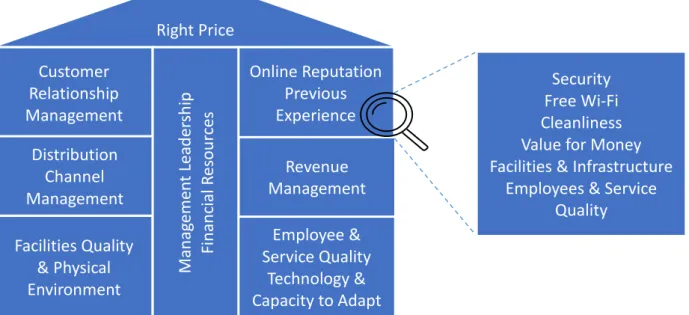
possible to access before a first experience in the hotel, but that are very important when choosing an hotel room. These characteristics can be resumed in: Cleanliness, Comfort, Staff & Service, Infrastructure, Facilities, Value for Money and Free Wi-Fi.
The transparency and the credibility aligned with the easiness of reaching an enormous quantity of guests through these platforms increases their importance and role in the hotel customers decision-making process. This is reflected in the need of managing hotel’s Online Reputation and it increases the responsibility of being in the top of its game all the time (Eye for Travel 2016).
Besides the characteristics available in other travellers’ reviews, there are factors that already played a crucial role before "social media word-of-mouth" and they are still taken into consideration: Price, Location, Previous Experience, Brand Reputation and Security.
Supply
It is important to highlight that although critical success factors are specific to each company, Melia (2011) was able to identify some commonalities in the hotel supply side: the quality of the hotel infrastructures and its facilities, the location, the offered services and the employees quality.
Maintain and enhance cleanliness is also a manager’s job through the continuous improvement of the hotel’s facilities and furniture (Lee and Lee 2015). Offering a comfortable hotel with the right and updated facilities will keep the hotel on the top of consumers’ bundle of choices, which adds significance to the infrastructure quality and physical environment/ambiance. Human resources represent one of the greatest costs in hotels (Enz 2010) and that happens because employees are a crucial asset in what concerns hotel management. They are the ultimate responsible for providing a quality service and for making every guest experience a memorable one throughout the different interactions. For that reason, it is important to assure employee quality through training, employee empowerment and guaranteeing employee
satisfaction by recognizing and rewarding accordingly. Although it represents higher costs, the return can be enormous: more efficient processes, lower employee turnover, better service, more satisfied employees and with all that, more satisfied customers.
Kandampully (2006) recognized the hard job it is to access customer desires for that reason customer relationship management is a tool that cannot be dismissed to guarantee a successful guest care.
A constant monitoring of the customer needs and how they are being addressed and satisfied improves the company ability to forecast demand variabilities and prepare accordingly, which reflects the hotel capacity to innovate, an important factor of hospitality competitiveness (Ioncica et al. 2007).
Besides the ability to be better prepared to serve demand, an updated available technology makes the hotel more efficient and responsive to customer wishes. For instance, air conditioning is considered a must have for 63% of travellers and in-room Wi-Fi for 46% (TripAdvisor 2015). As stated by Horwath (HTL 2016), online reputation is now deeply influencing business and leisure travellers’ decisions and so a strategic online reputation management “is of utmost importance” to retain and attract guests. Hotels have already understood this and the fact that online reputation management occupies, in general, the first position in hotel chains investment priorities reflect that acknowledgment (HTL 2016).
This impact on guests is explained by the fact that they perceive other travellers’ reviews as fair and independent and for that reason credible, so customers trust them more and use it to create expectations on the hotel experience (PWC 2015).
The hotel reputation might not only limit its presence in the selected customer filters but also how much each guest values it, which might then result in a dissatisfied customer for not met expectations or in a decreased price to be accordingly.
In OTAs, where competitors are just “one click away” (Stangl, Inversini, and Schegg 2016), online reputation reinforces its importance. This makes the everyday changing distribution environment quite a challenge for the hospitality industry.
An accurate management of distribution channels throughout the right diversification (Berezina et al. 2016) is important to optimize the relation between costs and the awareness that distribution channels allow. E-commerce represents an interesting source of sales but at a high cost – “Duetto3 recorded customer acquisition costs as high as 40%” (Sunny 2016). An accurate management of distribution channels – online and offline – is key to balance Revenue Per Available Room (RevPAR) and occupation levels (Ling et al. 2015). According to Sunny (2016), it is essential to disclose the real cost of each channel so the hotels can select the right composition for their distribution.
An efficient distribution channel management is part of an effective revenue management. Among the different definitions of revenue management, Mehrotra and Ruttley (2006) selected the following: “making the right room available for the right guest and the right price at the right time via the right distribution channel.” In a service industry as hospitality, a lost sale is a lost revenue, so inventory management becomes a plus. To sell the right room to the right guest, it must be available in the right distribution channel and that implies both on-time synchronization and the right number of available rooms in every channel. A strategic revenue and inventory management is now crucial to maximize the hotel revenue ((Croes and Semrad 2012), (Desiraju and Shugan 1999), (Kimes 1989)).
To answer the current demand expectations, hotels need to be more prepared than ever. Managers have to assure the quality of the hotel facilities as well as the human resources quality and the services they provide. Given the high customer acquisition costs, customer relationship management is a must, together with online reputation management, distribution channel
management and revenue management. To guarantee that all these aspects can be successfully implemented and maintained, the hotel needs to have (or to have access to) financial resources, which makes itself an important factor in the competitive framework. Last but not least, behind all these characteristics, it is imperative to have a good management leadership, that can recognize the importance of every factor, that will position them in the right place and is able to define and redefine strategic objectives, according to the market constant changes (Tsai, Song, and Wong 2009), (Brown and Dev 1999), (Morey and Dittman 1995)).
Lisbon: The Portuguese Capital Tourism Overview
In 2015, 609 million tourists arrived Europe (51% of the world international tourist arrivals) and it is expected that tourist arrivals continue to grow by 3.5%-4.5% in 2016 (World Tourism Organization 2016).
In 2015, Travel and Tourism activities were directly responsible for 6.4%4of the Portuguese Gross Domestic Product (GDP). It is expected that this contribution rises 3.6% in 2016 and then
4Direct Contribution to GDP: Gross Domestic Product created by industries that trade directly with tourists
(transportation, accommodation, intermediaries such as travel agents, and restaurants) Right Price Online Reputation Previous Experience Customer Relationship Management Employee & Service Quality Technology & Capacity to Adapt Facilities Quality & Physical Environment Revenue Management Distribution Channel Management M an ag eme n t Lea d er sh ip Fin an cial R eso u rc es Security Free Wi-Fi Cleanliness Value for Money Facilities & Infrastructure
Employees & Service Quality
2.2% pa until 2026, where it would represent 7.3% of the Portuguese GDP. The total contribution5 of Travel and Tourism to GDP was 16.4% in 2015 and it is expected to rise 1.9% pa so it reaches 18% of GDP. Until 2026, it is forecasted that the international visitors’ expenditure grow 2.5% pa. (World Travel & Tourism Council, 2016)
Lisbon Metropolitan Area (LMA) recorded 12 294 150 overnights in 2015. In the last 10 years (2005-2015), the total LMA revenue increased 74%, and the LMA overnights increased 69%. (INE 2015).
According to INE, June 2016 was the best June ever for tourism: an increase of 10.3% in hotel guests and 9.6% in overnight stays, compared to June 2015. The hotel revenue reflected these values, with an increase of 15.5% in accommodation income. The five-star hotels enjoyed an year-on-year increase of 9.9% and its RevPAR increased 6.9% (from 95.70€ to 102.20€). There are no doubts that Portugal is enjoying an amazing time as an European wished destination. In the last 10 years, the weight of tourists who travelled to Portugal and stayed in Lisbon increased by 26%. In the first semester of 2016, Lisbon hosted 27% of the tourists who visited Portugal (INE 2016).
When comparing the first semester of 2015 and 2016, the room occupation in Lisbon had slightly decreased (-0.8%), but the Average Daily Return (ADR) increased 5.4% and the RevPAR increased 4.6%. The five-star hotels enjoyed the same directions but faced a more severe decrease in occupancy rates (-2.18%) and an increase of 6.27% in ADR and 3.94% in RevPAR (INE 2016).
The future seems bright for Lisbon as a tourist destination: the current travel trends, the recent results and all the available forecasts support that believe: according to PWC, Lisbon hotels occupancy is expected to grow 1.4% in 2016 and 2.2% in 2017 (PWC, 2015). Also interesting is the expected growth of ADR (4.7% in 2017) and of RevPAR (6.9% in 2017) (PWC, 2015).
5Total Contribution to GDP: GDP generated through direct, indirect and induced contribution (World Travel &
Demand is expected to continue growing: Lisbon will be hosting Web Summit in 2017 and 2018; it is expected that the business travel spending rises about 6% in 2017 in Western Europe. On top of these, the program Portugal 2020 is also expected to stimulate demand as a result of the increased investment in tourism destination promotion.
The supply side has been showing to be ready to fulfil the increase in demand: there are 10 new airline companies operating in Lisbon airport in 2016 compared with the previous year until June 2016, the airport of Lisbon registed 9 756 600 passengers; and the city is expected to have more 2000 hotel beds until 2018.
Source Markets
In 2014, international tourists represented 75.9% of the Lisbon demand. Spain, France, Brazil, Germany and The United Kingdom represent Lisbon top markets. Portuguese tourists are responsible for 24.1% of the total overnights, followed by the Spanish market (10.1%). Brazil origin tourists had the greatest growth and in 2014, being responsible for 7.2% of the overnights. In the first semester of 2016, UK origin tourists were responsible for 18.3% of the tourism revenue, France (15.5%), Spain (13.2%), Germany (12%), the Netherlands (4.9%), which means that European Union guests represent 68.4% of the Portuguese Tourism revenues. The 6th position is occupied by USA (4.7%) and with an interesting growing trend (+12%). Then Brazil responsible for 3.5% of the tourism revenue but with a negative growth trend (-9.9%) (aicep Portugal Global, 2016). The Lisbon M.A. top markets in the first semester of 2016 are slightly different from the Portuguese one: Portugal occupies the first position (24%), followed by France (13.4%), Spain (12.4%), Germany (9.2%), UK (7.6%) and Brazil (7.4%).
Dom Pedro Palace
Dom Pedro Palace is the Lisbon hotel of Dom Pedro Hotels group. It is a 5-star hotel located in the Amoreiras area and it has 263 rooms. The hotel is opened since 1998. At that time, the hotel location was considered central and it had no sufficient rooms to answer the enormous MICE
(Meetings, Incentives, Conferences, Exhibitions) demand. It was considered one of the Lisbon’s greatest hotels.
Nowadays, the market where Dom Pedro Palace is competing has changed and the hotel is suffering and struggling to adapt itself to its differences. This new market framework faces, not only new customers’ concerns, but also new and/or renovated hotels, that are more prepared to satisfy these different customer needs.
Financial Analysis
If Dom Pedro Palace was analysed as an isolated company, one might consider it as regular performer. Since 2014, the occupancy rate had decreased slightly (-1.26%), but both ADR and RevPAR had increased about 25%.
Besides the interesting growth rates, all the three most important hotel performance indicators remain quite below the Lisbon market average. In 2015, Dom Pedro Palace had an ADR of 90.61€, while the average of Lisbon 5-Star Hotels was 132.60€. The same happened with RevPAR: 49.70€ for Dom Pedro and 91.10€ for Lisbon 5-Start Hotels. Unfortunately, the difference in prices did not result in higher occupancy rates. Dom Pedro Palace had less than 10% of occupancy levels, when compared with other Lisbon 5-Star hotels.
When comparing the first semester of 2016 with the same period of 2015, Dom Pedro Palace results were still quite below the market: when benchmarking, it was verified that the hotel had about less 15% of occupancy rate, less 25% of ADR and about 37% less RevPAR than its regular 5-Star competitors, for the abovementioned period.
During the analysed period (January 2014 – June 2016), the hotel has been facing a similar behaviour in what regards seasonality: the winter months (January, February, and December) face low occupancy rates, which leads to lower ADR and consequently lower RevPAR. On top of these, it is also a point of remark the fact that the company is facing losses during low season. Part of those losses can be explained by the huge amount of fixed costs that the
hotel has: no matter the season, the hotel costs are always between 400 thousand and 600 thousand euros, while revenues go from 277 thousand to almost 900 thousand euros.
The Human Resources department is currently a challenge for Dom Pedro Palace. In an industry where service plays such an important role, employees are the face of that excellence service. Besides their own capabilities, the service performance is also dependent on their ability to assume and behave within the hotel culture. That is only possible if an employee feels himself as part of the company, which is something hard to achieve if the hotel employee annual turnover is as high as in Dom Pedro (46.93%). Besides the recruitment and training costs associated with high employee turnover rates, the hotel also faces the risk of downgrading service quality. It’s imperative to understand the reasons behind this constant employee turnover. The hotel does not have upward staff communication channels and, for that reason, it is harder to find what are the challenges that employees face every day. Without that knowledge it is not possible to empower them with tools that increase their autonomy and contribution in decision making. The hotel also lacks employees’ incentives management which means that there is no mechanism to value and reward their effort. The application of these and similar actions can increase employee satisfaction, improve the service quality as well as drive employee turnover down.
There is no doubt that guests consider the staff a valuable part of their accommodation (8.6/10 in Booking.com), however guests evaluated the neighbour hotel (Epic Sana) with 9.3. Against the Dom Pedro Palace staff performance is also the fact that Epic has 5 times more reviews. A possible justification for not excelling in this category can be the hours of training – Dom Pedro Palace trained its 134 employees for 604.5h in the first nine months of 2016 which was mainly directed to administrative collaborators. Worth of remarking is also the fact that none of the training activities was focused in the service quality values. Obviously, the training is given, but informally, which results in a non-standardize basic training.
Competition Analysis
OTA insight allows the price comparison of Dom Pedro Palace with nine 5-star hotels that were considered by the hotel as its main competitors. However, to have a more accurate and restrict set of competitors hereafter the hotels defined as Dom Pedro Palace main competitors will only be part of those nine: Epic Sana, InterContinental, Corinthia, Altis Grand Hotel and Tivoli. Regarding these competitors, Dom Pedro Palace has been offering the lowest rates for about one year and a half6.
Epic Sana is the more recent competitor, but it represents an enormous treat: it is located right next to Dom Pedro Palace, offering its guests modern facilities – 311 rooms and 14 meeting rooms whose capacity goes up to 1000 guests. Dom Pedro Palace available resources for Meetings and Incentives lost competitiveness throughout time: as Epic Sana, other hotels are nowadays offering more prepared, updated and convenient meeting facilities, both in terms of capacity and in equipment and materials perceived quality.
When comparing the online reputation of Dom Pedro Palace with its competitors, the conclusions are quite similar: only Altis Grand Hotel is positioned below Dom Pedro Palace in this rating, now led by Epic Sana. Another interesting point has to deal with the amount of reviews that each hotel captures: as expected Corinthia (since it is the biggest one: 518 rooms) is the hotel with more reviews, both on Booking.com and on TripAdvisor, while Dom Pedro Palace and Altis Grand Hotel are the less reviewed ones.
Epic Sana Lisboa Hotel opened in 2013, Altis Grand Hotel was under a master renovation between 2011 and 2015, Tivoli Lisbon and Intercontinental Lisbon are currently going under extensive renovation processes and Corinthia has already announced its full renovation intention. These five hotels are an exact sample of what is happening in the hotel market: Lisbon 5-star hotels are enjoying a clean and new image in the market, which is explained both by the
opening of several new hotels in the last years and by the fact that several hotels in Lisbon have been renovating their infrastructure and their facilities (with different degrees of intervention). The customers and business partners7 perception of Dom Pedro Palace as a Lisbon 5-Star hotel is not correspondent to that, and it seems to be damaging its brand image, forcing the hotel to compete in prices – a harmful practice – that can be understood as a sign of relative lower quality.
During 4 years, Altis Grand Hotel went under a major renovation - a total investment of €7 million - resulting in an increase of 19% in sales, partly justified by the investment in the facilities to address the MICE segment, which was possible due to meeting rooms’ full renovation. Comparing the first trimester of 2015 with the same period of 2014, Altis Grand Hotel recorded a sales growth of 32%, the ADR increased 17% and the MICE segment grew 46% in sales volume. Its RevPAR rose 22% while its competitors rose 15%8. Tivoli Lisboa is going to be renovated under an expected cost of around €15 million. Intercontinental Lisbon invested recently almost €2.5 million in public areas renovation and now expects to renovate its rooms.
Customer Analysis
Dom Pedro Palace customer profile can be described as a middle age guest who choose the hotel both for leisure and for business; the usual visitor enjoys classic style and he comes mainly from Brazil, France, Portugal and USA (in 2015 and in the 1st semester of 2016 these were the origins of about 50% of the guests).
From January 2015 to June 2016, 68% of Dom Pedro Palace revenue in accommodation came from offline and online distribution channels. Within the direct sales, companies were the main customers, either for groups or individuals. It is also worth remarking that the sales in the Dom
7 Travel agents, meeting planners…
Pedro website accounted for less than 1% of revenue, while the sales through OTAs were responsible for 20% of total revenue. Meaning that there are customers available to buy online, but either they do not look for the Dom Pedro website after acknowledge the hotel existence, or they do not perceive any advantage in booking directly with the hotel instead of booking in an OTA. In the specific case of online sales, it is always preferable to sell rooms directly given the high charges that the hotel has to pay to OTAs. That is reason enough for investing in the hotel website promotion by offering advantages for booking directly that are easily perceived by the customer when he visits the company website. The hotel can also use the stay at Dom Pedro Palace to remember the guests of the all amazing benefits in booking directly in their next stay – adds in the hotel elevators, cards inviting the guest to meet the website…
Groups are a very interesting and important segment for Dom Pedro Palace, representing 32% of revenues. Groups are in Lisbon either for Leisure or for Business – these lasts are given a specific terminology, MICE. According to the Sales Director, historically, MICE segment was the strongest one, responsible for about 50% of total revenue. The market changed and nowadays its weight has decreased significantly and faces rather a low level of conversion9- fact that can be explained both by the increased offer of 5-star hotels in Lisbon and by the decreased demand for 5-star hotels due to new booking rules adopted by some economic sectors most prominent corporate players after the 2008 crisis.
MICE is a specially desired segment because it leads to higher revenue per guest: besides accommodation, this segment also requests renting rooms, coffee breaks, meals… The Leisure segment, whose weight increased, not only does not value the same facilities (for which the hotel was not set up), but it is also a more price sensitive segment.
In 2015, the main customer of Dom Pedro Palace was the Portuguese market (20%), closely followed by the Brazilian (18%). Another interesting presence was the French market with 13% of occupancy rate. In the last year, Europe represented, on average, 50% of the hotel’s sales. That is not the reality of Dom Pedro Palace competitors. The abovementioned Lisbon market sources show a different nationalities’ mix. On top of this, it is worth highlight the considerable amount of Scandinavian and British reviews on TripAdvisor, that are not present in any equivalent fraction in Dom Pedro Palace reviews. That can be explained by several facts: the hotel is not distributed by the local travel agents, the Dom Pedro Palace online reputation is not as impressive as its competitors, the facilities offered do not answer their needs or they do not identify with hotel identity. Since they represent an interesting segment for the hotel, it seems reasonable to understand their needs and have them in mind when renovating the infrastructure so they can be reached.
Is it the right time to renovate?
Portugal’s GDP is expected to growth 1.5% in 2016 and 1.7% in 2017. European Union countries are also expected to growth 1.8% in 2016 and 1.9% in 2017. This growth is explained by an increase in private consumption expenditure, supported by the rise of the disposable income as well as by the decrease of unemployment; is also supported by the low oil prices, by the low Euro exchange rates and by the low financial costs that stimulate investments and decrease companies’ costs (European Economic Forecast, Spring 2016).
All these factors support the belief that the economy is starting to recover from the 2008 financial crisis, consumers are recovering their purchasing power and Travel and Tourism industry is already profiting with that and, all the reports previously referred forecast interesting growth levels for the hospitality sector. On the other hand, the increased number of new and/or renovated hotels available in Lisbon, intensify the need of renovating Dom Pedro Palace, so it can compete without decreasing its ADR.
Given all these factors, the current moment is the perfect timing to invest in the hotel’s renovation, in order to be itself fully recovered to accommodate the future guests, who are now refining their financial situation.
Several studies demonstrated that post renovated hotels enjoy a premium in RevPAR growth (Colliers International 2014) after the first year. The impact of such effect depends heavily on the city. Given the impact on revenue of Altis Grand Hotel master renovation, Lisbon is a destination that offers an interesting return after renovation.
On top of the abovementioned tailwind factors, it is also worth of remark, the investment in the promotion of Lisbon as a “premium” touristic destination. So, there is enough evidence to withstand the confidence of interesting growth rates both on Lisbon touristic demand and for a premium growth of a post-renovated hotel.
Renovation Options
Dom Pedro Palace is studying and discussing a renovation plan, to restore its competitive profile, whose performance have been declining within the new Lisbon market hotel competitive environment. This renovation must be done after a clear definition of which segments the hotel wants to serve and respond, so that the changes are done accordingly. The usual segmentation in the hotel industry concerns the travel purpose: Business or Leisure. Dom Pedro Palace determination will continue to be serving both segments, taking advantage of the spare capacity for which each segment is responsible during specific days, in order to maximize the capacity utilization and, consequently, the total revenue.
The business sector itself has different needs within their accommodation objective. If, in case of holding a conference in the hotel itself, the meeting rooms have a crucial role; for individual business travellers, the biggest value remains in the room itself. Several items are considered critical: fast and free Wi-Fi, well located plugs, work desk and laundry facilities. ((Hoang 2014), (Hotel Genious 2015), (Patel 2015)).
Although increasingly business travellers end up being also leisure tourists, the pure leisure segment is especially concerned with great room views, the existence of a spa and wellness centre and other recreational facilities, such as swimming pool, health club, bar... ((Hoang 2014) (Hotel Genious 2015)).
The differences among nationalities can also be an interesting point to reflect about. It is quite curious to see, for instance, that air-conditioning is a must have for 70% of Americans, only 39% of French tourists consider it important (TripAdvisor, 2015).
Revising Dom Pedro Palace online reviews, it is possible to understand that the mainly missed things are free Wi-Fi in the whole hotel, some room equipment as kettles and iron and ironing board. On top of these, some guests’ complaint about “strange smells” and air conditioning functioning.
Hypothesis 1
The minor renovation concerns only the renewal of rooms’ soft goods: new carpets, the application of vinyl on walls, new curtains, new bed sheets and some small decoration appointment changes (lighting, paintings and all the textiles with the current room colour). It is possible to operate this renovation without damaging the guests’ experience by closing the upper and lower floor.
The estimated investment for this option would be 5 000€ per room. If the renovation is extended to corridors (which is recommended), this value will increase 2 000€ per room. The total amount of this renovation option will then be € 1 834 000. This option is expected to generate an increase of 10% in occupancy rates and an increase of 15% in RevPAR. That will result in a ROI of 3%.10
This investment hypothesis will allow the hotel to present a fresher and newer image, resulting both on increased demand and increased ADR, which then turns into higher RevPAR. The
increased demand is expected to be sustained by individual leisure and business guests and by leisure groups.
Hypothesis 2
The second option would represent a bigger investment since it would include – besides the minor renovation – bathroom structural changes and upgrading of materials offered in corner rooms that are located between the 15th and 19th floor, converting them into a special type of
suite. Another important concern of these option is to prepare rooms for guests with some physical limitation, as walk-in showers and grab rails – besides legal obligations of offering accessible rooms, a very interesting leisure segment would benefit from this changes: Baby Boomers. This transformation will be considered in the corner rooms renovation.
Within this hypothesis, meeting rooms would also be renovated: curtains, carpets, paintings and wall paintings. On top of these, chairs and tablecloth will be changed. It is also considered here the Wi-Fi and Air Conditioned improvement.
This option represents an estimated total investment of 2 227 000€, representing 8 500€ per room. This hypothesis will not have any audio-visual investment, being the best option to keep on outsourcing the usage of these products and services since the revenue that resulted from the utilization of meeting rooms in 2015 represented about 19% of the hotel revenue. Although it is an interesting source of revenues the fact that 68% of revenues came from accommodation11 seems reason enough to focus the hotel effort in what it is specialist: accommodating guests, leaving the other supporting activities to outsourced companies.
This option is expected to increase occupation in 15% and RevPAR in 17%, supported by – on top of the abovementioned reasons for option 1 – the recovery of meetings demand. Its ROI is expected to be 10%12.
11 Interestingly of notice is that the percentage of profit generated by accommodation increases its importance to
87% of the hotel gross profit
Hypothesis 3
Finally, the master renovation option would comprehend, besides the abovementioned changes, the renovation of public areas as the lobby, its adjacent rooms, and the restaurant. The investment would increase to 3 727 000€. The investment per room would be 14 225.19€. This option will ask for more logistical adjustments since part of it is performed in public areas – and that is a balance that has to be made: should the hotel close during that time or adapt its operations?
It is considered an increase of 20% in room occupancy and 20% in RevPAR. The ROI is expected to be 2%.13
Limitations and further research suggestion
As mentioned by Ioncica (et al, 2007), in the tourism industry the very first competition is between destinations. The one where a specific hotel belongs limits for itself internal decisions as the price charged or the type of product it offers. However, the aim of this project is to approach the micro competitiveness of each firm within a city capital context. So, although the destination competitiveness does have a role within the hotels’ competitiveness, it is not taken into consideration.
The same happens with the location within the destination. Location is considered a top concern in the decision-making process. Though the hotel cannot be moved once it is built, the relative location can change throughout the years. However, none of them can be changed once a hotel opens, so it is not considered in the competitive framework.
The hotel uniformed system of accounts does not allow an accurate distinction between leisure and business clients and, for that reason, that type of segmentation was not analysed. For that same reason, in financial analysis only data from 2015 and 2016 was analysed.
Conclusion and Final Recommendations
There are characteristics that guests look for when selecting the accommodation. Hotels should understand them and work to find the better mechanisms to offer what is asked. That is the aim of this competitive framework: match and align supply and demand.
Dom Pedro Palace is facing some difficulties within the current competitive environment and to keep up with its competitors offer. For that reason, the hotel is currently looking at renovation hypothesis. Independently of the chosen one, the company must remember that it is crucial to update the hotel image to guarantee that it is positioned where it wants to be. The renovation process has the potential to reposition the hotel. The idea of an old hotel would no longer exist, opening space for a classic but updated facility. However, that will heavily depend on selecting the right marketing strategy to show that change.
Hypothesis 2 is the recommended renovation project since it has the higher ROI.
The hotel should also consider the possibility of outsourcing the spa services given its high costs. The creation of a partnership with recognized players in the health lifestyle market (such as Holmes Place) would create the possibility of offering a personal trainer or a physician: answering the needs of customers who care about their well-being.
There are some interesting trends that can easily be exploited by Dom Pedro Palace: brunches and rooftops are examples of that. And the exciting part is that they can be exploited together! The hotel does not enjoy a rooftop but, on the other hand, it has an amazing terrace that is part of its restaurant - which is closed at weekend. That said, the terrace could be opened at the weekend morning to serve brunches (or late breakfast as an exclusive advantage of a specific type of tariff, as a gift for those who booked directly with the hotel or for those who stay more than 5 days… the possibilities are limitless!).
At nights, the terrace could be open with special events valued by tourists and business guests: small concerts, movie exhibitions or some wine taste event.
These two projects are an opportunity to engage guests and to attract external customers - driving demand upwards and increasing the word of mouth marketing.
Another detail that makes sense is having a complementary bottle of water when customer arrives as well as offering him some hotel merchandising that he would want to keep because it is fun or simply different.
A current trend that can easily be introduced is the offer of an alternative breakfast: special types of milk, bread without gluten…
Still regarding the customer experience, it would be a stimulating marketing tool to ask guests their emails and birthdays in order to send an email congratulating them and offering some discount in their next stay at Dom Pedro Hotels. By doing so, the company is not only creating a connection with its guests but also stimulating demand.
Another possibility would be the utilization of meeting rooms during low season for exhibitions; changing the concept of the customer’s smoking room using the same idea of art exhibitions, for example.
Finally, it is important to implement an employee feedback system to understand their needs and challenges so they can train the right competences. Some of the abovementioned recommendations were based on Dom Pedro Palace employees’ suggestions which just proves their value and the importance of hearing what they have to say about the hotel.
References
Abdullah, Abdul Aziz, and Mohd Hairil Hamdan. 2012. “Internal Success Factor of Hotel Occupancy Rate.” International Journal of Business and Social Science 3 (22): 199–218. Ahey, Julian K., Daniel Leung, Norman Au, and Rob Law. 2012. “Perceptions and Strategies of Hospitality and Tourism Practitioners on Social Media: An Exploratory Study.” Berezina, Katerina, Kelly J. Semrad, Svetlana Stepchenkova, and Cihan Cobanoglu. 2016. “The Managerial Flash Sales Dash: Is There Advantage or Disadvantage at the Finish
Line?” International Journal of Hospitality Management 54. Elsevier Ltd: 12–24. doi:10.1016/j.ijhm.2016.01.003.
Brown, James R, and Chekitan Dev. 1999. “Looking Beyond RevPAR: Productivity Consequences of Hotel Strategies.” Cornell Hotel and Restaurant Administration Quarterly 40 (2): 23–33. doi:10.1177/001088049904000213.
CNN. 2010. “Consumer Connect on Travel & Tourism.”
Colliers International. 2014. “Middle East Hotel Asset Management Managing the Asset Life Cycle.”
Croes, Robertico, and Kelly J. Semrad. 2012. “Discounting Works in the Hotel Industry: A Structural Approach to Understanding Why.” Tourism Economics 18 (4): 769–79. doi:10.5367/te.2012.0138.
Desiraju, Ramarao, and Steven M Shugan. 1999. “Strategic Service Pricing and Yield Management.” Journal of Marketing 63 (January): 44–56. doi:10.2307/1252000.
Dunne, Gerard, Sheila Flanagan, and Joan Buckley. 2010. “Towards an Understanding of International City Break Travel.” International Journal of Tourism Research, 409–17.
Enz, Cathy A. 2010. Hospitality Strategic Management - Concepts and Cases. Edited by Inc. John Wiley & Sons. Second. John Wiley & Sons, Inc.
Eye for Travel. 2016. “Smart Analytics: Identify , Track and Target the Modern Digital Consumer Effectively Research and Analysis into Online Consumer Behaviors and Best Marketing Analysis Smart Analytics : Identify , Track and Target the Modern Digital Consumer Effectively.”
Fawzy, Ahmed. 2010. “Business Travelers’ Accommodation Selection: A Comparative Study of Two International Hotels in Cairo.” International Journal of Hospitality & Tourism
Administration 11 (2): 138–56. doi:10.1080/15256481003732790.
Hassanien, Ahmed, and Tom Baum. 2002. “Hotel Innovation Through Property Renovation.” International Journal of Hospitality & Tourism Administration 3 (4): 5–24.
doi:10.1300/J149v03n01.
Hoang, Aileen. 2014. “Understanding the Differences Between Business and Leisure Travelers.” E-Marketing Associates. http://www.e-marketingassociates.com/understanding-differences-business-vs-leisure-travelers/.
Hotel Genious. 2015. “Leisure Travelers vs. Business Travelers.” Hotel Genious. https://www.hotelgenius.co/index.php/leisure-travelers-vs-business-travelers/.
Htl, Horwath. 2016. “How Online Reputation Affects Hotel Trading Performance Trading Performance.”
INE. 2015. “Press Release Tourism Tables Excel File.”
INE. 2016. “Atividade Turística Junho de 2016 Dormidas E Proveitos Com Crescimentos Expressivos.”
Ioncica, Maria, Madalina Tala, Catalina Brindusoiu, and Diana Ioncica. 2007. “The Factors of Competitiveness in the Hospitality Industry and the Competitive Strategy of Firms.”
Annals of the University of Oradea, no. 6: 212–18.
JN+A and HVS DESIGN. 2016. “Hotel Cost Estimating Guide.”
Kandampully, Jay. 2006. “The New Customer-Centred Business Model for the Hospitality Industry.” International Journal of Contemporary Hospitality Management 18 (3): 173–87. doi:10.1108/09596110610658599.
Kimes, S. E. 1989. “The Basics of Yield Management.” Cornell Hotel and Restaurant Administration Quarterly 30 (3): 14–19. doi:10.1177/001088048903000309.
Langvinienė, Neringa, and Ingrida Daunoravičiūtė. 2015. “Factors Influencing the Success of Business Model in the Hospitality Service Industry.” Procedia - Social and Behavioral
Lee, Seung Hee, and Hyunsoo Lee. 2015. “The Design of Servicescape Based on Benefit Sought in Hotel Facilities: A Survey Study of Hotel Consumers in Seoul.” Journal of Asian
Architecture and Building Engineering 14 (3): 633–40. doi:10.3130/jaabe.14.633.
Ling, Liuyi, Yufeng Dong, Xiaolong Guo, and Liang Liang. 2015. “Availability Management of Hotel Rooms under Cooperation with Online Travel Agencies.” International
Journal of Hospitality Management 50. Elsevier Ltd: 145–52. doi:10.1016/j.ijhm.2015.07.005. Lombana, Jahir. 2011. “Looking for a Distinctive Model with Which to Analyze Competitiveness.” Advances In Competitiveness Research 19 (3&4): 32–44.
Mehrotra, Ravi, and James Ruttley. 2006. “Revenue Management.”
Melia, Detta. 2011. “Critical Success Factors and Performance Management and Measurement: A Hospitality Context.”
Milohnic, Ines. 2012. “How to Increase the Competitive Advantages of Small Hotels: Measuring the Effects of Public Relations.” International Journal of Economic Perspectives 6 (4): 5–17.
Morey, Richard C., and David A. Dittman. 1995. “Evaluating a Hotel GM’s Performance - A Case Study in Benchmarking.” Cornell Hotel and Restaurant Administration Quarterly 36 (5): 30–35.
Nemec, Helena, and Rudež Ksenija Vodeb. 2015. “Students’ Use of Social Media During the Travel Process.” Tourism and Hospitality Management 21 (2): 179–90. doi:10.20867/thm.21.2.5.
Patel, Rupesh. 2015. “5 Things Business Travelers Want in Their Hotel Rooms.” Linkedin. https://www.linkedin.com/pulse/5-things-business-travelers-want-hotel-rooms-rupesh-patel. PWC. 2017. “European Cities Hotel Forecast for 2016 and 2017.”
Qu, Hailin, Bill Ryan, and Raymond Chu. 2000. “The Importance of Hotel Attributes in Contributing to Travelers’ Satisfaction in the Hong Kong Hotel Industry.” Journal of Quality
Assurance in Hospitality & Tourism 1: 65–83. doi:10.1300/J162v01n03.
Radojevic, Tijana, Nemanja Stanisic, Nenad Stanic, Marko Sarac, Tijana Radojević, Nemanja Stanišić, Nenad Stanić, and Marko Šarac. 2014. “Measuring Customer Satisfaction in the Hospitality Industry: An Empirical Study of the Hotels in the Capital Cities of Europe.” Proceedings of the 1st International Scientific Conference - Sinteza 2014, 788–95. doi:10.15308/sinteza-2014-788-795.
Stangl, Brigitte, Alessandro Inversini, and Roland Schegg. 2016. “Hotels’ Dependency on Online Intermediaries and Their Chosen Distribution Channel Portfolios: Three Country Insights.” International Journal of Hospitality Management 52. Elsevier Ltd: 87–96. doi:10.1016/j.ijhm.2015.09.015.
Sunny, Kiran. 2016. “Distribution vs Profitability – the Future of Hotel Revenue Management.” Hospitality Net.
TripAdvisor. 2015. “TripBarometer - Travel Trends 2016.”
Tsai, Henry, Haiyan Song, and Kevin K. F. Wong. 2009. “Tourism and Hotel Competitiveness Research.” Journal of Travel & Tourism Marketing 26 (5–6): 522–46. doi:10.1080/10548400903163079.
Watkins, Ed. 2003. “How Guests Choose Hotels.” Lodging Hospitality, February.
World Travel & Tourism Council. 2016. “Travel and Tourism: Economic Impact 2016 Portugal.”
World Tourism Organization. 2016. Annual Report 2015.
Yoo, Kyung-Hyan, and Ulrike Gretzel. 2012. “Use and Creation of Social Media by Travellers.” In Social Media in Travel, Tourism and Hospitality, 189–205.
Yoo, Kyung Hyan, and Ulrike Gretzel. 2011. “Influence of Personality on Travel-Related Consumer-Generated Media Creation.” Computers in Human Behavior 27 (2). Elsevier Ltd: 609–21. doi:10.1016/j.chb.2010.05.002.
Appendices
Appendix I – Hypothesis 1 Computations
Hypothesis 1
Investment Expected Return
Rooms Occupation Expected Variation 10%
Wall Treatment € 1,500.00 Total Expected Occupation 65%
Carpets € 1,305.36 Rooms sold (out of 262) 170
Curtains € 418.58 RevPAR Expected Variation 15%
Textiles € 1,000.00 Expected Extra RevPAR € 7.46
Bathroom small changes € 150.00 Extra RevPAR/Night € 1,267.35
SubTotal € 4,373.94 Extra RevPAR/Year € 462,582.75
Adjustments € 600.00 Revenue variation per room € 1,765.58
Room expected investment –
rounded € 5,000.00 Lifetime of renovation 5
Corridors WACC 7%
Wall Treatment € 361,250.00 PV of Extra RevPAR/Year € 1,896,680.61
Carpets € 158,508.00 NPV € 62,680.61
Total Corridors € 519,758.00 ROI 3%
Corridors Cost/Room € 1,983.81
Total Cost Hypothesis 1
(Rooms + Corridors rounded) € 7,000.00
Total € 1,834,000.00 Table 1 𝑷𝑽 (𝑯𝟏) =𝐼𝑛𝑐𝑟𝑒𝑚𝑒𝑛𝑡𝑎𝑙 𝑅𝑒𝑣𝑃𝐴𝑅 𝑊𝐴𝐶𝐶 × [1 − ( 1 1 + 𝑊𝐴𝐶𝐶) 𝐿𝑖𝑓𝑒𝑡𝑖𝑚𝑒 ] = € 462,582.75 0.07 × [1 − ( 1 1 + 0.07) 5 ] = € 𝟏, 𝟖𝟗𝟔, 𝟔𝟖𝟎. 𝟔𝟏 (1) 𝑅𝑂𝐼 =𝑃𝑉(𝐸𝑥𝑝𝑒𝑐𝑡𝑒𝑑 𝑅𝑒𝑡𝑢𝑟𝑛) − 𝐸𝑥𝑝𝑒𝑐𝑡𝑒𝑑 𝐼𝑛𝑣𝑒𝑠𝑡𝑚𝑒𝑛𝑡 𝐸𝑥𝑝𝑒𝑐𝑡𝑒𝑑 𝐼𝑛𝑣𝑒𝑠𝑡𝑚𝑒𝑛𝑡 𝑹𝑶𝑰 𝑯𝟏 = 1,869,680.61 − 1,834,000.00 1,834,000.00 = 0.034 ≃ 𝟑% (2)
Appendix II – Hypothesis 2 Computations
Hypothesis 2
Investment Expected Return
H1 Investment € 7,000.00 Occupation Expected Variation 15%
Total H1 Investment € 1,834,000.00 Total Expected Occupation 70%
Meeting Room - 16 meeting rooms Rooms sold (out of 262) 183
Chairs € 108,000.00 RevPAR Expected Variation 17%
Carpets € 91,608.30 Expected Extra RevPAR € 8.45
Textiles (Tables) € 16,000.00 Extra RevPAR/Night € 1,546.17
Curtains (average/room) € 1,000.00 Extra RevPAR/Year € 564,350.96
Decoration appointments € 1,000.00 RevPAR Variation from H1 to
H2/Year € 101,768.21
Decoration & Curtains € 32,000.00 Revenue variation/room € 26,663,269.71
Total Meeting Rooms Cost € 247,608.30 Lifetime of renovation 7
Meeting Rooms
investment/Bedroom € 945.07 WACC 7%
Meeting Rooms Rounded € 1,000.00 PV of Extra RevPAR/Year
just H2 € 548,458.31
Corner Rooms Upgrade - 19 rooms
Changing Bathroom Costs € 3,500.00 PV H1+H2 € 2,445,138.91
Extra budget for details € 1,000.00 PV H1+H2/room € 9,332.59
Total Cost Upgrade corner € 85,500.00 ROI 10%
Upgrade corner/all rooms € 326.34
H2 Incremental Costs/room € 1,326.34 Total H2 Incremental € 333,108.30 Total Hypothesis 2 (+H1) € 2,167,108.30 H1+H2 Cost/Room € 8,271.41 H1 + H2 Cost/Room Rounded € 8,500.00 H2 Incremental Rounded € 393,000.00 Total H1 + H2 Rounded € 2,227,000.00 Table 2 𝑷𝑽 (𝑯𝟐) =𝐼𝑛𝑐𝑟𝑒𝑚𝑒𝑛𝑡𝑎𝑙 𝑅𝑒𝑣𝑃𝐴𝑅 𝐻2 𝑡𝑜 𝐻1 𝑊𝐴𝐶𝐶 × [1 − ( 1 1 + 𝑊𝐴𝐶𝐶) 𝐿𝑖𝑓𝑒𝑡𝑖𝑚𝑒 ] + 𝑃𝑉(𝐻1) = € 101,768.21 0.07 × [1 − ( 1 1 + 0.07) 7 ] + 1,896,680.61 = € 𝟐, 𝟒𝟒𝟓, 𝟏𝟑𝟖. 𝟗𝟏 (3) 𝑹𝑶𝑰 𝑯𝟐 = 2,445,138.91 − 2,227,000.00 2,227,000.00 = 0.098 ≃ 𝟏𝟎% (4)
Appendix III – Hypothesis 3 Computations
Hypothesis 3
Investment Expected Return
H2 Investment/room € 8,500.00 Occupation Expected Variation 20%
Total H2 Investment € 2,227,000.00 Total Expected Occupation 75%
Public areas € 1,500,000.00 Rooms sold (out of 262) 197
Total H3 Investment € 3,727,000.00 RevPAR Expected Variation 20%
H3 Investment/room € 14,225.19 Expected Extra RevPAR € 9.94
Extra RevPAR/Night € 1,958.18
Extra RevPAR/Year € 714,735.70
RevPAR Variation from H2 to
H3/Year € 150,384.75
Revenue variation per room € 39,400,803.19
Lifetime of renovation 15 WACC 7% PV of Extra RevPAR/Year just H3 € 1,369,691.33 PV H1 + H2 + H3 € 3,814,830.24 PV H1 + H2 + H3/Room € 14,560.42 ROI 2% Table 3
The Technical Director indicated some exact costs, since the hotel had already asked for some budgets, while others were based on estimated costs based on his experience. The textiles item concerns bedsheets and decoration appointments on chairs and bed. The final values are rounded to account for some other costs such as Wi-Fi and the air conditioning functioning improvement and the design project.
𝑷𝑽 (𝑯𝟑) =𝐼𝑛𝑐𝑟𝑒𝑚𝑒𝑛𝑡𝑎𝑙 𝑅𝑒𝑣𝑃𝐴𝑅 𝐻3 𝑡𝑜 𝐻2 𝑊𝐴𝐶𝐶 × [1 − ( 1 1 + 𝑊𝐴𝐶𝐶) 𝐿𝑖𝑓𝑒𝑡𝑖𝑚𝑒 ] + 𝑃𝑉(𝐻2) = € 150,384.75 0.07 × [1 − ( 1 1 + 0.07) 15 ] + 2,445,138.91 = € 𝟑, 𝟖𝟏𝟒, 𝟖𝟑𝟎. 𝟐𝟒 (5) 𝑹𝑶𝑰 𝑯𝟑 = 3,814,830.24 − 3,727,000.00 3,727,000.00 = 0.023 ≃ 𝟐% (6)