Flow-through solid-phase based optical sensor for the multisyringe
flow injection trace determination of orthophosphate in
waters with chemiluminescence detection
夽
Inˆes P.A. Morais
a, Manuel Miró
b, Matias Manera
b, José Manuel Estela
b,
V´ıctor Cerdà
b, M. Renata S. Souto
a, António O.S.S. Rangel
a,∗aEscola Superior de Biotecnologia, Universidade Católica Portuguesa, R. Dr. António Bernardino de Almeida, 4200-072 Porto, Portugal bDepartment of Chemistry, Faculty of Sciences, University of the Balearic Islands, Carretera de Valldemossa Km 7.5, 07122 Palma de Mallorca, Spain
Abstract
In this work, a novel flow-through solid-phase based chemiluminescence (CL) optical sensor is described for the trace determination of orthophosphate in waters exploiting the multisyringe flow injection analysis (MSFIA) concept with multicommutation. The proposed time-based injection flow system relies upon the in-line derivatisation of the analyte with ammonium molybdate in the presence of vanadate, and the transient immobilisation of the resulting heteropolyacid in a N-vinylpyrrolidone/divinylbenzene copolymer packed spiral shape flow-through cell located in front of the window of a photomultiplier tube. The simultaneous injection of well-defined slugs of luminol in alkaline medium and methanol solution towards the packed reactor is afterwards performed by proper switching of the solenoid valves. Then, the light emission from the luminol oxidation by the oxidant species retained onto the sorbent material is readily detected. At the same time, the generated molybdenum-blue compound is eluted by the minute amount of injected methanol, rendering the system prepared for a new measuring cycle. Therefore, the devised sensor enables the integration of the solid-phase CL reaction with elution and detection of the emitted light without the typical drawbacks of the molybdenum-blue based spectrophotometric procedures regarding the excess of molybdate anion, which causes high background signals due to its self-reduction. The noteworthy features of the developed CL–MSFIA system are the feasibility to accommodate reactions with different pH requirements and the ability to determine trace levels of orthophosphate in high silicate content samples (Si/P ratios up to 500). Under the optimised conditions, a dynamic linear range from 5 to 50g P l−1for a 1.8 ml sample, repeatability better than 3.0% and a quantification limit of 4g P l−1were attained. The flowing stream system handles 11 analysis h−1and has been successfully applied to the determination of trace levels of orthophosphate in environmental samples such as mineral, ground, tap and pond waters as well as samples from a water-steam cycle of an incineration plant. The t-test comparison of the means for the developed optical sensor and the molybdenum-blue spectrophotometric APHA/AWWA/WPCF reference method revealed that there is no evidence of significant differences between the obtained results at the 95% confidence level.
Keywords: Multisyringe flow injection analysis; Solid-phase optical sensor; Chemiluminescence; Orthophosphate determination; Waters
Introduction
The analytical interest of chemiluminescence (CL) reac-tions has been increasing over the past years due to its high sensitivity, low detection limits and wide linear range [1].
夽Presented at the Flow Analysis IX Conference, Geelong, Australia,
17–21 February 2003.
∗Corresponding author. Tel.:+351-2-5580064;
fax:+351-22-5090351.
E-mail address: [email protected] (A.O.S.S. Rangel).
Moreover, CL methodologies become an attractive alterna-tive to conventional procedures as can be implemented with straightforward and economical equipment. These features are even maximised if associated with flow systems, whose precise timing enables increased repeatability. Easier sam-ple handling, reduced reagent consumption and improve-ment of analysis throughput are also guaranteed with the exploitation of flow techniques. Multisyringe flow injection
analysis (MSFIA) [2] scheme has been recently proposed
as an evolution to both flow injection (FIA)[3]and sequen-tial injection (SIA) [4]systems. This novel flowing stream _____________________________________________________
principle use a propulsion device named multisyringe which is a multiple channel piston pump, driven by a single motor of an automatic burette and controlled by computer software through a serial port. A three-way solenoid valve, analogous
to those employed in the multicommutation scheme[5], is
connected to the head of each syringe, allowing optional coupling to the manifold lines, both in dispense and
aspi-rate movements of the liquid driver [6]. MSFIA includes
the outstanding features pointed out to sequential and flow injection methodologies, namely robustness, flexibility, low reagent consumption and simultaneous flow of solutions, that enables the mixing of sample and reagents in proper confluence points. The main limitation of this approach is the movement of the four syringes in block; once the dis-pensing volume and the flow rate have been selected for one of the syringes, the values for the others become automat-ically defined and depend exclusively on the syringe size
[7]. Additionally, as the forward movement must be stopped after several operations to reload the syringes the sampling frequency, alike SIA systems, decreases in comparison with FIA assemblies[6], being however sufficient for monitoring purposes.
The interfacing of the MSFIA scheme with CL detection has recently been presented as a powerful combination for
fast CL reactions in homogeneous phase [8] overcoming
the Achilles’ heel of classical FIA and multicommutation approaches related to the ageing of Tygon tubing and the impossibility of other syringe pump-based flowing stream methods, such as SIA, to be adapted to the fast kinetics of the CL reactions involving luminol oxidation.
In this paper, an automated time-based injection CL– MSFIA system relied upon the luminol oxidation by the vanadomolybdophosphate complex immobilised in a spiral-shaped flow cell containing the N-vinylpyrrolidone/ divinylbenzene copolymer is reported for the determination
of orthophosphate at low g l−1 levels in unpolluted
wa-ters. To the best of our knowledge, this is the first CL-based solid-phase flow-through optical sensor devised for the automatic determination of orthophosphate at trace levels. The multicommuted-MSFIA assembly performs the in-line formation of the vanadomolybdophosphate species, which is retained downstream in the flow-through cell packed with the hydrophobic/hydrophilic copolymer and placed in front of the window of a photomultiplier tube. Following clean-up steps, the immobilised complex is determined by CL detection capitalizing on its ability to oxidize organic molecules, such as 3-aminophthalhydrazide (luminol), with the subsequent light emission. The in-line addition of methanol to the luminol solution enables simultaneously the elution of the reduced heteropolyacid without observing neither quenching effects nor signal depressing as a conse-quence of the fast kinetics of the luminol-based CL reac-tion. The feasibility to integrate the solid-phase CL reaction with detection of the emitted light and elution of the ad-sorbed species through a multicommutation protocol is thus demonstrated.
The proposed methodology is able to exploit consecu-tively two reactions with different pH requirements, that is, the in-line formation of the heteropolyacid in acidic condi-tions and the heterogeneous phase-CL reaction with luminol in alkaline medium without requiring additional neutrali-sation procedures as previously described in post-column ion-chromatography reactions[9]. Proper adjustment of the acidity in the first reaction[10]and kinetic discrimination of other heteropolyacid forming oxoanions such as silicate and arsenate[11,12], are to be considered as potential strate-gies aiming to minimize the interferences which hinder the real applicability of the conventional procedures devoted to orthophosphate monitoring [13], so that in the designed sensor neither selective masking agents as tartrate or oxalate
[14] nor multivariate calibration approaches [15,16] are
needed. The usefulness of the developed flow-through CL optical sensor is demonstrated by the determination of trace levels of orthophosphate in environmental waters as well as water-steam cycle samples, being validated using the stan-dard addition technique and the classical molybdenum-blue spectrophotometric method.
Experimental
Reagents and solutions
All solutions were prepared using analytical-reagent grade chemicals and boiled distilled water was used throughout. A stock standard solution of orthophosphate with
con-centration corresponding to 50 mg P l−1 was obtained by
dissolving 0.22 g of KH2PO4 (Probus) in water and dilut-ing to 1000 ml. Workdilut-ing standard solutions were prepared daily by serial dilution of the stock solution. A reagent
solution containing 1.5 × 10⁻³M ammonium molybdate
and 1.5 × 10⁻³M ammonium vanadate was prepared from
(NH4)6Mo7O24·4H2O (Panreac) and NH4VO3 (Probus) in
a 0.2 M H2SO4medium. An 80% (v/v) methanol solution
in water was used as eluent. This solution was degassed in an ultrasonic bath for 15 min before injection into the flowing system.
The chemiluminogenic reagent consisted of 0.0868 g of 3-aminophthalhydrazide (luminol, 98%, Acrós organics) dissolved in 1.75 ml of 2 M NaOH and made up to 100 ml
with water. According to Bowie et al. [17], the
chemilu-minogenic reagent is stable for at least 1 month at a pH> 12.0. Thus, the chemiluminescence methodology is more suitable for monitoring schemes than the conventional spec-trophotometric molybdenum-blue method involving unsta-ble reducing reagents (viz. ascorbic acid or tin(II) chloride),
which are recommended to be prepared daily[18].
For heteropolyacid pre-concentration, a
N-vinylpyrroli-done/divinylbenzene sorbent (Oasis®HLB, Waters) with an
average particle size of 30m and pore diameter of 80 Å
was used to assemble the solid-phase optical sensor. The spiral-shaped flow-through cell was filled with the beads
Fig. 1. Manifold for the determination of trace levels of orthophosphate in waters using the designed flow-through MSFIA–CL optical sensor. MS: multisyringe; PSM: photosensor module; (O) flow-through solid-phase optical sensor; HC: holding coil (230 cm); RC: reaction coil (160 cm); (a and b) confluences; W: waste; S: sample or standard; Carrier: distilled water; R1 = 1.5 × 10⁻³M ammonium molybdate and 1.5 × 10⁻³M ammonium vanadate in 0.2 M H2SO4; R2 = 5 × 10⁻³M luminol in
0.035 M NaOH;R3= 80% (v/v) MeOH.
previously suspended in distilled water by positive pressure using a peristaltic pump. A polyethylene retaining frit with
an average pore diameter of 10m was located at the flow
cell outlet. At the end of each working day, the packed column was washed with a 2 M NaOH solution to minimize the coating effect [19] and thus, the sensor life-time was prolonged to at least 10 days.
Instrumentation and flow system
A multisyringe device with programmable speed (Mi-croBU 2030, Crison, Alella, Barcelona, Spain) was used as a liquid driver[20]. It was equipped with four syringes with different volumes: 2.5 ml in positions 1, 2 and 3 and 1 ml in position 4 as shown inFig. 1. A three-way commutation valve (N-Research, Caldwell, NJ, USA) was connected to the head of each syringe; two extra solenoid valves were in-cluded in the module assembled, allowing sample aspiration and rinse between consecutive samples.
The holding coil (HC) was made of 1.5 mm i.d. poly-tetrafluoroethylene (PTFE) tube, the length being 230 cm, corresponding to ca. 4.1 ml. All the other connections were made with PTFE of 0.8 mm i.d. The reaction coil (RC) was constructed by interlacing a 160 cm long PTFE tub-ing in knots of ca. 5 mm diameter. Three and four-way poly(methylmethacrylate) (PMMA) connectors were used as confluences for the different reactions taking place in the flow set-up.
The laboratory-made chemiluminescence detector ar-ranged in a light tight home made box included: a Hama-matsu HS5784-04 photosensor module (185–850 nm), a
PMMA spiral-shaped flow-through cell with an internal
volume of 120l, a 10-bit analogue to digital converter
with eight analog input channels and a serial RS485 output
and a RS485 to RS232C converter card [8]. A
notewor-thy feature of the devised CL detector is the capability to adjust the sensitivity of the analysis through the selection of the proper value for the voltage of the implemented feedback circuit, which allows the control of the detector gain. Experimental control, data acquisition and treatment were carried out with the Autoanalysis software package (http://go.to/AEST) written in Delphi (version 5.0) and Visual C++ (version 6.0).
Procedure for chemiluminescence assays using the developed optical sensor
The CL determination of trace concentrations of or-thophosphate was performed according to the operational sequence given inTable 1. Syringes 1, 2, 3 and 4 contain carrier (water), molybdate/vanadate solution, luminol in alkaline medium and methanol, respectively. Initially, all solenoid valves were switched to ‘OFF’ position. The first three steps of the MSFIA protocol involve the change of sample/standard solution in order to avoid carryover effects between consecutive runs, being capitalised on the special configuration of the designed manifold with valve 6 con-nected to waste. In these steps, the sample is drawn up through solenoid valve 5 in ‘OFF’ position, cleaning the loading tube with the new solution; then with valve 6 di-rected to waste and switching on valve 5, the HC is flushed with water. A well-defined volume of sample solution is afterwards aspirated into the HC using syringe 1, when solenoid valve 5 is turned ‘OFF’ and keeping valve 1 ‘ON’ (step 5). Subsequently, with valves 1, 2, 5 and 6 activated to ‘ON’ position, sample and molybdate/vanadate solu-tions are delivered to the three-way confluence (a), where-upon the injected zones merge to form the heteropolyacid species, which was continuously retained in the solid-phase packed flow-through cell (step 6). After assuring that all the heteropolyacid formed in the RC was adsorbed on the polymeric material, following sorbent clean-up (step 8), valves 3 and 4 are switched to ‘ON’ position. Minute plugs of luminol and methanol are then introduced into the sys-tem, interdispersed at the four-way connector (confluence b) and driven to the flow detector, wherein the CL reaction and elution of the reduced compound take place (step 10). The ratio of 1:0.4 between luminol and methanol solutions (based on the syringe volumes) enabled to carry on the CL reaction and the elution process in the same step, without loss of sensitivity.
Reference batch APHA/AWWA/WPCF spectrophotometric method
Ammonium molybdate reacts in acidic medium with or-thophosphate in the presence of potassium antimonyl tartrate
Table 1
Operational protocol for the determination of orthophosphate in waters using the devised CL–MSFIA optical sensora
Step Operation Valve position Description
1 2 3 4 5 6
1 Dispense 0.6 ml at 7.5 ml min−1 OFF OFF OFF OFF OFF OFF Piston bar adjustment 2 Pickup 0.6 ml at 4 ml min−1 ON OFF OFF OFF OFF OFF Washing of sampling channel
3 Dispense 1.8 ml at 7.5 ml min−1 ON OFF OFF OFF ON OFF Dispense carrier solution to rinse the HC 4 Start loop
5 Pickup 1.8 ml at 4 ml min−1 ON OFF OFF OFF OFF OFF Aspirate sample zone into the HC 6 Dispense 2 ml at 1.1 ml min−1 ON ON OFF OFF ON ON Dispense sample and molybdate/vanadate
plugs to the RC, taking place the heteropolyacid formation and preconcentration onto the sorbent
7 Pickup 2 ml at 7.5 ml min−1 OFF OFF OFF OFF ON ON Piston bar adjustment
8 Dispense 1.3 ml at 0.5 ml min−1 ON OFF OFF OFF ON ON Dispense carrier solution to rinse the RC and packed reactor
9 Start to collect the emitted light (λ
∼ 425 nm) at high reading speed
with a feedback voltage of 0.7 V
14 readings s−1
10 Dispense 0.15 ml at 1.4 ml min−1 OFF OFF ON ON OFF OFF Dispense luminol and methanol slugs to the detector; taking place the CL reaction and elution
11 Dispense 0.15 ml at 2 ml min−1 ON OFF OFF OFF ON ON Dispense carrier solution through the flow-cell to recover the base line 12 Stop measurement
13 Dispense 0.2 ml at 7.5 ml min−1 OFF OFF OFF OFF OFF OFF Piston bar adjustment
14 Repeat n times from loop n: number of injections
a The indicated values of flow rate and volume are referred to syringe 1.
to form an heteropolyacid compound, that is then reduced to
molybdenum-blue with ascorbic acid[18]. The absorbance
is measured at 710 nm, and the orthophosphate concentra-tion is determined using a calibraconcentra-tion graph with linear dy-namic range from 0.10 to 1.30 mg P l−1.
Results and discussion
Preliminary assays on the performance of the solid-phase CL-optical sensor were carried out using a multicommuted flow system that relied on the use of a peristaltic pump fur-nished with elastic Tygon tubing as a liquid driver. Nonethe-less, the continuous ageing of the flexible tubes leads to an unpaired performance when exploiting time-based injec-tion strategies and imposes daily recalibrainjec-tion of the flow system. With the replacement of the peristaltic system by syringe pumps assembled in a multisyringe module, the se-vere aforementioned drawbacks were overcome and hence, a substantial improvement in robustness was achieved.
The developed time-based MSFIA optical sensor de-picted inFig. 1 for the determination of lowg l−1levels of orthophosphate in unpolluted waters relies upon the integration of the CL reaction, that is the luminol oxida-tion by the immobilised heteropolyacid compound in the flow-cell, with detection of the emitted light as well as elu-tion of the blue complex formed. Initially, sample and the acidic molybdate/vanadate slugs were drawn up and mixed in a T-confluence to form the vanadomolybdophosphoric
complex, which was continuously retained in the
N-vinylpyrrolidone/divinylbenzene copolymeric material
(Oasis® HLB), by both physical adsorption and polar
in-teractions. Luminol and methanol were then injected in the flow system, merged in a 4-way connector, and driven to the flow-through optical sensor for CL measurement, rendering the system ready for a new analytical cycle.
After an initial assessment to select approximate values for each parameter, optimisation of the different variables was performed using a univariate method due to the phys-ical and temporal separation of both the complexation and chemiluminescence reactions involved in the flowing stream system. These studies were carried out comparing the differ-ence between the CL-analytical signal recorded with a stan-dard solution containing 50g P l−1and the blank signal.
Selection of the sorben tmaterial
Preliminary batch studies were carried out aiming to select the proper solid material to perform the in-line vanadomolybdophosphoric acid pre-concentration. Initially, octadecyl(C18)-chemically modified silica-gel columns were tested considering previously reported results for the immo-bilisation of heteropoly complexes [16]. Nevertheless, the vanadomolybdophosphoric acid exhibited a low retention coefficient in this material with high longitudinal distribu-tion and analyte breakthrough after preconcentradistribu-tion of only a fewl of sample. The high polarity of the heteropolyacid complex accounted for the fact that it could not be retained
by reversed-phase adsorption on the C18-bead material. Besides, the silica gel support would be hydrolysed in the
alkaline medium (pH > 9) required for the CL-oxidation
of luminol, which in turn would hinder the long-term ap-plicability of the optical sensor as a consequence of the cleavage of active sites. Taking the polarity of the complex into account, the use of traditional non-polar copolymeric beads, viz. styrene-divinylbenzene, was also disregarded. The novel N-vinylpyrrolidone/divinylbenzene copolymer, including a hydrophilic/hydrophobic balance, was selected as the most suitable solid phase for the designed CL-sensor. Unlike C18-columns, no pre-elution effect due to the analyte solvent itself was detected with the selected copolymeric solid-phase when low loading rates are used.
Investigation of chemical variables
Regarding the in-line heteropolyacid formation in homo-geneous phase, ammonium molybdate concentrations
rang-ing from 5× 10⁻⁴ to 5× 10⁻³M in 0.4 M nitric acid
were assayed. A 1.5×10⁻³M molybdate concentration was
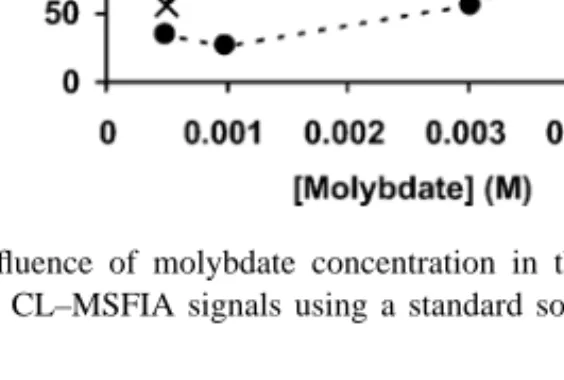
selected as an optimum value since the CL signal for a 50g P l−1standard solution increased up to this level and the blank signal produced as a consequence of the molyb-date self-reduction remained at a minimum value as shown inFig. 2. Hence, as opposed to the conventional spectropho-tometric method, an excess of molybdate does not cause increased background signals, which is attributed to the dif-ferent sorption behaviour of molybdate and heteropolyacid species on the copolymeric support.
The addition of ammonium metavanadate to an acidic molybdate reagent mixture was considered aiming to form the best heteropoly species for CL determination of trace concentrations of phosphorus(V) using the luminol chem-istry[9]. Different solutions of 1.5 × 10⁻³M ammonium molybdate containing 0, 1× 10⁻³, 1.5 × 10⁻³ and 2.5 ×
10−3M ammonium metavanadate were tested. The 1.5 ×
10−3M solution was selected as the optical sensor signals increased up to this concentration. This effect might be at-tributed to the decrease on the reduction potential of the complex in the presence of V(V). To improve sensitivity, the
Fig. 2. Influence of molybdate concentration in the analytical (×) and blank (䊉) CL–MSFIA signals using a standard solution of 50g P l−1.
addition of antimony to the ammonium molybdate solution, reported to catalyse the reduction of the heteropolyacid com-plexes[16]and contribute to the formation of the
antimonyl-molybdophosphorous species[19]was assayed. Increments
of 30 and 42% on the CL signals were observed when
us-ing a 1.5 × 10⁻³M ammonium molybdate solution
contain-ing 0.05 mM Sb or 1.5 × 10⁻³M VO3−, respectively. The latter solution was therefore chosen to improve the lower level of applicability of the sensor and avoid the incompat-ibility of the metalloid with the reaction media. Higher an-timony concentrations are not recommended since a sharp drop in the analytical signal, viz. a five-fold decrease, is thus attained. As the vanadomolybdophosphate formation takes place in acidic medium, solutions containing 1.5 × 10⁻³M
ammonium molybdate and 1.5 × 10⁻³M ammonium
vana-date together with 0.4 M H3O+were prepared using HNO3, HCl and H2SO4media. The HCl solution provided the low-est CL signals. A 50% increase in the recorded CL peak height was achieved when comparing the values obtained with the sulphuric acid solution with those of the nitric acid. This fact was probably due to the temperature rise during complex formation produced as a consequence of the dilu-tion heat released into the system when merging sample and reagent/H2SO4plugs.
The acid concentration in the reaction medium prior solid-phase preconcentration is a critical parameter to take into account for the performance of the developed CL-sensor. It is known that acidity has opposite effects on the sensitivity and selectivity of the molybdate reaction
[9,19,21]. Actually, an increase in the acid concentration level reduces silicate interference but produces a concomi-tantly decrease in the reaction sensitivity, while, low acid concentrations, even in the absence of orthophosphate, lead to self-reduction of molybdate [21–23]. For these reasons, sulphuric acid concentrations ranging from 0.10 to 0.30 M were tested. As expected, the lower the acid concentration, the higher blank and CL analytical signals were encoun-tered. Although the highest ratio between the analytical and
blank signals was attained with a 0.15 M H2SO4 medium,
a molybdate/vanadate reagent in 0.2 M H2SO4was selected as a compromise between blank signal, analytical/blank signal ratio and potential silicate interference.
To provide an alkaline medium for the isolated luminol-based optical sensor reaction following heteropolyacid im-mobilisation and clean-up protocols, the chemiluminogenic reagent was dissolved in a sodium hydroxide solution aim-ing to ensure low background CL signals[8]. After testing
several 8× 10⁻⁴M luminol solutions with sodium
hydrox-ide concentrations comprised between 0.02 and 0.05 M, the 0.035 M NaOH solution was chosen for ensuing experiments since the highest CL signal was recorded without detect-ing an unduly increase of the blank signal. The influence of luminol concentration on the CL measurements in
het-erogeneous phase was studied over the range of 6× 10⁻⁴
to 7× 10⁻³M. The results obtained pointed to a significant increase of peak height until 5× 10⁻³M. The sensitivity
decrease detected for higher luminol concentrations can be explained attending the contribution of self-absorption phe-nomena[8].
It is stressed in the literature that surfactants enhance the efficiency in the generation of molecules in excited state [8,24], and therefore their effect in the described flow-through sensor was investigated. The influence of two surfactants, i.e. the anionic sodium dodecyl sulphate (SDS) and the cationic hexadecyl trimethyl ammonium chloride (HTAC), was assessed. A concentration of 0.5% (w/v) of each surfactant, that is above the critical micelle concen-tration in water, was added to the luminol solution. In both cases, the analytical signal as well as the repeatability de-creased drastically (70 and 25%, respectively) as compared with the assays without involving micellar medium. Fur-thermore, the progressive colour change of the copolymeric sorbent revealed the irreversible retention of the surfactants, entailing an unpaired performance of the developed optical sensor.
Previous studies pointed out that the CL reaction between luminol and an oxidant species is catalysed by traces of metals in alkaline medium[25,26], and the kinetics of the formation of the blue heteropolyacid depends on the pres-ence of metalloids in the reaction medium[16]. Therefore, cobalt and antimony were selected as potential catalysts. As both species can not be added to the luminol solution, due
to precipitation of Co(OH)2 and hydrolysis of antimony,
well-defined zones of reagents were injected into the system synchronously with the luminol and methanol zones using a new multicommutation protocol, the replacement of conflu-ence b inFig. 1with a five-way connector being required. However, no substantial improvement on the kinetics of the luminescence reaction was observed at any case, mainly attributed to the merely contribution of antimony to the for-mation of the oxidizing agent in the absence of vanadium(V) under steady-state conditions and the relevant influence of metal traces in CL reactions involving the generation of singlet oxygen species as an active chemiluminogenic agent.
Investigation of physical variables
The length, diameter, and configuration of the RC were selected taking exclusively into account the kinetic require-ments of the heteropolyacid reaction since the fast CL pro-cess is integrated in the detection device. The length of the RC was as short as possible in order to minimize silicate interference, but ensuing an effective vanadomolybdophos-phate formation. A knotted reaction coil was selected aiming to achieve a lower axial dispersion, a better reagent/sample radial mixing[27]and guarantee high reaction yields.
With the chemical variables set at the stated values in the foregoing section, the flow rate of the different steps
of the experimental schedule listed inTable 1 was
evalu-ated. No significant differences at the 5% level were found for total flow rates ranging from 1.0 to 2.6 ml min−1during
the analyte derivatisation. A total flow rate of 2.2 ml min−1 was chosen, as larger values could provide the build-up of backpressure, or even clogging, which would deteriorate the solid-phase based system performance. The flow rate of the clean-up step was varied from 0.5 to 1.3 ml min−1. In this particular case, it is recommended to use the low-est rate achievable with the liquid-driver device considering the syringe dimensions, i.e. 0.5 ml min−1, as a signal de-pression for higher flow rates, attributed to the influence of the pre-elution effect, was observed. The total flow rate dur-ing the integrated CL reaction, detection and elution step
was tested between 1.3 and 2.3 ml min−1. The CL
analyt-ical signal increased with increasing flow-rates due to the fast kinetics of the luminol oxidation[8]. In order to avoid an excessive compaction of the solid-phase material, a flow
rate of 2.0 ml min−1was chosen as a compromise between
sensitivity and long-term applicability of the optical sensor. The influence of the temperature in the heteropolyacid for-mation was also studied using an in-line thermostatic bath. As no considerable improvement in the CL analytical signal was observed between 28 and 40◦C, a temperature of 28◦C (room temperature) was selected, since it is described that the higher temperature the more severe silicate interference is found[19].
Analytical figures of merit
Under the aforementioned chemical and physical condi-tions, and using a feedback voltage of 0.7 V allowing a gain value of 800, a linear calibration graph was established over the range 5–50g P l−1(ICL = 110[P]–497, r = 0.9975). Although the linear range of the developed methodology is narrower than for most chemiluminescence methods, this can be explained by the fact that the CL reaction occurs between species presented in two different phases. This could lead to additional phenomena like the retention of the vanadomolybdophosphate complex in the solid phase placed outside the photomultiplier tube detection zone. Dynamic working ranges at high orthophosphate concentrations are straightforwardly attainable either by changing the gain volt-age to a lower value or by reducing the injection loading time.
The limit of detection and quantification calculated as the concentration corresponding to the blank average (as-sessed by ten consecutive injections) plus three or ten times its standard deviation were 2 and 4g P l−1, respectively. Repeatability was estimated from 10 consecutive injections of three standard solutions. Relative standard deviations (R.S.D.s) of 2.6, 1.6 and 2.3% were obtained for standards containing orthophosphate concentrations of 10.9, 31.1 and 44.4g P l−1. The reproducibility calculated as the coeffi-cient of variation obtained by analysing the same standard solution (50g P l−1, three replicates) with three freshly packed solid-phase reactors was better than 3.0%. The sampling throughput for a sampling volume of 1.8 ml was 11 h−1.
Interference studies
Although the proposed optosensor shows high tolerance to ionic sample constituents (e.g. dissolved salts) due to the selective homogeneous-phase reaction involved and the iso-lation step of the analyte on the copolymeric packed-bed resin, the CL method is subjected at different extents to the interference of heteropolyacid forming oxoanions such as arsenate and silicate. Silicate is often present in natu-ral waters at concentrations that are one to three orders of magnitude higher than orthophosphate[19]. It is well doc-umented that the rate of formation of silicomolybdate is much slower than the rate of formation of phosphomolyb-date, as is also the rate of its reduction to the blue com-plex[16,21]. Hence, the maximum allowed flow rate for the in-line reaction without an unduly increase of flow resistance was selected. Under the optimised conditions, no interfer-ence of silicate was registered up to a Si/P concentration ratio of 500, which involves a 125-fold improvement with regard to the classical spectrophotometric vanadomolybdate method[13]. Higher concentration ratios led to a decrease in the analytical signal as a consequence of the competition between both complexes for the actives sites of the poly-meric material. The high silicate tolerance exhibited for the flow-through optical sensor under dynamic conditions may be explained according to factors related with the different properties of both heteropolymolybdate species, namely, the capacity to be retained by the Oasis®HLB solid-phase, the retention being more effective for the vanadomolybdophos-phate compound, and the lower potential of reduction of the phosphour-based heteropolyacid to the blue coloured complex.
Regarding arsenate, no additive interference at the 5% level was detected when As and P were present at the same concentration level. Environmental samples, which usually present an arsenate concentration much lower than orthophosphate, can be readily analysed. In areas of arsenic pollution, arsenate interference could be avoided by previ-ous addition of thiosulphate to reduce arsenate to arsenite, which is non-reactive to molybdate reagent[19]. No inter-ference is expected from metal ions able to precipitate as hydroxyoxides (e.g. Fe) in the alkaline medium required for the CL reaction, since the analyte is separated from sam-ple constituents under acidic conditions, by sorption of the vanadomolybdophosphoric acid complex on a copolymeric resin.
Validation of the developed chemical sensor
The applicability of the devised MSFIA CL-optical sen-sor was demonstrated through the determination of trace levels of orthophosphate in different environmental unpol-luted samples, viz. mineral, ground, tap and pond water. Samples collected from a water-steam cycle of an inciner-ator plant, wherein orthophosphate is added at suitable pH with the aim of minimizing salt precipitation in the conduits
Table 2
Determination of orthophosphate in waters using both the devised MSFIA–CL optical sensor and the spectrophotometric molybdenum-blue reference method
Sample Orthophosphate found (g P l−1) MSFIA Reference method RD (%)a t expb Ground water 109± 5 112± 4 −3.48 0.8 Pond water 136± 3 141± 3 −3.55 2.0 Boiler water (1) 568± 4 564± 6 +0.86 1.0 Boiler water (2) 487± 5 474± 6 +2.74 2.5 Results are expressed as the mean of three determinations± standard deviation.
a RD, relative deviation.
b t exp, t experimental value; t critical (n = 4, 0.05) = 2.78.
of the cycle, were also analysed.Table 2compares the ex-perimental results obtained using the developed automated procedure with those of the standard APHA/AWWA/WPCF batch method[18], relied upon the photometric detection of the molybdenum-blue complex obtained by chemical reduc-tion of Mo(VI) to Mo(V) in the heteropolyacid species. In order to bring the orthophosphate concentration within the linear working range of the MSFIA methodology, either a gain adjustment or a proper sample dilution was needed. No statistical differences were observed between the results ob-tained by both methodologies using a t-test comparison of the means[28]at a significance level of 0.05 and 4 degrees
Table 3
Recoveries of orthophosphate from unpolluted water samples determined using the proposed MSFIA sensor
Sample Orthophosphate added (g P l−1) Orthophosphate found (g P l−1) Recovery (%) Tap water – 38.2± 0.7 – 10 49± 1 102.9 20 59.2± 0.1 101.7 30 69± 2 101.2
Ground water (I) – 17.7± 0.9 –
10 29.4± 0.9 106.1 20 40.6± 0.4 107.7 30 47± 1 97.9 Mineral water – <DLa – 5 5.1± 0.2 102.0 10 9.7± 0.5 97.0 20 19± 1 95.0
Ground water (II) – 30.64± 0.02 –
5 37.8± 0.2 106.0 10 41.2± 0.5 101.4 20 50± 1 98.7 Vapour steam – 28± 2 – 5 33.6± 0.2 101.8 10 35± 2 92.1 20 49.5± 0.9 103.1
Results are expressed as the mean of three determinations± standard deviation.
of freedom, since the t critical value was higher than that of
t experimental for the entire set of samples analysed.
For unpolluted water samples with orthophosphate con-tents below the detection limit of the reference method but within the linear working range of the MSFIA methodology, the absence of multiplicative matrix interference was veri-fied by the use of the standard addition method, since the amount of analyte added was recovered in all cases with a mean difference of 4.0% as shown inTable 3.
Although the CL–MSFIA optosensor has not been applied to saline waters, it should be stressed that the methodology is inherently free from chloride quenching because of the matrix removal step performed prior to CL detection.
Conclusions
A novel solid-phase based CL–MSFIA optical sensor based on the luminol oxidation by the heteropolyacid species immobilised in a N-vinylpyrrolidone/divinylbenzene copolymer packed spiral shape flow-through cell was de-veloped for orthophosphate determination at the lowg l−1 level in environmental water samples. Although the two reactions involved in this methodology, i.e. the formation of the heteropoly complex in an acidic medium and the CL reaction with luminol in alkaline conditions, have incom-patible pH demands, no additional measures needed to be adopted in the devised sensor as both reactions are physi-cally separated; that is, the injection of the alkaline luminol plug into the flowing system occurs merely following the adsorption of the in-line formed heteropolyacid species onto the copolymeric sorbent. Moreover, the different kinetic requirements of the complexation/chemiluminescence reac-tions and clean-up steps can be readily guaranteed through the wide range of flow rates accessible via the multisyringe flow instrumentation.
An unique feature of the designed optical sensor is the capability to integrate the solid-phase CL reaction with de-tection of the emitted light as well as elution of the reduced complex. It combines the advantages of flowing stream sys-tems with the selectivity of the sensing element and exhibits great flexibility, easy miniaturisation and low cost. The high silicate tolerance level allowed, viz. a 500-fold Si/P concen-tration ratio, which makes it particularly suited for moni-toring the measurand in environmental samples, is specially worthmentioning. Besides, the sensor is inherently free from interference of dissolved salts owing to the separation step of the derivatised analyte onto the copolymeric resin. It should be, however, mentioned that its application is restricted to environmental samples containing concomitantly low levels of organic matter (e.g. humic and fulvic acids) as a conse-quence of the irreversible sorption of high molecular weight compounds on the sensing microzone.
Acknowledgements
Inˆes P.A. Morais thanks Fundação para a Ciˆencia e a Tec-nologia (Portugal) for the grant PRAXIS XXI BD/20302/99. Manuel Miró is grateful for financial support granted by the Spanish Ministry of Science and Culture through the FPU program. The authors also extended their appreciation to the MCyT (Ministerio de Ciencia y Tecnolog´ıa) for supporting the project PPQ2001-0474.
References
[1] A.M. Garc´ıa-Campaña, W.R. G.Baeyens, in: Chemiluminescence in Analytical Chemistry, Marcel Dekker, New York, 2001.
[2] V. Cerdà, J.M. Estela, R. Forteza, A. Cladera, E. Becerra, P. Altimira, P. Sitjar, Talanta 50 (1999) 695.
[3] J. Ruzicka, E.H. Hansen, Anal. Chim. Acta 78 (1975) 145. [4] J. Ruzicka, G.D. Marshall, Anal. Chim. Acta 237 (1990) 329. [5] B.F. Reis, M.F. Guiné, E.A.G. Zagatto, J.L.F.C. Lima, R.A. Lapa,
Anal. Chim. Acta 293 (1994) 129.
[6] M.A. Segundo, A.O.S.S. Rangel, J. Flow Injection Anal. 19 (2002) 3. [7] M. Miró, V. Cerdà, J.M. Estela, TrAC-Trends Anal. Chem. 21 (2002)
199.
[8] N. Pizà, M. Miró, G. Armas, E. Becerra, J.M. Estela, V. Cerdà, Anal. Chim. Acta 467 (2002) 155.
[9] T. Fujiwara, K. Kurahashi, T. Kumamaru, H. Sakai, Appl. Organomet-all. Chem. 10 (1996) 675.
[10] F. Mas-Torres, A. Muñoz, J.M. Estela, V. Cerdà, Analyst 122 (1997) 1033.
[11] H. Jiang, Z. Wang, J. Li, J. Lu, Fenxi Shiyanshi 16 (1997) 64. [12] F. Mas-Torres, A. Muñoz, J.M. Estela, V. Cerdà, Int. J. Environ.
Anal. Chem. 77 (2000) 185.
[13] A. Muñoz, F. Mas-Torres, J.M. Estela, V. Cerdà, Anal. Chim. Acta 350 (1997) 21.
[14] C.X. Galhardo, J.C. Masini, Anal. Chim. Acta 417 (2000) 191. [15] A.K. Pettersson, B. Karlberg, Anal. Chim. Acta 378 (1999) 183. [16] N. Lacy, G.D. Christian, J. Ruzicka, Anal. Chem. 62 (1990)
1482.
[17] A.R. Bowie, E.P. Achterberg, R.F.C. Mantoura, P.J. Worsfold, Anal. Chim. Acta 361 (1998) 189.
[18] APHA-AWWA-WPCF, Standard Methods for the Examination of Water and Wastewater, 20th ed., American Public Health Associa-tion, American Water Works AssociaAssocia-tion, Water Pollution Control Federation, Washington DC, 1998 (Chapter 4).
[19] J.-Z. Zhang, C.J. Fisher, P.B. Ortner, Talanta 49 (1999) 293. [20] F. Albertús, B. Horstkotte, A. Cladera, V. Cerdà, Analyst 124 (1999)
1373.
[21] S.-C. Pai, C.-C. Yang, J.P. Riley, Anal. Chim. Acta 229 (1990) 115. [22] J.E. Going, S.J. Eisenreich, Anal. Chim. Acta 70 (1974) 95. [23] J.F. Van Staden, R.E. Taljaard, Mikrochim. Acta 128 (1998)
223.
[24] C. Dodeigne, L. Thunus, R. Lejeune, Talanta 51 (2000) 415. [25] W. Qin, Z.-J. Zhang, H.-J. Liu, Anal. Chim. Act 357 (1997)
127.
[26] V. Cannizzaro, A.R. Bowie, A. Sax, E.P. Achterberg, P.J. Worsfold, Analyst 125 (2000) 51.
[27] Z.-L. Fang, in Flow Injection Separation and Preconcentration, VCH, Weinheim, 1993, Chapter 2, p. 36.
[28] J.C. Miller, J.N. Miller, in: Statistics for Analytical Chemistry, third ed., Ellis Horwood, Chichester, UK, 1993, p. 55.