EUROPEAN ORGANIZATION FOR NUCLEAR RESEARCH (CERN)
CERN-PH-EP/2012-320 2013/03/21
CMS-HIN-12-015
Observation of long-range, near-side angular correlations
in pPb collisions at the LHC
The CMS Collaboration
∗Abstract
Results on two-particle angular correlations for charged particles emitted in pPb col-lisions at a nucleon-nucleon center-of-mass energy of 5.02 TeV are presented. The analysis uses two million collisions collected with the CMS detector at the LHC. The correlations are studied over a broad range of pseudorapidity, η, and full azimuth,
φ, as a function of charged particle multiplicity and particle transverse momentum,
pT. In high-multiplicity events, a long-range (2 < |∆η| < 4), near-side (∆φ ≈ 0)
structure emerges in the two-particle∆η-∆φ correlation functions. This is the first ob-servation of such correlations in proton–nucleus collisions, resembling the ridge-like correlations seen in high-multiplicity pp collisions at√s=7 TeV and in AA collisions over a broad range of center-of-mass energies. The correlation strength exhibits a pronounced maximum in the range of pT =1–1.5 GeV/c and an approximately linear
increase with charged particle multiplicity for high-multiplicity events. These ob-servations are qualitatively similar to those in pp collisions when selecting the same observed particle multiplicity, while the overall strength of the correlations is signifi-cantly larger in pPb collisions.
Submitted to Physics Letters B
c
2013 CERN for the benefit of the CMS Collaboration. CC-BY-3.0 license
∗See Appendix A for the list of collaboration members
1
1
Introduction
This Letter presents measurements of two-particle angular correlations in proton-lead (pPb) collisions at a nucleon-nucleon center-of-mass energy √sNN = 5.02 TeV, performed with the Compact Muon Solenoid (CMS) detector at the Large Hadron Collider (LHC). Two-particle correlations in high-energy collisions provide valuable information for characterizing Quan-tum Chromodynamics and have been studied previously for a broad range of collision ener-gies in proton-proton (pp), proton-nucleus (pA), and nucleus-nucleus (AA) collisions. Such measurements can elucidate the underlying mechanism of particle production and possible collective effects resulting from the high particle densities accessible in these collisions.
Studies of two-particle angular correlations are typically performed using two-dimensional ∆η-∆φ correlation functions, where ∆φ is the difference in azimuthal angle φ between the two particles and∆η is the difference in pseudorapidity η =−ln(tan(θ/2)). The polar angle θ is
defined relative to the counterclockwise beam.
Of particular interest in studies of collective effects is the long-range (large|∆η|) structure of two-particle correlation functions, which is less susceptible to known sources of correlations such as resonance decays and fragmentation of energetic jets. Measurements in high-energy AA collisions have shown significant modifications of the long-range structure compared with minimum bias pp collisions [1]. Novel correlation structures extending over large∆η at|∆φ| ≈
0 and|∆φ| ≈2π/3 were observed in azimuthal correlations for intermediate particle transverse momenta, pT ≈1–5 GeV/c [2–10]. In AA collisions, long-range correlations are interpreted as a
consequence of the hydrodynamic flow of the produced strongly interacting medium [11] and are usually characterized by the Fourier components of the azimuthal particle distributions [12]. Of particular importance are the second and third Fourier components, called elliptic and triangular flow, as they most directly reflect the medium response to the initial collision geometry and its fluctuations [13], and allow the study of fundamental transport properties of the medium using hydrodynamic models [14–16].
In current pp and pA Monte Carlo (MC) event generators, the dominant sources of such long-range correlations are momentum conservation and away-side (∆φ≈ π) jet correlations.
Mea-surements in pp collisions at 7 TeV have revealed the emergence of long-range, near-side (∆φ≈
0) correlations in a selection of collisions with very high final-state particle multiplicity [17]. A large variety of theoretical models have been proposed to explain the origin of these so-called ridge-like correlations (see Ref. [18] for a recent review). The proposed mechanisms range from color connections in hard scattering processes and collective effects in the initial interaction of the protons to hydrodynamic effects in the high-density system possibly formed in these col-lisions. It is natural to search for the possible emergence of related features in pPb collisions, where a similar range of final-state multiplicities can be explored. The first comparison of pp and pPb measurements as a function of charged particle multiplicity and particle transverse momentum, presented in this Letter, should provide valuable information for understanding the origin of the long-range, near-side correlation signal seen in high-multiplicity pp collisions.
2
Experimental Setup
This analysis uses a pPb data set collected during a short run (lasting for about 8 hours) in September 2012. The beam energies were 4 TeV for protons and 1.58 TeV per nucleon for lead nuclei, resulting in a center-of-mass energy per nucleon pair of√sNN = 5.02 TeV. Due to the energy difference, the nucleon-nucleon center-of-mass in the pPb collisions is not at rest with respect to the laboratory frame. Since the higher energy proton beam traveled in the clockwise
2 3 Event and Track Selection
direction, i.e. at θ = π, massless particles emitted at ηcm= 0 in the nucleon-nucleon
center-of-mass frame will be detected at η= −0.465 in the laboratory frame.
A detailed description of the CMS experiment can be found in Ref. [19]. The main detector subsystem used for this analysis is the tracker, located in the 3.8 T field of the superconducting solenoid. It measures charged particles within the pseudorapidity range|η| <2.5 and consists
of 1440 silicon pixel and 15 148 silicon strip detector modules. It provides an impact parameter resolution of∼15 µm and a transverse momentum (pT) resolution of about 1.5% for 100 GeV/c
particles. Also located inside the solenoid are the electromagnetic calorimeter (ECAL) and hadron calorimeter (HCAL). The ECAL consists of more than 75 000 lead-tungstate crystals, arranged in a quasi-projective geometry and distributed in a barrel region (|η| <1.48) and two
endcaps that extend up to|η| = 3.0. The HCAL barrel and endcaps are sampling calorimeters
composed of brass and scintillator plates, covering|η| <3.0. Iron forward calorimeters (HF)
with quartz fibers, read out by photomultipliers, extend the calorimeter coverage up to|η| =
5.0. The detailed MC simulation of the CMS detector response is based on GEANT4 [20].
3
Event and Track Selection
The relatively low pPb collision frequency (about 200 Hz) provided by the LHC in this pilot run allowed the use of a track-based minimum bias trigger. For every pPb bunch crossing, the detector was read out and events were accepted if at least one track with pT > 0.4 GeV/c was
found in the pixel tracker. In the offline analysis, a coincidence of at least one HF calorime-ter tower with more than 3 GeV of total energy on both the positive and negative sides of HF was required to select hadronic collisions. Events were also required to contain at least one re-constructed primary vertex within 15 cm of the nominal interaction point along the beam axis (zvtx) and within 0.15 cm transverse distance to the beam trajectory. At least two reconstructed
tracks were required to be associated with the primary vertex. Beam related background was suppressed by rejecting events with a high fraction of pixel clusters inconsistent with a single collision vertex [21]. Based on simulations using theHIJING event generator, the event selec-tions have a total acceptance of about 96.2% for hadronic inelastic pPb interacselec-tions. A total of 2 million events passed all selection criteria, corresponding to an integrated luminosity of about 1 µb−1, assuming a pPb interaction cross section of 2.1 barns.
The angular correlation functions were obtained using the CMS highPurity [22] track selection. Additionally, a reconstructed track was only considered as a primary-track candidate if the significance of the separation along the beam axis, z, between the track and the primary vertex, dz/σ(dz), and the significance of the impact parameter relative to the primary vertex transverse to the beam, dT/σ(dT), were each less than 3. The relative uncertainty of the momentum measurement, σ(pT)/pT, was required to be less than 10%. To ensure high tracking efficiency
and low fake rate, only tracks within|η| <2.4 and with pT >0.1 GeV/c were used.
To match the analysis used for high-multiplicity pp collisions [17], the events were divided into classes of reconstructed track multiplicity, Noffline
trk , where primary tracks with |η| < 2.4 and
pT > 0.4 GeV/c were counted. The fraction of events falling into each of the four multiplicity
classes is listed in Table 1. The table also lists the average values of Ntrkoffline and Ntrkcorrected, the event multiplicity of charged particles with|η| <2.4 and pT>0.4 GeV/c corrected for detector
acceptance and efficiency of the track reconstruction algorithm, as discussed in the following section.
3
Table 1: Fraction of the full event sample for each multiplicity class. The last two columns show the observed and corrected multiplicities, respectively, of charged particles with|η| <2.4
and pT > 0.4 GeV/c. Systematic uncertainties are given for the corrected multiplicities, while
statistical uncertainties are negligible.
Multiplicity class Fraction DNtrkofflineE DNtrkcorrectedE (Ntrkoffline) (%) Minimum Bias 100.0 40.6 53.4±2.9 Noffline trk <35 50.4 17.1 23.5±1.3 35≤Ntrkoffline<90 41.9 56.3 75.6±4.1 90≤Ntrkoffline<110 4.6 98.2 114.3±6.2 Ntrkoffline≥110 3.1 128.2 149.1±8.1
4
Calculation of the Two-Particle Correlation Function
The analysis of two-particle correlations was performed in classes of track multiplicity, Ntrkoffline, following the procedure established in [7, 8]. For each track multiplicity class, “trigger” par-ticles are defined as charged parpar-ticles originating from the primary vertex within a given pT
range. The number of trigger particles in the event is denoted by Ntrig. In this analysis, particle
pairs are formed by associating every trigger particle with the remaining charged primary par-ticles from the same pT interval as the trigger particle (a minimum of two particles is required
in each pTbin from each event). The per-trigger-particle associated yield is defined as
1 Ntrig d2Npair d∆η d∆φ = B(0, 0) × S(∆η, ∆φ) B(∆η, ∆φ), (1)
where∆η and ∆φ are the differences in η and φ of the pair. The signal distribution, S(∆η, ∆φ), is the per-trigger-particle yield of particle pairs from the same event,
S(∆η, ∆φ) = 1
Ntrig
d2Nsame
d∆η d∆φ . (2)
The mixed-event background distribution, used to account for random combinatorial back-ground and pair-acceptance effects,
B(∆η, ∆φ) = 1
Ntrig
d2Nmix
d∆η d∆φ , (3)
is constructed by pairing the trigger particles in each event with the associated particles from 10 different random events in the same 2 cm wide zvtx range. The symbol Nmix denotes the
number of pairs taken from the mixed event, while B(0, 0)represents the mixed-event asso-ciated yield for both particles of the pair going in approximately the same direction and thus having full pair acceptance (with a bin width of 0.3 in∆η and π/16 in ∆φ). Therefore, the ra-tio B(0, 0)/B(∆η, ∆φ)is the pair-acceptance correction factor used to derive the corrected per-trigger-particle associated yield distribution. The signal and background distributions are first calculated for each event, and then averaged over all the events within the track multiplicity class.
Each reconstructed track is weighted by the inverse of an efficiency factor, which accounts for the detector acceptance, the reconstruction efficiency, and the fraction of misreconstructed tracks. Detailed studies of tracking efficiencies using MC simulations and data-based methods can be found in [23]. The combined geometrical acceptance and efficiency for track reconstruc-tion exceeds 50% for pT ≈ 0.1 GeV/c and|η| < 2.4. The efficiency is greater than 90% in the
4 5 Results
|η| < 1 region for pT > 0.6 GeV/c. For the multiplicity range studied here, little or no
depen-dence of the tracking efficiency on multiplicity is found and the rate of misreconstructed tracks remains at the 1–2% level.
Simulations of pp, pPb and peripheral PbPb collisions using thePYTHIA,HIJING andHYDJET
event generators, respectively, yield efficiency correction factors that vary due to the different kinematic and mass distributions for the particles produced in these generators. Applying the resulting correction factors from one of the generators to simulated data from one of the others gives associated yield distributions that agree within 5%. Systematic uncertainties due to track quality cuts and potential contributions from secondary particles (including those from weak decays) are examined by loosening or tightening the track selections on dz/σ(dz) and dT/σ(dT)from 2 to 5. The associated yields are found to be insensitive to these track selections within 2%.
η
∆
-4
-2
0
2
4
φ
∆
0
2
4
φ∆ d η∆ d pair N 2 d trig N 1 0.16 0.18 0.20 < 35 trk offline = 5.02 TeV, N NN s CMS pPb < 3 GeV/c T 1 < p (a)η
∆
-4
-2
0
2
4
φ
∆
0
2
4
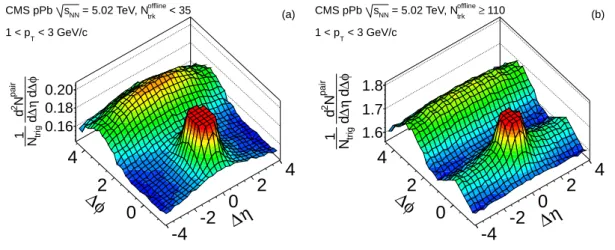
φ∆ d η∆ d pair N 2 d trig N 1 1.6 1.7 1.8 110 ≥ trk offline = 5.02 TeV, N NN s CMS pPb < 3 GeV/c T 1 < p (b)Figure 1: 2-D two-particle correlation functions for 5.02 TeV pPb collisions for pairs of charged particles with 1 < pT < 3 GeV/c. Results are shown (a) for low-multiplicity events (Ntrkoffline <
35) and (b) for a high-multiplicity selection (Ntrkoffline≥110). The sharp near-side peaks from jet correlations have been truncated to better illustrate the structure outside that region.
5
Results
Figure 1 compares 2-D two-particle correlation functions for events with low (a) and high (b) multiplicity, for pairs of charged particles with 1 < pT < 3 GeV/c. For the low-multiplicity
selection (Ntrkoffline < 35), the dominant features are the correlation peak near(∆η, ∆φ) = (0, 0)
for pairs of particles originating from the same jet and the elongated structure at∆φ ≈ πfor
pairs of particles from back-to-back jets. To better illustrate the full correlation structure, the jet peak has been truncated. High-multiplicity events (Noffline
trk ≥110) also show the same-side jet
peak and back-to-back correlation structures. However, in addition, a pronounced “ridge”-like structure emerges at ∆φ ≈ 0 extending to |∆η| of at least 4 units. This observed structure is similar to that seen in high-multiplicity pp collision data at√s=7 TeV [17] and in AA collisions over a wide range of energies [3–10].
As a cross-check, correlation functions were also generated for tracks paired with ECAL pho-tons, which originate primarily from decays of π0s, and for pairs of ECAL photons. These
distributions showed similar features as those seen in Fig. 1, in particular the ridge-like corre-lation for high multiplicity events.
5 | φ ∆ | 0 1 2 3 Z Y A M - C φ∆ d pair dN trig N 1 0.00 0.05 0.10 < 1.0 GeV/c T 0.1 < p < 35 offline trk N = 0.771 ZYAM C CMS | φ ∆ | 0 1 2 3 Z Y A M - C φ∆ d pair dN trig N 1 0.00 0.05 0.10 < 90 offline trk N ≤ 35 = 2.289 ZYAM C | φ ∆ | 0 1 2 3 Z Y A M - C φ∆ d pair dN trig N 1 0.00 0.05 0.10 < 110 offline trk N ≤ 90 = 3.781 ZYAM C | φ ∆ | 0 1 2 3 Z Y A M - C φ∆ d pair dN trig N 1 0.00 0.05 0.10 110 ≥ offline trk N = 4.807 ZYAM C | φ ∆ | 0 1 2 3 Z Y A M - C φ∆ d pair dN trig N 1 0.00 0.05 0.10 < 2.0 GeV/c T 1.0 < p = 0.136 ZYAM C = 5.02 TeV NN s pPb = 7 TeV s pp | φ ∆ | 0 1 2 3 Z Y A M - C φ∆ d pair dN trig N 1 0.00 0.05 0.10 CZYAM = 0.506 =0.037 3 =0.066, v 2 v HIJING pPb | φ ∆ | 0 1 2 3 Z Y A M - C φ∆ d pair dN trig N 1 0.00 0.05 0.10 CZYAM = 0.985 | φ ∆ | 0 1 2 3 Z Y A M - C φ∆ d pair dN trig N 1 0.00 0.05 0.10 CZYAM = 1.336 | φ ∆ | 0 1 2 3 Z Y A M - C φ∆ d pair dN trig N 1 0.00 0.05 0.10 < 3.0 GeV/c T 2.0 < p = 0.041 ZYAM C | φ ∆ | 0 1 2 3 Z Y A M - C φ∆ d pair dN trig N 1 0.00 0.05 0.10 CZYAM = 0.088 | φ ∆ | 0 1 2 3 Z Y A M - C φ∆ d pair dN trig N 1 0.00 0.05 0.10 CZYAM = 0.158 | φ ∆ | 0 1 2 3 Z Y A M - C φ∆ d pair dN trig N 1 0.00 0.05 0.10 CZYAM = 0.229 | φ ∆ | 0 1 2 3 Z Y A M - C φ∆ d pair dN trig N 1 0.00 0.05 0.10 < 4.0 GeV/c T 3.0 < p = 0.025 ZYAM C | φ ∆ | 0 1 2 3 Z Y A M - C φ∆ d pair dN trig N 1 0.00 0.05 0.10 CZYAM = 0.040 | φ ∆ | 0 1 2 3 Z Y A M - C φ∆ d pair dN trig N 1 0.00 0.05 0.10 CZYAM = 0.054 | φ ∆ | 0 1 2 3 Z Y A M - C φ∆ d pair dN trig N 1 0.00 0.05 0.10 CZYAM = 0.065
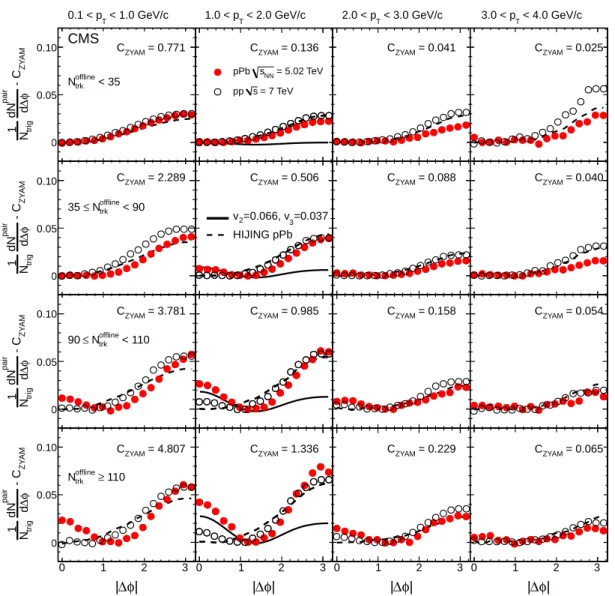
Figure 2: Correlated yield obtained from the ZYAM procedure as a function of|∆φ|averaged over 2< |∆η| <4 in different pTand multiplicity bins for 5.02 TeV pPb data (solid circles) and
7 TeV pp data (open circles). The pT selection applies to both particles in each pair. Statistical
uncertainties are smaller than the marker size. The subtracted ZYAM constant is listed in each panel. Also shown are pPb predictions for HIJING[24] (dashed curves) and a hydrodynamic model [25] (solid curves shown for 1< pT <2 GeV/c).
6 5 Results
To investigate the long-range, near-side correlations in finer detail, and to provide a quanti-tative comparison to pp results, one-dimensional (1-D) distributions in ∆φ are found by av-eraging the signal and background two-dimensional (2-D) distributions over 2 < |∆η| <
4 [7, 8, 17]. In the presence of multiple sources of correlations, the yield for the correlation of in-terest is commonly estimated using an implementation of the zero-yield-at-minimum (ZYAM) method [26]. A second-order polynomial is first fitted to the 1-D∆φ correlation function in the region 0.1< |∆φ| < 2. The minimum value of the polynomial, CZYAM, is then subtracted from
the 1-D∆φ correlation function as a constant background (containing no information about cor-relations) to shift its minimum to be at zero associated yield. The statistical uncertainty on the minimum level of N1
trig
dNpair
d∆φ obtained by the ZYAM procedure as well as the deviations found
by varying the fit range in∆φ give an absolute uncertainty of±0.0015 on the associated yield, independent of multiplicity and pT.
Figure 2 shows the results for pPb data (solid circles) for various selections in pTand
multiplic-ity Ntrkoffline, with pTincreasing from left to right and multiplicity increasing from top to bottom.
The results for pp data at√s =7 TeV, obtained using the same procedure [17], are also plotted (open circles).
A clear evolution of the∆φ correlation function as a function of both pTand Ntrkofflineis observed.
For the lowest multiplicity selection in pp and pPb the correlation functions have a minimum at ∆φ = 0 and a maximum at∆φ = π, reflecting the correlations from momentum conservation
and the increasing contribution from back-to-back jet-like correlations at higher pT. Results
from theHIJING[24] model (version 1.383), shown as dashed lines, qualitatively reproduce the shape of the correlation function for low Ntrkoffline.
For multiplicities Noffline
trk ≥ 35, a second local maximum near|∆φ| ≈ 0 emerges in the pPb
data, corresponding to the near-side, long-range ridge-like structure. In pp data, this second maximum is clearly visible only for Ntrkoffline > 90. For both pp and pPb collisions, this near-side correlated yield is largest in the 1 < pT < 2 GeV/c range and increases with increasing
multiplicity. While the evolution of the correlation function is qualitatively similar in pp and pPb data, the absolute near-side correlated yield is significantly larger in the pPb case.
In contrast to the data, theHIJING calculations show a correlated yield of zero at∆φ = 0 for
all multiplicity and pT selections. The long-range, near-side enhancement is also absent in
simulated pp collision events with thePYTHIA[27, 28] event generator (version 6.4.24) and in
simulated pPb collisions with theAMPT[29] model (version 1.25/2.25).
Long-range correlations in pPb collisions have been quantitatively predicted in models assum-ing a collective hydrodynamic expansion of a system with fluctuatassum-ing initial conditions [25]. The correlation resulting from the predicted elliptic and triangular flow components for pPb collisions at√sNN = 4.4 TeV are compared to the observed correlation in Fig. 2 for the 1< pT <
2 GeV/c selection (solid line, second column). The magnitudes for elliptic and triangular flow of v2 = 0.066 and v3 = 0.037 correspond to those given in Ref. [25] for the highest
multiplic-ity selection and the average value of pT ≈ 1.4 GeV/c found in the data. The same v2 and v3
coefficients were used for all multiplicity classes, showing the multiplicity dependence of the correlated yield assuming a constant flow effect. While this provides an indicative and useful illustration of the magnitude of the observed near-side enhancement, a detailed quantitative comparison of the model and data will need to include the additional non-hydrodynamical correlations from back-to-back jets, as well as the effects of momentum conservation, which suppress the correlation near∆φ≈0 relative to∆φ≈π.
cor-7
relations in the color-glass condensate framework, where the contribution of collimated gluon emissions is significantly enhanced in the gluon saturation regime [30]. This model qualita-tively predicts the increase in the correlation strength for higher multiplicity pPb collisions, although it remains to be seen if the large associated yield seen in the highest multiplicity se-lection can be quantitatively reproduced in the calculation.
(GeV/c)
Tp
0
2
4
6
A
s
s
o
c
ia
te
d
Y
ie
ld
/
(
G
e
V
/c
)
0.00
0.02
0.04
110 ≥ offline trk N CMS (a) = 5.02 TeV NN s pPb = 7 TeV s pp offline trkN
0
50
100
150
A
s
s
o
c
ia
te
d
Y
ie
ld
/
(
G
e
V
/c
)
0.00
0.02
0.04
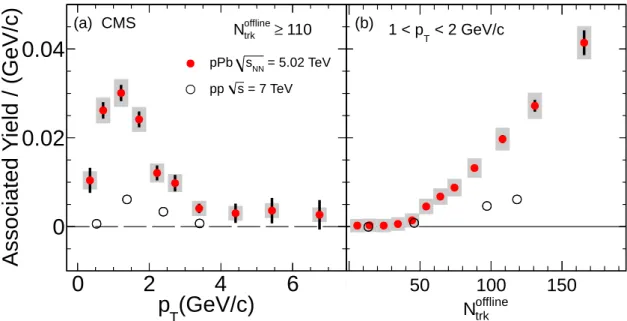
< 2 GeV/c T 1 < p (b)Figure 3: Associated yield for the near-side of the correlation function averaged over 2 < |∆η| < 4 and integrated over the region|∆φ| < 1.2 in 7 TeV pp collisions (open circles) and 5.02 TeV pPb collisions (solid circles). Panel (a) shows the associated yield as a function of pT
for events with Noffline
trk ≥ 110. In panel (b) the associated yield for 1< pT <2 GeV/c is shown
as a function of multiplicity Noffline
trk . The pTselection applies to both particles in each pair. The
error bars correspond to statistical uncertainties, while the shaded areas denote the systematic uncertainties.
The strength of the long-range, near-side correlations can be further quantified by integrating the correlated yield from Fig. 2 over|∆φ| < 1.2 using 12 classes of multiplicity. The resulting integrated “ridge yield”, normalized by the width of the pTinterval, is plotted as a function of
particle pTand event multiplicity in Fig. 3 for pp (open circles) and pPb (solid circles) data. The
error bars correspond to statistical uncertainties, while the shaded boxes indicate the systematic uncertainties.
Figure 3(a) shows that the ridge yield for events with Noffline
trk ≥ 110 peaks in the region 1 <
pT <2 GeV/c for both collision systems. However, while the yield in pp collisions is consistent
with zero for the 0.1 < pT < 1 GeV/c selection, it remains greater than zero in pPb data even
for the 0.1< pT < 0.5 GeV/c range. For higher pT, the ridge yield in pp collisions is consistent
with zero for pT >3 GeV/c, while the pPb results only approach zero at pT ≈4–7 GeV/c.
The multiplicity dependence of the ridge yield for 1< pT <2 GeV/c particle pairs is shown in
Fig. 3(b). For low-multiplicity collisions, the ridge yield determined by the ZYAM procedure is consistent with zero, indicating that ridge-like correlations are absent or smaller than the negative correlations expected due to, e.g. momentum conservation. At higher multiplicity the ridge-like correlations emerge, with an approximately linear rise of the ridge yield observed for Ntrkoffline & 40, which corresponds to Ntrkcorrected & 53. While the multiplicity dependence is qualitatively similar for pp and pPb collisions, a significantly larger yield per trigger particle is
8 6 Conclusion
seen in pPb than in pp at a given multiplicity.
When interpreting the differences in the correlation structure between the two collision sys-tems, it is important to consider the relative contributions of different particle production mechanisms to the observed particle yields. While very high multiplicity pp collisions should mainly arise from rare multiple hard-scattering processes, the high-multiplicity pPb events should mostly result from particle production in multiple soft proton-nucleon scatterings. This will in particular affect the correlations due to back-to-back jet fragmentation in the∆φ ≈ π
region. A simultaneous description of the measurements in pp and pPb should provide sig-nificant constraints on models of the underlying physics processes. With such an improved understanding of the smaller systems, comparisons to the PbPb data will also provide insights in understanding the similarity of the ridge-like correlations in all three systems.
6
Conclusion
The CMS detector at the LHC has been used to measure angular correlations between two charged particles with|η| < 2.4 in pPb collisions at√sNN = 5.02 TeV. Azimuthal correlations
for 2 < |∆η| < 4 in high-multiplicity pPb collisions exhibit a long-range structure at the near side (∆φ≈0). This ridge-like structure is qualitatively similar to that observed in pp collisions at√s = 7 TeV and in AA collisions over a broad range of center-of-mass energies. The effect is most evident in the intermediate transverse momentum range, 1 < pT < 1.5 GeV/c. The
near-side ridge yield obtained by the ZYAM procedure is found to be consistent with zero in the low-multiplicity region, with an approximately linear increase with low-multiplicity for Ntrkoffline & 40 (corresponding to Ntrkcorrected& 53). While the multiplicity and pT dependences of the observed
effect are similar to those seen in pp data at √s = 7 TeV, the absolute ridge yield in pPb is significantly larger than in pp collisions of the same particle multiplicity.
Acknowledgments
We congratulate our colleagues in the CERN accelerator departments for the excellent perfor-mance of the LHC and thank the technical and administrative staffs at CERN and at other CMS institutes for their contributions to the success of the CMS effort. In addition, we gratefully acknowledge the computing centres and personnel of the Worldwide LHC Computing Grid for delivering so effectively the computing infrastructure essential to our analyses. Finally, we acknowledge the enduring support for the construction and operation of the LHC and the CMS detector provided by the following funding agencies: BMWF and FWF (Austria); FNRS and FWO (Belgium); CNPq, CAPES, FAPERJ, and FAPESP (Brazil); MEYS (Bulgaria); CERN; CAS, MoST, and NSFC (China); COLCIENCIAS (Colombia); MSES (Croatia); RPF (Cyprus); MoER, SF0690030s09 and ERDF (Estonia); Academy of Finland, MEC, and HIP (Finland); CEA and CNRS/IN2P3 (France); BMBF, DFG, and HGF (Germany); GSRT (Greece); OTKA and NKTH (Hungary); DAE and DST (India); IPM (Iran); SFI (Ireland); INFN (Italy); NRF and WCU (Korea); LAS (Lithuania); CINVESTAV, CONACYT, SEP, and UASLP-FAI (Mexico); MSI (New Zealand); PAEC (Pakistan); MSHE and NSC (Poland); FCT (Portugal); JINR (Armenia, Belarus, Georgia, Ukraine, Uzbekistan); MON, RosAtom, RAS and RFBR (Russia); MSTD (Ser-bia); SEIDI and CPAN (Spain); Swiss Funding Agencies (Switzerland); NSC (Taipei); ThEP, IPST and NECTEC (Thailand); TUBITAK and TAEK (Turkey); NASU (Ukraine); STFC (United Kingdom); DOE and NSF (USA).
References 9
References
[1] PHOBOS Collaboration, “System Size Dependence of Cluster Properties from Two-Particle Angular Correlations in Cu+Cu and Au+Au Collisions at√sNN = 200 GeV”, Phys. Rev. C 81 (2010) 024904, doi:10.1103/PhysRevC.81.024904,
arXiv:0812.1172.
[2] PHENIX Collaboration, “Dense-Medium Modifications to Jet-Induced Hadron Pair Distributions in Au+Au Collisions at√sNN = 200 GeV”, Phys. Rev. Lett. 97 (2006) 052301,
doi:10.1103/PhysRevLett.97.052301, arXiv:nucl-ex/0507004.
[3] STAR Collaboration, “Distributions of charged hadrons associated with high transverse momentum particles in pp and Au + Au collisions at√sNN = 200 GeV”, Phys. Rev. Lett. 95(2005) 152301, doi:10.1103/PhysRevLett.95.152301,
arXiv:nucl-ex/0501016.
[4] STAR Collaboration, “Long range rapidity correlations and jet production in high energy nuclear collisions”, Phys. Rev. C 80 (2009) 064912,
doi:10.1103/PhysRevC.80.064912, arXiv:0909.0191.
[5] PHOBOS Collaboration, “High Transverse Momentum Triggered Correlations over a Large Pseudorapidity Acceptance in Au+Au Collisions at√sNN = 200 GeV”, Phys. Rev. Lett. 104 (2010) 062301, doi:10.1103/PhysRevLett.104.062301,
arXiv:0903.2811.
[6] STAR Collaboration, “Three-Particle Coincidence of the Long Range Pseudorapidity Correlation in High Energy Nucleus-Nucleus Collisions”, Phys. Rev. Lett. 105 (2010) 022301, doi:10.1103/PhysRevLett.105.022301, arXiv:0912.3977. [7] CMS Collaboration, “Long-range and short-range dihadron angular correlations in
central PbPb collisions at a nucleon-nucleon center of mass energy of 2.76 TeV”, JHEP 07 (2011) 076, doi:10.1007/JHEP07(2011)076, arXiv:1105.2438.
[8] CMS Collaboration, “Centrality dependence of dihadron correlations and azimuthal anisotropy harmonics in PbPb collisions at√sNN = 2.76 TeV”, Eur. Phys. J. C 72 (2012) 2012, doi:10.1140/epjc/s10052-012-2012-3, arXiv:1201.3158.
[9] ALICE Collaboration, “Harmonic decomposition of two-particle angular correlations in Pb-Pb collisions at√sNN = 2.76 TeV”, Phys. Lett. B 708 (2012) 249,
doi:10.1016/j.physletb.2012.01.060, arXiv:1109.2501.
[10] ATLAS Collaboration, “Measurement of the azimuthal anisotropy for charged particle production in√sNN = 2.76 TeV lead-lead collisions with the ATLAS detector”, Phys. Rev. C 86 (2012) 014907, doi:10.1103/PhysRevC.86.014907, arXiv:1203.3087. [11] J.-Y. Ollitrault, “Anisotropy as a signature of transverse collective flow”, Phys. Rev. D 46
(1992) 229, doi:10.1103/PhysRevD.46.229.
[12] S. Voloshin and Y. Zhang, “Flow study in relativistic nuclear collisions by Fourier expansion of azimuthal particle distributions”, Z. Phys. C 70 (1996) 665,
doi:10.1007/s002880050141, arXiv:hep-ph/9407282.
[13] B. Alver and G. Roland, “Collision-geometry fluctuations and triangular flow in heavy-ion collisions”, Phys. Rev. C 81 (2010) 054905,
10 References
doi:10.1103/PhysRevC.81.054905, arXiv:1003.0194. Also erratum, Phys. Rev. C 82 (2010) 039903(E).
[14] B. H. Alver et al., “Triangular flow in hydrodynamics and transport theory”, Phys. Rev. C 82(2010) 034913, doi:10.1103/PhysRevC.82.034913, arXiv:1007.5469.
[15] B. Schenke, S. Jeon, and C. Gale, “Elliptic and triangular flow in event-by-event D=3+1 viscous hydrodynamics”, Phys. Rev. Lett. 106 (2011) 042301,
doi:10.1103/PhysRevLett.106.042301, arXiv:1009.3244.
[16] Z. Qiu, C. Shen, and U. Heinz, “Hydrodynamic elliptic and triangular flow in Pb-Pb collisions at√sNN= 2.76 TeV”, Phys. Lett. B 707 (2012) 151,
doi:10.1016/j.physletb.2011.12.041, arXiv:1110.3033.
[17] CMS Collaboration, “Observation of long-range near-side angular correlations in proton-proton collisions at the LHC”, JHEP 09 (2010) 091,
doi:10.1007/JHEP09(2010)091, arXiv:1009.4122.
[18] W. Li, “Observation of a ridge correlation structure in high multiplicity proton-proton collisions: A brief review”, Mod. Phys. Lett. A 27 (2012) 1230018,
doi:10.1142/S0217732312300182, arXiv:1206.0148.
[19] CMS Collaboration, “The CMS experiment at the CERN LHC”, JINST 03 (2008) S08004, doi:10.1088/1748-0221/3/08/S08004.
[20] S. Agostinelli et al., “Geant4—a simulation toolkit”, Nucl. Instrum. Meth. A 506 (2003) 250, doi:10.1016/S0168-9002(03)01368-8.
[21] CMS Collaboration, “Transverse momentum and pseudorapidity distributions of charged hadrons in pp collisions at√s = 0.9 and 2.36 TeV”, JHEP 02 (2010) 041, doi:10.1007/JHEP02(2010)041, arXiv:1002.0621.
[22] CMS Collaboration, “CMS tracking performance results from early LHC operation”, Eur. Phys. J. C 70 (2010) 1165, doi:10.1140/epjc/s10052-010-1491-3,
arXiv:1007.1988.
[23] CMS Collaboration, “Measurement of Tracking Efficiency”, CMS Physics Analysis Summary CMS-PAS-TRK-10-002, (2010).
[24] M. Gyulassy and X.-N. Wang, “HIJING 1.0: A Monte Carlo Program for Parton and Particle Production in High-Energy Hadronic and Nuclear Collisions”, Comput. Phys. Commun. 83 (1994) 307, doi:10.1016/0010-4655(94)90057-4,
arXiv:nucl-th/9502021.
[25] P. Bo ˙zek, “Collective flow in p-Pb and d-Pd collisions at TeV energies”, Phys. Rev. C 85 (2012) 014911, doi:10.1103/PhysRevC.85.014911, arXiv:1112.0915.
[26] N. N. Ajitanand et al., “Decomposition of harmonic and jet contributions to particle-pair correlations at ultrarelativistic energies”, Phys. Rev. C 72 (2005) 011902,
doi:10.1103/PhysRevC.72.011902, arXiv:nucl-ex/0501025.
[27] T. Sj ¨ostrand, S. Mrenna, and P. Z. Skands, “PYTHIA 6.4 physics and manual”, JHEP 05 (2006) 026, doi:10.1088/1126-6708/2006/05/026, arXiv:hep-ph/0603175. v6.420, tune D6T.
References 11
[28] T. Sj ¨ostrand, S. Mrenna, and P. Z. Skands, “A brief introduction to PYTHIA 8.1”, Comput. Phys. Commun. 178 (2008) 852, doi:10.1016/j.cpc.2008.01.036,
arXiv:0710.3820.
[29] Z.-W. Lin et al., “Multi-phase transport model for relativistic heavy ion collisions”, Phys. Rev. C 72 (2005) 064901, doi:10.1103/PhysRevC.72.064901,
arXiv:nucl-th/0411110.
[30] K. Dusling and R. Venugopalan, “Evidence for BFKL and saturation dynamics from di-hadron spectra at the LHC”, (2012). arXiv:1210.3890.
13
A
The CMS Collaboration
Yerevan Physics Institute, Yerevan, Armenia
S. Chatrchyan, V. Khachatryan, A.M. Sirunyan, A. Tumasyan Institut f ¨ur Hochenergiephysik der OeAW, Wien, Austria
W. Adam, E. Aguilo, T. Bergauer, M. Dragicevic, J. Er ¨o, C. Fabjan1, M. Friedl, R. Fr ¨uhwirth1, V.M. Ghete, N. H ¨ormann, J. Hrubec, M. Jeitler1, W. Kiesenhofer, V. Kn ¨unz, M. Krammer1, I. Kr¨atschmer, D. Liko, I. Mikulec, M. Pernicka†, D. Rabady2, B. Rahbaran, C. Rohringer,
H. Rohringer, R. Sch ¨ofbeck, J. Strauss, A. Taurok, W. Waltenberger, C.-E. Wulz1 National Centre for Particle and High Energy Physics, Minsk, Belarus V. Mossolov, N. Shumeiko, J. Suarez Gonzalez
Universiteit Antwerpen, Antwerpen, Belgium
M. Bansal, S. Bansal, T. Cornelis, E.A. De Wolf, X. Janssen, S. Luyckx, L. Mucibello, S. Ochesanu, B. Roland, R. Rougny, M. Selvaggi, H. Van Haevermaet, P. Van Mechelen, N. Van Remortel, A. Van Spilbeeck
Vrije Universiteit Brussel, Brussel, Belgium
F. Blekman, S. Blyweert, J. D’Hondt, R. Gonzalez Suarez, A. Kalogeropoulos, M. Maes, A. Olbrechts, W. Van Doninck, P. Van Mulders, G.P. Van Onsem, I. Villella
Universit´e Libre de Bruxelles, Bruxelles, Belgium
B. Clerbaux, G. De Lentdecker, V. Dero, A.P.R. Gay, T. Hreus, A. L´eonard, P.E. Marage, A. Mohammadi, T. Reis, L. Thomas, C. Vander Velde, P. Vanlaer, J. Wang
Ghent University, Ghent, Belgium
V. Adler, K. Beernaert, A. Cimmino, S. Costantini, G. Garcia, M. Grunewald, B. Klein, J. Lellouch, A. Marinov, J. Mccartin, A.A. Ocampo Rios, D. Ryckbosch, M. Sigamani, N. Strobbe, F. Thyssen, M. Tytgat, S. Walsh, E. Yazgan, N. Zaganidis
Universit´e Catholique de Louvain, Louvain-la-Neuve, Belgium
S. Basegmez, G. Bruno, R. Castello, L. Ceard, C. Delaere, T. du Pree, D. Favart, L. Forthomme, A. Giammanco3, J. Hollar, V. Lemaitre, J. Liao, O. Militaru, C. Nuttens, D. Pagano, A. Pin, K. Piotrzkowski, J.M. Vizan Garcia
Universit´e de Mons, Mons, Belgium
N. Beliy, T. Caebergs, E. Daubie, G.H. Hammad
Centro Brasileiro de Pesquisas Fisicas, Rio de Janeiro, Brazil
G.A. Alves, M. Correa Martins Junior, T. Martins, M.E. Pol, M.H.G. Souza Universidade do Estado do Rio de Janeiro, Rio de Janeiro, Brazil
W.L. Ald´a J ´unior, W. Carvalho, A. Cust ´odio, E.M. Da Costa, D. De Jesus Damiao, C. De Oliveira Martins, S. Fonseca De Souza, H. Malbouisson, M. Malek, D. Matos Figueiredo, L. Mundim, H. Nogima, W.L. Prado Da Silva, A. Santoro, L. Soares Jorge, A. Sznajder, A. Vilela Pereira Instituto de Fisica Teorica, Universidade Estadual Paulista, Sao Paulo, Brazil
T.S. Anjos4, C.A. Bernardes4, F.A. Dias5, T.R. Fernandez Perez Tomei, E.M. Gregores4, C. Lagana, F. Marinho, P.G. Mercadante4, S.F. Novaes, Sandra S. Padula
Institute for Nuclear Research and Nuclear Energy, Sofia, Bulgaria
V. Genchev2, P. Iaydjiev2, S. Piperov, M. Rodozov, S. Stoykova, G. Sultanov, V. Tcholakov, R. Trayanov, M. Vutova
14 A The CMS Collaboration
University of Sofia, Sofia, Bulgaria
A. Dimitrov, R. Hadjiiska, V. Kozhuharov, L. Litov, B. Pavlov, P. Petkov Institute of High Energy Physics, Beijing, China
J.G. Bian, G.M. Chen, H.S. Chen, C.H. Jiang, D. Liang, S. Liang, X. Meng, J. Tao, J. Wang, X. Wang, Z. Wang, H. Xiao, M. Xu, J. Zang, Z. Zhang
State Key Lab. of Nucl. Phys. and Tech., Peking University, Beijing, China
C. Asawatangtrakuldee, Y. Ban, Y. Guo, W. Li, S. Liu, Y. Mao, S.J. Qian, H. Teng, D. Wang, L. Zhang, W. Zou
Universidad de Los Andes, Bogota, Colombia
C. Avila, C.A. Carrillo Montoya, J.P. Gomez, B. Gomez Moreno, A.F. Osorio Oliveros, J.C. Sanabria
Technical University of Split, Split, Croatia
N. Godinovic, D. Lelas, R. Plestina6, D. Polic, I. Puljak2 University of Split, Split, Croatia
Z. Antunovic, M. Kovac
Institute Rudjer Boskovic, Zagreb, Croatia
V. Brigljevic, S. Duric, K. Kadija, J. Luetic, D. Mekterovic, S. Morovic University of Cyprus, Nicosia, Cyprus
A. Attikis, M. Galanti, G. Mavromanolakis, J. Mousa, C. Nicolaou, F. Ptochos, P.A. Razis Charles University, Prague, Czech Republic
M. Finger, M. Finger Jr.
Academy of Scientific Research and Technology of the Arab Republic of Egypt, Egyptian Network of High Energy Physics, Cairo, Egypt
Y. Assran7, S. Elgammal8, A. Ellithi Kamel9, M.A. Mahmoud10, A. Mahrous11, A. Radi12,13 National Institute of Chemical Physics and Biophysics, Tallinn, Estonia
M. Kadastik, M. M ¨untel, M. Murumaa, M. Raidal, L. Rebane, A. Tiko Department of Physics, University of Helsinki, Helsinki, Finland P. Eerola, G. Fedi, M. Voutilainen
Helsinki Institute of Physics, Helsinki, Finland
J. H¨ark ¨onen, A. Heikkinen, V. Karim¨aki, R. Kinnunen, M.J. Kortelainen, T. Lamp´en, K. Lassila-Perini, S. Lehti, T. Lind´en, P. Luukka, T. M¨aenp¨a¨a, T. Peltola, E. Tuominen, J. Tuominiemi, E. Tuovinen, D. Ungaro, L. Wendland
Lappeenranta University of Technology, Lappeenranta, Finland K. Banzuzi, A. Karjalainen, A. Korpela, T. Tuuva
DSM/IRFU, CEA/Saclay, Gif-sur-Yvette, France
M. Besancon, S. Choudhury, M. Dejardin, D. Denegri, B. Fabbro, J.L. Faure, F. Ferri, S. Ganjour, A. Givernaud, P. Gras, G. Hamel de Monchenault, P. Jarry, E. Locci, J. Malcles, L. Millischer, A. Nayak, J. Rander, A. Rosowsky, M. Titov
Laboratoire Leprince-Ringuet, Ecole Polytechnique, IN2P3-CNRS, Palaiseau, France
S. Baffioni, F. Beaudette, L. Benhabib, L. Bianchini, M. Bluj14, P. Busson, C. Charlot, N. Daci, T. Dahms, M. Dalchenko, L. Dobrzynski, A. Florent, R. Granier de Cassagnac, M. Haguenauer,
15
P. Min´e, C. Mironov, I.N. Naranjo, M. Nguyen, C. Ochando, P. Paganini, D. Sabes, R. Salerno, Y. Sirois, C. Veelken, A. Zabi
Institut Pluridisciplinaire Hubert Curien, Universit´e de Strasbourg, Universit´e de Haute Alsace Mulhouse, CNRS/IN2P3, Strasbourg, France
J.-L. Agram15, J. Andrea, D. Bloch, D. Bodin, J.-M. Brom, M. Cardaci, E.C. Chabert, C. Collard, E. Conte15, F. Drouhin15, J.-C. Fontaine15, D. Gel´e, U. Goerlach, P. Juillot, A.-C. Le Bihan, P. Van Hove
Centre de Calcul de l’Institut National de Physique Nucleaire et de Physique des Particules, CNRS/IN2P3, Villeurbanne, France, Villeurbanne, France
F. Fassi, D. Mercier
Universit´e de Lyon, Universit´e Claude Bernard Lyon 1, CNRS-IN2P3, Institut de Physique Nucl´eaire de Lyon, Villeurbanne, France
S. Beauceron, N. Beaupere, O. Bondu, G. Boudoul, S. Brochet, J. Chasserat, R. Chierici2, D. Contardo, P. Depasse, H. El Mamouni, J. Fay, S. Gascon, M. Gouzevitch, B. Ille, T. Kurca, M. Lethuillier, L. Mirabito, S. Perries, L. Sgandurra, V. Sordini, Y. Tschudi, P. Verdier, S. Viret Institute of High Energy Physics and Informatization, Tbilisi State University, Tbilisi, Georgia
Z. Tsamalaidze16
RWTH Aachen University, I. Physikalisches Institut, Aachen, Germany
C. Autermann, S. Beranek, B. Calpas, M. Edelhoff, L. Feld, N. Heracleous, O. Hindrichs, R. Jussen, K. Klein, J. Merz, A. Ostapchuk, A. Perieanu, F. Raupach, J. Sammet, S. Schael, D. Sprenger, H. Weber, B. Wittmer, V. Zhukov17
RWTH Aachen University, III. Physikalisches Institut A, Aachen, Germany
M. Ata, J. Caudron, E. Dietz-Laursonn, D. Duchardt, M. Erdmann, R. Fischer, A. G ¨uth, T. Hebbeker, C. Heidemann, K. Hoepfner, D. Klingebiel, P. Kreuzer, M. Merschmeyer, A. Meyer, M. Olschewski, P. Papacz, H. Pieta, H. Reithler, S.A. Schmitz, L. Sonnenschein, J. Steggemann, D. Teyssier, S. Th ¨uer, M. Weber
RWTH Aachen University, III. Physikalisches Institut B, Aachen, Germany
M. Bontenackels, V. Cherepanov, Y. Erdogan, G. Fl ¨ugge, H. Geenen, M. Geisler, W. Haj Ahmad, F. Hoehle, B. Kargoll, T. Kress, Y. Kuessel, J. Lingemann2, A. Nowack, L. Perchalla, O. Pooth, P. Sauerland, A. Stahl
Deutsches Elektronen-Synchrotron, Hamburg, Germany
M. Aldaya Martin, J. Behr, W. Behrenhoff, U. Behrens, M. Bergholz18, A. Bethani, K. Borras, A. Burgmeier, A. Cakir, L. Calligaris, A. Campbell, E. Castro, F. Costanza, D. Dammann, C. Diez Pardos, G. Eckerlin, D. Eckstein, G. Flucke, A. Geiser, I. Glushkov, P. Gunnellini, S. Habib, J. Hauk, G. Hellwig, H. Jung, M. Kasemann, P. Katsas, C. Kleinwort, H. Kluge, A. Knutsson, M. Kr¨amer, D. Kr ¨ucker, E. Kuznetsova, W. Lange, J. Leonard, W. Lohmann18, B. Lutz, R. Mankel, I. Marfin, M. Marienfeld, I.-A. Melzer-Pellmann, A.B. Meyer, J. Mnich, A. Mussgiller, S. Naumann-Emme, O. Novgorodova, J. Olzem, H. Perrey, A. Petrukhin, D. Pitzl, A. Raspereza, P.M. Ribeiro Cipriano, C. Riedl, E. Ron, M. Rosin, J. Salfeld-Nebgen, R. Schmidt18, T. Schoerner-Sadenius, N. Sen, A. Spiridonov, M. Stein, R. Walsh, C. Wissing
University of Hamburg, Hamburg, Germany
V. Blobel, H. Enderle, J. Erfle, U. Gebbert, M. G ¨orner, M. Gosselink, J. Haller, T. Hermanns, R.S. H ¨oing, K. Kaschube, G. Kaussen, H. Kirschenmann, R. Klanner, J. Lange, F. Nowak, T. Peiffer, N. Pietsch, D. Rathjens, C. Sander, H. Schettler, P. Schleper, E. Schlieckau, A. Schmidt,
16 A The CMS Collaboration
M. Schr ¨oder, T. Schum, M. Seidel, J. Sibille19, V. Sola, H. Stadie, G. Steinbr ¨uck, J. Thomsen, L. Vanelderen
Institut f ¨ur Experimentelle Kernphysik, Karlsruhe, Germany
C. Barth, J. Berger, C. B ¨oser, T. Chwalek, W. De Boer, A. Descroix, A. Dierlamm, M. Feindt, M. Guthoff2, C. Hackstein, F. Hartmann2, T. Hauth2, M. Heinrich, H. Held, K.H. Hoffmann, U. Husemann, I. Katkov17, J.R. Komaragiri, P. Lobelle Pardo, D. Martschei, S. Mueller, Th. M ¨uller, M. Niegel, A. N ¨urnberg, O. Oberst, A. Oehler, J. Ott, G. Quast, K. Rabbertz, F. Ratnikov, N. Ratnikova, S. R ¨ocker, F.-P. Schilling, G. Schott, H.J. Simonis, F.M. Stober, D. Troendle, R. Ulrich, J. Wagner-Kuhr, S. Wayand, T. Weiler, M. Zeise
Institute of Nuclear Physics ”Demokritos”, Aghia Paraskevi, Greece
G. Anagnostou, G. Daskalakis, T. Geralis, S. Kesisoglou, A. Kyriakis, D. Loukas, I. Manolakos, A. Markou, C. Markou, E. Ntomari
University of Athens, Athens, Greece
L. Gouskos, T.J. Mertzimekis, A. Panagiotou, N. Saoulidou University of Io´annina, Io´annina, Greece
I. Evangelou, C. Foudas, P. Kokkas, N. Manthos, I. Papadopoulos, V. Patras KFKI Research Institute for Particle and Nuclear Physics, Budapest, Hungary
G. Bencze, C. Hajdu, P. Hidas, D. Horvath20, F. Sikler, V. Veszpremi, G. Vesztergombi21, A.J. Zsigmond
Institute of Nuclear Research ATOMKI, Debrecen, Hungary N. Beni, S. Czellar, J. Molnar, J. Palinkas, Z. Szillasi
University of Debrecen, Debrecen, Hungary J. Karancsi, P. Raics, Z.L. Trocsanyi, B. Ujvari Panjab University, Chandigarh, India
S.B. Beri, V. Bhatnagar, N. Dhingra, R. Gupta, M. Kaur, M.Z. Mehta, N. Nishu, L.K. Saini, A. Sharma, J.B. Singh
University of Delhi, Delhi, India
Ashok Kumar, Arun Kumar, S. Ahuja, A. Bhardwaj, B.C. Choudhary, S. Malhotra, M. Naimuddin, K. Ranjan, V. Sharma, R.K. Shivpuri
Saha Institute of Nuclear Physics, Kolkata, India
S. Banerjee, S. Bhattacharya, S. Dutta, B. Gomber, Sa. Jain, Sh. Jain, R. Khurana, S. Sarkar, M. Sharan
Bhabha Atomic Research Centre, Mumbai, India
A. Abdulsalam, D. Dutta, S. Kailas, V. Kumar, A.K. Mohanty2, L.M. Pant, P. Shukla Tata Institute of Fundamental Research - EHEP, Mumbai, India
T. Aziz, S. Ganguly, M. Guchait22, A. Gurtu23, M. Maity24, G. Majumder, K. Mazumdar, G.B. Mohanty, B. Parida, K. Sudhakar, N. Wickramage
Tata Institute of Fundamental Research - HECR, Mumbai, India S. Banerjee, S. Dugad
Institute for Research in Fundamental Sciences (IPM), Tehran, Iran
H. Arfaei25, H. Bakhshiansohi, S.M. Etesami26, A. Fahim25, M. Hashemi27, H. Hesari, A. Jafari, M. Khakzad, M. Mohammadi Najafabadi, S. Paktinat Mehdiabadi, B. Safarzadeh28, M. Zeinali
17
INFN Sezione di Baria, Universit`a di Barib, Politecnico di Baric, Bari, Italy
M. Abbresciaa,b, L. Barbonea,b, C. Calabriaa,b,2, S.S. Chhibraa,b, A. Colaleoa, D. Creanzaa,c, N. De Filippisa,c,2, M. De Palmaa,b, L. Fiorea, G. Iasellia,c, G. Maggia,c, M. Maggia, B. Marangellia,b, S. Mya,c, S. Nuzzoa,b, N. Pacificoa, A. Pompilia,b, G. Pugliesea,c, G. Selvaggia,b, L. Silvestrisa,
G. Singha,b, R. Vendittia,b, P. Verwilligena, G. Zitoa
INFN Sezione di Bolognaa, Universit`a di Bolognab, Bologna, Italy
G. Abbiendia, A.C. Benvenutia, D. Bonacorsia,b, S. Braibant-Giacomellia,b, L. Brigliadoria,b, P. Capiluppia,b, A. Castroa,b, F.R. Cavalloa, M. Cuffiania,b, G.M. Dallavallea, F. Fabbria, A. Fanfania,b, D. Fasanellaa,b, P. Giacomellia, C. Grandia, L. Guiduccia,b, S. Marcellinia, G. Masettia, M. Meneghellia,b,2, A. Montanaria, F.L. Navarriaa,b, F. Odoricia, A. Perrottaa, F. Primaveraa,b, A.M. Rossia,b, T. Rovellia,b, G.P. Sirolia,b, N. Tosi, R. Travaglinia,b
INFN Sezione di Cataniaa, Universit`a di Cataniab, Catania, Italy
S. Albergoa,b, G. Cappelloa,b, M. Chiorbolia,b, S. Costaa,b, R. Potenzaa,b, A. Tricomia,b, C. Tuvea,b INFN Sezione di Firenzea, Universit`a di Firenzeb, Firenze, Italy
G. Barbaglia, V. Ciullia,b, C. Civininia, R. D’Alessandroa,b, E. Focardia,b, S. Frosalia,b, E. Galloa, S. Gonzia,b, M. Meschinia, S. Paolettia, G. Sguazzonia, A. Tropianoa,b
INFN Laboratori Nazionali di Frascati, Frascati, Italy
L. Benussi, S. Bianco, S. Colafranceschi29, F. Fabbri, D. Piccolo INFN Sezione di Genovaa, Universit`a di Genovab, Genova, Italy P. Fabbricatorea, R. Musenicha, S. Tosia,b
INFN Sezione di Milano-Bicoccaa, Universit`a di Milano-Bicoccab, Milano, Italy
A. Benagliaa, F. De Guioa,b, L. Di Matteoa,b,2, S. Fiorendia,b, S. Gennaia,2, A. Ghezzia,b, S. Malvezzia, R.A. Manzonia,b, A. Martellia,b, A. Massironia,b, D. Menascea, L. Moronia, M. Paganonia,b, D. Pedrinia, S. Ragazzia,b, N. Redaellia, S. Salaa, T. Tabarelli de Fatisa,b
INFN Sezione di Napolia, Universit`a di Napoli ”Federico II”b, Napoli, Italy
S. Buontempoa, N. Cavalloa,30, A. De Cosaa,b,2, O. Doganguna,b, F. Fabozzia,30, A.O.M. Iorioa,b, L. Listaa, S. Meolaa,31, M. Merolaa, P. Paoluccia,2
INFN Sezione di Padovaa, Universit`a di Padovab, Universit`a di Trento (Trento)c, Padova, Italy
P. Azzia, N. Bacchettaa,2, M. Biasottoa,32, A. Brancaa,b,2, R. Carlina,b, P. Checchiaa, T. Dorigoa, F. Gasparinia,b, A. Gozzelinoa, M. Gulminia,32, K. Kanishcheva,c, S. Lacapraraa, I. Lazzizzeraa,c, M. Margonia,b, G. Marona,32, A.T. Meneguzzoa,b, J. Pazzinia,b, N. Pozzobona,b, P. Ronchesea,b, F. Simonettoa,b, E. Torassaa, M. Tosia,b, S. Vaninia,b, P. Zottoa,b, G. Zumerlea,b
INFN Sezione di Paviaa, Universit`a di Paviab, Pavia, Italy M. Gabusia,b, S.P. Rattia,b, C. Riccardia,b, P. Torrea,b, P. Vituloa,b INFN Sezione di Perugiaa, Universit`a di Perugiab, Perugia, Italy
M. Biasinia,b, G.M. Bileia, L. Fan `oa,b, P. Laricciaa,b, G. Mantovania,b, M. Menichellia, A. Nappia,b†, F. Romeoa,b, A. Sahaa, A. Santocchiaa,b, A. Spieziaa,b, S. Taronia,b
INFN Sezione di Pisaa, Universit`a di Pisab, Scuola Normale Superiore di Pisac, Pisa, Italy P. Azzurria,c, G. Bagliesia, J. Bernardinia, T. Boccalia, G. Broccoloa,c, R. Castaldia, R.T. D’Agnoloa,c,2, R. Dell’Orsoa, F. Fioria,b,2, L. Fo`aa,c, A. Giassia, A. Kraana, F. Ligabuea,c, T. Lomtadzea, L. Martinia,33, A. Messineoa,b, F. Pallaa, A. Rizzia,b, A.T. Serbana,34, P. Spagnoloa, P. Squillaciotia,2, R. Tenchinia, G. Tonellia,b, A. Venturia, P.G. Verdinia
18 A The CMS Collaboration
INFN Sezione di Romaa, Universit`a di Romab, Roma, Italy
L. Baronea,b, F. Cavallaria, D. Del Rea,b, M. Diemoza, C. Fanellia,b, M. Grassia,b,2, E. Longoa,b, P. Meridiania,2, F. Michelia,b, S. Nourbakhsha,b, G. Organtinia,b, R. Paramattia, S. Rahatloua,b, L. Soffia,b
INFN Sezione di Torino a, Universit`a di Torino b, Universit`a del Piemonte Orientale (No-vara)c, Torino, Italy
N. Amapanea,b, R. Arcidiaconoa,c, S. Argiroa,b, M. Arneodoa,c, C. Biinoa, N. Cartigliaa, S. Casassoa,b, M. Costaa,b, N. Demariaa, C. Mariottia,2, S. Masellia, E. Migliorea,b, V. Monacoa,b, M. Musicha,2, M.M. Obertinoa,c, N. Pastronea, M. Pelliccionia, A. Potenzaa,b, A. Romeroa,b, M. Ruspaa,c, R. Sacchia,b, A. Solanoa,b, A. Staianoa
INFN Sezione di Triestea, Universit`a di Triesteb, Trieste, Italy
S. Belfortea, V. Candelisea,b, M. Casarsaa, F. Cossuttia, G. Della Riccaa,b, B. Gobboa, M. Maronea,b,2, D. Montaninoa,b,2, A. Penzoa, A. Schizzia,b
Kangwon National University, Chunchon, Korea T.Y. Kim, S.K. Nam
Kyungpook National University, Daegu, Korea
S. Chang, D.H. Kim, G.N. Kim, D.J. Kong, H. Park, D.C. Son, T. Son
Chonnam National University, Institute for Universe and Elementary Particles, Kwangju, Korea
J.Y. Kim, Zero J. Kim, S. Song Korea University, Seoul, Korea
S. Choi, D. Gyun, B. Hong, M. Jo, H. Kim, T.J. Kim, K.S. Lee, D.H. Moon, S.K. Park, Y. Roh University of Seoul, Seoul, Korea
M. Choi, J.H. Kim, C. Park, I.C. Park, S. Park, G. Ryu Sungkyunkwan University, Suwon, Korea
Y. Choi, Y.K. Choi, J. Goh, M.S. Kim, E. Kwon, B. Lee, J. Lee, S. Lee, H. Seo, I. Yu Vilnius University, Vilnius, Lithuania
M.J. Bilinskas, I. Grigelionis, M. Janulis, A. Juodagalvis
Centro de Investigacion y de Estudios Avanzados del IPN, Mexico City, Mexico
H. Castilla-Valdez, E. De La Cruz-Burelo, I. Heredia-de La Cruz, R. Lopez-Fernandez, J. Mart´ınez-Ortega, A. S´anchez-Hern´andez, L.M. Villasenor-Cendejas
Universidad Iberoamericana, Mexico City, Mexico S. Carrillo Moreno, F. Vazquez Valencia
Benemerita Universidad Autonoma de Puebla, Puebla, Mexico H.A. Salazar Ibarguen
Universidad Aut ´onoma de San Luis Potos´ı, San Luis Potos´ı, Mexico E. Casimiro Linares, A. Morelos Pineda, M.A. Reyes-Santos
University of Auckland, Auckland, New Zealand D. Krofcheck
University of Canterbury, Christchurch, New Zealand A.J. Bell, P.H. Butler, R. Doesburg, S. Reucroft, H. Silverwood
19
National Centre for Physics, Quaid-I-Azam University, Islamabad, Pakistan
M. Ahmad, M.I. Asghar, J. Butt, H.R. Hoorani, S. Khalid, W.A. Khan, T. Khurshid, S. Qazi, M.A. Shah, M. Shoaib
National Centre for Nuclear Research, Swierk, Poland
H. Bialkowska, B. Boimska, T. Frueboes, M. G ´orski, M. Kazana, K. Nawrocki, K. Romanowska-Rybinska, M. Szleper, G. Wrochna, P. Zalewski
Institute of Experimental Physics, Faculty of Physics, University of Warsaw, Warsaw, Poland G. Brona, K. Bunkowski, M. Cwiok, W. Dominik, K. Doroba, A. Kalinowski, M. Konecki, J. Krolikowski, M. Misiura
Laborat ´orio de Instrumenta¸c˜ao e F´ısica Experimental de Part´ıculas, Lisboa, Portugal
N. Almeida, P. Bargassa, A. David, P. Faccioli, P.G. Ferreira Parracho, M. Gallinaro, J. Seixas, J. Varela, P. Vischia
Joint Institute for Nuclear Research, Dubna, Russia
I. Belotelov, P. Bunin, M. Gavrilenko, I. Golutvin, I. Gorbunov, A. Kamenev, V. Karjavin, G. Kozlov, A. Lanev, A. Malakhov, P. Moisenz, V. Palichik, V. Perelygin, S. Shmatov, V. Smirnov, A. Volodko, A. Zarubin
Petersburg Nuclear Physics Institute, Gatchina (St. Petersburg), Russia
S. Evstyukhin, V. Golovtsov, Y. Ivanov, V. Kim, P. Levchenko, V. Murzin, V. Oreshkin, I. Smirnov, V. Sulimov, L. Uvarov, S. Vavilov, A. Vorobyev, An. Vorobyev
Institute for Nuclear Research, Moscow, Russia
Yu. Andreev, A. Dermenev, S. Gninenko, N. Golubev, M. Kirsanov, N. Krasnikov, V. Matveev, A. Pashenkov, D. Tlisov, A. Toropin
Institute for Theoretical and Experimental Physics, Moscow, Russia
V. Epshteyn, M. Erofeeva, V. Gavrilov, M. Kossov, N. Lychkovskaya, V. Popov, G. Safronov, S. Semenov, I. Shreyber, V. Stolin, E. Vlasov, A. Zhokin
Moscow State University, Moscow, Russia
A. Belyaev, E. Boos, A. Ershov, A. Gribushin, V. Klyukhin, O. Kodolova, V. Korotkikh, I. Lokhtin, A. Markina, S. Obraztsov, M. Perfilov, S. Petrushanko, A. Popov, L. Sarycheva†, V. Savrin, A. Snigirev, I. Vardanyan
P.N. Lebedev Physical Institute, Moscow, Russia
V. Andreev, M. Azarkin, I. Dremin, M. Kirakosyan, A. Leonidov, G. Mesyats, S.V. Rusakov, A. Vinogradov
State Research Center of Russian Federation, Institute for High Energy Physics, Protvino, Russia
I. Azhgirey, I. Bayshev, S. Bitioukov, V. Grishin2, V. Kachanov, D. Konstantinov, V. Krychkine, V. Petrov, R. Ryutin, A. Sobol, L. Tourtchanovitch, S. Troshin, N. Tyurin, A. Uzunian, A. Volkov University of Belgrade, Faculty of Physics and Vinca Institute of Nuclear Sciences, Belgrade, Serbia
P. Adzic35, M. Djordjevic, M. Ekmedzic, D. Krpic35, J. Milosevic
Centro de Investigaciones Energ´eticas Medioambientales y Tecnol ´ogicas (CIEMAT), Madrid, Spain
M. Aguilar-Benitez, J. Alcaraz Maestre, P. Arce, C. Battilana, E. Calvo, M. Cerrada, M. Chamizo Llatas, N. Colino, B. De La Cruz, A. Delgado Peris, D. Dom´ınguez V´azquez, C. Fernandez
20 A The CMS Collaboration
Bedoya, J.P. Fern´andez Ramos, A. Ferrando, J. Flix, M.C. Fouz, P. Garcia-Abia, O. Gonzalez Lopez, S. Goy Lopez, J.M. Hernandez, M.I. Josa, G. Merino, J. Puerta Pelayo, A. Quintario Olmeda, I. Redondo, L. Romero, J. Santaolalla, M.S. Soares, C. Willmott
Universidad Aut ´onoma de Madrid, Madrid, Spain C. Albajar, G. Codispoti, J.F. de Troc ´oniz
Universidad de Oviedo, Oviedo, Spain
H. Brun, J. Cuevas, J. Fernandez Menendez, S. Folgueras, I. Gonzalez Caballero, L. Lloret Iglesias, J. Piedra Gomez
Instituto de F´ısica de Cantabria (IFCA), CSIC-Universidad de Cantabria, Santander, Spain J.A. Brochero Cifuentes, I.J. Cabrillo, A. Calderon, S.H. Chuang, J. Duarte Campderros, M. Felcini36, M. Fernandez, G. Gomez, J. Gonzalez Sanchez, A. Graziano, C. Jorda, A. Lopez Virto, J. Marco, R. Marco, C. Martinez Rivero, F. Matorras, F.J. Munoz Sanchez, T. Rodrigo, A.Y. Rodr´ıguez-Marrero, A. Ruiz-Jimeno, L. Scodellaro, I. Vila, R. Vilar Cortabitarte
CERN, European Organization for Nuclear Research, Geneva, Switzerland
D. Abbaneo, E. Auffray, G. Auzinger, M. Bachtis, P. Baillon, A.H. Ball, D. Barney, J.F. Benitez, C. Bernet6, G. Bianchi, P. Bloch, A. Bocci, A. Bonato, C. Botta, H. Breuker, T. Camporesi,
G. Cerminara, T. Christiansen, J.A. Coarasa Perez, D. D’Enterria, A. Dabrowski, A. De Roeck, S. Di Guida, M. Dobson, N. Dupont-Sagorin, A. Elliott-Peisert, B. Frisch, W. Funk, G. Georgiou, M. Giffels, D. Gigi, K. Gill, D. Giordano, M. Girone, M. Giunta, F. Glege, R. Gomez-Reino Garrido, P. Govoni, S. Gowdy, R. Guida, S. Gundacker, J. Hammer, M. Hansen, P. Harris, C. Hartl, J. Harvey, B. Hegner, A. Hinzmann, V. Innocente, P. Janot, K. Kaadze, E. Karavakis, K. Kousouris, P. Lecoq, Y.-J. Lee, P. Lenzi, C. Lourenc¸o, N. Magini, T. M¨aki, M. Malberti, L. Malgeri, M. Mannelli, L. Masetti, F. Meijers, S. Mersi, E. Meschi, R. Moser, M.U. Mozer, M. Mulders, P. Musella, E. Nesvold, L. Orsini, E. Palencia Cortezon, E. Perez, L. Perrozzi, A. Petrilli, A. Pfeiffer, M. Pierini, M. Pimi¨a, D. Piparo, G. Polese, L. Quertenmont, A. Racz, W. Reece, J. Rodrigues Antunes, G. Rolandi37, C. Rovelli38, M. Rovere, H. Sakulin, F. Santanastasio, C. Sch¨afer, C. Schwick, I. Segoni, S. Sekmen, A. Sharma, P. Siegrist, P. Silva, M. Simon, P. Sphicas39, D. Spiga, A. Tsirou, G.I. Veres21, J.R. Vlimant, H.K. W ¨ohri, S.D. Worm40, W.D. Zeuner
Paul Scherrer Institut, Villigen, Switzerland
W. Bertl, K. Deiters, W. Erdmann, K. Gabathuler, R. Horisberger, Q. Ingram, H.C. Kaestli, S. K ¨onig, D. Kotlinski, U. Langenegger, F. Meier, D. Renker, T. Rohe
Institute for Particle Physics, ETH Zurich, Zurich, Switzerland
L. B¨ani, P. Bortignon, M.A. Buchmann, B. Casal, N. Chanon, A. Deisher, G. Dissertori, M. Dittmar, M. Doneg`a, M. D ¨unser, P. Eller, J. Eugster, K. Freudenreich, C. Grab, D. Hits, P. Lecomte, W. Lustermann, A.C. Marini, P. Martinez Ruiz del Arbol, N. Mohr, F. Moortgat, C. N¨ageli41, P. Nef, F. Nessi-Tedaldi, F. Pandolfi, L. Pape, F. Pauss, M. Peruzzi, F.J. Ronga,
M. Rossini, L. Sala, A.K. Sanchez, A. Starodumov42, B. Stieger, M. Takahashi, L. Tauscher†,
A. Thea, K. Theofilatos, D. Treille, C. Urscheler, R. Wallny, H.A. Weber, L. Wehrli Universit¨at Z ¨urich, Zurich, Switzerland
C. Amsler43, V. Chiochia, S. De Visscher, C. Favaro, M. Ivova Rikova, B. Kilminster, B. Millan Mejias, P. Otiougova, P. Robmann, H. Snoek, S. Tupputi, M. Verzetti
National Central University, Chung-Li, Taiwan
21
National Taiwan University (NTU), Taipei, Taiwan
P. Bartalini, P. Chang, Y.H. Chang, Y.W. Chang, Y. Chao, K.F. Chen, C. Dietz, U. Grundler, W.-S. Hou, Y. Hsiung, K.Y. Kao, Y.J. Lei, R.-W.-S. Lu, D. Majumder, E. Petrakou, X. Shi, J.G. Shiu, Y.M. Tzeng, X. Wan, M. Wang
Chulalongkorn University, Bangkok, Thailand B. Asavapibhop, N. Srimanobhas
Cukurova University, Adana, Turkey
A. Adiguzel, M.N. Bakirci44, S. Cerci45, C. Dozen, I. Dumanoglu, E. Eskut, S. Girgis, G. Gokbulut, E. Gurpinar, I. Hos, E.E. Kangal, T. Karaman, G. Karapinar46, A. Kayis Topaksu,
G. Onengut, K. Ozdemir, S. Ozturk47, A. Polatoz, K. Sogut48, D. Sunar Cerci45, B. Tali45,
H. Topakli44, L.N. Vergili, M. Vergili
Middle East Technical University, Physics Department, Ankara, Turkey
I.V. Akin, T. Aliev, B. Bilin, S. Bilmis, M. Deniz, H. Gamsizkan, A.M. Guler, K. Ocalan, A. Ozpineci, M. Serin, R. Sever, U.E. Surat, M. Yalvac, E. Yildirim, M. Zeyrek
Bogazici University, Istanbul, Turkey
E. G ¨ulmez, B. Isildak49, M. Kaya50, O. Kaya50, S. Ozkorucuklu51, N. Sonmez52
Istanbul Technical University, Istanbul, Turkey K. Cankocak
National Scientific Center, Kharkov Institute of Physics and Technology, Kharkov, Ukraine L. Levchuk
University of Bristol, Bristol, United Kingdom
J.J. Brooke, E. Clement, D. Cussans, H. Flacher, R. Frazier, J. Goldstein, M. Grimes, G.P. Heath, H.F. Heath, L. Kreczko, S. Metson, D.M. Newbold40, K. Nirunpong, A. Poll, S. Senkin, V.J. Smith, T. Williams
Rutherford Appleton Laboratory, Didcot, United Kingdom
L. Basso53, A. Belyaev53, C. Brew, R.M. Brown, D.J.A. Cockerill, J.A. Coughlan, K. Harder,
S. Harper, J. Jackson, B.W. Kennedy, E. Olaiya, D. Petyt, B.C. Radburn-Smith, C.H. Shepherd-Themistocleous, I.R. Tomalin, W.J. Womersley
Imperial College, London, United Kingdom
R. Bainbridge, G. Ball, R. Beuselinck, O. Buchmuller, D. Colling, N. Cripps, M. Cutajar, P. Dauncey, G. Davies, M. Della Negra, W. Ferguson, J. Fulcher, D. Futyan, A. Gilbert, A. Guneratne Bryer, G. Hall, Z. Hatherell, J. Hays, G. Iles, M. Jarvis, G. Karapostoli, L. Lyons, A.-M. Magnan, J. Marrouche, B. Mathias, R. Nandi, J. Nash, A. Nikitenko42, J. Pela, M. Pesaresi,
K. Petridis, M. Pioppi54, D.M. Raymond, S. Rogerson, A. Rose, M.J. Ryan, C. Seez, P. Sharp†,
A. Sparrow, M. Stoye, A. Tapper, M. Vazquez Acosta, T. Virdee, S. Wakefield, N. Wardle, T. Whyntie
Brunel University, Uxbridge, United Kingdom
M. Chadwick, J.E. Cole, P.R. Hobson, A. Khan, P. Kyberd, D. Leggat, D. Leslie, W. Martin, I.D. Reid, P. Symonds, L. Teodorescu, M. Turner
Baylor University, Waco, USA
K. Hatakeyama, H. Liu, T. Scarborough
The University of Alabama, Tuscaloosa, USA O. Charaf, C. Henderson, P. Rumerio
22 A The CMS Collaboration
Boston University, Boston, USA
A. Avetisyan, T. Bose, C. Fantasia, A. Heister, J. St. John, P. Lawson, D. Lazic, J. Rohlf, D. Sperka, L. Sulak
Brown University, Providence, USA
J. Alimena, S. Bhattacharya, G. Christopher, D. Cutts, Z. Demiragli, A. Ferapontov, A. Garabedian, U. Heintz, S. Jabeen, G. Kukartsev, E. Laird, G. Landsberg, M. Luk, M. Narain, D. Nguyen, M. Segala, T. Sinthuprasith, T. Speer
University of California, Davis, Davis, USA
R. Breedon, G. Breto, M. Calderon De La Barca Sanchez, S. Chauhan, M. Chertok, J. Conway, R. Conway, P.T. Cox, J. Dolen, R. Erbacher, M. Gardner, R. Houtz, W. Ko, A. Kopecky, R. Lander, O. Mall, T. Miceli, D. Pellett, F. Ricci-Tam, B. Rutherford, M. Searle, J. Smith, M. Squires, M. Tripathi, R. Vasquez Sierra, R. Yohay
University of California, Los Angeles, Los Angeles, USA
V. Andreev, D. Cline, R. Cousins, J. Duris, S. Erhan, P. Everaerts, C. Farrell, J. Hauser, M. Ignatenko, C. Jarvis, G. Rakness, P. Schlein†, P. Traczyk, V. Valuev, M. Weber
University of California, Riverside, Riverside, USA
J. Babb, R. Clare, M.E. Dinardo, J. Ellison, J.W. Gary, F. Giordano, G. Hanson, H. Liu, O.R. Long, A. Luthra, H. Nguyen, S. Paramesvaran, J. Sturdy, S. Sumowidagdo, R. Wilken, S. Wimpenny University of California, San Diego, La Jolla, USA
W. Andrews, J.G. Branson, G.B. Cerati, S. Cittolin, D. Evans, A. Holzner, R. Kelley, M. Lebourgeois, J. Letts, I. Macneill, B. Mangano, S. Padhi, C. Palmer, G. Petrucciani, M. Pieri, M. Sani, V. Sharma, S. Simon, E. Sudano, M. Tadel, Y. Tu, A. Vartak, S. Wasserbaech55,
F. W ¨urthwein, A. Yagil, J. Yoo
University of California, Santa Barbara, Santa Barbara, USA
D. Barge, R. Bellan, C. Campagnari, M. D’Alfonso, T. Danielson, K. Flowers, P. Geffert, C. George, F. Golf, J. Incandela, C. Justus, P. Kalavase, D. Kovalskyi, V. Krutelyov, S. Lowette, R. Maga ˜na Villalba, N. Mccoll, V. Pavlunin, J. Ribnik, J. Richman, R. Rossin, D. Stuart, W. To, C. West
California Institute of Technology, Pasadena, USA
A. Apresyan, A. Bornheim, Y. Chen, E. Di Marco, J. Duarte, M. Gataullin, Y. Ma, A. Mott, H.B. Newman, C. Rogan, M. Spiropulu, V. Timciuc, J. Veverka, R. Wilkinson, S. Xie, Y. Yang, R.Y. Zhu
Carnegie Mellon University, Pittsburgh, USA
V. Azzolini, A. Calamba, R. Carroll, T. Ferguson, Y. Iiyama, D.W. Jang, Y.F. Liu, M. Paulini, H. Vogel, I. Vorobiev
University of Colorado at Boulder, Boulder, USA
J.P. Cumalat, B.R. Drell, W.T. Ford, A. Gaz, E. Luiggi Lopez, J.G. Smith, K. Stenson, K.A. Ulmer, S.R. Wagner
Cornell University, Ithaca, USA
J. Alexander, A. Chatterjee, N. Eggert, L.K. Gibbons, B. Heltsley, W. Hopkins, A. Khukhu-naishvili, B. Kreis, N. Mirman, G. Nicolas Kaufman, J.R. Patterson, A. Ryd, E. Salvati, W. Sun, W.D. Teo, J. Thom, J. Thompson, J. Tucker, J. Vaughan, Y. Weng, L. Winstrom, P. Wittich
Fairfield University, Fairfield, USA D. Winn
23
Fermi National Accelerator Laboratory, Batavia, USA
S. Abdullin, M. Albrow, J. Anderson, L.A.T. Bauerdick, A. Beretvas, J. Berryhill, P.C. Bhat, K. Burkett, J.N. Butler, V. Chetluru, H.W.K. Cheung, F. Chlebana, V.D. Elvira, I. Fisk, J. Freeman, Y. Gao, D. Green, O. Gutsche, J. Hanlon, R.M. Harris, J. Hirschauer, B. Hooberman, S. Jindariani, M. Johnson, U. Joshi, B. Klima, S. Kunori, S. Kwan, C. Leonidopoulos56, J. Linacre, D. Lincoln, R. Lipton, J. Lykken, K. Maeshima, J.M. Marraffino, S. Maruyama, D. Mason, P. McBride, K. Mishra, S. Mrenna, Y. Musienko57, C. Newman-Holmes, V. O’Dell, O. Prokofyev, E. Sexton-Kennedy, S. Sharma, W.J. Spalding, L. Spiegel, S. Tkaczyk, N.V. Tran, L. Uplegger, E.W. Vaandering, R. Vidal, J. Whitmore, W. Wu, F. Yang, J.C. Yun
University of Florida, Gainesville, USA
D. Acosta, P. Avery, D. Bourilkov, M. Chen, T. Cheng, S. Das, M. De Gruttola, G.P. Di Giovanni, D. Dobur, A. Drozdetskiy, R.D. Field, M. Fisher, Y. Fu, I.K. Furic, J. Gartner, J. Hugon, B. Kim, J. Konigsberg, A. Korytov, A. Kropivnitskaya, T. Kypreos, J.F. Low, K. Matchev, P. Milenovic58, G. Mitselmakher, L. Muniz, M. Park, R. Remington, A. Rinkevicius, P. Sellers, N. Skhirtladze, M. Snowball, J. Yelton, M. Zakaria
Florida International University, Miami, USA
V. Gaultney, S. Hewamanage, L.M. Lebolo, S. Linn, P. Markowitz, G. Martinez, J.L. Rodriguez Florida State University, Tallahassee, USA
T. Adams, A. Askew, J. Bochenek, J. Chen, B. Diamond, S.V. Gleyzer, J. Haas, S. Hagopian, V. Hagopian, M. Jenkins, K.F. Johnson, H. Prosper, V. Veeraraghavan, M. Weinberg
Florida Institute of Technology, Melbourne, USA
M.M. Baarmand, B. Dorney, M. Hohlmann, H. Kalakhety, I. Vodopiyanov, F. Yumiceva University of Illinois at Chicago (UIC), Chicago, USA
M.R. Adams, I.M. Anghel, L. Apanasevich, Y. Bai, V.E. Bazterra, R.R. Betts, I. Bucinskaite, J. Callner, R. Cavanaugh, O. Evdokimov, L. Gauthier, C.E. Gerber, D.J. Hofman, S. Khalatyan, F. Lacroix, C. O’Brien, C. Silkworth, D. Strom, P. Turner, N. Varelas
The University of Iowa, Iowa City, USA
U. Akgun, E.A. Albayrak, B. Bilki59, W. Clarida, F. Duru, S. Griffiths, J.-P. Merlo, H. Mermerkaya60, A. Mestvirishvili, A. Moeller, J. Nachtman, C.R. Newsom, E. Norbeck,
Y. Onel, F. Ozok61, S. Sen, P. Tan, E. Tiras, J. Wetzel, T. Yetkin, K. Yi Johns Hopkins University, Baltimore, USA
B.A. Barnett, B. Blumenfeld, S. Bolognesi, D. Fehling, G. Giurgiu, A.V. Gritsan, Z.J. Guo, G. Hu, P. Maksimovic, M. Swartz, A. Whitbeck
The University of Kansas, Lawrence, USA
P. Baringer, A. Bean, G. Benelli, R.P. Kenny Iii, M. Murray, D. Noonan, S. Sanders, R. Stringer, G. Tinti, J.S. Wood
Kansas State University, Manhattan, USA
A.F. Barfuss, T. Bolton, I. Chakaberia, A. Ivanov, S. Khalil, M. Makouski, Y. Maravin, S. Shrestha, I. Svintradze
Lawrence Livermore National Laboratory, Livermore, USA J. Gronberg, D. Lange, F. Rebassoo, D. Wright
University of Maryland, College Park, USA
24 A The CMS Collaboration
Y. Lu, M. Marionneau, A.C. Mignerey, K. Pedro, A. Peterman, A. Skuja, J. Temple, M.B. Tonjes, S.C. Tonwar
Massachusetts Institute of Technology, Cambridge, USA
A. Apyan, G. Bauer, J. Bendavid, W. Busza, E. Butz, I.A. Cali, M. Chan, V. Dutta, G. Gomez Ceballos, M. Goncharov, Y. Kim, M. Klute, K. Krajczar62, A. Levin, P.D. Luckey, T. Ma, S. Nahn, C. Paus, D. Ralph, C. Roland, G. Roland, M. Rudolph, G.S.F. Stephans, F. St ¨ockli, K. Sumorok, K. Sung, D. Velicanu, E.A. Wenger, R. Wolf, B. Wyslouch, M. Yang, Y. Yilmaz, A.S. Yoon, M. Zanetti, V. Zhukova
University of Minnesota, Minneapolis, USA
S.I. Cooper, B. Dahmes, A. De Benedetti, G. Franzoni, A. Gude, S.C. Kao, K. Klapoetke, Y. Kubota, J. Mans, N. Pastika, R. Rusack, M. Sasseville, A. Singovsky, N. Tambe, J. Turkewitz University of Mississippi, Oxford, USA
L.M. Cremaldi, R. Kroeger, L. Perera, R. Rahmat, D.A. Sanders University of Nebraska-Lincoln, Lincoln, USA
E. Avdeeva, K. Bloom, S. Bose, D.R. Claes, A. Dominguez, M. Eads, J. Keller, I. Kravchenko, J. Lazo-Flores, S. Malik, G.R. Snow
State University of New York at Buffalo, Buffalo, USA
A. Godshalk, I. Iashvili, S. Jain, A. Kharchilava, A. Kumar, S. Rappoccio Northeastern University, Boston, USA
G. Alverson, E. Barberis, D. Baumgartel, M. Chasco, J. Haley, D. Nash, T. Orimoto, D. Trocino, D. Wood, J. Zhang
Northwestern University, Evanston, USA
A. Anastassov, K.A. Hahn, A. Kubik, L. Lusito, N. Mucia, N. Odell, R.A. Ofierzynski, B. Pollack, A. Pozdnyakov, M. Schmitt, S. Stoynev, M. Velasco, S. Won
University of Notre Dame, Notre Dame, USA
L. Antonelli, D. Berry, A. Brinkerhoff, K.M. Chan, M. Hildreth, C. Jessop, D.J. Karmgard, J. Kolb, K. Lannon, W. Luo, S. Lynch, N. Marinelli, D.M. Morse, T. Pearson, M. Planer, R. Ruchti, J. Slaunwhite, N. Valls, M. Wayne, M. Wolf
The Ohio State University, Columbus, USA
B. Bylsma, L.S. Durkin, C. Hill, R. Hughes, K. Kotov, T.Y. Ling, D. Puigh, M. Rodenburg, C. Vuosalo, G. Williams, B.L. Winer
Princeton University, Princeton, USA
E. Berry, P. Elmer, V. Halyo, P. Hebda, J. Hegeman, A. Hunt, P. Jindal, S.A. Koay, D. Lopes Pegna, P. Lujan, D. Marlow, T. Medvedeva, M. Mooney, J. Olsen, P. Pirou´e, X. Quan, A. Raval, H. Saka, D. Stickland, C. Tully, J.S. Werner, S.C. Zenz, A. Zuranski
University of Puerto Rico, Mayaguez, USA
E. Brownson, A. Lopez, H. Mendez, J.E. Ramirez Vargas Purdue University, West Lafayette, USA
E. Alagoz, V.E. Barnes, D. Benedetti, G. Bolla, D. Bortoletto, M. De Mattia, A. Everett, Z. Hu, M. Jones, O. Koybasi, M. Kress, A.T. Laasanen, N. Leonardo, V. Maroussov, P. Merkel, D.H. Miller, N. Neumeister, I. Shipsey, D. Silvers, A. Svyatkovskiy, M. Vidal Marono, H.D. Yoo, J. Zablocki, Y. Zheng