CIÊNCIAS AGRÁRIAS, ALIMENTARES E VETERINÁRIAS AGRICULTURAL SCIENCES, FOOD AND VETERINARY
CIENCIAS AGRÍCOLAS, ALIMENTOS Y VETERINARIA
mill
e
nium
73
Millenium, 2(ed espec nº3), 73-80.
AVALIAÇÃO DO CONHECIMENTO ALIMENTAR NUMA AMOSTRA DE ESTUDANTES UNIVERSITÁRIOS EM VISEU, PORTUGAL
EVALUATION OF FOOD KNOWLEDGE IN A SAMPLE OF UNIVERSITY STUDENTS IN VISEU, PORTUGAL
EVALUACIÓN DEL CONOCIMIENTO DE LOS ALIMENTOS EN UNA MUESTRA DE ESTUDIANTES UNIVERSITARIOS EN
VISEU, PORTUGAL
Ana Cristina Ferrão
1Raquel Guiné
1Manuela Ferreira
2João Duarte
2Bruno Nunes
3Patrícia Morais
3Rafaela Sanches
3Romana Abrantes
3 1Polytechnic Institute of Viseu, CI&DETS/CERNAS Research Centres, Viseu, Portugal
2
Polytechnic Institute of Viseu, CI&DETS/UICISA Research Centres, Viseu, Portugal
3
Polytechnic Institute of Viseu, Health School of Viseu, Viseu, Portugal
Ana Cristina Ferrão - [email protected] | Raquel Guiné - [email protected] | Manuela Ferreira - [email protected] | João Duarte - [email protected] | Bruno Nunes - [email protected] | Patrícia Morais - [email protected] | Rafaela Sanches - [email protected] | Romana Abrantes – [email protected]
Corresponding Author
Ana Cristina Ferrão
Av. Cor. José Maria Vale de Andrade Campus Politécnico 3504 - 510 Viseu [email protected] RECEIVED: 11th September, 2018 ACCEPTED: 02th January, 2019
en
Ferrão, A.C., Raquel Guiné, R., Ferreira, M., Duarte, J., Nunes, B., Morais, P., Sanches, R. & Abrantes, R. (2019). Evaluation of food knowledge in a sample of university students in Viseu, Portugal. Millenium, 2(ed espec nº3), 73-80.
DOI: https://doi.org/10.29352/mill0203e.06.00217
e
3
74
RESUMO
Introdução: Os hábitos alimentares começam na infância, permanecem durante a idade adulta e sofrem alterações quando os jovens
adultos ingressam na universidade.
Objetivos: Este estudo teve como objetivo avaliar o conhecimento alimentar numa amostra de estudantes universitários em Portugal,
bem como identificar de que forma alguns fatores sociodemográficos influenciam esse conhecimento
Métodos: Este estudo transversal foi realizado por meio de um questionário sobre uma amostra não probabilística de 376 estudantes
universitários em Viseu.
Resultados: De um modo geral, os estudantes revelaram possuir um elevado grau de conhecimento sobre alguns aspetos de uma
alimentação saudável e a maioria deles identificou a atual roda de alimentos. Foi também observado que é através da família e da Internet que a maioria dos estudantes obtém as informações sobre alimentação saudável. Os valores médios foram maiores para os homens, estudantes com idade igual ou superior a 22 anos, bem como para aqueles que praticavam desporto de alta competição, que estavam ligados a áreas da alimentação e também para os alunos que já haviam frequentado uma aula lecionada por um nutricionista. Além disso, em geral, os alunos tinham noção de quais alimentos que deveriam comer em maior e menor quantidade, não sabendo, no entanto, quais são as porções diárias recomendadas.
Conclusões: Este estudo destacou a necessidade de aprofundar o debate sobre este tema, a fim de melhorar o conhecimento dos
alunos sobre alimentação saudável.
Palavras-chave: alimentação saudável, conhecimento alimentar, estudantes universitários, investigação
ABSTRACT
Introduction: Eating habits begin in childhood, remain during adulthood and undergo changes as young adults enter university. Objectives: This study aimed to evaluate the food knowledge in a sample of university students in Portugal, as well as to identify in
what way some sociodemographic factors influence that knowledge.
Methods: This cross-sectional study was undertaken by means of a questionnaire on a non-probabilistic sample of 376 university
students in Viseu.
Results: In general, students revealed to have a high degree of knowledge about some aspects of a healthy eating and the majority of
them identified the current food wheel. It was also observed that it is through family and Internet that most of the students get the information about healthy eating. The mean scores were higher for men, students who were aged 22 years or over, as well as for those who practiced high competition sport, who were connected to food areas and also for the students’ who had already attended a class performed by a nutritionist. Furthermore, in general, students had notion of which food they should eat in bigger and smaller quantities, not knowing, however, which are the recommended daily portions.
Conclusions: This study highlighted the need to deepen the debate on this topic in order to improve students’ knowledge about
healthy eating.
Keywords: food knowledge, healthy eating, survey, university students
RESUMEN
Introducción: Los hábitos alimenticios empiezan en la infancia, permanecen durante la edad adulta y sufren cambios a medida que los
jóvenes ingresan a la universidad.
Objetivos: Este estudio tuvo como objetivo evaluar el conocimiento de los alimentos en una muestra de estudiantes universitarios en
Portugal, así como identificar de qué manera algunos factores sociodemográficos influyen en ese conocimiento.
Métodos: Este estudio transversal se realizó mediante un cuestionario sobre una muestra no probabilística de 376 estudiantes
universitarios en Viseu.
Resultados: En general, los estudiantes revelaron tener un alto grado de conocimiento sobre algunos aspectos de una alimentación
saludable y la mayoría de ellos identificaron la rueda de alimentos actual. También se observó que es a través de la familia y de Internet que la mayoría de los estudiantes obtienen la información sobre una alimentación saludable. Los puntajes promedio fueron más altos para los hombres, los estudiantes que tenían 22 años o más, así como para los que practicaban deportes de alta competición, que estaban conectados a las áreas de alimentos y también para los estudiantes que ya habían asistido a una clase realizada por un nutricionista. Además, en general, los estudiantes tenían noción de qué alimentos deberían comer en cantidades cada vez mayores, sin saber, sin embargo, cuáles son las porciones diarias recomendadas.
Conclusiones: Este estudio resaltó la necesidad de profundizar el debate sobre este tema para mejorar el conocimiento de los
estudiantes sobre una alimentación saludable.
Ferrão, A.C., Raquel Guiné, R., Ferreira, M., Duarte, J., Nunes, B., Morais, P., Sanches, R. & Abrantes, R (2019). Evaluation of food knowledge in a sample of university students in Viseu, Portugal. Millenium, 2(ed espec nº3), 73-80.
DOI: https://doi.org/10.29352/mill0203e.06.00217
e
3
75
INTRODUCTION
In modern societies there has been an increase of several health problems, namely noncommunicable chronic diseases, that are related to unhealthy lifestyles, such as inactivity, poor and overnutrition, smoking, drug and alcohol abuse, inappropriate medication, stress, inadequate sleep, among others (Grosso, Marventano, D’Urso, Mistretta, & Galvano, 2017). According to the World Health Organization (2017), noncomunicable diseases, such as cardiovascular diseases, cancer, diabetes and chronic respiratory diseases, are the leading global cause of death and are responsible for 70% of deaths worldwide. Most of these premature deaths could be prevented by reducing common risk factors, namely tobacco use, unhealthy diet, physical inactivity and harmful use of alcohol (WHO, 2013, 2017). Furthermore, the healthcare costs associated with poor eating habits and low levels of physical activity are enormous, although both behaviours can be modified (Cobiac, Veerman, & Vos, 2013). However, food choice and eating behaviour are a complex systems driven by the interplay of numerous factors from the individual to the environmental levels (Stok et al., 2017). Hence, the choice to adopt a healthy diet depends not only on hunger and satiety, but on several other determinants, namely nutritional knowledge, economic status as well as biological, cultural, social and cognitive-affective factors (Leng et al., 2017; Okoro, Musonda, & Agumba, 2017).
Early adulthood is an important age for the development of health promotion strategies, because many health behaviours are developed and established during this period (Hilger, Loerbroks, & Diehl, 2017). However, in most cases, this period coincides with the transition from school to university, which is characterized by changes in living arrangements, that often result in unhealthy dietary patterns and weight gain (Wilson, Matthews, Seabrook, & Dworatzek, 2017). In this stage of their lives, students tend to supress meals or adopt deviant eating practices, such as the regular consumption of fast food meals and low intake of fruits and vegetables (Alves & Precioso, 2017). According to scientific evidences, the most common cited barriers to healthy eating among university students are limited time schedules, personal preferences (e.g., taste), self-discipline, finances and convenience. Moreover, academic demands, as well as social and physical environments, may also create additional obstacles (Alves & Precioso, 2017; Deliens, Clarys, De Bourdeaudhuij, & Deforche, 2014; Wilson et al., 2017). Therefore, it is crucial to have a more thorough and rigorous knowledge about the eating habits in this age group, in order to promote and implement strategies that can improve healthier eating habits among these young adults.
The main goal of this work was to characterize the food knowledge in a sample of university students in Viseu, Portugal, by means of a questionnaire survey. It was also analysed to what extent students’ knowledge varied according to some sociodemographical factors.
1 METHODS
1.1 InstrumentThe questionnaire used was purposely created for this study and was composed of two parts, which intended to collect information about different issues: Part I - Sociodemographic data; Part II – Knowledge about food. For that, in part II were included statements about which the respondents were asked to state their accordance measured on a scale varying from 1 (totally disagree) to 5 (totally agree), as well as other questions about the students’ degree of knowledge about a healthy eating.
1.2 Data collection
It was undertaken a cross-sectional study on a non-probabilistic sample of 376 students from the Polytechnic Institute of Viseu (IPV) and the Catholic University of Viseu. The data were collected from December 2017 to January 2018 and all ethical issues were verified when designing and applying the questionnaire, which was approved by the Ethical Committee with reference nº 13/2017. The data were collected after informed consent and analysed together and therefore it was guaranteed the confidentiality of the information of each individual participant.
1.3 Anthropometric evaluation
Height and body weight were self-reported and used to calculate the Body Mass Index (BMI), as weight (kg) divided by height squared (m2). Then, the results of the BMI were classified according to the standards of the International Classification: underweight (BMI < 18.50 kg/m2), normal weight (18.50 ≤ BMI ≤ 24.99 kg/m2), overweight (25.00 ≤ BMI ≤ 29.99 kg/m2) and obese (BMI ≥ 30.00 kg/m2) (World Health Organization, 2006).
1.4 Statistical analysis
For data analysis basic descriptive statistical tools were used, namely, frequency distribution, mean and standard deviation. For all data analysis was used the SPSS software from IBM Inc. (version 24).
Ferrão, A.C., Raquel Guiné, R., Ferreira, M., Duarte, J., Nunes, B., Morais, P., Sanches, R. & Abrantes, R. (2019). Evaluation of food knowledge in a sample of university students in Viseu, Portugal. Millenium, 2(ed espec nº3), 73-80.
DOI: https://doi.org/10.29352/mill0203e.06.00217
e
3
76
2 RESULTS AND DISCUSSION 2.1 Sample characterization
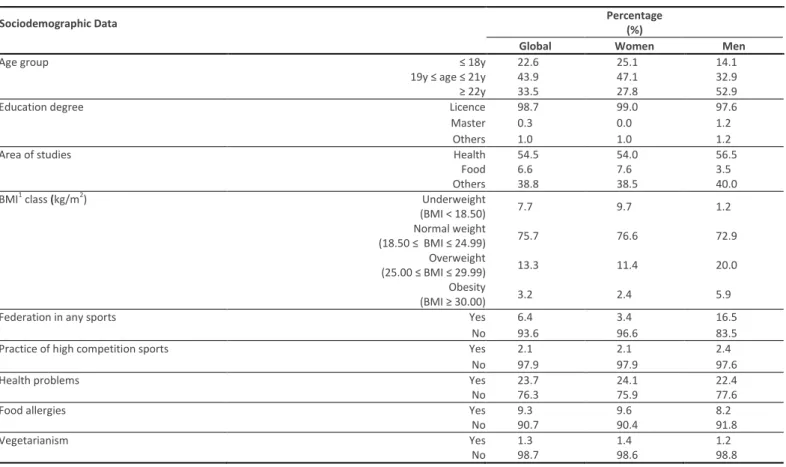
The 376 students involved in this survey were aged between 17 and 51 years, with an average of 31 ± 5 years, from which 77.4% were women and 22.6% were men. The male students were on average slightly older, 22 ± 4 years, when compared to female students (21 ± 5 years). Most of the participants were in the age group of 19-21 years, from which 32.9% were women and 47.1% were men (Table 1).
Regarding the education degree, the majority of the participants (98.7%) attended a license degree, followed by the participants who attended others degrees (1.0%) and only 0.3% attended a master degree, being this tendency similar for both genders (Table 1).
As for the area of studies, there was a predominance of students from health areas (54.5%), 38.8% from areas that were not specified in the questionnaire and 6.6% from food areas. When analysed by gender, a slightly higher percentage of male students (56.5%) were from health areas, when compare to female students.
For the sample at study, the majority of the participants, 75.7%, had a normal weight, being this percentage 76.6% for women and 74.4% for men. It was further observed that a higher percentage of men were overweighted (20.0%), when compared to women (11.4%). On the other hand, 9.7% of women were underweighted, against only 1.2% of men (Table 1).
When the participants were asked if they were federate in any sports, 93.6% answered no, against only 6.4% who answered yes. It was also observed that the majority of the students did not practice any high competition sport (97.9%), being this tendency similar for both genders.
As it can be observed in Table 1, the results indicated that more than half of the students, 76.3%, did not have any health problem (75.9% for women and 77.6% for men), less than 10% had food allergies (9.6% and 8.2%, respectively for women and men) and a minority of 1.3% were vegetarians, being this result again similar among genders.
Table 1 - Sociodemographical characterization according to gender.
Sociodemographic Data Percentage
(%)
Global Women Men
Age group ≤ 18y 22.6 25.1 14.1
19y ≤ age ≤ 21y 43.9 47.1 32.9
≥ 22y 33.5 27.8 52.9
Education degree Licence 98.7 99.0 97.6
Master 0.3 0.0 1.2
Others 1.0 1.0 1.2
Area of studies Health 54.5 54.0 56.5
Food 6.6 7.6 3.5
Others 38.8 38.5 40.0
BMI1 class (kg/m2) Underweight
(BMI < 18.50) 7.7 9.7 1.2 Normal weight (18.50 ≤ BMI ≤ 24.99) 75.7 76.6 72.9 Overweight (25.00 ≤ BMI ≤ 29.99) 13.3 11.4 20.0 Obesity (BMI ≥ 30.00) 3.2 2.4 5.9
Federation in any sports Yes 6.4 3.4 16.5
No 93.6 96.6 83.5
Practice of high competition sports Yes 2.1 2.1 2.4
No 97.9 97.9 97.6
Health problems Yes 23.7 24.1 22.4
No 76.3 75.9 77.6
Food allergies Yes 9.3 9.6 8.2
No 90.7 90.4 91.8
Vegetarianism Yes 1.3 1.4 1.2
No 98.7 98.6 98.8
2.2 Knowledge about food
The Food Wheel is a food guide created in Portugal which aims at helping to choose and combine the foods that should be a part of a daily diet. It is divided into segments representing seven food groups of different sizes, plus the water in the center, and for each it advises the daily portions and percentages recommended for the total daily diet (Rodrigues, Franchini, Graça, & de Almeida, 2006). The results of this study revealed that when confronted with five different images of food wheels, a high
Ferrão, A.C., Raquel Guiné, R., Ferreira, M., Duarte, J., Nunes, B., Morais, P., Sanches, R. & Abrantes, R (2019). Evaluation of food knowledge in a sample of university students in Viseu, Portugal. Millenium, 2(ed espec nº3), 73-80.
DOI: https://doi.org/10.29352/mill0203e.06.00217
e
3
77
percentage of the participants (80.6%) identified the correct food wheel for the Portuguese population. According to gender, 82.5% of the women hit the answer, against 74.1% of the men.
Table 2 presents the results for the participants’ knowledge about some aspects of healthy eating and the results showed that 44.4% of the students fully agreed that a high fiber diet is beneficial to the gastrointestinal tract. Regarding the intake of trans and saturated fats, most of the students, 53.2%, strongly agreed that their intake has the potential to increase the level of LDL (Low Density Lipoprotein) cholesterol. As for the association between the excessive consumption of added sugars and the increase of the glycemic index, 44.7% of the participants strongly agreed with the statement. It was also observed, that participants’ opinions were more divided regarding the effects of bioactive compounds and polyunsaturated fats on their health, and in these cases a higher percentage of the students neither agreed nor disagreed with the statements (29.5% for question 4 and 40.4% for question 5). Besides, more than a half of the participants, 54.3%, strongly agreed that fruits and vegetables are very rich in vitamins and bioactive compounds and none of them totally disagreed with that. According to other studies, even when students are aware about the nutritional aspects of their diets, they have difficulties in adopting healthier eating habits (Abraham, Noriega, & Shin, 2018; Montero, Ubeda, & García, 2006).
Table 2 - Participants’ knowledge about some aspects of a healthy eating (scale from 1 = totally disagree to 5 = totally agree).
Scale 1 (%) 2 (%) 3 (%) 4 (%) 5 (%)
1. A diet rich in fibers is beneficial to the gastrointestinal tract. 2.1 5.9 15.4 32.2 44.4
2. The consumption of trans and saturated fats increases LDL1 cholesterol (bad cholesterol). 1.1 1.1 12.0 32.7 53.2
3. Excessive consumption of added sugars increases the glycemic index. 1.6 5.6 14.9 33.2 44.7
4. The consumption of foods rich in antioxidant compounds helps to prevent degenerative diseases. 1.6 4.0 29.5 35.9 29.0 5. Polyunsaturated fats help to lower LDL cholesterol and raise HDL2 (good cholesterol). 5.9 9.3 40.4 24.7 19.7
6. Fruits and vegetables are very rich in vitamins and bioactive compounds. 0.0 2.1 11.4 32.2 54.3
1LDL – Low Density Lipoprotein. 2HDL - High Density Lipoprotein.
In order to evaluate the students’ degree of knowledge regarding some aspects about healthy eating, were also analyzed the mean scores obtained for each of the statements, measured on a scale from 1 to 5 (1 = very low, 2 = low, 3 = acceptable, 4 = high, 5 = very high). As it can be observed in Table 3, in general, the students revealed a high degree of knowledge about healthy eating (mean values between 4.0 and 5.0), with the exceptions of their acceptable knowledge regarding the effects of bioactive compounds and polyunsaturated fats on human health (mean values equal to 3.87 ± 0.93 and 3.43 ± 1.01, respectively).
Table 3 - Mean scores obtained for the participants’ degree of knowledge about some aspects of a healthy eating (scale from 1 = very low to 5 = very high).
Mean ± SD
1. A diet rich in fibers is beneficial to the gastrointestinal tract. 4.11 ± 1.01
2. The consumption of trans and saturated fats increases LDL2 cholesterol (bad cholesterol). 4.36 ± 0.81
3. Excessive consumption of added sugars increases the glycemic index. 4.14 ± 0.97
4. The consumption of foods rich in antioxidant compounds helps to prevent degenerative diseases. 3.87 ± 0.93 5. Polyunsaturated fats help to lower LDL cholesterol and raise HDL3 (good cholesterol). 3.43 ± 1.01
6. Fruits and vegetables are very rich in vitamins and bioactive compounds. 4.39 ± 0.77
1
LDL – Low Density Lipoprotein.
2
HDL - High Density Lipoprotein.
When the students were asked about the importance of a healthy diet, most of them (72.6%) answered that it is extremely important, and none considered that is not important at all. According to gender, a higher percentage of the women, 75.3%, considered that a healthy diet is an important aspect of their life, against 63.5% of the men.
It was also analysed where students usually obtained information about healthy eating, on a scale ranging from 1 to 5 (1 = never used, 2 = sporadically, 3 = sometimes, 4 = frequently, 5 = always used). As it can be observed in Table 4, the more relevant sources of information were family (3.88 ± 0.93), followed by Internet (3.68 ± 0.96) and school (3.63 ± 1.19). These findings are in accordance with scientific evidences, where it is widely recognised that family is fundamental for the establishment of eating habits (Haines et al., 2016; Hart, Damiano, Cornell, & Paxton, 2015). In another study by Rennis et al. (2015), it was found that students are active users of the Internet and search the web for a variety of health information.
Ferrão, A.C., Raquel Guiné, R., Ferreira, M., Duarte, J., Nunes, B., Morais, P., Sanches, R. & Abrantes, R. (2019). Evaluation of food knowledge in a sample of university students in Viseu, Portugal. Millenium, 2(ed espec nº3), 73-80.
DOI: https://doi.org/10.29352/mill0203e.06.00217
e
3
78
Table 4 - Mean scores obtained for the sources of information about healthy eating (scale from 1 = never, 5 = always, describing the frequency of use).
Mean score (value ± standard deviation)
School Television Friends Books Family Internet
3.63 ± 1.19 3.56 ± 0.94 3.16 ± 1.01 3.38 ± 1.13 3.88 ± 0.93 3.68 ± 0.96
Since schools are considered important for the promotion of a healthy behaviour (Bell, Audrey, Cooper, Noble, & Campbell, 2017), it was also investigated the role of school in transmitting information about healthy eating, either by the programmatic contents of the courses or by inviting a nutritionist to speak about eating habits and nutrition. The results showed that 23.4% of the students indicated that in the course they attend never or rarely are included programmatic contents related to a healthy diet and 19.4% of them indicated that those contents are always or almost always included (Table 5).
Table 5 - Participants’ opinions regarding the programmatic contents related to a healthy eating in the course they attend (scale from 1 = never or rarely, 5 = always or almost always).
1 (%) 2 (%) 3 (%) 4 (%) 5 (%)
In the course that you attend are included programmatic contents related to a healthy diet? 23.4 10.9 20.2 26.1 19.4
Regarding the classes taught by a nutritionist, 66.0% of the students answered that they never had a class with a nutritionist, while 34.0% of the students confirmed that they had already attended a class taught by a nutritionist.
The participants were further asked to do a self-evaluation about the degree of information they considered to have about healthy eating, measured on a scale from 1 (nothing informed) to 5 (totally informed), as it can be observed in Table 6. The average score obtained was 3.91 ± 0.78, which indicates that, in general, students believed to have an acceptable degree of information about healthy eating. When seen by gender, the mean value was equal to 3.90 ± 0.77 for female and 3.96 ± 0.84 for male students, revealing that the men considered themselves just slightly more informed than women. These results are contrary to the ones obtained in the study performed by Abraham and his colleagues (2018), in which it was found that female students tended to have greater nutrition knowledge than male students.
Concerning age group, it was found that the average score was higher for the students aged 22 years and over (4.06 ± 0.84), thus indicating that they considered to be well informed about healthy eating. In fact, according to previous studies, nutrition knowledge tends to increase with age (Hendrie, Coveney, & Cox, 2008; Sapp & Jensen, 1997).
As it was expected, the students who attended studies in food related areas were those that obtained a higher average score (4.20 ± 0.41), when compared to those who attended courses in other areas. These results corroborate those obtained in previous studies, in which nutrition students reported higher frequencies of positive health perceptions (Korn, Gonen, Shaked, & Golan, 2013). Furthermore, it was also observed that the participants who indicated that they had already been present in a class performed by a nutritionist, obtained a higher mean score (4.24 ± 0.71), meaning that they considered to be well informed about this theme.
Regarding the practice of high competitions sports and the degree of information about healthy eating, the results showed that the participants who practiced high competition sports considered to have a higher degree of information about healthy eating (4.63 ± 0.74) than the participants who did not (3.90 ± 0.78).
Table 6 - Mean scores obtained for the participants’ self-evaluation regarding the degree of information about healthy eating according to some sociodemographical characteristics (scale from 1= nothing informed to 5 = totally informed).
Variable Mean ± SD
Age group Age ≤18y 3.85 ± 0.65
19y ≤ age 21y 3.83 ± 0.79
Age 22y 4.06 ± 0.84
Gender Women 3.90 ± 0.77
Men 3.96 ± 0.84
Area of studies Health 4.02 ± 0.86
Food 4.20 ± 0.41
Other 3.72 ± 0.67
Practicing of high competitions sports Yes 4.63 ± 0.74
No 3.90 ± 0.78
Presence in a class taught by a nutritionist Yes 4.24 ± 0.71
No 3.74 ± 0.70
Ferrão, A.C., Raquel Guiné, R., Ferreira, M., Duarte, J., Nunes, B., Morais, P., Sanches, R. & Abrantes, R (2019). Evaluation of food knowledge in a sample of university students in Viseu, Portugal. Millenium, 2(ed espec nº3), 73-80.
DOI: https://doi.org/10.29352/mill0203e.06.00217
e
3
79
Moreover, it was also investigated the students’ concept about the recommended daily portions of some foods, and the results are presented in Table 7. The mean scores obtained revealed that the participants had notion of which foods they must eat in bigger and smaller quantities. However, the maximum and minimum values suggest that students are not fully aware about the correct values for the recommended daily doses. The knowledge about the recommended daily portions is fundamental to follow a healthy diet that meets the nutritional needs of each individual (Gregório, Tavares, Cruz, & Graça, 2017).
Table 7 - Mean values obtained for the participants’ guesses about the recommended daily portions of some foods.
Daily portions
Fruit and
Vegetables Glasses of water Bread Glasses of milk Meat Fat foods
Mean 3.54 7.41 2.05 1.56 1.34 0.96
Standard deviation 1.49 3.95 1.87 0.94 0.93 0.84
Minimum 1 0 0 0 0 0
Maximum 10 30 12 5 7 7
CONCLUSIONS
This study allowed concluding that most students had a normal weight and showed a very low prevalence of overweight and obesity. The majority of the students identified the correct food wheel for the Portuguese population, being this percentage higher for women than men. In general, the students revealed a high degree of knowledge about some aspects related to healthy eating. The privileged sources of information about healthy eating were family and Internet. The students who participated in this study believed to be well informed about healthy eating;
Furthermore, some sociodemographic factors were found to increase the average scores obtained for the students’ self-evaluation regarding the degree of information about healthy eating. In this case, the mean scores were higher for male students, who were aged 22 years or over, those who practiced high competition sport, who were studying areas related to food and for those who had already attended a class performed by a nutritionist.
Overall, the results also revealed that the students are aware of which foods they should ingest in bigger and smaller quantities, but are not very well aware about the exact recommended daily portions.
The findings of this study are very important because they highlighted the importance of continuing to develop health education sessions that can improve the knowledge and skills of university students about healthy eating;
One limitation of this study is related to the fact that it was undertaken on a specific and limited geographical area, and therefore in the future it would be important to include university students from other regions of Portugal. Another limitation is the fact that height and weight values have been self-reported, which means that they might not be as accurate as physical anthropometric measurements.
ACKNOWLEDGEMENTS
This work is financed by national funds through FCT - Fundação para a Ciência e Tecnologia, I.P., under the project UID/Multi/04016/2016. Furthermore we would like to thank the Instituto Politécnico de Viseu and CI&DETS for their support.
REFERENCES
Abraham, S., Noriega, B. R., & Shin, J. Y. (2018). College students eating habits and knowledge of nutritional requirements.
Journal of Nutrition and Human Health, 2(1). Retrieved from
http://www.alliedacademies.org/abstract/college-students-eating-habits-and-knowledge-of-nutritional-requirements-9188.html
Alves, R., & Precioso, J. (2017). Hábitos Alimentares dos/as Estudantes do Ensino Superior. Revista de Estudios e Investigación en
Psicología y Educación, 0(14), 239–244. https://doi.org/10.17979/reipe.2017.0.14.2974
Bell, S. L., Audrey, S., Cooper, A. R., Noble, S., & Campbell, R. (2017). Lessons from a peer-led obesity prevention programme in English schools. Health Promotion International, 32(2), 250–259. https://doi.org/10.1093/heapro/dau008
Cobiac, L. J., Veerman, L., & Vos, T. (2013). The role of cost-effectiveness analysis in developing nutrition policy. Annual Review
of Nutrition, 33, 373–393. https://doi.org/10.1146/annurev-nutr-071812-161133
Deliens, T., Clarys, P., De Bourdeaudhuij, I., & Deforche, B. (2014). Determinants of eating behaviour in university students: a qualitative study using focus group discussions. BMC Public Health, 14, 53. https://doi.org/10.1186/1471-2458-14-53 Gregório, M., Tavares, C., Cruz, D., & Graça, P. (2017). Programa de distribuição de alimentos: considerações para a adequação
Ferrão, A.C., Raquel Guiné, R., Ferreira, M., Duarte, J., Nunes, B., Morais, P., Sanches, R. & Abrantes, R. (2019). Evaluation of food knowledge in a sample of university students in Viseu, Portugal. Millenium, 2(ed espec nº3), 73-80.
DOI: https://doi.org/10.29352/mill0203e.06.00217
e
3
80
Grosso, G., Marventano, S., D’Urso, M., Mistretta, A., & Galvano, F. (2017). The Mediterranean healthy eating, ageing, and lifestyle (MEAL) study: rationale and study design. International Journal of Food Sciences and Nutrition, 68(5), 577–586. https://doi.org/10.1080/09637486.2016.1262335
Haines, J., Rifas-Shiman, S. L., Horton, N. J., Kleinman, K., Bauer, K. W., Davison, K. K., … Gillman, M. W. (2016). Family functioning and quality of parent-adolescent relationship: cross-sectional associations with adolescent weight-related behaviors and weight status. International Journal of Behavioral Nutrition and Physical Activity, 13, 68. https://doi.org/10.1186/s12966-016-0393-7
Hart, L. M., Damiano, S. R., Cornell, C., & Paxton, S. J. (2015). What parents know and want to learn about healthy eating and body image in preschool children: a triangulated qualitative study with parents and Early Childhood Professionals. BMC
Public Health, 15. https://doi.org/10.1186/s12889-015-1865-4
Hendrie, G. A., Coveney, J., & Cox, D. (2008). Exploring nutrition knowledge and the demographic variation in knowledge levels in an Australian community sample. Public Health Nutrition, 11(12), 1365–1371. https://doi.org/10.1017/S1368980008003042
Hilger, J., Loerbroks, A., & Diehl, K. (2017). Eating behaviour of university students in Germany: Dietary intake, barriers to healthy eating and changes in eating behaviour since the time of matriculation. Appetite, 109, 100–107. https://doi.org/10.1016/j.appet.2016.11.016
Korn, L., Gonen, E., Shaked, Y., & Golan, M. (2013). Health Perceptions, Self and Body Image, Physical Activity and Nutrition among Undergraduate Students in Israel. PLoS ONE, 8(3). https://doi.org/10.1371/journal.pone.0058543
Leng, G., Adan, R. A. H., Belot, M., Brunstrom, J. M., Graaf, K. de, Dickson, S. L., … Smeets, P. A. M. (2017). The determinants of food choice. Proceedings of the Nutrition Society, 76(3), 316–327. https://doi.org/10.1017/S002966511600286X
Montero, A. B., Ubeda, N. M., & García, A. G. (2006). [Evaluation of dietary habits of a population of university students in relation with their nutritional knowledge]. Nutricion hospitalaria, 21(4), 466–473.
Okoro, C. S., Musonda, I., & Agumba, J. (2017). Evaluating the Influence of Nutrition Determinants on Construction Workers’ Food Choices. American Journal of Men’s Health, 11(6), 1713–1727. https://doi.org/10.1177/1557988315625775 Rennis, L., McNamara, G., Seidel, E., & Shneyderman, Y. (2015). Google It!: Urban Community College Students’ Use of the
Internet to Obtain Self-care and Personal Health Information. College Student Journal, 49(3), 414–426.
Rodrigues, S. S. P., Franchini, B., Graça, P., & de Almeida, M. D. V. (2006). A new food guide for the Portuguese population: development and technical considerations. Journal of Nutrition Education and Behavior, 38(3), 189–195. https://doi.org/10.1016/j.jneb.2006.01.011
Sapp, S. G., & Jensen, H. H. (1997). Reliability and Validity of Nutrition Knowledge and Diet-Health Awareness Tests Developed from the 1989–1991 Diet and Health Knowledge Surveys. Journal of Nutrition Education, 29(2), 63–72. https://doi.org/10.1016/S0022-3182(97)70157-2
WHO. (2013). Global action plan for the prevention and control of noncommunicable diseases 2013-2020. World Health Organization. Retrieved from http://www.who.int/nmh/events/ncd_action_plan/en/
WHO. (2017). Noncommunicable Diseases Progress Monitor 2017 (p. 231). Geneva: World Health Organization. Retrieved from http://www.who.int/nmh/publications/ncd-progress-monitor-2017/en/
Wilson, C. K., Matthews, J. I., Seabrook, J. A., & Dworatzek, P. D. N. (2017). Self-reported food skills of university students.