A Work Project, presented as part of the requirements for the Award of a Master Degree in Economics from the NOVA – School of Business and Economics, developed during a Direct Research Internship at the GPEARI - Office for Economic Policy and International Affairs of
the Portuguese Ministry of Finance
The Effects of Structural Reforms on Employment
Outcomes in Portugal: A Short-Term Analysis
José Eduardo Vera de Matos 787
A Project carried out on the Master in Economics Program, under the supervision of Ana Fontoura Gouveia and Susana Peralta
2
The Effects of Structural Reforms on Employment Outcomes in Portugal:
A Short-Term Analysis
Abstract
This paper evaluates the short-term effects of both product and labour market reforms on employment growth. Using Portuguese firm-level data, covering the period 2006-2015, we show that product market deregulation brings employment gains. Concerning the labour market, while expenditure in active labour market policies and reductions of the tax wedge are also associated with positive employment developments, reforms targeted at lowering employment protection are associated with lower employment growth, at least during the short-term.
JEL Classification: D04, D22, J21, J23, H25, L51, M50
Keywords: Structural Reforms, Labour Market, Product Market, Employment
Acknowledgements
I would like to thank Ana Fontoura Gouveia (GPEARI – Ministry of Finance and Nova SBE) and Susana Peralta (Nova SBE) for their supervision, suggestions and motivation. In addition, I am grateful to Paulo Rodrigues (Nova SBE) and José Azevedo Pereira (GPEARI – Ministry of Finance) for helpful comments, Peter Gal (OECD) for providing data on product market reforms and Andrea Bassanini (OECD) for useful guidance on the STATA code. I would also like to thank Banco de Portugal, an in particular Carla Ferreira (Banco de Portugal) for providing the firm-level data and Ana Filipa Fernandes (GPEARI – Ministry of Finance) for the treatment of the initial database.
3 1. Introduction
The literature concerning the long-term effects of product and labour market structural reforms on macroeconomic outcomes is very rich, mainly due to the annual reports made by supranational institutions such as the OECD, the IMF and the European Commission, usually relying on aggregate data and cross-country analysis.
In recent years, short-term effects have gained weight in the literature, given their relevance for the political economy of the reform process. Understanding short-term dynamics is crucial for policy makers to design the optimal reform package, both in terms of sequencing and bundling of reforms. Additional, short-term effects are also key for the ownership of the reforms and for overall support. This is particularly true for employment, given that voters usually do not support reforms which cause significant job destruction (even if only in the short-term), thus penalizing the incumbent government (Buti et al., 2010). In the case of the reform process recently implemented in Portugal during the Economic Adjustment Programme in 2011-2014, the European Commission highlights the relevance of political economy considerations, underlining that “partners had to strike a difficult balance between pushing for more reforms and avoiding risks a political crisis in the government coalition or of breaking the social consensus” (European Commission, 2016). Indeed, Portugal is an interesting case study for reforms’ impact assessment, as it implemented a comprehensive and broad-based reform agenda during the past decade, with important reforms inter alia in the areas of product and labour markets.
A number of studies focus on the productivity effects of these reforms (see Gouveia, Santos and Gonçalves, 2017 or Monteiro, Gouveia and Santos, 2017). Thereby, the aim of this paper is to provide a closer look at the impact of the reforms on employment outcomes of Portuguese firms, since it complements past research at national level. Using a firm-level dataset covering all Portuguese firms for the period 2006-2015, we estimate a first-difference
4
model of employment growth with contemporaneous and lagged effects of the different reforms. We are thus able to compute impulse-response functions for the effects of the reforms one and two years after implementation. Our results show that product market deregulation, reductions of the tax wedge and increased spending in active labour market policies (ALMP) all bring employment gains, at least in the short-term. On the contrary, the effects of labour market deregulation are associated with short-term employment costs. The remainder of the paper is organized as follows: Section 2 provides an overview of the main reforms recently implemented; Section 3 summarizes the relevant literature concerning the effects of reforms on employment outcomes; Section 4 presents the methodology; Section 5 provides a detailed description of the data, and Section 6 presents the empirical findings and the robustness analysis. Finally, Section 7 concludes and presents avenues for further research.
2. A Bird’s Eye View on Recent Reforms
This section provides an overview of the recent product and labor market reforms implemented in Portugal, to shed light on the type of changes that are being assessed. We focus on four main areas: product market regulation, the strictness of the employment protection legislation, the magnitude of the tax wedge (i.e. ratio of labour taxation to total labour cost for the employer) and the so-called active labour market policies such as short-term training programs to improve the skills of labour supply, hiring subsidies for the unemployed in order to increase labour demand or investment to improve job matching. The choice of these reform areas follows three criteria: effective implementation of the reform in Portugal during recent years, variability of the available reform indicator and lack of single country, firm-level studies evaluating the impact of those reforms on the employment outcomes.
5
Product market deregulation, mainly in upstream sectors such as networks, begun even before the Economic Adjustment Programme and was key to improve the business environment. Liberalizing energy markets, like electricity and gas, controlled by their main incumbents (EDP and GALP) was an important step to put an end to entry barriers and further accumulation of excessive rents. Some adopted policies include reduce compensation for early termination of long-term purchase agreements, phasing out regulated tariffs and increase efforts to integrate Portuguese and Spanish energy markets. Changes in the transport sectors were also made, since competition in railways and ports was low. Despite delays, some loss-making railway lines were closed, CP Carga privatization started, the gradual elimination of port user fees helped exporting firms, and both TAP and the airport infrastructures’ manager (ANA) were privatized in order to improve efficiency in aviation sector. Regarding the telecommunications and postal sectors, many changes were made to strengthen the power of the regulator and to lower entry barriers, particularly through the abolishment of State’s privileged position and its golden shares in Portugal Telecom (PT), the entry into force of a new regulatory framework concerning telecommunications and the privatization of the national postal service (CTT), among others.
In recent years, there were also important reforms of employment protection, namely with reduced severance payments for fair dismissals of permanent employees (from the formerly 30 days per year worked down to 20 days, and later on 12 days) and the introduction of additional criteria to dismiss workers when a work position is extinct, relaxing the employment protection legislation. Labour taxation was also subject to important changes in recent years, with an increase of income taxation and higher social security contributions paid by employees and employers; which implied a significant tax wedge increase. Concerning ALMP, public spending has started to increase again in 2012, after a large drop in 2009. In recent years, changes were made to improve the quality of these policies, namely by
6
modernizing Public Employment Services to better match jobseekers with employers or temporary work agencies (see OECD, 2017 for more information).
3. Literature Review
3.1 Product Market Reforms Product Market Regulation
Empirical research using aggregate or industry-level (cross-country) data shows that pro-competitive reforms have a positive impact on employment outcomes in the long-run, often with short-term costs (see, for instance, IMF, 2016 and Cacciatore and Fiori, 2016 for studies using aggregate data; and OECD, 2016 using industry-level data).
Firm-level studies provide evidence of positive effects of product market deregulation on employment already in the short-term (see, e.g., Bertrand and Kramarz, 2002, for France; Viviano, 2008, for Italy, and Gal and Hijzen, 2016, for a cross-country analysis). Yet, some authors find short-term direct costs from deregulation in network industries, mainly due to re-organization and downsizing, allowing a cost reduction to deter the entry of competitors (Bassanini, 2015).
3.2 Labor Market Reforms
Employment Protection Legislation
Empirical findings suggest a positive impact on net employment from an EPL reduction (see, e.g., Kugler et al., 2003 for Spain, Autor et al., 2006 for the U.S., and Martins, 2009, evaluating the short-term impact of a reform introduced in Portugal, and Micco and Pagés, 2006, who use cross-country industry-level data). However, some firm-level studies show that reforms introducing less stringent legislation have, in the short-run, an immediate effect on dismissals with a milder effect on hirings (Messina and Vallanti, 2007). Thus, it results on a non-positive impact in the firm’s short-term net employment, as obtained by Von Below and
7
Thoursie (2010), using an employer-employee linked panel dataset for Sweden. Also, Boeri and Jimeno (2005), relying on individual data for Italy, find evidence that permanent employees in firms with better firing practices have higher probabilities of being dismissed.
Tax Wedge
In general, cross-county studies show that reducing the labour tax wedge increases employment rates in the long-term (e.g. Bouis and Duval, 2011 using industry-level data; Nickell, 2003, Bouis et al., 2012 and IMF, 2016 using aggregate data). Equivalently, Bassanini and Duval (2006) show that, for the “average” OECD country, higher tax wedges are associated with increased unemployment. Interestingly, some authors show that the magnitude of those effects depends on institutional features, such as the skill level of the labor force (Gorá et al., 2006), or unemployment benefits and minimum wages (Nickell, 2003; Kugler and Kugler, 2008).
Active Labor Market Policies
The literature suggests a positive relationship between public-sponsored training programs and employment rates in the long-term (Boone and van Ours, 2004 using cross-country aggregate data; Lechner et al., 2004 and Fitzenberger and Speckesser, 2005 both relying on micro-level, administrative data for Germany). In the short-term, evidence also points to positive employment effects (e.g. Lechner et al., 2004 highlight the effects of training). In Portugal, a recent paper by Martins and Pessoa e Costa (2014) shows that jobseekers receiving unemployment benefits who participate in job centre meetings, which include counselling and monitoring, are more likely to exit from unemployment than their non-treated counterparts.
8 4. Methodology
The empirical strategy for assessing the impact of structural reforms on employment is based on Bassanini (2015) and OECD (2016), which uses a first-difference model for contemporaneous and lagged effects. We also use Teulings and Zubanov (2014) local projections estimators to obtain impulse-response functions that allow for the identification of the reforms’ impact in different time horizons (y).
4.1. Baseline Regression for Short-Term Analysis
We implement a specification that estimates the effect of the reform up to Y years after its implementation relying on a system of simultaneous equations with leads (f) and lags (k):
ΔEmploymenti,t+y = ∑𝑦𝑓=1βfy ΔReformt+f + ∑𝑘=0𝑛 βky ΔReformt-k + ∑𝑛𝑘=1βky ΔEmploymenti,t-k +
ϒ1Xit + ϒ2Dj + ϒ3Dg + ϒ4Dt + Ɛit [1]
For y ∈ (0, Y) and where ΔEmploymenti,t+y is the first difference of the logarithm of
employment in firm i at time t+y (i.e. y years after the reform), ΔReformt+f is the change in
the reform indicator f years after t (with f ≤ y), and ΔReformt-k is the change in the reform
indicator k years before t. The k years lag is also used to account for past employment changes (ΔEmploymenti,t-k) in order to mitigate serial correlation issues. Xit are controls for firm-level
observables, and Dj, Dg and Dt are, respectively, dummies to control for unobserved
industry-specific effects, geographic location fixed-effects and time macroeconomic developments that are common across firms. Standard errors are robust and clustered by industry to account for heteroscedasticity.
9
The cumulated response (CR) at y periods after the reform implementation is computed by summing the estimated coefficients of the first-differences, following OECD (2016):
CR (y) = ∑𝑌 β
𝑦=0 0y
The contemporaneous effect (y = 0) is only used for the case of indirect effects of regulation, i.e. for the effect of changes in upstream regulation on downstream sectors, where omitted variable bias and reverse-causality is less of a concern. For the other reforms, we start at y = 1 precisely to avoid these issues. Unobserved, time-invariant, firm heterogeneity is eliminated by first-differences.
Moreover, in order to have a view beyond the impact of reforms on the average firm, we weigh the regressions with each firm’s average number of workers. Thus, our regressions give more relevance to firms for whom a given increase in employment is more important for the economy.
4.2. Baseline Regression for the Difference-in-Differences Estimation
We also present causal evidence of some specific reforms’ impact with Difference-in-Differences (DiD) specifications of the form:
Employmentit = β0Ti + β1Pt + β2 Ti . Pt + ϒ1Xit + ϒ2Dg + Ɛit [2]
where Employmentit is number of workers in firm i at time t, Xit are controls for observables,
and Dg are again geographic fixed-effects. Ti is an indicator variable for the treatment group,
and Pt indicates the after-reform period. In our DiD estimations fixed-effects (FE) are used
10 5. Data
5.1. Firm-level Database
We use firm-level data from the Informação Empresarial Simplificada database (IES), provided by Banco de Portugal. The dataset covers the entire population of firms in Portugal and includes annual information on their balance sheets, profit and loss statements and staff establishments. The data includes 3,840,634 observations for the 2006-2015 period. We eliminate firms with non-positive values of assets, liabilities, turnover or labour costs, as well as unreasonable values of debt to assets ratio. Moreover, sectors with a very particular business model were also excluded, as public administration, education, health care, household staff, international agencies or non-governmental organizations. Industries are classified according to the Statistical Classification of Economic Activities in the European Union at 3-digit level. In addition, and in line with Gal and Hijzen (2016), only firms that report, on average, at least 3 workers were taken into account. Therefore, our final dataset includes 1,287,142 observations, for a total of 183,222 firms.
5.2. Variables and Descriptive Statistics
Our main variable of interest is the total number of workers, for each firm and year. We use several firm-level controls in light of Gal and Hijzen (2016), including age (0-9; 10-24; 25+); size, a categorical variable computed by Instituto Nacional de Estatística (INE)1; debt to assets ratio, with debt proxied by non-current liabilities, and the ratio grouped according to year-specific terciles: low debt, some debt and high debt. We use turnover per worker to measure labour productivity (LP), and again categorize it into year-specific terciles.
1 Micro: less than 10 workers and turnover less than €2Million; Small: from 10 up to 50 workers and turnover
from €2Million up to €10Million; Medium: from 50 up to 250 workers and turnover from €10Million up to €50Million; Large: 250 or more workers and turnover higher than €50Million.
11
In addition, geographic location fixed-effects are given by the Portuguese 1st level administrative division (districts). Table 1 presents the descriptive statistics of key variables of interest.
Table 1 - Descriptive Statistics of Key Variables from IES (2006-2015)
Variable Unit Mean Std. Deviation Minimum Maximum
Turnover 103€ 2,264 36,500 0 9,630,000
Assets 103€ 3,058 82,800 0 27,100,000
Liabilities 103€ 2,177 61,400 0 24,000,000
Labour Productivity 103€ 113,753 1,600,317 0 486,000
Labour Costs per Hour € 22 1,347 0 976,286
Debt to Assets unit 0.26 1.79 0 196.61
Nr. Workers unit 17.4 132.571 0 23,768
∆Employment % 0.001 0.374 -6.975 7.008 Source: author’s own computations using the IES dataset for the 2006-2015 period. N = 1,287,142
Figure 1 illustrates the mean of employment growth (∆Employment), in percentage, for the average Portuguese firm in each year. It can be noted that, on average, larger employment gains occurred in 2007 and larger employment losses in 2012.
Figure 1 - Mean of Employment Growth for the Average Firm (per year, %)
12
5.3. Reform Indicators
We use the Regulatory Impact index provided by the OECD, an index of regulation in network sectors (energy, transport and communication) weighted by the input of those sectors used by each type of industry in Portugal (Regimpact PT) to measure the impact of product market reforms. The higher the index for a given industry, the larger the costs it bears from anti-competitive regulations in network sectors. Because country-specific weights can be endogenous, sectoral input weights for the US are also used for robustness purposes, as the input-output matrix in the US is closer to a situation with none or little regulation (see Rajan and Zingales, 1998). Yearly data, by industry, are available from 2004 until 2013.
We proxy employment protection legislation with the Hiring and Firing Practices indicator (HFP) provided by the World Competitiveness Index of the World Economic Forum. This variable ranks from a minimum flexibility of 1 to a maximum of 7. Yearly data are available from 2006 until 2015.
In order to estimate the impact of labour taxation, we use the OECD’s average tax wedge in Portugal, for a single person at 100% of average earnings without children. It consists on the ratio of labour taxation to total labour cost for the employer, representing additional costs with taxes both for employers and employees. Yearly data are available from 2000 until 2015. Finally, ALMP is measured by the governmental expenditure in active policies for those looking for a job (category 10 to 70), as a percentage of the GDP. This variable is provided by the OECD’s dataset on public expenditure and participant stocks on labour market programmes.2 Yearly data are available from 2004 until 2014.
2 ALMP are very heterogeneous and thus proxying them with a measure such as overall spending has limitations
13
Figure 2 - Reform Indicators
Indicator’s source: OECD Indicator’s source: World Economic Forum
Indicator’s source: OECD Indicator’s source: OECD
Note: author’s own computations. Product market regulation’s indicator is represented in this figure with no industry-specific weights
6. Empirical Results and Robustness Checks
6.1 Short-term Analysis: Impulse Response Functions 6.1.1. Product Market Reforms
Results show that employment losses from higher regulation of network sectors are visible already in the short-run (Figure 3). This is an expected result given that as networks become more competitive there is a reduction in their output prices and/or an increase in quality, which bring benefits for the all firms using networks as inputs in their production processes (downstream industries). Similar but larger effects can be seen in the weighted estimation, which means that firms with more workers are more harmed by regulation in upstream industries.
14
These results corroborate the literature who finds positive effects of deregulation of upstream sectors, such Gal and Hijzen (2016); Bertrand and Kramarz (2002) and Viviano (2008). Moreover, the impact on employment from regulation of network sectors is still negative and significant when, for purposes of robustness, the regulatory impact indicator using weights for Portugal is replaced by the one using US weights.
Figure 3 - Cumulative Impact of Product Market Regulation (%)
Non-weighted estimation Weighted estimation
Source: author’s own computations
6.1.2. Labour Market Reforms
According with the presented estimates, less stringent dismissal legislation is associated with employment losses, at least in the short-term (Figure 4). The intuition is that firms tend to initially dismiss workers and only after start to hire, in particular during periods of crisis.3 In any case, by comparing the weighted and non-weighted results, one can see that firms with more workers face relatively lower employment losses. Overall, our results are in line with the findings of Messina and Vallanti (2007) and Von Below and Thoursie (2010).
3
However, what can be seen as a loss in terms of employment does not necessarily mean a loss in terms of labour market efficiency, given that a firm that faces better firing conditions may dismiss two employees with low productivity while hiring another who is more productive However, the results in Gouveia, Santos and Gonçalves (2017) show that a more flexible labour market is detrimental to total factor productivity, except for the 8% least productive firms.
-2,0 -1,5 -1,0 -0,5 0,0 0,5 0 1 2 ∆ E m pl oy m e nt
Years After Reform
-2,0 -1,5 -1,0 -0,5 0,0 0,5 0 1 2 ∆ E m pl oy m e nt
15
Figure 4 - Cumulative Impact of Easing Firing and Hiring Practices (%)
Non-weighted estimation Weighted estimation
Source: author’s own computations
Looking now at the tax wedge prevailing in Portugal for the average wage (single earner without children), our results are in line with economic theory predictions and with most existing empirical literature. Increasing labour taxation as a percentage of employers’ labour costs reduces employment growth, at least in the short-term (Figure 5). This is especially relevant in a context of sticky wages, when a high tax wedge is synonym of high costs both for the employer (demand side) and employee (supply side), then reducing employment incentives. Results are similar in the weighted and non-weighted estimation.
Figure 5 - Cumulative Impact of Tax Wedge (%)
Non-weighted estimation Weighted estimation
Source: author’s own computations -0,20 -0,15 -0,10 -0,05 0,00 0,05 0,10 0 1 2 ∆ E m pl oy m e nt
Years After Reform
-0,20 -0,15 -0,10 -0,05 0,00 0,05 0,10 0 1 2 ∆ E m pl oy m e nt
Years After Reform
-0,20 -0,15 -0,10 -0,05 0,00 0,05 0,10 0 1 2 ∆ E m pl oy m e nt
Years After Reform
-0,20 -0,15 -0,10 -0,05 0,00 0,05 0,10 0 1 2 ∆ E m pl oy m e nt
16
Finally, spending in active labour market polices is found to be effective in increasing employment. Indeed, and in line with Lechner et al. (2004), employment effects are positive in the short-term and increasing with time, both for the average firm and for firms with more workers (Figure 6).
Figure 6 - Cumulative Impact of Active Labour Market Policies (%)
Non-weighted estimation Weighted estimation
Source: author’s own computations
Table 2 - Impact of Reforms on the Contemporaneous Employment Change
Panel OLS Weighted Panel OLS Variable Years After Reform
(y) ∆Employment N ∆Regimpact PT 0 -0.13 [-0.59; 0.34] -0.51*** [-0.55; -0.47] 267,959 1 -0.20 [-0.61; 0.20] -0.71*** [-0.76; -0.65] 200,172 2 -0.38** [-0.68; -0.09] -0.38*** [-0.45; -0.31] 138,354 ∆HFP 0 1.89 [-5.04; 8.82] 6.90*** [5.96; 7.84] 526,408 1 -0.10*** [-0.14; -0.06] -0.06*** [-0.06; -0.06] 425,143 2 -0.02** [-0.04; -0.01] -0.03*** [-0.03; -0.03] 330,500 ∆Tax Wedge 0 -0.01*** [-0.02; -0.01] -0.01*** [-0.01; -0.01] 526,408 1 -0.12*** [-0.16; -0.10] -0.10*** [-0.10; -0.09] 425,143 2 0.03*** [0.02; 0.04] 0.02*** [0.02; 0.02] 330,500 -0,20 -0,10 0,00 0,10 0,20 0,30 0,40 0 1 2 ∆ E m pl oy m e nt
Years After Reform
-0,20 -0,10 0,00 0,10 0,20 0,30 0,40 0 1 2 ∆ E m pl oy m e nt
17 ∆ALMP 0 0.00 [-.12; 0.12] -0.05*** [-0.06; -0.04] 447,747 1 0.20*** [0.11; 0.29] 0.19*** [0.18; 0.19] 349,712 2 0.16*** [0.11; 0.22] 0.13*** [0.13; 0.13] 260,929
Industry Fixed Effects Yes Yes
Geographic Fixed Effects Yes Yes
Time Fixed Effects Yes Yes
Legend: *p-value <0.1; **p-value <0.05; ***p-value <0.01 Source: author’s own computations
For further robustness, the same model was re-estimated using paid employees instead of the total number of workers and results did not change. The same was done without taking into account micro firms, but again with no significant changes for purposes of policy evaluation.
6.2. Using Policy Variations as Quasi-Experiments Natural Hiring and Dismissal Rates
Given the lack of consensus in the literature concerning employment effects of labor liberalization, we complement our analysis with a difference-in-differences (DiD) estimation (following [2]), in order to address causal inference in a more robust way, without possible problems of reverse-causality or omitted variable bias. By comparing employment developments of two groups of firms – one more exposed to labour market regulation than the other – we assess the impact of the largest change in hiring and firing practices during the period considered in our analysis (Figure 2).
As explored by Micco and Pagés (2006) and Bassanini et al. (2009), industries where layoff rates are higher (used as proxies for higher job turnover rates) are more likely to be affected by changes in employment protection legislation (EPL). Therefore, using sectoral data on US layoff rates computed by Bassanini et al. (2009) from 2001 to 2003, we have an exogenous indicator of EPL “bindness” for a given sector in a liberalized market (US), providing us with a measure of natural layoff propensity. Therefore, following Bassanini et al. (2009), firms
18
within industries whose average US layoff rate is above the median of US layoff rates for all industries are considered EPL-binding (treatment group) and the ones whose average US layoff rate is below this threshold are not (control group).4
In addition, and to properly identify the post-reform period, we find that laws introducing reductions in severance payments and making fair dismissals easier, entered into force in late 2011/early 2012 (Law 53/2011 of 14 October 2011, Law 3/2012 of 10 January 2012 and 3rd amendment to Labour Code no.23/2012, of 25 June 2012). Thus, the post-reform period considered is captured by the dummy “Reform” taking the value 1 from 2012 onwards.
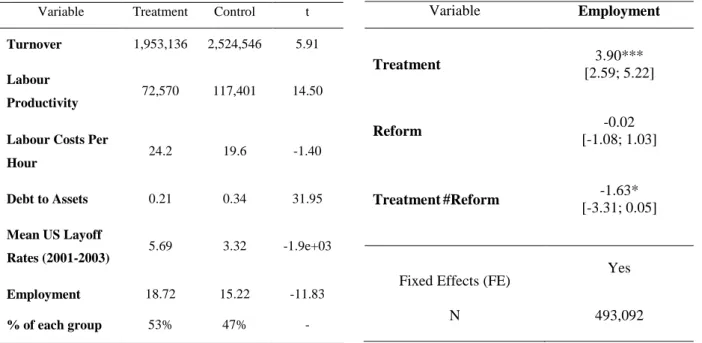
Table 3 - Descriptive Statistics Table 4 - Difference in Differences Estimation Results
Legend: *p-value <0.1; **p-value <0.05; ***p-value <0.01 Source: author’s own computations
Table 3 show the means of some key variables and respective test of equality of means between control and treatment groups. To account for large differences between groups, the
4 Sectors in the treatment group: textiles and leather, products of wood and cork; refined petroleum products;
rubber and plastics; fabricated metal products; basic metals; other non-metallic products; machinery n.e.c.; manufacturing n.e.c. and recycling; precision and optimal equipment; transport and storage; transport equipment; construction; post and telecommunications; electrical machinery and apparatus.
Sectors in the control group: food products and beverages, paper, printing and publishing; chemicals and chemical products; electricity, gas and water supply; wholesale trade; hotels and restaurants; retail trade (including motor trade).
Variable Treatment Control t
Turnover 1,953,136 2,524,546 5.91
Labour
Productivity 72,570 117,401 14.50
Labour Costs Per
Hour 24.2 19.6 -1.40 Debt to Assets 0.21 0.34 31.95 Mean US Layoff Rates (2001-2003) 5.69 3.32 -1.9e+03 Employment 18.72 15.22 -11.83 % of each group 53% 47% - Variable Employment Treatment 3.90*** [2.59; 5.22] Reform -0.02 [-1.08; 1.03] Treatment#Reform [-3.31; 0.05] -1.63*
Fixed Effects (FE) Yes
19
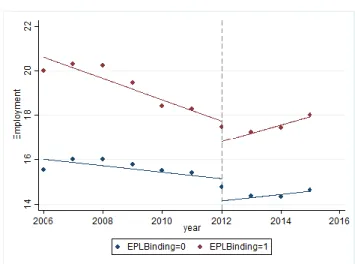
variables size, labour productivity and debt to assets are used as controls in the baseline regression [2]. Figure 7 presents the evolution of employment for the two groups and the break point being considered (2012).
Table 4 presents the results from the DiD estimation. We show that, as expected, the reform has no impact for the control group. For firms within sectors with higher layoff propensity, we find evidence of significant net job destruction after the implementation of reforms making employment protection legislation less stringent, which corroborates the results presented in Section 6.1.
Figure 7 - Mean of Employment (employees)
Source: author’s own calculations.
Note: This graph was produced using Binscatter command in STATA.
Finally, we use other reform dummies as a placebo experiment (for example, assuming that our post-reform period begins in 2008 instead of 2012), finding no significant results.
7. Conclusion
During the last decade, Portugal has implemented a set of structural reforms in several areas. Understanding the short-term impact of these reforms is crucial for policy makers to design the optimal reform mix. Additionally, short-term effects are key for the ownership of the process, with employment developments being particularly relevant for the support for reform.
20
Using firm-level data for Portugal, from 2006 to 2015, and relying on reform indicators provided by supranational institutions as OECD and the World Economic Forum, we conclude that product market reforms, aiming to decrease the level of regulation and entry barriers in network sectors, have a positive effect on firm-level employment in the years following the reform, given that many firms benefit from increased competition in upstream sectors. We also find that increasing labour market flexibility through easier hirings and firing practices has a negative impact on employment, at least during the short-term. In addition, reducing labour taxation and increasing public expenditure in active labour market policies are found to be effective in the short-term.
Going forward, we are extending our work to understand heterogeneous effects across firms, including also longer-term effects. This will allow us to better identify gainers and losers and thus to better inform policy makers.
Moreover, the results are informative on the impact on the quantity of employment, but are silent on the quality of employment, which is key for assessing equity considerations. Future research, based on worker-level datasets should aim at shedding light on these topics. In addition, it should be noted that the effects of labour market regulation reforms are assessed in our setting based on firm-level data, which provide us with net employment levels but not with churn rates. This is an important element to understand labour market dynamics but could only be incorporated using worker-level datasets. On measures of active labour market policies, our indicator is overall spending. However, given that ALMP include many heterogeneous policies, generalizations of our results need to be done with care. In particular, efficiency consideration should be taken into account through a cost-benefit analysis, which would help measuring the impact of public investment in this area.
Finally, and in line with the literature, the effect of the cycle should be taken into account. For this to be possible, longer time series are needed.
21 References
Autor, D. H., Donohue III, J. J. and Schwab, S. J. 2006. “The Costs of
Wrongful-Discharge Laws”. Review of Economics and Statistics, 88(2): 211-231.
Bassanini, A. 2015. “A Bitter Medicine? Short-term Employment Impact of Deregulation in
Network Industries”. IZA Discussion Paper, No. 9187.
Bassanini, A. and Duval, R. 2006. “Employment Patterns in OECD Countries: Reassessing
the Role of Policies and Institutions”. OECD Social, Employment and Migration Working Papers, No. 35. OECD Publishing, Paris.
Bassanini, A., Nunziata, L., Venn, D. 2009. “Job Protection Legislation and Productivity
Growth in OECD Countries”. Economic Policy, 58: 349-402.
Bertrand, M. and Kramarz, F. 2002. “Does Entry Regulation Hinder Job Creation?
Evidence from the French Retail Industry”. Quarterly Journal of Economics, 117(4): 1369-1413.
Boeri, T., and Jimeno, J. F. 2005. “The Effects of Employment Protection Learning from
Variable Enforcement”. European Economic Review, 49(8): 2057-2077.
Boone, J., van Ours, J.C. 2004. “Effective Active Labor Market Policies”. IZA Discussion
Paper, No. 1335.
Bouis, R., Causa, O., Demmou, L., Duval, R. and Zdzienicka, A. 2012. “The Short-Term
Effects of Structural Reforms: An Empirical Analysis”. OECD Economics Department Working Papers, No. 949. OECD Publishing, Paris.
Bouis, R. and Duval, R. 2011. “Raising Potential Growth After the Crisis: A Quantitative
Assessment of the Potential Gains from Various Structural Reforms in the OECD Area and Beyond”. OECD Economics Department Working Papers, No. 835. OECD Publishing, Paris.
Buti, M., Turrini, A., Van den Noord, P. and Biroli, P. 2010. “Reforms and Re-Elections
22 Cacciatore, M. and Fiori, G. 2016. “The Macroeconomic Effects of Goods and Labor
Markets Deregulation”. Review of Economic Dynamics, 20: 1-24.
Card, D., Kluve, J. and Weber, A. 2010. “Active Labour Market Policy Evaluations: A
Meta-Analysis”. The Economic Journal, 120: 452-477.
European Commission. 2016. “Ex-Post Evaluation of the Economic Adjustment
Programme. Portugal, 2011-2014”. Institutional Papers, No. 40.
Fitzenberger, B. and Speckesser, S. 2005. “Employment Effects of the Provision of Specific
Professional Skills and Techniques in Germany”. IZA Discussion Paper, No. 1868.
Gal, P. and Hijzen, A. 2016. “The Short-Term Impact of Product Market Reforms: A
Cross-Country Firm-Level Analysis”, OECD Economics Department Working Papers, No. 1311. OECD Publishing, Paris.
Góra, M., Radziwiłł, A., Sowa, A. and Walewski, M. 2006. “Tax Wedge and Skills: Case of
Poland in International Perspective”. CASE - Center for Social and Economic Research, No. 64.
Gouveia, A. F., Santos, S. and Gonçalves, I. 2017. “The Impact of Structural Reforms on
Productivity: The Role of the Distance to the Technological Frontier”. OECD Productivity Working Papers, No. 08.
International Monetary Fund. 2016. “Time for a Supply-Side Boost? Macroeconomic
Effects of Labor and Product Market Reforms”. In World Economic Outlook: Too Slow for Too Long, 101-142. IMF Staff Report, Washington.
Kugler, A. and Kugler, M. 2008. “Labor Market Effects of Payroll Taxes in Developing
Countries: Evidence from Colombia”. NBER Working Paper, No. 13855.
Kugler, A., Jimeno, J. F. and Hernanz, V. 2003. “Employment Consequences of Restrictive
Permanent Contracts: Evidence from Spanish Labor Market Reforms”. IZA Discussion Paper, No. 657.
23 Lechner, M., Miquel, R. and Wunsch, C. 2004. “Long-Run Effects of Public Sector
Sponsored Training in West Germany”. IZA Discussion Paper, No. 1443.
Martins, P. S. 2009. “Dismissals for Cause: The Difference That Just Eight Paragraphs Can
Make. Journal of Labor Economics, 27(2).
Martins, P. S. and Pessoa e Costa, S. 2014. “Reemployment and Substitution Effects from
Increased Activation: Evidence from Times of Crisis”. Centre for Globalisation Research Working Paper, No. 52.
Messina, J. and Vallanti, G. 2007. “Job Flow Dynamics and Firing Restrictions: Evidence
from Europe”. Economic Journal, 117: 279-301.
Micco, A. and Pagés, C. 2006. “The Economic Effects of Employment Protection: Evidence
from International Industry-Level Data”. IZA Discussion Paper, No. 2433.
Monteiro, G., Gouveia, A. F., Santos, S. 2017. “Short-Run Effects of Product Markets’
Deregulation: A More Productive, More Efficient and More Resilient Economy?”. GPEARI-Portuguese Ministry of Finance, Article 02/2017.
Nickell, S. 2003. “Employment and Taxes”. CESifo Working Paper, No. 1109.
Organization for Economic Co-operation and Development. 2017. “Labour Market
Reforms in Portugal 2011-2015. A Preliminary Assessment”. OECD Publishing, Paris.
Organization for Economic Co-operation and Development. 2016. “Short-Term Labour
Market Effects of Structural Reforms: Pain Before the Gain?” In OECD Employment Outlook 2016, 111-167. OECD Publishing, Paris.
Rajan, R. and Zingales, L. 1998. “Financial Dependence and Growth”. American Economic
Review, 88(3): 559-586.
Teulings, C. and Zubanov, N. 2014. “Is Economic Recovery a Myth? Robust Estimation of
24 Viviano, E. 2008. “Entry Regulations and Labour Market Outcomes: Evidence from the
Italian Retail Trade Sector”. Labour Economics, 15: 1200-1222.
Von Below, D. and Thoursie, P. 2010. “Last In, First Out? Estimating the Effect of Seniority