The role of CEO’s overconfidence and gender diversity in top
management teams in firm performance.
André Dantas Matos
UM i6149940 | Nova SBE 27359
January 2018
Master thesis developed under the supervision of:
Professors Boris Lokshin and Joana Story
School of Business and Economics, Maastricht University
Abstract
This thesis focuses on leader’s overconfidence and their influence on firm performance, measured by the ROA. Overconfidence may bias several decisions inside companies, namely the risk component that ought to be undertaken by the CEO and Top Management Team. The data was collected through the analysis of the letters to the shareholders presented in the annual reports, namely word counting related to different personality traits. Letters from 2008 to 2016 were gathered, in a total of 1162 letters from 148 companies and 350 CEOs from different industries. The second dimension studied was gender diversity in the top management team and the overconfidence of the CEO. Women in general are considered more risk averse than men in the literature, which could mean a negative influence on the relationship between overconfidence and performance. However, since it was not found a significant relationship, this supports the idea that businesswomen have not significant differences comparing to men considering overconfidence and risk. Finally, a positive relationship was found between gender, the proportion of women in the top management team and financial performance. In the robustness tests 37 regressions were computed to support my facts and, in the end, limitations and future research opportunities were presented and discussed.
Acknowledgements
Along the way several people contributed for the final result which is this thesis. To all people mentioned and others that will not be cited, my deepest thanks for all the help, support, insights and patience in this path which was one of the most demanding in my student and in general life.
My first appreciation goes to Professor Dr. Boris Lokshin, my supervisor from Maastricht University. He was, without any doubts, a pillar which supported my work. From all the insights, opinions and commentaries, I am deeply grateful for all the attention and commitment. It should also be mentioned that he provided me with data needed to my research, for several times available to answer my questions and criticize my thoughts, which helped me to improve and excel.
Secondly, to my supervisor at Nova SBE, Professor Joana Story, for accepting to be my supervisor, all the help in this process and her valuable opinions which enhanced my final work.
Thirdly, to my close family, for all the patience and emotional support which permitted to me to work at my fullest. They have helped me to revise and improve my final work, which include many opinions and critics and therefore they also have a big share in this work and my deepest appreciation. Fourthly, to my girlfriend Cristina Araújo, for the emotional support, the help in different phases in this process and the patience demonstrated during the elaboration of this thesis.
Fifthly, to my housemate and friend David Vermaut, for critics, insights, words of encouragement and in general the support many times needed during this process.
Sixthly to my good friend José Pedro Garcia for revising my work, all the commentaries, ideas and opinions which supported the realization and improvement of this thesis.
Finally, I would like to thank Maastricht SBE and Nova SBE for the education they provided in this year and a half. It was, without any doubts, an opportunity to grow as a student, professional and individual and I think I am now a different person. This evolution is mirrored in this thesis, so they also contributed to my work. To all the professors, students and staff, my deepest acknowledgement for your role in my education, evolution and progress.
Table
of Contents
Introduction ... 1
Background analysis ... 5
Hypotheses development ... 6
Overconfidence ... 6
Gender diversity ... 10
Method ... 15
Method analysis ... 15
Sample and procedure ... 17
Measures ... 18
Model ... 20
Results ... 21
Robustness tests ... 24
Discussion ... 26
Theoretical implications ... 30
Practical implications ... 31
Limitations and future research ... 32
Conclusion ... 35
List of Figures
Fig. 1: Conceptual model ... 14
List of Tables
Table 1: Frequencies of Overconfident ... 21
Table 2: Table of descriptive statistics and correlations ... 22
Table 3: Results of Overconfidence, gender and control variables ... 23
List of Abbreviations
BOD – Board of Directors
CEO – Chief Executive Officer
LIWC – Linguistic Inquiry and Word Count
M&A – Merger and Acquisitions
R&D – Research and Development
ROA – Return on Assets
ROE – Return on Equity
TMT – Top Management Team
TobQ - Tobin’s q
UE – Upper Echelons
1
Introduction
The main focus of this thesis is to study how the overconfidence of CEOs can positively or negatively influence companies’ performance. Many scholars agree that CEOs have a substantive effect on the overall performance of the companies they lead (Waldman, Javidan, & Varella, 2004). Although it is true that the CEO still occupies a major role in the structure of the company, some theories state that an organization becomes a reflection of its top management team (TMT). I use the definition of Raes, Heijltjes, Glunk, and Roe (2011) which conceptualize the TMT as the inner circle of executives that surround the CEO. According to the theories mentioned, the TMT’s influence is more crucial to understanding the outcomes of the organization than the characteristics of the CEO (Hambrick, Cho, & Chen, 1996). Despite the influence and power of the CEO, they are not alone in the decision-making process. Norburn and Birley (1988) showed the conflict between the importance of the CEO and the TMT in corporate performance by highlighting two opposite schools. One school argues that the influence of the CEO is minimal and firms are being insignificantly impacted by them. According to Chatterjee and Hambrick (2011), CEOs are not autonomous decision makers, because they depend on others in their organizations and do not decide independently. Consequently, the decisions taken by CEOs are not theirs alone, but they are supported and even magnified by the TMT. However, as mentioned by Norburn and Birley (1988), the second and opposite school highlights the vital role of the CEO. According to Olie, van Iterson, and Simsek (2012), the CEO is a key player in decision making, possibly its most influential actor, a vision shared by Hambrick and Mason (1984) and Lewellyn and Muller‐Kahle (2012) who mention that, in most firms, the CEO is the one who holds the most power. As this subject is still not clear, this thesis will be developed following the ideas of the first school, so the TMT’s influence is crucial in the corporate decision-making. My argument is that the TMT has a major influence on the CEO and vice-versa. In fact, at least a high percentage of the variance in organizational performance is explained indirectly by the interaction between the CEO and the TMT (Peterson, Smith, Martorana, & Owens, 2003; Thomas, 1988). However, it would be impractical or even impossible to study the effect of each executive on the team and in the decision-making process. Therefore, the CEO is considered the spokesperson of the TMT. Hence, the decisions and characteristics
2
of the CEO are not them alone, but personify the consensus inside the TMT and the interaction with the CEO. However, due to the method used, it was necessary to choose one individual, in this case the CEO was chosen, with the understanding that they are supported by the TMT and assuming that it follows the same guidelines as the CEO.
The main relationship to be studied in this thesis is that between the overconfidence of the CEO and the firm’s performance. I am using the definition of Hirshleifer, Low, and Teoh (2012) which is when individuals overestimate the confidence in their own abilities and judgement, among others, which can also be seen as overoptimism. This overoptimism, a characteristic of overconfident CEOs, may have effects on the company’s strategy, financial performance and more. For example, overconfidence may have an effect on decisions regarding mergers and acquisitions (Malmendier & Tate, 2008), innovation (Galasso & Simcoe, 2011) and other aspects. Of all the different domains of overconfidence, I will focus on CEO risk taking, which is the influence of overconfidence on how much risk the decisions, projects and other ventures of the company should take. This relationship between overconfidence and risk taking has already been documented by several researchers (Galasso & Simcoe, 2011; Li & Tang, 2010; Malmendier & Tate, 2008). According to Li and Tang (2010), overconfident CEOs tend to invest in more risky and radical decisions than incremental ones, which shows this desire for more risk and extra returns. Hence, overconfidence may lead to decisions that would not be made by less confident CEOs due to their risk, for example expansion into new territories. Therefore, in order to explore overconfidence, it is necessary to also explore risk, due to how closely related both subjects are.
According to conventional economic theory, the level of risk taken by a firm and its returns are positively correlated; higher risk implies higher returns (Jegers, 1991; Moses, 1992). The authors are indirectly stating that investors are risk averse because they need higher return to accept a higher level of risk (Bowman, 1984). Most theories about innovation and organizational change assume that innovation and risk taking are positive and increase future performance (Wiseman & Bromiley, 1996). Miller and Bromiley (1990) also mention in their study that in cases where high-performing companies take additional risks, the return must remunerate that risk, a conclusion later supported by Morrow, Sirmon, Hitt, and Holcomb (2007). Consequently, high performers who display risk-taking behaviours will usually increase subsequent performance. However, the opposite conclusion is drawn by Bowman
3
(1980), who argues that risk is associated with lower profits/returns in the future. One explanation is that good management brings higher returns and lower variance (compared to the industry mean). One of the major points of this thesis is to answer and help clarify this point, due to its importance to firms. I will study this relationship by evaluating the form of speech used by CEOs in their letters to shareholders present in the annual reports over the past 9 years, a method validated by Hirshleifer et al. (2012). By evaluating the reports from 2008 to 2016, it is possible to assess the most recent data, which is important to validate the idea that overconfidence has implications in the actual business world. However, the method implies that the form of speech of the CEOs shows the mentality and traits of both the CEO and the TMT. This argument is supported by Daly, Pouder, and Kabanoff (2004) and Hirshleifer et al. (2012), hence giving support to this method. Despite the fact that it is the CEO’s form of speech being evaluated and most letters are only signed by the CEO and/or Chairman, the TMT plays a major role in formulating this document (Daly et al., 2004). In fact, according to the same authors, these letters also shows the mind-set and values of the whole TMT (Daly et al., 2004), which consequently influence the CEO.
However, in order to answer this question thoroughly, and as mentioned before, it is necessary to evaluate the effect of the TMT on the CEO, as it is one of the main arguments present in this thesis. Due to its role in decision making and organizational outcomes, the composition of the TMT should be highlighted as a characteristic that ought to be evaluated, namely its diversity. There are several factors that may increase the diversity in a team, such as nationality, education, professional or social background. For a long time, corporate governance experts have advocated greater diversity in TMTs regarding gender (Westphal & Milton, 2000). Therefore, the factor that will be evaluated will be the presence of women in the TMT. Although it would be interesting to evaluate gender both in the TMT and as CEOs, the number of female CEOs is currently very low, which could jeopardize my analysis. As a moderator for the conceptual model, the relationship between the presence of women on the TMT and its influence on overconfidence, and consequently on risk taking, was used. Although women are stereotyped as being more risk-averse than men (Croson & Gneezy, 2009), they are also considered to be less overconfident in general (Barber & Odean, 2001). However, Berger, Kick, and Schaeck (2014) mentioned in their study that female directors seek more risk than men, which has negative effects on a
4
firm’s performance. This apparently contradictory result may be related to the fact that studies whose conclusions linked women to risk aversion were based on the non-managerial class. On the other hand, the study of Berger et al. (2014) was based on the managerial class, which differs significantly from the non-managerial class (Johnson & Powell, 1994). In order to clarify this topic, I will study the presence of women in the TMT and their influence on the overall overconfidence tone, using the CEO’s form of speech. My expectation is that this relationship is negative, meaning a higher proportion of women in the TMT will result in a lower tone of overconfidence from the CEO.
The last point covered in this thesis is documented by Dwyer, Richard, & Chadwick (2003), which is the effect of TMT diversity on performance, recognised as being unclear by the authors. In fact, some authors have found a negative association between TMT diversity and performance, due to the difficulty in coordinating and controlling a diverse team compared to a homogeneous one (Dwyer et al., 2003) for example. On the other hand, diversity enhances the spectrum of perspectives, cognitive resources and problem-solving capacity (Ferrier, 2001), which Olson, Parayitam, and Twigg (2006) mentioned as being a major force which propels companies towards higher organizational performances. To add to this point, gender diversity in the TMT has been linked to better firm performance and organizational outcomes (Eagly, 2007; Jeong & Harrison, 2017; Krishnan & Park, 2005). For this reason, I will now explore more about the positive and negative effects of a gender-diverse team on firm performance. My expectation is that this relationship will be positive, with gender diversity positively correlating to firm performance.
In order to answer the three questions, the relationship between overconfidence and firm performance, the role of gender in this relationship and the effect of gender diversity in the TMT on firm performance, several sections were developed. The next section is the background analysis to explain and discuss the main theories that are being indirectly supported and why they are important. The development of hypothesis is the next section, followed by the methodology and results. In the end, there is the discussion of the results, including theoretical and practical implications, limitations and future research and the conclusion.
5
Background analysis
One of the main theories explored is the upper echelons theory, developed by Hambrick and Mason (1984), which states that the individual characteristics of leaders are one important factor to be studied due to their relevance. According to this theory, the upper echelons (UE) characteristics (company leaders) can be defined as psychological (e.g. values) or observable (e.g. age, education, financial position). These values and other cognitive bases are a function of the observable characteristics which, in the end, will have a significant influence on the organizational outcomes. The UE theory argues that the performance of a company will be a reflection of its top managers and, consequently, provides a basis for the assessment and evaluation of team dynamics (Carpenter, Geletkanycz, & Sanders, 2004), in this case the leadership team.
Tone at the top, the effect of the leader’s example on firms, has been considered increasingly important recently, especially in the last ten years (Gartland, 2015; Warren, Peytcheva, & Gaspar, 2015). Recent scandals such as the Lehman Brothers bankruptcy are examples of how important this topic has become (Lail, MacGregor, Stuebs, & Thomasson, 2015). According to Gartland (2015), the tone established by leaders will spread through the rest of an organization’s individuals, meaning they will follow the behaviours and values promoted by the top leaders. However, it is important to understand who the leaders of companies, the TMT and the CEO, are.
The role of the TMT and the CEO in the process of decision-making is crucial because of their influence (Papadakis & Barwise, 2002). According to the authors, the TMT’s characteristics, such as their education, are more important than the CEO’s when predicting strategic decision-making processes. Therefore, the TMT will influence the process of decision-making and its consequences. Consequently, the role of the CEO in a company is crucial, not only due to their own influence in decision-making, but also because they exert their influence on the TMT, who also play an important role in the firm overall. By following both the tone at the top and the upper echelons theory, I can conclude that leadership matters in a company to the extent that the outcomes will differ depending on the distinct choice of leaders made. In the scope of this thesis, the difference studied was the CEO overconfidence.
6
Hypotheses development
Overconfidence
There are several definitions of overconfidence and, although some authors do not make distinctions between them, it is important to explore them (Moore & Healy, 2008). According to the authors, overconfidence definitions are mainly divided into three categories. The first one relates to overestimation of the individual’s actual abilities, performance or chance of success. An example would be the overestimation of success in a challenge or race. The second definition is when people overestimate themselves compared to others. Instead of the first definition, where an individual overestimates his or her own capabilities, in the second the individual underestimates others, like the competition. The final definition is linked to overprecision of one’s beliefs, regarding information for example. This could be seen if people are asked a general question, such as how much water the ocean has, and their answers are too precise, with little margin for error or scope for other possible answers.
In spite of all the definitions, in general overconfident CEO’s underrate the possibility of failure (Galasso & Simcoe, 2011), which can have decisive consequences on innovation (Hirshleifer et al., 2012), mergers and acquisitions (Malmendier & Tate, 2008), firm value (Ahmed & Duellman, 2013) and risk taking in general (Li & Tang, 2010). Decisions in corporations involve assessing different alternatives that are not certain and have a certain probability associated, for example the uncertainty of future returns (Libby & Fishburn, 1977). Baird and Thomas (1985) mentioned possible methods for CEOs to deal with uncertainty in their study, such as attempts to obtain reliable forecasts or estimates. Risk is the concept that captures this uncertainty, which is the probability distribution of different organizational outcomes (Bowman, 1980; Fisher & Hall, 1969; March & Shapira, 1987). Those decisions, concerning the level of risk, are of major importance to the strategy of a company (Baird & Thomas, 1985). In addition, risk and return are the two key factors in all investment decisions (Aaker & Jacobson, 1987). To link to the upper echelons theory and tone at the top, an agent’s risk preferences (particularly a senior manager or director) are exhibited through their behaviour and choices on behalf of the firm. In this case, the risk preferences of the CEO and/or TMT are shown in their strategy for the company and its future, an example that will be followed by the company has a whole. The reason for
7
this sentiment is precisely that the behaviours and tone of the leader will spread through the organization (Gartland, 2015), creating an example that other professinals will follow. According to Baird and Thomas (1985), there are different definitions of risk, such as different probabilities of outcomes or even variance of returns. However, in the scope of this thesis, risk is associated with CEO overconfidence, which leads to different choices with distinct levels of risk associated (Nosić & Weber, 2010). Choices involve a trade-off between risk and expected return, so risk-averse decision makers have a preference for less risky decisions and risk-seeking decisions makers for riskier decisions (March & Shapira, 1987). For example, according to Hallahan, Faff, and McKenzie (2004), a person’s attitudes and his or her acceptance regarding risk has implications for both financial service providers and customers. In the scope of this thesis, the overconfidence of the CEOs, which incorporates their positions towards risk, will be assessed by the overconfidence shown in the form of speech in the letters to the shareholders, which detects certain patterns by the choice of words used.
There are several strategies that are followed by overconfident CEOs, namely mergers and acquisitions (M&A) and a focus on innovation. Firstly, focusing on M&A, overconfident CEOs may be prone to investing in riskier projects with higher stock return variability (Ahmed & Duellman, 2013), which in the end may have negative expected value (Malmendier & Tate, 2008). Other typical characteristics of an overconfident CEO are overvaluing both their company and acquisition prices of target companies (Ben-David, Graham, & Harvey, 2007; Malmendier & Tate, 2008). Malmendier and Tate (2005) also documented the link between investment levels, actual cash-flow and the beliefs of the CEO in the market value of the company. This means that the CEO’s evaluation of the company and the market value can differ so much that it influences the investment and cash-flow of the company. According to Malmendier and Tate (2008), overconfident CEO’s overestimate their contribution towards the results of the company and their capacity to increase company’s growth, through revenues for example. However, they think and believe they are acting in the interest of the shareholders and the company (Malmendier & Tate, 2008). In the innovation strategy, overconfidence also plays a role, if not a major one (Galasso & Simcoe, 2011). According to the same authors, CEO overconfidence can influence the firm’s innovation strategy, for example by investing in more innovative projects, both in quantity and budget wise (Ahmed & Duellman, 2013; Hirshleifer et al., 2012).
8
The concept of overconfidence is deeply related to CEO hubris, as explored by Li and Tang (2010). According to the authors, CEO hubris is defined as exaggeration caused by the CEO’s self-confidence and an overvaluing of their judgement, a definition which relates to overself-confidence. In this case, hubris is described as optimistic overconfidence, which is the reason I considered both terms as synonyms for my argument, as argued by the authors. Overconfidence, in general, can have severe consequences, both on the company, which can suffer poor performance, and the CEO, because it can ruin their career, so individual and collective outcomes (Latham & Braun, 2009). The individual analysis of a CEO’s career is explored deeply in the studies of Goel and Thakor (2008). According to the authors, an individual is more likely to be selected as CEO if they show traits related to overconfidence. However, even if it is a trait desired in a CEO, they can be fired if it is proven they are excessively overconfident and their riskier decisions can harm the company. The reasons behind more risk-taking decisions being taken are supported by three main pillars (Li & Tang, 2010). The first one is overoptimistic problem-solving capabilities, due to the overconfidence of a CEO in their own capabilities. The second one is underestimation of the resources needed and overestimation of the company’s resources, a bias crucial in investment decisions and finally an underestimation of the uncertainties and risk of different situations. This relates to the three factors mentioned by Malmendier and Tate (2005), which are the illusion of control, ambition for good outcomes and the lack of a reference point to compare performance. The result is the trend for CEOs to interpret scenarios as less risky than they are, which increases the overall propensity of companies towards riskier behaviours and decisions.
To conclude, the effect of CEO overconfidence may be majorly important in the strategic decisions of the company, mainly due to the higher risk component that is incorporated. For this reason, the importance of external, independent and vigilant directors is crucial, with the objective of compensating for CEO overconfidence and its effects (Malmendier & Tate, 2005, 2008).
Therefore, it is important to explain the relationship between risk and performance, due to the important role of risk taking in overconfidence. This relationship is generally considered to be negative in the literature, so higher risk has an adverse effect on performance (Bowman, 1984). However, Bowman (1984) did not find support for that conclusion, so the relationship between risk taking and firm performance is ambiguous (Bromiley, 1991). According to the author, there are several indicators
9
that have an influence on the risk-taking behaviour of a firm, namely average industry performance (negative), expectations (negative), aspirations (positive) and concerns about future performance (negative).
Exploring future performance, one of most influential theories is the prospect theory (Bowman, 1980; Kahneman & Tversky, 1979). Bowman (1980) states that unprofitable firms are pressed to take riskier projects and decisions to become more profitable, unlike the most profitable ones, which do not need to take those risks. Consequently, firms performing above industry average tend to be more risk-averse, and the higher the performance, the less willing they are to take additional risks (Miller & Bromiley, 1990). Consequently, decision makers are risk-averse when the company is growing positively and risk taking in losses (Figenbaum & Thomas, 1986; Fisher & Hall, 1969; Singh, 1986). This is also related to satisfaction levels, which encourages risk-taking decisions when below certain levels and vice-versa. Wiseman and Gomez-Mejia (1998) state that the reasoning behind prospect theory is that executives anticipate possible future gains to personal wealth (bonuses etc.). On the other hand, possible losses will reduce personal wealth, through a decrease in the value of stocks for example, making them take more risks. Another interesting factor that influences risk-taking behaviour is highlighted by Lant and Montgomery (1987), which is that prior risk taking will have a positive effect on current risk taking, so past experience and performance also have an effect on the future. As mentioned before, risk taking is one feature of overconfidence, because overconfident CEOs tend to make riskier decisions. Consequently, if there is a significant relationship between overconfidence and firm performance, I can also conclude that the same relationship will apply to risk taking.
As mentioned before, the CEO does not lead alone and is not the only one involved in the decision making inside companies. According to my previous argument, there is interaction between the CEO and the TMT, so it is important to explore the relationship between risk and the TMT. Considering the position of the TMT towards risk taking, business managers try to avoid risk, instead of accepting it (March & Shapira, 1987). According to the same authors, executives higher in the command chain have higher scores on risk taking than lower level managers, which shows the importance of the TMT and its propensity towards risk and how it differs inside the structure of a company. In fact, there is evidence that risk-taking decisions are often below the optimal level (March
10
& Shapira, 1987). Consequently, firms would profit from more risk-taking actions by their executives, which would increase performance. In the studies of Laughhunn, Payne, and Crum (1980), a large majority of the managers exhibit risk-seeking behaviour when performance is below the target level. However, when the possibility of ruinous loss is present, with the survival of firms at stake, managers revert to being risk-averse. Tversky and Kahneman (1985) explored a new direction in the decision-making literature, which is that agents do not adjust their reference point after each loss. Consequently, they make bets that would otherwise be undesirable in an attempt to recover previous losses, a typical behaviour of casino players.
In the end, optimal decisions increase the chances of surviving and thriving in a competitive environment like business (Tversky & Kahneman, 1986). In order to clarify the influence of overconfidence in the firm performance, a problem already highlighted by Miller and Bromiley (1990), I propose the following hypothesis:
H1: Overconfident CEO’s and firm performance are positively related.
Gender diversity
Leaders are still seen today as having more male-related than female-related characteristics (Eagly, 2007; Powell, Butterfield, & Parent, 2002). According to Eagly (2007), the expectations from society are that women show traits of warmth, concern and kindness. On the other hand, men are expected to show traits linked to confidence, aggressiveness and directness. These traits are appointed by Eagly (2007) as one of the reasons why women are perceived as less qualified than men, an assumption based on the low number of women in managerial positions. In fact, although women are starting to have access to middle management positions, they are relatively low in the hierarchy and continue to be the exception in top management positions (Eagly, 2007; Eagly & Karau, 2002). Therefore, there is a barrier of discrimination against women that delays or prevents access to high-level positions, described as “the glass ceiling” (Eagly & Karau, 2002; Jeong & Harrison, 2017). However, there is a new continuous mind-set in business that these situations should come to an end (Jeong &
11
Harrison, 2017). Although women were considered less fit for leadership positions that traditionally belong to men, such as in the military, women thrived in positions evaluated as female-related, which demand cooperativeness and networking (Eagly, 2007). According to the same authors, the presence of women can, in fact, lead to gains for the firm.
In the literature regarding differences in gender, women are documented as more risk-averse, in general, than men (Eckel & Grossman, 2008; Harris, Jenkins, & Glaser, 2006; Powell & Ansic, 1997). In their study, Harris et al. (2006) mentioned that women were evaluated as being more risk-averse in four of the five domains studied, namely finance, health & safety, social decisions, recreational and ethical. The exception was social decisions, where women perceived the situation as less risky and engaged in more risk-seeking prospects. In both of Powell and Ansic’s studies (1997), women showed a lower propensity towards risk, even if that should not be considered a general trait if it is context specific. Men tend to be more overconfident, take riskier projects and more significant decisions than women (Huang & Kisgen, 2013). An overconfident male CEO tends to be more of a risk taker in a position that will influence, although not dominate, the strategic decisions of the TMT (Li & Tang, 2010), as explained before. Women have a higher tendency to show more conservatism than men while deciding financial topics (Adhikari, 2012). According to the author, female CEOs usually hold more financial resources like cash, lower financial leverage and lower capital investments than men. When men may see a risky situation as a challenge to embrace, women see it as a risk that should be avoided (Croson & Gneezy, 2009). The risk aversion of women is also documented in groups, and the attitudes concerning risk are equal whether women are deciding for the whole group or individually (Ertac & Gurdal, 2012). However, in the same study, men that decide for the group are more risk-seeking than both men who do not and women. These differences in gender were also studied by Dwyer, Gilkeson, and List (2002) in the financial market industry. According to the authors, in the biggest and most risky investment, women tend also to be more risk-averse than men, a result also shared by Barber and Odean (2001). Those authors explored the difference in transactions between genders and concluded that men trade 45 percent more than woman, they even trade when the expected gain is negative (Net Present Value). This behaviour might have negative consequences (Byrnes, Miller, & Schafer, 1999), such as hurting the performance of companies. On the other hand, women do not accept all positive net present
12
value projects (Faccio, Marchica, & Mura, 2016), even when they should be accepted (Byrnes et al., 1999). One reason for this is highlighted by Harris et al. (2006), which is that women link negative outcomes to personal emotions, such as feeling distressed or harmed. In the corporate finance domain, the leverage (the level of debt compared to assets) of companies led by a female CEO is lower on average than companies led by men (Faccio et al., 2016). Consequently, women tend to make less risky investment choices and financing options. However, it is necessary not to make this stereotype a general rule, as highlighted by Byrnes et al. (1999), who mention that gender differences vary by context and in some contexts women are encouraged to take more risks than women in others.
Even though it could be true that women are more risk-averse in general, by generalizing this fact, it can have important and negative consequences for many aspects of women’s lives (Eagly & Karau, 2002). One example, and the most important in the scope of this thesis, is adverse conditions for the career development of women (Johnson & Powell, 1994). Eckel and Grossman (2008) also mention in their study that women’s preferences for lower-risk positions might have consequences on their earnings, because higher wage professions are linked to higher risk, an idea shared by Eagly and Karau (2002). These authors highlighted that this stereotype can cause less generous initial offers and more forcefully wage bargaining, which will result in lower wages, even when that particular woman is a risk seeker. Although there have been developments on this topic, a gap in both wages and prospects for career development between men and women still exists (Gneezy, Leonard, & List, 2009). This prejudice against women in the workplace has undesirable outcomes, such as disadvantages when entering at any level of management or being unfavourably compared to men, even when their performance is equal (Powell et al., 2002).
The effect and possible positive influence of women on the CEO might be reduced or even non-existent due to their low number in the TMT. As I mentioned before, the TMT has a major influence on the CEO and the presence of women may be a factor that reduces overall overconfidence, and through it the risk taking, inside a company. I argued that it is possible that a higher proportion of women in the TMT might have an effect on the CEO and overall corporate decision-making. In this case, as women tend to seek less risk, they may influence the overall tone regarding overconfidence, reducing it. To
13
clarify this relationship between the presence of women in the TMT and the overall overconfidence in the CEO’s form of speech, I propose the following hypothesis:
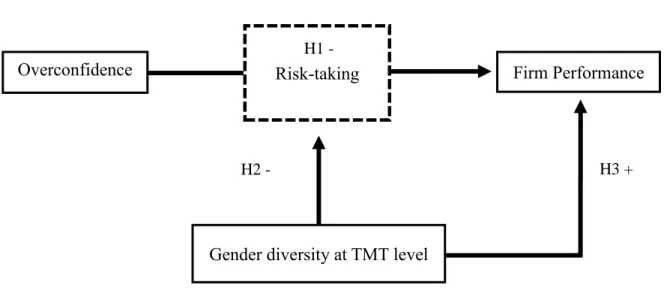
H2: Higher proportion of women in the TMT will negatively moderate the relationship between CEO overconfidence and firm performance.
The diversity of teams, particularly the TMT, has an important influence on organizational performance (Jeong & Harrison, 2017; Kimball, Palmer, & Marquis, 2012; Krishnan & Park, 2005). Core-level diversity, which is the diversity at the deepest level within an organizational, might be complemented by surface-level differences, such as in age, nationality or gender (Harvey, 2015). In fact, one major factor that increases diversity in TMTs is the presence of women in the team (Krishnan & Park, 2005). The studies of the previous authors showed new insights on how women can influence the performance of the TMT and, consequently, of the firm. When environments need a leader, who are more versatile in networking and bonding, a woman is more suitable and is more likely to be perceived as a leader (Krishnan & Park, 2005). According to the same authors, women can also minimize social identity issues and increase power sharing, which therefore increases organizational performance. Another process which is affected by women is strategic decision making, namely distinct risk-taking attitudes and knowledge, which also has positive outcomes on organizational performance (Jeong & Harrison, 2017). These attitudes could be the reduction of risk-taking decisions, which can improve the performance of companies in the long-term. In fact, male-dominant TMTs would normally choose riskier decisions and strategies, which would be multiplied and enhanced by group polarization, which is the tendency for the result to be more extreme due to group influence. The introduction of women to a TMT would help to decrease this effect, again with a positive effect on performance (Jeong & Harrison, 2017) This effect can be stronger in cases the CEO is a woman (Faccio et al., 2016). However, the announcement of a woman as CEO can lead to a drop in the stock market return, even if it has benefits in the long-term (Jeong & Harrison, 2017). At this point it is interesting to mention the work of Lee and James (2007), who explored stock market reactions to announcements regarding the promotion of women and men. According to the authors, the reactions do not differ significantly if the
14
announcement is to the TMT rather than as CEO, and they are more positive regarding women if they are promoted from within the firm compared to outside hires.
In spite of this, the tokenism theory defends the fact that if women are chosen to join the TMT or board of directors (BOD) for the public image only rather than on merit, this positive effect will be minimal or even negative (Adams & Ferreira, 2009). Still building on the token status theory, observers have little or sometimes no frame of reference regarding how to evaluate women in top management positions, due to their low occurrence (Lee & James, 2007). Adams and Ferreira (2009) discussed that mandatory gender quotas creating a minimum proportion of women on the board might not increase board efficiency, due to the additional control and monitoring which can harm performance, and ultimately decreasing shareholder value. According to the same authors, the presence of women has positive effects on the function of the TMT. Boards in which the proportion of women is higher are characterized by the greater participation of directors and are more in line with shareholders’ interests, regarding equity-based compensation. In order to further explore the effect of women on firm performance, I propose the following hypothesis:
H3: A higher proportion of women in the TMT will be positively associated with firm performance.
Fig. 1: Conceptual model
Overconfidence
Gender diversity at TMT level
Firm Performance
H3 + H2
H1
15
Method
Method analysis
In order to study the overconfident tone of CEOs and TMT in general, I will use the letters of the CEO and/or Chairman to the shareholders as the base for my argument. How people use words and how they communicate can give hints about their social status and motives, among others (Daly et al., 2004; Pennebaker, Mehl, & Niederhoffer, 2003). Daly et al. (2004) also mentions this that organizations and individuals, through the way they communicate, leave certain patterns of their own values, which can be studied and measure with the right tools.
The tools for this task can be either manual or through computer analysis, using programs like LIWC, CATA or DICTION (Pennebaker et al., 2003; Short, Broberg, Cogliser, & Brigham, 2010). There are some arguments in favour of automatic and manual techniques. Among the criticisms of automatic procedures, I highlighted that computer-based methods are less sensitive than manual analysis, because humans can judge different meanings for a word depending on context (Kabanoff, Waldersee, & Cohen, 1995). However, according to the same authors, this counter-argument is not well founded as the support for manual methods over computer-based ones is not consensual in the literature, specifically for the individual judgement mentioned earlier. On the other hand, Kabanoff et al. (1995) highlighted several advantages of the computer programs like the ones mentioned above. Firstly, it offers perfect reliability because the coding rules are always applied exactly the same way, a characteristic which is necessary and may not be strictly followed when several researchers analyse the documents. The programs use standard dictionaries to assess the documents, which can be a very positive support, since it increases the comparability between documents. Finally, it is more efficient than the manual, because the latter one is labour-intensive. One of the major drawbacks of using manual methods is the time required, which can be impractical when analysing hundreds or thousands of documents. Several studies used computer-based methods due to their many advantages (Daly et al., 2004; Kabanoff et al., 1995; Short et al., 2010).
Short et al. (2010) referred to several steps for a deductive approach to analysing content. One of them is the creation and development of a dictionary of keywords to be used in the analysis. Certain
16
computer programs, such as LIWC, counts how many times a certain word is used and in which category it corresponds (Daly et al., 2004). This frequency shows the importance the writer gives to a certain topic or domain, for example enthusiasm or sadness, which shows his or her values or mind-set (Pennebaker et al., 2003). One example of words used to categorize a text is present in the article of Short et al. (2010), which for risk taking would be audacious, adventurous and bold, among others.
LIWC mainly uses a word count system to analyse any given text file (Pennebaker et al., 2003). According to the same author, these dimensions use standardized language categories, as well as psychological processes (positive and negative emotions) and others. It includes more than 70 dimensions and 2300 words and it has recently expanded to other types of texts, such as press releases, and also incorporates the means with which to analyse classical literature sources.
The most common text file to be used in this analysis is the annual letters from CEOs to shareholders (Duriau, Reger, & Pfarrer, 2007), which can be found in the annual reports of companies (Daly et al., 2004). Those letters are produced on a regular basis, usually yearly, and they can be of use to predict the outcome of firms. As Daly et al. (2004) mentioned in their article, the annual letters can be used to forecast the survival of the firm, corporate performance in general, or, and of ultimate importance to the scope of this thesis, the propensity for risk and overconfidence. Consequently, those letters can be used to assess the mentality of CEOs and how overconfident they are. This method is the same as the one used in other studies, such as Kabanoff et al. (1995), which excluded all the sections which were technical or financial. The letters from the CEOs, although largely influenced by their individuality, are also influenced by the TMT (Daly et al., 2004), showing how necessary consensus is in order to write this document (Kabanoff et al., 1995). This idea integrates with the upper echelons theory mentioned before, so that the strategy of the company is not only devised by the CEO, but the TMT has a major or even bigger influence on it. It can be argued that the letters do not necessarily show the future course of the company, but is merely a public document whose inner truth is obscure (Daly et al., 2004). Even though this can be partly true, according to the same authors, the letters can in fact have real implications, and not just on public affairs.
To conclude, and relating to the gender differences mentioned in the section before, there is also a difference in the language used by women and men (Pennebaker et al., 2003). In fact, the differences
17
in language have been studied in depth. For example, men tend to be more direct and precise and less emotional in their language use, while women tend to refer more to emotions and use intensive adverbs and more discrepancy words (Pennebaker et al., 2003).
Sample and procedure
The letters to the shareholders were extracted from the annual reports from companies from all sectors, including Electrolux (household appliances), Bosch (technology), BMW (auto industry) and Associated British Foods (food industry). The time span selected was between 2008 and 2016 in order to analyse the patterns in the most recent years. In total, 1162 letters were extracted from 350 CEOs and/or Chairmen from 148 companies.
The sources of the annual reports necessary for the extraction were the websites of the companies, mainly because each company usually keeps those records for a certain amount of time. The other source was the website company.info (n.d.) due to its large library of firm documents, specifically annual reports.
The extraction of the letters to shareholders included other documents relevant for the analysis, such as interviews with CEOs or members of the TMT. One important factor about the extraction is that the CEO and Chairman of the companies were also documented in each letter. The reason behind such a procedure is that the levels of overconfidence of the same firm can be related to structural change, a dismissal and new hire of the Chairman and CEO, for example.
The data about the firm performance and the proportion of women in the TMT was obtained through the Worldscope database from Thompson Reuters. The data acquired included the average TMT member tenure, the proportion of women and size of the TMT. The financial data extracted included number of employees, return on assets (ROA), revenues, value invested in R&D, return on equity (ROE), Tobin’s q (TobQ) and all these variables lagged one year.
18
Measures
Exploratory variables
Overconfidence: The analysis of overconfidence was based on the article of Hirshleifer et al. (2012). In this case, I created a custom dictionary which enabled LIWC to do word count processing, searching for the words that appeared both in the letters and in the custom dictionary. The two different categories were “Confident” and “Caution”. The choice of words chosen for “Confidence” were “optimism” and “confident” and their variants like “optimistic”, “overconfident” and others. The words chosen for “Caution” included “pessimism” and its variants like “overpessimist”, “pessimist” as well as “reliable”, “steady” “practical”, “conservative”, “frugal”, “cautious” and “gloomy”. This procedure was also documented in the work of Cain and McKeon (2016), where the authors used the same categories of words in business cover letters. The same choice of words was used in the studies of Malmendier, Tate, and Yan (2011). The authors mentioned that this choice of words is used by business press to characterize CEOs. In the end, overconfidence was computed as a dummy variable, which would be 1 in cases where the number of words for “Confident” exceeded the number of words for “Caution”, or 0 otherwise. The result of whether the CEO was overconfident or not, as mentioned before, was created using the following procedure:
Overconfident CEO = {∑𝑡𝑠=1𝑎 > ∑𝑡𝑠=1𝑏
0 𝑜𝑡ℎ𝑒𝑟𝑤𝑖𝑠𝑒
Firm performance: In order to assess firm performance, the return on assets (ROA) was used.
The choice for ROA is recognised by several authors, as it is proven to be linked to overconfidence through narcissism (Chatterjee & Hambrick, 2007). According to the authors, overconfidence is one of traits present in narcissistic CEOs, which corroborates my choice to use ROA. ROA is also positively connected to gender diversity (Adams & Ferreira, 2009). For this reason, and because gender diversity is one of the main topics of this thesis, it supports the choice of ROA as the dependent variable for firm performance. There are several other studies that include ROA, both as a control variable and a dependent variable (Berger et al., 2014; Bromiley, 1991; Hirshleifer et al., 2012; Jegers, 1991; Wiseman & Bromiley, 1996). One of the most important reasons is because, following much research, to be a
19
stable variable (Krishnan & Park, 2005), which is essential when it is a study which includes several companies from completely different industries. The name of the variable computed was ROA.
Gender diversity: Jeong and Harrison (2017) discussed three possibilities to operationalize
female presence in a TMT. The three types were dichotomous (as a dummy variable), proportion and heterogeneity. To assess the gender diversity, the proportion of women in the TMT was used, which is the relationship between the number of women and the total TMT size. This choice is corroborated by Adams and Ferreira (2009), Kimball et al. (2012) and Krishnan and Park (2005) because the fraction of women in the TMT was also used in their studies. The name of the variable computed was Gender.
Control variables
Company size: One of the control variables considered for this thesis was the company size,
because it influences several domains (Chatterjee & Hambrick, 2011; Kimball et al., 2012). For example, according to the authors, bigger companies have more resources and more capacity to address problems in the organizational environment. According to Singh (1986), there are several definitions of company size, namely the natural logarithms of sales volume, net assets and number of employees. In this thesis, one of the measures documented by Singh (1986) was used, because, according to the author, any of the measures is justified as a proxy for company size. The name of the variable computed was the logarithm of the number of employees and was named Company Size.
Tenure: The use of tenures as a control variable is documented in several studies (Adams &
Ferreira, 2009; Chatterjee & Hambrick, 2011; Dwyer et al., 2003; Huang & Kisgen, 2013). Tenure was mainly linked to CEO tenure, the number of years since a CEO’s appointment. However, in this thesis, tenure is considered as tenure of the TMT’s members. The name of the variable computed was Tenure.
TMT size: Group decision making can work as a moderator for CEO overconfidence, as
mentioned previously. For example, it can work as a measure to limit the adoption of high-risk projects (Berger et al., 2014). The TMT size was also controlled by Adams and Ferreira (2009) to ensure that their conclusions referred to gender differences and not by TMT size. It is also documented that a larger TMT increases the potential of the company to identify threats and opportunities (Kimball et al., 2012). According to the same authors, large boards can result in less egocentric practices and more environmentally friendly policies, which show the influence they can have on company strategy. For
20
this reason, this variable was used as a control variable. The name of the variable computed was TMTsize.
R&D intensity: The use of R&D is explored in several studies (Chatterjee & Hambrick, 2011;
Galasso & Simcoe, 2011; Li & Tang, 2010). The reason is the relationship between R&D intensity and overconfidence. According to Miller and Bromiley (1990), R&D intensity shows the commitment of the company towards innovation, both in new products or processes and is linked to uncertainty and risk. R&D, through innovation, can create monopoly powers associated with successful innovations, which can result in differentiation and advantages for the companies (Naldi, Nordqvist, Sjöberg, & Wiklund, 2007). This variable was computed as a ratio, the same way as by Naldi et al. (2007) and Miller and Bromiley (1990). However, when those authors used R&D expenditure/Sales, I used R&D expenditure/Revenues, because revenues have wider range and they have more explanatory power than sales. The reason is that some companies may have revenues not driven by sales, such as subsidies, which can bias the results. The name of the variable computed was R&D intensity.
Model
Four models were computed in order to study the hypotheses proposed. The first model
only included the control variables. The following models added overconfidence, gender and
the interaction between overconfidence and gender, respectively. The most complete model
used included the variables mentioned before, which resulted in:
𝐹𝑖𝑟𝑚 𝑝𝑒𝑟𝑓𝑜𝑟𝑚𝑎𝑛𝑐𝑒 (𝑅𝑂𝐴)
= α + β1 Overconfience + β2 Gender + β3 Tenure + β4 TMTsize
+ β5 R&𝐷 𝑖𝑛𝑡𝑒𝑛𝑠𝑖𝑡𝑦 + 𝛽6 𝐶𝑜𝑚𝑝𝑎𝑛𝑦 𝑆𝑖𝑧𝑒 + β7 Overconfidence
∗ Gender + ε
21
Results
The first results to be analysed are from the overconfident dummy. In total 1162 letters were analysed. According to the data shown, 57.7% of the CEOs were considered overconfident because the number of words related to “Confidence” was superior to “Caution”. This shows that the number of overconfident is relevant and both categories are almost on equal terms, meaning the number of CEOs in both categories is comparable.
Table 1: Frequencies of Overconfident
Frequency Percent Valid Percent
0 491 42.3
1 671 57.7
Total 1162 100.0
The main two relationships that are important for the study are the correlation between both Overconfidence and Gender with the dependent variable, ROA. Focusing on the overconfidence, the pearson correlation indicates a positive relationship of 7,0% between overconfidence and ROA, which is statistically significant. This fact partially supports my first hypothesis, even if by itself it is no total proof. The same conclusion can be drawn for Gender and ROA, which is also positive and in this case the pearson correlation is 9,9%, also statistically significant. This fact also partially supports my third hypothesis that a higher proportion of women in the TMT increases overall firm performance. My second hypothesis is related to the interaction of overconfidence and gender with performance and the pearson correlation is 10,3%, statistically significant and partially supporting it.
22
Table 2: Table of descriptive statistics and correlations
Mean Std. Deviation 1 2 3 4 5 6 7 8 ROA 0.054 0.057 1 Overconfidence 6.639 2.560 .070* 1 Tenure 14.640 12.448 .089** .050 1 TMTsize 0.039 0.046 .038 -.061* -.402** 1 Gender 4.690 0.552 .099** .021 -.144** .181** 1 R&D intensity 0.580 0.494 .047 -.028 -.220** .270** .064* 1 Company Size 0.123 0.127 -.009 -.055 -.127** .365** -.016 .179** 1 Gender x Overconfidence 0.072 0.116 0.103 ** 0.53** -0.087** 0.07** 0.669** 0.10 -0.08** 1 a. N=1162 b. * p < 0.05; **p < 0.01
Several standard multiple regressions were performed between ROA and Tenure, TMTsize, R&D intensity, Company size, Overconfidence, Gender and Overconfidence * Gender. The first model only included the control variables. The following models added one additional variable compared to the previous model, as mentioned before and it is shown in Table 2. The best model studied included all variables except the interaction between Overconfidence and Gender. The reason may be because Overconfidence is a dummy, so the interaction would have the value of Gender in case Overconfidence was 1, and 0 otherwise. This may bias the results and may explain why the model’s R-square is equal compared to the model without the interaction. All models computed were statistically significant, with a R-square oscillating between 1,8% and 3,3%. The third model, which will be the model used in my analysis, had a R-square of 3,3%, so 3,3% of the ROA was explained by the independent variables included in the model. This model was also significant (F = 5,58, p < 0.00). The variables found significant were Tenure, TMTsize, Overconfidence and Gender. Tenure and Gender were highly significant (p < 0.01) and TMTsize and Overconfidence were significant (p< 0.05). The only variables which were found not to be significant were R&D intensity and Company size. However, when the interaction between gender and overconfidence is present, the variables Gender and Overconfidence lose significance at 5% of significance and the overall model does not increase its R-square.
23
Table 3: Results of Overconfidence, gender and control variables
Variables Model 1 Model 2 Model 3 Model 4
Tenure 0.003** 0.003** 0.003** 0.003** TMTsize 0.00** 0.00** 0.00* 0.00* R&D intensity 0.073 0.073 0.072 0.072 Company Size -0.004 -0.003 -0.002 -0.002 Overconfidence 0.008* 0.008* 0.007 Gender 0.045** 0.039 Overconfidence x Gender 0.010 R- Square 0.018 0.023 0.033 0.033
a. Dependent variable: ROA b. N=1162
c. * p < 0.05; **p < 0.01
Analysing table 3, I can conclude that higher tenure has positive effect on overall firm performance. The size of the company and the R&D intensity were proven not to be significant, by the models studied, so their effect is considered null in the performance measured by the ROA. The most important variables included in the model were overconfidence, gender and the interaction between overconfidence and gender.
Overconfidence is statistically significant in the third model and it is positive. These results prove that a company whose CEO is overconfident has a positive effect on the overall firm performance, measured by the ROA. This fact supports my first hypothesis that overconfidence has beneficial effects on the ROA. Consequently, I can also conclude that risk taking also has positive effects on firm performance. The reason behind this statement is because risk taking is shown to be a trait characteristic in overconfident CEOs, so if there is a positive relationship between overconfidence and the ROA, the same relationship will apply to risk taking.
The Gender variable is positive and statistically significant. I can conclude that a higher proportion of women in a TMT has positive effects on the ROA. This fact supports my third hypothesis, that a higher proportion of women has, in fact, beneficial effects on the firm performance.
Regarding the interaction between gender and overconfidence, the variable is not statistically significant. In fact, the model itself does not improve with this addition and the other variables lose
24
significance with the presence of the interaction. This fact does not support my second hypothesis, that a higher proportion of women in the TMT has a negative effect on the overall overconfidence tone of the CEO.
In order to prove that this regression model can be trusted, a collinearity diagnostic test was conducted. In cases where the Variance Inflation Factor (VIF) is very high for one variable, it would have to be excluded because it would over-inflate the R-square. There was one variable which had a very superior value compared to the others, the interaction between Gender and Overconfidence. Supported by the previous analysis, this shows that this variable should be excluded, due to the loss of significance of other variables when it is included, and due to multicollinearity.
I can conclude that in general the model is statistically significant and the main variables were significant, which proved my hypotheses. However, it is important to prove that this model was the best one to corroborate the results, which will be shown in the robustness tests.
Robustness tests
For the robustness tests, I computed new variables in order to assess if this model was truly the strongest one. In the end, a total of 37 regressions were analysed with different independent and dependent variables.
Doverconfidence:
Instead of assessing the CEO’s overconfidence through a dummy, a new variable was computed through the difference between the number of words related to “Confidence” and “Caution”, but now as a discrete variable.Doverconfidence = ∑𝑡𝑠=1𝑎 − ∑𝑡𝑠=1𝑏
Lagged variables:
Variables lagged for one year have been used by several authors, of which I highlight Adhikari (2012). By controlling for past performance, revenues, etc., it is speculated that the current variables would not depend on previous performance but only on elements from the current year. The lagged variables were ROA, revenues, R&D expenditure and number of employees. The result was lagged performance (ROA t-1), lagged R&D intensity (lagged R&D/lagged revenues) and lagged Company size (logarithm of lagged employees).25
Dependent variables:
Although the dependent variable used was the ROA, there are other variables that can be used to assess firm performance. The two variables included in the robustness tests were the return on equity (ROE) and TobQ. The ROE was also used in the studies of Cain and McKeon (2016), but in fact the ROA is the most used variable. One of the reasons why this happens is because the ROE might have issues with the different leverage of companies as it only assesses the equity, as mentioned by Naldi et al. (2007), Once the sample is as diverse as the one used in this thesis, with companies from different industries and distinct leverage levels, the use of ROE is counter indicated.In total 37 regressions were computed to compare with the models used. The first difference was the use of different dependent variables, ROE and TobQ. The results with ROE were significantly worse than with the ROA, namely the loss of significance in the key variables and in the overall model. The reason, as mentioned before, might be because the ROE is sensitive to different levels of leverage, a condition that should be avoided in very heterogeneous samples. However, TobQ had similar results as ROA, in terms of the aspects mentioned previously. Despite this fact, the ROA still showed better results in most of the regressions, so it should be used instead of the TobQ.
The second difference in the robustness tests were the use of different independent variables, namely Doverconfidence instead of Overconfidence, lagged variables and the interaction of overconfidence and gender with Doverconfidence or lagged variables. To conclude, in the majority of the studies the key variables lost significance. The difference between Doverconfidence and Overconfidence (dummy) was significant and the dummy was more significant than Doverconfidence in most studies. The interaction was always not significant in all the regressions and it also led to the loss of significance of the other key variables, similar to the models used.
I can conclude that the model used was the strongest one and it is the one which gives more insights. This is proven through the robustness tests, because even after 37 regressions, all proved to be inferior. The reason for my argument could be because of multicollinearity, loss of significance of the key variables or decrease of the model’s R-square.
26
Discussion
The main objective of my research is to gain more insight into overconfidence and risk-taking and how this influences the strategic intent inside companies. Most strategic decisions, considering long-term solutions, must take risk and uncertainty into account because they are embedded in decisions themselves (Baird & Thomas, 1985). Considering the very competitive environment most companies are experiencing today, risk is present in innovation and the proactive strategies of all major companies (Naldi et al., 2007). Hence, the analysis of this factor inside companies should not be underestimated, and therefore its academic study should accompany this trend.
In my thesis I started to highlight the reason that propelled this research, the tone at the top. When companies are starting to have clearer and more public facets, some scandal or certain actions might deeply harm them. One example of transparency in the business world is the website Glassdoor (n.d.), where it is possible to check for information about jobs, wages and firm culture in several companies worldwide. Due to its continuous presence in the business world, the tone of leaders, which will be followed by the employees, has to be analysed with extra commitment. Examples of this trend are the values of the companies, which the company defends and should be one of the pillars of their daily activities. In today’s world, millennials are starting to take company culture, the welfare of employees, sustainability and corporate social responsibility into consideration. For example, the article by Winograd and Hais (2014) shows this satisfaction between the new generation (millennials) and current practices in major financial companies. In fact, this new generation is responsible for big and decisive changes in diverse industries, such as the internet of things, retail and gaming (Patel, 2017).
In the scope of this thesis, consumers’ new requirement of innovation increases the risk propensity actions of companies, namely new products based on technological advancements (Naldi et al., 2007). However, leaders frequently try to explain less positive results or even losses using innovative projects that did not meet expectations, instead of seeing them as an opportunity (Wiseman & Bromiley, 1996). This reasoning may be the foundation for risk-taking decisions being behind suboptimal levels, as highlighted by March & Shapira (1987). In general, what seems really important and will probably become even more certain in the future is how beneficial risk is for firm performance. These benefits
27
could be, as mentioned before, in developing new products that meet consumers’ demands, attract talent into the organizations, namely millennials, or completely different domains not explored in this research. However, risk-seeking mind-sets tend to disappear when individuals grow within the hierarchical ladder, making it a rarer predisposition in top management teams (March & Shapira, 1987). This will have two effects on the overall organizations’ performance. Firstly, most of the strategic decisions inside a company are taken by senior and top managers, including, of course, the CEO. These decisions will give general indications towards the companies’ future. Decisions like new products, innovation and expansions into new territories, markets or industries can decide the survival, success, and reputation of a company, as well as other factors. For example, the success of Tesla as an innovative company which sells a market-fit product, or the case of Nokia and how it did not meet consumers’ demands, shows precisely the impact of such decisions. One risk-averse mind-set can influence the survival of a company, especially in the competitive and demanding business world. According to Byrnes et al. (1999), competition includes risk taking, so competitors make risky decisions in order to gain advantage over the opponent. When firms are not engaging risk as a necessary and important factor, they will eventually lose terrain in the market, as happened with Nokia and Blackberry.
Although the decisions made by TMTs are usually more eye-catching, the main effect that I would like to focus on in this thesis is the tone of these leaders and how this influences the overall structure, employees, middle managers, front-line and back office - in general the whole structure. As Gartland (2015) discussed, the tone established by leaders will spread throughout an organization. Not only will leaders be risk-averse but the general sentiment inside companies will also be risk-avert. Therefore, it was and is still necessary to assess the importance of risk and how beneficial it can be for firm performance. This way, in the future, companies may become more prone towards risk-seeking strategies, with greater variation in results and possibly better outcomes.
In order to assess the role of risk taking in companies’ performance, leaders’ form of speech and the level of overconfidence in their messages were used. This method is validated by Hirshleifer et al. (2012), a study recognised by academia and published in a top journal of the area. By studying letters for shareholders presented in annual reports, it was possible to assess the tone of leaders, and through them the whole TMT, as mentioned before. The main assumption in this thesis is that an overconfident