MEtop - a top FCNC event generator
Rita Coimbra1, Ant´onio Onofre2, Rui Santos3,4 and Miguel Won1,4
1 LIP / Departamento de F´ısica, Universidade de Coimbra, 3004-516 Coimbra, Portugal
2
Departamento de F´ısica, Universidade do Minho, 4710-057 Braga, Portugal
3 Instituto Superior de Engenharia de Lisboa - ISEL, Rua Conselheiro Em´ıdio Navarro 1,
1959-007 Lisboa, Portugal
4 Centro de F´ısica Te´orica e Computacional, Faculdade de Ciˆencias, Universidade de Lisboa,
Av. Prof. Gama Pinto 2, 1649-003 Lisboa, Portugal
E-mail: [email protected], [email protected], [email protected], [email protected]
Abstract. In this work we present a new Monte Carlo generator for Direct top and Single top
production via flavour-changing neutral currents (FCNC). This new tool calculates the cross section and generates events with Next-to-Leading order precision for the Direct top process and Leading-Order precision for all other FCNC single top processes. A set of independent dimension six FCNC operators has been implemented - including four-fermion operators - where at least one top-quark is present in the interaction.
1. Introduction
With the new experimental data from the Large Hadron Collider (LHC) one will be able to scrutinise the Standard Model (SM) boundaries with unprecedented precision. Flavour-changing neutral currents (FCNC) top decays such as t → V q, where V = Z, γ, g and q = u, c are highly suppressed in the SM due to the well known Glashow-Iliopoulos-Maiani (GIM) mechanism [1]. top-quark FCNC branching ratios are of the order of 10−14 and 10−12 for the electroweak and
strong case respectively. However, some versions of two-Higgs doublet models (2HDMs) predict quite larger values. In fact, for some regions of the 2HDM parameter space the BR(t → g q) could reach values of the order of 10−4 [2], which is eight orders of magnitude above the SM value. The high statistics expected in LHC data forces an increase in the precision of all relevant theoretical calculations. Hence, at least Next-to-Leading (NLO) calculations should be made available whenever possible. The experimental searches performed both at LHC and at the Tevatron on the direct top FCNC process have already used NLO cross sections from [3]. However, the NLO calculation was used only as a normalization factor and the events were generated using LO generators like TopRex [4] or Protos [5]. In this work we present a new Monte Carlo tool that generates FCNC direct top events with NLO precision. The FCNC interactions were implemented via an effective lagrangian [6] where a complete set of dimension six operators was used. The events are generated in the Les-Houches Event (LHE) format [7] and can therefore be easily interfaced with shower algorithms such as the one in Pythia [8]. Since the generator calculates the total inclusive cross section, the FCNC single top process was also included and can be generated independently. Not only strong FCNC interactions, but also electroweak and four-fermions dimensions six operators were included. Each operator can be turned on independently allowing for independent studies of the different Lorentz structures. In
section 2 the effective formalism is presented while in section 3 we show the physical processes already included in MEtop. In section 4 we give a description of the algorithm used by the Monte Carlo generator in order to obtain a final NLO result. In section 5 we discuss a few selected results and in section 6 we sum up our conclusions.
2. Effective operators
In the effective lagrangian formalism we assume that the SM is no more than a low energy limit of some more general theory to be revealed at TeV scale. In this context, the top-quark FCNC interaction is seen at low energies as a contact interaction that can be parametrized with higher dimension effective operators. The complete lagrangian is written as
L = LSM+ 1 ΛO 5+ 1 Λ2O 6+ O(1 Λ) (1)
where we have truncated the expansion series at dimension d = 6. We follow the formalism in [6], where the SM symmetries are imposed and all operators are built using the already known SM fields. This results in a reduced list of the possible dimension six operators. Additionally, baryon and lepton number conservation is imposed, which restricts the operators to dimension six only. Even imposing the SM symmetries, the number of all possible FCNC operators is quite vast. However, the list can be reduced by using appropriate equations of motion and Fierz transformations applied to the physical operators we are dealing with. The final minimal complete set of FCNC operators for top-quark physics was obtained in [9, 10, 11, 12]. With this procedure, a single operator survives in the strong sector [11]. Following the notation in [6] this operator can be written as
OijuGφ = ¯qi
Lλaσµνu j
Rφ G˜ aµν (2)
where Ga
µν is the gluonic field tensor, ui right-handed u or c-quark field and qi is the left-handed
quark doublet. The same operator also appears in the literature as a dimension 5 operator iκi
gs
Λq¯iλ
aσµν(f
i+ hiγ5)tGaµν , (3)
where κi is a real parameter, i = u, c, gs is the strong coupling constant and fi and hi are
complex numbers which respect |fi|2+ |hi|2 = 1. This operator is responsible for the effective
FCNC vertices tgu and tgc. The minimum set of operators in the electroweak sector is OuBφij = ¯qi Lσµνu j Rφ B˜ µν, OijuW φ = ¯qiLτIσµνujRφ W˜ µνI , (4) Oijφu = i (φ†Dµφ) (¯uiRγµu j R) , (5) Oφq(1),ij = i (φ†Dµφ) (¯qLi γµq j L) , O (3),ij φq = i (φ †τ IDµφ) (¯qiLγµτIqjL) , (6) Oijuφ = (φ†φ) (¯qLi ujRφ) ,˜ (7) where Bµν and WI
µν are the U (1)Y and SU (2)L field tensors, respectively. The field φ is the
usual Higgs boson doublet. In addition to this electroweak set of operators, we have included subsets of four-fermion operators which are described in [13].
3. Physical Processes
The physical processes included in MEtop are FCNC direct top production and FCNC single top production. Direct top is available both at LO and at NLO while FCNC single top is availble only at LO. All processes can be generated for both pp and p¯p hadron colliders. Furthermore, the full top decay chain is included so that spin correlations are preserved. Also, in order to perform spin correlations studies, a on/off switch for the top decay chain was made available. In figures 1 and 2 we show the generic Feynman diagrams for the physical processes implemented in MEtop. The production process depicted in figure 1 has only strong FCNC operator contributions. Born level FCNC direct top is shown in figure 1 (left) together with the t+g process (right). In figure 2 we present the diagrams for the LO t + q production process from gluon fusion (right) and with quarks in the initial state (left) . The former is only affected by strong FCNC operators while the later has contributions from the strong, electroweak and four-fermion sectors.
g q t g q t g 1
Figure 1. FCNC leading order direct top production and top + gluon production at the parton level. Only FCNC strong operators contribute to the process.
q2 q1 t q g g t q 1
Figure 2. FCNC leading order top + quark production at the parton level. FCNC strong and electroweak operators contribute to the process together with 4F operators.
4. NLO approximation
As mentioned in the previous section, MEtop is able to generate FCNC direct top events with NLO precision. The implementation was performed by adopting an NLO effective approximation [14]. A general NLO calculation of an n-particles final state process can be represented by
dσN LO = dσBdΦn+ dσVdΦn+ dσRdΦn+1, (8)
where B stands for Born, V for Virtual and R for Real. It is well known that the virtual term has infrared divergences that will only be cured by the inclusion of the real radiation term σR.
We show in figure 3 the class of diagrams contributing to NLO direct top production. The first process qg → t correspond to the Born term. The second, qg → t, corresponds to the Virtual term while the third, qg → gt, is the real radiation term. This last term gives rise to an infrared divergence which correspond to a low PT and/or to a collinear external gluon.
g q t + g q t + ... + g q t g
Figure 3. Inclusive FCNC direct top production at NLO in QCD.
it obviously occurs in the limit PT → 0. In order to avoid the divergence one could just impose
a PT cut. The resulting region has to be excluded from the event space generation with some
care - since the problem arises only in the collinear/soft limit, we can fill this phase space region with a branching mechanism. By doing so, we assume a collinear factorization, where the QCD radiation is emitted by one of the external legs of the Born configuration. This approximation can be translated by |Mt+g|2dΦ2→ |Mt|2dΦ1 αS 2π dt t Pq,qg(z)dz dφ 2π (9)
where Mt+gand Mtare the real radiation for (t + g) and direct top amplitudes, respectively; dΦi
is the phase space for the ith body processes and Pq,qg(z) is the Altarelli-Parisi splitting function.
The variable t is a resolution parameter which in our case is the top quark transverse momentum PTtop. The hard PT region will then be filled by using the appropriate transition amplitude and
the low PT region by the use of a shower mechanism. In this NLO effective approximation [14],
the PT phase-space is then divided in two regions parametrized by PTtop, which we call PTmatch.
This parameter plays the role of a matching parameter where the criterion for a good transition is the smoothness of the final PT distribution. The final cross section free of divergences can be
written as
σN LO= KσB(PTP S < PTmatch) + σR(PT > PTmatch), (10)
where PP S
T is the transverse momentum of the parton shower emission. The contribution from
the virtual term dσV in equation 8 is included via a K-factor applied to the born term and
because born and virtual terms share the same 2 → 1 topology we assume they have similar kinematics. It is from equation 10 that events in MEtop are generated. Since MEtop is a parton level generator, the events must then be submitted to a parton shower simulator in order to include initial (ISR) and final (FSR) state radiation. Therefore, since these parton showers are based on a branching mechanism, we leave the collinear and/or soft PT phase space region to
be filled by the corresponding parton shower. In order to avoid double counting we just have to ensure that the parton shower will not populate the PT > PTmatch region in the first emission.
To prevent it, the shower mechanism must be performed with the PT-ordered scheme with the first emission starting at PT = PTmatch. For the NLO direct top process, MEtop assumes that
the Pythia shower will be used with its PT-ordered scheme [15] flag on. Finally, we note that because this is a 2 → 1 process, the shower mechanism implemented in Pythia will not add FSR but only ISR. This does not pose any problems because FSR is negligible when compared to ISR due the large top-quark mass.
5. The generation process and some results
In figure 4 we show the diagram flow of the MEtop generation process. It was drawn specifically for the NLO direct top case. The remaining processes follow the same flow except for the K-factor calculation step. The amplitudes used to evaluate the cross sections were generated with CalcHEP [16], whit Feynman rules derived with LanHEP [17] and all integrations were performed using the Cuba Library [18]. The K-factors are calculated ”on the fly” and therefore each sub process has its own normalization factor.
Initialize: read paramt.txt card Calculate possible subprocesses
Evaluate each cross section: Born, Virtual and Real radiation Evaluate each subprocess K-factor Generate events according to equation 10
Write evetns in LHE format
Figure 4. MEtop flow cart for NLO Direct top generation.
In figure 5 we present the top-quark PT distribution for direct top after the first emission
and with the starting scale shower at mt (black solid line). The blue dashed line represents
the top PT distribution of the real radiation process. As explained before, both regions overlap
and therefore a matching must be introduced in order to avoid double counting. The matching process must be chosen so that the transition between the rescaled direct top distribution and the real radiation process is smooth. In figure 6 we show the top PT distribution for PTmatch= 10, 15
Gev where direct top is the gray dashed line and t + g is the blue dashed line. The first one corresponds to the top distribution after the first ISR emission, where the PT-shower starting scale was set to 10 and 15 Gev, respectively; the second one is the top distribution from the ’t+g’ process where a Pcut
T of 10 and 15 Gev was imposed. We have studied several PTmatch scenarios
in the 5 Gev to 20 Gev range finding no significant differences. We therefore recommend that this matching value should be included in any analysis as a systematic error.
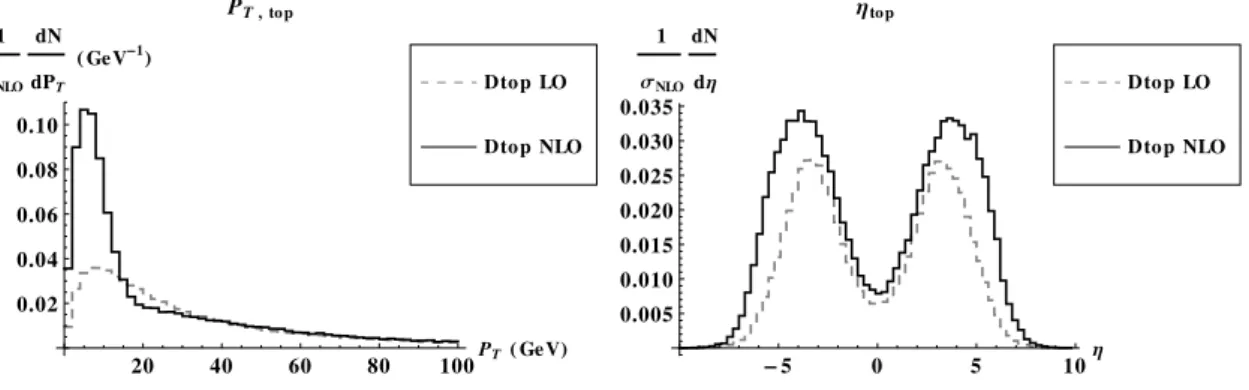
In figure 7 we show the final NLO direct top quark PT and η distribution (solid line), as well
as the LO result (dashed line) after full ISR, FSR and Multiple Interactions (MP). It is clear that in both distributions the final NLO result does not amount to simply multiplying the LO result by a K-factor. In fact, the distributions show that the NLO contribution concentrates more events in the low PT region and produces top quarks at higher angles. In figure 8 we
show the equivalent distribution for the lepton coming from the decaying W. The b-quark and neutrino distributions show similar differences between the NLO and LO results. For the top decay products, the NLO contribution does not result in a major change in distributions making a K-factor adjustment suitable. However, one must pay special attention to analysis where the top quark momentum is reconstructed. For example, analysis which include the study of the top spin polarisation usually requires full reconstruction of its momentum. In this case, figure 7 show that NLO events should be considered. Finally, when studying the inclusive NLO direct top production one must add the t + jet (single top FCNC) process as well. The distribution of
20 40 60 80 100PT HGe VL 0.02 0.04 0.06 0.08 0.10 0.12 0.14 1 N dN dPT HGe V-1L
PT, to p after first ISRÈNo Match
p p -> t +g p p -> t
Figure 5. PT distribution of the top quark for
√
s = 7 TeV. The black solid line is for direct top production after the first branching in ISR, with starting scale of mt. The blue dashed line
is for the hard process top+gluon production.
20 40 60 80PTHGe VL 1000 2000 3000 4000 5000 6000 7000 dN dPT HGe V-1 L
PT , top after first ISRÈMatch = 10 GeV
pp->t +g pp->t 20 40 60 80PTHGe VL 1000 2000 3000 4000 5000 dN dPT HGe V-1 L
PT , top after first ISRÈMatch = 15 GeV
pp->t +g pp->t
Figure 6. PT distribution of top quark after the first ISR branching with a PTmatch of 10 GeV
(left) and 15 GeV (right).
20 40 60 80 100PTHGe VL 0.02 0.04 0.06 0.08 0.10 1 ΣNLO dN dPT HGe V-1L PT , top Dtop NLO Dtop LO - 5 0 5 10Η 0.005 0.010 0.015 0.020 0.025 0.030 0.035 1 ΣNLO dN dΗ Ηto p Dtop NLO Dtop LO
Figure 7. Comparison of the LO and NLO PT (left) and η (right) distributions of the top
quark at the partonic level after the full shower (ISR+FSR) and Multiple Interaction.
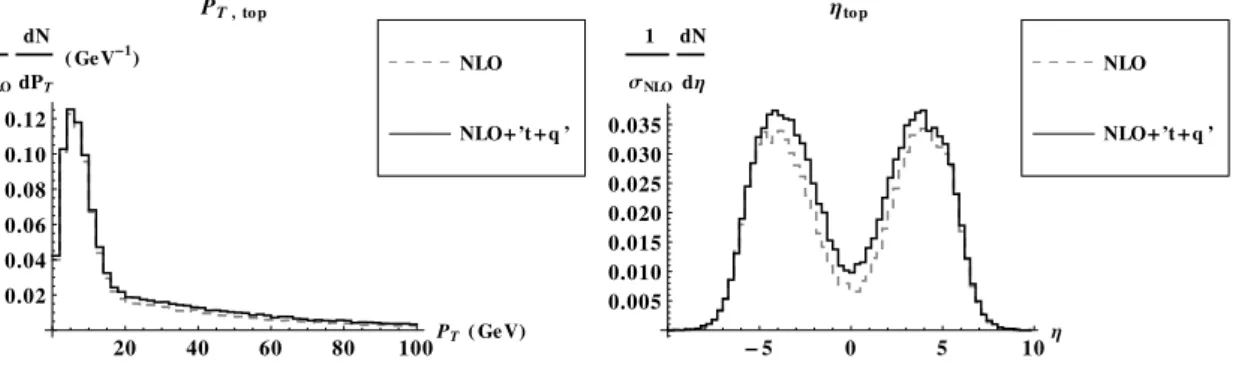
the sum of the two processes is shown in figure 9 for the top PT (right) and the top η (left). The
FCNC Single top process was generated with a Pcut
20 40 60 80 100PTHGe VL 0.01 0.02 0.03 0.04 1 ΣNLO dN dPT HGe V-1L PT , lepton Dtop NLO Dtop LO - 5 0 5 10 Η 0.01 0.02 0.03 0.04 1 ΣNLO dN dΗ Ηlepto n Dtop NLO Dtop LO
Figure 8. Comparison of the LO and NLO PT (left) and η (right) distributions of the lepton
from t → bW → blν at the partonic level after the full shower (ISR+FSR) and Multiple Interaction.
FCNC interaction takes place were included. Processes like u ¯d → t¯b which are pure SM single top production were discarded. In tables 1 and 2 we show the total contributions from each LO and NLO processes. They were calculated for ku,c = 0.01 and for LHC @ 7 TeV. As we
can see from figure 9, the FCNC single top contribution does not produce considerable shape modifications, although its contribution to the total cross section is approximately 13%.
20 40 60 80 100PTHGe VL 0.02 0.04 0.06 0.08 0.10 0.12 1 ΣNLO dN dPT HGe V-1L PT , top NLO+’t +q ’ NLO - 5 0 5 10Η 0.005 0.010 0.015 0.020 0.025 0.030 0.035 1 ΣNLO dN dΗ Ηto p NLO+’t +q ’ NLO
Figure 9. PT (left) and η (right) distributions of the top quark for NLO direct top (solid line)
and NLO direct top plus pp → tq with Pmatch
T = 10 GeV and jet pT > 10 GeV.
Table 1. FCNC Direct top (anti-top) LO and NLO cross sections for ku,c = 0.01 and LHC @
7 Tev.
Subprocess LO NLO
ug → t 6.12 8.74
cg → t 0.91 1.67
6. Conclusions
We have presented a new Monte Carlo generator dedicated to top FCNC physics. We have included the main FCNC top production channels: direct top and single top. The direct top
Table 2. FCNC t + q with ku,c = 0.01 and LHC @ 7 Tev and P Tcut = 10 Gev.
Subprocess ku= 0.01 kc= 0.01
p, p → t, q 1.12 0.40
channel is available at NLO and the single top at LO. A complete set of dimension six operators are already included. We have shown that the NLO top distributions obtained for the direct top cannot be built via a K-factor from the LO ones. Therefore NLO events should be used especially in the cases where top-quark momentum reconstruction is required.
Acknowledgments
This work is partially supported by the Portuguese Funda¸c˜ao para a Ciˆencia e a Tecnologia (FCT) under contracts CERN/FP/123619/2011 and PTDC/FIS/117951/2010. RS is also partially supported by an FP7 Reintegration Grant, number PERG08-GA-2010-277025 and by PEst-OE/FIS/UI0618/2011. RC is funded by FCT through the grant SFRH/BPD/45198/2008. References
[1] Glashow S L, Iliopoulos J and Maiani L 1970 Weak Interactions with Lepton-Hadron Symmetry Phys. Rev. D 2 1285
[2] Aguilar-Saavedra J A 2004 Top flavor-changing neutral interactions: Theoretical expectations and
experimental detection Acta Phys. Polon. B 35 2695 [arXiv:hep-ph/0409342].
[3] Liu J J, Li C S, Yang L L and Jin L G 2005 Next-to-leading order QCD corrections to the direct top quark production via model-independent FCNC couplings at hadron colliders Phys. Rev. D 72 074018
[4] Slabospitsky S R and Sonnenschein L 2002 TopReX generator (version 3.25): Short manual Comput. Phys. Commun. 148 87
[5] Aguilar-Saavedra J A 2010 Zt, gamma t and t production at hadron colliders via strong flavour-changing neutral couplings Nucl. Phys. B 837 122
[6] Buchm¨uller W and Wyler D 1986 Effective Lagrangian Analysis of New Interactions and Flavor Conservation
Nucl. Phys. B 268 621
[7] Alwall J et al. 2007 A standard format for Les Houches event files Comput. Phys. Commun. 176 300 [8] Sjostrand T, Mrenna S and Skands P 2006 PYTHIA 6.4 Physics and Manual J. High Energy Phys.
JHEP0605(2006)026
[9] Ferreira P M, Oliveira O and Santos R 2006 Flavour changing strong interaction effects on top quark physics at the LHC Phys. Rev. D 73 034011
[10] Ferreira P M and Santos R 2006 Strong flavour changing effective operator contributions to single top quark production Phys. Rev. D 73 054025
[11] Aguilar-Saavedra J A 2009 A Minimal set of top anomalous couplings Nucl. Phys. B 812, 181
[12] Grzadkowski B, Iskrzynski M, Misiak M and Rosiek J 2010 Dimension-Six Terms in the Standard Model Lagrangian J. High Energy Phys. JHEP1010(2010)085
[13] Coimbra R, Onofre A, Santos R and Won M 2012 MEtop - a generator for single top production via FCNC interactions Eur. Phys. J. C 72 2222
[14] Boos E E, Bunichev V E, Dudko L V, Savrin V I and Sherstnev A V 2006 Method for simulating electroweak top-quark production events in the NLO approximation: SingleTop event generator, Phys. Atom. Nucl. 69 1317
[15] Sjostrand T and Skands P 2005 Transverse-momentum-ordered showers and interleaved multiple interactions Eur. Phys. J. C 39 129 [hep-ph/0408302].
[16] Pukhov A 2004 CalcHEP 2.3: MSSM, structure functions, event generation, batchs, and generation of matrix elements for other packages Preprint arXiv:hep-ph/0412191
[17] Semenov A 1998 LanHEP: A package for automatic generation of Feynman rules from the Lagrangian Comput. Phys. Commun. 115 124
Semenov A 2009 LanHEP - a package for the automatic generation of Feynman rules in field theory. Version 3.0 Comput. Phys. Commun. 180 431