Escrita, Pintura, Fotografia
AA
T
HE
PHOTOGRAPHIC
SUBVERSIO
N
B e n j a m i n , M a n e t a n d A r t ( i s t i c ) R e p r o d u c t i o n
B e n j a m i n , M a n e t a n d A r t ( i s t i c ) R e p r o d u c t i o n
B e n j a m i n , M a n e t a n d A r t ( i s t i c ) R e p r o d u c t i o n
B e n j a m i n , M a n e t a n d A r t ( i s t i c ) R e p r o d u c t i o n
B e n j a m i n , M a n e t a n d A r t ( i s t i c ) R e p r o d u c t i o n
1Lauren S. Weingarden
Florida State University
R
R
R
R
R
E S U M OE S U M OE S U M OE S U M OE S U M OBesides referring to museum masterpieces in his 1863 paintings Le déjeuner sur l’herbe and Olympia, Édouard Manet used photography, of both academic and pornographic models, new genres of commercial photography that emerged during the early 1850s. I argue that Manet deliberately conflated fine art reproductions and mass media products, a practice that invites discussion in the light of Walter Benjamin’s “The Work of Art in the Age of Its Technological Reproducibility”. Since both engaged in a dialogue with Charles Baudelaire’s writings on art, culture, and photography, these writings provide a framework for discerning modernist paradoxes inherent in Manet’s and Benjamin’s critical interpretations of popular and material culture.
P
P
P
P
P
A L A V R A SA L A V R A SA L A V R A SA L A V R A SA L A V R A S---
C H A V EC H A V EC H A V EC H A V EC H A V E19th-century painting, erotic and stereoscopic photography, parody, the auratic/erotic gaze, criticism of photography
I
t is well known that Édouard Manet referred to museum masterpieces in his early Salon paintings produced in 1863, Le déjeuner sur l’herbe (Salon des Refusés, 1863; Fig. 1) and Olympia (Salon of 1865; Fig. 2), and in the process, relied on traditional media of reproduction, such as engravings after Raphael.2Less known is Manet’s use of photography,and specifically his use of “études après nature” (or “académies”), a new genre that emerged with the development of commercial photography during the early 1850s (Figs. 3-5).3
1 This is a slightly modified version of an essay to be published in Reproducing Art: Walter Benjamin’s Work of Art
Essay Reconsidered, ed. by Patricia ALLMER and John SEARS, a topical issue of InterCulture (ISSN 1552-5910), Volume 5 Issue 1 (Spring 2008). The essay is here printed with permission of the editors of InterCulture.
2 For example, for Le déjeuner sur l’herbe, Manet used Titian’s Concert champêtre (ca. 1510, formerly
attributed to Giorgione; Musée du Louvre) and Marcantonio Raimondi’s engraving after Raphael’s The Judgment of Paris (1514-18); and for Olympia he used Titian’s Venus of Urbino (1504; Galleria degli Uffizi, Florence). See CACHIN et al. Manet: 1832-1883, p. 168, 178. For a comprehensive study of Manet’s sources see FRIED. Manet’s Sources: Aspects of his Art, 1859-1865.
3 A few scholars have noted Manet’s use of “academic” and pornographic photographs for Olympia, but
have not delved deeply into the culture of censorship and public reception of the painting involved. See, for example, CACHIN et al. Manet, p. 179. NEEDHAM’s Manet, “Olympia” and Pornographic Photography is an exception. Although I encountered Needham’s article after completing research for this article at the Bibliothèque Nationale de France in 2002 and 2004, my argument supports his suggestions that pornographic
Fig. 1: Édouard Manet (1832-1883), Le déjeuner sur l’herbe, 1863. Oil on canvas, 81 x 101 cm. Paris: Musée d’Orsay, donation Étienne Moreau-Nélaton. Cf. Prancha 12, p. 382.
Within a few years many photographers turned their technical devices to the more profitable commodity of erotic-pornographic photography.4In this article I argue that
Manet deliberately conflated fine art reproductions and mass media products, particularly erotic photography, a practice that invites discussion in the light of Walter Benjamin’s critical analysis of “The Work of Art in the Age of Its Technological Reproducibility”.5
and stereoscopic photography were sources for Manet’s Olympia and the seated nude in Le déjeuner sur l’herbe. Needham does not cite the source of the photographs illustrated in his article, but we can assume that he did not have access to the complete BNF archival collection of this genre, which has only recently been catalogued and to which I had full access (see AUBENAS et al. L’Art du Nu au XIXe
siècle). Therefore, my comparisons of these paintings with specific photographs and stereoscopic images are more precise and my discussion of censorship pertains directly to these works as well. My research also complements FARWELL’s interpretation of Manet’s paintings in the context of popular graphic media illustrating prostitutes in Manet and the Nude, p. 204-58, and CLAYSON’s study of Olympia in the context of French realist novels about prostitutes and prostitution in Painted Love, p. 2, 4, 6, 16.
4 For the history of erotic/pornographic photography, its production and censorship I have relied primarily
on Chapter 4, Braquehais and the Photographic Nude, in McCAULEY’s landmark study Industrial Madness, especially p. 153-164. McCauley’s primary source is the police register begun in 1855, recording the models, photographers, hand-tinters, suppliers, colporteurs and street peddlers “arrested for outrage to public morals”, which is located at the Archives historiques de la Préfecture de Police in Paris (p. 156), which I have also personally researched. (The register is catalogued as BB3.)
5 Throughout this study I have used the English translations of Das Kunstwerk im Zeitalter seiner
technischen Reproduzierbarkeit (1936, unpublished in Benjamin’s lifetime), The Work of Art in the Age of Its Technological Reproducibility: Second Version. This version is the form in which Benjamin originally wished to see the work published; see Notes, p. 122.
Such a discussion is compelled by the dialectic each invokes between the “original” and “copy”.6 Furthermore, each engages in a dialogue with Charles Baudelaire’s writings
on art and culture, particularly “The Painter of Modern Life” (1862) and his Salon of 1859 review,7 where Baudelaire argues against photography as a fine art. Although this
Baudelairean discourse is of secondary interest in this study, it provides a framework for discerning modernist paradigms and paradoxes inherent in Manet’s and Benjamin’s critical interpretations of popular and material culture.
My argument begins with a review of Benjamin’s strategies for inverting the hierarchy of original works of art and technological reproductions. In “The Work of Art in the Age of Its Technological Reproducibility” Benjamin celebrated photography as a revolutionary invention for democratizing the fine arts. Writing in 1936, Benjamin here introduced the concept of a work’s “aura”, which he associated with “the whole sphere of authenticity” comprised of the artwork’s physical, unique presence, the historical tradition it carries, and the context in which it is viewed.8 These attributes, he asserted,
are not reproducible for a work of art, so that its reproduction “devalue[s] the here and now of the artwork”. While this devaluation also applies to a natural object and its reproduction – in a photograph we can see but not smell a rose – it does not apply to
6 For an in-depth discussion of the semantics of the “original” and the “copy” within the
nineteenth-century French academic and anti-academic artistic discourse see SHIFF. Representation, Copying, and the Technique of Originality.
7 The Salon of 1859 was addressed to “The Editor of the Revue Française” in the form of letters and was
published in four installments, between 10 June and 20 July 1859.
8 BENJAMIN. Work of Art, p. 103-04.
Fig. 2: Édouard Manet, Olympia, 1863. Oil on canvas, 130,5 x 190 cm. Paris: Musée d’Orsay. Cf. Prancha 13, p. 383.
experiencing the natural object’s authenticity or uniqueness. According to Benjamin, “in the work of art this process [of technological reproduction] touches on a highly sensitive core, more vulnerable than that of any natural object. That core is its authenticity”.9(A photograph of a rose is still a rose.)
This latter distinction is the key for converting the singular experience of a work of art into an aesthetic experience shared by the masses and by each viewer in his own space. Furthermore, it is at this intersection between the artwork and the viewer’s gaze that authenticity and the aura converge. Thus Benjamin’s proclamation:
One might focus these aspects [of authenticity] of the artwork in the concept of the aura, and go on to say: what withers in the age of the technological reproducibility of the work of art is the latter’s aura. [...] By replicating the work many times over, it substitutes a mass existence for a unique existence. And in permitting the reproduction to reach the recipient in his or her own situation, it actualizes that which is reproduced.10
In this essay Benjamin’s main concern is ideological, and for that reason, he sanctioned the mechanical reproduction of art as a mandate for social change.11 Less
known, but equally important, are Benjamin’s writings on Baudelaire and modern Paris, part of his unfinished Paris Arcades project, dating from 1938 and 1939.12 Here, Benjamin’s
main concern is that the creative and aesthetic experiences are based in actual, lived
9 BENJAMIN. Work of Art, p. 103. 10 BENJAMIN. Work of Art, p. 100-01.
11 In section I of the essay, which constitutes the Preface in the Third Version (1936-39, unpublished in
Benjamin’s lifetime), Benjamin argues for a Marxist approach to art criticism in order to subvert a Fascist one.
12 See BENJAMIN. The Paris of the Second Empire in Baudelaire (1938) and Some Motifs in Baudelaire
(1939).
Fig. 3: Bruno Braquehais (1823-1875), Étude de nu allongé, c. 1853.
experience, albeit filtered through the imagination. He therefore sets the aura of the artwork against photography and the reproducibility it yields.
To this end, Benjamin re-defined “aura” by distinguishing between “mémoire volontaire” and “mémoire involontaire”. Identified with objective, a priori information, “mémoire volontaire” gains authoritative value in a (modern) society in which “long experience” (or tradition) is in decline. Conversely, “mémoire involontaire”, identified with subjective attentiveness and “the depths of time”, retains only nostalgic value.13 In “Some Motifs in
Baudelaire”, where he treats Baudelaire’s critique of photography, Benjamin relates voluntary memory to photography, its mimetic properties and utilitarian tasks; involuntary memory is related to artistic creation and aesthetic contemplation. Here Benjamin endorses Baudelaire’s antipathy towards photography, since its mechanicity robs the artist of his imaginative faculties. He also concurs with Baudelaire’s designation of photography as a memory aide. In his 1859 Salon review, from which Benjamin quotes, Baudelaire identified photography’s “true duty [as] the record-keeper of whosoever needs absolute material accuracy for professional reasons [so as to] restore to his eyes the precision his memory may lack”. He also assigned photography the task to save “from oblivion all those precious things [...] which crave a place in the archives of our memories”.14
Extending this proviso, Benjamin observes that photography serves “the perpetual readiness of [mémoire volontaire]”, but by doing so “reduces the imagination’s scope for play”. In contrast, Benjamin defines the artistic imagination as “an ability to give expression to desires of a special kind, with ‘something beautiful’ thought as their intended fulfillment”. He thus explains that “According to this view [of the imagination], the painting we look at reflects back at us that of which our eyes will never have their fill. What it contains that fulfills the original desire would be the very same stuff on which the desire continuously feeds”, that is, the original desire for something beautiful. For Benjamin, this desire is what distinguishes painting from photography: “to the gaze that will never get its fill of a painting, photography is rather like food for the hungry or drink for the thirsty”. In other words, the photograph satisfies physical or material needs, but not the imagination. For Benjamin, the supersession of voluntary over involuntary memory is not necessarily a positive one. As he puts it: “The crisis of artistic reproduction that emerges in this way can be seen as an integral part of a crisis in perception itself.”15
What is important here is that Benjamin introduces the “gaze” as that which mediates the artist’s expressive intentions to the viewer. As such, the “gaze” is a function of the “aura”, wherein the latter is “attach[ed] to the object of a perception”, the former is a cognitive experience contingent with the object’s unique presence. The gaze thus provides a guide for determining photography’s (later) role in the modern “decline of the aura”. Looking at it from a historical perspective, Benjamin discerns the aura’s power in early figurative photography:
13 BENJAMIN. Some Motifs in Baudelaire, p. 336-38. In his article Reproduction/Repetition: Walter
Benjamin/Carl Einstein, HAXTHAUSEN also identifies an analogy between the aura and mémoire involuntaire in that both exert “a semblance of human subjectivity” (p. 53, original emphasis).
14 BAUDELAIRE. The Modern Public and Photography, p. 296-98. 15 BENJAMIN. Some Motifs in Baudelaire, p. 337-38.
What was inevitably felt to be inhuman [...] in the daguerreotypy [sic] was the (prolonged) looking into the camera, since the camera records our likeness without returning our gaze. Inherent in the gaze, however, is the expectation that it will be returned by that on which it is bestowed. Where this expectation is met, there is an experience of the aura in all its fullness.16
In this context, photography sustains the continuum between the aura and the gaze because, as Charles Haxthausen has observed, each “exerts the semblance of human subjectivity”17 in the photographed object. (The opposite effect of the aura occurs, and
hence its decline, when the artwork is the object of photographic reproduction.) Benjamin’s idea of the auratic gaze, in terms of the subjective reciprocity between viewer and image viewed, offers a paradigm for assessing the “reality” of the photographic nude and its presence in Manet’s paintings. While this analogy is an inversion of Benjamin’s critique of an artwork’s authenticity, his argument provides a means for re-asserting the power of the aura when the photographed object, the female nude, returns the viewer’s gaze. To note, Benjamin misjudged the relation between sitter and camera, and as a result, was blind to the photographer’s voyeuristic gaze, always present either behind, beside, or mirrored in the apparatus (Fig. 4). As such, the model was already poised to return the photographer-qua-viewer’s gaze. This auratic gaze is what frequently blurs the boundary between the erotic and the aesthetic function of the académies. That is, the erotic model’s direct frontal gaze ensnares the viewer’s gaze into active complicity with her nakedness, while an académie’s averted gaze enables the viewer’s passive contemplation of her nudity.
In what follows I will show how and why Manet incorporated photographic images, and their social/aesthetic discourses, into Le déjeuner sur l’herbe and Olympia in 1863.
16 BENJAMIN. Some Motifs in Baudelaire, p. 338 (emphasis added). 17 HAXTHAUSEN. Reproduction/Repetition, p. 53.
Fig. 4: Louis-Camille d’Olivier (1827-1870), stereoscopic photograph, 1856. Paris: Bibliothèque Nationale de France.
My argument here is premised on recent scholarship treating the nineteenth-century genre of the photographic nude, its erotic/pornographic derivatives, and the censorship it spawned.18 Viewed in this context, we shall see that Manet exposed his photographic
references at an extremely volatile moment in the history of the medium and that he did so to define himself as a Baudelairean painter of modern life. We can track both the particular and the general histories of the genre under the rubrics of the aesthetic, erotic, and pornographic Venus. While these categories are not easy to maintain, they help to show how the aesthetic Venus immediately morphed into the erotic Venus, and the erotic into the pornographic.19
Initially, académies could be categorized as aesthetic Venuses. By the end of the 1840s, a decade after the birth of photography, the female nude became an aesthetic object of study; photographers, often trained as academic painters, would arrange the female model in classical poses and under studio light that replicated chiaroscuro effects in painting. In the early 1850s, commercial photographers began marketing these photographic nudes to painters, which eliminated the cost of hiring live models and also provided a storehouse of Venus references, ranging from ancient to modern prototypes.20However, because most viewers regarded the photograph as a mimetic image
of the thing itself, the model posing for aesthetic purposes represented no one other than herself, a real woman inscribed with a specific social identity.
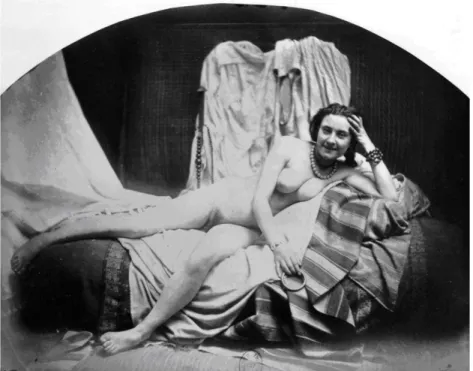
For nineteenth-century viewers, the female studio model was easily identified as a prostitute. Her social standing was even more vividly marked by the realism that photography exposed. These models are not the idealized product of artistic creation, but embody the brute reality of folded and bruised flesh, body hair and soiled feet. As seen in figure 5,21legally designated “restricted use” (“Autorisée sans exposition à l’étalage”),
this tangible slippage between the artistic and the commonplace blurred the cognitive difference between the aesthetic and the erotic, a slippage government censors were quick to arrest.
18 McCAULEY. Industrial Madness, p. 158, 160. Other histories of erotic photography have expanded
upon McCauley’s findings; see AUBENAS; COMAR. Obscénités: Photographies interdites d’Auguste Belloc (Paris, 2001); cf. also NAZARIEFF. Early Erotic Photography (Köln, 1993).
19 I have borrowed the categories of the aesthetic and erotic Venuses, and the slippage between them,
from ROUILLÉ. Le Corps et son image, p. 49.
20 McCAULEY. Industrial Madness, p. 157-58.
21 Although this photograph is attributed to the Quinet Frères in the Bibliothèque Nationale, I have
attributed it to Moulin, with the Quinet Frères as editors, based on McCauley’s attribution of a photograph using the same model and studio setting; see Industrial Madness, p. 172, fig. 65.
As Elizabeth Anne McCauley has shown, “the 1850s witnessed the height of increased censorship and public outrage [against] the marketing of photographic nudes”. Government seizures of photographic nudes began in 1851, and in 1852 copyright and censorship laws were extended to photography, “requiring that copies of photographic prints be deposited at the Ministry of Interior or the Prefecture of Police”. Here it was determined whether photographs could be offered for public sale or be restricted to classroom or studio use. In 1855 the police established a separate register to record arrests of models, photographers, hand-tinters, street peddlers and merchants of erotic/pornographic images for offending public morals. Police records also show how these illicit photographs were sold and everywhere displayed – in cafés, on street corners, in dance halls and brothels, in the backs of print shops, and in established photographer’s studios. And although “public condemnation became so strong, that it forced the nude photographic market underground”, that market thrived, as indicated by “a surge in arrests that began in 1859 and continued in the early 1860s”.22
Photography and art critics likewise decried the prostitute’s familiar personage in both the photographic medium and in paintings derived from these photographs. For example, in 1855 a writer for the Revue Photographique criticized a photographer of legitimate artists’ nudes (Jacques Antoine Moulin) for also marketing “‘académies de la rue’, or ‘street académies’”.23 In 1863, the conservative art critic Maxime Du Camp criticized Alexandre
Cabanel’s Birth of Venus (1863; Fig. 6), for merely depicting an académie – an actual paid model – and nothing more. (“C’est Venus! Non point, c’est un modèle, et rien de plus.”) In his words, she is not the “chaste” Venus born of the waves:
22 McCAULEY. Industrial Madness, p. 156-57. As police records indicate, illicit erotic and pornographic
objects, from photographs and stereographs to carved pipes, were widely available, which suggests that to identify Olympia’s kinship with such items would be either to state the obvious or to admit collusion with the underground market.
23 ANONYMOUS. Biographie: M. Moulin, Revue Photographique I (Dec. 1855), p. 26-27; cited in
McCAULEY. Industrial Madness, p. 156.
Fig. 5: Jacques Antoine Moulin (1802-after 1875; Quinet Frères, eds.), Étude d’après nature, c. 1854. Autorisée sans exposition à l’étalage. Paris: Bibliothèque Nationale de France.
sa [Cabanel’s] Vénus ne naît pas, elle se réveille. [...] elle semble solliciter l’admiration du spectateur et lui dire: Vois comme je suis belle! regarde, je suis là pour que tu me contemples à ton aise; la mer est un prétexte, mon nom un laisser passer. Je suis une femme, rien de plus, mais rien de moins.24
If viewers such as Du Camp did not distinguish between painted and photographed Venuses in the official Salon, then Manet’s Venuses must have enraged the moral guardians to the extreme. In his paintings, everything is laid bare, no effort is made to veil his real model and her social status. Manet replaced allegorical props with the mundane picnic and bedroom props of a modern prostitute-model. On this point, Émile Zola was as brazen as Olympia herself, frankly stating that “she is a girl of sixteen, doubtless some model whom Édouard Manet has quietly copied just as she is”.25 Analyzing
the critical responses to Olympia, T. J. Clark observed that, while a few critics identified her as a prostitute, most others skirted the issue by discussing “[the] violence done to the body, its physical uncleanliness, and [its] general air of death and decomposition”.26
To this I would add that, given the public’s widespread access to and ensuing scandal over erotic photographs, critics would have immediately recognized Olympia as the equivalent – or surrogate – of a hand-painted erotic photograph (Fig. 7), now enlarged to the life-size proportions of a full-scale Salon painting.
24 DU CAMP. Les Beaux-Arts à l’exposition universelle et aux Salons de 1863, 1864, 1865, 1866 & 1867
(Paris, 1867), p. 11, 29, 31-35; trans. and qtd. in McCAULEY. Industrial Madness, p. 163. As McCauley notes here, in Du Camp’s 1863 Salon review “Cabanel’s Birth of Venus and [Paul-Jacques-Aimé] Baudry’s Pearl and the Wave were criticized as académies surrounded by allegorizing but unbelievable props”.
25 ZOLA. A New Style of Painting: Édouard Manet, qtd. and trans. by HAMILTON. Manet and His
Critics, p. 99; first published in Revue du XIXe siècle, 1 Jan. 1867.
26 CLARK. The Painting of Modern Life, p. 96. In the chapter Olympia’s Choice, Clark discusses the
critical reception, in the form of suppression, of Olympia as a sexualized “naked” contemporary prostitute, and her recognizable working-class social status, as opposed to the frequently discussed contemporary mythological, sexualized nudes, such as Cabanel’s Birth of Venus. FLOYD, however, argues that Olympia was a high-class courtesan, perhaps Napoleon III’s mistress (The Puzzle of Olympia).
Fig. 6: Alexandre Cabanel (1823-1889), The Birth of Venus, 1863. Oil on canvas, 130 × 225 cm. Paris: Musée d’Orsay.
Olympia shares more than socio-economic status and tawdry studio attire with her photographed counterparts. What is most provocative about Manet’s Venus is the directness of her gaze. Yet, during the decade prior to Manet’s painting, photographers had already inverted the male gaze by having the model look head-on into the camera aperture. Now the female dominates the exchange between the viewer and the viewed. This female gaze distinguishes the illicit photograph from the legitimate académie, and Manet’s Venus from Cabanel’s, where Venus’s gaze toward the viewer is veiled by heavy eyelids and shadows cast by her hand and arm. Manet thus signaled his modernity in two photographic ways: by replacing the model’s indirect or sideways glance with a direct (or female) gaze and by painting a copy of an erotic photograph rather than an académie (Fig. 8).27
The female gaze is even more pronounced, as is its erotic function, in another invention that made its public debut in the early 1850s – stereoscopic photography.28
During the years 1853-54 it became a thriving industry, bringing home or to fair-grounds, real-life scenes of distant lands, rural pastimes, or farcical tableaux (Fig. 9). But it was most effective in capitalizing on the voyeuristic experience of viewing a three-dimensional figure through an apparatus held by a single viewer. The technology of stereoscopic photography made the nude even more real, endowing her corporeal presence with the “aura” of authenticity that Benjamin attributed to the natural object. At the same time, these images function like the “technological reproduction” of artworks. Benjamin claimed that “by permitting the reproduction to reach the recipient in his or her own
27 McCauley points out that the model’s pose determined whether the photograph was obscene. She
also discusses how “explicit sexual invitation”, registered in gestures and glances, transformed académies into erotic photography (Industrial Madness, p. 168, 170, 172).
28 For the history and techniques of stereoscopic photography, see: GERNSHEIM. The Rise of Photography,
p. 61-69; CRARY. Techniques of the Observer, p. 116-136; and PELLERIN. La photographie stéréoscopique sous le second Empire, exhibition catalog.
Fig. 7. Attributed to Auguste Belloc (1800-1867), [no title], left side of stereoscopic daguerreotype, 1850-52. Chalon-sur-Saône:
situation, it actualizes that which is reproduced”. From this Benjaminian position the stereoscope also responds to “the desire of the present-day masses to ‘get closer’ to things, [...] to get hold of an object at close range, in an image, or better, in a facsimile, a reproduction”.29 Thus, the stereoscopic image increases the auratic-qua-erotic value
29 BENJAMIN. The Work of Art, p. 104-05. Crary also quotes from Benjamin’s essay to note that the
stereoscope was a realization of this “present-day” need to “get closer to things”, Techniques of the Observer, p. 127.
Fig. 8: Anonymous, one half of stereoscopic photograph, 1854 (Duetz deposant). Paris: Bibliothèque Nationale de France.
Fig. 9: Charles Gaudin, [untitled], stereoscopic photograph, [1855-72]. Paris: Bibliothèque Nationale de France.
of the female nude, not only because of her three-dimensionality but also because she dominates the viewer’s field of vision. In this format académies could no longer pass as aesthetic Venuses, and stereoscopic Venuses pushed the erotic to the pornographic extreme.30 The technical novelty of a popular pastime and its notorious underside set
the stage for Manet’s contrivance of public spectacle into high art.
By viewing Manet’s Olympia and Le déjeuner sur l’herbe alongside stereoscopic photographs, features that have been considered technical aberrations can be better understood as deliberate copying of stereoscopic effects. These effects include harsh frontal lighting – on surfaces parallel to the camera lens – which diminishes tonal contrasts and shadows of the flesh. Conversely, an appendage – an arm or leg – projecting at an oblique angle to the lens obtain shaded and highlighted effects. (Figs. 7, 8, 11; Louis-Camille d’Oliver’s study of nudes, Fig. 4, is an exception here). As a result, those figures, limbs or objects closest to the camera lens are seen as the most relief-like when viewed through the binocular stereoscopic lenses, while those in the distance look flatter. Similar effects also caused critics to see Manet’s nudes as poorly modelled and flat. And those who saw Olympia’s more fully modeled left hand as an obscene gesture may have been right.31 However, we can also consider how the hand, and crossed feet,
project at an angle to the picture plane, simulating the stereoscopic effect of projecting anatomical parts in high relief.32
Manet first experimented with stereoscopic effects in Surprised Nymph (1861, Fig. 10). As in the stereoscopic view, the figure is pushed to the frontal plane, and its relief effect is intensified by the flatly painted landscape, a backdrop which replicates the photographer’s studio prop. This compositional disjunction closely corresponds with the spatial disruptions of the stereoscopic view that Crary describes as “a derangement of the conventional optical cues. [...] If perspective implied a homogeneous and potentially metric space, the stereoscope discloses a fundamentally disunified and aggregate field of disjunct elements”.33
An even more complex juxtaposition of three-dimensional figuration and planar backdrop also provides the basis for re-viewing Le déjeuner sur l’herbe and its affinities with stereoscopic imagery. These affinities are both general and specific – general in relation to a rural scene typical of the medium (Figs. 9, 11) and specific in relation to compositional disparities. In the latter case, the foreground figures are uniformly lit
30 For the history of stereoscopic photography’s appropriation of erotic/pornographic académies and the
censorship imposed on the trade, see PELLERIN. De quelques usages stéréoscope sous le second Empire, p. 30-42. Crary also notes “the very close association of the stereoscope with pornography”, Techniques of the Observer, p. 127. Several erotic/pornographic stereoscopic images, which closely resemble Olympia’s pose and gaze, are reproduced in AUBENAS and COMAR, Obscénités, and NAZARIEFF, Early Erotic Photography.
31 See Clark’s discussion of the critics’ complaints about the technical errors in the painting, including
the flexed, strongly modeled hand, in The Painting of Modern Life, p. 133-39; and Floyd’s discussion in “The Puzzle of Olympia.” McCauley identifies Braquehais’s “depiction of pubic hair” and the model’s clutched hand in his Academic Study – No. 6 as “an allusion to masturbation”, comparable to Olympia’s, in Industrial Madness, p. 173.
32 See Crary’s description of the stereoscope’s elusive “reality effect”, of which three-dimensionality is a
part, in Techniques of the Observer, p. 124-125.
and surrounded by a spatial vacuum lacking in orthogonal and atmospheric depth. With the exception of the two female figures, the trees and figures in the foreground are modelled in three dimensions while background objects appear flat. What is more problematic is the contradiction between the female figure in the foreground, which appears cutout or flat, and the background figure, which is fully modelled and projects from a sun-drenched landscape background. This discrepancy can also be explained as translations of stereoscopic views which force our reading of the composition as a “fundamentally disunified and aggregate field of disjunct elements”.
Fig. 10: Édouard Manet, Surprised Nymph. (Nymphe surprise). 1861. Oil on canvas,
144,5 cm x 112,5 cm. Buenos Aires, Argentina: Museo Nacional de Bellas Artes
(http://www.abcgallery.com/).
Fig. 11: Billon (Alfred-François Cordier, dit Billon-Daguerre), Baigneuse à l’étang, 1861. Paris: Bibliothèque Nationale de France.
Here I want to suggest that Manet combined two stereoscopic effects in a single painting, exaggerating the effects of “vertiginous uncertainty about the distance separating forms”.34 As in the figure of Olympia, the high-toned surfaces and minimal
modeling of the seated nude replicate the raking light effects of stereoscopic nudes that occupy the picture foreground (Fig. 11). While this lighting flattens torso and limbs parallel to the camera lenses, it renders relief-like the projections (toward the camera) of her elbow, facial features and the fingers of her right hand. (The same effects are found in the representation of her male companions, especially of the pointing hand of the right-side figure and the left-side figure’s right hand placed behind the nude’s buttocks.) This is one cutout effect of stereoscopic photography; however, the other effect renders foreground objects in high relief, as seen in the background figure. Viewed separately from the foreground, she appears in her own “disturbing[ly] palpable [...] airless space”. Here again the model is posed in front of a planar landscape backdrop, and there is no logical spatial distance between the two. Further evidence of Manet’s borrowings from stereoscopic photography is that this half-draped figure, framed by trees and crouching in a pond, clearly refers to a series of photographs titled Baigneuses à l’étang attributed to Billon (Alfred François Cordier, dit Billon-Daguerre),35 a photographer
who specialized in both académies and pornographic nudes (Fig. 11). Finally, when the distant figure is viewed within the entire landscape composition, another technological indicator comes to the fore: by rendering the most distant figure in high relief and at dead-centre, Manet overtly supplanted orthogonal perspective with stereoscopic projection. Manet’s references to stereoscopic images not only destabilize the painting’s compositional unity, but also the viewer’s gaze. Indeed, our attention keeps shifting from background to foreground with no transition in between. In this respect, Manet was re-presenting the actual optical experience of viewing stereoscopic images. As the inventors made known, two similar (but not exact) images fuse into one because of the convergence of the optic axes; this convergence, however, takes place over time, “uniting in rapid succession, similar points of the two pictures”.36 Crary further states, “no matter how ‘vivid’ the
quality of illusion, [...] the composite, synthetic nature of the stereoscopic image could never be fully effaced”.37 Thus, the stereoscopic experience can be characterized as a
doubling of opposite effects: disjunctive and divergent as well as unifying and convergent. It is this sustained doubleness that distinguishes Manet’s use of photography from his contemporaries’ and marks his originality as a Baudelairean painter of modern life. In “The Painter of Modern Life”, Baudelaire defined modernity as a constant state of flux between “the transient, the fleeting, the contingent”, on the one hand, and “the eternal and immutable”, on the other.38 The artist can achieve an aesthetic dualism by
34 This and the following quotations are from CRARY, Techniques of the Observer, p. 125. 35 PELLERIN. La photographie stéréoscopique, p. 104.
36 Crary describes this temporal convergence, quoting BREWSTER’s The Stereoscope (London, 1856),
in Techniques of the Observer, p. 120, 122.
37 CRARY. Techniques of the Observer, p. 133. See also his discussion of the stereoscope’s “principle of
disparity”, which endured even in the apparatus’s later forms (p. 125-26, 128-29).
rendering the familiar unfamiliar – “strange”, “mysterious” and “ever new” – and by “elud[ing] the rules and analyses of the school”.39 For Manet, parody became the means
to achieve this Baudelairean effect. By inscribing both “continuity” with, and “critical distance” from, the old masterpieces in the new ones, Manet sought to subvert the viewer’s aesthetic expectations, promote critical self-reflection and, thereby, advance an ongoing process of cultural renewal.40 As seen here, Manet’s subversive strategies
engage the photographic medium as well as its technological devices and deviations.
Fig. 12: Édouard Manet, Portrait of Émile Zola, 1868. Oil on canvas, 146 x 114 cm. Paris: Musée d’Orsay (www.artnet.com).
Fig. 12a: Detail, Portrait of Émile Zola.
39 BAUDELAIRE. The Painter of Modern Life, p. 395, 402, and The Exposition Universelle, 1855, in Art
in Paris 1845-1862, p. 124.
40 Here I use HUTCHEON’s definition of modern parody as double-coded, discussed in A Theory of Parody.
I have elsewhere treated Manet’s visual parody and its ironic effects in WEINGARDEN. Baudelairean Modernity and Mirrored Time, and WEINGARDEN. The Mirror as a Metaphor of Baudelairean Modernity.
By way of Manet’s modernism, we can identify how the technological reproduction obtains an aura of originality, a modernist paradox that Manet inscribed in a portrait of Émile Zola (1868; Fig. 12). In that work the artist painted his own engraving of Olympia (1867; Fig. 13), who here turns her seductive gaze to the sitter (Fig. 12a). (This engraving was included in Zola’s 1867 pamphlet on Manet, also included in the painting.41) Zola’s
own gaze, in turn, had sanctioned Manet’s modernity. Writing on Olympia and Le déjeuner sur l’herbe in 1867, the critic recognized a Baudelairean dialectic between the eternal and the transitory that marked artistic originality – a modernity which Benjamin extended when he correlated the technological reproduction of art with an ever-changing mode of perception.
Fig 13: Édouard Manet, Olympia, etching and aquatint, 1867, platemark 86 x 177 mm. (http://www.mattiajona.com/)
However, in considering a modernist discourse on the copy and the original, we should acknowledge what Benjamin would not: that whatever its mode of reproduction, the allusion to the original artwork remains the same, as does (ostensibly for Benjamin) the viewer’s aesthetic enjoyment. Benjamin skirted this issue when discussing the inextricable link between an artwork’s authenticity and tradition. “The here and now of the original underlies the concept of its authenticity, and on the latter in turn is founded the idea of a tradition which has passed the object down as the same, identical thing to the present day.” Here the original art object is of concern insofar as it gauged tradition’s demise in the age of technological reproducibility:
41 The pamphlet, Éd. Manet (Paris, 1867), is depicted with its blue cover on Zola’s desk; see CACHIN,
Manet: 1832-1883, p. 280-84. Françoise Cachin writes: “It is hard to tell whether this [the image] is a lost print or an enlarged photograph of the painting”, Manet: 1832-1883, p. 184. However, since Manet made several print versions after Olympia (a woodblock and two etchings), and because one of the etchings was made for the Zola portrait, I believe the version in the portrait is an etching, in particular the 4th state of
the “small plate”; for illustration see: http://www.ecademy.com/module.php?mod=list&lid=13627. For discussion of these prints see: Manet: 1832-1883, p. 186-189.
Since the historical testimony is founded on the physical duration (of the art object), the former, too, is jeopardized by reproduction, in which the physical duration plays no part. And what is really jeopardized when the historical testimony is affected is the authority of the object, the weight it derives from tradition.42
Benjamin’s focus on the “physical duration” that constitutes the artwork’s authenticity disregards how modern artists reproduced reproductions to assert their own originality and the aura of the unique work of art. Given Manet’s engagement in the whole realm of reproducibility,43 we should also consider how the technological
reproduction of the work of art might function, in Benjamin’s words, as a means for “tradition itself [to remain] thoroughly alive and extremely changeable”.44 Indeed,
Manet’s parodic “copies” transform and sustain tradition in ways that Benjamin overlooked. (Benjamin considered reproductions “made by hand [...] a forgery”.45)
A closer examination of how Olympia figures in the portrait of Zola reveals that Manet set an originary example in his own age of technological reproducibility by mastering the commodification of his art. Pierre-Lin Renié’s study of prints as decoration of nineteenth-century interiors is especially relevant here. That is, when museum and Salon paintings were reproduced in prints and photographs ad infinitum, Renié argues, “they could also become the subject of new paintings, which would themselves be transformed into images[.] Over and over this process repeated itself. As art was disseminated [...] in greater and greater quantities, it would begin to be reused and recycled at an accelerated pace”.46 Manet’s art
bears witness to this media explosion. As both a consumer and producer of art reproductions, Manet perpetuated the process of reproducibility, not to jeopardize tradition but to recycle and renew it. What makes it parodic is that he turned the process upon itself. Not only did Manet reproduce his own etching (Fig. 13), from which mechanical reproductions of his painting ensued, he also embedded the print of Olympia among a Japanese woodblock print of a sumo wrestler by Kuniaki II and an engraving of Diego Velázquez’s Los Borrachos (The Feast of Bacchus).47 By doing so, Manet extended the artistic
traditions with which he cast his own legacy, just as he had done by translating Marcantonio Raimondi’s engraving after Raphael’s Judgment of Paris into the modern figures of Le déjeuner sur l’herbe.48 But his pastiche of nineteenth-century prints goes further to
accommodate mass-produced art, made possible by photography and its related industries and its inextricable link to the history of print-making. Just as the traditional Japanese wood-block print was made for mass consumption and (foreign) distribution, so too were
42 BENJAMIN. The Work of Art, p. 103.
43 See FARWELL et al. The Cult of Images, p. 20-21, 27-31, 88-89, 137-38; and McCAULEY. A.A.E.
Disdéri and the carte de visite portrait photograph, p. 182-95.
44 BENJAMIN. The Work of Art, p. 105. Here Benjamin was referring to how, in the case of “an ancient
statue of Venus”, the meaning of an artwork changes with a change of context and viewers: the statue, “for instance, existed in a traditional context for the Greeks (who made it an object of worship) that was different from the context in which it existed for medieval clerics (who viewed it as a sinister idol).”
45 BENJAMIN. The Work of Art, p.103.
46 RENIÉ. The Image on the Wall: Prints as Decoration in Nineteenth-Century Interiors. 47 CACHIN. Manet: 1832-1883, p. 284.
the reproduced masterpieces Manet copied. For, more than likely, the Velásquez print was a photogravure, a process in which a photograph of a painting is transferred to and etched into a metal plate. This technological method of reproduction proliferated in the art market and invaded every middle- and upper-class home and artist’s studio during the second half of the nineteenth century. By fabricating this web of reproducibility within his own paintings, Manet brought the weight and changeability of tradition to bear on his modernity.
In the modernity that Manet cultivates, mémoire volontaire is activated by the enduring presence (in absentia) of an antecedent artwork, just as it is engaged by the presence of a real woman in the académie or the erotic photograph. This modernity conflicts with the aesthetic tradition Benjamin brought to bear on the viewer’s encounter with artworks. Thus, despite his ideological endorsement of modern technology, Benjamin’s aesthetic gaze remains fixed in the past. His aesthetic expectation to be held to a work of art by the subjective mediation between image and viewer is romantic to the extreme:
Experience of the aura thus arises from the fact that a response characteristic of human relationships is transposed to the relationship between human and inanimate or natural object and man. The person we look at, or who feels he is being looked at, looks at us in turn. To experience the aura of an object we look at means to invest it with the ability to look back at us. This ability corresponds to the data of the mémoire involontaire.49
Ironically, Benjamin’s paradigm of the auratic gaze facilitates our recovery of a nineteenth-century erotic gaze that art historical reproductions have traditionally repressed. Likewise ironic is the fact that his critique of the work of art in the age of its technological reproducibility exposes how the aura of authenticity remains alive and constantly changing in artworks that subsume copying technologies. In Manet’s paintings mémoire volontaire displaces mémoire involontaire, a paradox that induces, rather than reduces, “the imagination’s scope for play”.
A
A
A
A
A
B S T R A C TB S T R A C TB S T R A C TB S T R A C TB S T R A C TEm suas pinturas de 1863, Le déjeuner sur l’herbe e Olympia, Édouard Manet não apenas faz referências a obras-primas expostas em museus, mas também utiliza fotografias de modelos acadêmicos e pornográficos, um gênero novo de fotografia comercial surgido no início da década de 1850. Defendo a idéia de que Manet aproxima, de modo deliberado, reproduções das belas artes e produtos da comunicação de massa, uma prática que pode ser analisada à luz do ensaio de Walter Benjamin, “A obra de arte na era de sua reprodutibilidade técnica”. Como tanto Manet quanto Benjamin dialogam com os escritos de Charles Baudelaire sobre arte, cultura e fotografia, esses textos oferecem uma estrutura para se discernir paradoxos modernistas inerentes às interpretações críticas da cultura popular e material feitas por Manet e Benjamin.
49 BENJAMIN. Some Motifs in Baudelaire, p. 338.
K
K
K
K
K
E Y W O R D SE Y W O R D SE Y W O R D SE Y W O R D SE Y W O R D SPintura do século XIX, fotografia erótica e estereoscópica, paródia, olhar aurático/erótico, crítica da fotografia
R
R
R
R
R
E F E R E N C E SE F E R E N C E SE F E R E N C E SE F E R E N C E SE F E R E N C E SANON. Biographie: M. Moulin. Revue Photographique v. 1, p. 26-27, Dec. 1855. AUBENAS, Sylvie, et al. L’Art du Nu au XIXe siècle: le photographe et son modèle.
Exhibition catalogue. Paris: Bibliothèque Nationale de France, 1998.
AUBENAS, Sylvie; COMAR, Phillipe. Obscénités: Photographies interdites d’Auguste Belloc. Paris: Bibliothèque Nationale de France, 2001.
BAUDELAIRE, Charles. The Exposition Universelle, 1855. In: BAUDELAIRE, Charles. Art in Paris 1845-1862: Salons and other Exhibitions. Trans. Jonathan Mayne. Ithaca, NY: Cornell University Press, 1981.
BAUDELAIRE, Charles. The Modern Public and Photography. From The Salon of 1859. In: BAUDELAIRE, Charles. Selected Writings on Art and Literature. Trans. and ed. P. E. Charvet. London and New York: Penguin Press, 1992, p. 296-98.
BAUDELAIRE, Charles. The Painter of Modern Life. (1862.) In: BAUDELAIRE, Charles. Selected Writings on Art and Literature. Trans. and ed. P. E. Charvet. London and New York: Penguin Press, 1992, p. 390-436.
BAUDELAIRE, Charles. The Salon of 1859. In: BAUDELAIRE, Charles. Selected Writings on Art and Literature. Trans. and ed. P. E. Charvet. London and New York: Penguin Press, 1992, p. 285-324.
BENJAMIN, Walter. Das Kunstwerk im Zeitalter seiner technischen Reproduzierbarkeit (2nd version, 1936, unpublished in Benjamin’s lifetime). English: The Work of Art in the
Age of Its Technological Reproducibility: Second Version. Trans. Edmund Jephcott and Harry Zorn. In: BENJAMIN, Walter. Selected Writings. Volume 3: 1935-1938. EILAND, Howard; JENNINGS, Michael W. (Ed.). Cambridge, MA, and London: The Belknap Press of Harvard University Press, 2002, p. 101-33.
BENJAMIN, Walter. The Work of Art in the Age of Its Technological Reproducibility: Third Version (1936-39, unpublished in Benjamin’s lifetime). Trans. Harry Zorn and Edmund JEPHCOTT. In: BENJAMIN, Walter. Selected Writings. Volume 4: 1938-1940. EILAND, Howard; JENNINGS, Michael W. (Ed.). Cambridge, MA, and London: The Belknap Press of Harvard University Press, 2003, p. 251-83.
BENJAMIN, Walter. The Paris of the Second Empire in Baudelaire (1938) and Some Motifs in Baudelaire (1939). In: BENJAMIN, Walter. Selected Writings. Volume 4: 1938-1940, p. 3-92. BREWSTER, Sir David. The Stereoscope: Its History, Theory and Construction. London, 1856.
CACHIN, Françoise, et al. Manet: 1832-1883. Exhibition catalogue. New York: The Metropolitan Museum of Art, 1983.
CLARK, T. J. The Painting of Modern Life: Paris in the Art of Manet and his Followers. Princeton, NJ: Princeton University Press, 1984.
CLAYSON, Hollis. Painted Love: Prostitution in French Art of the Impressionist Era (1991), repr. Los Angeles: The Getty Research Institute, 2003.
CRARY, Jonathan. Techniques of the Observer: On Vision and Modernity in the 19th
Century. Cambridge, MA: The MIT Press, 1999.
DU CAMP, Maxime. Les Beaux-Arts à l’exposition universelle et aux Salons de 1863, 1864, 1865, 1866 & 1867. Paris, 1867.
FARWELL, Beatrice, et al.(Org.). The Cult of Images (Le cult des images): Baudelaire and the 19th-Century Media Explosion. UCSB Art Museum, April 6-May 8, 1977, in cooperation with the Bibliothèque Nationale, Paris. Santa Barbara: University of California at Santa Barbara Art Museum, c1977.
FARWELL, Beatrice. Manet and the Nude: A Study in Iconography in the Second Empire. PhD diss., University of California, Los Angeles, 1973. Repr. New York & London: Garland, 1981.
FLOYD, Phylis A. The Puzzle of Olympia. Nineteenth-Century Art Worldwide, Spring 2004. Disponível em:<http://19thc-artworldwide.org/spring_04/articles/floy.html>. FRIED, Michael. Manet’s Sources: Aspects of his Art, 1859-1865. Artforum v. 7, p. 28-62, March 1969.
GERNSHEIM, Helmut. The Rise of Photography: 1850-1880, the age of collodio. London, New York: Thames & Hudson, 1988.
HAMILTON, George Heard. Manet and His Critics. New Haven and London: Yale University Press, 1986.
HAXTHAUSEN, Charles M. Reproduction/Repetition: Walter Benjamin/Carl Einstein. October 107, p. 47-74, Winter 2004.
HUTCHEON, Linda. A Theory of Parody: Teachings of Twentieth Century Art Forms. New York: Methuen, 1985.
McCAULEY, Elizabeth Anne. A.A.E. Disdéri and the carte de visite portrait photograph. New Haven, CT: Yale University Press, 1985.
McCAULEY, Elizabeth Anne. Industrial Madness: Commercial Photography in Paris, 1848-1871. New Haven and London: Yale University Press, 1994.
NAZARIEFF, Serge. Early Erotic Photography. Köln: Taschen, 1993.
NEEDHAM, Gerald. Manet, Olympia and Pornographic Photography. In: HESS, Thomas B.; NOCHLIN, Linda (Ed.). Woman as Sex Object: Studies in Erotic Art, 1730-1970. New York: Newsweek, 1973, p. 81-89.
PELLERIN, Denis. De quelques usages du stéréoscope sous le second Empire. Paris: DEA, Université Paris I; Mondoubleau: D. Pellerin, 1999.
PELLERIN, Denis. La photographie stéréoscopique sous le second Empire. Exhibition catalogue. Paris: Bibliothèque Nationale de France, 1995.
RENIÉ, Pierre-Lin. The Image on the Wall: Prints as Decoration in Nineteenth-Century Interiors. Nineteenth-Century Art Worldwide, Autumn 2006. Disponível em: <http://19thc-artworldwide.org/autumn_06/articles/reni.html.>
ROUILLÉ, André. Le Corps et son image: photographies du dix-neuvième siècle. Paris: Contrejour: Bibliothèque nationale, 1986.
SHIFF, Richard. Representation, Copying, and the Technique of Originality. New Literary History, v. 15, p. 333-64, Winter 1984.
WEINGARDEN, Lauren. Baudelairean Modernity and Mirrored Time. In: POCHAT, Götz (Ed.). Kunsthistorisches Jahrbuch Graz 29/30 (2005). Graz: Akademische Druck und Verlagsanstalt, 2005, p. 125-138.
WEINGARDEN, Lauren. The Mirror as a Metaphor of Baudelairean Modernity. In: CLÜVER, Claus, et al. (Ed.). Orientations: Space/Time/Image/Word. Word & Image Interactions 5. Amsterdam and New York: Rodopi, 2005, p. 17-36.
ZOLA, Émile. A New Style of Painting: Édouard Manet, orig. published in French in Revue du XIXe siècle, 1 Jan. 1867.


![Fig. 7. Attributed to Auguste Belloc (1800- (1800-1867), [no title], left side of stereoscopic daguerreotype, 1850-52](https://thumb-eu.123doks.com/thumbv2/123dok_br/17345285.795409/11.829.123.447.81.457/fig-attributed-auguste-belloc-title-left-stereoscopic-daguerreotype.webp)