Universidade do Minho Escola de Engenharia Departamento de Inform´atica
David Luis Moniz Branco
Optimization in code generation
to reduce energy consumption
This work is funded by the ERDF through the Programme COMPETE and by the Por-tuguese Government through FCT - Foundation for Science and Technology, within projects: FCOMP-01-0124-FEDER-020484, FCOMP-01-0124-FEDER-022701, and grant ref. BI4-2014 GreenSSCM-38973 UMINHO.
Universidade do Minho
Escola de Engenharia Departamento de Inform´atica
David Luis Moniz Branco
Optimization in code generation
to reduce energy consumption
Master dissertation
Master Degree in Computer Science
Dissertation supervised by
Pedro Rangel Henriques
A C K N O W L E D G E M E N T S
I want to thank to Prof. Pedro Rangel Henriques for his consideration, dedication, teachings and guidance that came since the first day of the Computer Science Degree.
I am also grateful to Dr. Rui Pereira, Prof. Jo˜ao Saraiva, Prof. J´acome Cunha and other members of the GreenSSCM project team for their support, passed knowledge and always pertinent suggestions.
I also want to thank all my colleagues who have always provided assistance and great moments during the journey. Miro, Carc¸˜ao, Daniel, Jo˜ao, Hugo, Nuno, Marina and the remaining group that was part of the Infobiz family.
Lastly, I would also like to thank my family for their support over time and for the opportunity they gave me to carry out this work.
A B S T R A C T
In recent years we have witnessed a great technological advance accompanied by an equally impressive increase in energy consumption, causing problems of both financial and envi-ronmental order. In order to counteract this tendency, Green Computing emerges with a number of measures for a more efficient use of computing resources without a great loss of performance.
This essay is a study of several elements of Information Technology analyzed from the point of view of energy efficiency. With special emphasis on microprocessors, modern compiler design, development tools and optimization of code generation, a wide range of information is gathered on very relevant subjects through perspectives still not very considered by the community in general.
Also presented are two experimental studies that analyze the optimization of generated code for a set of benchmark programs in several programming languages with the aim of apraise the otimization impact on improving their energy consumption efficiency. A soft-ware measurement framework was also developed that, together with the methodologies presented in both studies, allows obtaining very precise and pertinent results for analysis. Finally, a ranking was produced for 18 development tools, considering the execution time and energy consumption of the executables generated through their compilation profiles.
This study also intends to contribute to an energy efficient technological advancement. All the work developed here may also serve as motivation so that these and other aspects of Information Technology may be seen through a greener perspective.
R E S U M O
Nos ´ultimos anos temos assistido a um grande avanc¸o tecnol ´ogico acompanhado por um aumento igualmente impressionante do consumo energ´etico, provocando problemas quer de ordem financeira quer de ordem ambiental. Com o intuito de contrariar essa tendˆencia, surge o Green Computing com v´arias medidas para uma utilizac¸˜ao mais eficiente dos re-cursos computacionais sem grande perda de performance.
Esta dissertac¸˜ao apresenta um estudo relativo a diversos elementos das Tecnologias de Informac¸˜ao analisados do ponto de vista da eficiˆencia energ´etica. Com especial destaque para microprocessadores, concec¸˜ao moderna dos compiladores atuais, ferramentas de de-senvolvimento e gerac¸˜ao de c ´odigo otimizado, ´e aqui reunida uma vasta gama de informac¸˜ao sobre assuntos bastante relevantes segundo perspetivas ainda pouco consideradas pela co-munidade em geral.
S˜ao tamb´em apresentados dois estudos experimentais que analisam a otimizac¸˜ao do c ´odigo gerado para um conjunto de programas benchmarks em v´arias linguagens de programac¸˜ao com o objetivo de compreender o impacto das otimizac¸ ˜oes no sentido de melhorar a eficiˆencia energ´etica dos programas compilados. Foi tamb´em desenvolvida uma framework de medic¸˜ao por software que em conjunto com as metodologias apresentadas em ambos os estudos permite a obtenc¸˜ao de resultados bastante precisos e pertinentes de an´alise. Por ´ultimo ´e elaborado um ranking para 18 ferramentas de desenvolvimento considerando o tempo de execuc¸˜ao e consumo energ´etico dos execut´aveis gerados atrav´es dos seus perfis de compilac¸˜ao.
Este estudo pretende assim contribuir para um avanc¸o tecnol ´ogico energeticamente mais eficiente. Que todo o trabalho aqui desenvolvido possa tamb´em ele servir de motivac¸˜ao para que estes e outros aspetos das Tecnologias de Informac¸˜ao possam ser vistos atrav´es de uma perspetiva mais ecol ´ogica.
C O N T E N T S
1 i n t r o d u c t i o n 1
1.1 Context and Motivation 1
1.2 Objectives 2
1.3 Study Plan 3
1.4 Document Structure 4
2 p r o c e s s o r v e n d o r s a n d g r e e n c o m p u t i n g 6
2.1 Green Computing 6
2.1.1 Advent of Green Computing 6
2.1.2 Meaning and Objectives of Green Computing 9
2.1.3 Roots of Green Computing 10
2.1.4 Importance and Solutions of Green Computing 10
2.2 Microprocessors 13
2.2.1 Different concerns in the development over time 14 2.2.2 Microprocessors as a means for reduction of energy consumption 15
2.3 Manufacturers of Microprocessors 16 2.3.1 Intel 17 2.3.2 AMD 18 2.3.3 IBM 19 3 c o m p i l e r d e s i g n a n d e n e r g y r e d u c t i o n 21 3.1 Code Generation 22
3.2 Power reduction and energy saving 25
3.2.1 Power vs. Energy 25
3.2.2 Energetic aspects of programs 26
3.3 Optimization Techniques 28
3.3.1 Just compiling for speed 29
3.3.2 Trading speed for power 29
3.3.3 Instruction scheduling and bit switching 30
3.3.4 Avoiding the dynamic scheduler 31
3.3.5 Domain-specific optimizations 32 3.4 Just-In-Time compilation 32 3.5 Summary 34 4 i m pa c t o f g c c o p t i m i z at i o n l e v e l s i n e n e r g y c o n s u m p t i o n d u r i n g p r o g r a m e x e c u t i o n 37 4.1 Related Work 38
4.2 Experimental Setup 39 4.2.1 Testing Platform 39 4.2.2 Measurement Software 39 4.2.3 Measured Software 40 4.3 Methodology 42 4.3.1 Optimizations Flags 42 4.3.2 Measurement Process 43 4.4 Discussion of Results 44 4.5 Conclusion 49 5 i m pa c t o f c o m p i l at i o n b y i n t e g r at e d d e v e l o p m e n t e n v i r o n m e n t s i n e n e r g y c o n s u m p t i o n d u r i n g p r o g r a m e x e c u t i o n 51
5.1 Integrated Development Environments 53
5.1.1 Meaning and Main Features 54
5.1.2 Advantages and Disadvantages 56
5.1.3 Differentiation Factors 58
5.1.4 Summary 58
5.2 Compilation Profiles 59
5.3 The Computer Language Benchmarks Game 61
5.4 Experimental Setup 63 5.4.1 Testing Platform 63 5.4.2 Measurement Software 63 5.4.3 Measured Software 63 5.5 Methodology 67 5.5.1 Analyzed Tools 67 5.5.2 Compilation Options 76 5.5.3 Measurement Process 103 5.6 Discussion of Results 108 5.6.1 Programs 109 5.6.2 Programs - Tools 119 5.6.3 Tools - Profiles 126 5.6.4 Profiles - Parameters 131 5.6.5 Parameters 140 5.6.6 Discussion 144 5.7 Summary 146 6 c o n c l u s i o n 150 a s u p p o r t m at e r i a l 163
L I S T O F F I G U R E S
Figure 2 Worldwide IT spending on servers, power and cooling and
manage-ment/administration (He,2008). 11
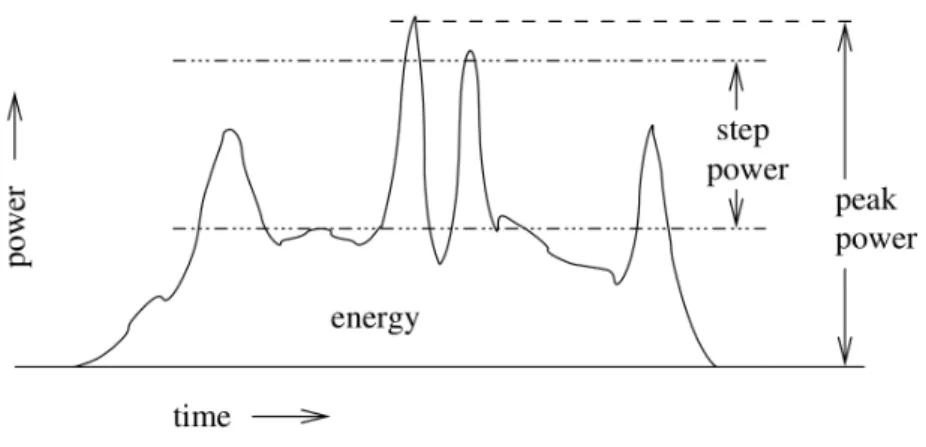
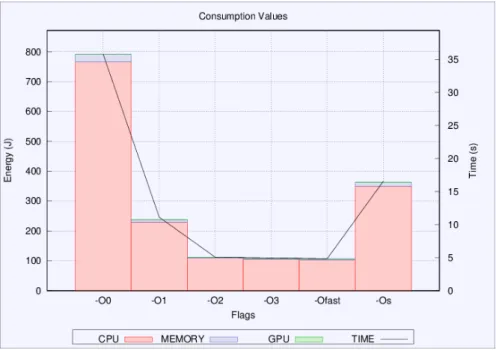
Figure 3 Industry Changes in Requirements (Davies,2012). 15 Figure 4 Server power breakdown by components (Ellison,2009). 16 Figure 5 Energy Consumption, Power, Step Power and Peak Power during a program execution (Grune et al.,2012). 28 Figure 6 Results of Bzip measurements (C program). 44 Figure 7 Results of Oggenc measurements (C program). 45 Figure 8 Results of Pbrt measurements (C++ program). 45 Figure 9 Results of PGo measurements (Go program). 46 Figure 10 Results of Matmulobjc measurements (Objective-C program). 46
Figure 11 Sphere Engine interface. 72
Figure 12 Geany interface. 73
Figure 13 Traditional C compilation stages. 77
Figure 14 Log message with the compilation parameters from ZinjaI. 80 Figure 15 Log message with the compilation parameters from CodeLite. 81 Figure 16 Project properties manager from NetBeans IDE. 81 Figure 17 Project properties manager from Eclipse CDT. 82 Figure 18 Example of CMakeLists.txt from CLion. 82 Figure 19 Default configuration file from AWS Cloud9. 83 Figure 20 Changing between profiles through Oracle Developer Studio. 83 Figure 21 Changing between profiles through Anjuta DevStudio. 84 Figure 22 Managing profiles through Oracle Developer Studio. 87
Figure 23 Managing profiles through GPS. 87
Figure 24 Results of mandelbrot measurements. 112 Figure 25 Results of fannkuch-redux measurements. 113 Figure 26 Results of reverse-complement measurements. 115 Figure 27 Results of regex-redux measurements. 116 Figure 28 Tools measurements for thread-ring. 120
Figure 29 Tools measurements for n-body. 121
Figure 30 Tools measurements for reverse-complement. 122 Figure 31 Default profiles measurements for binary-trees. 127 Figure 32 Release profiles measurements for mandelbrot. 129
Figure 33 Debug profiles measurements for spectral-norm. 130 Figure 34 Profiles without optimization and debug options for fannkuch-redux.132 Figure 35 Profiles with debug but without optimization options for
fannkuch-redux. 133
Figure 36 Profiles with debug and optimization options for fannkuch-redux.134 Figure 37 Profiles without debug but with optimization options for
fannkuch-redux. 134
Figure 38 Results of binary-trees measurements. 164 Figure 39 Results of chameneos-redux measurements. 164 Figure 40 Results of fannkuch-redux measurements. 165
Figure 41 Results of fasta measurements. 165
Figure 42 Results of k-nucleotide measurements. 166 Figure 43 Results of mandelbrot measurements. 166
Figure 44 Results of meteor measurements. 167
Figure 45 Results of n-body measurements. 167
Figure 46 Results of regex-redux measurements. 168 Figure 47 Results of reverse-complement measurements. 168 Figure 48 Results of spectral-norm measurements. 169 Figure 49 Results of thread-ring measurements. 169 Figure 50 Tools measurements for binary-trees. 172 Figure 51 Tools measurements for chameneos-redux. 172 Figure 52 Tools measurements for fannkuch-redux. 173
Figure 53 Tools measurements for fasta. 173
Figure 54 Tools measurements for k-nucleotide. 174 Figure 55 Tools measurements for mandelbrot. 174
Figure 56 Tools measurements for meteor. 175
Figure 57 Tools measurements for n-body. 175
Figure 58 Tools measurements for regex-redux. 176 Figure 59 Tools measurements for reverse-complement. 176 Figure 60 Tools measurements for spectral-norm. 177 Figure 61 Tools measurements for thread-ring. 177
L I S T O F TA B L E S
Table 1 Some features of the measured programs. 41 Table 2 Execution times of C/C++ programs in seconds by optimization
level. 47
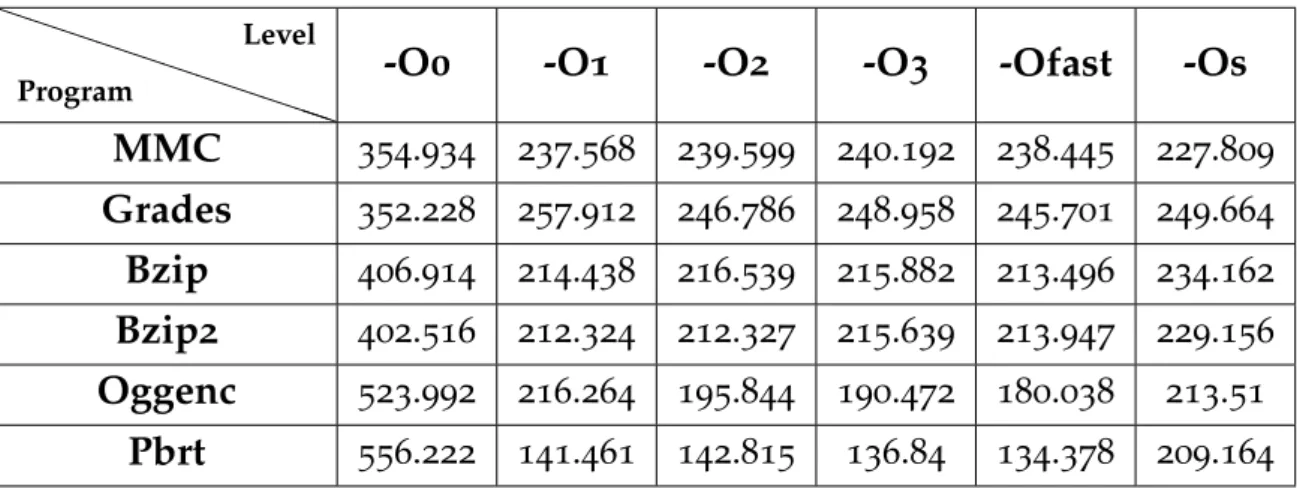
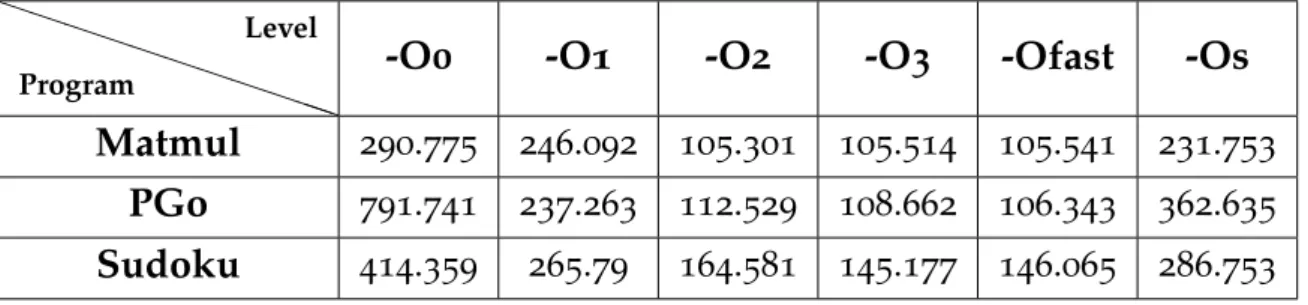
Table 3 Selected C/C++ programs and their energy consumption (CPU and memory) in Joules by optimization level. 47 Table 4 Execution times of Go programs in seconds by optimization level. 48 Table 5 Selected Go programs and their energy consumption (CPU and
mem-ory) in Joules by optimization level. 48 Table 6 Execution times of Objective-C programs in seconds by optimization
level. 48
Table 7 Selected Objective-C programs and their energy consumption (CPU and memory) in Joules by optimization level. 49
Table 8 Analyzed IDEs. 70
Table 9 Tools, profiles and parameters analyzed. 85
Table 10 Measured Profiles. 105
Table 11 Measurement results for all programs. 110 Table 12 Tools ranked with 1 decimal point. 123 Table 13 Default profiles ranked with 0 decimal points. 128 Table 14 Profiles ranked with 3 decimal points. 138
Table 15 Optimization levels results. 143
Table 16 Tools ranked with 0 decimal points. 170 Table 17 Tools ranked with 1 decimal point. 170 Table 18 Tools ranked with 2 decimal points. 171 Table 19 Tools ranked with 3 decimal points. 171 Table 20 Profiles ranked with 0 decimal points. 178 Table 21 Profiles ranked with 1 decimal point. 179 Table 22 Profiles ranked with 2 decimal points. 180 Table 23 Profiles ranked with 3 decimal points. 181
A C R O N Y M S
B
BAT Build Automation Tool. C
CLBG Computer Language Benchmarks Game. CPU Central Processing Unit.
G
GCC GNU Compiler Collection. GPU Graphics Processing Unit.
GREENSSCM Green Software Project for Space Control Mission. H
HTML Hypertext Markup Language. I
ICT Information and Communication Infrastructure. IDE Integrated Development Environment.
IT Information Technology. J JIT Just-In-Time. O OS Operating System. R
RAM Random Access Memory. RAPL Running Average Power Limit. V
1
I N T R O D U C T I O NThis project was initially funded by a research grant, under the Green Software project for Space Control Mission (GreenSSCM1
) / University of Minho, financed by European Regional Development Fund (ERDF) through the Programa Operacional Regional do Norte.
1.1 c o n t e x t a n d m o t i vat i o n
Currently we live in a period in which technology evolves very quickly and the number of those who use it, causing the associated energy consumption, reaches very high values in financial and environmental terms (Guelzim and Obaidat,2013;Zhang and Ansari,2013).
So there is a strong concern and an increasing need to reduce energy consumption in all the information and communication infrastructures (ICTs). Together with these factors emerged Green Computing, also the so-called Green Technology, which aims precisely at using computing resources more efficiently while maintaining or increasing overall perfor-mance (Harmon and Auseklis, 2009). This paradigm has already more than three decades
and directly covers the entire ICT infrastructure (Harmon and Auseklis,2009). Even though
this paradigm exists for some time, it never received proper attention, which is evidently one of the main reasons for the problems and limitations associated to the environmental impact of the IT industry (Harmon and Auseklis, 2009). This area is very wide, then the
question arises how can we reduce this consumption. Among the various possibilities, the chosen approach will be to study the reduction of energy consumption during program execution. This possibility raises several issues, namely: how can we reduce the energy consumption without affect the reliability of the application?; how does the energy con-sumption relates to all other aspects of the generated code?; what is the current stance of the compilers on this matter?; what compilation techniques can help us contradict this presented tendency?; what is the actual impact on the compiler’s generated code and the respective optimizations in terms of energy consumption?; what are the development tools that offer the best results in this strand? These are few of the major concerns that will be
discussed in this Master’s thesis.
Beyond the academic component of this project, there is also a great personal engagement. It is very motivating to know that I can contribute to the solution to a real problem that tends to increase (Koomey, 2011). The choice of this topic took in consideration these
aspects of motivation as well as an opportunity to apply the knowledge obtained over five years, thus enriching the education in theory and practice.
1.2 o b j e c t i v e s
The main focus of this thesis is to carry out, in a clear but detailed manner, a study about the current role of Green Computing in technology, by gathering a great number of related elements, in terms of hardware and software. It will also explore how do they relate to them-selves and to other surrounding elements, discovering their impact on energy consumption, and understanding how the consumption can be optimized. This work will emphasize the matters concerned with processors, compilers, programming languages and development tools. A historical, current and future context will also be carried out whenever it is con-sidered relevant to the intended analysis. Nonetheless, it is also intended to analyze other important strands for each element beyond the perspective of Green Computing.
In particular, it is expected that at the end of this dissertation the following goals will be achieved:
• Clear perception about the role, importance and potential of Green Computing in Information Technologies;
• Investigation of the weight of energy consumption on different types of hardware and detailed analysis of the role of the most relevant element;
• Investigation of the importance and potential of using software (with the main focus on compilers) to attain energy efficiency;
• Comprehension of the hardware-software-energy triplet in order to enhance signifi-cant improvements;
• Study of relevant software development tools (with the major focus on IDEs) and the performance of the executables they generate by default;
• Definition and application of study methodologies that allow to apply the knowledge acquired for concrete case studies with relevant elements;
• Obtaining results that allow not only to draw relevant conclusions in the scope con-sidered but also to be used in other areas of analysis.
1.3 s t u d y p l a n
Firstly, this report starts by defining the concept of Green Computing: what is its origin, its evolution and how relevant it currently became. Furthermore, it presents its goals and most relevant solutions, picturing what can technology benefit from this paradigm. This dissertation then discusses hardware manufacturers, more precisely the most renowned microprocessors manufacturers, giving an overview of the industry’s current position on Green Computing, from past to the current days. With all these facts it can portray the potential of the microprocessors in reducing the energy consumption on Information Tech-nologies.
It is revealed that it is equally important, and essential, to study the design of modern compilers and how do they relate to those previously mentioned elements. The aim of such study is to understand concretely how they act and what properties guarantee the code they generate, what considerations do they have regarding the topic under consideration, which optimization techniques currently stand out and what effect do they have on the energetic consumption of the generated code.
Furthermore, the dissertation presents an experimental study to demonstrate the ac-quired knowledge and understand, for each specific use case, how do these elements behave and analyze in detail all relevant features for real use case scenarios.
Particularly, the study observes what is the impact of the GCC optimization suites on the energy consumption of running programs. This subject allows to integrate, in experimental form, many of the aspects analyzed such as the hardware components, modern compilers and programming languages. This being presented under the perspective of the energy consumption and all around related concepts. The study shall select the most well known and commonly used programming elements to increase the relevance of the obtained re-sults.
After concluding the previous study, it is also relevant to discover how the analyzed practices are integrated with the developer process, and what is the impact on the code they produce. All these questions motivate the conduction of another experimental study that conciliates the acquired knowledge with the introduction of new elements that are in-dispensable in the daily routines of a programmer (software development environments, benchmarks, compilation parameters, among others).
Both experimental studies will require very rigorous measurements of energy consump-tion and related concepts, treatment of results that must be displayed in appealing formats in order for them to clearly become an asset for the intended analysis, study of relevant programs and prone to be compared effectively, among many other competences which need to be integrated into the desired objective. Although all the vital cooperation between heterogeneous elements and the aggregation of knowledge acquired from multiple areas is in fact an additional and quite demanding factor of difficulty, it is also a motivating factor that leads us into moving in that direction.
1.4 d o c u m e n t s t r u c t u r e This document contains six chapters.
The two sections that make up the State of the Art explain, in a theoretical way, the vari-ous issues related to the context and motivation for this dissertation. Section2.1highlights the problems that have led to the foundation of Green Computing, defines and describes its goals, presents a review of its evolution over time as well as some important landmarks, and finally reveals the solutions proposed to solve the drawbacks identified. Section2.2 dis-cusses the heterogeneous utilization of this technology. The evolution of the requirements of manufacturers and the consumers demand over the years is reviewed, in which the im-portance and growing complexity of microprocessors is described, and finally its energetic impact on a computer system is analyzed. Following, in Section 2.3some microprocessor manufacturers are studied within Green Computing perspective. It is analyzed what tools customers and developers are provided with, and also what is indicated in the instruction set of some of their latest products regarding energy optimization. Finally, the Chapter 3 examines some interesting features in the design of modern compilers, especially those that focus on energy efficiency issues. Initially it is verified what properties are currently considered ideal by the compilers in code generation. Then, the differences between power and energy are discussed and four energy aspects relevant to hardware and software are also described. Lastly, while maintaining the focus on achieving energy benefits, several op-timization techniques are presented in order to obtain greater advantages in the generated code.
Following the survey of all relevant information, there are two chapters referring to ex-perimental studies.
Chapter4examines the impact of GCC optimization levels on energy consumption dur-ing program execution. After exposdur-ing some interestdur-ing case studies, the elements that are specifically part of the study are described and how it will proceed. Finally, the results obtained and the consequent conclusions are presented and discussed. In turn, Chapter 5 examines the impact on energy consumption of programs compiled using Integrated Development Environments. After a brief introduction, some observations are made re-garding this kind of tools, namely what are their main functionalities, what are the main advantages/disadvantages they offer and the differentiating aspects in relation to the ex-isting alternatives. Next some more contextualization is made through the presentation of the project where the benchmarks will be extracted and which type of characteristics the compilation profiles have. After completing the more theoretical part, the selection and description of the elements under study starts and the applied experimental methodology is defined. Finally, we present and discuss the results obtained through an exhaustive anal-ysis of the various aspects considered.
Lastly, in Chapter 6 a conclusion is devised focusing the main considerations of the present work.
2
P R O C E S S O R V E N D O R S A N D G R E E N C O M P U T I N G2.1 g r e e n c o m p u t i n g
Green Computing appeared to address the problems associated to IT industry policies concerning their sustainability and impact on the environment. In this section will be explored various topics related to Green Computing, including:
SUBSECTION 1: Some of the problems that led to its arrival are explained in concrete; SUBSECTION 2: A definition and description of some of its goals is presented;
SUBSECTION 3: A description of a few landmarks and its evolution is reviewed;
SUBSECTION 4: Its importance and what measures and solutions have been proposed are highlighted.
2.1.1 Advent of Green Computing
The main target of the IT industry since the beginning was the processing power of their products. Although this objective has been achieved surprisingly well and incredibly fast, the proper attention was not given to other important factors like cooling, power consump-tion and space for data centers since they were considered always affordable and accessible (Harmon and Auseklis,2009).
As a result of rapid development as well as of the high demands, some facts soon evi-dence that this approach was problematic and limited, as said in (Harmon and Auseklis,
2009):
INCREASING ENERGY COSTS
It has been estimated, in an article in Computer Weekly journal (Computer Weekly,
2006), that the office equipment during the year 2006 was responsible for 15% of
the power consumed in all United Kingdom. It was also estimated that in 2020 the consume would be about 30%, with computer equipment responsible for about two-thirds of this energy consumption (Barnatt,2012).
For Data Center Servers this scenario is even worse because they use 50 times the energy per square foot as an office does (Roy and Bag,2009).
The energetic consumption of data centers worldwide doubled from 2000 to 2005 and these values tend to increase in the future as well has the number of data centers (Roy and Bag,2009).
INCREASING COOLING REQUIREMENTS
To prevent overheating of their IT equipment the companies usually resort to air-conditioning equipment, where the more powerful machines need even more atten-tion and support. This necessary measure entails more expenses for companies and every time they think about expanding their equipment they must think too in extra cooling costs. The energy required to power and cool the United States servers in 2005 was about 1.2% of all electrical energy consumed in the country (Roy and Bag,
2009).
At worldwide level and according to Gartner (an American IT research and advisory firm) in 2010, about half of the companies listed in Forbes magazines top 2000 had more expenditure in power consumption of their servers than with hardware (Roy and Bag, 2009). Nowadays circa 10 per cent of the average IT budget is for energy
costs but could rise to 50 per cent in several years, which is unsupportable for most companies (Roy and Bag,2009).
RESTRICTIONS ON ENERGY SUPPLY AND ACCESS
Sometimes in some regions the energy necessary for consumption and cooling of IT equipment reaches such high amounts that the power supply is not able to provides or requires it even higher costs. Because of this companies such as Yahoo, Microsoft, Google established or migrated their large data centers for colder regions of the world (e.g. in Northern Europe) or near hydroelectric power station (e.g. Columbia River in the USA) where they have direct access to low-cost energy to mitigate the problem (Harmon and Auseklis,2009).
INCREASING EQUIPMENT POWER DENSITY
Usually in IT companies whenever it is necessary to improve the performance of their servers the option taken is to install new equipment with more processing power and memory. As a result of the rapid development of IT equipment, it can take up less area (in some cases more than 70 %) than the previous machines but consume more energy. As a consequence this increase of processing capacity and energy consumption per square meter, is considered the main reason of the growing power density of data centers. This density has increased 10 times more from 91.5 watts per square meter in 1996 to over 1219 watts per square meter in 2007, a trend that is expect to continue its upward spiral (Harmon and Auseklis,2009).
RAPID GROWTH OF THE INTERNET
The Internet has a huge diversity and amount of content such as social networks, newspapers, videos, e-commerce or online gaming and is increasingly easy their ac-cess at high speeds and in diverse devices.
The great success of the Internet also led to a change in the interaction paradigm between companies and institutions and their users. As for example banking and government institutions relegate most of the services and features to their sites and notify users by electronic means making it almost unnecessary interaction in their ser-vice counters. Data security reasons require to make backups of existing information. All these factors are increasing the use of the Internet every year (about 10% per year) thus causing a large increase in the size of data centers and in memory capacity of these to meet the growing demand (Harmon and Auseklis,2009).
GROWING AWARENESS OF IT’S IMPACT ON THE ENVIRONMENT
From the green perspective, computers and their manufacture are not currently very effective. The normal production of computers makes use of toxic materials such as mercury, cadmium and lead. According to green experts a computer normally con-tains between 1.8kg and 3.6kg of lead alone making them along with other electronics, responsible for two-fifths of all lead in landfills (Roy and Bag,2009).
Having said that, it is natural that in 2010 only 2 of the 18 manufacturers listed in the Greenpeace Guide to Greener Electronics have been listed as reasonably green rating, highlighting the negative Nokia and Sony Ericsson (Barnatt,2012).
The increasing use of IT equipment caused that in 2007 there were significantly 44 million servers consuming 0.5% of all electricity in the world. The energy consumed has a direct impact on the environment because it is proportional to the amount of carbon emissions and only these servers are responsible for the emission of 80 met-ric megatons of CO2. It was estimated that this value can grow more than 11 per
cent a year to around 340 metric megatons by 2020, values that overcome more than three times the amount emitted by Czech Republic (112 Mt), more than double the amount emitted by United Arab Emirates (168 Mt), more than Poland (317 Mt) and approaches the values of France (361 Mt) and Australia (373 Mt) in 2010 (The World Bank,2014;Forrest et al.,2008;Harmon and Auseklis,2009).
Based on all these issues easily follows that computing is not very environment friendly and this becomes increasingly evident (and even unsustainable) for companies, organiza-tions and public opinion. In order to reverse this situation appeared the Green Computing.
2.1.2 Meaning and Objectives of Green Computing
Green Computing, also called Green IT or ICT Sustainability, is essentially the study and practice of efficient and environmentally sustainable use of computers and related resources. A more comprehensive definition is given by Green Computing Initiative (controller of the industry standards EFGCD — Eco–Friendly Green Computing Definition) defining Eco-Friendly Green Computing as the study and practice of the design, development, imple-mentation, utilization and disposal of IT infrastructure efficiently and effectively with low or zero impact on the environment while reducing operating costs. Combines a wide vari-ety of aspects of the whole computing and also has practical effects for other related fields (e.g. green chemistry). Some of its main objectives are (Roy and Bag, 2009; Jindal and Gupta,2012;Harmon and Auseklis,2009):
• Reduce the use of hazardous materials;
• Use new energy-generation techniques (e.g. sun, wind, water, sugar); • Maximize energy efficiency during the product’s lifetime;
• Minimizing waste from manufacturing and throughout the supply chain;
• Promote recyclability or biodegradability of defunct products and factory waste; • Study of advanced materials to be used in our daily life;
• Decrease pollution and the environmental impact.
It is an increasingly concern not only for a government or environmental IT organizations but also for business and other industries since they noticed that has benefits at financial level (e.g. cost reduction) and improves the public image of the company (Gingichashvili,
2007).
If the companies, from the financial perspective, can manage any losses using the proper mechanisms for that purpose (for example bank loans and sale of shares), from the public image perspective they are increasingly pressured to adopt more environmentally friendly measures and cannot change that fact without a deeper change in the company policy.
Yearly many entities such as magazines (e.g. Newsweek) or environmental organizations (e.g. Greenpeace) make rankings of brands that are based merely on aspects of Green Computing. These rankings are becoming more widespread and sought after by the general public that is increasingly concerned with this aspect and by the brands which sometimes use them in marketing campaigns.
2.1.3 Roots of Green Computing
Although this concept only become more popular over the past 15 years, its original idea arouse in the early 90s. More precisely in 1992 the U.S. Environmental Protection Agency started a voluntary program called the Energy Star, taking advantage of the Environmen-tal protection Agency (EPA) Green Lights program launched to promote energy-efficient lighting, in order to promote and recognize energy-efficient electronic equipment such as climate control equipment, monitors, and other technologies (Harmon and Auseklis,2009).
Many references to Green Computing were found at USENET posts just after the Energy Star has begun, leading to believe it may have been here origin of the term (Roy and Bag,
2009).
From this program resulted the large scale adoption of sleep mode by consumer electron-ics allowing a product reduce the amount of energy consumed when after use it automati-cally switches to sleep mode (Roy and Bag,2009;Gingichashvili,2007). This program was
then adopted by other countries and allowed products minimize the electricity waste. In 1998 was founded a nonprofit organization called China Energy Conservation Program (CECP) that was responsible for management, administration, and implementation of the certification for water-saving, energy-conserving and environmentally friendly products. The CECP cooperated with manufacturers, motivating them for producing more efficiently, and convincing customers to a more sustainable choice, participating actively in national and international projects, supporting improvements in energy efficiency and environmen-tal protection and assisting social and economic sustainable development (Gingichashvili,
2007).
The Energy Conservation Center in Japan also had an important role in promotion of energy conservation in the industry, for households and local communities, development of human resources engaged in energy conservation and implementation of national exam-inations, training and seminars (AEEC,2015).
2.1.4 Importance and Solutions of Green Computing
It is important for companies to maintain and analyze all data gathered from transactions that nowadays are ubiquitous and constant. From click stream data and event logs to mobile call records, from the flow of a topic at social networks to most watched video in the week, everything is tracked and has impact both in businesses and in the environment. The necessity to manage this information makes data warehouses and the sprawling data centers growing all the time and that raises a lot of limitations and problems related, for example, with huge amount of power and cooling (was provided in Section 2.1).
The first approaches from IT industry to solve this problem were quite direct and super-ficial. Trivial solutions, like more efficient cooling systems, will only alleviate the problem and will only add more hardware, quickly becoming an inefficient and unsustainable solu-tion (Jindal and Gupta,2012).
The transition to Green Computing implies several optimization strategies and the inte-gration of new approaches and technologies for the different existing processes in compa-nies. According to (Jindal and Gupta,2012;Harmon and Auseklis,2009) the five core Green
Computing technologies advocated by Green Computing Initiative (GCI) are:
GREEN DATA CENTER
In 2008, according to Gartner,
Traditionally, the power required for non-IT equipment in the data center (such as that for cooling, fans, pumps, and UPS systems) represented, on average, about 60% of total energy consumption.
Added the fact that spendings on servers, power and cooling and management/ad-ministration has increased every year (see Figure2) and these devices have more than 10 years of operation, a first approach must go through investing in new data centers which are designed to be energy efficient or improve some existing components.
Figure 2.: Worldwide IT spending on servers, power and cooling and management/admin-istration (He,2008).
Another problem in data centers is the increasing equipment power density. One pos-sible solution begins by a better and efficient heat dissipation strategy like thermal load management. Some examples of practices of this strategy are the variable cool-ing delivery, airflow management, and raised-floor data center designs to ensure good air flow, more efficient air conditioning equipment, ambient air, liquid heat removal
systems, heat recovery systems, and smart thermostats (Dietrich et al.,2008;Harmon and Auseklis,2009).
There are also some changes in the servers design that can make them more energy ef-ficient, such as exchange single-core microprocessors for multiple cores (run at slower clock speeds and lower voltages) and the development of dynamic frequency and voltage scaling technologies (allows for microprocessors have a better workload man-agement) (Dietrich et al.,2008).
VIRTUALIZATION
Data center virtualization is one of the most used strategies because it can combine an improvement in the utilization of existing resources with a reduce of costs and human intervention. It covers the areas of server hardware and operating systems, storage, networks, and application infrastructure.
This strategy is used particularly in cases where it is intended to extend the life of older data centers, although there is no room for expansion. One of the main advan-tages is that it is possible to use less energy regardless of workload level to which they are exposed in relation to standalone servers (for example by pooling applications on fewer servers).
Many operating systems can concurrently run on a same computer by using a hy-pervisor (a hardware platform virtualization program) that controls the access to the processor and to the memory, giving the illusion that there is only one operating system to the user. This approach can reduce the number of servers, which in turn reduces potential problems associated with them. There is also the concept of storage virtualization, that is analogous to server virtualization, and allows, for example, a reduction in the required disk space as well as better management of storage capacity (Dietrich et al.,2008;Harmon and Auseklis,2009).
CLOUD COMPUTING
Cloud computing has been a great success in recent years. Forrester Research (inde-pendent technology and market research company) estimates that in 2011 was spent $25.5 billion in services (at world level), and as a consequence an annual growth of 22% will reach the $160 billion in 2020. It has several well-known advantages as high scalability and easy access, but there are also some benefits related to Green Com-puting that are not too accentuated. Resource virtualization (enabling energy and resource efficiencies), automation software (maximizing consolidation and utilization to drive efficiencies), pay-per-use and self-service (encouraging more efficient behav-ior and life-cycle management) and multitenancy (delivering efficiencies of scale to benefit many organizations or business units) are just a few examples, as stated in (Mines,2011).
POWER OPTIMIZATION
Power management software allows a more personalized management of energy plans per-user/per-machine according to the worldload. It was estimated that it is possible to reduce the cost of energy of a desktop between 22eand 65eper month, an amount that is supposed to be even greater for servers. There is currently a significant market for this type of software that includes renowned brands such as 1E Night-Watchman, Data Synergy PowerMAN (Software), Faronics Power Save and Verdiem SURVEYOR. Most products offer Active Directory integration, multiple power plans, scheduled power plans, anti-insomnia features, undervolting and enterprise power usage reporting (Harmon and Auseklis,2009;Grier,2009;Bemowski,2010).
GRID COMPUTING
Grid Computing is a group of independent computing resources that are intercon-nected together with the same objective. Within this distributed system such indepen-dence is revealed in the heterogeneity and geographical distance in their components, which through internet connections will manage to work together.
A practical example of this strategy is a technique named of shared computing, which involves the use of multiple computational resources (usually processing power but also sometimes other resources) donated temporarily by their owners. These re-sources are elements that normally are provided when have a low or non-existent workload (typically overnight or mealtimes) and thus can minimize the waste of en-ergy which would be inevitable. The great advantage of this technique is that these components when in large numbers and interconnected by networking can match or even exceed the processing power of a supercomputer. Thus through the use of various resources that were idle, can be achieved similar results of an expensive su-percomputer without the necessity of this and acting in a better way from the point of view of Green Computing (Strickland,2008;Foster,2002).
2.2 m i c r o p r o c e s s o r s
Today microprocessors — or commonly, the CPUs or just processors — are practically ev-erywhere (Ryan H., 2012). They are found in generic items used everyday as electronic
devices or even in products that uses electronics. Microprocessors are used in almost all the modern vehicles and in their accessories (in some cases may contain approximately 50) , home appliances (e.g. refrigerator, microwaves, washing machine, dishwasher, coffee machine), electronic devices (e.g. digital camera, GPS equipment, tablet computer, mobile phone) or even found in various products existing in normal homes (e.g. toys, alarms, thermal sensors, DVD players).
Much has changed in microprocessors since its inception. Since the beginning of its distribution in commercial versions (early 70s) they were seen by companies as a promising device able to boost and lead the technological improvement. In fact, the ambition for better performance as well as advances in computer architecture, IC fabrication processes and design methodologies made microprocessors rapidly evolve (Betker et al.,1997).
2.2.1 Different concerns in the development over time
During the last 40 years the focus of microprocessors development was adjusting according to the requirement and necessity of users.
In the early 80s the great requirement of large firms (main customers of microprocessors) was directed towards them functionality to produce the desired results. They were mainly used in supercomputers and mainframes, and characteristics such as processing power, product cost or energy consumption were not considered as main concerns.
In the 90s the development of microprocessors, so that they can extend the market beyond the big companies, also started to have as a new requirement the product price. With the increased demand for personal computers, this aspect also happened to be rated by users. As a result, new users now started assessing the functionality they were buying was worth the investment they were doing.
The functionality of microprocessors having regard to its processing power and yet the cost to the market, was only the main focus for the industry at the beginning of the new century. After 20 years of manufacturing in commercial format, the functionality of the product was well defined and then came a major concern in making them more efficient. This has become apparent with the emergence of laptops with computing capabilities and price comparable to desktop computers.
In recent years, with the growing awareness of energy issues related to IT industry (see Section 2.1) and with the development of products such as smartphones and tablets, it became clear that this focus was no longer sufficient and acceptable. The main objective is no longer to increase their processing power, but while maintaining the functionality of the product and taking into account the price to the market, reduce its energy consumption. The latest smartphones for example already have a very high processing power, making them equivalent or even superior to the desktop computer used at the beginning of this century. Aspects relating to the autonomy or costs of electricity consumption are nowadays more relevant than increase further processing power (which also becomes increasingly difficult).
Figure 3.: Industry Changes in Requirements (Davies,2012).
This new behavior is also stressed by Kathryn McKinley, professor of Computer Science at The University of Texas at Austin, saying (CNS,2012):
In the past, we optimized only for performance, (...). If you were picking between two software algorithms, or chips, or devices, you picked the faster one. You didn't worry about how much power it was drawing from the wall socket.
This change in the development focus by manufacturers is then not only because of an increasing awareness of energy issues but also due to a growing search by consumers in products where these limitations are vital, thus forcing manufacturers to look for better solutions.
2.2.2 Microprocessors as a means for reduction of energy consumption
Although the basic characteristics that define a microprocessor remain the same from the beginning, the evolution process led them to have multiple execution engines (cores) and complex architectures, as well as a number of extra features such as memory controllers, floating-point units, caches, and media-processing engines.
Being microprocessors the heart and brain of the any usual computer (and also of a huge number of devices used on a daily basis), these new competences make them increas-ingly responsible for a growing number of tasks (e.g. communicating with new devices). Inevitably, watching the increasing of clock frequencies and transistor count in modern microprocessors also increased the energy dissipation.
All these factors make the microprocessor one of the components with the greatest impact on energy consumption of a computing system. According to the information from Intel
Labs in 2008, (see Figure 4), in servers the processors are even the largest consumers of energy with values between 45W to 200W per multi-core CPU (depending on the type of server and workload) (Minas and Ellison,2009;Ellison,2009).
Figure 4.: Server power breakdown by components (Ellison,2009).
Another important aspect of processors in relation to the other components is that gen-erally are fixed components of a computer over its lifetime. Unlike hard disk storage and RAM which may be upgraded over time, the processor should be necessarily the most appropriate for all the remaining years.
Due to its heterogeneous utilization, computational importance, ability to multitasking, their growing complexity and other factors also aforementioned, microprocessors are ar-guably the most important component in a computer system. They had a very important role in world’s development and will continue to affect the life at several levels of their population. For all those mentioned reasons, the optimization of aspects related with mi-croprocessors is a crucial way to combat excessive energetic consumption of IT industry.
As aforesaid there are already some efforts in this way. For example, the servers from Intel in 11 years have gone from a consumption of 800,000 watts (Pentium) to 10,000 watts (Quadcore Intel Xeon) to process 1.8 teraflops at peak performance. These are impressive figures for such short period of time, but namely in microprocessors, much more can and should be done to reduce the environmental impact of computing (Ellison,2009).
2.3 m a n u f a c t u r e r s o f m i c r o p r o c e s s o r s
Since its inception to the present day, the market for microprocessors was always seen with great interest by companies. Over the years, more than 30 manufacturers have created their own products promoting a lot of diversity in the solutions, namely in architectures and
way of manufacturing the products. This heterogeneity has been very important for the development of the microprocessor especially in its initial stage. A concrete example of this diversity was the representation of 11 different architectures at the Microprocessor Forum 1992.
Over the last 40 years the market has been changing significantly. It was found that some manufacturers have disappeared, new emerged, some merged, others changed target area or market, and there was also constant changes in the list of most brands market share over time.
Currently among several existing brands, three of them — Intel, AMD and IBM — are distinguished by their importance (either for their longevity, target market, importance in the past or by demonstrating potential).
In the next subsections these companies will be examined in more detail in Green Com-puting perspective, including its position on this issue, market fields, measures taken al-ready or intended to mitigate the problem, tools available to its customers and developers and also an analysis of what is indicated in the instruction set of some of their latest prod-ucts.
2.3.1 Intel
Intel is a recognized leader and identified as a model by other companies in environmental sustainability. It is the number 1 in several American rankings and also awarded several prizes internationally.
Overall they are being able to minimizing the environmental footprint of operations through measures such as (Economist,2008):
• air/water/waste programmes such as reducing greenhouse-gas emissions (GHG), wa-ter conservation and recycling;
• energy consumption reductions such as energy conservation and renewable power programs;
• dedication to green buildings and IT, and greening operational and supply chain processes.
The company is very active in this direction and have measures covering the entire cycle of its products: development, production, use, and ultimate disposal. Intel works with or-ganizations, customers, and businesses around the world in order to sensitize the industry to voluntarily implement measures to help shape progressive and practical environmental and energy policies (Intel Staff,2013,2015a).
The company offers quite extensive software developer’s manuals that describe the ar-chitecture and programming environment of the Intel 64 and IA-32 arar-chitectures. Contains
very detailed guidelines on software optimization to take advantage of performance char-acteristics (particularly related to energy consumption) of their processors as well as guides to work with performance tools to optimize application performance including compilers, multithreading tools and performance analyzer. They also provide descriptions and sug-gestions on operating-system support environment, specifically: memory management, de-bugging, system management mode, interrupt and exception handling, performance moni-toring, thermal and power management features, protection, multi-processor support, task management, virtual machine extensions (VMX) instructions, and Intel Virtualization Tech-nology (Intel Staff,2015b).
Among the many generic measures that disclose to reduce application’s power consump-tion can be found for example reduce to a minimum the number of very common calls (e.g. gettimeofday()), repeated events and system calls in order to reduce unnecessary work to a minimum, improve data localization, analyze with some detail the I/O application patterns (e.g. experiencing many cache misses) as well as maximize user time (over system time) (Belinda,2015).
The company offers power consumption measurement tools (that are used also by Intel engineers) to users who search this functionality. Depending on the case and the desired measurement level, it is possible to choose Frameworks, APIs and another type of tools (10 in total) available for different platforms and programming languages (Belinda,2015).
Intel also provides useful material for the regular users of its products as guidelines for good practices to adopt while using computing products in general, as well as tools that will warn and increase consumer awareness for some misbehavior.
2.3.2 AMD
AMD has published notable values in terms of environmental responsibility and trans-parency in recent years. The company put into practice measures to reduce environmental impact in their various business processes, particularly from business operations to the supply chain. Through public reports published by the company it is possible to attest its progress in key factors such as reduction of greenhouse gas emissions, use and waste wa-ter, waste (non-hazardous). Something remarkable is that the company has planned high and ambitious environmental goals, and they not only has achieved but also exceed them making it clear that they are taking an active role in conservation efforts (Staff AMD,2014).
As far as the level of improving power efficiency and increasing performance of their products the last results and projections are also admirable. With market interests similar to Intel (more details were provided in previous section) it was reported in 2014, that since 2008 managed a 10-fold energy efficiency improvement in its product line. AMD recently published the targets to be achieved in the entire line of mobile processors until 2020 and
still manage to be higher than those pledged for the last six years. When it was expected that the company would slow down this growing progress (because previously taken measures are nowadays increasingly difficult to perform with the same success) they estimate 25 times higher energy efficiency between 2014 and 2020 (Tirias Research,2014;Papermaster, 2014). According to the company responsible, these goals will be achieved thanks mainly
to three key points (Papermaster,2014):
• Improvements in intelligent, dynamic power management; • Heterogeneous-computing and power optimization; • Future innovations in power-efficient design.
The company provides to customers and users of their products some quite extensive and detailed documentation as reference manuals about several topics (e.g. compilers, software optimization, products manuals), developer guides and also some tools and libraries to help them optimize their software.
2.3.3 IBM
IBM mainly develops software and products for their big target market, companies that need more specific products such as business software, mainframe or very optimized disk storage. Remember that IBM works with clients from the most diverse fields, such as Aerospace and Defense, Automotive, Banking, Healthcare, Financial Markets and Telecom-munications.
The company has been focused on thematic of Green Computing for over 30, and was even one of the first companies in the IT industry to reduce their environmental impact. The first great measure was in 1971 when the company formally establishes the corporate policy on environmental affairs. Since then has established strong partnerships with governments and environmental organizations (e.g. WWF, Climate Leaders) as well as investigated how to dramatically increase the efficiency of their products. One of the biggest investments made by the company is Project Big Green created in 2008, where IBM invests since then $1 billion per year to meet the energy consumption problem (Wong, 2010). It was several
times recognized and distinguished by entities throughout the world for their good work developed, in particular in 2011 was considered the greenest company in the USA by The Newsweek magazine (Newsweek Staff,2011).
The measures put into practice in the company cover almost all of their own processes, such as reducing the consumption of water and electricity, transport of employees in a more intelligent way and supply chain sustainability management.
Investigating the last line of IBM mainframes (IBM zEnterprise System), it can be de-tected in their products some of the characteristics that the company considers important
for energy efficient and consumption. Specifically analyzing the IBM zEnterprise 196 model (z196) it is observed that with increased number of available processor cores per server and capacity, and with reduced floor space intend to reduce the energy consumption when doing large-scale consolidations of distributed workloads. To be able to make the z196 ex-tremely energy efficient they resorted to virtualization technologies, advances in micropro-cessor design, more efficient power conversion and distribution, 45nm silicon technology and more advanced sensors and cooling (high-voltage dc and water cooled). This product also has features such as static power savings mode and query max potential power to re-ducing wattage and power across the entire data center, as well as resource managers that provides trend reporting and monitoring of energy efficiency for the entire heterogeneous infrastructure. All these measures make the company considers that this mainframes line is the most powerful and energy-efficient System z ‘Green IT‘ server ever (IBM Staff,2015).
IBM provides quite material to raise awareness in people to adopt best environmental practices when using computer products in general, as manuals with some guidelines, pre-sentations and lectures of their awareness campaigns in other institutions and conferences and even detailed explanations of its products to a more optimal use in energetic terms.
3
C O M P I L E R D E S I G N A N D E N E R G Y R E D U C T I O NFollowing the growing evolution of technology, modern instruction sets are also increas-ingly complex. Allying the presented trend with the frequent addition of new instructions, naturally also the manuals of instruction sets become more and more extensive. Note that, for example, Intel’s instruction set reference manual (version 064) consists of more than 4700 pages divided into four volumes (N. Hasabnis,2015) (Intel Corporation, 2017). This
fact is even more relevant because the existing approaches to develop architecture specifica-tions are mainly based on manual modeling of instruction semantics. In addition, modern compilers support many different architectures (e.g. GCC over 45 in 2017) which reveals the enormous difficulty that exists to generate code that respects fundamental properties for its accurate creation, full usage, maintenance and respective post-processing tasks such as optimizations (GCC team,2017).
Compiler design is probably the most mature Computer Science object. Although pilation techniques and paradigms have stabilized over the years, the area is so vast, com-plex and important that space is never closed for further significant improvements. New features implemented in hardware that need to be harnessed (e.g. dynamic scheduling), optimizations of old algorithms (e.g. extension of optimal code generation through exhaus-tive search) or even the resurgence of techniques that regained importance (e.g. recursion removal) make it also one of the most challenging areas in Information Technology (Grune et al.,2012).
In a very simplistic way one can define a compiler as a program that receives a text in a given programming language and returns another text in another programming language, without changing the meaning of it. They are like an intermediary agent between program-mers and machines whose function is to mediate a translation process between the two parts. Due to their fundamental role in this relationship, they are subject to quite demand-ing requirements in order to ensure that the process is carried out successfully regardless of the context. Modern compilers must be able to generate always correct code, fully respect the specification of target languages, be able to handle program size programs and still
have an acceptable and suitable build size and time (e.g. linear in the input) (Grune et al.,
2012).
Despite the recent interest almost all over the Information Technologies area at least con-tain the growth of energy consumption in its products, actually some sectors have been for some time making considerable efforts in that direction. One of the most outstanding is the hardware sector, namely hardware architecture, which has been reinforcing this behavior with the prominence of mobile and portable devices. However, without the proper use of efficient software, in practice those benefits are virtually eliminated (Pallister et al.,2013).
Therefore, is required a greater effort on the part of the software developers in the accompa-niment of this tendency more and more in vogue. On the side of the compilers this effort is already visible since, although energy efficiency is still not considered a property of a good compiler, it is already considered an optimal property of the generated code.
In this chapter are analyzed some interesting properties of compiler and code generation, especially with a focus on energy efficiency issues. In the first section are described the properties nowadays considered optimal in the generated code. In the following is dis-cussed the topic of power and energy and also are described four energy aspects relevant to hardware and software. Thereafter, follows an exposition of five comprehensive domain optimization techniques applied by compilers, but with the primary goal of achieving en-ergy benefits. In the fourth section we present another compilation approach that tries to offer some of the best advantages of compiled and interpreted code. Finally, a balance is taken of what has been discussed and are added some relevant notes.
Most of the content in this chapter was inspired and based on the book Modern Compiler Design (2nd Edition) by five highly respected authors in the area of compilers: Dick Grune, Kees van Reeuwijk, Henri E. Bal, Ceriel JH Jacobs and Koen Langendoen (Grune et al.,2012).
That book covers the entire compiler design stack and contains much broader information on aspects that are not considered in this study. It also has a very complete bibliography, as well as other auxiliary material, that nicely complements the discussed subjects. Although the book does not have much detail in the topic intended in this chapter, it has, however, rather solid descriptions and points of view that we consider interesting to share.
3.1 c o d e g e n e r at i o n
Code generation denotes the phase in which the compiler’s code generator transforms an intermediate representation of source code in another one that can be immediately exe-cuted by a machine (for example, machine code). The generated code is an object code of some kind of low-level programming language. In the case of a source program written in
a high level programming languages, initially the source is transformed into a lower level language and then is applied the same process mentioned previously. Within the various phases of compilation, code generation can be considered the final stage. Although there is still a possibility for further processing of the code, such as application of optimizations and other processes with similar impact, such tasks can still be seen as part of the phase itself (Grune et al.,2012).
At present, in terms of code generation with optimal quality, modern compilers take into account four properties (Grune et al.,2012):
CORRECTNESS
This is the most important (and at the same time the most defenseless) code gen-eration property. It is obtained mainly through the use of adequate compilation techniques, such as, small semantics-preserving transformation. This approach is preferred to the transformation as a whole from source code to binary object that is admittedly quite complex, demanding and sometimes even incomprehensible.
The most labor-intensive part of a compiler (and also the most error-prone) is pre-cisely the study of which transformations (specially of optimization) can be applied safely, always requiring complex and exhaustive searches in the Abstract Syntax Tree. Compiler writers use the assistance of test suites to ensure that the transformations are correct not only at that time but also in the subsequent steps in the compiler development process.
HIGH SPEED
Improvements in code performance have been synonymous with runtime optimiza-tion for many years. Being an attribute so requested all over the industry, is naturally also the main focus of most compiler optimization techniques. For the vast majority of problems, the hardware and software they have at their disposal have enough re-sources to get better throughput at the detriment of other factors. Consequently, it is obviously one of the main requirements.
Two of the most effective techniques to obtain speed optimizations are in the hands of programmers and therefore outside the domain of compiler design. Choosing a more efficient algorithm or even writing the program (or parts of it) into assembly language are undoubtedly techniques that, despite the inherent disadvantages, allow to obtain quite relevant gains in the program execution speed. For the second situation pre-sented, it has been estimated that it is possible to obtain incredible gains around of 80% - 94% (Roy and Johnson,1997).
Among the most important techniques for the compiler designer to produce faster code, the following stands out:
• Traditional optimizations, for instance, code transformations that produce faster code as well as the necessary analysis for its correct application;
• Partial evaluation, in which program segments are evaluated even during the compilation phase (constant expressions, etc.);
• Replace code segment jumps by doubling it, allowing not only some improve-ments but also opening space for new optimizations. Some examples of this technique are unrolling a loop statement by repeating the loop body and in-lining function that replaces the function call by the body of the called function.
SMALL SIZE
The code size is no longer a big problem for most users as it used to be years ago. However, for an interesting (and growing) number of technologies it continues to be a determining factor — sometimes even the most important and restraining — within those stated here. Applications (usually mobile) that need to be downloaded as fast as possible or code for embedded systems such as smart cards, household appliances, etc., are two examples that demonstrate the importance of code size for very real day-to-day applications.
Among the several techniques that allow significant reductions in the code size, stand out:
• Procedural abstraction;
• Assorted code compression techniques; • Aggressive suppression of unused code; • Threaded code.
LOW ENERGY CONSUMPTION
The low power consumption is already taken by modern compiler designers as one of the four most important factors to appraise the quality of the generated code. This fact becomes extremely relevant to illustrate the global awareness for the problematic in question and also of the commitment of the software in trying to follow the effort of the hardware. The factors directly related to the triplet code-hardware-energy, briefly electrical power management, are two:
• Save energy in order to increase the autonomy and operation time in battery-powered equipment or respective costs with wall-battery-powered computers;
• Protect the various types of hardware (namely processors) limiting peak heat dissipation.
This property will be analyzed in much more detail in the remaining sections of this chapter.
Generally speaking, generated code must respect two essential properties: keep intact the same meaning of the text received originally and still be efficient in terms of resource management at its disposal.
The correctness plays a more important role compared with the remaining properties. The order of importance for the remaining three properties can be considered as presented above, but in practice greatly depends on the context of the problem and the specificity of the solution.
Correctness is achieved through the secure application of good compilation practices. In its turn, the remaining properties are achieved mainly through optimization techniques. Most of the optimization techniques are very inefficient in obtaining improvements simul-taneously in the three mentioned properties: high speed, small size and low energy con-sumption. In practice, they may even be incompatible and it may be necessary to consider a trade-off so that the benefit of one does not over-harm others. Namely, optimizations that have a major impact on reducing execution time are inefficient for code size, and these in its turn, usually generate less energy-efficient programs. But despite this global incompat-ibility, it is possible to obtain in a relatively simple way good optimizations in the energy consumption when applied techniques oriented to the optimization of the execution time. Afterwards in practice it may depend on a few more factors (such as the specificity of the code, language, or programming paradigm), but for most situations the simple fact that a program spends less time executing means that it spends less energy (Grune et al., 2012)
(Pereira et al.,2017).
3.2 p o w e r r e d u c t i o n a n d e n e r g y s av i n g
Although we all have at least a vague idea of what is potency and energy in electrical terms, it is however necessary to clarify in more detail the difference between both terms since they are sometimes (mis)used interchangeably. It is also important to mention that there are several energy aspects related to the execution of programs. Namely, there are four aspects widely referenced as good indicators for obtaining energy efficiency, increase battery autonomy and the hardware life cycle: peak power, step power, average power consumption and total energy cost.
3.2.1 Power vs. Energy
In the book Modern Compiler Design is reported a sidebar that summarizes in a very clear way how they are both terms related and what are their real implication in electrical terms. The title is ”Power and energy — Volts, amperes, watts, and joules” and is transcribed entirely below (Grune et al.,2012):