D5.4 A Virtual Learning
Environment model of
professional
development aimed at
enhancing diversity and
inclusiveness
D5.4 A Virtual Learning
Environment model of
professional
development aimed at
enhancing diversity and
inclusiveness
EDITORS: Pauline Slot. Bodine Romijn & Gil Nata
Document Identifier
D5.4 Report on the development and implementation of the design based Virtual Learning Environment model of professional development aimed at enhancing diversity and inclusiveness.
Version 1.0 Date Due M33 Submission date 30 September 2019 WorkPackage
WP5 Development of professionals and organisations
Lead Beneficiary
CONTRIBUTING AUTHORS
France: Jérôme Mbiatong & Frederique Montandon Italy: Valentina Pagani & Giulia Pastori
Netherlands: Bodine Romijn, Mirjam Pardijs, Ryanne Francot, & Pauline Slot Portugal: Gil Nata, Sofia Guichard, & Joana Cadima
ACKNOWLEDGEMENTS
We would like to acknowledge all professionals and volunteers from the preschools, primary schools and community centre who accepted to collaborate with us, for their time, inputs and active participation in this learning process. Additionally, the Portuguese team would like to thank the national experts that shared with us their powerful insights and knowledge about the Portuguese Professional Development context.
PARTNERS INVOLVED
Number Partner name People involved
1 Universiteit Utrecht Pauline Slot, Bodine Romijn, Ryanne Francot
7 University of Milano-Bicocca
Giulia Pastori, Valentina Pagani, Andrea Mangiatordi, Alice Sophie Sarcinelli, Caterina Falcone, Donata Ripamonti, Irene Capelli, Stefania Sharley, Sara Martino, Giulia Pipitone
9 University of Porto Gil Nata, Sofia Guichard, Joana Cadima
14 Université Paris-est Créteil
Val-de-Marne Jérôme Mbiatong, Frederique Montandon
CONTENT
CONTRIBUTING AUTHORS ... 3 ACKNOWLEDGEMENTS ... 3 PARTNERS INVOLVED ... 3 EXECUTIVE SUMMARY ... 6 INTERVENTION IN PORTUGAL ... 7 INTERVENTION IN ITALY ... 7INTERVENTION IN THE NETHERLANDS ... 8
INTERVENTION IN FRANCE ... 9
MAIN CONCLUSIONS CONCERNING THE VLE ... 10
MAIN CONCLUSIONS CONCERNING PROFESSIONAL DEVELOPMENT ... 11
MAIN CONCLUSIONS CONCERNING PROFESSIONALS’ INTERCULTURAL COMPETENCES ... 11
MAIN LESSONS LEARNED ... 12
AIMS OF THE PROFESSIONAL DEVELOPMENT INTERVENTION ... 14
1. PROFESSIONAL DEVELOPMENT INTERVENTION ... 16
1.1. INTRODUCTION ... 16
1.2. LINKS WITH PREVIOUS WORK IN WP5 ... 18
1.3. THEORETICAL MODELS ... 18
1.3.1. DESIGN-BASED APPROACH ... 18
1.3.2. MODEL OF PROFESSIONAL DEVELOPMENT AND THEORY OF CHANGE .... 19
1.3.3. MODEL OF GLOBAL AND INTERCULTURAL COMPETENCES ... 20
1.4. SHARED ISOTIS WORKFLOW ... 21
1.4.1. PHASE 0: SETTING THE STAGE ... 23
1.4.2. PHASE 1: EXPLORATORY PHASE AND CO-CONSTRUCTION OF NEEDS ... 24
1.4.3. PHASE 2: CO-DESIGNING PHASE ... 25
1.4.4. PHASE 3: IMPLEMENTATION PHASE ... 25
1.4.5. PHASE 4: MONITORING AND ASSESSMENT ... 25
2. COUNTRY REPORT: PORTUGAL ... 28
3. COUNTRY REPORT: ITALY ... 73
4. COUNTRY REPORT: THE NETHERLANDS ... 110
5. COUNTRY REPORT: FRANCE ... 166
6. CROSS-COUNTRY EXCHANGE ... 201
6.2. WELCOMING KIT ... 202
6.3. SKIN COLOUR ACTIVITY ... 203
6.4. IDEAL DAY WITH PARENTS ... 205
7. DISCUSSION AND CONCLUSION ... 206
7.1. WIDER ORGANIZATIONAL CONTEXT ... 207
7.1.1. RESOURCES ... 208
7.1.2. EMBEDDEDNESS IN ORGANISATIONAL POLICIES AND STRUCTURES ... 208
7.1.3. ORGANISATIONAL CONTEXT AS BASIS FOR COLLABORATIVE AND JOINT LEARNING ... 209
7.2. CONTEXT OF INTERVENTION... 210
7.2.1. CHARACTERISTICS OF LEARNERS AND CONTEXT ... 211
7.2.2. CONTENT AREAS AND FOCUS DOMAINS ... 212
7.2.3. THEORY AND PRACTICE ... 213
7.2.4. PROFESSIONAL DEVELOPMENT STRATEGIES AND DELIVERY MODES .... 214
7.3. INTRA-INDIVIDUAL PROCESSES ... 217
7.4. MAIN LESSONS LEARNED ... 220
7.4.1. READINESS FOR CHANGE ... 220
7.4.2. ROLE OF ISOTIS RESEACHERS ... 221
7.4.3. IMPORTANCE OF TIME ... 223
7.4.4. MAIN LESSONS LEARNED FROM THE VLE ... 223
RECOMMENDATIONS FOR PRACTICE ... 226
RECOMMENDATIONS FOR ORGANIZATIONAL, LOCAL OR NATIONAL POLICY ... 226
REFERENCES ... 227
LIST OF FIGURES AND TABLES ... 232
EXECUTIVE SUMMARY
The Description of Action of Task 5.4 refers to the development of a transferable model of professional development using a virtual learning environment (VLE) considering the contextual and organisational characteristics and the needs and challenges of diverse professionals working in these contexts using a design-based approach. The VLE will prioritize the promotion of community bonds in multilingual, multicultural and socially disadvantaged (pre)school and informal settings among the main actors (practitioners, parents and children), and the promotion of global intercultural competence of individuals and communities by i) raising awareness and knowledge of multiple languages, cultures, human rights, discrimination mechanisms and promoting skills in multiple languages and in critical thinking and establishing shared understanding, ii) promoting agency of all stakeholders based on valuing their cultural background, resources and identity, iii) using the resources available in the form of diverse family languages and cultural backgrounds to innovate learning practices of children and professionals and to create rich learning experiences, and iv) sustaining communication and collaboration between stakeholders, encouraging and supporting networking between stakeholders. The task includes two aspects: i) the co-design and implementation of a VLE, ii) a professional development (PD) intervention supportive to both the design of the VLE and to increasing professionals’ intercultural competences. The design and implementation of the VLE is a task that is shared with the work packages WP3 (parents) and WP4 (children in classrooms), and is regarding the technical part coordinated by WP4. The present report D5.4, therefore, focuses on the PD intervention to increase the intercultural competences of professionals working with children and families at risk of social exclusion and on the use of the VLE as support to the PD intervention. The design and technical development of the VLE is reported in D4.4.
The PD intervention followed a contextual approach, which highlights the importance of flexibility and adaptability from the professionals involved as well as the researchers guiding the process and resulted in unique interventions in the four countries. One of the main differences between the four countries concerned the type of professionals and the setting they work in. In Portugal, the work was conducted in primary school settings with school teachers, whereas in the Netherlands the work was carried out in preschools with preschool teachers and all supportive staff (managers, pedagogues). In Italy the work was conducted in a primary school and preschool (located in the same building). Lastly, in France the intervention was conducted in an informal setting, namely a community centre with social workers and volunteers that aimed at improving the relation between (mainly immigrant and disadvantaged) parents and their children’s schools. Another difference between Italy and Portugal on the one hand and France and the Netherlands on the other hand, concerned the additional involvement in T4.4. The work in T5.4 focused mainly on PD and improving professionals’ competences, with use of the VLE whenever relevant, whereas the work in T4.4 focused on the work with children in the classroom and improving their competences. The Italian and Portuguese teachers were involved in both T4.4 and T5.4, thus allowing for more synergy in aligning the work conducted in both aspects of the intervention. The work in France and the Netherlands was initially mostly focused on professionals, but soon also developed to more concrete work related to daily practice with children and parents to strengthen the connection between theory and practice.
INTERVENTION IN PORTUGAL
The Portuguese intervention involved two primary schools in the greater area of Porto and included both professionals working directly with children (e.g., teachers) as well as other staff (e.g., school board member, school administration member). Both schools have disadvantaged student populations from low income families, but particularly the school in site 2 is known for having several children from the Portuguese Roma minority (the larger and most discriminated ethnic minority within the Portuguese context). It is important to note that the professional development intervention (T5.4) was conducted in both sites in strict articulation with the development of the classroom and school activities under T4.4. Therefore, the focus was on the development of the T4.4 activities that could enrich their curriculum as well as getting the opportunity to learn from professionals in other countries and the PD activities were aligned with that. In site 1, the intervention mainly focused on topic of economic inequalities and social justice, whereas site 2 addressed multiculturalism education.
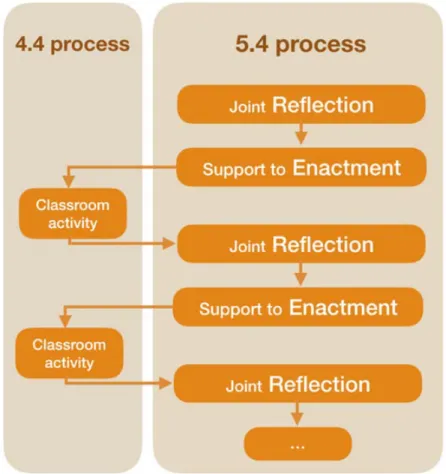
The professional development aspect of the intervention supported teachers in enactment and reflection on the classroom activities that were designed and implemented as part of T4.4. The teachers carried out student projects addressing socioeconomic inequalities and multiculturalism and were actively supported and supervised by the ISOTIS researchers. The VLE was actively used by the children in the classroom, but less frequently used by the teachers. As part of the professional development, the professionals were involved in multiple exchange activities with professionals from other countries. The teachers, for instance, worked on a welcoming kit for newly arriving children and exchanged the results of this project with Italian teachers. Also, the teachers exchanged experiences with Dutch preschool teachers on the book activity and the skin tones activity.
The Portuguese intervention showed that the teachers hardly had time allocated for professional development, thus the researchers decided to work on professional development while meeting with teachers in preparing and evaluating the classroom activities. The researchers actively supported the teachers in the classroom, which was highly appreciated and contributed to a positive and collaborative relationship. It required flexibility and adaptability from the researchers to maximize opportunities for professional development in this process. In the end, the teachers showed great appreciation and indicated they have further developed their global and intercultural competences.
INTERVENTION IN ITALY
In Italy, the intervention included seven teachers from a preschool and primary school (located in the same building). The schools are located in a culturally highly diverse neighbourhood of the city of Milan with a significant percentage of the children coming from disadvantaged immigrant families (mainly Arabic and North African families, but not exclusively). A particular feature of the Italian PD intervention was the strong synergy with the interventions focusing on parents (WP3) and on classroom processes (WP4). Due to this characteristic the intervention focused on a) increasing teachers’ awareness and knowledge regarding some of the central ISOTIS topics (e.g., multilingualism, second language learning, intercultural competences, family-school collaboration), b) promoting more positive and open attitudes towards linguistic and cultural
diversity within the school, c) supporting teachers’ reflection skills, and d) increasing teachers’ skills in dealing with multilingual and multicultural classrooms and in engaging in meaningful and effective dialogues with diverse families.
The intervention hinged around 5 main key-topics (i.e. knowledge on multilingualism and multiculturalism, ICTs, reflection skills, family-school collaboration, international exchange). Considering the central role that the VLE played in the Italian intervention (due to the synergy between the three WPs in Italy) the VLE was already introduced during the kick-off meeting and later presented more in-depth during the dedicated training meetings. The intervention combined different PD strategies, such as training, coaching, and reflection and was highly embedded in the VLE structure itself. The VLE is organized in different parts (namely, did you know, observe and reflect, what can you do) and these various parts provided opportunities to foster professionals' critical thinking and activity-designing skills (especially in the observe and reflect section). Moreover, one teacher engaged in a cross-country exchange and provided feedback on some of the Portuguese VLE activities which proved valuable for the Portuguese teachers and at the same time inspired the Italian teacher.
The Italian intervention was the most comprehensive and required the most extensive time investment of both the teachers and the researchers, which was mainly related to the involvement of Italy in all three WPs. The teachers were generally satisfied with the intervention, especially in relation to their increased knowledge and skills. They appreciated the professional development but were somewhat more critical towards the VLE for this purpose. It was children’s enthusiasm that helped the teachers to better appreciate the potential of the VLE. Due to this complexity of the intervention (given the comprehensive approach) there were moments the teachers perceived the intervention as challenging and sometimes tiring. At the same time, the intervention was mostly focused on individual teachers rather than the team of professionals. Already in the exploratory phase, it appeared that there was a lack of strong team cohesion and collaboration at the chosen intervention site and the intervention did not succeed in improving that.
INTERVENTION IN THE NETHERLANDS
The Dutch PD intervention involved two locations of a large preschool organisation in the city of Utrecht and included both professionals working directly with children (e.g., teachers) as well as other staff (e.g, managers, pedagogues). Both locations are characterized by a highly diverse child population, with the majority of the children coming from low educated families or having an immigrant background (e.g., Maghrebian, Turkish, Indian, Polish). The aim of the intervention was to align the work as much as possible between the two locations, but still tailor the activities to the local context of each location. As a result, a kick-off meeting, VLE workshop and assessment meeting were combined for both locations, whereas the other meetings were held separately for both locations. Four cross-location goals guided the Dutch intervention focussing on a) enhancing awareness of one’s own beliefs and attitudes regarding multiculturalism and multilingualism through reflection, b) expanding knowledge on the topic of diversity and inclusion, c) improving intercultural competences by exchanging (good) practices and knowledge between locations and countries, and d) reflection on and improvement of the relationship with parents and parental involvement.
The intervention mainly focused on the professional development of the organisation and staff. Therefore, each meeting focused on expanding professionals knowledge as well as reflecting on their attitudes and beliefs in order to raise awareness on their practice. A combination of the resources on the VLE, results of the T5.3 Staff survey and other findings in ISOTIS, and some additional theoretical models was used to expand knowledge and facilitate as a starting point for reflection. The use of the VLE as an online community of learners was addressed in two ways. Firstly, participants from the two locations were encouraged to exchange experiences and comment on each other’s work via the online forum. Secondly, the VLE was used to facilitate cross-country exchange with Portuguese and Italian teachers. An activity concerning skin colour (conducted in Portugal) and a welcome kit (developed in Italy and Portugal) were shown to the Dutch professionals to reflect on the topic of skin colour and to raise a discussion about ways to welcome new children and parents to the preschool. In addition, a reflection activity on implicit messages in children’s books (conducted in the Netherlands) was performed in Portugal as well, and the VLE was used to facilitate an exchange on these reflections.
The Dutch intervention showed that integrating such an intervention in the existing PD structure (e.g., allocating time and resources) is an important aspect both during the intervention as well as in view of sustainability in the longer term. Relatedly, a team-based intervention including managers and other supporting staff besides teachers, can enrich the discussion and strengthen the possibility for implementation and sustainability. At a more individual level, the intervention illustrated the importance of professionals’ beliefs and attitudes in addressing intercultural competences and highlights the important role of reflection as a PD strategy in raising awareness of their (sometimes prejudiced) beliefs and attitudes, and how these are related to the professionals’ actual practices and behaviour in the daily context.
INTERVENTION IN FRANCE
In France, the task was carried out in a community centre in Paris involving the manager and seven professionals (of which four were volunteers). The centre was located in a diverse neighbourhood with a majority of low-income families and/or of (North) African or Eastern European background. The organisation’s approach is based on the principle that professionals should support parents in developing the necessary competences to contact and collaborate (and if necessary confront) with the school and teachers, rather than act as a mediator between the school and the parents. In other words, the organisation should rather empower parents to approach school. It was therefore agreed to address family-professional’s collaboration (also termed co-education). Consequently, the PD intervention aimed at the development of the staff’s knowledge, beliefs, attitudes and expectations, hereby advancing their competences to better fulfil the organisation’s mission.
A crucial part of the intervention consisted of group-wise reflection about actual cases or situations that participants shared with the rest of the group. These cases were related to the co-education approach with the final aim of improving disadvantaged children’s co-educational opportunities and were experienced as challenging. Complementary to the group reflection on the shared cases, the researchers also prepared a presentation of theoretical models and scientific research to augment the participants’ knowledge on relevant subjects connected to the
main topics and objectives. A few of the VLE resources were used to enrich participants’ knowledge as well. In addition, a cross-country exchange via the VLE was facilitated by providing the participants with narratives about the ideal day written by Dutch professionals, which helped them reflect on their own parent-professional relationship. Finally, the researchers supported the organisation in the development of a game that can be played by parents, children and teachers to enhance parents’ knowledge regarding the French education system.
The French intervention showed that the (para) professionals expressed satisfaction with the PD meetings as it brought them relevant tools (skills) and ideas (knowledge) on empowering parents. Already during the exploratory phase it appeared that there was, within the organization, a lack of a clear-cut definition of the professionals’ role in the relationship with parents, which caused confusion especially when parents solicited their help in a conflict with the school. This issue was addressed in the intervention but not fully resolved yet. Possibly, establishing an organizational policy in which the professionals’ roles and functions are clearly stipulated and shared agreement on functions and roles is sought, can support the professionals in establishing and maintaining a professional identity. This seems especially relevant for non-permanent staff who work in the organization on a voluntary basis. The same holds for establishing clear guidelines on how to conduct the activities with children and parents.
MAIN CONCLUSIONS CONCERNING THE VLE
The VLE proved to be a rich resource on several topics, including cultural diversity, multilingualism, second language learning, intercultural competences, family-school collaboration, economic inequalities and social justice with a repository of video clips, narratives, concrete examples from practice and dilemmas for professionals to reflect on. Further, it provided examples of concrete activities for both professional development and activities with parents or with children in the classroom, supporting professionals in enacting their competences. These resources were generally appreciated by professionals and contributed to enhancing their knowledge about specific topics. The joint reflection on one or more of these resources, which was part of the PD activities, supported professionals in reflecting on their beliefs and attitudes.
Another function of the VLE was establishing a virtual community of learners. Although most professionals gave this function a try, as this was facilitated by means of the cross-country exchange, the potential of this function has not been fully explored yet. This exchange was completely guided and supervised by the ISOTIS researchers, which appeared necessary also in view of tackling language barriers. Although the VLE was available in many languages and featured an automatic translation function, this did not always functioned well. Some nuances got lost in translation and sometimes the automatic translation created confusion among professionals. Therefore, it seems essential to have someone actively guiding the process of exchanging experiences.
MAIN CONCLUSIONS CONCERNING PROFESSIONAL DEVELOPMENT
The PD intervention was contextualized and adapted to the needs of professionals in their local situation, while taking into account the organizational structures and policies, which resulted in different processes in the different countries and organizations involved in the intervention. However, this design-based process followed a number of phases from the exploration of the context, the co-design, implementation and evaluation of the intervention and all countries adhered to the general guidelines that were formulated. Altogether, this resulted in a process taking place over the course of more than one year.
The exploration of the context appeared very important to get a better understanding of the local needs and desires of professionals and how these professionals function within the larger organization. Moreover, this phase also functioned to establish trust and to build positive relations with the professionals, which proved to be essential for the success of the intervention. The co-design phase was new for both researchers and professionals and relied heavily on a good collaboration and mutual trust. Especially the professionals experienced some uncertainty about the intervention and what it would bring them during this phase. In all countries, this led to a stronger connection to professionals’ everyday work and to seeking for ways to integrate the PD work in the preparation of classroom activities. The implementation and exchange of activities, especially between professionals from different countries, supported the professionals in understanding the added value of the intervention and was highly appreciated.
MAIN CONCLUSIONS CONCERNING PROFESSIONALS’ INTERCULTURAL
COMPETENCES
Overall, the assessment of the intervention revealed changes in professionals’ intercultural competences based on their own reflections and self-evaluation forms as well as on the ISOTIS researchers’ assessement. However, there were some differences depending on the targeted competence (i.e. beliefs, attitudes, knowledge, skills, behaviour and practices). Generally, most changes occurred in professionals’ awareness on multiculturalism, intercultural sensitivity, multilingualism, social justice and to a lesser extent on parent-school relationships and parent involvement. These changes were reported by professionals in all four countries and were generally also appreciated by them.
Following our theory of change, professionals’ beliefs, attitudes, knowledge and skills showed bidirectional relations with their behaviour and practices. The emphasis on reflecting on one’s beliefs and attitudes and on how these were enacted in the classroom, appeared strong facilitators of this underlying mechanism. The VLE played an important role in supporting professionals by providing videos, narratives, dilemmas and concrete examples from practice to reflect on. Also, the cross-country exchange was considered interesting and valuable in enhancing multi-perspectivity. Moreover, the suggestions for (classroom) activities encouraged professionals to enact and apply newly required knowledge, beliefs, attitudes or skills in their own context.
MAIN LESSONS LEARNED
Generally, the professionals were satisfied with the intervention. However, some professionals reported lower levels of satisfaction as their high expectations before the start of the intervention were not fully met. This was particularly related to the VLE and what they had expected of it and to a lesser extent also pertained to the newly acquired knowledge and skills, which in their view was lower than expected. Overall, the evaluation showed that most gains were made in the domains of beliefs and attitudes, which the researchers felt was a necessary prerequisite for changing behaviour and practices. Interestingly, there were examples in several countries in which professionals went beyond the scope of the intervention in initiating a change of practice. This seems an indication of change in professionals’ beliefs and attitudes that set in motion a process of change in other domains as well, even though the professionals might not have been aware of it.
The work in the four countries highlighted that there are several aspects of the context (i.e. characteristics of the professionals, the (classroom) context and the organization) that were relevant for the success of the intervention. It appeared important that the intervention was tailored to this local context and adjusted to fit in existing policies and structures in the organization. Despite these contextual differences the overall design-based approach worked well and uncovered some similar findings and lessons learned across countries.
Related to the overall process, there are three points worth noting. The first relates to professionals’ readiness to change, which is conceptualised as comprising factors at the individual and organizational level that reflect the extent to which people are inclined to accept, embrace and adopt a particular approach or plan with the intention to change the current situation. Secondly, guidance of the PD process by someone with the appropriate knowledge and skills (e.g., an external expert or a member of staff who is facilitated to guide the team) is critical to success. Throughout the PD interventions in all countries, an active role of the ISOTIS researchers appeared to be essential to guide the co-constructive process in which mutual trust and positive, collaborative relationships were crucial. Last, but not least, sufficient time for preparation and engagement in the intervention was essential too and lack of time appeared a barrier at some points, in some countries.
Concerning the VLE, five aspects seemed important. First, the content, structure and functionalities of the VLE should be customized to the wishes and needs of the professionals who are to use it. Second, the VLE should be viewed as a dynamic and continuously evolving platform adapting accordingly to the context and professionals, which is in line with the idea of continuous professional development. Relatedly, it is essential to have someone actively guiding this process from development through implementation and beyond, to establish a sustainable practice. In line with this active facilitation, a fourth point concerns the embeddedness within the organisation. The results indicate that integrating the VLE within the daily work in the classroom environment is important. Relatedly, in view of alignment and integration within current practice, this also calls for technical requirements to enable this.
AIMS OF THE PROFESSIONAL DEVELOPMENT INTERVENTION
In line with the Call REV-INEQUAL-06-2016, the research strategy of ISOTIS to address the challenge of reducing inequality and discrimination in European education is twofold. First, to analyse institutional, cultural and ideological mechanisms underlying inequality and discrimination, ISOTIS focuses specifically on the socio-economic and ethnic-cultural dimensions of inequality, which pertain to low-income native groups, major immigrant groups and the Roma (Description of Action [DoA], p.3). Focusing on these groups is especially relevant in view of current intercultural and interethnic tensions, increasing polarization and persistent segregation in many European countries that can be regarded as a major threat to inclusion and equity. In the DoA, ISOTIS stipulates, based on an extensive literature review, that “(…) in the context of increasing diversity, the social mobility of children of disadvantaged families not only depends on educational achievement, but also on social and cultural integration (…) integration and acculturation is an issue for native communities as much as it is for immigrant communities. There are tensions reflecting rivalry between groups, lack of inter-cultural contact and decreasing support for multicultural integration, undermining social cohesion.” (DoA, p.4). Second, to identify inclusive approaches to professional development ISOTIS adopts a broader orientation on several types of diversity and inequality as may commonly occur in classrooms and neighbourhoods. ISOTIS does not explicitly address the issue of race or colour, as in many European countries these dimensions are not part of the local or national policy discourses. Yet, awareness of the role race and colour may play is especially apparent in the ISOTIS studies among Roma families, whereas discrimination based on ethnicity and/or low socioeconomic status is a key topic in all interviews.
The overall aim of WP5 is to identify effective strategies for professional development that take into account new approaches to professional learning, i.e. virtual learning and team-based models of learning, and that focus specifically on increasing cultural and linguistic awareness among professionals in their work with culturally and linguistically diverse children. A related aim is to identify characteristics of the centers and schools at the organizational level that support or hinder professionals in dealing with cultural and linguistic diversity and in creating an inclusive, positive climate in the classroom, center and school. Task 4 concerns specifically the development, implementation and evaluation of a prototype of a Virtual Learning Environment (VLE) in family, community and school settings to support and enhance research interventions in several contexts conducted in three intervention-study tasks (Task 3.4, 4.4, 5.4). Although, the VLE task was carried out in three different work packages, each with its own focus and target group (i.e. parents, children and teachers, and para/professionals and professionals in early education, primary education, child and youth care, family support and social work who are working with children and families), the VLE was developed from the same overarching conceptual framework in order to contribute to a coherent and comprehensive support system for professionals, children and families from different systems perspectives, and to encourage collaboration between sectors (e.g. early education and family support). This has also enhanced synergies between the three work packages. Therefore, part of the VLE was designed and developed for all target groups (a detailed description of this process can be found in the Section A ISOTIS VLE report by Pastori, Pagani, Mangiatordi, & Menegola, 2019), whereas other parts focused specifically on the particular stakeholder groups that were involved and on the specific objectives that were pursued in each VLE-related task, in this case (para)professionals. The specific aim of the current task,
as described in the DoA was to develop a transferable model of a VLE for professionalization with a focus on fostering professionals’ multicultural and multilingual awareness and competences to create inclusive practices.
Chapter 1 provides an overview of the theoretical models guiding this task as well as the overall ISOTIS workflow. The next chapters entail four country reports and provide a detailed description of the professional development interventions in Portugal (Chapter 2), Italy (Chapter 3), The Netherlands (Chapter 4), and France (Chapter 5). Each country report addresses the selection of the sites (Part I – Sites’ selection and shared intervention agreement), the context of the intervention (Part II – Exploratory Phase), the design and implementation of the professional development activities (Part III – Implementation co-constructive process), and the assessment of the intervention (Part IV – Assessment). Chapter 6 focusses on the cross-country exchange. Overall conclusions and a discussion of the results are presented in Chapter 7. Lastly, several recommendations for policy and practice are suggested.
1.
PROFESSIONAL DEVELOPMENT INTERVENTION
European countries are facing increasing cultural, linguistic and socio-economic diversity with at the same time increasing societal inequality. Consequently, dealing with diversity is inevitable for professionals working with (young) children in institutionalized settings, such as (pre)schools, as well as local, community-based social services. However, professionals feel they are ill prepared to deal with diversity and multilingualism (DeCastro-Ambrosetti & Cho, 2005; Michel & Kuiken, 2014; Van Gorp & Moons, 2014). Intercultural competence is essential in the relations between professionals and families in a diverse society. This is the ability to understand one another across and beyond all types of cultural barriers and is a fundamental prerequisite for making our diverse democratic societies work. Therefore, there is a need for a concerted effort to develop the necessary attitudes, skills and knowledge that contribute to intercultural competence in the everyday practice of teaching and learning. It addresses the root of a range of issues our societies face: stereotyping, discrimination, and all forms of racism, which are exacerbated in times of economic difficulty.
The concept of intercultural competence is related to the concepts of identity, culture, intercultural encounter and competence, and can be broken down into attitudes, knowledge and understanding, skills and actions (Barret, Huber & Reynolds, 2014). The attitudes involved include for instance valuing cultural diversity and pluralism of views and practice, respecting people who have different cultural affiliations from one’s own and being willing to learn from and about people who have different cultural orientations and perspectives. The knowledge and understanding that contribute to intercultural competence include an understanding of the internal diversity and heterogeneity of all cultural groups, an understanding of processes of cultural, societal and individual interaction, knowledge of the beliefs, values, practices, discourses and products that may be used by people who have particular cultural orientations, and the socially constructed nature of knowledge. The skills involved in intercultural competence include skills like multi-perspectivity or the ability to decentre from one’s own perspective and to take other people’s perspectives into consideration in addition to one’s own, empathy or the ability to understand and respond to other people’s thoughts, beliefs, values and feelings, cognitive flexibility or the ability to change and adapt one’s way of thinking according to the situation or context, the ability to act as a mediator in intercultural exchanges, including skills in translating, interpreting and explaining. While attitudes, knowledge, understanding and skills are all necessary components of intercultural competence, they have to be first acquired/possessed but they also have to be deployed and put into practice through action during intercultural encounters. The overarching aim of the current task was to support professionals in developing their intercultural competences.
1.1.
INTRODUCTION
The ISOTIS Virtual Learning Environment (VLE) provides a set of functions, sources and suggested activities, but the main feature of the VLE implementation is initiating collaboration between researchers and research participants (teachers, other professionals, volunteering paraprofessionals, parents, children), who are invited to participate in creating contents and materials for the VLE. Co-creating the contents of the VLE, using the cultural and linguistic resources of families and communities for this purpose, is a key design-principle, with a twofold
expected outcome: (1) increased engagement and empowerment of stakeholders; (2) an enriched and truly intercultural curriculum. Initiating and supporting this process in selected study sites was the main task of three WPs for the period September 2018-September 2019, after a period of preparation, focusing on parents, classroom practices and professionals, respectively. This process of participation fits in well with the open and positive nature of the technology and reporting on this process – what can be learned for future implementations – is equally important as a technically working VLE. Documenting the process, evaluating process and outcomes, articulating the strategies developed throughout the process is a main outcome of ISOTIS and will be made available in addition to the VLE prototype as a deliverable. The current report focuses specifically on the professional development (PD) of professionals working with children and families at risk of social exclusion in formal settings, such preschools and primary schools, as well as informal settings, such as after-school activities and care, using the VLE.
The selection of countries for the VLE across WP’s 3, 4 and 5 is in line with the ISOTIS tasks and based on two considerations. First, countries were selected to represent relevant variation in national income level, structure of the education, welfare and support systems, and representation of the main target groups of ISOTIS. The selections included countries from the wealthy Northwest, post-communist countries from the East, and less wealthy countries from the South of Europe. Second, within the limits of the budget and in order to distribute the workload for the country teams evenly, while taking the expertise and capacity of the teams into account, not all countries could be involved in all WP’s resulting in the following representation presented in Table 1.1.
Table 1.1
General Overview of the Three Workpackages and Participation across Countries.
WP3 Parent Support WP4 Curriculum Innovation
WP5 Professional development
Task leader England Italy The Netherlands
Partners
The Netherlands England
Italy Italy
NL Wise & Munro NL Wise & Munro NL Wise & Munro
ISSA ISSA
Portugal Portugal
Czech Republic Czech Republic
France Greece
Germany
In WP5 different types of professionals and target groups were included. In France the professionals worked in a community centre aimed to bridge the school and home environment. Following from this, the professionals worked mainly with parents in supporting their engagement in their children’s school career. The parents were from a poor and disadvantaged area with a mainly North African migration background. In Italy a preschool and primary school (located in the same building) in a culturally highly diverse neighbourhood of Milan were involved. The
Netherlands involved a large preschool organisation in the city of Utrecht that provides preschool education in disadvantaged and highly diverse neighbourhoods. Preschool teachers and other staff working in the centres were included in the process. For Portugal two primary schools were chosen with a relatively high share of Romani and low-income families.
1.2.
LINKS WITH PREVIOUS WORK IN WP5
The current task explores new approaches to professional learning, i.e. virtual learning and team-based models of learning, focusing specifically on increasing cultural and linguistic awareness among professionals while considering the organizational level that support or hinder professionals in dealing with cultural and linguistic diversity and in creating an inclusive, positive climate in the classroom, centre and school. The task builds on the previous work that has been conducted in Tasks 5.1, 5.2 and 5.3. Task 5.1 started with a first review of the literature on professionals’ attitudes and the challenges they encounter in working with culturally and linguistically diverse children and families as well as characteristics of professionals and their work environment and how they relate to their attitudes and practices. In Task 5.2 we conducted an inventory and review of current professional development models employed in different countries that are considered examples of good practices, including also the role that ICT can play. Lastly, in Task 5.3 we conducted an internet-based staff survey in ten countries among (para)professionals working in informal and formal (education) settings to identify the needs and obstacles they face in their work with culturally and linguistically diverse children and families and to examine the characteristics of organizational culture and structure that can support professionals in this work. The results of these tasks were all used to inform the development of the VLE and the PD intervention. In addition, several theoretical models were used as will be elaborated on in the following section.
1.3.
THEORETICAL MODELS
The work for Task 5.4 has been guided by several theoretical models focusing on different levels of the process: a) the co-design and implementation of the PD intervention; b) the PD model that addresses the underlying mechanism of change and important preconditions that contribute to the effectiveness of the PD, and c) the level of professionals’ global and intercultural competences. A brief description of these theoretical models will be provided below.
1.3.1. DESIGN-BASED APPROACH
Design-based research includes operationalization of theoretical knowledge in concrete actions and materials, involvement of stakeholders, and repeated formative evaluations based on observation and interviewing. Design-based research is deemed essential for creating practice as concrete deliverables, but also, and foremost, for contextualizing scientific knowledge in relevant action contexts to generate practical knowledge that can bridge the theory-practice gap (Reeves, 2012). There are a number of key characteristics of this approach that makes it particular suitable for the current task. It is pragmatic and grounded in the real-world context in designing and conducting interventions in the dynamics and complexity of everyday practice. It is characterized by interactive and iterative processes between researchers and professionals. The
process encompasses iterative cycles of analysis, design, implementation and redesign, which take place in a collaborative exchange between researchers and professionals. The meaningfulness for professionals is central in this process. Also, it is a flexible and contextual process. The initial description of the intervention provides sufficient information for all participants to know what to do and why to do it, but not every detail is scripted, allowing room for flexibility and adaptability to the context. This process is carefully documented. Lastly, reflexivity of both researchers and professionals pervades the whole process and is a key aspect for PD.
1.3.2. MODEL OF PROFESSIONAL DEVELOPMENT AND THEORY OF CHANGE
In the context of professional development, we follow the lifelong learning approach - all learning activity undertaken throughout life with the aim of improving knowledge, skills and competences within a personal, civic, social and/or employment-related perspective (CEDEFOP, 2003). Competences are viewed as the combination of professionals’ knowledge, skills and attitudes, resulting in everyday behaviour and practices.
Professional development (PD) is used as a means to improve professionals’ competences or behaviour, as will be discussed in more detail in our theoretical framework. PD refers to all actions and activities focused at education, training and development opportunities for professionals (Sheridan, Edwards, Marvin, & Knoche, 2009). Following Sheridan et al. (2009), the ultimate goal of PD is improving children’s developmental or educational outcomes. In the short term, PD can serve two main objectives related to the professionals who are involved. First, it is assumed that PD will advance professionals’ knowledge, beliefs, attitudes, skills, behaviour and (teaching) practices. Secondly, PD enhances opportunities for on-going professional growth in individuals and organizations, which can be viewed as important in the context of lifelong learning (European Council, 2007). The latter refers to an increasing understanding of the importance of establishing sustainable and continuous approaches of improving (teaching) practice in view of a rapidly changing societal context. This means that PD gradually moves from a more externally initiated or oriented process in which external demands are triggering professionals to engage in PD into a more individual and intrinsically motivated process of self-improvement resulting in a more dynamic attitude of a ‘learning professional’. It also highlights a shift in agency in which professionals are perceived as active learners who shape their own learning process through reflective professional development (Clarke & Hollingsworth, 2002). Following this development, different forms of PD (i.e. training, coaching or collegial exchange) targeting different domains (i.e. knowledge, beliefs, attitudes or skills) might be appropriate during different stages of this process. Although PD is commonly viewed from an individual’s perspective, individuals are part of larger teams and organizations, thus aligning PD between individuals within an organization or even making it a joint and team-based effort might strengthen the effectiveness and sustainability in the long run. Therefore, it is important to target the individual professional as part of a larger team when considering a PD intervention.
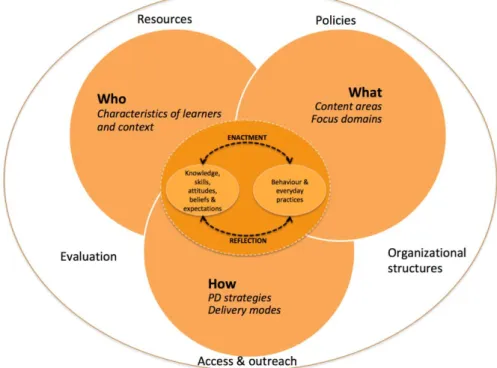
The conceptual framework introduced in the report D5.2 (Slot, Romijn, & Wysłowska, 2017) has guided the work in this task, see Figure 1.1. At the core, this model shows how professionals’ everyday behaviour and practices is shaped by their knowledge, skills, attitudes, beliefs, and expectations. Reflection and enactment are viewed as the key mechanisms of change. Secondly,
the three core components that can be distinguished relate to the who, the what and how of PD. The first component considers the features and background of professionals as well as the children and families they work with. The second component concerns the focus of the PD program in terms of specific content areas and focus domains (e.g., knowledge, skills, beliefs). The third component addresses the PD strategies (e.g., training, coaching, reflection, communities of learners) and the way the PD is delivered (face-to-face vs online and team-based vs individual-based). Finally, this model situates the professional within the larger (organisational) context that provides important preconditions that contribute to the effectiveness of PD.
Figure 1.1. Conceptual model of professional development.
1.3.3. MODEL OF GLOBAL AND INTERCULTURAL COMPETENCES
As introduced in the Section A of the report on Task 4.4 (Pastori et al., 2019), the human rights perspective serves as the main underlying framework that guided the work across WPs. Elaborating on our general professional competence model, we build on frameworks focusing on global competences that have been used by for instance UNESCO (2013, 2014) and the OECD (2018), and the framework of the Council of Europe (2014). Although there are some minor differences in emphasis, all these frameworks share a focus on knowledge, values, attitudes, skills and action from a basic human rights perspective while valuing cultural diversity as the foundation for global competence, thus placing our professional competence model into a human rights and diversity context. Following the OECD (2018), global competence refers to the ability to examine local, global and intercultural issues in order to understand and value the perspectives and world views of others, to engage in open and constructive dialogue with people from different cultures, and to act for collective well-being and sustainable development. Moreover, we include a view on multilingualism as a resource with potential benefits for individuals and society, as proposed by the Council of Europe (2014), resulting in the model presented in Figure 1.2. This model was central in the co-design and implementation of the professional development intervention and VLE.
Figure 1.2. Conceptual model of global and intercultural competences.
1.4.
SHARED ISOTIS WORKFLOW
As detailed in the Section A of the D4.4 report on the ISOTIS VLE (Pastori et al., 2019), the VLE was developed to provide a set of functions, sources and suggested activities, but the main feature of the VLE implementation was initiating collaboration between researchers and research participants (teachers, other professionals, volunteering paraprofessionals, parents, children), who were invited to participate in creating content and materials for the VLE. Co-creating the content of the VLE, using the cultural and linguistic resources of families and communities for this purpose, was a key design-principle, with a twofold expected outcome: (1) increased engagement and empowerment of stakeholders; (2) an enriched and truly intercultural curriculum. This process of participation fits in well with the open and positive nature of the technology, and reporting on this process – what can be learned for future implementations – is equally important as a technically working VLE. The main features of the VLE are represented by:
a. a repository of resources: such as information and guidelines for practices about various topics connected to the ISOTIS themes;
b. a social networking infrastructure: tools facilitating communication and exchange through pages that adopt typical social media layouts, featuring multilingual support, and offering a shared collaborative work space for professionals, children and parents, fostering the creation of ‘communities of practice’;
c. a space for designing and documenting: a professional can storage materials, applications she/he wants to propose or collect the documentation related to the activities implemented (in a classroom, in a group of children or parents, with a child … )
The repository provides three main types of content. The first concerns informative and descriptive resources on the main ISOTIS topics such as equality, Human Rights, multilingualism, and multiculturalism. This information is provided via animated videos in different languages and theoretical background texts. The second aspect concerns concrete guidelines for observing and reflecting. It provides a ‘critical case’ designed to trigger reflection on the case and a short set of questions that can be used to observe children and/or parents and/or one’s own professional attitudes, behaviours and practices. A third component concerns concrete guidelines for action and activities with children in the classroom or for teachers as part of professional development.
The co-constructive nature of the design and implementation of the VLE implies that the development of the VLE was an ongoing process while working with the professionals on professional development. This process highlights the synergetic nature of this intervention in which questions, issues, challenges or needs of the professionals working in their own local context were used to inform the design of the VLE content, and vice versa, the content on the VLE that was already available could inspire the professionals in their reflection on their daily practice. As a result, the PD intervention was running in parallel to the development of the VLE following a cyclic process of design – implementation – redesign. Different phases can be distinguished in this process in which the first phase constituted an exploration of the local context and the challenges, desires and needs of the professionals working in this context. This was followed by a phase of co-designing the content of activities and resources as well as developing and testing the technical requirements of the VLE. In the next phase, the implementation phase, the professionals started working with the VLE, followed by the assessment and reporting phase.
The aim of Task 4 (see Section A ISOTIS VLE Report by Pastori et al., 2019) was to create a joint VLE with WP3 and 4, therefore there was agreement on a common workflow, while remaining flexible in local adjustments, to align the work and to maximize synergy across the three work packages, see Table 1.2.
Table 1.2
Overview of Shared ISOTIS Workflow
Phase Actions Timeline
Phase 0: Setting the stage
• Recruitment of organisations • Definition of the problem • Ethics and timeline
January – April 2018
Phase 1:
Exploratory phase and co-construction of needs
• Exploration of the context (e.g., interviews, focus groups).
April – July 2018
Phase 2: Co-design phase
• Co-design of PD activities September 2018 – January 2019 Phase 3:
Implementation phase
• Implementation of PD activities February – June 2019
Phase 4:
Monitoring and assessment
• Reflection and assessment • Reporting
July – September 2019
1.4.1. PHASE 0: SETTING THE STAGE
The main goals of Task 5.4 are aligned with the ISOTIS goals of promoting equality and inclusiveness. Depending on the local context, this resulted in differences in emphasis and choices that were made in the four countries and respective sites, but all fit well into this overall framework. At the site in Portugal the focus in one site was on social justice, whereas the other site in Portugal and the two locations in the Netherlands focused more strongly on cultural diversity. The organisation in Italy targeted multilingualism more explicitly, which was shared with the locations in the Netherlands. The site in France specifically addressed the relationship with parents and home-school connections, which was also included in the work in Italy and in the Netherlands as part of the focus on cultural and linguistic diversity.
Given the focus of ISOTIS the selection of sites in the four different countries followed a number of criteria:
• Presence of one or more ISOTIS target groups
• Located in one of the main ISOTIS study sites (involved in the staff survey and the parent study)
• Willingness to participate and commit to the professional development intervention for the duration of the task at all levels of the organisation (from the director level to the level of the professionals working in daily practice) and all participants (professionals and parents when required)
Overall, this resulted in sites that differed in type of organisation (formal vs informal), and the socio-economic and cultural background and age range of children these professionals worked with, but shared a common focus on promoting equality and inclusiveness, see Table 1.3. More specific information on the organisations will be given in the respective country chapters.
Shared general ISOTIS collaboration agreement
In the phase of recruiting organisations for participation in the intervention, we explained the ISOTIS project, goals, general philosophy, and established a shared collaboration agreement. This agreement implied knowledge of the overall process — the exploratory phase, which would culminate with the co-construction of the needs and, at least in broad lines, also the “how” of the intervention — and willingness of organizations to participate and commit to the whole intervention spanning a period of about a year.
Table 1.3
Basic Characteristics of the Sites who Participated in the Task.
Portugal Italy The Netherlands France
Organisation 2 primary schools
(pre)school Preschool Community centre Age range children 7 classrooms (school 1) 7-10 and 12-14 years (school 2) 7-10 years 1 classroom 3-6 year 3 classrooms 9-10 years 2 classrooms 2-4 years School age
Area Greater area of
Porto
Milan Utrecht Paris
Target group Low-income, Roma Culturally diverse (Maghrebian, Filipino, Peruvian) Low income, culturally diverse (Turkish, Indian, Maghrebian, Polish) Low-income, (North) African, Eastern European Number of professionals 7 9 12 8 Type of professionals Teachers, school board member, school administration members, school coordinator Teachers Teachers, managers, special needs supervisor, pedagogical coach Community centre workers, manager, volunteers PD Topics Cultural sensitivity, social justice Multilingualism and reflection Cultural sensitivity, multilingualism, parent-teacher relations and parent involvement
Relations with parents and empowerment of parents
1.4.2. PHASE 1: EXPLORATORY PHASE AND CO-CONSTRUCTION OF NEEDS
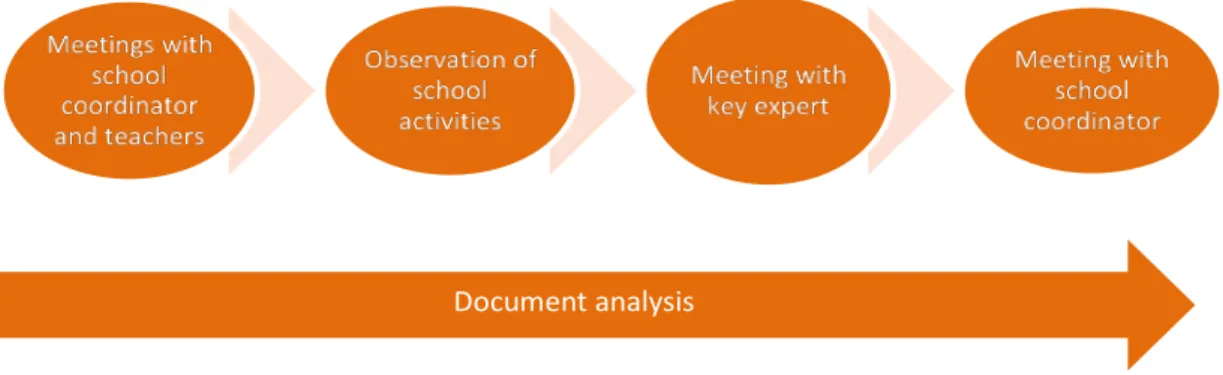
In this phase the context of the organisation is explored by conducting document analyses, and having interviews and/or focus group discussions with the participants. If deemed relevant, observations (e.g., classroom practices) could also be carried out. The main aim is to enhance our understanding of the starting point concerning the local socioeconomic, cultural and linguistic diversity in the context and how professionals shape their everyday practices in the classroom and with parents, as well as the needs or challenges they encounter. Among others, the organizational policies and practices concerning diversity, multilingualism and parent-professional relationships were investigated. In addition, this exploratory phase was used to better understand the organisational structure and existing policies regarding the team of professionals, team professionalization, and organisational support with the aim to adapt and integrate the intervention in the ongoing organisational practices in the best way possible. The outcomes of this exploratory phase and professionals’ needs were expected to feed into the co-construction
of the intervention and development of the VLE and remain an important point of reference throughout the whole process. By acknowledging the active contribution of all professionals as experts in their field we aim to support their feelings of ownership and empowerment.
1.4.3. PHASE 2: CO-DESIGNING PHASE
The co-design phase built on the information and knowledge that was gained in the exploratory phase and focused on the development of PD activities that were targeted at the local needs in each country. It required a reciprocal process in which the researchers introduced new theoretical knowledge and connected this to professionals’ everyday practices and challenges through a process of reflection and enactment. This process combined a bottom-up approach based on professionals’ actual experiences professionals with a top-down approach of providing new information and knowledge on certain topics (e.g. multilingualism or social justice) to foster meaningfulness and authenticity for the professionals. This phase is characterized by an on-going and cyclic process in which the development of PD activities and experiences in each meeting was based on the experiences of the previous one, thus highlighting a flexible and progressive process that was adapted in content and pace to the local context, while keeping in mind the overall goals of the intervention at each site.
1.4.4. PHASE 3: IMPLEMENTATION PHASE
In the implementation phase several PD activities were carried out using both the VLE and team meetings. Although the professionals from the four countries worked in different contexts, they expressed an interest in each other’s work; thus, an explicit goal during this phase was fostering cross-country exchange of information and practices via the VLE. During this phase, researchers guided the exploration of the VLE and supported the implementation of activities in the classroom or with parents.
1.4.5. PHASE 4: MONITORING AND ASSESSMENT
The assessment of the process was done following a common framework (Common Monitoring & Assessment Procedures, see Table 1.4) in which four main domains were assessed: a) staff’ competences/skills, knowledge and beliefs/attitudes regarding the aim of the intervention; b) organizational and collaboration practices, i.e., the impact that the intervention had/is having on the organizational climate of the institution as well as the collaboration and team working between the professionals that are participating in this task; c) the VLE usage, usefulness, satisfaction and further usage; and d) the intervention process. Additionally, 3 different “informants/actors” will evaluate the intervention: a) the teachers/practitioners involved; b) other key figures, such as the organization leaders or pedagogues; and c) we as researchers. The idea is to have three different perspectives on the intervention. The evaluation process was done retrospectively in the case of the teachers/practitioners and key figures/leaders through interviews, focus groups and/or more informal conversations. In our case (i.e., the researchers), a critical reflection on how the process went was done with explicit reference to the field notes and observations made during the process.
Table 1.4
Common Monitoring and Assessment Procedures T5.4.
What When By Whom/How Common set of questions
STAFF
• Satisfaction
• Competences/skills • Knowledge
• Beliefs/attitudes
• (Content: e.g., intercultural competences, relationship with parents, etc.)
Post phase Teacher/practitioners: • Interviews • Focus groups • Conversations Key figures/leaders: • Interviews • Conversations Researchers: • Field notes • Observations
Satisfaction with the intervention:
• What did you (not) like? (what did you like the most? What did you like the least?)
• What was (not) useful? (what was the most useful features? The less?)
• Given the time and investment required, how and why would you rate your satisfaction level with this experience?
Do you feel, or not, that you have gained/changed [what applicable, i.e.,
what the intervention was aiming at, namely in terms of competencies,
knowledge, beliefs] on [what applicable; e.g., Intercultural competencies, social justice]?
ORGANIZATION &
COLLABORATION PRACTICES
• Organizational climate • Team work/collaboration
Do you think this intervention [includes PD activities + VLE] has had any impact on the organizational climate, and/or the way you work(ed), or not, as a team and collaborate amongst yourselves? [if not given, specifically get info on the impact that both “parts” might have played, as follows]
• Did the PD activities have prompted further/other meetings between professionals, for example for joint discussions or reflections and/or have had any impact on the organizational climate?
• Did the VLE activities/usage have prompted further/other meetings between professionals, for example for joint discussions or reflections, and/or have had any impact on the organizational climate?
VLE
• Usage • Usefulness • Satisfaction • Future use
Use and satisfaction with VLE:
• How often did you use the VLE (namely outside the meetings with ISOTIS staff or planned…)?
• For what purpose did you use the VLE? • What was (not) useful?
• What did you (not) like?
• What do you think could/should be improved in order to make it more useful?
• Do you think a tool as the ISOTIS VLE might be useful for you in the future? Do you think you will use it? How so?
INTERVENTION PROCESS
• Partnership ISOTIS
researchers & professionals
Post phase; but referring to whole process, i.e. pre, during and post phase
Teacher/practitioners: • Interviews • Focus groups Key figures/leaders: • Interviews • Conversations Researchers: • Field notes • Observations • Critical reflection
Critical reflexion on our part of all the process, since its beginning to its conclusion. Aspects that we should cover:
• Relevance and feasibility of the Aims (WHAT) that were set at the beginning
• What was the initial reaction of the professionals involved (eager to participate, resistant, etc.). Why?
• Were professionals engaged during meetings and did they prepare meetings when asked too?
• Were there changes, regarding interest and participation, during the process?
• What were the main difficulties and challenges found? How were they met?
• What were the main positive aspects and why?
• Lessons learned: what would be, in a future intervention, the key aspects to change and the key aspects to maintain?
2.
COUNTRY REPORT: PORTUGAL
Authors: Gil Nata, Sofia Guichard, & Joana Cadima
CONTENT
2. COUNTRY REPORT: PORTUGAL ... 28 2.1. INTRODUCTION ... 30 2.1.1. DEFINITION OF THE MAIN TOPICS AND PROBLEMS ... 30 2.2. PART I: SITES’ SELECTION AND SHARED INTERVENTION AGREEMENT ... 31 2.2.1. SITE AND ORGANISATION SELECTION ... 31 2.2.2. SHARED GENERAL ISOTIS COLLABORATION AGREEMENT ... 32 2.3. PART II: THE EXPLORATORY PHASE ... 33 2.3.1. METHODS AND PROCEDURES USED FOR THE EXPLORATORY PHASE ... 33 2.3.2. RELEVANT CONTEXT FOR PD INTERVENTION ... 35 2.3.2.1. MACRO CONTEXT ... 35 2.3.2.2. PD IN EDUCATION ON MULTICULTURALISM AND SOCIAL/ECONOMIC
JUSTICE ... 36 2.3.3. CHARACTERISTICES OF THE SITES ... 37 2.3.3.1. CHARACTERISTICS OF SITE 1 ... 37 2.3.3.2. CHARACTERISTICS OF SITE 2 ... 42 2.3.4. IMPLEMENTATION PD PROCESS AND SHARED AGREEMENT ... 44 2.3.4.1. SITE 1 ... 45 2.3.4.2. SITE 2 ... 46 2.3.4.3. RELATION TO THE GENERAL WP5 FRAMEWORK ... 48 2.4. PART III: IMPLEMENTATION CO-CONSTRUCTIVE PROCESS ... 49 2.4.1. PROCEDURES ... 49 2.4.1.1. SITE 1 ... 49 2.4.1.2. SITE 2 ... 50 2.4.2. PROFESSIONAL DEVELOPMENT PROCESS ... 51 2.4.2.1. PROFESSIONAL DEVELOPMENT PROCESS SITE 1 ... 51 2.4.2.2. PROFESSIONAL DEVELOPMENT PROCESS SITE 2 ... 57 2.4.2.3. VLE ACTIVITIES ... 59 2.5. PART IV: ASSESSMENT ... 63 2.5.1. ASSESSMENT OF DOMAINS AND PROCEDURES ... 63
2.5.2. RESULTS ... 64 2.5.2.1. STAFF ... 64 2.5.2.2. ORGANISATION AND COLLABORATION PRACTICES ... 67 2.5.2.3. VIRTUAL LEARNING ENVIRONMENT ... 68 2.5.2.4. PROCESS OF CO-CONSTRUCTION ... 69 2.5.3. DISCUSSION ... 71
2.1.
INTRODUCTION
This country report provides an overview on the main topics and problems that were addressed in the Portuguese case. It addresses the selection of the sites (Part I – Sites selection and shared intervention agreement), the context of the intervention (Part II – Exploratory Phase), the design and implementation of the professional development activities (Part III – Implementation co-constructive process), and the assessment of the intervention (Part IV – Assessment).
2.1.1. DEFINITION OF THE MAIN TOPICS AND PROBLEMS
Portugal focused its work on two different settings, both involved in T5.4 and T4.4 (which focus primarily on inclusive curricula, pedagogies and educational practices). Different topics and approaches were chosen, according to the specificities of each setting, and in respect with the guiding principles of ISOTIS in general and this task in particular, namely the flexibility of the process and respect to the contextual characteristics and needs. It is important to notice that the professional development intervention (T5.4) was conducted, in both sites, in strict articulation with the development of the classroom and school activities under T4.4. To be sure, although specific PD activities were carried out in both settings, teachers did not start by identifying any particular need to which PD activities could respond to (more on this below); rather, teachers did agree to participate highlighting that the collaboration with the ISOTIS team in the development of the 4.4 activities would be enriching to them, as well as the opportunity to learn what professionals from other (ISOTIS) countries were doing regarding each one of the topics. Furthermore, in each site the goal of the development of the VLE was made clear, namely it’s potential as a source of information and resources about the ISOTIS topics and as an access to a tool where professionals can communicate and create communities of learning and sharing.
On site 1, we focused on economic inequalities and social justice. On one hand, given that this is a school that puts a strong emphasis on democracy, responsibility and autonomy, as well as social justice in general, with an active student participation in the school life, we intended to document and share school practices regarding social justice and democratic education. On another hand, we planned to co-develop and implement activities for children with teachers, taking advantage of the VLE platform. These activities aimed to introduce the concepts of fairness, justice and interdependence, recognizing global and local social and economic inequalities and providing students with a pathway to action towards a just world.
On site 2, we addressed multiculturalism education. As teachers and children were not involved in any form of intercultural training/education at the moment of the intervention, we aimed at increasing teachers’ cultural awareness and intercultural competencies, valuing children’s and families’ unique characteristics and making cultural differences visible in the school, while constructing a sense of belonging to a multicultural community and providing a pathway to action to favour inclusion. In a nutshell, the main objective was to make multiculturalism (awareness, recognition and appreciation of cultural differences) an important and declared value of the school’s teachers and community. The ISOTIS intervention at this site seemed particularly relevant if one takes into account that this school is known for having several children from the Portuguese Roma minority, the larger and most discriminated against ethnic minority within the Portuguese context.