GÜLŞAH ANGI
PLASTICS PACKAGING WASTE
MANAGEMENT and REGULATIONS
TURKEY versus EUROPE
Mestrado em Inovação Química e Regulamentação / Erasmus Mundus MSc in Chemical Innovation and Regulation
Trabalho efetuado sob a orientação de: Prof. Daniel Sainz and Prof. Isabel Cavaco
Faculdade de Ciências e Tecnologia 2019
i
DECLARATION of AUTHORSHIP and COPYRIGHT
I declare that I am the author of this work, which is original. The work cites other authors and works, which are adequately referred in the text and are listed in the bibliography.
____________________________________ Gülşah ANGI
Copyright: Gülşah Angı. The Universidade do Algarve (University of Algarve) and
Universitat de Barcelona (University of Barcelona) have the right to keep and publicize this work through printed copies in paper of digital form, or any other means of reproduction, to disseminate it in scientific repositories and to allow its copy and distribution with educational and/or research objectives, as long as they are non-commercial and give credit to the author and editor.
ii ACKNOWLEDGEMENTS
First of all, I would like to thank you to EMMC-ChIR team for accepting me as a member of this programme. It was a wonderful opportunity for me to increase my knowledge and skills in the area of chemical innovation and regulations, and besides to meet with outstanding people from different parts of the World. The people I met and the cities I lived during these 2 years thought me a lot and totally changed my vision for the future, I am so grateful. I also would like to thank you to all professors, lecturers and invited speakers who significantly contributed to me and to the success of this programme.
I would like to thank to my friend Miguel Reino Pires for his helping me for the translation of my Abstract into Portuguese language.
Special thanks to Professor Isabel Cavaco, as the coordinator of the programme, and as the co-advisor of my thesis for her support and assistance.
And finally, I am very thankful to Professor Daniel Sainz as the coordinator of our year, and as the co-advisor of my thesis, he was the one supporting me and the all other students the most, during these 2 years of journey.
iii ABSTRACT
Plastics are used almost everywhere and making our lives much easier thanks to their multiple functionalities. However, due to inadequate production and recycling methods, millions tons of plastic litter are ending up in the earth and oceans every year.
The European Union is taking necessary actions to make an impact and to be able to overcome that problem. In 2015, the EU Commission adopted an ‘Action Plan’ for a circular economy of plastics. In 2017, the EU Commission declared another goal of ensuring all plastic packagings will be recyclable by 2030. In comparison to the EU, as a big contributor of plastics waste in the region, Turkey’s actions were also wondered and so, Turkish plastics waste management system and related regulations have been examined, as well as the European Union’s.
Primarily, it has been investigated that the current Turkish waste management regulations are mostly compatible with the European Union ones, as Turkey is adapting its regulations according to the EU requirements. The significant difference between the examined Turkish and the EU regulations was the recycling target ratios for plastic packagings. While Turkish regulation on management of packaging waste was obliged to recyclate min 54% (until 2020) of the plastic packaging waste, the mandatory ratio according to the EU’s packaging waste directive was only 22.5% (until 2025). According to the latest data reached, Turkey was recycling 54% of its total plastic packaging waste occurred in 2017 which was equal to the given target. On the other hand, the EU was recycling 40.8% of its total plastic packaging waste occurred in 2016 and that was much higher than their given target ratio.
By considering only the recent ‘plastic packagings waste’ recycling ratios, it can be interpreted that Turkey’s recycling performance is better than the EU average. However, considering both current Turkish and the EU’s plastics waste management practices and results, even though there are good plans for the future, it can be concluded that their recent systems are not sustainable and not adequate enough to solve plastics waste problem in our territory everlastingly.
Keywords: Plastics, Waste Management Systems, Waste Management Regulations,
iv RESUMO
Os plásticos são usados em quase todo o lado e facilitam muito a nossa vida graças às suas múltiplas funcionalidades. No entanto, devido a métodos inadequados de produção e reciclagem, milhões de toneladas de resíduos plásticos acabam na terra e nos oceanos cada ano.
A União Europeia está a tomar as medidas necessárias conseguir superar esse problema. Em 2015, a Comissão Europeis adotou um "Plano de Ação" para uma economia circular de plásticos. Em 2017, a Comissão Europeia declarou outra meta: garantir que todas as embalagens de plástico sejam recicláveis até 2030. Em comparação com a UE, sendo a Turquia um grande contribuinte de resíduos plásticos na região, as suas ações também foram questionadas, sendo que tanto o sistema turco de gestão de resíduos de plástico como os regulamentos afins foram examinados, assim como os da União Europeia.
Primeiramente, verificou-se que os atuais regulamentos turcos de gestão de resíduos são em grande parte compatíveis com os da União Europeia, já que a Turquia está adaptando suas regulamentações de acordo com os requisitos da UE. A diferença significativa entre as regulamentações turcas examinadas e as regulamentações da UE foi o objetivo relativo à taxa de reciclagem para embalagens de plástico. Embora a regulamentação turca sobre a gestão de resíduos de embalagens tenha como meta reciclar 54% (até 2020) dos resíduos de embalagens de plástico, de acordo com a diretiva de resíduos de embalagens, as exigências da UE eram de apenas 22,5% (até 2025). De acordo com os últimos dados obtidos, a Turquia reciclou 54% de seu total de resíduos de embalagens de plástico em 2017, o que foi igual à meta estabelecida. Por outro lado, a UE reciclou 40,8% do seu total de resíduos de embalagens plásticas em 2016 e foi muito superior à meta estabelecida.
Ao considerar apenas as taxas de reciclagem de resíduos de embalagens de plástico, pode interpretar-se que o desempenho de reciclagem da Turquia é melhor que o média da UE. No entanto, considerando as atuais práticas e resultados da gestão de resíduos de plástico tanto da Turquia como da UE, embora exista um bom plano para o futuro, pode concluir-se que os seus sistemas atuais não são sustentáveis nem suficientes para resolver o problema dos resíduos de plástico no nosso território para sempre.
Palavras-chave: Plásticos, Sistemas de Gestão de Resíduos, Regulamentos de Gestão de
v TABLE OF CONTENTS
ACKNOWLEDGEMENTS ... ii
ABSTRACT ... iii
LIST OF TABLES ... vii
LIST OF ABBREVIATIONS ... viii
1. INTRODUCTION ... 1
1.1 Objective of the Study ... 1
1.2 Plastics and Plastics Waste ... 1
1.2.1 Plastics ... 1
1.2.2 Circular Economy of Plastics ... 2
1.2.3 Plastics Waste ... 4
1.3 Plastics Waste Management ... 4
1.4 Plastics Waste Management Regulations ... 6
2. METHODOLGY ... 7
2.1 Methodology ... 7
2.2 Limitations ... 8
3. RESULTS ... 9
3.1 Turkish Plastics Industry ... 9
3.2 Turkish Plastic Packaging’s Industry ... 10
3.3 Turkish Plastics Waste Management System ... 13
3.4 Plastics Waste Management Regulations of Turkey ... 19
3.5 The European Union Plastics Industry ... 21
3.6 The European Union Plastics Packaging Industry ... 25
3.7 The European Union Plastics Waste Management System ... 25
3.7.1 Reasons of Low Recycling Ratios of Plastics in the EU ... 30
3.7.2 The EU Strategy to Increase the Recycling Ratios of Plastics ... 32
3.8 Plastics Waste Management Regulations of the EU ... 35
4. DISCUSSION ... 43
4.1 Turkish versus the European Union’s Plastics Industries ... 43
4.2 Turkish versus the European Union’s Plastics Waste Management Systems ... 46
4.3 Turkish versus the European Union’s Plastics Waste Management Regulations ... 54
5. CONCLUSION ... 58
vi LIST OF FIGURES
Figure 1.1 Circular Plastics Value Chain ... 3
Figure 1.2 Plastics Recycling Scheme ... 5
Figure 3.1 Turkish Plastics Products Manufacturing Data ... 10
Figure 3.2 Plastic Product Manufacturing by Subsectors ‒ 2018/6 (1000 t) ... 10
Figure 3.3 Production Percentages of Packaging Materials in Turkey ... 13
Figure 3.4 Recycling Life Cycle of Packaging Products in Turkey ... 14
Figure 3.5 The Disposal Methods and Rates of Municipal Waste in 2014 ... 17
Figure 3.6 The number of ‘Collection and Separation’ and ‘Recycling’ Facilities in Turkey 18 Figure 3.7 Plastics Manufacturing and Processing Trade Balances of EU28 ... 22
Figure 3.8 Trade Partners of the European Plastics Industry (2017) ... 23
Figure 3.9 Distribution of EU Plastics Demand by Country (2017) ... 23
Figure 3.10 Distribution of EU Plastics Demand by Sectors (2017) ... 24
Figure 3.11 Distribution of EU Plastics Demand by Polymer Types (2017) ... 24
Figure 3.12 Distribution of EU Plastics Demand by Sectors and Polymer Types (2017) ... 25
Figure 3.13 The EU’s Plastic Waste Treatment Evolution (2006-2016) ... 26
Figure 3.14 The EU Plastic Waste Treatment Values (2016) ... 26
Figure 3.15 The EU Plastic Waste Rates of Recycling, Energy Recovery and Landfill ... 27
Figure 3.16 The EU’s Plastic Packagings Waste Treatment Evolution (2006-2016) ... 28
Figure 3.17 The EU’s Plastic Packaging Waste Treatment Values (2016) ... 28
Figure 3.18 The EU Plastic Packagings Recycling Rates per Country (2016) ... 29
Figure 3.19 Waste Hierarchy ... 36
Figure 4.1 Some Key Figures of Plastics Industries of Turkey and the EU (2017) ... 44
Figure 4.2 Street Waste Collector Pictures from Turkey ... 48
Figure 4.3 Turkey’s Plastics Packaging Waste Management Performance (2017) ... 50
Figure 4.4 The EU’s Plastics Packaging Waste Management Performance (2016) ... 51
vii LIST OF TABLES
Table 3.1 Installed Capacity of Plastics Packaging Industry ... 11
Table 3.2 Plastics Packaging Products Manufacturers by Location ... 12
Table 3.3 Plastics Packaging Products Production Data ... 12
Table 3.4 Supply and Demand Equilibrium in Plastics Packaging Products (1000t) ... 13
Table 3.5 Targets for Recovery/Recycling (%) of Packaging Waste in Turkey per Material . 15 Table 3.6 Produced and Recovered Amounts of Packaging Waste in Turkey (2017) ... 16
Table 3.7 Annual Mandatory Use of Recycled Raw Materials by Industry (%) ... 18
Table 3.8 Plastic Waste Management Related Regulations of Turkey ... 20
Table 3.9 Plastics Waste Management Related Regulations of EU ... 37
viii LIST OF ABBREVIATIONS
B2B Business to business ÇEVKO
Turkish Foundation for Environmental Protection and Reappraisal of Packaging Wastes
CF Cohesion Fund
EC European Commission
EEA European Environmental Agency EPR Extended Producers Responsibility ERDF Regional Development Fund
ESM Environmentally Sound Management
EU European Union
EuPC European Plastics Converters Association Eurostat European Union Statistics Office
HDPE High density polyethylene LDPE Low density polyethylene LLDPE Linear low-density polyethylene MDPE Medium density polyethylene
MoEU Turkish Ministry of Environment and Urbanization NWMP National Waste Management Plan
OECD The Organization for Economic Co-operation and Development PAGÇEV Turkish Packaging Waste Recycling Enterprise
PAGEV Turkish Plastic Industry Foundation PCB Polychlorinated Biphenyl
PCE Polymer Comply Europe
PE Polyethylene
PET Polyethylene Terephthalate
PP Polypropylene
PRE Plastics Recyclers Europe
PS Polystyrene
PVC Polyvinylchloride
SDGs Sustainable Development Goals
TOBB The Union of Chambers and Commodity Exchanges of Turkey TÜİK Turkish Statistical Institute
UN United Nations
1 1. INTRODUCTION
1.1 Objective of the Study
The present study aims to analyze the adequacy of current Turkish plastic packaging waste management system and its regulations which are in force and to compare their compliance with the European Union’s plastic packaging waste management and legislation system.
Specifically, the objectives of this research project are;
1. Collect information about the current status of Turkish and European Union plastics packagings production markets.
2. Investigate how plastics packagings are treated and recycled as waste in Turkey as well as in European Union.
3. Identify the regulations of Turkey and European Union which are needed to manage their plastics waste management systems successfully.
4. Analyze the performances of Turkish plastics packagings waste management system and regulations along with the European Union’s and conclude if they are sufficient enough to overcome the plastics waste problem.
1.2 Plastics and Plastics Waste
1.2.1 Plastics
Plastics are originally polymers which can be made of repeating molecular units of single monomers or the combination of different polymers. Depending on their chemical structure of polymers, plastics can be differentiated as acrylics, polyesters, polyolefins, silicones, polyurethanes, and halogenated plastics. They can be also classified according to their synthesis types or some properties such as the density, thermoplasticity, biodegradability, electrical conductivity or chemical resistance. [1]
2
Plastics are light, robust, durable and relatively cheap. These outstanding properties make plastics very special materials which can be used in different manufacturing industries such as energy, healthcare, construction, automotive or food. The plastics can have different functionalities depending on the polymer types which have used in their production. [1]
The traditional way to produce plastics is to use fossil feedstocks such as petroleum or natural gas. In the meantime, plastics can also be produced by the alternative feedstocks such as agricultural residues or organic waste. In both cases, produced plastics are recyclable and can be bio-degradable. [1, 2]
Another way to produce plastics is to use secondary materials which are obtained by the recycling of plastics waste. The recycling can be made via mechanical process starting from grinding, washing, separating, drying, re-granulating and compounding respectively. Or plastics waste can be degraded into its monomers via chemical processes. Chemical recycling is especially important for the recycling of contaminated and mixed plastics waste [1]
1.2.2 Circular Economy of Plastics
The lifecycle of products is generally linear and follows the sequence of produce, use and dispose. Considering the problems such as limited resources, climate change or the growing population of the world, this linear lifecycle pattern is not efficient and sustainable at all. Thus, a new approach called ‘circular economy model’ is getting more important to sustain value added products in the market and to eliminate waste generation as much as possible. [1] The lifecycle of plastics is a long process which starts from the production of plastics materials that are used by the converters to manufacture finished plastics products. These finished products reach to customers after a complex purchasing and selling processes, and end up into garbage in the worst case scenario. According to the circular model, it will not be end of the story, but these plastics waste will be collected and sorted properly to recycle. And the recyclate plastic materials will be used as a raw material again in the system. [1]
3
Figure 1.1 Circular Plastics Value Chain (adapted from [1])
In the case of plastics, they are extremely resource efficient along their service life as well as a waste. During their service life they can be repaired or re-used, and when ultimately they become waste, they can be used as a new resource for plastics production, by closing their loop according to circular economy model. [2]
Their usage as secondary raw materials will avoid using more virgin raw materials and that means more energy and the feedstock saving. At the same time, it will help for environmental protection, by leading less greenhouse gas emission. [1]
While even their secondary products are so valuable, their ending up in the landfills has to be restricted, and the most efficient plastics waste management systems that foster recycling have to be established as early as possible. [2]
Raw materials (Oil & Gas, petrochemical / natural products, additives) Plastic creation Plastic conversion into final products Consumption and disposal of final products Waste collection, sorting Recycling Reuse Composting (Bio-plastic and bio-polymers) Incineration with energy recovery Incineration without energy recovery Landfilling
4 1.2.3 Plastics Waste
In the current practice, plastics are mainly non-biodegradable and so they can remain in the environment as waste for hundreds of years. Of course, their indestructible existence in the ecosystem may cause possible risks for the environment as well as for the humankind. [3]
According to the researches ‘10 million tons of litter, mostly plastic, which ends up in the world's oceans and seas annually, turning them into the world's biggest plastic dump, harm the coastal and marine environment as well as aquatic life’. [4]
Marine litter is very harmful for plants and animals in aquatic life, causing even many deaths of creatures. Additionally, the potential hazards of micro-plastics for human health is also a part of discussion now, as toxic chemicals (persistent organic pollutants) which are used in plastics production, can enter into the food chain via micro-plastics and may cause carcinogenic, mutagenic or other health effects on human bodies. [1]
Thus, plastics waste leakage to the environment has to be under controlled immediately and in order to do so more efficient ‘Plastic Waste Management’ systems have to be established.
1.3 Plastics Waste Management
‘The plastic waste management cuts across a number of policy fields, not only the sustainable management of resources, but also climate change, energy, biodiversity, habitat protection, agriculture and soil protection’. [3]
Due to the problems that may have caused by plastics, their waste management must be done in a most efficient way. There are several methods to deal with plastics waste such recycling, incineration (with or without energy recovery), or landfilling. [3]
Among those, the recycling is the most efficient way as the plastics can be used as raw materials again. And besides, it is more energy and resource efficient since they are derived from limited natural sources. As another option, incineration method is used mainly for energy recovery purposes however; it must be prohibited as incineration of plastics may release hazardous chemicals such as cancer causing dioxin and PCB. And also landfilling as
5
plastics are so valuable to burry and their landfilling may release toxic chemicals in to ground water or soil [5]
Figure 1.2 Plastics Recycling Scheme (adapted from [6])
Unfortunately, recycling of plastics is not simple. Only less than 20% of plastic waste can be recycled by simple remolding while more than 80% of them can be recycled through pyrolysis or hydrolysis only. The methods which are used for plastics recycling can be divided into four groups and called as primary, secondary, tertiary and quaternary recycling.
[6]
Primary and secondary recycling’s are physical methods of plastics recycling. Only segregated plastics waste can be recycled with this method, multi-layered or mixed plastics waste cannot be recycled via primary and secondary recycling. Primary recycling cause a change in the structure of its polymer such as reduction or increase in its average molecular weight. Remolding can be an example of this process. [5, 6]
Secondary recycling includes the mechanical recycling, chemical modification, the co-extrusion and the co-injection molding.Mechanical recycling of thermoplastics includes the following steps; collection, manual sorting, chipping, washing and pelleting’. [5]
As, the 80% of the plastics waste generated cannot be recycled via primary or secondary recycling methods, tertiary recycling is the most sustainable method for plastics waste. Tertiary recycling is a chemical method and suitable for all types of plastics waste including
Plastic Waste Classification
More than 95% pure & segregated plastic waste: HDPE, PE, PP Granules for recycling End-of-life plastic waste: unsegregated waste, less than 95% pure, multi-layered plastic waste, packing waste. Chemical recycling Industrial diesel Electricity Petrochemicals Lubricants
6
the multi-layer plastics. It causes the production of basic chemicals and fuels by using the pyrolysis and hydrolysis processes. Tertiary recycling allows the energy recovery from waste without burning the plastics. [6]
‘Pyrolysis is a physical and chemical decomposition of organic materials at elevated temperatures (400-1000 o C in low oxygen pressure) in order to produce basic chemicals, fuels and char from the plastics waste. Pyrolizer vaporize the plastics and resulting gas condensed to produce gasoline, diesel and heavy oil. Pyrolysis reduces the volume of waste by 90% or more and does not cause air pollution and requires little space and recovers the energy from waste’. [5]
And finally, quaternary recycling is a method to retrieve the energy from plastics waste by incineration. However, incineration causes very high levels of pollution due to the emissions of harmful chemicals such as dioxins or PCB. Thus, incineration of plastics is banned in most of the developed countries. [5, 6]
1.4 Plastics Waste Management Regulations
In the current system, there is still no global institution which can manage plastics waste starting from their production until the final treatments, neither a harmonised legislation system which will help to control the plastics pollution at the global level. Of course, there are some initiatives, action plans and agreements followed by different countries or groups around the world especially leading by the United Nations and the European Union. [7]
For instance; in 2015, the UN member countries has published their 2030 Agenda including 17 Sustainable Development Goals (SDGs) to achieve until 2030. The 2030 Agenda and its SDGs is requiring a commitment at local, regional and global levels, including partnerships. After their release, the EU and its Member States declared their commitments for the SDGs immediately. And the EU started to play an important role for fostering SDGs, as the sustainability, circular economy, and waste management issues are also the EU’s priorities and some of SDG are directly relevant with their targets. [1]
7
In general, ‘the EU takes an active part in the decision-making processes under the relevant multilateral environmental agreements and provide guidance for all countries especially in some areas such as chemicals and waste management’. [1]
The Basel Convention’s initiatives can be given also as practical examples of the actions taken at global level. For example, the Basel Convention Parties have prepared a toolkit which is called ‘Environmentally Sound Management (ESM)’ that can be used by countries who want to improve their national waste management policies and systems. The ESM toolkit consists of practical manuals, fact sheets, training materials, checklist for self-assessment of national capacity, pilot projects, and case studies to help for developing an efficient waste management system. [1]
To be successful at global level and keep the plastics problem under control, the efforts of the EU itself is not enough unfortunately. Thus, the EU is sharing its circular economy and plastics strategy approaches within other countries as well. In order to do so, the European Commission is having regular policy dialogues with partner countries such as G20 members including China and India. Besides, the neighbors and the EU candidates such as Western Balkan countries and Turkey are the valuable partners to promote these approaches at international level. [1]
2. METHODOLGY
2.1 Methodology
‘The current status of Turkish and the European Union’s plastics waste management systems and their applicable regulations’ was decided as the topic of this reseach project. During the preparation, ‘Plastic Packagings’ sector was selected as a sub-category in order to give more information about how they are processed and treated as waste. It was especially selected since it covers the largest share of the plastics production in Turkey, as well as in the EU comparing to other sub-categories. Plastics are also used in other sectors such as automotive, electric and electronic, construction and demolition, or agriculture. However, all of them have different systems and regulations, different treatment methods and obstacles. That is why this research has mainly more focused on ‘Plastic Packagings’ category.
8
After the selection of the sub-category, a detailed google search was made in order to reach related data from scientific papers, reports, legislations and news.
The main data regarding to the waste management of Turkey, were obtained from the action plans, reports and regulations published by the Turkish Ministry of Environment and Urbanization, and also the sectoral reports published by different Turkish non-governmental organizations such as PAGEV, PAGÇEV and ÇEVKO.
On the other hand, the data have found regarding to the European Union, based on the European Commission’s reports and the action plans about their plastics strategy and its circular economy, as well as the other reports published by the European Organizations such as EuPC, PRE, UNEP, and Greenpeace. Besides, the related EU regulations were obtained by the EURO-Lex system which is the official website for the European Union laws and other public documents.
2.2 Limitations
The biggest limitation which had faced during the preparation of this thesis was to try to compare two different data prepared by different sources and most probably by using different methods.
In the Turkish side, the only available plastic packagings recycling data was belonging to 2017 and prepared by the Turkish Ministry. The report was giving the ‘recovered’ plastic packagings ratio as 54% but it was not clear that if this data belongs to only ‘recycling’ or also covers any other results such as the incineration ratios for energy recovery. The 2017 Ministry report was using the ‘recovery’ ratio word in Turkish, but its latest regulation was using ‘recovery’ word for 2017 target ratios (54% for plastics) but also ‘recycling’ word for 2018 (54% for plastics). So, it was not clear if they meant ‘recycled’ ratio also for 2017 or not. Moreover, the waste statics in general could be reached from Turkish Statistical Institute’s website, but it was not including the plastic packaging waste management statistics to be analyzed separately.
9
On the other side, the European Plastics Manufacturers Association (PlasticsEurope)’s 2018 report was used to obtain the latest EU data from 2016. Additionally, the waste statistics of plastics packaging could also be reached from Eurostat’s website. However, the results of PlasticsEurope’s report were even different than the results given by the Eurostat. By considering the need of some corrections, PlasticsEurope’s data preferred to be used.
As a final limitation, it can be added that all the Turkish regulations were available in Turkish language so, it was hard to translate their names or details exactly into English and compare them with the EU versions.
3. RESULTS
3.1 Turkish Plastics Industry
According to PAGEV (Turkish Plastic Industry Foundation), plastics industry is one of the key drivers of the Turkish economy. ‘With over 10 million tons of production, 40 billion dollars in revenue, 5 billion dollars in direct exports and an annual rate of growth that has consistently exceeded 10% over the last decade, the industry is increasingly a major contributor to the economy. The processing capacity of Turkish plastics sector is the 6th in the World and the 2nd in Europe. And it provides employment for 250,000 people in almost 14,000 firms, with 99% being at the SME level’. [8,9]
Turkey is located between the Middle East and the Europe which brings a certain advantage for the Turkish plastics producers as they can reach the main raw material sources from the East easily, while they can sell their cost advantageous products in the European market. [10]
As of 2018, the Turkish plastics industry was still growing. According to the report issued by PAGEV for the first half of 2018, plastics production was increased by 7.2% to 5 million tons in terms of amount, and increased by 9.3% to 19.4 billion dollars in terms of value. During the same period, plastic products exports were increased by 12.8% to 2.4 billion dollars. [8]
10
Figure 3.1Turkish Plastics Products Manufacturing Data (adapted from[8])
In the first 6 months of 2018, 5.1 million tons of plastic products were produced in total in Turkey. Amongst this amount; ‘Plastic Packaging Products’ sub-category had the biggest amount portion within the 2.21 million tons and ‘Plastic Construction Materials’ sub-category came after within the 1.1 million tons of productions. [8]
Figure 3.2 Plastic Product Manufacturing by Subsectors ‒ 2018/6 (1000 t) (adapted from[8])
3.2 Turkish Plastic Packaging’s Industry
According to PAGEV’s Turkish Plastics Packaging Materials Industry Follow-Up Report, plastic packaging production is covering 40-53% of the total plastic products manufacturing in leading countries. In 2017, while the world average was 46%, in Turkey this ratio was
8,9 9,6 5,1 10,1 33,8 36,8 19,4 38,7 0 10 20 30 40 50 2016 2017 2018/6 2018/T
Million Ton Billion $
707 202 202 303 505 1.111 2.021 Others Automotive Textile Agriculture E/E Construction Packaging
11
40%. After paper and cardboard, plastics are the mostly used raw material for packagings. In developed countries, 1/3 of all products are packaged with plastics. [10]
According to the same report, during 2013-2017, Turkey’s plastics packaging market had increased by 3.4% in production, 5.1% in imports, 9.1% in exports, 2.3% in domestic consumption on amount basis. In 2017, 24% of the total production was exported, 14% of domestic consumption was met by imports. [10]
Additionally, during 2013-2017, Turkey’s plastics packaging market had increased by 2.4% in imports, 2.7% in exports in value basis. However, the production had declined by 0.7% on average and domestic consumption had declined by 0.8% in this period. [10]
In Turkish plastic packagings industry, different products are manufactured by different sized companies. According to the TOBB database, the total manufacturing capacity of registered companies in 2017 were as below; [10]
Table 3.1 Installed Capacity of Plastics Packaging Industry [10]
Products # of Companies Ton M 2 M2 Meter 1000 Unit Plastic film 205 200.639 1.036.345.507 421.630.400 Sheets 137 128.243 342.572.240
Bottles and Cans 235 86.589 2.008.991
Storage Containers 543 279.737 1.648.000
Packaging bags 734 493.000 1.247.482.460 841.000
TOTAL 1854 1.188.208 2.626.400.207 421.630.400 4.497.991
According to PAGEV data base, about 61% of the companies who were operating in plastics packagings industry were located in Istanbul. The rest of the companies are generally operating in the below cities; [10]
12
Table 3.2 Plastics Packaging Products Manufacturers by Location [10]
City # of Companies % Share
İstanbul 871 61 İzmir 84 6 Konya 57 4 Ankara 51 4 Bursa 51 3 Gaziantep 42 3 Kocaeli 40 2 Adana 27 2 Denizli 23 1 Mersin 17 1 Kayseri 16 1 Manisa 15 1 Samsun 13 1 Antalya 11 1 Others 105 7 Total 1423 100
During the last 5 years (2013-2017), cumulative aggregate growth rate of plastic packaging materials production was 3.4% on the amount basis while it was - 0.7% on the value basis. The total production amount in 2017 was 3.8 million tons and its value was equal to 12,7 billion $ according to PAGEV’s Turkish Plastics Packaging Materials Industry Follow-Up Report. [10]
Table 3.2 Plastics Packaging Products Production Data [10]
2013 2016 2017 % Increase 2017/2016 CAGR% 2013-2017 Million Tons 3,3 3,5 3,8 7.1 3.4 Billion $ 13,0 11,8 12,7 6.9 - 0.7
According to the same report, plastics packagings were having the highest share in Turkey comparing to the production of other packaging types with a 37% share in total production; [10]
13
Figure 3.3 Production Percentages of Packaging Materials in Turkey [10]
The annual average increases in plastic packaging materials over the last 5 years (2013-2017) on amount basis as below; [10]
Table 3.3 Supply and Demand Equilibrium in Plastics Packaging Products (1000t) [10]
2013 2016 2017 % Increase 2017/2016 CAGR% 2013-2017 2018 Expect. Production 3.327 3.547 3.800 7.1 3.4 3.928 Imports 382 431 466 8.1 5.1 490 Exports 646 864 915 6.0 9.1 999 Domestic Consumption 3.064 3.114 3.351 3.419
Foreign Trade Surplus 263 433 449 509
Export/Production (%) 19 24 24 25
Imports/Domestic Consumption (%) 12 14 14 14
Exports/Imports (%) 169 200 196 204
3.3 Turkish Plastics Waste Management System
In Turkey, ‘Waste Management’ implementations are under the control of Turkish Ministry of Environment and Urbanization (MoEU). The waste management has been a priority for Turkey since many years and in order to improve the Turkish system, the EU waste management directives had been transposed into Turkey’s national legislation system. [11]
Paper cupboard 27% Plastics 37% Cartoon 8% Paper 1% Wood 7% Glass 14% Metal 6%
14
According to current regulations, Municipalities in Turkey are the sole responsibles for providing all services regarding to collection, transportation, separation, recycling, disposal and storage of solid wastes, or to appoint others to provide these services. However, while they were fulfilling their duties in collecting and transporting the solid waste to a great extent, they did not show the required level of activity in the solid municipal waste management. This situation has been improving by newly adopted management perspectives according to the 2016 Municipal Waste Management Report in Turkey. [11]
Apart from the municipalities, the industry (producers or suppliers) are also responsible for the collection and recycling of packaging waste they have created/released to the market. [12]
Figure 3.4 Recycling Life Cycle of Packaging Products in Turkey (adapted from[13])
Every year, the producers/suppliers of packaging products (or their authorized organizations) are responsible for collecting and the recycling of packaging product wastes in certain amounts according to targets given by the ‘Regulation on the Management of Packaging Waste’ in the below table; [12]
15
Table 3.4 Targets for Recovery/Recycling (%) of Packaging Waste in Turkey per Material [11]
Year Plastics Paper/
Cardboard Glass Metal Wood
2016 2017 2018 2019 2020 and later 52 54 54 54 55 52 54 54 54 60 52 54 54 54 60 52 54 54 54 55 7 9 11 13 15
As an obligation of Turkish ‘Regulation on the Waste Management’, an online ‘Packaging Information System’ (http://atikambalaj.csb.gov.tr/Yetki/Login) was created for the purpose of establishing an inventory of packaging waste. [14] The packaging producers/suppliers have to upload information about their packaging production and released amounts (production, export, import amounts) to the market, the usage areas, and the and recovery rates until the end of March every year. If they have an agreement within an authorized organization, they have to declare it also online. [15]
The system can be reachable by several users such as the Ministry, provincial directorates of environment and urbanization, packaging producers, suppliers, companies that sell their products into market by packaging, packaging waste separation and collection companies, packaging waste recycling and recovery facilities, authorized organizations and municipalities. [14]
According to the data collected on the ‘Packaging Information System’ in 2017, below amounts and ratios were obtained according to the Turkish packaging waste management system; [14]
16
Table 3.5 Produced and Recovered Amounts of Packaging Waste in Turkey (2017) [14]
Waste Codes Waste Types Production Amounts (t) Given Amount to the Market (t) Recovered Amount (t) Recovery Ratio (%) 15.01.02 Plastic 3.150.000 915.301 497.089 54 15.01.04 Metal 373.682 142.482 81.146 57 15.01.05 Composite 300.159 96.385 55.410 57 15.01.01 Paper/Cardboard 2.757.848 1.604.823 1.258.128 78 15.01.07 Glass 1.331.265 845.615 193.563 23 15.01.03 Wood 719.741 523.261 113.509 22 Total 8.633.055 4.127.867 2.198.845 53
According to the 2017 packaging waste report, ~8.6 million tons of packaging waste was released to the market by the end of 2017. Among this amount, only ~2,2 million tons of packaging waste was recycled. As the realized recovery ratios were compared with the targets given by law, it was seen that with the exception of glass packaging, all materials were reached their given targets in 2017. [14]
As a part of the waste management system, municipalities are obliged to prepare their own ‘waste management plans’ since 2008 according to the data collected on ‘Packaging Information System’. By the end of 2015, 620 packaging waste management plans which had prepared by municipalities were approved by the MoEU. [11]
In every 5 years, the Turkish Ministry of Environment and Urbanization (MoEU) also has to prepare a ‘National Waste Management Plan (NWMP)’ according to the information collected from the municipal waste management plans. The NWMP plan examines the current status of waste management activities in the 81 provinces of Turkey. The performances of the municipalities are declared by sharing a real time data. Additionally, projections for the upcoming years are also shared.The latest NWMP has prepared in 2016 and it covers the period of 2016-2023 (an exception for this edition, time period is longer). [12]
According to the NWMP 2016 report, 61.07% of the municipal waste (MSW) was sent to sanitary landfills and 28% was dumped into municipal dumpsites. 11% of the MSW (packaging waste included) was reported as recycled, composted or disposed of by other methods in 2014. [11]
17
Figure 3.5 The Disposal Methods and Rates of Municipal Waste in 2014 (adapted from[11])
It has aimed to reach 35% recycling and 65% landfilling ratios until the 2023 according to the NWMP action plan, also it is aimed to increase the 6% recycled plastics waste ratio up to 12% by the end of 2023. [12]
According to the current waste management system, the collected waste first goes to separation facilities before delivering them to the recycling or landfilling areas. Collection and separation facilities are responsible from the classification and separation of whole waste into the groups and after to deliver to treatment. All those facilities have to get an ‘Environmental License’ from the MoEU by law to operate. [12]
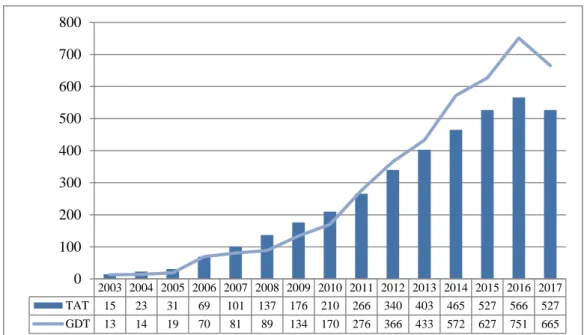
The changes in the number of ‘Collection and Separation’ and ‘Recycling’ facilities in Turkey by years are shown below. While there were only 28 licensed facilities in 2003, this number had increased to 527 for ‘Collection and Separation’ and to 665 for ‘Recycling’ facilities in 2017. [14] Landfilled 61% Recycled Packaging Waste 6% MBT + Biological Process + Energy Recovery 5% Dumpsited 28%
18
Figure 3.6 The number of ‘Collection and Separation (TAT)’ and ‘Recycling (GDT)’ Facilities in Turkey (2017) (adapted from [14])
There are references in the literature which say that the informal recycling sector (unlicensed) could be covering up to 30 % of MSW’s material recycling. But there is no more information on the current situation concerning this informal recycling practice. [11]
According to the NWMP report, İstanbul, İzmir, Tekirdağ, Ankara, Bursa, Kocaeli and Antalya were the biggest municipalities with the highest number of ‘collection and separation’ and ‘recycling’ facilities for packaging wastes. The report also mentioned that İstanbul, İzmir, Ankara, Antalya, Bursa, Kocaeli and Mersin are the provinces which had highest collection ratios of packaging waste from the first source. [12]
In order to increase the efficiency of separate collection and recycling amounts in the upcoming years, the MoEU brought a new mandatory rule within ‘Regulation on the Management of Packaging Waste’ for the packaging product producers. The producers have to use min % of below given amounts of recycled raw materials in their productions; [13]
Table 3.6 Annual Mandatory Use of Recycled Raw Materials by Industry (%) [13]
Year Plastic Paper/
Cardboard Glass Metal
2018 4 25 12 10 2019 6 30 15 15 2020 8 35 20 20 2003 2004 2005 2006 2007 2008 2009 2010 2011 2012 2013 2014 2015 2016 2017 TAT 15 23 31 69 101 137 176 210 266 340 403 465 527 566 527 GDT 13 14 19 70 81 89 134 170 276 366 433 572 627 751 665 0 100 200 300 400 500 600 700 800
19
As it is mentioned, ‘Regulation on Management of Packaging Waste’ stipulates that industries that produce packaging goods are obliged to ensure that 54% of the total amount of packaging produced in 2018 is recycled, and that they have to contribute to the recycling costs. Those industries can choose to either recycle those goods themselves or transfer their obligations to authorized organization by paying a fee. An authorized organization has to use those fees to implement policies and to separate wastes at source, in cooperation with municipalities. And municipalities are responsible for planning, managing and tracking the implementations carried out. [16]
In this matter, ‘Çevre Koruma ve Ambalaj Atıkları Değerlendirme Vakfı (ÇEVKO Foundation)’ is the biggest authorized organization in Turkey which collects packaging waste at source as a volunteer to recover since 2005. Since then, they have provided the recycling of almost 6 million tons of packaging waste. [16]
As an authorized organization, ÇEVKO Foundation develops activities regarding the separate collection of packaging waste at source in cooperation with municipal administrations and licensed companies on behalf of the packaging producers and economic operators which put packaging on to the market it represents. ÇEVKO Foundation, having taken over the recovery responsibilities of the industry, carries out its activities on contractual basis with many economic operators. [16]
ÇEVKO foundation is now working on recycling together with 162 county municipalities that have the highest population in Turkey. With their 51 members among whom there are the greatest firms of Turkey, they are fulfilling the recycling obligations of approximately 1,900 companies. [16]
At the same time, ÇEVKO Foundation is working together with all concerned parties, mainly their foundation members for the dissemination of the “Zero Waste” Project of the Environment and Urbanization Ministry of the Turkish Republic nowadays. [16]
3.4 Plastics Waste Management Regulations of Turkey
The Turkish Republic waste legislation is structured based on two overarching legislations; [17]
20
Regulation on the Waste Management (02.04.2015-29314 amended 23.07.2017-30016)
The rest of the specified waste management legislations are organized under these two main legislations. But only plastics waste management related ones will be mentioned in this chapter. [17]
Table 3.7 Plastic Waste Management Related Regulations of Turkey [17]
National Acts Main Content
The Environmental Law
(08.11.1983- 2872) [18]
As the framework law, it defines the rules and principles for environmental protection, addresses the responsibles and authorized institutions and organizations, determines the processes for the implementation and establishes the punishments for the improper acts and the liabilities. Regulation on the Waste
Management (02.04.2015 29314)
And its amending Regulation
(23.07.2017-30016) [15]
This regulation aims to ensure an efficient waste management in each and every phase from their formation to their disposal. It sets forth provisions regarding the reduction, reuse and recycling of waste. It covers all electronic items, packages, vehicles, batteries and battery products.
Regulation on the
Management of Packaging Waste (27.12.2017 - 30283)
[19]
This regulation aims to determine the technical and administrative principles of all kinds of packaging and packaging waste management. It defines the rules for the reduction of packing wastes by recycling, separate collection at the source, carrying and decomposition.
The Municipality Law
(3.7.2005 - 5393) [20]
Municipalities are responsible to provide all services regarding to the collection, transportation, separation, recycling, disposal and storage of municipal waste, or to appoint others to provide these services. They are responsible to prepare waste management plans.
The Metropolitan
Municipality Law (10.7.2004- 5216) [21]
Metropolitan municipalities are also responsible to implement the waste management plans to make sure that waste are collected at source, recycled, reused, or stored and removed accordingly. And they have to establish appropriate facilities, or to make sure that they are established by others, so that these services can be fulfilled.
Regulation on the Landfill of Waste (26.03.2010 – 27533) And its amending Regulation
(11/3/2015-29292) [22]
Technical principles for landfill facilities and the procedures and principles regarding the acceptance of wastes to landfill facilities and the regular storage of wastes, the measures to be taken, the inspections to be carried out and the responsibilities to be taken.
21
The first particular regulation on packaging waste management came into force in 2004 with the “Regulation on the Management of Packaging Waste” and was revised lately in December 2017. The aim of the regulation was to minimize the generation of packaging waste and to also increase the rate of recycled packaging waste which cannot be avoided within the method of production. The regulation also includes principles and standards for packaging waste to be collected separately at its source, then sorted and transported within a certain system. [11]
Finally in 2015, the ‘Regulation on the Waste Management’ was came into a force (also amended 23.03.2017-30016) and set the framework of waste management in Turkey, from waste generation to disposal so that the procedures are followed in an environmentally sound way. [11]
According to the ‘Metropolitan Municipality’ and ‘Municipality’ laws, municipalities are the responsibles for providing all services regarding to the collection, transportation, separation, recycling, disposal and storage of solid wastes, or to appoint others to provide these services.
[11]
Turkey does not have a federal character, thus all legislations are valid and binding throughout the country and there are no regional waste acts. [17]
3.5 The European Union Plastics Industry
According to Association of Plastics Manufacturers (PlasticsEurope) ‘2018 Plastics - Fact Report’, the European plastics industry consists of plastics raw materials producers, plastics converters, plastics recyclers and plastics machinery manufacturers which are located in the 28 EU Member States. The European plastics industry provides a direct employment to over 1,5 million people within 60,000 operating companies (most of them SME’s), having annual turnover ~350 billion Euros and ~17 billion Euros trade balance in 2017. [2]
22
Figure 3.7 Plastics Manufacturing and Processing Trade Balances of EU28 [2]
The total plastic production data of Europe (EU28+Norway/Switzerland) in 2017 was 64,4 million tons, while the total production of the world was 348 million tons (including plastic products such as thermoplastics, polyurethanes, thermosets, adhesives, coatings and sealants but not including PET fibers, PA fibers, PP fibers and polyacryls-fibers). China was the biggest plastics producer (29,4%) in the world, followed by Europe (18,5%) and NAFTA (17,7%) region. [2]
According to the same report, the European plastics industry has ranked as 7th biggest industry in Europe in terms of ‘added value’ which is at the same level as the pharmaceutical industry, and very close to the chemical industry. The European plastics industry contributed close to 32,5 billion Euros to public finances and welfare in 2017. [2]
As it can be seen from the below figure, the main trade partners of the European plastics industry are; the USA, China, Korea, Turkey, Russia, Switzerland, Saudi Arabia and Japan. For the plastic manufacturing products, the EU was mainly importing from the USA while was exporting to Turkey at most. On the other hand, for the plastics processing products side, the EU was mainly importing from China and exporting them to the USA. [2]
23
Figure 3.8 Trade Partners of the European Plastics Industry (2017) [2]
According to the below figure, the biggest European countries such as Germany, Italy, France, Spain, UK and Poland respectively were covering almost 70% of the European plastics converter demand (51,2 MT) in 2017. [2]
Figure 3.9 Distribution of EU Plastics Demand by Country (2017) [2]
Within Europe, plastics were primarily used in packaging sector (39,7%) while secondly in the building and construction (19,8%) followed by an automotive sector (10,1%) in 2017. Apart from them, electrical and electronic, household and agriculture sectors are the other ones where plastics were mainly used. [2]
24
Figure 3.10 Distribution of EU Plastics Demand by Sectors (2017) [1]
The plastic end products are mainly composed of a great variety of plastic materials (thermoplastics or thermosets) in order to meet their very different needs. In Europe, ‘polypropylene’ was the most commonly used (19,3%) thermoplastics type in 2017 that was mainly used in plastics packagings, automotive and construction sectors. According to the same data, ‘Polyethylene’ was the second mostly used resin type (LDPE + LLDPE in total 17,5% and HDPE + MDPE in total 12,3%) for the production of plastic packagings, household and construction materials in general. [2]
25
3.6 The European Union Plastics Packaging Industry
In 2017, ‘Plastics Packaging’ was covering the biggest part (39,7%) of the plastics production in the EU. According to the below figure, the most commonly used polymer types during the plastics packaging’s productions are LDPE and LLDPE which are followed by HDPE, PP and PET. [2,3]
Figure 3.12 Distribution of EU Plastics Demand by Sectors and Polymer Types (2017) [2]
Plastics Packaging’s are usually produced by the combination of different polymers and also other materials and adhesives have to be used. For example, plastic bottles are mainly composed of PET while plastics caps are generally composed of PE. Their labels around may be composed of also another type of plastic film such as PS, PVC and PP, or even a paper. All of these materials have very different properties and needs to be recycled differently. [3]
3.7 The European Union Plastics Waste Management System
During the last decade, around half of the plastics waste collected in the EU for recycling was exported to third countries due to the Europe's insufficient domestic recycling capacity, higher cost of recycling and the inadequate quality of the sorted waste. [1]
26
In between 2006-2016, plastics waste recycling in Europe had increased by almost 80%, landfilling decreased by 43% and energy recovery increased by 61%. However, reuse and recycling of end-of-life plastics still remains low, particularly when it is compared to other materials such as paper, glass or metals. [1, 2]
Figure 3.13 The EU’s Plastic Waste Treatment Evolution (2006-2016) [2]
In 2016, the EU generated about 27,1 million tons of post-consumer plastics waste of which only 31.1% was recycled and that was the first time, more plastic waste was recycled than landfilled (27.3%). However, still 37% of the plastics waste collected in the EU for recycling were exported to other countries. [1, 2]
Figure 3.14 The EU Plastic Waste Treatment Values (2016) [2]
China used to be the primary address of the EU’s plastics waste collected where 85% of the plastic waste used to export to China. [1] However, China decided to ban the imports of household plastic waste and 23 other kind of solid wastes at the beginning of 2018, as part of a campaign against foreign waste and environmental pollution. After the Chinese plastic waste import ban, the global plastic waste trade has dropped 50% in 2018 comparing to 2016.
27
The majority of the plastics waste was re-directed to less regulated countries such as Malaysia, Thailand, Vietnam, Indonesia, India, Taiwan, South Korea, and Turkey. [23]
Although the recycling performance of plastics waste in the EU is in progress, there is still plenty of room for an improvement. A more ambitious target was needed to increase the recycling rates of plastics waste and actually that ratio has increased by the amendment to the Packaging and Packaging Waste Directive (by the end of 2025; 50% and the end of 2030; 55% of the plastics packaging waste have to be recycled). [1]
Figure 3.15 The EU Plastic Waste Rates of Recycling, Energy Recovery and Landfill per Country (2016) [2]
The EU countries which are having landfill restrictions of recyclable and recoverable waste have, on average, higher recycling rates of plastic post-consumer waste comparing to ones which do not have land fill bands. [2]
In between 2006-2016, plastic packagings waste recycling in Europe had increased by almost 75%, landfilling decreased by 53% and energy recovery had increased by 71%. [2]
28
Figure 3.16 The EU’s Plastic Packagings Waste Treatment Evolution (2006-2016) [2]
In 2016, 16.7 million tons of plastics packaging waste were collected through official schemes in order to be treated. Only 40.8 % of the plastics packaging waste were recycled while 20.4% of them landfilled and 38.8% of them used for the energy recovery. [2]
Figure 3.17 The EU’s Plastic Packaging Waste Treatment Values (2016) [2]
The recycling rate of plastics packagings generally lowers comparing to other packaging materials. In 2015, while the average packaging recycling rate was 65%, metal recycling ratio was 76%, paper and cardboard recycling ratio was 83% and glass packaging recycling ratio was 73% separately. One of the reasons for the low recycling rates of plastics packagings is the use of different plastic polymers (e.g. PP, PET, and PVC) in their productions depending on the functions of the packagings. The diversity of polymers, as well as the presence of multi-material and multi-layer packaging, make their recycling more difficult as it requires a better separation or extra processing and that creates a problem for to achieving economies of scale. [1]
29
In 2016, the average EU recycling rate for plastic packaging waste was 40.8% that was well above the ratio of 22.5% requested from EU countries according to the EU Packaging Waste Directive. Czechia was the only country who had achieved a recycling rate of more than 50% and Germany was the second by the addition of its feedstock recycling ratio. [2]
Figure 3.18 The EU Plastic Packagings Recycling Rates per Country (2016) [2]
For example; in Germany, 3 million tons of plastic packagings waste was collected through official schemes in order to be treated in 2016. From this amount only 50% were recycled and 49.9% was used for the energy recovery. [2]
In United Kingdom, 2.3 million tons of plastic packaging waste was collected through official schemes in order to be treated in 2016. From this amount while only 46% were recycled, 33% was used for energy recovery and 21% was landfilled. [2]
In Italy, 2.2 million tons of plastic packaging waste was collected through official schemes in order to be treated in 2016. From this amount while only 41% were recycled, 45.2% was used for energy recovery and 13.8% was landfilled. [2]
30
In France, 2.2 million tons of plastic packaging waste was collected through official schemes in order to be treated in 2016. From this amount while only 26.2% were recycled, 44.6% was used for energy recovery and 29.2% was landfilled. [2]
In Spain, 1.5 million tons of plastic packaging waste was collected through official schemes in order to be treated in 2016. From this amount while only 45.4% were recycled, 16.4% was used for energy recovery and 38.2% was landfilled. [2]
In Poland, 1 million tons of plastic packaging waste was collected through official schemes in order to be treated in 2016. From this amount while only 38.5% were recycled, 33% was used for energy recovery and 28.5% was landfilled. [2]
3.7.1 Reasons of Low Recycling Ratios of Plastics in the EU
As of today, only 4-6% of the EU plastics raw material demand is covered by the recycled plastics and that is approximately equal to 3.5 million tons/year.There are different reasons that lead businesses to use less recycled plastics but it is changing recently due to the increasing awareness of the circular economy and the sustainability concepts. [1, 3]
In 2017, the European Plastics Converters Association (EuPC) had launched a survey to learn more about the use of recycled plastics in the European plastics industry. The survey was completed by the help of Polymer Comply Europe (PCE) and they had reached 485 participants from 28 different countries. [24]
This survey was giving detailed information about the current status of recycled plastics materials throughout the whole plastics value chain and was concluding the main reasons of having low plastics recycling ratios in the EU. And the results were as below; [24]
1. Lack of sustainability mindset: The European plastics converting companies stated that only 27% of their customers were sufficiently aware of the benefits or the needs of using recycled plastics in their production. The survey also mentioned that 76% of the respondents were currently using recycled plastic materials and 75% of them were planning to increase their usage of recyclates. On the other hand, 64% of the companies who did not use recycled plastic materials were planning to use in near future.
31
2. Insufficient Recycled Product Quality: The quality of recycled plastic materials remained the biggest barrier to use more recyclates as raw materials. Almost 60% of the European plastics converting companies found it very hard to supply recycled plastic materials which have an acceptable quality.
3. Inadequate Regulatory Framework: The current EU regulations needed to be changed to support the use of recycled plastic materials in a better way. Almost 60% of the European plastics converting companies were thinking that the current regulations were not suitable to support a stronger use of recycled plastic materials.
According to the results of this survey, the primary reason for low recyclate rates is the mind sets of the companies which are far from a real ‘Sustainability’ approach. Plastics packagings which include higher amounts of recycled materials are not preferred by the companies because the packagings are their principal marketing tools to differentiate from other competitors. Of course, there are some sectors that packagings made of recyclates cannot be used due to the safety issues, but apart from that most of the producers are hesitant to use recycled materials for their packagings due to the aesthetical aspects such as color or odor. [1]
Plastics packagings which include higher recyclates are mostly used in Business to Business (B2B) sectors because of the less safety concerns. On the other hand, food packaging is the sector which plastics are mostly used, but due to the food safety and hygiene concerns, the use of recycled plastics in food packaging is almost impossible. [1, 3] Packaging materials that are used in the food sector, whether they are virgin materials or recycled, have to comply legal requirements and the recycled packagings are not preferred as it is very difficult to control their origin and composition comparing to virgin raw materials. Recycled plastics may contain incidental contaminants that can originate from multiple sources and these can affect the quality and safety of recyclates. [1]
As the surveyors are complained, to find high quality recycled plastics that are sufficiently clean and homogenous is not easy. The recyclers generally enable to have pure and clean raw materials from the tertiary and secondary packagings, as they are produced in large quantities and generally composed of one single polymer. However, for the primary packagings it is more complicated and not possible. [1]
32
Even though, it is easier and advantageous to use tertiary and secondary packagings for recycling, their potential is not fully used also. According to the European Commission’s ‘European Strategy for Plastics in Circular Economy’ report, for example clean plastic films, which have significant recycling potential, are not collected at all in most of the Member States. So, by increasing the volume of clean plastic waste collected around the EU, higher quality recyclates can be more obtained as its consequence. [1]
In some other cases, it is not easy to find a pure recyclate which is not contaminated or mixed by other products. For example, PET and PVC have many problems with cross contamination as they appear visually very similar to one another. They also have the same specific gravity, therefore the use of conventional float and sink techniques may not be successful in separating them. Separation is very important as just a small amount of PVC can seriously impair the integrity of PET melted plastic. [3]
In the meantime, trends in recycling industry show that PET bottles and PE containers are the drivers of the plastics waste recycling industry. In contrast, despite being the fastest growing plastic type for use in the packaging, electrical and electronics, and automotive sectors, PP still shows a low recycling rate due to a number of technical issues. PP comes in very many types which make its separation and reprocessing into new products more demanding; also, PP is often used with other plastics, metals or other materials, which makes its recovery and separation very difficult. [3]
Additionally, over the last five years the price index has almost doubled and a further strong increase in plastic prices is expected in the medium term due to rising crude oil prices. Thus, plastics recycling is getting more attractive due to it’s the potential environmental as well as its increasing economic benefits. [3]
3.7.2 The EU Strategy to Increase the Recycling Ratios of Plastics
According to the Europe’s 2020 strategy, the aim is to turn the EU into a smart, sustainable and stronger economy delivering high levels of employment, productivity and social attachment. In other terms, the EU wants to create more resource efficient, greener and more competitive economy. In this regard, prepared ‘Circular Economy Action Plan’ and the
33
‘Plastics Strategy’ of the EU can be considered as the complementary of their 2020 strategy.
[1]
In order to achieve these ‘Circular Economy’ goals, the recycling ratios in Europe have to be increased. And as they have mentioned, low recycling ratios are because of the wrong mindset of the people who use or produce plastics primarily, but more importantly, there are also technological or infrastructural obstacles that have to be overcome in order to increase the recycling ratios. [1]
Across the EU, every country has a diverse infrastructure capacity, logistics system and waste management practices because of the different technical, economic and social reasons. First of all, collection and sorting of post-consumer plastics waste are complex issues and not easy to implement. Thus, a well-designed, good functioning waste management system has to be settled and separate collection of plastics waste has to be ensured to maximize the recovery of resources and to prevent their release to the environment. [1]
According to one study undertaken in 2015 within the EU, the methods which are used to collect different waste streams and the practical implementation of the obligations vary a lot across the 28 EU Member States. According to study results, only 18 Member States collect plastics via door-to-door systems. Among these countries only 4 of them collect plastics as a separate fraction but all others apply co-mingling with one (metal), two or three other fractions. On the other hand, 6 Member States collect plastics (five together with metals) via bring-points. And unfortunately, 4 Member States do not collect plastic separately from residual waste within the main collection system. [25]
The same study concluded that the collection of plastics as a single fraction within door-to-door collection system delivers the best outcome both in terms of quality and quantity of the collected waste. Even though the collection costs are higher, the treatment costs are lower and higher revenues can be earned from the recyclates. By considering, all these results, door-to-door collection should be more applicable within the Member States. [25]
In addition, everyday more and more municipalities are starting to apply pay-as-you-throw-schemes which provide strong incentives for the waste prevention, correct separation of waste and cleaner fractions which are easier to recycle. [1]
![Figure 1.1 Circular Plastics Value Chain (adapted from [1])](https://thumb-eu.123doks.com/thumbv2/123dok_br/18845589.929108/13.892.127.756.161.621/figure-circular-plastics-value-chain-adapted-from.webp)
![Figure 1.2 Plastics Recycling Scheme (adapted from [6])](https://thumb-eu.123doks.com/thumbv2/123dok_br/18845589.929108/15.892.110.786.178.425/figure-plastics-recycling-scheme-adapted.webp)
![Figure 3.1 Turkish Plastics Products Manufacturing Data (adapted from [8])](https://thumb-eu.123doks.com/thumbv2/123dok_br/18845589.929108/20.892.205.684.114.347/figure-turkish-plastics-products-manufacturing-data-adapted.webp)
![Table 3.1 Installed Capacity of Plastics Packaging Industry [10]](https://thumb-eu.123doks.com/thumbv2/123dok_br/18845589.929108/21.892.104.789.637.838/table-installed-capacity-plastics-packaging-industry.webp)
![Table 3.2 Plastics Packaging Products Manufacturers by Location [10]](https://thumb-eu.123doks.com/thumbv2/123dok_br/18845589.929108/22.892.207.686.137.494/table-plastics-packaging-products-manufacturers-by-location.webp)
![Figure 3.3 Production Percentages of Packaging Materials in Turkey [10]](https://thumb-eu.123doks.com/thumbv2/123dok_br/18845589.929108/23.892.242.616.114.366/figure-production-percentages-packaging-materials-turkey.webp)
![Figure 3.4 Recycling Life Cycle of Packaging Products in Turkey (adapted from [13])](https://thumb-eu.123doks.com/thumbv2/123dok_br/18845589.929108/24.892.178.712.451.801/figure-recycling-life-cycle-packaging-products-turkey-adapted.webp)
![Table 3.5 Produced and Recovered Amounts of Packaging Waste in Turkey (2017) [14]](https://thumb-eu.123doks.com/thumbv2/123dok_br/18845589.929108/26.892.110.789.140.348/table-produced-recovered-amounts-packaging-waste-turkey.webp)
![Figure 3.5 The Disposal Methods and Rates of Municipal Waste in 2014 (adapted from [11])](https://thumb-eu.123doks.com/thumbv2/123dok_br/18845589.929108/27.892.185.672.131.335/figure-disposal-methods-rates-municipal-waste-adapted.webp)