The Choice of Technological Innovation Modes:
A Multiple Case Study in the Green Lighting Industry in China
TAN Guoyi
Thesis submitted as partial requirement for the conferral of
Doctor of Management
Supervisor:
Professor Virginia Trigo, Associate Professor, ISCTE University Institute of Lisbon Co-supervisor:
Professor LI Shiming, Professor, University of Electronic Science and Technology of China, School of Management and Economics
- Spine –
The Choice of
Te
chnological Innovation Modes:
A
Multiple Case S
tudy in the Green
Lighting Industry in China
TA
N
G
u
o
y
i
The Choice of Technological Innovation Modes:
A Multiple Case Study in the Green Lighting Industry in China
TAN Guoyi
Thesis submitted as partial requirement for the conferral of
Doctor of Management
Supervisor:
Professor Virginia Trigo, Associate Professor, ISCTE University Institute of Lisbon Co-supervisor:
Professor LI Shiming, Professor, University of Electronic Science and Technology of China, School of Management and Economics
Declaration
I declare that this thesis does not incorporate without acknowledgement any material previously submitted for a degree or diploma in any university and that to the best of my knowledge it does not contain any material previously published or written by another person except where due reference is made in the text.
Signed Date _________________ Name: _____________ 作者申明 本人郑重申明:除了论文致谢中明确说明并致以谢意的部分外,所呈交的论文不 包含任何他人或作者本人已用于获得任何教育机构的学位和证书而使用过的材 料。同时尽我所知,除了文中特别加以标注引用的内容外,本论文不包含任何其 他个人或集体已经发表或撰写的成果作品。 作者签名: 日期: 姓名(拼音)
Since the beginning of the 21st century, the human living environment has been increasingly facing serious challenges. Energy-saving and environmental protection has become the theme of the era. Worldwide governments and enterprises work on the effective policies and measures that are jointly committed to the use and development of clean energy. In the 12th “Five-Year Plan” (i.e. The National Economic and Social Development Plan between 2011 and 2015) the Chinese government makes it clear that the energy saving and environmental protection industries will be the priority for its development.
The green lighting industry is the new wave of energy saving and environmental protection industry. Due to its long industrial chain and comparatively less capital investment, the industry has attracted a large number of start-ups. According to statistics, the majority of enterprises in the industry were established less than ten years. The emerging entrepreneurial enterprises play an important role in the green lighting industry. However, the technology of green lighting is not mature yet. The competition of the industry is highly strong due to the fast changing market and demanding performance of the products. Against this backdrop, it is an inevitable requirement to strengthen and emphasize technological innovation.
Based on the reality of green lighting industry, this thesis aims to develop models of technological innovation for entrepreneurial enterprises facing resource and capability constraints. Taking Grand Technology Co. Ltd, Kingsun Optoelectronic Co. Ltd and Sanan Photoelectrical Co. Ltd as the cases for the study, we focus our research on the competition environment of green lighting industry and identify the characteristics of entrepreneurial enterprises and technological innovation models. We then construct a theoretical framework for the selection of technological innovation of entrepreneurial enterprises with resource and capability constraints. The research adopts a multiple case study method to study representative companies of green lighting industry and finds the differences in the innovative selection under different resource and capability constraints.
Key words: entrepreneurial enterprise, resource, capability, technological innovation,
China
Desde o início do século XXI que o meio ambiente tem vindo a enfrentar desafios cada vez mais difíceis e que a necessidade de proteção ambiental se tornou no tema da época designadamente através da poupança de energia. Os governos e as empresas de todo o mundo trabalham no sentido da promoção de políticas e medidas destinadas à utilização e desenvolvimento de energias limpas e, no seu 12º Plano Quinquenal (i.e. o Plano Nacional de Desenvolvimento Económico e Social para o quinquénio 2011 - 2015), o governo chinês torna bem claro que será dada prioridade ao desenvolvimento de indústrias no ramo da poupança de energia e proteção ambiental.
Neste âmbito insere-se a indústria da iluminação verde pelo seu impacto na poupança de energia. Nos últimos dez anos esta indústria tem atraído um número elevado de empresas nascentes devido à extensão da sua cadeia industrial e às necessidades de investimento relativamente reduzidas pelo que são empresas no seu estádio empreendedor que desempenham um papel importante na indústria da iluminação verde. Contudo, a tecnologia não está ainda suficientemente madura e a concorrência é muito intensa devido à elevada dinâmica do mercado e às crescentes exigências quanto ao desempenho dos produtos sendo inevitável reforçar e enfatizar a necessidade de inovação tecnológica.
Baseando-se na realidade que a indústria da iluminação verde apresenta, esta tese pretende analisar e propor modelos de inovação tecnológica para empresas empreendedoras que se confrontam com escassez de recursos e de competências. Para tal foram estudados os casos das empresas Grand Technology Co. Ltd, Kingsun Optoelectronic Co. Ltd e Sanan Photoelectrical Co. Ltd procurando-se identificar e analisar as características destas empresas e os seus modelos de inovação. Através desse estudo procurou-se depois apresentar um modelo teórico para a seleção de inovação tecnológica por parte de empresas que se debatem com restrições de recursos e competências. Esta tese adopta o método do estudo de caso múltiplo e, focalizando-se em empresas representativas do fenómeno a analisar, foi possível encontrar diferenças no modo de seleção da inovação tecnológica em função das restrições de recursos e competências de cada empresa.
Palavras chave: empresa empreendedora, recursos, competências, inovação tecnológica,
China
During the past three years of UESTC-ISCTE DBA study, I have gone through both the bitterness of hard-work and the sweetness of learning. In the three years, I obtained a wealth of extensive knowledge in the field of management science, and also received the enthusiastic help of the fellow students and the careful guidance and cordial aids from the teachers. I cannot put even a bit of my thanks into words. Thank you!
I would like to extend my sincere thanks to all the teachers who helped me from primary school to university, and to all the teachers who taught me when I pursued my master degree and to all teachers who helped me with my doctoral study. I want to say to my teachers: thank you, my dear teachers!
Especially, I would like to grant my warmest thanks to the teachers involved in my doctoral study in the past three years. They are: Professor Zeng Yong, Professor Jing Ruitian, Professor Li Shiming, Professor Ma Yongkai, Professor Li Ping, Professor Deng Jianping from University of Electronic Science and Technology of China, Professor Zhang Lihua from Renmin University, Professor Yang Baiyin from Tsinghua University, Professor Virginia Trigo, Professor Nelson Santos Antonio, Professor Luis Bernardino, Professor Mohamed Azzim from ISCTE.
My sincerest thanks will go to my thesis instructors and mentors: Professor Li Shiming form University of Electronic Science and Technology of China, and Professor Virginia Trigo from ISCTE. Their profound knowledge, rigorous scholarship, and their kindness and generosity have impressed me greatly and will be inspiring to me all my life. They have put great efforts in helping me select research topic, working on the outline, choosing research methodology, data collection, etc. and this thesis is the result of their hard work and great endeavors. Here, I have the honor to give my sincere gratitude to my mentors.
My gratitude also goes to my DBA fellow students and the team of DBA program as well as all the friends who have helped me. Thanks to your care, help, support and encouragement, I have completed my study. Again, words fail me to express my thanks to all of them.
CHAPTER 1: INTRODUCTION... 1
1.1 RESEARCH BACKGROUND... 1
1.1.1 The significance of saving energy and protecting the environment... 1
1.1.2 Green lighting is an important industry practicing energy saving. ... 5
1.1.3 Technology innovation is the drive of the development of green lighting industry. 8 1.1.4 Technological innovation in enterprises is driven by the enterprise resources and capacity... 9
1.2 RESEARCH QUESTIONS... 11
1.3 RESEARCH OUTLINE... 12
1.4 RESEARCH SIGNIFICANCE... 13
CHAPTER 2: LITERATURE REVIEW AND THEORETICAL BASIS ... 15
2.1 THEORY OF ENTERPRISE RESOURCE AND CAPABILITY... 15
2.1.1 Resource-based theory ... 15
2.1.2 Capability theory of firms ... 20
2.1.3 Enterprise social capital and social network ... 24
2.2 ENTREPRENEURIAL THEORY... 27
2.2.1 Entrepreneurship and entrepreneurial opportunities ... 27
2.2.2 Entrepreneurial cycle theory ... 30
2.2.3 Main characteristics of entrepreneurial enterprise ... 31
2.3 THEORY OF TECHNOLOGICAL INNOVATION... 32
2.3.1 Connotation of technological innovation ... 32
2.3.2 Technological innovation model ... 36
2.4 SUMMARY OF LITERATURE REVIEW AND IMPLICATION... 39
2.5 THEORETICAL FRAMEWORK OF THE STUDY... 40
CHAPTER 3: RESEARCH DESIGN AND METHOD... 47
3.1 RESEARCH METHODOLOGY... 47
3.1.1 Case study method ... 47
3.1.2 Major research procedures ... 50
3.2.1 Data collection... 52
3.2.2 Data analysis and processing... 55
CHAPTER 4: TECHNOLOGICAL INNOVATION SELECTION IN GREEN LIGHTING ENTREPRENEURIAL ENTERPRISES ... 57
4.1 CURRENT SITUATION OF GREEN LIGHTING... 57
4.1.1 Features of green lighting industry... 57
4.1.2 The current situation of green lighting industry... 59
4.1.3 The future of green lighting technology innovation... 67
4.2 CASE STUDY ONE: THE TECHNOLOGICAL INNOVATION SELECTION OF SICHUAN GRAND TECHNOLOGY CO.,LTD. ... 70
4.2.1 Introduction of Sichuan Grand Technology Co., Ltd... 70
4.2.2 Analysis of Grand resources and capacity ... 72
4.2.3 Grand’s selection of technological innovation ... 78
4.2.4 An analysis of technological innovation resources selection of Grand ... 78
4.2.5 An analysis of technological innovation capability of Grand ... 80
4.3 CASE STUDY TWO:TECHNOLOGICAL INNOVATION SELECTION OF KINGSUN OPTOELECTRONICS CO.LTD... 85
4.3.1 The introduction of the company ... 85
4.3.2 Resource and capability analysis of Kingsun... 86
4.3.3 Technological innovation selection of Kingsun ... 89
4.4 CASE STUDY THREE:TECHNOLOGICAL INNOVATION SELECTION OF SANAN OPTOELECTRONICS CO.LTD... 95
4.4.1 Introduction of Sanan Optoelectronics Co. Ltd ... 95
4.4.2 Resource and capability analysis of Sanan Optoelectronics ... 96
4.4.3 Technological innovation selection of Sanan Optoelectronics... 97
4.5 THE COMPARATIVE ANALYSIS OF CASE STUDY AND IMPLICATIONS. ... 102
4.5.1 The comparative analysis of three case studies... 102
4.5.2 Research significance and implications. ... 104
CHAPTER 5: RESEARCH CONCLUSION AND OUTLOOK ... 107
5.1 RESEARCH CONCLUSION... 107
5.2 FUTURE RESEARCH WORK... 111
List of Tables
Table 1- 1 Global LED lighting market penetration forecast data 2009-2013... 6
Table 2- 1 Main resources of enterprises ... 3
Table 2- 2 Summary of the Enterprise capabilities and their performances ... 9
Table 2- 3 Components and classification of enterprise social capital... 10
Table 2- 4 Technological innovation model and classification ... 23
Table 2- 5 Evaluation index of enterprise capability for innovation... 29
Table 2- 6 Technological Innovation Models... 29
Table 3- 1 Classification of Case Study ... 34
Table 3- 2 Main reports used for data collection... 39
Table 3- 3 Sources of three cases’ information ... 40
Table 3- 4 Main interviewees and interview content ... 41
Table 3- 5 coding schedule... 42
Table 4- 1 Comparison of the efficacy of several lightings ... 44
Table 4- 2 2010-2020 LED backlighting, automotive lighting, ... 47
Table 4- 3 Comparing the international power-type white LED indicators average level... 53
Table 4- 4 LED lighting "12th Five-Year-Plan” Technology Development Key Indicators.. 55
Table 4- 5 Introduction of executives of Grand ... 59
Table 4- 6 Summarization of Grand’s combination of resources and capacities ... 64
Table 4- 7 Main performance and technical features of Grand’s products... 67
Table 4- 8 List of Grand’s patents ... 69
Table 4- 9 Time Line of Grand’s Technological Innovations... 69
Table 4- 10 Grand’s business distribution as of 2011... 70
Table 4- 11 The financial reports of Kingsun Optoelectronics between 2008 and 2011 ... 72
Table 4- 12 Resources and capabilities of Kingsun ... 75
Table 4- 13 The financial report of Sanan Optoelectronics 2007-2011 ... 82
Table 4- 14 Resource and capability of Sanan Optoelectronics... 83
Table 4- 15 Sanan’s main technological achievements and honors ... 86
Table 4- 16 Comparing the Selection of Technological Innovation by the Three Companies. 89 Table 5- 1 LED enterprise technology innovation mode analysis (barrel principle) ... 94
List of Figures
Figure 1- 1 The outline of the study ... 13
Figure 2- 1 Three types of resources ... 27
Figure 2- 2 Theoretical Framework... 31
Figure 4- 1 LED lighting industrial chain ... 46
Figure 4- 2 Time of banning the use of incandescent bulbs in different countries ... 46
Figure 4- 3 External environmental analysis of Chinese LED industry ... 50
Figure 4- 4 Grand structure frame... 60
Figure 4- 5 A analytical model of technological innovation resource of Grand’s products .. 65
Figure 4- 6 Grand’s an analytical model of technological innovation capability ... 66
Figure 4- 7 An analytical model of technological innovation resources of Kingsun ... 77
Figure 4- 8 An analytical model of technological innovation capability of Kingsun ... 79
Figure 4- 9 Organizational structure of Sanan ... 82
Figure 4- 10 An analytical model of Sanan technological innovation resource... 84
Figure 4- 11 An analytical model of technological innovation capability of Sanan ... 85
Figure 5- 1 LED enterprise technology innovation mode analysis ... 95
Chapter 1: Introduction
This chapter deals with the background of the study, which explains the necessity to promote innovation in Chinese lighting industry. As China’s economy has been developing very fast in the past three decades and will be expected to grow in a fast pace, a sustainable energy supply will be a great challenge to the economic development and wellbeing of the people in China. Energy-saving technology application in terms of lighting industry has drawn more and more attention from the government, academics and industry. Seeking appropriate models for different types of innovation in the green lighting industry appears to be more strategic than ever before. Chapter One introduces the current situation of China’s energy consumption and analyzes the importance of taking strategies to save the energy. Among the important strategies, developing energy-saving lighting technology becomes the vital solution to the energy problem of China.
1.1 Research background
1.1.1 The significance of saving energy and protecting the environment
(1) The energy crisis and environmental protection has become a worldwide problem.
The development and progress of human society depends on the energy consumption. In particular, since industrialization began, the global demand for energy is growing. To date, the energy that human beings can utilize is mainly oil and coal-based fossil resources. As non-renewable resources, these energies will be depleted sooner or later. According to the analysis of International Energy Agency, despite the emergence of a variety of alternative energy technologies to meet the global demand, countries have used the energies in a more efficient way. However, in the next decade, global demand for fossil fuels will continue to grow and occupy a major position in the global energy structure in a long run.
The global energy consumption grew by 2.5% in 2011, among which China accounted for 71% of incremental global energy consumption. Global energy growth was on a par with the historical average but much lower than the 5.1% growth in 2010. All net growth was from emerging economies and the growth rate reached 5.3%. However, the energy demand by
Organization of Economics, Cooperation and Development OECD(The organization for economic cooperation and development ) countries declined by 0.8% for the third time in the past four years, among which Japan decreased sharply. Oil is still the main source of energy, accounting for 33% of the global energy consumption. Oil, gas, coal and other conventional energy sources dominate. According to the analysis report of BP, it is predicted that the world's oil is only enough for 54 years of exploration, natural gas for about 64 years, nearly 112 years of coal at the present energy consumption level1. In a long term, human beings must seek new sources of energy. So the new energy industry will be vigorously developed.
In the context of high energy consumption, the environment has been faced with great challenges: environmental pollution, unbalanced ecology, global warming. Due to global warming, the sea level has risen 10 – 20 centimeters. If the sea level rises two meters, Los Angeles would disappear in the sea; if it rises six meters, Shanghai would disappear2. Global warming has seriously affected the sustainable development of human society.
Global warming can be mainly attributed to the greenhouse effect caused by the emission of CO2 during industrialization process. At present, the energy resources are mainly chemical
energy resources, such as coal, petroleum and natural gas. According to the statistics released by international energy institution, the carbon emission in 2011 has reached 31.6 billion tons with an increase of 3.2% over 2010. The carbon emission has increased quickly in China, India and other emerging economies.
Greenhouse emissions have caused global warming, which has drawn widespread concern in the international community. Addressing global climate change, saving energy, reducing consumption has become an imperative. In December 1997, the Third Conference of the Parties of the United Nations Framework Convention on Climate Change (hereinafter referred to as "the Convention") was held in Kyoto, Japan. Representatives from 149 countries and regions agreed on the Kyoto Protocol designed to limit emissions of greenhouse gases from developed countries to curb global warming. On December 7th, 2009, the conference themed “Can climate change save the earth, and how to save the earth?" was held in Copenhagen where the countries present have reached consensus that by 2050 the worldwide emission will be reduced to half of that in 1990. A decision to start the second phase of "Kyoto Protocol" and to launch the project of the Green Climate Fund was made at
1 BP Statistical Review of World Energy June 2012
the Global Climate Change Conference held in Durban, South Africa, form November 28 to December 9, 2011.
The negotiations on World Climate Conference have been very difficult, and all countries, especially the developed countries and the developing countries, criticize each other and the conflicts between them have been constant, which is in fact the fight for the social and economic interests of their own countries. For a long time, the economic development and energy conservation can not be balanced worldwide.
(2) Difficulties in balancing the energy crisis and the economic and consumption growth in China.
China has become the world's second-largest economy and is also the second largest energy consumer. Though it is enjoying rapid economic growth and great achievements in the construction of its process of reforms, it has also paid a big price in resources and environment. The conflicts between economic development and resource consumption and environmental protection have been intensified and people complain severely about the environmental pollution, which could be the consequence of unreasonable economic structure and extensive mode of growth. Therefore, if we do not accelerate restructuring the economy and modifying the growth mode, the resources will soon run out and the environment will break down; hence the economic development can not be sustained.
In fact, during the period of the eleventh "Five-Year Plan"3, due to the energy crisis 10% -12% of the enterprises could not operate normally for the insufficient electricity supply. Every year, at the peak time of electricity consumption, in a number of regions, electricity limit is imposed on both residents and enterprises. In the future, Chinese economy still needs to develop; however, under the enormous pressure of energy saving and emission reduction, we must modify the current mode to seek for a more scientific way to development.
As a developing country, China is at an important stage during which industrialization and urbanization are speeding up. As a result, China is faced with a larger population, resource and environmental pressures, and higher energy consumption. In 2011, the total energy consumption in China reached 3.48 billion tons of standard coal, which has become
3 The “Five-Year Plan” is a part of China national economic plan which is mainly about the key national construction
projects, production force distribution and important proportional relations of the national economy. It sets the goal and direction of the national economic development. The first “Five-year Plan” was started from 1953 and eleven “Five-year Plans” have been made so far. The eleventh one was implemented between 2006 and 2010. At present the tweleveth “Five-Year Plan” (2011-2015) is being implemented.
the world’s first largest energy consumer. In recent years, the energy consumption growth has kept about 5%, higher than the world average and the OECD countries4. China’s energy consumption has increased every year in the world’s total energy consumption. With China’s economic growth, the shortage of China’s energy is growing. With the current economic development mode, the conflict between economic development and energy consumption will become increasingly prominent. Changes must be made to the economic development mode, industrial structure and the use of energy.
As the world’s second largest economy, China faces huge challenges in terms of energy consumption, climate change, green house gas emissions. At present, China depends on coal as its main energy, which results in large amounts of greenhouse gas emissions. It also restricts its industrialization and modernization process. China promised a decrease of 40% --45% of carbon dioxide emissions per unit of GDP by 2020 over 2005 at the World Climate Conference in Durban5. In early 2012, the Chinese government introduced the "controlling greenhouse gas emissions during the 12th five-year-plan, which proposed a significant reduction in carbon dioxide per unit of GDP and targeted at a decrease of carbon dioxide emissions by 17% per unit of GDP by 2015 over 2010.6
(3) China’s priority to the development of energy-saving industry so as to solve the energy crisis
China is aware of the tremendous impact of climate change from the scientific and social development and starts a positive response.7 On the basis of the first “Renewable Energy Law” passed in 2005, China put forward “China National Pan for Addressing Climate Change” in 2007, which highlights specific measures in key areas.8 To reduce the carbon dioxide emissions in the atmosphere, on the one hand it is necessary to optimize the energy structure to develop the new clean energy such as wind power, solar energy and tidal energy, on the other hand new products shall be introduced through the technological progress to develop the energy saving and environmental protection in order to reduce the energy consumption.
In the 11th “Five-year Plan”, namely 2006 to 2010, China clearly stated that the energy,
4 Conference proceedings of the Fourth China (Taiyuan) International Energy Industry Exhibition 5 China Securities Website: Durban Climate Conference
6 “ The 12th Five-year Woking Plan for Controlling Emission of Greenhouse Gas” China State Concil 7 The first in the raw energy law
raw materials, real estate, transportation industry, energy-saving and environmental protection were the key industries for development and support. To develop the economy, the State Council attached great importance to energy saving and emission reduction which was regards as an important means to restructure the economy, change the development mode and promote scientific development. The objectives included about 20% reduction in energy consumption per unit of GDP and the binding target of 10% reduction of total emissions.
China's 12th “Five-Year Plan” (namely, from 2011 to 2015) aims to promote development in key areas with focusing on developing energy conservation and environmental protection as well as strategic emerging industry. Chinese government, in the program of energy conservation issued by the State Council, requires the governments at all levels to fully understand the importance and significance of energy conservation and emission reduction. In addition, work of energy saving is assigned to the specific principal leaders of local government.
The Chinese government urges to develop the emerging industries of energy saving and environmental protection, of information technology, biotechnology, high-end equipment manufacturing, new energy, new materials and new energy automobile. To relieve energy crisis, the main task of these industries is to provide equipment, product and services involving energy-efficiency, environmental protection and resource recycling.
The industry of energy saving and environmental protection includes six areas, namely the energy-saving technologies and equipment, energy-efficient products, energy services industry, advanced environmental protection technology and equipment, environmental products and services. The energy efficient lighting is an important part in the energy saving and environmental protection industry. According to "the decision by the State Council on accelerating the development of strategic emerging industries" (National Development and Reform Committee [2010] No. 32) and the “ Notice of comprehensive energy conservation program during the 12th five-year-plan” issued by the State Council (National Development and Reform Committee [2011]No. 26), to promote rapid and healthy development of energy saving and environmental protection industry, the State Council, issued "a plan of developing energy saving and environmental protection industry", and pinned green lighting as the second most important industry in the area of energy-saving.
1.1.2 Green lighting is an important industry practicing energy saving.
Electricity for lighting accounts for 20% of world electricity consumption and Chinese lighting counts for 13% of the total electricity consumption. Many countries and regions in the world are vigorously promoting the development of green lighting. Green lighting means saving energy and reducing air pollutants and greenhouse gas from power generation emissions through improving the efficiency of electrical lighting system, so as to achieve the environmental protection. LED energy-saving lights are the representatives of the green lighting and developing green lighting can save energy and money, and can ensure the national energy security and reduce air pollution and protect the environment. The Chinese government attaches great importance to energy-saving lighting, and has included green lighting as the main energy saving projects in the Ninth Five-Year Plan and the Tenth Five-Year Plan and in the "Eleventh Five-Year Plan" and the "Twelfth Five-Year Plan" as the focus of energy-saving projects. The Chinese government launched China's green lighting projects in 1996, and carried out three-phased green lighting international cooperative projects with the United Nations Development Program (UNDP) and the Global Environment Facility (GEF).
(2) The global influence of the application of green lighting technology.
In the whole world, the overall lighting market in 2010 reached 130.207 billion US dollars9. While the tradition lighting market has gradually declined LED lighting will increasingly penetrate into the area of tradition lighting market. It is expected that the market share of the LED products will reach 19.9% of the world lighting market. The global lighting market will see a rapid growth in the next few years. The global LED lighting in 2013 is expected to grow to 31.6156 billion US dollars10. Table 1-1 shows the global LED lighting market penetration forecast data in the year 2009-2013.
Table 1- 1 Global LED lighting market penetration forecast data 2009-2013
Year 2008 2009 2010 2011 2012 2013
Global LED lighting market penetration
rate
1.5% 1.9% 3.2% 10.6% 14.6% 19.9%
Source: Digitimes, 2010/2
From the development of China’s semiconductor lighting market, the semiconductor innovation and industrialization expansion has become an important condition for the rapid growth of China’s semiconductor lighting market since lighting projects launched in 2003. In
9 A survey and investment strategy report of China semiconductor LED industry between 2010-2015 10 A survey and investment strategy report of China semiconductor LED industry between 2010-2015
particular, with the government support on the demonstration lighting engineering and subsidies for purchase of semiconductor lighting products, China has become one of the fastest growing semiconductor lighting markets. In 2010, China’s LED chip output value reached 50 billion RMB. The LED packing production value got 250 billion RMB and the application LED value reached 90 billion RMB11.
At present, China's energy is mainly generated by thermal power, which consumes oil and coal. Constantly soaring oil prices have caused the increase of the cost of power generation. In addition, large amounts of carbon dioxide from firing coal caused greenhouse effect. Today, when the energy crisis and the greenhouse effect are getting more and more serious, energy saving and environmental protection has become an imperative, as the low efficiency of traditional source of energy resulted in the fact that only 3% -12% of the electricity is transformed into light and a large amount of energy is wasted12. Therefore, it is an imperative to prohibit the use of lighting with traditional energy source and to promote green energy-efficient lighting.13 At the EU spring Summit in 2008, the European Union
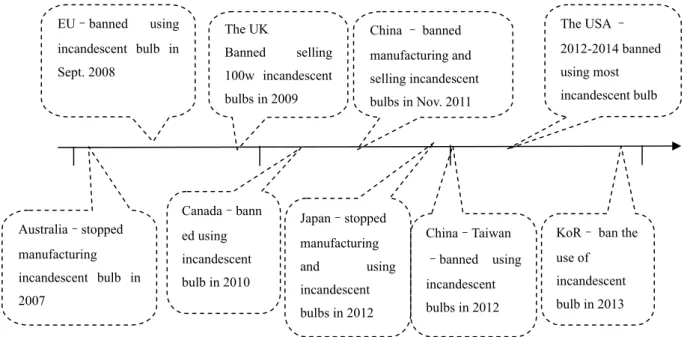
countries reached a consensus on gradually replacing incandescent lamps with new energy-saving light source to reduce greenhouse gas emissions. Many countries legislate against the production of energy consumption light, and traditional energy-consumption light source suffered a constant global ban.
Currently, among many energy-efficient lighting products in the market, LED lights are the product of advanced technology. LED lights are semiconductor lighting, and LED is an abbreviation for light emitting diode. Because it is cold and solid light source, it is featured by low operating voltage, low power consumption, high luminous efficiency and endurance, and has become the mainstream in the field of energy-efficient lighting. In fact, LED lamps can save 80% energy over incandescent lights and 50% over fluorescent energy-saving lights.14 Since green lighting can greatly save energy, the power generation can be cut off and thereby energy consumption and carbon emissions will be reduced as well. If all the incandescent lamps are replaced by the energy-saving lighting, over 60 billion kwh would be saved annually, which is close to the generation capacity of the Three Gorges Power Station per year, or is equivalent to saving 22 million tons of standard coal and this can help to reduce the
11 Date statistics by Gaogong LED Industry Insitute (GLII) 12 LED Lighting, Baidu Website
13 LED Lighting, Baidu Website
emission of over 6000 tons of carbon dioxide and 59 million tons of sulfur dioxide.15
According to the "11th Five-Year Plan" and the "12th Five-Year Plan”, China will carry out 10 major energy conservation projects, among which green lighting and the promotion of efficient energy-saving lighting system will be the main task. Therefore, as a fourth lighting revolution after fire, incandescent and fluorescent, semiconductor lighting (LED) will become the technology trend in the next few years. The development of the green LED lighting industry will greatly influence the global environment, as well as the economic and cultural areas and will bring the whole world great enjoyment of art and beautiful light.
1.1.3 Technology innovation is the drive of the development of green lighting industry.
Semiconductor (LED) lighting industry is an important part of the green lighting which is divided into “upstream” and “downstream” and is composed of four parts: epitaxial wafers, chip, package, application (the whole lamp manufacturing). The intellectual property rights of epitaxial wafer and chip technology are controlled by Japanese, European and American companies, and most major processing equipment is mainly owned by European and American countries. Because there are some problems with sealing, and application, and there is a lack of major companies, talents, funds, and skills, and the customers are not confident enough in LED industries, this is affecting the upstream development.
According to a survey of Chinese Association of Lighting in 2010, 70% of companies in lighting industry in China are losing money, 20% are breaking even, and only 10% of the companies are making profits16. The statistics of the national semiconductor lighting industrial engineering R & D and Industry Alliance showed that in the first three quarters of 2011, more than 90% of the enterprises of the LED lighting industry are losing money and less than 100 enterprises have their own intellectual property rights, which means that the green LED lighting industry lack technological innovation and hence lack core competitiveness. To win customers’ recognition, they must achieve technological innovation, to advance their technology in a more mature and more economical way. But now more than 95% of LED lighting companies are small and medium-sized enterprises; in addition, their technological innovation is constrained by resources and capacity.
From the general development of industry, technology has played a key role in the
15 China Industry Daily, June 25, 2008
industry transition from infancy to growth. Technical progress and technological innovation is the driving force of industrial development. Technological innovation improves product performance, cost structure and market acceptance. For the whole industrial chain of green lighting and the related technologies, there is currently lack of collaborative innovation. The innovation environment of the industry is poor and insufficient technological innovation becomes the bottleneck which restricts the industry from the development.
1.1.4 Technological innovation in enterprises is driven by the enterprise resources and capacity.
Though technological innovation is the key of developing green lighting industry, and of enhancing the competitiveness of enterprises, technological innovation has been constrained by the fact that the majority of enterprises in China are entrepreneurial SMEs.
(1) Enterprise technology innovation is restrained by limited resources.
Technological innovation in enterprises is guaranteed by the supply of strategic resources, general resources and market factor resources. The three kinds of resources, especially internal resources, are very scarce for start-up enterprises, where there are serious shortages of funds, qualified human resources and there are the problems of poor management, lacking ability to adapt to the changes in the market and lacking competitiveness, poor corporate credit status, low level of marketing management, inadequate government support for the enterprises and immature social service system.
(2) Technological innovation of the enterprises is constrained by its capacity.
The technology innovation of the start-up enterprise is constrained by management, investment, R & D capability, production capacity and marketing capabilities. For the majority of the manufacturing enterprises in China, especially SMEs, the management level is low, they do not have enough funds, lack scientific and technological personnel, their R & D ability is poor, the overall quality of the production equipment is poor, and they lack marketing network. They are facing many difficulties and problems when it comes to technological innovation (Cai, 2008; Jia et al., 2006). The practical measures should be taken to change the unfavorable situation of technological innovation.
(3) The plight of entrepreneurial enterprises in technological innovation
Chinese entrepreneurial enterprises are faced by many difficulties in technological innovation due to the constraints of resources, and their own inadequacies, such as:
The first one is the shortage of innovative talents and high quality employees (Zhang, 2011).
Conservative ideology of the planned economy period makes most of the high-quality talents to select relatively stable, relatively leisurely universities and research institutes, instead of joining the wave of the market economy and fierce challenges. Only 38% of the R & D personnel selected enterprises are concentrated in large enterprises 17. This makes it difficult for enterprises to get much-needed high-quality talent scarcity of researchers, the lack of a driving force of innovation of the pioneering period.
The second problem is the lack of funds that make it hard to finance enterprises (Xi, 2012).
Technological innovation means the transformation of scientific and technological achievement into productive activities, which needs substantial investment. For start-up enterprises, they do not have sufficient funds to support innovation activities and therefore financing for SMEs is very difficult.
Third, technology intermediary institutions need to be improved.
Technological innovation is a highly social activity. Individual companies generally do not have all the capacities and resources for technological innovation. So they need to co-work with other enterprises on innovation. It takes a large amount of energy and financial resources to collect information to find the right partner. Hence, the intermediaries can play a key role in connecting the small and medium-sized enterprises to promote cooperation between them and achieve optimal allocation of resources. However, in China, the intermediaries are not mature and face many problems, for instance, the number of intermediaries is small and the professional level is comparatively low, there is a lack of cooperation, and the service is not standardized and not multi-oriented. They fail to build a strong information network system and fail to promote technical information exchange among SMEs (Gao, et al., 2003)
Fourth: the lack of legal protection.
The government has not attached enough importance to the start-up enterprise and cannot provide complete legal system to support technology innovation of entrepreneurial
17 Discuss about the plight of small and medium-sized enterprise technology innovation in our country and the countermeasures, Science and technology economic market,Xuliya,2007,02,28
enterprise. Moreover, there are some problems with the enacted laws and regulations for the entrepreneurial ventures.
In summary, in the era of energy conservation and environmental protection, green lighting industry is an important emerging industry. Technological innovation and technological progress is important to the development and popularization of green lighting industry. The key to technological innovation is to reduce costs and increase production, and to enhance the core competitiveness of the enterprises. However, the deficiencies of innovative enterprises, which are subject to a number of constraints, affect their technological innovation. Under the constraints of resources and capabilities, the selection of appropriate technology innovation modes, is a key issue that most entrepreneurial enterprises need to face and it is also worthy of in-depth study by the academia.
1.2 Research questions
The background introduced above indicates that the green lighting industry has a huge development potential in China and in the world as a whole. However, technological innovation has become the obstacle to the development of the industry and how technological innovation is selected has become key to the development of business and industry.
This thesis is aimed to study the following questions: for green lighting industry, what are the features in terms of resources and capabilities of entrepreneurial enterprises? How can start-ups select appropriate technological innovation under the constraint of resources and capabilities? The thesis attempts to establish technology innovation selection mode in the context of constraints of resource and capability, and to explain the modes relevant through multiple case studies of green lighting industry.
The thesis is composed of five chapters. Chapter one is the introduction describing the research background, the main research questions, theoretical values and the arrangement of the chapters.
Chapter two deals with literature review. This chapter summarizes the development of corporate resource theories and then provides a detailed discussion of resources and capacity. The basic model of technological innovation, entrepreneurial enterprise features are also discussed in the chapter. Literature review will provide literature support to the theoretical model.
the research, proposes practical design. Through a multiple case study method, this part is written up following the procedures of case studies. This chapter gives a full description of data collection, data analysis and the selection of specific cases.
Chapter 4 mainly discusses technology innovation selection in green lighting enterprises. It is composed of multiple case studies and is based on the studies of Sichuan Grand, Kingsun in Guangdong and Sanan in Xiamen. This thesis discusses the corporate background of these three companies, their development history, current status, the challenges they are facing and their status quo of resources and capacity. To conclude, the technological innovation selection model under the constraint of resources and capacity is proposed in this chapter.
Chapter 5 deals with conclusions and implications of the study. This chapter summarizes the conclusions of this study, identifying its inadequacies, and expecting to improve the conclusions in the follow-up studies.
1.3 Research outline
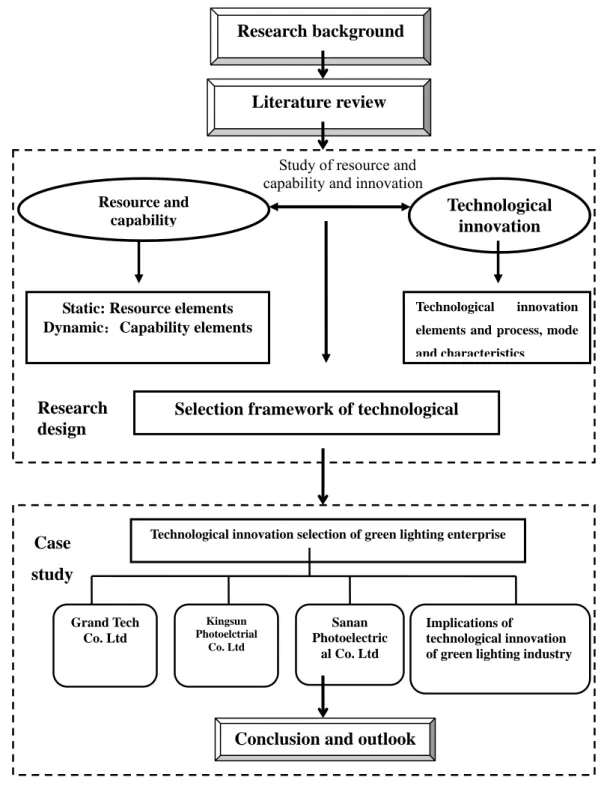
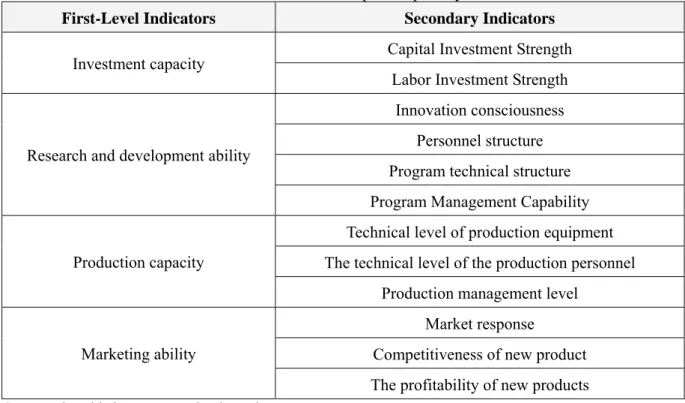
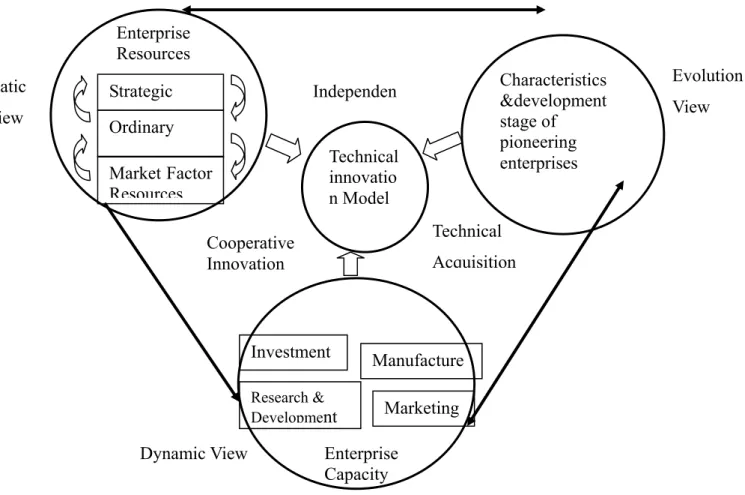
First, based on the above background we propose the research questions. Then the literature review is conducted with regards to the relevant theories and the understanding that the selection of technology innovation by entrepreneurial enterprises depends on its resource and capability. The study takes a static view to analyze the resources of enterprises such as human resources, technology resources, capital resources and market resources. It also takes a dynamic view to analyze the capabilities such as input capability, research and development, and marketing capability. On the basis of this, we propose the selection framework of technological innovation. The main body of the thesis is composed of three case studies. We analyze the resources and capability of three companies and their technological innovation selections. The final section summarizes the study and presents the outlook.
Figure 1- 1 The outline of the study
1.4 Research significance
Today,China is facing the enormous pressure of energy saving. The development of green industries is the focus of the economic development of the country in the long run. But China’s green lighting industry has yet to establish clear industry standards and achieve synergy and integration between the middle and downstream of the industrial chain. There are
Research background
Literature review
Resource and
capability Technological innovation
Static: Resource elements Dynamic:Capability elements
Technological innovation elements and process, mode and characteristics
Case study
Conclusion and outlook Selection framework of technological
Technological innovation selection of green lighting enterprise
Kingsun Photoelctrial Co. Ltd Sanan Photoelectric al Co. Ltd Implications of technological innovation of green lighting industry Grand Tech
Co. Ltd
Study of resource and capability and innovation
Research design
also some problems in terms of applications and to solve such problems technology innovation is needed.
Technological innovation plays a key role in green lighting industry and how to choose the technology innovation mode to promote the development of green lighting and to enhance the competitiveness of enterprises is the main issue. This thesis focuses on the green lighting industry through multiple case studies, and proposes the theoretical framework of the entrepreneurial enterprise technology innovation selection, which is both theoretically and practically significant.
Chapter 2: Literature Review and Theoretical basis
This research is aimed at studying technological innovation selection by start-up ventures under resource and capability constraints in the context of China. The key words involve “start-up venture”, “technological innovation” and “resource and capability”. The chapter is outlined as follows: first, the related theories, such as resource-based theory, enterprise capability theory and social network theory, are reviewed; second, entrepreneurship and entrepreneurial opportunities are presented; Finally, the innovation theory as well as technological innovation modality are reviewed. Reviewing these theories will help to lay a theoretical basis for the research.
2.1 Theory of enterprise resource and capability
2.1.1 Resource-based theory
Resource-based theory (RBT) was developed from the study of competitive advantage in the field of economics and strategic management. On the source of enterprise competitive advantage, there have been two main viewpoints: industrial organization view (Porter, 1980, 1985) and resource-based view (Wernerfelt, 1984; Barney, 1991). With the influence of the traditional economics and industrial organizational economics, earlier scholars studied the competitive advantages from the perspective of external competitive environment of the enterprise. It was not until the birth of the resource-based view that an increasing number of scholars started to focus on the resources of the enterprise and its influence on strategies and competitive advantages.
The resource-based theory was mainly originated from Penrose's (1959) enterprise growth theory and Nelson and Winter's (1982) evolutionary theory. Followed by the development by Wernerfelt (1984), Barney (1986, 1991) and Peteraf (1993), the theory has now become an essentially economic accredited school of business theory. Penrose (1959) argued that firms were composed of a bundle of resources. Wernerfelt (1984) pointed out that the internal resources of firms were of great significance for making profits and maintaining their competitive advantages, which played a decisive role in creating market advantages. His contribution promoted the academic field to turn to the resource-based and capability view
from the theory of industrial organization. Grant (1991) further studied the roles of four resource endowments on the sustainable competitive advantages, namely, durability, transparency, transferability and reliability.
With the development and maturity of the resource-based view, RBV theory has gradually become one of the main theories in strategic management. According to RBV, the strategic success of firms is based on its resource structure and the internal resources vary from one firm to another. So, firms can utilize heterogeneous resources to provide unique products or services, which are different from those of their competitors. By acquiring, owning and exploiting these resources, firms can take the advantage and specialty of the resource to obtain their competitive advantages (Prahalad and Hamel, 1990).
Although most scholars take different perspectives to formulate their own views on the competitive advantages of firms based on the resource view, which to a great extent enriched the theory, their studies are of difficult operationalization on the whole. For this reason, Barney (1991) and Peteraf (1993), based on those previous studies, constructed an analysis framework of competitive advantage of firms from the resource-based view.
Barney (1991) argued that different firms possessed or controlled different resources hence their resources are heterogeneous. When firms have resources that are valuable, rare, inimitable and non-substitutable, they are likely to attain sustainable competitive advantages and enjoy better performance. The value and rarity of resources is a necessary condition to generate competitive advantage, but in order to obtain a sustainable competitive advantage, firms must have resources that are difficult to imitate and substitute. Limitability directly concerns the ability of competitors to purchase or accumulate the target resource with the same endowment to generate competitive advantages. Non-substitutability directly concerns the ability of competitors to acquire other resources. Therefore, the attributes of being inimitable and non-substitutable focus more on the barriers impeding the imitability and substitutability, and a large amount of studies on RBV have been conducted to recognize and classify these barriers (e.g., Rommel, 1987;Dierickx&Cool, 1989;Grant, 1991).
Peteraf (1993) took a different perspective to explain the formulation of firm's competitive advantages based on the resource view. Her analysis is more focused on the basic price theory, especially in the economic analysis of different types of rent. According to Peteraf, only when the resources controlled by firms meet four requirements at the same time can they generate the sustainable competitive advantages: a) the firm can rely on the heterogeneous resources to obtain rent; b) by virtue of prior restrictions on competition, the
firm can obtain quality resources which are lower than the cost of rent; c) the firm can rely on the immobility of resources to keep rents within it; d) finally, the firm can hold the rents by virtue of afterwards restrictions on competing for the resources.
As Barney and Peteraf systematically integrated the various theories of competitive advantages based on the resource view, the frameworks developed by both of them have been widely accepted by the academic field. As they put forward the thesis on this analytical framework: “the resource-based view: the cornerstone of technological innovation”, Barney and Peteraf 's analytical framework laid a solid foundation for the following studies which are relevant to the resource-based view. William et al. (2011) suggested that the resource-based view provides the conditions for diversity of the enterprise and presented an outlook for the future studies in this field.
In recent decades, more attention has been given to the knowledge-based view (KBV) by the academia, which has become a branch of the resource-based view. According to the knowledge-based view, firms have heterogeneous knowledge. The competitive advantages of firms come from the creation, storage, and application of knowledge (Zander and Kogut, 1995; Conner and Prahalad, 1996: Spender and Grant, 1996). In spite of the special attribute of knowledge, it can be categorized as a kind of resource detained by firms. Therefore, as a branch of the resource-based view, the knowledge-based view (KBV), which focuses on the knowledge of firms, has extended and perfected the theoretical framework of the resource-based view.
According to the previous literature, various resources of firms are summarized as illustrated in Table 2-1.
Table 2- 1 Main resources of enterprises
Types of resource Main contents
Financial resource Cash and financial capability of firm, the ability to generate cash profit Physical resource Manufacturing equipment and its layout, raw materials and procurement Technological resource Various intellectual property and the relevant technical knowledge
Innovation resource Technicians and equipment for research and development Goodwill resource Brand recognized by customers and suppliers, goodwill, and partnership
Human resource Employees’ training, adaptation and judgment
Organizational resource Organizational structure and its planning, control and coordination
Source: “Strategic Management: Competition and Globalization” by M.A Hitt, R. Duane Ireland, R.E. Hoskisson. Translated by Lv Wei, et al (2012), Mechanical Industry Press.
Generally the resources of firms can be categorized into two kinds: tangible and intangible. Resources such as plant facilities, production equipment, raw materials and other resources of physical form, that is tangible resources, often enable firms to have a basic production or ability to provide services, but they are easier to obtain through market transactions, thus making it difficult to use them as a source for gaining access to the advantages of technological innovation. Intangible resources include knowledge, trust and communication between managers and staff, thinking of all staff, innovation capability, management capacity, management practices, goodwill of enterprise products and services, the way of communicating with people and business reputation. The intangible resources are usually rooted in the history of firms and accumulated through long-term development. It is usually difficult to mobilize, hence the main source of technological innovation advantage of firms.
By summarizing the relevant studies on the resources of firms by a large number of scholars, Barney (1991) classified the resources of firms into three types: physical capital resources, human capital resources and organizational capital resources. Physical capital resources include the application of hard technology by the firms, plants and equipment, the geographic location of firms and access to raw materials and so on. Human capital resources include training, experience, judgment, intelligence, relationship and insights of mangers and staff. Organizational capital resources include the formal chain of command structure, formal and informal plan, control and coordination of the system as well as the informal links between internal groups or the firm and its surrounding environment.
On the basis of the resource-based theory, the theory of technology innovation advantage further explains the mechanism of obtaining rent through firm resources. In accordance with the ownership of resources and the two dimensions of heterogeneity and incomplete mobility of resources, the resources for obtaining the technology innovation advantage can be divided into three types: the first type is the heterogeneous and incomplete mobile resources that firms own; the second type is the homogeneous and incomplete resources that firms possess; the third type is the homogeneous and incomplete mobile resources that firms do not own.
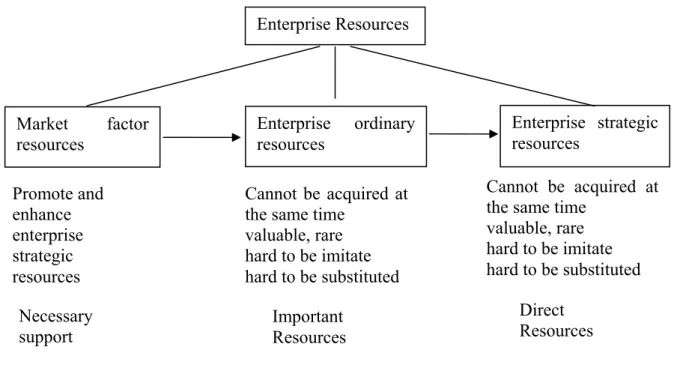
Based on the theory of technological innovation advantage of the resources and taking the resource ownership and the heterogeneity and incomplete mobility of resources into consideration, the resources used to acquire the technological innovation advantage can be divided into (i) enterprise strategic resources, (ii) ordinary resources and (iii) market factor resources. The strategic resources of firms are the direct source of technological innovation
advantage of firms while the ordinary resources, together with market factor resources, constitute the important source of enterprise to enhance and strengthen the strategic resources, which indirectly affect the performance of enterprises to obtain sustainable technological innovation advantages.
Among the various resources of firms, the strategic resources are the source of firms to gain technological innovation advantage. The characteristics of strategic resources are embodied in a way that they are controlled by firms, enable firms to create and execute value creation strategies, and enhance the operational efficiency and effectiveness of resources (Daft and Weich, 1984). In addition, the complementary resources have a positive impact on the strategic alliance between enterprises. It can improve the level of partnership and further strengthen the competitive advantage (Liu, 2004).
The resource-based strategic view took a further study on the strategic resource of firms, which reveals the mechanism by which the strategic resources of firms acquire the continuous technological innovation advantage. It also demonstrates the heterogeneity and incomplete mobility of corporate strategic resources, which endows the strategic resource with the four attributes mentioned before, namely, valuable, rare, inimitable and non-substitutable.
However, not all the physical, human and organizational capital resources are corporate strategic resources. Enterprises also have considerable ordinary resources that are not heterogeneous and immobile, such as, the company’s plant, machinery and equipment, raw materials, and the front line of skilled workers. These ordinary resources do not simultaneously have the attributes of value, rarity, inimitability and non-substitutability. Although ordinary resources belong to the same specific enterprise, they can not become direct sources of advantage to gaining access to technological innovation because the competitors of the enterprise have similar resources due to the homogeneous and mobile attributes of those resources. Operation activities of firms are inseparable from the support of the ordinary resources; however, ordinary resources can only ensure the production and operation of enterprises to gain the breakeven point in the same industry. They can not directly create above average profits before they are integrated and transformed into strategic resources.
In addition to the internal resources, the impact of the external mobile market factor resources on the ability of enterprises to obtain the advantages of technological innovation can not be ignored, because the resources of market factors are the major source to upgrade and enhance the strategic resources of an enterprise. The market factor resources exist outside
the enterprises, and are not owned by any particular firms. Before they enter a specific enterprise, the external resources have the same homogeneity and mobility to all the enterprises, hence the equal opportunity for all in accessing market factor resources. This type of resources include all the factors pending for transaction, such as land, machinery and equipment, raw materials and semi-finished products, as well as college graduates and job seekers at the job market. Although these resources cannot make any contribution to enterprises when they are free outside the company, the huge potential of the enterprise to obtain the advantages of technological innovation will be displayed once they are integrated into the internal strategic resources with heterogeneity and imperfect mobility.
In summary, the resource-based view initially illustrates the importance of the internal conditions of firms for competitive advantage. In addition, it gradually formed a relatively complete theoretical system “from the inside out” strategic management, which has laid a solid foundation for the subsequent development of enterprise capacity management. However, the resource-based view has some imperfections, too. It overemphasizes the utilization of the existing resources of firms to obtain the rents without considering how to integrate the current resources and nurture the new resources. As time goes by, the resource-based view has matured and is facing new developments. Barney et al (2011) proposed the future research directions on the theory from a combination of the resource view with other views, including the resource acquisition process, the micro-foundation of the resource theory, continuity of the resource theory, and measurement methods.
2.1.2 Capability theory of firms
Competitive strategy emphasizes that the industrial structure is a key part of the competitive environment. However, the characteristics and evolution of industrial structure is only one of the main basis of formulating competitive strategy rather than a whole. The capability theory is a continuation of the analysis logic of the resource theory and emphasizes the unique capability in the process of enterprise production and management as a starting point to formulate and implement the competitive strategy of firms.
The school of capacity theory shifts the focus to the internal resource of firms and is closely related to total quality management, re-engineering and core competences, capacity competition, and the rise of the learning organization. It explains how the resource of a firm can be effectively combined in a dynamic competitive environment and promotes the generation of performance. If the capability of firms can be deemed as their resource, the
school of capability should fall into a broader resource school.
The capability theory of firms can be traced back to as early as 1920 and 1925. The economist Marshall argued that the evolution of the enterprise is decided by the increasing skills, knowledge and coordination. Enterprises must accumulate special abilities through “self-construction” and “self-building”. This special capability is a core competency and the most central and fundamental part of an enterprise capability. Nelson and Winter (1982) proposed that enterprises are teams of capabilities and the development of enterprises is the result of the accumulation and expansion of core competences. Lippman and Rumelt (1982) put forward the theory of winning capability. Based on the study of excellent experiences of world top companies, Prahalad and Hamel (1990) pointed out that the true source of competitive advantage lies in the capability of the management of firms to combine the technology and production skills within the company, which enables the whole business to quickly adapt to changing opportunities. In addition, they put forward the concept of core competencies and pointed out that the formulation and expansion of the business advantage is closely related to the formulation and protection of the core competitiveness of firms.
Foss (1993) published a paper titled “Core competence theory” where he defends that it is the core competence focus on the individual key advantage in the enterprise value chain and the overall capability that stress the overall advantage in the value chain. In 1994, Hamel and Heene proposed a view of enterprise capability based competition stating that core competence is the basis on which a corporation draws up its strategy and is also a source of competitive advantage as it determines the business and products which the enterprise can make. Teece and Thomas (1997) put forward the dynamic capability of enterprises by which the dynamic capability refers to the capability to integrate, build and reconfigure the resource inside and outside of enterprises in order to adapt to a rapid changing environment. The concept of “dynamic capability” means that enterprises need to reshape their competitiveness to keep up with the changing business environment. When time effects and the speed of the market become critical, technology changes faster, and the future competition and the essence of market uncertainty require that enterprises have specific capabilities to respond to innovations.
Grant (1991) makes a distinction between resources and capabilities. He pointed out that the resources can be divided into tangible resources, intangible resources, and personnel-based resources. Capabilities can enable enterprises to combine the resources working together, and ultimately create a competitive advantage for enterprises. The
resource-based view adopts a static equilibrium analysis while the capability view takes the method of dynamic analysis by which various resources are put into interaction and coordination. The workflow and norms of enterprises are also put into the theoretical system. Although RBV has always considered unique resources and capabilities as the joint source of creating competitive advantages, scholars who are in favor of the capabilities highlight the role of capabilities in obtaining the competitive advantages based on the resource-based theory framework (Hamel and Prahalad, 1994; Prahalad & Hamel, 1990).
The school of competence turned their attention to the internal enterprise, closely related to which was the emergence of the total quality management, reengineering and core competence, capability competition and lean organization. The new strategic method is still rooted in the economics, which explains how the enterprise resource drives the performance in the dynamic context. If the capability of the enterprise is seen as its resource, then it belongs to the resource school in a broad sense.
According to the capability-based view, capability refers to the ability of enterprises to configure their controlled resources. They are information-based, tangible or intangible firm-specific processes and are produced by the interaction of the long-term enterprise resource and development (Amit and Schoemaker, 1993). These capabilities demonstrate the heterogeneity among firms within an industry and own the attributes of inimitability and non-substitutability (Barney, 1986; Mahoney and Pandian, 1992; Mit and Schoemaker, 1993: Peteraf, 1993). Therefore, capabilities have strategic potential to utilize opportunities or avoid threats, enabling the enterprise to obtain a near-monopoly in the market and create competitive advantages (Rumelt, 1984; Prahalad and Hamel, 1990).
Campbell, Goold and Alexander (1995) argue that the concept of capability is broader than the concept of core competencies, which include the entire value chain (core competencies are only reflected in one link or several links of value chain. The top companies should be able to make their strategic business units to create more values than their competitors. From the analysis and views above on the capabilities, it can be seen that the core competences are embedded in the production and operation of firms, constituting a combination of individual technologies and production skills with obvious advantages. They are accumulated knowledge in the organization, especially with regard to how to coordinate the different production skills and combine the knowledge of multiple technological flows.
With the increase in the theoretical study of enterprise capabilities, the view of dynamic capability emerged. Dynamic capabilities refer to the abilities of enterprise to respond quickly
to the external environment, integrate the competencies within and outside the enterprise, construct and rebuilt. Therefore, dynamic capabilities reflect the new and innovative competitive advantages that enterprises obtain.
Developed from the resource-based view, the dynamic capability theory was constructed upon Nelson and Winter’s (1982) evolutionary economics. The theory holds that the competitive advantage of an enterprise comes from the excellent management and organization of the enterprise itself, the constitution of specific assets, and the path dependency of enterprise evolution (Teece et al, 1997). On the analysis of the four main strategic models (competition model, strategic confrontation model, the resource-based view model and dynamic capability model) formed in 1990s, Teece, Pisano, and Shuen (1997) first proposed the dynamic capability strategic model.
As the dynamic capability theory is based on the dynamic market environment, which is more consistent with the rapid changes in today’s globalized market competition environment, the theory has recently attracted considerable attention from the field of strategic management and has gradually been adopted, studied and developed by many scholars.
Although some studies, based on the division of resources and capabilities of firms, attempt to separate the dynamic capability theory from the RBV theoretical framework, essentially the views, whether they are capability-based, knowledge-based or dynamic capability, have all been developed from the RBV theoretical framework. It is no doubt that knowledge is a kind of resource and belongs to the RBV theory. Therefore it would be better to improve and expand the RBV theoretical framework, which provides a rich, powerful theoretical and methodological support for the follow-up study of this research project.
Helfat and Peteraf (2003) put forward the life-cycle model of capability of firms, which divides the development of firm capability into three stages: formulation, development and maturity. By reviewing the relevant literature, parts of firm capabilities are illustrated as follows (Table 2-2).
Table 2- 2 Summary of the Enterprise capabilities and their performances
Capabilities Main performance
Distribution capabilities Effective use of logistics management technology Human resource Stimulate, delegate and promote employees Marketing capability Effectively promote products and serve customers