HORTICULTURAL AGROFORESTRY SYSTEMS: A
MODELLING FRAMEWORK TO COMBINE
DIVERSIFICATION AND ASSOCIATION EFFECTS
Paut R1*, Sabatier R1, Tchamitchian M1
(1) ECODEVELOPPEMENT, INRA, 84000, Avignon, France *Corresponding author: [email protected]
Abstract
While much research has been devoted to analyze the benefits of intercropping and agroforestry systems on yield, through the concept of Land Equivalent Ratio, little literature is available on the benefits of such systems for reducing yield variability. In the present study, we intend to introduce the notion of yield variability in the Land Equivalent Ratio and to combine both concepts in a new framework. Through an application of this new framework on cases selected from literature, we show how intercropping or agroforestry systems may result in both an increase in yield and a decrease in its variability. This exploratory work may nevertheless be completed with further studies to confirm and evaluate the situations under which such benefits can be expected.
Keywords: intercropping, fruits, vegetables, Land Equivalent Ratio, Modern Portfolio Theory
Introduction
In a context of increasing environmental awareness and evolving relationships between farmers and consumers, new farming organizations have emerged in the last decades thus creating innovative agro-ecological systems (Wezel et al. 2014). One of these systems, known as mixed horticultural system, which corresponds to the intercropping of fruit trees and vegetables is attracting a growing interest in Europe, especially among new entrants into farming (Warlop 2016).
From the agronomic perspective, this type of system presents two major advantages: (i) firstly, it reduces the overall risk on production through a diversification effect (Letourneau et al. 2011; Isbell et al. 2017) (ii) secondly, it benefits from positive interactions between crops through an association effect (Vandermeer 1989). The risk reduction arising from diversification which is a well-studied mechanism in the field of economy (Markowitz 1952) has been formalized in the Modern Portfolio Theory (MPT). Yet, this theory, primarily established to design a portfolio of assets in finance, does not take in account for assets that interact together such as crops in associations. On the other hand, the effect of crop association on production is covered in agricultural sciences by the concept of Land Equivalent Ratio (LER) that provides a standardized basis to assess intercropping system performance. However, this approach is still limited since it does not account for the effect of diversification on risk reduction. Our objective was therefore to combine these two theoretical approaches in a unified framework to formalize the effect of intercropping on both production and risk. After presenting the model linking diversification and association effects, we apply this unified framework on examples based on a literature review.
Materials and methods
Formalizing the effect of association: the Land Equivalent Ratio
When two crops are cultivated simultaneously on the same surface, interactions between the two crops may lead to an overall production different from the weighted sum of the production of each crop cultivated in sole crop. This association effect is classically assessed in the literature by the so-called Land Equivalent Ratio (Mead and Willey 1980; Vandermeer 1989). For a given proportion (k) of crop A in the association with crop B, the value of the LERk corresponds to the area that would be needed to produce the same amount of crops in two separate sole crops. LERk is formalized as follows:
(1) where Yki is the yield of crop i cultivated in intercropping, and Si represents the yield of a sole crop i.
An LER greater than 1 means that the intercropping system mixing crop A and crop B produces more than their respective sole crop for the same cultivated area.
Formalizing the effect of diversification: the Modern Portfolio Theory
The Modern Portfolio Theory (MPT) formalizes how risk can be reduced in a context of assets diversification (Markowitz 1952). The general idea behind this theory is that when assets are combined in a portfolio and when asset returns are not perfectly correlated, the portfolio risk is reduced compared to single assets portfolio. Applied to agriculture, a diversified portfolio becomes a combination of several crops within a farm.
According to this theory, the expected return of a portfolio P is the weighted sum of each individual assets in the portfolio:
(2) with wi the weight of crop i (that is, the proportion of crop i in the portfolio) and E(Ri) the expected yield of crop i
On the other hand, the risk of a portfolio is measured by the standard deviation, P:
(3) with ij the yield standard deviation of crop i when i=j, and the covariance of crop i and j when j The MPT has already been used in agriculture (Knoke et al. 2015) but always considering farms as portfolios of non-interacting crops. When applying MPT to agroforestry systems, the challenge is to integrate the effects of interaction between associated crops on the yield of intercropped cultures.
Combining MPT and LER
Combining both Modern Portfolio Theory and Land Equivalent Ratio requires improving Eq. (2) so as to account for interactions between the two crops:
(4) with E(Ri) the expected yield of crop and LERki the partial LER of crop i at the proportion of k in the portfolio.
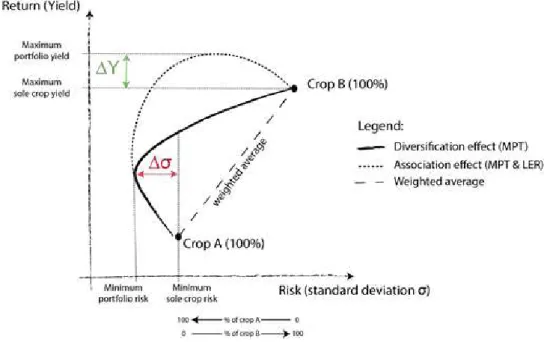
Graphically, this new framework is represented in Figure 1. The solid curve displays the risk and yield of crops portfolio for different proportions of crop A and B in a situation where only the diversification effect is considered ( formalized by MPT). The dotted curve represents the same combination of crops in a situation where both the diversification effect and the
association effects are considered ( Y formalized by our new framework combining MPT and LER). The dashed line represents the weighted average of risks and returns.
Figure 1: Possible return and risk combinations for a theoretical intercropping system for different proportions of crop A and crop B. Solid curve: diversification effect ( formalized by MPT). Dotted curve: association effect ( formalized by our new framework combining MPT & LER). The dashed line represents the weighted average of risks and returns.
Applying the new conceptual framework to cases selected from literature
A literature review was carried out for fruits and vegetables intercropping data in the Web of
vegetables intercropping systems. Furthermore, the search identified 12 studies which had data fitting our model requirements: crop yields, yield variability and LERs. For illustrative purpose, the model was run on three studies for which sufficient data was available: Guvenc and Yildirim 2006; Blazewicz-Wozniak and Wach 2011; van Asten et al. 2011.
Results
Characteristics of fruits and vegetables intercropping systems
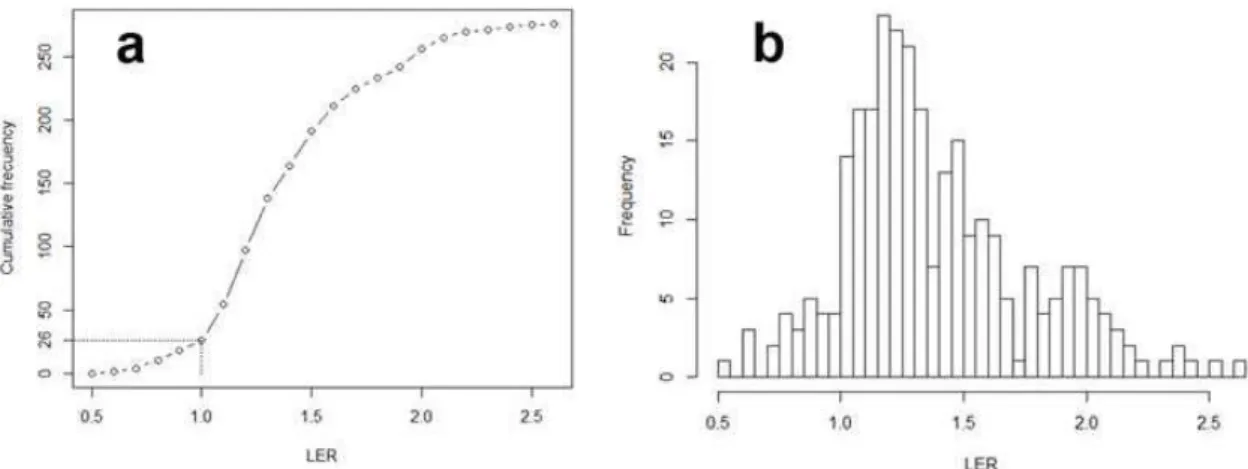
The review of intercropping studies involving vegetables and/or resulted in 277 LER measures (often several experiments per study). On average, intercropping was more efficient than sole cropping, since 251 out of the 277 calculated LER values were larger than 1. The median LER was 1.28 and the mean 1.36. However, the standard deviation on LER was 0.36, suggesting a high variability in LERs depending on crop species, treatments and experimental designs (Figure 2).
Figure 2: Cumulative frequencies (a) and frequency distribution (b) of land equivalent ratios (LER) for fruits and vegetables intercropping experiments.
Illustration with three cases from literature
Among the reviewed papers, the risk-return combination curves took two possible functional shapes. The first functional form appears when a low yield - low risk crop is combined with a high yield - high risk crop (Figure 3a; 15 of the 24 studies). In the example given here (cabbage-bean intercropping), diversification led to a strong reduction in risk and association made it possible to reach the lowest level of risk for a yield similar to the one obtained with cabbage only. The second functional form is obtained when a high yield - low risk crop is combined with a low yield - high risk crop (Figure 3b; 9 of the 24 studies). Interestingly, in this functional form, adding a high-risk / low-yield crop to a low-risk / high-yield monoculture is still beneficial in terms of risk reduction. In the example given here (carrot-parsley intercropping), risk reduction was moderate and yield improvement was particularly high. The only agroforestry systems for which we found sufficient data in the literature is the coffee-banana system (Figure 3c). It corresponds to the first functional form. In this particular example, risk reduction is marginal but yield improvement can be important. The main difference with the cabbage-bean association is that in the coffee-banana system, no combination of the two crops makes it possible to reach at the same time both a lower risk and a higher yield than the sole crops.
Figure 3: Risk-return combinations observed for different types of interactions. The interactions are detailed in the body of the text. Dots ( ) represent the performances of intercropping systems for different proportions of crop A and B in the case where only the diversification effect is considered, triangles ( ) represent the performances of the same intercropping systems in the case where both the diversification effect and the association effect are considered.
Discussion
The two perspectives examined here were Modern Portfolio Theory, and Land Equivalent Ratio. The former quantifies the effect of diversification on risk, the latter measures the effect of
association on production. This research has merged both approaches in a combined framework in order to assess horticultural-agroforestry system performances. The results show how some fruit and vegetable combinations can outperform monoculture in both the risk and production dimensions. In other words, that it is possible to reduce the overall risk related to production while maintaining or even increasing the global yield thanks to the association of fruits and vegetables. Even though application of this framework to real situations was limited in this study (due to the scarcity of literature data), our results indicate that a two dimensional analysis (risk and return) of agroforestry systems adds insight into the assessment of such systems. Further evaluations of yield and associated standard deviations in a wide variety of agroforestry systems are now needed to evaluate the conditions in which such benefits can be expected. It would be especially interesting to extend this approach to more diversified systems. From the theoretical point of view, extension of the framework to situations with more than two crops is straightforward and does not present any mathematical difficulty. The issue once again lies in the availability of data since (to our knowledge) no study have evaluated yield and standard deviations of more than 2 crops in associations compared to sole crops. Besides the issue of data availability on production, a further limitation of our study is that we limited our analysis to crop production. However, crop productivity does not directly reflect economic profitability. To further enhance and improve our model, more information on production costs and returns (especially in intercropping systems) would also be necessary (Betters 1988). Finally, this study only accounts for the effect of association on production and does not consider the effect of crop association on risk. While many studies have focused on the effect of crop association on overall production, the particular issue of production variability in agroforestry systems remains unstudied (Mead and Willey 1980). A consensus seems to emerge on the fact that crop association can decrease the risk associated with each crop (Vandermeer 1989; Rao and Singh 1990) but this effect has rarely been quantified. Therefore, our hypothesis that the individual risk associated to each crop remains unchanged under intercropping can be considered as a conservative hypothesis; and integrating an effect of association on risk is likely to strengthen our conclusion that crop association benefits both production and risk reduction.
Acknowledgments
References
Betters DR (1988) Planning optimal economic strategies for agroforestry systems. Agrofor Syst 7: 17 31.
Blazewicz-Wozniak M, Wach D (2011) The effect of intercropping on yielding of root vegetables of Apiaceae family. Acta Sci Pol Hortorum Cultus 10: 233 243.
Guvenc I, Yildirim E (2006) Increasing Productivity with Intercropping Systems in Cabbage Production. J Sustain Agric 28:29 44.
Isbell F, Adler PR, Eisenhauer N, Fornara D, Kimmel K, Kremen C, Letourneau DK, Liebman M, Polley HW, Quijas S, Scherer-Lorenzen M (2017) Benefits of increasing plant diversity in sustainable agroecosystems. J Ecol 105:871 879.
Knoke T, Paul C, Härtl F, Castro ML, Calvas B, Hildebrandt P (2015) Optimizing agricultural land-use portfolios with scarce data-A non-stochastic model. Ecol Econ 120: 250 259.
Letourneau DK, Armbrecht I, Rivera BS, Montoya Lerma J, Jiménez Carmona E, Daza MC, Escobar S, Galindo V, Guitiérrez C, Duque López S, López Mejía J, Acosta Rangel AM, Herrera Rangel J, Rivera L, Saavedra CA, Torres AM, Trujillo AR (2011) Does plant diversity benefit agroecosystems? A synthetic review. Ecol Appl 21:9 21.
Markowitz H (1952) Portfolio Selection. J Finance 7: 77 91. Agric 16: 217-228.
Rao MR, Singh M (1990) Productivity and risk evaluation in constrasting intercropping systems. F Crop Res 23: 279 293.
van Asten PJA, Wairegi LWI, Mukasa D, Uringi NO (2011) Agronomic and economic benefits of coffee-banana smallholder farming systems. Agric Syst 104: 326 334.
Vandermeer J (1989) The Ecology of Intercropping. Cambridge University Press, Cambridge
Warlop F (2016) The smart project: a focus on fruit trees and vegetables agroforestry systems in France. 3rd European Agroforestry Conference. EURAF. Montpellier, France.
Wezel A, Casagrande M, Celette F, Vian JF, Ferrer A, Peigné J (2014) Agroecological practices for sustainable agriculture. A review. Agron Sustain Dev 34: 1 20.