17.ª Conferência da Associação Portuguesa de Sistemas de Informação (CAPSI’2017) 6 to 7 of June of 2017, Guimarães, Portugal
ISSN 2183-489X
DOI http://dx.doi.org/10.18803/capsi.v17.111-126
111
What Drives Perceptions of Review Trustworthiness in Electronic
Word-of-Mouth: An Experimental Study of TripAdvisor
Constantinos K. Coursaris, Michigan State University, U.S.A., [email protected] Wietske van Osch, Michigan State University, U.S.A., [email protected]
Alice Albini, IESEG School of Management, France, [email protected]
Abstract
With the proliferation of online Tourism websites, consumers’ Web-based search queries for cues that minimize the uncertainty surrounding brands and the risk associated with corresponding purchase decisions become more commonplace. Yet, despite the recent interest in user-generated online reviews, understanding how various dimensions of ‘the message’ (online review) may affect consumers’ perceptions of a review’s trustworthiness, and whether the latter drives brand attitudes and subsequent booking intentions remains unknown. To fill this gap, a 2x2x2 scenario-based online experiment was designed exposing participants to real user-generated TripAdvisor.com reviews, and an online questionnaire was used to evaluate antecedents and consequents of review trustworthiness. Using PLS-based structural equation modeling (SEM), our findings offer a comprehensive framework of the review characteristics—timeliness, accuracy, and reviewer credibility—that drive overall perceptions of review trustworthiness, brand attitude, and booking intention. Implications for theory and practice are discussed.
Keywords: Online reviews; information quality; review timeliness; review accuracy; review sentiment; reviewer credibility; brand attitude; booking intention; purchase intention; TripAdvisor; hotel reviews; travel website.
1. I
NTRODUCTIONTripAdvisor nowadays represents the world leading travel website and it is perceived by users as a useful tool to acquire information, plan and book their desired travel. As of today, TripAdvisor provides 385 million opinions generated by travellers around the world; it offers reviews for more than 6.8 million businesses and properties, including hotels, B&Bs, restaurants and attractions in 28 different languages and 48 markets.
Tourism, as a sector, has always been characterized by intense information search behaviors. Prior to the era of social media, most information search behaviors would occur through the use of travel agencies. With the rise of online tourism, users no longer need to rely on travel agencies and instead can book their own travel relying on the reviews of other consumers like themselves. Although a relatively recent domain, research on online tourism has begun to explore several important avenues, including how marketing efforts and information systems development have been impacted by the rise of online tourism (Fesenmaier and Pan, 2006; Xiang et al., 2008). Other
Coursaris, van Osch & Albini /Review Trustworthiness in eWOM
17.ª Conferência da Associação Portuguesa de Sistemas de Informação (CAPSI’2017) 112 studies have examined the importance of the anonymity of such user-generated online content, showing that decision-making is often impacted by the reviews of strangers (Levin and Cross, 2004; Zhu et al., 2016).
Yet, despite the recent interest in user-generated online reviews on the Internet, there is a lack of research exploring the link between characteristics of user-generated online reviews—such as their recency and accuracy—and a consumer’s perception of the trustworthiness of the review, which may ultimately drive attitudes towards the brand and subsequent behaviors—including making a reservation. To fill this gap, this study answers the following research questions: What is the effect of four online review characteristics—nature, recency, accuracy, and reviewer (i.e., source) credibility—on the perceived trustworthiness of that review?
In order to answer these research questions, a 2x2x2x2 scenario-based experiment was designed exposing respondents to real Tripadvisor reviews that were manipulated to reflect different objective levels of nature (positive vs. negative), recency (recent vs. outdated), accuracy ( and source credibility (novice vs. expert reviewer). Furthermore, using a questionnaire, we asked respondents for their perception of these review qualities as well as overall trustworthiness to perform manipulation checks as well as determine the effect of these review characteristics on ultimate perceptions of review trustworthiness, which is likely to impact subsequent behaviors toward the brand. Data were analyzed using one-way ANOVAs and PLS-based structural equation modeling (SEM).
Our findings show that despite the overwhelming majority of e-WOM research focusing on review nature (positive vs. negative) as the critical predictor of sales, it is actually not a significant predictor of overall review trustworthiness perceptions as is recency. Instead, accuracy and source credibility seem to be the deciding factors jointly predicting nearly 50% of the R2 in overall
perceptions of review trustworthiness.
2. T
HEORETICALB
ACKGROUNDIn what follows, we offer a brief discussion of the theoretical underpinnings of this study as it pertains to e-WOM and user-generated content and the hospitality industry.
2.1. Online Reviews and Electronic Word-of-Mouth (eWOM)
Electronic word-of-mouth (eWOM), which refers to “any positive or negative statement made by potential, actual, or former customers about a product or company, which is made available to a multiple of people and institutions via the Internet” (Stauss, 2000). Online review websites are useful platforms through which reviewers are able to post and share their thoughts and opinions about products, services and businesses in general. The final purpose is to provide other and future
Coursaris, van Osch & Albini /Review Trustworthiness in eWOM
17.ª Conferência da Associação Portuguesa de Sistemas de Informação (CAPSI’2017) 113 users with personal and candid experiences in order to give them more detailed information not easily accessible through official websites or traditional forms of advertising. This phenomenon has progressively increased throughout the years and nowadays even official brand websites include testimonials and reviews from real customers to lend credibility and authenticity to the quality of their brand.
The drastic migration to online WOM (eWOM) represents an evolution in how consumers collect and access information (O’Connor, 2010). According to several studies (c.f., Liang et al., 2013), eWOM is more effective than traditional WOM and has brought several benefits: free efficient channels of distribution, capacity to spread rapidly, unlimited audience, large availability of comments accessible to users, long online permanence and anonymity which can help both the reader and the author as the former is less keen to be influenced as it may happen with experiences shared by friends and acquaintances and the latter feels free to share his/her candid opinions, either positive or negative (Bellman et al., 2006; Puri, 2007; Stringam and Gerdes, 2010).
BrightLocal, a search agency founded in 2009 and operating worldwide, has extensively studied how online reviews are able to influence the purchasing decision process of customers. By conducting the same research every year for four years from 2011 up to 2014, they have observed various dimensions:
• The number of people reading online customer reviews to determine the quality of a local business has increased from 85% in 2013 to 88% in 2014; 39% of users read reviews on a regular basis in 2014 compared to only 7% in 2013.
• In 2014, 67% of users said they read up to 6 reviews, 85% of users read up to 10 reviews, while 7% of users read more than 20 reviews.
• In 2014, 72% of users confirmed that reading positive reviews affect them in a positive way by increasing their trust in the business;
• In 2014, 88% of the users said that online reviews affect them in the same way personal recommendations do, compared to 79% in 2013.
2.2. User-Generated Content and the Hospitality Industry
As for the hotel industry, the growth of social media has progressively changed customers’ information search preferences and behaviors. Current research related to the travel industry has shown a great influence of eWOM among online users, meaning that hoteliers have switched their attention from traditional marketing channels to online and interpersonal strategies to take advantages of the opportunities offered by eWOM (O’Connor, 2010).
Coursaris, van Osch & Albini /Review Trustworthiness in eWOM
17.ª Conferência da Associação Portuguesa de Sistemas de Informação (CAPSI’2017) 114 TripAdvisor.com together with Booking.com, Priceline.com and Expedia.com represent today’s largest user-generated content websites for the travel industry. These new online forums involve revolutionary peer-to-peer models of sharing information as people interact with one another and share their experiences. The content available on those websites is freely accessible and includes large amounts of user-generated content, including only opinions and ideas that cannot be edited or filtered by anyone except the original author (O’Connor, 2010).
Several studies have begun to explore the principal features and elements of online reviews. For instance, some researchers have focused on the effects review features on hotel reservations (Racherla and Friske, 2012) or restaurant selection intention (Jeong and Jang, 2011). Other studies have studied the review rating system (Boon et al., 2014; Aicher et al., 2016) adopted by online platforms. However, none of these studies have offered a more comprehensive framework of review characteristics and their effect on perceptions of overall review trustworthiness. The present research aims to fill this gap by studying online reviews shared on TripAdvisor, specifically analyzing four characteristics of online reviews simultaneously, namely nature, recency, accuracy, and source credibility.
3. R
ESEARCHM
ODEL ANDH
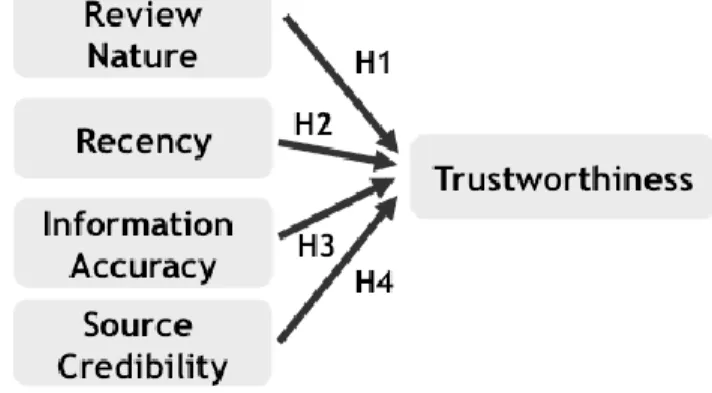
YPOTHESESAlthough many characteristics of reviews exist; in this study we focus on four such characteristics, namely review nature, recency, accuracy, and source credibility, to offer a more holistic model of drivers of overall assessments of review trustworthiness (also see Figure 1).
3.1. Review Nature
Messages shared through online platforms can thus been either positive or negative: this communication direction has been defined as “nature” or “valence” by Benedicktus et al. in 2006. Review nature thus refers to the positive or negative orientation toward a product or service (Sarker and Valacich, 2010). Normally, given that platforms like Tripadvisor are designed to reflect consumers’ genuine opinions, companies have no influence over such reviews and users are able to freely express themselves, deciding what to write (Kusumasondjaja, 2012) and which aspects of their experience mention or not.
Most of the e-WOM literature to date has focused on studying the antecedents to as well as effects of review nature; yet, literature in this area has produced conflicting findings. According to Gretzel et al. (2007), online travel contributions are more effective when they keep a balance between positive and negative opinions. Others sustain that negative eWOM has a stronger effect than positive one when it comes to eWOM effectiveness (Park and Lee, 2009) and sales (Chevalier and
Coursaris, van Osch & Albini /Review Trustworthiness in eWOM
17.ª Conferência da Associação Portuguesa de Sistemas de Informação (CAPSI’2017) 115 Mayzlin, 2006). The equivocality of findings may stem from moderating factors, such as the product or service type (Sen and Lerman, 2007) and the brand image (Chiou and Cheng, 2003). Yet, taken together, there is large evidence that online reviews are able to influence product and services choices, but only if the overall review is perceived to be trustworthy. Hence, we propose that:
H1: Review nature affects the trustworthiness of reviews. 3.2. Review Recency
Recency refers to the currency of the information provided, which is strictly related to the date of the publication of the review. For the present study, timeliness is defined as a measure of the time elapsed from the moment a specific review was posted to the moment a user consults it (Berendt et al., 2003). As mentioned on TripAdvisor.com, recent reviews are more valuable to travellers than older ones: recent contributions give fresher and more authentic opinions of current experiences and they help readers with up-to-date insights and suggestions. When reviews are posted on TripAdvisor.com, users are also asked to specify the period of time of their travel experience. Also, when considering the Popularity Index adopted by the website, recent reviews (even if negative) hold a heavier weight on the overall ranking value of the hotel reviewed.
A few studies have explicitly associated recency with trustworthiness (c.f., Wathen and Burkell, 2002; Kahana et al., 2002). Thus, the second hypothesis is:
H2: The more recent the review, the higher the perceived trustworthiness. 3.3. Review Accuracy
Information accuracy is the degree to which information is correct—i.e., free from mistakes— unambiguous, meaningful, believable, and consistent (Nelson et al., 2005; Yoo et al., 2015). Thus, although information accuracy can be manipulated, it is to a large extent dependent on the perceptions of the reader.
Information accuracy has been designated as an important antecedent to message interpretation (Daft and Lengel, 1986). Nonetheless, information accuracy can ultimately only be assessed through actual experimentation with the product or service to assess review accuracy. Nonetheless, research has shown that information accuracy is strongly related to trustworthiness. In particular, Freeman and Spyridakis (2004) found that users’ opinion concerning trustworthiness of a message involves judgements related to information quality and accuracy. Hence, we propose the following hypothesis:
Coursaris, van Osch & Albini /Review Trustworthiness in eWOM
17.ª Conferência da Associação Portuguesa de Sistemas de Informação (CAPSI’2017) 116
3.4. Source Credibility
User-generated content platforms have established multiple platform features that give users insights into and assurances regarding reviewer credibility. For instance, TripAdvisor has adopted the badge feature, which attributes different levels of expertise to each member of the community. Even though this system does not guarantee against fake profiles and doubtful reviews, it can help readers to evaluate how active a user is on the platform, the types of services (s)/he typically reviews (i.e. hotels, restaurants, attractions, etc.), where (s)/he comes from, how many reviews (s)/he has shared, and how many helpful votes (s)/he has given to reviews from others (i.e., how engaged (s)/he is with the community). Additionally, it is possible to read all the reviews a member has shared, no matter the category, the city or the date of publication.
Some resarchrs have argued that source credibility—as assessed through badges—is particularly important in the online environment given that users are not always able to identify who wrote the message (Tidwell and Walther, 2002; Dellarocas, 2003; Litvin et al., 2008), especially when platforms include anonymous and possibly fake profiles (Tidwell and Walther, 2002). Hence, we propose that:
H4: Source credibility positively affects the trustworthiness of the review.
Figure 1 - Research Model
4. R
ESEARCHD
ESIGNThis study uses an experimental design to manipulate each of the review characteristics that may drive overall perceptions of trustworthiness. The following outlines in detail the study context, the experimental design, the construct operationalization, as well as the methods of data collection and analysis.
4.1. Study Context: TripAdvisor.com
Today, TripAdvisor represents the world leading travel website and it has recorded an intensive growth during the latest years as travellers are becoming progressively friendlier with online platforms. For travelling purposes, TripAdvisor is well known and used worldwide by travellers
Coursaris, van Osch & Albini /Review Trustworthiness in eWOM
17.ª Conferência da Associação Portuguesa de Sistemas de Informação (CAPSI’2017) 117 looking for information related to whatever concerns their trips, such as restaurants, properties and places where to stay, guided tours, travel packages, etc. The aim is to bring people together so that they are able to interact with one another creating a whole travel community.
In 2007, the site was nominated one of the Top 25 Travel Milestone by USA Today as it has progressively become crucial in changing the way people conduct research and collect information when planning their travels (O’Connor, 2010).
When a traveller is willing to review a hotel, TripAdvisor offers an easy and clear format for this purpose. In order to review a new hotel or simply comment on an existing one, the user needs to be a member of the community, after registering and logging into the website. In both cases, the process is quite simple and intuitive. The purpose is to help other potential customers to find all the information they may be looking for. Readers are also able to see who the author of the review is; moreover, TripAdvisor assigns a contribution level going from 1 up to 6 to every reviewer, depending on how active that person is in terms of contributions, either reviews or comments. This helps to gain credibility as the reader has the possibility to investigate if the author is an occasional user writing reviews to raise its own score or to criticize a specific hotel or if, on the contrary, he is someone willing to help other travellers, sharing his personal experience.
4.2. Experimental Design & Procedure
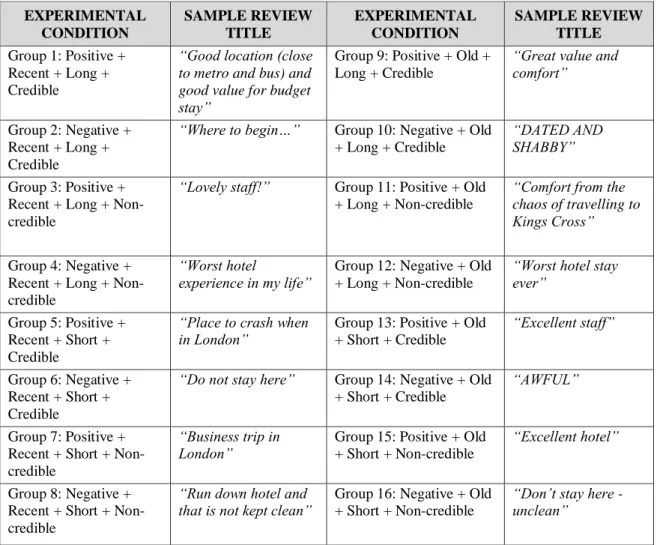
The hypotheses are tested in a 2 (Positive vs. Negative) * 2 (Recent vs. Old) * 2 (Long vs. Short) * 2 (High credibility vs. Low credibility) experimental design. Therefore, sixteen groups have been created and for each group three hotel reviews have been selected, for a total of forty-eight reviews. The experimental groups and their respective conditions are listed in Table 1 below. Respondents in each experimental group were exposed to three reviews that were consistent in their nature per the experimental conditions described in Table 1. While completing the online survey, respondents were presented with a fictitious scenario to ensure respondents were fully immersed in the situation and that the stimuli, i.e., the three reviews, were perceived as meaningful. The specific scenario that all respondents were presented with was that of a solo business trip to London (U.K.) where money was not a factor. The trip had been scheduled for the end of November, lasting approximately one week (from 21st to 25th). Respondents were also
informed that given their work responsibilities, a hotel with a central location, free Wi-Fi and breakfast included would be desirable.
The specific hotel from which we selected reviews was the Travelodge London Kings Cross Royal Scot hotel, which has over 2.500 reviews on TripAdvisor, 2.170 of which are in English. Furthermore, according to the bubble ranking system adopted by TripAdvisor, this hotel has three bubbles out of five, meaning that it has an average reputation so that it includes both negative and
Coursaris, van Osch & Albini /Review Trustworthiness in eWOM
17.ª Conferência da Associação Portuguesa de Sistemas de Informação (CAPSI’2017) 118 positive reviews, which we needed in order to be able to select reviews for the experimental conditions. In particular, on October 25th, the hotel had 985 positive (4 bubbles = very good or 5
bubbles = excellent) reviews and 578 negative (2 bubbles = poor or one bubble = terrible) reviews. In order to test the proposed hypotheses, three reviews were selected per experimental condition for a total of forty-eight reviews. A sample of titles of one of the selected reviews per condition is provided in Table 1 below and an example experimental condition is shown in Figure 2.
EXPERIMENTAL CONDITION SAMPLE REVIEW TITLE EXPERIMENTAL CONDITION SAMPLE REVIEW TITLE Group 1: Positive + Recent + Long + Credible
“Good location (close to metro and bus) and good value for budget stay”
Group 9: Positive + Old + Long + Credible
“Great value and comfort”
Group 2: Negative + Recent + Long + Credible
“Where to begin…” Group 10: Negative + Old + Long + Credible
“DATED AND SHABBY” Group 3: Positive +
Recent + Long + Non-credible
“Lovely staff!” Group 11: Positive + Old + Long + Non-credible
“Comfort from the chaos of travelling to Kings Cross” Group 4: Negative +
Recent + Long + Non-credible
“Worst hotel
experience in my life” Group 12: Negative + Old + Long + Non-credible
“Worst hotel stay ever”
Group 5: Positive + Recent + Short + Credible
“Place to crash when
in London” Group 13: Positive + Old + Short + Credible
“Excellent staff”
Group 6: Negative + Recent + Short + Credible
“Do not stay here” Group 14: Negative + Old + Short + Credible
“AWFUL”
Group 7: Positive + Recent + Short + Non-credible
“Business trip in
London” Group 15: Positive + Old + Short + Non-credible
“Excellent hotel”
Group 8: Negative + Recent + Short + Non-credible
“Run down hotel and
that is not kept clean” Group 16: Negative + Old + Short + Non-credible
“Don’t stay here - unclean”
Coursaris, van Osch & Albini /Review Trustworthiness in eWOM
17.ª Conferência da Associação Portuguesa de Sistemas de Informação (CAPSI’2017) 119 Figure 2 - Sample Experimental Condition
4.3. Operationalization of Constructs
In order to collect data, a questionnaire has been distributed online. Each construct from the research model (Figure 1) was measured using previously validated scales, summarized in Table 2.
CONSTRUCT DESCRIPTION SAMPLE ITEM (7-POINT
LIKERT SCALE)
REF. Review Nature The positivity or negativity of the
review
“Overall, I would give the information
from this review high marks” Wixom and Todd (2005) Review
Recency
Date of publication (Actual reviews ranged between July 1 – October 25, 2016)
“The reviews are current” Wixom and Todd (2005) Review
Accuracy
The user’s perception that the information is correct
“Information provided is correct” Wixom and Todd (2005) Source
Credibility
The extent to which an information source is perceived to be
believable, competent and trustworthy
“The person who wrote the review was knowledgeable in evaluating the hotel” Bhattacherjee and Stanford (2006) Trust-worthiness
The respondent's perception of the trustworthiness of the review(er)
“To what extent is the review
trustworthy?” Griskevicius et al. (2006) Table 2 - Operationalization of Constructs
Coursaris, van Osch & Albini /Review Trustworthiness in eWOM
17.ª Conferência da Associação Portuguesa de Sistemas de Informação (CAPSI’2017) 120
4.4. Data Collection
The questionnaire included 22 questions in total, with a completion time of 10-15 minutes. Sixteen different versions of the questionnaire were distributed using Qualtrics, differing only in the three reviews that were presented to the groups per the experimental conditions described in Table 1. A link to the survey was shared through an emailing platform service offered by the University. In addition to the questions pertaining to the key constructs in the research model, participants were also asked two screening questions pertaining to the likelihood of booking travel through a website like TripAdvisor and whether they had used online travel platforms for information search about hotels. Only respondents that indicated a high likelihood of traveling and previous experiences using platforms like TripAdvisor were retained for the final analysis.
Finally, in order to validate respondents’ understanding of the scenarios, the end of the survey included 3 questions where respondents were asked to recall the type of trip (business), the requisite amenities (free Wi-Fi and breakfast included) as well as the number of the reviews read (3).
4.5. Sample and Respondents
Both men and women were recruited globally to answer the survey. In the end, 45.1% of the answers came from men and 54.9% from women. The questionnaire was completed by 777 participants, however, after eliminating respondents based on the screening questions (regarding past and future use of platforms such as TripAdvisor) 355 valid answers have been collected. Their split among the randomly assigned sixteen experimental conditions is shown in Table 3 below.
SCENARIO # FREQUENCY SCENARIO # FREQUENCY
1 24 9 19 2 23 10 20 3 15 11 20 4 20 12 20 5 29 13 25 6 26 14 22 7 23 15 26 8 20 16 23 Total N 355
Coursaris, van Osch & Albini /Review Trustworthiness in eWOM
17.ª Conferência da Associação Portuguesa de Sistemas de Informação (CAPSI’2017) 121 Table 3 - Frequency Distribution of Scenario in Final Sample
5. ANALYSIS
AND
RESULTS
Following the data screening and cleaning, the final sample of 355 valid responses was imported in SmartPLS for Confirmatory Factor Analysis to validate the measurement model and Path Modeling for hypothesis testing.
5.1. Confirmatory Factor Analysis
Using SmartPLS (v 3.2.4), the measurement model was validated. Construct statistics are summarized in Table 4 below and the Fornell-Larcker test of discriminant validity is provided in Table 5. Table 5 also shows that none of the latent variable correlations exceed .75, therefore providing further evidence of adequate discriminant validity.
CRONBACH’S (>.7) COMPOSITE RELIABILITY (> .7) CONVERGENT VALIDITY (AVE) (> .5) DISCRIMINANT VALIDITY √(AVE) (> .7) Review Nature 0.864 0.917 0.786 0.886 Recency 0.902 0.939 0.836 0.914 Accuracy 0.839 0.903 0.756 0.869 Source Credibility 0.826 0.883 0.658 0.886 Trustworthiness 0.858 0.913 0.778 0.882
Table 4 - Construct Statistics
ACCURACY RECENCY REVIEW
NATURE SOURCE CREDIBILITY TRUSTWORTH INESS Accuracy 0.869 Recency 0.511 0.914 Review Nature 0.544 0.431 0.886 Source Credibility 0.639 0.409 0.476 0.886 Trustworthiness 0.606 0.424 0.423 0.652 0.882
Table 5 - Discriminant Validity (Fornell-Larcker Criterion) The bolded numbers on the diagonal represent the√(AVE, which should exceed all the numbers below and/or to the left of it
5.2. Hypothesis Testing
Using SmartPLS (v 3.2.4), we then tested our hypotheses regarding the relations between the review characteristics—nature, recency, accuracy, and source credibility—on overall perceived trustworthiness of the review(er). The results from the hypotheses testing are provided in Table 6 below. The overall explained variance (R2) of the dependent variable—Trustworthiness—is 0.494
Coursaris, van Osch & Albini /Review Trustworthiness in eWOM
17.ª Conferência da Associação Portuguesa de Sistemas de Informação (CAPSI’2017) 122 After removing the two non-significant predictors—review nature and recency—the R2 remains
high at 0.486 (Adj. R2 0.483); thus review accuracy and source credibility predict nearly 50% of
the variance in the dependent variable, trustworthiness. Using R2 partitioning in SPSS, it was further determined that from the 48.6% variance in trustworthiness, 27.3% is due to Source Credibility and 21.3% is due to Accuracy.
HYP. SPECIFICATION REGR.
WEIGHTS
P-VALUE
RESULT H1: Review Nature > Trustworthiness 0.033 .499 Not Supported H2: Recency > Trustworthiness 0.101 .080 Marginal Support H3: Accuracy > Trustworthiness 0.264 .000 Supported H4: Source Credibility > Trustworthiness 0.426 .000 Supported
Table 6 - Hypotheses Testing
5.3. Validated Model
The final validated model is displayed in Figure 3 below.
* = significant at p = .01; ** = significant at p = .05; *** = significant at p = .001
Figure 3 – Validated model
6. D
ISCUSSIONThe ongoing attention for e-WOM highlights the importance of theoretically grounded, empirically validated, and comprehensive frameworks that allows both practitioners and academics to categorize, assess, and inform effective reviews with the aim of increasing the trustworthiness of online reviews, which in turn may positively affect purchase intention.
To the best of our knowledge, this paper is the first attempt at offering such a comprehensive framework of characteristics of reviews, by looking at review nature, recency, accuracy, and source credibility and their relation to overall perceptions of trustworthiness. Although the attention in the e-WOM literature has been largely on assessing the nature of reviews and
Coursaris, van Osch & Albini /Review Trustworthiness in eWOM
17.ª Conferência da Associação Portuguesa de Sistemas de Informação (CAPSI’2017) 123 outcomes associated with either positive or negative reviews, our results show that review nature actually represents the weakest—and a non-significant—predictor of review(er) trustworthiness. Although review recency—the second most studied review characteristic—is borderline significant, the two significant drivers of overall perceptions of review(er) trustworthiness are the perceived information accuracy and source credibility, which jointly explain nearly 50% of the variance (Adj. R2 0.483) in trustworthiness. From the two significant predictors, Source Credibility
is the strongest driver of trustworthiness.
Thus, when users interact with platforms like TripAdvisor, it seems that the critical factor in determining how users judge the overall trustworthiness of the review—which ultimately drives booking attitudes and behaviors—is foremost whether or not the reviewer is an expert reviewer, followed by the accuracy of the information provided. Whether or not the review was written recently or positively does not seem to affect users in their perceptions of overall trustworthiness.
6.1. Limitations and Future Research
Since the main aim of this study was to propose a comprehensive model of the characteristics of reviews that ultimately drive a user to conclude whether or not the advice offered by a reviewer is trustworthy and should be acted upon; this study focused on four such characteristics—review nature, recency, accuracy, and source credibility – and in turn their effects on trustworthiness, we did not explore further downstream effects of trustworthiness, for instance, on the attitudes toward the property and likelihood of booking a room in that property. Future research should explore these effects and assess if trustworthiness ultimately drives attitudes and behaviors toward to property.
The second limitation pertains to the choice of only a single hotel for the purpose of the study. Future experiments could be designed to offer respondents different hotels with different types of reviews (based on the scenarios used in this study) and offer them a choice of hotels. Furthermore, even though hotels and accommodations represent TripAdvisor’s largest business, the platform is also well known for reviews about restaurants and other types of attractions. Therefore, it would be interesting to conduct similar analyses for other types of venues and explore if the review factors that have the greatest predictive power—i.e., source credibility and accuracy—remain the same or whether these are venue-specific.
Finally, although we tried to be comprehensive in including review characteristics, certain characteristics of reviews have not been considered, such hotel management responses. The traditional marketing literature has heavily studied responses by business in the context of written (i.e., offline) consumer complaints to how future replies by the same consumers as well as repurchase intention and positive word-of-mouth are affected by strategic responses to customer correspondence (c.f., Shields, 2006).
Coursaris, van Osch & Albini /Review Trustworthiness in eWOM
17.ª Conferência da Associação Portuguesa de Sistemas de Informação (CAPSI’2017) 124 Finally, future research could further explore interaction effects between characteristics of the review and of the property (e.g., hotel star ratings), to see if particular review characteristics are more salient for specific type of property (.g., luxury properties). Additionally, interaction effects among review characteristics can also be explored. For instance, perhaps review nature only matters when reviewer’s are experts versus novices or maybe accuracy of the review is only important in the context of a non-recent review.
6.2. Concluding Remarks and Contributions
The rapid growth of eWOM has resulted in substantial online information search behaviors by consumers, in particular in context such as tourism. The advantage of instant booking platforms such as TripAdvisor is that they offer consumers easy, free, and fast access to information about tourist venues. Consequently, user-generated reviews have become increasingly influential in users’ decision-making process when it comes to hotels to book or restaurants to eat at (c.f., BrightLocal, 2016).
From a research perspective, the findings of this study are relevant in that they conflict with much of the research on e-WOM, which has focused almost entirely on the nature of reviews. Instead our finings show that nature is the least significant predictor of overall assessments of review(er) trustworthiness. Rather, source credibility and review accuracy are the critical drivers of a user’s perception of review quality, which may in turn drive his or her decision-making process. The fact that review nature was insignificant may be a consequent of the inclusion of additional review characteristics.
From a practical viewpoint, the findings of this study reveal three factors influencing prospective consumers’ perceptions of online reviews’ trustworthiness. First, as the reviewer’s credibility is the strongest predictor of said trustworthiness, hoteliers would be well served if they can identify travellers among their guests who are frequent reviewers, and incentivize their endorsement on a travel review site. Second, given the importance of information accuracy, hoteliers could also engage in the online reviews by either validating information as provided by reviewers, extending this information, or correcting misinformation as provided by the reviewers. Lastly, given the importance of a review’s timeliness, hoteliers should prompt their guests to review their reviews on a regular basis so that there is a consistent stream of online reviews available, which may influence subsequent decisions by travellers to select said hotelier.
R
EFERENCESAicher J., Asiimwe F., Batchuluun B., Hauschild M., Zöhrer M.,Egger R., (2016). “Online Hotel Reviews: Rating Symbols or Text… Text or Rating Symbols? That Is the Question!”, Information and Communication Technologies in Tourism 2016, 369-382.
Coursaris, van Osch & Albini /Review Trustworthiness in eWOM
17.ª Conferência da Associação Portuguesa de Sistemas de Informação (CAPSI’2017) 125 Berendt B., Hotho A., Mladenic D., Van Someren M., Spiliopoulou M., Stumme G. (2003), “Web
Mining: From Web to Semantic Web”.
Bellman S., Johnson E., Loshe G., Mandel N., (2006), “Designing Marketplaces of the Artificial with Consumers in Mind”, Journal of Interactive Marketing, 20, 21-33.
Benedicktus R.L., Andrews M.L., (2006), “Building Trust with Consensus Information: The Effects of Valence and Sequence Direction”, Journal of Interactive Advertising, 6, 15-25.
Bhattacherjee A., Stanford C., (2006), “Influence Processes for Information Technology Acceptance: an Elaboration Likelihood Model”, MIS Quarterly, 30, 805-825.
Boon E., Bonera M., Bigi A., (2014), “Measuring Hotel Service Quality from Online Consumer Reviews: a Proposed Model”, Information and Communication Technologies in Tourism 2014, 367-379.
BrightLocal Official Website, https://www.brightlocal.com.
Chevalier J.A., Mayzlin D., (2006), “The Effect of Word of Mouth on Sales: Online Book Reviews”, Jorunal of Marketing Research, 43, 345-354.
Daft R.L., Lengel R.H., (1986), “Organizational Information Requirement, Media Richness and Structural Design”, Management Science, 32, 554-571.
Dellarocas C., (2003), “The Digitalization of Word of Mouth: Promise and Challenges of Online Feedback Mechanisms”, Management Science, 49, 1407-1424.
Fesenmaier D., Pan B., (2006), “Online Information Search, Vacation Planning Process”, Annals of Tourism Research, 33, 809-832.
Freeman K.S., Spyridakis J.H., (2004), “An Examination of Factors that Affect the Credibility of Online Health Information”, Technical Communication, 51, 239-263.
Gretzel U., Yoo K.H., Purifoy M., (2007), “Online Travel Review Study: Role and Impact of Online Travel Reviews”, Texas A&M University, Department of Recreation, Park and Tourism Sciences, Laboratory for Intelligent Systems in Tourism.
Griskevicius V., Cialdini R.B., Douglas T.K., (2006), “Peacocks, Picasso and Parental Investment: the Effects of Romantic Motives on Creativity”, Journal of Personality and Social Psychology, 91, 63-76.
Jeong E., Jang S.S., (2011), “Restaurant Experiences Triggering Positive Electronic Word-of-Mouth (eWOM) Motivations”, International Journal of Hospitality Management, 30, 356-366. Kahana M.J., Howard M.W., Zaromb F., Wingfield A., (2002), “Age Dissociates Recency and Lag
Recency Effects in Free Recall”, Journal of Experimental Psychology: Learning, Memory, and Cognition, 28, 530-540.
Kusumasondjaja S., Shanka T., Marchegiani C., (2012), “Credibility of Online Reviews and Initial Trust: The Roles of Reviewer’s Identity and Review Valence”, Journal of Vacation Marketing, 18, 185-195.
Levin D.Z., Cross R., (2004), “The Strength of Weak Ties You Can Trust: The Mediating Role of Trust in Effective Knowledge Transfer”, Management Science, 50, 1477-1490.Liang S.W.J., Ekinci Y. Occhiocupo N., Whyatt G., (2013), “Antecedents of Travellers’ Electronic Word-of-Mouth Communication”, Journal of Marketing Management, 29, 584-606.
Litvin S., Goldsmith R., Pan B., (2008), “Electronic Word of Mouth in Hospitality and Tourism Management”, Tourism Management, 29, 458-468.
Nelson R.R., Todd P.A., Wixom B.H., (2005), “Antecedents of Information System Quality: an Empirical Examination Within the Context of Data Warehousing”, Journal of Information Management System, 21, 199-235.
O’Connor P., (2010), “Managing a Hotel’s Image on TripAdvisor”, Journal of Hospitality Marketing and Management, 19, 754-772.
Park C., Lee T.M., (2009), “Information Direction, Website Reputation and eWOM Effect: a Moderating Role of Product Type”, Journal of Business Research, 62, 61-67.
Puri A., (2007), “The Web of Insights: The Art and Practice of Webnography”, International Journal of Market Research, 49, 387-408.
Racherla P., Friske W., (2012), “Perceived ‘Usefulness’ of Online Customer Reviews: An Explanatory Investigation Across Three Services Categories”, Electronic Commerce Research and Applications, 11, 548-559.
Sarker S., Valacich J.S., (2010), “An Alternative to Methodological Individualism: a Non-Reductionist Approach to Studying Technology Adoption by Groups”, MIS Quarterly, 34, 779-808.
Shields, P. O. (2006). Customer Correspondence: Corporate Responses and Customer Reactions. Marketing Management Journal, 16(2).
Stauss B., (2000), “Using New Media for Customer Interaction: a Challenge for Relationship Marketing”, Relationship Marketing, 13, 233-253.
Coursaris, van Osch & Albini /Review Trustworthiness in eWOM
17.ª Conferência da Associação Portuguesa de Sistemas de Informação (CAPSI’2017) 126 Stringam, B.B., Gerdes, J. Jr, (2010), “An Analysis of Word-of-Mouse Ratings and Guest Comments on Online Hotel Distribution Sites”, Journal of Hospitality Marketing & Management, 19, 773-796.
Tidwell L.C., Walther J.B., (2002), “Computer-Mediated Communication Effects on Disclosure, Impressions and Interpersonal Evaluation: Getting to Know One Another a Bit at a Time”, Human Communication Research, 28, 317-348.
TripAdvisor Help Center, “Our Guidelines for Forum Posts” (2016),
https://www.tripadvisorsupport.com/hc/en-us/articles/200613647.
TripAdvisor Help Center, “What Is a Rating?”, https://www.tripadvisorsupport.com/hc/en-us/articles/200613867-What-is-a-rating-.
TripAdvisor Insights, “TripAdvisor Popularity Ranking: Key Factors and How to Improve” FAQ,
https://www.tripadvisor.com/TripAdvisorInsights/n684/tripadvisor-popularity-ranking-key-factors-and-how-improve.
TripAdvisor Official Website: www.tripadvisor.com - Q3, 2016
https://www.tripadvisor.co.uk/PressCenter-c4-Fact_Sheet.html.
TripCollective, “TripCollective Overview: Where Shared Experiences Help Travelers Everywhere”,
https://www.tripadvisor.com/TripCollective.
“USA Today Names TripAdvisor Top Travel Milestone” press release (2007),
http://prweb.tripadvisor.com/index.php?option=com_content&view=article&id=2269:httptri padvisormediaroomcomindexphps121aitem151&catid=1:press-releases&Itemid=27.
Wathen C.N., Burkell J., (2002), “Believe It or Not: Factors Influencing Credibility on the Web”, Journal of American Society for Information Science and Technology, 53, 134-144.
Wixom B.H., Todd P.A., (2005), “A Theoretical Integration of User Satisfaction and Technology Acceptance”, Information System Research, 16, 85-102.
Xiang Z., Gretzel U., Fesenmaier D., (2008), “Semantic Representation of Tourism on the Internet”, Journal of Travel Research, 47, 440-453.
Yoo C.W., Kim Y.J., Sanders G.L., (2015), “The Impact of Interactivity of Electronic Word of Mouth Systems and E-Quality on Decision Support in the Context of the E-Marketplace”, Information & Managment, 52, 496-505.
Zhu D.H., Chang Y.P., Luo J.J., (2016), “Understanding the Influence of C2C Communication on Purchase Decision in Online Communities from a Perspective of Information Adoption Model”, Telematics and Informatics, 33, 8-16