
Computational Model for Timber Connections
Exposed to High Temperatures
Abderrahim Aissa
Final Thesis Report Presented to:
Escola Superior de Tecnologia e Gestão
Instituto Politécnico de Bragança
Thesis submitted to fulfil the requirements of Ms.C degree in:
Construction Engineering
Supervised by:
Professor Elza Maria Morais Fonseca Professor Belkacem Lamri
iii
Acknowledgements
To begin, I would like to express my deepest gratitude to my thesis supervisors, Prof. Elza Fonseca and Prof. Belkacem Lamri, for their orientation, trust, availability and encouragement throughout the writing of this work.
More, I must express my very profound gratitude to ‘My Family’ and Aisha for providing me with unfailing support and continuous encouragement throughout my period of study and through the process of researching and writing this thesis. This accomplishment would not have been possible without them. Thank you.
iv Computational Model for Timber Connections Exposed to High Temperatures
By:
Abderrahim Aissa
Thesis submitted to fulfill the requirements of MSc degree in: Construction Engineering
Supervised by:
Prof. Elza Maria Morais Fonseca Prof. Belkacem Lamri
Abstract:
The aim of this work is to present an approach for wood-wood-wood connections design in double shear at ambient and high temperatures, using dowelled connectors. For each situation, all calculations will be performed to determine the cross-section and the number of dowels. A procedure will be presented to calculate the load carrying capacity per shear plane and per steel fastener, using a glued laminated in birch W-W-W timber GL28h.
The designed connection will be considered unprotected at ambient temperature, and protected for high temperatures. In this study, it is important to determine the type of insulation material and the correct dimension for guarantee a fire resistance time.
All developed study will contribute to the knowledge in these connections, where the wood material represents a complex behaviour in fire situations and the combination with steel dowels intensify the heat conduction inside the material. All proposed methodologies (analytical and numerical) could be used to study W-W-W connections with or without insulation material to assess and contribute for a safe design, at ambient and high temperatures. For mechanical analysis, the obtained numerical results were greater than the analytical results according the Eurocode. For thermal analysis, gypsum plasterboard can be considered as the best insulation material for the connection in study.
Keywords:
v Modelo computacional para ligações em madeira expostas a altas temperaturas
Abderrahim Aissa
Dissertação para obtenção do grau de Mestre em: Engenharia da Construção
Realização sobre a supervisão de: Prof. Doutora Elza Maria Morais Fonseca
Prof. Doutor Belkacem Lamri
Resumo
O objetivo deste trabalho é apresentar uma abordagem para o projeto de ligações em madeira (W-W-W) com cavilhas, submetidas a corte duplo, à temperatura ambiente ou a elevadas temperaturas. Para cada situação em estudo, serão apresentados os cálculos para o projeto da ligação tipo cavilha, avaliando a seção transversal da ligação e o número de elementos de fixação necessários. É apresentado o procedimento para o cálculo da carga resistente no plano de corte e de cada elemento de ligação em aço. A ligação W-W-W é em madeira laminada colada do tipo madeira de bétula, com resistência GL28h.
O projeto da ligação tipo cavilha será considerada não protegida à temperatura ambiente e protegida a altas temperaturas. Neste estudo, é importante determinar o tipo de material de isolamento e a dimensão correspondente para garantir um tempo de resistência ao fogo.
O estudo desenvolvido contribuirá para o conhecimento deste tipo de ligações, uma vez que a madeira apresenta um comportamento complexo em situações de incêndio e a combinação com cavilhas metálicas intensificam a condução de calor para o interior do material. As metodologias propostas (analítica e numérica) podem ser utilizadas para a garantia no projeto com segurança, deste tipo de ligações com cavilha com ou sem material de isolamento, à temperatura ambiente ou temperatura elevada. Na análise mecânica, os resultados numéricos obtidos foram superiores aos resultados analíticos obtidos de acordo com as regras do Eurocódigo. Na análise térmica, a colocação de placas de gesso pode ser considerada como o melhor material de isolamento na ligação de madeira em estudo.
Palavras-chave:
vi
Contents
1. Introduction ... 2
1.1. Objectives ... 11
1.2. Summary of the chapters ... 12
2. Material Properties ... 14
2.1. Wood material ... 14
2.1.1. Wood classification ... 14
2.1.2. Mechanical properties of wood ... 15
2.1.3. Thermal properties of wood ... 20
2.2. Steel material ... 23
2.2.1. Steel grades / categories ... 23
2.2.2. Mechanical properties of steel ... 26
2.2.3. Thermal properties of steel ... 29
3. Design of W-W-W Connection at Ambient Temperature ... 33
3.1. Introduction ... 33
3.2. Properties for GL28h as yellow birch and steel material at ambient temperature ... 33
3.3. W-W-W configuration at ambient temperature ... 36
4. FEM Analysis of W-W-W Connection at Ambient Temperature ... 42
4.1. Introduction ... 42
4.2. W-W-W connection at ambient temperature in FEM analysis... 43
5. Design of W-W-W Connection at High Temperatures ... 51
5.1. Introduction ... 51
5.2. Charring rate ... 51
5.3. Insulation materials ... 53
5.3.1. Wood-based panels ... 53
5.3.2. Gypsum plasterboards ... 55
5.4. W-W-W configuration at high temperature ... 55
5.4.1. Unprotected connection ... 56
5.4.2. Protected connection ... 59
6. FEM Analysis of W-W-W Connection at High Temperature ... 62
6.1. Thermal introduction ... 62
6.2. Conduction ... 62
6.3. Convection ... 63
6.4. Radiation ... 63
6.5. Equations and boundary conditions for heat transfer ... 64
vii
6.6.1. Unprotected connection at high temperature in FEM analysis ... 66
6.6.2. FEM results of the unprotected model at high temperature ... 69
6.6.3. Conclusions of the FEM analysis results for the unprotected models ... 71
6.7. Protected W-W-W connection at high temperature ... 72
6.7.1. Protected connection at high temperature in FEM analysis ... 72
6.7.2. FEM results of the protected model at high temperature ... 75
6.7.3. Conclusions of the FEM analysis results for the protected models ... 81
7. Conclusions ... 83
viii
Index of Figures
Figure 1: Typical connections by URJURO@URJURO_MEXICO ... 2
Figure 2: Double-shear timber connections: (a) S-W-S; (b) W-S-W; (c) W-W-W ... 3
Figure 3: Single tooth and two teeth joints ... 4
Figure 4: Different connections considered: (a) CN, (b) EX, (c) SE ... 6
Figure 5: Examples of traditional joints ... 8
Figure 6: Types of bonded joints: (a) Scarf joint; (b) Lateral finger joint; (c) Vertical finger joint ... 8
Figure 7: Glued in steel rods joints ... 8
Figure 8: Nails < 8 mm (NF EN14592) definition profiled nails ... 9
Figure 9: Example of screws ... 9
Figure 10: Example of bolts and dowels ... 10
Figure 11: Punched metal plate fasteners ... 10
Figure 12: Split-ring connectors with (64- 104 mm) diameter and Bolts (M12 to M20) ... 11
Figure 13: Presence of pores in hardwoods and the absence of pores in softwoods ... 14
Figure 14: Three principal axes of wood with respect to grain direction and growth rings ... 15
Figure 15: Effect of temperature on modulus of elasticity parallel to grain of softwood ... 18
Figure 16: Reduction factor for strength parallel to grain of softwood ... 19
Figure 17: Temperature-specific heat variation for wood ... 20
Figure 18: Temperature - thermal conductivity variation for wood ... 21
Figure 19: Temperature - density variation for wood ... 22
Figure 20: Reduction factors for stress-strain relationship of carbon steel at high temperatures ... 28
Figure 21: Relative thermal elongation of carbon steel as a function of the temperature ... 29
Figure 22: Specific heat of carbon steel as a function of the temperature ... 30
Figure 23: Thermal conductivity of carbon steel as a function of the temperature ... 31
Figure 24: Yellow birch wood... 33
Figure 25: W-W-W connection in study ... 36
Figure 26: Spacing and end and edge distances ... 40
Figure 27: SOLID185 3-D Structural Solid ... 43
Figure 28: The numerical model representative of the W-W-W connection ... 44
Figure 29: The reduced model, one quarter of the entire model. Mesh for reduced model and for dowels ... 44
Figure 30: The equivalent stresses of the model under analysis, time=15s ... 46
Figure 31: The equivalent stresses of the model under analysis, time=20 [s] ... 47
Figure 32: The equivalent stress [Pa] in timber holes at 15 [s] and 20 [s] ... 48
Figure 33: The development of the equivalent stress in upper and lower sides of timber holes ... 48
Figure 34: Equivalent stress distribution with the timber holes shape deformation... 49
Figure 35: Degradation zones in a wood section... 52
Figure 36: One-dimensional char layer for one fire exposure direction ... 52
Figure 37: Char layer depth for more than one fire exposure direction ... 52
Figure 38: Medium density fibreboard (MDF) ... 54
Figure 39: Gypsum Plasterboards ... 55
Figure 40: Unprotected connection in study under high temperature ... 58
Figure 41: Protected connection in study under high temperature ... 60
Figure 42: Heat conduction through a large plane wall of thickness Δx and area A ... 62
Figure 43: Natural or free convection ... 63
Figure 44: The exposed faces - Boundary conditions ... 67
Figure 45: PLANE77 2-D 8-Node Thermal Solid ... 67
ix
Figure 47: Mesh of half-model, top side of the unprotected W-W-W connection ... 68
Figure 48: Mesh of half-model, top cross-section at the level of the dowels, unprotected W-W-W connection ... 68
Figure 49: The temperature - time history in 10, 20 and 30 [mm] (front side) ... 69
Figure 50: The temperature - time history in 3, 6 and 9 [mm] (top side). ... 70
Figure 51: The temperature - time history in 3, 6 and 9 [mm] (top cross-section). ... 70
Figure 52: Char layer of the front side at 15 [min], 739 [ºC] ... 71
Figure 53: Char layer of the top side at 15 [min], 739 [ºC] ... 71
Figure 54: Char layer of the cross-section at the level of the dowels at 15 [min], 739 [ºC] ... 71
Figure 55: Front model of the protected W-W-W connection with gypsum ... 73
Figure 56: Top cross-section of the protected W-W-W connection with gypsum ... 73
Figure 57: Front model of the protected W-W-W connection with gypsum plasterboards ... 73
Figure 58: Top cross-section, protected W-W-W connection with gypsum plasterboards ... 74
Figure 59: Front model of the protected W-W-W connection with MDF... 74
Figure 60: Top cross-section at the level of the dowels, protected connection with MDF ... 74
Figure 61: Temperature - time history for the front model with gypsum ... 75
Figure 62: Temperature - time history, top-section, protected model with gypsum ... 76
Figure 63: Char layer of the front model protected with gypsum at 15 [min] ... 76
Figure 64: Char layer, top cross-section, protected model with gypsum at 15 [min] ... 77
Figure 65: Temperature - time history for the front model with gypsum plasterboard ... 77
Figure 66: Temperature - time history, top cross-section, protected with gypsum plasterboard ... 78
Figure 67: Char layer of the front model protected with gypsum plasterboard at 15 [min] ... 78
Figure 68: Char layer of top cross-section, protected with gypsum plasterboard at 15 [min] ... 79
Figure 69: Temperature - time history for the front model with MDF... 79
Figure 70: Temperature - time history, top cross-section, protected model with MDF. ... 80
Figure 71: Char layer of the front model protected with MDF at 15 [min] ... 81
x
Index of Tables
Table 1: The elastic modulus of some types of wood at room temperature ... 16
Table 2: The yield and the ultimate stress of some types of wood at ambient temperature ... 17
Table 3: Poisson’s ratios for various hardwood species at approximately 12% moisture content ... 17
Table 4: Poisson’s ratios for various softwood species at approximately 12% moisture content ... 17
Table 5: Equations of relative modulus of elasticity of softwood ... 19
Table 6: Equations of reduction factor for strength of softwood ... 19
Table 7: Temperature - Specific heat capacity relationship for wood ... 20
Table 8: Temperature - thermal conductivity relationship for wood... 21
Table 9: Temperature - density relationship for wood ... 22
Table 10: Density of some types of wood ... 23
Table 11: Indication of AISI/SAE steel numbers ... 24
Table 12: Nominal values of yield strength fy and ultimate tensile strength fu for hot rolled structural steel ... 26
Table 13: Nominal values of yield strength fy and ultimate tensile strength fu for structural hollow sections ... 27
Table 14: Reduction factors for stress-strain relationship of carbon steel at elevated temperatures ... 28
Table 15: Values of strength, stiffness and density of GL28h at ambient temperature... 34
Table 16: Elastic ratios at approximately 12% moisture content ... 34
Table 17: Poisson ratios at approximately 12% moisture content... 34
Table 18: Strength properties of yellow birch material at ambient temperature ... 35
Table 19: Values of strength, stiffness and density of the steel at ambient temperature ... 35
Table 20: Minimum spacing and edge and end distances for dowels ... 40
Table 21: Load carrying per shear and each fastener calculation... 46
Table 22: Thermal properties of medium density fiberboard ... 54
Table 23: Thermal properties of gypsum types of insulation material ... 55
Table 24: Fire resistance calculation for 30 [min]... 57
Table 25: Charring time for different protection options for 30 [min] ... 59
Table 26: Values of 𝑡𝑐ℎ and ℎ𝑝 depending on the protection type and 𝑡𝑟𝑒𝑞 ... 59
Table 27: Results of the charring rate of the half-model at front side ... 72
Table 28: Results of the charring rate of the half-model on top side ... 72
Table 29: Results of the charring rate of the half-model at cross-section at the level of the dowels .... 72
Table 30: Results of the analysis for the front model with MDF ... 80
1
Chapter 1
2 1. Introduction
The use of wood, as a structural material, continues to grow far beyond traditional application. As a consequence, it is important to improve the knowledge of the connection behaviour under fire conditions by the continuously increasing demand for timber constructions. Connections, indeed, are often considered as the critical point of timber structures because their resistance and durability mainly depend on the connections joining design of the different structural elements, and because they find themselves subject to localized stresses and strains, and may expose the overall stability of the structure, [1]. Figure 1 shows different connections for several structural members (beam to column) used in construction.
Figure 1: Typical connections by URJURO@URJURO_MEXICO
The main condition for the use of wood in buildings is the adequate fire safety. Wood is one of the combustible building materials who burn on their surface, release energy and thus contribute to fire propagation and the smoke development in case of fire. Also in the presence of fire, timber has a surrounding char layer. This layer has the function of delaying the propagation process temperature to its interior, which can be considered as an insulator, [1].
The high timber vulnerability, due to accidental situation, requires the rigour and the accuracy of the thermal and mechanical assessment and their determination. During an accidental situation, the combustion and the chemical phenomena developed in this type of material are a complex study issue. When timber structures are exposed to high temperatures, the burned wood is transformed in a char layer, which loses all strength, and insulates the core of the element, [2].
When choosing the most appropriate method of timber connections, the most relevant is to consider the quality of joint and the strength requirements.
3 types have been developed to be used in building construction, as roof trusses, laminated beams (glued, nailed or a combination of both), wall and portal frames.
Timber must be able to make strong joints as well as having strong spanning ability. This condition is determined by the strength developed parallel or perpendicular to wood grain. If one direction is weaker than the other, then joint strength is reduced. Splitting may occur if the connectors are placed too close to the edge or too close to each other.
The analysis of connections (timber and steel) under fire or high temperatures can be a challenge due their complexity, due various connections types, different geometries, fastener arrangements and also the most important the great variability of the material properties. Wood and steel are materials with characteristics strongly temperature dependent. In this work, using a numerical program based on the finite element method it will become possible to calculate the thermal and mechanical resistance of the timber connections, as an important parameter in compliance with safety rules and design.
In 2013, C. Maraveas, worked with timber connections exposed to fire, verifying performance in connections design and concluding about which are typically the weakest zones in timber construction, determining the overall fire resistance of the structure. Experimental and numerical studies on the fire resistance of typical components, as wood-wood-wood (WWW), wood-steel-wood (WSW) and steel-wood-steel (SWS) connections, were presented and studying the effect of several parameters. Results show that timber connections are extremely vulnerable to fire. The fire rating of unprotected joints loaded axially is typically less than 30 min. So, the most effective solution is the application of fire protection, [3]. Figure 2 shows different types of double-shear timber connections, as referred before.
(a) (b) (c)
Figure 2: Double-shear timber connections: (a) steel-wood-steel connection; (b) wood-steel-wood connection; (c) wood-wood-wood connection, [4]
4 not reinforced, were subjected to static and cyclic testing. Among the unreinforced connections, they are also assessed the influence of the level of pre-compression of the member. The tests in specimens were preceded by an adequate characterization of the wood used in the connections construction. The results of the experimental tests show that capacity depends on the level of compressive stress on the member, however, parameters such as the angle of the components, the width of the connected elements and the friction coefficient are typical conditions to have in attention, [5].
In 2014, L. Dias, also made a study who consists to know the way that traditional joint of roof timber structures act with emphasis to the joint with a single tooth and with two teeth. The main results obtained in this study are that the geometry has a big influence in the transmitted loads, and the critical points of the notch vary the amplitude of the angle between the member and the row of wood, also a larger free end of the wooden truss line allows a decrease in the stress on the edge notch. So, the solutions needed to strengthen this type of slots may be different from each case due the critical sections geometries, [6].
In November 2014, L. Dias, S. Teixeira, E. M. M. Fonseca, presented some different construction solutions with the use of wooden beams in steel profiles sections under fire. The main objective was to study the temperature evolution in transient field in these constructive solutions and choose the best or worst behaviour. They use a numerical program and concluded about the performance as a thermal insulation using wooden beams in the upper profile side, verifying a higher thermal resistance inside in the steel profile, [6].
In 2015, S. I. F. Barbosa, prepared a research in order to understand the mechanisms and factors that influence the global behaviour of the traditional timber connections and evaluate the same connections with reinforced, as metal parts or composite materials. The author observed that the crushing of the fibers in the groove surface was almost common failure mode in all tests, and the deformations in the areas in contact were higher. This phenomenon could introduce a question about its feasibility when applied to a structure. The analytical approaches studied, although they are different when compared to the results of tests, offer very conservative values of the maximum load capacity of connection with single tooth, [7].
5 For timber members and structures, it is possible to use the Eurocode 5, that applies basic rules to the design of buildings and engineering construction. It complies with the principles and requirements for the safety and serviceability of structures and the basis of design, concerning the requirements for mechanical resistance, durability and fire resistance of timber structures, [8].
P.B. Cachim et al., applied the simplified and advanced methods proposed in Eurocode 5 on traditional wood connections under fire action and they observe a good agreement between the analytical calculations and the experimental results. The results showed that the rounding of the cross-sections corners appears to be more pronounced where there is an oldest wood material (with less dense material). And also, the heat flow is perpendicular to the faces tangentially to wood fibers, and the metal screws conduct heat into the section causing an enlargement of the holes, which leads to serious consequences on the performance of connections, [9].
The general objectives of fire protection are to limit risks with respect to the individual and society, neighbouring property, and where required, environment or directly exposed property, in the case of fire, [10]. The construction works must be designed and built in such a way, that in the event of an outbreak of fire:
the load bearing resistance of the construction can be assumed for a specified period,
the generation and spread of fire and smoke within the works are limited,
the spread of fire to neighbouring construction works is limited,
the occupants can leave the works or can be rescued by other means,
the safety of rescue teams is taken into consideration.
A structural fire design analysis should consider the following steps as relevant:
▪ selection of the relevant design fire scenarios (to identify the accidental design situation, the relevant design fire scenarios and the associated design fires should be determined based on a fire risk assessment),
▪ determination of the corresponding design fires (the design fire should be applied only to one fire compartment of the building at a time, unless otherwise specified in the design fire scenario),
temperature-6 time curve, the temperature analysis of the structural members is made for a specified period, without any cooling phase, and with a fire model, the temperature analysis of the structural members is made for the full duration of the fire, including the cooling phase),
▪ calculation of the mechanical behaviour of the structure exposed to fire (it shall be performed for the same duration as used in the temperature analysis, and verification of fire resistance should be in the time, strength or in temperature domain).
In an attempt to present the fire behaviour and resistance of unprotected hybrid connection systems, S. B. A. Boadi (2015) created a system with different materials which are involved in its construction with varying ambient and thermal properties must perform together to ensure a safe and stable structural system. Three different shear double connection systems were studied for two load ratios of 60% and 100%, figure 4. The connection types with side plates (Seated and Exposed Connection Assembly) recorded an average charring rate of 1.09 mm/min as compared to 2.0 mm/min for the other connection type. This confirms the contribution of the slotted in steel plate in advancing the char front to the inner core of the beam at the connections, [11].
Figure 4: Different connections considered: (a) CN, (b) EX, (c) SE, [11]
7 In 2009, A. Frangi, C. Erchinger and M. Fontana, had made fire tests to analyse two types of timber connections. The results show that the unprotected multiple shear steel-to-timber connections with dowels designed for room temperature reached a fire resistance of about 30min. By increasing the side timber members as well as the end distance of the dowels by 40mm, the connections reached a fire resistance of more than 70min. And the unprotected connections with steel side plates and annular ring nails failed after about 12min with large deformations of the nails. And other hand, by protecting the steel side plates using an intumescent paint, the fire resistance of the connections was increased to around 30min, [13].
In 2013, M. Audebert et al, developed a three-dimensional numerical model to simulate the thermo-mechanical behaviour of dowelled and bolted timber to timber connections loaded in tension parallel to grain. The comparison between modelled and experimental nonlinear load–displacement curves reveals that modelling gives satisfactory results regarding the global nonlinear behaviour of the connections. But the comparison under fire exposure presents similar trends, the fire resistance times achieved with the numerical model are always shorter than those observed experimentally with an average relative deviation of 33%, [14].
Lei Peng et al, considered existing calculation models developed in prediction of the fire resistances of double-shear timber connections. A three-dimensional finite-element thermal model was employed to analyse heat transfer within bolted wood (WWW), wood-steel-wood (WSW) and wood-steel-wood-steel (SWS) connections. Comparison with experimental results showed that the method could reasonably predict the fire resistances of WWW and WSW connections with an accuracy of about ± 15% and the method could predict the fire resistances of SWS connections with an accuracy of about ± 10%. In addition, the method can be modified by introducing safety factors to ensure the predictions on the conservative side, [4]. Other typical connections used in construction are two separate pieces of wood and joint up considered to be a joint. There are many possible ways to obtain the joint up of two wood pieces. Some are more applicable to various scenarios than others. Generally, there is three types of timber joints: traditional connections, bonded connections and mechanical connections.
8
Figure 5: Examples of traditional joints, [16].
Other joints are the glued connections (Bonded), commonly used for connecting new and reinforcing existing members in timber structures represented in figure 6. There are three types of bonded joints: scarf, lateral finger and vertical finger joints. This type of glued connections follows national regulations in design construction.
(a) (b) (c)
Figure 6: Types of bonded joints: (a) Scarf joint; (b) Lateral finger joint; (c) Vertical finger joint, [15].
Their main advantage is that the glued in steel rods connection is hidden itself within the timber member, effectively providing the joint with a higher fire rating as well as a more aesthetically pleasing “look” in comparison with traditional dowel-type connections, as shown in figure 7.
Figure 7: Glued in steel rods joints, [16].
9 Wood members connected with dowel-type fasteners are probably the most common mechanical connections type because they are effective at transferring loads while also being relatively simple and efficient to install. They come in many forms and their strength properties can be calculated using the National Design Specification (NDS) for Wood Construction. Dowelled connections transfer the load between members through a combination of dowel bearing and bending of the dowel fastener. Nails are generally used when loads are relatively light, as in multi-family and light commercial buildings, figure 8. Staples can be used in place of nails, but equivalent capacities need to be determined as the NDS doesn’t publish design values for staples.
Figure 8: Nails < 8 mm (NF EN14592) definition profiled nails, [16].
Screws may be more satisfactory than nails under certain conditions (such as exposure to moisture) since they have less tendency to work loose and generally have high wind withdrawal resistance under severe wind events, figure 9.
Figure 9: Example of screws, [16].
10 fitting into holes in two adjacent pieces to prevent their slipping or to align them, and used to reinforce. Figure 10 represents typical examples of bolts and dowels.
Figure 10: Example of bolts and dowels, [16].
Shear connectors, sometimes referred to as bearing connectors, are typically used to accommodate heavier loads. They include split rings, shear plates and toothed shear plates. They are usually made from cast iron or light metals, and are capable of transmitting the load relying solely on bearing and shear resistance of the wood in the direction parallel or perpendicular to the grain. They can be used to connect wood to wood members or wood to steel, and may be hidden or visible, represented in figure 11.
Figure 11: Punched metal plate fasteners, [16].
11
Figure 12: Split-ring connectors with (64- 104 mm) diameter and Bolts (M12 to M20), [16].
Numerical models of different timber connections (S-W-S, W-S-W, W-W-W) were analyzed and compared with experimental tests by C. Austruy. Numerical results give an acceptable prediction of the fire resistance of timber connections. Even if the temperature obtained with numerical program are very different of the experimental temperature, the thermal parameters determined give acceptable predictions of fire resistance. The aim of the numerical study was to determine in the future the fire resistance of all types and sizes of connections during a standard fire from numerical temperatures because it cannot be done with tests as too many would be needed. But the differences between the numerical and experimental results are too variable to be trusted, [17].
1.1. Objectives
The main objective of this work is to present a methodology for wood-wood-wood connections design in double shear, following the rules presented in Eurocodes 3 and 5. Also, a comparison of results with a numerical program based on finite element method will be used. This type of connections W-W-W will be designed at room and high temperatures using dowelled connectors. For each situation, all calculations will be performed to determine the cross-section and number of dowels. A procedure will be presented to calculate the load carrying capacity per shear plane per steel fastener in a typical glued laminated in birch timber GL28h. The timber and steel material properties at room and high temperatures will be presented, according the standards, and considering the orthotropic wood.
The W-W-W designed connection will be considered unprotected at room temperature, and protected for high temperatures. In this study, it is relevant to determine the type of insulation material and thickness dimension for guarantee a fire time resistance.
12 study W-W-W connections with or without insulation material to assess and contribute for a safe design.
1.2. Summary of the chapters
More six chapters will be presented in this report with all described work and steps to concretize the final Master thesis.
Chapter 2 express the mechanical and thermal performances of the materials. The behaviour of the mechanical properties of wood and steel under ambient and high temperatures are described. Also, the thermal and physical properties of wood and steel are illustrated specifically, the thermal conductivity, specific heat and density.
In Chapter 3, wood-wood-wood (W-W-W) connections are calculated according standards (Eurocode 5 Part 1-1), [23]. As well as, defining the mechanical properties of the adopted materials (yellow birch GL28h for wood and hot-rolled low carbon S275 for steel).
The Chapter 4 describes the finite element method (FEM) used for the numerical model with the equations for the equivalent stress calculation. Also, this chapter presents the shape functions of the finite element for 3D meshes and explain the procedure used in FEM program to solve the mechanical problem under an incremental applied loading condition and discuss the different results obtained from the simulation.
In Chapter 5, W-W-W connections are designed unprotected and protected with different insulation materials, according standards (Eurocode 5 Part 1-2), [23]. The thermal properties of the assumed materials are presented.
Chapter 6 presents the numerical model under thermal transient analysis with a description of the shape functions of the finite element for 2D meshes. The equations used for the heat transfer and the general boundary conditions will be exposed. The results from the thermal analysis will be discussed.
13
Chapter 2
14 2. Material Properties
2.1. Wood material
2.1.1. Wood classification
Wood is a heterogeneous, hygroscopic, cellular and anisotropic material. Wood is classified into two main groups, softwoods and hardwoods. It is overly simple to think of hardwoods as being hard and durable compared to soft and workable softwoods. This happens to be generally true, but there are exceptions, such as in the cases of wood from yew trees (a softwood that is relatively hard), and wood from balsa trees (a hardwood that is softer than softwoods), [18].
Hardwood comes from flowering plants (angiosperm) such as oak, maple, or walnut, that are not monocots. Softwood comes from nonflowering plants (gymnosperm), usually evergreen conifers, like pine or spruce, [18], [19].
Hardwood has vessel elements that transport water throughout the wood; under a microscope, these elements appear as pores. Softwood usually have needles and cones. Medullary rays and tracheids transport water and produce sap. Softwoods have no visible pores because of tracheids, as it is shown if figure 13, [20].
Figure 13: Presence of pores in hardwoods (oak, on the left) and the absence of pores in softwoods (pine, on the right), [18].
15 softwoods, [18]. Though hardwoods are often more expensive, also more resistant under fire conditions and sometimes more challenging to work with, their upside is that most - though not all - are denser, meaning many hardwoods will last longer than softwoods. For this reason, hardwoods are more likely to be found in high-quality furniture, decks, flooring, and the construction that needs to last [18]. The denser a wood is, the harder, stronger, and more durable it is. Most hardwoods have a higher density than most softwoods, [21].
2.1.2. Mechanical properties of wood
Wood may be described as an orthotropic material, that is, it has unique and independent mechanical properties in the directions of three mutually perpendicular axes: longitudinal, radial, and tangential, as represented in figure 14. The longitudinal axis L is parallel to the fiber (grain), the radial axis R is normal to the growth rings (perpendicular to the grain in radial direction), and the tangential axis T is perpendicular to the grain and tangent to the growth rings, [22].
Figure 14: Three principal axes of wood with respect to grain direction and growth rings, [22].
The following values have been obtained by tests carried out on samples of relatively small timber, without disturbing thread without knots, etc. The test conditions are controlled and wood humidity is between 12% and 15% "dry air". For higher moisture content, the modulus of elasticity and resistance drop considerably, [22].
Mechanical properties of timber at ambient temperature Young´s modulus
16
𝜎 = 𝐸 × 𝜀 (1)
Elasticity or Young's Modulus is a measure of the material stiffness. It is used to describe the elastic properties of the material when they are in tensile or compression. Table 1 shows the modulus of elasticity of some wood species, [24].
Wood Species Modulus of elasticity [MPa]
Basswood (American) 7200 … 10100
Birch (Yellow) 10300 ... 13900
Cherry tree (Black) 9000 ... 10300
Chestnut (American) 6400 ... 8500
Oak (Pin) 9100 ... 11900
Douglas Fir (Coast) 10800 ... 13400
Maple (Red) 9600 ... 11300
Hemlock (Eastern) 7400 ... 8300
Larch (Western) 10100 ... 12900
Walnut (Black) 9800 ... 11600
Elm (American) 7700 … 9200
Pear tree 7500 ... 8500
Pine (Eastern White) 6800 ... 8500
Lime Tree 7000 ... 11000
Alder (Red) 8100 … 9500
Beech (American) 9500 … 11900
Cedar (Yellow) 7900 … 9800
Hickory (True Mockemut) 10800 … 15300
Redwood (Young-growth) 6600 … 7600
Spruce (Red) 9200 … 11100
Table 1: The elastic modulus of some types of wood at room temperature, [22], [25], [26].
Yield strength
17
Material Yield Stress [MPa] Ultimate Stress [MPa]
Ash 40-70 50-100
Douglas Fir 30-50 50-80
Oak 40-60 50-100
Southern Pine 40-60 50-100
Table 2: The yield and the ultimate stress of some types of wood at ambient temperature, [28].
Poisson's ratio
Poisson's ratio is the ratio between the transverse to longitudinal strain in the direction of the applied load, usually represented as ν. Tables 3 and 4 represents some typical values of Poisson’s ratio for different types of wood in different orthotropic planes.
Species 𝜈𝐿𝑅 𝜈𝐿𝑇 𝜈𝑅𝑇 𝜈𝑇𝑅 𝜈𝑅𝐿 𝜈𝑇𝐿
Hardwood
Basswood (American) 0,364 0,406 0,912 0,346 0,034 0,022
Birch (Yellow) 0,426 0,451 0,697 0,426 0,043 0,024
Cherry tree (Black) 0,392 0,428 0,695 0,282 0,086 0,048
Maple (Red) 0,434 0,509 0,762 0,354 0,063 0,044
Maple (Sugar) 0,424 0,476 0,774 0,349 0,065 0,037
Oak (Red) 0,350 0,448 0,560 0,292 0,064 0,033
Oak (White) 0,369 0,428 0,618 0,300 0,074 0,036
Walnut (Black) 0,495 0,632 0,718 0,378 0,052 0,035
Table 3: Poisson’s ratios for various hardwood species at approximately 12% moisture content, [22].
Species 𝜈𝐿𝑅 𝜈𝐿𝑇 𝜈𝑅𝑇 𝜈𝑇𝑅 𝜈𝑅𝐿 𝜈𝑇𝐿
Softwood
Cedar (northern white) 0,337 0,340 0,458 0,345 - -
Cedar (western red) 0,378 0,296 0,484 0,403 - -
Douglas Fir (Coast) 0,292 0,449 0,390 0,374 0,036 0,029
Hemlock (Western) 0,485 0,423 0,442 0,382 - -
Larch (Western) 0,355 0,276 0,389 0,352 - -
Pine (Western White) 0,329 0,344 0,410 0,344 - -
Redwood 0,360 0,346 0,373 0,400 - -
Spruce (Sitka) 0,372 0,467 0,435 0,245 0,040 0,025
18 Wood mechanical properties under high temperatures
Moisture content (MC) and temperature (T) have important effects on mechanical properties of wood. These effects need to be understood and taken into account in the structural use of wood. The mechanical properties of wood increase as moisture content decreases below fiber saturation point, at least down to about 5% MC, and as temperature decreases, [29].
Effect of temperature on modulus of elasticity
The behaviour of the modulus of elasticity under the effect of high temperature is linear and is expressed on two phases, the first between 20 [°C] and 100 [°C] and the second between 100 [°C] and 300 [°C], according Eurocode 5 1-2 [7]. This behaviour is mentioned on figure 15, and also in the table 5 as equations.
𝐾
𝐸,𝑇=
𝐸𝐸𝑤,𝑇𝑤 (2)19
Temperature [°C] Relative modulus of elasticity
Tensile Compression
20 ≤ 𝑇 ≤ 100 𝐾 =(90 − 0,5 𝑇)80 𝐾 =(93 − 0,65 𝑇)80
100 ≤ 𝑇 ≤ 300 𝐾 =(150 − 0,5 𝑇)200 𝐾 =(105 − 0,35 𝑇)200
Table 5: Equations of relative modulus of elasticity of softwood.
Effect of temperature on strength
The figure 16 and the table 6 shows the thermal degradation of bending strength in a linear behaviour, according Eurocode 5 1-2, [8].
𝐾𝑦,𝑇 = 𝑓𝑦,𝑇𝑓𝑦 (3)
Figure 16: Reduction factor for strength parallel to grain of softwood, [8].
Temperature [°C] Reduction factor Kθ
Tensile Shear Compression
20 ≤ 𝑇 ≤ 100 𝐾 =(87 − 0,35 𝑇)80 𝐾 =(92 − 0,6 𝑇)80 𝐾 =(95 − 0,75 𝑇)80
100 ≤ 𝑇 ≤ 300 𝐾 =(195 − 0,65 𝑇)200 𝐾 =(120 − 0,4 𝑇)200 𝐾 =(75 − 0,25 𝑇)200
20 2.1.3. Thermal properties of wood
Specific heat
The specific heat is reflected in the required amount of heat so that there is a 1 temperature increase [° C] for 1 [kg] matter. This is independent of the type of wood may vary due to its moisture, [30]. The values of the specific heat are shown in table 7 and figure 17, as referred on Eurocode 5 1-2, [8].
Temperature [°C] Specific heat [kJ/kg.K]
20 1,53
99 1,77
99 13,60
120 13,50
120 2,12
200 2,00
250 1,62
300 0,71
350 0,85
400 1,00
600 1,40
800 1,65
1200 1,65
Table 7: Temperature - Specific heat capacity relationship for wood, [8].
21 Thermal conductivity
The thermal conductivity (λ) defined by the speed of the heat that the material can carry, and is assigned to each able to drive this heat material. Wood because of its molecular structure is a poor heat conductor, [30].
Wood material has conductivity values lower than the metals as shown in table 8 and figure 18 according to Eurocode 5 1-2, [8].
Temperature [°C] Thermal Conductivity [W/m.k]
20 0,12
200 0,15
350 0,07
500 0,09
800 0,35
1200 1,50
Table 8: Temperature - thermal conductivity relationship for wood, [8].
22 Density
Wood density is defined according to the moisture, Eurocode 5, [8]. The values, shown in table 9 and figure 19, correspond to a moisture content average 12% (ω).
Temperature [°C] Density Coefficient
20 1+ ω
99 1+ ω
120 1,00
200 1,00
250 0,93
300 0,76
350 0,52
400 0,38
600 0,28
800 0,26
1200 0,00
Table 9: Temperature - density relationship for wood, [8].
23 Table 10, shows the density of some types of wood.
Solid Density [103 kg/m3] Solid Density [103 kg/m3]
Alder 0,4 – 0,7 Hickory 0,83
Ash, white 0,65 – 0,85 Juniper 0,55
Balsa 0,16 Larch 0,5 – 0,55
Basswood 0,3 – 0,6 Maple 0,6 – 0,75
Beech 0,7 – 0,9 Oak 0,6 – 0,9
Birch, British 0,67 Oak, American Red 0,74
Cedar, western red 0,38 Pine, Scots 0,51
Cherry, European 0,63 Pine, yellow 0,42
Douglas Fir 0,53 Redwood, European 0,51
Elm, American 0,57 Spruce 0,4 – 0,7
Hackberry 0,62 Walnut 0,65 – 0,7
Hemlock, western 0,50 Yew 0,67
Table 10: Density of some types of wood, [31].
2.2. Steel material
2.2.1. Steel grades / categories
24
AISI / SAE
Designation Major Classifications of Steel Indicator of the Amount of Carbon
10xx
Carbon steels
Plain carbon, Mn 1.00% max
11xx Resulfurized free machining
12xx Resulfurized / rephosphorized free machining
15xx Plain carbon, Mn 1.00-1.65%
13xx Manganese steel Mn 1.75%
23xx
Nickel steels Ni 3.50%
25xx Ni 5.00%
31xx
Nickel-chromium steels
Ni 1.25%, Cr 0.65-0.80%
32xx Ni 1.75%, Cr 1.07%
33xx Ni 3.50%, Cr 1.50-1.57%
34xx Ni 3.00%, Cr 0.77%
40xx
Molybdenum steels Mo 0.20-0.25%
44xx Mo 0.40-0.52%
41xx Chromium-molybdenum steels Cr 0.50-0.95%, Mo 0.12-0.30%
43xx
Nickel-chromium-molybdenum steels Ni 1.82%, Cr 0.50-0.80%, Mo 0.25%
47xx Ni 1.05%, Cr 0.45%, Mo 0.20-0.35%
46xx
Nickel-molybdenum steels Ni 0.85-1.82%, Mo 0.20-0.25%
48xx Ni 3.50%, Mo 0.25%
50xx
Chromium steels
Cr 0.27-0.65%
51xx Cr 0.80-1.05%
50xxx Cr 0.50%, C 1.00% min
51xxx Cr 1.02%, C 1.00% min
52xxx Cr 1.45%, C 1.00% min
61xx Chromium-vanadium steels Cr 0.60-0.95%, V 0.10-0.15%
72xx Tungsten-chromium steels W 1.75%, Cr 0.75%
81xx
Nickel-chromium-molybdenum steels
Ni .30%, Cr 0.40%, Mo 0.12%
86xx Ni .55%, Cr 0.50%, Mo 0.20%
87xx Ni .55%, Cr 0.50%, Mo 0.25%
88xx Ni .55%, Cr 0.50%, Mo 0.35%
93xx
Nickel-chromium-molybdenum steels
Ni 3.25%, Cr 1.20%, Mo 0.12%
94xx Ni 0.45%, Cr 0.40%, Mo 0.12%
97xx Ni 0.55%, Cr 0.20%, Mo 0.20%
98xx Ni 1.00%, Cr 0.80%, Mo 0.25%
25 Carbon steel: Carbon Steel is the type of steel used in our case studies, and it can be segregated into three main categories: Low carbon steel (sometimes known as mild steel), Medium carbon steel, and High carbon steel, [32].
• Low Carbon Steel (Mild Steel): Typically contain 0.04% to 0.30% carbon content. This is one of the largest groups of Carbon Steel. It covers a great diversity of shapes, from Flat Sheet to Structural Beam. Depending on the desired properties needed, other elements are added or increased. For example: Drawing Quality (DQ) - The carbon level is kept low and Aluminium is added, and for Structural Steel the carbon level is higher and the manganese content is increased.
• Medium Carbon Steel: Typically has a carbon range of 0.31% to 0.60%, and a manganese content ranging from 0.60% to 1.65%. This product is stronger than low carbon steel, and it is more difficult to form, weld and cut. Medium carbon steels are quite often hardened and tempered using heat treatment.
• High Carbon Steel: Commonly known as “carbon tool steel” it typically has a carbon range between 0.61% and 1.50%. High carbon steel is very difficult to cut, bend and weld. Once heat treated it becomes extremely hard and brittle.
Alloy steel: Alloy steel is a steel that has had small amounts of one or more alloying elements (other than carbon) such as such as manganese, silicon, nickel, titanium, copper, chromium and aluminium added. This produces specific properties that are not found in regular carbon steel. Alloy steels are workhorses of industry because of their economical cost, wide availability, ease of processing, and good mechanical properties. Alloy steels are generally more responsive to heat and mechanical treatments than carbon steels, [32].
Stainless steel: Stainless steel metal is a versatile material offering corrosion resistance, strength, good pricing, and a wide range of shapes. Stainless steel is generally formable and wieldable, making it a popular choice in both structural and design applications, [32].
26 2.2.2. Mechanical properties of steel
Ambient temperature of steel mechanical properties
Tables 12 and 13 present the yield strength, fy, and the ultimate tensile strength, fu, for hot
rolled structural steel and structural hollow sections at ambient temperature are given in the product standards EN 10025, EN 10210 and EN 10219 respectively. Simplifications are given in Tables C.1 and C.2, which are taken from EN 1993-1-1.
Standard and steel grade
Nominal thickness of the element t [mm]
𝑡 ≤ 40 𝑚𝑚 40 𝑚𝑚 < 𝑡 ≤ 80 𝑚𝑚]
𝑓𝑦 [𝑁 𝑚𝑚⁄ 2] 𝑓𝑢 [𝑁 𝑚𝑚⁄ 2] 𝑓𝑦 [𝑁 𝑚𝑚⁄ 2] 𝑓𝑢 [𝑁 𝑚𝑚⁄ 2]
EN 10025-2
S235 235 360 215 360
S275 275 430 255 410
S355 355 490 335 470
S450 440 550 410 550
EN 10025-3
S275 N/NL 275 390 255 370
S355 N/NL 355 490 335 470
S420 N/NL 420 520 390 520
S460 N/NL 460 540 430 540
EN 10025-4
S275 M/ML 275 370 255 360
S355 M/ML 355 470 335 450
S420 M/ML 420 520 390 500
S460 M/ML 460 540 430 530
EN 10025-5
S235 W 235 360 215 340
S355 W 355 490 335 490
EN 10025-6
S460 Q/QL/QL1 460 570 440 550
27
Standard and steel grade
Nominal thickness of the element t [mm]
𝑡 ≤ 40 𝑚𝑚 40 [𝑚𝑚] < 𝑡 ≤ 80 𝑚𝑚
𝑓𝑦 [𝑁 𝑚𝑚⁄ 2] 𝑓𝑢 [𝑁 𝑚𝑚⁄ 2] 𝑓𝑦 [𝑁 𝑚𝑚⁄ 2] 𝑓𝑢 [𝑁 𝑚𝑚⁄ 2]
EN 10025-2
S235 H 235 360 215 340
S275 H 275 430 255 410
S355 H 355 490 335 490
S275 NH/NLH 275 390 255 370
S355 NH/NLH 355 490 335 470
S420 NH/NLH 420 540 390 520
S460 NH/NLH 460 560 430 550
EN 10025-3
S235 H 235 360
S275 H 275 430
S355 H 355 510
S275 NH/NLH 275 370
S355 NH/NLH 355 470
S460 NH/NLH 460 550
S275 MH/MLH 275 360
S355 MH/MLH 355 470
S420 MH/MLH 420 500
S460 MH/MLH 460 350
Table 13: Nominal values of yield strength fy and ultimate tensile strength fu for structural hollow sections, [33].
The material coefficients and the elastic constants used at ambient temperature to be adopted in calculations for the steel design parts of this work covered by the first Eurocode 3 Part should be taken as follows:
Modulus of elasticity: 𝐸 = 210000 𝑀𝑃𝑎
Shear modulus: 𝐺 =2(1+𝜈)𝐸 ≈ 81000 𝑀𝑃𝑎
Poisson’s ratio in elastic stage: 𝜈 = 0,3
28 Steel mechanical properties under high temperatures
The reduction factors for the effective yield strength, the proportional limit and the slope of the linear elastic range is shown in table 14. And it can be also illustrated in figure 20.
Steel temperature θa
[°C]
Reduction factors at temperature θa relative to the value of fy or Ea at 20 [°C]
Reduction factor (relative to fy) for effective yield
strength
Reduction factor (relative to fp) for proportional limit
Reduction factor (relative to Ea) for the slop of the
linear elastic range
𝐾𝑦,𝜃= 𝑓𝑦,𝜃⁄𝑓𝑦 𝐾𝑝,𝜃= 𝑓𝑝,𝜃⁄𝑓𝑝 𝐾𝐸,𝜃= 𝐸𝑎,𝜃⁄𝐸𝑎
20 1 1 1
100 1 1 1
200 1 0.807 0.9
300 1 0.613 0.8
400 1 0.42 0.7
500 0.78 0.36 0.6
600 0.47 0.18 0.31
700 0.23 0.075 0.13
800 0.11 0.05 0.09
900 0.06 0.0375 0.0675
1000 0.04 0.025 0.045
1100 0.02 0.0125 0.0225
1200 0 0 0
Table 14: Reduction factors for stress-strain relationship of carbon steel at elevated temperatures, [33].
29 2.2.3. Thermal properties of steel
Thermal elongation
When an object is heated or cooled, its length changes by an amount proportional to the original length and the change in temperature. The relative thermal elongation of steel Δl / l should be determined from the following:
For 20℃ ≤ 𝜃𝑎 < 750℃ :
∆𝑙 𝑙⁄ = 1,2 ×10⁻⁵ 𝜃
𝑎 + 0,4 ×10⁻⁸ 𝜃𝑎2− 2,416 ×10−4 (4) For 750℃ ≤ 𝜃𝑎 < 860℃ :
∆𝑙 𝑙⁄ = 1,1 ×10⁻² (5) For 860℃ ≤ 𝜃𝑎 < 1200℃ :
∆𝑙 𝑙⁄ = 2 ×10⁻⁵ 𝜃
𝑎− 6,2 ×10⁻³ (6)
where: 𝑙 is the length at 20℃; ∆𝑙 is the temperature induced elongation; 𝜃𝑎 is the steel
temperature [℃].
The variation of the relative thermal elongation with temperature can be explained in the figure 21.
30 Specific heat
The specific heat of steel ca should be determined from the following equalizations:
For 20℃ ≤ 𝜃𝑎 < 600℃ :
𝑐𝑎 = 425 + 7,73 ×10⁻¹ 𝜃𝑎− 1,69 ×10⁻³ 𝜃𝑎2+ 2,22 ×10⁻⁶ 𝜃𝑎3 [𝐽 𝑘𝑔. 𝐾⁄ ] (7) For 600℃ ≤ 𝜃𝑎 < 735℃ :
𝑐𝑎 = 666 +738−𝜃13002
𝑎 [𝐽 𝑘𝑔. 𝐾⁄ ] (8) For 735℃ ≤ 𝜃𝑎 < 900℃ :
𝑐𝑎 = 545 +𝜃17820𝑎−731 [𝐽 𝑘𝑔. 𝐾⁄ ] (9)
For 900℃ ≤ 𝜃𝑎 < 1200℃ :
𝑐𝑎 = 650 [𝐽 𝑘𝑔. 𝐾⁄ ] (10)
where: 𝜃𝑎 is the steel temperature [℃].
The variation of the specific heat with temperature can be displayed in the figure 22.
31 Thermal conductivity
The thermal conductivity of steel λa should be determined from equations 11 and 12: For 20℃ ≤ 𝜃𝑎 < 800℃ :
λ𝑎 = 54 − 3,33 ×10⁻² 𝜃𝑎 [𝑊 𝑚. 𝐾⁄ ] (11)
For 800℃ ≤ 𝜃𝑎 < 1200℃ :
λ𝑎 = 27,3 [𝑊 𝑚. 𝐾⁄ ] (12)
where: 𝜃𝑎 is the steel temperature [℃].
The variation of the thermal conductivity with temperature can be illustrated in the figure 23.
32
Chapter 3
33 3. Design of W-W-W Connection at Ambient Temperature
3.1. Introduction
In this work, typical wood-wood-wood (W-W-W) connections will be calculated according standards to be used in building construction. The wood material used is Glue Laminated Timber (GLULAM or GL) as a construction material with significant attributes: strength, stiffness and density, [34]. The mechanical properties are placed in categories in order to distinguish the quality of structural timber. These categories are called quality grades, [34], identified according numbers.
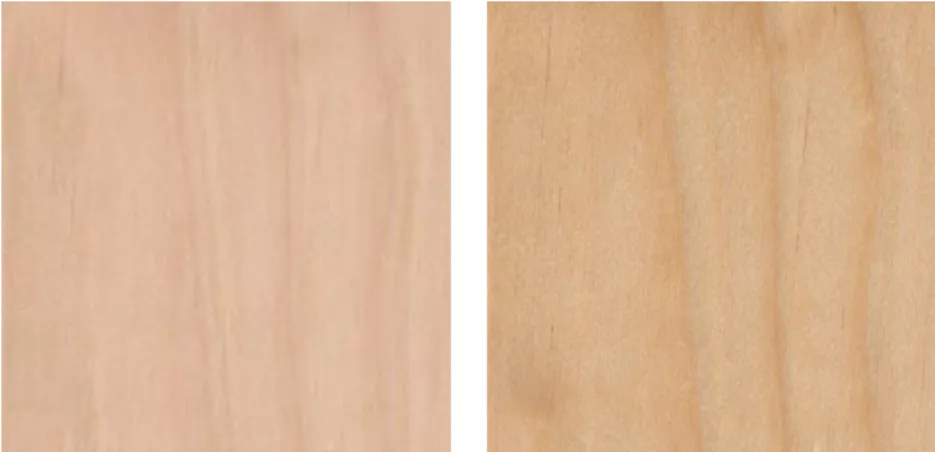
For the wooden plates in this study, a typical yellow birch wood type GL28h (Homogeneous Glue Laminated Timber) with 28 [MPa] bending strength will be used, figure 24. The W-W-W connection will be submitted to an external tensile force equal to 100 [kN], in direction parallel to the grain. The fasteners used in W-W-W connection will be a steel dowels with a diameter equal to
ϕ
12 [mm] and a grade steel material as S275.
Figure 24: Yellow birch wood. (http://www.wood-database.com/yellow-birch/)
34
Strength Class GL28h
Designation Value
Strength [MPa]
Bending strength fm, k 28
Tension parallel to the fibers ft,0, k 19,5
Tension perpendicular to the fibers ft,90, k 0,5
Pressure parallel to the fibers fc,0, k 26,5
Pressure perpendicular to the fibers fc,90, k 3,0
Stiffness [MPa]
Modulus of elasticity parallel to the fibers E0, mean 12600
Modulus of elasticity perpendicular to the fibers E90, mean 420
Shear modulus Gmean 780
Density [kg/m3]
Density ρk 410
Table 15: Values of strength, stiffness and density of GL28h at ambient temperature, [34].
Considering the values of strength and stiffness for GL28h, a typical yellow birch could be used. Tables below (table 16 and 17) give the properties for this spice as an orthotropic material, that is, it has unique and independent mechanical properties in the directions of three mutually perpendicular axes: longitudinal or parallel to the fiber or grain (L), radial normal to the growth rings (R) and tangential perpendicular to the grain but tangent to the growth rings (T). The strength in the longitudinal direction is the greatest usually about 10 times the other directions. Tables 16 and 17 represents the material properties at ambient temperature for this spice.
Specie ET / EL ER / EL GLR / EL GLT / EL GRT / EL
Birch, yellow 0,050 0,078 0,074 0,068 0,017
Table 16: Elastic ratios at approximately 12% moisture content, [22].
Specie μLR μLT μRT μTR μRL μTL
Birch, yellow 0,426 0,451 0,697 0,426 0,043 0,024
35 Table 18 presents the strength properties of timber material at ambient temperature.
Common species names Unit Birch Yellow
Moisture content [%] 12
Specific gravity - 0,62
Static b
en
din
g Modulus of rupture [kPa] 114000
Modulus of elasticity [MPa] 13900
Work to maximum load [kJ/m3] 143
Impact bending [mm] 1400
Compression parallel to grain [kPa] 56300
Compression perpendicular to grain [kPa] 6700
Shear parallel to grain [kPa] 13000
Tension perpendicular to grain [kPa] 6300
Side hardness [N] 5600
Table 18: Strength properties of yellow birch material at ambient temperature, [22].
Table 19 presents the values of strength, stiffness and density for steel material used in dowels connections at ambient temperature. Steel is an isotropic material, and hot-rolled low carbon or mild carbon is often used in timber connections as fasteners and connectors.
Steel grade S275
Designation Value
Strength [MPa]
Characteristic value of strength at the max load fu, k 400
Yield strength fy 275
Ultimate tensile strength fu 430
Stiffness [GPa]
Modulus of elasticity E 210
Poisson's Ratio
Poisson's ratio υ 0,3
Density [kg/m3]
Density ρs 7850
36 3.3. W-W-W configuration at ambient temperature
To determine the configuration in study, W-W-W connection at ambient temperature, all requirements according standards will be conducted under a report guide from, [35]. The final W-W-W configuration with all dimensions is presented in figure 25. The proposed model is calculated in cross-section size, number of dowels and spacing between dowels, due to an applied tensile force.
Figure 25: W-W-W connection in study.
According the standards, all rules will be conducted to establish the correct procedure for the design of W-W-W connection. The following steps will be used for this type of connection.
The ultimate limit state in the connection needs to be controlled, using the expression of the tension parallel to the grain, EN 1995-1-1, [23]:
𝜎𝑡,0,𝑑 ≤ 𝑓𝑡,0,𝑑 (13)
where: 𝜎𝑡,0,𝑑: the design tensile stress along the grain and 𝑓𝑡,0,𝑑: the design tensile strength along
the grain. For normal design tensile stress, the calculation is given by:
𝜎𝑡,0,𝑑 = 𝐹𝐴𝑑𝑠 (14)
240
100 85 85
Ø12 x 20 (a1)
100
40
40
85
Ø12 x 20 (a2)
40
60
240 (a3,t)
120
85
60
(a4,c)
40
40
(t2) 50
50 (t1)
100
37 where: 𝐹𝑑 is the applied design force equal to 100 [𝑘𝑁] and 𝐴𝑠 the cross-section of the
W-W-W connection.
Design tensile strength is obtained according EN 1995-1-1, [23] considering the following expression:
𝑓𝑡,0,𝑑 =𝑘𝑚𝑜𝑑𝛾×𝑓𝑀𝑡,0,𝑘 (15)
Where: 𝑘𝑚𝑜𝑑 is the modification factor taking into account the effect of the duration of load
and moisture content, from the table 3.1 EN 1995-1-1, [23], and for short term action 𝑘𝑚𝑜𝑑is
equal to 0,9. 𝑓𝑡,0,𝑘 is the tension parallel to the fibers, for laminated timber GL28h equal to 19,5
MPa. 𝛾𝑀 is the partial safety factor equal to 1,25.
With all considerations, the calculated design tensile strength is:
𝑓𝑡,0,𝑑= 0,9 × 19,51,25 = 14,04 [𝑀𝑃𝑎]
𝜎𝑡,0,𝑑 =𝐹𝐴𝑑
𝑠 ≤ 𝑓𝑡,0,𝑑 ⇔ 𝐴𝑠 ≥
𝐹𝑑
𝑓𝑡,0,𝑑 ⇔ 𝐴𝑠 ≥
100 × 103
14,04
𝐴𝑠 ≥ 7122,507 [𝑚𝑚2]
And inverting the equation it is possible to determine the minimum cross-section for W-W-W connection. The chosen cross-section for the timber plates of W-W-W-W-W-W-W-W-W connection is:
{𝐶𝑒𝑛𝑡𝑒𝑟: 200 ×100 = 20000𝐿𝑎𝑡𝑒𝑟𝑎𝑙: 200 ×50 = 10000}
𝑡𝑜𝑡𝑎𝑙: 20000 + 2×10000 = 40000 [𝑚𝑚2] ≥ 7122,5 [𝑚𝑚2]
38
𝐹
𝑣,𝑅𝑘= 𝑚𝑖𝑛
{
𝑓ℎ,1,𝑘 . 𝑡1 .𝑑 (𝑎)
0,5 .𝑓ℎ,2,𝑘 . 𝑡2 .𝑑 (𝑏)
1,05 𝑓ℎ,1,𝑘 . 𝑡1 .𝑑2+𝛽 [√2𝛽 (1+𝛽)+4𝛽 (2+𝛽) 𝑀𝑦,𝑅𝑘
𝑓ℎ,1,𝑘 . 𝑑 . 𝑡12 −𝛽]+𝐹𝑎𝑥,𝑅𝑘4 (𝑐)
1,15√1+𝛽2𝛽 .√2 .𝑀𝑦,𝑅𝑘 .𝑓ℎ,1,𝑘 . 𝑑+𝐹𝑎𝑥,𝑅𝑘4 (𝑑)
(16)
𝛽 =𝑓𝑓ℎ,2,𝑘
ℎ,1,𝑘
where:
𝐹𝑣,𝑅𝑘: is the characteristic load-carrying capacity per shear plane per fastener,
𝑡𝑖: is the timber or board thickness or penetration depth, with i either 1 or 2 (t1=50 [mm] and
t2=100 [mm]),
𝑓ℎ,𝑖,𝑘: the characteristic embedment strength in timber member i, at an angle 0° to the grain,
for Laminated veneer lumber (LVL) and a diameter between 6 [𝑚𝑚] ≤ 𝑑 ≤ 30 [𝑚𝑚],
𝑑: is the fastener diameter equal to 12 [mm],
𝑀𝑦,𝑅𝑘: is the characteristic fastener yield moment, for rounded nails,
𝛽: is the ratio between the embedment strength of the members, the characteristic embedment strength parallel to the grain in all members is equal 𝑓ℎ,1,𝑘 = 𝑓ℎ,2,𝑘 ⇒ 𝛽 = 1.
𝐹𝑎𝑥,𝑅𝑘: is the characteristic axial withdrawal capacity of the dowels equal to 0%.
𝑓ℎ,0,𝑘 = 0,082 (1 − 0,01×𝑑) . 𝜌𝑘 (17)
𝑓ℎ,0,𝑘 = 0,082 (1 − 0,01×12)×410 = 29,5856 [𝑀𝑃𝑎]
𝑀𝑦,𝑅𝑘 = 0,3 . 𝑓𝑢 . 𝑑2,6 (18)
𝑀𝑦,𝑅𝑘 = 0,3 . 𝑓𝑢 . 𝑑2,6 = 0,3 × 400 ×122,6=76745,4 [kN.m]
39
{
𝑓ℎ,1,𝑘 . 𝑡1 . 𝑑 = 29,5856 × 50 × 12 = 17751,36 (𝑎)
0,5 . 𝑓ℎ,2,𝑘 . 𝑡2 . 𝑑 = 0,5 ×29,5856 ×100 ×12 = 17751,36 (𝑏)
1,05 𝑓ℎ,1,𝑘2 + 𝛽 . 𝑡1 . 𝑑[√2𝛽 (1 + 𝛽) +4𝛽 (2 + 𝛽) 𝑀𝑓 𝑦,𝑅𝑘
ℎ,1,𝑘 . 𝑑 . 𝑡12 − 𝛽] +
𝐹𝑎𝑥,𝑅𝑘
4 =
1,05 × 29,5856 . 50 . 122 + 1 [√2×1 (1 + 1) + 4×1 (2 + 1) 76745,429,5856 . 12 . 502 − 1] = 7731,81 (𝑐)
1,15√ 2𝛽1 + 𝛽 . √2 . 𝑀𝑦,𝑅𝑘 . 𝑓ℎ,1,𝑘 . 𝑑 +𝐹𝑎𝑥,𝑅𝑘4 =
1,15√ 2×11 + 1 . √2 × 76745,4 × 29,5856 × 12 = 8489,26 (𝑑)
The characteristic load-carrying capacity is the minimum value between all four equations. The result obtained should be multiplied by the modification factor which take into account the effect of the load and moisture content duration.
𝐹𝑣,𝑅𝑘 = 𝑚𝑖𝑛 {
17751,36 17751,36 7731,81 8489,26
= 7731,81 [𝑁]
𝐹𝑣,𝑅,𝑑 =𝑘𝑚𝑜𝑑𝛾×𝐹𝑣,𝑅,𝑘
𝑀 =
0,9×7731,81
1,25 = 5566,90 [𝑁]
In this study, the load carrying 𝐹𝑣,𝑅,𝑑 per shear and for each fastener is equal to 5566,9 [N],
considering a safe factor equal 1,338 (N=1,25/0,9) where the minimum value of the characteristic load-carrying capacity per shear plane per fastener 𝐹𝑣,𝑅𝑘 was determined in
previous. According the applied design force 𝐹𝑑, in safe design the number of dowels Nº for
the connection in symmetry is given by:
𝑁º = 𝐹𝑑 𝐹𝑣,𝑅,𝑑 =
100000
5566,90≥ 18 (19)
40 used are: 𝑎1 represents the spacing of nails within one row parallel to grain; 𝑎2 the spacing of
rows of nails perpendicular to grain; 𝑎3,𝑡 the distance between nail and loaded end and 𝑎4,𝑐 the
distance between nail and unloaded edge.
Figure 26: Spacing and end and edge distances, [23].
Spacing and edge /
end distances Angle
Minimum spacing or edge /
end distance Value
𝑎1
(Parallel to grain) 0° ≤ 𝛼 ≤ 360° (3 + 2|cos ∝|). 𝑑
(3 + 2|cos 0|). 12 = 60 [𝑚𝑚]
𝑎2
(Perpendicular to grain) 0° ≤ 𝛼 ≤ 360° 3 . 𝑑
3 ×12 = 36 [𝑚𝑚]
⇒ 40 [mm]
𝑎3,𝑡
(loaded end) −90° ≤ 𝛼 ≤ 90° max (7. 𝑑 ; 80 𝑚𝑚)
max(7×12 ; 80 𝑚𝑚) = max(84 ; 80 ) = 84 [𝑚𝑚]
⇒ 85 [mm]
𝑎3,𝑐
(unloaded end)
90° ≤ 𝛼 ≤ 150° 150° ≤ 𝛼 ≤ 210° 210° ≤ 𝛼 ≤ 270°
max ((𝑎3,𝑡|sin ∝|). 𝑑 ; 3. 𝑑)
3. 𝑑
max ((𝑎3,𝑡|sin ∝|). 𝑑 ; 3. 𝑑)
-
𝑎4,𝑡
(loaded edge) 0° ≤ 𝛼 ≤ 180° max([2 + 2 sin ∝]. 𝑑 ; 3. 𝑑) -
𝑎4,𝑐
(unloaded edge) 180° ≤ 𝛼 ≤ 360° 3 . 𝑑
41
Chapter 4
42 4. FEM Analysis of W-W-W Connection at Ambient Temperature
4.1. Introduction
The finite element method (FEM) is a numerical procedure that can be used to obtain solutions to a large class of engineering problems involving stress analysis, heat transfer, electromagnetism, fluid flow, … [36]. Today the finite element method is considered as one of the well-established and convenient technique for the computer solution of complex problems in different fields of engineering as civil engineering, mechanical engineering, etc. From other side, FEM can be examined as a powerful tool for the approximate solution of differential equations describing different physical processes, [36].
In this work ANSYS will be used as a finite element analysis software applicable in all fields of engineering such as structural, thermal, fluid (including computational fluid dynamics), electrical, electrostatics and electromagnetics. The structural analysis is employed to determine the displacements, deformations, strains and stresses. Coupled-field analysis considers the mutual interaction between two or more fields such as thermal-stress analysis. The fact that each depends upon another makes it is impossible to solve each separately, therefore the program that can solve both physics problems by combining them, [37]. The design is modelled using discrete elements, and each element has exact equation that describe how it responds to a certain load, and the sum of the response of all elements in the model gives the total response of the problem. The thermal analysis is used to determine the temperature distribution in the problem in study. Other quantities of interest include amount of heat lost or gained, thermal gradients, and thermal flux. All three primary heat transfer modes can be simulated: conduction, convection, radiation, [37].
In FEM analysis, continuous models are approximated using a finite number of discrete elements, as called ‘discretization’. Interpolation within the elements is achieved through typical shape functions. The shape function is the equation which interpolates the solution between the discrete values obtained at the nodal elements. Therefore, appropriate functions must be used and, as already mentioned, low order polynomials are typically chosen as shape functions, [37]. In this work, linear shape functions are used.
![Table 1: The elastic modulus of some types of wood at room temperature, [22], [25], [26].](https://thumb-eu.123doks.com/thumbv2/123dok_br/16861816.753678/26.892.132.762.265.769/table-elastic-modulus-types-wood-room-temperature.webp)
![Table 3: Poisson’s ratios for various hardwood species at approximately 12% moisture content, [22]](https://thumb-eu.123doks.com/thumbv2/123dok_br/16861816.753678/27.892.121.780.467.712/table-poisson-various-hardwood-species-approximately-moisture-content.webp)
![Figure 15: Effect of temperature on modulus of elasticity parallel to grain of softwood, [8]](https://thumb-eu.123doks.com/thumbv2/123dok_br/16861816.753678/28.892.182.713.534.1000/figure-effect-temperature-modulus-elasticity-parallel-grain-softwood.webp)
![Figure 16: Reduction factor for strength parallel to grain of softwood, [8].](https://thumb-eu.123doks.com/thumbv2/123dok_br/16861816.753678/29.892.198.709.394.851/figure-reduction-factor-strength-parallel-grain-softwood.webp)
![Table 14: Reduction factors for stress-strain relationship of carbon steel at elevated temperatures, [33].](https://thumb-eu.123doks.com/thumbv2/123dok_br/16861816.753678/38.892.106.796.241.648/table-reduction-factors-stress-strain-relationship-elevated-temperatures.webp)
![Figure 21: Relative thermal elongation of carbon steel as a function of the temperature, [27]](https://thumb-eu.123doks.com/thumbv2/123dok_br/16861816.753678/39.892.193.708.672.1051/figure-relative-thermal-elongation-carbon-steel-function-temperature.webp)
![Figure 23: Thermal conductivity of carbon steel as a function of the temperature, [27]](https://thumb-eu.123doks.com/thumbv2/123dok_br/16861816.753678/41.892.194.708.493.870/figure-thermal-conductivity-carbon-steel-function-temperature.webp)
![Table 15: Values of strength, stiffness and density of GL28h at ambient temperature, [34].](https://thumb-eu.123doks.com/thumbv2/123dok_br/16861816.753678/44.892.107.788.101.497/table-values-strength-stiffness-density-gl-ambient-temperature.webp)
![Table 18: Strength properties of yellow birch material at ambient temperature, [22].](https://thumb-eu.123doks.com/thumbv2/123dok_br/16861816.753678/45.892.105.756.153.523/table-strength-properties-yellow-birch-material-ambient-temperature.webp)