AGRICULTURAL WOOD AS AN ECOLOGICAL FOCUS
ATTITUDES
Drittler L1*, Theuvsen L1
(1) Department of Agricultural Economics and Rural Development, University of Goettingen B, Goettingen, Germany *Corresponding author: [email protected]
Abstract
Cultivating agricultural wood is an option to comply with the greening-restrictions of the current Common Agricultural Policy. Agricultural wood is a bioenergy source well accepted by wider society. It is classified as ecologically important by various European studies and its growing could answer some of the public criticism directed towards industrialised agriculture. However, agricultural wood is only of minor relevance in most European countries. In order to identify survey was conducted among farmers in Germany in the first quarter of 2017. The results indicate that farms with less favourable local conditions and arable farms as well as risk-averse farmers are more promising target groups.
Keywords: agricultural wood; ecological focus areas; farmers; attitudes; Germany
Introduction
In the current funding period 2014-2020 of the Common Agricultural Policy (CAP), direct payments are linked to three greening-restrictions: crop diversification, preservation of permanent grassland and land use for environmental interests. To comply with these requirements, farms with more than 15 hectares of arable land have to create at least five percent of their arable land as so-called Ecological Focus Areas (EFA). Cultivating agricultural wood (such as short-rotation-coppice (SRC) or agroforestry) is an option for the provision of these EFAs. Currently, agroforestry systems are not accepted as EFA in Germany. But SRC are permitted as EFA under the conditions of a minimum size of 0.3 hectares and the growing of specific tree species (BMEL 2015). Another option for the provision of agricultural wood as EFA is strip-type integrated agricultural wood. For this, a SRC is planted on parts of the farmland that are mechanically difficult to reach (Feldwisch 2011).
Agricultural wood is a bioenergy source that is well accepted by wider society (Henke and Theuvsen 2015; Herbes et al. 2014). Various European studies classify it as ecologically important (Burger 2010; Nahm and Morhart 2017) and growing agricultural wood could answer some of the public criticism directed towards industrialised agriculture (Nahm and Morhart 2017). Despite these advantages agricultural wood is only of minor relevance in most European countries. For example in Germany, only 2.474 hectares of agricultural wood has been planted as EFA (BMEL 2016).
However acceptance of agricultural wood is vital for the successful establishment of this EFA-measure. So far, only a few studies have dealt with the acceptance of agricultural wood in general, to which one can add that, reference to Greening as a core element of the CAP has been completely lacking in those studies (Glithero et al. 2013; Boll et al. 2015; Warren et al. 2016).
Against this background, the objective of this article is therefore to identify differing target groups could then be defined for an increase in acceptance.
Materials and methods
Conventional farmers throughout Germany were surveyed in the first quarter of 2017 by means of a standardized online survey. Different distribution channels such as mailing lists and advertisements in agricultural newsletters were used to recruit as many farmers as possible. All towards risk, were measured using the fivepoint Likert scale from
and sociodemographic characteristics, nominally scaled variables were used.
The data were evaluated using IBM SPSS Statistics 24. In order to obtain a brief overview, frequency distributions of sociodemographic and farm characteristics, as well as attitudes towards agricultural wood as EFA, were considered (Raab-Steiner and Benesch 2008). To , correlation analysis and (Raab-Steiner and Benesch 2008). Normal distribution was neglected due to the explorative character of the study.
Results
Two hundred and thirty eight farmers farming conventionally completed the survey. On average, tolerance. Most of the farms are located in southern Germany (30.7%), followed by northern (27.7%) and western Germany (24.8%). The lowest share of farmers surveyed is situated in eastern Germany (16.8%). This differs somewhat from the situation over the entire country, since nearly half of all farms are located in southern Germany and a quarter in western Germany (Destatis 2017). In the survey, the average farm size is 309.0 hectares, of which, on average, 259.7 hectares are arable land. These farms are therefore considerably larger than the German average (Destatis 2017). Among all participants, 89.1% work full time on their farms. Frequencies shown in Figure 1 clearly illustrate that the farmers surveyed have a negative attitude to strip-type integrated agricultural wood as EFA. Only 10.9% of the participants already
-
-1.61) to grow strip-type integrated agricultural wood as EFA. Furthermore, more than two thirds of the farmers are put off growing agricultural wood by the long term commitment of farm land (76.1%).
Figure 1: Frequency distributions of important statements.
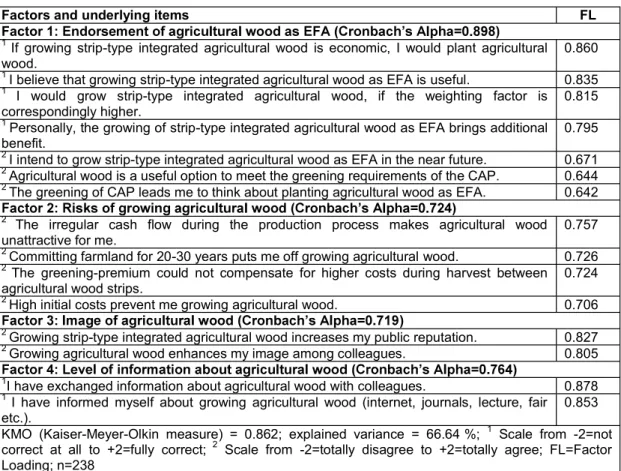
-type integrated agricultural wood as EFA and to reduce complexity, an explorative factor analysis was conducted. The final factor solution contained four factors with 15 variables (Table 1). All
the general attitude towards agricultural wood as EFA from the point of view of conventional farmers. It summarises items growing agricultural wood. The second fa
image increas
Table 1: Result of the factor analysis.
Factors and underlying items FL
Factor
1 If growing strip-type integrated agricultural wood is economic, I would plant agricultural
wood.
0.860
1 I believe that growing strip-type integrated agricultural wood as EFA is useful. 0.835
1 I would grow strip-type integrated agricultural wood, if the weighting factor is
correspondingly higher.
0.815
1 Personally, the growing of strip-type integrated agricultural wood as EFA brings additional
benefit.
0.795
2 I intend to grow strip-type integrated agricultural wood as EFA in the near future. 0.671
2 Agricultural wood is a useful option to meet the greening requirements of the CAP. 0.644
2 The greening of CAP leads me to think about planting agricultural wood as EFA. 0.642
2 The irregular cash flow during the production process makes agricultural wood
unattractive for me.
0.757
2 Committing farmland for 20-30 years puts me off growing agricultural wood. 0.726
2 The greening-premium could not compensate for higher costs during harvest between
agricultural wood strips.
0.724
2 High initial costs prevent me growing agricultural wood. 0.706
)
2 Growing strip-type integrated agricultural wood increases my public reputation. 0.827
2 Growing agricultural wood enhances my image among colleagues. 0.805
1I have exchanged information about agricultural wood with colleagues. 0.878
1 I have informed myself about growing agricultural wood (internet, journals, lecture, fair
etc.). 0.853
KMO (Kaiser-Meyer-Olkin measure) = 0.862; explained variance = 66.64 %; 1 Scale from -2=not
correct at all to +2=fully correct; 2 Scale from -2=totally disagree to +2=totally agree; FL=Factor Loading; n=238
ts, type of farming, as well as location characteristics. Correlation analysis shows a significant (r=0.139; p=0.032). The more risk-averse the farmer is, the higher is the perception of an image increase by growing agricultural wood. Furthermore, it was possible to detect differences with differs significantly in mean values between full- -0.06) and
part--0.14) and farmers
-0.15) (p=0.000). This finding is validated by a significant positive correlation (r=0.182; p=0.005). Part-time farmers, farmers without livestock, as well as farmers who cultivate permanent crops, are rather better informed about agricultural wood. Farmers who
permanent crops no permanent crops
cultivate permanent crops, they stronger support the growing of agricultural wood and estimate the risks as lower than other farmers.
Moreover, it was possible to detect differences and connections between attitude and location characteristics. It could be found that significant differences in mean values exist between the level of information and the relief of the farm location (p=0.001). Farmers who cultivate areas on -0.10). This finding is validated by a significant positive correlation between the level of information and the location altitude (r=0.130; p=0.045). between the different levels of erosion risks (p Factor 4=0.003; p Factor 3=0.039). Farmers who cultivate areas without risks of wind e -0.17) are rather less informed about agricultural
-Additionally, significant negative correlations could be found between annual rainfall and -0.261; p=0.000). The less the annual rainfall, the higher is the endorsement of agricultural wood.
Discussion
The descriptive results showed that, in general, farmers tend to be against growing strip-type integrated agricultural wood as EFA. This result is in line with other studies concerning the acceptance of agricultural wood in other regions, for instance in England (Glithero et al. 2013; Warren et al. 2016). In Germany, farmers are also rather sceptical due to their lack of knowledge and experience with regard to agricultural wood as well as due to the long-term capital and area commitment (Skodawessely et al. 2008). However, German farmers are still willing to grow agricultural wood (Boll et al. 2015).
The aim of this article was to analyse characteristics that influence the attitudes of German farmers towards agricultural wood as EFA. The acceptance of agricultural wood is important for successful establishment of this EFA-measure. This analysis also contributed to closing the existing gap in research by highlighting the role of personality traits, type of farming, and location characteristics.
However, high standard deviations indicated that farmers cannot be regarded as one homogeneous group. They differ in various characteristics with regard to their attitudes towards agricultural wood as EFA. Due to the general low acceptance of agriculture wood as EFA in Germany, all farmers should be seen as a target group. In particular the results indicate that farms with less favourable local conditions (risk of erosion, low rainfall precipitation) and arable farms are more promising target groups, and risk-averse farmer can be considered as another. Further research, the identified characteristics can help in classifying different groups (clusters) of farmers that vary with regard to their willingness to cultivate agricultural wood as EFA. On the basis of this further specification of target groups, recommendations for action could be derived in order to contribute to an increase in the acceptance of agricultural wood in Germany.
Acknowledgements
This work is supported by the Deutsche Bundesstiftung Umwelt (DBU). The authors express their gratitude to the DBU for the financial support.
References
BMEL (2015) Umsetzung der EU-Agrarreform in Deutschland. BMEL, Bonn, Germany.
BMEL (2016) Antwort der Bundesregierung auf die Kleine Anfrage der Abgeordneten Dr. Kirsten Tackmann, Caren Lay, Karin Binder, weiterer Abgeordneter und der Fraktion Die Linke. Bundestags Drucksache 18/10569. Deutscher Bundestag, Berlin, Germany.
Boll T, Neubert F, Zimmermann K, Bergfeld A (2015) Decision Criteria and Implementation Strategies for Short Rotation Coppice in Germany from the Perspective of Stakeholders. In: Manning DB, Bemmann A, Bredemeier M, Lamersdorf N, Ammer C (ed) Bioenergy from Dendromass for the Sustainable Development of Rural Areas. Wiley, Weinheim, pp 331-346.
rtation, Technical University of Munich, Germany.
Destatis (2017) Landwirtschaftliche Betriebe.
https://www.destatis.de/DE/ZahlenFakten/Wirtschaftsbereiche/LandForstwirtschaftFischerei/Landwirtschaftlich eBetriebe/LandwirtschaftlicheBetriebe.html (accessed 31/05/2017).
Sachsen relevanten Energiepflanzen. In: LfULG (ed) Umweltgerechter Anbau von Energiepflanzen. https://www.deutsche-digitale-bibliothek.de/item/DRE6H5WTGCSBGGGEB6FOMSAF3BWTNNUA.
(accessed 22/09/2017).
Glithero NJ, Wilson P, Ramsden SJ (2013) Prospects for arable farm uptake of Short Rotation Coppice willow and miscanthus in England. Appl Energ 107: 209-218.
Henke S, Theuvsen L (2014) SLCA: Regional differenzierte Bewertung von Biogasanlagen und Kurzumtriebsplantagen. In: Eder
Vienna, pp 81-90
Novelle des Erneuerbare-Energien-Gesetzes (EEG) 2012. GAIA 23: 100-108 Land(wirt)schaft
30.11. to 01.12.2016 in Senftenberg, pp 17-24
Raab-Steiner E, Benesch M (2008) Der Fragebogen von der Forschungsidee zur SPSS/PASW Auswertung. UTB, Stuttgart, Germany.
Skodawessely C, Glaser T, Pretzsch J, Schmidt PA (2008) Attitudes of farmers and nature conservation associations to short-rotation coppice (in German). Swiss Forestry Journal 159: 158- 164.
Warren CR, Burton R, Buchanan O, Birnie RV (2016) Limited adoption of short rotation coppice: The role of farmers'