UNIVERSIDADE DE LISBOA FACULDADE DE PSICOLOGIA
CONDITIONAL ACTIVATION OF ASSOCIATIVE
SEMANTIC STRUCTURES: FORMING AND
TRANSMITTING IMPRESSIONS OF PERSONALITY
Ludmila Duarte da Silva Nunes
DOCTORATE IN PSYCHOLOGY
Specialty in Social Cognition
UNIVERSIDADE DE LISBOA FACULDADE DE PSICOLOGIA
CONDITIONAL ACTIVATION OF ASSOCIATIVE
SEMANTIC STRUCTURES: FORMING AND
TRANSMITTING IMPRESSIONS OF PERSONALITY
Ludmila Duarte da Silva Nunes
Thesis supervised by Professor Doutor Leonel Garcia-Marques
(Universidade de Lisboa) and co-supervised by Professor Henry
L. Roediger, III, (Washington University in St. Louis), especially
elaborated for obtaining the degree of Doctor in Psychology,
Specialty in Social Cognition.
ii
The present work was sponsored by a Doctoral Grant (Ref. SFRH/BD/48569/2008) of the Science and Technology Foundation (FCT), Portugal.
iii ACKNOWLEDGMENTS
According to Gertrude Stain “silent gratitude isn’t very much to anyone”, so it is now time to thank (almost) all who played a role in the preparation of this dissertation.
First of all, I want to thank Leonel Garcia-Marques for being such a great advisor and having the ability to keeping my scientific curiosity alive. I am also thankful for all the effort you put on this project, while having to deal with me and my doubts (I know it was not always easy). Above all, thanks for trusting me.
I am also grateful to Roddy Roediger, who showed me a lot about Academia and allowed me to be part of one of the most exciting working environments I have ever experienced. Thank you for being my co-advisor and teaching me about how the greatest Science is usually the most simple.
All my colleagues and professors from University of Lisbon and the Washington University in St. Louis were essential for the making of this thesis. Because I am lucky enough to have received support from too many of you, I will just mention your labs. From the Washington University in St. Louis, I want to thank everyone in the Memory Lab, for “adopting” me and always making me feel at home; the Memory and Cognition Lab, especially Kathleen McDermott; and Mitch Sommers, Mark McDaniel, Ian Dobbins, and SimineVazire for sharing their knowledge in a brilliant way. I am also very thankful to the “Portuguese team” – I want to show my gratitude to my colleagues from the lab in the University of Lisbon and also to those from other Labs who form the Social Cognition group; J. Frederico Marques and Mário Ferreira for being directly responsible for some of my academic choices; Tammy Garcia-Marques, Tomás Palma, André Mata, and Rui S. Costa, for being colleagues and “teachers” whenever I needed to deal with statistics or find obscure papers, or convincing myself I could finish this.
I am also very grateful to my colleagues Andrew Butler, J. F. Marques, Mário Ferreira, Nate Rose, Rui Mata, and Yana Weinstein – it has been a pleasure working with you.
I also want to thank some of my friends who always knew what to tell me or do when I needed them. Megan Smith, Andrée-Ann Cyr, Nate and Denise Rose, Pooja Agarwal, Yana Weinstein and Jon Jackson – thank you so much for showing me friendships easily cross oceans. Peter, Marta C., Teresa R., Teresa G., Nikola V., Luana F., Marília P., David R., Ricardo F., David K., Tânia R., thank you for everything, but especially for trying to teach me how to deal with my frustrations. Isabel, Joaninha, Joana M., Teresa G., J. e M., Carla, PZ, Pedro, Nuno T., Nuno e Rita S., Nuno M., yes you deserve all the scones I can bake, having you as friends is a gift. Marta J. and Conrad, you spoiled me with cupcakes, tough love, and meows, and this would not have been possible without your support. Ana V., thank you for being the best sister ever. Also, those who accompanied me through the process of writing this thesis – those who stayed and those who left; those who made me cry and those who made me laugh - those are the ones who really taught me about impression formation and memory and I am grateful for it.
Finally, I want to thank my parents. Obrigada por me ensinarem que liberdade e responsabilidade são a mesma coisa. Obrigada por estarem sempre aqui e agora. Mãe, acho que a pessoa que mais me ensinou merece que esta tese seja também sua, por isso, este trabalho é teu.
iv Abstract
In the presented line of research we intended to systematically study the importance of memory to the formation and transmission of impressions of personality. We consider that impressions of personality are grounded in associative structures (e.g., Asch, 1946), which should be prone to similar memory distortions that other associative memory structures are (e.g., Roediger& McDermott, 1995). These distortions, which are a performance cost of flexible structures that allow us to adapt to the world (e.g., Howe, 2011), should also influence the transmission of information. More specifically, when information is retrieved from memory and transmitted serially between people, the information should be progressively changed by individual memory distortions, which must reflect previous representations of the transmitted concepts (Bartlett, 1932). In a set of five studies we investigated the susceptibility of the associative structure underlying impression formation to memory biases, using an adaptation of the DRM paradigm (Roediger& McDermott, 1995); the organization of personality traits in memory and the classic impression formation effects of centrality and primacy; and the pattern of distortions implied in serial transmission of personality traits. Our results pointed that a paradigm typically used to study memory can be adapted to study impression formation and that the beliefs that people hold about others’ personalities can be represented by an associative memory structure that is susceptible to memory distortions. Also, the organization of personality traits in memory seems to be responsible for classic impression formation effects, such as the centrality and primacy effects. Interestingly, by showing that some of these effects only occur when the impression formation goal is active, we obtained evidence for the conditional nature of the activation of the memory structure implied in impression formation. Moreover, we verified that serial transmission of information leads to systematic and predictable changes, with both information loss and intrusions.
Keywords: impression formation, memory, DRM paradigm, repeated reproduction, serial reproduction
v Resumo
Sempre que alguém nos é apresentado ou descrito, formamos uma impressão sobre a sua personalidade. Este processo deverá ocorrer mesmo que a informação inicial seja escassa e levar a uma impressão unificada do alvo em causa (Asch, 1946). Mas, qual a relação entre as impressões formadas e a representação prévia dos traços de personalidade em memória? Esta relação tem sido pouco explorada e, no presente trabalho, sugerimos que a informação sobre traços de personalidade está armazenada em memória numa estrutura associativa que, tal como outras estruturas associativas de memória, como a memória semântica, está sujeita a enviesamentos e erros de memória (e.g., Deese, 1959; Roediger&McDermott, 1995). A ideia que os traços de personalidade estão associados entre si numa representação que reflecte as crenças partilhadas sobre que traços de personalidade normalmente co-ocorrem foi denominada “teoria implícita da personalidade” (Bruner &Tagiuri, 1954). A representação da teoria implícita da personalidade como uma estrutura bidimensional, composta por quatro quadrantes que resultam do cruzamento de duas dimensões – intelectual e social – com dois pólos avaliativos – positivo e negativo – foi depois proposta por Rosenberg, Nelson, e Vivekananthan (1968). Partindo desta ideia que a teoria implícita da personalidade é uma estrutura de memória associativa sujeita aos mesmos enviesamentos de memória que outras estruturas de memória associativa, propomos estudar os efeitos clássicos de formação de impressões, como os efeitos de centralidade e primazia, adaptando um paradigma habitualmente utilizado para estudar falsas memórias semânticas, o DRM (Deese, 1959; Roediger&McDermott, 1995). Para tal, desenvolvemos um conjunto de três estudos, nos quais se pretendeu explorar a susceptibilidade da teoria implícita da personalidade a falsas memórias e a tradução do efeito de primazia e do efeito de centralidade em falsas memórias. Como referido, usou-se uma adaptação do DRM. No DRM clássico, apresenta-se uma lista de palavras semanticamente associadas a uma determinada palavra que nunca é apresentada – o item crítico – e verifica-se que, em testes de recordação livre ou reconhecimento, o item critico é tão falsamente recordado quanto os items apresentados são veridicamente recordados. Uma das explicações para este efeito prende-se com a dispersão automática da activação através das associações entre os items apresentados e que deverá convergir para o item crítico, activando-o de modo a ser incorrectamente julgado como tendo sido apresentado. Posto isto, e se a teoria implícita da personalidade pode ser representada através de uma estrutura associativa de traços de personalidade, efeitos semelhantes deverão ser obtidos quando traços de personalidade são apresentados. Porém, a activação da teoria implícita da personalidade poderá ser condicional ao objectivo de formação de impressões de personalidade, levando
vi
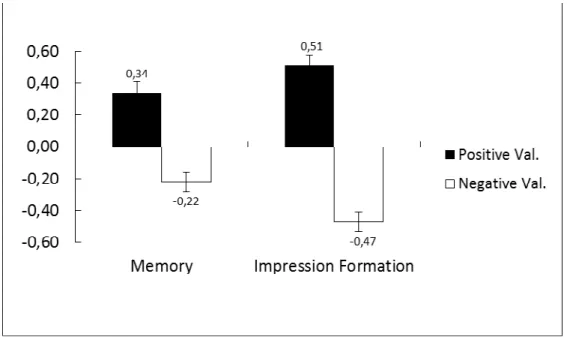
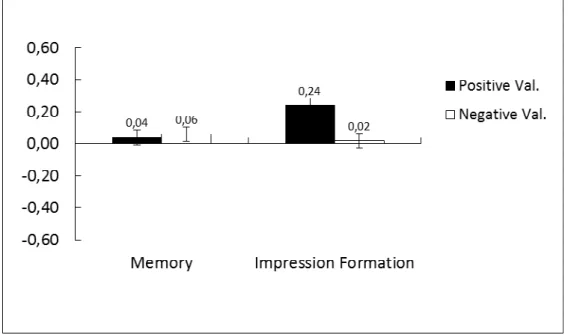
a que os efeitos sugeridos ocorram apenas quando este objectivo de processamento está activo. Assim, ao longo dos vários estudos que apresentamos, manipulamos sempre o objectivo de processamento, dando aos participantes instruções de simples memorização ou de formação de impressões, pondo a hipótese de que os efeitos de falsas memórias expectáveis dada a configuração da teoria implícita da personalidade ocorreriam apenas quando o objectivo de formar impressões de personalidade fosse activado. Para tal, num primeiro estudo apresentamos traços de personalidade de um determinado quadrante e medimos, num teste de reconhecimento, o números de falsos alarmes quanto a traços desse quadrante por comparação ao número de falsos alarmes a traços de personalidade dos outros quadrantes. Verificou-se que os traços de personalidade do quadrante da lista apresentada eram mais falsamente reconhecidos do que os traços de personalidade de outros quadrantes, sendo, tal com previsto, esta diferença maior para participantes instruídos a formar impressões de personalidade. É de referir que não se encontraram diferenças entre participantes instruídos a memorizar a informação e participantes instruídos a formarem uma impressão de personalidade quanto à memória verídica para os traços apresentados. Num teste inclusivo subsequente, no qual os participantes eram instruídos a aceitar não só os traços apresentados mas também aqueles que partilhavam características com os traços apresentados, obteve-se o mesmo padrão de resultados. Os resultados obtidos sugerem então que é possível estudar falsas memórias de personalidade recorrendo a esta adaptação do DRM e que a activação da teoria implícita da personalidade é condicional à activação do objectivo de formação de impressões de personalidade. O padrão semelhante de resultados no teste de reconhecimento e no teste inclusivo sugerem que as diferenças entre as condições de formação de impressões e memória se devem a tipos de processamento distintos, com os participantes instruídos a memorizar a lista a revelarem um défice de processamento relacional não evidenciado pelos participantes instruídos a formar impressões de personalidade. No estudo seguinte procuramos encontrar um efeito de centralidade (Asch, 1946) em falsas memórias de personalidade, introduzindo apenas um traço considerado central dada a sua localização na representação bidimensional da teoria implícita da personalidade (Rosenberget al., 1968) numa lista composta por traços de um quadrante da dimensão oposta. Neste caso, medimos a diferença entre falsos alarmes da dimensão e valência do traço central e traços da mesma dimensão mas valência oposta. A existir, o efeito de centralidade revelar-se-ia num maior nível de falsas memórias relativas a traços que partilhassem tanto a dimensão como a valência com o traço central. Foi precisamente este resultado que obtivemos, mas apenas quando os participantes eram instruídos a formar impressões de personalidade e eram testados num teste inclusivo ou num teste de reconhecimento com pressão temporal.
vii
Deste modo, o efeito de centralidade parece ocorrer desde que a monitorização seja suprimida, dado que a centralidade dos traços parece conferir-lhes uma distintividade que facilita o processo de monitorização e a rejeição de traços associados ao traço central (e.g. Gallo, 2004). É de salientar que este efeito é especialmente inovador, dado que se obtiveram falsas memórias de vários traços de personalidade com a apresentação de apenas um traço de personalidade, o que não pode ser explicado pela teoria habitual de dispersão de activação, e que terá de ser explicado por um processo de divergência associativa ou processamento temático (e.g., Reyna&Brainerd, 1995). Num terceiro estudo, explorou-se um paralelo do efeito de primazia (Asch, 1946) em falsas memórias de personalidade. Seguindo o procedimento das experiências anteriores, manipulou-se agora a constituição da primeira e da segunda parte das listas apresentadas. No caso de uma das experiências, verificou-se que quando as listas eram compostas por traços da mesma dimensão mas a primeira parte era constituída por uma maioria de traços positivos em relação a traços negativos, os falsos alarmes relativos a traços da valência maioritariamente representada na primeira parte da lista eram mais frequentes do que os falsos alarmes relativos a traços da valência maioritariamente representada na segunda parte da lista. Isto poderá ser considerado um efeito de primazia mas, dado que o mesmo não acontece quando os traços maioritariamente representados na primeira parte da lista são negativos, parece-nos mais estarmos na presença de um efeito de positividade do que de um efeito de primazia. Numa outra experiência, na qual se manipulou a valência e a dimensão da primeira e da segunda parte da lista apresentada, verificou-se a ocorrência de um efeito de positividade semelhante, indicando que este parece ocorrer entre dimensões, o que apoia uma teoria de consistência avaliativa (e.g., Brown, 1986) apenas quando esta consistência ocorre no sentido da positividade. Em ambas as experiências, os referidos efeitos ocorrem apenas quando os participantes formavam impressões de personalidade. Assim, os resultados destes três estudos apontam para a existência de uma representação de traços de personalidade numa estrutura associativa cujas propriedades influenciam as impressões feitas e levam à existência de efeitos de primazia e centralidade que se reflectem em falsas memórias. Apesar de ser uma estrutura de memória associativa altamente flexível que partilha com outras estruturas de memória associativa, como a memória semântica, a mesma tendência a originar enviesamentos, a teoria implícita da personalidade parece ter a característica especial de ser activada apenas quando o objectivo de processamento activo é o de formação de impressões de personalidade. Por fim, apresentamos ainda dois estudos nos quais se explorou a transmissão serial de traços de personalidade, sob instruções de memorização ou de formação de impressões. Nestes estudos, os participantes eram divididos em grupos de quatro, constituindo uma cadeia de
viii
reprodução serial, sendo que o primeiro elo da cadeia recebia a lista original de traços de personalidade e era-lhe pedido que a recordasse, e o produto da sua recordação livre era então usado como lista de estudo para o segundo elo, cujo produto de recordação livre era depois usado como lista de estudo para o terceiro elo, e assim sucessivamente. Cada elo era também instruído a recordar repetidamente a mesma lista, por quatro vezes. Assim, comparamos a acumulação de alterações individuais com a acumulação de alterações colectivas, verificando que a reprodução serial levava a mais erros de omissão de traços e de intrusões de traços relacionados, mas que reflectiam os padrões individuais de alteração. As correlações entre a localização dos traços na teoria implícita da personalidade e os seus índices de sobrevivência nas cadeias de reprodução serial e de reprodução repetida também foram calculadas. Em suma, os resultados obtidos nos cinco estudos apresentados apontam para a possibilidade de estudar processo de formação de impressões de personalidade recorrendo a um paradigma habitualmente usado no estudo de falsas memorias semânticas; e apoiam a ideia que a teoria implícita da personalidade funciona como uma estrutura de memória associativa, sujeita a enviesamentos individuais e colectivos tal como outras estruturas de memória associativa, mas com a característica especial de ser activada condicionalmente à activação de um objectivo de processamento relevante, como o objectivo de formação de impressões de personalidade.
Palavras-chave: formação de impressões, memória, paradigma DRM, reprodução repetida, reprodução serial
ix
TABLE OF CONTENTS
INTRODUCTION……….………....1
1. IMPRESSION FORMATION………...………..…………3
1.2.In the beginning was the Gestalt: Asch and his seminal study………..…………5
1.2.From the Gestalt to the Implicit Theory of Personality………11
1.3. Norman Anderson and the mathematics within the personality……….…………14
1.4.The implicit theory of personality as a map………18
1.5.Descriptive issues and evaluative questions: Consistency of impressions………22
1.6.Summary: An integrated impression of an impression……….………32
2. SERIAL REPRODUCTION………..………34
2.1.Rumor and gossip: From wartime to everyday life………36
2.2.Before and beyond rumor: Biases in serial and repeated reproduction………41
2.3.A modern study on serial and repeated reproduction: A direct comparison…………45
2.4.Recent studies on serial reproduction and future directions…………...………48
3. FALSEMEMORIES ..……….……….…...… 53
3.1.The Deese-Roediger-McDermott Paradigm………56
3.2.Main theories and effects………60
3.2.1.The Activation-Monitoring framework………60
3.2.2.The Fuzzy Trace Theory………..………65
3.2.3.The Activation-Monitoring vs. The Fuzzy Trace Theory……….…………68
3.3. Monitoring related processes: Decreasing false memories? ……….…73
3.4. Concluding remarks: Implications of processes and effects………76
4. PRESENT STUDIES: THE IMPLICIT THEORY OF PERSONALITY AS AN ASSOCIATIVE STRUCTURE PRONE TO FALSE MEMORIES………..………78
EXPERIMENTAL RESEARCH………..………83
STUDY 1:FALSE MEMORIES WITHIN THE IMPLICIT THEORY OF PERSONALITY………..…83
EXPERIMENT 1………85 Method………85 Participants.………..……….………85 Materials.………..………….………85 Design.………..………….………86 Procedure.……….……….………86 Results………...……87
Standard Recognition Test.………...………88
x
Discussion………..………92
STUDY 2:INFERENTIAL COSTS OF THE CENTRALITY EFFECT………..………95
EXPERIMENT 2A………95 Method………96 Participants.………...………96 Materials.………..….………96 Design.………..….………97 Procedure.……….……….………97 Results………...……97
Standard Recognition Test.……….…...………98
Gist Recognition Test………..…….101
Discussion………..…….105 EXPERIMENT 2B………..107 Method………..108 Participants.……….…..………….…108 Materials.………...……….108 Design.………...………..108 Procedure.……….…….……….108 Results………...…..109
Standard Recognition Test.……….……...……..109
Gist Recognition Test………..…….112
Discussion………..…….115
STUDY 3:PRIMACY EFFECT AND EVALUATIVE CONSTRAINTS……….……..…….116
EXPERIMENT 3A………..117 Method………..118 Participants.……….………..……….118 Materials.……….………..……….…118 Design.……….………..………..120 Procedure.……….……….……….……120 Results………...…..120
Standard Recognition Test.……….………...……..121
Gist Recognition Test………..…….124
Discussion………..…….126
EXPERIMENT 3B……….……….129
xi Participants.……….………..………...…130 Materials.……….…………..……….130 Design.………..……….…..131 Procedure.……….……….….131 Results………...…..132
Standard Recognition Test.………...….…..132
Gist Recognition Test………..…….136
Discussion………..….140
STUDY 4:SERIAL AND REPEATED REPRODUCTION OF PERSONALITY TRAITS……….….143
EXPERIMENT 4………..………..…….144 Method………..………..…….145 Participants.………..………..………...…….145 Materials.………...………..………..….….145 Design.………..………..………..….….146 Procedure.……….………..………...…….146 Results………....………..………..…….147 Veridical Recall………..………..……….148 False Recall.………..………....…….151 Discussion………..………..…..…….152
STUDY 5: SURVIVAL RATES OF PERSONALITY TRAITS IN SERIAL AND REPEATED REPRODUCTION CHAINS………..………..………..…….155 EXPERIMENT 5………..………..…….155 Method………..………..…….155 Participants.………..………..………….………..…….156 Materials.………..………..……….……..…….156 Design.………..………..……….……..…….156 Procedure.……….………..……….……..…….156 Results………..………..…….157 Free Recall.………..………..…….157 Veridical Recall.………..………...………..…….157 False Recall.……….……….…..………..…….162 Correlations.………..……..………..…….163 Discussion………..……..………..…….164
xii
GENERAL DISCUSSION………..………..…….169
SUMMARY OF RESULTS AND IMPLICATIONS………..………..…….172
CONCLUDING REMARKS………....………..…….187
REFERENCES………..……….………..…….192
APPENDICES………..………..………..….206
APPENDIX 1 Implicit Theory of Personality – Portuguese personality traits……….…..…….207
APPENDIX 2 Study 1 – Presented lists and tests……….……….…..…….209
APPENDIX 3 Standard Recognition Test Instructions and Gist Recognition Test Instructions……..…..…….211
APPENDIX 4 Study 2 – Presented lists and tests……….…….…..…….212
APPENDIX 5 Study 3A – Presented lists and tests………..……….…..…….215
APPENDIX 6 Study 3B – Presented lists and tests……….………....…….218
APPENDIX 7 American personality traits currently used - Multidimensional Scaling and Cluster Analysis……….……….221
APPENDIX 8 Study 4 – Originally presented lists………..……….…..…….224
APPENDIX 9 Study 5 – Originally presented lists………..……….…..…….225
APPENDIX 10 Study 5 – Complete importance ratings (94 personality traits)……….…..…….226
APPENDIX 11 Study 5 – Full results of importance ratings, distance to its cluster’s centroid, and survival indexes for the 40 traits analyzed ……….……….…..…….229
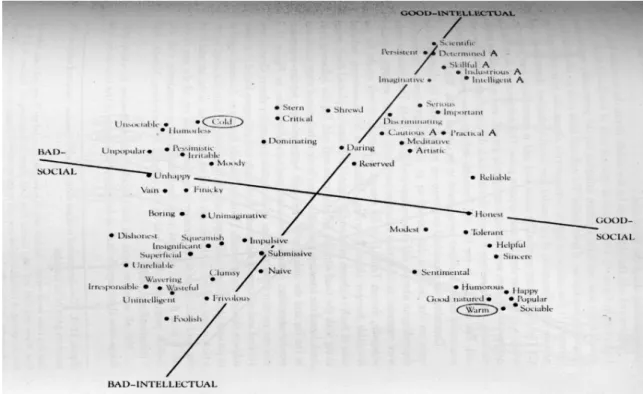
INDEX OF FIGURES Figure 1.The bidimensional representation of the implicit theory of personality, from Rosenberg and colleagues (1968).……….…………..…..….22
xiii
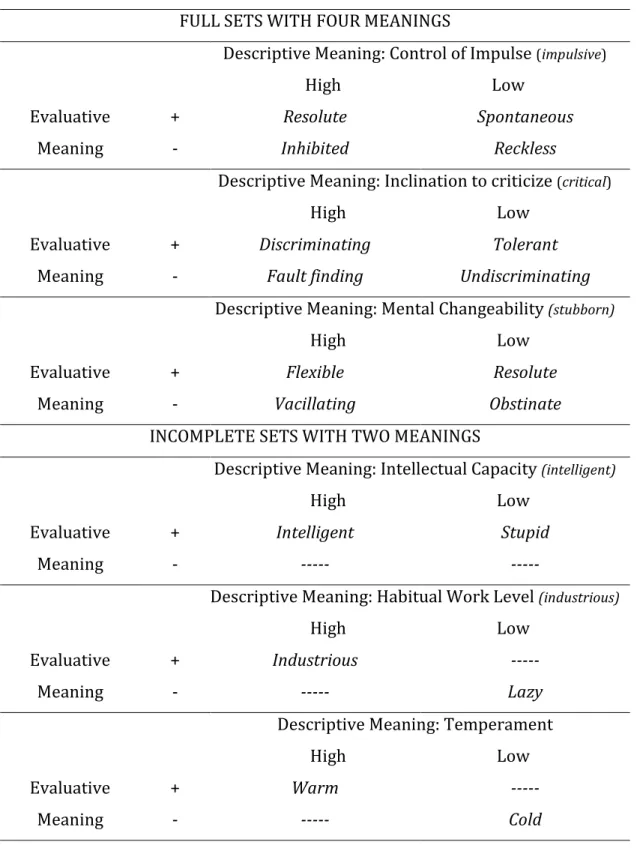
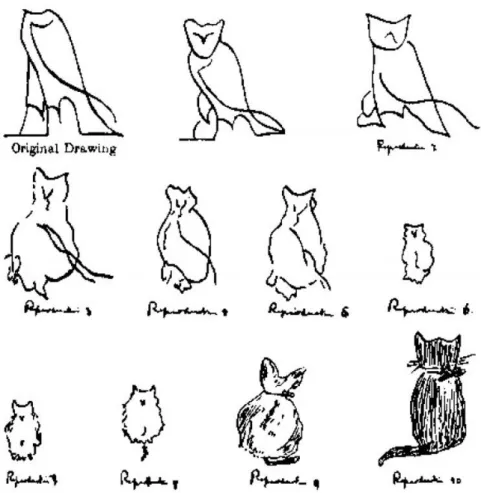
Figure 2. Descriptive and evaluative meanings of personality traits (adapted from Brown, 1986; pp. 403).……….……….…..………..….28 Figure 3. Original picture of the “subway scene” used by Allport and Postman (1947) to test the serial reproduction/social transmission of information (left) and description of the same scene by one of the last links on a serial reproduction chain (right; Allport& Postman, 1947; p. 70).……….……….……….…40-41 Figure 4. Alterations of an Egyptian mulak representing an owl until it becomes a cat, in a serial reproduction paradigm (Bartlett, 1932; p. 180)……….….45 Figure 5.Mean proportion of false alarms produced in the standard recognition test relative to list cluster personality traits and to other personality traits in Experiment 1 as a function of condition. Error bars display standard errors of the mean.………...…….90 Figure 6.Mean difference between the proportion of veridical recognition of positive and negative personality traits from the list’s dimension, in the standard recognition test in Experiment 2A, as a function of condition and list’s valence. Error bars display standard errors of the mean.……….……….………..…..101 Figure 7.Mean difference between the proportion of false recognition of positive and negative personality traits from the central trait’s dimension, in the standard recognition test in Experiment 2A, as a function of condition and central trait’s valence. Error bars display standard errors of the mean.……….……….…………..…101 Figure 8.Mean difference between the proportion of veridical recognition of positive and negative personality traits from the list’s dimension, in the gist recognition test in Experiment 2A, as a function of condition and list’s valence. Error bars display standard errors of the mean……….…..…….104 Figure 9.Mean difference between the proportion of false recognition of positive and negative personality traits from the central trait’s dimension, in the gist recognition test in Experiment 2A, as a function of condition and central trait’s valence. Error bars display standard errors of the mean.………...……….……….…..…….105 Figure 10.Mean difference between the proportion of veridical recognition of positive and negative personality traits from the list’s dimension, in the standard recognition test in Experiment 2B, as a function of condition and list’s valence. Error bars display standard errors of the mean.………..……….…..111-112 Figure 11.Mean difference between the proportion of false recognition of positive and negative personality traits from the central trait’s dimension, in the standard recognition test in Experiment 2B, as a function of condition and central trait’s valence. Error bars display standard errors of the mean.………..……….……….…..…….112
xiv
Figure 12.Mean difference between the proportion of veridical recognition of positive and negative personality traits from the list’s dimension, in the gist recognition test in Experiment 2B, as a function of condition and list’s valence. Error bars display standard errors of the mean……….…..…….114 Figure 13.Mean difference between the proportion of false recognition of positive and negative personality traits from the central trait’s dimension, in the gist recognition test in Experiment 2B, as a function of condition and central trait’s valence. Error bars display standard errors of the mean.……….……….…..…….115 Figure 14.Mean proportion of positive and negative false alarms, in the standard recognition test in Experiment 3A, as a function of condition and predominant valence of the first half of the list. Error bars display standard errors of the mean.……….….…..…….123 Figure 15.Mean proportion of positive and negative false alarms, in the gist recognition test in Experiment 3A, as a function of condition and predominant valence of the first half of the list. Error bars display standard errors of the mean.……….…….126 Figure 16. Mean difference between the proportion of false alarms to traits from the cluster of the first half of the list and the proportion of false alarms to traits from the cluster of the second half of the list, in the standard recognition test in Experiment 3B, as a function of condition and valence of the first half of the list. Error bars display standard errors of the mean.….…..…….136 Figure 17. Mean difference between the proportion of false alarms to traits from the cluster of the first half of the list and the proportion of false alarms to traits from the cluster of the second half of the list, in the gist recognition test in Experiment 3B, as a function of condition and valence of the first half of the list. Error bars display standard errors of the mean.….…..…….139 Figure 18. Serial reproduction procedure for each serial reproduction chain of four elements (links). L1 through L4 represent the four links, i.e., subjects, in a chain; R1 through R4 represent the four repeated free recall for each link; m stands for the math operations performed between recall attempts; inside the circles there is the indication of the list each link studied initially.……….………..…..…….147 Figure 19. Mean proportion of personality traits and athematic words correctly recalled in the first recall episode of all the participants, in Experiment 5, as a function of condition. Error bars display standard errors of the mean.……….…..…….162
xv
INDEX OF TABLES
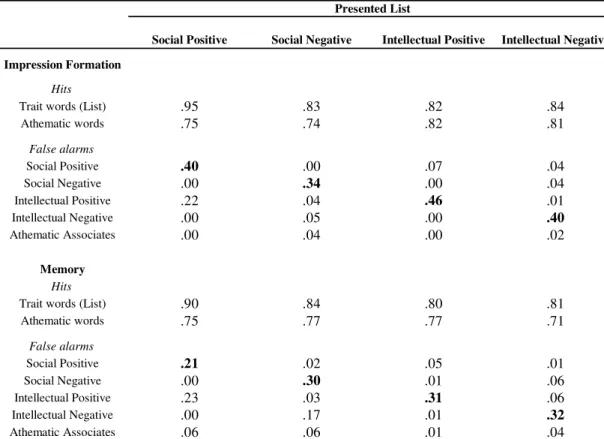
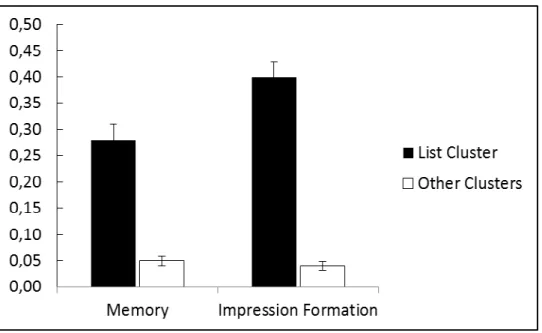
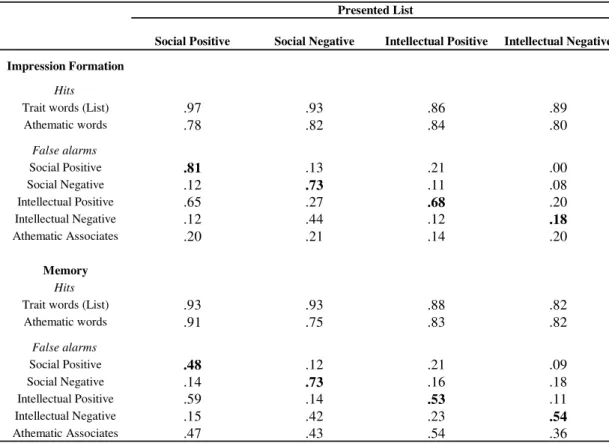
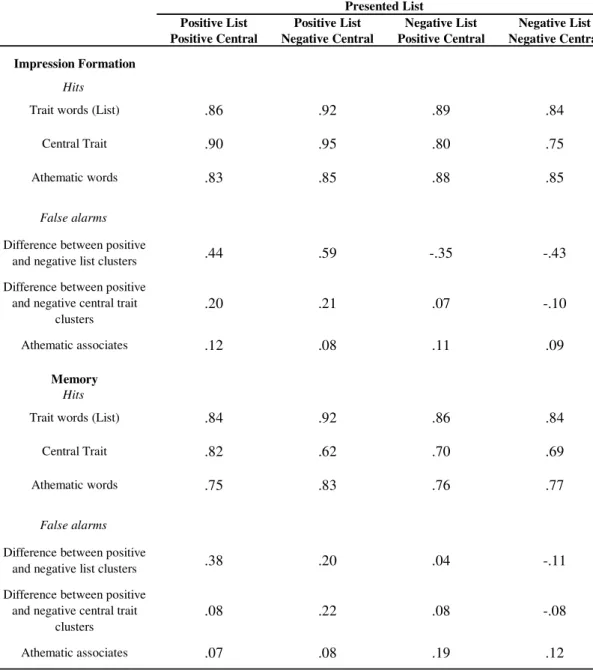
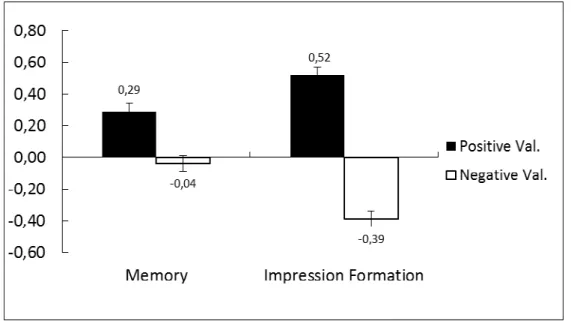
Table 1. Mean proportions of different types of veridical and false memories by type of list and condition in the standard recognition test in Experiment 1.……….…..……...89 Table 2. Mean proportions of different types of veridical and false memories by type of list and condition in the gist recognition test in Experiment 1.………..…….92 Table 3.Mean proportions of trait hits, central trait hits, athematic hits, athematic false alarms and mean differences between the proportions of false memories opposing in valence (for list and central trait dimensions) by list valence and central trait valence and condition, for the standard recognition test in Experiment 2A.……….…..…….99 Table 4. Mean proportions of trait hits, central trait hits, athematic hits, athematic false alarms and mean differences between the proportions of false memories opposing in valence (for list and central trait dimensions) by list valence and central trait valence and condition, for the gist recognition test in Experiment 2A. ………..….……102-103 Table 5. Mean proportions of trait hits, central trait hits, athematic hits, athematic false alarms and mean differences between the proportions of false memories opposing in valence (for list and central trait dimensions) by list valence and central trait valence and condition, for the standard recognition test in Experiment 2B.………..…….110 Table 6. Mean proportions of trait hits, central trait hits, athematic hits, athematic false alarms and mean differences between the proportions of false memories opposing in valence (for list and central trait dimensions) by list valence and central trait valence and condition, for the gist recognition test in Experiment 2B.……….……….….113 Table 7.Mean proportions of trait hits, positive and negative trait hits, athematic hits, athematic false alarms and false alarms to positive and negative traits (for the list dimension) by type of list (dimension and predominant valence of the first half) and condition, for the standard recognition test in Experiment 3A.……….…….……….…..…….122 Table 8.Mean proportions of trait hits, positive and negative trait hits, athematic hits, athematic false alarms and false alarms to positive and negative traits (for the list dimension) by type of list (dimension and predominant valence of the first half) and condition, for the gist recognition test in Experiment 3A.………...……….……….….124-125 Table 9.Mean proportion of trait hits, mean difference between the proportions of first half trait hits and second half trait hits, mean proportions of athematic hits, athematic false alarms and mean difference between the proportions of false alarms from the first half of the list cluster and false alarms from the second half of the list cluster by type of list (dimension and valence of the first and the second half) and condition, for the standard recognition test in Experiment 3B……….………..…133-134
xvi
Table 10.Mean proportion of trait hits, mean difference between the proportions of first half trait hits and second half trait hits, mean proportions of athematic hits, athematic false alarms and mean difference between the proportions of false alarms from the first half of the list cluster and false alarms from the second half of the list cluster by type of list (dimension and valence of the first and the second half) and condition, for the gist recognition test in Experiment 3B.………...…137-138 Table 11. Mean proportion of personality traits correctly recalled out of the original list presented to Link 1 in Experiment 4, by recall episode (recall 1 through 4) and position in the serial reproduction chain (link 1 through 4).………...….148-149 Table 12. Mean proportion of personality traits correctly recalled out of the original list presented to Link 1 in the first recall episode of each participant in Experiment 4, by position in the serial reproduction chain (link 1 through 4) and condition (memory vs. impression formation).……….……….…..…….149 Table 13. Mean proportion of athematic words correctly recalled out of the original list presented to Link 1 in Experiment 4, by recall episode (recall 1 through 4) and position in the serial reproduction chain (link 1 through 4).………...…..…….150 Table 14. Mean proportion of personality traits correctly recalled out of the actually studied list in Experiment 4, by recall episode (recall 1 through 4) and position in the serial reproduction chain (link 1 through 4).……….……….…..…….150 Table 15. Mean proportion of personality traits correctly recalled out of the actually studied listin the first recall episode of each participant in Experiment 4, by position in the serial reproduction chain (link 1 through 4) and condition (memory vs. impression formation)……….………….……….…..…….151 Table 16. Mean proportion of athematic words correctly recalled out of the actually studied list in Experiment 4, by recall episode (recall 1 through 4) and position in the serial reproduction chain (link 1 through 4).……….……….…..…….151 Table 17. Mean proportion of personality traits falsely recalled out of the five nonpresented critical traits from the studied lists’ cluster in Experiment 4, by recall episode (recall 1 through 4) and position in the serial reproduction chain (link 1 through 4).………..…….152 Table 18. Mean proportion that false recall of nonpresented critical traits comprises of total recall output in Experiment 4, by recall episode (recall 1 through 4) and position in the serial reproduction chain (link 1 through 4).……….……….…..…….152 Table 19. Mean proportion of personality traits correctly recalled out of the original list presented to Link 1 in Experiment 5, by recall episode (recall 1 through 4) and position in the serial reproduction chain (link 1 through 4).………...…...157-158
xvii
Table 20. Mean proportion of personality traits correctly recalled out of the original list presented to Link 1 in the first recall episode of each participant in Experiment 5, by position in the serial reproduction chain (link 1 through 4) and condition (memory vs. impression formation).……….……….…..…….158 Table 21. Mean proportion of athematic words correctly recalled out of the original list presented to Link 1 in Experiment 5, by recall episode (recall 1 through 4) and position in the serial reproduction chain (link 1 through 4).……….….159 Table 22. Mean proportion of athematic words correctly recalled out of the original list presented to Link 1 in the first recall episode of each participant in Experiment 5, by position in the serial reproduction chain (link 1 through 4) and condition (memory vs. impression formation).……….159 Table 23. Mean proportion of personality traits correctly recalled out of the actually studied list in Experiment 5, by recall episode (recall 1 through 4) and position in the serial reproduction chain (link 1 through 4).……….……….…..………….159-160 Table 24. Mean proportion of personality traits correctly recalled out of the actually studied list in the first recall episode of each participant in Experiment 5, by position in the serial reproduction chain (link 1 through 4) and condition (memory vs. impression formation)………..…….160 Table 25. Mean proportion of athematic words correctly recalled out of the actually studied list in Experiment 5, by recall episode (recall 1 through 4) and position in the serial reproduction chain (link 1 through 4).……….……….………..…….160-161 Table 26. Mean proportion of athematic words correctly recalled out of the actually studied list in the first recall episode of each participant in Experiment 5, by position in the serial reproduction chain (link 1 through 4) and condition (memory vs. impression formation)………..…….161 Table 27. Mean number of personality traits intruded (falsely recalled) in Experiment 5, by recall episode (recall 1 through 4) and position in the serial reproduction chain (link 1 through 4).………...……….……….…..…….163 Table 28. Correlations between importance ratings of personality traits, their distance to the centroid of their cluster represented in the implicit theory of personality, and their survival indexes calculated for serial and repeated recall for each one of the conditions (memory and impression formation) ad for the last recall (recall 4) of the last link in the serial reproduction chain (link 4) for each condition.……….……….……….…..…….164
xviii
Memory believes before knowing remembers. Believes longer than recollects, longer than knowing even wonders.
William Faulkner
Somewhere I have heard this before In a DReaM my memory has stored.
Kurt Cobain
A few more details, enabling the listener to repeat his version in turn, then
nothing to talk about (…)
1
INTRODUCTION
You are meeting your friend Jane and she starts describing her childhood friend, Mike. Almost immediately you form an impression about Mike who you have never met. You will take the information Jane is giving you and make some inferences in order to achieve a coherent impression about Mike’s personality. But how does the way Jane conveys you the information influence the impression you are forming? And are you a passive receiver or does the previous representation you hold about others’ personalities play a role in the shaping of the impression? Now imagine that you want to tell your own childhood friend, John, about Mike. Will you convey the actual information that has been passed to you by Jane? And what if John wants to share the same information with someone else? How will this shared information differ from the original information conveyed by Jane?
Research in impression formation and memory has already provided some hints useful to answer these questions (e.g. Hamilton, 1989). However, to our knowledge no one has ever systematically studied these issues. And it is precisely what we proposed to do in the research program reported here. Taking into account previous studies, we believe that impressions of personality are grounded in associative structures (e.g., Asch, 1946) and, consequently, the impressions we form about others’ personalities will reflect the organization within those associative structures. As associative structures, the structures serving impressions formation processes should also be prone to memory distortions already identified in other associative structures, such as semantic structures (e.g., Roediger & McDermott, 1995). The referred distortions rather than being a memory impairment can be seen as a performance cost of the usage of highly flexible structures that allow us to navigate the world and adapt to it (e.g., Howe, 2011). But, despite these cognitive similarities to other associative structures, we believe that the activation of the associative structure underlying impressions formation processes is conditional to that processing goal and whenever there is another processing goal, a default semantic structure should be activated and it should lead to differences in the pattern of memory distortions within the activated structure in each case. The study of the patterns of memory distortions is in accordance with the idea that memory processes are mainly reconstructive processes, as Sir Frederic Bartlett (1932) suggested. Plus, we also
2
borrowed from Bartlett (1932) the notion that transmission of information must suffer an accumulation of individual biases across the transmission chain. More specifically, when information is retrieved from memory and transmitted serially between people within a serial reproduction chain, the information should be progressively changed according to predictable patterns that reflect the conditions of transmission and, more interestingly, the previous representations of the transmitted concepts. Thus, we became interested in seeing what would occur when the transmitted information actually had social relevance, like what occurs with the transmission of impressions of personality. If in the story we told you initially it is not very important if you did not get the correct impression from Mike and may have even confounded his personality with your own childhood friend’s, or if the last person receiving information about Mike got a completely different impression about him, in certain situations such as work environments or spreading of important news, these alterations may have a large impact in some people’s lives. Gossip and rumor are a byproduct of alterations that occur during the social transmission of information (Allport & Postman, 1947) and we propose to study these alterations using a socially relevant material – impressions of personality.
In sum, we will be presenting a set of five studies designed to investigate (1) the susceptibility of the associative structure underlying impression formation to memory biases; (2) the role of the organization of personality traits in memory in the pattern of biases obtained, which should be related to the classical effects obtained in impression formation literature (e.g., Asch, 1946); (3) the possible conditional nature of the activation of the referred associative structure; and (4) the pattern of distortions implied in the serial transmission of socially relevant information, such as impressions of personality.
Before presenting the actual experiments and discuss the obtained results, we will start by presenting a review of the literature that has already dealt with these issues. So, in this introduction, we will start by reviewing the main studies that tried to elucidate the cognitive processes underlying impression formation – from Asch (1946) and his identification of those that still are considered the classic effects in impression formation (centrality and primacy effects) to Anderson (e.g., 1967) who proposed a different theory, passing by the attempts to map an implicit theory of personality and finishing with the debate between Peabody (1990) and Brown (1986)
3
on the weight of evaluative and descriptive aspects of personality traits for the impression formed. Then we will review the studies on serial reproduction of information, which started with Bartlett’s (1932) attempts to study the reconstructive nature of memory and was summarized by Allport and Postman (1947) in their book on psychology of rumor. Finally, we will report the most significant studies on memory distortions, mainly on false memories, including the work with the DRM paradigm (Deese, 1959; Roediger & McDermott, 1995) and the main effects obtained with it (for a review, see Gallo, 2004) as well as the main theories used to explain those effects. After the review of the literature on these three main themes, we will be able to introduce our research line in more detail and to provide a theoretical framework for the interpretation of our results, in the general discussion.
1. IMPRESSION FORMATION
The way we form impressions about others has been studied for more than 60 years. Asch (1946) was the first author to systematically study how impressions of personality are formed, but the whole idea that impressions of personality are a rich study subject had been developed earlier by authors as Allport & Allport (1921) who were more interested in the accuracy of impressions formed than in the process involved in their formation. The fact that this line of research had assumed a relevant role in Social Psychology (Asch, 1946) and later in Social Cognition (e.g., Hamilton, 1989) and Social Neuroscience (e.g., Mitchell, Macrae, & Banaji, 2005) is not very surprising since impression formation occurs automatically and on a daily basis.
As we live in complex societies and do have to frequently interact with each others, forming impressions about others help us navigating the social world. It is our impressions of others that give us information about the social behaviors we should adopt and what type of interactions we should initiate, maintain, or terminate. These impressions tip us about who to trust, whom to vote for, if a given person is right for the job, whether that used cars salesman is presenting us with a bad or a good deal. But how do we form these impressions? If they have such a prominent role in guiding our social behavior they must have proved to be somehow accurate and “economic” in the sense that they must form easily and in the absence of complex information. Actually, it is quite amazing how we can go beyond very few bits of information provided and form an integrated impression about someone’s personality (e.g.,
4
Thorndike, 1920; Asch, 1946). Thus, it seems fair to assume that the process of forming impressions of personality rely on previous representations that people hold about others personalities and their strong expectations about which personality characteristics usually go together (Bruner, Shapiro, & Tagiuri, 1958).
The beliefs people hold about how personality traits usually combine in someone was dubbed as the implicit theory of personality and it can be seen as an associative structure. The implicit theory of personality thus represents the personality traits most commonly used to describe others and the relationships between those traits (Rosenberg, Nelson, & Vivekanathan, 1968). If we assume that this representation is accurate we can think of the implicit theory of personality as an associative memory structure, prone to the same effects found within other associative memory structures and possible to be studied by methods similar to those used to study other associative memory structures, as we will propose in this research line.
But how do we form impressions about someone’s personality in the first place? Is it a gestaltic process by which we combine information, sharpening some characteristics and leveling others (Asch, 1946)? Or do we apply mathematical rules to combine someone’s characteristics and average them until forming an impression of personality (Anderson, 1967)? Despite its early beginning, this debate about the process of forming an impression of personality is still open and benefitting from research on memory and other cognitive processes (Hamilton, 1989). In the present study, we will review some of these theories about the processes involved in forming impressions of personality but we will focus more on how the results obtained in those experiments can be related to memory processes and affected by the same biases that affect associative structures of memory such as semantic memory.
In this chapter we will start by reviewing the first study that focused the process of forming impressions of personality and not only on the accuracy of the impression (Asch, 1946). Then we will turn to the attempt to provide theoretical background to the study of impressions of personality and the notion of implicit theory of personality (Bruner et al., 1958). After this conceptualization we will review Anderson’s (1962; 1967; 1969) application of a mathematical model to impression formation and then we will turn a more theoretical conceptualization of the implicit theory of personality and its mapping, focusing on the relations between personality traits (Rosenberg et al., 1968). After this we will review the debate about the weight of different
5
characteristics of personality traits themselves in impression formation – descriptive and evaluative characteristics (Peabody, 1967; Brown, 1986). Finally we will try to come up with a general view of the structure of impressions of personality and the way personality traits are represented in memory.
1.1. In the beginning was the Gestalt: Asch and his seminal study
In 1946, Solomon E. Asch was the first researcher to systematically study how we make impressions about other people. In his seminal paper, Asch explored some impression formation effects that triggered the interest of other researchers during the past six decades. By conceiving impressions as coherent and integrated representations of persons and proposing that inferential processes come to action when people form impressions, Asch (1946) prompted an entire research field interested in identifying the processes underlying impression formation. However, before identifying those processes, two basic questions had to be answered: (1) how is it possible to form a unified coherent representation of someone’s personality departing solely from individual personality traits and (2) which principles guide this integration of traits. These two questions reflect exactly what Solomon Asch (1946) tried to answer with a set of ten experiments. The general procedure used consisted in presenting participants lists of adjectives, i.e., personality traits, about a given target, and then ask them to write comments on which impression they formed about the target; after this task, participants were presented with a checklist composed of pairs of opposed personality traits (e.g., frivolous-serious) and were asked to give more information about their impression of the target by choosing the traits that were most in accordance with the formed impression about the target, given the initial list of adjectives; participants were also asked to rank the chosen traits according to their importance for the impression.
Asch clearly had a gestaltic view of the way impressions of personality are formed and his experiments explored the principle that the whole is more than the sum of the parts. Only by showing participants individual personality traits, Asch (1946) was able to having them forming unified representations that reflected a whole impression of personality that was more than the simple sum of the presented traits but was affected by factors such as the order of their presentation or the simple inclusion of a different trait. In Experiments 1 to 3, Asch (1946) shows how some
6
traits are more central or peripheral (the centrality effect) and how that quality can be changed just by changing the context, i.e., the other presented traits; in Experiments 4 and 5, Asch illustrates how the importance of traits and their value can be changed; in Experiments 6 to 8, Asch demonstrates the primacy effect by which the first presented traits guide the entire impression formation process, changing the way the following traits are perceived; in Experiment 9, Asch shows how complete impressions can be made based solely in three personality traits, or even only one; and, finally, in Experiment 10, some of the qualities that allow for judgments of similarity or difference between persons were analyzed.
The centrality effect is perhaps the most intriguing effect described by Asch. Asch (1946; Experiment 1) departs from the idea that some personality traits play a basic role in impression formation, being weighted more heavily than others, more secondary, traits. To test this assumption, Asch had two groups of participants hearing one of two target descriptions; each description consisted exactly of the same personality traits with the exception of a trait included in the middle of the description. So, one group heard the traits “intelligent – skillful – industrious – warm – determined – practical – cautious” whereas the other group heard the traits “intelligent – skillful – industrious – cold – determined – practical – cautious”. After hearing the traits, participants were asked to write a brief sketch about the target’s personality. Then, participants were presented with a checklist of 18 pairs of opposite personality traits (e.g., generous-ungenerous; unhappy-happy; important-insignificant; ruthless-humane; strong-weak) and instructed to chose, from each pair, the trait that was most in accordance with the view they formed about the target. Results showed that participants presented with the description that included the trait warm formed impressions far more positive than the ones presented with the description that included the trait cold. More interestingly, in the checklist, certain traits choice reflected a drastic reversal according to which description was presented while other traits choice was unaffected. For instance, when warm was included in the list, 91% of the participants chose generous from the pair generous-ungenerous, but when
warm was replaced by cold, the same percentage was reduced to 8%; but approximately 90% of participants chose reliable from the pair reliable-unreliable, independently of whether warm or cold was included in the list. According to Asch, these results support the idea that there are central and peripheral traits that contribute
7
more and less, respectively, to an impression of personality. In a following experiment, Asch (1946; Experiment 2) omitted the words warm and cold from the descriptions but added the pair warm-cold to the checklist and verified that 41% of the participants judged the target as warm whilst the other 59% judged the target as cold and based the other trait judgments on this inference thus showing similar choices to participants that in Experiment 1 had been presented with the “warm” description and the “cold” description, respectively. Again, this result seems to support the notion that the traits warm and cold are so important that even when they are not presented, they are inferred in order to construct a unified impression. In a third experiment, Asch (1946; Experiment 3) used the same procedure he had used in Experiment 1 but instead of the traits warm and cold he manipulated the inclusion of the traits polite and blunt, and found that this manipulation had virtually no effects in the judgment of a target. These traits are thus considered peripheral and to contribute less to the formation of an impression of personality.
In the following two experiments, Asch (1946; Experiment 4 and Experiment 5) illustrated the possibility of changing the interpretation of the central traits warm or
cold simply by changing the traits accompanying them (Experiment 4); or by
presenting lists composed three opposite traits and two similar traits and asking participants to write down the synonyms of the presented traits (Experiment 5). When accompanied by traits such as obedient, weak, shallow, unambitious, and vain, the trait warm was interpreted as submissive; and when accompanied by traits such as
vain, shrewd, unscrupulous, shallow, and envious, the trait warm was interpreted as fake. A similar modification occurred for the trait cold when accompanied by
different sets of traits. Also, the traits warm and cold lost their central quality; as they were reinterpreted, and their content was changed due to the accompanying traits used in the descriptions, making them lose importance in the overall impression formed. These results alert to the fact that a central trait only plays a central role in impression formation in comparison to the other traits possessed by the target. However, Asch (1946) states that this is simply a change of functional value within someone’s description and that central traits do not suffer changes in their general evaluation, being this the reason why they must be reinterpreted within targets’ description that do not match the usual meaning of the central trait.
8
thoroughly studied. Asch defined this “primacy effect” as a directional effect by which the first personality traits presented about a given target would guide all the impression formation process and the following traits interpretation, thus it should be possible to alter an entire impression about someone described exactly by the same traits by just changing the order of the traits presentation. In Experiment 6, Asch presented a group of participants with the traits “intelligent – industrious – impulsive – critical – stubborn – envious” and another group with exactly the same traits but in reversed order, “envious – stubborn – critical – impulsive – industrious – intelligent”. The first series of traits starts with positive traits such as intelligent and industrious and proceeds with less positive ones whereas the other series starts with more negative traits and ends with the positive ones. Asch found that when positive traits were presented first the impression formed about the target was much more positive and dominated by the impression derived from those traits than when participants heard exactly the same traits but the positive traits only appeared later. Actually, in this Experiment, participants presented with the series starting with “intelligent” evaluated the target as an “able person who possesses certain shortcomings which do not, however, overshadow his merits” (Asch, 1946, p.270); on the other hand, participants presented with the traits in reversed order evaluated the target as “a problem, whose abilities are hampered by his serious difficulties”. Besides this, for the first series, some more negative traits are interpreted as positive qualities whereas they are interpreted as fully negative when the presentation is reversed. Moreover, in the checklist, positive traits were selected more often when participants had been presented with more positive traits earlier. Plus, in a within condition, where 24 participants were first presented with the reversed series and afterwards with the series starting with “intelligent”, 14 participants claimed their impression suffered a change. Asch argued that these results show that primacy guides the development of an impression and exerts continuous effects on the encoding of latter traits. However, it must be noted that, according to Asch (1946), this concept of primacy is not the same that is usually found in memory studies (Ebbinghaus, 1885/1964) in which the first items of a series are better remembered than the following ones and that is usually compared to the recency effect, which is an advantage in memory for the latter items in a series. Asch refers that this primacy effect does not depend only on the temporal position of the traits but also on the functional relation between them.
9
Nevertheless, the idea that the primacy effect in memory depends only on the temporal position of the items in a series and that it is based on mechanisms similar to the ones involved in the recency effect has been challenged by authors such as Endel Tulving (2007), who proposed that all sorts of primacy effects are distinct from the recency effects and are based in a very specific mechanism – the camathotic encoding. But we will get to this idea later, when the primacy effect is discussed in depth. Yet, Asch gathered more evidence for this primacy effect in impression formation in two more experiments. In Experiment 7, Asch (1946) used a procedure similar to the one used in Experiment 6, but instead of a gradual change in the merit of the presented traits he presented a more negative trait in the beginning or the end of each series. Again, the results pointed to a more negative impression when this more negative trait was presented in the beginning of the series, and it should be noted that this was the only dubious trait presented. Finally, in Experiment 8, the first series presented in Experiment 6 was split in two and presented as describing two targets, one was “intelligent – industrious – impulsive” and the other was “critical – stubborn – envious”; after the separate presentation and the usual impression sketch and checklist procedures for each target, participants were informed that the two lists described a single target and that they should now form an impression corresponding to the entire list of traits. This group of participants found very difficult to integrate the two descriptions in one single impression because the two sets of traits seemed completely contradictory; on the other hand, a control group that had been presented with the same traits as only one target description did not report difficulties in forming an impression. Taken together, the results of these three experiments suggest that the first presented personality traits contribute more to the impression formation process than the latter ones because they guide the direction of the impression and the inferences made about the target, while the meanings of the latter presented traits are selected to be more congruent with the first presented traits (Asch, 1946).
In two final experiments, Asch (1946; Experiment 9 and 10) proposes to observe in a more extreme way the formation of a global impression. To do so, Asch presented only one personality trait and then asked participants to select from the same checklist used in the previous experiments the traits from each pair that better described the target person described by that given trait. The traits used were “cold” and “warm”. The results indicated that the differences between the two targets were
10
even more remarkable now than in Experiment 1. Asch also made participants characterize the targets with a different checklist and found that even physical characteristics were differently attributed to the warm target and to the cold targets, for instance, the warm target was short and stout whereas the cold target was tall and thin. The fact that the judgments in this Experiment were more extreme than the judgments in Experiment 1 made Asch consider that the central traits warm and cold had been highly influenced by the other presented traits in Experiment 1, despite their centrality. In a final experiment, Asch (1946; Experiment 10) investigated which conditions influence judgments of similarity and difference between sets of traits. Participants were presented with four sets of three traits each and were instructed to pick the set that was more similar to the first set in the series. The sets were built in a way that one of the characteristics remained the same in all four sets (helpful) and the other two characteristics (skillful and quick) either changed separately (skillful and
slow; clumsy and fast) for two of the sets or at the same time for the fourth set (clumsy
and slow). Thus, the fourth set was the most distant from the first set and the other two sets were equally distant from the first set. Strikingly, the results showed that the first set is considered to be more similar to the third set in 87% of the cases, whereas the second set is considered to be more similar to the fourth set in 85% of the cases. This is not compatible with a simple judgment based on the number of identical traits per set, because if so sets 1, 2, and 3 should be considered equally similar. So, the suggested explanation for these results is that some traits resemble more or less other traits depending on which traits they are accompanied by. So, quick accompanied by
helpful and skillful is more similar to slow accompanied by helpful and skillful than it
is similar to itself when accompanied by helpful and clumsy. Thus, this last experiment not only shows how judgments of similarity are affected by the totality of traits involved in the targets’ descriptions but also reinforces the idea that traits meanings can change because of the other traits used to describe the same target.
Taken together, the set of results obtained by Asch (1946) seem to support his idea that the process of impression formation obeys to gestalt rules, in the sense that when forming an impression about someone, we try to come up with an unified impression in which the whole is more than the sum of the parts, as the interplay between each part, i.e., between each personality trait, defines the meanings attributed to each one of the traits. So, personality traits do not have an intrinsic meaning or
11
quality but are defined in accordance to the context. Even if we consider that there are more central and more peripheral traits, they only possess those characteristics in comparison with the traits also attributed to the same target.
1.2.From the Gestalt to the Implicit Theory of Personality
The gestaltic integrative view of impression formation suggested by Asch (1946) assumes that an impression about someone’s personality is unified and integrates all the information available. This view points to a reinterpretation of any single bit of information about someone according to the context, i.e., according to all the other bits of information available, however it does not specify how any previous experience with forming impressions may affect the impression formation process itself. More specifically, Asch does not explain how the relations between personality traits are shaped and how people made the stable inferences they did in his experiments. Moreover, it seems that for Asch the context (the set of traits used and its ordering) explains all the impression formation process. But is it really likely that people form impressions about others without any previous notions?
According to Bruner and Tagiuri (1954), the reason why people are able to make inferences about other people’s personality and thus show the effects reported by Asch (1946) is because they hold an implicit theory of personality. This term was dubbed by Bruner and Tagiuri (1954) to describe the beliefs that people have about which personality traits tend to co-occur within the same individual, this is which categories do people generally use to describe others when making impressions, and Cronbach (1955) made the use of the term implicit theory of personality more mainstream. This idea that people hold an implicit theory of personality has been supported by research showing that perceivers have strong expectations about which personality traits "go together" (Bruner et al., 1958); and in perceivers' judgments, the correlations between such traits that "go together" tend to be overestimated (Berman & Kenny, 1976), being as persistent when perceivers judge strangers as when they judge familiar targets (Passini & Norman, 1966).
The existence of an implicit theory of personality, conceived as the set of expectations that people have about which personality traits should co-occur, goes against the idea that impressions of personality are perceptually based, as could be suggested by Asch’s (1946) studies. More specifically, instead of being perceptual