THE COSTS OF NON-TRAINING IN CHRONIC
WOUNDS: Estimates through practice simulation.
Pedro Gaspar1a; Josep Monguet2b; Jordi Ojeda2b; João Costa1a; Rogério Costa1a1
Polytechnic Institute of Leiria, 2
Universitat Politècnica de Catalunya
a
PhD student; b
PhD
[email protected]; [email protected]; [email protected]; [email protected] ; [email protected]
Abstrat. The high prevalence and incidence rates of chronic wounds represent high financial costs for patients, families, health services, and for society in general. Therefore, the proper training of health professionals engaged in the diagnosis and treatment of these wounds can have a very positive impact on the reduction of costs.
As technology advances rapidly, the knowledge acquired at school soon becomes outdated, and only through lifelong learning can skills be constantly updated. Information and Communication Technologies play a decisive role in this field. We have prepared a cost estimate model of Non-Training, using a Simulator (Web Based System – e-fer) for the diagnosis and treatment of chronic wounds.
The preliminary results show that the costs involved in the diagnosis and treatment of chronic wounds are markedly higher in health professionals with less specialized training.
Keywords: Non-training; pratice simulation; costs estimation;
1 Introduction
The prevalence and incidence rates of chronic wounds are substantial in the world [1] and, in addition to the obvious impacts they have on the quality of life, they represent very high economic costs for patients, families, health services, and for society in general [2,3]. For instance, the estimates point to a spending between 2.3 and 3.1 billion pounds (2005-2006 prices) per year in the United Kingdom [4] and 7 billion dollars in the USA, in 2007 (in dressing materials alone), a number that can rise to 20 billion dollars if other costs related to salaries, hospitalization, infection control, among others, are taken into consideration [5].
The training of health care professionals involved in the diagnosis and treatment of chronic wounds plays a decisive role in the control and optimization of costs, simply because by associating the technological advances of materials and equipment with adequate and standard guidelines on prevention and treatment, there will be a very positive impact on the clinical and economic results [6], and, therefore, a large portion of the financial load can be avoided [4].
In a context of fast-moving scientific and technological advances, knowledge acquired at school soon becomes outdated [7] and only through lifelong learning can we achieve professional updating. Information and Communication Technologies provide the health professionals with the means to access, interpret and apply the organizational knowledge, best practices, competences and skills, leading to more positive clinical results, thus maximizing cost reduction [8].
We have prepared a cost estimate model of non-training, using a Simulator (Web Based System – e-fer) for the diagnosis and treatment of chronic wounds. The use of such a simulator and of virtual cases has allowed us to overcome methodological problems and ethical constraints we faced when devising the experience, when we searched for empirical evidence to support the general hypothesis that costs vary according to the training of health professionals involved in the diagnosis and treatment of chronic wounds.
2 Materials and methods
(1) We developed a Web Based Learning (e-fer) that allows us to submit virtual cases of patients with chronic wounds, including the pictorial and non-pictorial information (time of evolution, location, size, tunnelization, oedema, hardening, smell, exudate, pain) on the wound, socio-demographic data, medical history, mobility and nutrition status, and the adequate diagnosis and treatment options. Nine virtual cases of patients with chronic wounds were validated (4 leg ulcers, 3 pressure ulcers, 2 diabetic foot ulcers), through the double-blind peer review.
(2) We developed a mathematical model to estimate the costs of chronic wounds (Figure1) which, in a society perspective, takes into account variables such as the Expected Treatment Time, Direct Costs (dressing costs, labour costs, travel costs from patient home to health service, travel costs from health service to patient home and costs of equipment for pressure relieving support) and Indirect Costs (productivity losses by patient, if the patient is a worker, and productivity losses by familiar that support patient. By applying the mathematical model to the virtual cases validated, we prepared the Optimum Cost matrices (estimated costs for the optimum treatment options).
(3) We developed a Web Based System (e-fer Simulator) that allows the simulation of decision-making in the treatment of the virtual cases of chronic wounds. The application of the mathematical model to the options chosen by the users enables the preparation of Cost of Decision matrices (estimated costs for the treatment options selected in the e-fer Simulator).
Figure 1 – Cost Estimation Model
(
DCW
LCW
TChs
TCph
)
CE
PLF
PLP
ETT
TC
=
×
+
+
+
+
+
+
Where: TC – Total CostsETT – Expected Treatment Time (weeks)
(
WWIHr DIHr ADIHr APIHr)
HT
ETT = + + +
HT - Healing Time
WWIHr - Wound Washing Impact in healing rate DIHr - Dressing Impact in healing rate
ADIHr - Additional Dressing Impact in healing rate APIHr - Additional Procedure Impact in healing rate DCW – Dressing Costs per Week
DCP DC DCW = ×
DCP- Dressing Change periodicity, per week DC- Dressing (materials) Costs, per week LCW –Labour (nursing) Costs per Week
(
)
[
]
(
LC Smob DCP)
LCW= min×201+0,251− ×
Smob –Mobility status (1 if the patient is autonomous ; 0 if the patient is not autonomous) LCmin – Labour Costs per minute
TChs – Travel costs from patient home to Health Service – per week
(
DCP)
SmobTChs= 49, × ×
TCph – Travel costs from Health Service to patient home – per week
[
]
(
)
[
]
(
Smob LC DCP) (
Smob)
TCph= 10,6+4,41+0,251− +20 min × ×1−
CE – Costs of Equipment for pressure relieving support
PRC ErgC PRM
CE= + +
PRM – Pressure relieving Mattress ErgC – Ergonomic Chair
PRC – Pressure Relieving Cushion
PLF – Productivity losses by familiar that support patient.
ETT DCP DPV
PLF = × ×
2
DPV – Daily production value
PLP – Productivity losses by patient (if the patient is a worker) Age2 – 0 if ? 65 years old
1 if < 65 years old
2 7ETT Smob Age DPV
(4) We conducted a quasi-experimental pre-test/post-test study with a non-equivalent control group, including 12 health professionals in each group. Participants were pre-tested with the e-fer Simulator (nine virtual cases) prior to starting an accredited training programme on the prevention and treatment of chronic wounds (totalling 35 hours of theory and practice). The experimental group alone attended the training programme. Both groups were post-tested with the e-fer Simulator (same nine virtual cases) at the end of training (Figure2). The results were analysed with the Man-Whitney and Wilcoxon nonparametric test, with 95% confidence interval.
Figure 2 - Quasi-experimental study design
Experimental group (n=12) Control group (n=12) Pre-test Post-test TRAINING Prevention and Treatment of Chronic Wounds 35h
X
Data pre-test Data post-test
Time (two weeks)
e-fer Simulator
e-fer Simulator
e-fer Simulator
e-fer Simulator
3 Results
The results reflect the difference between Optimal Costs and the Costs of Action observed in the groups.
The groups were homogeneous with regard to the Cost of Decision in the pre-test (U=64; p=0.641; 95,5 % CI = -5741,45€ to 4122,89€).
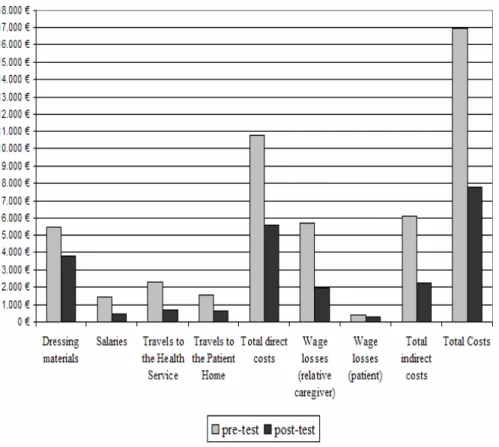
In the Experimental Group, the costs involved in the treatment of virtual cases were fewer in the post-test (figure 3), with a statistically significant difference (Z= -3.059; p= 0.002; 95,8 % CI = -5057,43€ to 13106,51€).
Figure 3 – Difference between Optimal Costs and Costs of Decision observed in Experimental Group (before and after training)
In the Control Group, there were no statistically significant differences (Z=-0.314; p=0.753; 95,8%CI= -3775,78€ to 7836,31€).
Although the Cost of Decision after training (post-test) were more than the Optimum Costs in both groups, we noticed that there are obvious differences between the Experimental Group (58.90% above the Optimum Costs) and the Control Group (119.19% above the Optimum Cost).
If we consider the 2009 prices, the estimated values for the non-training costs total 890.07 € for each wound, and 8,010.60 € for the total treatment of the nine virtual cases. 48% (3,852.73 €) of the savings fall on the indirect costs (salary losses of the reference family member and/or patient) and 52% (4,157.88 €) fall on direct costs. To be more precise, 22% (1,772.1 €) of the savings are related to the nurse’s salaries and travel expenses, 19% (1,541.52 €) to the patient’s travel expenses to the Health Service, and 11% (873.84 €) to the costs of dressing materials.
4 Conclusion
We believe that it is possible to estimate the costs of no training on several areas of health care, and to avoid methodological and ethical constraints in research by following the proposed method. Based on the development of Web Based Learning Systems that allow experts to submit virtual cases built upon real experiences, including all relevant data and the adequate diagnosis and treatment options, this method envisages the development of simulators that allow trainees to diagnose and treat patients in a virtual environment. Finally, by taking on a mathematical model that allows for cost estimation, it is possible to estimate the cost of non-training.
References
1. Vu, T., Harris, A., Duncan, G. & Sussman, G.: Cost-effectiveness of multidisciplinary wound care in nursing homes: a pseudo-randomized pragmatic cluster trial. Fam. Pract., cmm024, 1-8 (2007)
2. Franks, P. J. & Bosanquet, N. : Cost-Effectiveness: Seeking Value for Money in Lower Extremity Wound Management. International Journal of Lower Extremity Wounds, 3, 87-95 (2004)
3. Janßen, H. J. & Becker, R. : Integrated system of chronic wound care healing. EWMA Journal 7, 19-23 (2007)
4. Posnett, J. & Franks, P. J. :The burden of chronic wounds in the UK. Nursing Times, 104, 44–45 (2008)
5. Zaleski, T.: “Active” Products Drive Wound-Care Market. Goal Is to Offer a Lower Overall Cost Solution. (2008) , Available from:
http://www.genengnews.com/articles/chitem.aspx?aid=2459&chid=0 (Accessed 5 May 2009).
6. Dini, V., Bertone, M. & Romanelli, M.: Prevention and management of pressure ulcers. Dermatologic Therapy, 19, 356–364 (2006)
7. Kokol, P., Blažun, H., Mičetić-Turk, D. & Abbott, P. A.: e-Learning in Nursing Education – Challenges and Opportunities. In : Park et al (eds.) Consumer-Centered Computer-Supported Care for Healthy People. IOS Press,Amsterdam (2006)
8. Nelson, A.: E-learning. A Pratical Solution for Training and Tracking in Patient-care Settings. Nursing Admtnistration Quarterly, 27(1):29-32 (2003)