Generative Theatre of Totality
Pedro Alves da Veiga
CIAC, Universidade Aberta, Universidade do Algarve ---
ABSTRACT
Generative art can be used for creating complex multisensory and multimedia experiences within pre-determined aesthetic parameters, characteristic of the performing arts and remarkably suitable to address Moholy-Nagy’s Theatre of Totality vision. In generative artworks the artist will usually take on the role of an experience framework designer, and the system evolves freely within that framework and its defined aesthetic boundaries. Most generative art impacts visual arts, music and literature, but there does not seem to be any relevant work exploring the cross-medium potential, and one could confidently state that most generative art outcomes are abstract and visual, or audio. It is the goal of this article to propose a model for the creation of generative performances within the Theatre of Totality’s scope, derived from stochastic Lindenmayer systems, where mapping techniques are proposed to address the seven variables addressed by Moholy-Nagy: light, space, plane, form, motion, sound and man (“man” is replaced in this article with “human”, except where quoting from the author), with all the inherent complexities.
KEYWORDS
Generative Art, Performing Arts, L-system, Theatre of Totality, Complex Systems.
ARTICLE INFO Received: 07 November 2017 Accepted: 11 November 2017 Published: 22 December 2017 https://dx.doi.org/10.7559/citarj.v9i3.422 1 | INTRODUCTION
There are several definitions of generative art (Galanter, 2014; McCormack et al., 2014) that classify it according to media, methodologies or genres, such as systems art, interactive art, algorithmic art, OpArt, BioArt, evolutionary art, among others. Georg Nees first proposed the designation “generative” in 1965, with his exhibition Generative Computergraphik in Stuttgart, not so far apart from Moholy-Nagy’s outlining of the Theatre of Totality, in 1961. The term generative implies the existence of an autonomous system, an algorithmic structure that is followed, by machine or human endeavours, for the creation of whatever output the artwork generates. Generative art is not a style or genre, but rather a process to produce aesthetic experiences.
The underlying algorithm is used to combine structure (order) with randomness (chaos), as one iteration becomes the seed for the next one, thus resulting in a seemingly infinite sequence of states or combinations, but all within a certain aesthetic boundary defined by the artist/programmer (Dorin, 2013). Current generative art is either used to model living systems growth, particularly plant growth (a direct inheritance from L-systems) or is mostly abstract (Galanter, 2011).
There are multiple approaches and studies that deal with the applicability of generative systems to particular areas or fields of study/creation, such as most well-known turtle graphics examples, music (Rodrigues et al., 2016; Dean, 2017), and literature (Balpe, 2005). Galanter states that “contemporary technology-based generative art explores the same
territory as complexity science and is at the apogee of the complexity curve” (Galanter, 2011).
However there doesn’t seem to be a global vision that combines all areas into one integrated score making direct use of all of the above: literature, emotional and body expressiveness, visual and musical elements. Because generative systems essentially produce sequences of code that can be interpreted as colours, spatial coordinates and motion vectors, pitch, modulation, tempo, rhythm, among others, there is no apparent reason why such systems cannot be used to generate interpretation (emotion, duration, aim, intent, etc.) or body-expression (movement, directionality, intensity, force, etc.).
When we see a theatrical performance, the experience is unique. The individual interpretation and overall delivery are exclusive not just to the specific expression of the play but also to the audience. A subsequent performance will likely differ from the first. This is a strength that theatre and the performing arts hold over cinema, video, photography, painting or sculpting, where repeat viewings can reveal missed details, but the pieces are static and immutable. And this strength is shared with digital art, through controlled randomness and interactivity. The performing arts imply different viewings and experiences. The relationship between the performer(s) and the audience is key to the experience and creates a deeper human bond. The idea of expanded or augmented performance is not new. The Bauhaus school advocated an approach to theatre that aimed to integrate technology with performance and Moholy-Nagy proposed the following:
“Man as the most active phenomenon of life is indisputably one of the most effective elements of a dynamic stage production (Bühnengestaltung), and therefore he justifies on functional grounds the utilization of his totality of action, speech, and thought. (...) And if the stage didn't provide him full play for these potentialities, it would be imperative to create an adequate vehicle. But this utilization of man must be clearly differentiated from his appearance heretofore in traditional theatre. While there he was only the interpreter of a literarily conceived individual or type, in the new Theatre of Totality he will use the spiritual and physical
means at his disposal productively and from his own initiative submit to the over-all action process. (...) The Theatre of Totality with its multifarious complexities of light, space, plane, form, motion, sound, man – and with all the possibilities for varying and combining these elements – must be an organism.” (Schlemmer, Moholy-Nagy & Molnár, 1961)
This multifunctional organism, with several different vectors of action and expression, shares some similarities with Deleuze and Guattari’s Body without Organs (BwO): “The body without organs is an egg: it is crisscrossed with axes and thresholds, with latitudes and longitudes and geodesic lines, traversed by gradients marking the transitions and the becomings, the destinations of the subject developing along these particular vectors” (Deleuze & Guattari, 1988). To materialize a BwO is to actively experiment with oneself, to draw out and activate the virtual potentials, through becomings with other BwOs. Moholy-Nagy’s claim focused on the transient and organic nature of the performing arts, where several (f)actors, human and environmental, assemble in configurations – becomings – that are never quite repeated, yet maintain a certain structure that allows us to recognize the piece being performed. As Davis explains:
“The intuition is that the centre of this spectrum from random to simplistically ordered structures in art is much richer than either of the extremes; all blank white canvases are more similar to one another than to any Impressionistic painting. Most art appears to fit into a band moderately between either complete order or total disorder. A simple explanation of this property of art is that the human mind is itself constrained to find appealing those visual and auditory event combinations that share properties of both symmetry and asymmetry, hierarchical complexity and subtle disorder, and that combinations of these loosely-defined properties tend to place interesting pieces in the centre of this spectrum. The question remains, however, as to what formal abstractions can be proposed that can broadly generate art that follows these contours of moderate complexity, yet is flexible enough to allow the structural extremes.” (Davis, 1997)
In order to bring generative art and the Theatre of Totality together, a complex system is needed to generate and map all the relevant information that can be used to create a performance: light, space, form, motion, sound, music, emotion, action, speech, interaction. Let us refer to such a system as a performance generator, which seeks to abstract an understanding of systems across all of these variables, its task being one of integration rather than specialization (Galanter, 2014).
2 | TAXONOMY
The central concept of L-systems is that of rewriting, which is a technique for defining complex objects by successive segments of an initial object using a set of rewriting rules, like the classic von Koch’s snowflake curve example, later restated by Mandelbrot (1983). Koch and Mandelbrot’s models can produce infinite outcomes/refinements, but because they are repetitive, they soon become predictable, and thus are of limited interest. But there are ways to make such systems behave in more interesting manners.
2.1 COMPLEXITY
Generative systems can be expanded (and subsequently classified) according to their complexity, which can be a direct result of the use of randomness in the generator. They can vary between ordered systems, which are serial, repetitive, patterned; and chaotic systems, which are totally random, devoid of structure. Complex systems are those that are both ordered and chaotic, and are characterized by the appearance of patterns and elaborate, non-predictable yet recognizable structures.
Usually randomness is achieved by using pseudo-random number generators, but it can also be conceptually introduced as “something that the artist does not control”, such as audience-dependent data (number of people, seating distribution, male/female percentage, etc.) or audience-generated data (noise, physical participation, tweeting during the performance, etc.). In this light, randomness-complexity can be directly linked to audience interaction, which is yet another differentiation factor.
2.2 SENSITIVITY TO INITIAL CONDITIONS
These systems also vary in terms of their sensitivity to initial conditions, and can be either non-sensitive (also known as closed) or sensitive (open). Non-sensitive systems can only generate a finite number
of elements, so that the final result has no significant dependency on the initial generation. This way, the system’s structuring device defines the overall result. Sensitive systems, on the other hand, will eventually generate a potentially infinite number of elements: the system starts with an initial generation that strongly influences its evolution. Small changes in the initial generation, and in all the intermediate generations, bear significant changes in the final overall result, since a performance if appreciated by its evolution over time, and is not appreciated as a single frame – unlike most static generative visual artworks.
2.3 A CAREFUL MIX OF ORDER AND CHAOS
The performance generator is a complex system. Most performing arts are based on a vocabulary that the audience can recognize and interpret, but constant or predictable repetition, obtainable through ordered systems, quickly becomes monotonous and uninteresting. At one point the concept of complexity was overlapped by that of chaos and randomness, in other words, complexity was regarded as the opposite of order. But for a number of years complexity has been recognized as a balance of order and disorder.
“Thus something almost entirely random, with practically no regularities, would have effective complexity near zero. So would something completely regular, such as a bit string consisting entirely of zeroes. Effective complexity can be high only in a region intermediate between total order and complete disorder.” (Gell-Mann, 1995) The key to producing an engaging artwork is to balance order and chaos, and one means to achieve that is through evolutionary stochastic L-systems. A performance structure (or score) can be generated to engage the audience in/by sub-structures (acts), and yet allow them to be surprised by unexpected changes and nuances (variations to the plot), all within well-defined aesthetic and cognitive boundaries – the style and content of the performance, the conceptual artwork itself.
3 | DESIGN STAGES
Generative art systems can be characterized by three stages in their design: (1) structuring device
definition, (2) amplification mechanisms definition and (3) event detection.
3.1 STRUCTURING DEVICE
The first stage corresponds to the design of the structuring device, through which the artist/creator sets the boundaries and aesthetics of the artwork. This is essentially a set of rules and procedures – an algorithm, a set of acquisition rules – the vocabulary that will be used in the system, and a set of potentiation or modulation mechanisms through which the vocabulary will be manipulated, changed or combined.
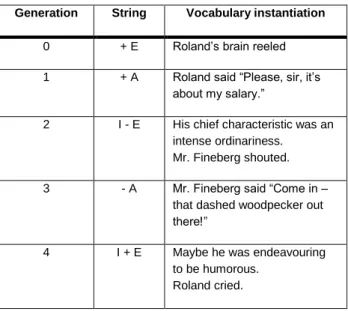
Usually L-systems are built from grammars, comprising symbolic axioms and rules. Each symbol can then be interpreted in any way, as turtle graphics instructions or musical note pitch and duration, among many others. But more complex directions are possible and desirable. Let us use the word vocabulary to designate the set of all possible symbol replacements we can consider using in the system. When designing a structuring device for a performance, the choice of vocabulary is as important to its outcome as the rules that will manipulate that vocabulary. Consider this very simple example of an L-system grammar used to remix a situational dialogue between two characters, Roland and Mr. Fineberg. Each constant (represented by + and -) is a character; each variable is an emotion (E), an action (A) and an interference (I):
Variables: E, A, I Constants: +,- Axiom: + E
Rules: (+ E → + A), (+ A → I - E), (- E → - A), (- A → I + E).
Vocabulary:
Characters: Roland (+), Mr. Fineberg (-)
Emotions: X cried; X shouted; X’s brain reeled; Actions: X knocked at the door; Only at the nineteenth knock did X raise his head; X said “Come in – that dashed woodpecker out there!”; X said “Please, sir, it’s about my salary.”
Interferences: Maybe he was endeavouring to be humorous; He was a married man himself; His chief characteristic was an intense ordinariness.
Let us assume that each time a variable comes up in a generation, a random element is chosen – and removed, to avoid repetition – from the respective vocabulary. We can then populate the vocabulary that relates to characters, emotions, actions and interferences.
Table 1 displays a partial remix on the first lines of “The Episode of the Landlady’s Daughter” (Wodehouse and Bovill, 1916).
The above sentences, presented as emotions, actions and interferences, are basic, and they could have been automatically generated from a set of verbs, adjectives and adverbs, or from textual analysis of existing texts, as was the case – found texts – thus enabling one of today’s most widely distributed activities: remixing. It is not the goal or scope of this article to dwell in the field of computer generated literature, but the options abound, as the NaNoGenMo (National Novel Generation Month, 2016) initiative can attest, as well as one of its best-known cases, Nick Montfort’s World Clock (2013). A poet and professor of digital media at MIT, Montfort used 165 lines of Python code to arrange a new sequence of characters, locations, and actions for each minute in a day.
Even though the vocabulary is randomly instantiated, the structure is too repetitive and soon becomes monotonous; therefore stochastic systems can disrupt repetition and predictability in the dialogue structure, and Markov chains are a good approach at solving this issue. By adding Markov chain probabilistic reasoning to an L-system, the outcome
Table 1 | Successive generations
Generation String Vocabulary instantiation 0 + E Roland’s brain reeled 1 + A Roland said “Please, sir, it’s
about my salary.”
2 I - E His chief characteristic was an intense ordinariness.
Mr. Fineberg shouted.
3 - A Mr. Fineberg said “Come in – that dashed woodpecker out there!”
4 I + E Maybe he was endeavouring to be humorous.
is a stochastic context-free grammar, which builds likely follow-up sentences based on the input vocabulary, while remaining grammatically accurate (Lamb, Brown & Clarke, 2017).
But even if the solutions for dealing with text/dialogue generation abound, one important aspect of performance is missing: stage direction. Performing requires interpretation, timing, body and facial language and expression, pauses, physical interaction with objects or performers, among other directions, which implies that the structuring device will have to consider these variables and their mapping, how stochastic variations will affect them, and how their interrelation will contribute to the required artwork/performance.
Going back to Moholy-Nagy’s seven variables of the Theatre of Totality (ToT) – light, space, plane, form, motion, sound, human – the structuring device needs to address all of them. The previous example used a vocabulary that would at most address human, yet Moholy-Nagy’s vision for human implied several more degrees of freedom than the classical theatrical interpretation of pre-written text. The generative art approach proposes that a coherent generative system – and its structuring device – can indeed tie all variables together, and that the choice of vocabulary is crucial in defining the type, style and nature of the performance.
There are several studies regarding cross-modal correspondences in perception, and Spence’s
comprehensive tutorial highlights some of them (Spence, 2011). For example, high-pitched sounds are usually related to small bright lights and to higher spatial positioning, whereas slow movement is associated to darker ambiances, long and low pitched sounds. More broadly, loudness is usually associated with brightness and size; pitch with elevation, size and spatial frequency; acoustic tempo/rhythm is usually associated with luminous and spatial frequency. If these relations suggest mappings between sound and spatial positioning, motion, plane and form (at least as far as size is concerned), a connection to human is still missing.
For that purpose let us use Plutchik’s work in The Nature of Emotion (Plutchik, 2001). For him, an emotion is a complex chain of loosely connected events that begins with a stimulus and includes feelings, psychological changes, impulses to action and specific, goal-directed behaviour. Feelings do not happen in isolation: they are responses to significant situations in an individual’s life, and often they motivate actions. Plutchik created a three-dimensional circumplex model of emotions – Figure 1 – best known through its planar projection as the emotions wheel. He assigned colours to emotions, with smooth transitions (slight changes in hue or saturation) between neighbouring emotions and harsh distinctions (significant changes in hue) between different and opposite emotions, making the wheel graphically more evident both in terms of intensity and similarity / opposition. Given any starting Figure 1 | Plutchik’s emotion colour wheel. If the outer flaps are bent toward the centre, its shape resembles that of a cone, with intensity as its vertical axis. The top tier is smaller since intensity is at its lowest, making all the emotions very close/similar. Source: author.
emotion, the following generation will be obtainable through its direct neighbours – or its direct opposition. For instance, using annoyance as an axiom, possible first generations would be anger, interest and boredom – or apprehension; if fear is generation n-1, generation n candidates are apprehension, terror, trust and surprise – or anger. There is emotional coherence in all these evolutions, which facilitates bringing plausible evolutionary story-telling characteristics into the performance.
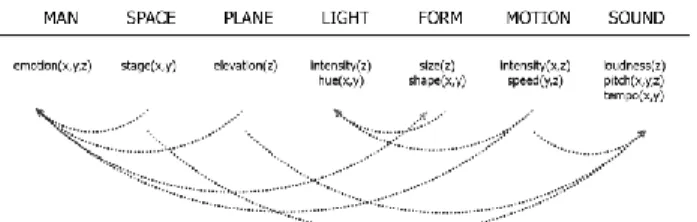
This model allows for reverse mapping between emotions (human) and colour (light), as well as space and plane (derived from the emotion three-dimensional spatial positioning on Plutchik’s model), thus completing the mapping onto all seven variables of the ToT, as shown in Figure 2. The generative system will directly assign human with generated emotions and/or dialogues and directions, and all other performing agents will be connected by cross-modal correspondences, and/or feedback mechanisms.
3.2 AMPLIFICATION MECHANISMS
The second level is the amplification stage, where cognitive extensions are added to the system, correlations are made between different media types and collaborative practices may occur. Generative art is often recursive, and feedback mechanisms can be triggered by information gathered from the performance itself, and be used to influence the direction and evolution of the generative artwork. In this way, sound, image, movement, emotion, can be interpreted and manipulated in a dynamic performance. The seven ToT variables can then be addressed by mapping the outcomes of the emotion and dialogue generators, where the dialogue lines are engulfed in emotions. However, the reverse exercise seems just as appealing: take a found-text dialogue, break it down into paratactic segments (parts, scenes, e.g.: beginning, middle, end), identify the emotions in every speech and tag them according
to the colour wheel emotions and the part of the text in which they appear.
When an emotion is generated, a non-repetitive hypotactic dialogue sequence is also generated, as a function of the current segment of the performance (same structure as before, e.g.: beginning, middle, end) allowing for stochastic variations within emotions and dialogues. The result will be a remixed, probably surreal version of the original text, which keeps hypotactic coherence yet permeated with paratactic challenges. Since the pragmatic discourse relations are kept, the overall meaning should be grasped (Redeker, 1990). The emotion sequence can be respected, even if allowing the system to insert controlled random detours into neighbouring emotions.
Movement is an important part of language, and goes beyond vocabulary and reason, that which cannot truly be expressed through words. Another important element in the proposed performance framework is interpretive dance, which translates specific feelings and emotions, human conditions, situations, or fantasies into a combination of movement and dramatic expression. Russian ballerina, Anna Pavlova, when asked the meaning of one of the dances she performed, replied, "If I could have said it, I shouldn't have had to dance it" (Hava-Robbins, 2002).
It appears adequate to advocate interpretive dance as one of the main focuses of human and motion. For Hansen (2008) “the body-as-interface” consists of three key concepts that are digitally advanced mutations of features that our body already contains: an enhanced multi-sensorial organ, a physical converter of abstracted meaning, and an interconnected unit that immediately transfers sensed and experienced material to other bodies. These enhanced features encourage active contribution to a physically mediated community of people, who make their ideas and thoughts manifest through visceral and physio-aesthetic experiences. The body-as-interface is then the ToT variable human.
Costume, in its relation to form, is another important amplification mechanism, and Oskar Schlemmer produced some of the richest avant-garde examples of the Bauhaus period (Fox, 2015), as shown in Figure 3, which could easily be adapted into the 21st century, thus further connecting human and form. Figure 2 | Mapping Plutchik’s emotions three-dimensional space
model (x,y,z) to the ToT variables, and cross-modal feedback. Source: author.
The dialogue can be projected, as a replacement or complement of the spoken form, or even its reinforcement or highlight, thus becoming part of light, along with other expressive projections that use form (shape and size) – see Figure 3 – and motion (intensity and speed), leaving all aspects of body expression to human, and transforming the performance into a unique generative remix, whose true challenge is to extract and communicate the emotional and cognitive essence of the score/script. This is a very different direction than that of artists / performers offering predetermined content to the audience, and through these mechanisms each performance can substantially differ from its previous rendering, namely by introducing silences, musical moments, body motion, lighting effects, etc. between different generations (i.e.: between emotion/dialogue sequences).
3.3 EVENT DETECTION
Finally, the third level is the event detection stage, where the artist has already made adjustments to the system, both in terms of structuring device and amplification mechanisms, and is now concerned in identifying the more interesting occurrences as the system runs. The artist can attain this stage through trial and error, and then identify unique generation sets as full-bodied artistic expressions of the initial concept and aesthetics, and assume them as a performance score. But it can also be attained as a real-time generated performance, by the artist, performers and audience, with as many degrees of unpredictability as the artist has decided to use randomness and interaction in the system.
Eigenfeldt et al. (2012) mention five canonical instances in the meta-creation of algorave performances, which can be adapted to the current paradigm: (1) composition – being the process of creating a series of performance instructions (i.e. a score); (2) interpretation – being the process of subjectively performing a composition and producing a live rendering; (3) improvisation – which combines (1) and (2) in real-time performance; (4) accompaniment – being the process of following a live performer in an accompanying role, possibly according, but not constrained, to a pre-composed score; and (5) continuation – the process of continuing a given performative input in the same style.
4 | ISSUES
4.1 DISTRIBUTED AUTHORSHIP
An issue can emerge with the use of a performance generator by a third party. Since the generator itself outlines the scope within which the performance takes place – and is assumed by its author as an artwork – and it can then be used to produce radically different concept performances, then the resulting performance authorship is clearly distributed.
Furthermore, if the performance is obtained through a real-time system that takes into consideration both performers and audience data – like motion detection, noise (on and off-stage), real-time hashtag detection in shared media, audience held light emitting devices, etc. – both performers and audience are considered as part of the performance authorship (even though the act of purchasing a ticket or Figure 3 | Mapping human to form – or vice-versa – where size varies according to plane height (elevation). Source: Bauhaus costume by Oskar Schlemmer, Das Triadische Ballett, 1916 and author.
participation is often tied to a contract relinquishing co-authorship rights), thus potentially leading toward a distributive, democratic model, potentially defined as an interplay of negotiated capacities of a number of actors, including the original system developer, producer, director / system parameterizer, performers and audience, to create the content, structures, form and affordances of the performance (Jennings, 2016), whose biggest risk is the Kilo-Author (Austin, 2015).
A simple and powerful solution to this issue would be releasing the performance generator code under a copyleft or Creative Commons license, binding all future uses of the distributed code, and, in the process, revolutionising current business models.
4.2 AUDIENCE ENGAGEMENT AND ROLE
By interacting with the system, and becoming a co-author, the audience gains a new dynamic and empowering role, away from the (usual) passive consumption that takes place during a standard performance. Hansen (2008) questions the difficulty to learn non-verbal languages that are expressed through physical gestures and corresponding media forms, claiming that in a community of performers that act together, in an ensemble, the person who is foreign to the media situation generated, would need to understand the physio-aesthetic language that is shared among the people, who participate in a non-verbal conversation. Therefore she suggests that these language forms may eventually either share some universal characteristics, or rely on a platform, an interface that is embedded in the architecture of the performance of a "conversational space" that gives the audience the possibility to tune in to the performers’ conversations.
In this context we can consider the existence of a creatively interfaced/engaged audience, and this creativity as a form of social interaction, rather than the outcome of a social/cultural activity, as an emergent phenomenon of audiences-as-communities, reminiscent of Latour's actor-network theory, involving individuals, groups, apparatus and systems. Not all audiences are willing to participate, and the motivation / ability / opportunity model has been used in their study (Wiggins, 2004), so that mechanisms to change their audience members from disinclined to participate, to being inclined to participate, to participating can also be implemented.
There are definitional challenges regarding the term engagement in audience research studies. Steven Tepper defines engagement as “to interlock, to involve, or to cause” (2008, p. 363). This definition works well for modern audiences who “actively connect to art – discovering new meanings, appropriating it for their own purposes, creatively combining different styles and genres, offering their own critique” (Tepper, 2008, p.363).
Nina Simon (2010) suggests that effective audience participation is ultimately a question of design, which would determine that, in this situation, it should be addressed by the generative framework. Successful participatory design makes relationships between artists, arts organizations and audiences “more fluid and equitable” by opening up “new ways for diverse people to express themselves and engage with institutional practice”, according to Simon. Based on extensive participatory research in the context of museums, Simon suggests that audiences “thrive on constraints, not open-ended opportunities for self-expression”. These constraints require design principles, met by the generative framework.
Even if interactive audience engagement has yet to be studied in depth, several interesting findings have been made, relating mood and music (Speicher et al., 2016), audience as performer and composer (Walker & Bellet, 2016), and physical audience engagement in the performance (Simon, Van Der Vlugt & Calvi, 2016).
5 | CONCLUSION
Artists of all eras have chosen to use people as a medium for several reasons: to challenge traditional artistic criteria by reconfiguring everyday actions as performance; to render visible certain social interactions and render them more complex, immediate, and embodied; to introduce aesthetic effects of chance, randomness, illogic and risk; to expose and explore the dualities of live and mediated, original and remixed, spontaneous and staged; and to examine the construction of collective identity.
Performances are becoming increasingly hybrid and technology permeates the stages. But the core of these complex systems is the content of the performance, not (just) the mise-en-scène. In recent years there is not only a notorious ethical redirection in performing arts, but also an overtaking of stages by hybrid bodies in hybrid motion, non-human, natural
and artificial subjectivities, as the conscience of post-humanism sets in (Balona, 2017). Improvisation has gained credibility in connection with task or game structures that depend on individual interpretation of rules in performance (Jowitt, 2011) and Martha Graham described the dancer / performer as an athlete of God, with openness to the past, with memory of choreography and vocabulary, and the present, by means of creativity and reactivity (Carter & O´Shea, 2010).
Interpretive dance and the Theatre of Totality can be brought together by means of a stochastic evolutionary L-system – the performance generator – that falls within Galanter’s complexism theory (Galanter, 2011). “Experimentation has replaced all interpretation... No longer are there acts to explain, dreams or phantasies to interpret... instead there are colours and sounds, becomings and intensities” (Deleuze & Guattari, 1988). Expect the unexpected. The understanding of performance as sensation – as a force that disrupts perceptions and prejudgements, to make perceptible the imperceptible forces – paves the way for experimenting with complex systems, such as the one advocated by the author.
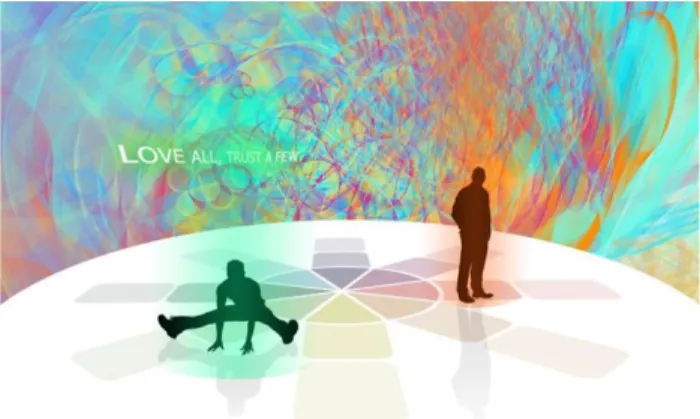
If you have experimented with the many online L-systems turtle graphics applets, you will know that writing a successful L-system (i.e.: that produces appealing graphics) is not an easy task, let alone an evolutionary stochastic L-system whose outcome is a performance, as illustrated in Figure 4.
Nevertheless the potential for producing thoroughly entertaining, engaging and radically different events / performances, even the refinement process itself – as
a series of interactive workshops, in order to reach a performance score – is the drive behind on-going developments. Their aim is to determine which variables (emotions; actions; dialogues; spatial, scenic and sonic atmospheres) are key to make creators, participants and audience relinquish their control to determinism, chance and chaos and enjoy meaningful performative experiences.
REFERENCES
Austin, W. (2015). How Does the Rise of the ‘Kilo-Author’ Affect the Field of Composition and Rhetoric? The CCCC-IP Annual: Top Intellectual Property Developments of 2015, 47-53. Retrieved November
07, 2017 from
http://www.ncte.org/library/NCTEFiles/Groups/CCC C/Committees/TopIP2015Collection.pdf
Balona, A. (2017). Coreografar além do sujeito. A crise da matéria em ‘the artificial nature series’, de Mette Ingvartsen. ArteCapital. Retrieved November 07, 2017 from http://artecapital.net/perspetiva-194- alexandra-balona-coreografar-alem-do-sujeito-a- crise-da-materia-em-the-artificial-nature-series-de-mette-ingvartsen
Balpe, J. (2005). Principles and Processes of Generative Literature - Questions to Literature. Retrieved November 07, 2017 from http://www.dichtung-digital.de/2005/1/Balpe/
Carter, A. & O’Shea, J. (2010). Performing Dance. In A. Carter & J. O’Shea (Eds.), The Routledge Dance Studies Reader. London and New York: Routledge.
Davis, M. W. (1997, April). Complexity formalisms, order and disorder in the structure of art. In International Conference on Evolutionary Programming, 1-12. Springer, Berlin, Heidelberg.
Dean, R. (2017). Generative Live Music-Making. Journal of Creative Music Systems, 1(2). DOI:10.5920/jcms.2017.05.
Deleuze, Gilles, & Guattari, Félix. (1998). A thousand plateaus: capitalism and schizophrenia. Minneapolis: University of Minnesota Press.
Dorin, A. (2013). Chance and complexity: stochastic and generative processes in art and creativity. Proceedings of the Virtual Reality International Conference on Laval Virtual, 19. ACM.
Figure 4 | A simplified vision of the stage/performance. The character on the left is using the trust space. The generative scenario behind him shows mainly lower plane activity and smaller forms, according to his spatial placement, whereas the character on the left is causing more disturbances (in colour, frequency and form) since he is standing, therefore using the higher planes, on the anger space. Source: author.
Eigenfeldt, A., Burnett, A., & Pasquier, P. (2012). Evaluating Musical Metacreation in a Live Performance Context. Proceedings of the International Conference on Computational Creativity, 140-144.
Fox, P. (2015). Oskar Schlemmer: Visions of a New World. West 86th: A Journal of Decorative Arts, Design History, and Material Culture 22(1), 97-101.
Galanter, P. (2014). Complexism and the Role of Evolutionary Art. In J. Romero & P. Machado (Eds.), The Art of Artificial Evolution A Handbook on Evolutionary Art and Music, 311-333. Berlin: Springer Berlin.
Galanter, P. (2011). Shot By Both Sides: Art-Science And The War Between Science And The Humanities. Artnodes, 0(11).
Hansen, A. (2008). The Body-as-Interface: A possibility to merge mind spaces with hybrids of physical and virtual worlds. Intelligent Agent 8(1), Special Issue, Social Fabrics, Leonardo Educational Forum Exhibition, College Art Association, Dallas, Texas.
Hava-Robbins, N. (2002). Interpretive Dance. The Turning Point School of Interpretive Dance. Retrieved
November 07, 2017 from
http://www.snowcrest.net/turningpoint/interpdance.ht ml
Jennings, S. (2016). Co-Creation and the Distributed Authorship of Video Games. In K. Valentine & L. Jensen (Eds.), Examining the Evolution of Gaming and Its Impact on Social, Cultural and Political Perspectives, 123-146. Hershey, PA: IGI Global.
Jowitt, D. (2011). In M. Bremser & L. Sanders (Eds.), Fifty Contemporary Choreographers. London and New York: Routledge.
Lamb, C., Brown, D. & Clarke, C. (2017). A taxonomy of generative poetry techniques. Journal of Mathematics and the Arts, 11(3), 159-179.
Mandelbrot, B. (1983). The Fractal Geometry of Nature. New York: W. H. Freeman.
McCormack, J., Bown, O., Dorin, A., McCabe, J., Monro, G., & Whitelaw, M. (2014). Ten questions concerning generative computer art. Leonardo 47(2), 135-141.
Montfort, N. (2013). World Clock. Retrieved
November 07, 2017 from
https://nickm.com/post/2013/11/world-clock/
National Novel Generation Month (2016). 2016 edition. Retrieved November 07, 2017 from https://github.com/NaNoGenMo/2016
Plutchik, R. (2001). The Nature of Emotions. American Scientist 89(4), 344-350.
Redeker, G. (1990). Ideational and pragmatic markers of discourse structure. Journal of pragmatics, 14(3), 367-381.
Rodrigues, A., Costa, E., Cardoso, A., Machado, P., & Cruz, T. (2016, March). Evolving L-Systems with Musical Notes. International Conference on Evolutionary and Biologically Inspired Music and Art, 186-201. Springer, Cham.
Schlemmer, O., Moholy-Nagy, L., & Molnár, F. (1961). The Theater of the Bauhaus. Connecticut: Wesleyan University Press.
Simon, L. U., van der Vlugt, M., & Calvi, L. (2016). Triggers to entice an audience to'perform as interface'in an interactive installation. Proceedings of the 20th International Academic Mindtrek Conference, 322-330. ACM.
Simon, N. (2010). The participatory museum. Santa Cruz: Museum 2.0. Retrieved November 07, 2017 from http://www.participatorymuseum.org/chapter8/
Speicher, M., Gröber, L., Haluska, J., Hegemann, L., Hoffmann, I., Gehring, S. & Krüger, A. (2016). The audience in the role of the conductor: an interactive concert experience. Proceedings of the 5th ACM International Symposium on Pervasive Displays, 235-236. ACM.
Spence, C. (2011). Crossmodal correspondences: A tutorial review. Attention, Perception, & Psychophysics 73(4), 971-995.
Tepper, S. J. (2008). The next great transformation: leveraging policy and research to advance cultural vitality. In S.J. Tepper, & B. Ivy (Eds.), Engaging art: the next great transformation of America’s cultural life, 363–383. New York: Routledge.
Walker, W. & Belet, B. (2016). Musique Concrète Choir: An Interactive Performance Environment for
Any Number of People. Proceedings of the 2nd Web Audio Conference 2016. Atlanta.
Wiggins, J. (2004). Motivation, Ability and Opportunity to Participate: A Reconceptualization of the RAND Model of Audience Development. International Journal of Arts Management 7(1), 22-33.
Wodehouse, P. & Bovill, C. (1916). The Episode of the Landlady’s Daughter. A Man of Means – A series of six stories. Retrieved November 07, 2017 from http://www.gutenberg.org/files/8713/8713-h/8713-h.htm
BIOGRAPHICAL INFORMATION
Pedro Alves da Veiga is an artist and researcher. He holds a degree in Computer Science, a
post-graduation in Advanced Studies of Digital Media Art, a two-decade business career in web-design and information systems, including the launch and sale of two IT companies. He is currently finishing his PhD thesis at Universidade Aberta and Universidade do Algarve, in Portugal, on the topic of new media art ecosystems. He is a member of CIAC - Centro de Investigação em Artes e Comunicação, where he is conducting research in generative systems and telemedia arts education. Since 2001 he has participated in several group and individual exhibitions and projects, in visual arts, theatre and in digital media art.