1. Health Economics & Outcomes Research - Novartis Farma, Oeiras, Portugal; Centro de Investigação em Saúde Pública, Escola Nacional de Saúde Pública, Universidade NOVA de Lisboa 2. Consulting & Services, IQVIA, Oeiras, Portugal
3. Rheumatology Department, ULSAM, Ponte de Lima, Portugal 4. Centre for Rheumatology and MRC Centre for Neuromuscular Diseases, University College London, London, UK; Department of Rheumatology, University College London Hospitals NHS Foundation Trust, London, UK; Department of Rheumatology, Northwick Park Hospital
5. Rheumatology Department, Portuguese Institute of Rheumatology, Lisbon, Portugal
6. Chronic Diseases Research Centre, NOVA Medical School | Faculdade de Ciências Médicas – NOVA University of Lisbon; Rheumatology Department, Centro Hospitalar Lisboa Ocidental, Hospital de Egas Moniz, Lisbon, Portugal
7. Serviço de Reumatologia e Doenças Ósseas Metabólicas, Hospital de Santa Maria, CHLN; Unidade de Investigação em Reumatologia, Instituto de Medicina Molecular, Faculdade de Medicina, Universidade de Lisboa, Centro Académico de Medicina de Lisboa, Portugal;
8. Serviço de Reumatologia, Hospital Garcia de Orta, Almada; Unidade de Investigação em Reumatologia, Instituto de Medicina Molecular, Faculdade de Medicina, Universidade de Lisboa, Portugal
velopment comprised a modified-Delphi method in a four-step procedure: 1) literature search and experts’ opinion collection about quality indicators for PsA management; 2) Delphi design to address the develop-ment of the measuredevelop-ment tool; 3) three Delphi ques-tionnaire rounds; 4) final consensus meeting. This phase resulted in the definition of two measurement tools, one to evaluate the quality of biologic switch in peripheral (pPASQAL) and another one in axial PsA (axPASQAL). For the validation of PASQAL, 12 expe-rienced rheumatologists were asked to evaluate and classify the biologic switch of 80 clinical cases (40 with predominant peripheral and 40 with predominant ax-ial PsA). Clinical judgement was defined to be the “gold standard” against which the performance of PASQAL was assessed. The results were used to assess tools’ per-formance (sensitivity/specificity analysis) and the agree-ment between the tools and the gold standard (Cohen’s kappa).
Results: PASQAL consists of 6 domains (joint disease activity, dactylitis, enthesis, physical function, quality of life, and skin and nail manifestations), respective in-struments and thresholds. The classification of the bi-ologic switch was divided into three quality levels: “Good”, based on treattotarget thresholds; “Mode -rate”, based on improvement from baseline; and the re-maining as “Insufficient”. pPASQAL was found to be highly sensitive (92%) with the “Good” quality level and specific (97%) with the “Insufficient” quality le vel. Whilst axPASQAL showed overall higher sensitivity and specificity for all quality levels, as well as a higher level of agreement between the tool and the gold stan-dard than pPASQAL (k=0.87 vs k=0.71).
Conclusion: PASQAL was developed and showed good criterion validity for the evaluation of the quality of switch in both peripheral and axial PsA phenotypes.
Development and validation of psoriatic arthritis
switch quality assessment tool (PASQAL) – an outcomes
measurement tool to assess the quality of
biologic switch decisions in psoriatic arthritis
Laires PA1, Carrilho M2, Tavares-Costa J3, Lucas P2, Machado P4, Cunha-Miranda L5,
Pimentel-Santos F6, Santos H5, Vieira-Sousa E7, Santos MJ8
ACTA REUMATOL PORT. 2020;45:46-57
AbstrAct
Background: Switching between biologic therapies is a recommended strategy for Psoriatic Arthritis (PsA) patients that show an insufficient response or adverse events. Although the choice of the subsequent biolog-ic may be dependent on many factors, assessing the quality of the switch decision is of utmost relevance. Objectives: To develop and validate two outcomes measurement tools (for patients with peripheral and axial PsA phenotypes) that address the quality of treat-ment decisions in PsA regarding the switch of biologic therapies in clinical practice.
Methods: A Task Force and an Expert Panel were specifically assembled for this purpose. The Psoriatic Arthritis Switch Quality Assessment tool (PASQAL)
de-These tools may be used in research as well as in clin-ical practice, to support rheumatologists in making more informed therapeutic decisions.
Keywords: Psoriatic Arthritis; Biologic switch; Con-sensus; Outcomes measurement tools; Therapeutic de-cisions
INtrODUctION
Psoriatic arthritis (PsA) is a chronic inflammatory mus-culoskeletal disease preferentially managed by rheumatologists. PsA can affect the peripheral joints, the axial skeleton, entheses, skin and nails, and it can also have systemic involvement. According to Moll and Wright’s 1973 criteria, PsA can be divided into five sub-groups: asymmetrical oligoarthritis, symmetrical pol-yarthritis, distal interphalangeal disease, arthritis
mu-tilans, and spondylitis1. However, this classification can be resumed in two main PsA phenotypes: peripheral (predominantly peripheral involvement) and axial (predominantly spinal involvement).
Treatment options have expanded and are increas-ingly more effective, enabling the simultaneous control of multiple PsA manifestations. Given the heterogenei -ty of disease manifestations, the assessment of disease activity and consequent response to treatment is more complex in PsA than in other inflammatory rheuma -tic diseases.
The Outcome Measures in Rheumatoid Arthritis Clinical Trials (OMERACT) group has defined a core set of domains to be measured to study treatment out-comes, aiming to guide therapeutic decisions in PsA. These domains include peripheral joint activity, skin activity, pain, patient global assessment, physical func-tion, and health-related quality of life2. Consequently, outcome measures to evaluate these PsA domains were defined, with the vast majority being adapted from re-lated diseases (e.g. 28-joint Disease Activity Score [DAS28], initially developed for rheumatoid arthritis and the Ankylosing Spondylitis Disease Activity Score [ASDAS], originally developed for ankylosing spondylitis) and only some of them validated for PsA3. Composite measures, which combine different do-mains into a single score, have also been created. One example is the Minimal Disease Activity (MDA), a com-posite remission score created specifically for PsA. This composite measure comprises a core set of domains (tender joint count ≤1; swollen joint count ≤1; Pso
-riasis Activity and Severity Index ≤1 or body surface area ≤3; patient pain visual analogue score (VAS) ≤15; patient global disease activity VAS ≤20; health assess-ment questionnaire ≤0.5; tender entheseal points ≤1). These domains are then used to define a “state” of MDA (high versus low disease activity), which in turn can be used as a target for treatment in clinical practice. If a patient does not achieve MDA criteria (at least 5 out of 7 criteria), the treatment may be modified either by in-creasing therapeutic doses or by adding new drugs or even by switching therapies4. However, MDA, as other outcome measures, has limitations, as it only de-fines a disease state and does not allow assessment of different levels of disease activity5. This is different from the ASDAS, a continuous composite index for which cut-offs for disease activity states and improvement scores have been published. Four disease activity states have been defined for ASDAS: inactive disease (remis-sion-like state6), low, high and very high disease activi -ty7. However, the ASDAS was not validated in PsA.
While there are no agreed definitions about the qual-ity of biologics’ switch in PsA and which outcome mea-sure should be used for this quality assessment, the choice of subsequent biologic continues to be empiri-cal, which makes the clinical evaluation of PsA patients a challenge to rheumatologists. Additionally, there is no composite measure that addresses the quality of the switch in the two different phenotypes of PsA. Therefore, the objective of this study was to develop and va -lidate two outcomes measurement tools (for patients with peripheral and axial PsA phenotypes) that address the quality of treatment decisions in PsA regarding the switch of biologic therapies in clinical practice.
MAtErIALs AND MEtHODs
This study consisted of two phases: 1) the develop-ment of two outcomes measuredevelop-ment tools, named PASQAL (Psoriatic Arthritis Switch Quality Assess-ment tooL), one for peripheral (pPASQAL) and an-other for axPASQAL, 2) the subsequent vali dation of these tools.
Research activities were developed by a Task Force and an Expert Panel specifically created for this study. tAsk FOrcE AND ExpErt pANEL sELEctION The Task Force comprised six members from different backgrounds, including health economics and outcomes research, and was chaired by a
rheumatolo-cators should be included in a tool, were asked. With the information of both literature search and physi-cians’ questionnaires/interviews, a long-list of poten-tial quality indicators was gathered, and a list of do-mains was elaborated and organized according to three perspectives: physician, patient, and society. The cate-gorization of perspectives was created together with the Experts to facilitate the systematization of infor-mation (e.g. elimination of repeated domains; group-ing domains) and to structure the next steps.
Step 2: From the interactions between the Task Force and the Experts’ Panel, it was agreed that the biologic switch outcome should be classified into three quality levels: “Good”, based on treat-to-target thresholds; “Moderate”, based on improvement from baseline sta-tus; and “Insufficient”. The Delphi questionnaire rounds were discussed and validated by the Task Force, considering the Expert Panel input.
Step 3: A three-round Delphi session was then ap-plied to start the decision-making process needed to define two outcomes measurement tools. In the first round, experts were asked which domains to include in each perspective and to rank these domains by rel-evance. In the second and third rounds, each Expert re-ceived a personalized questionnaire, which included previous answers, the Experts’ Panel response interval, and the average response. The second and third rounds included additional questions related to the prioritiza-tion of domains, selecprioritiza-tion of instruments, the definiprioritiza-tion of quality thresholds, and definition of tool’s output (i.e. quality of switch) given the possible combinations on the domains. In each subsequent round, experts re-answered the questions from the previous round and answered new questions. The three Delphi rounds re-sulted in a pre-selection of domains and respective in-struments and quality thresholds that served as the dis-cussion starting point for the consensus meeting9.
Step 4: Tools’ definition was concluded at the con-sensus meeting, to which all members from the Experts Panel and the Task Force attended. The Delphi results were presented and discussed. A decision-making pro-cess was promoted to reach conclusions regarding the definition of both outcomes measurement tools. This process involved structured discussion and democrat-ic voting whenever necessary (e.g. distribution of points, individually or in groups, by the domains to be included in both tools; hands raised to reach consen-sus on the instruments cut-offs).
The modified-Delphi consensus resulted in the def-inition of two outcomes measurement tools to evaluate gist. The Expert Panel comprised seven experienced
rheumatologists, all but one practice in Portugal. These rheumatologists were chosen from the Spondy-loarthritis Study Group of the Portuguese Society of Rheumatology, recognized by their strong know-how in the PsA area. Both groups had significant roles dur-ing this study: Task Force was responsible for struc-turing the discussion process, while the Experts’ Pa nel was responsible for decision making.
PHASE 1: TOOL DEVELOPMENT
To develop both PASQAL tools, a modified-Delphi method was applied in a fourstep procedure: 1) litera ture search and experts’ opinion collection about quali -ty indicators for PsA management; 2) Delphi design to address the development of the measurement tool; 3) three Delphi questionnaire rounds; 4) consensus meet-ing to discuss the results and to decide about the out-comes measurement tools’ components. During all phases, the Task Force and the Experts’ Panel interac -ted regularly and in different formats (questionnaires, interviews, meetings) to ensure both tools comprised all relevant components and to promote an effective design of the modified-Delphi process.
Step 1: A literature search was performed in the PubMed database up until October 2017 to identify and collect relevant data to support the identification of potential quality indicators in PsA valued by all rel-evant stakeholders in this area (patients, rheumatolo-gists, dermatolorheumatolo-gists, and others). The selection of the information was in English language and had, as a start-ing point, the OMERACT core set of domains agreed for PsA8. In PubMed, search terms reporting PsA man-agement, switch recommendations, patient-reported outcomes (PROs) and clinical outcome indicators and measures were used. Search limits included links to full text only, humans, English language articles, males and females, and all adult ages. Additional information was collected through specific questionnaires and inter-views administered to experts to understand the best practices on PsA management. Experts were asked about the different PsA phenotypes commonly man-aged in clinical practice, which indicators are com-monly evaluated in PsA patients (from clinical to pa-tient-related), and how they are measured. Additionally, questions about which indicators do pa-tients value the most, when should indicators be eval-uated, how indicators should be organized and com-bined, what constitutes an “appropriate” versus “inappropriate” biologic switch, and how many
indi-the quality of biologic switch in peripheral and axial PsA patients.
PHASE 2: TOOLS’ VALIDATION
The Task Force agreed to focus the analysis on the quantification of the performance of the tools for each quality level and calculation of the level of agreement between both tools and the gold standard (criterion va-lidity).
Assembly of clinical cases: A total of 80 clinical ca -ses who switched biologic treatment, 40 with pre-dominantly peripheral PsA and 40 with predominant-ly axial PsA, were assembled, based on real-world patients, retrieved from the Reuma.pt registry. Reuma.pt, the Rheumatic Diseases Portuguese Register from the Portuguese Society of Rheumatology (SPR), is a nationwide web-based platform where Portuguese rheumatologists collect data on a routine basis regard-ing rheumatic patients (rheumatoid arthritis, axial spondyloarthritis, psoriatic arthritis, and juvenile idio -pathic arthritis) receiving biological therapies or syn-thetic disease-modifying anti-rheumatic drugs (DMARDs)10. The clinical cases included information about age, gender, symptoms, disease activity and oth-er parametoth-ers related to the current patient’s disease state (e.g. physical function and quality of life), rele-vant to make a judgment about the quality of the bio-logic switch. In order to have a significant sample of each of the tools’ switch levels for the analyses, 12 cas-es classified as “Good”, 16 as “Moderate” and 12 as “In-sufficient” were conside red for both tools’ validations. Clinical judgment: A total of 12 experienced rheumatologists were recruited to evaluate clinical cas-es before and three months after switching to a second biologic therapy and were asked to classify the quality of that biologic switch as “Good”, “Moderate” or “In-sufficient”. Rheumatologists did not receive any infor-mation about the tool’s components or quality levels before clinical judgement to avoid a bias in the results. Experts’ clinical judgment was defined as the “gold standard”, against which the tools’ output was com-pared. Three experts evaluated each clinical case, and only those with consensual clinical judgment (same bi-ologic switch classification of at least 2 out of 3 rheuma-tologists) were included in the validation analysis.
Tools’ performance: The performance was assessed through a sensitivity/specificity analysis, which evalu-ates the level of performance of the tool in classifying the biologic switch correctly, comparing the tool’s out-come with the clinical judgment result. Sensitivity is
the tool’s ability to correctly classify the biologic switch as “Good”, “Moderate” or “Insufficient” (true positive rate). Specificity is the ability of the tool to correctly classify the biologic switch as “Not Good”, “Not Mode -rate” or “Not Insufficient” (true negative rate)11,12.
Agreement between the tool and the gold standard: The agreement between the output of each tool and the gold standard was quantified using the Cohen’s kappa. Generally, Cohen’s kappa ranges from 0 to 1, whereas larger numbers (i.e. above 0.6) represent a good level of agreement. For the calculation of Cohen’s kappa, a 95% confidence interval (CI) was also reported13.
rEsULts
tOOL DEvELOpMENt
From the literature search and experts’ opinion, a total of forty-five domains relevant for PsA management were identified (Annex - Table I) and organized ac-cording to three perspectives: physician (n=19), pa-tient (n=20) and society (n=6).
During the Delphi questionnaire rounds, experts pre-selected eleven domains (Annex - Table II) to be in-cluded in both outcomes’ measurement tools (physi-cian=5, patient=4, society=2), and listed instruments and the respective quality thresholds for nine domains. For the remaining two (therapy costs and indirect costs from society’s perspective), no consensus was achieved regarding the instruments and respective quality thresholds.
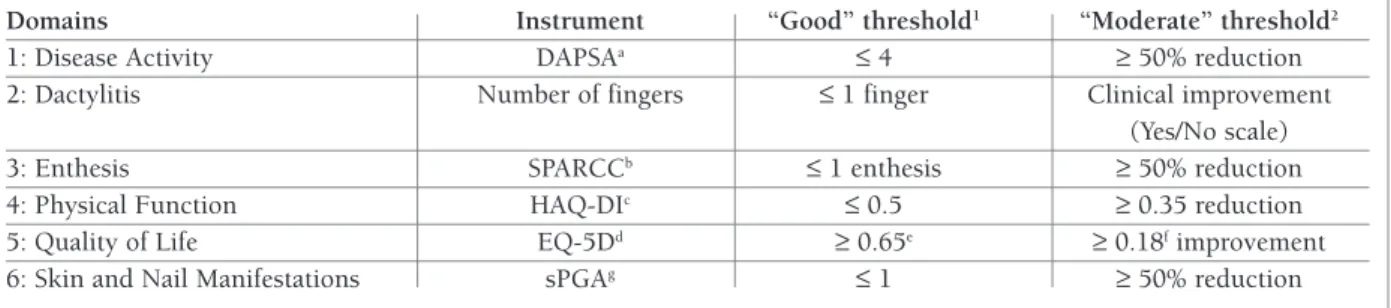
At the consensus meeting, experts agreed that both tools should be feasible to implement in daily clinical practice. As such, some domains were clustered (e.g. disease activity, swollen and tender joints, inflamma-tory parameters, joint pain and patient global disease evaluation into a composite “Joint Disease Activity” main) and experts agreed on a final selection of six do-mains to be included in each tool (physician=4, pa-tient=2, society=0). Experts concluded that none of the domains included in the preliminary list of society per-spective should be included in the final tool due to the inexistence of internationally accepted and easy to use instruments to quantify these domains, which conse-quently would generate difficulties on the measure-ment and results’ interpretation. Considering these domains, experts defined the most appropriate instru-ments and thresholds for both peripheral and axial phenotypes, concluding the core set criteria of the two outcomes measurement tools (Table I and Table II).
Despite skin clearance being one of the most valued symptoms in patients with PsA and Psoriasis, this do-main shows limitations since the agreed measures (e.g. Psoriasis Area Severity Index - PASI, Body Surface Area - BSA) are difficult to evaluate and to use in clinical practice. Therefore, these parameters are rarely com-pleted by rheumatologists during patient assessment. Given the importance of this assessment, the Task Force and the Expert Panel agreed to choose physician global assessment applied to skin and nails (sPGA) as the instrument of “Skin & Nails Manifestations” do-main14. sPGA is commonly measured using a visual analogue scale (VAS) based on the GRAPPA 0-5 scale with a good correlation with the PASI index, i.e. a “Good” quality level is a patient with a clean or almost
clean skin corresponding to a Physician VAS of 0/1. Currently, the “Skin and Nails Manifestations” domain is not routinely assessed by all rheumatologists, hence this domain was agreed to be optional. “Productivity and Activity Impairment” was discussed as a possible seventh domain but was discarded due to feasibility concerns. Due to the need for further literature search, the thresholds for the EQ-5D instrument were defined after the consensus meeting by the Task Force. Two possible options regarding the threshold definition for EQ-5D were discussed. According to Carreño et al. 2011, the EQ-5D thresholds can be defined using HAQ-DI scores.15The conversion of the "Good" state of HAQ-DI=0.50 results in a value of EQ-5D=0.80, which is too ambitious, given the average results of the
tAbLE I. DOMAINs, INstrUMENts AND tHrEsHOLD DEFINItIONs FOr ppAsQAL
Domains Instrument “Good” threshold1 “Moderate” threshold2
1: Disease Activity DAPSAa ≤ 4 ≥ 50% reduction
2: Dactylitis Number of fingers ≤ 1 finger Clinical improvement
(Yes/No scale)
3: Enthesis SPARCCb ≤ 1 enthesis ≥ 50% reduction
4: Physical Function HAQ-DIc ≤ 0.5 ≥ 0.35 reduction
5: Quality of Life EQ-5Dd ≥ 0.65e ≥ 0.18fimprovement
6: Skin and Nail Manifestations sPGAg ≤ 1 ≥ 50% reduction
1: based on treat-to target thresholds; 2: based on improvement from the baseline
a: Disease Activity in Psoriatic Arthritis is a composite instrument that covers 5 domains of the initial pool; b: Spondyloarthritis Research Consortium of Canada index; c: Health Assessment Questionnaire Disability Index; d: EuroQol five-dimensional questionnaire; e: Based on the thresholds for Patient Acceptable Symptom State (PASS) in line with the average Portuguese Population above 50 years old = [0.60–0.69] and equivalent to HAD-DI ~1; f: Based on the Minimal Clinically Important Improvement (MCII); g: Visual analogue scale performed by physicians based on the GRAPPA 0-5 scale
tAbLE II. DOMAINs, INstrUMENts AND tHrEsHOLD DEFINItIONs FOr axpAsQAL
Domains Instrument “Good” threshold1 “Moderate” threshold2
1: Disease Activity ASDASa < 1.3 ≥ 1.1 reduction
2: Dactylitis Number of fingers ≤ 1 finger Clinical improvement
(Yes/No scale)
3: Enthesis MASESb ≤ 1 finger ≥ 50% reduction
4: Physical Function BASFIc ≤ 2 points ≥ 2 points reduction
5: Quality of Life EQ-5Dd ≥ 0.65e ≥ 0.18fimprovement
6: Skin and Nail Manifestations sPGAg ≤ 1 ≥ 50% reduction
1: based on treat-to target thresholds; 2: based on improvement from the baseline
a: Ankylosing Spondylitis Disease Activity Score – measures of Axial Spondyloarthritis disease activity; b: Maastricht Ankylosing Spondylitis Enthesitis Score; c: Bath Ankylosing Spondylitis Functional Index – measures disease activity and function of axial spondyloarthritis; d: EuroQol five-dimensional questionnaire; e: Based on the thresholds for Patient Acceptable Symptom State (PASS) in line with the average Portuguese Population above 50 years old = [0.60 – 0.69] and equivalent to HAD-DI ~1; f: Based on the Minimal Clinically Important Improvement (MCII); g: Visual analogue scale performed by physicians based on the GRAPPA 0-5 scale
EQ-5D obtained in the overall Portuguese population.16 Furthermore, the EQ-5D has a sigmoid distribution and decreases sharply at upper values (i.e. better health states) - the perfect health EQ-5D score is 1 and, in the Portuguese population, the closest result (i.e. near-per-fect health state) is 0.77. The other option available for the threshold definition of EQ-5D was based on the work of Kvamme et al. 2010 which aimed to identify-ing the thresholds for Patient Acceptable Symptom State (PASS) and Mi nimal Clinically Important Im-provement (MCII) of the Norwegian population with rheumatoid arthritis, ankylosing spondylitis, and PsA17. Thus, the Task Force decided to choose the sec-ond option. The “Good” threshold was defined as EQ-5D ≥ 0.65 using PASS as an anchor; this is in line with the average EQ-5D score of the Portuguese population above 50 years old = [0.60 – 0.69] and equivalent to HAQ-DI ~1 according to Lara Ferreira et al. 2014. The “Moderate” threshold was defined as EQ-5D equal or above 0.18, using EQ-5D MCII as the reference value. The research and the Task Force discussion on the def-inition of the EQ-5D thresholds led to the revision of the “Good” and “Moderate” thresholds of HAQ-DI (function domain). As a result, the “Good” threshold was kept because it was already an accepted value by the medical community; the “Moderate” threshold was changed from 0.33 to 0.35, as the latter seems to be of-ten accepted in the recent literature as the "minimally important change". Although, the practical impact is null since HAQ-DI comprises intervals of 0.125; 0.250; 0.37518.
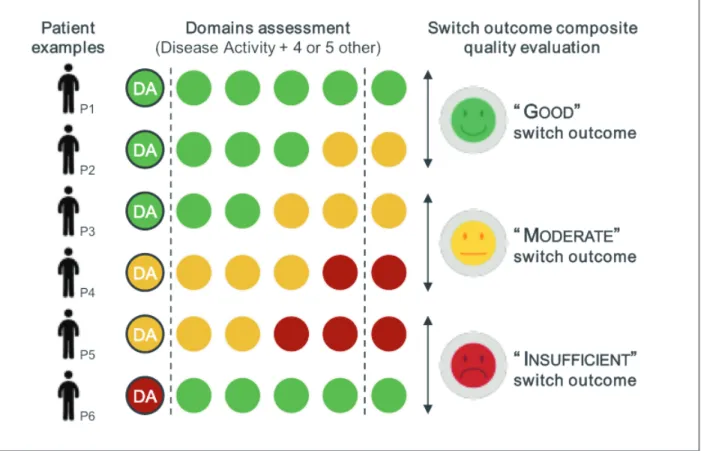
Regarding overall switch quality, a “Good” biologic switch was defined when comprising most of the do-mains with “Good” outcome and up to 1 or 2 dodo-mains with a “Moderate” outcome, out of 5 or 6 evaluated do-mains, respectively. A “Moderate” switch outcome was defined when comprising most of the domains with “Good” or “Moderate” outcomes and up to 1 or 2 do-mains with an “Insufficient” outcome, out of 5 or 6 eval-uated domains, respectively. Besides, experts agreed that “Joint Disease Activity” domain outcome is a crit-ical prerequisite of overall switch quality, meaning that if a given biologic switch is to be classified as “Good”, then the “Joint Disease Activity” domain also needs to have a “Good” outcome; and if instead the overall qual-ity of switch is classified as “Moderate”, then the “Joint Disease Activity” needs to have at least a “Moderate” outcome. When “Joint Disease Activity” had an “Insuf-ficient” outcome the switch outcome should be classi-fied as “Insufficient”, regardless of the result obtained
in the other domains. (Figure 1)
Tools’ validation: From the 80 clinical cases (40 with peripheral PsA and 40 with axial PsA phenotypes) as-sessed, 30 cases for the peripheral PsA and 25 cases for the axial PsA tools’ validation were used. These were the cases where at least 2 out of 3 rheumatologists gave the same biologic switch classification (“Good”, “Mod-erate” or “Insufficient”) to the clinical scenario. The overall results leading to the cases used for both tools’ validation are presented in the Annex – Table III).
Regarding the performance of the tools, the peripher al PsA tool was found to be more sensitive (92%) for the “Good” quality level and more specific (97%) for the “Insufficient” quality level. The axial PsA tool was found to be more sensitive (100%) for the “Good” quality level and more specific (100%) for the “Insufficient” quality level. Both tools showed to be less sensitive for the “Moderate” quality level. Most cases of discordance between the opinion of the rheumatolo-gists and PASQAL were due to the switch being classi-fied as “Moderate” by the tool and as “Good” by the rheumatologists (83% of the discordant cases in pPASQAL and 70% of the discordant cases of axPASQAL). Additional performance parameters re-garding sensitivity/specificity analysis are also shown in the Annex – Table V.
An additional analysis was conducted for the cases where rheumatologists disagreed between themselves regarding the quality of the switch (without the agree-ment of at least 2 out of 3 rheumatologists) to under-stand the main reasons for rheumatologists to evaluate the biologic switch differently from the tools. The ex-ample in the Annex – Figure 1 depicts the tool’s output of the 40 peripheral PsA cases (coloured balls corre-sponding to the “Good”, “Moderate” and “Insufficient” tool’s outcomes) and the cases where the rheumatolo-gists gave a different classification (red crosses). No-tably, cases considered “Moderate” by the tool (consid-ering the outcomes of all domains) are classified as “Good” by the rheumatologists mainly because they ac-cepted some residual “Disease Activity” if the patient has a considerable improvement from the baseline (e.g. patient with a DAPSA=5.6 but with an improvement from the baseline of 64%). Similar findings were ob-tained for axial PsA cases (Annex – Figure 2).
Good levels of agreement of both tools with the gold standard were achieved. The peripheral PsA tool pre-sented a kappa=0.87, whereas the axial PsA tool had a kappa=0.71. The summary of the validation results for both tools is shown in Table III.
These validation analyses were also performed con-sidering all cases without discarding the non-consen-sual cases, i.e. without considering at least 2 out of 3 rheumatologists giving the same biologic switch clas-sification. The answers of the experts to all 80 clinical
cases were analyzed and compared with the tool out-put through the metrics mentioned above (Annex – Table 4). The results reflect a higher divergence in the opinion of experts, i.e. less coherence with the tool. As expected, the sensitivity and specificity for all quality
tAbLE III. vALIDAtION rEsULts OF ppAsQAL AND apAsQAL
Outcome Measurement Biologic Switch Agreement between the
Tool Classification1 "Sensitivity"2 "Specificity"3 tool and rheumatologists4
pPASQAL "Good" 92% 89% k=0.71 "Moderate" 73% 85% (95% CI = 0.59-0.83) "Insufficient" 75% 97% "Good" 100% 90% k=0.87 aPASQAL "Moderate" 83% 97% (95% CI = 0.78-0.96) "Insufficient" 86% 100%
1. All patient profiles (40 with Peripheral PsA and 40 with Axial PsA) were evaluated by 3 experts and the biologic switch was classified into three quality levels: "Good", "Moderate" or "Insufficient"
2. "Sensitivity": Only of those consensual patient profiles, proportion (%) correctly classified as "Good"; "Moderate" or "Insufficient" 3. "Specificity": Only of those consensual patient profiles, proportion (%) correctly classified as not "Good"; "Moderate" or "Insufficient" 4. The agreement between the tool and the “gold standard” was calculated by Cohen's kappa (k); values above 0.61 are considered a good level of agreement
levels as well as the reliability were lower for both tools.
DIscUssION
A tool to assess the quality of biologic switch decisions in PsA was developed and shown to have good content validity. The fact that there are no agreed definitions about the quality of biologics’ switch in PsA and which outcome measure should be used for this quality as-sessment makes this project the first attempt to create a new dedicated overall measure to evaluate the bio-logic switch in PsA patients overcoming these current limitations.
The methodology used for the validation analysis was carefully chosen and needed to ensure that both tools are valid, also having clinical application and fea-sibility in mind. The validation results showed that aPASQAL is more sensitive classifying a biologic switch as “Good”, “Moderate” or “Insufficient” and more spe-cific classifying a biologic switch as not “Good”, “Mod-erate” and “Insufficient”. Also, the axial PsA clinical cas-es classified as “Good” by both tools were 100% correctly classified by the rheumatologists, enabling the statement that a negligible error will be involved when classifying these cases in the future. The “Mod-erate” quality level (in both tools) was the one showing higher discrepancies between tool’s output and clinical judgement, where rheumatologists seem to be more “optimistic” than the tool, given that, in most of the discordant cases, they classified the biologic switch as “Good” instead. Also, the axial PsA tool has shown to have a higher agreement when compared with the gold standard than the peripheral PsA tool. However, if all cases were considered, including the ones without an agreement, a higher divergence in the opinions of ex-perts would have been observed, resulting in lower sen-sitivity, specificity, and level of agreement for both tools. PASQAL’s development comprised several interac-tions between the Task Force and the Expert’s Panel, which were essential to arrive at the final tools’ defini-tion. The main objective of this phase was to develop a tool that should be feasible in daily clinical practice. Experts reached consensus on having the “Joint Dis-ease Activity” domain as a prerequisite in both tools as they considered essential for the patient to meet this “requirement” to have a “Good” or “Moderate” biolog-ic switch, otherwise, it is an “Insuffbiolog-icient” switch. The special importance given to this domain was then
val-idated during clinical judgement namely in cases with-out an agreement, as most rheumatologists focused mainly on the joints to give their opinion about the quality of the biologic switch.
The analysis of the cases without an agreement for both tools led to the conclusion that often rheumatol-ogists take into consideration only one or two key pa-rameters when evaluating the biologic switch. From all domains involved, the “Joint Disease activity” proved to be the main driver of rheumatologists’ opinion. Overall, the discordant cases showed that rheumatol-ogists are less demanding when classifying the biolog-ic switch than the tool. For instance, they accepted a “Good” outcome for “Articular Disease Activity” even when the patient was not in remission/inactive disease. This also suggests that PASQAL may be more “de-manding” that the rheumatologists, related to the fact that this tool considers a broader number and type of domains.
This study has some limitations. First, it is a subjec-tive process and dependent on the opinion of the in-volved Experts, which may not necessarily reflect the view of the entire community of rheumatologists. Sec-ond, although the patient perspective was considered in the literature search, the lack of direct patient in-volvement in this study is a limitation. Third, the vali-dation results are based on a small sample, mainly due to lack of patients’ information (some hospitals do not report measures that are outputs of the tools) available at the time of the study. Thus, PASQAL needs to be test-ed in a larger sample to further analyze its performance, usability and feasibility. Lastly, both tools were created to evaluate the outcome three months after switching to a second biologic therapy. Therefore, it would be in-teresting to test PASQAL in other stages of the disease and management (e.g. first biologic switch and DMARD switch).
In conclusion, two outcome measurement tools were developed to address the quality of treatment de-cisions regarding biologics’ switch in PsA management. Both outcomes measurement tools define states of the disease and levels of improvement and their use can be extended to other therapeutic interventions in PsA, such as the introduction of first biologic DMARD or to subsequent switches, and consequently gain a broad-er scope and utility. Besides, the developed tools are more demanding than the rheumatologists’ opinion since they take into consideration relevant parameters that are not always considered by rheumatologists dai-ly, and include the patients’ perspective (through the
quality of life assessment measured by the EQ-5D). In the future, it would be interesting to evaluate the implications of PASQAL output on long-term “hard” outcomes (e.g. persistence, quality of life, remission, structural damage), namely to test if a “Good” switch can predict significant positive outcomes, and there-fore enhancing the therapeutic decisions of rheuma-tologists and PsA management. Finally, this project can also contribute to the implementation of PASQAL in the Reuma.pt registry and be used to evaluate the qual-ity of treatment decisions done by rheumatologists in PsA, as well as to evaluate how well controlled are bi-ologic-persistent patients according to a core set of quality indicators. Hence directly supporting clinical practice and real-world research.
cOrrEspONDENcE tO Pedro A. Laires
Centro de Investigação em Saúde Pública Escola Nacional de Saúde Pública Universidade NOVA de Lisboa E-mail: [email protected] rEFErENcEs
1. Moll JM, Wright V. Psoriatic arthritis. Semin. Arthritis Rheum. 3, 55–78 (1973).
2. Gladman DD et al. Consensus on a core set of domains for pso-riatic arthritis. J. Rheumatol. 34, 1167–1170 (2007). 3. Coates LC, Fransen J, Helliwell PS. Defining minimal disease
ac-tivity in psoriatic arthritis: a proposed objective target for treat-ment. Ann. Rheum. Dis. 69, 48 LP-53 (2010).
4. Smolen JS et al. Treating axial spondyloarthritis and peripheral spondyloarthritis, especially psoriatic arthritis, to target: 2017 update of recommendations by an international task force. Ann. Rheum. Dis. 77, 3–17 (2018).
5. Tucker LJ, Coates LC, Helliwell PS. Assessing Disease Activity in Psoriatic Arthritis: A Literature Review. Rheumatol. Ther. 6, 23–32 (2018).
6. Machado P, Landewé R. Is it time to replace BASDAI with AS-DAS? Nat. Rev. Rheumatol. 9, 388 (2013).
7. Machado PM, Landewé R, van der Heijde D Assessment of SpondyloArthritis international Society (ASAS)Ankylosing Spondylitis Disease Activity Score (ASDAS): 2018 update of the nomenclature for disease activity statesAnnals of the Rheumat-ic Diseases 2018;77:1539-1540
8. Orbai AM et al. Updating the Psoriatic Arthritis (PsA) Core Do-main Set: A Report from the PsA Workshop at OMERACT 2016. J. Rheumatol. 44, 1522 LP-1528 (2017).
9. K, F., SJ, B., MS, A. & Al., E. RAND/UCLA Appropriateness method user’s manual. (2001).
10. Canhao H, Faustino A, Martins F, Fonseca JE. Reuma.pt - the rheumatic diseases portuguese register. Acta Reumatol. Port. 36, 45–56 (2011).
11. Petri M et al. Derivation and validation of the Systemic Lupus International Collaborating Clinics classification criteria for sys-temic lupus erythematosus. Arthritis Rheum. 64, 2677–2686 (2012).
12. Fawcett T. An introduction to ROC analysis. Pattern Recognit. Lett. 27, 861–874 (2006).
13. Kwiecien R, Kopp-Schneider A, Blettner M. Concordance anal-ysis: part 16 of a series on evaluation of scientific publications. Dtsch. Arztebl. Int. 108, 515–521 (2011).
14. Cauli A et al. Physician’s Global Assessment in Psoriatic Arthri-tis: A Multicenter GRAPPA Study. J. Rheumatol. 45, 1256 LP-1262 (2018).
15. Carreño A, Fernández I, Badia X, Varela C, Roset M. Using HAQ-DI to estimate HUI-3 and EQ-5D utility values for patients with rheumatoid arthritis in Spain. Value Heal. 14, 192–200 (2011). 16. Ferreira PL, Ferreira LN, Pereira LN. Contribution for the Vali-dation of the Portuguese Version of EQ-5D. Acta Med. Port. 26, 664–675 (2013).
17. Kvamme M, Kristiansen I, Lie E, Kristian Kvien T. Identification of Cutpoints for Acceptable Health Status and Important Im-provement in Patient-Reported Outcomes, in Rheumatoid Arthritis, Psoriatic Arthritis, and Ankylosing Spondylitis. The Journal of rheumatology 37, (2009).
18. Mease PJ et al. Minimally Important Difference of Health As-sessment Questionnaire in Psoriatic Arthritis: Relating Thresh-olds of Improvement in Functional Ability to Patient-rated Im-portance and Satisfaction. J. Rheumatol. 38, 2461 LP-2465 (2011).
ANNEx
ANNEx – tAbLE I. prELIMINAry LIst OF tHE 45 DOMAINs rELEvANt FOr psA sELEctED prIOr tO DELpHI prOcEss
Perspective Domain
Joint disease activity Swollen joints Dactylitis
Inflammatory parameters Enthesis
Side-effects, safety and tolerability Global disease evaluation (physician) Skin manifestations
Tender joints
Ophthalmologic manifestations Imaging evaluation of the inflammatory activity
Joint pain (related to Peripheral PsA) Gastrointestinal manifestations Axial pain (related to Axial PsA) Nail manifestations
Persistence Structural damage Axial mobility
Cardiometabolic events Global patient satisfaction Global disease evaluation (patient) Physical function
Joint pain (related to Peripheral Joint PsA) Quality of life
Side-effects, safety and tolerability Treatment satisfaction
Work productivity
Axial pain (related to Axial PsA) Fatigue
Emotional well-being Social life
Anxiety and depression Sleep disturbance
Impact on family and/or caregiver Axial manifestations
Convenience Sexual life
Rejection, discrimination and shame Fear and uncertainty
Therapy costs Indirect costs Direct medical costs Social life
Impact on family and/or caregiver Persistence Physician (N=19) Patient (N=20) Society (N=6)
ANNEx – tAbLE II. prE-sELEctED 11 DOMAINs AFtEr DELpHI prOcEss
Perspective Domain
Joint disease activity Swollen joints Dactylitis
Inflammatory parameters Enthesis
Global patient satisfaction Global disease evaluation (patient) Physical function
Joint pain (related to Peripheral Joint PsA) Therapy costs Indirect costs Physician (N=5) Patient (N=4) Society (N=2)
ANNEx – tAbLE III. rEsULts OF tHE twO OUtcOMEs MEAsUrEMENt tOOLs, cOMpArED wItH tHE "GOLD stANDArD" (cLINIcAL jUDGEMENt) UsING ALL cAsEs (wItHOUt cONsIDErING At LEAst 2 OUt OF 3 rHEUMAtOLOGIsts GIvING tHE sAME bIOLOGIc swItcH cLAssIFIcAtION)
Outcome Measurement Biologic Switch Agreement between the
Tool Classification1 "Sensitivity"2 "Specificity"3 tool and rheumatologists4
Peripheral "Good" 92% 74% k=0.49
PsA Tool "Moderate" 52% 78% (95% CI = 0.34-0.63)
"Insufficient" 58% 97%
Axial "Good" 100% 70% k=0.45
PsA Tool "Moderate" 44% 79% (95% CI = 0.30-0.60)
"Insufficient" 53% 95%
1. All patient profiles (40 with Peripheral PsA and 40 with Axial PsA) were evaluated by 3 experts and the biologic switch was classified into three quality levels: "Good", "Moderate" or "Insufficient"
2. "Sensitivity": Only of those consensual patient profiles, proportion (%) correctly classified as "Good"; "Moderate" or "Insufficient" 3. "Specificity": Only of those consensual patient profiles, proportion (%) correctly classified as not "Good"; "Moderate" or "Insufficient" 4. The agreement between the tool and the “gold standard” was calculated by Cohen's kappa (k); values above 0.61 are considered a good level of agreement
ANNEx – tAbLE III. cOMMON pErFOrMANcE MEtrIcs cALcULAtED FrOM sENsItIvIty/spEcIFIcIty ANALysIs
Outcome Biologic Switch
Measurement Tool Classification1 PPV1 NPV2 LR+3 LR-4
"Good" 0.85 0.94 1.04 0.71 pPASQAL "Moderate" 0.71 0.86 0.87 1.75 "Insufficient" 0.90 0.91 0.77 8.75 "Good" 0.90 1.00 1.13 0 aPASQAL "Moderate" 0.88 0.95 0.86 4.83 "Insufficient" 1.00 0.95 0.86 -5
1. Precision or positive predictive value (PPV). PPV = True Positives / (True Positives + False Positives) 2. Negative predictive value (NPV). NPV = True Negatives / (True Negatives + False Negatives) 3. Positive likelihood ration (LR+). LR+ = True Positive Rate / (1-False Positive Rate)
4. Positive likelihood ration (LR-). LR- = (1-True Positive Rate)/False Positive Rate
Annex - Figure 1. Additional analysis in peripheral PsA – Agreement between tools’ output and clinical judgement using DAPSA thresholds
a – Example of a case without agreement between clinical judgement and the tool: Experts have evaluated this case as “Good” and the tool has considered it “Moderate” due to DAPSA = 5.60 and DAPSA improvement above 50%.
Annex - Figure 2. Additional analysis in axial PsA – Agreement between tools’ output and clinical judgement using ASDAS thresholds a – Example of a case without agreement between clinical judgement and the tool: Experts evaluate this case as “Good” and the tool has considered it “Moderate” due to ASDAS = 1.7 and ASDAS improvement above 1.1.