Questioning the Brazilian Status Quo through Brechtian
Techniques in Sérgio Bianchi’s Art Films
Questionando o status quo brasileiro através das técnicas
brechtianas nos filmes de Sérgio Bianchi
Resumo: Analisamos o uso das técnicas brechtianas nos filmes do diretor Sérgio Bianchi
para questionar o status quo na cultura brasileira. Seus filmes, Quanto vale ou é por quilo? e Cronicamente inviável apresentam técnicas fílmicas que proporcionam ao espectador uma visão mais crítica de eventos nacionais correntes. As obras de Bianchi se mostram politicamente engajadas e não deixam de lado vários temas polêmicos, por exemplo, a corrupção de organizações não governamentais (ONGs), preconceito racial, a exploração do sofrimento da classe menos favorecida para obtenção de lucros etc. Bianchi utiliza técnicas que desconstroem supostas verdades e conceitos intocáveis em uma sociedade de falso moralismo. As técnicas de Brecht podem parecer caóticas, mas o caos possibilita a desconstrução de princípios enraizados na sociedade brasileira. Brecht argumentava que o cinema pode gerar uma ilusão convincente que não permite aos expectadores margem para o pensamento crítico (2000). Para contrariar essa tendência, suas técnicas rompem a sequência da trama fílmica através da inserção de diferentes gêneros textuais.
Palavras-chave: técnicas brechtianas; Sergio Bianchi; cultura e identidade.
Abstract:We have analyzed the use of Brechtian techniques in the films of the director Sérgio Bianchi to question the status quo in Brazilian culture. His films, Quanto vale ou é por quilo? and Cronicamente inviável, presents filmic techniques that allow the spectator to have a more critical view of national current affairs. The oeuvre of Bianchi is politically engaged and it includes several polemic themes, for instance, the corruption of non-governmental organizations (NGOs), racial prejudice, exploitation of people in need to obtain financial profit etc. Bianchi uses techniques that deconstruct supposed truths and untouchable concepts of a society with false morality. Brecht’s techniques seem chaotic, but the chaos make it possible for spectators to deconstruct rooted principals in the Brazilian society. Brecht argued that cinema can generate a convincing illusion that does not give the chance for spectators to have critical thinking (2000). In order to overcome this trend, his techniques break the sequence of the filmic plot through the insertion of different textual genres.
Keywords: Brechtian Techniques; Sérgio Bianchi; culture and identity.
Samuel Rodrigues dos Santos1
1Mestre em Línguas Românicas pela University of Georgia. Mestrando em Estudos Linguísticos pela Universidade
A minha intenção é provocar, eu sou muito Bretchiano, não estou muito preocupado em achar soluções. (BIANCHI apud ARANHA; EDUARDO, 2005)
Since film can represent reality in such an abstract way, it lends itself to confrontations with reality. It can confirm or dispute. It can recall or prophesy. (BRECHT, 2000, p. 7)
Brazil has witnessed since the dictatorship between 1964 and 1985 a political fight through the arts. Currently, this artistic political movement is still present and cinema has played an important role in it. The director Sérgio Bianchi is one of the most famous and polemic due to his movies with social inequality agenda. Bianchi’s mains inspiration seems to be the German director Bertolt Brecht who were active during the Nazi dictatorship and made important contributions to different sorts of media, like radio, television, film, and dramatic performance. As a Marxist, Brecht believed that all artistic activities are political.
The Brazilian director, Bianchi, has been using film to raise awareness among ‘mentally colonized Brazilians’, as the he classifies them (ARANHA; EDUARDO, 2005), in a similar way as Augusto Boal, a late Brazilian playwright, who used his Theater of the Oppressed to expose oppression and call the population to a social movement through the arts, mainly theater. Bianchi believes that Brazilians still have a slave mindset. One of his films, Quanto vale ou é por quilo?, released in 2005, features the reality of non-governmental organizations taking advantage of their social prestige to exploit the misery of lower social classes in Brazil. The plot presents a comparison between modern charitable institutions and historical individuals from the slave trade period who were philanthropists supposed to help people of African descent. During the movie, we learn relevant information related to the culture of charity in Brazil, a former colony exploited by Europeans who took a position of civilizers of the uncivilized. The idea of providing the
native, or the other, with a better way of living is still common, but it has taken other
proportions in a capitalist, democratic, governmental system. Quanto vale has an informative status and in certain parts is similar to a
documentary, if we consider its format. There are voiceovers in several scenes, and it includes scenes in which advertisements of NGOs occur. These advertisements can remind the Brazilian viewer of Programa Criança Esperança, which has a logo of children holding hands, as figure 1 shows. Criança Esperança is an annually fundraising event
organized by TV Globo; this event has funds from private and public institutions. Celebrities, rich and poor individuals pose for the cameras as they are helping children in need. Generally, this show has very high audience ratings, and its popularity could be justified by the national point of view that charity is a very noble deed. Thus, Bianchi uses this imagery to lead the viewer to the topic of philanthropist industry in Brazil. In an interview for Revista Época, Bianchi commented:
É, eu gosto de ver as coisas sempre em nível de classe social. Eu não consigo ver qualquer realidade sem inserir o contexto da classe da qual aquela pessoa fala. Isso eu observo, não consigo não colocar. Algumas pessoas dizem que sou marxista. Não sei, mas eu não consigo ver de outro jeito (ARANHA; EDUARDO, 2005)
The director is very engaged politically and seems to be a critique of Brazilian society, familiar with the injustices and neo-colonization schemes that oppress the poor
by taking advantage of society’s morality based on work and dignity. The production reveals that no matter how much the poor works, they will never conquer wealth in a system that keeps profit in the hands of a minority, in which citizens are led to believe that they will improve their lives through hard work, generating a vicious cycle, for their hard work rarely results in their aspirations.
Probably, Bianchi finds in the film Kuhle Wampe or Who Owns the World? (Figure 2), by the directors Brecht and Slatan Dudow, an inspiration for his own
production. The German movie brings attention to all sorts of social problems that affected mainly the proletariat class in the Nazi Germany. The production is from 1932, a period with high rate of unemployed youth in Germany and homeless families who received eviction orders for not being able to afford their houses, having a swamp as an only option of place where to live.
Figure 2 - Poster for the film Kuhle Wampe
Brecht believed that “the cinema’s potential is in its technological capacity to collect documents. To present some philosophy or another, or images of life itself” (2000, p. 6). He would insert all sorts of different textual genres in the screen that the viewers, mainly the working class, could relate to their situation, forming a cinematic collage, which served as proof of the status quo. He claimed, “the integration of documentary film material into theatre productions also brings forth the Verfremdungseffekt - the distancing feeling generated in the spectator. The on-stage actions are alienated by juxtaposition with the more general actions on the screen” (BRECHT, 2000, p. 10). The viewers would be able to break the hypnotic cycle produced by the motion pictures, resulting in a more critical approach to the filmic piece. Brecht wrote:
It is essential for hypnosis that the necessary manipulations are made unobtrusively as possible, Sources of light and sound are hidden. The theatre does not wish to be identified as theatre… Under these conditions the set has no interest in appearing as the set. It presents itself as nature, possibly as enhanced nature. (BRECHT, 2000, p. 16).
According to his theory, films, as well as theater, would be able to hypnotize the spectator, leading them to consider the actor’s performance as mere reality. In this situation, there is a deprivation of critical thinking and emphasis in a more passive role of the spectator. Brecht broke this process through inserting different sequences or nuclei, interrupting the chronological development of the plot, requiring from the audience a higher cognitive engagement to derive meaning from the images.
Bianchi applies a similar approach; along the film, he uses different genres. Quanto vale begins showing the story of a female former slave who was able to save money and buy other slaves. She has some of her slaves captured, mistaken for fugitive ones. After having her story narrated with a voice over, the viewer learns through a caption in white letters on a black background that this account is a notary’s office official document. Next, a short film begins based on current time, telling the story of Mônica, a woman who struggled to create her own charitable institution, she is proud to say: “I have a mission and I think it has proved to be a success. But I won’t sleep on my laurels. I have many challenges ahead of me and I want to expand it and I won’t rest while there are hungry
people around me and people who have nothing to eat.” Her discourse is flawed because under close analysis, we understand that she does not want poverty to be over, otherwise she will not have a job or any prestige as a philanthropist, she needs the poor to continue poor, since they are keeping her business.
As she gives her statement, we notice several interruptions by the producers of the short film; they put some make up on her, check the light and move around her, carrying film setting tools, which contributes for the idea of a built reality. After that, we discover that she is actually daydreaming about her future fame. The following scene is another historical notary’s office account about slavery, and the movie continues featuring several different enacted documents and TV commercials until the final credits.
Even the final cast list plays a role in breaking the sequence of events. The viewer might think the movie is over, but in the middle of the credits, another scene takes place. The sequence happens as the figure three shows. There is a short film ending in a perfect family picture, after that the movie credits appear, interrupted by an alternative ending, and then the real final credits reappear, as the following screenshots exemplify:
Along the movie, the director includes different sources of information in sequence, giving the impression of a chaos, as Brecht did in his political movies, inserting short films, photography, newspaper’s headlines, official documents, etc, making the plot not so obvious, requiring the viewer to build associations that generate criticism. In a way, the director speaks directly to his audience and admonishes them to think differently to what society teaches them. We see the application of a series of interconnected methods that make the audience rethink their social beliefs.
Another asset employed by the producers are some visual metaphors that triggers criticism, for instance, when the head of a prestigious NGO visits the favela by car to donate some shabby computers to a poor community. The NGO visitors end up stuck in the mud, in need of the locals help. The message becomes clear through the scene: to be able to help the underprivileged, the rich class needs the poor’s help (Figure 4). The spectator notices that the ones who benefit most from these transactions of ‘charity’ are
the organizers of the NGO, who are also members of the elite, always carried by the oppressed class, with a discourse of willingness to help. In a larger scale, we understand that the car represents the country, Brazil, driven or controlled by the rich, but the hardest part is left to the poor, pushing the heavy car forward.
Figure 5– Visual metaphors.
The movie becomes pedagogical because it contrasts episodes of current ways of living in Brazil with the life people had until the 19th century, when slavery still shaped the
economy (Figure 5). However, slavery still exists, but it has taken other ways to materialize itself, which are more subtle, making it hard for subjects to realize their enslaved condition. Recurring images in Quanto vale facilitate this understanding for the audience, for visual representation is grasped quickly, simply through the glimpse of an eye. Once visual symbols does not require much to be decoded, the voiceover can even be silent as the camera closes up to show the characters emotion, for example, the scenes in which the slaves are portrayed in torturing sessions, and the modern jail where inmates are featured as if they were in a modern slave ship (Figure 6).
The movie also provokes the spectators by questioning their common national belief that Brazil is a racial democracy, which offers equal opportunities for the white and black to flourish either socially or economically. This idea is proven not so accurate in the scene the producers of the advertisement for an NGO started a quarrel about the children chosen as cast; the latter were supposed to be beautiful, clean, healthy and preferably pure black, white or indigenous. The conflict happens because there is a great mixture among the Brazilian people, originating other racial nuances, thus the producers, who seem to be very conservative, name the cast, moreninho, mulato, preto, pretinho, índio
etc (Figure 7). It becomes evident for the viewer of Quanto vale that there is no such thing as peaceful cultural reciprocity as the national narrative states, and actually people still make many derogatory comments about the non-white population in Brazil.
Like Brecht, Bianchi is determined to help the spectators understand that reality can be built. He wants his viewers to know that the movie being watched is a construction, just like certain social discourses are also constructed. Bianchi portrays movie productions, TV commercials, inside the movie, using a sort of visual meta-language, thus the viewer learns to doubt everything, for what he or she learned can actually be a bent truth. The fourth wall, the invisible wall between the audience and the mise-en-scéne, which creates an illusion of reality tumbles down.
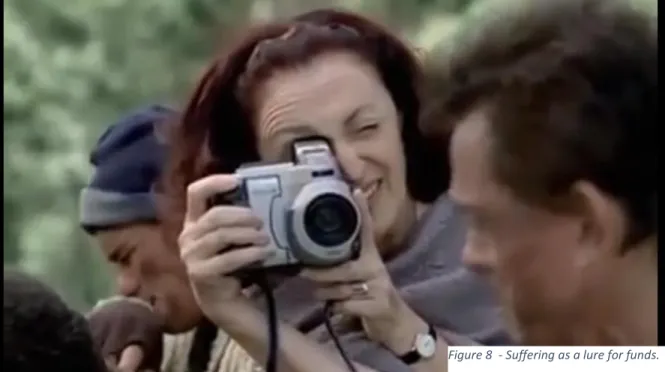
Spectators start questioning the good intensions of the NGOs featured, which use the poor’s suffering as a lure for international funds (Figure 8). The underprivileged characters go through of process of reification, for they become commodities, a product that is manipulated for their own greedy interests (GORDON, 2013, p. 24).
The movie associates slavery from previous centuries with the present NGOs that strengthen the status quo, comprehended by poverty and social injustice. It reveals their selfishness and insensitivity, causing in the audience a distaste for corrupted characters (GORDON, 2013, p. 25). Thus, viewers understand that supposed benefactors can be a
threat occasionally. The common belief that Brazilian kindness is always motivated by unselfish reasons passes through a process of reassessment and reconfiguration.
Bianchi does the same in Cronicamente Inviável (Chronically Unfeasible), a movie produced in 2000. He criticizes the Brazilian social injustice and defends that it has already become a cultural trait. Throughout the movie, the narrator talks to the spectator and invites him to think about the scene, giving him a more active role, to think and not merely be a recipient of the piece. The narrator comments the scenes several times, as in the extract: “this scene is too sad, wouldn’t it be better to make it as in real life?”. After that, the actors reshape the scene in the presence of the spectator. In passages like this, we see a clear resemblance with the Theater of the Opressed created by the Brazilian playwright, Augusto Boal, who was inspired by Brecht as well to create new ways of reading a dramatic scene. For instance, by encouraging the viewer to reconstruct the piece.
The intention is to avoid an illusion, as if the movie were a real story, the director intends to present the acting as a construction, elaborated to reach certain understanding by the spectator. The narrator in Bianchi is similar to the joker in Boal’s theater. The joker is closer to the spectator and further to the other characters. The joker offers explanations for the scenes, hence the piece has features from the fable, for it keeps the scenic illusion, and features from a lecture because he explains the events on screen (BOAL, 1980, p. 196).
In Cronicamente, the joker who could be mistaken for a narrator gives his opinion about many scenes, for instance, when he sees the police torturing an indigenous person:
É por isso que a lógica indutiva me assusta, ela acaba com a indignação. Se a gente for tentar explicar o espancamento de um índio através da realidade, vai chegar a que conclusão? É claro que na verdade, aquele índio deve ser um traficante, ou se não, deve ter comido a mulher do policial. Mas, desde quando isso explica alguma coisa? (...) Bom, os índios que eram a população original aqui da terra já exerciam violência entre eles, a violência sempre existiu, mas eles organizavam a violência e até a guerra de forma ritual, se bem que o jeito de fazer as coisas hoje em dia
não deixa de ser ritual. Ritual de bater sistematicamente no mais fraco.(fragment from the film)
The perception of the joker-actor, according to Boal, is beyond the space and time that the other characters are in. He belongs to a magical reality, he has powers to invent new possibilities, and the characters will obey his creations (1980, p. 203). For instance, in Cronicamente, the joker reconstructs one of the scenes, as if he were the own author-director. Two assistant cooks comes out from a fancy restaurant kitchen, putting the trash in dumpsters, next two beggars come to open the dumpsters and eat their content, but the joker comments: “é muito explícita essa cena, não seria melhor fazer de uma forma mais adaptada à realidade?”. Immediately, the actors rearrange the scene in a way that, a dog comes to eat the food from the dumpster and the beggars are expelled by the an assistant cook who says: “oh, vão embora, fora daqui, não pode comer resto não, fora daqui!”. As in Boal’s Theater of the Oppressed the scenes are redone before the spectator.
Brazilian artists have been using art to reshape society’s ideologies and beliefs. A number of cinematic techniques help individuals learn more about the status quo and teach them how to be critical thinkers by requiring an increased cognitive engagement to comprehend the filmic plot. Bianchi, for instance, is an important representative of political cinema in current Brazil. Through his art film, he has generated a reflection about Brazilianess promoted by national narratives throughout the country’s history. It seems that in his film he wants to inform the spectator about the national discourse of hard work and good morals, which in some cases, the elite uses to dominate the lower classes. For him, there is a neo-colonized class, which is led to believe they can become rich through their work, however they cannot find a way out of this vicious working cycle that seldom take them to their goals of improving their life quality; the irony is that it all happens in a so-called free, democratic country.
References
BRECHT, B.; DUDOW, S. Kuhle Wampe, or Who Owns the World? [Filme-vídeo]
Prometheus-Film-Verleih und Vertriebs-GmbH, 1932.
_____________. “Diaries”: Brecht on Film and Radio. Ed. and trans. Silberman. London: Methuen, 2000.
BOAL, A. Teatro do Oprimido e outras Políticas Poéticas. Rio de Janeiro: Civilização Brasileira, 1980.
ARANHA, A.; EDUARDO, C. Revista Época. Entrevista com o diretor do filme Quanto
Vale ou é Por Quilo?, Sérgio Bianchi (16 de maio de 2005). Disponível em:
http://revistaepoca.globo.com/Epoca/0,6993,EPT961935-1655-2,00.html. Data de
acesso: 21/05/2016.
GORDON, Richard A.(2013). “A Narrative of National Reform: Quanto vale ou é por
quilo?” Journal of Cognitive Semiotics. 4.2. 20-39. http://www.cognitivesemiotics.com .
BIANCHI, S. Quanto vale ou é por quilo? [Filme-vídeo] Riofilme, 2005.