Departamento de Ciência Política e Políticas Públicas
Party-system fragmentation and its effect on likelihood of voting: The
moderating role of polarization
Vicente Dinis Valentim
Dissertação submetida como requisito parcial para obtenção do grau de
Mestre em Ciência Política
Orientador
Doutor André Freire, Professor Associado com Agregação,
ISCTE – Instituto Universitário de Lisboa
Coorientadora
Doutora Eva Anduiza Perea, Professora Associada de Ciência Política,
Faculdade de Ciência Política e Sociologia – Universidade Autónoma de Barcelona
ii Agradecimentos
Tenho a sorte de poder ter contado com o apoio uma grande quantidade de pessoas que, durante os meses de redação desta dissertação, estiveram ao meu dispor de uma forma que mudou por completo a experiência de escrever estas páginas. Esta é uma forma manifestamente insuficiente de lhes agradecer. Devo a todas as pessoas aqui presentes um agradecimento mais digno e próximo. Esse agradecimento, no entanto, merece um lugar e momento que não este.
O primeiro agradecimento é dirigido aos meus orientadores, professores André Freire e Eva Anduiza, cujo contributo melhorou incomensuravelmente a qualidade desta dissertação e que fizeram crescer em mim uma permanente vontade de chegar ao fundo das coisas, mesmo – ou principalmente – daquelas que não o têm realmente. Foi para mim uma enorme honra ter a orientação de duas pessoas por quem tinha uma admiração tão grande antes ainda de as conhecer. O Vicente de há dois anos não acreditaria se lhe dissessem que hoje estaria a escrever-lhes este agradecimento. Um agradecimento especial também ao professor José Santana Pereira, um autêntico terceiro orientador, sempre inteiramente disponível para discutir esta dissertação e a criticá-la de uma forma que me foi sempre muito útil.
O agradecimento seguinte é dirigido às pessoas cuja influência sobre as páginas que se seguem é mais antiga e mais difusa e, talvez por isso, mais importante, as que me fizeram desenvolver um “inner sense of how the world works” (Geddes, 2003: 31). O pai, a mãe e o António.
Seguidamente, às pessoas que, talvez mais do que se apercebam, me ensinaram a olhar para o mundo como um cientista social e a quem devo, para além disso, os três melhores anos da minha vida. O Afonso e a Bárbara.
Depois, àqueles que me ensinaram a pensar como um cientista político, ainda antes do início do meu mestrado. Os professores José Monteiro e Diogo Ramada Curto.
Segue-se a pessoa que me incentivou a estudar a abstenção, e a quem devo muito mais acerca desta dissertação do que o tema, bem como um enorme agradecimento pelo apoio permanente ao longo do período do meu mestrado: o professor José Ramón Montero.
Tive também a sorte de ter conhecido, nos últimos dois anos, um conjunto de pessoas que contribuiu para que a minha passagem pelo ISCTE-IUL tenha sido melhor do que alguma vez poderia ter desejado, que fez com que lesse imenso e pensasse de forma diferente e que me deu, durante o decorrer deste período, mais apoio do que sinto ter merecido: os professores Luís Francisco Carvalho, Emmanouil Tsatsanis, Britta Baumgarten, Luísa Tiago Oliveira, Filipa Raimundo e Ana Belchior.
Simultaneamente, outro conjunto de pessoas contribuiu para que grande parte desta dissertação tenha sido escrita num dos momentos e ambientes mais inspiradores da minha vida: a turma de 2016/2017 do mestrado de Ciência Política da Universidade Autónoma de Barcelona e a professora Dani Marinova.
iii Seguem-se o Luís e a Mariana, provavelmente as pessoas com quem mais partilhei a escrita destas páginas, e a quem devo grande parte do que de bom aconteceu neste último semestre, amigos novos num momento de ruptura com coisas antigas.
Gostaria também de agradecer aos professores que se disponibilizaram para me encurtar as suas aulas deixando-me aplicar o meu inquérito, sem o que esta dissertação não teria sido possível: os professores João Salis Gomes, Sónia Cardoso, Maria João Vaz, Ricardo Paes Mamede e Paulo Raposo.
Um enorme agradecimento também a um grupo de amigos que são importantes para mim desde que os conheci e que, sendo de áreas muito diferentes, tiveram sempre interesse e disponibilidade para discutir o que eu estava a fazer. Ou só para partilhar um copo de vinho e de jazz. São eles a Bia, o João, o Maia, o Fragoso e a Maria.
E, por último, à Catarina, a pessoa mais importante durante o período de transição do Vicente-aspirante-a-pianista-de-jazz para o Vicente-aspirante-a-cientista-social-e-escritor-de-dissertações-de-mestrado.
Uma pessoa pouco mais é do que a soma das circunstâncias e pessoas com quem se vai encontrando. Um enorme obrigado a todos.
iv Acknowledgements
I am lucky to have been able to count on a large number of people who, during the writing of this dissertation, supported me in a way that completely changed the experience of writing these pages. This is a clearly insufficient way of thanking them. I owe all the people here a closer, more dignifying acknowledgement. Such acknowledgement, however, deserves a different place and time.
I would first like to thank my supervisors, Professors André Freire and Eva Anduiza, whose contribution elevated the quality of this dissertation to a completely different level, and who made me grow a permanent will to get to the bottom of things, even – or especially – to that of things that do not really have such bottom. I was very honoured to work under the supervision of two people for whom I had such a deep admiration even before I had met them. The Vicente from two years ago would not believe it if he was told that, today, he would be writing them this acknowledgement. A special acknowledgement to Professor José Santana Pereira as well, who played the role of an authentic third supervisor, always entirely available to discuss this dissertation and to criticize it in an always helpful manner.
The following acknowledgement is to the people whose influence over the next pages is older and more diffuse and, perhaps because of that, more important. The people who made me to develop an “inner sense of how the world works” (Geddes, 2003: 31): Mom, Dad, and António.
Next, to those who, maybe without realizing it, taught me how at the world as a social scientist and to whom I how, besides that, the three best years of my life. Those people are Afonso and Bárbara.
I would also like to thank those people who taught me to think like a political scientist, even before my enrolment in the masters: Professors José Monteiro and Diogo Ramada Curto.
The next acknowledgement goes to the person who provided me with the incentive to study voter turnout and to whom I owe much more about this dissertation than its topic, as well as an enormous thank you for all his help and guidance throughout the last two years: Professor José Ramón Montero.
I was also lucky to have met, for the last couple of years, a group of people who made my time in ISCTE-IUL better than I could ever have hopped for, who made me read a lot and think differently and who gave me, during this period, more support than I feel like I deserved: Professors Luís Francisco Carvalho, Emmanouil Tsatsanis, Britta Baumgarten, Luísa Tiago Oliveira, Filipa Raimundo and Ana Belchior.
Simultaneously, another group of people allowed a large part of this dissertation to be written in one of the most inspiring environments and moments of my life: the 2016/2017 class of the masters in Political Science at the Autonomous University of Barcelona and Professor Dani Marinova.
The people who follow are probably the ones with whom I shared most of the wiring of these pages, and to whom I owe much of the good things that happened during the last semester, new friends in a period of rupture with old things. They are Luís and Mariana.
v I would also like to thank the Professors who let me shorten their classes by running my survey, without whom the writing of this dissertation would not be possible: Professors João Salis Gomes, Sónia Cardoso, Maria João Vaz, Ricardo Paes Mamede and Paulo Raposo.
I also would like to deeply thank a group of friends who have been important for me ever since I met them and who were always interested and available to discuss what I was doing, even though they work on very different fields. Or simply to share a glass of wine and some jazz. They are Bia, João, Maia, Fragoso and Maria.
And, finally, to Catarina, the most important person during the period of transition from Vicente-who-wants-to-be-a-jazz-pianist to Vicente-who-wants-to-be-a-social-scientist-and-who-writes-masters-dissertations.
One is little more than the sum of circumstances and people one meets along. A huge thank you to all.
vi Abstract: The relation between party-system fragmentation and turnout is a puzzling one. Theoretically, some authors argue that higher fragmentation boosts turnout, whereas others argue the opposite. Empirically, different studies have paid support to both these expectations.
This dissertation aims to shed some light over this controversy. It contends that these conflicting results are due to a neglect of the moderating role that polarization is expected to play over the relation between fragmentation and turnout. In highly polarized party systems, parties are likely to provide voter with more differentiated alternatives. Thus, a higher number of parties is likely to work as an incentive to voting, by increasing overall levels of party identification and increasing the likelihood that the mobilization efforts of parties will reach different voters. Yet in poorly polarized systems, as the higher number of parties does not translate into a richer array of options, increasing fragmentation should depress voter turnout, by making it harder to collect information on the parties and putting the same voter under cross pressures.
These expectations are tested through a survey experiment. The results support the main argument. Fragmentation has a positive effect over likelihood of voting in highly polarized contexts, but a negative one in lowly polarized contexts. The negative effect of fragmentation over likelihood of voting when polarization is low is partly mediated by the cognitive costs of voting. In highly polarized contexts, it is rather the intensity of preference for a party that partly mediates the relation, although this mediation has a direction opposite to expected.
Keywords: Electoral participation; party-system fragmentation; party-system polarization; survey experiment.
vii Resumo: A relação entre fragmentação dos sistemas partidários e participação eleitoral é controversa. Teoricamente, alguns autores argumentam que a fragmentação tem um efeito positivo sobre a participação eleitoral, enquanto outros defendem o oposto. Empiricamente, diferentes estudos têm corroborados ambas as expectativas.
Esta dissertação pretende contribuir para resolver esta controvérsia. Argumenta que os resultados contraditórios da literatura se devem à sua negligência do papel moderador que a polarização deve desempenhar sobre a relação entre fragmentação e participação eleitoral. Em contextos altamente polarizados, os partidos oferecem alternativas mais diferenciadas aos eleitores. Assim, é expectável que um maior número de partidos funcione como incentivo ao voto, por tornar a identificação partidária mais provável e possibilitar que os esforços de mobilização dos partidos alcancem diferentes eleitores. No entanto, em contextos pouco polarizados o maior número de partidos não se traduz numa maior riqueza das alternativas. Um aumento da fragmentação deve assim reduzir a participação eleitoral, por aumentar os custos de acesso a informação e colocar os eleitores debaixo da pressão simultânea de diferentes partidos.
Estas expectativas são testadas através de um inquérito experimental. Os resultados corroboram o argumento central. Em contextos altamente polarizados, a fragmentação tem um efeito positivo sobre a probabilidade de um indivíduo votar, mas este efeito é negativo em contextos pouco polarizados. O efeito negativo da fragmentação em contextos pouco polarizados é parcialmente mediado pelos custos cognitivos do voto. Em contextos altamente polarizados, é a intensidade com que um indivíduo prefere um partido que medeia a relação, embora esta mediação funcione no sentido oposto ao esperado.
Palavras-chave: Participação eleitoral; fragmentação dos sistemas partidários; polarização dos sistemas partidários; inquérito experimental.
viii
Table of Contents
INTRODUCTION ... 1
CHAPTER I — THEORY ... 3
1.1. Social and academic pertinence of the dissertation ... 3
1.2. Literature review ... 5
1.2.1. Party system fragmentation and voter turnout: Theory ... 5
1.2.2. Party-system fragmentation and voter turnout: Empirical studies ... 8
1.2.3. A theory of how and why polarization should moderate the relation between fragmentation and turnout ... 11
1.2.4. Party-system polarization and voter turnout: Empirical studies ... 14
CHAPTER II: THE RESEARCH DESIGN ... 17
2.1. Objectives of the study ... 17
2.2. Why an experiment? ... 17
2.3. Student samples and the issue of external validity ... 18
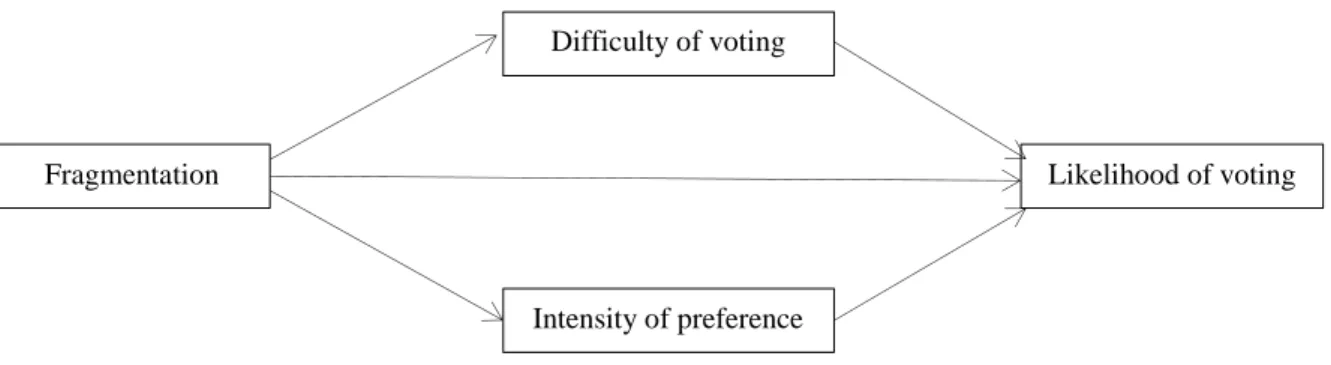
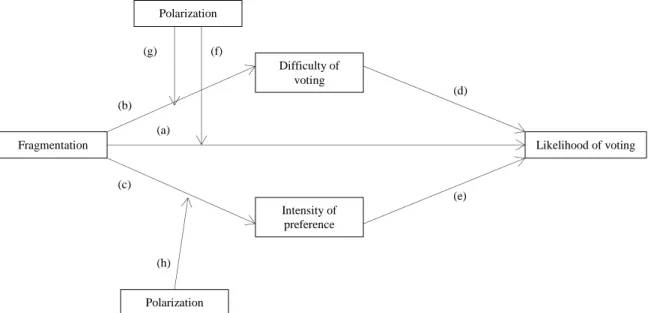
2.4. The conceptual model ... 21
2.5. Presentation of the statistical procedures ... 23
2.6. Hypotheses ... 26
2.7. Conceptual and operational definitions ... 27
2.8. Description of the experiment ... 30
CHAPTER III — FINDINGS ... 33
3.1. Characterization of the sample ... 33
3.2. Testing the hypotheses ... 34
3.3. Discussion of the findings ... 39
CONCLUDING REMARKS ... 41
DATA SOURCES ... 44
REFERENCES ... 45 APPENDICES ... I APPENDIX A – The survey ... I APPENDIX B – Results of ANOVA analysis testing for differences between experimental groups in the key political covariates. ... XI APPENDIX C – Assumptions of the various statistical analyses ... XII
ix List of Tables
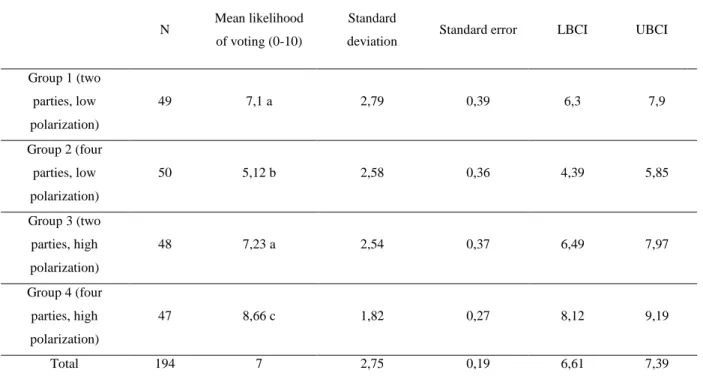
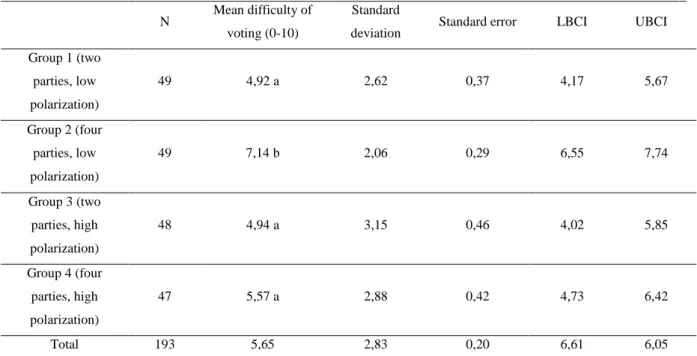
Table 1.1. – Rate of ESS Round 7 respondents who reported to have engaged in each form of political participation. ... 3 Table 2.1. – Level of party-system fragmentation and polarization of the fictitious election presented to each experimental group. ... 31 Table 3.1. – Descriptive statistics for likelihood of voting in the four experimental groups, and results of the Scheffe post-hoc test (indicated by the letters that follow each mean). ... 34 Table 3.2. – Descriptive statistics for difficulty of voting in the four experimental groups, and results of the Scheffe post-hoc test (indicated by the letters that follow each mean). ... 35 Table 3.3. – Descriptive statistics for intensity of preference in the four experimental groups. ... 36 Table 3.4. – Bootstrapped indirect effects of fragmentation on likelihood of voting via difficulty of voting at specific levels of the moderator (polarization). ... 37 Table 3.5. – Bootstrapped indirect effects of fragmentation on likelihood of voting via intensity of preference at specific levels of the moderator (polarization). ... 37
x List of Figures
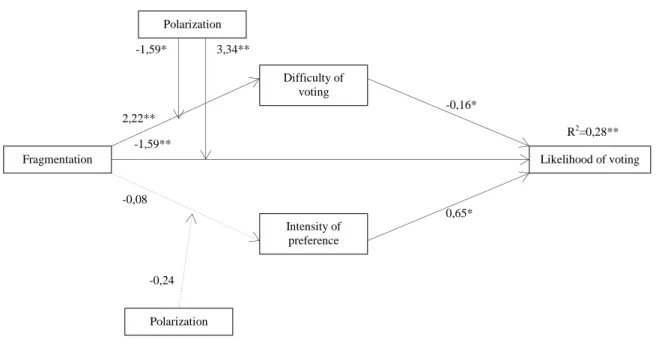
Figure 1.1. – Left-right placement of Canadian, Spanish, Slovenian and Czech parties, according to citizen perceptions. ... 12 Figure 2.1. – Conceptual diagram for the rational choice model. ... 22 Figure 2.2. – Conceptual diagram for the socio-psychological model. ... 22 Figure 2.3. – Conceptual diagram for the combined model, including the mediators from both the rational choice and socio-psychological models. ... 23 Figure 2.4. – Conceptual diagram for the complete model, including the mediators from both the rational choice and socio-psychological models and polarization as a moderator. ... 23 Figure 2.5. – Conceptual diagram for the complete model, indicating the different relations on which the analysis will provide information. ... 25 Figure 3.1. – Results for the complete model (moderated mediation). ... 37
1
INTRODUCTION
Voter turnout is one of the most studied topics in Political Science. Studies concerning this topic are usually divided into two perspectives: the aggregate and the individual one. The former intends to shed some light over the factors that explain variation in voter turnout across different temporal and spatial contexts. The latter intends to understand the differences in the voting rates of individuals with diverging characteristics, as well as the factors that explain those differences (Blais, 2007: 623).
At the contextual level, the sets of independent variables that have been used in the study of voter turnout are frequently divided into institutional factors, socioeconomic factors and factors related to the party system (Blais, 2000; Blais, 2006; Blais, 2007; Blais and Dobrzynska, 1998; Cancela and Geys, 2016; Dettrey and Schwindt-Bayer, 2009; Fornos, Power and Garand, 2004; Freire and Magalhães 2002; Geys, 2006; Kostadinova, 2003; Kostadinova and Power, 2007). Among the factors related to the party system, one that has been commonly used to explain variation in levels of voter turnout is that of party-system fragmentation. Yet, as shall be discussed below, there is still poor understanding of the relation between these two variables.
This dissertation aims to deepen our knowledge of that relation, by answering the following research questions: How does party-system fragmentation influence one’s likelihood of voting? And how does party-system polarization moderate this relation? Its main argument is that the lack of consensus in the literature regarding how party-system fragmentation affects voter turnout is due to a tendency of the literature to overlook the moderating role that party-system polarization can be expected to play in this relation. It contends that, in highly polarized party systems, where parties are likely to provide more differentiated alternatives to voters, a higher number of parties should work as an incentive to voting. In turn, in poorly polarized systems, as the higher number of parties does not translate into a richer array of options being offered to voters, increasing fragmentation should instead depress voter turnout.
From a methodological point of view, the empirical part of this dissertation relies on an experimental survey. The resource to this method makes an important contribution to extant research, as I am aware of no experimental study drawing upon the effect of party-system fragmentation over turnout. Moreover, experiments are particularly well suited to deal with this particular topic, for two main reasons. In the first place, experiments allow for the manipulation of the specific variables under study, in order to disentangle the effects of a number of highly correlated variables that shape voter turnout (Gallego, 2014: 66–67; McDermott, 2002a: 334–335). In the second place, they allow one to dig deeper into the mechanism by which the independent variable exerts its effect upon the dependent variable (Morton and Williams, 2008). This is especially important because, as shall be discussed above, the specific mechanism by which fragmentation affects turnout is a matter of debate in the literature.
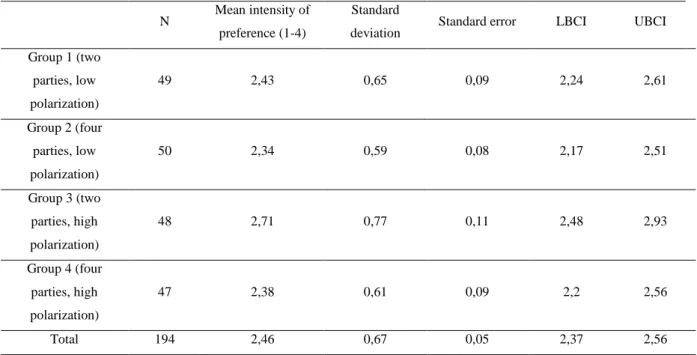
2 The results of the empirical analyses support the main argument. Fragmentation does have a positive effect over likelihood of voting when accompanied by high polarization, but a negative one when accompanied by low polarization instead. The results also suggest that the cognitive costs of voting partly mediate the relation between fragmentation and likelihood of voting in lowly polarized contexts, such that higher fragmentation increases the difficulty of voting, which decreases one’s likelihood of voting. In highly polarized contexts, it is instead the intensity of preference for a party that partly mediates the relation between fragmentation and likelihood of voting. However, this mediation is not as expected by the theoretical argument put forward in this dissertation. Higher fragmentation still depresses the intensity of preference for one of the parties when polarization is high. Intensity of preference, in turn, bears a positive relation to likelihood of voting.
The remainder of the dissertation will be structured as follows. The next section presents the theory on which the dissertation is grounded. It opens with a discussion of the social and academic pertinence of studying voter turnout. After that, it presents the main theoretical and empirical studies that have focused on the effect of party-system fragmentation over voter turnout. Then, it provides a theory of why this literature has to come to ambiguous results, by arguing that such ambiguity is due to a neglect of the moderating role that polarization is expected to play over this relation. It closes with a discussion of the empirical literature that has already provided evidence concerning the effect of party-system polarization over turnout.
The second section presents the research design. It starts with a presentation of the objectives that the dissertation aims to pursue, followed by the justification of why it employs an experiment. Then, it discusses the extent to which this study can suffer from a lack of external validity. After that, it presents the conceptual model that guides the empirical analysis and the statistical procedures it employs, after what it presents its hypotheses. The section follows with a discussion of the conceptual and operational definitions of the variables under study and closes with the description of the experimental survey it employs.
The following section aims at presenting the findings of the empirical analyses. After characterizing the sample, it provides empirical tests of each of the hypotheses of the dissertation. It closes with a discussion of these findings.
Finally, a last section concludes the dissertation, by reflecting on its main findings, its contributions for the literature and by pointing some of its limitations, which open some avenues for future research.
3
CHAPTER I — THEORY
1.1. Social and academic pertinence of the dissertation
From a social and political point of view, it is crucial to understand the factors that explain variation in levels of voter turnout, because the act of voting is central for the working of democracy. It is so for three main reasons.
In the first place, voting is a building block of citizen’s ability to participate in politics. It is the most basic form of political activity (Blais, 2000) and the one that has the most direct consequences upon the process of decision-making, as it allows discontent voters to “throw the rascals out” and replace them with a new government. It is also the form of political activity that is exercised by most people (Crepaz, 1990). Table 1.1. shows the rate of respondents of the European Social Survey (ESS) Round 7 who reported to take part in each form of political participation. It shows how voting is, by far, the most common form of participation.
Table 1.1. – Rate of ESS Round 7 respondents who reported to have engaged in each form of political
participation.
Form of participation Percentage
Conventional participation Voting 69,9
Contacting politician or
government official 16,1
Working in a political party or
action group 4,5
Unconventional participation Signing a petition 25
Taking part in a lawful public
demonstration 7,4
Boycotting certain products 19,5
Source: Table elaborated by the author, based on data from the ESS Round 7.
Moreover, voting plays a crucial role in the legitimization of democratic systems. By allowing citizens to communicate their preferences and exert control over their rulers, it constitutes the primary source of legitimacy of a democratic government (Hill, 2014: 333; Michelson and Nickerson, 2011: 228). Low levels of voter turnout can thus be regarded as an indicator of an unhealthy democratic system (Ballinger, 2006; Kymlicka and Norman, 1994; Van Deth, 2001). If one assumes the legitimacy of governing bodies to come from their ability to present themselves as the representatives of the majority of the population, low turnout may cast a shadow over such legitimacy. That is because, with very low levels of voter turnout, the winner of an election can actually be elected by a minority of the citizens eligible to vote (Hoffman and Graham, 2006).
In the third place, turnout bears an important relation to the democratic ideal of political equality. By awarding each citizen with one vote, universal suffrage makes the voice of every
4 individual equally important in the choosing of her country’s government. Election day can thus be regarded as the one moment in which democracy comes closer to achieving its ideal of equal political influence (Verba, Schlozman and Brady, 1995: 304), which can work as a means for compensating for socioeconomic inequalities (Verba and Nie, 1972). Conversely, low electoral participation has been associated with unequal participation, meaning that citizens with lower socioeconomic status tend to participate at lower-than-average rates (Lijphart, 1997),1 as well as to low accountability of policymakers to the preferences of social groups that tend to participate less (Burnham, 1987; Key, 1949). These reasons have led some authors (e.g., Schattschneider, 1960) to argue that, under such situations, there is a danger that policy outcomes can come to be unjust.
The study of the determinants of voter turnout is thus one of very high social pertinence. In the context of the academic literature devoted to study such determinants, this dissertation is relevant for three main reasons.
In the first place, despite the large number of studies devoted to studying the influence of party-system fragmentation on voter turnout, there is still a poor understanding of the relation between these two variables. As shall be discussed in the two following sections, there is disagreement on both the theoretical and empirical level. Some authors have put forward reasons to expect a negative relation between fragmentation and turnout, whereas others have argued that this relation should rather be positive. Different empirical studies have paid support to both of these theoretical expectations.
This dissertation has an academic contribution in that it pushes towards the solving of this disagreement, on both the theoretical and empirical levels. Theoretically, it argues that the two sides of the debate are not necessarily incompatible, if one takes into consideration the way in which party-system polarization should moderate the relation between fragmentation and voter turnout. It contends that the two sides of the debate assume fragmentation and polarization to be related in a rather mechanical way, even though there is empirical evidence showing that they are not. Building on this realization, I argue that both sides of the debate may be partly right, but their arguments apply to contexts where the level of polarization is different. Empirically, this dissertation provides an experimental analysis of how fragmentation and polarization interact in influencing voter turnout, whose results supports the main theoretical argument.
In the second place, the literature on the effect of party-system fragmentation over turnout has also been unable to conclude as to the specific mechanism by which one variable affects the other. By relying on an experiment, this dissertation is able to test different mechanisms, instead of just assuming some mechanism to be operating to produce the relations found. Moreover, it is able to
1 However, Gallego (2014) shows how the inequality of electoral participation does not have such a mechanic
relation to levels of voter turnout. Inequality rather seems to vary widely along democratic systems worldwide.
5 check whether or not different mechanisms affect this relation under contexts where the level of polarization is different.
Finally, the methodological choice of relying on an experiment is in itself academically relevant as well, because it provides a debate that has been exclusively grounded on analyses of observational data with new sorts of evidence. An experiment brings important evidence to this debate, because of its focus on internal, instead of external validity, which makes it particularly well suited to provide a first test of the theoretical argument that this dissertation puts forward.
1.2. Literature review
1.2.1. Party system fragmentation and voter turnout: Theory
As mentioned above, the relation between party-system fragmentation and voter turnout is not a straightforward one. To start with, theoretical arguments can be found for both a positive and a negative relation between these variables. This section aims at presenting the most relevant ones.
A negative relation can be expected on the basis of three main arguments. The first two build upon rational choice theory. The milestone of the application of this approach to Political Science is Downs' (1957) rational voter model. This model regards individuals as endowed with strategic rationality, i.e., the ability to set a number of goals they want to achieve, as well as to choose the means most suited to attain them. Rational individuals aim to maximize their utility, either by maximizing output for a given input or by minimizing input for a given output (Downs, 1957: 5). Electoral participation is regarded as the result of a calculus of cost and benefit. The individual will choose to vote when the benefits of such action outweigh its costs, and to abstain when they do not.2 Therefore, any mechanism that lowers the costs of voting or increases its benefits can be expected to increase an individual’s likelihood of voting, by making it more likely that the costs of voting she needs to endure will be outweighed by its benefits. Conversely, any mechanism that increases the costs of voting or lowers its benefits can be expected to decrease one’s likelihood of voting.
The first argument relates to how elections in multiparty systems can increase the costs of voting. These costs are made up of opportunity costs and information costs. The former consist of the activities that the voter could be performing during the time she goes to the voting station, whereas the later refer to the costs that voters needs to bear in order to be acquainted with the parties or candidates running for the election (Geys, 2004: 42).
2 It should be noted that the classical rational choice model has struggled with the so-called “paradox of turnout”.
Because the benefits of voting relate mostly to the possibility of electing and individual’s preferred government, and because the chances of a single voting being decisive for the electoral outcome are virtually zero, one should conclude that the rational action is to abstain. However, this conclusion is at odds with the levels of voter turnout that can be found in democratic systems. This paradox – as well as the ways in which it can be overcome – have fuelled intense debate, with several reformulations of the original model being proposed (for reviews, see Dhillon and Peralta, 2002; Dowding, 2005; Feddersen, 2004; Geys, 2006b).
6 This argument relates to the latter. In two-party systems, deciding the party to which one relates the most should be fairly simple. However, as the number of parties increases, each voter has to get acquainted with a higher number of parties, which increases the costs of accessing information about all of them.
Furthermore, in multiparty systems it is increasingly likely that no party will win a majority of the vote, and coalitions need to be formed. Under such circumstances, it becomes harder for a voter to identify the potential government alignments coming out of the election (Narud and Valen, 1996). That voter would need to acquire more information in order to make a voting decision: she would need to know not only the likely voting scores of each party, but also the coalitions that are likely to end up being formed (Downs, 1957: 142–163).
Both the need to get acquainted with a higher number of parties and the need to access information regarding the coalition negotiations increase the overall cognitive costs of voting. It thus becomes more likely that, for a given individual, those costs will outweigh its benefits, increasing that individual’s likelihood of abstaining instead of voting.
The second argument also relates to the consequences of the necessity of coalition building in multiparty systems, but it rather concerns its effect upon the benefits of voting. The main benefit that individuals get from voting in a given election is the possibility of electing their favourite party to the government.3 However, the frequent need for coalition building in multiparty systems means that, under such systems, a given voter will be voting for just one part of the government. Furthermore, in the process of coalition negotiation, a given voter’s preferred party will be forced to make concessions that can drag it away from her preferences (Downs, 1957: 142–143). This makes the formation of government depend less on the results of elections and more on the process of elite negotiation, which makes the electoral process less decisive. The benefits of the act of voting will thus tend to decrease, making it more likely that they are outweighed by its costs.
Even though this argument has been presented from a rational choice theory point of view, it should be noted that a number of classic works from different perspectives also claim that individuals are less likely to vote when they perceive elections as being less decisive (Burnham, 1971; Key, 1955; Lipset, 1960; Milbrath and Goel, 1977).
The last argument relates to socio-psychological models of electoral behaviour, instead. Since the seminal work of Campbell et al (1960), party identification has come to be regarded as one of the main predictors of voter turnout. According to these authors (Campbell et al, 1960: 96-101), the likelihood that an individual will cast a vote in a given election is higher when she has a strong attachment to a party. However, it has been argued that, as the number of parties rises, the amount of
3 However, in order to solve the “paradox of turnout”, Riker and Ordeshook (1968) have famously contended
that, apart from these instrumental benefits, voters also extract expressive benefits from the act of voting. These benefits mostly concern the feeling that the individual is fulfilling a civic duty.
7 signals a voter receives that can help her determine which party is closer to her attitudes become increasingly “noisier” (Achen, 1992; see also Huber, Kernell and Leoni, 2005). This makes it more unlikely for voters to build strong attachments to any one party, as it becomes harder to determine the differences between them. And, with lower levels of party identification, it becomes increasingly likely for voters to abstain.
In a similar vein, Dittrich and Johansen (1983: 111) argue that, in multiparty systems, voters are under the effect of a higher number of cross-pressures (Berelson, Lazarsfeld and McPhee, 1954: 283– 284), which may discourage them from participating in an election. There is indeed some empirical evidence suggesting that exposure to cross-pressures depresses political involvement (Tóka, 2003).
Let us now draw upon the two main arguments supporting a positive relation between party-system fragmentation and voter turnout. In the first place, if one regards voting as a ways of individual self expression (Crepaz, 1990; Milbrath and Goel, 1977), one should expect a higher number of parties to enhance aggregate levels of political participation. In fact, according to Milbrath and Goel (1977: 35), an individual will tend to participate deeper and more frequently in politics when the political stimuli to such participation are higher.
On this regard, Campbell et al (1960: 399) draw a distinction between low and high stimulus elections, as well as between core and peripheral voters. While core voters tend to vote in every election, peripheral voters do so only in high stimulus elections. An election’s stimuli can have several sources, one of which is the existence of a party whose policy preferences are closer to those of the individual (Crepaz, 1990: 186–187). One can thus expect systems with more parties to improve the likelihood that any given voter will have a party closer to her preferences. This, in turn, can be expected to boost electoral participation.
In the second place, one can expect an increasing number of parties to lead to higher mobilization of voters (Banducci and Karp, 2009: 111; Blais, 2006: 118). The effects of party mobilization over turnout have been supported by a number of empirical studies (Adams and Smith, 1980; Bedolla, Green and Michelson, 2008; Bochel and Denver, 1971; Eldersveld, 1956; Gerber and Green, 2000; Gosnell, 1926; Gray and Caul, 2000; Michelson, Bedolla and Green 2007; Vavreck, 2007).4 One can thus assume that, in multiparty systems, the mobilization of voters will be more far reaching as more parties strive to secure and mobilize their own specific constituency.5
4 For a review of these studies, see Green, McGrath and Aronow (2013).
5 However, it should be noted that Karp, Banducci and Bowler (2008) find party mobilization to be higher under
candidate-based elections, typical of the majoritarian two-party system. These authors thus conclude that the effect of party mobilization cannot account for the levels of turnout in countries with proportional electoral systems.
8 1.2.2. Party-system fragmentation and voter turnout: Empirical studies
The discussion carried out in the previous section highlighted the different theoretical expectations for how party-system fragmentation should affect voter turnout. Is the empirical literature more consensual? This section aims to answer this question, by reviewing the most important studies that have set out to empirically assess the impact of fragmentation on turnout.
A broad number of empirical studies have focused on this relation, drawing upon different sets of cases. An important distinction should be made between comparative studies, whose level of analyses is the nation state, and case studies of one country, whose analyses rather compare sub-state entities. Also, one should distinguish between studies that focus mostly on advanced industrial democracies and studies that consider other sets of countries. This distinction is important because it has been suggested that economic development is an important predictor of aggregate levels of voter turnout (Blais and Dobrzynska, 1998; Dettrey and Schwindt-Bayer, 2009; Fornos, Power and Garand, 2004; Norris, 2002).
Case studies, both in and out of advanced industrial democracies, present the most contradictory findings. On the one hand, most studies find a negative relation between party-system fragmentation and voter turnout (Berdiev and Chang, 2013; Boulding and Brown, 2013;6 Couture, Breux and Bherer 2014; Franklin and Hirczy de Miño, 1998; Geys and Heyndels, 2006; Hoffman-Martinot, Rallings and Thrasher, 1996; Jou, 2010; Lehoucq and Wall, 2004; Settle and Abrams, 1976).
On the other hand, the findings of a number of studies run against this general rule. Positive relations have been found in the United Kingdom (Seidle and Miller, 1976), Norway (Hansen, 1994), Brazil (Boulding and Brown, 2013), and Taiwan (Berdiev and Chang, 2013). Also, studies drawing upon the cases of India (Diwakar, 2008) and South Africa (Fauvelle-Aymar, 2008) have found insignificant relations, as has Henderson and McEwen's (2010) comparative study of regional elections. Finally, in their case study of the Belgian municipal elections, Ackaert et al (1992) have found a curvilinear relation between these two variables.7
Comparative studies with samples consisting mostly of advanced industrial democracies have also mostly found a negative relation between party-system fragmentation and voter turnout (Blais and
6 Boulding and Brown (2013) analyse municipal elections in both Brazil and in Bolivia, and they conclude that
in the former there is a negative relation between party system fragmentation and turnout, whereas in the latter that relation is rather positive. However, because their results consist of two separate analyses, they are presented in that way.
7 Some authors (e.g., Geys and Heyndels, 2006) also consider Franklin and Hirczy de Miño's (1998) study
among those that draw upon the effect of party-system fragmentation on voter turnout. Yet the measure used in this study is the number of years of divided government in the United States. Because this measure is drastically different from the other ones included in this literature review, I have opted to exclude this study. Nevertheless, it does find that the number of years of divided government bears a negative relation to voter turnout.
9 Carty, 1990; Blais and Dobrzynska, 1998; Jackman, 1987; Jackman and Milner, 1995; Radcliff and Davis, 2000; Siaroff and Merer, 2002).
Yet, this pattern is again far from consensual. Crepaz's (1990) study finds a positive relation between the two variables. Similarly, Brockington (2004) reports that, once the existence of coalitions is controlled for, a higher number of parties increases voter turnout. It should be noted, however, that none of these authors controls for the level of closeness of each election, a political factor that has been consistently reported to have an important role in predicting voter turnout (e.g., Cann and Cole, 2011; Chapman and Palda, 1983; Cox and Munger, 1989; Freire and Magalhães, 2002). Yet, while controlling for the effect of closeness, Banducci and Karp (2009) also find a positive relation between party-system fragmentation and electoral participation.
In turn, Dittrich and Johansen (1983) and Kaempfer and Lowenberg (1993) have found insignificant relations. However, these analyses may once again lack some controls. The former relies on mere correlations, leaving aside a number of important factors that can influence the relation between party system fragmentation and voter turnout. The latter controls solely for the level of proportionality of the electoral system and the aggregate level of literacy, leaving aside the effect of closeness once again.
Finally, two studies (Capron and Kruseman, 1988; Taagepera, Selb and Grofman, 2014) find curvilinear relations. I shall come to these later.
The results of comparative studies outside advanced industrial democracies are even more ambiguous. A negative relation seems to exist in Eastern Europe (Kostadinova, 2003; Kostadinova and Power, 2007), but studies drawing upon Latin American countries have consistently reported insignificant relations (Fornos, Power and Garand, 2004; Kostadinova and Power, 2007; Pérez-Liñan, 2001), as has Kuenzi and Lambright's (2007) study of Sub-Saharan Africa. In turn, studies comprising large samples of non-advanced industrial democracies as well as some advanced industrial democracies have again found negative relations (Dettrey and Schwindt-Bayer, 2009; Elgie and Fauvelle-Aymar, 2012).
This discussion suggests that, even if most studies do conclude that a higher level of party-system fragmentation leads to lower levels of voter turnout, this finding is far from consistent. Moreover, it appears not to be replicated in some national and regional contexts.
But these results are even more puzzling if one takes into consideration the results of some of the few studies that have tried to investigate the reasons lying behind the negative relation they found between fragmentation and turnout. As mentioned in the previous section, one of the theoretical reasons why one could expect such a relation is the fact that a higher number of parties leads to a need for coalition-building, which in turn makes elections less decisive. It is true that the aforementioned results of Brockington (2004) and Banducci and Karp'(2009) seem to support this claim. Yet, by the same token, elections in which a single part wins a majority of the seats should have higher turnout.
10 However, studies explicitly testing this hypothesis have concluded that such is not the case (Blais and Carty, 1990; Blais and Dobrzynska, 1998).
Another theoretical explanation why one might expect an increasing number of parties to depress voter turnout is that it increases the cognitive costs of voting. If this were true, the magnitude of turnout decrease should be greater when the level of parties becomes extremely high. Yet the findings of Blais (2000) and Blais and Dobrzynska (1998) both suggest that this is not the case. The reduction in turnout levels seems to be greater when one moves from two- or three-party systems to systems with around six parties. From that point on, an increase in the number of parties still depresses turnout but the magnitude of such decrease is smaller. This runs contrary to the expectation derived from the theoretical argument according to which the negative relation between party-system fragmentation and voter turnout is due to the higher cognitive costs of voting that are brought about by an increasing number of parties (Blais, 2000).
One possible explanation for these puzzling results is that the effect of party-system fragmentation over voter turnout is curvilinear, taking the shape of an inverted U-Curve. In fact, such a relation has been reported by the comparative studies of Capron and Kruseman (1988) and Taagepera, Selb and Grofman (2014), as well as by Ackaert et al's (1992) case study of Belgium.
Yet this explanation is again not entirely satisfactory, as it runs contrary to the above-mentioned findings of Blais (2000) Blais and Dobrzynska (1998). Again, these authors find that an increasing number of parties always leads to a decrease in voter turnout. Such decrease seems to be higher when one moves from a small number of parties to a moderate one, and smaller when one moves from a moderate number of parties to a very high one. This finding runs against the possibility that the relation between these two variables takes the shape of an inverted U-Curve.
Still another possibility is that the effect of party-system fragmentation on voter turnout is different according to the electoral system that is in place, as argue Boulding and Brown (2013). According to these authors, a higher number of parties should be expected to increase the levels of voter turnout under proportional systems, but to depress it under majoritarian systems. This expectation is supported by their comparative analysis of the Brazilian and Bolivian municipal elections.
However, this explanation is not entirely satisfactory either. Boulding and Brown rely on a comparative analysis of local elections in Brazil and Bolivia, which is problematic for three main reasons. In the first place, this sample is rather small for one to conclude as to the general effect of party-system fragmentation over voter turnout under different electoral systems. In the second place, it is a sample made up of subnational regions of Latin American countries, a continent where, as mentioned above, the analyses of the relation between fragmentation and turnout have produced results that do not follow the general trend. Finally, Seidle and Miller's (1976) analysis of voter turnout in United Kingdom counties yields a positive relation between number of parties and electoral
11 participation. As this is a country with a majoritarian electoral system, these findings run contrary to Boulding and Brown's (2013) argument.
All in all, this literature review suggests that we still have a poor understanding of how party-system fragmentation explains variation in levels of voter turnout. There is a tendency for empirical studies to find a negative relation, but there are important exceptions to this rule. Furthermore, the few studies that have tried to understand the mechanism lying behind this relation have been unable to come to conclusive results. Finally, all proposed explanations for why the literature has produced such ambiguous results clash with the findings of other empirical studies.
1.2.3. A theory of how and why polarization should moderate the relation between
fragmentation and turnout
This dissertation argues that, in order to shed some light over the contradictions discussed in the two previous sections, one needs to move away from a mere numeric analysis of party-system fragmentation, so as to take into consideration the moderating role that party-system polarization can be expected to play in the relation between fragmentation and turnout.
Both arguments supporting a negative relation between party-system fragmentation and turnout and those supporting a positive one implicitly or explicitly assume that party-system fragmentation has a mechanical effect over the level of party-system polarization. However, they assume that mechanical effect to work in quite different ways.
On the one hand, arguments for a negative relation assume that a higher number of parties translates into a low level of party-system polarization. Arguing that a higher level of party-system fragmentation leads to an increase in the cognitive costs of voting is to assume that an increasingly fragmented party system leads parties to be increasingly undifferentiated, making it more difficult for individuals to determine the one to which they relate the most. Similarly, arguing that higher fragmentation puts voters under cross-pressures is to assume that a higher number of parties does not translate into a higher array of options, which makes various parties aim at similar constituencies, putting the same voter under the influence of several parties.
On the other hand, arguments for a positive relation assume that a higher number of parties automatically translates into a high level of party-system polarization. Arguing that a higher number of parties increases the likelihood that any given voter will have a party close to her preferences makes sense only as long as those parties are differentiated enough for them to create bonds with different voters. Likewise, to argue that a higher number of parties makes parties capable of mobilizing different constituencies makes sense only as long as these parties are differentiated enough for their mobilization efforts to reach individuals that were not already under the mobilization of another party. The fact that there are there conflicting expectations as to how the mechanical relation between fragmentation and polarization should play out is a first hint that such relation is probably not indeed mechanical. It cannot be so and simultaneously work in radically different ways. But, apart from that,
12 one can find literature arguing that ideological polarization and fragmentation are not necessarily correlated. One example of such is Sartori's (1976) classical distinction between segmented and polarized multipartism – the former having a high level of fragmentation but a low level of ideological polarization, the latter having a high level of both fragmentation and ideological polarization.
Further empirical evidence also suggests that these two variables are indeed not mechanically related. For example, Dalton (2008) shows how systems with the same number of parties can have very different levels of polarization. Figure 1.1. – retrieved from Dalton’s (2008) article – provides some examples that should make clear how fragmentation and polarization are not mechanically related. It compares Spain to Canada and Slovenia to Czech Republic, two pairs of countries with similar number of parties, but whose level of polarization varies widely.
Figure 1.1. – Left-right placement of Canadian, Spanish, Slovenian and Czech parties, according to citizen
perceptions.
The discussion thus far suggests that the fact that we have been assuming party-system fragmentation as a proxy for polarization – in either one way or another –, when it is actually not so may be a clue as to why the results of studies concerned with effect of fragmentation on turnout have been rather puzzling. That is, indeed, the main argument of this dissertation.
Theoretical wise, this argument builds upon spatial models of party systems. The origin of these models goes back to Downs' (1957) contention that voters will tend to vote for the party that is closer
Note: The width of the arrows represents the relative size of each party. Source: Retrieved from Dalton (2008: 905).
13 to their ideal position, in a unidimensional left-right continuum. To be sure, one can find examples of dimensions of competition that are orthogonal to the left-right scale, such as the centre-periphery cleavage in countries like Spain or Canada. Yet many authors have suggested that the left-right scale possesses an impressive flexibility which has enabled it to absorb the main dimensions of political conflict through different time periods (Inglehart, 1984; Inglehart and Klingemann, 1976; Laponce, 1981; Sani and Montero, 1986). This flexible character allows different political issues to be reduced to the left-right continuum without major distortions (McDonald and Budge, 2005: 47). Further, it has the advantage of reducing the complexity of contemporary politics, allowing for a comparison of the ideological placement of the parties of different systems (Powell, 2000: 162).
This Downsian assumption according to which voters pay support to the party that is closer to their left-right position has been further explored in a number of later studies concerned with electoral behaviour (e.g., van der Ejik, Schmitt and Binder, 2005), coalition building (e.g., Warwick, 1996), or political representation (e.g., Powell, 2000). This dissertation shares such assumption. However, it also assumes that two other characteristics of the party system play a crucial role when deciding whether to vote or to abstain: the distance between a voter’s position on the left-right scale and that of the closest party; and the relative position of the various parties of the system.
On this regard, it is important to refer to Hinich and Munger's (1997: 151) distinction between abstention by indifference and by alienation. The former refers to a situation where a voter perceives little or no difference between the party alternatives that are presented to her, whereas the latter refers to a situation in which all those alternatives are far from the voter’s ideal point. Both situations can lead a voter to abstain from voting.
This suggests that perceiving political parties as offering clearly differentiated options – which should happen under highly polarized contexts –, as well as being close to one of those options, are necessary conditions for a voter to cast a vote (Brockington, 2009: 439). It also suggests that a minimal level of aggregate alienation and indifference represent the conditions under which voter turnout is higher.
One can thus assume that the optimal situation in order to maximize aggregate voter turnout is one where there is a high number of parties spread throughout the whole left-right spectrum – a system that is both polarized and fragmented. On the one hand, the high level of polarization minimizes the number of voters that are indifferent. On the other hand, the high number of parties providing clearly differentiated alternatives maximize the chances that any one of those parties will be closer to a given voter’s optimal position, thus minimizing aggregate levels of voter alienation. Conversely, when one of these conditions is missing, aggregate levels of voter turnout can be expected to be lower.
However, just like party fragmentation and polarization are not necessarily related and can vary independently from one another, so can aggregate alienation and indifference. One can thus expect that when the number of parties increases but polarization does not, voter turnout will decrease rather than increase. That is so because, under such contexts, aggregate levels of indifference will tend to
14 increase. With more parties offering similar sets of policies, voters will tend to have a stronger feeling that “parties are all the same”. At the same time, overall levels of alienation are not likely to decrease: as parties are not offering clearly differentiated choices, they are not appealing to different voters either.
The discussion made so far suggests that an increasing number of parties can have a contradictory effect under contexts where the level of party-system polarization is different. When polarization is high, increasing fragmentation will tend to increase overall levels of voter turnout by reducing aggregate levels of both indifference and alienation. But, when polarization is low, increasing fragmentation will rather tend to depress overall levels of turnout by increasing overall levels of indifference while not decreasing overall levels of alienation.
On an empirical level, this means that party-system polarization should play a moderating role in the relation between fragmentation and turnout, such that this relation is positive when polarization is high, and negative when it is low. Yet studies drawing upon this relation very rarely take party-system polarization into consideration – the only exception are the studies by Crepaz (1990) and Siaroff and Merer (2002), which use it as a control variable. The neglect of the effect of this variable may thus explain the ambiguous results found in the literature.
On a theoretical level, this means that arguments contending that a higher level of party-system fragmentation should have a negative relation to voter turnout and the ones contending that it should have a positive one may actually not be incompatible. The reason for the disagreement lies on divergent implicit assumptions regarding the mechanical effect of party-system fragmentation over polarization. By making such claim explicit, one can reconcile both sides of the discussion, pushing forward our understanding of the factors that influence voter turnout. Party-system fragmentation does not have a mechanical impact on the differentiation of choices provided by parties. Instead, the arguments favouring a positive and a negative relation may both be partly correct, but they apply to contexts where the level of party-system polarization is different.
1.2.4. Party-system polarization and voter turnout: Empirical studies
It is not innovative to argue that individuals are more likely to vote when they perceive the choices presented to them as being clearly differentiated. A number of authors have drawn upon the effect of polarization on voter turnout. Even though they all rely on the placement of parties along the left-right scale, the actual operationalization of the independent variable has diverged from one study to the next.
Anduiza (1999) and Crepaz (1990) have both operationalized polarization according to the placement of parties along the ideological continuum, as made by experts. They both conclude that such distance has a positive effect over turnout. Yet the former relies on the ideological distance between the two major parties of a given system, whereas the latter relies on the ideological distance between parties placed at the extreme ends of the ideological spectrum. A measure of the ideological
15 distance between the two main parties of the system, however, may present an advantage because extreme parties may be too small to have a relevant impact on the political system (Anduiza, 1999: 166–167).
Wessels and Schmitt (2008) also rely on expert judgements, but they analyse the meaningfulness of electoral choices provided to voters along two dimensions: the structure and differentiation of policy support and the institutional effectiveness in translating electoral results to public policy. The first dimension – the one that is closer to the aims of this dissertation – is measured according to the effective number of parties, the ideological distance between the most extreme parties according to expert judgements and left-right differentiation, which is measured by the mean of absolute left-right distances between pairs of parties of a given system. These authors also conclude that this dimension has a positive effect over voter turnout.
In turn, Siaroff and Merer (2002) measure the ideological distance between the most extreme relevant parties of a system (i.e., those winning more than 10% of the vote) by introducing a dummy variable for polarized systems – those in which the difference between the most extreme relevant parties in a 10-point left-right scale is above 3,75. Their placement of the parties along the left-right scale is based on expert judgements, as they rely on data provided by Huber and Inglehart (1995). Their results also suggest that this variable has a significant positive effect over voter turnout.
Another study, that of Aarts and Wessels (2005), conducts two different analyses. The first one relies on data from the Comparative Manifesto Project (CMP) (Budge et al, 2001; Klingemann, et al, 2006), and relies on the weighted mean distance between the parties of each country as its independent variable. Its results are mixed. For some of the countries included in the sample, this variable bears a positive relation to voter turnout. For others, it bears a negative one. The second analysis of the study is rather based on individual-level data. The authors rely on questions of how sympathetic or unsympathetic voters are to a specific party in order to build measures of indifference and alienation, according to the afore-mentioned definition of Hinich and Munger (1997). The results suggest that both measures have a strong negative effect over turnout.
Finally, three studies have measured polarization by building an index of the dispersion of a country’s parties along the left-right scale. This measure has an important advantage over measures of ideological distance between only two parties, be they the major ones or the most extreme ones: it takes into account all the ideological position relevant parties in the system.
Brockington (2009) and Dalton (2008) have built such measures by relying on the position of parties made by voters, according to data from the Comparative Study of Electoral Systems (CSES). They both conclude that, when parties cover the left-right continuum to a larger extent, voter turnout tends to increase. Significantly, the latter also concludes that this index is a better predictor of voter turnout than party-system fragmentation. In the last place, Steiner and Martin's (2012) index is conceptually similar to the two previous ones, except for the fact that it relies on data from the CMP. Their aim is to understand how economic integration affects the policy positions of national parties
16 and how these, in turn, influence voter turnout. Their data suggests that increasing economic integration does lead national parties to converge in terms of their policy positions, and that such convergence depresses turnout.
These studies have provided extensive support for the claim that higher levels of party-system polarization tend to boost voter turnout. However, none of these studies has focused on the moderating role that polarization can be expected to play in the relation between party-system fragmentation and voter turnout.
17
CHAPTER II: THE RESEARCH DESIGN
2.1. Objectives of the study
Following the discussion made in the theoretical sections, this study aims at extending our knowledge of how party-system fragmentation influences the decision to vote or to abstain, pushing towards a better understanding of the ambiguous results that the literature has found hitherto. The main objective of this dissertation is thus to understand how party-system polarization moderates the relation between party-system fragmentation and one’s likelihood of voting. This broad objective can be further divided into three more specific objectives:
(1) To understand the way in which system polarization moderates the direct effect of party-system fragmentation over one’s likelihood of voting;
(2) To test competing mechanisms by which party-system fragmentation can be expected to influence one’s likelihood of voting, in contexts where the level of polarization is different; (3) To provide a pioneer experimental study of the how party-system fragmentation and
polarization affects one’s likelihood of voting.
It should be noted that the main focus of this study is on internal validity. It aims at providing a first empirical test of the theoretical argument put forward in Section 1.2.3. While I shall argue in section 2.3. that there are reasons to believe that the study does possess external validity, it should still be noted that its main objective is to test the theory it puts forward, rather than generalizing it.
2.2. Why an experiment?
The empirical sections of this study rely on a survey experiment. Experiments are still rather rare in Political Science, even if the amount of experimental studies published in top journals in the field has been steadily increasing since the beginning of the 1960’s (cf. Druckman et al, 2011b: 3, Figure 1.1.).
Thus far, experimental studies of voter turnout have mostly consisted of field experiments concerned with the effect of mobilization over electoral participation (Adams and Smith, 1980; Bedolla, Green and Michelson, 2008; Eldersveld, 1956; Gerber and Green, 2000; Gerber, Green and Shachar, 2003; Gosnell, 1926; Michelson and Nickerson, 2011; Miller, Bositis and Baer, 1981; Nickerson, 2007; Vavreck, 2007). Experimental literature focusing on the effect of other independent variables over voter turnout is much more scarce. A rare example is the study by Gallego (2014), which relies on a survey experiment to test the effect of ballot structure and coalition formation over one’s likelihood of voting.
Regarding the effect of party-system fragmentation and polarization, in turn, I am aware of no experimental evidence available. The literature overwhelmingly relies on observational data to test the effect of these characteristics of the party system over voter turnout. Yet, an experiment presents a number of advantages that observational studies lack. In the context of this study, concretely, the resource to an experiment has three main advantages.
18 In the first place, some authors have recently cast some doubts over the ability of studies based on observational data to come to internally valid conclusions, especially regarding the factors that explain variation in levels of voter turnout. It has been argued that the factors that affect voting decisions are so deeply entangled in one another that it is very difficult for the researcher to sort out the impact of each of them, making conclusions very sensitive to the specific configuration of each statistical model (Gallego, 2014: 66–67; McDermott, 2002a: 334–335). Experiments are particularly well suited to avoid these problematic issues, because internal validity is their main strength. By allowing the researcher to interfere in the process of creation of data through systematic manipulations of the independent variables whose effect is being tested (Morton and Williams, 2008), they make it possible to test the effect of each independent variable per se, avoiding omitted-variable biases and the danger that the conclusions of the study depend on model specifications.
In the second place, the usage of experiments is particularly pertinent when it comes to topics regarding which the remaining methods have come to contradictory results (McDermott, 2002b). As the sections devoted to the literature review have made clear, the effect of party-system fragmentation on voter turnout is one such topic, which makes an experimental study of this effect especially pertinent.
Finally, an experiment allows for the testing of the mechanism by which an independent variable exerts its effect upon a dependent variable, through analyses of mediation effects (Bullock and Ha, 2011). This possibility is particularly important in the context of this study because, as discussed above, the mechanism by which fragmentation should affect one’s likelihood to vote is itself a matter of debate in the literature.
2.3. Student samples and the issue of external validity
The classic distinction between external and internal validity is often defined in Campbell and Stanley's (1963: 5) terms. According to these authors, in the context of an experiment, internal validity answers the question of whether or not the experimental treatment made a difference in the specific experimental instance one is concerned with. In turn, external validity “asks the question of generalizability: to what populations, settings, treatment variables, and measurement variables can this effect be generalized?”.
As mentioned in the previous section, the main strength of experiments is their internal validity. The fact that internal validity is, indeed, the main focus of this study explains why it relies on an experiment. Political science, however, tends to emphasize external validity (McDermott, 2002a: 335; 2011: 27), which has been referred to as the Achilles’ heel of experimental social science (Kam, Wilking and Zechmeister, 2007: 417). Concretely, Campbell (1968, Apud McDermott, 2011: 37–38) identifies six factors that can threaten the external validity of a study, two of which may apply to the experiment on which this dissertation relies. The first one is the fact that its sample is not representative of the whole population. The second factor is the so-called “Hawthorne effect”