Social participation is associated with better functionality, health status and
educational level in elderly women
A participação social está associada a melhor funcionalidade, estado de saúde e
nível educacional em mulheres idosas
DOI:10.34117/bjdv6n4-299
Recebimento dos originais: 10/03/2020 Aceitação para publicação: 23/04/2020
Walter Sepúlveda-Loyola
Program of Masters and Doctoral degree in Rehabilitation Sciences, Londrina State University (UEL) and University North of Parana (UNOPAR), Londrina, Brazil.
Program of Specialization in University Teaching, University North of Parana (UNOPAR), Londrina, Brazil
Felipe Ganz
Program of Master in Rehabilitation Science, Faculty of Rehabilitation Medicine, University of Alberta, Edmonton, Canada
Renata Pires Tricanico Maciel
Program of Masters and Doctoral degree in Rehabilitation Sciences, Londrina State University (UEL) and University North of Parana (UNOPAR), Londrina, Brazil
Rosielma Dos Santos Lopes
Program of Laws, University Center Philadelphia (UNIFIL), Londrina, Brazil
Paulo Sérgio Negri
Program of Specialization in University Teaching, University North of Parana (UNOPAR), Londrina, Brazil Educational Technology Laboratory (Labted), Londrina State University, Londrina Brazil
Eladio Mancilla Solorza
Gerontology Laboratory, Department of Kinesiology, Faculty of Health Sciences, Universidad Católica del Maule, Talca, Chile
Hector González Caro
Gerontology Laboratory, Department of Kinesiology, Faculty of Health Sciences, Universidad Católica del Maule, Talca, Chile
Vanessa Suziane Probst
Program of Masters and Doctoral degree in Rehabilitation Sciences, Londrina State University (UEL) and University North of Parana (UNOPAR), Londrina, Brazil
ABSTRACT
Social participation (SP) has been identified as a protective factor for healthy aging. The aim of this study was to examine characteristics associated with social participation in elderly women. They were allocated 125 older women (aged ≥ 60 years) from Requinoa, Chile into two groups according to the level of SP: socially active (SA) and socially non-active (SNA). Modified Health Assessment Questionnaire, handgrip strength, unipedal stance test, timed up and go test, mini-mental state examination, age-adjusted Charlson comorbidity index, and educational level were assessed. The results indicated that SA women presented lower disability (P<0.001) and better dynamic balance and muscle strength than their SNA peers (P< 0.03 for all). Women who were SA presented less
comorbidities (P=0.002) and higher education (P=0.03) compared to SNA. In conclusion, elderly women who are socially active have better functionality, health status and higher educational level than socially non-active.
Keywords: Social participation; aging; health status; physical function, education, mental health.
RESUMO
A participação social (PE) foi identificada como fator de proteção para o envelhecimento saudável. O objetivo deste estudo foi examinar características associadas à participação social em mulheres idosas. Eles foram alocados 125 mulheres mais velhas (com idade ≥ 60 anos) de Requinoa, Chile, em dois grupos, de acordo com o nível de SP: socialmente ativo (SA) e socialmente não ativo (SNA). Foram avaliados o Questionário de Avaliação de Saúde Modificado, força de preensão manual, teste de postura unipedal, teste de cronometragem e go, miniexame do estado mental, índice de comorbidade de Charlson ajustado à idade e nível educacional. Os resultados indicaram que as mulheres com SA apresentaram menor incapacidade (P <0,001) e melhor equilíbrio dinâmico e força muscular do que seus pares de SNA (P <0,03 para todos). As mulheres que eram SA apresentaram menos comorbidades (P = 0,002) e ensino superior (P = 0,03) em comparação ao SNA. Concluindo, mulheres idosas socialmente ativas têm melhor funcionalidade, estado de saúde e maior nível educacional do que socialmente não ativas.
Palavras chave: Participação social; envelhecimento; Estado de saúde; função física, educação,
saúde mental
1 INTRODUCTION
Aging is a process characterized by declining of the physical and health function observed over time.(Tuna, Edeer, Malkoc, & Aksakoglu, 2009) This decline is a consequence of reduction in muscle strength, balance, endurance, agility, flexibility and increase in comorbidities related to the aging process. (Cruz-Jentoft et al., 2010; Glass, de Leon, Marottoli, & Berkman, 1999) Physical and health condition are associated with social support and social participation, which are protective factors to functionality and health in older people. (Takagi, Kondo, & Kawachi, 2013; Unger, McAvay, Bruce, Berkman, & Seeman, 1999; Willie-Tyndale et al., 2016)
Physical and mental health have been related to higher social participation, which is an important factor to prevent frailty and disability in elderly people. (Holt-Lunstad, Smith, & Layton, 2010; Loyola, Camillo, Torres, & Probst, 2017) Social participation is defined as the inclusion and formal or informal participation of the elderly in social activities with friends, family and community, including religious, social, political, sport and cultural encounters.(Loyola et al., 2017; Willie-Tyndale et al., 2016) The interest of studying the effects of social participation has increased substantially (Loyola et al., 2017; Richard, Gauvin, Gosselin, & Laforest, 2009; Van Brakel et al., 2006), since the social participation increase the physical activity levels and the social interaction, improving the mental and physical disability, reducing the depression symptoms and the risk of mortality. (Kavanagh, Bentley, Turrell, Broom, & Subramanian, 2006; Unger et al., 1999)
Studies have reported that social participation may vary between both sexes. (Campos, Almeida, Campos, & Bagutchi, 2016; Takagi et al., 2013)Sociability has different influences to men and women´s health, since women and men interact with their environment in different ways. (Kavanagh et al., 2006; Loyola et al., 2017; Takagi et al., 2013) Social participation has been more studied in women, (Unger et al., 1999)probably because they are more likely to be part of social networks. (Kavanagh et al., 2006; Loyola et al., 2017) However, there is no evidence related to the effects of social participation on health, functionality and disability in Latin-American elderly women. Therefore, the present study aimed to compare the functional and health condition in Chilean older women with and without social participation.
2 MATERIALS AND METHODS
A cross-sectional study was conducted with older women from the Primary Health Care of the Commune of Requinoa, Chile. Inclusion criteria were: retired women with age ≥ 60 years old, classified as independent according to the functional scale for the older people designed by Chilean Ministry of Health (MINSAL, 2013). Exclusion criteria were: subjects unable to walk, history of recent hip fracture or stroke (2 years before). After a personal interview, individuals were allocated into two groups according to the level of social participation: socially active (SA) and socially non-active (SNA). A socially non-active subject was defined as a person who attend community organizations (COs) at least once a week. (Loyola et al., 2017; Willie-Tyndale et al., 2016) The COs considered were: religious groups, sport, cultural, neighborhood association and senior centers. A socially non-active was defined as a person who do not attend the COs. The subject’s participation was voluntary, and all participants provided a written informed consent. The study was approved by the ethics committee of the Primary Care Center of the city (M.2015). The social factors were evaluated in a personal interview face to face with a health professional (all participants were evaluated by the same professional). Subjects were classified according the following social factors: living place (rural or urban), marital status (married, widowed or single) and educational level (less than primary education, primary education, secondary education or higher education). Higher education was considered women who were graduated at university or professional institute.
MEASUREMENTS
2.1 HANDGRIP STRENGTH
Handgrip strength was assessed with a digital hand dynamometer (Jamar Dynamometer Plus + Digital 563213; Lafayette Instrument Company, Lafayette, IN, USA). During assessment, participants were standing upright, with their feet hip-width apart, shoulder adducted and neutrally
rotated with the elbow at 90°, and the forearm and wrist at neutral position.(Mancilla S, Ramos F, & Morales B, 2016; Mathiowetz, Weber, Volland, & Kashman, 1984) Three trials were performed after one practice trial, for their right hand.. The average of the peak force of the three trials for the right hand was calculated by kilograms (kg). 30 seconds rest time was provided between trials. All data were collected by trained physical therapists.
2.2 DYNAMIC BALANCE
Dynamic balance was assessed with the timed up-and-go test (TUG). The Timed Up and Go (TUG) test is a, cost-effective, safe, and time-efficient measure to evaluate overall functional mobility (Podsiadlo & Richardson, 1991). Participants were asked to stand up from a standard armchair, walks to a line on the floor three meter away, turns around, walk back to the chair, and sit down. They received the following instructions: “stand up on the word ‘go,’ walk three meters, turn around, walk back to the chair, and sit down.” The timing of the test began at the word “go,” and ended when the participant was seated. After a practice trial, the shortest time (in seconds) of two trials was considered as the TUG score. (Podsiadlo & Richardson, 1991)
2.3 STATIC BALANCE
Static balance ability was performed with unipedal stance test (UPST). Participants stood, up to a maximum of 40 seconds, with arms crossed over chest and foot of choice on the floor with the other leg separated from the weight bearing leg and from the floor. It was performed two attempts; the highest value was used for the data analysis (da Silva, Sepúlveda-Loyola, Martins da Silva, Castilho dos Santos, & Pereira, 2019).
2.4 DISABILITY
The index of disability was measured by the Modified Health Assessment Questionnaire (MHAQ). The MHAQ assess degree of difficulty (without any difficulty, with some difficulty, with much difficulty, unable to do) and changes over the past 6 months in eight different items: dressing, arising, eating, walking, hygiene, reaching, gripping, and getting in and out of car. (White, Wilson, & Keysor, 2011)
2.5 MENTAL STATUS
Mini-Mental state examination (MMSE-EFAM)(Jiménez et al., 2017) was used to evaluate the mental status, which is an adaptation of the original mini-mental state examination (MMSE) for
Chilean elderly designed by Chilean Ministry of Health.(MINSAL, 2013) MMSE-EFAM has 19 points. (Jiménez et al., 2017)
2.6 COMORBIDITY INDEX
The age-adjusted Charlson comorbidity index (ACCI) was used to quantify the overall burden of comorbidities. The index includes 19 medical conditions with corresponding weights.(Charlson, Szatrowski, Peterson, & Gold, 1994)
2.7 STATISTICAL ANALYSIS
Statistical analysis was performed using software Statistical Package for the Social Sciences version 19.0 (SPSS 19.0, BM Co., Armonk, NY, USA). All data were expressed as mean ± SD. The Kolmogorov–Smirnov test was used to analyze normality of data distribution. Comparisons between groups were performed using Chi-square and unpaired Student t-test. Statistical significance was set as P<0.05.
3 RESULTS
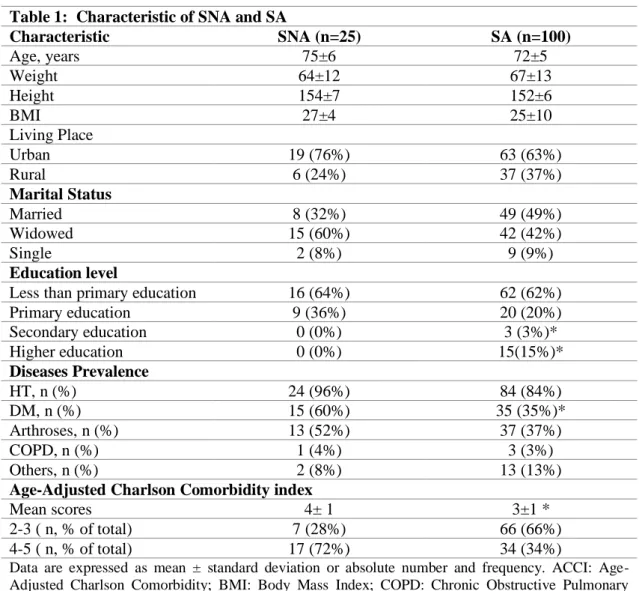
One-hundred and twenty-five elderly women were included in this study, one-hundred were socially active (72±5 years old; BMI 25±10 kg/m2) and twenty-five were socially non-active (75±6
years old; BMI 27±4 kg/m2). Socio-demographic characteristics and age-adjusted Charlson
comorbidity index are reported in a table 1. Secondary and higher education was more prevalent in SA compared to SNA women (P<0.05). Age-adjusted comorbidity index was lower in SA compared to the SNA women (P< 0.05). In addition, the prevalence of diabetes mellitus was also lower in SA compared to SNA women (P<0.05).
Functional measurements are presented in figure 1. SA compared to SNA women showed better dynamic balance (TUG: 9.5 ± 1.6 sec versus 10.3 ± 1.9 sec; P< 0.031), higher muscle strength (HGS: 21.9 ± 4.5 Kg versus 18.7 ± 3.4 Kg; P< 0.001) and lower disability (MHAQ: 1.9 ± 2.4 points versus 3.8 ± 2.0 points P< 0.05 for all). No differences were observed between groups in static balance ability and mental status.
4 DISCUSSION
The present study reported that the social participation has a positive impact on functional and health status in older women. Those who were classified as socially active have better dynamic balance, higher muscle strength, lower disability, less comorbidities and higher educational level
compared to socially non-active women. This is an important finding to the literature, since there are few studies in this field especially in Latin America.
The World Health Organization’s International Classification of Functioning (Who, 2001), Disability and Health model describes a relation among different domains for a biopsychological perspective of health with activities and participation. (Who, 2001) Social participation has been related to heath status, mobility limitations, mental and cognitive impairment which might explain further engagement in social organizations. (Cimarolli et al., 2017; Pinto & Neri, 2017) In addition, individuals who have more social relationships and social support are characterized by lower disability, frailty and mortality.(Holt-Lunstad et al., 2010; Wallace, Theou, Pena, Rockwood, & Andrew, 2015) Indeed, social participation has been associated with higher levels of physical activity and health status. (Smith, Banting, Eime, Sullivan, & Uffelen, 2017) This study showed that women who were classified as socially active presented better dynamic balance, higher muscle strength, lower disability and comorbidities compared to those without social participation. Considering that muscle strength, balance and presence of comorbidities are risk factors to sarcopenia and frailty (Cruz-Jentoft et al., 2010; Muscaritoli et al., 2010) , therefore it could be hypothesized a relationship between social participation and the prevalence of geriatric syndromes.
This study reported that women with social participation had higher educational level compared to those without it. Similar findings have been reported in the literature. (Chiao, Weng, & Botticello, 2011; Loyola et al., 2017) For example, Chiao et al. (Chiao et al., 2011) in a 18-years longitudinal analysis in China, with adults aged 60-64, reported that individuals socially active present higher educational levels compared to those whom have never participated in a social organization (i.e. religious or church, political, retired or elderly-related groups). In addition, lower educational level has been associated with an increased decline in cognitive and verbal memory in older population. (Alley & Crimmins, 2009) Specifically, less than 6 years of education has been associated with higher levels of depression in older women (OR: 2.77; 95% CI: 1.35-5.49). (Takagi et al., 2013) Depression has been associated to cognitive process, social interactions and motivation to engage in social activities, leading to a lower social participation. (Pinto & Neri, 2017) Therefore, higher education could be a protective factor in older women who participate in community organizations. (Pinto & Neri, 2017)
Although, in this study, no difference was observed between the mental status of SNA and SA, in the literature the social participation have showed an important role in cognitive functioning and successful aging. (Bourassa, Memel, Woolverton, & Sbarra, 2017) Probably, this finding is different because it is a cross-sectional study, since most of the literature in this field are longitudinal studies, which have reported the effect of social participation in cognitive function over time. (Bourassa et
al., 2017; Tomioka, Kurumatani, & Hosoi, 2018) However, this study reported that social participation in elderly women was associated with better health status, since they presented lower disability and less comorbidities. These findings are in accordance with other studies which suggest that involvement in social activities can improve the physical and mental health in older women. (Alizadeh, Mohseni, Khanjani, & Momenabadi, 2014; Takagi et al., 2013) Aida et al (Aida et al., 2013) reported that older women that are involved in community organizations presented lower incidence of disability. In addition, Tomioka et al (Tomioka et al., 2018) reported that participate in different social organization prevent the declining in instrumental activities of daily living in older people. Douglas et al. (Douglas, Georgiou, & Westbrook, 2017) suggests that the effect of social participation on health is mediated by social support and social cohesion, which produce physiological well-being in elderly population. (Douglas et al., 2017) Therefore, social participation is an important factor to have a better functionality and health status in older people.
Despite our work provides relevant aspects about the effects of social participation on the health and functionality of elderly women, limitations need to be addressed. Firstly, we used a cross-sectional design, therefore the causality of the results should be observed with caution. Secondly, the sample size between the groups is different, because it was difficult to find socially non-active women to participate in the study. Finally, although this study measured social, functional and health factors, however, the depression, motivation and quality of life were not assessed, which are important determinants of women’s health. Finally, social participation was identified with a single question due to the lack evidence about questionnaires to assess this condition in Chilean population. Future research should consider the association between social participation with the prevalence of geriatric syndromes and develop an instrument to measure the level of social participation to elderly people in Latin America.
In conclusion, elderly women who are socially active have better functionality, health status and higher educational level, than socially non-active elderly women. Additionally, this study suggest that the level of social participation must be considered as an evaluation by the clinicians into their daily routines, since it has an impact on different health and functional outcomes in elderly people.
ACKNOWLEDGEMENT
The authors would like to thank the older people members from the community groups of the Commune of Requinoa, Chile.
CONFLICT OF INTEREST
The authors declare no conflict of interest
REFERENCES
Aida, J., Kondo, K., Kawachi, I., Subramanian, S. V, Ichida, Y., Hirai, H., … Watt, R. G. (2013). Does social capital affect the incidence of functional disability in older Japanese? A prospective population-based cohort study. Journal of Epidemiology and Community Health, 67(1), 42–47. https://doi.org/10.1136/jech-2011-200307
Alizadeh, S., Mohseni, M., Khanjani, N., & Momenabadi, V. (2014). Correlation between social participation of women and their quality of life in Kerman. Journal of Health Promotion Management, 3(2), 34–42. Retrieved from http://jhpm.ir/browse.php?a_id=190&sid=1&slc_lang=en Alley, D., & Crimmins, E. (2009). Education and Cognitive Decline in Older Americans: Results From the AHEAD Sample. 29(1), 1–19. https://doi.org/10.1177/0164027506294245.Education Bourassa, K. J., Memel, M., Woolverton, C., & Sbarra, D. A. (2017). Social participation predicts cognitive functioning in aging adults over time: comparisons with physical health, depression, and physical activity. Aging and Mental Health, 21(2), 133–146. https://doi.org/10.1080/13607863.2015.1081152
Campos, A. C. V., Almeida, M. H. M., Campos, G. V., & Bagutchi, T. F. (2016). Prevalence of functional incapacity by gender in elderly people in Brazil: a systematic review with meta-analysis. Rev. Bras. Geriatr. Gerontol., 19(3), 545–559. https://doi.org/10.1590/1809-98232016019.150086 Charlson, M., Szatrowski, T. P., Peterson, J., & Gold, J. (1994). Validation of a combined comorbidity index. Journal of Clinical Epidemiology, 47(11), 1245–1251. https://doi.org/10.1016/0895-4356(94)90129-5
Chiao, C., Weng, L. J., & Botticello, A. L. (2011). Social participation reduces depressive symptoms among older adults: An 18-year longitudinal analysis in Taiwan. BMC Public Health, 11. https://doi.org/10.1186/1471-2458-11-292
Cimarolli, V. R., Boerner, K., Reinhardt, J. P., Horowitz, A., Wahl, H. W., Schilling, O., & Brennan-Ing, M. (2017). A population study of correlates of social participation in older adults with age-related vision loss. Clinical Rehabilitation, 31(1), 115–125. https://doi.org/10.1177/0269215515624479 Cruz-Jentoft, A. J., Baeyens, J. P., Bauer, J. M., Boirie, Y., Cederholm, T., Landi, F., … Zamboni, M. (2010). Sarcopenia: European consensus on definition and diagnosis. Age and Ageing, 39(4), 412– 423. https://doi.org/10.1093/ageing/afq034
da Silva, E. M., Sepúlveda-Loyola, W., Martins da Silva, J., Castilho dos Santos, G., & Pereira, C. (2019). Comparación entre simple y doble tarea, capacidad cognitiva y equilibrio postural en adultos mayores que participan de 3 modalidades de ejercicio físico. Fisioterapia, (xx). https://doi.org/10.1016/j.ft.2019.10.002
Douglas, H., Georgiou, A., & Westbrook, J. (2017). Social participation as an indicator of successful aging: An overview of concepts and their associations with health. Australian Health Review, 41(4), 455–462. https://doi.org/10.1071/AH16038
Glass, T. A., de Leon, C. M., Marottoli, R. A., & Berkman, L. F. (1999). Population based study of social and productive activities as predictors of survival among elderly Americans. BMJ (Clinical Research Ed.), 319(7208), 478–483. Retrieved from http://www.ncbi.nlm.nih.gov/pubmed/28199 Holt-Lunstad, J., Smith, T. B., & Layton, J. B. (2010). Social relationships and mortality risk: A meta-analytic review. PLoS Medicine, 7(7). https://doi.org/10.1371/journal.pmed.1000316
Jiménez, D., Lavados, M., Rojas, P., Henríquez, C., Silva, F., & Guillón, M. (2017). Evaluación del minimental abreviado de la evalución funcional del adulto mayor (EFAM) como screening para la detección de demencia en la atención primaria. Revista Medica de Chile, 145, 726–732.
Kavanagh, A. M., Bentley, R., Turrell, G., Broom, D. H., & Subramanian, S. V. (2006). Does gender modify associations between self rated health and the social and economic characteristics of local environments? Journal of Epidemiology and Community Health, 60(6), 490–495. https://doi.org/10.1136/jech.2005.043562
Loyola, W. S., Camillo, C. A., Torres, C. V., & Probst, V. S. (2017). Effects of an exercise model based on functional circuits in an older population with different levels of social participation. Geriatrics & Gerontology International. https://doi.org/10.1111/ggi.13167
Mancilla S, E., Ramos F, S., & Morales B, P. (2016). Association between handgrip strength and functional performance in Chilean older people. Revista Medica de Chile, 144(5), 598–603. https://doi.org/10.4067/S0034-98872016000500007
Mathiowetz, V., Weber, K., Volland, G., & Kashman, N. (1984). Reliability and validity of grip and pinch strength evaluations. The Journal of Hand Surgery, 9(2), 222–226. https://doi.org/http://dx.doi.org/10.1016/S0363-5023(84)80146-X
MINSAL. (2013). http://web.minsal.cl/portal/url/item/ab1f81f43ef0c2a6e04001011e011907.pdf. Muscaritoli, M., S.D. Anker, Aversa, Z., Bauer, J. M., Biolo, G., Boirie, Y., … Sieber, C. C. (2010). Consensus definition of sarcopenia , cachexia and pre-cachexia : Joint document elaborated by Special Interest Groups ( SIG ) ‘“ cachexia-anorexia in chronic wasting diseases ”’ and ‘“ nutrition in geriatrics .”’ Clin Nutr, 29, 154–159. https://doi.org/10.1016/j.clnu.2009.12.004
Pinto, J. M., & Neri, A. L. (2017). Factors related to low social participation in older adults: findings from the Fibra study, Brazil. Cadernos Saúde Coletiva, 25(0), 286–293. https://doi.org/10.1590/1414-462x201700030300
Podsiadlo, D., & Richardson, S. (1991). The timed “Up & Go”: a test of basic functional mobility for frail elderly persons. Journal of the American Geriatrics Society, 39(2), 142–148. Retrieved from http://www.ncbi.nlm.nih.gov/pubmed/1991946
Richard, L., Gauvin, L., Gosselin, C., & Laforest, S. (2009). Staying connected: neighbourhood correlates of social participation among older adults living in an urban environment in Montréal, Quebec. Health Promotion International, 24(1), 46–57. https://doi.org/10.1093/heapro/dan039 Smith, G. L., Banting, L., Eime, R., Sullivan, G. O., & Uffelen, J. G. Z. Van. (2017). The association between social support and physical activity in older adults : a systematic review. 1–21. https://doi.org/10.1186/s12966-017-0509-8
Takagi, D., Kondo, K., & Kawachi, I. (2013). Social participation and mental health: moderating effects of gender, social role and rurality. BMC Public Health, 13(1), 701. https://doi.org/10.1186/1471-2458-13-701
Tomioka, K., Kurumatani, N., & Hosoi, H. (2018). Social Participation and Cognitive Decline among Community-dwelling Older Adults: A Community-based Longitudinal Study. Journals of Gerontology - Series B Psychological Sciences and Social Sciences, 73(5), 799–806. https://doi.org/10.1093/geronb/gbw059
Tuna, H. D., Edeer, A. O., Malkoc, M., & Aksakoglu, G. (2009). Effect of age and physical activity level on functional fitness in older adults. European Review of Aging and Physical Activity, 6(2), 99– 106. https://doi.org/10.1007/s11556-009-0051-z
Unger, J. B., McAvay, G., Bruce, M. L., Berkman, L., & Seeman, T. (1999). Variation in the impact of social network characteristics on physical functioning in elderly persons: MacArthur Studies of Successful Aging. The Journals of Gerontology. Series B, Psychological Sciences and Social Sciences, 54(5), S245-51. Retrieved from http://www.ncbi.nlm.nih.gov/pubmed/10542826
Van Brakel, W. H., Anderson, A. M., Mutatkar, R. K., Bakirtzief, Z., Nicholls, P. G., Raju, M. S., & Das-Pattanayak, R. K. (2006). The Participation Scale: Measuring a key concept in public health. Disability and Rehabilitation, 28(4), 193–203. https://doi.org/10.1080/09638280500192785
Wallace, L. M. K., Theou, O., Pena, F., Rockwood, K., & Andrew, M. K. (2015). Social vulnerability as a predictor of mortality and disability: cross-country differences in the survey of health, aging, and retirement in Europe (SHARE). Aging Clinical and Experimental Research, 27(3), 365–372. https://doi.org/10.1007/s40520-014-0271-6
White, D. K., Wilson, J. C., & Keysor, J. J. (2011). Measures of adult general functional status: SF-36 Physical Functioning Subscale (PF-10), Health Assessment Questionnaire (HAQ), Modified Health Assessment Questionnaire (MHAQ), Katz Index of Independence in Activities of Daily Living, Functional Independ. Arthritis Care and Research, 63(SUPPL. 11). https://doi.org/10.1002/acr.20638
Who. (2001). The International Classification of Functioning, Disability and Health. World Health Organization, 18, 237. https://doi.org/10.1097/01.pep.0000245823.21888.71
Willie-Tyndale, D., Holder-Nevins, D., Mitchell-Fearon, K., James, K., Laws, H., Waldron, N. K., & Eldemire-Shearer, D. (2016). Participation in Social Activities and the Association with Socio-Demographic and Health-Related Factors among Community-Dwelling Older Adults in Jamaica.
Journal of Cross-Cultural Gerontology, 31(4), 427–447.
https://doi.org/10.1007/s10823-016-9297-x
Table 1: Characteristic of SNA and SA
Characteristic SNA (n=25) SA (n=100) Age, years 75±6 72±5 Weight 64±12 67±13 Height 154±7 152±6 BMI 27±4 25±10 Living Place Urban 19 (76%) 63 (63%) Rural 6 (24%) 37 (37%) Marital Status Married 8 (32%) 49 (49%) Widowed 15 (60%) 42 (42%) Single 2 (8%) 9 (9%) Education level
Less than primary education 16 (64%) 62 (62%)
Primary education 9 (36%) 20 (20%) Secondary education 0 (0%) 3 (3%)* Higher education 0 (0%) 15(15%)* Diseases Prevalence HT, n (%) 24 (96%) 84 (84%) DM, n (%) 15 (60%) 35 (35%)* Arthroses, n (%) 13 (52%) 37 (37%) COPD, n (%) 1 (4%) 3 (3%) Others, n (%) 2 (8%) 13 (13%)
Age-Adjusted Charlson Comorbidity index
Mean scores 4± 1 3±1 *
2-3 ( n, % of total) 7 (28%) 66 (66%)
4-5 ( n, % of total) 17 (72%) 34 (34%)
Data are expressed as mean ± standard deviation or absolute number and frequency. ACCI: Age-Adjusted Charlson Comorbidity; BMI: Body Mass Index; COPD: Chronic Obstructive Pulmonary Disease; DM: Diabetes Mellitus; HT: Hypertension; SA: Socially Active; SNA: Socially Non-Active. *Statistically significant (P < 0.05)
Figure 1: Functional measurements in socially active and non-socially active women
SA: Socially Active; SNA: Socially Non-Active; TUG: Timed Up-and-Go; HGS: Handgrip Strength; UPST: Unipedal Stance Test; MMSE: Mini-Mental State Examination; MHAQ: Modified Health Assessment Questionnaire. *