BJRS
RADIATION SCIENCES
03-01 (2015) 01-15Norm in soil and sludge samples in Dukhan oil Field,
Qatar state
A.T. Al-Kinani
a, M. Hushari
a, Huda Al-Sulaiti
aand I.A. Alsadig
aaRadiation and chemical protection department Ministry of environment ,Doha-Qatar
Correspondent author: Mohammad Hushari, P.O.Box7634, Doha-Qatar. Tel w:(+974)44139476
Fax (+974)44207000 Mob:(+974)77991059 [email protected]
ABSTRACT
The main objective of this work is to measure the activity concentrations of Naturally Occurring radioactive Materials (NORM) produced as a buy products in oil production. The analyses of NORM give available information for guidelines concerning radiation protection. Recently NORM subjected to restricted regulation issued by high legal authority at Qatar state. Twenty five samples of soil from Dukhan onshore oil field and 10 sludge samples collected from 2 offshore fields at Qatar state. High resolution low-level gamma-ray spectrometry used to measure gamma emitters of NORM. The activity concentrations of natural radionuclide in 22 samples from Dukhan oil field, were with average worldwide values . Only three soil samples have high activity concentration of Ra-226 which is more than 185 Bq/kg the exempted level for NORM in the Quatrain regulation. The natural radionuclide activity concentrations of 10 sludge samples from offshore oil fields was greater than 1100Bq/kg the exempted values of NORM set by Quatrain regulation so the sludge need special treatments. The average hazards indices (Hex , D , and Raeq), for the 22 samples were below the word permissible values .This means that the human
exposure to such material not impose any radiation risk. The average hazards indices (Hex , D , and Raeq),for 3 soil
samples and sludge samples are higer than the published maximal permissible. Thus human exposure to such material impose radiation risk.
1. INTRODUCTION
Series of naturally occurring radionuclides are found at varying concentrations in the Earth’s crust depending on the geological formation. Various industrial processes of oil and gas extracting and processing operations lead to enhance the natural activity. This “enhanced’’ NORM, some state called this enhancement as TENORM. (Technologically-Enhanced Naturally Occurring Radioactive Materials). Sludge, are examples of materials that can contain high levels of NORM, in equipment and materials, can be created when industrial activity increases the concentrations of uncontrolled activities such as leak of produced water or scale from pipe and valves can contaminate the soil and environment and pose a risk to human health.
Various industrial processes of oil and gas extracting and processing operations lead to enhance the natural activity. Since Ra-226 is slightly soluble, it mobilized from subsurface formation in the liquid phases and transported to the surface in the produced water. As the produced water is brought to the surface, some of the dissolved radium precipitates out in solid. The primary radionuclide of concern in oil and gas stream are Ra-226, Th-232, and K-40 which are responsible for most of the external exposure in such facilities (1).
Radium solubility and mobility depend on the salinity of the formation water; higher salinity is aligned with greater solubility (2).
2. MATERIAL AND EXPERIMENTAL ARRANGEMENTS
2.1.
SAMPLES LOCATIONSTwenty five samples of soil from Dukhan at north west of coast which is a big onshore oil field in state of Qatar it comprise three reservoirs the oldest one was AL- Khatiyah which started the oil production at 1947 till now. The other two sectors are Fahahil starting producing oil at 1954 followed by Jaleha in 1955.
The most important production of oil in the state of Qatar are the offshore oil fields which are operated by QP, sharing with other international oil companies according to exploration and development sharing agreements (DPSA).
Ten samples of sludge collected from separation tanks from two offshore the first one the field PS and the second location for sludge collection was from Al Shaheen field. samples preparation
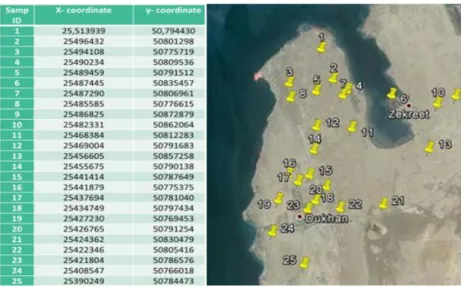
Twenty five soil samples from Dukhan field were collected randomly near the oil well head as
seen in Figure 1 using Back-Back detector as radiation survey meter and tools for positioning. Sample of about 1 kg was taken after removal stones and biological parts , then transferred into sealed labeled polyethylene bags.
Figure 1: Samples location on Qatar map
The samples were dried to get rid from any significant moisture using oven set at 353 K for 12 hours. Each soil sample is packed and sealed in an airtight PVC Marinelli beaker. The beakers was stored for 30 days before its counting radioactivity to achieve the secular equilibrium between the daughter products of radon (222Ra), (220Ra) and their short lived decay products.
2.2. GAMMA RAY SYSTEM CALIBRATION
Measurements were conducts by Gamma ray spectroscopy system equipped with Canberra n-type detector of high-purity germanium (HPGe). Each sample was counted for 24h to reduce the statistical uncertainty. Minimum detectable activity was determined from the background radiation spectrum
The detector has a resolution of 2.5 keV and relative efficiency of 30% for 1.332 MeV gamma energy of 60Co. The output of the detector is connected to PC. The spectral data analyzed using the “Genie 2000 Gamma Analysis Software package”. The detector was has a graded shielding made of lead of 10 cm thick shield to reduce the background radiation level of the system, and lined inside with 1 mm copper sheets to minimize the X-rays emitted due to interaction of cosmic radiation with lead.
The absolute photo-peak efficiency calibration of the system were carried out using standard source of 152Eu in Marinelli beaker because of its suitable half-life and the wide range of gamma
ray energies produced during its decay process.
The specific radioactivity of 226Ra under the peak energy of 186.21 keV is the sum of 235U under
the peak energy of 185.7 keV and peak energy of 226Ra alone. Thus the radioactivity of 226Ra alone calculated by subtracting the specific radioactivity of 235U which is calculated from the peak energy of 143.76 keV from the total specific radioactivity calculated for 226Ra. can be measured from the weighted mean of the activity concentration of Pb-214 and Bi-214. 232Th activities were determined from the average concentrations of 238.6 keV peak of its 212Pb progeny and 911.1keV peak of its 228Ac progeny or by 208TI gamma-ray emission probability corrected for 212Bi α decay branching ratio of 35.94 %. Activities of 40K were calculated from the 1,4607 keV peak.
2.3. EXPOSURE TO RADIATION SOURCES AND RISK ASSESSMENT
Naturally radionuclides 232Th, 226Ra and40K in terrestrial soils or sludge decay to its progeny, which produce external radiation exposure human beings due to gamma-beta radiation. The exposure rate to individual depend on the concentrations of radionuclides in the sample. The main objective of external hazard index Hex is to limit the radiation dose to the admissible annual dose
equivalent limit of 1 mSv/y (3). Beretka and Mathew at 1985 (4) drive the equation:
Hex ={ (CRa /370 )+ (CTh /259) + (CK/4810 )} ≤ 1 eq. 1
Where:
CRa, CTh and CK are the activity concentrations in Bq/kg of 226Ra, 232Th and 40K in Bq/kg,
respectively. The values of this index must be less than unity in order to keep the radiation hazard without posing any significant radiological threat to public.
The Radium equivalent (Raeq) in Bq/ kg are used to assess the radiological hazards associated with
materials that contain natural radioactivity in Bq/kg (5). Yu et al. 1992 (6) using the following equation to calculate Raeq:
Raeq = CRa + 1.43 CTh + 0.077 CK eq 2
Maximum value of Raeq must be less than 370 Bq/kg that equivalent to the annual dose equivalent
of 1.5 mSv/y. Radium equivalent activity defined on the assumption that 1 Bq/kg of 226Ra, 0.7 Bq/kg of 232Th, and 13 Bq/kg of 40K produce the same radiation dose rates.
The total external terrestrial Gamma radiation absorbed dose rate (D) in air is the quantity that cocidering radiation risk due to gamma rays emitted by the 238U , 232Th decay chain and 40K at 1m above the ground level. The published maximal permissible. dose rate is 51 nGy/h.
Rohit Mehra et al (7) use the following equation to calculate the absorbed dose rate (D) in air:
D( nGy/h) =0.461 CRa + 0.623CTh + 0.0414CK eq 3
3. RESULTS AND DISCUSSIONS
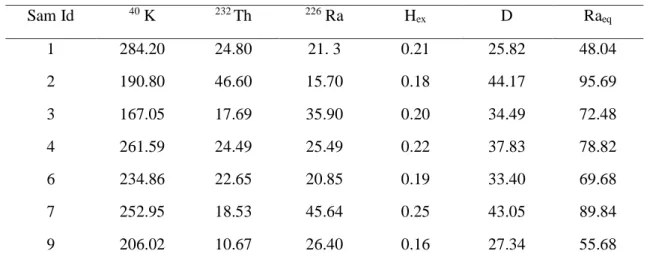
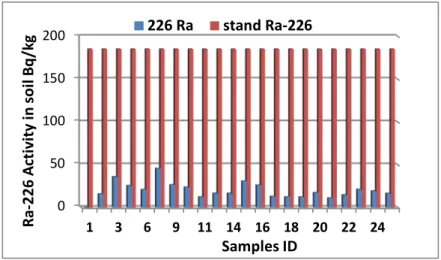
The activity concentrations of natural radionuclide Ra-226,Th-232,and K-40, (Hex), (Raeq), and (D) of the 25 samples from Dukhan oil field were calculated for each samples are summarized in Table 1 and Figure 2. 22 of investigated soil samples which have normal activity of Ra-226, and shows that the average activity concentration of Ra-226,Th-232,and K-40, were 20.05 , 16.43, and 216.69 Bq/kg respectively, which is below the world wide averaged value of Ra-226,Th-232,and K-40 in normal soil which are 33, 45, and 420 Bq/kg respectively cited by UNSCEAR(5).
Table 1: Radioactivity concentrations of 226Ra , 232Th, and 40K in Bq/kg ,and risk indices in soil
samples at Dukhan oil field in Qatar.
Sam Id 40 K 232 Th 226 Ra H ex D Raeq 1 284.20 24.80 21. 3 0.21 25.82 48.04 2 190.80 46.60 15.70 0.18 44.17 95.69 3 167.05 17.69 35.90 0.20 34.49 72.48 4 261.59 24.49 25.49 0.22 37.83 78.82 6 234.86 22.65 20.85 0.19 33.40 69.68 7 252.95 18.53 45.64 0.25 43.05 89.84 9 206.02 10.67 26.40 0.16 27.34 55.68
10 198.79 6.78 23.69 0.13 23.37 47.30 11 174.39 10.69 12.32 0.11 19.56 39.81 13 249.63 10.82 16.44 0.14 24.65 49.39 14 218.21 17.14 16.59 0.16 27.36 56.37 15 211.89 20.61 30.94 0.29 35.87 75.24 16 229.58 12.54 26.12 0.17 29.36 60.12 17 135.56 7.77 12.79 0.09 19.48 33.39 18 127.74 13.35 12.34 0.11 19.29 40.37 19 192.39 9.83 12.09 0.11 19.66 39.61 20 255.19 19.14 17.26 0.17 30.44 62.49 21 179.52 11.09 10.87 0.11 19.35 39.29 22 222.16 12.48 14.68 0.13 23.74 48.08 23 254.19 10.69 21.05 0.15 26.89 54.13 24 272.70 19.35 19.25 0.18 32.22 66.00 25 247.90 13.80 16.29 0.15 26.37 53.37 Average 216.69 16.43 20.05 0.16 26.04 53.29 5 112.50 8.80 226.70 0.67 114.65 247.16 8 109.90 6.70 289.50 0.83 142.18 306.77 12 120.80 9.80 198.30 0.599 102.52 220.70
Figure 2: 226Ra concentration of soil samples not contaminated with NORM at Dukhan oil field
in Qatar
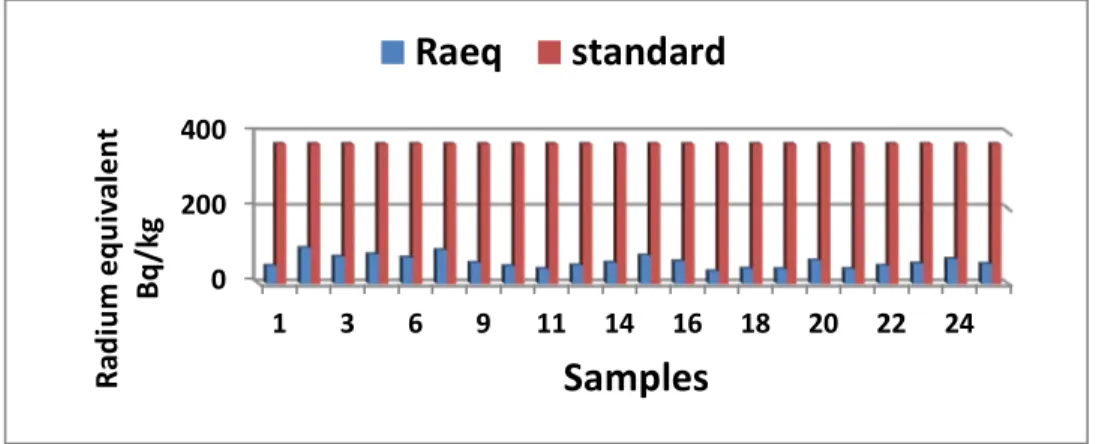
The average Hex for the 22 samples were less than unity Figure 3 .The average value the of (D) for 22 investigated soil samples was found to be 26.04 nGy/h which is less than the published maximal permissible, Figure 4. The average value (Raeq) was 53.29 which is less than the published maximal permissible value, Figure 5, 370 Bq/kg (5).
Figure 3: External hazard index Hex of soil samples not contaminated with NORM at Dukhan oil
field in Qatar 0 50 100 150 200 1 3 6 9 11 14 16 18 20 22 24 Ra -2 26 A ct iv ity in so il B q/ kg Samples ID 226 Ra stand Ra-226 0 0,2 0,4 0,6 0,8 1 1 2 3 4 6 7 9 10 11 13 14 15 16 17 18 19 20 21 22 23 24 25 Ex te rn al H az ard as In de x Samples ID Hex) Standard
Figure 4: The average absorbed dose rate of the soil sample
Figure 5: Radium Equivalent of soil samples not contaminated with NORM
All data for the 22 samples indicate that the soil sample are normal and represent the a normal level of natural background radiation of soil at that area.
0 10 20 30 40 50 60 1 2 3 4 6 7 9 10 11 13 14 15 16 17 18 19 20 21 22 23 24 25 Abs or be d do se ra te µ Gy /h
Sampels
D µGy/h
standard
0 200 400 1 3 6 9 11 14 16 18 20 22 24 Ra di um e qu iv ale nt Bq /kgSamples
Raeq
standard
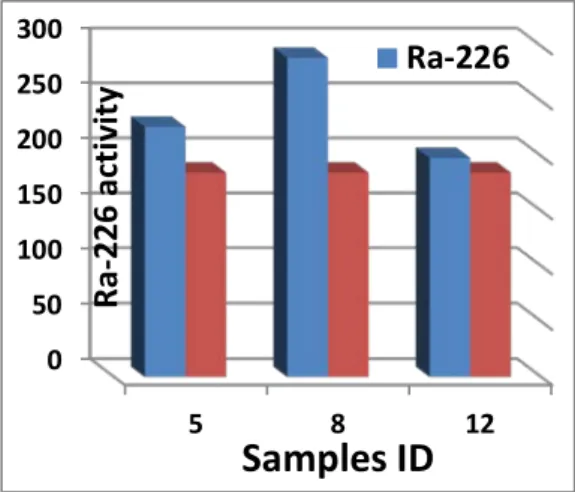
Three soil sample (NO 5, 8, and 12 ) has high activity concentration of Ra-226 which is more than 185 Bq/kg the exempted level for NORM in the Quatrain regulation, Figure 6, recently issue by the legal authorization. It is likely that the high radioactivity of Ra-226 for these samples is as a result of contamination of this soil by NORM these many be contaminated by produced water or scale from oil well.
Figure 6: 226Ra concentration of soil samples
The Ra-226 concentration was more than 185 Bq/kg this is agree with Al-Sulaiti -etal finding of the same area (8).
The external hazard index, (Hex) were less than the world permissible value of unity, Figure 7. This indicates that the values will not lead to respiratory cancer and external other radiation diseases such as erythema, and cataracts.
0 50 100 150 200 250 300 5 8 12 Ra -226 a ct iv ity
Samples ID
Ra-226Figure 7: Hex of contaminated soil
Figure 8: Absorbed dose rate of contaminated soil
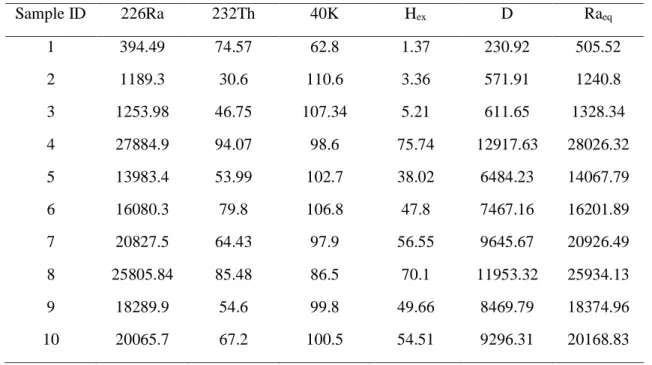
The measured value of Radium equivalent (Raeq) of the three contaminated samples were 247.16, 306.77, and 220.7 Bq/kg which are less than the internationally safe limit 370 Bq/kg and (D) also less than published maximal permissible value 51 nGy/h. Table 2 shows the activity concentrations Bq/kg of natural radionuclide 226Ra 232Th, and 40K of the 10 sludge samples from offshore oil fields. The calculated Hex, Raeq (Bq/kg) and the absorbed dose D (nGy/h) in each of these samples are also shown.
0 0,2 0,4 0,6 0,8 1 5 8 12 Ex te rn al H az ard in de x
Contaminated soil sample Hex Standard Hex
0 20 40 60 80 100 120 140 160 5 8 12 ads or be d do se o f con ta m in at ed soi l D Standard D
Table 2: Radionuclide concentration of NORM (Bq/kg) in sludge samples Sample ID 226Ra 232Th 40K Hex D Raeq 1 394.49 74.57 62.8 1.37 230.92 505.52 2 1189.3 30.6 110.6 3.36 571.91 1240.8 3 1253.98 46.75 107.34 5.21 611.65 1328.34 4 27884.9 94.07 98.6 75.74 12917.63 28026.32 5 13983.4 53.99 102.7 38.02 6484.23 14067.79 6 16080.3 79.8 106.8 47.8 7467.16 16201.89 7 20827.5 64.43 97.9 56.55 9645.67 20926.49 8 25805.84 85.48 86.5 70.1 11953.32 25934.13 9 18289.9 54.6 99.8 49.66 8469.79 18374.96 10 20065.7 67.2 100.5 54.51 9296.31 20168.83
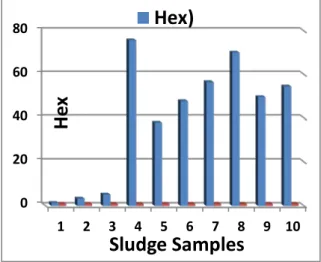
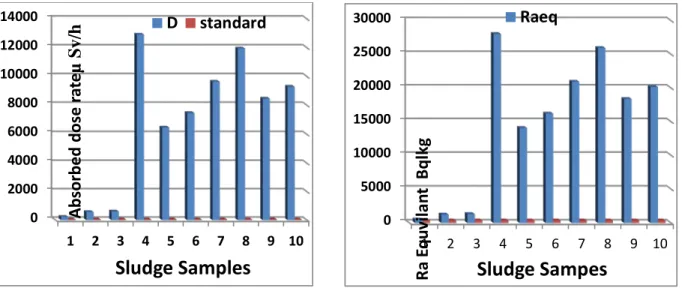
The Ra-226 activity concentrations of 9 of these samples were greater than 1100Bq/kg the exempted values set by Quatrain regulation Fig 10. The (Hex) values was more than unity Fig 11, (Raeq) and D were more than the published maximal permissible value by many factors, Fig 12, 13 which means that the human exposure to such material impose high risk, thus the sledges must be store in safe storage for final disposal.
Figure 9: Radium equivalent of soil
Figure 10: 226Ra concentration of sludge Figure 11: External Hazards of sludge
0 5000 10000 15000 20000 25000 30000 1 2 3 4 5 6 7 8 9 10 Ra -2 26 A ct iv ity B ql kg
Sludge samples
226Ra
Standard
0 50 100 150 200 250 300 350 400 5 8 12 Ra di um E qi va le ntRaeq Standard Raeq
0 20 40 60 80 1 2 3 4 5 6 7 8 9 10
He
x
Sludge Samples
Hex)
Figure 12: Absorbed dose of sludge Figure 13: Radium equivalent of sludge
4. ACKNOWLEDGEMENTS
This article was made possible by NPRP award (NPRP 5-335-1-065) from the Qatar national Research Fund (a member of the Qatar Foundation).The statements made herein are solely the responsibility of the authors.
REFERÊNCIAS
[1] Al- MASRI and SUMAN .H, "NORM Waste in Oil and Gas Industry" The Syrian Experience "AECS_CN-87/78, IAEA,Malta, p 67-90, (2001).
[2] ROBERT JOHNSON, R SMITH,K.P and JOHN QUINN. The Application of Adaptive Sampling and Analysis Program (ASAP) Techniques to NORM Sites. Argonne National Laboratory Environmental Assessment Division 9700 S. Cass Avenue Argonne, IL 60439 (1999)
0 2000 4000 6000 8000 10000 12000 14000 1 2 3 4 5 6 7 8 9 10 Ab so rb ed d os e r at eµ Sv /h
Sludge Samples
D standard 0 5000 10000 15000 20000 25000 30000 1 2 3 4 5 6 7 8 9 10 Ra E qu vila nt B qlk gSludge Sampes
Raeq[3] NOORDDIN IBRAHIM, Natural activities of 238U, 232Th and 40K in building materials. Journal of Environmental Radioactivity, 1999. 43(3): p. 255-258.
[4] BERETKA, J. MATHEW, P.J., Natural radioactivity of Australian building materials, industrial wastes and byproducts.. Health Phys., 1985. 48: p. 87-95.
[5] UNSCEAR, Effects of Atomic Radiation to the General Assembly, in United Nations Scientific Committee on the Effect of Atomic Radiation. 2000, United Nations: New York.
[6] YU, K.N.., GUAN, Z. J., STOKS, M. J., & YOUNG, E. C. ,The assessment of natural radiation dose committed to the Hong Kong people. Journal of Environmental Radioactivity, (1992), 17, 31.
[7] ROHIT MEHRA, SURINDER, SINGH., KULWANT,SINGH., & RAJENDRA. SONKAWADE, 226Ra, 232Th and 40K analysis in soil samples from some areas of Malwa region, Punjab, India using gamma ray spectrometry. Environ Monit Assess(1997) . 134:333–342
[8] Al-SULAITI, H., REGAN, P. H., BRADLEY, D. A., MALAIN ,D., et al., A preliminary report on the determination of natural radioactivity levels of the State of Qatar using high-resolution gamma-ray spectrometry. Nuclear Instruments and Methods in Physics Research Section A: Accelerators, Spectrometers, Detectors and Associated Equipment, 2010. 619(1-3): p. 427-431.