IUL School of Social Sciences
Department of Social and Organizational Psychology
Children’s and adolescents’ self-representations in the context of
adverse family experiences: emotional, relational and cognitive
processes, and implications for psychosocial functioning
Carla Sofia Carvalho de Freitas Silva
A thesis presented in partial fulfilment of the requirements for the degree of Doctor in Psychology
Supervisor:
PhD Doutora Maria Manuela de Amorim Calheiros, Assistant Professor
Department of Social and Organizational Psychology, ISCTE - Instituto Universitário de Lisboa
IUL School of Social Sciences
Department of Social and Organizational Psychology
Children’s and adolescents’ self-representations in the context of
adverse family experiences: emotional, relational and cognitive
processes, and implications for psychosocial functioning
Carla Sofia Carvalho de Freitas Silva
A thesis presented in partial fulfilment of the requirements for the degree of Doctor in Psychology
Jury
Doutora Isabel Alexandra de Figueiredo Falcão Correia, Professora Associada com Agregação, Departamento de Psicologia Social e das Organizações, ISCTE – Instituto
Universitário de Lisboa
Doutora Madalena Moutinho Alarcão Silva, Professora Associada, Faculdade de Psicologia e de Ciências da Educação, Universidade de Coimbra
Doutora Maria Adelina Acciaiuoli Faria Barbosa Ducharne, Professora Auxiliar, Faculdade de Psicologia e Ciências da Educação, Universidade do Porto
Doutora Mónica López López, Professora Auxiliar, Faculty of Behavioral and Social Sciences, University of Groningen
Doutora Cecília do Rosário da Mota Aguiar, Professora Auxiliar, Departamento de Psicologia Social e das Organizações, ISCTE – Instituto Universitário de Lisboa Doutora Maria Manuela de Amorim Calheiros, Professora Associada, Faculdade de
Psicologia, Universidade de Lisboa
October, 2017 Children’s and ado lesc ents’ self -re presentat io ns in the co ntext of adverse fami ly exper ie nces: emo ti onal, rel a tio nal and co g nitive processes, a nd impl icat ions fo r ps ychosoc ial f unctioning
The present thesis was funded by a doctoral grant (SFRH/BD/90354/2012) from the Portuguese Foundation for Science and Technology [Fundação Portuguesa para a Ciência e Tecnologia] - FCT
Acknowledgments
This was an enthralling and rewarding, as much as challenging and arduous, journey.
My heartfelt gratitude towards everyone who inspired, encouraged and enhanced my development as a researcher, who participated and collaborated in this work, making it possible,
who cared for me and continuously nourished my strength,
Resumo
Neste projeto foram analisados três aspetos, ainda pouco explorados, acerca das auto-representações de crianças e adolescentes: 1) a sua relação com a exposição ao conflito interparental destrutivo; 2) a sua construção no contexto do mau trato/negligência parental; e, 3) as suas associações com o funcionamento psicossocial das crianças/adolescentes no contexto destas experiências familiares. Para tal, foram realizados dois estudos transversais. No primeiro, com base na teoria da segurança emocional, analisou-se o papel mediador da insegurança emocional das crianças/adolescentes na relação interparental, e da sua percepção acerca da relação com ambos os pais, na relação entre o conflito interparental e as suas auto-representações. Os resultados suportaram o papel mediador destes dois processos nessa relação. No segundo estudo, testou-se a “Looking-Glass Self Hypothesis” (LGSH), isto é, a relação entre as hetero-representações de outros significativos e as auto-representações através das meta-representações, no contexto do mau trato/negligência, tendo-se em conta o papel moderador da comunicação pais-filhos nesse processo. A LGSH foi suportada em todas as dimensões avaliadas. Em cada estudo foi ainda analisado o papel mediador das auto-representações na relação entre estas experiências familiares adversas e o funcionamento psicossocial das crianças/adolescentes. Os resultados salientaram o papel específico e diferenciado de várias dimensões de auto-representações como mecanismos intervenientes nessa relação. Estes estudos reforçam assim a importância das experiências relacionais com outros significativos, nomeadamente com os pais/cuidadores, nas auto-representações das crianças e adolescentes, bem como a especificidade do papel de diferentes dimensões das auto-representações no seu funcionamento psicossocial, com importantes implicações para a investigação e intervenção.
Palavras-Chave:
Auto-representações; Crianças e adolescentes; Conflito interparental; Mau trato/negligência; Funcionamento Psicossocial
PsycINFO Codes:
2800 Psicologia do Desenvolvimento 2900 Processos sociais & Questões sociais 3000 Psicologia Social
Abstract
In this project, three issues, still little explored, about children’s and adolescents’ self-representations were analysed: 1) their association with experiences of exposure to interparental destructive conflict; 2) their construction in the context of child and adolescent maltreatment; and, 3) their associations with children’s and adolescents’ psychosocial functioning in the context of these adverse family experiences. Two cross-sectional studies were carried out. In the first one, based on the emotional security theory, the mediating role of children’s and adolescents’ emotional insecurity in the interparental relationship and of their perception about their relationship with both parents in associations between interparental conflict and their domain-specific self-representations was analysed. Both mediational pathways were supported. The second study focused on testing the "Looking-Glass Self Hypothesis" (LGSH), that is, the mediating role of reflected appraisals in associations between significant others’ actual appraisals and self-representations, in the context of child/adolescent maltreatment, considering the moderating role of parent-child communication in this process. Findings supported the LGSH in all dimensions evaluated. In each study, the mediating role of self-representations in associations between these adverse family experiences and children’s and adolescents’ psychosocial functioning was also analysed. Findings emphasized the specific and differentiated role of several self-representation dimensions as intervening mechanisms in those associations. These studies thus reinforce the importance of relational experiences with significant others, namely parents/caregivers, on children’s and adolescents’ self-representations, and highlight the specific and differentiated role of different self-representation dimensions in their psychosocial functioning, bearing important implications for both research and practice.
Keywords:
Self-representations; Children and Adolescents; Interparental conflict, Child/adolescent maltreatment; Psychosocial functioning
PsycINFO Codes:
2800 Developmental Psychology 2900 Social Processes & Social Issues 3000 Social Psychology
TABLE OF CONTENTS
INDEX OF TABLES v
INDEX OF FIGURES vi
GENERAL INTRODUCTION 1
CHAPTER I - GENERAL THEORETICAL BACKGROUND 7
I. The Self 8
1. Changing conceptualizations of the self throughout history 11
1.1. From introspection to cognitions 11
1.2. From a one-dimensional to a multidimensional conceptualization 13
1.3. Contemporary conceptualization 15
2. Developmental Social Psychology as a theoretical umbrella for the study of self-construction 16
3. The Self as socio-cognitive construction 20
3.1. Self as a cognitive construction 22
3.1.1. Content and Structure of self-representations 23
3.1.2. Cognitive-developmental aspects of self-representations 26
3.2. Self as a social construction 29
3.2.1. The relevance of significant others 32
3.2.2. Liabilities associated to significant others’ influence: Adverse family experiences and
self-construction 34
4. Implications of self-representations for overall psychosocial functioning 35
CHAPTER II - GENERAL RESEARCH PROBLEMS AND OBJECTIVES 39
I. General Research Problems 40
II. General research objectives 42
CHAPTER III - INTERPARENTAL CONFLICT AND CHILDREN’S AND ADOLESCENTS’
SELF-REPRESENTATIONS: AN EMOTIONAL SECURITY PERSPECTIVE 45
I. Theoretical Framework 46
1. Interparental conflict conceptualization and its contribution to risky family environments 46 1.1. Interparental conflict as a characteristic of risky family environments 47 1.2. Process oriented approaches for studying how interparental conflict relates do child and
adolescent outcomes 48
2. Interparental conflict and children’s and adolescents’ self-representations 51 2.1. An emotional security perspective to understanding the relation between interparental
conflict and children’s and adolescents’ self-representations 55 2.1.1. Emotional insecurity in the interparental relationship as an explaining mechanism 56 2.1.2. Parent-child relationship dimensions as explaining mechanisms 58
II. Goals and Hypotheses 62
III. Empirical evidence 67
1. Methodology 67 1.1. Participants 67 1.2. Measures 68 1.3. Procedure 71 1.4. Data analysis 72 2. Results 75
2.1. Adaptation and validation of the SIS Scale 75
2.1.1. Adaptation 76
2.1.2. Validity analysis 76
2.2. Interparental conflict and children’s and adolescents’ self-representations 83
2.2.1. The mediating role of emotional insecurity 84
2.2.2. The mediating role of perceived parent-child relationships 87
3. Discussion 92
3.1. Adaptation and validation of the SIS Scale 92
3.2. Interparental conflict and children’s and adolescents’ self-representations 100
3.2.1. The mediating role of emotional insecurity 100
3.2.2. The mediating role of perceived relationship with parents 104
3.3. Limitations and strengths 110
3.4. Concluding remarks 113
CHAPTER IV - THE LOOKING GLASS SELF IN THE CONTEXT OF CHILD AND
ADOLESCENT MALTREATMENT 115
I. Theoretical Framework 116
1. Conceptualization of child and adolescent maltreatment 116 2. Maltreatment experiences and children’s and adolescents’ self-representations 119
3. The looking-glass self hypothesis 121
3.1. Reflected appraisals accuracy 122
3.2. The influence of significant others 124
3.2.1. The relevance of communication with significant others 128
II. Goals and hypotheses 130
Overview 131 1. Methodology 132 1.1. Participants 132 1.2. Measures 133 1.3. Procedure 137 1.4. Data analysis 138 2. Results 142
2.1. Adaptation and validation of the Parent-Adolescent Communication Scale (PACS) to a
sample of Portuguese Children and Adolescents 142
2.1.1. Adaptation 142
2.1.2. Validity analyses 143
2.2. The looking-glass self hypothesis (LGSH) and the moderating role of mother-child
communication 148
2.2.1. LGSH mediation model in the mother-child relationship 148 2.2.2. The moderating role of child-mother communication 154
3. Discussion 155
3.1. Adaptation and validation of the PACS 155
3.2. The looking-glass self in the context of child/adolescent maltreatment 158
3.3. Limitations and strengths 164
3.4. Concluding remarks 165
CHAPTER V -THE ROLE OF SELF-REPRESENTATIONS IN THE LINK BETWEEN ADVERSE FAMILY EXPERIENCES AND CHILDREN’S AND ADOLESCENTS’
PSYCHOSOCIAL FUNCTIONIN 169
I. Theoretical framework 170
1. Adverse family experiences and children’s and adolescents’ psychosocial functioning 170 2. Adverse family experiences and children’s and adolescents’ self-representations 171 3. Associations between self-representations and psychosocial functioning 173
II. Goals and hypothesis 177
III. Empirical evidence 179
Overview 179
1. The mediating role of children’s and adolescent’ self-representations in associations between interparental conflict and internalizing and externalizing behaviour 180
1.1. Methodology 180
1.1.1. Measures 180
1.1.2. Data analysis 180
1.2.1. Descriptive statistics and correlations 182 1.2.2. Mean differences on children’s and adolescents’ sex 182
1.2.3. Mediation model 184
2. The mediating role of children’s and adolescent’ self-representations in associations between maltreatment experiences and internalizing and externalizing behaviour 185
2.1. Methodology 185
2.1.1. Measures 185
2.1.2. Data analysis 186
2.2. Results 189
2.2.1. Descriptive statistics and correlations 189
2.2.2. Mean differences on children’s and adolescents’ sex 189
2.2.3. Mediation model 191
2.2.4. The moderating role of children’s and adolescents’ age 192
3. Discussion 194
3.1. Domain-specific self-representations as mediators of associations between exposure to
interparental conflict and psychosocial functioning 195
3.2. Domain-specific self-representations as mediators of associations between maltreatment
experiences and psychosocial functioning 200
3.3. Limitations and strengths 205
3.4. Concluding remarks 205 CHAPTER VI - CONCLUSIONS 209 REFERENCES 233 APPENDIXES 293 APPENDIX A 295 APPENDIX B 299 APPENDIX C 309 APPENDIX D 311
INDEX OF TABLES
Table 1. Factor pattern matrix from the exploratory factor analysis of the Security in the
Interparental Subsystem (SIS) Scale in a sample of Portuguese adolescents ... 79
Table 2. Correlations between the SIS dimensions and Internalizing and Externalizing Problems ... 83
Table 3. Descriptive statistics and correlations among the model variables (N=221) ... 85
Table 4. Descriptive statistics and correlations among the study variables (N=214) ... 89
Table 5. Fit indices for alternative PACS (mother’s version) models ... 144
Table 6. Fit indices for alternative PACS (father’s version) models ... 146
Table 7. Correlations between the PACS dimensions and Internalizing and Externalizing Scales of the CBCL ... 146
Table 8. Descriptive statistics and correlations among the study variables (N=203) ... 150
Table 9. Moderated mediation models... 154
Table 10. Unstandardized indirect effects of social MAA on instrumental SR through instrumental SR, conditional on the level of children’s/adolescents’ perceived communication with their mother ... 155
Table 11. Descriptive statistics and bivariate correlations among the model variables (N=243) ... 183
Table 12. Descriptive statistics and bivariate correlations among the model variables (N=203) ... 190
Table 13. Unstandardized indirect effects of physical and psychological abuse on children’s and adolescents’ internalizing behaviour through instrumental SR, conditional on their age. ... 193
Table 14. Unstandardized indirect effects of physical and psychological abuse on children’s and adolescents’exnternalizing behaviour through instrumental SR, conditional on their age. ... 193
Table 15. Unstandardized indirect effects of physical and psychological abuse on children’s and adolescents’ externalizing behaviour, through social SR, conditional on their age. ... 194
Table 16. Unstandardized direct effects of psychological neglect on children’s and adolescents’ externalizing behaviour, conditional on their age. ... 194
INDEX OF FIGURES
Figure 1. Unstandardized factor structure for the SIS Scale in the present sample ... 82 Figure 2 – Model examining emotional insecurity in the interparental relationship as
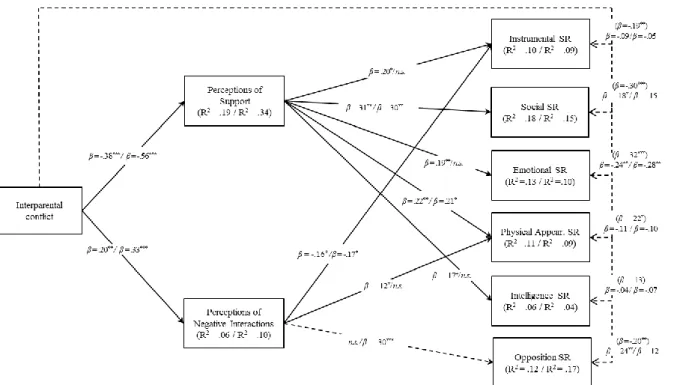
mediators of the link between interparental conflict and their SR... 87
Figure 3 – Model examining adolescents’ perceptions of their relationship with their parents
as mediators linking interparental conflict and their SR. ... 90
Figure 4. PACS (mother’s version) unstandardized factor structure in the present sample .. 145 Figure 5. PACS (father’s version) unstandardized factor structure in the present sample .... 147 Figure 6 – Model examining MRA as mediators of the association between MAA and
children and adolescents’ SR. ... 151
Figure 7 – Model examining the mediating role of children’s and adolescents SR in
associations between interparental conflict and their internalizing and externalizing
behaviour... 184
Figure 8 – Model examining the mediating role of children’s and adolescents SR in
associations between maltreatment experiences and their internalizing and externalizing behaviour as perceived by their parents.. ... 191
1 GENERAL INTRODUCTION
This work focuses on analysing children’s and adolescents’ self-representations in the context of adverse family experiences, as well as their associations with their psychosocial functioning. We grounded our research in a broad conceptualization of self-representations as cognitive constructs, product of social relationships, with implications for behaviour (e.g., Oyserman, Elmore, & Smith, 2012). Bridging together these three core precepts of self-representations – i.e., cognitive constructs, social products, and predictors of action – the studies developed within this thesis focused on how adverse interpersonal experiences within the family, specifically within the interparental and parent-child relationships, serve as building blocks for the social construction of children’s and adolescents’ self-representations (i.e., the cognitive component of self-concept).
Indeed, the construction of self-representations is imbued in cultural and social contexts and, more specifically, in significant relational contexts. Although the relevance of significant others has been emphasised by different theories, empirical research about the influence of significant others in the formation of self-representations has neglected the analysis of adverse family experiences, such as interparental conflict and child/adolescent maltreatment parenting practices, as matter for the construction of children’s and adolescents’ self-representations. By affecting family interactions in a global way, this kind of family experiences can shape children’s and adolescents’ representational patterns, and, therefore, how their self-representations are formed (Cummings & Davies, 2010; Davies & Cummings, 1994; Toth, Cicchetti, Macfie, & Emde, 1997). In addition, considering the growing body of evidence demonstrating associations of children’s self-representations with concurrent and subsequent functioning (e.g., Caldwell, Rudolph, Troop-Gordon, & Kim, 2004; Davis-Kean, Huesmann, Collins, Bates, & Lansford, 2008; Salmivalli & Isaacs, 2005), studying self-representations in the context of adverse family experiences may contribute to increase our understanding of how such experiences may be associated with children’s and adolescents’ psychosocial functioning.
We developed our research under the perspective of developmental social psychology, by integrating features of the social psychology and developmental psychology approaches to the study of the self. Indeed, overall, the study of the self has been divided in two main theoretical and research traditions. On the one hand, in the developmental
2 psychology perspective, research on the self has been embedded in the cognitive-developmental theory (e.g., Case, 1992; Fischer, 1980), focused on understanding the structural growth in self-representations, in terms of cognitive ontogenesis, seeking to describe the changing contents of children’s and adolescents’ self-representations, characteristic of specific developmental phases (e.g., Bennett & Sani, 2004; Damon & Hart, 1988; Keller, Ford, & Meacham, 1978). On the other hand, in the social psychology field, research on the self has been highly influenced by the cognitive approaches to the self, focusing on self-schemas (i.e., cognitive self-representations as generalizations about the self in the form of self-descriptive attributes) and on how information about the self is processed and organized in memory (Higgins, 1987; Kihlstrom & Cantor, 1984; Markus, 1977; Markus & Wurf, 1987), without considering developmental issues regarding the contents of self-representations. Also, while in the developmental psychology field, studies have mostly focused on children and adolescents (Harter, 2015), in the social psychology field, research has focused mainly on adults (McConnel, 2011).
Given the increasing agreement about how the study of the self may benefit from a close association between developmental and social psychology (e.g., Bennett & Sani, 2004; Brehm, Kassim, & Gibbons, 1981; Durkin, 1995; Eckes & Trautner, 2000; Flavell & Ross, 1981; Pomerantz & Newman, 2000), in this thesis, we intended to lessen the chasm between these two approaches to the study of self-representations, by bringing together aspects of the different research lines that stemmed from these two psychology disciplines. Specifically, in this work, we integrate the social psychology focus on studying the processes of social influence (e.g., Allport, 1968; McCarthy & Haslam, 1997) and its socio-cognitive approach to the self with the developmental psychology emphasis on age related developmental characteristics of self-representations. We brought the social psychology self-schema operationalization of self-representations, analysing their associations with social experiences in context, under a developmental perspective, that is, considering the developmental characteristics of the population under study. Indeed, important changes in the contents of self-representations take place over the life-course with relevant implications for individuals’ psychosocial functioning (Harter, 1990; 2015). Thus, a developmental perspective can greatly enrich the discussion of the social processes related to self-construction.
Under this theoretical umbrella, this research project had three main goals: a) to analyse how interparental conflict is associated with children’s and adolescents’
domain-3 specific self-representations, in a process-oriented way; b) to analyse children’s and adolescents’ self-representation construction process in the context of child/adolescent maltreatment; and c) to analyse the role of children’s and adolescents’ domain-specific self-representations in the associations between those adverse family experiences and their psychosocial functioning. These goals were pursued through two cross-sectional studies, which will be briefly described below, in terms of general research problems and objectives.
Considering these main research goals, this dissertation was organized in six chapters. In Chapter I, we provide a broad theoretical framework of the study of the self. With this literature review, we intend to provide an overarching theoretical frame for the research problems addressed in the present thesis. Following a historical perspective on the study of the self, and a brief framing of this research project in a developmental social psychology perspective, we will outline how, despite differences in research traditions and emphasis, self theories converge in conceptualizing self-representations identity as mental constructs, that are shaped by the contexts in which they develop and have implications for behaviour (Oyserman et al., 2012).
After outlining the main research problems and objectives of this research project in Chapter II, we then move to the empirical part of this dissertation, which will be presented in the three following chapters. These chapters describing the empirical evidence of this research project are organized in three main topics: 1) theoretical framework; 2) empirical evidence and 3) discussion. Chapter III describes the first part of the first study. In this study, based on the emotional security theory, the associations between interparental conflict and children’s and adolescents’ domain-specific self-representations were analysed, considering the mediating role of children’s and adolescents’ emotional insecurity in the interparental relationship and of their perception about their relationship with both parents in those associations. Indeed, although self-representations were recognized as important potential outcomes in research on the effects of interparental conflict on children and adolescents almost 30 years ago (Grych & Fincham, 1990), since then they have remained neglected in the research literature in this field. Particularly, although a few studies have documented associations between destructive interparental conflict and more negative children’s and adolescents’ self-representations in general, little is known about the processes that explain those associations, especially considering the multidimensional nature of self-representations. Thus, evidence is needed about the mechanisms that explain how exposure to destructive
4 interparental conflict is associated with different facets of children’s and adolescents’ self-representations. In addition, given that interparental conflict is a normal and inevitable phenomenon in marital relationships, which can include any dispute, discord, or expression of any given emotion about matters of the interparental everyday life (e.g., household duties, children’s education), it is important to analyse these processes at the community level, that is, in the overall community, and not only in the context of high risk families. Indeed, Cummings and Davies (2010) extend the notion of risky families to include a wide range of community families, arguing that it is important to consider interparental conflict whenever one is concerned about how family contexts may be associated with children’s and adolescents’ development outcomes (Davies & Cummings, 2006). Therefore, this study was conducted with a community sample of 10-18-year-old children and adolescents.
Chapter IV will, in turn, present the first part of the second study, in which the influence of significant others on maltreated children’s and adolescents’ self-representations was addressed by testing Cooley’s looking-glass self-hypothesis (LGSH), that is, the mediating role of reflected appraisals in associations between significant others’ actual appraisals and self-representations, in the context of child/adolescent maltreatment, considering the moderating role of parent-child communication in this process. Indeed, the LGSH has not yet been analysed in maltreating family contexts, although maltreatment experiences may lead to negative representational models of the self, the caregivers and overall interpersonal relationships (Toth et al., 1997). In fact, self-representations have been practically absent from research in the field of child abuse and neglect for the past almost 20 years. In addition, even though research on the LGSH with normative/community samples have supported the association between significant others’ reflected appraisals and self-representations (e.g., Martins, 2013; Nurra & Pansu, 2009), results on the association between significant others’ actual appraisals and reflected appraisals have been inconclusive (Cook & Douglas, 1998; Shrauger and Shoenemen, 1979). Given that feedback parents give their children about their actual appraisals of them, through parent-child communication, can play an important role in the formation of reflected appraisals, that is, children’s and adolescents’ representations of their parents’ appraisals of them (Cook & Douglas, 1998; Nurra & Pansu, 2009), it is important to analyse parent-child communication as a moderator of the associations between significant others’ actual appraisals and reflected appraisals. To that end, parent-child communication measurement tool will be previously adapted and
5 validated in the context of the study’s sample.
Despite the theoretical consensus that self-representations have implications for behaviour, and are explanatory factors between context experiences and action, research has yet to assemble a similarly robust body of evidence in support of that assumption. That is, there is a theory-evidence gap regarding robust models of what self-representations do and how they function. Therefore, in both studies, we also intended to address this theory-evidence gap and contribute to increase the body of knowledge regarding self-representations as meaning-making lenses and forces for action. Specifically, we were interested in understanding how different domains of self-representations may differentially function as explaining mechanisms in associations between those experiences and psychosocial functioning, specifically regarding internalizing and externalizing behaviour. Thus, Chapter V will describe the second part of both studies, in which the mediating role of children’s and adolescents’ domain-specific self-representations in associations between these adverse family experiences (i.e., interparental conflict in Study 1, and maltreatment experiences in Study 2) and children’s and adolescents’ psychosocial functioning was analysed. In doing so, we go beyond documenting effects of experiences in the social context on self-representations or of self-self-representations on behaviour, to document how specific experiences are associated to behaviour through their associations with different self-representation domains.
In Chapter VI, we will conclude this work by highlighting the main contributions of this research, with a global reflection about the studies’ findings, providing some inputs for future studies in this line of research, and emphasizing several practical implications and suggestions for interventions. Indeed, the ultimate goal of testing the proposed theory-driven models is to identify relevant predictors and mediators of the outcome variables, and to reflect upon how our findings may contribute for informing interventions aimed at changing the identified predictors and mediators, and thus the outcomes, in the desired direction (Buunk & Vugt, 2008). Thus, based on our models results, we will make specific recommendations for interventions with children/adolescents and parents, targeting the factors associated with more negative self-representations and more internalizing and externalizing behaviour.
7
CHAPTER I
8 I. The Self
“Ever since the man thinks, he thinks about himself” (Santi, 2012, p. 10). This self-reflective capacity of the human being (i.e. the process of knowing of ourselves) has raised interest and discussion in the fields of philosophy, sociology and psychology throughout history. Over the past three decades, the theoretical and methodological advances in these fields have contributed to the recognition that the knowledge that individuals construct about themselves (i.e. the self-concept) has important functions in terms of information processing, construction of meaning, and emotional and behavioural self-regulation (Baumeister, 1998; Baumeister & Bushman, 2014; Brandstädter & Greve, 1994; Harter, 2015; Higgins, 1996; Jacobs, Bleeker, & Constantino, 2003; Leary & Tangney, 2003; Markus & Herzog, 1991; Markus & Wurf, 1987).
According to Baumeister (1998, 1999), selfhood is grounded on three main human experiences: 1) reflexive consciousness, which encompasses a broad set of research, including the study of how knowledge about the self is acquired, stored, transformed and used; 2) interpersonal being, which refers to the fact that the self is not created nor discovered in isolation, but instead involves connections to others, especially close ones; and 3) executive function, which enables the self to make choices, initiate action, and exert control over self and world – the representations that individuals have of themselves allows them to develop goals and regulate their behaviour (Baumeister, 1995; Baumeister & Bushman, 2014; Jacobs et al., 2003; Nurius & Markus, 1990).
When conceived in its broadest sense, self-knowledge includes within its purview representations of affective states, of motivational states, and of action orientations. It contains, for example, representations of both desired and undesired states for the self, as well as specific ideas about how to realize or avoid these future states. Self-knowledge thus serves to frame behaviour, to guide it, and to direct its course. Most importantly, knowledge indicates those aspects of behaviour thought to be the most relevant (i.e., self-defining, self-diagnostic, or self-revealing). In constructing a self-concept, not everyone is concerned about the same aspects of his or her behaviour. Individuals are not equally invested in, nor do they feel equally responsible for, all of their actions. One’s behavioural repertoire may be quite vast, yet only some aspects will be viewed as self-relevant. Specifying the self-relevant domains is critical because it is in these domains that individuals
9 will be most attentive to their behaviour, feel responsible for it, and attempt to regulate it (Markus, 1983; Baumeister & Bushman, 2014; Jacobs et al., 2003; Nurius & Markus, 1990).
Although people are highly motivated to gain self-knowledge, their motivation differs across different kinds of information about the self. Social psychology has identified three main motives that guide individuals’ search for self-knowledge: 1) the appraisal accuracy motive, by which people seek accurate information about their traits or attributes; 2) the consistency motive, that is the quest for information that confirms what they already believe to be true about themselves, in order to maintain some constancy among the several representations of themselves; and 3) the self-enhancement motive, which entails the desire and quest for favourable information about the self as well as attempts to reject or revise previous unfavourable views of the self (Baumeister, 1999; Brown, 1998).
It is easier to enumerate the several functions and motives underlying self-knowledge than to define the concept. Anglo-Saxon literature has grouped the several studies about self-knowledge in the overarching concept ‘the self’. However, the way self-self-knowledge has been studied includes a large diversity of concepts with ‘self’ as a prefix (e.g., concept; self-esteem; self-image; self-efficacy). Despite that diversity of designations, there is a global definition that allows the delimitation of the concept of self from the concepts with ‘self’ as a prefix. According to James (1890, 1892), the self includes the totality of individuality and includes two aspects – o I self (the aspect of the self that is continuously perceiving, thinking and seeing) and the Me self (the aspect of the self which is object of one’s attention, thoughts or perception). Similarly, Linville and Carlston (1994) refer to the notion of ‘knower self’ as a “procedural knowledge that directs our actions, thoughts and feelings” and to the notion of a ‘known self’ as “the declarative knowledge we have about ourselves” (p. 31), stating that the later corresponds to self-concept.
According to James (1890), the Me self is composed of three main elements: the constituents, the feelings and emotions that those constituents elicit; and the action triggered by them. It is still generally recognized that self-knowledge includes a cognitive, an emotional and a behavioural component (Baumeister, 1999). The cognitive component refers to the contents, and is often designated by self-concept, while the evaluative and affective/emotional aspects refer to the self-esteem (e.g., Baumeister, 1995; Byrne, 1996; Brown, 1998; Harter, 2003, 2015; Wylie, 1974). The behavioural or executive component refers to the regulation of behaviour, that is, to the management of the I self, in physical,
10 relational and emotional terms (e.g., Baumeister, 1998).
Therefore, self-concept can be defined as the conception and evaluation of the self, including the various facets of individual reality, namely, body image, traits, values, interests, abilities, goals, social roles, group membership, personal worth, and strategies for regulating and controlling behaviour (Corsini, 1999; Markus, 1983). It is composed of conscious and unconscious representations that became more integrated and organized in higher order self-representations throughout life, and in a variety of realistic, desired, ideal, past, present and future self-conceptualizations (Horowitz, 2000). It is thus a multifaceted phenomenon, including a collection of images, schemas, conceptions, prototypes, theories, goals, or tasks (Carver & Scheier, 1985; Epstein, 1980; Greenwald, 1981; Greenwald & Pratkanis, 1984; Kihlstrom & Cantor, 1984; Markus, 1983; Markus & Sentis, 1982; Markus & Wurf, 1987; Rogers, 1981; Schlenker, 1985). It is, therefore, a construct that includes a large set of knowledge, of which only a small part is conscious at any given time. The conscious part may tent to resemble a self-concept in that it is largely coherent and integrated. However, the whole set of information about the self may contain gaps, contradictions, inconsistencies and a lot of disconnected information. Trying to integrate all that knowledge into a single concept – self-concept – poses serious operationalization difficulties, as most theorists have come to notice (Baumeister, 1999).
In such expanded views of self-knowledge, the primary concern will be with information about the self that is available to consciousness or to working memory and that can be expressed symbolically. This view does not deny the importance of unconscious information processes, or the behavioural effects of uncommunicated needs or desires. Nor does it ignore the influence of a diversity of social structural factors in producing behaviour. Rather, it suggests that substantial progress in understanding the personality/behaviour relation can be made by focusing on overt or manifest self-knowledge. Self-knowledge that can be abstracted, symbolized, and articulated is particularly significant because it can be communicated to others and thus represents those aspects of self that are likely to have the most impact on social behaviour (Markus, 1983).
Given that, in the present thesis, we focus on the cognitive component of self-concept, a more appropriate unit of analysis may be the self-schema (or self-representation), a term proposed by Markus (1977) to designate an individual piece of information or a specific belief about the self. According to this author, the efforts to organize and explain one's own
11 behaviour result in the formation of cognitive structures about the self, i.e. self-schemas/self-representations — that are “cognitive generalizations about the self, derived from past experience, that organize and guide the processing of the self-related information contained in an individual's social experience” (Markus, 1977, p.1).
1. Changing conceptualizations of the self throughout history
Perspectives and conceptualizations of the self have shifted throughout history, from ancient philosophers’ thinking to the work of contemporary academics and scientists. In the academic field, the study of the self has been marked by multiple definitions, theoretical perspectives, and methodologies. It has included varied topics, such as concept, self-esteem, self-representation, self-efficacy, among others (Harter, 2015). Thus, the differences between the several approaches to the study of the self and between the various definitions are reflected on the different aspects analysed and, therefore, on the how the constructs are operationalized. In addition, research on the self has not occurred within one specific discipline of psychology, but instead in several psychology fields - namely in clinical, developmental, educational and social psychology - and in other social sciences disciplines, such as Sociology (Brinthaupt & Lipka, 1992; Gecas, 1982; Greenwald & Pratkanis, 1984; Rosenberg, 1979; Yardley & Honess, 1987). Given this diversity of perspectives, it is quite unanimous among several authors that, more important than reaching a consensual definition, an explanation of the operationalization that was considered in the studies conducted is essential (Ashmore & Jussim, 1997; Brinthaupt & Lipka, 1992; Leary & Tangney, 2003). Thus, a brief presentation of the main theoretical perspectives on the self, in a historic perspective, is pertinent at this point in order to provide an overview of how the study of the self has evolved from its roots to a contemporary perspective.
1.1. From introspection to cognitions
Since the period of romanticism, the shifting philosophical conceptualizations of the self were paralleled by the trends the academic discipline of psychology that emerged at the end of the 19th century. During the romanticism period (18th and 19th century), the psychological, unobservable, characteristics of the self became increasingly highlighted (e.g., creative inspiration, spirituality, passion, the soul). In the remnant of this era, during the early phase of introspection, there was a flourishment of legitimate inquiries into topics concerning
12 the self. The first psychological approach of the self was made by William James (1890, 1892) with his introduction of the distinction between the I-self - identified as the knower - and the Me-self - the object of one’s knowledge, as well as the contention that the individual creates multiple Me-selves, paralleling one’s different social roles, which is the grounding principle of the multidimensional and dynamic perspective of the self. James’s pioneer work is still recognized in virtually all contemporary approaches to the study of the self.
In the 20th century, with the onset of the modernism period, this perspective became incompatible with the emerging values of reason, objective evidence and rationality, which led to a reconceptualization of the self, where rationality and reason became the essence of humanity. The self was forced to be seen as a material reality (Norman, 2006) that obeyed the laws of science and became self-directing, consistent over situations and time, coherent in its organization, stable, principled, and authentic (see Gergen, 1991; Vitz, 2006). In this period, the study of the self was made of conscious and intelligent inferences about behaviour’s attributes and strengths that were observable. Radical behaviourism emerged in this setting and imposed a focus on observable behaviour that could be directly measured. In this context, James’ subjective, mental constructs were removed from the scientific spotlight. Cognitions in general, including self-descriptions, were considered unmeasurable since they could not be operationalized as observable behaviours. Self-report measures designed to tap self-constructs were not included in the behaviourists methodologies because people were assumed to be inaccurate judges of their own behaviour. Even those more accepting of the introspective methodology did not endorse the existing self-concept measures because their content was considered overly vague and general. In addition, self-constructs were not welcome in behaviourism because their functions were not clearly specified.
Around 1950, with the cognitive revolution in Psychology, there was a resurgence of the interest in cognitive processes. This shift in emphasis brought back the scientific interest in self-constructs, and with it, changes in the study of the self, both theoretical and methodological (e.g., Markus & Wurf, 1987). As the cognitive revolution took place, it was assumed that, to better understand human behaviour, it was necessary to consider the cognitive processes mediating the relation between stimuluses and response (Kihlstrom & Hastie, 1997). Thus, Piagetian and neo-Piagetian models became the vanguard of the study of the self. Experimental and social psychologists favoured cognitive models. In this process, the self was resurrected as a cognitive construction, as mental representations that constitute a
13 theory of the self (e.g., Epstein, 1973, 1981; Fisher, 1980; Markus, 1977, 1980). Cognitive theories of the self represented the new zeitgeist in an evolving application of modernistic scientific theory and paradigms, leading to significant changes in the study of the content and structure of self-concept, with the application of information processing models and the conceptualization of self-concept as a mental representation, organized in memory as a knowledge structure (e.g., Greenwald, 1981; Greenwald & Pratkanis, 1984; Higgins & Bargh, 1987; Kihlstrom & Cantor, 1984; Klein & Loftus, 1993; Markus, 1980; Markus & Sentis, 1982; Markus & Wurf, 1987; Rogers, 1981; Rogers, Kuiper, & Kirker, 1977; Strauman & Higgins, 1993; Turner & Onorato, 1999). Self-representations (i.e., attributes of the self, described by the person) began to gain increasing legitimacy, as clinicians, including behaviourists, were forced to acknowledge that the spontaneous self-evaluative statements of their clients seemed powerfully implicated in their pathology (Harter, 2015).
1.2. From a one-dimensional to a multidimensional conceptualization
Many scholars placed a major emphasis on the integrated, unified self (Allport, 1961; Horney, 1950; Jung, 1928; Lecky, 1945; Maslow, 1954; Rogers, 1951). For Allport, the self includes all aspects of personality that make for a sense of inward unity. Lecky (1945) shaped an entire theory around the theme of self-consistency, emphasizing how behaviour expresses the effort to maintain the integrity and unity of the self. Epstein (1973, 1981) has argued that internal consistency is among the criteria that one’s theory must meet. Thus, one’s self-theory will be threatened by evidence inconsistent with the portrait one has constructed of the self, or by postulates within the theory that appear to be contradictory. Epstein (1981) formalized these observations under the rubric of the “unity principle”, emphasizing that one of the most basic needs of the individual is to maintain the unity and coherence of the conceptual system that defines the self.
With the advent of postmodernism, truths became relative (Vitz, 2006) and the values of objective reality and scientific reasoning were overruled by the highlight of the limitations of reason and science as erroneous and misleading quests. The maxims of pluralism, contextualism, and the multiplicity of perspectives set the ground to a shift of the conceptualization of the self to a socially, and rather tangled, constructed self. As psychologists realized that people naturally took themselves as objects of self-reflection, James’ distinction between the I-self (as knower) and the Me-self (as known), and especially
14 his characterization of multiple Me-selves regained interest. With the realization that the self varied across situations and relational contexts, this multiplicity began to represent the reality of self-development (Harter, 2015).
This led to a series of concerns about this postmodern self and the doubts regarding multiplicity, stability, coherence, and authenticity and to postmodern theorists to question whether the self could function as a compass to individuals’ choices and behaviour (Harter, 2015). Criticism to the unidimensional conceptualization of the self began to arise, in face of the notion that an undifferentiated structure could not sensitively mediate and reflect the diversity of behaviour to which it was supposedly related. Thus, the field began to shift toward an increasing enthusiasm for models describing how the self varied across situations and relational contexts (see Ashmore & Ogilvie, 1992; Gergen, 1991; Kihlstrom, 1993; Markus & Cross, 1990). This marked an important transition in the study of the self, not only at the theoretical level, with the shift from one-dimensional models to multidimensional models, but also at the methodological level, with the use of confirmatory factor analyses, structural equation models and multi-trace/multi-method analyses.
In the educational psychology field, the transition to the multidimensional approach was marked by the hierarchical model proposed by Shavelson et al. (1976), subsequently developed by Marsh (Marsh, Byrne & Shavelson, 1988; Marsh, Craven, & Martin, 2006; Marsh & Shavelson, 1985; Shavelson & Marsh, 1986; Marsh & Hattie, 1996). This research group argued that the study of how the self relates to other variables should be based upon the theoretical formulation of the domains of self-concept. In their model, self-concept was conceived as a multidimensional and hierarchical construct, in which overall self-concept, assumed as the most stable component of self-concept, was divided in academic and non-academic self-concept. From here on, the importance given to the psychometric qualities of instruments developed based on a strong theoretical model became a central aspect of research in this field.
In the developmental psychology field, based on the James’ (1892) initial propositions, Harter also proposed a multidimensional model of self-concept (Harter, 1982, 1989, 1999, 2003), focused on the perception of competence (Harter, 1985, 1988, 1990, 1993, 1998, 1999). James (1892) emphasized the need to consider individuals’ perceptions of success and failure regarding their aspirations, arguing that this association predicted global self-esteem. According to this perspective, failure in a domain considered by the individual as
15 little important would have a weak effect on his/her global self-esteem. In her operationalization of James’ model, Harter (1985, 1988, 1990, 1993, 1998, 1999) proposed that self-esteem would result from the discrepancy between individuals perceived competence in several domains and the relevance attributed to those domains. In several studies with different age groups, she found that the competence domains deemed as most relevant for the individual were more strongly correlated with overall self-esteem than the domains rated as less important (Harter, 1985, 1986, 1990, 1993). Thus, the measure developed by her team – the Self-Perception Profile (SPP; Harter, 1982, 1985) – includes individuals’ perceptions of competence in a set of relevant domains, as well as a relevance scale regarding those domains and a global self-esteem measure.
The critics to one-dimensional models also arose in the social psychology field, particularly regarding the role attributed to self-esteem as a predictor. More concretely, research on the self was criticized because of its focus on trying to relate the broad range of complex human behaviour to a single aspect of self-knowledge: self-esteem (Markus & Wurf, 1987; Swann, Chang-Schneider, & McClarty, 2007). Another obstacle to the understanding of the link between self-concept and behaviour regulation was a conceptualization of concept as stable, global, or as an average of the individuals’ self-representations (Markus & Wurf, 1987). The solution has been to view the self as a multifaceted phenomenon, as a set of images, schemas, conceptions, prototypes, theories, goals, or tasks (Markus & Wurf, 1987; Greenwald & Pratkanis, 1984; Kihlstrom & Cantor, 1984).
1.3. Contemporary conceptualization
Undeniably, the experience of a stable sense of self is one of the defining characteristics of human beings (Oyserman, 2001; Oyserman et al., 2012). Individuals seek to know themselves and keep a sense of themselves as a unique entity with consistent and durable characteristics (Bem & Allen, 1974). Therefore, although most contemporary theorists acknowledge that the multiplicity of selves is a reality, they also contend that the individual has the capacity to retain a vital sense of continuity across the lifespan, making meaning of a history of personal experiences that allow him/her to retain a core sense of identity that includes authenticity, without serious threat to one’s core being (Martin & Sugarman, 2000; Vitz, 2006).
16 Therefore, in the most recent theories and contemporary research, the self-concept is conceptualized as a multidimensional and dynamic system, in which the information about the self is organized in a set of multiple domain-specific self-representations having a key role in information processing (Epstein, 1973; Harter, 1996; Hattie, 1992; Marsh & Hattie, 1996; Oosterwegel & Oppenheimer, 1993, 2002; Oppenheimer, 1995; Shavelson et al., 1976; Turner & Onorato, 1999). Self-concept is thus conceived not as an overall representation, but instead as the differentiation and integration of multiple specific self-representations (Markus & Wurf, 1987; Oosterwegel & Oppenheimer, 2002). In this sense, self-concept is conceived as both stable and malleable (Markus & Kunda, 1986). Self-representations are related to different social contexts and include present, past, ideal and future representations which are progressively incorporated in self-concept as development unrolls. They are organized in the cognitive system as individuals reflect on their experiences (Epstein, 1990; Oosterwegel, Field, Field, & Anderson, 2001). The advances in cognitive psychology have facilitated the conceptualization of several characteristics of the self, such as the multiplicity and diversity of their expressions and the apparent paradox of its simultaneous stability and malleability. Overall, theories converge in assuming that the self comes from somewhere, is stored in memory, and matters (i.e., has implications). That is, self-concept is shaped by the contexts in which it develops, and influences action (Oyserman et al., 2012). Specifically, self-representations, viewed as mental constructs, social products, and forces for action, will be further discussed in the following sections.
2. Developmental Social Psychology as a theoretical umbrella for the study of self-construction
From this excursion through the historic evolution of the study of the self, two parallel global perspectives stand out: social and developmental psychology. These two disciplines have examined self-representations, adopting cognitive views of the self. However, despite their similarity in terms of this substantive interest, there have been considerable differences between the two approaches in terms of both theoretical orientation (i.e., definition and operationalization of the concepts) and methods, which have led to quite contrasting research traditions. On the one hand, in the development psychology field, although the self has been conceived in cognitive terms, it has been traditionally associated with the notion of personal competence (Bong & Skaalvik, 2003; Skaalvik & Bong, 2003; Harter, 2015), and
self-17 representations have been operationalized as global appraisals regarding specific abilities. In addition, in a developmental perspective, the study of the self has been embedded in the cognitive-developmental theory, specifically Piagetian and neo-Piagetian theory (e.g., Case, 1992; Fischer, 1980). This theory posits that individuals’ overall cognitive or conceptual development is a key determinant of the emergence, differentiation and integration of the relevant self-representation dimensions. These progressive modifications reflect the process of increasing cognitive maturity and social integration in different relational contexts (e.g., Harter, 1990). Accordingly, cognitive-developmental researchers have typically focused on understanding age-related structural growth in self-representations in terms of cognitive ontogenesis, seeking to describe the changing contents of children’s self-representations (e.g., Bennett & Sani, 2004; Damon & Hart, 1988; Keller et al., 1978).
On the other hand, within the social psychology field, research on the self has been embedded in a completely different tradition. Specifically, it has been highly influenced by cognitive approaches to the self, focusing on self-schemas (i.e., cognitive self-representations as generalizations about the self in the form of self-descriptive attributes) and on how information about the self is processed and organized in memory (Higgins, 1987; Kihlstrom & Cantor, 1984; Markus, 1977; Markus & Wurf, 1987). Regarding definition, in this perspective, self-concept is conceived as a contextualized, dynamic and interpretative cognitive structure which provides and important conceptual framework for explaining a broad set of processes and behaviours (Baumeister, 1998; Brandstädter, & Greve, 1994; Higgins, 1996; Markus & Herzog, 1991; Markus & Wurf, 1987; Orbach, Mikulincer, Stein, & Cohen, 1998). It is assumed that self-concept is composed of multiple self-representations, including not only the present, past and future self-representations, but the ideal and ought self-representations as well. As for the focus of the studies, social psychology research tradition on the self has placed a greater emphasis on the processes, such as the way individuals organize self-knowledge and its implications at the level of emotional and behavioural regulation, and on information processing. Thus, in this research tradition, developmental issues and the self-representation contents have not been analysed.
Another key difference has been the age group typically studied in both lines of research. While in the developmental psychology field, studies have mostly focused on children and adolescents (e.g., Harter, 2015), in the social psychology field, research has focused mainly on adults (e.g., McConnel, 2011). However, as mentioned earlier, it has been
18 shown that important changes in the contents of self-representations take place over the life-course with relevant implications for individuals’ psychosocial functioning (Harter, 1990; 2015). Thus, to fully understand the self and its functioning, it is important to consider the contents of self-representations that are characteristic of the different developmental stages.
Therefore, a thorough approach to the construction of the self requires a reference to both social and developmental psychology fields. The differences identified thus far reflect to some extent differences in the disciplines orientation. In general, while social psychologists are more interested in studying processes of social influence (e.g., Allport, 1968; McCarthy & Haslam, 1997), developmental psychologists study age related developmental differences and change over time. However, both orientations could potentially complement each other (Durkin, 1995). Indeed, it has been argued that the study of the self may benefit from a close association between developmental and social psychology (e.g., Bennett & Sani, 2004; Brehm et al., 1981; Durkin, 1995; Eckes & Trautner, 2000; Flavell & Ross, 1981; Pomerantz & Newman, 2000).
Given the many shared themes in their object of study, it is easily understandable that both disciplines could benefit from one another’s perspective. Namely, Pomerantz and Newman (2000) claimed that a developmental psychology approach could enhance social psychology research by providing new perspectives on process-related issues. For instance, a developmental perspective can help understand individual differences. They noted that the replication of social psychology research on samples with children/adolescents could provide additional support, and thus robustness, to previous findings and theories (Bennet & Sani, 2004; Durkin, 1995). Likewise, the importance that social psychology assigns to social contexts and individuals’ actions upon those contexts (Doise, 1996) is essential to the understanding of developmental processes. Indeed, over the past decades, important contributions have integrated social and developmental perspectives in psychology (e.g., Collins & Gunnar, 1990; Doise, 1996; Goodnow & Collins, 1990; Hartup, 1991; Higgins, Ruble, & Hartup, 1983; Moscovici, 1990; Ruble & Goodnow, 1998; Taylor, 1998; Baltes & Staudinger, 1996; Carpendale & Müller, 2004; Durkin, 1995; Mercer, 1995; Perret-Clermont, Carugati, & Oates, 2004; Resnick, Levine, & Teasley, 1991; Rogoff, 1998; Wegerif, Mercer, & Dawes, 1999) and retraced the historical and theoretical evolution of this integration (see Valsiner, 1998; Valsiner & Van der Veer, 2000).
19 both social and developmental, binary understandings of psychological phenomena – that is, representing only the relationship between the person and the object – are avoided, giving room to ternary models, which include the person, the object, and the social world. In their attempt to help answer the questions: “How can social psychologists account for changes that people undergo through their interaction with others and their world? And how can developmental psychologists, interested in the genesis of new forms of understanding, take account of the social world in which people live?” (Zittoun & Perret-Clermont, 2009, p. 387), these authors proposed that, social psychology of development must consider the social interactions in which development takes place. In this perspective, development occurs within a psychosocial triangle, composed of two persons interacting on an object (e.g., Schubauer-Leoni & Perret-Clermont, 1997; Schubauer-Leoni, Perret-Clermont, & Grossen 1992). Instead of viewing development as the progressive construction of cognitive structures, this paradigm suggests that, under certain circumstances, a social interaction can promote a restructuring of the persons' understanding, and therefore can result in a cognitive development (Zittoun & Perret-Clermont, 2009).
The psychosocial triangle does not occur in a void. Two persons interacting on an object are usually themselves located in certain social situations or in a specific socio-cultural-frame. When interacting with each other, in a specific setting, people draw on rules that constitute the socio-cultural frame. In each social situation, people will draw on the available cues in the process of giving meaning to the situation or interaction (Bruner, 1996; Rommetveit, 1978). Most relevant for the development of children and adolescents are the triangular interactions that happen within settings that are framed by the customs and rules of the family. These rules can be implicit and explicit, creating responsibilities and mutual expectations. As a social frame, the family is a pre-constrained field of possible interactions, positions, and actions, with consequences for the individuals’ development. In sum, the notion of frame allows an analysis of socially situated interactions. Social developmental psychology, as well as sociocultural approaches, assumes that intra-psychological processes are constructed through interpersonal/social dynamics (Valsiner 2000; Vygotsky & Luria, 1994). People’s transition across situations requires the re-use and reconstruction of previous knowledge. Trying to comprehend one’s position in another relational network or situation requires the mobilization of that previous knowledge as well as the acquisition of new knowledge. This can lead to a redefinition of previous knowledge. Therefore, people’s
20 successive transitions across frames (i.e., social contexts), and consequent potential transformations of their current knowledge, require them to engage in processes of making personal sense of those changes. The elaboration of those changes into personal sense provides the person with an orientation system and a sense of continuity within transitions (Zittoun & Perret-Clermont, 2009).
In sum, psychological development can be viewed as involving socially framed, interpersonally negotiated and culturally mediated processes, as well as dynamic relations between the person, others and objects, which are reconfigured through transitions. However, the increasing attention given to the complex nature of the social in development has often brought researchers to forget intra-psychological dynamics. But intra-psychological dynamics, such as cognitive self-representations, are fundamental components of development, and should be studied together with interpersonal and social interactions (Zittoun & Perret-Clermont, 2009).
3. The Self as socio-cognitive construction
The journey through the several shifts of conceptualizations of the self throughout history, particularly since the establishment of Psychology as a scientific discipline, also allowed a lookout at the origins of the fundamental notions of the self as both a cognitive and social construction. Both cognitive and social factors have received consistent support, from research in this field, as antecedents that contribute to the construction of self.
The cognitive construction of the self is unavoidable. Those socio-cognitive theorists who have studied adults’ self-representations (e.g., Epstein, 1991; Greenwald, 1980; G. A. Kelly, 1955; Leary & Tangney, 2003; Markus, 1980; Sarbin, 1962) have been vehement in their contention that people actively create theories of the self in order to make meaning of their experiences. In socio-cognitive theory, the cognitive construction of self-representations occurs through cognitive processing of information about the self conveyed by modelling, differential social evaluative reactions, and direct guidance in interpersonal transactions within the several social subsystems, such as familial, educational, peer, mass media, and occupational (Bandura & Bussey, 2004).
Concurrently, in cognitive-developmental theory, deeply engrained in Piagetian tradition, the normative-developmental changes in cognitive processes are the main determinants of changes in the structure and organization of the self. The cognitive
21 developmental theorists (e.g., Case, 1992; Fisher, 1980) thus focused on the changing cognitive structures that determine children’s construction of that self-theory, at different periods of development. In this perspective, the changing characteristics of the I-self in each development stage directly impact the set of self-representations (i.e., the Me-self), which thus emerge as a function of the natural biopsychosocial development (e.g., Harter, 2006b, 2015; Martin et al., 2002; Montemayor & Eisen, 1977).
At the same time, the self is also undoubtedly a social construction. As recognized by Markus (1990), the other or others have a critical role in producing and maintaining self-representations, which are thus in large measure interpersonal achievements. To be sure, the cognitive generalizations about the self often involve the self-relevant responses of other people (Markus & Wurf, 1987). Thus, self-schemas develop around those aspects of the self that become personally significant during our social interactions and they reflect domains of enduring salience, investment, or concern (Markus, 1983). As such, the self is inextricably relational, and hence, to understand it, the relationship context in which the self exists must be considered (Carmichael, Tsai, Smith, Capraiello, & Reis, 2007). This second class of antecedents – namely, socialization experiences - are more likely than cognitive development to impact the valence of self-attributes, resulting in both positive and negative representations (Harter, 2015).
The social nature of the self was emphasized by the symbolic interactionists (Cooley, 1902; Mead, 1934), who viewed the self as constructed within social interactions, through linguistic exchanges (i.e., symbolic interactions). Several elements from the symbolic interactionism theory are still present in the contemporary study of the self. Of paramount importance is the role of others’ appraisals in shaping individuals’ self-representations. To Cooley (1902), the reflected appraisals of specific others (i.e., individuals’ appraisals of how specific others appraise them) are internalized in the form of a looking-glass self. Mead (1934) expanded this view conveying a preponderant role to the general social environment and asserting that a more generalized sense of self is shaped by the individuals’ overall social experiences.
In addition to the symbolic interactionists, object relation theorists, including Bowlby (1969), Sullivan (1953) and Kohut (1977) have generally defended as a foundational principle that interpersonal experiences are central to the formation and development of the self. Moreover, even though the development of all self-representations is assumed to