Coffea canephora Pierre ex A. Froehner
Carolina Augusto de Souza1, Rodrigo Barros Rocha2, Enrique Anastácio Alves3, Alexsandro Lara
Teixeira 4, Janderson Rodrigues Dalazen5,
Aymbiré Francisco Almeida da Fonseca
6 (Received: June 14, 2017; accepted: November 06, 2017)ABSTRACT: Differentiation of coffee according to its quality can result in added value. Both the coffee genotype and the
environment influence beverage quality. The main species grown in the Amazon region is C. canephora, which includes two distinct botanical varieties: Conilon and Robusta. The aim of this study was to characterize beverage quality in C. canephora and distinguish the Conilon and Robusta botanical varieties and intervarietal hybrids. We evaluated the beverage quality of 130 superior clones from samples of hulled coffee collected in the experimental field of Embrapa Rondônia in the municipality of Ouro Preto do Oeste, RO, Brazil. The beverage was classified according to the Robusta Cupping Protocols, which also considers the nuances of the beverage, described as neutral, fruit-like, exotic, refined, and mild. The final mean values classified the Robusta botanical variety and the intervarietal hybrids as coffees with a premium beverage, and the Conilon botanical variety as usual good quality. The nuances of the Conilon botanical variety were found to be predominantly neutral (78%), as compared to the Robusta botanical variety and the intervarietal hybrids, which exhibited 50% and 44% of their beverages, respectively, with fruit-like, exotic, or mild nuances. The genetic parameters indicate that the genetic component was more important than the environmental in expression of coffee quality attributes. Genetic variability was observed in the population evaluated, except for the Uniform Cup and Clean Cup beverage attributes.
Index Terms: Specialty coffees, plant breeding, genetic parameters, conilon, robusta.
CARACTERIZAÇÃO DA QUALIDADE DA BEBIDA DE Coffea Canephora Pierre ex A. Froehner
RESUMO: O café de qualidade diferenciada proporciona um aumento no valor da saca. A qualidade da bebida é uma
característica influenciada tanto pelo genótipo quanto pelo ambiente. A principal espécie cultivada na região Amazônica é C.
canephora que apresenta duas variedades botânicas distintas: o Conilon e o Robusta. O objetivo neste trabalho foi caracterizar
a qualidade da bebida de C. canephora discriminando as variedades botânicas Conilon, Robusta e híbridos intervarietais. Para isso foi avaliada a qualidade da bebida, de 130 clones superiores a partir de amostras de café beneficiado coletadas, no campo experimental da Embrapa Rondônia do município de Ouro Preto do Oeste - RO. A classificação da bebida foi realizada conforme o Protocolo de Degustação de Robusta Finos, que também considera os nuances da bebida descrita como neutro, frutado, exótico, fino e suave. As médias finais classificaram a variedade botânica Robusta e os híbridos intervarietais como cafés de bebida Prêmio, e a variedade botânica Conilon como Boa qualidade usual. Observou-se que os nuances da variedade botânica Conilon foram predominantemente neutros (78%), em comparação com a variedade botânica Robusta e de híbridos intervarietais que apresentaram 50% e 44% respectivamente de suas bebidas divididas entre os nuances frutado, exótico ou suave. Os parâmetros genéticos indicam que o componente genético foi mais importante que o ambiental na expressão dos atributos de qualidade do café. Observou variabilidade genética na população avaliada, exceto para os atributos uniformidade e limpeza da bebida.
Termos para indexação: Cafés especiais, melhoramento de plantas, parâmetros genéticos, conilon, robusta.
1 INTRODUCTION
Coffee is growing of great economic importance; coffee was the second largest agricultural commodity crop in terms of revenue for Brazil in 2016, behind only soybean (CONAB, 2017). Although the Coffea genus is composed of more than 120 species, only two are grown in a significant way, C. arabica L. and C. canephora (DAVIS et al., 2011). In the Amazon region, Rondônia is the main coffee-producing state,
1Universidade Federal de Rondônia/UNIR - Programa de Desenvolvimento Regional e Meio Ambiente/ PGDRA - Campus
José Ribeiro Filho, BR 364 km 9,5 - 76.801-059 - Porto Velho - RO - [email protected]
2,3,5Empresa Brasileira de Pesquisa Agropecuária - Embrapa Rondônia - BR 364 - Km 5,5 - Zona Rural - 76.815-800
Porto Velho - RO - [email protected], [email protected], [email protected]
4Empresa de Assistência Técnica e Extensão Rural/EMATER - Av. Farquar, 3055 - Panair - 78.903-031 - Porto Velho - RO
6Empresa Brasileira de Pesquisa Agropecuária - Embrapa Café/INCAPER - Rua Afonso Sarlo, 160 - 29.052-010 - Bento Ferreira
Vitória - ES - [email protected]
and the second largest producer of the species
C. canephora in Brazil, with approximately
95,000 hectares of coffee under cultivation and production of 1.6 million bags of hulled coffee in 2016 (COMPANHIA NACIONAL DE ABASTECIMENTO-CONAB, 2017).
In general, in the North region of Brazil, coffee quality is not yet recognized through variation in price, and this discourages more suitable harvest and post-harvest practices
nine accession of Robusta and observed that 14% of the genotypes of the Conilon botanical variety and 50% of the Robusta botanical variety had full-bodied coffee.
In this context, the aim of this study was to characterize the beverage quality of 130 clones of the Conilon and Robusta botanical varieties and of intervarietal hybrids to assist in development of new varieties that have a series of favorable characteristics.
2 MATERIALS AND METHODS Samples
Were evaluated 130 samples of C.
canephora, collected in 2015, originating from
clones (genotypes) under evaluation in clone competition trials in the experimental field of Embrapa-Rondônia in the municipality of Ouro Preto do Oeste, RO (10°37’03’’ S, 62°51’50’’ W). The samples were composed of selected fruits, which were in the M3 maturation phase, light red and physiologically mature. Drying was performed in a batch-type, solar-heated air drier with mechanical system of unloading after approximately 140 hours when they reached 12% moisture (ALVES et al., 2014).Fourteen percent of the samples were discarded due to fermentation occurred during the drying process.
The clone competition trial was set up in 2011 at plant spacing of 3x2m for evaluation of 130 genotypes: 84of the Conilon botanical variety, 26 of the Robusta botanical variety, and 20 intervarietal hybrids. The experiment was managed according to the recommendations of Marcolan et al. (2009).
Climate in the municipality is Aw (Köppen classification), defined as humid tropical with a rainy season (October to May) in the summer and well-defined dry period in the winter (BRASIL, 1992).The mean annual amplitude of temperature ranges from 21.2ºC to 30.3ºC, and the highest temperatures occur in July and August. Mean annual rainfall is 1,939 mm, with mean relative humidity of 81% and altitude of 254m. The soil is a red eutrophic oxisol with a well drained clay texture (SANTOS, 1999). According to the soil analysis performed in 2016, the available phosphorus was 4 mg.dm-3 (Melich-1), potassium
0.19 cmolc.dm-3, calcium 2.66 cmolc.dm-3and
magnesium 0.54 cmolc.dm-3. The sum of the
aluminum and hydrogen was 2.97 cmolc.dm-3,
the organic matter was 20.2 g.kg-1 and the base
saturation was 53%. (SCHLINDWEIN et al.,2013).According to
Souza et al. (2015), many producers end up harvesting coffee fruit in the green or cane green stage because they need financial resources.
C. canephora is characterized by two
distinct botanical varieties that are commercially grown (RAMALHO et al., 2016; ROCHA et al., 2013).The Conilon botanical variety is characterized by plants with bush-like growth, early flowering, branched stems, elongated leaves, greater susceptibility to diseases and higher tolerance to water deficit when compared to the Robusta variety. The Robusta variety, for its part, is characterized by greater vegetative vigor, upright growth, larger leaves and fruit, later maturation, less tolerance to water deficit, and greater tolerance to pests and diseases (FERRÃO et al., 2009; MONTAGNON; LEROY; YAPO, 1992). The natural intervarietal hybrids of ‘Conilon’ x ‘Robusta’ can be observed in the field (RAMALHO et al., 2016; MARCOLAN; ESPINDULA, 2015). Both genotype and environment affect beverage quality; coffee bean aroma and flavor are also influenced by soil and climate characteristics (SUNARHARUM; WILLIAMS; SMYTH, 2014).
Characterization of the beverage quality of
C. canephora is a fundamental activity performed
for scientific and commercial purposes. In 2010, the Robusta Cupping Protocol was developed, which presents specific evaluation criteria for C.
canephora beverages, standardizing the beverage
classifications upon considering the characteristic variations of this species (UGANDA COFFEE DEVELOPMENT AUTHORITY - UCDA, 2010). The main organoleptic attributes of the
C. canephora beverages are Fragrance/Aroma,
Flavor ,Aftertaste, Salt/Acid Aspect Ratio; Bitter/Sweet Aspect Ratio; Mouthfeel; Balance; Uniform Cup; Clean Cup, and Overall attributes. The means of the scores of all the attributes are used to obtain a final score that is used to classify a beverage according to its quality (BRASIL, 2011; MARCOLAN; ESPINDULA, 2015).
C. canephora accessions from the Conilon
and Robusta botanical varieties represent important sources of variability for development of new varieties with differentiated beverage quality (ROCHA; et al., 2015; VENEZIANO, 1993) since each botanical variety has different amounts of soluble solids, which influence the body, aroma, acidity, and astringency of the beverage (ESQUIVEL;JIMÉNEZ, 2012; MENDONÇA, PEREIRA; MENDES, 2005). In Rondônia, Veneziano (1993) evaluated the quality of coffee from seven accessions of Conilon and
Sensory analysis of the samples was performed in the laboratory of the Conilon Brasil company in Jaguaré, ES, by three judges /cuppers (R Grader), according to the international method of beverage classification for C .canephora, i.e., the Robusta Cupping Protocol of the Coffee Quality Institute - CQI (Uganda Coffee Development Authority - UCDA, 2010).
During cupping, nuances of the beverage
can be quantified
(FERREIRA et al., 2012), which wereclassified as neutral, fruit-like/
exotic, refined, and mild. Detailed descriptions
of the nuances are used to characterize the
market potential of the product for production
of specialty coffees
(SALVA;LIMA, 2007).To evaluate the hypothesis that there are significant differences among the coffee samples derived from the Conilon and Robusta botanical varieties and intervarietal hybrids, the F test of analysis of variance was interpreted in a completely randomized design according to the following model (CRUZ; CARNEIRO; REGAZZI, 2014):
in which: observation of the i-th botanical variety in the j-th replication,
u
=
overall mean,=
G
i i-th botanical variety (Conilon, Robusta botanical varieties and intervarietal hybrids), random error associated with the i-th botanical variety in the j-th replication. To quantify the difference between the botanical varieties and the hybrid genotypes, the Tukey test was used at the level of 5% probability.Among the genetic parameters most important for characterization of genetic control and efficiency of the selection process are heritability, repeatability, and selection accuracy (CRUZ; CARNEIRO; REGAZZI, 2014). Broad-sense heritability measures the relative proportion between the genotypic and environmental effects on expression of the characteristics. According to Vencovsky and Barriga (1992), this can be estimated by:
in which h2 is the broad-sense heritability, 2 g
σ
is the genotypic variance, and 2e
σ
is the environmental variance.3 RESULTS AND DISCUSSION
Of the 130 samples evaluated, 14% were discarded because the coffee had a fermented flavor caused by deficiencies in the drying process, which led to undesirable fermentation in the coffee fruit and, consequently, the impossibility of characterization of the organoleptic attributes of the beverage (MARCOLAN; ESPINDULA, 2015) (Table 1).
Analysis of variance indicated a significant difference between the botanical varieties for all the sensory analysis characteristics, except for Uniform Cup and a Clean Cup beverage, at 1% and at 5% probability (Table 1). The Clean Cup and Uniform Cup atributes refer to the absence of defects in the cup, in which the cupper evaluates five replications of the same sample, and the beverage is considered uniform when all the replications exhibit the same attributes, flavors, and nuances (Uganda Coffee Development Authority - UCDA, 2010). Similarity among these attributes is desirable and indicates that the post-harvest procedures were carried out in a uniform manner for the samples under evaluation.
The estimates of the experimental coefficient of variation observed for all the attributes evaluated can be considered low (CV<20%) (Table 1).In comparison to field evaluations, variations from 19% to 30% in the estimate of the coefficient of variation for production of hulled coffee indicate that the experiment was well conducted (FERRÃO et al., 2008). Other studies that quantified the coefficient of variation of the attributes of the C. canephora beverage were not found in the literature.
The mean final score of 68.41 indicates a good quality beverage, classified as Usual Good Quality. The classification and mean value of the attributes of the beverage produced by C.
canephoraare of good quality beverages, with
potential for sale of 100% C. canephora coffees, as well as mixtures with C. arabica (RIBEIRO et al., 2014). For the coffee industry, the greater concentration of soluble solids of C. canephora in relation to C. arabica provides higher industrial yield in the production of blends (FONSECA; FERRÃO; FERRÃO, 2013).
For the rural producer, the production of specialty coffees can be profitable, encouraging production of quality coffees (ALVES et al., 2011). According to the Brazil Specialty Coffee Association – BSCA (2017), differentiation of coffee according to its quality can result in up to 40% additional value of the bag.
TABLE 1 - Estimate of the F test of analysis of variance (ANOVA) of the following attributes: Fragrance/Aroma, Flavor, Salt/Acid Aspect Ratio, Bitter/Sweet Aspect Ratio, Mouthfeel, Balance, Aftertaste, Uniform Cup (Unifor.), Clean Cup, and Overall attributes among the Conilon and Robusta botanical varieties and the intervarietal hybrids.
S.V. D.F. Fragrance Flavor Acidity Bitter Mouthfeel
Botanical Var. 2 4.82** 5.16** 6.65** 7.10** 4.41**
Residue 109 - - - -
-Total 111 - - - -
-Mean - 6.42 6.18 6.14 6.16 6.21
CV(%) - 12.55 13.47 13.34 12.98 12.4
S.V. D.F. Balance Aftertaste Unifor. Clean Overall
Botanical Var. 2 5.27** 3.59** 1.14 NS 1.14 NS 6.14**
Residue 109 - - - -
-Total 111 - - - -
-Mean - 6.19 6.15 9.51 9.51 6.19
CV(%) - 12.37 12.1 15.69 15.69 13.26
** Significant at 1% probability according to the F test of ANOVA, NS: not significant, S.V.: source of variation,
D.F.: degree of freedom, CV(%): coefficient of variation. In Brazil and outside Brazil, the specialty coffee trade grows at a rate of about 15% a year (ROHDE; CASTAGNA, 2016; TONETTI; PAVAN; DALBOSCO, 2015).
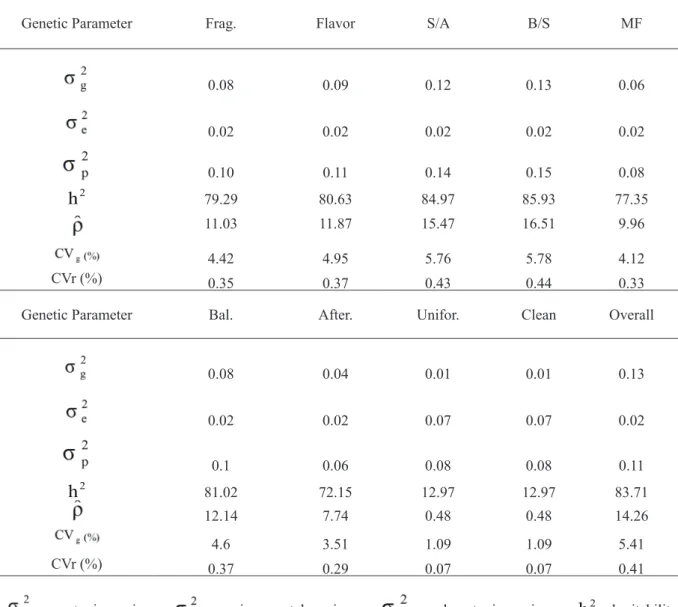
Beverage quality is defined by the genotype and by the environment because they are factors that determine the formation of the organoleptic properties of the beverage (SCHOLZ et al, 2011). The magnitudes of genotypic and environmental variances indicate that the genetic component was more important than the environmental component in the expression of coffee quality attributes, except for Uniform Cup and a Clean Cup; which did not exhibit genetic variability in the evaluated population (Table 2). According to Falconer and Mackay (1996) heritability estimates higher than 0.80 indicates genetic progress with plant selection.
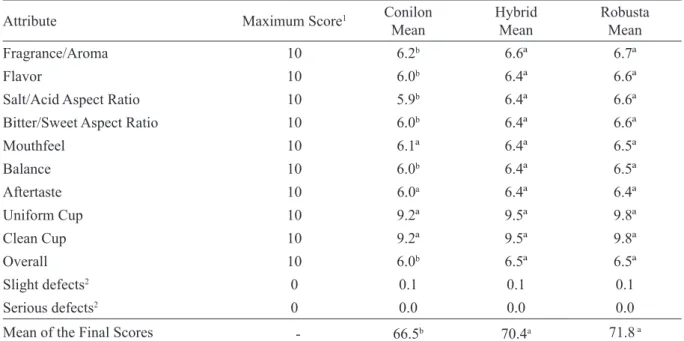
The Conilon and Robusta botanical varieties and the intervarietal hybrids exhibited different final beverage quality according to the Tukey test at 5% probability (Table 3). The scores showed differences between the type of beverage produced by the Conilon botanical variety compared to the type of beverage produced by the Robusta botanical variety and by the hybrid; the last two were placed in the same group due to their similarity. According to Verdin Filho et al. (2016) and Silva et al. (2009), the difference observed between Conilon and Robusta is the result of the chemical composition of the coffee beans, which was shown in the differentiation of the attributes.
Uniform Cup, Clean Cup, Aftertaste, and Mouthfeel are attributes of quality that did not exhibit significant differences between the botanical varieties (Table 3). According to Aguiar et al. (2005), the amount of chlorogenic acid ranges from 5.70% to 5.99% in the botanical varieties of the C. canephora species, and no significant difference was observed by the Tukey test at 5% probability. The concentration of chlorogenic acid in the coffee beans maintains the chemical constitution of the coffee bean after roasting, and affects the Uniform Cup of the organoleptic attributes (FAGAN et al., 2011). Aftertaste and Mouthfeel are attributes associated with the taste perceived by the taste buds, and are similar among the C. canephora botanical varieties. According to Verdin Filho et al. (2016), a high quality coffee should have a pleasant finish, with a residual effect of good duration adequate for the final taste in the mouth.
The attribute of Balance and the Overall attributes of the Conilon botanical variety differed from those of the Robusta botanical variety and from the intervarietal hybrids. The scores of these attributes are associated with other evaluations because Balance is interaction between the attributes, just as evaluation of the Overall attributes is, which is evaluated in a holistic manner in the sample according to the perception of the cuppers. According to Verdin Filho et al., (2016), Balance is responsible for determining the pleasant flavor sensation during consumption and after cupping, and this is an important characteristic for both specialty coffees and for preparation of blends.
It was also observed that the scores of the Fragrance/Aroma and Flavor attributes of the Conilon botanical variety were less than those of the Robusta botanical variety and the hybrid (Table 3). The fragrance defined as the smell of coffee when still dry and the aroma when the coffee is diluted in hot water is directly reflected in final beverage quality (UGANDA COFFEE DEVELOPMENT AUTHORITY - UCDA, 2010). Some chemical characteristics, such as lipid content of the coffee beans, have a beneficial
TABLE 2 - Estimates of genetic parameters estimated for the attributes evaluated according to the Robusta Cupping Protocols: Fragrance/Aroma (Frag), Flavor, Salt/Acid Aspect Ratio(S/A), Bitter/Sweet Aspect Ratio(B/S), Mouthfeel (MF), Balance (Bal.), Aftertaste (After.), Uniform Cup (Unifor.), Clean Cup (Clean), and Overall.
Genetic Parameter Frag. Flavor S/A B/S MF
0.08 0.09 0.12 0.13 0.06 0.02 0.02 0.02 0.02 0.02 0.10 0.11 0.14 0.15 0.08 2
h
79.29 80.63 84.97 85.93 77.35 11.03 11.87 15.47 16.51 9.96 4.42 4.95 5.76 5.78 4.12 CVr (%) 0.35 0.37 0.43 0.44 0.33Genetic Parameter Bal. After. Unifor. Clean Overall
0.08 0.04 0.01 0.01 0.13 0.02 0.02 0.07 0.07 0.02 0.1 0.06 0.08 0.08 0.11 2
h
81.02 72.15 12.97 12.97 83.71 12.14 7.74 0.48 0.48 14.26 4.6 3.51 1.09 1.09 5.41 CVr (%) 0.37 0.29 0.07 0.07 0.41:genotypic variance, : environmental variance, : phenotypic variance,
h
2: heritability for selection between botanical varieties, : intraclass correlation, : coefficient of genetic variation,effect on aroma and on flavor because, during roasting, they concentrate on the external areas, protecting the bean from possible losses of the component during this process (MARTINEZ et al., 2014). Aguiar et al. (2005) observed a significant difference between the amount of lipids in the Robusta botanical variety (10.91 g / 100 g) and in the Conilon botanical variety (7.33 g / 100 g).
Salt/Acid Aspect Ratio also differentiated Robusta and the intervarietal hybrids from the Conilon botanical variety (Table 3).
TABLE 3 - Scores given for each one of the attributes from classification of beverage quality for clones of the Conilon botanical variety (68), intervarietal hybrids (18), and Robusta botanical variety (26).
Attribute Maximum Score1 Conilon
Mean Hybrid Mean Robusta Mean
Fragrance/Aroma 10 6.2b 6.6ª 6.7ª
Flavor 10 6.0b 6.4ª 6.6ª
Salt/Acid Aspect Ratio 10 5.9b 6.4ª 6.6ª
Bitter/Sweet Aspect Ratio 10 6.0b 6.4ª 6.6ª
Mouthfeel 10 6.1ª 6.4ª 6.5ª Balance 10 6.0b 6.4ª 6.5ª Aftertaste 10 6.0a 6.4ª 6.4ª Uniform Cup 10 9.2ª 9.5ª 9.8ª Clean Cup 10 9.2ª 9.5ª 9.8ª Overall 10 6.0b 6.5ª 6.5ª Slight defects2 0 0.1 0.1 0.1 Serious defects2 0 0.0 0.0 0.0
Mean of the Final Scores - 66.5b 70.4a 71.8 a
1Maximum score that can be attributed in evaluation of the beverage characteristics according to the Robusta
Cupping Protocols. 2The defect score is subtracted from the sum of the individual scores given for each one of the
primary attributes, obtaining the final score. a,b Means followed by the same letter do not differ according to the
Tukey test at 5% probability.
This attribute is associated with the pleasant flavor that is possible to distinguish in the acidity and sweetness qualities of the beverage (SUNARHARUM; WILLIAMS; SMYTH et al., 2014). According to Moura et al. (2007) and Nascimento et al. (2008), high acidity of the C
.canephora beverage is due to the large quantity
of soluble solids, which are also responsible for the dark color and body of the beverage. Aguiar et al. (2005) observed a significant difference between the amount of soluble solids of Conilon and Robusta; however, Veneziano (1993) found similar values for these botanical varieties.
A total of 78% of the samples of the Conilon botanical variety were classified as neutral beverages (Table 4). The final score is estimated summing the individual scores of each beverage quality attributes. This score is used to classify the beverage quality in a range of 0 to 100 points, in which, scores below 50 points characterize commercial beverage, from 50-70 points usual good beverage, from 70-80 points premium classification and above 80 fine quality beverages. This result is in agreement with the score for its attributes because the Conilon attributes maintained similar scores, which
expressed a beverage with neutral flavor of good quality (Table 3). Using protocol adapted from
C. arabica, Veneziano (1993) characterized the
beverage from genotypes of the Conilon botanical variety as neutral (86%) and light bodied (14%). The neutrality of coffees is desirable for the blends and soluble coffee industry (RIBEIRO et al., 2014). However, specialty coffees or differentiated coffees are those that have superior quality (BRESSANELLO et al.,2017) or those that have some kind of certificate of sustainable practices (NAVARINI; RIVETTI, 2010), serving different segments of the market.
The hybrid provides a beverage with predominantly neutral characteristics, though with a significant percentage of fruit-like, fine, and mild coffees, with characteristics of the two botanical varieties, Conilon and Robusta. Its quality classification was predominantly premium, showing potential for specialty coffees with greater sweetness and mildness.
Beverages originating from the Robusta botanical variety exhibited a greater incidence of fruit-like, exotic, fine, and mild nuances, for 50% of all samples; its predominant classification was of the premium type (Table 4).
Characterization and selection of specialty coffees with the fruit-like, exotic, mild, and fine nuances is important for development of new varieties.
Prior to the Robusta Cupping Protocols for classification of fine C. canephora varieties, beverage quality classification was required only for the C. arabica species because marketing of the C. canephora species was only a classification of ‘kind’ (grain defects and impurities) and sieve size (VERDIN FILHO et al., 2016); there was thus no appreciation of the beverage quality of C. canephora. In classification according to Normative Instruction no. 8 of June 11, 2003 (BRASIL, 2003), coffees originating from C.
canephora with neutral flavor are adequate for
production of commodity coffees; nevertheless, the Robusta botanical variety shows potential for production of specialty coffees.
The divergent beverage attributes among Conilon, Robusta botanical varieties and their intervarietal hybrids subsidy the characterization of new coffee organoleptic profiles and selection of plants with special beverage characteristics.
4 CONCLUSION
In expression of the attributes of the beverage from the Conilon and Robusta botanical varieties and from the intervarietal hybrids, the genetic parameters indicated that the genetic component is predominant in relation to the environmental for all the characteristics, except for the Uniform Cup and Clean Cup attributes of the beverage. The attributes Fragrance/Aroma, Flavor, Salt/Acid Aspect Ratio, and Bitter/Sweet Aspect Ratio are different between the Conilon and Robusta botanical varieties and define the
TABLE 4 - Percentage of nuances in the samples and classification according to ROBUSTA CUPPING PROTOCOLS in five levels: fair: commercial; fair: usual good quality (fair-UGQ); average –usual good quality (average-UGQ); premium; and fine, in evaluation of 130 clones of the botanical varieties Conilon and Robusta, and intervarietal hybrids.
Botanical Var. Neutral Fruit-like Exotic Fine Mild
Conilon 78% 15% 4% 1% 2%
Hybrids 67% 11% 0% 21% 1%
Robusta 50% 15% 12% 22% 1%
Botanical Var. Commercial Fair-UGQ Average- UGQ Premium Fine
Conilon 2% 13% 46% 38% 1%
Hybrids 0% 6% 11% 83% 0%
Robusta 4% 0% 30% 62% 4%
nuances of the beverages. The intervarietal hybrids exhibit attributes similar to the Robusta botanical variety. In terms of coffee quality, the Conilon botanical variety exhibited a beverage with neutral nuances, and the Robusta botanical variety and the intervarietal hybrids exhibited a beverage with neutral, fruit-like, exotic, and mild nuances. All the samples evaluated were considered adequate for consumption; however, Robusta and the intervarietal hybrids exhibited higher proportions of classification as premium coffee.
5 ACKNOWLEDGEMENTS
The authors thank to the Conselho Nacional de Desenvolvimento Científico e Tecnológico (CNPq) for the scholar ship grant. We also gratefully acknowledge the Consórcio Pesquisa Café for financial support.
6 REFERENCES
AGUIAR, A. D. E. et al. Diversidade química de cafeeiros na espécie Coffea canephora. Bragantia, Campinas,v. 64, n. 4, p. 577-582, jan. 2005.
ALVES, H. M. R.et al. Características ambientais e qualidade da bebida dos cafés do estado de Minas Gerais. Informe Agropecuário, Belo Horizonte,v. 32, n. 261, p. 18-29, mar/abr. 2011.
ALVES, E. A. et al. Terreiro de secador com cobertura móvel para secagem do café Barcaça SECA CAFÉ. Embrapa Rondônia - Comunicado Técnico392 (INFOTECA-E), p.1-4, 2014.
BRASIL, E. C. Novo protocolo de degustação de robustas é testado: Cafés capixabas obtiveram
FALCONER, D.S.; MACKAY, T.F.C.Introduction to quantitative genetics. 4th ed.Longman Group Limited, Edinburgh, 1996. 463p.
FERRÃO, M. A. G.et al.Genetic divergence in Conilon
coffee revealed by RAPD markers. Crop Breeding and Applied Biotechnology, Londrina, v. 9, n. 1, p. 67-74, jan, 2009.
FERRÃO, R. G. et al. Genetic parameters in Conilon
coffee. Pesquisa Agropecuária Brasileira, Brasília,v.
43, n. 1, p. 61-69, Jan. 2008.
FERREIRA, A. D. et al. Análise sensorial de diferentes genótipos de cafeeiros Bourbon. Interciencia, Caracas, v. 37, n. 5, p. 390-394, May. 2012.
FONSECA, A. F. A.; FERRÃO, M. A. G.; FERRÃO, R. G. Vantagens e riscos no uso de mudas clonais de Coffea canephora. Visão Agrícola, Piracicaba, v. 12, p. 17 - 18, jan/jul. 2013.
MARCOLAN, A. L. et al. Cultivo dos cafeeiros conilon e Robusta para Rondônia. Porto Velho: EMBRAPA Rondônia, 2009. 67 p. (EMBRAPA Rondônia: Sistema de Produção, 33).
MARCOLAN, A. L.; ESPINDULA, M. C. Café na Amazônia. 1.ed. Brasília: Embrapa, 2015. 474 p. MARTINEZ, H. E. P. et al. Coffee mineral nutrition and beverage quality. Revista Ceres, Viçosa, v. 61, n. suppl, p. 838-848, Nov/Dec. 2014.
MENDONÇA, L. V. L.; PEREIRA, R. G. F. A.; MENDES, A. N. G. Parâmetros bromatológicos de grãos crus e torrados de cultivares de café (Coffea
arabica L.). Ciência e Tecnologia de Alimentos,
Campinas, v. 25, n. 2, p. 239-243, abr/jun. 2005. MONTAGNON, C.; LEROY, T.; YAPO, A. Diversité génotypique et phénotypique de quelques groupes de caféiers (Coffea canephora Pierre) en collection. Conséquences sur leur utilisation en sélection. Café cacao thé, Paris, v. 36, n. 3, p. 187-198, 1992.
MOURA, S. D. et al. Avaliações físicas, químicas e sensoriais de blends de café arábica com café canephora (robusta). Brazilian Journal Food Technology, Campinas,v. 10, n. 4, p. 271-277, Oct/Dec. 2007. NASCIMENTO, E. A. et al. Constituintes voláteis e odorantes potentes do café conilon em diferentes graus de torração. Ciência & Engenharia, Uberlândia, v. 16, n. 1-2, p. 23-30, jan. 2008.
resultados animadores. Revista Conilon Brasil, Vitória,v. 8, n.2, p. 10-11, fev. 2011.
BRASIL. Ministério da Agricultura e Reforma Agrária. Secretaria Nacional de Irrigação. Normais climatológicas: 1961-1990. Brasília: Departamento Nacional de Meteorologia, 1992. 84p.
BRASIL. Ministério da Agricultura, Pecuária e Abastecimento. Instrução Normativa n. 8, de 11 de junho de 2003. Aprova o regulamento técnico da identidade e de qualidade para a classificação de café beneficiado grão cru. Brasília, 2003. Disponível em: <http://www.codapar.pr.gov.br>.Acesso em:16 jun. 2016. Brazil Specialty Coffee Association – BSCA. O que são cafés especiais. Varginha, Brasil, maio de 2017. Disponível em:<http://bsca.com.br/cafes-especiais. php>. Acesso em:28 maio. 2017.
BRESSANELLO, D.et al.Coffee aroma: Chemometric comparison of the chemical information provided by three different samplings combined with GC–MS to describe the sensory properties in cup. Food chemistry, Oxford. v. 214, p. 218-226, july. 2017.
COMPANHIA NACIONAL DE ABASTECIMENTO-CONAB. Acompanhamento de safra brasileira de Café, v. 4 – Safra 2017, n.1 - Primeiro Levantamento, Brasília, p. 1-98, jan.2017. Disponível em:<http:// www.conab.gov.br>. Acessoem: 17 fev. 2017.
CRUZ, C. D.; CARNEIRO, P. C. S.; REGAZZI, A. J. Modelos biométricos aplicados ao melhoramento genético. 3. ed. Viçosa: Universidade Federal de Viçosa, 2014. 668 p.
DAVIS, A. P. et al. Growing coffee: Psilanthus (Rubiaceae) subsumed on the basis of molecular and morphological data; implications for the size, morphology, distribution and evolutionary history of
Coffea. Botanical Journal of the Linnean Society,
Londres,v. 167, n. 4, p. 357-377, Oct. 2011.
ESQUIVEL,A, P.; JIMÉNEZ B. V. M. Functional properties of coffee and coffee by-products. Food Research International, Burlington, v. 46, n. 2, p.488–495, May. 2012.
FAGAN, E. B.; et al. Efeito do tempo de formação do grão de café (Coffea sp) na qualidade da bebida. Bioscience Journal,Uberlândia, v. 27, n. 5, p. 729-738, Sept/Oct. 2011.
NAVARINI, L.; RIVETTI, D. Water quality for Espresso coffee. Food chemistry, Oxford. v. 122, n. 2, p. 424-428, Sept. 2010.
RAMALHO, A. R. et al. Progresso genético da produtividade de café beneficiado com a seleção de clones de cafeeiro ‘Conilon’. Revista Ciência Agronômica, Fortaleza, v. 47, n. 3, p. 516-523, jul/set. 2016.
RIBEIRO, B. B. et al. Avaliação química e sensorial de blends de Coffea canephora Pierre e Coffea arabica L. Coffee Science, Lavras, v. 9, n. 2, p. 178-186, abr/ jun. 2014.
ROCHA, R. B. et al. Adaptabilidade e estabilidade da produção de café beneficiado em Coffea canephora. Ciência Rural, Santa Maria, v.45, n.9, p.1531-1537, set. 2015.
ROCHA, R. B. et al. Caracterização e uso da variabilidade genética de banco ativo de germoplasma de Coffea canephora Pierre ex Froehner. Coffee Science, Lavras, v. 8, n. 4, p. 478-485 out/dez. 2013. ROHDE, L. A.; CASTAGNA, A. C. Os diferentes clusters de consumidores do café brasileiro: estudo sobre as atitudes, crenças e marca Brasil. Estudo & Debate, Lajeado, v. 23, n. 2, p. 311-329, dez. 2016. SALVA, T. J. G.; LIMA, V. A composição química do café e as características da bebida e do grão. O Agronômico, Campinas,v. 59, n. 1, p. 57-59, nov. 2007. SANTOS, P.L. Levantamento semi-detalhado dos solos do campo experimental de Ouro Preto D´Oeste. Embrapa Amazônia Oriental Documentos, Belém, n.8, p.1-38, 1999.
SCHLINDWEIN, J. A. et al. Solos de Rondônia: usos e perspectivas. Revista Brasileira de Ciências da Amazônia, v. 1, n. 1, p. 213-231, jan. 2013.
SCHOLZ, M. B. S. et al. Características físico-químicas de grãos verdes e torrados de cultivares de café (Coffea
arabica L.) do IAPAR.Coffee Science, Lavras, v. 6, n. 3, p. 245-255, set/dez. 2011.
SILVA, M. C. et al. Caracterização química e sensorial de cafés da chapada de minas, visando determinar a qualidade final do café de alguns municípios produtores. Ciência e Agrotecnologia, Lavras, v. 33, p. 1782-1787, Edição especial.2009.
SOUZA, F. F. et al. Aspectos gerais da biologia e da diversidade genética de Coffea canephora. In: MARCOLAN, A.L; ESPINDULA, M.C.(Org.) Café na Amazônia. Brasília, DF: Embrapa, 2015. p. 85-95. SUNARHARUM, W. B.; WILLIAMS, D. J.; SMYTH, H. E. Complexity of coffee Flavor: A compositional and sensory perspective. Food Research International, Saskatchewan,v. 62, n 1, p. 315-325, Aug. 2014. TONETTI, D.; PAVAN, D.; DALBOSCO, I. Análise da viabilidade mercadológica da exportação do café essenza produzido pela empresa brasitália para os estados unidos. Unoesc & Ciência-ACSA, Joaçaba, v. 6, n. 2, p. 163-170, jul/dez. 2015.
UCDA- Uganda Coffee Development Authority. Robusta cupping protocols. PSCB 123/10. Londres, Inglaterra, Junho de 2010. Disponível em: <http://dev. ico.org/documents/pscb-123-p-robusta.pdf>. Acesso em: 20 maio. 2017.
VENCOVSKY, R.; BARRIGA, P. Componentes da variação fenotípica: análise em um ambiente. In: ___________. Genética biométtrica no fitomelhoramento. Ribeirão Preto: Sociedade Brasileira de Genética, 1992. cap.3, p.83-232.
VENEZIANO, W. Avaliação de progênies de cafeeiros (Coffea canephora Pierre ex. Froehner) em Rondônia. 1993. 78 p. Tese (Doutorado em Fitotecnia)-Escola Superior de Agricultura’Luiz de Queiroz’–USP, Piracicaba,1993.
VERDIN FILHO. et al. The beverage quality of Conilon coffee that is kept in the field after harvesting: Quantifying daily losses. African Journal of Agricultural Research, Lagos,v. 11, n. 33, p. 3134-3140, Aug. 2016.