ISSN 1518-3483 Licenciado sob uma Licença Creative Commons
[T]
Different perspectives on teaching: of
what teacher are we talking about?
Diferentes olhares sobre a docência: de qual professor
estamos falando?
Maiane Liana Hatschbach Ourique[a], João Luis Pereira Ourique[b] [a] PhD, professor at Universidade Federal do Pampa, Jaguarão, RS - Brazil, e-mail: [email protected] [b] PhD, professor at Universidade Federal de Pelotas, Pelotas, RS - Brazil, e-mail: [email protected]
Abstract
This work aims to reflect some images of teacher propagated in current discourses of education, focusing on the expectations and demands which corroborate to arrange different teaching figures. On the one hand, public policies use to their advantage a social imaginary of the profession to associate quality education to professional competence in teaching. Secondly, the different records of the Brazilian educational daily show the material misery and educational of the teacher work. From the tension between these two points, we ask about conceptions of rationality and formation that support the normative discourse of teaching. Still, can these models images-teacher effectively deal with the problems of the contemporary school? In light of the formative dimensions of Critical
Theory, this study focuses on the writings of Theodor Adorno, performing a hermeneutic reading of space configured between the proposed and developed in the field of teaching. Keywords: Formation. Teaching. Policies. Images. Teacher.
Resumo
Este trabalho visa repercutir algumas imagens de professor propagadas nos discursos atu-ais da educação, enfocando as expectativas e demandas que corroboram para compor diferentes figuras docentes. Por um lado, as políticas públicas valem-se de um imaginá-rio social da profissão para associar a qualidade na educação à competência profissional docente. Por outro, os diferentes registros do cotidiano educacional brasileiro mostram a miserabilidade material e pedagógica do trabalho do professor. A partir do tensionamento entre esses dois pontos, indaga-se sobre quais concepções de racionalidade e formação respaldam os discursos normativos da docência. Ainda, essas imagens-modelo de profes-sor conseguem enfrentar de forma efetiva as problemáticas da escola contemporânea? À luz das dimensões formativas da Teoria Crítica, este estudo dá especial atenção aos escri-tos de Theodor Adorno, realizando uma leitura hermenêutica do espaço configurado entre o proposto e o desenvolvido no campo da docência.
Palavras-chave: Formação. Docência. Políticas. Imagens. Professor.
First considerations
This paper aims to discuss some teacher’s images that are disseminated on the actual discourses about the profession, focusing especially on the expectations and demands that corroborate the composition of different teacher’s images. The intention is to contribute in opening a self-enlightening dialogue about possible relationships between
theory and practice, considering that condescending normativeness and materialness, projection and action in the aesthetic-expressive instance is part of the wider process of formation as Bildung, without hypostatizing neither of those areas. On the threshold among thinking and reality, the composition of images allows the reception of the polysemy of discourses, producing, reproducing, and transforming the understanding. In this way, the images are not limited to iconographic constructions, but they also, according to Justino Magalhães (2003, p. 396), may refer to discursive, narrative or images representations, such as technological and sign, as historic constructions that have a materiality, a relationship of communication, an appropriation. Understanding that the semiotic and metaphoric shapes of images can enlarge our perception of teaching paths, we invest on a critical and hermeneutic comprehension in order to perceive which expectations, in the teaching education area, are related to immediacy and utilitarianism. These expectations help to make a frame of déformation professionelle that, in the images context, “become the own profession’s definition” (ADORNO, 2003, p. 109).
In the end of the twentieth century, meaningful changes in the Brazilian educational policies point to new perspectives of teaching practice, especially about conceptions and actions that start to subsidize the area of teaching education. Until that moment, we understand that the curricular proposals of teaching education graduation courses were centered on the content or on what should be taught during professional practice. From the promulgation of the Law of Directives and Bases of National Education (LDB – Law 9.394/1996), and from 2000 on, with the discussion about the Directives for Initial Education of Basic Teaching Teachers in Higher Education, there is a new articulating perspective of teacher’s education, which is the professional practice, especially the practice of teachers inside the schools. The directives presented in the Resolution CNE/CP Number 1, from February 18, 2002, attest a very explicit theoretical line, which centers on the learning of necessary competences for professional intervention in the future acting reality. The legitimacy for the proposed changes is searched on the critics and
on the “form of ridicule of past policies that are, in this way, described as unthinkable” (BALL, 1998, p. 130). This is for Ball the key aspect that led the making of these policies.
In a social setting where demands for narrower relationship between science and life, theory and practice are each time bigger, the concept that teacher’s education courses did not help the course’s identity constitution, and that teachers had little knowledge about curricular documents became stronger. Thus, the National Curricular Directives for Basic Teaching Teachers’ Education (DCNFPEB) in the higher education have two directions: to guide the elaboration of courses’ curricular proposals and to define some organizational principles (especially the relationship theory-practice, and the constitution of competences for professional acting in basic education). This radical change in teachers’ education, focusing on the practice, induces the submission, by the teaching courses proposals, of the theoretical dimension to the service of the teacher’s interventionist practice.
With this discussion imposed in the teachers’ education, confused or disparate images are made about what comprehend the teacher’s profession, making us question: which rationality and education concepts endorse teaching normative discourses? Besides, is the construction of model images of a teacher able to face effectively the problems of contemporary school? We do know that political and economic motivations were decisive for a change of concepts in the Brazilian teaching legislation, but we want to attribute a philosophical perspective to this discussion, calling attention to how a narrow rationality view may distort the understanding of the education ideia, and the normative grammar of possibilities inscribed on an educative reality. For this, the images’ texture of the contemporary education context is based on the ideia that expressive-mimetic language’s expressiveness allows a hermeneutic reconstruction of socialized discourses about the teacher’s image. Referring to the images’ potentiality, Magalhães (2003, p. 394) says: “behind the fantastic, the imagined, the idealized, the dreamed, and the utopistic, there is a misunderstood universality in the small world of
the likely and said educational relationship”. In this discussion, the image construction of the competent teacher presented on Brazilian public policies gives its place each time more to the image of the miserable teacher, whose everyday is shown on the documentary Pro dia nascer feliz [For the happy day rising], directed by João Jardim (2006).
Based on a hermeneutic comprehension about the images of “competent teacher” and “miserable teacher”, it is possible to refresh Adorno’s distrust about the perspective’s insufficiency that promised the transition to the practice: “the praxis, delayed for indefinite time, it is not the instance of appeal against the own satisfied speculation anymore” (ADORNO, 2009, p. 11). This happens because the changing praxis does not prescind from critical thought about the limits and possibilities of man’s action in a situated context; on the contrary, it is in fact this rational evaluation that keeps the ties between theory and practice, thought and action, subjectivity and objectivity. In this way, we make in this paper some notes on the inscribed possibilities in the change for practice, as well as on the differences of an approach that is restricted to interventionist action in the reality to Theodor Adorno’s materialist concept, which does not give up theoretical thinking as a way of disseminating productive forces in this case.
The idealization of teaching in public policies: the “competent teacher” Since the end of the twentieth century, we have been seeing the enthusiasm of many theorists and teachers, in general, with the idea of learning through competences. The possibility of direct access to knowledge – through cognitive resources (knowledge, capacities, information, etc.) — to solve efficiently and relevantly many everyday situations has enlarged the expectations about the instrumental rationality’s range in the educational process. Among the exponents of this theoretical position, there are Perrenoud (1999; 2000a) and César Coll
(1994), who was the Ministry of Education and Culture consultant between 1995 and 1996, helping to elaborate the National Curricular Parameters
(PCNs). These orientations became reference for the regulations that followed PCNs, such as the continuous and initial education policies for teachers, and the establishment of an evaluative index of Basic Education.
Based on this perspective, both government documents and advertising campaigns have been developed aiming the idea of teachers as professionals who can efficiently promote student’s learning, composing, in this way, the image of the “competent teacher”. Besides connecting narrowly and directly what is learned by the student and what is taught by the teacher – considering the exclusive cause of every kind of learning –, DCNFPEB (2002) present the initial education as a moment for developing this ability through devices for solving problems faced in the schools – teaching strategies for training and interviewing –, which are the future workplaces of teachers. The competent teacher inspires him/herself in the business and technical discourses for assuming a quantifiable and visible character in his/her functions, which is to serve the productive society values, teaching valuable contents for introducing the student in this context, instead of triggering elements of a critical understanding about the social configuration. Duarte (2001, p.38) made a relevant evaluation about the adaptive character of this education perspective:
It is about preparing individuals forming necessary competences to unemployed condition, deficient person, single mother etc. It would be up to educators know the social reality in order not to criticize this reality and build an education committed to fights for a radical social change, but to know better which competences social reality is asking for individuals. When educators and psychologists present the “lear-ning to learn” as a summary of an education destined to form creative people, it is important to pay attention on a fundamental detail: this creativity should not be taken as a search for radical changes in social reality, a search of radical overcoming in the capitalist society, but it should be understood as the capacity of finding new ways of acting which allow a better adaptation to the capitalist society dictates.
In order to evaluate the learning quality of Basic Education students, it was created by the Brazilian government in 2007 the Index of Basic Education
Development (IDEB), which relates the results of Brazil Test and the rates of students’ approval. Despite of the fact that this index do not directly refer to teaching education in university level, it is possible to see continuity between practice related to this area and practice related to Basic Education, since this one is constituted, in large scale, in the space of teacher’s professional action. Besides, the study conducted by Teodora Ens, Maria Lourdes Gisi and Ana Maria Eyng
(2011) shows the strong influence that educational policies have in the construction of the teaching profession’s image. Certainly, besides their own social, political, and cultural representations, the initial and continuous education courses, the career plan, the earnings, and the work, for example, are elements that contribute to constitute a teacher’s image.
From that comprehension, we can articulate some elements in order to compose a teacher’s image, whose competent action would correspond to the qualifications of established results in the biennial aims of IDEB. In the Figures 1 and 2, are showed moments of the publicity campaign in which the character has characteristics of teacher figure presents in the social imaginary.
Figura 1 - Scene of publicity campaign made by Federal Government – IDEB 2008-2009
Figura 2 - Character’s close of IDEB publicity campaign
Source: IDEB, 2008.
In this advertising campaign, a young lady teacher explains the objectives of IDEB, makes comparisons between the quality indexes in Brazilian education and in developed countries, and urges that everyone “improve Brazilians’ education”. When we debate1 with hundreds of
teachers about this advertising campaign, one of the questions that most appears refers to the idealization of its attached teacher’s image. The young appearance of the teacher, with her hair and clothes very well presented, may guide us to four or five decades ago, when being a teacher meant to have social status, and teachers’ words formed public opinion. Nowadays, a Brazilian teacher works two or three daily periods to earn a minimum wage for his/her expenses, making it impossible, sometimes, to get updated or to take care of his/her appearance, such as wearing social clothes or shoes during a workday with commutes from one school
1 The discussions occurred in the form of educational workshops during 2009 with several groups of teachers of basic education in the central region of Rio Grande do Sul - Brazil.
to another by foot or public transit. Thus, this idealized image has a sense of nostalgia, shown by the character’s appearance, and the ideia of learning by competences has elements from the traditional pedagogical theories, which understood that it was possible for the teacher to transfer to students in the same way that we can pass water from a full recipient to an empty one. The assumption of this perspective is made by Perrenoud (2000b, p. 20): “the approach of competences is a way of getting serious, in
other words, an old problem, which is transferring knowledge”.
However, in the “critical” and “post-critical” pedagogical theories, social, cultural and experience aspects are part of the wide range of elements that interfere on the learning, in a way that the use of words to refer to the learning process, such as construction, exchange, reflection, critical thinking, etc., is not only a semantic change. So, the learning by competences cognitive-psychologist perspective assumes just one side of the criticality and comprehension processes. From this point, it is possible to establish such analogies: in the same way that knowing how to guide oneself in an unknown city mobilizes capacities (reading a map, getting located, asking for information, etc.), and knowledge (knowing about scale, topography, geographical references, etc.), a teacher knows how to guide him/herself in a classroom in front of students with different lives and levels of knowledge from an theme. For that, the teacher mobilizes capacities (environmental, didactic, and discursive devices, etc.), and knowledge (about learning theories, human development, etc.). In this case, it seems that the “competent teacher” education only refers to the activation/deactivation of devices, in other words, the wide culture knowledge, the social and political organization, and the subjective interests are built and mobilized as pragmatic and utilitarian everyday actions of any person.
Maybe in situations that teachers have a wider cultural education, which derives from an experiential framework built outside teacher’s education programs – since legal orientations do not consider profoundly those questions –, and in the situations in which students
from basic education also have this range of cultural experiences, an educative process guided through the learning by competences would not cause deficiencies. For the pedagogical situations in which teachers and students engage in a limited reading of mundane manifestations, a cognitive-instrumental approach in the education process has constituted a legion of “miserable teachers”, who are presented in the documentary Pro dia nascer feliz [For the happy day rising], directed by João Jardim (2006).
Teaching realization: the “miserable teacher”
The deteriorated situation of public schools is only one of the factors that contribute to the actual impoverishment of the pedagogical relationship established between students and teachers. António Nóvoa (1999) presents some aspects about social rhetoric in which teachers are responsible for the “future society”, having to build ways for facing the “future challenges”. Trying to show those narratives’ traps, Nóvoa presents the following counterpoints:
- From the excess of political rhetoric and mass-media to the po-verty of educational politics;
- From the excess of international specialists languages to the po-verty of teacher’s education programs;
- From the excess of educational-scientific discourse to the po-verty of pedagogical practices;
- From the excess of teachers’ “voices” to the poverty of teaching associative practices;
The documentary Pro dia nascer feliz [For the happy day rising], directed by João Jardim and released in 2006, shows a little of the reality of schools from Brazilian northeast and southeast big urban centers. Presenting teachers and students testimonies, as well as interactions’
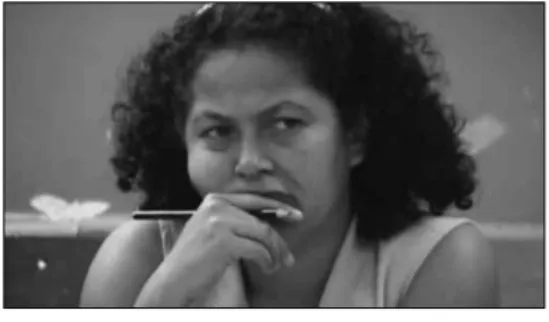
records from different school places (classrooms, class council, informal conversations in the backyard and the halls, for example), the documentary brings elements for the construction of a dense panel about thoughts and actions that are actually valid in the Brazilian education. In the portrayed situations, it calls our attention the teachers’ big difficulty in comprehending the elements in which are anchored on the experienced problems, as well as in dealing with different demands in the school. Below, there is a documentary’s scene (Figures 3 and 4).
Figure 3 - Scene from the documentary Pro dia nascer feliz [For the happy day rising]
Source: PRO DIA NASCER FELIZ, 2006.
Figure 4 - Picture of the character in an eva-luating moment of her teaching practice
In the situation presented on Figure 1, teacher Helenita (wearing a blue T-shirt) is in the middle of a History class, and she is questioned by a student about a task she had asked. In the highest point of the discussion, the teacher asks the following: “What did you research? When did Getúlio Vargas first come to power?”. This question was answered by the teacher herself: “After the 1929 Crisis. Mrs. Iraci [directing herself to an about 60-year-old student] do you remember the 1929 Crisis?”. The group, at this moment, caused a commotion, considering the teacher’s question a joke, because of the student’s age, showing that they understood that the student had faced the political and economical World 1929 Crisis. At this moment, the teacher raises her voice in order to recall the group’s attention, saying that they should decide whether they wanted to attend the class or to leave the room.
The “miserable teacher’s” image was constituted for us not only because of its aesthetics, but also because of the reasons and adopted postures. Different from the well presented clothes and hair, and the teacher’s good discursive articulation on Figures 1 and 2, teacher Helenita wears similar clothes to her students’ — T-shirts and jeans — , which are more accessible to the population in general. Also, her facial expressions do not carry the same serenity and confidence as the teacher portrayed in the IDEB’s advertising, but they reveal an attempt to defense and/or protection — partially hiding her face and looking sideways — over the need of self evaluation of her teaching practice. Maybe the uncertainty expression over the students learning that is built in the pedagogical process and/or the impotence expression over the diverse paths students take during their lives. By proposing a research, teacher Helenita effectives one of the curricular directives’ guiding principles; nevertheless, she sees her strategy threatened when some students protested that they did not know about the task and most of them did not answer the questions about the research theme.
The “welcome and diversity dealing” try — directive that should be intrinsic to the teaching practice, according to DCNFPEB (2002) — can be seen in the principle of discussion that the teacher wanted to provoke
with her questions about what the students had researched. However, from the initial ideia of giving voice to the students and establishing similarities and differences from this position, the discussion was deviated to the joke in comparisons between the students’ ages. In this case, the teacher’s posture to conduct the learning process should have been anticipating biased interpretations and/or outlining the escaping possibilities from the central debate, since the ideia of considering different realities and experiences is based on ethical and aesthetical questions, and not only on cognitive objectives. Even if the teacher had made other reading possible for this situation, she should have used stronger arguments for undoing the misunderstanding and turning it a learning situation.
Thus, there are many moments in which teacher Helenita demonstrates to know about the necessary competences that should be activated during the educational process. These competences range from considering diversity and involving everyone in the pedagogical situation to keeping the focus on the curricular content teaching. Taking this into account, why does it little contribute for the solidification of her students’ educational process? The difference between the aseptic setting where the competent teacher — Figure 1 — moves, and teacher Helenita’s impregnated and obscure school environment gives a clue to the huge difficulty in guiding human education, as well as in educational actions through the learning by competences principles. In the first situation, in a scenery composed by hard, symmetric and aligned objects (glass, metal, geometric objects, numbers), and the relationship among them is mostly going to be established in advance due to their characteristics; in the second one, in a pedagogical space, the interactions between the students directly interfere on the knowledge and meaning building, since “man is a social being”, as many Human Sciences theories confirm (from psychological, sociological, philosophical, anthropological approaches, among others). There are many moments in which teacher Helenita cannot justify her acts and arguments, using sometimes a disseminated teaching practice among teachers — giving grades for students to be approved because of his/
her behavior has improved in the school, proposing a discussion in the classroom and do not assuming the role of mediator, etc. — , and in other times using authoritarian arguments — such as rising her voice tone, abandoning a student who does not show interest in the class and asking him/her to leave the classroom, etc. This kaleidoscopic configuration presented by teacher Helenita in her teaching action is, as the documentary showed, a frequent practice in the country as a whole, and it can be understood as the other side of the “competent teacher” idealization, or in other words, it demonstrates in a hermeneutic view the actual misery condition in teaching practice.
The relationship between the act of equipping reason — which permeates the learning by competences perspective — and the impoverishment of communicable experiences – perceived through the fragile arguments and comprehensions made by teacher Helenita — is also pointed out by Benjamin (1986, p. 115): “A new way of misery came up with this monstrous technique development, overlapping man”. The lately effervescence of different ways of explaining the world, such as the renewal of astrology or yoga, of scholasticism or spiritualism, according to Benjamin, seems directly proportional to that misery. In his observation, this happens because of that renewal is not authentic, but a copy of something that has already passed and is not connected to us anymore, once we cannot establish an educational experience with this production.
With the technique, the man can manipulate and control nature, creating a new environment for which he needs to adapt. This instrumental dimension impoverished human experiences because it allowed men to think about “getting free of all experience”, as explains Benjamin. Different from the middle-end relationship that the concept of experience acquired in many teaching education programs — in general, as well as in the schools —, the experience, for Benjamin, is connected to contact with the past and its new elaboration, in the sense of comprehending happenings’ history in a self-educative movement. From this, it is established the importance of reflecting about culture and
its artifacts, engaging on a critical reading about paths already taken and the possibilities of reordering what has been lived.
The misery in the learning by competences discourse is already characterized in its aseptic directives, centering the educational process in the knowledge cognitive area and taking cultural and interactive dimensions as training environments for insertion and future intervention. The planning of an education based on those principles impoverishes the pedagogical relationship, getting the teacher surprised due to everyday interactions in the classroom, and making him/her believe that they complicate — instead of improving — the learning process.
For another relationship between theory and practice in teaching education
In the teaching education area, this experience degradation is configured when the normative grammar of pedagogical process is abandoned, in which life, culture and education surround key relationships for human education. In the teaching courses curricula, these references are broadly approached on the Education Principles, and on the studies about pedagogical theories, both cores relegated to a second plan by DCNFPEB (2002). The reason for that was the simplest one, that is, “[we] only learn to do by doing”. Underlying this argument there is a restrict concept of practice, understood exclusively as an interventionist action in the educational everyday. It is possible to perceive that the practical dimension is not considered on the theoretical subjects mentioned above, but it is only approached on pedagogical and methodological courses’ cores. These cores, in general, emphasize performing dimensions of knowledge, presenting guides and proposals of intervention in any reality. It is configured, this way, the slit between pedagogical knowledge and theoretical studies that justify them. We understand that this new approximation is in fact the
condition of possibility for a substantial map composition of the not doctrinaire intervention in educational environments.
The unitelarism of reason on its instrumental perspective, as a monologue, allowed public policies to emphasize the adaptive aspect, either in relation to the quick diagnosis of the lack of teacher’s education, or to the role of education and school in human education. In this way, the teaching problem does not belong only to Pedagogy, appearing as a crisis of education’s (Bildung) own idea. Neither it is a safe alternative to the act of psychology or sociology of teacher’s education courses, juxtaposing historic or lived theory and practices, or centering the problem in the practice area:
The symptoms of cultural education collapse that appear everywhe-re, even in the stratum of refined people, do not end with the system insufficiencies and education methods, beneath criticism of sequent generations. Isolated pedagogical changes, although indispensable, do not add substantial contributions. They could even, in some occa-sions, reinforce the crisis because they show an innocent unconcern about the power that extra pedagogical reality over them. Also, over the impetus of what is happening, reflections and isolated investiga-tions about the social factors that positively or negatively interfere on cultural education, considerations about the present, and about many aspects of their relationships with society remain insufficient, because for them the own category of education is already defined. The same happens with partial moments, which are immanent in the system, and act in each case inside the social whole: they move in the space of sets while these should in fact be the first ones to be considered (ADORNO, 1996, p. 388-389).
The instrumental reason devices covered up the aspect of becoming that education carries, imposing a technical and interventionist feature that blinds to possible relationships with cultural area, in which knowledge acquires meaning. Maybe for the urgent needs of our society, many times untimely for educational institutions, the teachers’
rationality tends to configure itself on a precarious education board, guided especially through the dissemination of pedagogical redemptive narratives and the hypostatizing of the teacher’s doing. Both positions weaken the theoretical and practical dimension, covering up the common core that underlies teaching education.
According to Adorno, the practice, understood as an interventionist action, which aims solving everyday problems, empties itself from the possibility of transforming the reality in something better, rebuilding it to restrict itself to the established as its own measure. This arbitrary practice, when destroys the thinking possibilities and configures theory as forceless over felt needs, destroys its own potentialities since it restricts itself to the immediate adaptation processes. Nevertheless,
The analysis of the situation does not end itself in the adaptation to that. While it reflects about it, it emphasizes moments that can lead beyond constraints and the situation. This assumes incalculable rele-vance for the relationship between theory and praxis. By its differen-ce, as immediate action connected to the situation and, thus, by its self-naming, theory turns into practical and transforming productive force. It always gets something important, the thought produces a practical impulse, even if it is hidden of it (ADORNO, 1995, p. 210).
The theory, as it was subjugated in the relationship theory-practice, became not conceptual, mirroring itself only in dogmatized and politicized practices. This does not contribute to the practice qualification, which impotency is criticized on the theoretical area. Also the theory is defamed by practice through its generalizations and anachronisms. So, it is interest of the own practice that theory conquers again its autonomy as capacity inscribed on rationality, under the penalty of the reflexive posture languishes or the experience reifies in practice theorizations. The theoretical effort carries in fact the ideia of not-consenting with what is decided, entering, thus, in the movement of becoming that praxis configures:
Thinking is an acting, theory is a way of praxis; only ideology of thinking purity mystifies this point. Thinking has a dual character: it is immanently determined and it is obliged and tighter in itself, but at the same time it is a kind of irrefutably real behavior in the middle of reality (ADORNO, 1995, p. 204-205).
The philosopher alerts for the need of critically interposing over any movement in direction to transformation, keeping the atmosphere of distrust as immanent to dialectic thinking, since we are excessively susceptible to accepting the new and eliminating the old, understood as outdated, obsolete. For Adorno, there it is all danger of the thinking that curves irrationally to the practice primacy. The urgency for renovation takes off the thinking of its historical place, contributing not to transforming, but to keeping the structures. In this perspective, the aversion or estrangement caused by theory are legitimate, since it carries the commitment with historicity of ideias not in the meaning of pure conservation, but in the critical new elaboration of happenings aiming the enlargement of educational process.
Thus, Adorno (1996) tries to approach the education as a tension between the transcendence and the accommodation, occurring a regressive process when it is isolated in the spirit’s growing — as did Wilhelm Dilthey when he encouraged German middle classes with the concept of spiritual culture as an end in itself –, but also when it restricts to data, to the adaptation moment — as did the philosophy of Schiller, Kantians and late Goethe. By undoing this tension, a misshapen rationality is instituted because the freezing of fix categories, isolated, either from the spirit or from nature, from transcendence or accommodation, according to Adorno, promotes a regressive education.
Adorno’s alert that “knowledge does not have any of its objectives completely” (ADORNO, 2009, p.20) seems to us a valid perspective for a hermeneutic and critical reading of DCNFPEB, since it
still persists in many teacher’s education programs the ideia of choosing through isolated educative models, idealized under theory focus or practice perspective exclusively. This impulse by self explicative models of teaching is connected in large scale to the trying of restricting practical and theoretical expectations of education, endowing the proposals with an immediate feature in which the own education is averse.
Teaching as a cultural and political activity has a high level of critical fluidity and creation, thus the need of prescriptive aspects is inversely proportional to the presence of autonomy’s rational devices. In this sense, teachers’ competence is structures not only through a cognitive set of knowledge, but also through a social repertoire built in the multiplicity and estrangement with cultural and epistemological productions. It is only through this rationality socially situated that teacher’s pedagogical arguments assume the intended efficiency and achieve international aims of education quality, in a way of free traffic between organized knowledge and their wider comprehensive dimensions. Final considerations
This study shows, thus, a possible confluence between the conceptual moment and the expressive-imaginable moment, in the sense of comprehending the interpretation that material and cognitive dimension offer to built and assumed in praxis. In this way, the images of “competent teacher” and “miserable teacher” that we configure allow us to find out elements that have not been perceived yet, or that are slightly discussed. The reconstruction and hermeneutic reading of these teaching representations allow, in some way, the comprehension about which rationality the education expectations are designed, as well as the normative and profession demands. Approaching, through the expressive instance of language, those two images as sides of the same coin,
produced by the same psychological-cognitive perspective of knowledge, makes us reflect about the path this rationality can take the educative processes of teaching courses. It is not our intention that teachers may “only” manage the institutionalized pedagogical situation, but also that they may evaluate and propose ways to the education and teaching area.
From the idea of education — either as Paideia, Humanitas or
Bildung —, does not seem justifiable to us that, having teachers difficulties
to deal with curricular content, it is chosen to privilege professional practice instead of a substantial view of its cultural and political meaning. This path adopted in public policies for teacher’s education not only interfered in many initiatives of teaching programs — since DCNFPEB guided to a cognitive view of education process —, but also distanced even more the teaching course from the wider idea of education as an advisory educative process, legitimating the misunderstanding of “theory is one thing and practice is another thing” —, a statement frequently used among teachers to justify the common act of not establishing relationships between theory and practice.
Thus, public policies of teacher’s education have replaced the image of “reflexive teacher” — commonly used in academic research in the beginning of nineteenth century, according notes of Campos (2003) — for the image of “competent teacher”, which emphasis is placed on the profession’s instrumental and pragmatic aspects. This subordination of thought to immediate action has triggered an impoverishment of the profession’s educative dimensions, which is built on the idea of “miserable teacher”. A safer way for educating a teacher who will work competently is maybe provoking estrangement and reflection about the many sides of teaching and learning process, as well as emphasizing the social dimension of teaching activity.
In the perspective of having to understand the educative problem in its deeper causes, the teacher’s cultural experience composes the set in which teaching comprehension happens, provoking the
reflection from its constitutive elements. This mobilization happens, in large scale, in teaching education courses by the estrangement from pedagogical theories and the discussion that this experiences causes. In this moment, thus, good arguments are built in order to be used in the classroom, when for example a graduated teacher in the perspective of competences would appeal to authoritarian attitudes.
References
ADORNO, T. W. Palavras e sinais: modelos críticos 2. Trad. Maria Helena Ruschel. Petrópolis: Vozes, 1995.
ADORNO, T. W. Teoria da semicultura. Revista Educação & Sociedade, v. 17, n. 56, p. 388-411, dez. 1996.
ADORNO, T. W. Tabus acerca do magistério. In: ADORNO, T. W. Educação e
eman-cipação. Trad. Wolfgang Leo Maar. 3. ed. São Paulo: Paz e Terra, 2003. p. 97-117.
ADORNO, T. W. Dialética negativa. Trad. Marco Antonio Casanova. Rio de Janeiro: Zahar, 2009.
BALL, S. Cidadania Global, consumo e política educacional. In: SILVA, L. H. da (Org.). A escola cidadã no contexto da globalização. Petrópolis: Vozes, 1998. BENJAMIN, W. Experiência e pobreza. In: BENJAMIN, W. Magia e técnica, arte
e política. Trad. Sérgio Paulo Rouanet. São Paulo: Brasiliense, 1986. p. 114-119.
BRASIL. Conselho Nacional de Educação. Resolução CNE/CP. n. 1, de 18 de
fe-vereiro de 2002. Institui Diretrizes Curriculares Nacionais para a Formação de
Professores da Educação Básica, em nível superior, curso de licenciatura, de gra-duação plena. Brasília, DF, 9 abr. 2002. Available at: <http://portal.mec.gov.br/ seesp/arquivos/pdf/res1_2.pdf>. Accessed in: July 7 2014.
BRASIL. Lei 9.394, de 20 de dezembro de 1996. Estabelece as diretrizes e bases da educação nacional. Brasília, DF, 23 dez. 1996. Available at: <http://www.plan-alto.gov.br/ccivil_03/Leis/L9394.htm>. Accessed in: July 4 2014.
CAMPOS, R. F. Do professor reflexivo ao professor competente: os caminhos da reforma no Brasil. In: MORAES, M. C. M.; PACHECO, J. A.; EVANGELISTA, O. (Org.). Formação de professores: perspectivas educacionais e curriculares. Porto: Porto Editora, 2003. p. 83-104.
COLL, C. S. Aprendizagem escolar e construção do conhecimento. Porto Alegre: Artes Médicas, 1994.
DUARTE, N. As pedagogias do aprender a aprender e algumas ilusões da assim chamada sociedade do conhecimento. Revista Brasileira de Educação, n. 18, p. 35-40, set./dez. 2001.
ENS, R. T.; GISI, M. L.; EYNG, A. M. Formação de professores: possibilidades e desafios do trabalho docente na contemporaneidade. Revista Diálogo Educacional, v. 11, n. 33, p. 309-329, mai./ago. 2011.
IDEB – COMERCIAL DO GOVERNO FEDERAL (INFORMATIVO). Brasília: Ministério da Educação, 2008. (66 seg.). Available at: <http://www.youtube. com/watch?v=M9mSauEMwV8>. Accessed in: July 7 2014.
MAGALHÃES, J. O imaginário como origem e meta histórico-pedagógica. In: ARAÚJO, A. F.; BAPTISTA, F. P. (Coord.). Variações sobre o imaginário: domínio, teorizações, práticas hermenêuticas. Lisboa: Instituto Piaget, 2003. p. 393-407. NÓVOA, A. Os professores na virada do milênio: do excesso dos discursos à po-breza das práticas. Educação e Pesquisa, v. 25, n. 1, p. 11-20, jan./jun. 1999. PERRENOUD, P. Construir as competências desde a escola. Porto Alegre: Artmed, 1999.
PERRENOUD, P. Dez novas competências para ensinar. Porto Alegre: Artmed, 2000a.
PERRENOUD, P. A arte de construir competências. Revista Nova Escola, n. 135, p. 19-31, set. 2000b. Entrevista.
PRO DIA NASCER FELIZ. Direção e roteiro de João Jardim. Rio de Janeiro: Ravina Filmes /Fogo Azul Filmes, 2006. Documentário. 1 DVD (88 min).
Received: 03/11/2013
Recebido: 11/03/2013
Approved: 04/18/2014