UNIVERSIDADE DA BEIRA INTERIOR
Engenharia
Decision-Making Under Uncertainty for Market
Bidding Strategies of Wind and Photovoltaic
Technologies
Renata Filipa Morais Martins
Dissertação para obtenção do Grau de Mestre em
Engenharia e Gestão Industrial
(2º ciclo de estudos)
Orientador: Doutor João Paulo da Silva Catalão
Coorientador: Doutor Agustin Alejandro Sánchez de la Nieta López
This work was supported by FEDER funds (European Union) through COMPETE and by Por-tuguese funds through FCT, under Projects FCOMP-01-0124-FEDER-014887 (Ref. PTDC/EEA-EEL/110102/2009) and PEst-OE/EEI/LA0021/2013. Also, the research leading to these results has received funding from the EU 7th Framework Programme FP7/2007-2013 under grant agree-ment no. 309048.
Acknowledgements
I would like to express my gratitude to my supervisor Professor Doctor João Paulo da Silva Catalão. I am grateful for the opportunity he gave me to develop this dissertation under Sus-tainable Energy Systems Laboratory (SES). His trust, support and motivation were crucial for the success of this dissertation. Also, I would like to express my gratitude for the Professor
Doctor João Carlos Oliveira Matias, for its support and trust not only during this phase but also during my path in the master. I would like to express my deepest gratitude to Doctor Agustin
Alejandro Sánchez de la Nieta López. His patience and support was important during the course of this work. Also, I’m thankful for the knowledge that he passed me. I considered his inputs significant and of importance for the success of this work. Finally, I would like to express my
gratitude to my parents. There are no words to describe their support during these years. I am grateful for their support, patience and trust which without them this important mark would not be possible.
Resumo
O sector de energia elétrica tem vindo a sofrer alterações ao longo dos últimos anos devido a pressões ambientais e económicas. As alterações climáticas levaram à criação do Protocolo
de Quioto de modo a controlar os problemas ambientais. Uma das soluções encontradas para estes problemas depara-se com a introdução de produção renovavel na produção de energia eléctrica. As Energias renovaveis não só contribuem para os objectivos ambientais como tam-bém apresentam-se como uma oportunidade de reduzir as pressões económicas que os países tem enfrentado no que respeita à dependencia dos combustíveis fosseis. No entanto, existem
desafios com a introdução de energias renováveis na produção elétrica, nomeadamente com a introdução tecnologias como o vento e a fotovoltaica. Este tipo de tecnologia são caracter-izadas como energia de produção variável por serem fortemente dependentes das condições climatéricas podem ter impactes negativos quando integrados no mercado de energia elétrica, uma vez que a producção deste tipo de renováveis traz muitas vezes incerteza para o mercado, desencorajando a sua utilização. Contudo, se a produção apartide de fonted renováveis for bem sucedida, melhores modelos de decisão serão necessários para permitir, ao investidor, um maior grau de confiança necessária à promoção do uso destas tecnologias. Nesta dissertação
serão apresentadas duas estratégias de oferta ao mercado diário. Ambas as tecnologias ofer-ecem a produção a partir do vento e da fotovoltaica com o objectivo de chegar a uma mais benéfica oferta de mercado.
Palavras-chave
Mercado de eletricidade; Tomada de decisão; Programação estocástica, Fontes de energias renovaveis; estratégias de oferta ao mercado.
Abstract
The electrical energy sector has been changing over the past years due to economical and envi-ronmental pressures. The climate change paradigm has led to the creation of the Kyoto Protocol
in order to address these environmental concerns. The appointed solution to address these con-cerns is the production of electrical energy through renewable energy sources (RES). The RES
not only contribute to these environmental goals, but also are an opportunity to reduce the eco-nomic pressures that countries face due to fossil fuel dependence. However, it is important to
address the challenges that come with adopting RES as a mean of energy production. Variable RES such as wind and solar production, are strongly dependent on weather conditions, could have negative impacts on market structures. The production from these types of sources can bring significant uncertainty to electricity markets, further discouraging their use. If the energy production from RES such as wind and solar is to succeed, better decision models are needed, in order to provide the investors the degree of confidence necessary to further promote the use of these technologies. In this dissertation two bidding strategies in the Day-Ahead market are
presented. Both strategies offer the production from wind and photovoltaic technologies. In this work, the objective is to achieve a more profitable market offer for the holder of these technologies.
Keywords
Electricity market; Decision-making; Stochastic Programming; Renewable energy sources; Bid-ding strategies.
Contents
List of Figures vii
List of Tables viii
Relevant Acronyms ix
List of Symbols x
Chapter 1 - Introduction 1
1.1 Background . . . 2
1.2 Motivation and Objectives . . . 4
1.3 Dissertation Structure . . . 5
1.4 Summary . . . 5
Chapter 2 - An insight in Electricity Markets 6 2.1 Introduction . . . 6
2.2 The vertical approach . . . 6
2.3 Market Liberalization . . . 8
2.4 The Liberalized European Market . . . 9
2.4.1 MIBEL . . . 11
2.4.2 Day-ahead Market . . . 12
2.4.3 Challenges of integrating RES in electricity markets . . . 14
2.5 Summary . . . 16
Chapter 3 - Prediction Tools in Decision-Making 17 3.1 Introduction . . . 17
3.2 Decision-Making . . . 17
3.2.1 Scenarios . . . 18
3.2.2 Importance of prediction . . . 19
3.2.3 Wind Power Production . . . 22
3.2.4 Solar Power Production . . . 24
3.3 Integration of Renewable Energy into Electricity Market . . . 25
3.3.1 Separate offer . . . 27
3.3.2 Joint different technologies . . . 28
3.4 Summary . . . 28
Chapter 4 - Proposed Methodology 29 4.1 Introduction . . . 29
4.2 Problem description . . . 29
4.3 Photovoltaic Formulation . . . 31
4.4 Wind Formulation . . . 34
4.5 Mathematical Constraints . . . 37
4.6 Combined wind and photovoltaic model . . . 40
4.6.1 Constraints . . . 42
4.7 Summary . . . 43
Chapter 5 - Results and Discussions 44 5.1 Introduction . . . 44
5.2 Input data . . . 44
5.3.1 Market price and Imbalances . . . 47
5.3.2 Production . . . 50
5.3.3 Separate offer and combined offer . . . 50
5.4 Summary . . . 55
Chapter 6 - Final considerations 56 6.1 Future work . . . 56
6.2 Research Contributions resulting from this Work . . . 57
List of Figures
1.1 Evolution of renewable energy production. . . 2
1.2 Wind and photovoltaic installed capacity of Portugal over the years . . . 3
1.3 Distribution of different RES technologies for Europe . . . 4
2.1 Market Models Evolution. . . 10
2.2 Mibel structure. . . 12
2.3 Curve of demand supply . . . 13
3.1 Types of scenarios. . . 18
3.2 Wind Speed density with different distributions. . . 23
3.3 Seasonality represented by lower limit, winter, and upper limit, summer. . . 25
3.4 Bidding strategies into Electricity Market. . . 26
4.1 Separate wind-photovoltaic strategy. . . 30
4.2 Scenarios input schematic. . . 31
4.3 Single wind-photovoltaic strategy. . . 32
4.4 Irradiation caption phenomena from a photovoltaic system. . . 33
4.5 Wind power production under the influence of air mass trough the turbine. . . . 35
4.6 Wind production region. . . 36
4.7 Illustrative example of combining production ( Photovoltaic and Wind). . . 41
5.1 Scenario schematic of Two stage decision. . . 46
5.2 Price scenarios, in e/MWh and average price scenarios from July to September 2014. . . 48
5.3 Prices, ine/MWh, from July to September, 2014. . . 49
5.4 RES generation, in MWh, from July to September, 2014. . . 51
List of Tables
5.1 Total profits, standard deviation of the total profits, average positive imbalances and average negative imbalances for both strategies. . . 52
Relevant Acronyms
CO Combined Offer DAM Day-ahead MarketDO Different offers
ERSE Empresa Reguladora dos Sistemas Energéticos EU European union
IEM Internal Electricity Market IPP Independent Power Producers Mibel Mercado Iberico de Energia Electrica
MO Market operater
Mtoe Million tonnes of oil equivalent (1M toe = 11, 63T W h) NWP Numerical Weather prediction
OMIE Operador del Mercado Ibérico de Energia - Polo Espanhol OMIP Operador de Mercado Ibérico Português
PV Photovoltaic Technology REE Red Eléctrica de Espanã REN Rede Energéticas Nacionais RES Renewable energy sources VIC Vertical integrated companies
List of Symbols
A. Sets
n
Index referring to the number of photovoltaic panels.t
Index referring to a period [hour].w
Index referring to a scenario.B. Parameters
c
P V Photovoltaic marginal cost [e/MWh].c
W Wind marginal cost [e/MWh].g
P Vt,w Power produced by the photovoltaic park in period t and scenario w [MW].
g
Wt,w Power produced by the wind park in period t and scenario w [MW].
λ
t,w Day-ahead market price in period t and scenario w [e/MWh].λ
+t,w Positive imbalance market price in period t and scenario w [e/MWh].λ
−t,w Negative imbalance market price in period t and scenario w [e/MWh].P
M ax Maximum installed power capacity of the combination of photovoltaic andwind parks [MW].
P
P VM ax Maximum installed power capacity of the combination of photovoltaic and
wind parks [MW].
P
M axW Maximum installed power capacity of the combination of photovoltaic and wind parks [MW].C. Continuous Variables
b
t Power offer in the day-ahead market associated to the photovoltaic andwind park in period t [MW].
b
P Vt Power offer in the day-ahead market associated to the photovoltaic park in
period t [MW].
b
Wt Power offer in the day-ahead market associated to the wind park in period
t [MW].
∆
t,w Imbalance between actual photovoltaic and wind production and offer inperiod t and scenario w [MW].
∆
+t,w Positive imbalance between actual photovoltaic and wind production and offer in period t and scenario w [MW].∆
−t,w Negative imbalance between actual photovoltaic and wind production and offer in period t and scenario w [MW].∆P V
t,w Imbalance between actual photovoltaic production and offer in period tand scenario w [MW].
∆P V
t,w+ Positive imbalance between actual photovoltaic production and offer in period t and scenario w [MW].∆P V
t,w− Negative imbalance between actual photovoltaic production and offer in period t and scenario w [MW].∆W
t,w Imbalance between actual wind production and offer in period t andscenario w [MW].
∆W
t,w+ Positive imbalance between actual wind production and offer in period t and scenario w [MW].∆W
t,w− Negative imbalance between actual wind production and offer in period t and scenario w [MW].P F
Profit of sales energy in the day-ahead market [e].P F
W Profit of sales wind energy in the day-ahead market [e].P F
P V Profit of sales photovoltaic energy in the day-ahead market [e].D. Binary Variables
j
t,w 0/1 variable, that is equal to 1 if the imbalance in period t is negative,otherwise it is 0 for a positive imbalance.
j
t,wP V 0/1 variable, that is equal to 1 if the photovoltaic imbalance in period t is negative, otherwise it is 0 for a positive imbalance.j
Wt,w 0/1 variable, that is equal to 1 if the wind imbalance in period t is negative,
Chapter 1
Introduction
The world industrialization and population growth has contributed to the increase of electrical energy consumption over the past years, especially in emergent countries. This rapid electrical demand growth, contributed to the increase of greenhouse gas emissions due to the use of fossil fuel as a means of energy production. In order to maintain the sustainability and prevent further damages from the greenhouse gas emissions, an agreement was created, the Kyoto Protocol. This international protocol supported by several countries, envisioned the reduction of greenhouse gases and the increase of energy efficiency. This protocol was active until December 2012, but its principles were continued with the DOHA amendment.
The European Union (EU) started addressing this climate change issue. Therefore, an European directive has rose, being widely known as the “20-20-20” Directive [1], which has the objectives of promoting the increase of renewable energy and energy efficiency. Therefore, the overall goals of this directive can be summarized as follows:
• Reduction in 20% of EU greenhouse gas emissions;
• Increase in 20% of EU energy share of renewable energy resources; • Improve 20% of EU energy efficiency.
This challenge made renewable energy sources (RES) a strong candidate to fit the European Directive policy. The RES would play a key role in the reduction of fossil fuel dependence by contributing in the process to the reduction of greenhouse gas emissions. This presented itself as a good opportunity to improve the energy efficiency in countries that are highly dependent on fossil fuels.
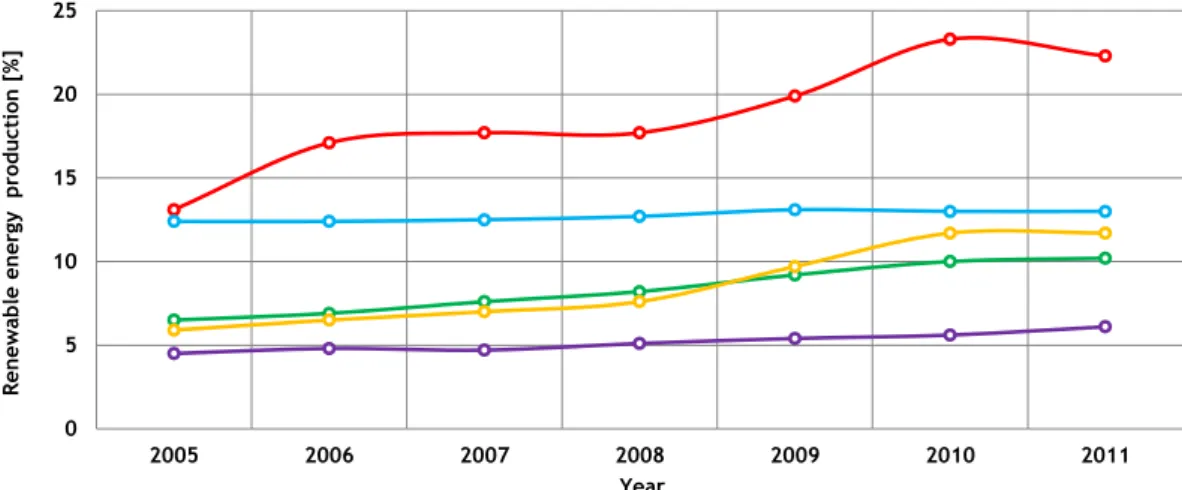
For a country like Portugal, the RES can significantly improve the country economic situation, since this country is highly dependent on fossil fuels. Depicted in the Figure 1.1 is Portugal status regarding the renewable energy production. One can note that, regarding the energy balance the production from RES in 2011 was 22%. On the other hand, Spain has lower levels of RES penetration when compared to Portugal, with a share of renewable generation of 12%. However, Spain is not so dependent on fossil fuels, since it rely on nuclear energy production. The Portuguese government did not follow this course of action leaving the current option of focusing on the investments in RES.
0 5 10 15 20 25 2005 2006 2007 2008 2009 2010 2011 R enew ab le ener gy prod u ct ion [% ] Year
European Union (28 countries) Portugal Spain United States World
Figure 1.1 – Evolution of renewable energy production.
Countries like Portugal, due to its geographical location [2], have a great opportunity to effec-tively exploit favorable weather conditions facing the current economical crisis. The RES could contribute to the energy efficiency of this country, since it could reduce on this country high rates of fuel importations.
According to [3], the wind energy production in Portugal has been increasing as it is observable in Figure 1.2. In 2013, the installed capacity was approximately 45 000 MW. If weather conditions were favorable to produce the maximum installed capacity, it would be enough to satisfy 80% of total energy consumption in the country in this year REN. Moreover, it is evident the relation between CO2emissions reduction and installed capacity of wind and photovoltaic capacity. The
certain is that emissions have been lowering at the same time of increased installed capacity of both renewable technologies. It means that Portugal is on its way to meet the european goals to 2020.
Despite of the increase penetration of RES in past years, the RES still require a considerable cost of initial investment. The uncertain production and the low incentive policies present itself as a setback to attract possible investors. The appointed solution is the development of a market framework that makes the RES more competitive against fossil fuels.
1.1
Background
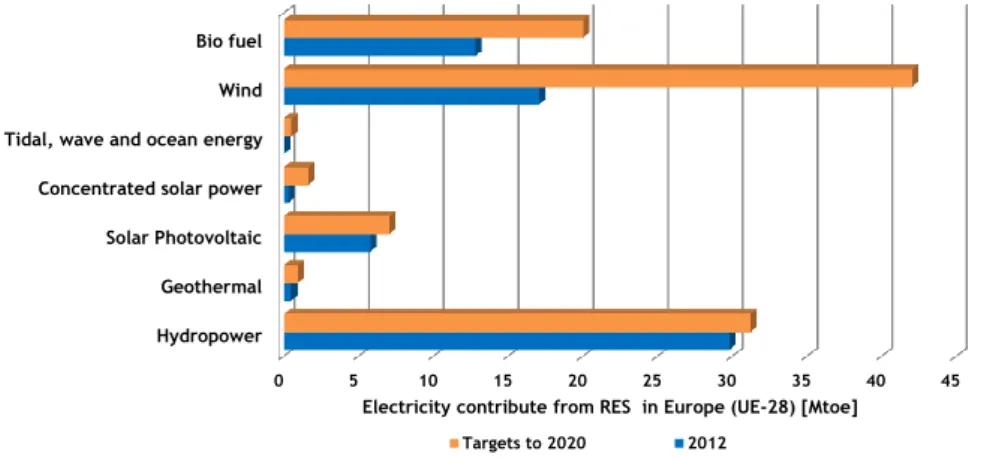
It is important the integration of RES in order to accomplish the European environmental and efficiency goals. It is expected in 2020, according to [4], that an expected 90 MToe, approxi-mately 1048 TWh, of RES share make a contribution of 36 % of the Europe energy balance. In Figure 1.3 the current and the target energy share is presented.
0 500 1000 1500 2000 2500 3000 3500 4000 4500 5000 2005 2006 2007 2008 2009 2010 2011 2012 2013 In st all ed capaci ty [M W ] Year Wind 0 50 100 150 200 250 300 2005 2006 2007 2008 2009 2010 2011 2012 2013 In sta ll ed ca paci ty [M W ] Year Photovoltaic 0 10 20 30 40 50 60 70 80 C O 2 emi ss ion [M T on ] Year CO2
Figure 1.2 – Wind and photovoltaic installed capacity of Portugal over the years
It is noticed in the Figure 1.3 that wind power production projections for 2020. Of all the RES, wind has the most ambitious goal. It is expected by 2020, the integration of RES such as wind and solar will have a 30 % contribution to electricity sector in the order of 38 Mtoe (442 TWh). Comparing these projections to the last year of the available data (2012), this represents an increase of 209 TWh [4].
The use of RES such as solar and wind, bring several uncertainties with respect to the production side. For instance, RES such as solar and wind production are highly dependent on weather conditions, in which it is considerable non-dispachtable energy production. Thus, it becomes a challenge in integrating these technologies in the electrical system due to its unpredictability.
Additionally, this aggravates in the electricity market. Another problem is with the price of energy because renewable have almost zero price of production but otherwise has an higher cost of initial investment that made the price higher than fossil fuel energy. Therefore, the goal is to bring the RES closer and more competitive to the generation of energy through fossil fuels, by lowering its selling price, increasing the profit from the investor, by reducing the payback period.
One way to make the RES more competitive, is selling in liberalized market structure. However, the variable production can be challenging in settling the production price. Several resources have been explored in order to predict the market price and also the RES production.
0 5 10 15 20 25 30 35 40 45 Hydropower
Geothermal Solar Photovoltaic Concentrated solar power Tidal, wave and ocean energy Wind Bio fuel
Electricity contribute from RES in Europe (UE-28) [Mtoe] Targets to 2020 2012
Figure 1.3 – Distribution of different RES technologies for Europe
1.2
Motivation and Objectives
In order to fulfill the efficiency goals, the RES need a robust electricity market, in order to make them more competitive against the traditional way of energy production through fossil fuel. However, the challenges of integrating RES cannot be neglected. It is expected that RES such as wind and photovoltaic production will increase in a near future. Although these types of RES have several setbacks mainly due to its variable production output that could be catastrophic in the electricity markets.
Therefore, there is a need to address this concern by designing better market integration strate-gies that prevents the consequences from the variable production. This can be achieved by developing prediction techniques which aids the bidding of these technologies in the electricity markets. Moreover, it could aid to attract more investors in the use of RES, reducing the risk associated and increase the revenue. This ultimately leads to an increase of market competi-tiveness and in the process, the lowering of the electricity prices.
Although market prices are characterize by higher level of volatility, making market less pre-dictable in studying its behavior. A good market price prediction as well as RES production is essential on determine the optimal offer to the market, increasing the profit of participants.
The main goal of this dissertation aim to make use of decision-making under uncertainty to bid into electricity market. Bidding variable energy is a as well as the participant profit decrease in level of uncertainty.
The contribution of this work is to propose a bidding offer strategy in the Iberian Electricity Market, by maximizing the revenue from a holder of a RES production. The objective is to consider the two types of variable RES (wind and solar) into offering strategies in order to determine the best possible offer. Moreover, it is the purpose of this dissertation to study the possible outcomes between the two offering strategies. A strategy that consists in offering these technologies as a single independent offer; A strategy that combines both productions and make a single combined offer.
1.3
Dissertation Structure
This dissertation is divided into 6 chapters. The current chapter, Chapter 1 , started by intro-ducing the research question and the contribution that this work aims to provide in addressing the problem of integrating variable RES in electricity markets. The following chapters are struc-ture as follows:
In Chapter 2 an overview about the evolution of the electrical sector is presented. It is explained the restructuring of the electric systems in Europe, explaining the liberalization of the European Electricity market. At the end of this chapter, the working principles of the Iberian Electricity Market (MIBEL) are presented, highlighting the Day-Ahead Market.
In Chapter 3 the importance of the decision-making process is presented. It starts by address-ing the production prediction techniques that are required to aid in the integration of RES in electricity markets. It is also explored in this chapter, the importance of different possible out-come scenarios in the decision-making process. At the end of this chapter, a literature survey regarding the market bidding strategies of RES is presented.
In Chapter 4 the mathematical formulation is presented. It starts by explaining the wind and photovoltaic model, presenting the objective function and the considered constraints. More-over, it is presented the bidding strategies used in this work (Single offer and Combined offer)
In Chapter 5 the obtained results and their discussion is presented.
In Chapter 6 the final conclusions and the contributions that result from this work are presented. Additionally, the future work possibilities are also presented.
1.4
Summary
In this chapter, a brief introduction of the research work was provided. It started by addressing the research question, presenting afterward the motivation that leads to the development of this dissertation.
The following chapter will address the principles of electricity markets. It starts by explaining the changing process to the liberalized market. The European market structure is presented, stating its challenges with respect to the integration of RES.
Chapter 2
An insight in Electricity Markets
2.1
Introduction
The electrical energy production has been changing over the past years mainly due to the in-creased consumption and other factors such as environmental, political and economic pressures. The importance of these factors led to a significant restructure of the electrical system all over Europe.
Therefore, this chapter starts by addressing the importance of these factors and their contri-bution to the restructuring of electrical system. The contricontri-butions of adopting an European Liberalized Market are explored, focusing mainly on the Iberian Liberalized Electricity Market (MIBEL).
2.2
The vertical approach
The world industrialization and the increased population growth, have significantly contributed to the changes in the electrical system.
However, this was not the only reason that led to the change of this system. An important historical event shaped this sector, the Second World War. At the end of this period, European electrical systems were significantly damaged and even destroyed. There was a need to rebuild this sector in order to promote the developments of each country after the war.
To facilitate the management of the electrical system the approach focused on creating a struc-ture that envisioned the use of large companies to take full responsibility of the electrical sys-tem. This structure was also known as Vertically Integrated Companies (VIC). Basically, these companies were responsible for the Production, Transmission, Distribution of the electrical sys-tem [5].
The production was at the top of this structure. The production mainly relied on the use of fossil fuels to produce energy. In this vertical structure, the production is planned and scheduled in order to guarantee that the entire system demand is satisfied, without compromising the system stability.
Additionally, the responsibility for energy deliver to the consumers through Transmission and Distribution systems was also entitled to these companies. Therefore, the VIC had to sustain the costs of production, transmission and distribution.
Being the fully responsible for the electrical system, the VIC companies had several opportu-nities that could be exploited. This structure allowed these companies the full control of the system even on the price regulation. By this price regulation, it provides the occasion for these companies to grow economically faster. A large scale production, allowed them the reduction of the operation costs. The consumers paid these companies a fixed bill by an electricity price that was stated by these companies. As a consequence, these companies could manage better their productions in order to profit from this fixed pricing scheme.
In this structure, the consumer has no choice regarding the selection of the energy supplier. Moreover, the electrical bill paid by the consumers was not transparent since they do not know the actual costs of production, transmission and distribution [6].
Despite of the electrical system was relatively secure and stable for decades, there is a need to change this structure. The energy supply through the VIC, constitutes a monopoly that can be exploited regarding the prices [6]. The low transparency to the consumers of the real electricity prices raises concerns. Additionally, these VICs are more susceptible to political and economic pressures, that can further compromise the efficiency of this system [7].
Besides the reasons stated before, another important event contributed to the aggravation of this situation. The excessive use of fossil fuels for the electrical energy production brought se-vere consequences regarding the climate changes. There was a need to reduce the consequences from the use of the fossil fuels by reducing the greenhouse emission gases that contribute to these environmental problems.
This contributed to the rethinking of electrical energy production. The energy production through Renewable Energy Sources (RES) was the appointed path to help achieve these goals. It presented as a new form of energy production that could level the scales in the economic and environmental front.
The use of RES could benefit the countries that rely on the energy production from fossil fuel sources. However, the RES have several challenges that need to be addressed in order for it to succeed. The structure of a vertical electrical system can no longer support these new sources of production. The availability of the RES will increase the number of possible small-scale producers. This will contribute to the change of production from a centralized to a decentralized approach.
Several RES technologies will be available to residential consumers that could have the ability of supplying energy back to the electrical system when it is most needed. Despite of the en-vironmental benefits of electrical energy production from RES, several technical and economic complexities needs to be addressed. In the technical part, the main problem that rises with this introduction is the shift of energy flow. It will cease to be in a single-flow to be a bidirectional flow of energy. This is especially important when designing protection equipment in case of system faults. However, the economic part of the introduction of these RES could be a serious setback. The RES will need to have a robust market structure that can address the market of-ferings from any producer. Moreover, regulation will need to be deployed in order to prevent further pressures from the VIC. Thus, a market structure will be needed in order to promote the competitiveness of the RES against the production from fossil fuels.
2.3
Market Liberalization
An appointed path to address these concerns is through the liberalization process. This process requires new regulations to abolish the VIC, splitting them in different activities in order to remove their total control. This process, also known as deregulation, intents to reduce the existent regulation in order to facilitate the introduction of a new electricity market that works with private interaction, decentralized trading and investment decisions [5]. However, this diversity into separate companies requires control mechanisms to continuous follow the market in order to guarantee the security and reliability in operation [8].
In order to promote the competitiveness of energy production, a liberalization of the electricity market must occur. This market needs to be liberalized, in order to include several partici-pants (buyers and sellers) to further promote its competitiveness. To achieve this liberalized structure, it needs to rely on three important factors:
• Open access; • Restructuring; • Deregulation.
Electricity markets can only be competitive if opened to everyone without discrimination. It is expected with this openness, that electricity can be freely negotiated between each country. Moreover, this point contributes to the lowering of electricity prices due to the large number of participants, making it more competitive.
The second important point stated before is the restructuring. This aims to design new regu-lations in order to abolish the VICs monopoly, separating them in different activities. By this, their monopoly power is removed and transparency is guaranteed. Moreover, this separation will prevent disloyal competition, by bringing more competitors into the electricity market. How-ever, this separation of companies, requires independent control mechanisms to continuously supervise the market, in order to guarantee its security and reliability [8].
It is the purpose of the deregulation to simplify the market structure. This is accomplished by abolishing the price control that was associated with the VIC and the promotion of decentralized trading and investment decisions [5].
This process can be expensive due to the necessity of separate companies (e.g privatization process). However, the disintegration is benefic to the electricity market system in manner of transparency and increase competiveness, since it removes the VIC price control.
In a liberalized electricity market, the energy production activity is open not only for large scale producers but also for retailers. In production, participants can freely negotiate energy without interference of other companies and regulated system. The trade is done in different basis, depending on type of market. In the European Union section, more detailed Iberian market will be presented.
Regarding transmission and distribution systems, it is expected that these systems will not be liberalized since they are natural monopolies, cannot be competitive in order to serve everyone. Companies responsible for these systems are require to maintain their operation and technical considerations [6].
Therefore, the liberalized electricity market stands on two principles: technical and econom-ical. On the technical side, these markets will have a system operator that is responsible to guarantee the electrical system stability. It ensures the secure trading of energy while main-taining practical considerations (e.g avoid energy congestion in transmission lines).
On the other hand, the market operator is responsible for the harmonization of the prices be-tween the different energy producers. Handling offers and bids while assuring the transparency of the price to further motivate the producers. These two entities (market and system operator) can operate in an individual or in a combined manner [9]. Different approaches have been sug-gested in order to achieve a liberalized market. The different approaches of electricity market models are :
• Single-buyer model • Wholesale market model • Retail market model
The first approach to create competition was the single buyer model. In this model, the producer is able to make contrasts with only one buyer. However, this model had its limitations. The competition was created between producers, leaving no advantages for the final consumers since they were obligated to buy the electrical energy only from unique buyer company.
In order to address the problems of this model, two others were proposed: wholesale market designed for electrical energy producers; retail market designed for energy retailers, resellers. In the next section these models are explored in the context of European Markets.
2.4
The Liberalized European Market
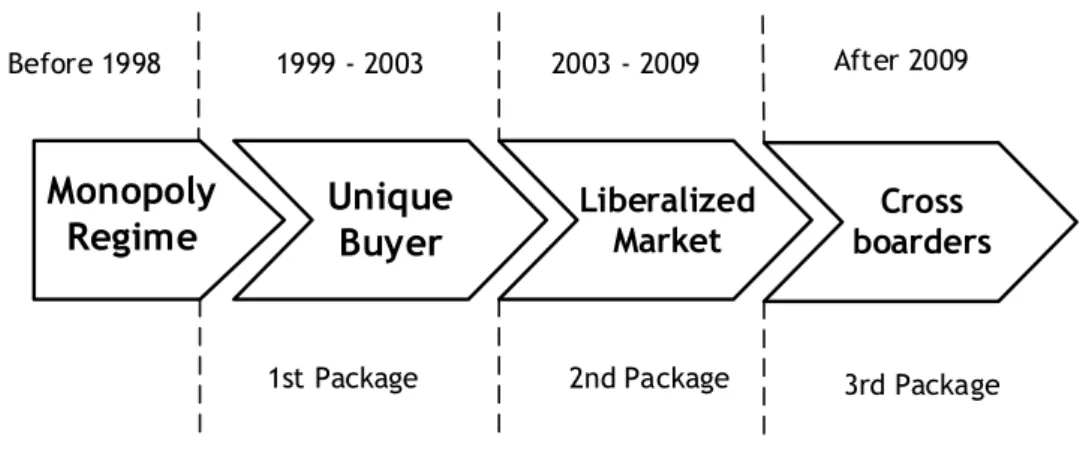
The European Union already started to address these concerns regarding the liberalization of the electricity market. An important Directive [?]tated the purpose of the liberalization and its core principles. These goals stated by, �20-20-20� European Directive, consist in a reduction of the greenhouse emission gases and the further integration of RES into each country energy production [10]. In Figure 2.1 the evolution process of the European electricity market models is presented.
The main goal of IEM is give the opportunity of consumers to choose their suppliers with rea-sonable and similar price in any part of Europe. Hence, inter-ligation transmission lines are required to connect countries.
Unique
Buyer
boarders
Cross
Before 1998 1999 - 2003 2003 - 2009 After 2009
1st Package 2nd Package 3rd Package
Monopoly
Regime
Liberalized
Market
Figure 2.1 – Market Models Evolution.
The process of market change started in 1996, by the Directive 96/92/CE [11]. This first ap-proach consisted on adopting the single-buyer in each state-member of the European Union. In this model, there is only one single-buyer of energy for producer companies. These companies are independent power producers (IPP) from regulated system. Competition is done in long sell contract to operate this IPP with the single buyer companies.
This contracts protected producer of investment risk. Moreover, revenues are paid in a fixed price base, independent of its production. This risks are supported by final consumers, not only by the producers [12]. This model is not an abolishment of the monopoly, once they have the full control of final consumers. Additional costs are applied to the final electricity price to the final consumers. One more time, final consumers had no right in choosing their supplier. The sell is done by single-buyer companies, giving one more time, total access to electricity price determination.
Later in 2003, the Directive 2003/54/CE [13] was created to replace the single-buyer market model. This document had the intention to promote the creation of an internal electricity market (IEM), in where all buyers and sellers could choose their energy suppliers [10]. At the same time, there was a need to create an independent entity responsible to regulate this market model, in order to ensure its transparency.
The main goal of IEM is to give the opportunity of consumers on choosing their energy suppliers. Hence, the central objective is to connect different countries with interconnection transmission lines.
Note that the main purpose is the separation of powers of the VICs. However, there are still monopoly companies. For example in islanded systems where it is impossible to create an open market (e.g. EDA in Azores). The isolation due to the geographical properties is one of the most important limitations, since it is difficult to establish an electrical connection to continental regions. Therefore, these companies are responsible for maintaining the entire electrical system.
The last package, Directive 2009/72/CE, was created with the main reason of introducing the interconnection regulation. There was a need to open the cross-borders to new energy suppliers in order to further increase the price competitiveness [14]. This is an important step into developing the liberalized market shaping into the IEM. However, developing an European IEM is challenging. It requires an organized structure, supported by strong policies. The IEM is a complex process and the approach starts by decomposing into smaller markets that can be connected later. Following this philosophy, small markets have been emerging, following the same principles of the competitive electricity market. Currently, it is expected that Europe is divided into several markets, being the most relevant [15]:
• Nord pool (includes north European countries, Norway, Finland, Denmark); • MIBEL (Portugal and Spain);
• APX-ENDEX (Netherlands and Belgium); • EPEX (France and Germany);
• APX-ENDEX (Britain); • IDEM and GME (Italy).
For the context of this work it is relevant to address the working principles of MIBEL.
2.4.1
MIBEL
In Iberian space, Spain and Portugal made an agreement that led to the creation of the Iberian Electricity market in 2004 [16]. In 1997, Spain started its liberalization process by the imple-menting the market operator (MO) and system operator (SO).
The main objective was the equalization of the tariffs between both countries by promoting competition in a transparent way. Hence, every consumer in Iberia space could buy electrical energy from any energy supplier or retailer operating in Portugal or Spain.
Evidently, each country still has its own regulation system. In Portugal, this regulation is man-aged by an independent company, ERSE [17]. In Portugal, to gain access to production in this market licenses are required. Despite small producers can be found in Portugal, they have no direct access to the market structure. These small producers are obligated by law, to sell the energy to the last-resort marketing company. [18].
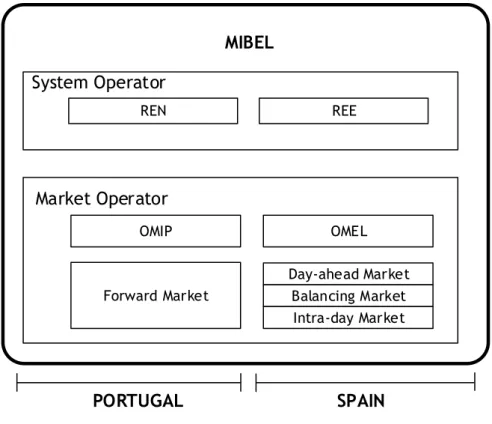
The Iberian Electricity Market is organized and managed by two countries. Portugal is responsi-ble for the forward market where Portuguese market operator (OMIP) is the system operator and Spain is responsible to manage the short-term market supervised by Spanish market operator (OMEL). Bilateral contracts are also available in both countries. There are also system operators in each country responsible for the technical parts: Portuguese case, Rede Electrica Nacional REN; Spain, Red Electrica de Espanã, REE.
SPAIN
PORTUGAL
REE RENSystem Operator
OMIP OMEL Forward Market Day-ahead Market Balancing Market Intra-day MarketMarket Operator
MIBEL
Figure 2.2 – Mibel structure.
It is to be noted that each country still has public entities where regulation exists. However the goal is to migrate all entities to electricity market, but the change is slow. It is a complex process and require a gradually migration due to the necessity of create good interconnection capacity between countries.
2.4.2
Day-ahead Market
Short-term transactions in electricity market are done in Day-ahead Market. This market is a typical spot market or pool market that deals in short-time period. This market has the main goal to make use of management mechanisms in order to create equilibrium between production and consumption supported by participants, eligible consumers and producers.
Every year the number of players in short-term market rises. Still, it is not a perfect compe-tition market due to the number of participants. Thus, big companies are obligated to have a percentage of participation in market. If not, the market price would fluctuate significantly due to the lack of market participants. In day-ahead market trading takes place one day before the delivery of energy. This is done in an hourly basis, meaning that 24 submissions have to be made in order to complete 24 hours. These 24 submissions has to take place in the twelve hours before the first hours of d− 1 day.
Pr ic e Energy Marginal price Demand Supply Negociated quantity
Figure 2.3 – Curve of demand supply
A producer has to decide the amount and the price of energy that intents to offer the market. Hence, these bids can have two components: price and quantity [19]. Regarding this bidding structure the principles are[19]:
• Bid cannot be changed after submission; • The bid is unknown by other participants;
• Daily market bid has a limited number of hourly block with different prices for each period.
After submission, the market operator will determine the price of energy. This behavior can be observed in Figure 2.3 . In the intersection of both curves it is the marginal clearing price, represented by λ. It is because some decisions have to be made in order to take some variables and also to determine the marginal price of energy. Different sources of energy have different prices and it can be reflected on market price.
Marginal is achieved considering the lower bid price to avoid disparities in the market, risk of having bids so much high than marginal price. This could comprise the generation dispatch. On the other hand, very low offer indications would increase the probability of being dispatch, resulting in lower price than production costs. So market must functional with marginal price system.
After the energy negotiation time in day d, marginal prices are determined for those periods. So price, in this type of market is more volatile.
The balancing market and intra-day market, is not a real market but a mechanisms of adjust-ments to the undelivered of promised energy. It takes place minutes before the actual energy delivery. These adjustments are required in order to ensure the constant balance between energy supply and demand.
The existence of both these market are important. The day-ahead market is used by energy providers in which they state they plan on energy delivery amount and its price. In cases of deviation of unexpected production (positive or negative), producers will need to take balancing trading in order to compensate this deviation.
In positive deviation, is achieved when more production is being supplied to the market than the one that was reported. In this case, producers will receive extra payments to bring more energy, helping in the equilibrium of the market. On the other hand, if production is not enough to match the reported supply, to the producers a penalty is applied for this imbalance [20].
In some cases, there is a need to compensate the energy match when the energy delivered is lower than the system demand. This energy is more expensive, since this is achieved through the use ancillary services which constitute energy reserves to be introduced in the system in case of need.
Balancing market is needed due to technical issues of transmission, struggled cheap energy in some areas may result, sometimes a force of using other units of energy more expensive, against liberalized market goals [20].
Another important decision to be made after the bid submission has to deal with technical operation in order to guarantee the electric energy supply with secure and reliability. Its system operator job to guarantee the limit capacity of transmission and check constrains in order to prevent congestion problems. In the beginning of MIBEL, the interconnection capacity between Spain and Portugal was difficult to match resulting in difference between electricity prices.
Although, there are some important considerations to be taken, especial when integrating RES into the market. Marginal cost of renewable is very low, zero or even negative depending on cases. Zero prices occur for hours in while the renewable and hydro production exceeded energy demand. Periods with higher renewable energy production, the amount of schedule production and consumption increase and market price decreases. Thus, if a large variation of renewable generation are to accommodate by conventional generation, this may result in conventional power plants operations in a less efficient way, thus reducing the emissions savings bought about by the contribution of renewable to the electricity supply [20].
The higher RES generation, the lower is the market supply and the lower is the spot price [21]. Adequate economic incentives for electricity producers to invest in conventional generation, in particular, in the flexible production technologies required to continue integrating larger amounts of renewable without jeopardizing the security of supply [20].
2.4.3
Challenges of integrating RES in electricity markets
There are still some concerns about the consolidation of electricity market, especially after the blackout that happened in America.
USA motivated by volatility of the price caused by political conflicts of fossil fuel owner coun-tries, in 1970's, adopted an liberalized electricity market. United states, pressed by the fossil fuel dependence, lead to introducing the liberalized market in order to restore the economy devastated by volatility of fossil fuel price. Although, this market was not well succeed end-ing with a complete blackout of the whole electric system. Carefully attention has to be done to this system in order to solve this challenge without compromise the whole Europe electric system [7].
Electricity is not a typical tradable commodity. Once produced, it has to be consumed at the same time which further complicates its economics. When producing energy with fuel it is easy to determine the price of production. There are some challenges in having these liberalized markets to trade energy. First of all, the big production companies could try to manipulate the market price by removing or adding capacity from the market, having a direct influence in price face compared to small participants [22]. Secondly, if all participants were trying to have benefits from selling in higher price period and buy at lower price periods, it will have the side effects, especially on the first steps of market liberalization.
The reason is at the beginning, market do not have enough participants to develop low prices [23]. All market participants are paid with the marginal price. For instance, if the supply becomes higher than demand, the marginal price will be lower. This is a situation than producers do not want for the reason that they will have less benefit in those cases.
With the liberalized market, it will be more difficult to determine degradation on the electrical grid and choose the right tariff that present the actual cost of using the interconnection [7].
It is evident that with a liberalized market that renewable energy waste is prevented. Energy that is not absorved by one country can be consumed by another country. However, problems rise with the increase of RES in electricity market. Due to uncertainty of production from vari-able RES (e.g. wind and solar production), these types of RES are non-dispatchvari-able. Evidently, it has significant influence in prices due to the consequences regarding price volatility. This is one of the reasons why these types of RES are traded in pool markets.
In order to minimize the risks from integrating RES in electricity markets, decision methods need to be developed. Decision-making methods can be used in order to predict variable productions. By this prediction, better market offerings can be made which leads to a reduction of possible imbalances associated with the offer. Additionally, by reducing the possible consequences of a mismatch between the reported and the actual production, makes the RES an attractive option for investors. With this, it is expected an increase number of market participants, leading to a more competitive market.
2.5
Summary
Electricity market has been changing due to a series of important factors. The previous monopoly structure is changing to the liberalized approach in order to meet the efficiency goals by sup-porting the integration of RES.
However, the RES integration became a complex for electricity markets. Variable RES present serious setbacks in the market due to the possible consequences of the mismatch between the actual production and the reported production.
Thus, better decision methods are required in order to develop better offering strategies for the electricity market. In the next chapter, the prediction tools that could aid in the integration of RES in electricity markets are presented.
Chapter 3
Prediction Tools in Decision-Making
3.1
Introduction
The previous chapter presented the typical market frameworks and its benefits in making the RES more competitive in face of fossil fuels options. This chapter starts by addressing the most common tool used in Decision-Making process of variable assets.
It starts by addressing the importance of making-decision the production of energy from RES in making good predictions and market offerings. For the context of this work, it will be demon-strated two types of approaches: Wind and Photovoltaic. Later this chapter, a literature survey on the market offering strategies is presented.
3.2
Decision-Making
Optimization is a reality in engineering solving problems, because everyday decisions has to be made and optimization is a extremely useful tool in making-decision problems. However, making-decision is associated with future decisions that most of the time are uncertainty be-cause is future, so there are a lot of variables that cannot be known. In making-decision they are assumed as a vector of random variables that the value change over the time. This are also called stochastic processes.
Optimal methods has been knowing as a part of operational research problems. Operational research was developed earlier in Second War World [24] as a need to solve problems. Nowadays, operational research is used in a lot of field, as for example engineering.
Stochastic process is considered random process due to the support in random variables. Ran-dom variables are a vector of countable numbers displayed in a ranRan-dom sequence. The main goal of this variables is to describe phenomenons that cannot be predict with one under percent sure, due to the uncertainty of the future events. The dependent variables to future events in most of the cases are so large that make it impossible to predict. So each value is associated with a probability, which could be discrete or continuous. For the relevance of this work contin-uous probability will be explored. In electricity market, making decision should be decide in a continuous base due to the nature of the resource previously explored. Continuous probability it means to work with periods of interval. Probabilities such as probability density function (PDF) and cumulative density function can be used associated to a set of data.
a) b) c)
Figure 3.1 – Types of scenarios.
To evaluate this random variables, probability assumptions are made, as a distribution of random variables to occur. Usually it can be evaluate as scenarios illustrated in figure 3.1.
3.2.1
Scenarios
Each node represent a decision and each arc probability of an event to happen. Those nodes represent the possibles stages that a process can be shaped given by a set of variables, presenting by probability. Peter in [25] mentions 3 types of scenario schemes. They are:
• Linear; • Scenario Tree; • Dynamic.
Due to the nature of these process, these stages can or cannot be independent. Linear sce-narios assume that the process is deterministic. It means that the future will follow a similar relation that was present in the past, there are no unpredictable variables, no uncertainty in the process, the future is well known and precise. Other scenario schemes, such as scenario tree, are normally used in classical stochastic programming, since in the process it describes there is uncertainty present and one cannot predict the future outcome of the event. These type of scenarios, takes into account different possible outcomes, displaying a range of possible future realizations. In the other hand, it can be used a different kind of scenario that recombine scenarios tree. This type is used in dynamic process and take into account that each decision (node) can modify the probability of the next stages (nodes). It is considered dynamic scenario tree, since the future revealed developments can recombine scenarios. In both approaches, regards the same only a single realization from the initial to the final state. Typically,[25], sce-narios tree are more appropriate to used with short-therm models. On the other hand, dynamic scenarios with recombination of scenario tree is a more complex process and requires more time consuming [25].
In mathematical statistics, it is mostly the analysis of 'wait-and-see' solutions that is of inter-est. Stochastic programming is mostly concerned with problems that require a 'here-and-now' decision, without making further observations of the random variables [26].
According to the number of stages considered it can distinguish between two-stage and mul-tistage stochastic programming problems. In two-stage programming there are two levels of decisions [27]:
1. The first is called here-and now and it is a correspondent of a first stage. This decisions are made before the realization of stochastic process. As a consequence they are not dependent of each realization of stochastic process.
2. wait-and-see is for the second stage of decision. This decisions are made after the previous stage had determined. In this case, they are dependent of stochastic process. Being a second stage, each value is defined for each scenario.
Multi-stage problems comprise more than two-stages. It has an identical process as the previous one but with more decisions states and as a consequence it will has more scenarios determina-tion.
3.2.2
Importance of prediction
Due to variability of renewable energy, it is important to predict the availability of resource to help in making-decision process.
Because of the change of matter that cross electricity field and its complexity, there are two main areas of study, technical issues from electric network and electricity market issues.
The new approach of electric network, distributed generation, caused by integration of renew-able energy and the possibility of having different direction of energy flow, shown in previous chapter, becomes with different benefits as presented in [28], but it needs prediction tech-niques to help in technical issues. First of all, the high integration of renewable energies will increase the problems in transmission lines because the network is still keep the old structure as before, when it used to use only fossil fuel, and it will provoke the degradation of electric grid due to variability of renewable energies. In other hand, it could cause network constrains if the injection is more than the network supports [29]. More serious problems could happen because of lack of prediction or bad prediction as having black outs that force the stop[30].
There are different studies that predict methods are used to solve problems such as, save fossil, to schedule maintenance and equipment conditions. There are also important prediction when dealing with unit commitment. Unit commitment is a method to lower the costs of power plant, scheduling units of generation to meet the demand. In order to satisfy the total demand with the most precise prediction, so it is important because in large scale resources and issues can be optimize without lose electric energy as well as costs result from bad prediction [31].
Prediction is essential when integrating renewable generation into electricity Market. It is a wide step for renewable become with more competitive prices as fossil fuel. As known, re-newable energies still have higher costs of implementation, initial investment and maintenance comparing with production because power generation come only when wind blows or the sun shine, and this production is variable and uncertain. This variability, there are not such com-petitive as fossil fuel energy, resulting in a higher price. Due to this fact, electricity market development was a strategy of integrating renewable electricity with other kinds of technologies in order to lower the cost of production and be more competitive than fossil.
But this kind of energy is non-dispatch because it always depend of weather condition that make it intermittent. This becomes a problem that have encouraged researchers to intensify their efforts in the development of better predicting techniques [32]. It is necessary improve the predicting methods to have a better support in making-decision situation with a lower risk, reduced unexpected profit. The challenge is a higher penetration of renewable in electricity market and and more competitive energy than fossil fuel, with a similar price. Great challenge from fossil dependent countries as incorporating european union, such German and Spain that take this position to face the crises [22].
With price prediction and weather prediction, producers can achieve the best offer in order to reduce risk of having a bad prediction, maximizing the profit. Thinking into account a producer point of view, a good prediction will help in deciding the amount of energy to be sold in electric-ity market. This is important in Day-ahead market due to the necesselectric-ity of deciding this amount in the previous day of delivery. In case of the producer cannot satisfy the announced amount, in some markets, it could be penalized with extra payment.
Although, electricity market has to be transparent and well structured to lead a good will. But market is still vulnerable.There are some disadvantage in having markets to trade energy. First of all, the big companies can do a tricky game to manipulate the market price by removing or adding capacity from the market and having a direct influence in price face to small participants [22]. Second, if all participants were trying to have a benefice for selling in higher price period and buy at lower price it will have the side effect, the more profitable period before to sell it will become the less profitable after playing with the prediction and the market price.
It is expected the increase of RES, such as wind and solar, for replacing the traditional fossil fuel production. However, due to the nature and the variability of these resources, rises the necessity of having a good prediction techniques, if the RES want to strive in the electricity markets.
It is important to predict the availability and the production output of these resources. And also with integrating RES, electric system will have other behavior, since electricity stopped being unidirectional but distributed [28]. It will result in the technical issues. First of all, the high integration of renewable energies could lead to an increase problems in transmission lines, since the network still keeps the old vertical structure.
RES integration could lead to the degradation of the electrical grid due to variability of pro-duction output. Moreover, it could lead to network injection problems in situations that the electrical grid does not support the the energy introduction [29] due to variable production of RES-E. A reasonable prediction can prevent this problem, but if neglected it could represent more injection than grid is able to accommodate. As a consequence grid may become over-loaded and in extreme cases provoke electrical system blackouts [30].
The RES have higher costs of implementation, bigger initial investment and maintenance costs when compared to the fossil production. This fact is because of the higher price of technology that is an negative point of RES implementation, requiring a big initial investment. Investments of this nature, are not favorable, since the pay-back is still high due to uncertainty of production and also the lack incentive of governments.
Although, prediction can reduce the return period of investment, once they will have a better prediction of production that allow decision-maker to get a better decision in order to get a better profitable revenue when selling in electricity market. It is an incentive to encourage new investors coming into RES business and it is also an opportunity to make extra money.
However, in terms of production these RES could be considered cheaper due to the variability from oil prices, due to global conflicts or economic pressures. Although, this kind of energy is considered, due to their variability, non-dispatchable since it is strongly dependent from weather conditions. This nature creates a major setback for the RES and prevents them of having a more competitive price.
Probability provides different ratios of probabilities and do not have one single value, but it can take a range of probabilities that may represent the future prediction. This type of prediction make use of probability density functions (PDF)[33].
For the context of this work, it will be focus on probability due to characteristics of RES such as wind and photovoltaic Probability is used in RES power production, since it is dependent on weather conditions. Typically, weather conditions are difficult to predict, seeing that it depends on a combination of a several non-controllable factors. These conditions also vary with time. For instance, if a renewable power plant has to be operational, it can only do it in times of favorable weather, making it a non-dispatchable energy. Because it is not available in time of need, so can not satisfy the required demand all time.
So, it is requires techniques to put renewable more technical and economic efficient [20], solv-ing the problem of non-dispatchable with prediction techniques that helps in maksolv-ing-decision problems in dispatching energy. Having a RES-E predicted, it is easier to manage the technical and the economic problems, network is well organized and money can be save in selling green energy more cheaper than conventional one and not have penalties in market due to undelivered scheduled RES-E.
Evidently, these techniques vary between the resource it wants to predict and different factors are taken into account. In the next sub-sub-sections 3.2.3 and 3.2.4, two cases of different sources requiring different approaches.
From a producer point of view, a good prediction will aid in deciding the amount of energy to be sold in electricity market. This is important in Day-Ahead market due to the necessity of deciding the amount of energy previous the day of the delivery. It gives an certain degree where producer schedule the production, with a more predictable injection and also it will save the penalty balances from the unscheduled energy. For the market it is advantageous because they can easily equilibration of the market energy trading. Jeopardizing more expensive energy sources to meet the undelivered energy promised by producers. So prediction is a gain for each part and system safety, allowing markets to works better, well structured.
3.2.3
Wind Power Production
Wind production sites are directly dependent of the wind strength. Although, there are maxi-mum limits of operation due to mechanical and electronic constrains. Wind's power is primary converted into mechanical power trough the wind turbine where wind is crossing the turbine and make a force that allow turbine to rotate and produce mechanical energy. After, this mechan-ical energy is connected to a generator that it is connected to the electrmechan-ical network. Those processes of conversion has mechanical and electrical inefficiencies. Several technologies and developments are presented in [34] and [35] that address the strategies on how to explore the maximum energy potential output of the wind generation. So a system control is important in machine operation and power production, existing then an optimization field in mechanical and electrical losses that can be found in [36].
Wind is considered the most developed renewable energy and also the most available in liter-ature in electricity market . Many integration studies have been done, in United States, on a prospective basis, looking at the potential future power system with wind in order to deter-mine the integration cost of wind or to deterdeter-mine the impact of wind on electricity market operators[37]. The same problems are also taking into account in European studies [38].
Although, there are some important characteristics to take into account when trading wind energy in electricity market, such as shape of wind speed curve as [39]. This characteristics will be important because they can affect the bidding price, having strong impacts on receiving amount for selling in market. So a deviation of scheduled wind production will have economic impacts for producer. Having a lower production is bad to producer, because he will have to take penalties resulting from balancing market, specially designed for RES traders. So for wind power producer, predicting wind power availability requires a carefully factors of interest. Other many factors are relevant for wind variability that it can be found in [40], there are:
• Variations from direction; • Variations from seasonality; • Variations from local; • Variations from time;
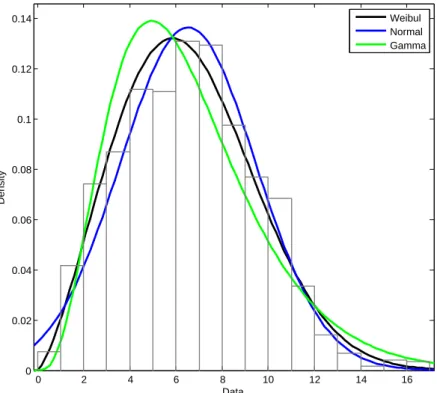
0 2 4 6 8 10 12 14 16 0 0.02 0.04 0.06 0.08 0.1 0.12 0.14 Data Density Weibul Normal Gamma
Figure 3.2 – Wind Speed density with different distributions.
Probabilities count events and see how many times they happened in the passed and it convert in a percentage that will define the probability of having an specific event. Using distributions supposed statistical parameters such as variance and covariance of historical data. This data is important to get statistical parameters that can quantify and characterize the shape behavior. This is useful to work with a little data set and is easier to modulate, getting only parameters that can represent the general behavior. With higher density of data, processes become more complex and slow.
Looking at the figure below, can be observed the characteristic curve of wind speed, distributed by hourly curve. The most used method to predict this curve is a weibul distribution [41], [42], [43], [44] and it is noticed in graph that the shape is near to the wind power curve, because weibul is the probability density function that best approach the behavior of wind distributed for different hours of a day as can be observed in figure 3.2. With this distribution, it can be seen that wind is more available at night and in fact it is true due to the sunset, air mass become more cold starting their movements, resulting in more windy region. At day, air mass become more warm and the probability of having wind is lower.
As it can be seen, the most availability is observed at night, when there is a temperature drop in which results in more movements of cold mass of air. The variation in wind speed is also due to a combination of: tower shadow, wind shear and turbulence [45].
To operate a wind turbine there are some equipment characteristics by the fact all wind avail-able is not good for wind production. There are a minimum speed defined to get an output production and above this is not possible to operate. As well with a certain speed, it has a maximum power and and higher of this value that wind turbine is forced to shut down. This is also a safety procedure due to wind turbine dimensions and the possibility to explode and cause serious dangers.
3.2.4
Solar Power Production
Solar energy is the most abundant energy available, inexhaustible and clean of all the renewable energy resources till date. The power from sun received by the Earth is about 1.81011MW , which
is many times larger than the present rate of all the energy consumption [46].
The use of solar energy is usually divided into two main areas: Solar thermal and solar photo-voltaic electrical production. The first uses the sun as a direct source of heat energy and is most commonly used for supplying hot water to houses and swimming pools. The solar elec-trical energy production seeks to convert light from the sun directly into electricity through a process known as photovoltaic [47]. The photovoltaic effect is developed in [48] and its present on photovoltaic cells [49]. Electric limitations are considered in photovoltaic once conversion factors are very low. There are some developed technologies that allow panels to follow the sun path, tracking system, maximizing the power extraction in every day hour.
Although, the main challenge of photovoltaic is to develop material capable of improve the maximum possible energy that can be extracted from the irradiation there are achieve using advanced chemical and metallurgical rout [46]. More efficient panel has to be developed in order to increase the conversion efficiency to maximize the possibility of power production and it also an mechanism to become more cost effective, once photovoltaic is still expensive due to low development of technology, representing a large initial investments once returns rate are very very long face to capacity of production. Giving an example, the most typical panels commercially available are made of multi-crystalline silicon that has an efficiency between 14% to 19% [46]. It is a small amount considering the total power potential that comes from the sun. Depicted on the figure, is difference of available and the possible amount of energy that can be extracted. It is still a small amount considering the total power potential that comes from the sun.
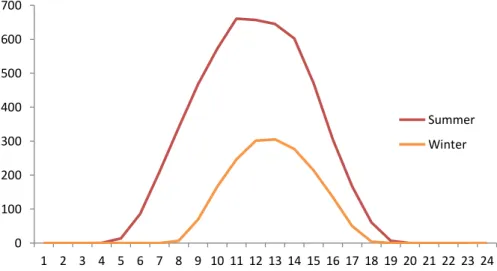
To produce electricity is required, as mentioned efficiency of but also the number of effective sun hours [48], once technology is not so developed to create so efficient materials than can produce at lower light, as night period. So, sun hours changes with seasonality due to sun trajectory around earth, that means that in summer it has more sun hours available than in winter, and because sun is closer to earth in summer, the temperatures increases, as it can be observed in figure. As the same way with Latitude that change the angle of hours available.