1
This article was published in Science of the Total Environment, 526, 278-311, 2015
http://dx.doi.org/10.1016/j.scitotenv.2015.04.055
Advances in analytical methods and occurrence of organic
UV-filters in the environment – a review
Sara Ramos, Vera Homem*, Arminda Alves, Lúcia Santos
LEPABE – Laboratory for Process Engineering, Environment, Biotechnology and Energy,
Faculty of Engineering, University of Porto, Rua Dr. Roberto Frias, 4200-465, Porto, Portugal
*Corresponding author. Tel.: +351 22 041 4947, Fax: +351 22 508 1449, e-mail address:
[email protected]
2
Abstract
UV-filters are a group of compounds designed mainly to protect skin against UVA and UVB radiation, but they are also included in plastics, furniture, etc., to protect products from light damage. Their massive use in sunscreens for skin protection has been increasing due to the awareness of the chronic and acute effects of UV radiation. Some organic UV-filters have raised significant concerns in the past few years for their continuous usage, persistent input and potential threat to ecological environment and human health. UV-filters end up is wastewater and because wastewater treatment plants are not efficient in removing them, lipophilic compounds tend to sorb onto sludge and hydrophilics end up in river water, contaminating the existing biota. To better understand the risk associated with UV-filters in the environment a thorough review regarding their physicochemical properties, toxicity and environmental degradation, analytical methods and their occurrence was conducted.
Higher UV-filter concentrations were found in rivers, reaching 0.3 mg/L for the most studied family, the benzophenone derivatives. Concentrations in the ng to µg/L range were also detected for the p-aminobenzoic acid, cinnamate, crylene and benzoyl methane derivatives in lake and sea water. Although at lower levels (few ng/L), UV-filters were also found in tap and groundwater. Swimming pool water is also a sink for UV-filters and its chlorine by-products, at the µg/L range, highlighting the benzophenone and benzimidazole derivatives. Soils and sediments are not frequently studied, but concentrations in the µg/L range have already been found especially for the benzophenone and crylene derivatives. Aquatic biota is frequently studied and UV-filters are found in the ng/g-dw range with higher values for fish and mussels. It has been concluded that more information regarding UV-filter degradation studies both in water and sediments is necessary and environmental occurrences should be monitored more frequently and deeply.
3
Abbreviations
1-Oc - 1-octanol; [C4MIM]PF6 - 1-butyl-3-methylimidazolium hexafluorophosphate; [HMIM][FAP] -
1-hexyl-3-methylimidazolium tris(pentafluoroethyl)trifluorophosphate; AcOH - acetic acid; Ac – acetone; ACN – acetonitrile; ASE – accelerated solvent extraction; BSTFA - N,O-bis(trimethylsilyl)trifluoroacetamide; CAS - Chemical Abstracts Service; CHL – chloroform; CYHex – cyclohexane; CYPN – cyclopentane; DAD - diode-array detection; DCM – dichloromethane; DI - direct-immersion; DLLME - dispersive liquid-liquid microextraction; EC50 - Half maximal effective
values; EtOH – ethanol; Eth – ether; EA - ethyl acetate; GC-MS – gas chromatography coupled with mass spectrometry; GPC - gel permeation chromatography; HPLC - high performance liquid chromatography; HS – headspace; HAS - human serum albumin; Hep – heptane; Hex – hexane; IL – ionic liquid; IL-SDME - ionic liquid-based single-drop microextraction; IL-USAEME - ionic liquid based ultrasound-assisted emulsification microextraction; KOC - organic carbon/water partition coefficient;
KOW - octanol-water partition coefficient; LC - liquid chromatography; LD - liquid desorption; LLE -
liquid–liquid extraction; LODs - limits of detection; MAE – microwave assisted extraction; MALLE - membrane-assisted liquid–liquid extraction; MASE - membrane assisted solvent extraction; MeOH – methanol; MEPS - microextraction by packed sorbent; MME - micele mediated extraction; MNPs-based dSPE - magnetic nanoparticles dispersive solid-phase extraction; MSTFA - N-methyl-N-(trimethylsilyl)trifluoroacetamide; MTB-STFA - N-methyl-N-(tert-butyldimethylsilyl)trifluoroacetamide; PCPs - personal care products; PDA - photodiode array detector; PDMS - poly(dimethylsiloxane); PLE - pressurized liquid extraction; POCIS - polar organic chemical integrative sampler; PrOH – propanol; Rec - recovery; SBSE - stir bar sorptive extraction; SEHSDT - sequential extraction with high-speed dispersion tool; SLE - solid-liquid extraction; SPE – solid-phase extraction; SPF - sun protection factor; SPLE - selective pressurized liquid extraction; SPMDs - semipermeable membrane devices; SPME – solid phase microextraction; TD - thermal desorption; TCE – tetrachloroethylene; THF – tetrahydrofuran; Tl – toluene; UPLC - ultra-performance liquid chromatography; USE - ultrasound extraction; UV - ultraviolet; WTP - water treatment plant; WWTP – wastewater treatment plant
4
1. Introduction
In the past few years, concern for sunburns, premature skin aging and the risk of developing skin cancer has raised and ultraviolet (UV) radiation has been considered a public health threat. UV radiation can reach the earth surface in both UVA (315-400 nm) and UVB (280-315 nm) range, while solar light UVC (200-280 nm) is absorbed by ozone in the stratosphere (Kim and Choi, 2014).
UV-filters are compounds designed mainly to protect our skin against damage by UVA and UVB radiation. These compounds can either be organic (chemical) absorbers or inorganic (physical) blockers, depending on the basis of their mechanism of action. Organic UV-filters absorb UV radiation and the absorbed energy produces an excited state of the molecule, giving it higher energy content. The excess of energy is dissipated by emission of higher wavelengths or relaxation by photochemical processes, for example isomerisation and heat release (Abdelraheem et al., 2015). Inorganic sunscreens, like titanium dioxide and zinc oxide, protect the skin by reflecting and scattering UV radiation (Crista et al., 2014). In this review, only organic UV-filters are considered because of their frequent use at higher quantities.
Although UV-filters are mainly incorporated in cosmetics (such as sunscreen lotions, skin care, facial makeup and lip care products), they are also included in a wide range of products including plastics, adhesives, paint and rubber in order to protect from UV degradation (Brooke et al., 2008; Gackowska et al., 2014). Personal care products with a high sun protection factor (SPF) values are the most popular amongst consumers; however, the ‘false’ sense of protection leads to prolonged sun exposure. In order to enhance the SPF values, several combinations of UV-filters are used (both organic UVA and UVB and inorganic) and their total concentration in the final products increased. This results in an increased population exposure to a higher and greater diversity of UV-filters (Chisvert et al., 2001; Manova et al., 2013).
At some point, the majority of cosmetic products will find their way into wastewater (due to bathing and washing activities) and consequently into rivers, lakes and ocean, so it is not surprising that UV-filters are found in the environment (Abdelraheem et al., 2015; Duirk et al., 2013). A schematic of the major pathways of UV-filters in the environment was presented by Giokas et al. (2007) and can be completed with the understanding of the urban water cycle presented by Pal et al. (2014). UV-filters are very persistent in the environment due to their massive use and physicochemical properties (Liu and Wong, 2013; Rodil et al., 2009a) and their environmental issues are related mainly to their endocrine disrupting potential, systemic circulation and probable
5
exposure of all tissues in the body in humans (Krause et al., 2012), mammals (Schlumpf et al., 2004), amphibian and also fish (Blüthgen et al., 2014).
The first review specifically oriented to UVfilters appeared in 1999 by Daughton and Ternes and the second in 2007 by Giokas et al. However, other reviews regarding specific topics under UV-filters also exist, such as BP3 (Kim and Choi, 2014), UV-filters transformation products (Santos et al., 2012) and UV-filters occurrence in biota (Gago-Ferrero et al., 2012). Overviews of analytical methods for determining UV-filters in cosmetic products (Salvador and Chisvert, 2005), human samples (Jiménez-Díaz et al., 2014) and advanced aspects of current LC-MS/MS methodology (Gago-Ferrero et al., 2013) were also published, as well as regarding toxicity of few UV-filters in the aquatic environment (Brausch and Rand, 2011).
Therefore, the main objective of this review is to summarise the scattered information about the utilization of UV-filters and to explain why this class of compounds has raised so much concern in the past years. It is also expected to summarise and analyse the UV-filter profiles in several matrices (water, soil, sediments and biota), describe the analytical methods most used and analyse the overall distribution and fate of UV-filters in the environment.
2. UV-filters characterization 2.1 Chemistry
The most used UV-filters in today’s worldwide industry and the most detected in environmental matrices are represented in Figure 1, according with their chemical family. Those whose use in cosmetics is currently allowed by European legislation (Directive, 1998) (in Annex VI “List of UV-filters allowed in cosmetic products”) are marked in bold. Different abbreviations were found in literature for the same compound. For that reason, the CAS number which unequivocally defines the chemical, an abbreviation and also the chemical structure, were included in Figure 1.
The 46 organic UV-filters were grouped in 11 chemical families (Bester, 2007; Crista et al., 2014): benzophenone derivatives (two benzene rings joined by a carbonyl group), p-aminobenzoic acid derivatives (one benzene ring substituted with an amino group and a carboxyl group in the para position), camphor derivatives (organic compounds classified as terpenoids), benzotriazole derivatives (composed by a fused benzene and 5 member unsaturated ring structure with 3 nitrogen atoms), salicylate derivatives (containing a monohydroxybenzoic acid group), triazine derivatives (six-membered benzene-like ring, with three carbons replaced by nitrogen atoms), benzimidazole
6
derivatives (heterocyclic aromatic organic compound derivative with a merged benzene and imidazole ring), cinnamate derivatives (unsaturated carboxylic acids), benzylmalonate derivatives (esters of dicarboxylic acids with a benzylic substituent), crylene derivatives (aromatic acrylates) and dibenzoyl methane derivatives (aromatic 1,3-diketone derivative of acetylacetone, where both methyl groups have been substituted by phenyl groups). Another compound, benzhydrol (diphenylmethanol), was not grouped in any family because it is a metabolite that results from benzophenone reduction. However, this UV-filter is widely used and detected in the environment, therefore is also relevant in this review. A common feature of these compounds is the presence of an aromatic moiety with a side chain, showing different degrees of unsaturation (Díaz-Cruz et al., 2008). As can be seen in Figure 1, some of these compounds are chiral (e.g. EMC, OC and 4-MBC), but their enantiomers are expected to show the same physicochemical properties (Bester, 2007).
Among the benzophenone derivatives, BP5 (2-hydroxy-4-methoxybenzophenone-5-sodium sulfonate) is the salt of BP4 (2-hydroxy-4-methoxybenzophenone-5-sulfonic acid), and both are allowed in cosmetics in a maximum concentration of 5% (w/w) (Directive, 1998). The percentage of UV-filter added to cosmetic formulations depends on the degree of protection (SPF) and protection zone desired (UVA, UVB). However, they are usually combined in concentrations that should not exceed 10% in combination with an inorganic UV-filter (Santos et al., 2013). UV-filter dometrizole trisiloxane (DTS) is an exception, whose maximum concentration in the final product is 15% (Directive, 1998; Moreta and Tena, 2011).
2.2 Physicochemical properties
Physicochemical properties of UV-filters will determine their fate in environment and are also important to understand which analytical methodologies are appropriate to their determination in the different environmental compartments. Figure 2 presents their main properties (boiling point (A), water solubility (B) and the octanol-water partition coefficient (C)) grouped by chemical family. Data was not found for most of the compounds presented in Figure 1. Therefore, the EPI Suite™ tool was used. This is is a screening-level tool that provides either measured and/or estimated physical/chemical property values (EPA, 2012b).
Regarding the boiling points (Figure 2 (A)) UV-filters are not considered as volatile compounds since they have boiling points with average values of 400 oC (EPA, 2012b). The most volatile
compounds are Et-PABA, BP and IMC (around 300 – 350 oC). The less volatile compoundsare
7
The UV-filters' solubility in water is presented in Figure 2 (B). Water solubility provides some information on the likely distribution of the chemicals between the different environmental compartments, specially soil/sediment and water and consequently, the potential for environmental or human exposure through release to the aquatic compartment. Water solubility (S) values were estimated using EPI Suite™ and, accordingly compounds are classified as: highly soluble if S ≥1.0x10⁴ mg/L; soluble if 1.0 x10⁴ mg/L> S ≥1.0 x10³ mg/L; moderately soluble if 1.0 x10³
mg/L> S ≥1.0 x10² mg/L; slightly soluble if 1.0 x10² mg/L> S ≥1.0 x10⁻¹ mg/L and negligibly soluble if
S <1.0x10⁻¹ mg/L (EPA, 2012a). According to this classification the benzimidazole group and BP5 and
BP4 (benzophenone derivatives) are highly soluble, which was already shown by several studies (Gago-Ferrero et al., 2013; Fent et al., 2010; Wick et al., 2010; Kasprzyk-Hordern et al., 2009). Most benzophenone derivatives are moderately soluble, as well as BCSA (camphor derivative). Other camphor, benzophenone, p-aminobenzoic acid, salicylate and cinnamate derivatives are slightly soluble. On the other hand, compound families of triazine, benzotriazole and crylene derivatives are not soluble, which means that are not likely to be found in water bodies.
The log Kow values for each compound are presented in Figure 2 (C). This partition coefficient is
an indicator of the environmental fate of the UV-filters, translating how they are distributed between octanol (which represents the lipids or fats in biota) and water (the aqueous phase). Values were also estimated with EPI Suite™. Benzimidazole derivatives and benzophenone derivatives BP4 and BP5 with values <1 are considered hydrophilic (highly soluble in water). On the other hand, most compounds with values >4 are hydrophobic like crylene, dibenzoyl methane, cinnamate, p-aminobenzoic and salicylate derivatives (Díaz-Cruz and Barceló, 2009). Compounds like BEMT (>8) are considered not readily bioavailable and compounds with values >10, like EHT, DBT, MBBT and DTS, are not bioavailable at all (EPA, 2012a).
The organic carbon-water partitioning coefficient (log Koc), as the log Kow, has a similar
distribution. Considering the properties discussed before, the water compartment seems to be the priority matrix for these compounds. Compounds as benzophenone derivatives, BP4 and BP5 and benzimidazole derivatives, PBSA and DPDT, with high solubility in water and low log Kow, are very
likely to be found in water. On the other hand, triazine and benzotriazole derivatives with very low solubility in water and high Kow and log Koc are not likely to be detected in that matrix, but in
8
2.3 Toxicity and legislation
For the past years, UV-filters have been detected in trace levels, in different environmental matrices, but mostly in water with values in the µg/L range. However, the effects and consequences of their presence is a growing subject of discussion. Sobek et al. (2013) presented evidence in inconsistencies in EU environmental hazard classification requirements for UV-filters. Because the Cosmetic Directive (Directive, 1998) does not include any requirements on conducting environmental risk assessments (ERAs), the list of approved UV-filters may include substances with environmentally hazardous properties. In fact, the present review presents evidence of UV-filters detection in surface water, sediments and biota (Kasprzyk-Hordern et al., 2009; Amine et al., 2012; Peng et al., 2015). The European regulation on classification, labelling and packaging (CLP) of substances and mixtures is not used in UV-filters. However, if it was used, 12 of the 26 individual UV-filters approved for use in cosmetics would meet the CLP classification as ‘hazardous to the aquatic environment’ (Sobek et al., 2013). Of these 12 compounds, 4 would be classified according to the highest toxicity category, and the others would not be classified for lack of information (Sobek et al., 2013).
Regarding water policy, the Council Directive 98/83/EC (Directive, 1998) on the quality of water intended for human consumption makes no reference to UV-filters. Hopefully, with the increasing knowledge about the UV-filters occurrence and ecotoxicity, it will be possible that risk assessment studies may lead to impose legal limits for some compounds of this group in wastewater effluents in the near future. These limits would narrow the amounts of UV-filters discharged from WWTPs to rivers that then accumulate in other matrices.
The reason why these compounds are under scope is related to their toxicity and adverse effects like the known estrogenic effects on biota and humans (Schlumpf et al., 2004; Bester, 2007; Weisbrod et al., 2007; Sieratowicz et al., 2011; Kaiser et al., 2012; Paredes et al., 2014). These effects have already been systematically described by Díaz-Cruz and Barceló (2009) and they include estrogenic activities in vitro (Fent et al., 2008), maximum effects on cell proliferation by EMC, ODP, 4-MBC and HMS (Ciszmas et al., 2008), induction of transcriptional activation of human estrogenic receptor α (hERα) and β (hERβ) by BP3, BMDM, EMC, ODP, 4-MBC and HMS (Schreurs et al., 2002). Multiple hormonal activities have also been demonstrated in vitro for estrogenic and antiestrogenic for 4-MBC and also antiandrogenic for BP3 and HMS (Schlumpf et al., 2004). Compounds 4-MBC and EMC, identified as ‘endocrine disruptor compounds’ (EDCs) are usually compared to estradiol-17β
9
(E2) a chemical that like UV-filters was found to negatively affect reproduction and sometimes detected at environmentally relevant concentrations (Weisbrod et al., 2007).
Although UV-filters estrogenic activity has been widely studied both in vivo and in vitro test systems, namely in fish and mammals (Schlumpf et al., 2004; Søeborg et al., 2007; Christen et al., 2011; Kim et al., 2014), recent studies have demonstrated that not only estrogens, but also different hormonal targets in mammals and fish are affected by UV-filters (Blüthgen et al., 2014; Ponzo and Silvia, 2013). To date, more attention has been given on the interaction of UV-filters with sex-steroid hormones in mammals, because research about the adverse effects of these compounds has been mainly focused on assessing the potential risk to humans. Although significantly less attention has been paid to the effects in invertebrates, there is also some evidence of the toxic effects (Gao et al., 2013) and developmental or reproductive impairments of UV-filters in these organisms (Ozáez et al., 2014).
Information regarding UV-filters toxicity is still very scarce and is not possible to develop adequate aquatic risk assessments. However, preliminary hazard assessments are already available. Brausch et al. (2011) reviewed some UV-filters in the environment presenting acute (BP, BP3, BP4, 4-MBC and EMC) and chronic toxicity data (BP, BP1, BP2, BP3, BP4, 3BC, 4-MBC and Et-PABA). Rodríguez et al. (2015) presented an approach to environmental risk assessment for BP3, 4-MBC and EMC in waters of monitored beaches and found small potential for adverse effects for BP3 and significant potential for adverse effects for 4-MBC and EMC, whose risk quotient (RQ) values were higher than 10. An ecological risk assessment is available for BP3 and although the levels observed in ambient water are generally an order of magnitude lower than the predicted no effect concentration (PNEC), the authors consider that further studies on environmental monitoring and potential consequences of long-term exposure in aquatic ecosystem are needed (Kim and Choi, 2014).
In Table S1 in the Supporting Information, it is available data for some UV-filters regarding their ecotoxicity and assessment of priority. Most of the available data was calculated using the EPI Suit™ tool; however, some information comes from measured experiments (EPA, 2012b). According to information in Table S1, compounds with ‘No Observed Effect Concentration’ (NOEC) values lower than 0.01 mg/L are considered high priority for further work. The compounds with this classification are HMS, OC, EMC, IMC, 4-MBC, 3BC, ES and EDP (Brook et al., 2008).
10
2.4 Environmental degradation and transformation products
Although the main characteristic of UV-filters should be their high stability upon exposure to sunlight, several studies report that some organic UV-filters undergo degradation under UV radiation (De Laurentiis et al., 2013; Vione et al., 2013). This happens mainly due to the inability to convert the energy absorbed fast enough, so the molecule stays excited and chemically react (Díaz-Cruz et al., 2008). This compromise the products' efficiency, since the UV-filters lose their photoprotective properties and photodegradation reactions may change their physical properties, namely the maximum absorption wavelength and absorbance coefficient (Díaz-Cruz et al., 2008; Serpone et al., 2002). Considering that these compounds are added to personal care products and applied frequently and in large quantities, it is essential to study their transformation products, since they can accumulate in human skin, posing a threat to human health, and afterwards will end up in the environment (Negreira et al., 2008).
A similar situation occurs in the environment. When these contaminants are released into the ecosystems, they are also susceptible to degradation by sunlight. UV-filter degradation can also happen in chlorine media, like swimming pools, resulting in chlorinated by-products that are often more toxic than the parent UV-filters (Santos et al., 2012).
In fact, photolysis is a chemical process that causes the dissociation of the UV-filters into reactive fragments (free radicals) or reactive intermediates. However, it was shown that the photochemistry of sunscreen products (usually containing different UV-filters) is more complex than the isolated behaviour of individual UV-filter (Sayre et al., 2005). It also depends on environmental conditions and on the presence of other compounds, like dissolved organic matter (Sakkas et al., 2003b). UV-filters degradation can also happen in chlorine media, like swimming pools, resulting in chlorinated by-products that are often more toxic than the parent UV-filters (Santos et al., 2012).
As mentioned before, Santos et al. (2012) recently reviewed the transformation products of UV-filters in aqueous and chlorinated aqueous solutions. Although few studies have been found, these authors verified that transformation products of benzophenone, p-aminobenzoic acid, camphor, benzimidazole, cinnamate and dibenzoyl methane derivatives were already been identified. Although this topic is beyond the scope of this work, a small overview on these transformation products is presented in Supplementary Material.
11
The major number of analytical methods for UV-filters has been developed for water matrices and therefore this chapter is essentially centred in this matrix. However, other environmental compartments (soil and sediments) are also included. As previously mentioned, the methods regarding biota analysis have been already reviewed by Gago-Ferrero et al. (2012) and, for that reason, it was not included in this study.
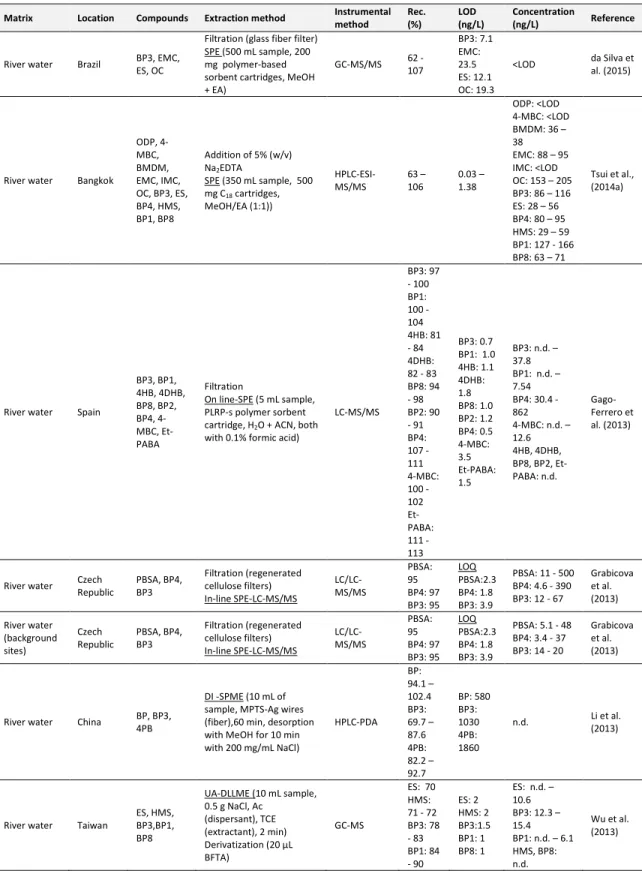
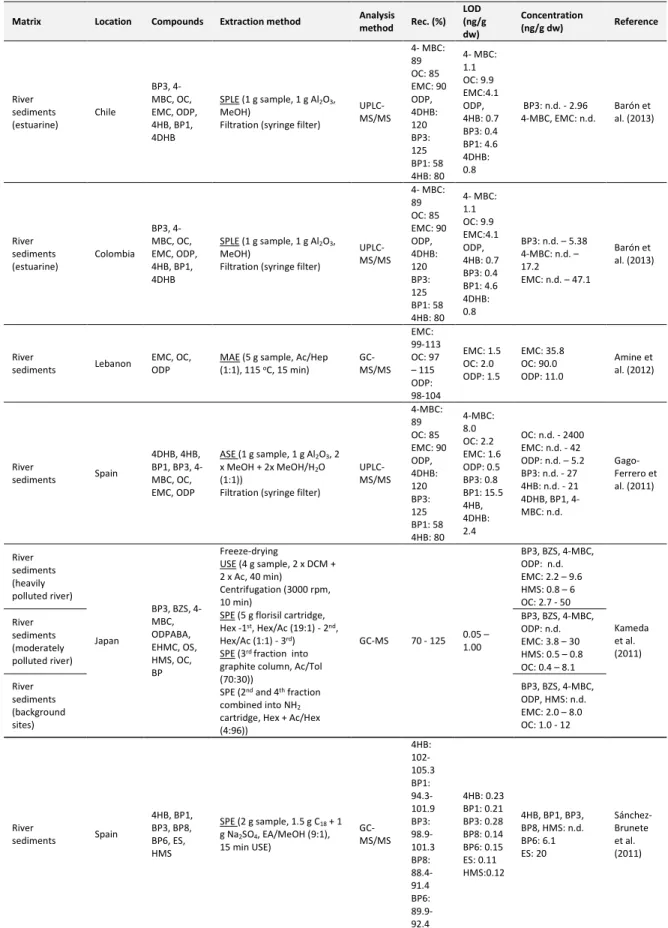
An extensive overview of UV-filters publications since 2000 was performed. Information regarding extraction and cleanup procedures, chromatographic analysis, validation parameters (limits of detection and recoveries) and environmental concentrations is presented in Tables 1 to 3.
3.1 Extraction techniques for water analysis
Extraction methods usually follow a common path involving the release of the target components from their matrices to a desirable solvent, followed by removal of the unwanted components. Although several extraction methodologies have been used to determine UV-filters in water, solid-phase extraction (SPE) is the most used (Table 1). Considering the extraction recovery yield, this method is often applied using commercial cartridges with monomerically bonded C18 silica
sorbents (Tsui et al., 2014a). This type of sorbent is able to retain the major organic analytes from aqueous solution, but it is mostly used in the extraction of moderately polar to non-polar analytes from aqueous samples (Giokas et al., 2004; Goksoyr et al., 2009; Li et al., 2007; Tsui et al., 2014a). However, polymeric reversed phase sorbents (hydrophobic), with no bonded phase or alkyl ligands, water wettable, were also used (Rodil et al., 2012; Ho and Ding, 2012). This type of sorbents is suitable for applications with target compounds over a wide range of chemical properties like the UV-filters under study (Arukwe et al., 2012; Liu et al., 2011). The high sample volumes in this procedure, usually from 100 mL (Goksoyr et al., 2009; Liu et al., 2010) up to 1.0 L (Kameda et al., 2011; Liu et al., 2011) is the main disadvantage of this technique. Because UV-filters are relatively polar, the great majority of authors use intermediate polarity solvents like dichloromethane (DCM) (Goksoyr et al., 2009; Kameda et al., 2011; Lambropoulou et al., 2002; Tashiro and Kameda, 2013) or ethyl acetate (EA) (Arukwe et al., 2012; Balmer et al., 2005; da Silva et al., 2015; Negreira et al., 2008; Poiger et al., 2004) to extract water samples. However, Rodil et al. (2012) used a more polar solvent, methanol (MeOH), which is justified by the complex mixture analysed, containing not only very polar UV-filters (like PBSA and BP4), but also other polar compounds like pharmaceuticals and herbicides. SPE is considered a good method, easy to perform and generally yields high recoveries,
12
ranging 60 to 100% (Giokas et al., 2004; Goksoyr et al., 2009; Kameda et al., 2011; Li et al., 2007; Liu et al., 2010; Liu et al., 2011; Tsui et al., 2014a). In order to obtain a better clean-up, SPE is also used coupled to other clean-up techniques, as gel permeation chromatography (GPC) (Balmer et al., 2005) with recoveries ranging 78 – 129%. SPE is usually performed off-line (i.e. prior to separation and detection), however, on-line SPE is emerging as an effective technique, coupled online with an LC system or as a fully-automated system in order to analyse organic UV-filters (Gago-Ferrero et al., 2013; Grabicova et al., 2013; Jurado et al., 2014) yielding recoveries around 100%.
Besides SPE, other approaches exist, as the dispersive liquid-liquid microextraction (DLLME) (Jeon et al., 2006; Zhang and Lee, 2012b) and solid-phase microextraction (SPME) (Lambropoulou et al., 2002; Zhang and Lee, 2012a). These methods have the benefit of being more environmental-friendly since they use small amounts of organic solvents, are usually faster and conducts to less matrix effects are less. However, sensitivity and the precision tend to be worse than commonly used SPE techniques.
DLLME is a liquid-liquid extraction (LLE), based on the relative solubility of the analytes in two different immiscible liquids. A small volume of extracting solvent (a high-density solvent) is dispersed by the action of a second solvent, the disperser (a water miscible, polar solvent). Dispersion increases the effective extraction area, obtaining fast extraction rates and high enrichment factors, as well as simplicity of operation and low cost of implementation (Ojeda and Rojas, 2009; Maya et al., 2014). The usual combinations of extractant and disperser used of UV-filters extraction are chloroform/acetone (CHL/Ac) (Benedé et al., 2014; Tarazona et al., 2010; Tovar-Sánchez et al., 2013) and tetrachloroethylene/Ac (Wu et al., 2013). Ionic liquid-based combinations like 1-hexyl-3-methylimidazolium tris(pentafluoroethyl)trifluorophosphate ([HMIM][FAP])/MeOH (Zhang and Lee, 2012b) or 1-butyl-3-methylimidazolium hexafluorophosphate [C4MIM]PF6/MeOH (Ye et al., 2011) are starting to be used, due to their
unique physical and chemical properties, such as non-flammability, negligible vapour pressure, good extractability for a wide spectrum of inorganic, organic and organometallic compounds, as well as tuneable viscosity and miscibility with water and organic solvents (Zhang and Lee, 2012a). This technique was tested in five classes of UV-filters (benzophenone, camphor, salicylate, crylene and
p-aminobenzoic acid derivatives) and conducted to high recovery rates (70-118%), using different
matrices like river, lake, sea and swimming pool waters (Benedé et al., 2014; Wu et al., 2013; Tovar-Sánchez et al., 2013; Zhang et al., 2011; Tarazone et al., 2010).
13
In SPME, a fibre coated with a stationary phase is exposed to the sample, typically until equilibrium is reached either by direct-immersion (DI) or headspace (HS) (Doong et al., 2000). Usually sampling in the headspace presents a significant advantage in terms of selectivity because only volatile and semi-volatile organic compounds can be released into the headspace. Because the fibre is not in contact with the sample, background adsorption and the matrix effect are reduced, which also enhances the life expectancy of SPME fibres (Doong et al., 2000). These fibres are reusable, unlike single-use SPE cartridges, resulting in cost savings (Wong and MacLeod, 2009). However, few types of fiber are available (e.g. PDMS, PDMS-DVB, polyacrylate (PA) and carboxen) narrowing the users choice. In order to extract the most volatile UV-filters (salicylate derivatives ES and HMS and benzophenone derivatives BP1, BP3 and BP8), Negreira et al. (2009) verified that PDMS-DVB coated fibres were the most appropriate, using a headspace assembly (relative recoveries ranging from 89 to 115%). Note that recoveries in microextraction techniques (e.g. SPME) are usually referred as relative recoveries. Liu et al. (2010) used PDMS coated fibre for the extraction of salicylate ES, benzophenone BP3, camphor 4-MBC and crylene OC, obtaining relative recoveries of 72.5 – 115%. 3-(Mercaptopropyl) trimethoxysilane (MPTS)-Ag-C12 wire was also used in a SPME
approach (Li et al., 2013), conducting to relative recoveries of 69.7 to 102.4% for benzophenone derivatives BP, BP3 and 4PB. This technique seems to be appropriate for the extraction of the most volatile UV-filters. However, when compared with SPE, the SPME procedure is limited in the method manipulation and presents a restriction in the choice of fibres.
Stir-bar sorptive extraction (SBSE), a technique related to SPME, is based on the extraction of the analytes from the liquid matrix onto a thick film coated on a magnetic stir bar. This technique is usually followed by liquid or thermal desorption (LD or TD) (Wong and MacLeod, 2009). This technique was successfully applied for the extraction of UV-filters, using stir bars externally coated with poly(dimethylsiloxane) (PDMS) (Kawaguchi et al., 2008; Pedrouzo et al., 2010; Rodil and Moeder, 2008a). This methodology has the advantage of using small sample volumes (10 to 50 mL) with extraction times from 120 to 180 minutes and 800 to 1000 rpm stirring at room temperature. Recoveries varied from 80 to 130% when thermal desorption was used (Kawaguchi et al., 2008; Rodil and Moeder, 2008a) and ranging 30 to 80% using liquid desorption (Pedrouzo et al., 2010).
Other less conventional methodologies were also applied to water samples in order to extract the organic compounds, like ionic liquid based ultrasound-assisted emulsification microextraction (IL-USAEME) (Ge and Lee, 2012) with around 100% recovery, ionic liquid-based single-drop microextraction (IL-SDME) (Vidal et al., 2010) with average recovery of 100%, non-porous
14
membrane-assisted liquid–liquid extraction (MALLE) (Rodil et al., 2009b) yielding 60 to 100% recovery, magnetic nanoparticles dispersive solid-phase extraction (MNPs-based dSPE) (Román et al., 2011) with about 70-125% recovery, microextraction by packed sorbent (MEPS) (Moeder et al., 2010) with 60 to 115% and micelle mediated extraction (MME) (Giokas et al., 2005) with average recoveries of 100%. These techniques are relatively new and their applicability to extract UV-filters from water samples has been poorly investigated. However, the results obtained so far are very promising. It is also important to remember that some of these extraction techniques have disadvantages. For example, most ionic liquids are not commercially available, being necessary to synthesize them. A similar situation can be verified with the specific sorbents used in MEPs or MNPs-based dSPE.
Water may also be indirectly analysed (passive sampling) using semipermeable membrane devices (SPMDs), which support the presence of UV-filters in lakes and rivers (Goksoyr et al., 2009). SPMDs are usually used for integrative in situ concentration of more lipophilic contaminants and measure time-weighted average concentrations of the dissolved (bioavailable) compounds (Balmer et al., 2005). These devices consist of a thin lay flat tube made from semipermeable polyethylene membranes. They are mounted on assemblies to give a spread configuration in perforated stainless steel containers and are exposed for 3 to 6 weeks at a 1 to 2 m depth. The UV-filter concentrations in the SPMDs (CSPMD, ng/SPMD) can be used to estimate the respective concentrations in water (CW,
ng/L) (Poiger et al., 2004). Extractions from these devices are usually by dialysis for 24 h and the solvents used are cyclopentane/DCM (95:5) (CYPN/DCM), CYPN or hexane (Hex) (Goksoyr et al., 2009; Balmer et al., 2005; Poiger et al., 2004). These authors studied mid-polar UV-filters (BP3, OC, 4-MBC, EMC, BMDM, 3BC) and obtained average recoveries of 42 to 110%, with the lowest values for the more polar compounds.
Fent et al. (2010) reported a similar passive sampling device, a polar organic chemical integrative sampler (POCIS) which is used with the same purpose as SMPDs. However, they are used to in situ collection of hydrophilic organic contaminants. The POCIS sampler consists of several sampling disks mounted on a support rod. Each disk consists of a solid sorbent sandwiched between two microporous membranes. For the analysis, the sorbent is removed and placed into a SPE column or empty cartridge. The UV-filters are usually extracted using more polar solvents or mixtures as MeOH and MeOH/toluene/DCM. In this specific case, Fent et al. (2010) studied four polar to mid-polar UV-filters (BP3, BP4, 4-MBC and EMC). This sampler yields good recoveries, ranging from 70 to 100%.
15
3.2 Extraction techniques for sediments and soil analysis
Information regarding occurrence and method development of UV-filters in soils and sediments is rather scarce, unlike water samples. It is worth notice that sediments and soils are extracted with similar methodologies. Usually, prior to extraction, samples are either frozen (Sánchez-Brunete et al., 2011) or freeze-dried (Gago-Ferrero et al., 2011) and homogenized. Samples are then extracted by solid-liquid techniques and sometimes cleanup with solid-phase extraction. Solid-phase techniques usually require small amounts of sample (1 to 10 g) and in these specific cases, small volumes of extraction solvents (8 to 120 mL). The extraction solvents vary in polarity from polar MeOH, intermediate polarity like DCM and Ac, to apolar Hex, depending on the target compounds. Mixtures with intermediate polarity are also used and in different proportions like Ac/heptane (Hep) (1:1) (Amine, 2012), Ac/toluene (Tl) (7:3) (Kameda, 2011), EA/Hex (8:2) (Rodil et al., 2008), EA /MeOH (9:1) (Sánchez-Brunete, 2011).
These extraction techniques yielded high recoveries like conventional solid-liquid extraction (SLE) using ultrasounds with 65 (BP8) to 125% (BP) (Jeon et al., 2006), pressurized liquid extraction (PLE) with 58 (BP1) to 128% (IMC) (Gago-Ferrero et al., 2011; Rodil et al., 2008), and selective pressurized liquid extraction (SPLE) from 85 (OC) to 125% (BP3) (Barón et al., 2013). Solid-phase extraction (SPE) used as a cleanup also yields high recoveries, ranging from 70 to 125% (Kameda et al., 2011), applied to sediments, and 88 to 105% applied to soils (Sánchez-Brunete et al., 2011). Other techniques were also used in sediments extraction like microwave assisted extraction (MAE) which is a fast, reliable method, with high recoveries from 97 to 115% (OC) and sequential extraction with high-speed dispersion tool (SEHSDT), used to analyse camphor 4-MBC (75% recovery) and benzophenone BP (90% recovery) (Ricking et al., 2003).
3.3 Chromatographic analysis
Usually, after extraction and clean-up of UV-filters, chromatographic methods are employed to both identify and quantify several components in a single analysis. Those have to be sensitive enough to detect trace levels of the potential contaminants.
Peck (2006) already described the most common analytical methods for the determination of persistent ingredients of personal care products in environmental matrices, dedicating a section to the UV-filters extraction from water, sewage sludge and fish tissues samples and also to specific details related with detection and quantification. Pietrogrande and Basaglia (2007) rewied in deep detail the GC-MS analytical methods for the determination of PCPs (UV-filters included) in water
16
matrices. Regarding liquid chromatography, Gago-Ferrero et al. (2013) thoroughly rewied the liquid chromatography-tandem mass spectrometry for the multi-residue analysis of organic UV-filters and their transformation products in the aquatic environment.Therefore, in this section a small comparision and discussion of the most commonly used chromatographic methods to determine UV-filters will be presented.
The most used chromatographic method is liquid chromatography (LC) (Oliveira et al., 2010; Rodil et al., 2008; Giokas et al., 2005; Giokas et al., 2004), since UV-filters are generally non volatile compounds (Figure 2). Reversed-phase chromatography with octadecyl-based stationary phase is the normally used, combined with mobile phases consisting of mixtures of acetonitrile (ACN), MeOH and water (H2O), with phase modifiers to improve peak shape, retention, and resolution (Zenker et
al., 2008). Good chromatographic separations are desirable, even with sophisticated detectors like mass spectrometers. Diode-array (DAD) (Giokas et al., 2005; Zhang et al., 2011) or photodiode array detectors (PDA) (Li et al., 2013) are also used coupled to HPLC. Recently, ultra-performance liquid chromatography (UPLC) has been explored for this type of analysis since it uses less solvent and provides improved speed, resolution, and sensitivity from narrower and sharper chromatographic peaks and also reduction of matrix effects during MS/MS detection (Wong and MacLeod, 2009).
When choosing the analytical method the physiochemical properties of the target analyte must be taken into consideration. More polar and less volatile compounds are usually analyzed by LC-MS, while to identify and quantify volatile or volatilizable compounds and transformation products, gas chromatography coupled with mass spectrometry (GC-MS) is the choice (Jurado et al., 2014; Rodil and Moeder, 2008), especially when resolution is essential to separate isomers or congeners (Goksoyr et al., 2009). Most studies using GC-MS method present a significant improvement in limits of detection (LODs) in the low-ng/L level (Kawaguchi et al., 2008; Weihong Li et al., 2007; Lambropoulou et al., 2002). However, an additional derivatisation step is needed as UV-filters with polar groups are not easily analysed by GC–MS due to their low sensitivity and volatility for GC (Jeon et al., 2006). In general, derivatisation reduces the polarity of the analyte, which prevents co-elution with high polar endogenous materials in complex matrices. Furthermore, the derivatisation increases the molecular weight of relatively low weight molecules. As a result, the interference of endogenous materials is prevented by increasing the retention times during the reversed-phase chromatographic run (Ho and Ding, 2012). Several reagents have been steadily developed for this purpose, such as N-methyl-N-(trimethylsilyl)trifluoroacetamide (MSTFA) (Jeon et al., 2006; Negreira et al., 2009; Zhang and Lee, 2012a), N,O-bis(trimethylsilyl)trifluoroacetamide (BSTFA) (Román et al.,
17
2011; Tarazona et al., 2010) and N-methyl-N-(tert-butyldimethylsilyl)trifluoroacetamide (MTB-STFA) (Negreira et al., 2008). These studies were conducted under high temperatures (60 oC) and
for at least 30 min of reaction time. Some authors couple extraction methods like DLLME (Wu et al., 2013) and SBSE (Kawaguchi et al., 2008) with in situ derivatisation, which seems to increase the throughput of sample analysis.
4. Occurrence in the environment
4.1 Occurrence in water matrices
The presence of UV-filters in water has been verified in tap water, natural waters (lake, river, groundwater and sea water) and swimming pool water (Table 1). Probably the increasing number of analytical methods for UV-filters enhanced the incidence of occurrence in water matrices (Figure 3).
4.1.1 Natural and tap waters
A detailed overview about the occurrence of UV-filters in natural and tap water is shown in Table 1. Distribution is analysed by type of water and per family of UV-filters.
In water bodies, UV-filter compounds can be separated into two groups since they present different mobility depending on their physicochemical properties: the less mobile molecules have significant log Kow, since they might exhibit sorption affinity with organic matter present in aquifer
sediments; the more mobile molecules might have a more hydrophilic character (Jurado et al., 2014). In fact, UV-filters like BP4, BP5, PBSA and DPDT are expected predominantly in aqueous matrices (Figure 2).
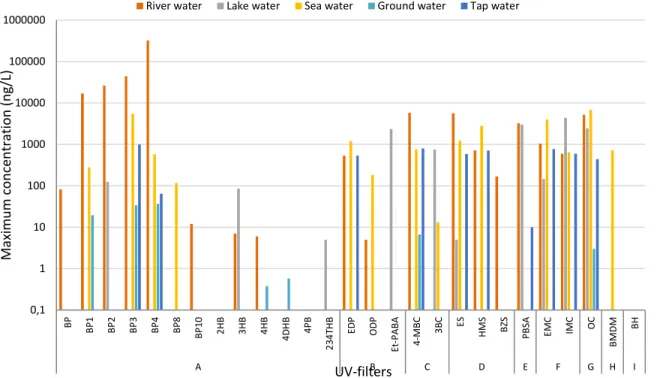
River water
River water is the matrix that shows higher concentrations and different types of UV-filters (Figure 4). The highest detected concentration was in the UK with concentrations up to 0.3 mg/L (BP4). Kasprzyk-Hordern et al. (2009) examined the presence of four UV-filters (BP1, BP2, BP3, and BP4) in water from two rivers, upstream and downstream of a WWTP. Among the studied benzophenones, BP4 was found at higher concentrations (32 – 323 µg/L) followed by BP3 (n.d. – 44
18
µg/L), BP2 (n.d. – 26 µg/L) and BP1 (9 – 17 µg/L). In Spain Gago-Ferrero et al. (2013) determined BP3, BP1, 4HB, 4DHB, BP8, BP2, BP4, 4-MBC, Et-PABA. Out of the 9 compounds, only four (BP1, BP3, BP4, 4-MBC) were found in river water, where BP4 had the highest concentration (21.3 – 862 ng/L). The above results could be explained with the high polarity and solubility in water of BP4 compared with other benzophenones (Figure 2).
In Japan, BP4 has not been studied. However, the most dominant sun-blocking agent in heavily polluted rivers is EMC, with concentrations from 125 to 1040 ng/L. This profile was consistent with those found in moderately polluted river (12 – 91 ng/L) and background river sites (18 ng/L), but not with smaller river streams where OS was up to 266 ng/L. In addition to BP4 being found in high concentrations (Gago-Ferrero et al., 2013; Kasprzyk-Hordern et al., 2008a; Kasprzyk-Hordern et al., 2009), it is possible to point other UV-filters, such as PBSA ranging from 5.1 to 500 ng/L in Czech Republic (Grabicova et al., 2013) and 48 – 3240 ng/L in Germany (Wick et al., 2010).
BP3 is also a UV-filter frequently studied and found in high concentration in rivers. It was found in Taiwan with concentrations from 12.3 to 15.4 ng/L (Wu et al., 2013) and 3 ng/L (Ho and Ding, 2012), in Switzerland from 56 to 68 ng/L (Fent et al., 2010), in the UK up to 220 ng/L (Kawaguchi et al., 2008), in Germany with 30 ng/L (Rodil and Moeder, 2008a). In Spain concentrations were found from 28 ng/L in a background river to 993 ng/L in a heavily polluted river (Negreira et al., 2009; Pedrouzo et al., 2010; Román et al., 2011).
Salicylate derivatives ES, HMS and BZS were frequently detected and in high concentrations. Román et al. (2011) found 586 ng/L of ES and 712 ng/L of HMS in samples from Spain, and Liu et al. (2010) found concentrations of ES ten times higher (5620 ng/L) in samples from China. On the other hand, BZS was only found in samples from Japan (169 ng/L) (Kameda et al., 2011).The crylene derivative OC was also often under study and higher concentrations (5180 ng/L) were found in China (Liu et al., 2010). The cinnamate derivatives EMC and IMC were also found in high concentrations ranging 21 – 1040 ng/L and 595 ng/L, respectively (Kameda et al., 2011; Román et al., 2011).
The most detected UV-filter families in river water were the benzophenone derivatives (BP, BP1, BP2, BP3 and BP4) with concentrations up to 0.4 mg/L, p-aminobenzoic acids (EDP) with 531 ng/L, camphor derivatives (4-MBC) up to 5.8 µg/L, salicylate derivatives (ES, HMS and BZS) from 169 ng/L to 5.6 µg/L, benzimidazole derivatives (PBSA) up to 3.3 µg/L, cinnamate derivatives (EMC and IMC) from 595 ng/L to 1.1 µg/L and crylene derivatives (OC) with 5.2 µg/L. Although the maximum values for benzophenones (0.4 mg/L for BP4) were found after a WWTP discharge point in the UK (Kasprzyk-Horden et al., 2009), most authors don’t mention this pollution source. Kameda et al.
19
(2011) studied a heavily polluted river in Japan were BZS and EMC were found at high concentrations. It’s worth mention that EMC is allowed in Japan at a concentration limit in sunscreens of 20% (only 10% allowed in EU) (Jansen et al, 2013). In Spain, Román et al. (2011) found the higher concentrations for IMC, EDP and HMS, whereas in Germany Wick et al., 2010 found higher concentrations for PBSA. In the µg/L range were found 4-MBC and OC in river samples from China (Liu et al., 2010).
Lake water
As previously mentioned, UV-filters enter the environment in two ways, either indirectly via WWTP effluent or directly from swimming and other recreational activities (Pal et al., 2014). Studies performed in lake water reported higher UV-filter content in samples collected during the summer. In fact, recreational activities like bathing and swimming occur most frequently in summer months, which may create seasonal variations (Rodil and Moeder, 2008a). Moeder et al. (2010) presented a study from a lake intensively used for swimming and bathing in Germany and detected 4-MBC (2351 ng/L), BP3 (83 ng/L), EMC (150 ng/L) and OC (274 ng/L). In the same conditions, but with higher range of concentrations, Rodil et al. (2009) detected 7 of the 9 compounds under study (BP3, IMC, 4-MBC, BMDM, OC, EMC and ES). OC was found in the highest concentration (4381 ng/L) and the dibenzoyl methane derivative BMDM was found in 2431 ng/L, the highest concentration among all types of water studied.
Besides the previous studies, benzophenone-type UV-filters were determined in lakes of South Korea, whose main pollution sources are indirect inputs (contaminated rivers) (Jeon et al., 2006). Out of 7 compounds under study, only 4HB showed concentrations above the limit of quantification (85 ng/L).
Balmer et al. (2005) analysed UV-filters in lakes with direct and indirect inputs and in remote locations. UV-filters were detected in several lakes, but concentrations were lower than expected, even during summer when direct inputs are supposedly higher. In fact, maximum concentrations were detected for 4-MBC and BP3 (28 and 35 ng/L, respectively). The same concentration levels were reported by Poiger et al. (2004) in midland lakes, where BP3 showed the highest concentration (125 ng/L) followed by 4-MBC (82 ng/L). In both studies UV-filters were determined using SPMDs systems. In the latest study, the concentrations measured in the SPMDs exposed during summer were generally higher than in spring, again reflecting an increased use of UV-filters (sunscreens) during this season. In the remote mountain lake, Balmer et al. (2005) detected no compounds above
20
blank levels. However, Poiger et al. (2004) reported levels around 60 ng/SPMD for EMC in a small mountain lake.
Compared to river water, fewer studies were performed in lakes and again, lower concentrations were found, which is expectable considering that sources are mainly swimming and other recreational activities. Higher concentrations were found in Germany, for camphor 4-MBC (2.4 µg/L) (Moeder et al., 2010), salicylate ES (0.8 µg/L), cinnamate derivatives EMC (3.01 µg/L) and IMC (146 ng/L), crylene OC (4.4 µg/L) and dibenzoyl methane BMDM (2.4 µg/L) (Rodil et al., 2009). It is worth mention that BMDM was not detected in any river water. Benzophenone derivatives were only found in Switzerland (BP3 at 125 ng/L) (Poiger, 2004) and South Korea (4HB at 85 ng/L) (Jeon et al., 2006).
Groundwater
Surface and groundwater bodies, used sometimes for water supply purposes, are the endpoint for some UV-filters (Gago-Ferrero et al., 2013). The presence of UV-filters in groundwater may be due to water leaks in the plumbing systems that collect wastewater (Gago-Ferrero et al., 2013). Climate conditions can also affect UV-filters entrance in groundwater since intense sun irradiation, high temperatures and high microbial activity can accelerate materials decomposition. Then, heavy rain might be able to leach chemicals and transport them directly or adsorbed on particles into groundwater (Arukwe et al., 2012). UV-filters are either not found in groundwatet (Ho and Ding, 2012; Wick et al., 2010) or found at very low concentrations (0.38 – 36.6 ng/L) (Arukwe et al., 2012; Gago-Ferrero et al., 2013; Jurado et al., 2014). Considering the mixing of the different sources that contribute to the occurrence of the UV-filters in groundwater, these concentrations are below the expected. Jurado et al. (2014) suggests that in groundwater, UV-filters might be removed under different redox conditions.
The UV-filter found in higher concentrations in groundwater was BP4, whose major inputs could be explained by its highly solubility in water and frequent use in cosmetics and as colour protector in products with translucent package (Gago-Ferrero et al., 2013).
Sea water
In sea water, apart from recreational activities and surface runoff, the major contributor to filters occurrence is probably wastewater release into the ocean (incomplete removal of organic UV-filters in WWTPs) (Tsui et al., 2014a).
21
Most sea water data comes from method development studies and takes particular emphasis in Southern Europe (Spain and Greece) and Japan. Among these studies, BP3, ES and OC appear in higher concentrations, all part of ‘the Allowed UV-filter in cosmetics list’. Tarazona et al. (2010) obtained the higher concentrations for BP3 (3300 ng/L) in samples from Alicante and BP1 (280 ng/L) in samples from Murcia, Spain. Other UV-filters such as BP8 and 234THB, which are not part of the allowed compounds in cosmetics, were also studied but they were not detected.
In a comparison study between water collected in the ocean and collected in a natural swimming pool, higher concentrations were found in the latest matrix, with BP3 ranging from 25 to 216 ng/L and EMC ranging 53 to 86 ng/L, opposed to 118 ng/L and 83 ng/L respectively from the sea water samples (Tovar-Sánchez et al., 2013). Although the difference was expected, since the dilution factor is much higher at sea, the reported concentrations are in lower concentration levels than in other studies (Román et al., 2011; Tarazona et al., 2010).
The UV-filter ES was found in high concentrations in Alicante, Spain, ranging 792-1222 ng/L (Román et al., 2011), while in Majorca (Spain) concentrations were 440 – 880 ng/L (Benedé et al., 2014). This compound, although relatively weak UV absorber has an excellent safety record, is easily incorporated into cosmetic formulations due to its aesthetics, stability, emollience and non-water-solubility, so it is widely used in many sunscreen products (Lowe et al., 1996).
Román et al. (2011) detected other 7 UV-filters in high concentrations: HMS (625 – 1030 ng/L), IMS (245 – 645 ng/L), 4-MBC (358 – 758 ng/L), BP3 (254 – 879 ng/L), EDP (409 – 774 ng/L), EMC (682 – 1187 ng/L) and OC (440 ng/L). The same compounds were detected by Benedé et al. (2014), but in a lower concentration range (220 to 390 ng/L). Vidal et al. (2010) also detected OC at 3000 ng/L, while BP3, IMC, 4-MBC, EDP and EMC were detected between 60 and 190 ng/L.
Sea water collected from beach sites revealed higher UV-filter concentration (e.g. BP3: 1258 ng/L) than reef sites (BP3: 9 ng/L). In Japan, concentrations ranged from 4.1 ng/L (ODP) to 1258 ng/L (BP3) in beach sites, while in reef sites they varied between 1.8 ng/L (ES) and 9.0 ng/L (BP3). Compounds like BZS and 4-MBC were not detected in either site. In Greece, UV-filters were not detected (Lambropoulou et al., 2002) or detected at low concentrations - 8.2 (BP3) to 19.7 ng/L (4-MBC) (Giokas et al., 2005) and 1.8 ng/L (BP3) (Giokas et al., 2004).
SPMDs devices were used to determine UV-filters in the middle of the Pacific Ocean and these levels were compared to those found in the collected sea water. Compounds were detected in concentrations between 6 and 55 ng/L in water and below LOD (0.15 – 0.51 ng/SPMD) and 34.3 ng/SPMD in the devices (Goksoyr et al., 2009). Due to the fact that UV-filters were found far away
22
from the coastal area, where direct inputs are predominant, it may indicate that they are transported via ocean currents or atmospheric transport, either long-range or short-range.
Tsui et al. (2014) determined the concentrations and spatial occurrence of twelve commonly consumed UV-filters, including BP1, BP3, BP4 and BP8, ES, IMC, ODP, BMDM, EMC, HMS, 4-MBC and OC in surface sea water samples collected in different countries, including China (Hong Kong, Shantou and Chaozhou), United States (New York City and Los Angeles), Japan (Tokyo Bay), Thailand (Bangkok) and the Arctic region. Hong Kong showed the higher concentrations (117 (BP8) to 6812 (OC) ng/L). OC was the compound found in higher concentrations among all Chinese cities. Tokyo’s highest concentration was BP4 (136 ng/L), while in Los Angeles and Shantou it was the BP3 (601 and 188 ng/L, respectively). In Chaozhou the ES was detected in higher concentration levels (128 ng/L) and in Artic was the BMDM (70 ng/L). This is the only report of the occurrence and distribution of organic UV-filters in the Arctic, for which there possible pathways are the same as for the middle of the Pacific Ocean (ocean currents or atmospheric transport).
Tap water
The presence of UV-filters in tap/drinking water has been poorly studied. Therefore, few conclusions can be drawn.
da Silva et al. (2015) investigated drinking water samples from a water treatment plant (WTP), while Ge and Lee (2012), Rodil et al. (2012) and Zhang and Lee (2013) studied samples collected in their research labs. In fact, if treatment plants are efficient, no UV-filters should be found in tap water. This was verified by da Silva et al. (2015) in a Brazilian WTP. This showed good treatment efficiencies, since reported UV-filters concentrations were below the limit of detection (7.6 – 24.1 ng/L). Regarding the tap water analysed in Singapore (Ge and Lee, 2012; Zhang and Lee, 2013) and in Japan (Kameda et al., 2011), UV-filters were not found in the collected samples. However, Rodil et al. (2012) and Román et al. (2011) from Spain found high amounts of these compounds in tap water samples – around 10 ng/L for PBSA and 4-MBC and 62 ng/L for BP4 in the first case and below LOQ (0.5 – 20 ng/L) to 160 ng/L for ES, EMC and IMC. Also in Spain, Díaz-Cruz et al. (2012) found in a slight higher range the following UV-filters: BP3, ODP, EMC and OC ranging from 110 to 290 ng/L and 4-MBC at 35 ng/L.
23
Swimming pools, as lakes, are widely used in summer for recreational activities, where UV-filters entrance is a direct input since sunscreens are often used. Higher UV-filter concentrations were found in swimming pool water samples. The maximum concentrations detected are shown in Figure 5.
Chlorination disinfection is still one of the most widely used techniques in water treatment practices, and often associated to swimming pools, because of its strong oxidation ability, lower cost when comparing to other techniques and effective persistence. However, the free available chlorine does not only kill the harmful pathogens, but may also react with some chemical pollutants that enter or already exist in the water and may possibly create poisonous and harmful by-products (Liu et al., 2014).
Ye et al. (2011) analysed four benzophenone-type UV-filters in a swimming pool water sample from China and detected concentrations as high as 4500 (BP3), 8700 (BP1), 15400 (4HB) and 18800 (BP) ng/L. BP and 4HB are not part of ‘the compounds allowed in cosmetics list (Annex VI)’ so their presence in swimming pool water is not very well understood. It’s known that BP’s are usually not directly incorporated in personal care products, but no information regarding 4HB utilization was found among literature. Therefore, their presence in swimming pools may be due to its presence in the tap or other source of water that is used to fill the pool (PROGRAM, 2006).
UV-filters were also detected in Czech Republic by Grabicova et al. (2013). PBSA (24 – 13000 ng/L), BP3 (21 – 620 ng/L) and BP4 (3.3 – 46 ng/L) were detected in the collected samples. Higher concentration levels of PBSA could be explained by its massive use as an UV-filter in cosmetic products (maximum concentration of 8% (expressed as acid) in Europe and 4% in the USA (SCCP/1056/06)). On the other hand, PBSA is highly water-soluble and chlorine plays a negligible role in PBSA degradation (Ji et al., 2013).
Nguyen et al. (2011) reported concentrations of BP3 ranging 25 – 216 ng/L and EMC from 53 – 86 ng/L in a seawater swimming pool in Italy. Other compounds were also investigated (OC, EDP, HMS and ES), but they were not detected. Limits of detection were considerably low (0.01 ng/L for EDP to 2.65 ng/L for ES) and the method combined SBSE-LD with LC-MS.
Giokas et al. (2004) obtained concentrations of 4.2 – 5.7 ng/L for BP3, 5.4 – 6.9 ng/L for 4-MBC and 3.0 – 4.5 ng/L for EMC, by SPE-GC-MS, in Greece. However, BMDM was not detected using LC-UV-DAD. Zhang and Lee (2012) did not detect UV-filters in swimming pool water, either because the analytes (BP, BP3, ES, HM) were not present or due to the high LOD of the IL-SDME - LC-UV method
24
(200 – 5000 ng/L). The UV-filter IMC was the only compound found in samples from Spain at 700 ng/L, among OC, BP3, EDP, EMC and 4-MBC, using IL-SDME and LC-UV (Vidal et al. (2010)).
UV-filters in shower waste water samples were compared with swimming pool water samples by Lambropoulou et al. (2002), where BP3 and ODP levels were higher in shower waste (8200 – 9900 ng/L and 5300 – 6200 ng/L respectively) than in swimming pool water (2400 – 3300 ng/L for BP3 and ODP was not found). In the same country (Greece), shower waste water UV-filter levels were in a lower range for BP3 (10.0 ng/L), 4-MBC (3.8 ng/L) and EMC (4.1 ng/L) (Giokas et al., 2004).
The detection range of UV-filters in swimming pool water is different from the other water matrices probably because of the different contamination sources and degradation processes. The most frequently detected compounds are benzophenones BP (18.8 µg/L), 4HB (15.4 µg/L), BP1 (8.7 µg/L) and BP3 (4.5 µg/L) (Ye et al., 2011), however, benzophenone BP4 was also found at lower concentrations by Grabicova et al. (2013) at 46 ng/L. Other compounds such as benzimidazole PBSA (13 µg/L) (Grabicova et al., 2013) and cinnamate derivatives EMC and IMC were also found at high concentrations, 86 and 700 ng/L respectively. Compounds such as ODP, EDP and BMDM were either not detected or detected at low concentrations, which may be due to the degradation processes they suffer upon contact with chlorine. Although UV-filter EMC and BP3 were found at relatively high concentrations, they also suffer degradation with chlorine (Supplementary Material).
4.2 Occurrence in sediments and soils
Although the occurrence of UV-filters in water samples has been well documented, the information regarding soil and sediments is rather scarce. So far only 8 papers regarding this subject were published since 2000 (Table 2).
UV-filters maximum concentration found in soil and sediments are shown in Figure 6. For lipophilic organic UV-filters, these matrices constitute a trapping compartment (Amine et al., 2012). Most UV-filters found in these matrices can be called hydrophobic once their log Kow are higher than
4, and their affinity to the matrices in study can be proven by their high log Koc up to 5.5, which
translates into moderate to very strong sorption to soil/sediments. Among all the UV-filters found in these solid compartments, the crylene derivative OC presented the higher frequency of detection and one of the highest concentrations. Although it was not studied in soil samples, it was found in sediments with concentrations ranging 79 and 2400 ng/g-dw (Amine et al., 2012; Gago-Ferrero et al., 2011a; Kameda et al., 2011; Rodil and Moeder, 2008b). This compound is highly lipophilic with log Kow 6.9 (Figure 2), therefore with tendency to adsorb upon sediment organic matter. It also has
25
very low water solubility (0.0038 mg/L at 25 oC), which makes lixiviation not possible, and is highly
stable and resistant to sunlight degradation (Gago-Ferrero et al., 2011a). These high concentrations in sediments can be associated with its extensive use in personal care products, especially sunscreens (Amine et al., 2012; Gago-Ferrero et al., 2011a). However, OC was not found in all studies, which suggests that the production and use profiles of UV-filters are different among countries (Barón et al., 2013).
Like the UV-filter OC, the cinnamate derivative EMC (log Kow = 5.8) was frequently studied and
detected in sediments with concentrations between 9 (Amine et al., 2012) and 101 ng/g-dw (Kameda et al., 2011). The average range concentrations of UV-filters in river/lake sediments is similar on different impacted environments: river transition zones (11-90 ng/g-dw) (Amine et al., 2012), moderately polluted rivers (0.4 – 30.0 ng/g-dw), highly polluted rivers (0.8 – 50 ng/g-dw) (Kameda et al., 2011), slightly polluted rivers (5.2 – 42 ng/g-dw, exception for OC found at 2400 ng/g-dw) (Gago-Ferrero et al., 2011a) and recreational lakes (14 – 93 ng/g-dw) (Rodil and Moeder, 2008b). River sediment samples from Korea present high concentration levels, which constitutes an exception to the tendency presented above: benzophenone derivatives BP (1520 – 9730 ng/g-dw), 4HB (18380 ng/g-dw), BP1 (500 – 2140 ng/g-dw) and benzophenone metabolite BH (530 ng/g-dw). UV-filters BP3 and BP8 were not detected in these samples (Jeon et al., 2006).
A temporal trend in sediment contamination was also shown by Amine et al. (2012), who explain that higher concentrations of UV-filters can be found in low flow conditions like the ones in the dry season, where simultaneously happens an increase in UV-filters consumption. Also Gago-Ferrero et al. (2011) tried to correlate UV-filters concentrations with total organic carbon (TOC) values of the sediments, however, no direct correlation was found.
Regarding soil samples, (Jeon et al. (2006)) detected really high concentrations of UV-filters in soil collect from residential, park, commercial and industrial areas with dense population. Concentrations found were around 820 – 16550 ng/g-dw (BP), 510 – 6950 ng/g-dw (BH), 1060 – 4910 ng/g-dw (4HB), 730 – 3880 ng/g-dw (BP3) and 500 - 4170 ng/g-dw (BP8). UV-filters BP1 and 234THB were not detected.
On the other hand, Sánchez-Brunete et al. (2011) studied salicylate and benzophenone-type UV-filters in agricultural soils amended with sewage sludge. Compounds 4HB, BP3, BP8, ES and HMS were not detected. BP1 (5.7 ng/g-dw) and BP6 (0.6 ng/g-dw) were detected at lower concentration levels.
26
4.3 Occurrence in biota
UV-filters occurrence in biota has been widely studied throughout the past years. In fact, an overview of UV-filters in aquatic biota by Gago-Ferrero et al. (2012) synthesizes the scattered information in this subject by discussing the analytical methods and levels. This section, however, intends to compile the latest results published in the past 3 years (since 2012). An overview on the occurrence for the UV-filters is presented in Table 3. Since the last review several fish species have been investigated together with, although to a lesser extent, clams, urchins, prawns, crabs and mussels.
A study carried out by Peng et al. (2015) compared the levels of wild and farmed fish species from China, detecting BP3 in both at low ng/g-dw. 4-MBC and EDP were detected at 41.5 and 52 ng/g-dw, respectively in the farmed fish species, opposed to the wild species (2.3 ng/g-dw and not detected, respectively). Similar concentrations were found in Taiwan for ES, HMS, BP3, BP1 and BP8 ranging 0.5 and 6.9 ng/g-dw for wild fish (Tsai et al., 2014). Higher levels were found in wild fish, in samples from Spain for EMC at 241.7 ng/g-dw (Gago-Ferrero et al., 2015; Gago-Ferrero et al., 2013) and from Norway for BP3 at 1037 ng/g-dw and OC at 11875 ng/g-dw (Langford et al., 2015). Besides the high concentrations of UV-filters in codfish, Langford et al. (2015) also detected levels of BP3, EMC and OC in prawns Pandalus borearis (BP3 at 68.4, OC at 23.1 ng/g-dw). Crabs (Carcinus meanas) were also under studied, but values were below the limit of detection for all compounds. In New Zealand, BP3 was detected in samples of clams (108 ng/g-dw), urchins (8.6 ng/g-dw) and fish (14.1 in the fillet and 41.0 ng/g-dw in the liver), but BP1 was not detected in either sample (Emnet et al., 2015). Samples of wild mussels (M. galloprovincialis) from Portugal were studied by Groz et al. (2014) and high levels were detected for EMC (1765 ng/g-dw), ODP (833 ng/g-dw) and OC (3992 ng/g-dw); however, compound UV-326 was not detected. These results are in a lower range of that detected by Bachelot et al. (2012), except OC which was found at higher concentrations (7112 ng/g-dw).
As shown, of all the UV-filters under study, BP3 is the most frequently found and in all type of biota (except crab, where no compounds were detected) at concentrations ranging 68.9 (urchins) to 1037 ng/g-dw (fish). However, the UV-filter OC was found at higher concentrations ranging 23.1 (prawns) and 11875 ng/g-dw (fish).
27
The present review provided comprehensive information about the occurrence and fate of UV-filters in the environment, as well as the main analytical methods to detect them. The widespread use of UV-filters in several personal care products, including sunscreens and cosmetics, household products or as industrial additives and its frequent detection in both water and sediments have raised multiple concerns. Their multiple endocrine disruptive activities make them a threat both to biota and humans.
Based in the available in vitro and in vivo toxicity studies and the levels at which they occur in the environment, UV-filters may pose a risk to freshwater ecosystems, with higher risk incidence in some hotspot areas. However, much more information is needed in order to establish a temporal effect in water and long-term exposure in biota. Also, it is known that under certain conditions UV-filters can degrade and form, in some cases, unknown by-products. These by-products may be more toxic than the parent compounds.
Due to the wide dimension of the UV-filter class and the different physico-chemical properties of these compounds, several analytical procedures have been developed so far in order to obtain a reliable multi-residue method to determine different UV-filters in a single extraction. Solid-phase extraction (SPE) has been the favorite procedure and yield to high recoveries, probably due to its simple procedure and versatitily in the sorbents and solvents that can be used. However, this technique when compared with microextraction methodologies is not environmentally friendly, considering the great amounts of solvents used and can be time consuming. On the other hand, techniques like DLLME and SPME, that are often used, need small amounts of solvents and sample and often deliver good results. Passive sampling using either SPMDs or POCIS were found to be a good method to indirectly analyse UV-filters in water, more specifically for lipophilic compounds. Extraction from these devices are mostly by dialysis and recoveries are usually high.
UV-filters were found, to date, in water bodies, soil and sediments. However, most studies have focused on the occurrence in water. In natural waters they are detected in higher concentrations in river water and are especially detected benzophenones BP1, BP2, BP3 and BP3 with concentrations up to 0.3 mg/L. There are few studies on sediments and soils, but those that exist show that benzophenones 4HB and BP were found at higher concentrations, up to 0.02 mg/g-dw. Studies on biota had already been extensively reviewed in 2012. However, a small overview was perfomerd since then. These latest studies showed that fish presents concentration levels up to 11.9 µg/g-dw for crylene OC and around 1 µg/g-dw for BP3. Other compounds such as 4-MBC, BMDM, UV-326, EMC and EDP were detected at relevant concentrations (from 10 to 200 ng/g-dw). Relevant