Inter-agent communication in a FIPA compliant intelligent distributed
dynamic-information system
Luís M. Botelho Rui J. Lopes Manuel M. Sequeira Paulo F. Almeida Sérgio Martins ADETTI/ISCTE
Association for the Development of Telecommunications and Information Techniques 1600 Lisbon Portugal
ABSTRACT
This paper describes a traffic surveillance system as a particular case of the class of intelligent distributed dynamic-information systems (IDDIS). The Traffic Surveillance System is a vision-based FIPA compliant multi-agent system that uses the FIPA Agent Communication Language (ACL) and the FIPA Semantic Language (SL). The focus of the work is inter-agent communication and coordination. We have extended the SL expressiveness with respect to the representation of uncertainty and to the representation of ad hoc MPEG7 descriptions. We propose a transport encoding format more suitable for time-constrained systems than the original textual format proposed in the FIPA specifications. We show that, within the scope of the FIPA platform, the FIPA ACL is a communication language powerful enough to achieve multi-agent coordination through communication. This work also suggests that the FIPA platform is suitable for building surveillance based applications.
Keywords: Intelligent Agents, Multi-agent communication and coordination, Intelligent Distributed Dynamic-Information Systems, IDDIS, Traffic Surveillance System, MODEST, FIPA, Agent communication language, ACL, Semantic language, SL
1. INTRODUCTION
The MODEST project [9] is an ACTS [1] European project with two distinct purposes: a development purpose and a research purpose. The development purpose is to build a vision-based Traffic Surveillance System based on a network of video cameras placed along roads, tunnels, bridges, or highways. The research purpose is to evaluate and contribute for the work of the FIPA [4] and the MPEG7 [10] standardization bodies. With this goal in mind, the MODEST project conceived the Traffic Surveillance System as a FIPA compliant intelligent multi-agent system. We have developed several aspects of the FIPA specifications [5][6] including inter-agent communication and some components of the FIPA platform.
Inter-agent communication was addressed with MPEG7 in mind, that is, the agents in the system can exchange messages containing ad hoc MPEG7 descriptions. Another concern of the project is real-time. Design options were taken considering the demanding time-constraints imposed to real-time systems.
This paper is essentially devoted to inter-agent communication and coordination although it also presents an overview of the Traffic Surveillance System.
Currently, the main goals of the Traffic Surveillance System are to detect abnormal individual behaviors (such as
"driving in zigzag"), to determine global traffic patterns (e.g., "traffic jams" and "very intense fast traffic") and to compute traffic macro indicators (e.g., statistics and pollution indexes).
In this phase of the project, the Traffic Surveillance System is composed of four cameras placed along a bridge in Brussels. There is no overlap between the visual fields of the cameras. The cameras are fixed in specified locations and, apart from the tilt resulting from strong wind, they don’t move. The cameras don’t zoom nor pan, either. This restricted version of the Traffic Surveillance System can be viewed as a distributed information management system operating in a dynamic environment. Information-management system because it does not control any sensors nor effectors; distributed because each camera is connected to several computational agents acting autonomously in separate computers; dynamic because the vehicles enter the scope of the system in unpredicted instants of time with unpredicted positions and speeds.
The Traffic Surveillance System described in this paper can be seen as an example of a class of information management systems hereafter termed Intelligent Distributed Dynamic Information Systems (IDDIS). Instead of operating over a relatively static database (as traditional Information Systems do) an IDDIS operates over dynamic physical processes. Instead of being composed of a single program that accesses and manages a single or multiple sources of information, an IDDIS is composed of several agents that access one or more information sources or distinct views of the same physical source. Besides information management, the main issues in such systems are inter-agent communication and multi-agent coordination. Figure 1 depicts the generic organization of an IDDIS.
In general, we view Intelligent Distributed Dynamic Information Systems as a class of real-time systems because it is supposed that they interact with their environment, with their peers and with their clients, in real-time.
Intelligent Distributed Dynamic Information Systems have two agent layers: the objective observation layer and the application layer.
The agents in the objective observation layer observe the dynamic process(es) and cooperate with each other to build a distributed objective high-level description of the observed process. The agents in the application layer are mostly mutually independent although they may communicate. Each of them communicates with several observation agents in order to get the information required to build its own biased view of the available information. The role of yellow pages agents is obviously very important in an IDDIS. If an application agent wants to get some specific information, first it asks the yellow pages agent what is the name of the agent that provides such information.
Examples of observed dynamic processes include highway traffic, Internet traffic, motion pictures, stock markets, plant
production processes, organizational processes and multimedia animated environments. Examples of applications include traffic surveillance, investments advising, production scheduling and diagnostic systems.
Since the MODEST is a very recent project, the preliminary test phase has just started. In this phase, the Traffic Surveillance System is tested off-line: it analyses images stored on tape captured from a single video camera.
The remaining of the paper is organized as follows. Section 2 presents the architecture of the Traffic Surveillance System. Section 3 presents the knowledge representation scheme, the inter-agent communication mechanisms and messages used in the system, and the coordination mechanism adopted. The transport level of the agent inter-communication is described in section 4. Section 5 analysis the contributions of the work to the FIPA and MPEG7 standardization bodies. Finally, section 6 shows conclusions and points directions for future work.
2. ARCHITECTURE OF THE TRAFFIC SURVEILLANCE SYSTEM
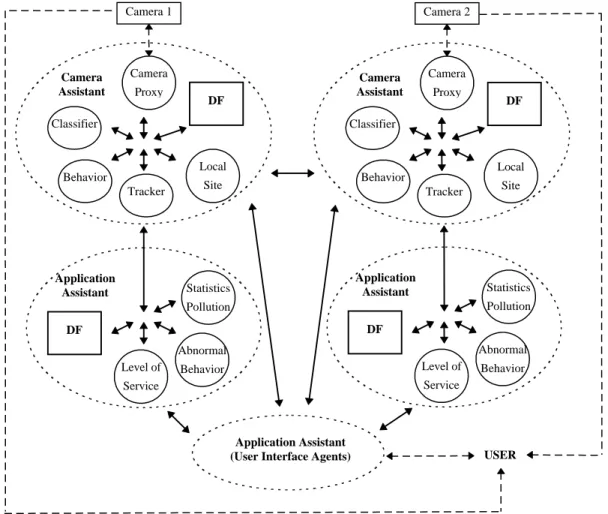
The Traffic Surveillance System is an intelligent multi-agent system in a FIPA compliant platform. The whole system is composed by a collection of agents in the objective observation layer, by a collection of agents in the application layer and by the platform agents. The platform agents perform generic tasks for the other agents: agent management tasks and agent communication tasks.
In the Traffic Surveillance System, the agents of the objective observation layer constitute the Camera Assistant subsystem; the agents of the application layer constitute the Application Assistant. Each camera has its own Camera Assistant. Some of the agents in the Application Assistant are associated to each camera whereas some others are not associated to the cameras. Besides these agents, there are other agents that belong to the FIPA Platform. These include the AMS ("Agent Management System"), the ACC ("Agent Communication Channel") and the DF ("Directory Facilitator", a yellow pages agent).
Every agent that belongs to the Traffic Surveillance System must register (advertise) its services with the DF. Any agent can ask the DF to tell it the names of the agents that perform some required task.
Camera Assistant
Each Camera Assistant has a Camera Proxy Agent (CP) that represents the camera, as seen by all other agents. As far as
other agents are concerned, all communication between an agent and the camera is made via the Camera Proxy. The Camera Proxy uses a set of software tools to analyze the digitized images from the camera and to produce high level ad-hoc MPEG7 descriptions of the images. The CP delivers excerpts of those MPEG7 descriptions to all other agents in the Traffic Surveillance System that want to receive them.
Besides the Camera Proxy, each Camera Assistant includes a Local-Site agent, a Classifier Agent, a Behavior Characterizer agent and a Tracker agent. All these agents work on objective, application independent representations of the external environment.
The Local Site Agent maintains static representations of the road pertaining to the scope of the camera to which it is associated and the region between the camera and the next one. It also maintains dynamic representations of the typical trajectories of vehicles. The typical trajectories of the vehicles are determined by the Behavior agent.
The static information about the road includes the characterization of each lane, the slope of the road, information regarding bends, information regarding legal and typical speeds, and also information used for the calibration of the camera.
The Classifier agent classifies the observed mobile objects. For the time being, there are seven classes: car, van, truck, bike, motorcycle, person and very-long-vehicle. A very-long-vehicle is possibly not a vehicle, but the effect produced by several vehicles very close to each other moving with similar speeds.
The Behavior agent computes the points of the typical trajectories of vehicles and describes the behavior of individual Figure 1 - Generic architecture of an IDDIS
Dynamic Process Objective Observation Layer Process information extraction agent Process information extraction agent Process information extraction agent Process information extraction agent Application Assistant agent Application Layer (Objective High-level Descriptions) Application Assistant agent Application Assistant agent
vehicles. Each point in a typical trajectory includes information regarding the speed and the position of the vehicle. A specific individual behavior description may be something like "very slow vehicle", "constant speed", "same lane". The Local Site agent stores information about typical trajectories computed by the Behavior agent.
The Tracker is responsible for the identification of vehicles in two consecutive cameras. It receives descriptions of vehicles in its camera and compares them with descriptions of vehicles in the previous camera. When the descriptions are similar enough, the Tracker assumes they describe the same vehicle. The Tracker also detects new and missing vehicles.
Application Assistant
The Application Assistant is composed by a set of agents, some of which are just user agents. The user agents are not associated to the cameras. Besides the user agents, the Application Assistant contains a Level of Service agent in each camera, an Abnormal Behavior agent in each camera, and some Pollution and Statistics agents.
The Level of Service agent determines the global pattern of the traffic and its tendency. For instance, one may have an
intense traffic with tendency to increase intensity (or to decrease it).
The Abnormal Behavior agent associates degrees of alarm to the behaviors of individual vehicles (determined by the Behavior agent of the Camera Assistant), using knowledge of the application domain and of the local site. For instance, it may determine that a particular observed zigzag was not an instance of dangerous behavior, but was due to a momentary obstruction of one lane.
The Statistics and Pollution agent computes several statistics and pollution indicators, such as the number of vehicles of each class that were observed in given location per hour.
There may be several types of user agents. One such agent can decide to send a MPEG4 stream to the user, showing images of an accident. Another user agent may depict a graphical representation of the global level of service in the scope of the system. For this end, it uses the information about the level of service in each camera, creates a summarized version and produces a graphical representation.
Thick arrows indicate ACL inter-agent communication. Dashed arrows indicate non-ACL communication. Small ovals represent individual agents. Large dotted ovals represent the Camera Assistant and the Application Assistant. The DF is represented as a square because it is a component of the FIPA Platform. The AMS and the ACC are not explicitly represented because there is no
explicit interaction between them and the agents of the Traffic Surveillance System. Figure 2 - Traffic Surveillance System Architecture
Statistics Pollution Level of Service Abnormal Behavior Application Assistant Application Assistant
(User Interface Agents) USER
Camera 1 Camera Proxy Local Site Tracker Classifier Behavior Camera Assistant DF Camera 2 Camera Proxy Local Site Tracker Classifier Behavior Camera Assistant DF DF Statistics Pollution Level of Service Abnormal Behavior Application Assistant DF
3. COMMUNICATION AND COORDINATION All inter-agent communication uses ACL, a speech act [14] based language. The contents of the ACL messages are expressed in extended SL (“Semantic Language”), a content language based in [13].
This section covers two main aspects related to inter-agent communication and coordination: the expressiveness of the content language and the cooperation achievement capabilities of the agent communication language.
First, the content language of the messages exchanged among agents enables the representation of ad hoc MPEG7 descriptions of complex objects such as snapshots (instantaneous view of the scene) and individual vehicles. The capability of representing such complex descriptions enables the agents to talk about arbitrary multimedia objects. We will see that the content language used enables the representation of two kinds of uncertainty: uncertainty of data and uncertainty of relations between objects. We show that the FIPA SL content language can easily be extended to exhibit the described properties.
Second, we show that the FIPA ACL language supports the implementation of a flexible and efficient cooperation achievement mechanism that enables agents to coordinate their efforts to solve global goals and that allows the addition of new agents with new capabilities. This last feature supports the flexible and modular development of increasingly complex intelligent distributed dynamic-information systems.
Extending SL: ad hoc MPEG7 descriptions and uncertainty The MODEST project adopted FIPA SL ("Semantic Language") as the content language of ACL messages. In this section, we extend the SL language to represent ad-hoc MPEG7 descriptions and uncertainty.
In the Traffic Surveillance System, data entities such as object descriptions are sent as logical terms within the contents of ACL messages.
In the lisp notation used by ACL and SL, the parenthesis around functional expressions come before the function symbol. For instance, (Car white 177 medium) would be used instead of the more usual Car(white, 177, medium). We use a special notation to represent possibly incomplete descriptions of compound objects. In this notation, a description starts with the constructor of the description type; the constructor is followed by a list of attribute-value pairs that represent the arguments of the constructor. These arguments are the components of the compound object. For instance the term (Car :position 177) is our notational convention for (Car unknown-color 177 unknown-size), in which Car is the constructor of the type car, and the constants unknown-size and unknown-color represent unspecified size and color, respectively.
Complex descriptions can also be lists of terms. We use the function list with any number of arguments to represent lists.
Any of the components of a compound object may be an uncertain term. In our extension of the SL language, we use the operator uncertain-object that takes a term and a confidence and returns an uncertain term, for instance (uncertain-object 177 0.9). The following grammar rules define the grammar of the extended SLTerms.
ExtendedSLTerm =
SLTerm | // original SL grammar
Description | Collection | UncertainTerm. Description = “(“ ConstructorSymbol ComponentSpec* “)”. ConstructorSymbol = FunctionSymbol.
ComponentSpec = “:”RoleName Value. RoleName = Word. Value = ExtendedSLTerm. Collection = “(“ “list” ExtendedSLTerm+ “)” UncertainTerm= “(““uncertain-object” ExtendedSLTerm Confidence “)”. Confidence = RealNumber.
In the proposed extension of the SL language, the special operator uncertain-proposition is used to represent uncertain propositions, for instance (uncertain-proposition (stopped obj125) 0.8). The following syntactic rules formalize this new kind of formula: ExtendedSLWff = SLWff | // original SL grammar UncertainProposition. UncertainProposition = “(“ “uncertain-proposition” SLWff Confidence “)”.
Notice that the original uncertainty modal operator defined in the SL specification does not allow to say how much uncertain an agent is about a given proposition. In application domains in which the execution of certain actions depends on the confidence the agent has on its information, it is required that confidences be quantified.
Coordination by Information-Subscription
In this section, we show that the FIPA ACL language is powerful enough to achieve coordination by communication.
In a multi-agent system, coordination is achieved if agents cooperate with each other in a constructive way to achieve global goals or to solve individual problems. Coordination can be achieved in a variety of ways, ranging from the centralized control architectures [7] to the protocol-based approach [15] and to the emergent behavior approach [11].
The coordination mechanism adopted in the Traffic Surveillance System represents a compromise between flexibility and efficiency. This mechanism is called information-subscription because it is useful for cases in which agents that need some information class from a provider agent must subscribe that information class with the provider. It is assumed that each agent in the Traffic Surveillance System registers (advertises) its services with the DF.
Following a BDI-like understanding of agents rationality [2], if an agent wants another agent to perform some action on its behalf, it must send a message that creates the intention in the receiver of performing the action that is desired by the sender. This is the basic idea behind information-subscription. This coordination mechanism has already been suggested in [3], about the register and the service protocols.
Although the intentional semantics of the FIPA ACL language has been subject to some criticism [12], it is suitable to implement the described coordination mechanism. Actually, the rational effect of the messages used by an agent to request some action from another agent is to create the intention on the receiver to perform the requested action. In particular, the query-ref performative is used to ask an agent what is the object that satisfies a given condition. This message has the desired result because, upon accepting it, the receiver becomes committed to send the requested information to the sender. The subscribe performative creates the persistent version of the intention that may be created using the query-ref performative.
In the Traffic Surveillance System, the cameras and the associated image processing algorithms extract high-level descriptions from the images. The agents of the system receive all or part of the descriptions extracted from the image by the image processing algorithms. Each time a given description is available, each agent needs to receive the parts of it that are of interest to the agent. Therefore the coordination mechanism should provide an economic but flexible way to generate persistent intentions in the mental state of the providers to send the requested information to the consumers. Any agent in the system may play the role of a provider or a consumer or both.
If an agent wants to receive some desired information, it must proceed as follows. First it asks the DF (“Directory Facilitator”) what is the agent that provides the required information. The DF replies with the name of the provider.
Second, it sends one or more inform messages to the information provider defining the relation between the information produced by provider and the information it considers relevant. This relation is represented by a function from the descriptions of the provider agent to the descriptions of the requestor agent.
Third, it sends a query-ref, a subscribe or a request-whenever message so that the provider creates the intention or the persistent intention to send the relevant information to the agent. This message requires the provider agent to apply the previously defined function to its descriptions and send the result to the requestor.
The above three steps constitute the information-subscription coordination mechanism. This coordination mechanism works with agents that have the (implicit or explicit) socially oriented meta-intention of committing themselves to perform actions that are requested by some other agent once they have accepted the request.
After an agent has subscribed some information class, it may send other messages canceling the subscription or updating the definition of the desired information.
In the remaining of this section we present a sequence of FIPA ACL messages used in a particular instance of the described cooperation achievement process.
Preliminary step. Registration with the DF
In the following message, an agent called Camera Proxy registers the capability of delivering mobile object descriptions with the DF.
(request
:sender (Agent Proxy 1) :receiver (Agent DF 1) :content (action (Agent DF 1) (register (:df-description
(:agent-name (Agent Proxy 1)) (:services (:service-description (:service-type image-description-delivery) (:service-ontology traffic-surveillance-domain))) (:interaction-protocols (list fipa-request))))) :language SL0 :ontology fipa-agent-management)
The terms (Agent Proxy 1) and (Agent DF 1) represent the name of the Camera Proxy agent and the name of the DF agent of camera number 1.
First step. Ask the DF to search the name of the provider. An agent called Classifier asks the DF to tell it the name of the agent that provides the image-description delivery service.
(request
:sender (Agent Classier 1) :receiver (Agent DF 1) :content (action (Agent DF 1) (search (:df-description (:service-type image-description-delivery)))) :reply-with (Message (Agent Classifier 1)16) :language SL0
:ontology fipa-agent-management)
In the message below, the DF informs the Classifier that, as a result of the requested search, it found that the Camera Proxy provides an image-description delivery service.
(inform
:sender (Agent DF 1)
:receiver (Agent Classifier 1) :content (result (action (Agent DF 1) (search (:df-description (:service-type image-description-delivery)))) (:df-description
(:agent-name (Agent Proxy 1)) (:services (:service-description (:service-type image-description-delivery) (:service-ontology traffic-surveillance-domain)))) :in-reply-to (Message (Agent Classifier1)16) :language SL0
The term (Message (Agent Classifier 1) 16) in the parameter :reply-with and :in-reply-to represents a unique message identifier composed by the agent identifier and by a sequential number. When the DF answers this request, it must specify the same message identifier.
Second Step. Definition of the relevant data entities. In the following message, the Classifier defines the relationship between the descriptions managed by another agent (the Camera Proxy) and the descriptions that are relevant from the Classifier’s point of view. This relationship is represented by the function ClassifierObject/1. This function is applied to a mobile object description managed by the Camera Proxy and returns a mobile object description suitable for the Classifier.
(inform
:sender (Agent Classier 1) :receiver (Agent Proxy 1) :content
(forall ?obj (=
(ClassifierObject ?obj) (Cons (MObjectSize ?obj)
(Cons (MObjectShape ?obj) null)))) :language ExtendedSL
:ontology Traffic-surveillance-domain)
MObjectSize is a function that takes a Camera Proxy mobile object and returns its size. MObjectShape is a function that takes a Camera Proxy and returns its shape.
Third step. Creation of the desired (persistent) intention in the provider.
In the following message, the Classifier tells the Camera Proxy: each time you have a new snapshot, pick each mobile object of that snapshot, apply the function ClassifierObject/1 and send me the result.
(subscribe
:sender (Agent Classier 1) :receiver (Agent Proxy 1) :content (iota ?x (exists ?snap (exists ?obj (and (last-snapshot ?snap)
(member ?obj (objectsList ?snap)) (= ?x (ClassifierObject obj)))))) :conversation-id (Message (Agent Classifier
1) 34) :language ExtendedSL
:ontology Traffic-surveillance-domain)
From this point on, the provider (i.e., the Camera Proxy) will send the relevant mobile object descriptions to the consumer agent (i.e., the Classifier).
This coordination mechanism has the following advantages. 1. The designer of an agent does not need to know what
other agents should receive the information produced by it. An agent just receives information-subscription messages. If it accepts the subscription, it must send the required information to the requestor.
2. The designer of the agent does not need to know what agents produce the required information. If an agent wants to know the name of the agent that produces the required information, it just asks the DF.
3. The information-subscription can be made only once, usually during the initialization stage of the agent existence. This is much better than having to repeat the same query to the same agent demanding the same class of information. This is a specially important issue in time-constrained systems like the Traffic Surveillance System.
All the above advantages mean we can create new application agents without having to modify the existing agents. It is worth noting that there isn’t any agent in the Traffic Surveillance System that plays the role of controlling the other agents.
As a final remark, the previous description of the coordination mechanism assumes that all agents use the same vocabulary. However, if this is not the case, an agent can first ask the OA (“Ontology Agent”, another agent of the FIPA platform) to translate the necessary concepts. This would be the first step of the information-subscription mechanism. In the current implementation of the Traffic Surveillance System, the OA has not been implemented.
4. TRANSPORT ENCODING FORMAT In the current stage of the project, it is assumed that there is a single agent platform (the MODEST platform), no inter platform interaction will occur, and no mobile agent will visit the MODEST platform. Thus, only a proprietary protocol is specified in the project for the efficient exchange of FIPA ACL messages. Two different types of requirements were defined for the protocol: transport mechanism requirements and message format requirements.
Transport mechanism requirements: • reliable and ordered delivery of messages, • low overhead.
One protocol that copes with these requirements is the TCP/IP protocol. Thus, TCP/IP Berkley sockets where used to implement the transport mechanism between agents in the MODEST platform.
Message format requirements:
• efficient coding of FIPA ACL messages,
• fast interpretation of FIPA ACL messages. Figure 3 Message data and stream structure
In order to cope with these two requirements the FIPA ACL messages are stored in a message data structure as represented in Figure 3.
In the message data structure, literal components are represented by numeric codes instead of the usual textual
Message Data Structure
format. Examples of these components are message types, predicate and function symbols, and logical operators. This representation leads to a more efficient processing of the messages.
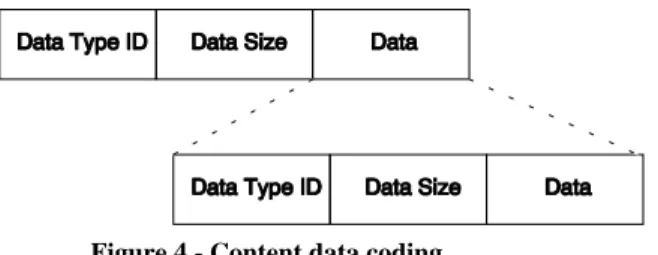
The message contents are made of ad hoc MPEG7 descriptions, propositions, actions such as other ACL messages, identifying expressions and agent names. General contents are coded as described in Figure 4.
Figure 4 - Content data coding
The message formats expressed above allow that FIPA ACL messages can be directly copied to the agent interaction stream and from the stream to the message structures, thus avoiding the computational effort of parsing textual FIPA ACL messages.
5. EVALUATION OF RESULTS
Besides the development goal of building a Traffic Surveillance System, the MODEST Project has other research goals, namely to evaluate and contribute for the proposals of MPEG7 and FIPA standardization bodies. In this section, the work reported in this paper is considered on the perspective of a contribution to MPEG7 and to FIPA.
The (yet) preliminary results obtained in the test stage of the Traffic Surveillance System show that the FIPA platform provides a suitable and natural support for building intelligent surveillance systems in particular and intelligent distributed dynamic-information systems in general. We emphasize the role of the Directory Facilitator and of the Ontology Agent. These FIPA agents are crucial to keep the systems flexible and opened. They are also fundamental from the point of view of the designer, because the agent control loop becomes simpler and more flexible.
Our experiments also suggest that the FIPA ACL and the FIPA SL are suitable for surveillance applications and provide the basis upon which to build more comprehensive languages. The information-subscription coordination mechanism was promptly defined using ACL and ExtendedSL. ExtendedSL has also shown appropriate for representing ad hoc MPEG7 descriptions and uncertainty. All messages of the system were written in ACL language with ExtendedSL contents and there was no need to create new application specific actions.
Although we have successfully used FIPA ACL language within a FIPA platform, we have found it necessary to adopt a different transport encoding format. The encoding format used is more adequate for time-constrained applications. Transported messages are shorter; the processing time required for converting transported messages into the agent internal processing format and back is shorter. The flexibility and generality of the proposed encoding format is the same as the original textual format proposed by FIPA.
We hope we can get some more quantitative and qualitative results in two or three months. We intend to compare the
expressiveness of KQML [8] with that of FIPA ACL in the scope of surveillance application. We also intend to proceed our experimentation with the purpose of acquiring relevant data regarding several transport encoding formats, including the original textual format proposed in the FIPA specifications.
6. CONCLUSIONS AND FUTURE WORK The main conclusion of our work is that the FIPA platform, the FIPA ACL and the FIPA SL provide the means to develop intelligent multi-agent systems in the surveillance domain, allowing flexible mechanisms of coordination. It also turned out that FIPA SL was easily extended to represent ad hoc MPEG7 descriptions and uncertainty.
Since we are dealing with dynamic environments, the semantic model underlying inter-agent messages should be a temporal logic. This will be one of our future research directions.
Another direction for future work is to build an ontology agent, as specified in [6], Part 12.
7. ACKNOWLEDGMENTS
This work was partially supported by the ACTS project AC 304.
8. REFERENCES
[1] Advanced Communications Technologies and Services, http://www.uk.infowin.org/ACTS/
[2] Cohen, P.R. and Levesque, H. “Intention is choice with commitment”, Artificial Intelligence, 42:213-26, 1990 [3] D’Inverno, M.;. Kinny, D.; and Luck, M. “Interaction
protocols in Agentis”. In Proceedings of the ICMAS98, p112-119, 1998
[4] Foundation for Intelligent Physical Agents http://www.fipa.org
[5] Foundation for Intelligent Physical Agents. “FIPA 97 Specification”. http://www.fipa.org/spec/fipa97.html. 1997 [6] Foundation for Intelligent Physical Agents “FIPA 98
Specification”, http://www.fipa.org/spec/fipa98.html 1998 [7] Hayes-Roth, B. “An architecture for adaptive intelligent
systems”. Artificial Intelligence, 73:329-365. 1995 [8] Labrou, Y.; and Finin, T. 2Semantics and conversations for
an agent communication language”. In Proceedings of the IJCAI97, p584-591. 1997
[9] Multimedia Object Descriptors Extraction from
Surveillance Tapes. http://www.tele.ucl.ac.be/MODEST/ [10] Moving Picture Experts Group.
http://drogo.cselt.stet.it/mpeg/
[11] Park, S.; Durfee, E.H.; and Birmingham, W.P. “Emergent properties of a market-based digital library with strategic agents”. In Proceedings of the ICMAS98, p230-237. 1998 [12] Pitt, J.; and Mandani, A. “Some remarks on the semantics
of FIPA’s Agent Communication Language”. Draft document. The Imperial College of Science Technology and Medicine. 1998
[13] Sadek M.D. “A study in the logic of intention” Proceedings of the 3rd Conference on Principles of Knowledge Representation and Reasoning (KR'92), p462-473. 1992.
[14] Searle, J.R. “Speech Acts”. Cambridge University Press, 1969.
[15] Singh, P.M. “Developing formal specifications to coordinate heterogeneous autonomous agents”. In Proceedings of the ICMAS98, p261-268. 1998