CIES e-W
ORKINGP
APERN.º 81/2009
Learning Insularity?
Social Capital, Social Learning and Staying at Home
among European Youth
DAVID CAIRNS AND KATARZYNA GROWIEC
CIES e-Working Papers (ISSN 1647-0893)
2 David Cairns has been a researcher at the Centre for Research and Studies in Sociology since May 2009. Previously, he was a Senior Research Associate in the Institute of Social Sciences at the University of Lisbon for three years. He has also worked and studied at the National University of Ireland, Galway, Queen’s University Belfast and the University of Ulster. Research activities undertaken include a study of youth and geographical mobility (2005-2008), the European Commission funded study Families and Transitions in Europe (2001-2005), and a doctoral thesis exploring sectarianism in Northern Ireland. His main research interests are in the areas of youth and migration, in particular from comparative European perspectives, with over twenty publications to date, including articles in International Migration, Journal of the Royal Anthropological Institute and Young. E-mail: [email protected]
Katarzyna Growiec has recently completed her PhD at the Polish Academy of Sciences and is now a postdoctoral researcher at the Centre for Research on Prejudice at the Warsaw School of Social Sciences and Humanities, Warsaw University. She has also recently been conducting research with return Polish migrants at the Institute of Public Affairs in Warsaw. Her main research interests include the study of social capital, social trust and migration, and is the author of numerous articles on these themes. E-mail: [email protected]
Abstract
This paper explores youth mobility in two European regions: Northern Ireland and Portugal. The original research upon which it is based focuses on two specific mobility themes: housing transitions and migration intentions. We have found that almost three quarters of the young people in both samples were living in the parental home, with a significant correlation between living at home and not wanting to migrate in the future. A number of explanations are discussed, including the importance of economic, emotional and social ties in encouraging and inhibiting youth mobility. Our analysis leads us to conclude that many of these young people have learnt to become geographically insular through a social learning process involving strong reliance on the bonding social capital created and embedded in their family relationships.
3 Learning Insularity? Social Capital, Social Learning and Staying at Home among European Youth
Recent research on geographical mobility among European youth in Northern Ireland and Portugal has discovered that not only are many young people refusing to consider transnational mobility as a strategy to further their educational and occupational development but also that the majority are living at home with their parents while they study at university – and doing so with an apparently high level of contentment (Cairns, 2008; 2009; Cairns & Smyth, 2009). Considering this outcome, it is possible to deduce that, for youth, there may be a relationship between prolonged residence in the parental home and aversion towards transnational mobility in future educational and occupational trajectories.
The finding that so many young people refuse or feel unable to leave home and subsequently prefer not to consider future international migration is perhaps unexpected in regional contexts that the same young people characterise as having limited labour market opportunities or offering job openings with insufficient economic rewards. Such results certainly fly in the face of rational action and utility-maximisation (Boswell, 2008) or the idea that highly educated young people seek to maximise their earning potential through geographically strategic educational and occupational planning.
Why young people deliberately eschew mobility and accept what may turn out to be a limited horizon of possibilities in life, particularly in respect to employment, requires some explanation. At a broader policy level, this finding also emerges at a time when the European Commission is encouraging the internal geographical movement of European youth. Encouraging youth mobility and transforming such movement from the exception into the general rule has in fact been a long-standing goal of the European Union. For instance the ew Impetus for Youth White Paper regards “youth as a positive force in the construction of Europe rather than as a problem” and sees mobility in education as “the main asset of European integration” (European Commission, 2001, p. 9). This white paper also asserts, albeit without solid evidence, that youth mobility is “becoming increasingly widespread” (European Commission, 2001, p. 55). For the Commission, success in stimulating transnational mobility, particularly amongst tertiary-educated
4 youth, is demonstrated in the take-up of its official youth mobility programmes, most notably Erasmus-Socrates. While it is estimated by the Commission that in the region of three to four million young Europeans have participated in these programmes during the last twenty years (Mairesse, 2007, p. 35), other statistics tell us otherwise – that the majority of young people are not planning to embark on/undertake transnational mobility in education or become free-moving professionals in their future working lives. For instance, analysis of Eurobarometer data from 2005 (EB 64.1) has revealed that only 12.6% of the European population aged 18-24 sampled have seriously considered migrating to another country within the next five years, although those still studying have a higher (16.7%) level of willingness to be mobile (Fouarge & Ester, 2007, p. 14-15).
The domestic culture which young people inhabit, most notably the values inherent in their parental homes, provides one explanation as to why so many of them eschew the thought of living outside their country of origin. The assumption that young people are somehow “freer” to move, that they have accumulated a lower stock of social capital and incur a lower psychosocial cost in being mobile, or that they simply feel less bound by family ties (Fouarge and Ester, 2007: 6) is evidently not substantiated among many of those studied in the present research contexts. On the contrary, what we observe is the power of social ties in young people’s lives, particularly familial relationships, to mediate and dissipate migration intentions, adding a new significance, for the study of youth transitions, to this period of prolonged residence in the parental home.
Theoretical Context
The theoretical framework adopted in this paper uses ideas from social capital and social learning theories. Specifically, resources embedded in “relations among persons” (Coleman, 1988, p. 83; emphasis in original), particularly between parents and their children, are interpreted as embodiments or generators of social capital, while housing behaviours – leaving home and managing prolonged stays in the parental home – are discussed as being socially learnt. It is worth mentioning at this point that, in the present
5 article, housing covers all forms of accommodation (e.g. family home, lodgings, student residences, shared flats).
In regard to social capital, it is important to acknowledge the importance of certain key ideas derived from studies by Granovetter (1973), Burt (1995), Portes (1998), Woolcock (2001), Lin (2001) and Beugelsdijk and Smulders (2003) and to recognise the considerable debt owed to Putnam’s notion of “connections amongst individuals” – social networks and the norms of reciprocity and trustworthiness that arise from them and his usage of the concepts of “bonding” and “bridging” social capital: the former reinforce exclusive identities and the strength of homogeneous groups while the latter support more outward looking identities and enables the formation of effective relationships across social cleavages (Putnam, 2000, p. 19-22; see also Gittell & Vidal, 1998). Bonding social capital thus denotes “ties between like people in similar situations, such as immediate family, close friends and neighbours”, whereas bridging social capital refers to “more distinct ties of like persons, such as loose friendships and workmates” (Woolcock, 2001, p. 13-14). Woolcock (2001) also discusses “linking” social capital, which relates to alliances made with sympathetic individuals in positions of power. However, as none of the respondents to the present study demonstrated any evidence of possessing such resources, linking social capital is treated as a residual category in our subsequent analysis.
Regarding the distinction between bonding and bridging social capital, we should refrain from being overly prescriptive: these are not “either-or” categories but rather “more or less” dimensions (Putnam, 2000, p. 23), and those who possess one variety of social capital may also be endowed with the other. It is also important to acknowledge that a substantial critique of social capital, and of Putnam’s work, has emerged in recent years, mentioning, for example, its failure to adequately consider gender and other possible cultural biases (Arneil, 2006). In his pioneering work on this theme, Bourdieu (1977; 1986) also places more emphasis on the relationship between social capital and social class habitus. Accordingly, the present research takes into account social class, gender and the “complex and sophisticated agency and actions of young people” (Raffo & Reeves, 2000, p. 148; see also Seaman & Sweeting, 2004; Holland, Reynolds & Weller, 2007).
6 A further pertinent issue explored within this paper is how young people learn specific housing behaviours: both living independently and in the parental home. In respect to explaining this important matter, ideas associated with Bandura’s social learning theory (see, for example, Bandura, 1977) have been employed. This entails an understanding of both living independently and inter-generationally, in terms of young people’s need to attain competence in certain key areas such as negotiating space in shared households (whether living with parents or peers), finding an affordable and appropriate home, and forming peer networks to facilitate house-sharing.
Although social learning theory has long been regarded as a powerful explanatory tool in such diverse fields as alcohol and drug abuse research (Akers, Krohn, Lanza-Kaduce & Rodosevich, 1979; Niaura, 2000), criminology (Akers, 1990), domestic violence (Wofford, Mihalic & Elliott, 1997; Haj-Yahia & Dawud-Noursi, 1998; Anderson & Kras, 2005) and sexuality patterns (Hogben & Byrne, 1998), our analysis represents perhaps the first attempt to relate social learning to youth housing behaviour. The theory itself states that:
“[…] social behavior is acquired both through direct conditioning and imitation or modeling of others’ behavior. Behavior is strengthened through reward (positive reinforcement) and avoidance of punishment (negative reinforcement) or weakened by aversive stimuli (positive punishment) and loss of reward (negative punishment). Whether deviant or conforming behavior is acquired and persists depends on past and present rewards or punishments for the behavior and the rewards and punishments attached to alternative behavior—differential reinforcement. In addition, people learn in interaction with significant groups in their lives evaluative definitions (norms, attitudes, orientations) of the behavior as good or bad. These definitions are themselves verbal and cognitive behavior which can be directly reinforced and also act as cue (discriminative) stimuli for other behavior” (Akers, Krohn, Lanza-Kaduce & Rodosevich, 1979: 638).
Peer friendships and family ties are thus potentially major sources of reinforcement in youth housing behaviour, entailing punishment as well as exposure to
7 models and normative definitions. “Rewards” in this context could be interpreted not only in literal terms, in respect to economic largess, or at least the avoidance or prevention of feelings of relative poverty, but also in terms of the maintenance of close emotional bonds and “ontological security” (Giddens, 1991) by parents and other significant groups such as siblings and peers, should the correct or normative behavioural path be chosen.
Research Context: European Youth at Home
The research discussed in this paper by no means represents the only study of prolonged youth “staying at home” to have been conducted in recent years. We have in fact become increasingly aware that young people are living with their parents for protracted periods, thanks to the work of a great number of authors (see, for example, Avery, Goldscheider & Speare, 1992; Buck & Scott, 1993; Wallace & Kovatcheva, 1998; Cherlin, Scabini & Rossi, 1997; Galland, 1997; Bendit, Gaiser & Marbach, 1999; Billari, Philipov & Baizán, 2001; Aassve, Billari, Mazzuco & Ongaro, 2002): we may even talk of the existence of a “nestling generation” (Nave-Herz, 1997, p. 673). We also know that, as with youth migration decision-making (see Cairns, 2008; 2009; Cairns & Smyth, 2009), youth housing behaviour tends to resist explanation by simple economic equations. Deciding to stay at home or leave is evidently “a complex process” (Rusconi, 2004, p. 627). Research by Ford, Rugg & Burrows (2002) shows that, despite facing challenging circumstances, some young people still leave home at relatively early ages while others stay at home when there are no material pressures or other economic obstacles.
Societal norms and values – “culturally usual and acceptable” housing behaviour (Iacovou, 2002, p. 67-68) – transmitted through families help define youth housing behaviour. Among the youth of Europe, staying on at home is most prevalent in southern Member States and Ireland (European Observatory on the Social Situation, 2006, p. 36-37; see also Iacovou, 2001) and research in these contexts points toward the importance of the family. In her study of young people in the Basque Country, Holdsworth reveals
8 how “familism” and “family solidarity” postpone home-leaving (2005, p. 549). In Italy, studies by Sgritta (2001) and Santoro (2005) note that even when young people are in employment they may continue to live with their parents as part of a postponement syndrome. These studies also demonstrate the significance of the physical assets of the parental home, alongside emotional resources, which may range from access to a quiet place in which to study to use of the family car. Therefore, while more affluent parents may have the potential to subsidise their children’s move out of the parental home, their comfortable and spacious homes also provide their children with an opulent incentive to stay.
Studies of contemporary youth home-leaving, as opposed to home-staying, experiences are thin on the ground. Some evidence does exist on specific aspects of students’ and young professionals’ housing transitions, such as how they make friends at university (Holdsworth, 2006) and manage shared-household living (Heath & Kenyon, 2001), often focusing upon different socio-economic class experiences (Patiniotis & Holdsworth, 2005). There is, however, less consideration of what compels young people to leave home in the first place, with the notable exception of Christie et al. (2002). Hence, regarding the transition to independent housing, there remains much to be explored.
Research Contexts and Methodology
The original research upon which this paper is based formed part of a research project entitled “Culture, Youth and Future Life Orientations”. The aim of this project, conducted during 2005-2008, was to examine the future life plans of young, highly-skilled and well-qualified Europeans, particularly in respect of various forms of geographical mobility. In the course of this research, young people were surveyed in two different geographical contexts: Northern Ireland and Portugal or, more specifically, the Greater Belfast and Greater Lisbon regions.
The choice of these two locations was in part inspired by prior research on education-to-work transitions, which revealed that in a study of nine different European
9 regions, Portugal had the least geographically mobile young people and Northern Ireland some of the most, which made for a potentially interesting contrast (Biggart & Cairns, 2004; Cairns & Menz, 2009). The geographical selection was also influenced by certain more pragmatic reasons, such as budgetary and time constraints, though these two regions have a number of key commonalities such as a strong historical tradition of migration and a geographically peripheral position within the European Union.
This project entailed both quantitative and qualitative investigation, although, due to space constraints, only the former is discussed in this paper. During sampling, the focus was placed on gathering data from university students. In respect to transnational mobility, while questions were asked regarding past travel experiences, the main focus was on mobility intentions rather than the study of migrants in their destination countries: the latter approach is too prone to bias due to “selectivity issues” (Fouarge & Ester, 2007: 2).
In the quantitative research phase, a questionnaire was administered to a total of 250 young people in Northern Ireland, all of whom studied at universities in and around the Belfast area, and 200 young people in Portugal, specifically those at university institutions in Lisbon. In both regions, respondents were sourced from four different academic areas: arts and humanities, social sciences, science and engineering. These samples were also balanced in terms of gender and the inclusion of ethnic minorities, though a deliberate decision was taken not to include students from courses in which geographical mobility is mandatory, e.g. languages. Accordingly, this is a study of “optional” movement (Findlay et al. 2006: 300).
Results
In the results that follow, out of a wealth of data collected on youth mobility, two key indices have been selected for specific analysis, namely intentions to migrate and present living status. These results are presented in terms of specific breakdowns both between the two regions and within samples, in respect to gender and social class.
10 Intentions to Live outside the Country of Origin
In respect to their future educational and occupational planning, respondents in both research contexts were asked if they envisaged living outside their country of origin in the future. Unlike other recent surveys, e.g. Eurobarometer 64.1, there was no time limit as to when this anticipated mobility would take place or specified locale where they anticipated going.
Table 1 Intention to Live outside Country of Origin by Region and Gender
Region Gender Live Outside Country of Origin? (%)
Yes No Belfast Male 60 40 Female 51 49 All 55 45 Lisbon Male 35 65 Female 30 70 All 32 68
Pearson chi-square level of significance = .170 (Belfast), .530 (Lisbon)
Table 1 shows that 55% of those sampled in Northern Ireland and 32% in Portugal had intentions to live outside their countries of origin in the future. A gender breakdown is also included in Table 1, although the Pearson chi-square level of significance tells us that the differences between males and females are not of major importance. Further analysis also reveals that there is no clear relationship between increasing age and wanting to be mobile, or vice versa, in either research context.
An important consideration is the impact of young people’s particular social and economic backgrounds on their orientations/attitudes. Do “affluence” or “poverty” have a stimulating effect or the potential to dissipate the desire to be geographically mobile? This relationship is explored through the breakdown of intentions to live outside the country of origin by socio-economic background, as derived from parental occupation.
11
Table 2 Intention to Live outside Country of Origin by Region and Socio-economic Background
Region Socio-economic Background Live outside Country of Origin (%)
Yes No
Belfast Skilled non-manual 54 46
Skilled manual 51 49
Semi/Unskilled non-manual 69 31
Semi/Unskilled manual 54 46
Service 60 40
All 54 46
Lisbon Skilled non-manual 32 68
Skilled manual 26 74
Semi/Unskilled non-manual 38 62
Semi/Unskilled manual 0 100
Service 23 77
All 29 70
Pearson chi-square level of significance = .720 (Belfast), .477 (Lisbon)
The outcomes presented in Table 2 reveal no clear trends. There are apparent differences within both sets of data, e.g. in the Belfast sample, we can see that those from “non-manual” backgrounds were more likely to be considering mobility, while in the Lisbon sample, no one from the “semi/unskilled manual” group envisaged themselves living outside of Portugal in the future. However, the Pearson chi-square levels of significance tell us that such differences are not significant. The small size of some of these socio-economic sub-groups, particularly in the Lisbon sample, also limits what we can read into these results, as does the fact that the socio-economic status is unknown for 6% of the Belfast sample and 25% of those surveyed in Lisbon, due to respondents having economically inactive parents.
In respect to how these results compare with previous studies, Eurobarometer 64.1 found that, in the UK as a whole, 7.9% of those interviewed had intentions to migrate within the next five years, while 4.9% in Portugal thought likewise (Fouage & Ester, 2007, p. 13). Although migration intentions registered in Eurobarometer 64.1 tended to be higher across the board among those still studying (16.7%), these earlier
12 figures are well beneath the level of migration intentions registered in the present research.
Housing Mobility
One of the key findings of this research was that, in both of the regions surveyed, almost three quarters of those sampled were found to be living in the parental home. The result was slightly higher in the Portuguese sample than among those surveyed in Northern Ireland.
Table 3 Living Status by Region and Gender
Region Gender Living Status (%)
Living with Parents Independent
Belfast Male 61 39 Female 77 23 All 70 30 Lisbon Male 76 24 Female 76 24 All 76 24
Pearson chi-square level of significance = .004 (Belfast), .884 (Lisbon)
As the preceding table illustrates, 70% of those sampled in Northern Ireland were residing at home with their parents, with the remaining 30% living in shared private or university-owned rented accommodation. It is evident that the female respondents in Belfast exhibit a stronger propensity for staying at home than their male counterparts. It may be the case that the parents of these young women socialise their children in a way that discourages them from leaving home, while encouraging males or being more indifferent, should they want to leave home (see Cairns & Growiec, 2008). In terms of social learning theory, we can interpret this behaviour in terms of the idea that, for young women, the family is a much stronger source of reinforcement and punishment, as well as
13 of behavioural models and normative definitions, than, for instance, peer groups. In contrast, for young men, the opposite may be the case. It seems that the young women in the Belfast sample tend to rely more upon their parents’ attitudes towards independent living than their male counterparts do and accept parental normative definitions of staying at home as good behaviour. Meanwhile, in the Portuguese sample, 76% of all those surveyed lived at home, with no gender difference; the subsequent qualitative research also revealed that those living away from home were more likely to be residing with another relative or a partner than living alone or with friends.
These outcomes represent a contrast with other recent work on student housing behaviour in Europe, which has suggested that staying at home is less prevalent, at least in Northern European contexts. Research conducted in both regions less than five years before found that, among young people studying, around 50% of those surveyed in Northern Ireland and 98% of those in Portugal lived at home while studying (Biggart & Cairns, 2004). While this result implies that the popularity of remaining at home has increased in the first region and decreased in the second, this impression is misleading due to the inclusion of greater numbers of respondents from younger age groups in the earlier study, namely those studying at the end of their compulsory and upper-secondary education. However, Holdsworth’s study of youth housing transitions, conducted in the Greater Merseyside area of Britain in the period 2002/2003, found that only 23% of those surveyed were living at home – largely for financial reasons (Patiniotis & Holdsworth, 2005, p. 88; Holdsworth, 2006, p. 497).
In regard to further analysis of the housing transitions in our samples, Table 4 below presents a breakdown of the respondents' residential status by region and socio-economic background.
14
Table 4 Residential Status by Region and Socio-Economic Background
Region Socio-economic Background Residential Status (%)
Living with Parents Independent
Belfast Skilled non-manual 74 26
Skilled manual 61 39
Semi/Unskilled non-manual 75 25
Semi/Unskilled manual 71 29
Service 80 20
All 70 30
Lisbon Skilled non-manual 73 27
Skilled manual 75 25
Semi/Unskilled non-manual 65 35
Semi/Unskilled manual 100 0
Service 88 12
All 75 25
Pearson chi-square level of significance = .404 (Belfast), .315 (Lisbon)
As with the class breakdown of migration intentions (Table 2), we can see that while there are differences between groups, they are not statistically significant. In regard to other pertinent statistics, contentment with living in the parental home is much greater among the Portuguese youth, with 77% agreeing that it is a good idea to live with your parents: 84% of those staying at home and 16% of home-leavers. Meanwhile, 71% of stayers in Belfast thought living at home was a good idea, as did 49% of home-leavers (Pearson chi-square level of significance = .001). That so many of those living at home are content with doing so leads us to conclude that these young people do not necessarily think of living at home as a negative condition but rather as a normal part of growing up. This finding is consistent with much of the earlier research on this theme (Jones & Wallace, 1992, p. 93; Jones, 1995, p. 1; Christie et al., 2002, p. 212; see also Kenyon, 1999).
There may also be reasons beyond the enjoyment of inter-generational cohabitation that account for this high level of satisfaction. Those living at home, for instance, were found to be significantly more likely to fear unemployment in the future: in Belfast, 55% of home-stayers and 39% of home-leavers had such concerns (Pearson
15 chi-square level of significance = .021); in Lisbon, 79% of home-stayers and 21% of home-leavers had the same anxiety (Pearson chi-square level of significance = .064). This finding is particularly interesting, and even more so in the context of Belfast, considering that the research was carried out before the recent economic crisis began in 2008, when we might have anticipated higher levels of optimism regarding the future.
Residential Status and Migration Intentions
The next step in this analysis is to examine whether we can establish a relationship between residential/living status and migration intentions.
Table 5 Residential Status and Migration Intentions by Region
Region Migration Intentions Residential Status (%)
Living with Parents Independently
Belfast Yes 65 35 No 77 23 All 70 30 Lisbon Yes 65 35 No 81 19 All 76 24
Pearson chi-square level of significance = .049 (Belfast), .015 (Lisbon)
As Table 5 illustrates, this relationship is statistically significant in both samples, though more so in the Lisbon sample, with those living in the parental home being much less likely to have migration intentions. In explaining this result, we may speculate that the strong economic and emotional base provided by continued residence with the family of origin – coupled with the ability to maintain social ties with friends who have remained where they grew up – inhibits them from imagining themselves in a scenario of transnational mobility in future educational and occupational trajectories. This finding was also made in Britain by Holdsworth, who makes the important point that, while
16 students who live at home may be “missing out” on campus life, they are also able to avoid the “sense of discontinuity” experienced by those who move away (2006: 508).
A further issue concerns the more direct impact of the presence, or absence, of immediate family members, not only parents but also siblings. If brothers and sisters have also remained at home, does this make respondents more likely to be home-stayers themselves? Furthermore, if there is a social learning dimension to home-leaving, do siblings who have left provide a housing mobility role model? The impact of these relationships is further explored in Table 6, via a series of binary linear regression statistics, with residential/living status as the dependent variable.
Table 6 Statements on Family Life by Residential Status and Region
Statement Region ß Exp (ß)
Most of my family live near me Belfast 1.083 2.955*** Lisbon 2.250 9.489*** It’s good to live at home with your parents Belfast .970 2.639**
Lisbon 1.288 3.616*** I would feel incomplete without my family Belfast .009 1.009
Lisbon .693 2.000 I need my family to support me Belfast .146 1.157 Lisbon -.347 .707 Having a good family life is more important than having a good
job
Belfast -.291 .747
Lisbon .176 1.193 My family need me to support them Belfast -.339 .713
Lisbon -.614 .541 My family would understand if I had to leave home to find a
good job
Belfast -.675 .509
Lisbon .666 1.946 I have siblings who left home to live in other countries Belfast -.376 .686
Lisbon -.974 .378* I have siblings who left home to live in other parts my country Belfast -.535 .585* Lisbon -1.221 .295** Pearson chi-square level of significance: *less than .050/**less than .005/***= .000
17 Proximity to family and positive feelings regarding staying at home are important for young people who are living with their parents. For those who have left, the presence of siblings outside the parental home and outside the country of origin is significant. These findings generally hold for both samples. Observing siblings living as such can lead to imitation or to housing behaviour modelled on this precedent. Those who have such siblings evidently regard this behaviour as good and seek to follow the example set. Moreover, at a more practical level, young people on the point of leaving can use their contacts with siblings, and also with friends who may have left their parental homes, as sources of information on, for example, where to look for a flat or house to rent (Röper, Völker & Flap, 2009). From Table 6, we can also observe what is not significant, e.g. items such as needing to support or be supported by the family or believing that having a good job is more important than having a good life. These latter findings imply that living at home is not necessarily related to material factors for these young people. Housing behaviour is rather more a question of values and norms, and feelings, which matter in respect to how to manage staying and leaving.
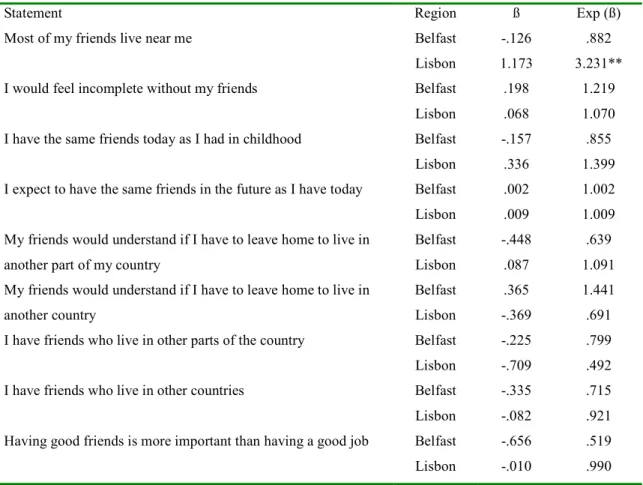
A final area of analysis concerns peer relationships. While we can see that siblings who have exited the parental home may act as mobility role models, who else may be having a decisive impact on this group's future life plans?
18
Table 7 Statements on Peer Relationships by Residential Status and Region
Statement Region ß Exp (ß)
Most of my friends live near me Belfast -.126 .882 Lisbon 1.173 3.231** I would feel incomplete without my friends Belfast .198 1.219
Lisbon .068 1.070 I have the same friends today as I had in childhood Belfast -.157 .855
Lisbon .336 1.399 I expect to have the same friends in the future as I have today Belfast .002 1.002 Lisbon .009 1.009 My friends would understand if I have to leave home to live in
another part of my country
Belfast -.448 .639 Lisbon .087 1.091 My friends would understand if I have to leave home to live in
another country
Belfast .365 1.441 Lisbon -.369 .691 I have friends who live in other parts of the country Belfast -.225 .799 Lisbon -.709 .492 I have friends who live in other countries Belfast -.335 .715 Lisbon -.082 .921 Having good friends is more important than having a good job Belfast -.656 .519 Lisbon -.010 .990
Pearson chi-square level of significance: *less than .050/**less than .005/***= .000
It is obvious from these outcomes that the quality and/or forms of friendship ties has/have little or no relationship with housing behaviour, with one solitary exception, namely, that those home-stayers in the Portuguese sample are, somewhat unsurprisingly, more likely to live near most of their friends. Clearly, in respect to housing behaviour, it is family and not friends who really matter.
Discussion: Socially Learning Insularity?
In respect to housing behaviour, despite the association we might have between growing up and wanting to living independently, for many young people in Europe today there is a seductive logic behind their prolonged staying at home if we consider the
19 immediate absence of the expense and inconvenience that would be incurred by leaving home. These home-stayers care more about maintaining their close relationships with family and long-standing friends than expanding their educational and occupational horizons by leaving home. Despite this apparently rosy picture, there may be unintended consequences, such an acquired insularity, demonstrated in an aversion to imagining a future outside their countries of origin. Failure to make the first move (out of the parental home while studying) removes the probability of there being a second move (out of the country of origin for work or further study). This is not to mention the impact on later housing market experience due to the delay in commencing a “housing career” and the missed opportunity of learning the skills of independent life at a formative age. It is difficult to see how these home-stayers will learn how to find appropriate accommodation and adapt to what may be rudimentary living conditions, not to mention profit from real estate investments. The gain from staying at home may be short-term and actually prove to be a loss in the long-term, should poor decisions or expensive mistakes be made regarding where and how to live.
Returning to the main theoretical topic of this paper, we can see that it is possible to conceptualise tight social connections, particularly between parents and children and amongst siblings, as generators of social capital, specifically bonding social capital. Looser social ties with friends and acquaintances, more closely associated with generating bridging social capital, including relationships with those who live abroad, do not for the most part have a significant bearing upon youth housing behaviour. Young people look up to their immediate family members rather than their peers in housing decision-making. Parents can reinforce the prolonged stay of their children at home, justifying or even rewarding such actions and giving them normative definitions. As mentioned previously, this does not necessarily entail a negative condition, since parents may have positive attitudes towards their children’s independence and do much to enhance their lives while they are at home. Parents today may also be better off than previous generations and be more tolerant and permissive, making prolonged home-staying a very comfortable situation (Biggart, Bendit, Cairns et al., 2002: 72; see also Sgritta, 2001, and Santoro, 2005). It is later in life, when these young people have little or no choice but to enter the housing market, that they may pay the price for not learning
20 independent living skills or not having availed themselves of opportunities that depended on geographical mobility. This is obviously a topic in need of investigation in future studies.
To conclude the discussion in the present research context, we can observe the strength of family social ties and familial social norms. The majority of young people sampled in the two regions in question are also learning to be more geographically insular in terms of their reliance upon these family ties and the bonding social capital generated in these relationships. While there are a number of contrasts between the two regions covered, the similarities are more pronounced, both for those who stay at home and those who leave, suggesting that youth housing behaviours may be shared experiences across contemporary European societies. This conclusion also implies the need for a better appreciation of the importance of local and/or family cultures in the discussion of how transnational population movements, including migration, are initiated or discouraged, rather than the trotting out of simplistic assumptions regarding young people as economic maximisers.
References
Aassve, A., Billari, F. C., Mazzuco, S. & Ongaro, F. (2002). “Leaving Home: a Comparative Analysis of ECHP Data”, Journal of European Social Policy 12: 259-275.
Akers, R. L., Krohn, M. D., Lanza-Kaduce, L. & Radosevich, M. (1979). “Social Learning Theory and Deviant Behavior: a Specific Test of General Theory”, American Sociological Review, 44: 636-655.
Akers, R. L. (1990). “Rational Choice, Deterrence, and Social Learning Theory in Criminology: The Path Not Taken”, The Journal of Criminal Law & Criminology, 81(3): 653-676.
Anderson, J. F. & Kras, K. (2005). “Revisiting Albert Bandura’s Social Learning Theory to Better Understand and Assist Victims of Intimate Personal Violence”, Women & Criminal Justice, 17(1): 99-124.
Arneil, B. (2006). Diverse Communities: The Problem with Social Capital, Cambridge: Cambridge University Press.
Avery, R., Goldscheider, F. & Speare, A., Jr. (1992). “Feathered Nest/Gilded Cage: the effects of Parental Resources on Young Adults’ Leaving Home”, Demography 29(3): 375-388.
21 Bandura, A. (1977). Social Learning Theory, Englewood Cliffs, N.J.: Prentice-Hill. Bendit, R., Gaiser, W. & Marbach, J. (1999). Youth and Housing in Germany and the
European Union. Data Trends on Housing: Biographical, Social and Political Aspects, Opladen: Leske and Budrich.
Beugelsdijk, S. & Smulders, J. A. (2003). “Bridging and Bonding Social Capital: Which Type is Good for Growth?” in W. Arts, J. Hagenaars & L. Halman (eds) The Cultural Diversity of European Unity. Findings, Explanations and Reflections from the European Values Study, Leiden: Koninklijke Brill N.V.: 147-185.
Biggart, A., Bendit, R., Cairns, D., Hein, K. & Mørch, S. (2004). Families and Transitions in Europe - State of the Art, Brussels: European Commission.
Biggart, A. & Cairns, D. (2004). Families and Transitions in Europe: Comparative Report, Coleraine: University of Ulster.
Billari, F. C., Philipov, D. & Baizán, P. (2001). “Leaving Home in Europe: The Experience of Cohorts Born Around 1960”, International Journal of Population Geography 7: 339-356.
Boswell, C. (2008). “Combining Economics and Sociology in Migration Theory”, Journal of Ethnic and Migration Studies 34(4): 549-566.
Bourdieu, P. (1977). Outline of a Theory of Practice, Cambridge: Cambridge University Press.
Bourdieu, P. (1986). “The Forms of Capital,” in J. E. Richardson (ed.) Handbook of Theory for Research in the Sociology of Education (pp. 241-258). Westport: Greenwood Press.
Buck, N & Scott, J. (1993). “She’s Leaving Home: But Why? An Analysis of Young People Leaving the Parental Home”, Journal of Marriage and the Family 55(4): 863-874.
Burt, R. S. (1995). Structural Holes. The Social Structure and Competition, Harvard University Press, Cambridge, Massachusetts and London.
Cairns, D. (2008). “Moving in Transition: An Exploration of Northern Ireland Youth and Geographical Mobility”, Young, 16(3): 227-249.
Cairns, D. & Smyth, J. (2009). ‘“I don’t know about living abroad”: Exploring Student Mobility and Immobility in Northern Ireland’, International Migration, Vol. 47(4). Cairns, D. (2009). “The Wrong Portuguese? Youth and Geographical Mobility Intentions
in Portugal”, in Fassman, H., M. Haller & D. Lane (eds) Migration and Mobility in Europe: Trends, Patterns and Control, Aldershot: Edward Elgar.
Cairns, D & Menz, S. (2007). “Youth on the Move? Exploring Youth Migrations in Eastern Germany and Northern Ireland”, in T. Geisen & C. Reigel (eds) Youth and Migration, Frankfurt: IKO-Verlag.
Cairns, D. & Growiec, K. (2008). “‘I always need my mum’: Social Capital and Student Housing Transitions in Northern Ireland”, unpublished conference paper, BSA Youth Study Group/University of Teesside Youth Research Group: Young People, Place and Class, September 2008.
Cherlin, A. J., Scabini, E. & Rossi, G. (1997). “Still in the Nest: Delayed Home Leaving in Europe and the United States”, Journal of Family Issues 18: 572-575.
Christie, H., Munro, M. & Rettig, H. (2002). “Accommodating Students”, Journal of Youth Studies 5: 209-235.
22 Coleman, J. S. (1988a). “Social Capital in the Creation of Human Capital”, American
Journal of Sociology, 94 (supplement), 95-120.
European Commission (2001). European Commission White Paper. A ew Impetus for Youth, Brussels: Commission of the European Communities.
European Observatory on the Social Situation (2006). Demographic Trends, Socio-Economic Impacts and Policy Implications in the European Union, Brussels: European Commission.
European Values Survey (2006). European Values Survey 1999/2000. Sourced: http://zacat.gesis.org/webview/index.jsp
Findlay, A., King, R., Stam, A. & Ruiz-Gellices, E. (2006). “Ever Reluctant Europeans. The Changing Geographies of UK Students Studying and Working Abroad”, European Urban and Regional Studies 13: 291-318.
Ford, J., Rugg, J. & Burrows, R. (2002). “Conceptualising the Contemporary Role of Housing in the Transition to Adult Life in England”, Urban Studies, 39, 2455-2467. Fouarge, D. & Ester, P. (2007). Factors Determining International and Regional
Migration in Europe, Dublin: European Foundation for the Improvement of Living and Working Conditions.
Galland, O. (1997). “Leaving Home and Family Relations in France”, Journal of Family Issues 18(6): 645-670.
Giddens, A. (1991). Modernity and Self-Identity, Cambridge: Polity Press.
Gittell, R. & Vidal, A. (1998). Community organising: Building social capital as a development strategy, Thousand Oaks, CA: Sage.
Granovetter, M. (1973). “The Strength of Weak Ties”, American Journal of Sociology, 78, 1360–1380.
Haj-Yahia, M. M. & Dawud-Noursi, S. (1998). “Predicting the Use of Different Conflict Tactics Among Arab Siblings in Israeli: A Study Based on Social Learning Theory”, Journal of Family Violence, 13(1): 81-103.
Heath, S. & Kenyon, L. (2001). “Single Young Professionals and Shared Household Living”, Journal of Youth Studies 4(1): 83-100.
Hogben, M. & Byrne, D. (1998). “Using Social Learning Theory to Explain Individual Differences in Human Sexuality”, Journal of Sex Research, 35(1): 58-71.
Holdsworth, C. (2005). “‘When are the Children Going to Leave Home!’ Family Culture and Delayed Transitions in Spain”, European Societies 7(4): 547-566.
Holdsworth, C. (2006) “‘Don’t You Think You’re Missing Out, Living at Home?’ Student Experiences and Residential Transitions”, The Sociological Review 54(3): 495-519. Holland, J., Reynolds, T. & Weller, S. (2007). “Transitions, Networks and Communities:
The Significance of Social Capital in the Lives of Children and Young People”, Journal of Youth Studies, 10, 97-116.
Iacovou, M. (2001). “Leaving Home in the European Union”, Working Papers of the Institute for Social and Economic Research 2001-18, Colchester: University of Essex. Iacovou, M. (2002). “Regional Differences in the Transition to Adulthood”, The Annals
of the American Academy 580: 40-69.
Lin, N. (2003). Social Capital: A Theory of Social Structure and Action, Cambridge: Cambridge University Press.
Mairesse, P. (2007). “Impact of the White Paper on European Youth Policies”, Forum21: European Journal on Youth Policy 9(6): 34-40.
23 Nave-Herz, R. (1997). “Still in the Nest: the Family and Young Adults in Germany”,
Journal of Family Issues 18(6): 671-689.
Niaura, R. (2000). “Cognitive Social Learning and Related Perspectives on Drug Craving”, Addiction, 95(1): 155-163.
Portes, A. (1998). “Social Capital: Its Origins and Applications in Modern Sociology”, Annual Review of Sociology, 24, 1-24.
Putnam, R. D. (2000). Bowling Alone. The Collapse and Revival of American Community, New York: Touchstone.
Raffo, C. & Reeves, M. (2000). “Youth Transitions and Social Exclusion: Developments in Social Capital Theory”, Journal of Youth Studies, 3, 147-166.
Röper, A., Völker, B. & Flap, H. (2009). “Social Networks and Getting a Home: Do Contacts Matter?”, Social etworks, 31(1): 40-51.
Rusconi, Alessandra (2004). “Different Pathways out of the Parental Home: A Comparison of West Germany and Italy”, Journal of Comparative Family Studies 35(4): 627-649.
Santoro, M. (2006). “Living with Parents. A Research Study on Italian Young People and their Mothers” in C. Leccardi & E. Ruspini (eds) A ew Youth? Young People, Generations and Family Life, Ashgate: Aldershot.
Seaman, P. & Sweeting, H. (2004). “Assisting Young People’s Access to Social Capital in Contemporary Families: A Qualitative Study”, Journal of Youth Studies, 7, 173-190. Sgritta, G. (2001). “Family and Welfare Systems in the Transition to Adulthood: An
Emblematic Case Study”, Working Papers of the Institute for Social and Economic Research 2001-18, Colchester: University of Essex.
Wallace, C. & Kovatcheva, S. (1998). Youth in Society. The Construction and Destruction of Youth in East and West Europe, Houndmills: Macmillan.
Wofford Mihalic, S. & Elliott, D. (1997). “A Social Learning Theory of Marital Violence”, Journal of Family Violence, 12(1): 21-47.
Woolcock, M. (2001). “The Place of Social Capital in Understanding Social and Economic Outcomes”, Isuma: Canadian Journal of Policy Research, 2, 1-17.