o
COURNOT ON MECHANICS 1826-1834, ESPECIALLY USING INEQUALITIES
I. Grattan-Guinness Middlesex University - England (aceito para publicação em janeiro de 2005)
Resumo
Durante um período no final de seus 20 e início de seus 30 anos, Cournot dedicou muita atenção a problemas de mecânica. Ele escreveu sobre aspectos relativos à mecânica celeste e à engenharia mecânica; mas seu estímulo principal era aplicar programação linear (como chamamos agora), que tinha sido criado recentemente por Joseph Fourier, em algumas situações mecânicas padrões. Porém, apesar de sua riqueza, este novo tópico não ganhou atenção geral (seu desenvolvimento mesmo só data do final da década de 1940). Em particular, Cournot nunca a usou em seu desenvolvimento da economia matemática do final dos anos 1830, embora os dois tópicos tenham importantes noções em comum, especialmente a noção de convexidade.
Palavras-chave: Cournot, programação linear, mecânica
Abstract
For a period in his late twenties and early thirties Cournot gave much attention to problems in mechanics. He wrote on aspects of celestial and engineering mechanics; but his main stimulus was to apply to some standard mechanical situations linear programming (as we now call it), which had recently been created by Joseph Fourier. However, despite its richness, this new topic did not gain general attention (its proper development dates only from the late 1940s). In particular, Cournot never used it in his development of mathematical economics from the late 1830s, even though the two topics have important notions in common, especially convexity
Keywords: Cournot, linear programming, mechanics
Publicação Oficial da Sociedade Brasileira de História da Matemática
o 1. Cournot: Student and Reviewer
Antoine-Augustin Cournot was born in 1801 at a time of major reforms of higher education in France. The first important part had centred upon the creation of the new Ecole Polytechnique in 1794 and the remodelling of the engineering Eccles d’application. The second and clearly inferior part began only with a decree of 1808, which established the strangely named Université Impériale de France, with the country divided into arrondissements, each under an académie (again so-called) to administer the primary and secondary schools and also to provide higher education in facultés of science, medicine, law, letters and theology. In addition, an elite Ecole Normale was set up in Paris outside the académies, with its own Facultés of science and letters. Cournot passed his entire professional career within this system, studying at the Ecole Normale for a year until its closure in 1822 and advancing in 1829 to a doctoral degree within the Université. In §3 I treat one of the theses and some surrounding papers, which showed his strong interest in a novel approach to mathematics described in §2. Then §4 records some other papers of this period and his other thesis, which also lay in mechanics but in more orthodox ways.
Most of Cournot‟s papers were published in a remarkable enterprise: the Bulletin universel des sciences et de l’industrie, a comprehensive review of the world‟s literature in science, medicine, technology, business, and some humanities. After a preliminary run in 1823 under a somewhat different title, it appeared from 1824 to 1832 in eight parallel series under the general direction of the naturalist André Etienne Just Paschal Joseph François d‟Audebart, baron de Ferrusac (1786-1836). From 1826 to 1831 Cournot contributed both his own short papers and reviews of others‟ work to the series sciences mathématiques, astronomiques, physiques et chimiques. Its two principal editors were his fellow normalien the physicist and textbook writer J.F. Saigey (1797-1871) and the brilliant young Swiss immigrant mathematician Charles Sturm (1803-1855); their own reviews sometimes overlapped in content with Cournot‟s.1 As well as the intellectual interest, the work might have brought him some income.
In addition to the items in and around mechanics to be cited below, Cournot wrote dozens of other reviews of material from the German and French literature. His range included not only mechanics but also mathematical analysis, algebra and number theory, and several branches of physics, especially meteorology, hygronomy and magnetism. He also reviewed, sometimes at length, recent issues of journals, especially two newcomers: the Journal für die reine und angewandte Mathematik, founded in Berlin by the engineer August Leopold Crelle (1780-1856), which at once had set an impressive standard (Eccarius 1976); and the Exercices de mathématiques of A.L. Cauchy (1789-1857), editor and sole author. He used „A.C.‟ as his signature; maybe he contributed still other reviews anonymously.
1
Despite its importance, the Bulletin has been little studied; (Taton 1947) comprises a useful survey of the mathematical contents of this seers. The whole project had to close in 1832 because the government cancelled all the subscriptions for which it was responsible, and thus demolished the economic base of the journal.
o
2. Fourier’s ‘New Type of Calculus’
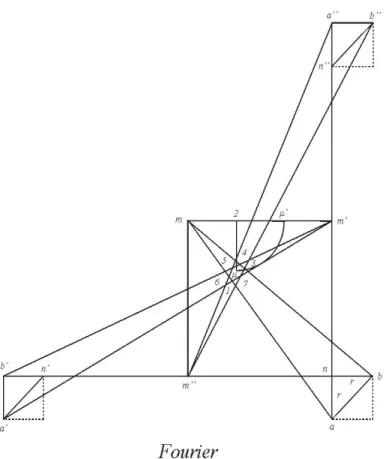
One of the most eminent French mathematicians of that time was Joseph Fourier (1768-1830), a secrétaire perpétuel of the Académie des Sciences, renowned for his pioneering analysis of the diffusion of heat in bodies and fluids, and for a method of solution of the differential equations involved by trigonometric series of a type that later was to carry his name (Grattan-Guinness 1990, esp. chs. 9 and 12). In the 1820s he also launched a project of an entirely different kind: to supplement the solution of mathematical problems by equations with solution using also linear inequalities. His vision was quite general, in that in principle any area of mathematics was susceptible to this treatment. He also envisaged a geometrical means of solution, representing equations and inequalities by lines and half-planes respectively and exhibiting a convex polygonal region of possible solutions, which could (not) be reduced to specific solutions by imposing some condition for optimisation.
o
Figure 1 shows an example published in (Fourier 1826), without reference to any particular application; the region sought is the small central polygon marked „μ‟. To a modern mathematicians this diagram and the related procedure belong to linear programming; and indeed Fourier had conceived of this subject 120 years before its proper launch. However, despite his general reputation and enthusiasm for his new idea, he gained little response from his colleagues; among other reasons (which are discussed in Grattan-Guinness 1994), effective means of solution need a good theory of matrices, which then barely existed.2
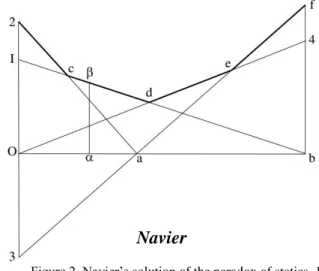
The only follower of note was Fourier‟s fervent disciple Claude Navier (1785-1836), who took up one of his examples: the perplexing fact that if a rod rests in equilibrium on three or more supports placed upon a secure base, then the loads on these supports cannot be calculated; for only two independent equations apply, those balancing forces and moments. (A version of the paradox in three dimensions occurs when, for example, a chair in equilibrium has more than three legs.) To solve this „paradox of statics‟ Euler and other discussants of the 18th century had had to make further assumptions, usually concerning properties of the elasticity of the rod (or chair); but (Navier 1825a) now followed Fourier in introducing inequalities stating as extra conditions that the loads had to be positive, and less than the respective breaking loads. Figure 2 from a sequel paper (Navier 1825c) shows his representation, where the concave region shows possible solutions.3
Figure 2. Navier‟s solution of the paradox of statics, 1825.
2 However, fellow enthusiasts for the history of lost opportunities might muse over the evidence given in
(Grattan-Guinness 1994, 66-68),
3 Both Fourier and Navier published somewhat more on inequalities than the items cited here; see
(Grattan-Guinness 1994, 48-52). The only other figure to take an active interest was Cournot‟s exact contemporary the Russian mathematician Mikhail Ostrogradsky (1801-1862), who spent those years in Paris and applied inequalities to aspects of mechanics after his return to Saint Petersburg. J.D. Gergonne (1771-1859), another major figure in the Université, claimed priority for the use of inequalities in mechanics (Gergonne 1826); but he was quite uninfluential.
o
Attracted to this novelty, Cournot began a crusade for its merits in Ferrusac. He may have written the short review (Anonymous 1827) there of Fourier‟s paper; and he signed a survey article (1826c) on Fourier‟s initiative and Navier‟s application. Soon afterwards he treated an important case which had been emphasised by Fourier: the „extension of the principle of virtual velocities to the case where the conditions of connection of the system are expressed by inequalities‟ (Cournot 1827b). This principle was a cornerstone of the analytical mechanics as established in the late 18th century by J.L. Lagrange (1736-1813), equating to zero the sum of the products of forces P after infinitesimal displacement dp from equilibrium. Lagrange had stated it without proof, and several had been offered by followers (Lindt 1904). Again Fourier replaced it by an inequality:
∑ P dp ≤ 0, (1)
since, as Cournot put it, „if a material point is simply placed on a surface having for equation z = f (x,y )‟ z positive; then „z > f (x,y ) will be the algebraic expression of the place in which the point stays contained, or of the connection to which it is subjected‟ (Cournot 1827b, 166: here and elsewhere he made clear that „>‟, and also „<‟, included the cases of equality). He went on here to elaborate various versions of (1) in the form of inequalities, some including of multiplier terms to express the connections, and opened up an interesting range of possibilities which however were long ignored.4 But soon he had a related story to tell the Université.
3. Cournot’s First Doctoral Thesis
3.1 The doctoral process. An innovation in the Facultés of the Université was the manner of awarding doctoral degrees. The candidate was required to submit two essays, of which at least one had to be printed in full, the other maybe in more summary form. They were submitted to the Faculté involved, and read by the appropriate professors, usually on different days; then verbal examinations were held, after the second of which the professors voted for decision.
Cournot submitted his theses to the Faculté des Sciences of the Académie de Paris of the Université Royale de France. The first thesis, printed as (Cournot 1829a, 1-32), was defended on 17 February 1829; the second, summarised in (Cournot 1829a, 33-36), was examined a week later. The professors involved were Cauchy, S.F. Lacroix (1765-1843), J.B. Biot (1774-1862), S.-D. Poisson (1781-1840), L.B. Francoeur (1773-1849), and L. Lefebure de Fourcy (1785-1864?), a polytechnicien who had been one of the first mathematicians to take the doctorate in the Faculté. They decided by majority to award the degree.5
4 On this theme see (Franksen 1981); and on the partly related history of non-linear programming, see (Kjeldsen
2000).
o
In this section we are concerned with the first thesis; the second one is treated in §4.2. Cournot quickly reprinted it in 1830 in Crelle‟s new Journal. He was one of the first French mathematicians to publish there, and I shall cite this version, (Cournot 1830b), as the more accessible. He followed it with a two-part supplement in the journal (Cournot 1830b, 1832), the ensemble totalling around 60 pages.6
3.2 Cournot’s thesis and the two supplements. Cournot applied to dynamics the idea of indeterminacy exemplified by the paradox of statics. Presumably stimulated by Poisson‟s lecture courses in mechanics at the Faculté and the Ecole Normale, he took from Poisson‟s Traité de mécanique (1811, Book 3, ch. 6) the case of „the motion of a rigid body, sustained upon a fixed plane‟. As he explained by way of example (Cournot 1830b, 133),
If the body is not supported on more than three points, or on more than two in a straight line, one has the number of equations sufficient to determine separately all the unknowns of the problem; that is, the six elements of double motion of translation and rotation, and the pressures suffered by the plane. If, on the contrary, the number of points of support exceeds those which were just mentioned, the equations formed by the principle of d‟Alembert well suffice to determine the six elements of motion, but not to assign the individual values of the pressures: [a] fact which is absolutely similar to what one observes in all the analogous questions of mechanics.
The thesis contained analyses of several cases of gradual force and of percussion applied to the body, in which inequalities were used to supply further information. In order he tackled a polyhedron resting on a face (pp. 136-138); a body moving after pressure is applied at one, two or three vertices (pp. 138-142); and a body with a smooth surface rolling upon the plane, maybe about a curved edge (pp. 142-144). Then he took cases of percussion: upon an apparently polygonal body resting upon one, two or three points (pp. 144-152); a circular cylinder sitting upon its circular base and susceptible to turn and roll along its base (pp. 152-153); and a body sliding after impact received through its centre of gravity, and maybe turning about an edge or even lifting off the plane (pp. 154-162). An unsigned review of the paper appeared in Ferrusac (Anonymous 1829); since the original thesis version was cited, it might have been written by its author.
In the supplements Cournot considered the effects of friction, which had been treated before only in passing. In the first one, which was completed in June 1829, he considered a body resting with one point of support and subject to both rolling and sliding friction (Cournot 1830c, 223-229). One of his later examples partially drew upon the recent study (Poisson 1826a) of the motion of cannon after firing a shot (pp. 233-236); in the same spirit he treated the motion of a homogeneous sphere, which he was able to generalise to some kinds of solids of revolution (pp. 236-242). Finally he took a case where sliding friction vanished and lift-off might occur (pp. 242-249). At various places he considered continuity, especially in one intriguing passage where he followed Poisson in regarding
6 No correspondence between Cournot and Crelle exists in Crelle‟s Nachlass in the archives of the Akademie der Wissenschaften der Berlin-Brandenburg (Eccarius 1974, 204-210).
o
percussion as a „sum‟, or sequence, of pressures executed over a very short period of time (p. 248).
In the second supplement (Cournot 1832) treated in some detail the effects of striking a cuboid. Naming the separate coefficients for the two cases of friction, he formed the inequalities suitable to represent the four possibilities: no motion at all; slide along its base; turn about an edge; and both slide and turn.
3.3 Limitations and consequences of the theory. Although Cournot stressed the algebraic character of the theory (1830b, 135) rather than the all-embracing algebra of Lagrange‟s approach to mechanics, much of his analysis consisted of adroit manipulations of the formulae. He did not use inequalities as novelly as had Fourier and Navier, who were never cited; no diagrams like Figures 1 and 2 adjoined the text. The inequalities were used valuably, but only to express properties such as positive values of pressure on supports, or that forces of motion surpassed (or not) those of resistance or friction. Thus while he published more on Fourier‟s initiative than anyone else, he did not advance it theoretically. As was mentioned in §2, the new tradition soon lapsed into obscurity. In particular, when in 1833 Poisson published the second edition of his treatise on mechanics, he did not mention Cournot‟s work in the revised version of the motivating chapter (Poisson 1833, Book 4, ch. 6), even though he seems to have had good relations with Cournot in their common concerns with the Université.7
Another non-student was the economist Cournot. Only a few years were to pass before he started to publish on that subject (Cournot 1838); moreover, in his theory of supply and demand curves he was to deploy optimisation, inequalities, and convex and concave curves, and he also alluded to various branches of mechanics (for example, capillarity and hydrodynamics). Nevertheless, he did not even cite in passing the new approach to mathematics which had so caught his enthusiasm some years earlier; Cournot seems to have forgotten Cournot.8
4. Cournot’s other Interests in Mechanics
In this section I note Cournot‟s contemporary researches in branches of mechanics where inequalities played little or no role. Once again, most of the material was articles or reviews in Ferrusac.
4.1 Hydrodynamics. During the 1820s Navier made important contributions to elasticity theory and fluid flow, which however were to be challenged by Poisson and somewhat eclipsed by Cauchy, in a three-way dispute nasty even by Parisian standards (Grattan-Guinness 1990, ch. 15). Cournot reviewed three of Navier‟s later papers. On (Navier 1825d) on the flexure of rods, (Cournot 1826a) stressed Navier‟s motivation from construction engineering. From a summary (Navier 1825b) of the third paper on the motion
7
From 1816 until his death in 1840 Poisson was a member of the governing Conseil of the Université. During the time of his declining health Cournot substituted for him sometimes (see, for example, Cournot 1839).
8 The same remark applies to his later judgement on mechanics, that Lagrange „belonged with all the geometers of
o
of viscous fluids (Cournot 1826b) wrote out the equations for incompressible fluids which have become named after Navier and (the later work of) the British mathematician G.G. Stokes (1819-1903),9 and also recorded Navier‟s use of Fourier series for his solution. Finally, when the Académie des Sciences published the full version (Navier 1827) of that paper, (Cournot 1828d) noted the contrast between his non-molecular treatment of fluids and the ambitious molecularist programme led by P.S. Laplace (1749-1827), which was then waning (Grattan-Guinness 1987).
Cournot then gave his own „Observations on the conditions of the equilibrium of fluids‟ (1828c). Noting d‟Alembert‟s warnings (1768) on the difficulties of establishing the equilibrium of fluid body, especially that assuming that the expression in (1)1 admitted a potential (to use the modern name) may be necessary but is not sufficient, he criticised d‟Alembert‟s argumentation and followed Euler‟s use of potentials. While nothing new appeared in this paper, it was a useful survey, and connected to a greater interest in mechanics of that time which we consider next.
4.2 Equipotential surfaces. Research into the characteristics of these surfaces was one of Poisson‟s principal preoccupations during the mid 1820s, when he extended some of the classic results of Lagrange and Laplace with new properties of the Legendre functions (as they are now known) and also deployed the integral now named after him which carries a quadratic form in its denominator. One issue was a dispute with the Scottish mathematician James Ivory (1765-1842). He had produced some nice theorems in potential theory (Craik 2000); but now, when analysing the shapes in which ellipsoids could rotate in equilibrium, he slipped in insisting that such surfaces could intersect. Following the study of isotropic pressure due to Aléxis Clairaut (1713-1765), Poisson argued against Ivory in various papers in Paris journals and in the London-based Philosophical magazine (Grattan-Guinness 1990, 1190-1195).
Ferrusac‟s journal followed this discussion and its attendant mathematics quite closely. In a very rare appearance there, (Lacroix 1825) reviewed (Ivory 1824) on equipotential surfaces and gave a nice historical review of work by Clairaut, Euler and others, showing how Ivory‟s argument for intersection could not be maintained. Then (Cournot 1827c) reviewed (Poisson 1826b) on spheroids and reviewed the properties of Legendre functions, especially the expansion in power series and the satisfaction of Laplace‟s equation. An „addition‟ (Poisson 1828b) to that paper appeared, and (Cournot 1829d) praised its new criticism of Ivory‟s suggestion, referring back to Lacroix‟s analysis. This attack provoked (Ivory 1829) to a reply in Philosophical magazine, where he charged both Poisson and „the author in the Bulletin ‟ of inconsistency in analysing the attractions of portions of the bodies of each other: an anonymous reviewer (1830) in Ferrusac declined to go once again through the details.
Cournot rehearsed some of this material in his second Université thesis, in a summary account printed after the first thesis (1829a, 33-36). He went through the basic
9 In fact the name „Navier- Stokes equations‟ is unhappy, since the two men used different models and indeed
produced different equations which however reduce the same for incompressible fluids (Grattan-Guinness 1990, 986-988).
o
features of the theory on the existence of potentials, attraction of bodies to external points, shapes of equilibrium, and the recent discussion between Ivory, Poisson and some other recent authors. The main part was a set of „remarks‟ on Ivory‟s position, and also on his own recent note (1828c) on the equilibrium of fluids (§4.1). He also rehearsed the argument in a short article (1829b) in the new Annales des sciences d’observation which Saigey had launched with a colleague after departing from Ferrusac (but returning in 1830 after its short life).
4.3 Mathematical astronomy. Poisson was also writing on various aspects of celestial mathematics, including in (1828a) a reply to the Italian mathematician Giovanni Plana (1781-1864) on the orders of supposed smallness of certain terms in the expansions of co-ordinate functions: in a short review (Cournot 1829c) accepted Plana‟s caution. He did not partake in another dispute of that time, much discussed in Ferrusac: the definition of the invariable plane of the motion of a system of planets (that is, the plane relative to which the sum of moments about any plane normal to it is zero). As editor (Saigey 1829) pointed out in his own reflections, Louis Poinsot (1777-1859), Poisson‟s non-friend, had recently modified the defining expression by adding in the areas swept out by satellites as they circled their planets; the details were to appear as (Poinsot 1830) in Ferrusac among other places.
Also in 1829 Cournot reviewed for Saigey‟s new Annales the first two volumes of a treatise on astronomy by Philippe Gustav Le Doulcet, Comte de Pontécoulant (1795-1874), the diligent though modestly talented follower of Laplace and Poisson. (Cournot 1830a) was noticeably warm, noting the use of variational methods and criticising the „uselessly complicated‟ calculations of Laplace. This criticism of the great man, who had died in 1827, contrasts with the praise of the last Books of the Traité de mécanique céleste, which (Cournot 1826d) had welcomed as a „fine monument overall, worthy to be available in all great libraries‟.10
Cournot returned to astronomy in 1833 with a translation of an astronomy textbook by John Herschel (1792-1871).11 To it he added an appendix (1833b) on the distribution of comets and planets — a probabilistic interest, which he was beginning to develop at that time. Herschel was then well regarded in France; his recent survey of optics had appeared in French that year (Herschel 1833), which (Cournot 1833a) reviewed warmly and well-informedly in a recently established education journal.
In March 1834 Cournot submitted to the Académie des Sciences a paper on the constitution of the planetary system and its cause (Académie des Sciences 1922, 422). Poisson, Poinsot and G. Libri (1803-1869) were supposed to prepare a report but never did, and the paper seems to be lost. Seemingly Cournot stopped writing on astronomy thereafter. 4.4. Engineering mechanics and percussion. Cournot‟s concern with percussion in his first doctoral thesis had already been made manifest in a two-part essay (1827) in
10 In a succeeding note (Cournot 1826e) reproved Laplace‟s theorem that a rotating homogeneuos fluid mass must
take an oblate shape.
o
Ferrusac on „two hard bodies, which hit each other in several points‟, presented as an extension of the analysis of impact in Poisson‟s treatise on mechanics (Poisson 1811, Book 3, ch. 7). While primarily concerned with the basic equations, he recalled the indeterminacy of the paradox of statics, and concluded that the assumption of perfect rigidity must be abandoned since it was absent from nature (Cournot 1827a, 9). This time he did not introduce inequalities but modified the analysis by taking points to be infinitely small spheres and obtaining as extra condition that „the sum of the squares of the percussions be a minimum ‟ (p. 87). In effect this was the first integral of a sufficient equilibrium condition on percussions R:
if ∑ R2 is a minimum, then ∑ R dp = 0. (2)
As before, Cournot‟s proposal was to be ignored by Poisson in the second edition of his treatise on mechanics (Poisson 1833, Book 4, ch. 7); but the new condition inspired Cournot to a companion study of tensions. Again noting cases of indeterminacy, he proposed to deploy the theorem analogous to (2) on minimising ∑P2 for forces P, where the new version of (2)1 is Lagrange‟s principle of virtual velocities (Cournot 1828a, 13). He then rehearsed the use of inequalities on such problems, broadly similar to the account given in his earlier paper (1827b) on the principle.12
At the end of that paper Cournot had cited a theorem due to Lazare Carnot (1753-1823), which stated that if a machine were set in motion by forces P, then ∑Pv2 ≥ 0, when v was the component of velocity in the direction of P at its point of application (Cournot 1827b, 170, citing Carnot 1803, 199). He criticised the mixture of statics and dynamics in the theorem, and expanded in a review of a posthumous paper on the principles of mechanics by the German mathematician and astronomer F.T. von Schubert (1758-1825). Schubert had proposed to identify the elusive notion of force as a multiple of velocity (Schubert 1826); but Cournot recommended the reader to the preface of Carnot‟s book, where the normal, especially Lagrangian, reduction of dynamics to statics was reversed, from which various new connections between „force‟ (as momentum, work, percussion, and so on) and velocity or acceleration could be entertained; for example, in the case of firing a shot from a cannon, „It is necessary to find a means of comprehending this force independent of the velocity that it engenders‟ (Cournot 1828b, 73).
Carnot had raised the status, especially in generality, of energy mechanics in his book and elsewhere; forces vives and its exchange into work were to be studied in great detail by compatriot successors including Hachette, Navier, and above all by G.G. Coriolis (1792-1843) at the Ecole Polytechnique and J.V. Poncelet (1788-1867) at the military école d’application at Metz in the late 1820s (Grattan-Guinness 1984; 1990, ch. 16). Cournot gave his own summary of the theory in 1834, as a chapter added to his own
12 There is a striking similarity of form between Cournot‟s ∑ R2 and a suggestion made soon afterwards by C.F.
Gauss (1777-1855) in Crelle‟s journal (Gauss 1829) of a „principle of least constraint‟ for a system of mass-points m moving under the action of impulses and under restrictions. It assumed that ∑md2 was minimal, where d was the distance between the point to which m would have moved during time dt if able to do so free of restrictions, and the point where it actually arrived then. (Sturm 1829) reviewed the paper in Ferrusac; as with Fourier‟s initiative, the sleep thereafter lasted long (Grattan-Guinness 1994, 72-73).
o
translation of an English book on mechanics (Cournot 1834).13 The translation was prepared for use of the book in a new course of engineering mechanics for trainee science teachers, which was printed at the head of the book (Kater and Lardner 1834, ix-xi).
The account was fairly elementary: Cournot did not even state the general equation of exchange of forces vives and work (Coriolis‟s word, which he disliked on pp. 416-417, preferring Navier‟s „quantité d’action ‟). But he gave some nice examples, including measure of work rate in the emerging science of ergonomics. In this connection on p. 435 he mentioned Charles Dupin (1784-1873), who had given a substantial account of ergonomics in his teaching of energy mechanics at the Conservatoire des Arts et Métiers in Paris (Dupin 1826, especially lectures 1-5). After him, Cournot‟s treatment was one of the early summaries of this important tradition.
5. Concluding Remarks: A Lateral Thinker
After the mid 1830s Cournot does not seem to have concerned himself with mechanics to any significant extent, although he still attended to its role in mathematics education. His early academic career exposes a feature which is evident also in the later parts: a taste for the unusual. His concern with mechanics in general was quite normal for the time, but to pick on inequalities was very non-standard. After that he went on to probability theory, which was not enjoying a wide reception among mathematicians even after the contributions of Laplace; next to economics, a moderately well established discipline as long as mathematicisation was kept to a minimum, quite contrary to his approach; and then to philosophy, not a normal activity for mathematicians.
One consequence of choosing odd-ball topics was that progress was slow and solutions incomplete; thus the reception and influence of most of Cournot‟s work was limited in his lifetime.14 His work on inequalities has never gained much attention even from historians; probability theory and economics have done better, but mainly posthumously; his philosophy never became part of any major current. His outsider status was accentuated by the fact that he formed his career within the second-rate Université rather than within the Ecole Polytechnique and the écoles d’application. His important role as an educator has been recognised (for example, in Hulin-Jong 1989), but even there much work still needs to be done on this fascinating lateral thinker.
Bibliography
In the list below Bulletin universel des sciences et de l’industrie, series sciences mathématiques is abbreviated to „Ferrusac ‟.
Académie des Sciences 1922. Procès-verbaux des séances de l'Académie des Scienecs tenues depuis la fondation [in 1795] jusqu'au mois d'août, 1835, vol. 10, Hendaye (Observatoire).
13
A second edition of this translation appeared in 1842; this chapter was modified in various ways which are presented in an appendix to (Vatin 1998).
14 Even Cournot‟s recollections of his student time and early career are not very informative, mainly because of the
general disorder of the autobiography (Cournot 1913, esp. pp. 66-91 passim, 141-155 passim ). Apparently it was completed in 1859.
o Anonymous 1827. Review of Fourier 1826, Ferrusac, 7, 1-2.
Anonymous 1829. Review of Cournot 1829a, Ferrusac, 11, 264-266. [By Cournot?] Anonymous 1830. Review of Ivory 1829, Ferrusac, 14, 94-95.
Carnot, L.M.N. 1803. Principes fondementaux de l'équilibre et du mouvement, Paris (Bachelier).
Cournot, A.-A. 1826a. Review of Navier 1825d, Ferrusac, 5, 303-304. Cournot, A.-A. 1826b. Review of Navier 1825a, Ferrusac, 5, 307-310.
Cournot, A.-A. 1826c. „Sur le calcul des conditions d'inégalité‟, Ferrusac, 6, 1-8.
Cournot, A.-A. 1826d. Review of P.S. Laplace, Traité de mécanique céleste, vol. 5, Books 14-16 (1825), Ferrusac, 6, 30-35.
Cournot, A.-A. 1826e. „Observations sur le n°. 20, Livre III, de la Mécanique céleste‟, Ferrusac, 6, 35-36.
Cournot, A.-A. 1827a. „Sur les percussions entre deux corps durs, qui se choquent en plusieurs points‟, Ferrusac, 7, 4-11, 85-90.
Cournot, A.-A. 1827b. „Extension du principe des vitesses virtuelles au cas où les conditions de liaison du système sont exprimées par des inégalités‟, Ferrusac, 8, 165-170.
Cournot, A.-A. 1827c. Review of Poisson 1826b, Ferrusac, 8, 14-18. Cournot, A.-A. 1828a. „Sur la théorie des pressions‟, Ferrusac, 9, 10-22. Cournot, A.-A. 1828b. Review of Schubert 1826, Ferrusac, 9, 68-74.
Cournot, A.-A. 1828c. „Observations sur les conditions d'équilibre des fluides‟, Ferrusac, 9, 158-161.
Cournot, A.-A. 1828d. Review of Navier 1827, Ferrusac, 10, 11-14.
Cournot, A.-A. 1829a. Mémoire sur le mouvement d’un corps solide, soutenu par un plan fixe, Paris (Hachette).
Cournot, A.-A. 1829b. „Examen du nouveau principe d'hydrostatique dans le cas où les molécules fluides s‟attirent mutuellement‟, Ann. sci. obs., 1, 337-340.
Cournot, A.-A. 1829c. Review of Poisson 1828a, Ferrusac, 11, 411. Cournot, A.-A. 1829d. Review of Poisson 1828b, Ferrusac, 11, 411-413. Cournot, A.-A. 1830a. Review of Pontécoulant 1829, Ann. sci. obs., 3, 9-16.
Cournot, A.-A. 1830b. „Mémoire sur le mouvement d‟un corps solide, soutenu par un plan fixe‟, Journal für die reine und angewandte Mathematik, 5, 133-162.
Cournot, A.-A. 1830c. „Du mouvement d‟un corps sur un plan fixe, quand on a égard à la résistance du frottement, et qu‟on ne suppose qu‟un seul point de contact‟, Journal für die reine und angewandte Mathematik, 5, 223-249.
Cournot, A.-A. 1832. „Du mouvement d‟un corps sur un plan fixe, quand on a égard à la résistance du frottement‟, Journal für die reine und angewandte Mathematik, 8, 1-12.
Cournot, A.-A. 1833a. Review of Herschel 1829-1833, Journal général de l’instruction publique, 3, 10-11. [Signed „A.C.‟.]
Cournot, A.-A. 1833b. „Application de la théorie des chances à la série des orbites des comètes dans l‟espace‟, in (Herschel 1833), appendix.
Cournot, A.-A. 1834. „De la mesure des forces et du travail des machines‟, in (Kater and Lardner 1834), ch. 23. [Second ed. (1842) cited here.]
o
Cournot, A.-A. 1838. Recherches de les principes mathématiques sur la théorie des richesses, Paris (Hachette). [Also Oeuvres complètes, vol. 8 (ed. G. Jorland), Paris (Vrin), 1980.]
Cournot, A.-A. 1839. Report on a concours d’agrégation, Mon. univ., 2 October, 1837. Cournot, A.-A. 1875. Matérialism, vitalisme, rationalisme. Etude sur l’emploi des données
de la science en philosophie, Paris (Hachette). [Cited from Oeuvres complètes, vol. 5 (ed. G. Salomon-Bayet), Paris (Vrin), 1979.]
Cournot, A.-A. 1913. Souvenirs (1760-1860) (ed. E.P. Bottinelli), Paris (Hachette).
Craik, A.D.D. „James Ivory, F.R.S., mathematician‟, Notes and records of the Royal Society, 54, 223-247.
Crowe, M. 1998. (Ed.) A calendar of the correspondence of Sir John Herschel, Cambridge (Cambridge University Press).
d‟Alembert, J. le R. 1768. „Sur l'équilibre des fluides‟, in Opuscules mathématiques, vol. 5, Paris (David), 1-40.
Dupin, P.C.F. 1826. Géométrie et méchanique des arts et métiers et des beaux-arts, vol. 3, Paris (Bachelier).
Eccarius, W. 1974. „Der Techniker und Mathematiker August Leopold Crelle (1780-1855)‟, Leipzig (University dissertation).
Eccarius, W. 1976. „August Leopold Crelle als Herausgeber wissenschaftlicher Fachzeitschriften‟, Annals of science, 33, 229-261. [See also Journal für die reine und angewandte Mathematik, 286-287 (1976), 5-25.]
Fourier J.B.J. 1826. „Solution d‟une question particulière du calcul des inégalités‟, Nouveau bulletin des sciences, par la Société Philomatique de Paris, 99-100. [Also in Oeuvres, vol. 2 (ed. Académie des Sciences [G. Darboux]), Paris (Gauthier-Villars) 315-321 [including note by Darboux].]
Franksen, O. I. 1981. „The virtual work principle — a unifying system concept‟, in Ø. Bjørke and Franksen (eds.), Structures and operations in engineering and management systems, Trondheim (Tapir), 17-152.
Gauss, C.F. 1829. „Über ein neues allgemeines Grundgesetz in der Mechanik; ,,Die Bewegung eines Systems, materieller, auf was immer für eine Art unter sich verknüpter Punkte, deren Bewegung zugleich an was immer für äussere Beschränkungen gebunden sind, geschieht in jedem Augenblick in möglich grösster Übereinstimmung mit der freien Bewegung, oder unter möglich kleinsten Zwange, in dem man als Mass des Zwanges, den das ganze System in jeden Zeittheilchen erleidet, die Summe der Produkte aus dem Quadrate der Ablenkung jedes Punktes von seiner freien Bewegung in seiner Masse betrachtet”‟, Journal für die reine und angewandte Mathematik, 4, 232-235. [Also in Werke, vol. 5, Leipzig (Teubner), 1877, reprinted Hildesheim (Olms), 1973, 23-28.]
Gergonne, J.D. 1826. „Note sur le calcul des conditions d‟inégalité‟, Annales des mathématiques pures et appliquées, 17, 134-137.
Grattan-Guinness, I. 1984. „Work for the workers: advances in engineering mechanics and instruction in France, 1800-1830‟, Annals of science, 41 (1984), 1-33.
o
Grattan-Guinness, I. 1987. „How it means: mathematical theories in physical theories. With examples from French mathematical physics of the early 19th century‟, Rendiconti dell„Accademia del XL, (5)9, pt. 2 (1985: publ.1987), 89-119.
Grattan-Guinness, I. 1990. Convolutions in French mathematics, 1800-1840. From the calculus and mechanics to mathematical analysis and mathematical physics, 3 vols., Basel (Birkhäuser) and Berlin (Deutscher Verlag der Wissenschaften). Grattan-Guinness, I. 1994. „“A new type of question”: On the prehistory of linear and
non-linear programming, 1770-1940‟, in E. Knobloch and D. Rowe (eds.), History of modern mathematics, vol. 3, New York (Academic Press), 43-89.
Herschel, J.F.W. 1829-1833. Traité de la lumière (trans P.F. Verhulst and A. Quetelet), 2 vols.,Paris (Hachette).
Herschel, J.F.W. 1833. Traité d’astronomie (trans. A.-A. Cournot), 1st ed., Paris (Paulin). Hulin-Jong, N. 1989. L’organisation de l'enseignement des sciences: la voie ouverte par le
second Empire, Paris (Comité des Travaux Historiques et Scientifiques).
Ivory, J. 1824. „On the figure requisite to maintain the equilibrium of a homogeneous fluid mass that revolves upon an axis‟, Phil. trans. Roy. Soc. London, 114, pt.1, 85-150. Ivory, J. 1829. „Some remarks on‟ Cournot 1829c, Phil. mag., (2)6, 272-275.
Kater, H. and Lardner, D. 1834. Eléments de mécanique (trans. A.-A. Cournot), 1st ed., Paris (Paulin). [Second ed. (1842).]
Kjeldsen, T.H. 2000. „A contextualised historical analysis of the Kuhn-Tucker theorem in nonlinear programming‟, Historia mathematica, 27, 331-361.
Lacroix, S.-F. Review of Ivory 1825, Ferrusac, 3, 333-336.
Lindt, R. 1904. „Das Prinzip der virtuellen Geschwindigkeiten. Seine Beweise und die Unmöglichkeit seiner Umkehrung bei Verwendung des Begriffes ,,Gleichgewicht eines Massensystems”‟, Abhandlungen zur Geschichte der Mathematik, 18 , 145-195.
Navier, C.L.M.H. 1825a. „Note sur les questions de statique dans lesquelles on considère un corps pesant supporté par un nombre de points d‟appui surpassant 3‟, Nouveau bulletin des sciences, par la Société Philomatique de Paris, 35-37.
Navier, C.L.M.H. 1825b. „Mémoire sur les lois du mouvement des fluides‟, Nouveau bulletin des sciences, par la Société Philomatique de Paris, 49-52.
Navier, C.L.M.H. 1825c. „Sur le calcul des conditions d‟inégalité‟, Nouveau bulletin des sciences, par la Société Philomatique de Paris, 66-68, 81-84.
Navier, C.L.M.H. 1825d. „Sur la flexion des verges élastiques courbes‟, Nouveau bulletin des sciences, par la Société Philomatique de Paris, 98-100, 114-118.
Navier, C.L.M.H. 1827. „Mémoire sur les lois du mouvement des fluides‟, Mémoires de l’Académie des Sciences, 6 (1823), 389-440.
Poinsot, L. 1830. 'Mémoire sur la théorie et détermination de l'équateur du système solaire‟, Ferrusac, 13, 327-341.
Poisson, S.-D. 1811. Traité de mécanique, 1st ed., 2 vols., 1811, Paris (Courcier).
Poisson, S.-D. 1826a. Formules relatives aux effets du tir du canon sur les différentes parties de son affût, Paris (Guiraudet). [Repr. Paris (Bachelier), 1838.]
Poisson, S.-D. 1826b. „Mémoire sur l'attraction des sphéroïdes‟, Connaissance des temps, (1829), 329-379.
o
Poisson, S.-D. 1828a. „Mémoire sur plusieurs points de la mécanique céleste‟, Connaissance des temps, (1831), 23-48.
Poisson, S.-D. 1828b. „Addition‟ to 1828a, Connaissance des temps, (1831), 49-57. Poisson, S.-D. 1833. Traité de mécanique, 2nd ed., 2 vols., 1811, Paris (Bachelier).
Pontécoulant, P.G. le D. 1829. Théorie analytique du système du monde, 1st ed., vols.1 and 2, Paris (Bachelier).
Saigey, J.F. 1829. „Notes du rédacteur sur‟ articles by Poisson and Plana on celestial mechanics, Ferrusac, 9, 366-368.
Schubert, F.T. von 1826. „Réflexions sur les principes de la mécanique‟, Mém. Acad. Imp. Sci. Bell.-Lett. St. Pétersbourg, 10, 57-70.
Sturm, J.C.F. 1829. Review of Gauss 1829, Ferrusac, 12, 304.
Taton, R. 1947. „Les mathématiques dans le «Bulletin de Ferrusac»‟, Arch. int. hist. sci., 26, 100-125.
Vatin, F. 1998. Economie politique et économie naturelle chez Antoine-Augustin Cournot, Paris (Presses Universitaires de France).
I. Grattan-Guinness
Middlesex University at Enfield, Middlesex EN3 4SF, England