Mechanical feasibility of using red mud as filler in
asphalt mixtures to improve permanent deforma%on
Mayara Sarisariyama Siverio Lima1, Liseane Padilha Thives21Departamento de Engenharia Civil, UFSC, [email protected] 2Departamento de Engenharia Civil, UFSC, [email protected]
Recebido:
24 de setembro de 2018
Aceito para publicação:
29 de maio de 2019
Publicado:
15 de maio de 2020
Editor de área:
Francisco Thiago Aragão
ABSTRACT
Red mud is a solid residue that results when bauxite ore is processed to obtain alumina (aluminum oxide –Al2O3), the main chemical compound to produce aluminum. Brazil has a wide reserve of bauxite in Pará State and the ore is processed in large scale. However, in the country red mud is stored inadequately in the environment. Pará is situated in northern region of Brazil and presents high temperature throughout the year. The ele-vated traffic volume and the high temperatures contributed to the early appearing of defects in the flexible asphalt pavement surfaces. This laboratory study aims the intro-duc%on of the red mud as filler in dense asphalt mixtures to improve the permanent deforma%on resistance. Asphalt mixtures with 3%, 5% and 7% of red mud (range be-tween 0.02 to 2,800 micrometers) were produced. A conven%onal mixture with 7% stone powder filler (maximum diameter of 0.075 mm) was used as reference. Perma-nent deforma%on resistance of the mixtures was evaluated through French RuDng Tester. As a result, the mixture with 5% red mud presented beEer resistance that ob-tained at 30,000 cycles, 3.5% of ruDng percentage depth. The asphalt mixtures with red mud presented good performance, with reduc%on of the permanent deforma%on of 12.63 to 42.62% in rela%on to reference mixture. Red mud as filler in asphalt mixtures is a viable op%on to reuse this waste, as well as being an environmentally friendly alterna%ve.
RESUMO
A lama vermelha é um resíduo sólido resultante do processamento do minério de bau-xita para obtenção da alumina (óxido de alumínio – Al2O3), que é o principal composto químico para produzir alumínio. O Brasil possui uma grande reserva de bauxita no es-tado do Pará e o minério é processado em larga escala. No entanto, no país, a lama vermelha tem sido armazenada inadequadamente no meio ambiente. O Pará está situ-ado no norte do Brasil e apresenta alta temperatura durante todo o ano. O elevsitu-ado vo-lume de tráfego e as altas temperaturas contribuíram para o surgimento precoce de de-feitos nos reves%mentos asfál%cos dos pavimentos flexíveis. Este estudo laboratorial visa à introdução deste resíduo como Kler em misturas asfál%cas densas. Para tanto, foram produzidas misturas de asfalto com 3%, 5% e 7% de lama vermelha (tamanho nominal entre 0,02 a 2.800 micrometros). Como referência, foi produzida uma mistura convencional com 7% de Kler de pó de pedra (tamanho nominal inferior a 0,075 mm). A resistência à deformação permanente das misturas foi avaliada através do simulador de tráfego francês. Como resultado, a mistura com 5% de lama vermelha apresentou o me-lhor desempenho à deformação permanente e obteve, aos 30.000 ciclos, a porcentagem de afundamento de 3,5%. As misturas asfál%cas com lama vermelha apresentaram bom desempenho, com redução da deformação permanente de 12,63 a 42,62% em relação à mistura de referência. A lama vermelha como Kler em misturas asfál%cas mostrou ser uma opção viável para reu%lizar este resíduo, além de ser uma alterna%va ecologica-mente adequada. Keywords: Red mud, Permanent deforma%on, Filler. DOI:10.14295/transportes.v28i2.1847
1. INTRODUCTION
Red mud is the solid waste residue from bauxite ores process with caustic soda for alumina (Al2O3) production (Sutar et al., 2014). In general, for each tonne of alumina produced, 0.3 to
1.5 tonnes of red mud can be generated (Komnitsas et al., 2004; Hildebrando et al., 2013). These values are referred to as dry-mass. The variations depend on the ore composition (Li, 1998). The production of primary aluminum is composed of the following phases: (1) mining, in which the bauxite is removed and treated; (2) processing, which results in alumina; (3) reduction, which refers to the electrolytic process that originates the metallic aluminum.
Currently, alumina is produced from bauxite through the Bayer process. The Bayer process was discovered in 1887 by Karl Bayer. He found that aluminum hydrate can be precipitated by carbon dioxide, CO2 from an alkaline solution of sodium aluminate (Tabereaux, 2010). This is
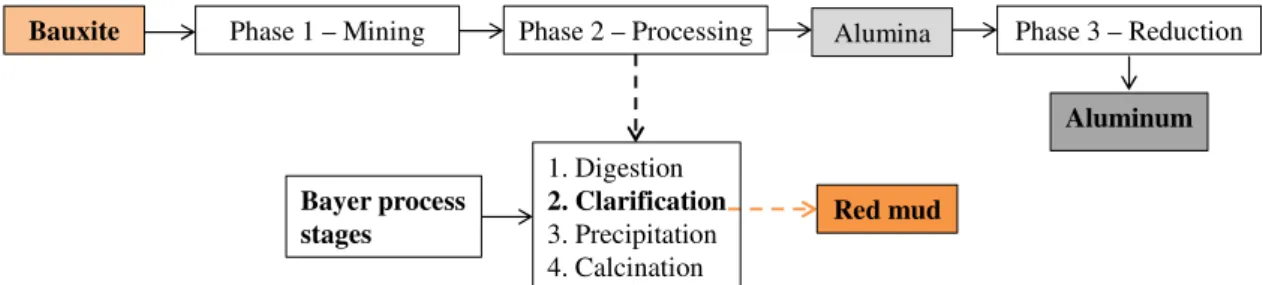
the process of re4ining alumina from bauxite (aluminum ore containing 30-50% of hydrated aluminum oxide) by selective extraction of pure aluminum oxide dissolved in sodium hydroxide (Li, 1998). From this process, the major by-product is converted to a slurry waste, named red mud, which contains 15% to 40% solids and is very alkaline (pH 11.0 to 12.5). In the processing phase, the Bayer process is applied and it is composed by these four main stages: (1) digestion, (2) clari4ication, (3) precipitation, (4) calcination (Li, 1998; Sampaio et al., 2005; Habashi, 2005; Sutar et al., 2014). The red mud is the residue resulting from the clari4ication stage, as shown in Figure 1.
Figure 1. Red mud obtainment as from bauxite processing
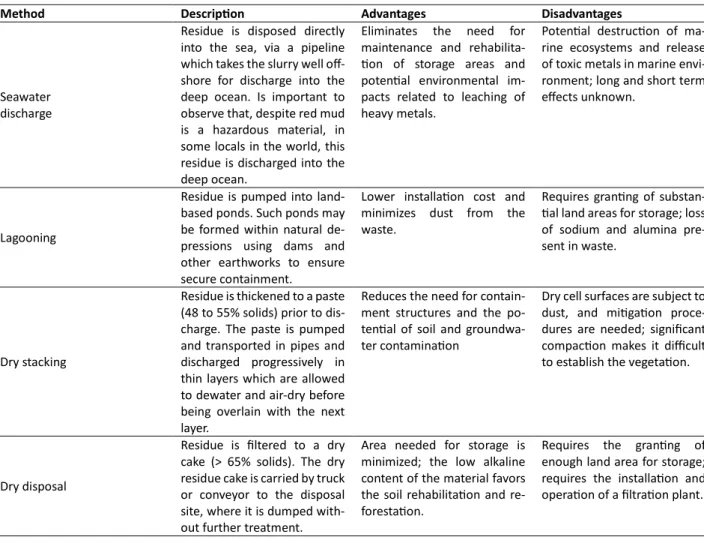
In the clari4ication phase, red mud is separated from a liquor rich in aluminum hydroxide (supernatant), through thickening and 4iltration techniques. The material originated from the digestion process is transferred to the thickeners in which, under action of 4locculants, the res-idue is separated by sedimentation. The red mud coming from the decanters pass through washing and 4iltration processes and then is stored (Mccormick et al., 2000; Habashi, 2005). However, during the washing process, part of the sodium hydroxide (caustic soda) added to the process cannot be removed, which results in the high alkalinity and hazardousness of the resi-due. First, the bauxite residue (red mud) slurry is then pumped to a large on-site impoundment area commonly known as red mud lake. After that, the red mud drying occurs in the open air (Tabereaux, 2010). Due to the alkaline nature and the presence of heavy metals (arsenic, cad-mium, nickel, zinc, lead, copper, chrocad-mium, vanadium, iron, gallium, phosphorus, manganese, magnesium, thorium, and niobium), red mud is considered a hazardous waste (Hind et al., 1999; Brunori et al., 2005; Bertocchi et al., 2006). Residue is usually placed off in the land4ills and the sodium hydroxide content can contaminate the adjacent and the storage areas (Hind et al., 1999; Menzi et al., 2010). The main methods used for red mud disposal are classi4ied into groups, namely: (i) seawater discharge, (ii) lagooning, (iii) dry stacking, (iv) dry disposal (Wang et al., 2008; Power et al., 2009), as presented in Table 1.
Bauxite Phase 1 – Mining Phase 2 – Processing Phase 3 – Reduction
1. Digestion 2. Clarification 3. Precipitation 4. Calcination Red mud Alumina Aluminum Bayer process stages
Table 1 – Advantages and disadvantages of red mud disposal methods
Method Descrip0on Advantages Disadvantages
Seawater discharge
Residue is disposed directly into the sea, via a pipeline which takes the slurry well off-shore for discharge into the deep ocean. Is important to observe that, despite red mud is a hazardous material, in some locals in the world, this residue is discharged into the deep ocean.
Eliminates the need for maintenance and rehabilita-%on of storage areas and poten%al environmental im-pacts related to leaching of heavy metals.
Poten%al destruc%on of ma-rine ecosystems and release of toxic metals in marine envi-ronment; long and short term effects unknown.
Lagooning
Residue is pumped into land-based ponds. Such ponds may be formed within natural de-pressions using dams and other earthworks to ensure secure containment.
Lower installa%on cost and minimizes dust from the waste.
Requires gran%ng of substan-%al land areas for storage; loss of sodium and alumina pre-sent in waste.
Dry stacking
Residue is thickened to a paste (48 to 55% solids) prior to dis-charge. The paste is pumped and transported in pipes and discharged progressively in thin layers which are allowed to dewater and air-dry before being overlain with the next layer.
Reduces the need for contain-ment structures and the po-ten%al of soil and groundwa-ter contamina%on
Dry cell surfaces are subject to dust, and mi%ga%on proce-dures are needed; significant compac%on makes it difficult to establish the vegeta%on.
Dry disposal
Residue is filtered to a dry cake (> 65% solids). The dry residue cake is carried by truck or conveyor to the disposal site, where it is dumped with-out further treatment.
Area needed for storage is minimized; the low alkaline content of the material favors the soil rehabilita%on and re-foresta%on.
Requires the gran%ng of enough land area for storage; requires the installa%on and opera%on of a filtra%on plant.
All methods present advantages and disadvantages; however, reinsert residue into the pro-duction chain is a most adequate practice in environmental terms. Even when stored correctly, industrial wastes such as red mud represent a threat to fauna and 4lora, being able to cause environmental damage, such as contamination of surface and groundwater ef4luents, and affect health of neighboring populations (Antunes et al., 2011).
Depending on the time of exposure to the environment, red mud suffers variations of its chemical composition. Yang and Xiao (2008) indicated that red mud stored for 10 years pre-sented a loss of its capacity of combustion due to carbonation of compounds such as calcium aluminate and dicalcium silicate.
As consequence of the red mud inadequate disposal, several environmental accidents oc-curred in the world. The most serious accidents ococ-curred in Brazil (in 2003, 2004, 2009, 2018) and in Hungary (in 2010). The environmental disasters represented a world great concern and contributed to the researchers increased the studies in order to search for alternatives to reuse and reinsertion of the red mud in the production chain.
Brazil has a large reserve of bauxite and is the third largest producer of this ore in the world (U.S. Geological Survey, 2016). The Brazilian State Pará has the major reserves of this ore and in 2015 produced 90.9% (32.2 Mt of bauxite) of the national total (Brazil, 2016). However, in the country, the recycling of red mud is incipient and this hazardous residue is still deposited inad-equately in the environment.
Several researches have studied alternatives to red mud reuse and reinsertion in the produc-tion chain (Kavas, 2006; Yang et al., 2009; Hanumanth et al., 2012; Jitsangiam and Nikraz, 2013). Although the red mud has been studied in some researches, it is application as 4iller in asphalt mixtures is still limited.
The asphalt mixtures applied as 4lexible pavement surfaces are composed of coarse and 4ine aggregates, 4iller (material with at least 65% passing in the 75 μm sieve) and asphalt. The 4iller incorporated into the asphalt mixture can improve rheological, thermal and water sensitivity performance, having void 4illing functions and increasing asphalt viscosity. Also, the presence of 4iller tends reduce the thermal susceptibility, the increase of the strength and the resistance to permanent deformation (FHWA, 2001).
The interaction powder/asphalt is an important factor to be considered in asphalt mixtures characterization, once it depends on the chemical composition of the asphalt and the character-istics of the 4iller, such as mineralogical composition, surface texture and speci4ic surface. The powder/asphalt ratio indicates the absence of free asphalt, which expresses the amount of as-phalt to coat aggregates. The higher is this ratio, the thinner is the asas-phalt 4ilm that involves the aggregates and dif4icult the adhesion between them. The ideal powder/asphalt ratio for dense asphalt mixtures is from 0.8 to 1.6 (Motta and Leite, 2000; FHWA, 2001; Wesseling et al., 2003). The Brazilian highways have shown early defects due to the high rate of heavy traf4ic along with high temperatures. One of the main defects veri4ied is the permanent deformation on the asphalt mixture surface. In high-temperature conditions, because of the repeated effect of the wheel rolling, load stress will exceed the plastic limit of the asphalt mixture, and then 4low de-formation will accumulate to form ruts, named permanent dede-formation (Yang e Ning, 2011). The permanent deformation is a defect that occurs in the pavements and affects the safety of their users, reducing the rolling comfort and increasing the maintenance costs. Permanent de-formation results from the accumulation of small amounts of irreparable strain as a result of repeated loads applied to the pavement (Sousa et al., 1994; Tigdemir, 2008).
Permanent deformation in a pavement often develops gradually with increasing numbers of applications, typically appearing as longitudinal depressions in the wheel paths sometimes ac-companied by small upheavals to the sides. The main problem of permanent deformation arises from excessive traf4ic consolidation on the upper layer of the pavement, plastic deformation due to insuf4icient mixture stability and also instability caused by stripping of asphalt below the riding surface of the pavement. Test procedures have been conducted to evaluate and predict rutting in a laboratory. One of these is the wheel tracking test, which simulates conditions sim-ilar to pavement conditions in service to obtain rut depth under a speci4ied load cycle (Nevelt and Thanfold, 1988; Brow et al., 2001; Ahmad et al., 2011; Xu et al., 2013).
The Pará State is situated in the Northern Brazil and presents high temperature over the year. The elevated traf4ic volume and the high temperatures of the region have contributed to the early appearance of defects in the road pavement, especially in the asphalt surfaces. In this con-text, this laboratory study aims the introduction of the red mud as 4iller in dense asphalt mix-tures to improve the permanent deformation resistance.
2. METHODOLOGY
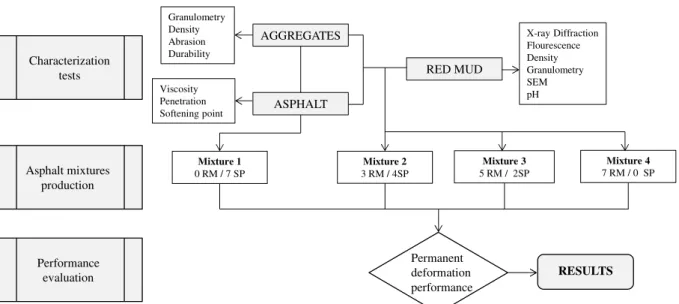
In this study the use of red mud as 4iller in asphalt mixtures was evaluated in relation to perma-nent deformation at state temperatures. Figure 2 shows the 4lowchart of the experimental methodology.
Figure 2. Flowchart of the experimental methodology
In the experimental methodology, dense asphalt mixtures were produced according to the Brazilian speci4ication DNIT 031/06, Grade C (Brasila, 2006). The asphalt CAP-50/70, classi4ied
by penetration grade (Brasilb, 2006), granite aggregates, and 4iller (red mud stone powder)
were used. Prior carrying out of the mechanical tests, material characterization tests were con-ducted (asphalt, aggregates and red mud).
The asphalt mixtures were produced with a total of 7% 4iller, being 3%, 5% and 7% red mud (Mixture 2 – 3RM / 4SP; Mixture 3– 5RM / 2SP and Mixture 4 – 7RM / 0SP, respectively). A mixture with 0% red mud and 7% stone powder (Mixture 1 – 0RM / 7SP) was used as reference. The mixtures were designed according to the Superior Performing Asphalt Pavements (SUPER-PAVE®) method for high traf4ic volume. The performance to permanent deformation was eval-uated through the wheel tracker test, in the French Rutting Tester at 60°C, according to NF-P 98-253-1 (AFNOR, 1993).
3. RESULTS
This section presents the materials (aggregates, red mud, and asphalt) characterization results. The granulometric curve used for asphalt mixtures production (with and without red mud), the volumetric parameters from design and the results of the permanent deformation tests are also shown and discussed.
3.1. Materials characteriza0on
3.1.1. Aggregates
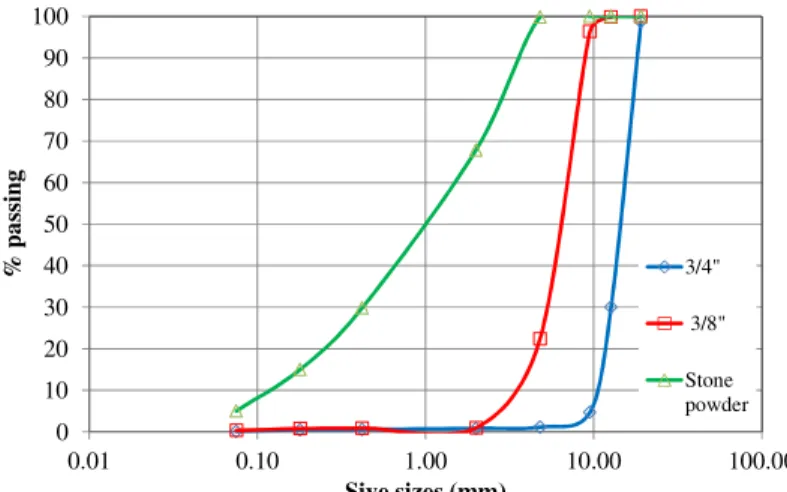
The granulometric analysis of the aggregates was carried out according to the Brazilian stand-ard DNER ME 083/98 (Brasil, 1998) and is illustrated in Figure 3.
The granite aggregates come from a quarry located in Santa Catarina State, Brazil. Gravel 1 (maximum diameter of ¾ inches), gravel 0 (maximum diameter of ⅜ inches) and stone powder (maximum diameter of 4.75 mm) were used for the asphalt mixtures composition. Aggregates characterization tests (granulometry, density, abrasion and durability) were carried out and are presented in Table 2. The results showed that the aggregates 4it according to Brazilian speci4i-cations (Brasila, 2006) and were able to produce asphalt mixtures.
ASPHALT
AGGREGATES X-ray Diffraction
Flourescence Density Granulometry SEM pH RED MUD Granulometry Density Abrasion Durability Viscosity Penetration Softening point Mixture 1 0 RM / 7 SP Mixture 2 3 RM / 4SP Mixture 3 5 RM / 2SP Mixture 4 7 RM / 0 SP RESULTS Permanent deformation performance Performance evaluation Asphalt mixtures production Characterization tests
Figure 3. Aggregates granulometric distribution
3.1.2. Asphalt
The asphalt used for the production of the mixtures was the Brazilian asphalt CAP-50/70, clas-si4ied by penetration. The asphalt characterization was performed by means of softening point, penetration and viscosity tests. The asphalt 4it into Brazilian speci4ications (Brasilb, 2006) and
the results are presented in Table 3.
Table 2 – Aggregates characterization tests results
Tests Standard Aggregates
3/8 inches ¾ inches Stone powder Apparent specific gravity (Gsa) ASTM C 127/ 2.774 2.7748 2.717
Bulk specific gravity (Gsb) DNER ME 084/ 2.740 2.701 -
Absorp%on (%) DNER ME 085 0.351 0.521 -
Los Angeles abrasion (%) ASTM C 131 20.70 21.70 -
Soundness (%) ASTM C 88 0.20 - -
Table 3 – Aggregates characterization tests results
Tests Standard Specifica0ons3 Results SoXening point1 (ºC) ASTM D 36 45 (min.) 49.5 Penetra%on (100g; 5s; 25ºC) ASTM D 5 50 – 70 64.0 Apparent viscosity2 (cP)
135°C, SP 21, 50 rpm 141 (min.) 308.7
150°C, SP 21, 60 rpm ASTM D 4791 50 (min.) 157.5
177°C, SP 21, 100 rpm 30 – 150 63.2
1Ring and ball method; 2Brookfield viscometer; 3Asphalt specifica%ons are given in DNIT
031/06 – ES (Brasilb, 2006).
3.1.3. Red mud
The red mud comes from Barcarena city (Pará State). The mineralogical analysis was carried out using an X-ray diffractometer. The test was performed between angles 2θ of 5° to 90°, with pitch of 0.05 and 1 second in counting time. Figure 4 presents the results and shown phases of hematite (Fe2O3), anatase (TiO2), quartz (SiO2), karelianite (V2O3), gibbsite (Al(OH)3)) coming
from the bauxite and sodalite were detected. Hematite, anatase, quartz, gibbsite and sodalite are substances that do not present health hazard, except in concentrations higher than those
0 10 20 30 40 50 60 70 80 90 100 0.01 0.10 1.00 10.00 100.00 % p a ss in g Sive sizes (mm) 3/4" 3/8" Stone powder
listed in the Brazilian standard NBR 10.004/2004 (ABNT, 2004). Karelianite (V2O3), or
vana-dium trioxide, in presence of moisture (humidity), may oxidize and transform into vanavana-dium pentoxide (V2O5), which, in high concentrations, presents hazard to the residue.
The morphological structure of the material was evaluated by a scanning electron micro-scope (SEM). In Figure 5(a), the micrograph with magni4ication of 1,000x, the red mud presented
a spongious structure that characterizes the high speci4ic surface of the material and; in Figure 5(b), with a magni4ication of 5,000x, it was observed agglomerates of particles of size inferior to
5 μm with irregular granulometric distribution.
Figure 4. Red mud diffractogram
.
(a) (b)
Figure 5. Red mud micrographs (a) Magnification of 1,000x (b) magnification of 5,000x
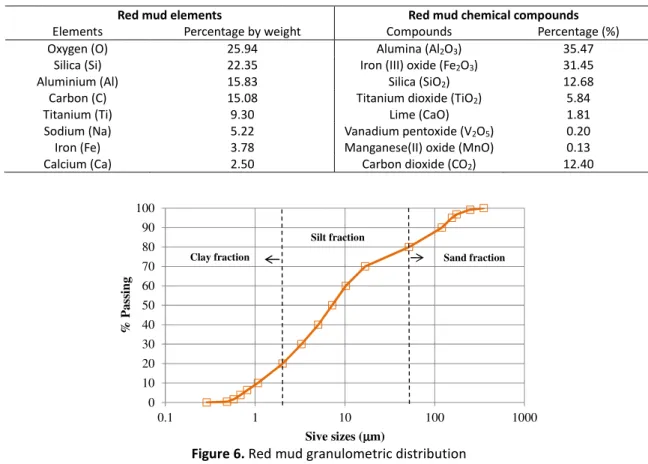
The microscopic characterization of the material was performed by energy dispersive X-ray spectrometry (Shimadzu Energy Dispersive X-ray 4luorescence spectrometer – EDX) that pro-vided the composition of the chemical elements in the red mud, presented in Table 4, that also, shows the compounds present in the red mud that were quanti4ied by a.
The granulometry of the red mud was determined in a laser particle analyzer (MICROTAC model S3500), with a detection range of 0.02 to 2,800 micrometers (μm). From the results pre-sented in Figure 6, around 85% of the particles had a diameter in the range of 0.4 µm to 60 µm, being 20% the clay fraction (< 2 µm) and 65% the silt fraction (2 µm - 60 µm), according to the Brazilian classi4ication (ABNT, 1995). From Figure 6, also was observed that 15% of the parti-cles presented a grain size of 60 µm to 200 µm range that is characteristic of 4ine sand granu-lometry. The presence of particles larger than 40 µm tends to 4ill the voids of the aggregates and
particles smaller than 20 µm mix with the binder, altering the viscosity, softening point and thermal susceptibility (Li, 2014). Thus, as 70% of the grains of red mud presented a grain size of less than 20 µm, it is possible that this material is incorporated to the asphalt and altered its rheological properties.
Table 4 – Elements and compounds measured in the red mud
Red mud elements Red mud chemical compounds
Elements Percentage by weight Compounds Percentage (%)
Oxygen (O) 25.94 Alumina (Al2O3) 35.47
Silica (Si) 22.35 Iron (III) oxide (Fe2O3) 31.45
Aluminium (Al) 15.83 Silica (SiO2) 12.68
Carbon (C) 15.08 Titanium dioxide (TiO2) 5.84
Titanium (Ti) 9.30 Lime (CaO) 1.81
Sodium (Na) 5.22 Vanadium pentoxide (V2O5) 0.20
Iron (Fe) 3.78 Manganese(II) oxide (MnO) 0.13
Calcium (Ca) 2.50 Carbon dioxide (CO2) 12.40
Figure 6. Red mud granulometric distribution
The speci4ic surface, calculated by the Vogt equation, resulted in 119.0 m²/kg. The red mud presented a pH of 10.25 ± 0.05. According to the Brazilian standard NBR 10.004/2004 (ABNT, 2004), the waste is considered corrosive when the value is in the range 12.5 ≤ pH ≤ 2.0. However, a pH above 7.0 gives the residue a basic character, so that the surface of the residue becomes electrically negative, which may in4luence the asphalt-aggregate adhesiveness.
3.2. Asphalt mixtures produc0on
Asphalt mixtures were produced with red mud as 4iller in three percentages (3%, 5%, and 7%). Another asphalt mixture was produced with 7% of stone powder (4iller). This mixture with stone powder was the reference. The granulometric curve was established according to the Grade C of the Brazilian standard (Brasila, 2006) as presented in Figure 7. The results of asphalt
mixtures design are shown in Table 5.
From Table 5, observed that the mixtures did not achieve the minimum VMA value according Brazilian speci4ication. As a result, this had in4luence in other parameters, such as the relation P/A and in the asphalt content. Despite the asphalt mixtures with red mud contain more 4ine particles that a conventional mixture, the asphalt contents were low. Al-Shamsi et al. (2017) produced mixtures varying the type of 4ine aggregates and obtained VMA values inferior to the
0 10 20 30 40 50 60 70 80 90 100 0.1 1 10 100 1000 % P a ss in g Sive sizes (µm)
Clay fraction Sand fraction
limits. They concluded that lower VMA led to lower effective asphalt content, which in turn re-duced the asphalt 4ilm thickness. Chadboum et al. (1999) assert that, in general, aggregate gra-dations that deviate from the maximum density line in the 4ine direction did not increase the VMA. The generation of 4ines can be caused by aggregate degradation due to aggregate handling during loading, hauling, mixing, and construction. Adequate VMA in a mixture is an important part of the mix design which must be met. A minimum VMA requirement speci4ied for asphalt mixtures based on nominal maximum aggregate size may be not suitable. In this way, 4ineness modulus and crushed coarse and 4ine aggregate content may be much more strong indicators of critical VMA. Current minimum VMA requirements may exclude mixtures that present good perform (Hislop and Coree, 2000). The lower VMA values obtained is this study can be resulted from the red mud particle sizes. In this case, micro size particles can be acted as an aggregate degraded as Chadboum et al. (1999) concluded.
Figure 7. Asphalt mixtures granulometric curve and Grade C limits
Table 5 – Asphalt mixtures volumetric parameters
Parameters DNIT Mixtures
031/06 0RM / 7SP 3RM / 4SP 5RM / 2SP 7RM / 0SP
Filler – stone powder (%) - 7 4 2 0
Filler – red mud (%) - 0 3 5 7
Asphalt content (%) - 4.7 4.6 4.5 4.4
Gmm1 (g/cm3) - 2.551 2.558 2.559 2.557
Gmb2 (g/cm3) - 2.448 2.460 2.455 2.455
Voids content (%) 3-5 4.0 4.0 4.0 4.0
Voids in the mineral aggregate (VMA) min. 15 14.1 13.4 12.6 12.4
Asphalt-void ratio (RBV) 75-82 70.9 71.7 67.6 67.8
Powder-asphalt ratio (P/A) - 1.49 1.52 1.55 1.59
1Gmm – Maximum specific mass measured; 2Gmb – Apparent specific mass.
The asphalt mixtures design was performed according to the standards AASHTO M 323 (AASHTO, 2011) and AASHTO R 35-12 (AASHTO, 2012) in specimens with diameter of 150 mm for Nproject of 125 revolutions. The production temperatures, established from the asphalt
vis-cosity curve, were 148°C (for mixing) and 137°C (for compaction). The heating temperature of the aggregates was 15°C above the mixing temperature. The compaction was performed by a SUPERPAVE® gyratory compactor (brand SERVOPAC) with rotation angle of 1.25 ± 0.02°, rate of 30 revolutions per minute and vertical tension of 600 kPa. The mixtures met the volumetric parameters established by the SUPERPAVE® methodology and the Brazilian standard DNIT 031/06-ES (Brasila, 2006) 0 10 20 30 40 50 60 70 80 90 100 0.01 0.10 1.00 10.00 100.00 % p a ss in g Sive sizes (mm) Curve Grade "C" limits
3.3. Permanent deforma0on tests
The asphalt mixtures permanent deformation resistance was evaluated in the laboratory through French Rutting Tester (FRT), developed by Institut Français des Sciences et Technologies des Transports, de L'aménagement et des Réseaux – IFSTTAR (in French). The FRT is capable of testing two asphalt mixtures samples (slabs). The slabs dimensions were 180 mm wide, 50 mm long, 50 mm thick. Samples were compacted with a French laboratory-tired compactor until reaching the apparent density established at the design, follows NF-P 98-250-2 French standard (AFNOR, 1997).
The test was performed by the French standard NF-P 98-253-1 (AFNOR, 1993), in which loading of samples is accomplished by applying a 5,000N load onto a 400 x 8 Treb Smooth pneu-matic tire in4lated to 600 kPa. During testing, the pneupneu-matic tire passes over the center of the sample twice per second. Test temperature was 60°C, since the asphalt mixtures will be used as a pavement surface. Rut depths within the FRT are de4ined by rutting depth (deformation) ex-pressed as a percentage of the original slab thickness.
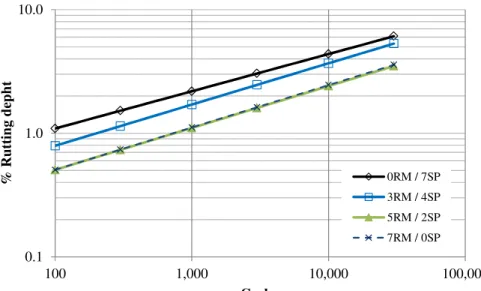
Before the test, the samples are conditioned and a zero rut depth is de4ined by loading a sample at ambient temperature for 600 cycles. With the established test temperature (60°C) readings in the cycles 0, 100, 300, 1,000, 10,000 and 30,000 were performed in 15 points of each slab. The measurement of rutting depth along the cycles is shown in Figure 8.
Figure 8. Evolution of the rutting depth along the cycles
The French speci4ications limit the rutting depth of asphalt mixtures by 10% in relation to the initial reading, for the standard axis of 130 kN, while in Brazil, the standard axis used in the 4lexible pavements design is 80 kN. Considering the most severe condition, according to the French speci4ication, the asphalt mixtures obtained rutting depth of less than 10%. The mix-tures with red mud 4iller presented higher resistance to permanent deformation in relation to the reference mixture, and the mixture M3 (5% of red mud 4iller) obtained better results. The red mud insertion as 4iller for asphalt mixtures improved the performance to permanent defor-mation in relation to the conventional mixture, with rutting depth reduction, on average, of 12.82% to 42.63%, related to 30,000 cycles, as presented in Table 6.
0.1 1.0 10.0 100 1,000 10,000 100,000 % R u tt in g d ep h t Cycles 0RM / 7SP 3RM / 4SP 5RM / 2SP 7RM / 0SP
Table 6 – Asphalt mixtures with red mud rutting depth reduction in relation to conventional mixture Cycles Mixtures M1 M2 M3 M4 Rutting (depht) (%) 100 1.09 0.79 0.51 0.51 300 1.52 1.14 0.73 0.74 1,000 2.19 1.71 1.10 1.11 3,000 3.05 2.66 1.60 1.62 10,000 4.38 3.68 2.41 2.46 30,000 6.10 5.31 3.50 3.58
Rutting depth reduction at 30,000 cycles (%) - 12.82 42.63 41.30
4. CONCLUSION
This laboratory studies evaluated the application of the bauxite processing waste, the red mud, as 4iller in dense asphalt mixtures in relation to the increase in resistance to permanent defor-mation. Asphalt mixtures composed of 3% (M2 – 3RM / 4SP), 5% (M3 – 5RM / 2SP) and 7% (M4 – 7RM / 0SP) of red mud were produced. A mixture with 7% (M1 – 0RM / 7SP) of stone powder was used as reference for comparison. The red mud was characterized by the following tests: X-ray diffraction, 4luorescence, speci4ic mass, laser granulometry and Scanning Electron Microscopy. The granulometry test showed that the red mud can be used as 4iller (0.075 mm). The pH of the waste is in accordance to standards established in the Brazilian standard regard-ing toxicity. However, the presence of vanadium pentoxide (V2O5), even in small portions
(0.20%), characterizes it as toxic (Class I - hazardous waste). The evaluation of the resistance to permanent deformation showed that all the mixtures containing red mud as 4iller had supe-rior performance with reduction of the rutting depth of 12.63 to 42.63 in relation to the refer-ence mixture at 30,000 cycles. The mixture with 5% red mud (M3) presented the best perfor-mance with rutting depth at 30,000 cycles of 3.50%. It is possible that the red mud has acted on the thermal susceptibility of the asphalt. The lower asphalt content obtained for asphalt mix-tures was no expected considering the 4ine particles size. The lower asphalt content could have in4luenced the permanent deformation results. As a result, this study showed the viability of reinserting the red mud in the production chain and contributed for the mitigation of its dis-posal and reuse problems, as alternative material of possible applied in the road infrastructure. Despite the use of industrial residues in order to replacement natural or industrial materials can represent an advantage in relation to waste management; red mud is as a hazardous waste. Also, for use asphalt mixtures with red mud in pavements, in large scale, some tests need to be done in order to evaluate the potential pollutants or contaminants that could leach during the pavement life. Also, was observed that to use this residue in large scale to produce asphalt mix-tures in asphalt plants, some important regards must be emphasized as a procedure to be fol-lowed. For example, depends on the air humidity, red mud tends to form clumps, which is a problem that will affect the mixture performance on the 4ield. To use the residue in large scale a sprayer has to mount in the asphalt plant. Also, the material must be conserved dried.
REFERENCES
AASHTO (2011) M 323 – Standard speci ication for Superpave volumetric mix design. American Association of State Highway and Transportation Of4icials. Washington, D.C., USA.
AASHTO (2012) R 35-12 – Standard practice for Superpave volumetric design for hot-mix asphalt (HMA). American Association of State Highway and Transportation Of4icials. Washington, D.C, USA.
ABNT (1995) NBR 6502/95 – Rochas e solos. Associação Brasileira de Normas Técnicas. Rio de Janeiro/RJ, Brasil. [In Portu-guese].
ABNT (2004) NBR 10.004 – Resíduos sólidos - Classi icação. Associação Brasileira de Normas Técnicas. Rio de Janeiro/RJ, Bra-sil. [In Portuguese].
AFNOR (1993) NF-P 98-253-1 – Préparation des mélanges hydrocarbonés, Partie 1: essai d'orniérage. Association Française de Normalisation, AFNOR. France.
AFNOR (1997) NF-P 98-250-2 – Essais relatifs aux chaussées - préparation des mélanges hydrocarbonés, Partie 2: compactage des plaques. Association Française de Normalisation. France.
Ahmad, J.; Abdul Rahman, M. Y. and M. R. Hainin (2011). Rutting evaluation of dense graded hot mix asphalt mixture. Interna-tional Journal of Engineering & Technology, IJET-IJENS, v.11 n. 05, p. 56–60.
Al-Shamsi, K.; Hassan, H. F. and L. N. Mohammed (2017). Effect of low VMA in hot mix asphalt on load-related cracking re-sistance. Construction and Building Materials, v. 149, p. 386–394.
Antunes, M. L. P.; Conceição, F. T. D. and G. R. B. Navarro (2011). Caracterização da Lama Vermelha Brasileira (Resı́duo do Re-4ino da Bauxita) e Avaliação de suas Propriedades para Futuras Aplicações. 3rd International Workshop Advances in Cleaner Production. São Paulo, Brazil. [In Portuguese].
ASTM (2013) ASTM C 88 – Standard test method for soundness of aggregates by use of sodium sulfate or magnesium sulfate. American Society of Testing and Materials, USA.
ASTM (2012) ASTM C 127 – Standard test method for density, relative density (speci ic gravity), and absorption of coarse aggre-gate. American Society of Testing and Materials, USA.
ASTM (2006) ASTM C 131 – Standard test method for resistance to degradation of small-size aggregate by abrasion and impact in the Los Angeles machine. American Society of Testing and Materials, USA.
ASTM (2013) ASTM D 5 – Standard test method for penetration of bituminous materials. American Society of Testing and Mate-rials, USA.
ASTM (2014) ASTM D 36 – Standard test method for softening point of bitumen (ring-and-ball apparatus). American Society of Testing and Materials, USA.
ASTM (2013) ASTM D 4402 – Standard test method for viscosity determination of asphalt at elevated temperatures using a rota-tional viscometer. American Society of Testing and Materials, USA.
Bertocchi, A. F; Ghiani, M.; Peretti, R. and A. Zucca (2006). Red mud and 4ly ash for remediation of mines sites contaminated with As, Cd, Cu, Pb e Zn. Journal of Hazardous Materials , v.134, p. 112–119.
Brasil (1998). DNER ME 083/98 – Agregados – análise granulométrica. Norma rodoviária. Departamento Nacional de Estradas de Rodagem/Departamento Nacional de Infraestrutura de Transportes. Rio de Janeiro/RJ, Brasil. [In Portuguese].
Brasil (2006a). DNIT 031/06-ES – Pavimentos lexíveis - concreto asfáltico, Especi icação de serviço. Norma rodoviária. Depar-tamento Nacional de Infraestrutura de Transportes. Rio de Janeiro/RJ, Brasil. [In Portuguese].
Brasil (2006b). DNIT 095/06-EM – Cimentos asfálticos de petróleo - Especi icação de material. Norma rodoviária. Departa-mento Nacional de Infraestrutura de Transportes. Rio de Janeiro/RJ, Brasil. [In Portuguese].
Brasil (2016). Sumário Mineral 2015. Departamento Nacional de Produção Mineral. ISSN 0101 2053, 2016. [In Portuguese]. Brown, E. R.; Kandhal, P. S. and J. Zhang (2001). Performance testing for hot mix asphalt. NCAT Report n. 01-05. National Center
for Asphalt Technology – NAPA. Auburn/AL, USA.
Brunori, C.; Cremisini C.; Massanisso, P.; Pinto, V. and L. Torricelli (2005). Reuse of a treated red mud bauxite waste: studies on environmental compatibility. Journal of Hazardous Materials, v.117, p. 55–63.
DOI: 10.1016/j.jhazmat.2004.09.010.
Chadbourn, B. A.; Skok, E. L.; Newcomb, D. E.; Crow, B. L. and S. Spindler (1999). The effect of voids in mineral aggregate (VMA) on hot-mix asphalt pavements. Final Report n. MN/RC – 2000-13. University of Minnesota, Minneapolis, MN, USA. DNER (1995) – DNER-ME 084 – Agregado miúdo – Determinação da densidade real. Departamento Nacional de Estradas de
Rodagem, Rio de Janeiro, Brasil. [In Portuguese].
DNER (1994) – DNER-ME 085 – Material inamente pulverizado – Determinação da massa especí ica real. Departamento Nacio-nal de Estradas de Rodagem, Rio de Janeiro, Brasil. [In Portuguese].
FHWA (2001). Superpave mixture: design guide. Federal Highway Administration. United States Department of Transportation. Westrack Forensic Team Consensus Report. Washington, D.C., USA.
Habashi, F. (2005). A short history of hydrometallurgy. Hydrometallurgy, v. 79, p. 15–22. DOI: 10.1016/j.hy-dromet.2004.01.008.
Hanumanth Rao, C. V.; Ganapati Naidu, G.; Satyanayarana, C. H. V. and S. Adiseshu (2012). Application of GGBS stabilized red mud in road construction. Journal of Engineering (IOSRJEN), v. 2, n. 8, p. 14–20. ISSN: 2250-3021.
Hildebrando, E. A.; Souza, J. A. S.; Angélica, R. S. and R. F. Neve (2013). Application of bauxite waste from Amazon region in the heavy clay industry. Materials Research, v. XVI, n. 6, p. 1418–1422. DOI: 10.1590/S1516-14392013005000145.
Hind, R. A.; Bhargava, S. K. and S. C. Grocott (1999). The surface chemistry of Bayer process solids: a review. J. Colloids and sur-faces A: Physicochemical and engineering aspects, 146, 1999. p. 359–374. DOI: 10.1016/S0927-7757(98)00798-5.
Hislop, P. W. and K. J. Coree (2000). VMA as a design parameter in hot-mix asphalt. Proceedings Mid-Continent Transportation Symposium 2000. Center for Transportation Research and Education, Iowa State University, USA.
Jitsangiam, P. and H. R. Nikraz (2013). Sustainable use of coarse bauxite residue for alternative roadway construction materi-als. Australian Journal of Civil Engineering, v. 11, n. 1, p. 1–12.
Kavas, T. (2006). Use of boron waste as a 4luxing agent in production of red mud brick. Building and Environment, v. 41, p. 1779–1783. DOI: 10.1016/j.buildenv.2005.07.019.
Komnitsas, K.; Bartzas, G. and I. Paspaliaris (2004). Ef4iciency of limestone and red mud barriers: laboratory column studies Miner. Minerals Engineering, v. 17, p. 183–194. DOI: 10.1016/j.mineng.2003.11.006.
Li, L.Y. (1998). Properties of red mud tailings produced under varying process conditions. Journal of Environmental Engineer-ing, v. 124(3); 254–264. DOI: 10.1061/(ASCE)0733-9372(1998)124:3(254).
Li, Y. (2014). Digital mix design for performance optimization of asphalt mixture. Thesis. Virginia Polytechnic Institute and State University, Virginia, USA.
Mccormick, P. G.; Pı́caro, T. and P. A. I. Smith (2000). Mechanochemical treatment of high silica bauxite with lime. Minerals En-gineering, v. 15, p. 211–214. DOI: 10.1007/978-3-319-48179-1_5.
Menzie, W. D.; Barry, J. J.; Bleiwas, D. I.; Bray, E. L.; Goonan T. G. and G. Matos (2010). The global low of aluminum from 2006 through 2025. United States Department of the Interior United States Geological Survey, Reston, Virginia, USA.
Motta, L. M. G. and L. M. F Leite (2000). Efeito do fı́ler nas caracterı́sticas mecânicas das misturas asfálticas. In: XI PANAM. Bra-sil, p. 09-19. [In Portuguese].
Nevelt, G. and H. Thanfold (1988). Evaluation of the resistance to deformation of different road structures and asphalt mix-tures determined in the pavement-rutting tester. Proceeding of the Association of Asphalt Paving Technologists, vol. 57, p. 320–345.
Power, G.; Gräfe, M. and C. Klauber (2009). Review of current bauxite residue management, disposal and storage: practices, engi-neering & science. The Commonwealth Scienti4ic and Industrial Research Organization (CSIRO). CSIRO document DMR-3608. Austrália.
Sampaio, J. A.; Andrade, M. C. and A. J. B. Dutra (2005). Bauxita. Rochas & Minerais Industriais. Ed. Luz, Rio de Janeiro, Brasil. ISBN 85-7227-204-6. [In Portuguese].
Sousa, J. B.; Solaimanian, M. and S. L. Weissman (1994). Development and use of the repeated shear test (constant height): an optional Superpave mix design tool – SHRP-A-698. Strategic Highway Research Program. National Council. Washington, D.C., USA.
Sutar, H.; Mishra, S. C.; Sahoo, S. K.; Chakraverty, A. P. and H. S. Maharana (2014). Progress of red mud utilization: an overview. American Chemical Science Journal, v. 4(3), 255–279.
DOI: 10.9734/ACSJ/2014/7258.
Tabereaux, T. Alton (2010). Hungarian red mud disaster: addressing environmental liabilities of alumina, residue storage & disposal. Series the discovery, commercialization, and development of the aluminum industry in France. Light Metal Age, v. 68, p. 22-24.
Tigdemir, M. (2008). Dynamic permanent deformation testing of asphalt mixes and deformation waveform analysis. Indian Journal of Engineering & Materials Sciences, v. 15, p. 29–35. ISSN 0971-4588.
U.S. Geological Survey (2016). Mineral Commodity Summaries. Available in: https://minerals.usgs.gov/minerals/pubs/com-modity/bauxite/mcs-2016-bauxi.pdf
Wang, S.; Ang, H. M. and M. O. Tadé (2008). Novel applications of red mud as coagulant, adsorbent and catalyst for environ-mentally benign processes. Chemosphere, v. 72, p. 1621–1635.
DOI: 10.1016/j.chemosphere.2008.05.013.
Xu, T.; Wang, H.; Li, Z. and Y. Zhao (2014). Evaluation of permanent deformation of asphalt mixtures using different laboratory performance tests. Construction and Building Materials , v.53, p. 561–567.
DOI: 10.1016/j.conbuildmat.2013.12.015.
Wessling, D. H.; L. P. Specht and Ceratti, J. A. P. (2003). Estudo laboratorial do comportamento de misturas em concreto asfál-tico com diferentes tipos de 4ilers. 34a Reunião Anual de Pavimentação, Associação Brasileira de Pavimentação (ABPv).
Campinas, S.P., Brasil. [In Portuguese].
Yang, H.; Chenb, C.; Panb, L.; Lub, H.; Sunb, H. and X. Hub (2009). Preparation of double-layer glass-ceramic/ceramic tile from bauxite tailings and red mud. Journal of the European Ceramic Society, v. 29, p. 1887–1894. DOI: DOI: 10.1016/j.jeurcer-amsoc.2009.01.007.
Yang, J. and B. Xiao (2008). Development of unsintered construction materials red mud wastes produced in the sintering alu-mina process. Construction and Building Materials, n. 22, p. 2299–2307.
DOI: 10.1016/j.conbuildmat.2007.10.005
Yang, Q. and J. Ning (2011). The environmental in4luence of asphalt pavement and countermeasures. Energy Procedia, v. 5, p. 2432–2436. DOI: 10.1016/j.egypro.2011.03.418.