Printed version ISSN 0001-3765 / Online version ISSN 1678-2690 http://dx.doi.org/10.1590/0001-3765201620140715
www.scielo.br/aabc
Ultrastructure and pollen morphology of Bromeliaceae species
from the Atlantic Rainforest in Southeastern Brazil
VANESSA J.D. SILVA, ESTER M. RIBEIRO, ANDREA P. LUIZI-PONZOand ANA PAULA G. FARIA
Departamento de Botânica, Instituto de Ciências Biológicas, Universidade Federal de Juiz de Fora, Rua José Lourenço Kelmer, s/n, Campus Universitário, Bairro São Pedro, 36036-900 Juiz de Fora, MG, Brasil
Manuscript received on December 22, 2014; accepted for publication on January 30, 2015
ABSTRACT
Pollen grain morphology of Bromeliaceae species collected in areas of the Atlantic Rainforest of southeastern Brazilwas studied. The following species were analyzed: Aechmea bambusoides L.B.Sm. & Reitz, A. nudicaulis (L.) Griseb., A. ramosa Mart. ex Schult.f., Ananas bracteatus (Lindl.) Schult.f., Billbergia distachia (Vell.) Mez, B. euphemiae E. Morren, B. horrida Regel, B. zebrina (Herb.) Lindl., Portea petropolitana (Wawra) Mez, Pitcairnia fl ammea Lindl., Quesnelia indecora Mez, Tillandsia polystachia (L.) L., T. stricta Sol., T. gardneri Lindl., T. geminifl ora Brongn. and Vriesea grandifl ora Leme. Light and scanning electron microscopy were used and the species were grouped into three pollen types, organized according to aperture characteristics: Type I – pantoporate pollen grains observed in P. petropolitana, Type II – 2-porate pollen grains, observed in the genera Ananas, Aechmea and Quesnelia, and Type III – 1-colpate pollen grains, observed in the genera Billbergia, Pitcairnia, Tillandsia and Vriesea. Pollen data led to the construction of an identifi cation key. The results showed that the species analyzed can be distinguished using mainly aperture features and exine ornamentation, and that these characteristics may assist in taxonomic studies of the family.
Key words: epiphytes, morphology, pollen grains, taxonomy.
Correspondence to: Ana Paula Gelli de Faria E-mail: [email protected]
INTRODUCTION
Bromeliaceae Juss comprises nearly 3.172 species, distributed in 58 genera (Luther 2008). It is considered the fourth-richest Angiosperm family in terms of the number of species in the Atlantic Forest (Stehmann et al. 2009), and the southeastern of Brazil represents a center of endemism for many of its taxa.
The traditional infrafamiliar taxonomy of Bromeliaceae (Smith and Downs 1974, 1977, 1979) relies on the characteristics of the position of the ovary, as well as types of habit, fruits and seeds in order to recognize the subfamilies Bromelioideae, Pitcairnoideae and Tillandsioideae. However, phylogenetic studies based on morphological and molecular data only consider Bromelioideae and Tillandsioideae to be monophyletic, while Pitcairnoideae is considered to be polyphyletic (Terry et al. 1997, Givnish et al. 2007, 2011).
structures (Faria et al. 2004). The fl oral morphology is usually poorly preserved in herbarium collections, and therefore, it is also poorly studied. This limits the utilization of many characteristics that could potentially be diagnostic. Benzing (1994) and Schulte and Zizka (2008) mentioned the importance and the necessity of more studies focusing on the detailed analysis of underemployed characteristics, such as the morphological variation of stigmas and petal appendages, as well as the pollen morphology. In this context, pollen morphology has provided important information for the taxonomy of Bromeliaceae, aiding in a better defi nition of the generic and specifi c delimitation (Moreira et al. 2005).
Mez (1891-1894, 1896, 1934-1935) made the fi rst attempt to apply pollen morphology to the systematics of Bromeliaceae. Based on the types of aperture, the author classifi ed the subfamilies Pitcairnoideae and Tillandsioideae as stenopalynous, due to having pollen grains that were predominantly monocolpate, while Bromelioideae was considered euripalynous and had different types of aperture (including the tribes Poratae and Sulcatae), in addition to inaperturate grains (tribe Integrae). Other important palynological studies concerning Bromeliaceae include the studies by Ehler and Schill (1973), Erdtman and Praglowski (1974), Wanderley and Melhem (1991), Halbritter (1992), Sousa et al. (1997), Melhem et al. (2003), Souza et al. (2004) and Moreira et al. (2005). However, knowledge regarding the palynology of Bromeliaceae is still scarce, especially when considering the species’ richness within the family.
The present work describes the pollen morphology of bromeliad species from the Atlantic Rainforest in southeastern Brazil, with the aim to provide additional morphological characteristics to support the taxonomy and systematic of the family.
MATERIALS AND METHODS
Pollen grains were obtained from herbarium specimens deposited in the CESJ herbarium (acronyms follow Index Herbariorum; Thiers 2014 continuously updated). The species analyzed were gathered from portions of the Atlantic Rainforest in the states of Minas Gerais and Espírito Santo, southeast of Brazil. Whenever possible, more than one exsiccate was examined, in order to compare all possible variations within a single species. The best quality material was indicated as “standard” (marked with an asterisk in the examined material list below), and the other materials from the same species were referred to as “comparison” materials. The examined material included: Aechmea bambusoides L.B.Sm. & Reitz - BRAZIL. Minas Gerais: Juiz de Fora, Campus UFJF, IX/2010, S. G. Furtado, L. Menini Neto and A. P. G. Faria 144 (CESJ 60640*).
- BRAZIL. Minas Gerais: Descoberto, 09/IV/2010, C.O. Rezende et al.879 (CESJ 56016*); Descoberto, 03/III/2002, R. C. Forzza, V. R. Scalon and A. V. Lopes 2086 (CESJ 36350). Portea petropolitana (Wawra) Mez - BRAZIL. Minas Gerais: Juiz de Fora, Mata do Krambeck, 22/X/2010, L. C. D. Dias and A. P. G. Faria 08 (CESJ 56920); Juiz de Fora, Mata do Krambeck, 21/IX/2010, M. C. Tagliati 01 (56934*). Quesnelia indecora Mez - BRAZIL. Minas Gerais: Chácara, 16/VII/2011, D. E. F. Barbosa et al. 8 (CESJ 60683); Juiz de Fora, VIII/2012, A. P. G. de Faria 237 (CESJ 60802*). Tillandsia gardneri Lindl. - BRAZIL. Minas Gerais: Barroso, Mata do Baú, 30/IV/2001, L. C. S. Assis 118 (CESJ 34255*). BRAZIL. Espírito Santo: Cachoeiro de Itapemirim, 20/VII/2012, F. C. Favoreto et al.183 (CESJ 60385). Tillandsia geminifl ora
Brongn. - BRAZIL. Minas Gerais: Olaria, Serra do Cruz, Mata nebular, 01/I/2011, F. E. Alves et al. 213 (CESJ 60879*); Juiz de Fora, 23/XII/2004, V. Shuchter 24 (CESJ 42819). Tillandsia polystachia (L.) L. -
BRAZIL. Minas Gerais: Juiz de Fora, Mata do Krambeck, V. J. Silva 3, 25/X/2013 (CESJ 63719); Juiz de Fora, Mata do Krambeck, 22/X/2010, L. C. D. Dias and A. P. G. de Faria11 (CESJ 56927*). Tillandsia stricta Sol. - BRAZIL. Minas Gerais: Chácara, 06/X/2012, D. E. F. Barbosa 139 et al. (CESJ 60887*); Caldas, 14/IX/2008, T. M. Machado et al.86 (CESJ 52078). Vriesea grandifl ora Leme - BRAZIL. Minas Gerais: Juiz de Fora, Mata do Krambeck, 26/IX/2012, A. P. G. de Faria 238 (CESJ 60803*).
Pollen grains were prepared using acetolysis (Erdtman 1960) and in addition to the Wodehouse (1935) modifi ed methodology. Fragile pollen grains were also prepared by lactic acetolysis (ACLAC 40%) following Raynal and Raynal’s (1971) protocol. They were studied under light microscopy (LM). For scanning electron microscopy (SEM), the untreated pollen grains were mounted on a stub with adhesive carbon double face tape and sputtered with a 20 nm thick gold coat. Three slides containing acetolyzed pollen grains were prepared for each specimen. Whenever possible, the largest diameter of 25 pollen grains on polar view of each specimen was measured, as well as the equatorial and polar diameters on equatorial view; a micrometer ocular and a BX-41 Olympus microscope was used. To evaluate the measurements, Microsoft Excel software was applied in order to calculate the arithmetic mean (X), size range (Xmin– Xmax), standard error (Sx), standard deviation (S), variability (V), and confi dence interval. If it was not possible to take 25 measurements for a specimen, only the arithmetic mean was calculated.
The photomicrographs were taken using a Canon camera adapted to a Zeiss Primo-Star light microscope. The terminology follows Punt et al. (2007), and Barth and Melhem (1988).
RESULTS
The pollen analyses, especially concerning apertural characterization, enabled the description of three pollen grain types:
Type I - pantoporate (Figs. 1-3)
Pollen grains heterogeneous in size; subcircular; apolar; 7-(9)-pantoporate, pores circular, operculate, sparsely distributed over the surface; semitectate, reticulate; lumina rounded and irregular in size; muri narrow; sexine thicker than nexine.
Species included: Portea petropolitana (Wawra) Mez.
Type II - 2-porate (Figs. 4-12)
Species included: Aechmea bambusoides L.B.Sm. & Reitz, A. nudicaulis (L.) Griseb., A. ramosa Mart. ex Schult.f., Ananas bracteatus (Lindl.) Schult.f., Quesnelia indecora Mez.
The pollen grains of A. ramosa with two or three apertures, are predominantly 2-porate (85%). Under SEM, the pollen of A. bambusoides shows a small reticulate pattern with granulate lumina. In A. bracteatus, the sexine is slightly thicker than the nexine. The pollen grains of Q. indecora are elliptical, with large, circular pores, the exine is heterobrochate, the lumina are smooth, polygonal. Under SEM, a decrease in the reticulum size near the apertures is observed, as well as the presence of an operculum.
Type III - 1-colpate (Figs. 13-28)
Pollen grains homogeneous in size; elliptical to ovate; heteropolar; 1-colpate, colpus long and irregular in shape; tectate, reticulate, heterobrochate to microreticulate; the lumina are variable in shape; muri large to narrow; sexine thicker than nexine.
Species included: Billbergia distachia (Vell.) Mez., B. euphemiae E. Morren, B. horrida Regel, B. zebrina (Herb.) Lindl, Pitcairnia fl ammea Lindl., Tillandsia gardneri Lindl., T. geminifl ora Brong, T. polystachia (L.) L., T. stricta Sol., Vriesea grandifl ora Leme.
The pollen grains of B. zebrina show wide colpus, with an ornamented margin. Under SEM, an undulate tectum is observed, mixed with a small reticulum. Tillandsia geminifl ora has folded apertures with fused ends. Vriesea grandifl ora has polygonal lumina that are variable in size, containing pila. Under SEM, the reticulum decreases towards the poles and the colpus exhibit a median constriction.
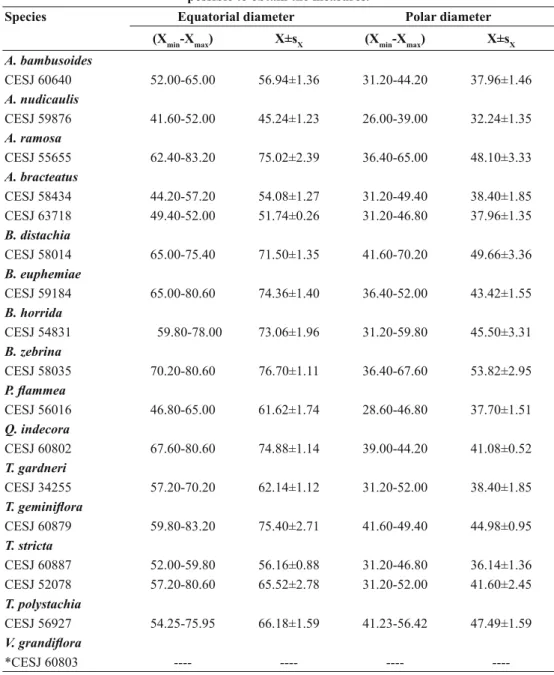
The pollen morphometric data are presented in Tables I and II. Billbergia distachia and V. grandifl ora
have fragile pollen grains that do not resist to acetolysis. The largest diameters (polar view) were observed in B. zebrina pollen grains (76.44 μm), while the smallest ones were observed in P. petropolitana (23.77 μm). However, the majority of pollen grains of the species studied presented about 45.24–75.40 μm.
TABLE I
Morphometric data of the largest diameter (in polar view) of pollen grains of the studied taxa. Arithmetic mean (X), size range (Xmin–Xmax), standard error (Sx), standard deviation (S),
variability (V) and confi dence interval (IC) of 95% (n = 25, except for the specimens with *, which n < 25). **It was not possible to obtain the measures.
Species Largest diameter
Xmin-Xmax(μm) X±sX(μm) S V (%) IC (95 %) A. bambusoides
*CESJ 60640 49.40-62.40 56.94±0.95 ---- ----
----A. nudicaulis CESJ 59876 CESJ 55680 52.00-78.00 39.00-52.00 61.67±1.62 45.24±0.98 8.14 4.92 13.18 2.16 58.31- 65.0343.20-47.47 A. ramosa
CESJ 55655 57.20-85.80 74.88±1.43 7.19 1.90 71.90-77.85
A. bracteatus CESJ 58434 *CESJ 63718 44.20-57.20 46.80-57.20 53.04±0.52 52.65±0.61 2.60 ----4.90 ----49.57-54.11 ----B. distachia
**CESJ 58014 ---- ---- ---- ----
----B. euphemiae
CESJ 59184 62.40-85.80 74.67±1.14 5.75 7.68 72.30-77.04
B. horrida
*CESJ 54831 54.60-80.60 71.28±1.78 ---- ----
----B. zebrina
CESJ 58035 72.80-80.60 76.44±0.49 2.48 3.26 75.41-77.46
P. fl ammea
*CESJ 56016 54.60-65.00 61.39±0.84 ---- ----
----P. petropolitana CESJ 56934 CESJ 56920 43.40-56.42 17.55-28.08 49.21±0.88
23.77±0.42 4.412.07 8.968.70
47.38-51.04 22.91-24.63 Q.indecora
CESJ 60802 65.00-85.80 74.36±0.96 4.80 1.29 72.38-76.34
T. gardneri
CESJ 34255 54.60-70.20 61.25±0.88 4.44 7.25 59.42-63.09
T. geminifl ora
CESJ 60879 65.00-83.20 75.40±1.13 5.61 7.44 73.08-77.71
T. polystachia
CESJ 56927 65.1-80.29 73.29±1.60 4.82 6.57 80.29-88.48
T. stricta CESJ 60887 CESJ 52078 49.40-65.00 52.00-80.60 55.01±0.69 65.31±1.44 3.49 7.21 6.35 11.04 53.56-56.46 62.33-68.28 V. grandifl ora
----Pollen key for the identifi cation of the Bromeliaceae species studied
1. Pollen grains pantoporate………...
Portea petropolitana
1. Pollen grains with other types of aperture
2. Pollen grains porate
3. Pollen grains with 2 or 3 pores ...
Aechmea ramosa
TABLE IIArithmetic mean (X), size range (Xmin–Xmax) and standard error (Sx), in μm, the equatorial and polar diameters (on equatorial view) of pollen grains of the studied taxa (n = 10). *It was not
possible to obtain the measures.
Species Equatorial diameter Polar diameter
(Xmin-Xmax) X±sX (Xmin-Xmax) X±sX A. bambusoides
CESJ 60640 52.00-65.00 56.94±1.36 31.20-44.20 37.96±1.46
A. nudicaulis
CESJ 59876 41.60-52.00 45.24±1.23 26.00-39.00 32.24±1.35
A. ramosa
CESJ 55655 62.40-83.20 75.02±2.39 36.40-65.00 48.10±3.33
A. bracteatus CESJ 58434 CESJ 63718
44.20-57.20 49.40-52.00
54.08±1.27 51.74±0.26
31.20-49.40 31.20-46.80
38.40±1.85 37.96±1.35 B. distachia
CESJ 58014 65.00-75.40 71.50±1.35 41.60-70.20 49.66±3.36 B. euphemiae
CESJ 59184 65.00-80.60 74.36±1.40 36.40-52.00 43.42±1.55
B. horrida
CESJ 54831 59.80-78.00 73.06±1.96 31.20-59.80 45.50±3.31 B. zebrina
CESJ 58035 70.20-80.60 76.70±1.11 36.40-67.60 53.82±2.95
P. fl ammea
CESJ 56016 46.80-65.00 61.62±1.74 28.60-46.80 37.70±1.51
Q. indecora
CESJ 60802 67.60-80.60 74.88±1.14 39.00-44.20 41.08±0.52
T. gardneri
CESJ 34255 57.20-70.20 62.14±1.12 31.20-52.00 38.40±1.85
T. geminifl ora
CESJ 60879 59.80-83.20 75.40±2.71 41.60-49.40 44.98±0.95
T. stricta
CESJ 60887 CESJ 52078
52.00-59.80 57.20-80.60
56.16±0.88 65.52±2.78
31.20-46.80 31.20-52.00
36.14±1.36 41.60±2.45 T. polystachia
CESJ 56927 54.25-75.95 66.18±1.59 41.23-56.42 47.49±1.59
V. grandifl ora
----3. Pollen grains always have 2 pores
4.
Operculate
pores...
Quesnelia indecora
4.
Non-operculate
pores
5. Heterobrochate exine; pollen grains
elliptical……….
Aechmea nudicaulis
5. Reticulate exine; pollen grains ovate
6. Lumina large, microreticulate ...
Ananas bracteatus
6. Lumina small, no
microreticulate………....
Aechmea bambusoides
2. Pollen grains 1-colpate
7. Pollen grains psilate-perfurate or reticulate
8. Exine psilate-perfurate...
Tillandsia gemini
fl
ora
8. Exine reticulate ...
Pitcairnia
fl
ammea
7. Pollen grains microreticulate or heterobrochate
9. Exine microreticulate
10. Colpus irregular shaped, margin thick,
ornamented
...………..
Billbergia zebrina
10. Colpus without thick
margin………
Tillandsia gardneri, Tillandsia stricta
9. Exine heterobrochate
11. Lumina with few pila……
Vriesea grandi
fl
ora
11. Lumina smooth
12. Muri wide...
Billbergia horrida
12. Muri narrow...
Billbergia distachia
,
Billbergia euphemiae
,
Tillandsia polystachia
DISCUSSION
This work describes, for the fi rst time, the pollen morphology of Aechmea bambusoides and Vriesea grandifl ora. In Aechmea, the largest and most morphologically diverse genus of Bromelioideae, the pollen grains embrace all types of aperture observed within the family (Faria et al. 2004). The species of Aechmea
Aechmea species presented heterobrochate exine with higher lumina. Sousa et al. (1997) also described differences in the type of exine (semi-tectate, tectate-perfurate, rugulate, reticulate and microreticulate) for species of Aechmea from northeastern Brazil, strengthening the morphological diversity of the pollen grains within this genus. Wanderley and Melhem (1991) analyzed 12 species of the Vriesea genus and found morphological characteristics similar to those found in V. grandifl ora, such as grains 1-colpate, heterobrochate exine and lumina with few pila.
Portea petropolitana was distinguished from all other species by presenting pantoporate pollen grains. Smith and Dows (1979) considered this characteristic as diagnostic for the genus, and Halbritter (1992) confi rmed this apertural pattern for species of Portea. Pantoporate grains, however, are also observed in some Aechmea species native to northeastern Brazil, which is related to the Gravisia complex (Read and Luther 1991). Mez (1891-1894, 1896, 1934-1935) fi rst suggested the morphological proximity between
Portea and Aechmea species originally described within the genus Gravisia, while Faria et al. (2004) confi rmed this close relationship using phylogenetic studies.
This work corroborates the aperture pattern (2-porate) of Ananas bracteatus and Quesnelia indecora, as observed by Ehler and Schill (1973), Wanderley and Melhem (1991) and Halbritter (1992). However, our analysis reports differences in the exine ornamentation for both species, with A. bracteatus presenting a microreticulated exine vs. reticulate exine and lumina with crests and granulations (Ehler and Schill 1973, Wanderley and Melhem 1991). Quesnelia indecora, in turn, showed a reticulate exine, contrary to Halbritter’s (1992) observations. Moreover, we also observed the presence of operculum covering the aperture of Q. indecora.
The Billbergia species have been reported in the literature to have 1-colpate pollen grains, varying from reticulate to heterobrochate (Ehler and Schill 1973, Wanderley and Melhem 1991, Halbritter 1992, Melhem et al. 2003). These characteristics were confi rmed for the genus in our study. Related to the colpus, only B. zebrina showed ornamentation in the margins. B.A. Moreira (unpublished data), described the pollen morphology of this species, presenting a well-ornamented colpus and a psilate-perforate exine. Our study corroborates the colpus ornamentation, but indicates differences in the characterization of the exine, which is characterized here as microreticulate.
Erdtman and Praglowsky (1974) and Halbritter (1992) analyzed pollen grains of Pitcairnia species and observed the 1-colpate aperture pattern and exine with reticulate ornamentation in P. fl ammea pollen grains, as well as for other taxa of the genus. Our study corroborates the aperture and ornamentation pattern of this specie.
The basic 1-colpate aperture pattern of the genus Tillandsia is confi rmed for the species analyzed in the present study. Wanderley and Melhem (1991) and Souza et al. (2004) analyzed the pollen grains of Tillandsia
species and indicated differences in the exine structure, as the main palynological characteristic. The results obtained in this study corroborate the morphological variety of the patterns of exine ornamentation, which varied from psilate-perfurate in T. geminifl ora, and microreticulate in T. stricta and T. gardneri, to heterobrochate in T. polystachia.
This study revealed some useful taxonomical characteristics that could be used to identify species, to delimit groups of species, and for future taxonomic and phylogenetic studies of Bromeliaceae.
ACKNOWLEDGMENTS
the Programa de Capacitação em Taxonomia (PROTAX), process number 562218/2010-6. The authors would also like to thank the Bryophyte Laboratory (Universidade Federal de Juiz de Fora), the Núcleo de Microscopia e Microanálise da Universidade Federal de Viçosa and Fátima Salimena (curator of CESJ herbarium), for the logistic support.
RESUMO
A morfologia dos grãos de pólen de espécies de Bromeliaceae coletadas em áreas de Floresta Atlântica do sudeste do Brasil foi estudada. As seguintes espécies foram analisadas: Aechmea bambusoides L. B. Sm. & Reitz, A. nudicaulis (L.) Griseb., A. ramosa Mart.exSchult.f., Ananas bracteatus (Lindl.) Schult.f., Billbergia distachia (Vell.) Mez, B. euphemiae E. Morren, B. horrida Regel, B. zebrina (Herb.) Lindl., Portea petropolitana (Wawra) Mez, Pitcairnia fl ammea Lindl., Quesnelia indecora Mez, Tillandsia polystachia (L.) L., T. stricta Sol., T. gardneri Lindl., T. geminifl ora Brongn. e Vriesea grandifl ora Leme. Microscopia de luz e microscopia eletrônica de varredura foram empregadas e as espécies foram agrupadas em três tipos polínicos organizados de acordo com as características das aberturas: Tipo I - grãos de pólen pantoporados, observados em P. petropolitana; Tipo II – grãos de pólen 2-porados, observados nos gêneros Ananas, Aechmea e Quesnelia e Tipo III - grãos de pólen 1-colpado observado nos gêneros Billbergia, Pitcairnia, Tillandsia e Vriesea. Os dados polínicos levaram à elaboração de uma chave de identifi cação. Os resultados mostraram que as espécies analisadas podem ser separadas utilizando-se, principalmente, o padrão de aberturas e ornamentação da exina, e que essas características podem auxiliar nos estudos taxonômicos da família.
Palavras-chave: epífi tas, morfologia, grãos de pólen, taxonomia.
REFERENCES
BARTH OM AND MELHEM TS. 1988. Glossário ilustrado de Palinologia. Campinas: Editora Unicamp, 75 p. BENZING DH. 1994. How much is know about Bromeliaceae in 1994? Selbyana 15: 1-7.
EHLER N AND SCHILL R. 1973. Die Pollenmorphologie der Bromeliaceae. Pollen Spores 15: 13-45. ERDTMAN G. 1960. The acetolysis method. A revised description. Svensk Bot Tidskr 54: 561-564.
ERDTMAN G AND PRAGLOWSKI K. 1974. A note on pollen morphology. In: Smith LB and Downs RJ (Eds), Fl Neotropica 14(1): 28-33.
FARIA APG, WENDT T AND BROWN GK. 2004. Cladistic relationships of Aechmea (Bromeliaceae, Bromelioideae) and allied genera. Ann Mo Bot Gard 91: 303-319.
GIVNISH TJ ETAL. 2011. Phylogeny, adaptive radiation and historical biogeography in Bromeliaceae: Insights from an eight-locus plastid phylogeny. Am J Bot 98: 872-895.
GIVNISH TJ, MILLAM KC, BERRY PE AND SYTSMA KJ. 2007. Phylogeny, adaptive radiation, and historical biogeography of Bromeliaceae inferred from ndhF sequence data. Aliso 23: 3-26.
HALBRITTER H. 1992. Morphologie und Systematische Bedeutung des Pollens der Bromeliaceae. Grana 31: 197-212. LUTHER H. 2008. An alphabetical list of Bromeliad binomials. Bromeliad Society International, 11th
ed., Sarasota: The Marie Selby Botanical Gardens, 110 p.
MELHEM TS, CRUZ-BARROS MAV, CORRÊA MAS, MAKINO-WATANABE H, SILVESTRE-CAPELATO MSF AND ESTEVES VLG. 2003. Variabilidade polínica em plantas de Campos do Jordão (São Paulo, Brasil). Bol Bot Univ São Paulo 16: 1-106. MEZ C. 1891-1894. Bromeliaceae. In: Martius CFP, Eichler AG and Urban I (Eds), Fl. Bras., 3, München, Wien, Leipzig, p.
173-634.
MEZ C. 1896. Bromeliaceae. In: De Candolle APP and De Candolle ACP (Eds), Monographiae Phanerogamarum, 9, Paris, G. Masson, p. 1-990.
MEZ C. 1934-1935. Bromeliaceae. In: Engler HGA (Ed), Das Pflanzenreich, 4, Wilhelm Engelmann, Berlin, Wilhelm Engelmann, p. 1-667.
MOREIRA BA, CRUZ-BARROS MAV AND WANDERLEY MGL. 2005. Morfologia polínica de algumas espécies dos gêneros
Neoregelia L.B. Sm. e Nidularium Lem. (Bromeliaceae) do Estado de São Paulo, Brasil. Acta Bot Bras 19: 61-70.
RAYNAL A AND RAYNAL J. 1971. Une technique de préparation des grains de pollen fragiles. Adansonia 11: 77-79. READ RW AND LUTHER HE. 1991. The Aechmea/Gravisia complex (Bromeliaceae). Selbyana 12: 54-67.
SCHULTE K AND ZIZKA G. 2008. Multi locus plastid phylogeny of Bromelioideae (Bromeliaceae) and the taxonomic utility of petal appendages and pollen characters. Candollea 63: 209-225.
SMITH LB AND DOWNS RJ. 1974. Pitcairnioideae (Bromeliaceae). In: Wurdack JJ (Ed), Fl Neotropica 14(1), New York: Hafner Press, p. 1-658.
SMITH LB AND DOWNS RJ. 1977. Tillandsioideae (Bromeliaceae). In: Rogerson CT (Ed), Fl Neotropica 14(2), New York: Hafner Press, p. 663-1492.
SMITH LB AND DOWNS RJ. 1979. Bromelioideae (Bromeliaceae). In: Rogerson CT (Ed), Fl Neotropica 14(3), New York: Hafner Press, p. 1493-2141.
SOUSA GM, WANDERLEY MGL AND CRUZ-BARROS MAV. 1997. Morfologia polínica de Aechmea Ruiz & Pav. (Bromeliaceae) de Pernambuco, Brasil. Bol Bot Univ São Paulo 16: 21-30.
SOUZA FC, MENDONÇA CBF AND GONÇALVES-ESTEVES V. 2004. Estudo polínico de espécies de Pitcairnioideae e Tillandsioideae (Bromeliaceae Juss.) ocorrentes na Restinga de Carapebus, Estado do Rio de Janeiro. Arq Mus Nac 62: 15-23.
STEHMANN JR, FORZZA RC, SALINO A, SOBRAL M, COSTA DP AND KAMINO LHY. 2009. Plantas da Floresta Atlântica. Rio de Janeiro: Jardim Botânico do Rio de Janeiro, 516 p.
TERRY GR, BROWN GK AND OLMSTEAD RG. 1997. Examination of subfamilial phylogeny in Bromeliaceae using comparative sequencing of the plastid locus ndhF. Am J Bot 84: 664-670.
THIERS B. 2014 [continuosly updated]. Index Herbariorum: a global directory of public herbaria and associated staff. New York Botanical Garden’s Virtual Herbarium. Available in <www.sweetgum.nybg.org/ih>. Accessed on Dec 20, 2014.
WANDERLEY MGL AND MELHEM TS. 1991. Flora polínica da reserva do Parque Estadual das Fontes do Ipiranga. Família: 178- Bromeliaceae. Hoehnea 18: 5-42.