(Annals of the Brazilian Academy of Sciences) ISSN 0001-3765
www.scielo.br/aabc
Nematicidal and larvicidal activities of the essential oils from aerial parts of
Pectis oligocephala
and
Pectis apodocephala
Baker
MARIA ROSE JANE R. ALBUQUERQUE1, SONIA MARIA O. COSTA2, PAULO N. BANDEIRA2, GILVANDETE MARIA P. SANTIAGO3, MANOEL ANDRADE-NETO1, EDILBERTO R. SILVEIRA1
and OTILIA D.L. PESSOA1
1Departamento de Química Orgânica e Inorgânica, Centro de Ciências, Universidade Federal do Ceará, Campus do Picí Caixa Postal 12200, 60021-970 Fortaleza, CE, Brasil
2Coordenação de Química/Biologia, Universidade Estadual Vale do Acaraú, Campus Betânia Caixa Postal D-3, 62040-370 Sobral, CE, Brasil
3Departamento de Farmácia, Faculdade de Farmácia, Odontologia e Enfermagem, Universidade Federal do Ceará, Rua Capitão Francisco Pedro, 1210, Rodolfo Teófilo, 60430-370 Fortaleza, CE, Brasil
Manuscript received on October 19, 2005; accepted for publication on August 15, 2006; presented byRAIMUNDOBRAZFILHO
ABSTRACT
The chemical composition of the essential oils from aerial parts of Pectis apodocephala andPectis oligocephalawere analyzed by GC-MS. The essential oils of these species were predominantly constituted by monoterpenes. Geranial (42.9–44.5%), neral (32.2–34.2%) andα-pinene (10.7–11.4%) were the main constituents in the oil ofP. apodocephala, whilep-cymene (50.3–70.9%) and thymol (24.4–44.7%), were the prevalent compounds in the oil ofP. oligocephala. The essential oils were tested against the root knot nematodeMeloidogyne incognitaandAedes aegyptilarvae survival. The results obtained show that both essential oils exhibited significant activity and could be considered as potent natural namaticidal and larvicidal agents.
Key words:Pectis apodocephala,Pectis oligocephala, essential oil, nematicidal activity, larvicidal activity.
INTRODUCTION
Essential oils from different plant sources have demon-strated several biological activities, including antibacte-rial (Iacobellis et al. 2005), insecticidal (Araújo et al. 2003), larvicidal (Albuquerque et al. 2004a), acaricidal (Kim et al. 2004), nematicidal (Duschatzky et al. 2004) and antifungal (Wang et al. 2005). As a consequence, this vast arsenal of bioactive compounds has attracted significant and crescent attention of researchers in re-cent years. Nematodes are tiny worms, some of them are parasites to plants, and can play an important role in the predisposition of the host plant to the invasion by secondary pathogens (Jayasinghe et al. 2003). Plants
Correspondence to: Dra. Otília Deusdênia Loiola Pessoa E-mail: [email protected]
attacked by nematodes show retarded growth and devel-opment, as well as loss in the quality and quantity of the harvest product. The nematodeMeloidogyne incog-nitais a widespread nematode found in several important
agronomical cultures of Brazil.
Innumerous human diseases such as malaria, filaria-sis, dengue fever, yellow fever and several viral diseases are transmitted by mosquitoes (Venkatachalam and Je-banesan 2001), being theAedes aegyptione of the most
hazardous because it is the vector for yellow fever and dengue hemorrhagic fever, besides to be responsible for some allergic response such as urticaria and angioedema (Cheng et al. 2003). The synthetic pesticides have been generally used with success for the eradication of nema-todeM. incognitaandA. aegyptilarvae. Nevertheless,
in-secticides has also induced undesirable effects including toxicity to non-target organisms and environmental pol-lution problems. Since essential oils constitute a rich source of bioactive compounds, they may be considered as an useful alternative strategy to the currently avail-able insecticidal agents in the use for controlling both
M. incognitaandA. aegypti.
As part of a continuous research program on aro-matic plants from Northeast Brazil, we have investigated the volatile composition of the essential oils of several plants from the Asteraceae family (Albuquerque et al. 2001, 2003, 2004a, b). The genus Pectis is constituted by approximately 76 neotropical species. Despite the et-nobotanical uses of some of them, this genus has been the subject of scant phytochemical and biological stud-ies. In the flora of Northeast Brazil, the genus is rep-resented by five species, includingPectis apodocephala
andPectis oligocephala, whose essential oils we have
previously investigated (Craveiro et al. 1986, Albuquer-que et al. 2003). The present work reports the rein-vestigation of the essential oils from aerial parts of P. apodocephalaandP. oligocephala, as well as their
ne-maticidal and larvicidal effects against the nematode
M. incognitaandA. aegyptilarvae.
MATERIALS AND METHODS
PLANTMATERIAL
BothP. apodocephalaandP. oligocephala, in the
flower-ing stage were collected in May 2000 and June 2003, in Sobral County, State of Ceará, Northeast Brazil. Voucher specimens (#29441 and #29453) were deposited at the Herbário Prisco Bezerra (EAC) of the Departamento de Biologia, Universidade Federal do Ceará, Brazil.
EXTRACTION OF THEESSENTIALOILS
Samples of fresh aerial parts of both species were sub-jected to hydrodistillation for 2 hours in a Clevenger-type apparatus. The isolated oils were subsequently dried over anhydrous sodium sulfate and stored under refrigeration until analyzed and tested. The oil yields (w/w on fresh weight basis) forP. apodocephalawere 0.20 and 0.12%,
while the oil yields forP. oligocephala were 0.40 and
0.18%, respectively.
ANALYSIS OF THEESSENTIALOILS
The volatile components from aerial parts ofP. apodo-cephala and P. oligocephala (Table I), were analyzed
by GC-MS on a Hewlett-Packard Model 5971 GC/MS using a (5%-phenyl)-methylpolysiloxane DB-5 capillary column(30 m×0.25 mm)with film thickness 0.1µm;
carrier gas helium, flow rate 1 mL/min with split mode. The injector temperature and detector temperature were 250◦C and 280◦C, respectively. The column
tempera-ture was programmed at 4◦C/min from 35◦C to 180◦C
and then at 10◦C/min from 180◦C to 250◦C. Mass
spec-tra were recorded from 30–450m/z. Individual
com-ponents were identified by matching their 70 eV mass spectra with those of the spectrometer data base using the Wiley L-Built library and two other computer li-brary MS searches using retention indices as a prese-lection routine (Alencar et al. 1984, 1990) as well as by visual comparison of the fragmentation pattern with those reported in the literature (Stenhagen et al. 1974, Adams 2001).
USEDORGANISMS
Second-stage juvenile (J2) of the plant parasite root-knot nematodeMeloidogyne incognitaand instar III larvae of Aedes aegypti.
NEMATICIDALBIOASSAY
Egg masses of M. incognita obtained from okra roots
with aid of a stereomicroscope were maintained in Petri dishes during 24 h in distilled water for the juveniles eclosion. 50µL portions of water containing
approxi-mately 100 juveniles (J2) were transferred to nematolog-ical vials to which 1 mg of the oils to be tested was added and a H2O:DMSO 2% solution was poured to complete
1 mL. The nematological vials were kept on a hood at 28◦C. The inactive nematodes counting were performed
at every 24 h for 72 h. After the last counting the inac-tive juveniles were maintained in distilled water for 24 h to observe their revival. Four repetitions for each treat-ment were performed using water and H2O:DMSO 2%
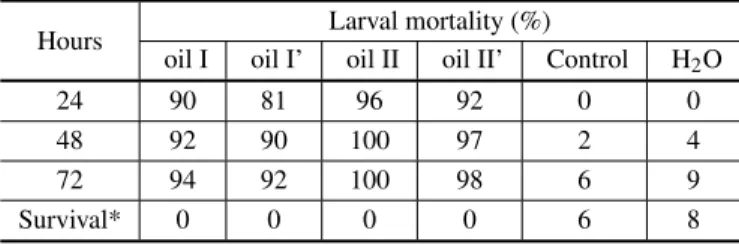
solution as control. Table II shows the nematicidal effect for the essential oils from aerial parts ofP. apodocephala
andP. oligocephala. In Table II the survival figures mean
TABLE I
Volatile components identified in the essential oils from aerial parts of
P. apodocephala(oils I and I’) andP. oligocephala(oils II and II’).
Relative contents (%) Compoundsa
IKb oil Ic oil I’d oil IIc oil II’d α-pinene 940 11.4 10.7 – 0.2 6-methyl-5-hepten-2-one 991 1.0 – – –
myrcene 993 – – 1.7 0.7
α-phellandrene 1007 – – 0.9 0.5
limonene 1034 6.7 6.9 – 1.2
p-cymene 1026 – – 70.9 50.3
β-phellandrene 1046 – – 2.1 –
nerol 1221 – 0.8 – –
neral 1235 34.2 32.2 – –
geraniol 1252 1.3 3.4 – –
geranial 1270 44.5 42.9 – –
thymol 1289 – 24.4 44.7
β-caryophyllene 1427 – 0.6 – 0.4
α-humulene 1456 – 0.6 – –
Total identified 99.1 98.1 100.0 98.0
aOrder of elution on DB-5 capillary column. bIK = Kovats retention index in reference to C8–C26n-alkanes on DB-5 column. cSamples ofP. apodocephala andP. oligocephalacollected in May 2000.dSamples ofP. apodocephalaandP. oligocephalacollected in June 2003.
TABLE II
Nematicidal activity (%) of the essential oils from aerial parts of
P. apodocephala(oil I and I’) andP. oligocephala(oil II and II’) expressed as the average of four repetitions for each treatment.
Larval mortality (%) Hours
oil I oil I’ oil II oil II’ Control H2O
24 90 81 96 92 0 0
48 92 90 100 97 2 4
72 94 92 100 98 6 9
Survival* 0 0 0 0 6 8
*Number of motionless juveniles that recovered motility.
LARVICIDALBIOASSAY
Portions of essential oils (5 to 500µg/mL) were placed
in a beaker (50 mL) and dissolved in H2O:DMSO
(98.5:1.5). 50 instar III larvae of A. aegyptiwere
de-livered to each beaker. After 24 hours, at room temper-ature, the number of dead larvae was counted and the lethal percentage calculated. A control using DMSO and water was carried out in parallel. For each sample,
three independent experiments were run. The bioassays were performed at Laboratório de Entomologia, Núcleo de Endemias da Secretaria de Saúde do Estado do Ceará, Brazil.
RESULTS AND DISCUSSION
values listed in order of elution from a DB-5 capillary column. The chemical composition of the essential oils from both species,P. apodocephalaandP. oligocephala,
were essentially constituted by monoterpenes, but as can be seen from Table I, the essential oil of each species has a characteristic chemical composition, either qualitative or quantitative, that has been maintained steady indepen-dent of the time of extraction. The main compounds of the oil ofP. apodocephala, in order of their abundance,
were: geranial (42.9–44.5%) and neral (32.2–34.2%) followed byα-pinene (10.7–11.4%) and limonene (6.7–
6.9%). On the other hand, the most prevalent compounds detected in the oils of P. oligocephalawere p-cymene
(50.3–70.9%) and thymol (24.4–44.7%).
The nematicidal and larvicidal potential of the oils from both species were evaluated against the nematode
M. incognitaand theA. aegypti larvae. The results of
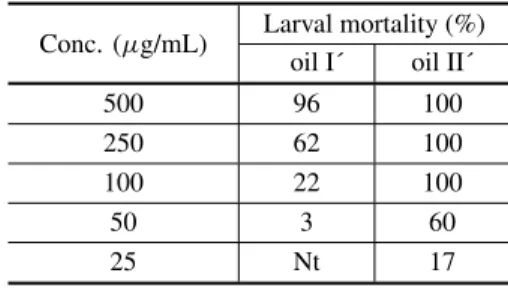
the bioassays are summarized in Tables II and III. Since all oils from both plants exhibited similar and significant activities in the bioassays and the oils have very different chemical composition this make evident the unspecific susceptibility of the tested organisms. Several papers re-cently published have dealed with biological activities of essential oils. Citral (geranial + neral) rich oils pre-sented antifungal activity (Wang et al. 2005, Pattnaik et al. 1997, Belletti et al. 2004) while thymol rich oils presented, antibacterial, antifungal and larvicidal activi-ties (Singh et al. 2004, Shin and Kim 2004, Tepe et al. 2004, Goren et al. 2003, Carvalho et al. 2003). Interest-ingly, p-cymene in particular, and other monoterpenoids
such as α- andβ-pinene are also present as the major
components in all those biologically active oils. Despite the two-fold higher concentration of thymol in oil II’ the activity of this oil is still similar to the one of oil II. On the other hand, the figures are inverted in the case of p-cymene concentrations. If at a lower concentration
of p-cymene oil II’ still showed a slightly improved
ac-tivity this maybe means that p-cymene contributes more
for the activity than thymol, once the total concentration of both components (95.3% and 95.0%, for oil II and II’, respectively) is maintained steady. It is also worthy of notice the higher toxicity of oils II and II’ relative to oils I and I’ in both assays.
The steady chemical constitution pattern of the oils, associated to their nematicidal and larvicidal properties,
TABLE III
Larvicidal activity of the essential oils from leaves of
P. apodocephala(oil I’) andP. oligocephala(oil II’).
Larval mortality (%) Conc. (µg/mL)
oil I´ oil II´
500 96 100
250 62 100
100 22 100
50 3 60
25 Nt 17
nt = not tested.
could be relevant points to be considered to the possible economical potential of the oils from both species.
ACKNOWLEDGMENTS
The authors are grateful for the financial support pro-vided by the Brazilian Agencies Conselho Nacional de Desenvolvimento Científico e Tecnológico (CNPq), Co-ordenação de Aperfeiçoamento de Pessoal de Nível Su-perior (CAPES), Fundação Cearense de Apoio ao Desen-volvimento Científico e Tecnológico (FUNCAP), Pro-grama de Apoio a Núcleos de Excelência (PRONEX) and Financiadora de Estudos e Projetos (FINEP). Spe-cial thanks to Mrs. Olga Ramos (LPN/UFC) and João Carlos da Costa Assunção (DQOI/UFC) for recording the GC-MS spectra.
RESUMO
A composição química dos óleos essenciais das partes aéreas dePectis apodocephalaePectis oligocephalafoi analisada por CG-EM. Os óleos essenciais destas espécies foram predomi-nantemente constituídos por monoterpenos. Geranial (42,9– 44,5%), neral (32,2–34,2%) eα-pineno (10,7–11,4%) foram os constituintes majoritários no óleo deP. apodocephala, en-quantop-cimeno (50,3–70,9%) e timol (24,4–44,7%), foram os compostos prevalentes no óleo deP. oligocephala. Ambos os óleos foram testados contra o nematóideMeloidogyne incog-nitae larvas do mosquitoAedes aegyptino terceiro estágio. Os resultados obtidos mostraram que os óleos exibem significante atividade e podem, portanto, ser considerados como potenciais agentes nematicida e larvicida naturais.
Palavras-chave: Pectis apodocephala, Pectis oligocephala,
REFERENCES
ADAMSRP. 2001. Identification of Essential Oil Compo-nents by Gas Chromatography/Quadrupole Mass Spec-troscopy. Carol Stream, Illinois, USA: Allured Publishing Corporation, 456 p.
ALBUQUERQUE MRJR, SOUZA EB, MESQUITA EF, NUNESEP, CUNHAANANDSILVEIRAER. 2001. Vol-atile constituents from leaves of Vernonia chalybaea Mart. and Eupatorium ballotaefolium H.B.K. J Essent Oil Res 13: 376–377.
ALBUQUERQUE MRJR, SOUZA EB, MESQUITA EF, NUNESEP, CUNHAANANDSILVEIRAER. 2003. Vol-atile constituents of the aerial parts of Pectis apodoce-phala and Pectis oligocephala. J Essent Oil Res 15: 372–373.
ALBUQUERQUE MRJR, SILVEIRA ER, UCHOA DEA, LEMOSTLG, SOUZAEB, SANTIAGOGMPANDPES -SOAODL. 2004a. Chemical composition and larvicidal activity of the essential oils fromEupatorium betonicae-forme(D.C.) Baker (Asteraceae). J Agric Food Chem 52: 6708–6711.
ALBUQUERQUE MRJR, SOUZA EB, LINS MUDS, NO -GUEIRANAP, LEMOSTLG, SILVEIRAER ANDPES -SOA ODL. 2004b. Composition and antimicrobial ac-tivity of the essential oil from aerial parts ofBaccharis trinervis(Lam.) Pers. Arkivoc 6: 59–65.
ALENCARJW, CRAVEIROAAANDMATOSFJA. 1984. Ko-vats indices as a preselection routine in mass spectra li-brary search of volatiles. J Nat Prod 47: 890–892. ALENCARJW, CRAVEIROAA, MATOSFJAANDMACHA
-DO MIL. 1990. Kovats indices simulation in essential oils analysis. Quim Nova 13: 282–284.
ARAÚJOECC, SILVEIRAER, LIMAMAS, NETOMA,DE ANDRADE IL, LIMA MAA, SANTIAGO GMP AND MESQUITAALM. 2003. Insecticidal activity and chem-ical composition of volatile oils from Hyptis martiusii Benth. J Agric Food Chem 51: 3760–3762.
BELLETTIN, NDAGIJIMANAM, SISTOC, GUERZONIME, LANCIOTTI R AND GARDINI F. 2004. Evaluation of the antimicrobial activity of citrus essences on Saccha-romyces cerevisiae. J Agric Food Chem 52: 6932–6938. CARVALHOAFU, MELOVMM, CRAVEIROAA, MACHA
-DOMIL, BANTIMMB ANDRABELO EF. 2003. Lar-vicidal activity of the essential oil fromLippia sidoides Cham. AgainstAedes aegyptiLinn. Mem Inst Oswaldo Cruz 98: 569–571.
CHENGSH, CHANGHT, CHANGST, TSAIKHANDCHEN WJ. 2003. Bioactivity of selected plant essential oils against the yellow fever mosquitoAedes aegyptilarvae.
Biores Technol 89: 99–102.
CRAVEIROAR, ANDRADE CHS, MATOSFJA, ALENCAR JW AND MACHADO MIL. 1986. Essential oils from Brazilian Compositae. J Nat Prod 49: 361–363. DUSCHATZKY CB, ALMEIDA NV ANDBONIVARDOSL.
2004. Nematicidal activity of the essential oils of several Argentina plants against the root-knot nematode. J Essent Oil Res 16: 626–628.
GOREN AC, BOLSELG, BILSEL M, DEMIRHAND KO -CABASEE. 2003. Analysis of essential oil of Coridothy-mus capitatus (L.) and its antibacterial and antifungal activity. Z Naturforsch C 58c: 687–690.
IACOBELLIS NS, CANTOREPL, CAPASSOF ANDSENA -TOREF. 2005. Antibacterial activity ofCuminum cymi-numL. andCarum carviL. essential oils. J Agric Food Chem 53: 57–61.
JAYASINGHE ULB, KUMARIHAMY BMM, BANDARA AGD, VASQUEZEA ANDKRAUS W. 2003. Nemati-cidal activity of some Sri Lankan plants. Nat Prod Res 17: 259–262.
KIMSI, YIJH, TAKJHANDAHNYJ. 2004. Acaricidal ac-tivity of plant essential oils againstDermanyssus gallinae (Acari: Dermanyssidae). Vet Parasitol 120: 297–304. PATTNAIKS, SUBRAMANYAMVR, BAPAJIMANDKOLE
CR. 1997. Antibacterial and antifungal activity of aro-matic constituents of essential oils. Microbios 89: 39–46. SHINSANDKIMJH. 2004. Antifungal activities of essential oils fromThymus quinquecostatusandT. magnus. Planta Med 70: 1090–1092.
SINGHG, MAURYAS, CATALANCANDLAMPASONAMP. 2004. Chemical constituents, antifungal and antioxidative effects of ajwain essential oil and its acetone extract. J Agric Food Chem 52: 3292–3296.
STENHAGENE, ABRAHAMSONSANDMCLAFFERTYFW. 1974. Registry of Mass Spectral Data Base. Washington DC: Government Printing Office.
TEPE B, DAFERERA D, SÖLMEN M, POLISSIOUM AND SÖKMENA. 2004. In vitro antimicrobial and antioxidant activities of the essential oils and various extracts of Thy-mus eigiiM. Zohary et P.H. Davis. J Agric Food Chem 52: 1132–1137.
VENKATACHALAMMRANDJEBANESANA. 2001. Repel-lent activity ofFerronia alephantum Corr. (Rutaceae) leaf extract againstAedes aegypti(L). Biores Technol 76: 287–288.