Vol.57, n.3: pp. 326-325, May-June 2014 http://dx.doi.org/10.1590/S1516-89132014005000008
ISSN 1516-8913 Printed in Brazil
BRAZILIAN ARCHIVES OF BIOLOGY AND TECHNOLOGY
A N I N T E R N A T I O N A L J O U R N A L
Growth Curve, Biochemical Profile and Phytochemical
Analyses in Calli Obtained from the Procambium Segments
of Bacupari
Plinio Rodrigues dos Santos Filho
1*, Breno Régis Santos
2, Sandro Barbosa
2, Letícia Rios
Vieira
2, Natália Chagas de Freitas
2, Daniele Ferreira Dias
3and Marcelo Henrique dos
Santos
41Departamento de Bioquímica; Instituto de Ciências Biomédicas; Universidade Federal de Alfenas; Alfenas - MG -
Brasil. 2Instituto de Ciências da Natureza; Universidade Federal de Alfenas; Alfenas - MG - Brasil. 3Instituto de Química; Universidade Federal de Alfenas; Alfenas - MG - Brasil. 4Departamento de Química; Universidade Federal de Viçosa; Viçosa - MG - Brasil
ABSTRACT
Garcinia brasiliensis, popularly known as Bacupari, is native to the Amazon and commonly used in folk medicine for its therapeutic properties. This plant is rich in bioactive compounds like benzophenones. However, there are no works about the in vitro establishment and achievement of secondary metabolites in this plant. Thus, the aim of this work was to determine the growth curve and to perform the biochemical and phytochemical analyses in calli obtained from the procambium segments of Bacupari. The growth curve of calli followed a sigmoidal pattern, with four distinct phases (lag, exponential, linear, deceleration). Total soluble sugars were higher on the inoculation day and the reducing sugars on the 20 th day. Amino acids increased from the 60 th day up to the stabilization on the 120 th day. The protein content varied, but it seemed to be related to the amino acids metabolism. The phytochemical screening showed the presence of phenolic and flavonoid compounds in the calli and the HPLC analysis allowed the identification of Fukugetin, Guttiferone A and 7-epiclusianone.
Key words: Bacupari, benzophenones, calli
*Author for correspondence: [email protected]
INTRODUCTION
Garcinia brasiliensis Mart., popularly known as
Bacupari (Gonçalves-Esteves and Mendonça 2001), is a medium- sized tree native to the Amazon, but found now throughout the Brazilian territory. It belongs to the Clusiaceae family and is used in folk medicine for the treatment of ailments such as wounds, peptic ulcers and tumors (Lorenzi 2008). Previous reports have demonstrated the presence of bioactive compounds in this plant, such as biflavonoids and prenylated xanthones and
benzophenones (Delle Monache et al. 1984; Santos et al. 1999). Among the natural bioactive compounds, the polyisoprenylated benzophenones are associated with the biological activities such as anti-HIV (Gustafon et al. 1992); leishmanicidal (Pereira et al. 2010), free radical scavenger (Ngouela et al. 2006), anti-cholinesterase (Lenta et al. 2007), anti-inflammatory and antinociceptive (Santa-Cecília et al. 2011). Three natural polyisoprenylated benzophenones have been
isolated from Garcinia brasiliensis: Guttiferone-A
al. 1999) and Garciniaphenone (Derogis et al. 2008).
The capacity of plant cell, tissue, and organ cultures to produce and accumulate many of the same valuable chemical compounds as the parent plant in nature has been recognized (Karuppusamy 2009). In recent work, Hussein et al. (2010) found
flavonoids, tannins, volatile oils and
anthraquinones in the calli of Brassica nigra. In
calli of Prunus cerasus, the cultivation in the light
and in the presence of jasmonic acid increased the production of cyanidin 3-O-glucoside compound (Blando et al. 2005). The production of metabolites through the plant cell culture is attractive for bringing ecological and economic benefits by reducing the predatory gathering of plant species with pharmaceutical relevance. In this way, assessing the biochemical changes
during the calli development can support the in
vitro establishment.
Thus, the aim of this work was to determine the growth curve and to perform the biochemical and phytochemical analyses in calli obtained from the procambium segments of Bacupari.
MATERIALS AND METHODS
Plant material and calli induction
Fruits of Garcinia brasiliensis Mart. were
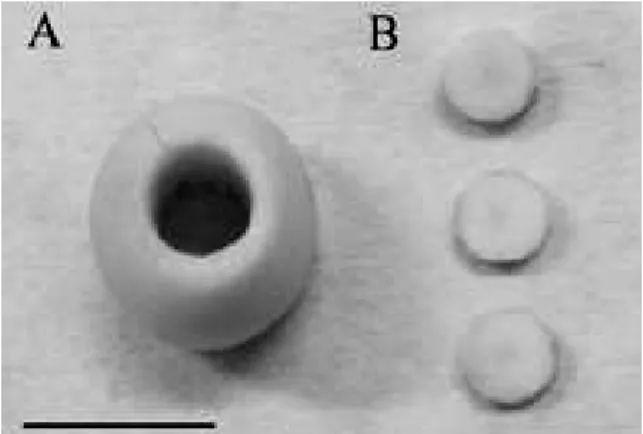
collected in Viçosa-MG. Intact seeds were disinfested with ethanol (70°GL) for 4 min and sodium hypochlorite (12500 ppm) for 15 min. Then, they were washed three times with distilled and autoclaved water. The explants (2 mm thickness and 4 mm in diameter) were obtained from the procambium segments of the seeds (Fig. 1) and were inoculated into culture flasks containing 30 mL of MS medium (Murashige and Skoog 1962), supplemented with sucrose (3%), agar (0.7%) and BAP (6-Benzilaminopurine, 0.5
mg/L-1). The pH was adjusted to 5.8 before
autoclaving. Tissue flasks were kept at 25 ± 2°C in the dark. This condition was previously determined for calli induction in Bacupari.
Growth curve determination
The growth curve was determined from the random selection of 20 explants inoculated according to the description above. Each explant was weighed aseptically at the intervals of 20 days during the 140 days of cultivation, starting on the inoculation day.
Figure 1 - Bacupari seeds drilled (A) in order to obtain
the procambium segments (B) used as explants in the experiments. Scale: 1 cm.
Biochemical analyses
Four samples, each containing 300 mg of calli (fresh weight) were collected. They were macerated in 3.0 mL of extraction buffer (0.1 M potassium phosphate, pH 7.2) containing 300 mg polyvinylpyrrolidone (PVP) and centrifuged at
20,800 xg at 4°C for 30 min. Supernatant was
collected and stored at -20°C (Lemos et al. 1999). Biochemical analyses were done at the intervals of 20 days following the growth curve. Total soluble sugars and reducing sugars were determined according to Yemm and Willis (1954) and Miller (1959), respectively, using anthrone and 3,5-dinitrosalicylic acid. Glucose was used as standard. Total content of amino acids and proteins was determined according to Yemm and Cocking (1955) and Bradford (1976). Glutamine and Bovine Serum Albumin (BSA) were used as the standards.
Phytochemical analyses
Samples for the phytochemical analyses were collected on the 140 th day after the inoculation during the deceleration period of the culture according to the growth curve. For the extract
preparation, four samples of thecalli and the initial
ethanol PA. Total phenolic content was
determined as described by
Ainsworth and
Gillespie (2007)
with minor modifications.Briefly, 0.1 mL of the samples were mixed with 0.5 mL of Folin-Ciocalteu reagent diluted in water (1:10). After 8 min, 0.4 mL of 4% sodium carbonate were added. The samples were incubated for two hours in the dark and the
absorbance was measured at 740 nm.
Quantification was based on a standard curve of gallic acid. Total flavonoid content was measured according to Park et al. (1997). Aliquots of 0.5 mL of the samples were mixed with 1.5 mL of methanol, 0.1 mL of 10% aluminum chloride, 0.1 mL of potassium acetate and 2.8 mL of distilled water. They were then incubated for 30 min at room temperature and the absorbance was measured at 415 nm. Quantification was based on a standard curve of quercetin.
High performance liquid chromatography (HPLC) analysis of the samples was performed on Shimadzu LC-20A equipment using a C18 NST column, Nano Separation Technologies (150 x 4.6 mm), with a 5 µm particle size according to Santa Cecília et al. (2011). The mobile phases consisted
of eluent A (0.5 mM L-1 aqueous acetic acid) and
eluent B (methanol/acetic acid 0.1%). The gradient
conditions at 1.2 mL min-1 flow rate were as
follows: 50% solvent B for 10 min, 50% to 100% solvent B for 10 min, 100% solvent B for 10 min, followed by a 2 min re-equilibration in 50% solvent B. The retention time and UV absorption spectrum of the compounds were detected at 254 nm with a photodiode array detector. Samples were injected at a volume of 20 µL and concentration of 1 mg/mL. LC solution software was used for data collection. Fukugetin, Guttiferone A and 7-epiclusianone, previously
obtained and characterized in Garcinia braziliensis
extracts (Martins et al. 2010; Gontijo et al. 2012) were used as the standard compounds for the HPLC analyses.
RESULTS AND DISCUSSION
Growth curve determination
The growth curve of calli followed a sigmoidal pattern, with four distinct phases in the observed period (Fig. 2). The decline and stationary stages were not observed in this study. Mendonça et al.
(2012) working with calli of Eucalyptus
camaldulensis obtained a similar result, not
identifying the decline and stationary stages.
Figure 2 - Growth curve of the calli obtained from the
procambium segments of Bacupari inoculated in MS medium supplemented with 0.5 mg/L-1 of BAP.
The lag phase, in which the cells prepared for division by accumulating biomass (Santos et al.
2008), was observed as far as the 20th day of
inoculation. Serra et al. (2000) reported that the lag phase in the calli of Brazil nut occurred for 30th day after the inoculation. However, in the
calli of Coffea arabica L. (cultivar Ruby), the lag
phase occurred up to 42nd day after the inoculation
(Santos et al. 2003). The exponential phase, period in which there was the maximum cell division,
(Scragg and Allan 1993), was observed from 20th
to 60th day after the inoculation. In the calli of Inga
vera Willd. Subsp. Affinis-DC, this phase was
observed from the 40th to 50th day of inoculation
(Stein et al. 2010) and in the calli of Byrsonima
intermedia, this phase occurred between the 20th
and 40th day after the inoculation (Nogueira et al. 2008).
The linear phase, in which the calli diminished their division and increased their cellular area
(Stein et al. 2010), occurred between 60th and 100th
day. This phase was observed between 50th and
70th day in the calli of Inga vera (Stein et al. 2010)
and between 40th and 60th day in the calli of
Byrsonima intermedia (Nogueira et al. 2008). The
growth deceleration was observed between the
100th and 140th day. In this phase, the calli should
be transferred to a new medium due to the lack of nutrients and/or accumulation of toxic substances in the culture medium (Smith 1992). The growth
curve of Bacupari calli indicated slow growth.
challenging because they have long life cycles and little genetic information available. Thus, future studies should be useful to provide information about the slow growth observed.
Biochemical analyses
The carbohydrate metabolism is associated with many functions in the plant cells. It is believed that carbohydrates are involved in transport and storage processes, providing energy and carbon skeletons and regulation of gene expression (Carrier et al. 1997; Johnson et al. 1997). Total soluble sugar content was higher on the inoculation day. From the 20th day, there was a decline that remained until the 60th day. On the
80th day, there was a further decline followed by
an increase on 100th and 120th day and a decrease
on the 140th day (Fig. 3A). Serra et al. (2000) and
Nogueira et al. (2008) also found a higher content
of sugars at the beginning of cultivation in the calli
of Byrsonima intermedia and Bertholletia excelsa,
respectively. According to Nogueira et al. (2008), higher levels of sugars on the inoculation day could be related to the energetic reserves of the explant that were consumed to supply the demands of the calli.
With regard to reducing sugars (Fig. 3B), the
highest level occurred at 20th day, probably by
breaking down the carbohydrate reserves present
in the initial explant. The 20th day corresponded to
the beginning of the exponential phase and the demand for energy increased to support the cell division. The drop at 40th day corroborated with this hypothesis. From this, there was a tendency of stabilization, possibly due to the sugar supply from the culture medium (Serra et al. 2000; Santos et al. 2008). Sucrose present in the culture medium comes into the metabolism after breaking into glucose and fructose (Huber and Huber 1996), providing the reducing sugars to the calli.
Santos et al. (2003) found a decrease in the reducing sugars content up to 21st day, and a gradual increase up to 84th day after the
inoculation of Coffea arabica L. cv. Ruby calli,
whereas in the calli of Coffea canephora L. cv.
Apoatã, the maximum level occurred on the inoculation day, decreasing to the minimum as far as the 84th day of cultivation (Santos et al. 2008).This suggested that the capacity of plant tissues to use the sugars could change according to the species, type of explant and culture medium (Nikolova et al. 1991).
Figure 3 - Total soluble sugars (A) and reducing sugars (B) content in calli obtained from the
priocambium segments of Bacupari inoculated in MS medium supplemented with 0.5 mg L-1 of BAP.
In contrast to the sugars, amino acid content was lower in early development stages of the calli and increased from the 60th day until the stabilization
at 140th day (Fig. 4A). According to Serra et al.
(2000), this increase could be due to enhanced absorption of nitrogen sources present in the culture medium. Amino acids are the primary
products of nitrogen metabolism and, in addition
to directly, or indirectly participating in protein
synthesis, they control many aspects of plant growth and development (Vidal and Gutierrez 2008). In several studies, the amino acid accumulation has been associated to the
development of in vitro cultures, including
The late accumulation of amino acids could be associated to the delay in the use of nitrogen sources of the culture medium, probably due to the slow development of the calli, as observed in the growth curve. Based on this, the supplementation of the culture with an organic nitrogen source, such as glutamine, can be considered since it represents a lower metabolic cost and has shown some interesting results in many cultures (Robichaud et al. 2004; Zouine and Hadrami 2007).
With respect to total protein content, higher concentrations were observed from the beginning
of cultivation until the 40th day and then in the
140th day (Fig. 4B). On the other hand, between
60th and 120th day of cultivation, lower
concentrations were observed. Such variation in the protein content makes sense to the amino acids profile. The trend towards lower levels between
the 60th and 120th day corresponded to the period
of amino acids accumulation, suggesting that the protein degradation was, at least in part, a source of amino acids. The calli formation requires cellular dedifferentiation and acquisition of new competencies (Fehér et al. 2003; Costa and Shaw 2007). This is possible due to plant totipotency mechanisms, which allow the cells to change their fate quickly in response to extracellular signals (Costa and Shaw 2007), including in response to the nitrogen sources present in the culture medium, since much of this change requires degradation of unnecessary polypeptides and synthesis of new proteins. Thus, the type and amount of nitrogen present in the culture medium represent not only a nutritional source, but a cellular signaling mechanism (Santos-Filho et al. 2012).
Figure 4 - Amino acids (A) and protein (B) content in calli obtained from the procambium segments
of Bacupari, inoculated in MS medium supplemented with 0.5 mg L-1 of BAP.
Phytochemical analyses
Table 1 shows the total content of phenolic and flavonoid compounds in the calli of Bacupari compared to the initial explant. The occurrence of these compounds was higher in the initial explant.
Table 1 - Total phenolic and flavonoid content
Sample Phenolic content
(mg.g FW-1)
Flavonoid content
(mg.g FW-1)
Calli 5,68 ± 0,31 2,60 ± 0,16 Initial explant 11,28 ± 0,60 3,08 ± 0,41
Total phenolic and flavonoid content in the ethanolic extracts of the calli obtained from the procambium segments of Bacupari after 140 days of inoculation in MS medium supplemented with 0.5 mg L-1 of BAP.
Nicioli et al. (2010) also reported higher levels of secondary metabolites in the initial explant when compared to those in the calli. These authors mentioned that the highest degree of cellular differentiation of the initial explant kept the primary metabolism more constant and promoted the secondary metabolism.
Garcinia brasiliensis. This approach allowed the
identification of the biflavonoid Fukugetin (retention time 29.8 min) and the benzophenones guttiferone A and 7-epiclusianone (retention times 25.40 and 26.02 min, respectively) (Table 2).
Table 2 - Constituents Identified By HPLC/UV.
Retention Time (min)
Peak area (%)
UV
(λmax) Constituents
8.29 3 289, 343 Fukugetin 25.40 0,63 251, 362 Guttiferone A 26.02 0,5 252, 297 7-epiclusianone
Constituents identified by HPLC/UV in the ethanolic extracts of the calli obtained from the procambium segments of Bacupari after 140 days of inoculation in MS medium supplemented with 0.5 mg/L-1.
The presence of benzophenones and other phenolic compounds, even at lower concentrations than in the parental plant, showed that the metabolic pathways of the cell responsible for the synthesis of these metabolites remained active in the calli. The chromatographic data (not shown) suggested the presence of other secondary compounds, possibly phenolic ones, which could not be identified due to the lack of standards. Although many compounds do not achieve high concentrations in undifferentiated cell cultures, plant cells can produce novel compounds, which may or may not be related to those previously isolated in the entire plant (Schmeda-Hirschmann
et al. 2005). It has been demonstrated that the
optimization of the culture can increase many folds the content of a specific metabolite and even induce the cultured cells to synthesize the metabolites, which could not be detected in the wild parent plant (Verpoorte et al. 1994). According to literature, an alternative to increasing the production of secondary metabolites is the elicitation of the cultures. Some studies have been successful using biosynthetic precursors such as amino acids and abiotic stresses (Karppinen et al. 2007; Kin and Kunter 2009). Therefore, this
provided useful information for the in vitro
establishment of Bacupari in order to obtain the bioactive compounds.
ACKNOWLEDGEMENTS
This work was supported by Fundação de Amparo a Pesquisa do Estado de Minas Gerais (FAPEMIG,
grant APQ- 01671-09) and Coordenação de Aperfeiçoamento de Pessoal de Nível Superior (CAPES, Grant AUX PE–PNPD-2297.2011).
REFERENCES
Ainsworth EA, Gillespie KM. Estimation of total phenolic content and other oxidation substrates in plant tissues using Folin–Ciocalteu reagent. Nat. Protoc. 2007, 2: 875-877.
Blando F, Scardino AP, De Bellis L, Nicoletti, I, Giovinazzo G. Characterization of in vitro anthocyanin-producing sour chery (Prunus cerasus L.) callus cultures. Food Res Int. 2005, 38(8-9): 937-942.
Bradford MM. A rapid and sensitive method for the quantification of microgram quantities of protein utilizing the principle of protein-dye binding. Anal Biochem. 1976, 72(1-2): 248-254.
Cangahuala-Inocente GC, Silveira V, Caprestano CA, Ducroquet, JPHJ, Floh EIS, et al. Dynamics of biochemical and morphophysiological changes during zygotic embryogenesis in Acca sellowiana (Berg.) Burr.Plant Growth Regul. 2009, 59(2): 103-115. Carrier DJ, Cunningham JE, Taylor DC, Dunstan DI.
Sucrose requirements and lipid utilization during germination of interior spruce (Picea glauca engelmanii complex) somatic embryos. Plant Cell. 1997, 16(8): 550-554.
Costa S, Shaw P. ‘‘Openminded’’ cells: how cells can
change fate. Trends Cell Biol. 2007, 17(3): 1001-1106.
Dai W, Su Y, Castillo C, Beslot O.Plant regeneration from in vitro leaf tissues of Viburnum dentatum L. Plant Cell Tiss Org. 2011, 10(2): 257-262.
Delle Monache G, Delle Monache F, Waterman PG, Crichton EG, De Lima, RA. Minor xanthones from Rheedia gardneriana. Phytochemistry. 1984, 23(8): 1757-1759.
Derogis PBC, Martins FT, Souza TC, Moreira MEC, Souza Filho JD, Doriguetto AC, et al. Complete assignment of the 1Hand 13CNMR spectra of Garcinia phenone and keto-enol equilibrium statements for prenylated benzophenones. Magn Reson Chem. 2008, 46(3): 278-282.
Fehér A, Pasternak TP, Dudits D. Transition of somatic plant cells to an embryogenic state. Plant Cell Tiss Org Cult. 2003, 74(3): 201-228.
Gerdakaneh M, Mozafari A, Sioseh-Mardah A, Sarabi B. Effects of different amino acids on somatic embryogenesis of strawberry (Fragaria x ananassa Duch.). Acta Physiol Plant. 2011, 33(5): 1847-1852. Gonçalves-Esteves V, Mendonça CBF. Estudo polínico
Gontijo VS, Souza TC, Rosa IA, Soares MG, Silva MA, Vilegas W, et al. Isolation and evaluation of the antioxidant activity of phenolic constituents of the Garcinia brasiliensis epicarp. Food Chemistry, 2012, 132(3): 1230-1235.
Gustafson KR, Blunt JW, Munro MHG, Fuller RW, Mckee TC, Cardellina II JH, et al. The Guttiferones, HIV-inhibitory benzophenones from Symphonia globulifera, Garcinia livingstonei, Garcinia ovalia and Clusia rosea. Tetrahedron. 1992, 48(46): 10093-10102.
Huber SC, Huber JL. Role and regulation of sucrose-phosphate synthase in higher plants. Annu Rev Plant Physiol Plant Mol Biol.1996, 47(1): 431-444.
Hussein EA, Taj-Eldeen AM, Al-Zubairi AS, Elhakimi AS, Al-Dubaie AR. Phytochemical Screening, Total Phenolics and Antioxidant and Antibacterial Activities of Callus from Brassica nigra L. Hypocotyl Explants. Int J Pharm. 2010, 6(4): 464-471.
Johnson RW, Asokanthan PS, Griffith M. Water and sucrose regulate canola embryo development. Physiol Plant. 1997, 101(2): 361-366.
Karppinen K, Hokkanen J, Tolonen A, Maltila S, Hohtola A. Biosynthesis of hyperforin and adhyperforin from amino acid precursors in shoot cultures of Hypericum perforatum. Phytochem. 2007, 68(7): 1038-1045.
Karuppusamy S. A review on trends in production of secondary metabolites from higher plants by in vitro tissue, organ and cell cultures. J Med Plants Res. 2009, 3(13): 1222-1239.
Kin N, Kunter B. The effect of callus age, UV radiation and incubation time on trans-resvertrol production in grapevine callus culture. Tarim Bilimleri Dergisi. 2009, 15(1): 9-13.
Lemos GB, Delú Filho N, Oliveira LEM, Purcino AAC. Atividade das enzimas de assimilação do nitrogênio em plantas jovens de seringueira cultivadas com diferentes relações de nitrato e amônio. Rev Bras Fisiol Veg. 1999, 11(2): 113-118.
Lenta BN, Vonthron‐Sénécheau C, Weniger, B, Prasad KD, Ngoupayo J, Kaiser M, et al. Leishmanicidal and cholinesterase inhibiting activities of phenolic compounds from Allanblackia monticola and Symphonia globulifera. Molecules. 2007, 12(8): 1548-1557.
Lorenzi H. Árvores Brasileiras: manual de identificação e cultivo de plantas arbóreas nativas do Brasil. 5nd ed. Nova Odessa: Instituto Plantarum de Estudos da Flora; 2008.
Martins FT, Santos MH, Coelho CP, Barbosa LCA, Dias G, Fracca MP, et al. Powder X-ray diffraction method for detection of polyprenylated benzophenones in plant extracts associated with HPLC for quantitative analysis. J Pharm Biomed Anal. 2010, 54(3): 451-457.
Mendonça EG, Paiva LV, Stein VC, Pires MF, Santos BR, Pereira FJ.Growth curve and development of the internal calli structure of Eucalyptus camaldulensis Dehn.Braz Arch Biol Techn. 2012, 55(6): 887-896. Miller GL. Use o dinitrosalicylic acid reagent for
determination of reducing sugar. Anal Biochem. 1959, 31(3): 426-428.
Murashige T, Skoog F. A revised medium for rapid growth and bioassays with tobacco tissue cultures. Physiol Plantarum. 1962, 15(3): 473-479.
Ngouela S, Lenta BN, Noungoue DT, Ngoupayo J, Boyom FF, Tsamo E, et al. Anti-plasmodial and antioxidant activities of constituents of the seed shells of Symphonia globulifera Linn f. Phytochemistry. 2006, 67(3): 302-306.
Nicioli PM, Paiva R, Castro AHF, Herrera RC, Nogueira GF, Emrich EB. Induction and Phytochemical Analyses in Stryphnodendron adstringens (Mart.) Coville Calli Rev Bras Ciênc Agrár. 2010, 5(2): 159-162.
Nikolova P, Moo-Young M, Legge RL. Application of process mass spectroscopy to the detection of metabolic changes in plant tissue culture. Plant Cell Tiss Org Cult. 1991, 25(3): 219-224.
Nogueira RC, Paiva R, Lima EC, Soares GA, Oliveira LM, Santos BR, et al. Curva de crescimento e análises bioquímicas de calos de murici-pequeno (Byrsonima intermediaA. Juss.). Rev Bras Plantas Med. 2008, 10(1): 44-48.
Park YK, Koo MH, Ikegaki M, Contado JL. Comparison of the flavonoid aglycone contents of Apis mellifera propolis from various regions of Brazil. Braz Arch Biol Techn. 1997, 40(1): 97-106. Pereira IO, Marques MJ, Pavan ALR, Codonho BS,
Barbieri CL, Beijo LA, et al. Leishmanicidal activity of benzophenones and extracts from Garcinia brasiliensis Mart. Fruits.Phytomedicine. 2010, 17(5): 339-345.
Robichaud RL, Lessard VC, Merkle SA. Treatments affecting maturation and germination of American chestnut somatic embryos. J Plant Physiol. 2004, 161(8):957-969.
Sacchi GA, Morgutti S, Abruzzese A. Changes in some physiological and biochemical parameters during two subcultures in kiwi (Actinidia deliciosa) callus. Plant Sci. 1995, 106(1): 107-113.
Santa-Cecília FV, Vilela FC, Rocha CQ, Dias DF, Cavalcante GP, Freitas LAS, et al. Anti-inflammatory and antinociceptive effects of Garcinia brasiliensis. Journal of Ethnopharmacol. 2011, 133(2): 467-473. Santos CG, Paiva R, Paiva PDO, Paiva E. Indução e
análise bioquímica de calos obtidos de segmentos foliares de Coffea arábica L., cultivar Rubi. Ciênc Agrotec. 2003, 27(3): 571-577.
Santos MH, Nagem TJ, Oliveira TT, Raimundo BF. 7-Epiclusianona, a nova benzofenona tetraprenilada e outros constituintes químicos dos frutos de Rheedia gardneriana.Quim Nova. 1999, 22(5): 654-660. Santos-Filho PR, Vitor SC, Frungillo L, Saviani EE,
Oliveira HC, Salgado I. Nitrate reductase-and nitric oxide-dependent activation of sinapoylglucose: malate sinapoyltransferase in leaves of Arabidopsis thaliana.Plant Cell Physiol. 2012, 53(9): 1607-1616. Schmeda-Hirschmann G, Jordan M, Gerth A, Wilken
D. Secondary metabolite content in rhizomes, callus cultures and in vitro regenerated plantlets of Solidago chilensis. Z Naturforsch. 2005, 60(1-2): 5-10.
Scragg AH, Allan EJ. Picrasma quassioides Bennet (Japanese quassia tree): in vitro culture and production of quassin. In: BAJAJ YPS, editor. Biotechnology in agriculture and forestry: medicinal and aromatic plants. Berlim: Springer-Verlag; 1993. p. 249-268.
Serra AGP, Paiva R, Paiva PDO. Análises bioquímicas de calos formados de explantes foliares de castanha-do-Brasil (Bertholletia excelsa H.B.K.). Ciênc Agrotec. 2000, 24(40): 833-840.
Smith RH. Plant tissue culture: techniques and experiments. San Diego: Academic Press, 1992. Stein VC, Paiva R, Herrera RC, Vargas DP. Curva de
crescimento e índice de divisão celular de calos de Ingazeiro. Rev Bras Ciênc Agrár. 2010, 53(2): 159-163.
Verpoorte R, Van Der Heijden R, Hoge H, Hoopen H. Plant cell biotechnology for the production of secondary metabolites. Pure Applied Chem. 1994, 66: 2307-2310.
Vidal EA, Gutierrez RA. A systems view of nitrogen nutrient and metabolite responses in Arabidopsis. Curr Opin Plant Biol. 2008, 11: 521-529.
Yemm EW, Cocking EC. The determination of amino-acids with ninhydrin. Analyst. 1955, 80(948): 209-213
Yemm EW, Willis AJ. The estimation of carbohydrates in plant extracts by anthrone. Biochem J. 1954, 57(3): 508-514.
Zouine J, Hadrami IEI. Effect of 2, 4-D, glutamine and BAP on embryogenic suspension culture of date palm (Phoenix dactylifera L.). Sci Hortic. 2007, 112(2): 221-226.