Proceedings of the 2011 International Conference on Industrial Engineering and Operations Management Kuala Lumpur, Malaysia, January 22 – 24, 2011
Exploring Lean and Green Supply Chain Performance Using
Balanced Scorecard Perspective
Susana Duarte; Rosário Cabrita; V. Cruz Machado
UNIDEMI, Departamento de Engenharia Mecânica e Industrial
Faculdade de Ciências e Tecnologia (FCT), Universidade Nova de Lisboa,
2829-516 Caparica, Portugal
Abstract
Going lean/green is a trend more manufacturers are beginning to recognize as important in an era of economic aus-terity and environmental responsibility. Unlike lean supply chain, which focuses on ways to improve operations and cut wastes from the customer’s perspective, green initiatives look at ways to eliminate waste from the environment’s perspective. Looking at operations from a ‘lean/green’ perspective has benefits to not only the environment, but to manufacturers and customers as well. Based on the literature review we developed a conceptual model incorporating lean and green supply chain into a performance measurement system, using the balanced scorecard approach.
Keywords
Supply chain management; Lean supply chain; Green supply chain; Balanced Scorecard
1. Introduction
Today’s information age brings with it an ever-expanding portfolio of technology solutions, sophisticated processes, and new organizational skills in order to deliver products and services to a global marketplace in less time, with higher quality, and at a lower cost than ever before. In such scenario, organizations must take proactive strategies to react to market globalization and competition growth. A key area for improvement in many companies is the re-quirement for environmental management to be taken using a systemic approach, i.e. analyzing how decisions will impact not only on environmental aspects but also on the overall business and operations strategy. Opportunities are then emerging for supply chain improvement when exploring lean and green supply chain paradigms. While the lean supply chain searches for reducing wastes increasing value-added, the green supply chain aims to minimize envi-ronmental impacts. Such paradigms change supply chain management (SCM) practices in order to obtain a more efficient and sustainable supply chain.
Literature emphasizes the importance of performance measurement systems at different levels of decision making [1], however performance measurement does not get enough consideration in supply chain management [2]. Ac-cording to Cai et al. [3] “since many measurement systems lacked strategy alignment, a balanced approach and sys-temic thinking, they had difficulty in systematically identifying the most appropriate metrics.” For these authors [3] to address this difficulty, the balanced scorecard (BSC) framework should be used to evaluate supply chain perfor-mance. The BSC can help top managers clarify and operationalize the vision and strategy of the organization, focus-ing management’s attention on a few but critical value drivers, and gives an indication of how performance mea-surement is perceived by stakeholders on supply chain [4]. Sidiropoulos et al.[5] developed the Eco-Balanced Sco-recard (Eco-BS) incorporating in the widely-adopted BSC developed by Kaplan and Norton [6-8] a fifth perspective consisting of environmental indicators. According to the authors, “a company that uses the Eco-BS can model its processes, assess their performance in relation to all five perspectives, contemplate on improvements, implement them on the model(s) and then assess their effects”.
A very few studies relate lean/green measures to operational and strategy goals on the SCM. Based on the revision of literature, this paper seeks to gather a number of measures integrating lean/green considerations into strategic and operational decisions, using the BSC approach. It focuses on the adoption of a hybrid supply chain trying to under-stand what green and lean thinking have in common and how firms can benefit from a holistic approach on manag-ing performance at the strategic level.
close with conclusions and indicate some directions of future work.
2. Supply Chain Management
The success of a firm passes through the control of its supply chain. According to Roy and Dhalla [9] “Supply chain initiatives have become a critical part of firms operations”. SCM intends to manage and improve the flow of mate-rials, services and information, from the origin to the delivery points, in way to satisfy the requirements of the final customer to the lowest possible cost for all the intervenient [10]. The purpose passes for delivering the right mate-rials, in the right places, in the right quantities, with the appropriate appearance [11]. To achieve this purpose, the supply chain is confronted with an increased number of modern management strategies that recognize new oppor-tunities for supply chain improvement, mainly through lean and green approaches. These paradigms have been ex-plored in an independent way, in isolated contexts and normally applied to production level. However, the under-standing of how these two paradigms may be integrated within the supply chain context does not seem to have been deeply explored. These two paradigms aim the same goal, i.e. to satisfy the customer needs, at the lowest possible cost to all members in the supply chain.
2.1 Lean Supply Chain
Lean paradigm connected to SCM is a strategy based on cost and time reduction to improve the effectiveness. It is focused on optimizing the processes of all supply chain, searching for simplification, reducing waste and reducing activities that do not add value [11]. Lean thinking, extended to supply chain, comprises: i) identifying value; ii) determining the best sequence for value-creating steps, eliminating wastes; iii) performing activities without inter-ruption when a customer requests them; and iv) improving processes continually [12]. Shah and Ward [13] devel-oped a list of lean characteristics: i) supplier feedback; ii) JIT delivery by suppliers; iii) supplier development; iv) customer involvement; v) pull system; vi) continuous flow; vii) set up time reduction; viii) total preventive mainten-ance; ix) statistical process control and x) employee involvement. Adopters of lean strategy may implement practic-es such as mass production, just-in-time, and long-term supplier relationships to eliminate waste and achieve a lower cost [14].
2.2 Green Supply Chain
Another relevant issue in SCM is the green paradigm related to the environmental and ecological efficiency of the organizations [15]. Practices connected with the environmental questions are based on green purchasing to be inte-grated into life-cycle management supply chains flowing from supplier, through manufacturer, customer, and clos-ing the loop with reverse logistics [15]. Mudgal et al.[16] refer that “greening the supply chains is considered as a process of integration the environmental values into supply chain”. Greening the supply chains seek to balance mar-keting performance with environmental issues [16]. According Shang et al. [17] green supply chain management involves finance flow, logistics flow, information flow, integration, relationships, and environmental management, promoting efficiency and synergy between partners, facilitates environmental performance, minimal waste and cost savings. Therefore it is an important source of the organizations’ competitive advantages.
2.3 Hybrid Supply Chain
Integrating lean and green paradigms may develop a hybrid supply chain. The compatibility between lean and green paradigms represents a new way of thinking in the context of SCM. Cost efficiency and environmental responsibility are not mutually exclusive, they are mutually enforcing. Lean manufacturing minimizes wasted material and energy usage, as well as storage space and transportation expenses [18], while green operations practices can be considered as those practices that contribute to the enhancement of environmental performance in companies' operations. The practices that support lean paradigm are related to the environmental performance practices [18]. Organizations im-plementing lean practices continually expected to improve environmental performance through good housekeeping practices, such as general waste reduction and minimizing hazardous wastes, reducing lead times, material and staff costs and yet simultaneously increasing production activity and enhancing quality [19].
2.4 Supply Chain Performance
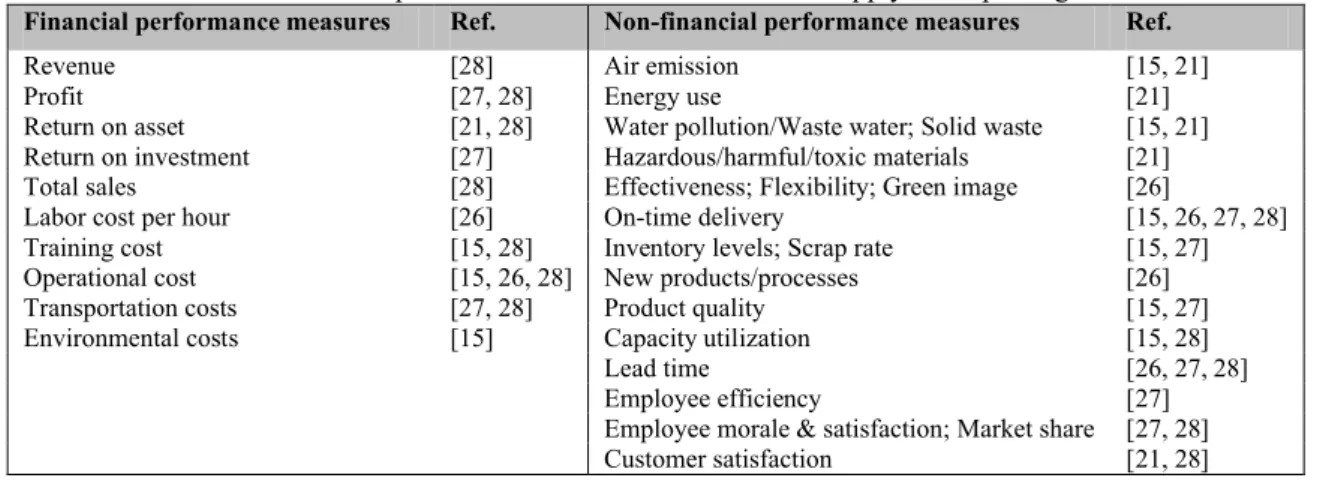
The application of paradigms practices on SCM influences the performance measurement systems and allows organ-izations to obtain a more holistic vision of effective and efficient businesses. However, very few studies exist relat-ing performance metrics in current strategies of the SCM [25]. Pochampally et al.[26] refer that “developing the metrics for performance measurement of a supply chain is a difficult problem”. The performance measures may influence the decisions to be made at the different organizational levels: i) Financial measures are appropriate for strategic decision and ii) Non-financial measures might be more proper for operational decisions. So it is important to develop a performance measurement system that incorporates issues in way to study the lean and green supply chain performance. Based on the literature, Table 1 summarizes a list of lean and green measures divided into two categories: financial indicators and non-financial or operational indicators.
Table 1: List of performance measures identified for supply chain paradigms
Financial performance measures Ref. Non-financial performance measures Ref.
Revenue [28] Air emission [15, 21]
Profit [27, 28] Energy use [21]
Return on asset [21, 28] Water pollution/Waste water; Solid waste [15, 21] Return on investment [27] Hazardous/harmful/toxic materials [21] Total sales [28] Effectiveness; Flexibility; Green image [26]
Labor cost per hour [26] On-time delivery [15, 26, 27, 28]
Training cost [15, 28] Inventory levels; Scrap rate [15, 27] Operational cost [15, 26, 28] New products/processes [26]
Transportation costs [27, 28] Product quality [15, 27]
Environmental costs [15] Capacity utilization [15, 28]
Lead time [26, 27, 28]
Employee efficiency [27]
Employee morale & satisfaction; Market share [27, 28] Customer satisfaction [21, 28]
Successful supply chains will coordinate their processes, focus on delivering customer value and eliminate unneces-sary costs in key functional. The four major goals of SCM are waste reduction, time compression, flexible response, and unit cost reduction [29]. A supply chain that achieves those goals will ultimately create financial benefits, tangi-ble benefits for customers whilst companies will continually learn and innovate to ensure future profitability.
3. Supply Chain and Balanced Scorecard Perspective
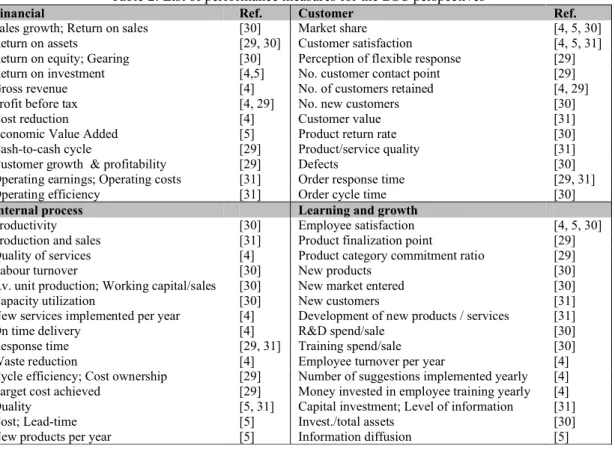
Fundamentally, the Balanced Scorecard (BSC) is about performance measures. The appeal of the BSC is its ability to include both traditional financial metrics and non-financial performance measures in its reporting capacity, thus the term “balanced”. Kaplan and Norton [7] distinguish Financial, Internal process, Customer, and Learning and Growth perspectives on organizational processes essential to an overall strategy. In their book The Balanced Score-card, the authors set forth a hypothesis about the chain of cause and effect that leads to strategic success. This cause-and-effect hypothesis could be fundamental to understand SCM metrics in a way that the balanced scorecard pre-scribes. The BSC suggests that the balance is obtained by adopting performance measures from four different pers-pectives. The determination of SCM metrics can be a challenge and is important to explore which should be used. Table 2 summarizes a list performance measures categorized by the four BSC perspectives. This can be used as a template to evaluate SCM performance.
Table 2: List of performance measures for the BSC perspectives
Financial Ref. Customer Ref.
Sales growth; Return on sales [30] Market share [4, 5, 30]
Return on assets [29, 30] Customer satisfaction [4, 5, 31]
Return on equity; Gearing [30] Perception of flexible response [29] Return on investment [4,5] No. customer contact point [29]
Gross revenue [4] No. of customers retained [4, 29]
Profit before tax [4, 29] No. new customers [30]
Cost reduction [4] Customer value [31]
Economic Value Added [5] Product return rate [30]
Cash-to-cash cycle [29] Product/service quality [31]
Customer growth & profitability [29] Defects [30]
Operating earnings; Operating costs [31] Order response time [29, 31]
Operating efficiency [31] Order cycle time [30]
Internal process Learning and growth
Productivity [30] Employee satisfaction [4, 5, 30]
Production and sales [31] Product finalization point [29] Quality of services [4] Product category commitment ratio [29]
Labour turnover [30] New products [30]
Av. unit production; Working capital/sales [30] New market entered [30]
Capacity utilization [30] New customers [31]
New services implemented per year [4] Development of new products / services [31]
On time delivery [4] R&D spend/sale [30]
Response time [29, 31] Training spend/sale [30]
Waste reduction [4] Employee turnover per year [4]
Cycle efficiency; Cost ownership [29] Number of suggestions implemented yearly [4] Target cost achieved [29] Money invested in employee training yearly [4] Quality [5, 31] Capital investment; Level of information [31]
Cost; Lead-time [5] Invest./total assets [30]
New products per year [5] Information diffusion [5]
4. Linking the Balanced Scorecard to Supply Chain performance
There is little evidence that firms have incorporated the BSC approach into their SCM practices [29]. Sharma and Bhagwat [1] developed a BSC for the SCM evaluation using an analytical hierarchy process approach. Xiaoping and Chen [31] create a supply chain performance evaluation system based on the BSC and benchmarking approach. Si-diropoulos et al. [5] add a fifth environmental perspective to its BSC. Hsu and Liu [32] used a specific environmen-tal BSC. In short, it seems that BSC is being compatible with lean paradigm. According to Stenzel [33] “companies already using the BSC prior to embarking on lean transformation should find the BSC a useful tool for promoting lean”. Those who understand the interrelationship between the BSC and SCM will have a greater likelihood of leve-raging their supply chains into a source of competitive advantage.
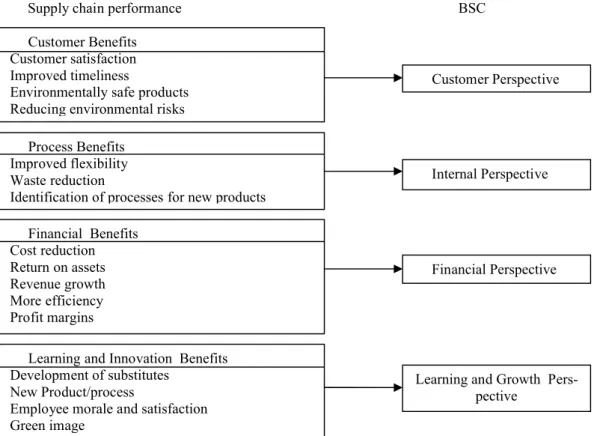
Based on the literature review, we argue that balanced scorecard is a promising starting-point to incorporate lean and green supply chain into a performance measurement system. The conceptual linkage between the supply chain per-formance and the BSC is shown in Figure 1.
5. Conclusions
Supply chain performance BSC
Figure 1: Linking supply chain performance and the BSC
Acknowledgements
Authors would like to acknowledge Fundação para a Ciência e Tecnologia for its support (project MIT-Pt/EDAM-IASC/0033/2008). Susana Duarte was supported by a PhD fellowship from Fundação para a Ciência e Tecnologia (SFRH/BD/60969/2009).
References
1. Sharma, M. K. and Bhagwat, R., 2007, “An integrated BSC-AHP approach for supply chain management evaluation”, Measuring Business Excellence, 11 (3), 57-68.
2. Bhagwat, R. and Sharma, M. K., 2009, “An application of the integrated AHP-PGP model for performance measurement of supply chain management”, Production Planning & Control, 20 (8), 678-690.
3. Cai, J., Liu, X., Xiao, Z. and Liu, J., 2009, “Improving supply chain performance management: A systemat-ic approach to analyzing iterative KPI accomplishment”, Decision Support Systems, 46, 512–521.
4. Chia, A., Goh, M. and Hum, S., 2009, “Performance measurement in supply chain entities: balanced score-card perspective”, Benchmarking: An International Journal, 16 (5), 605-620.
5. Sidiropoulos, M., Mouzakitis, Y., Adamides, E. and Goutsos, S., 2004, “Applying Sustainable Indicators to Corporate Strategy: the Eco-balanced Scorecard”, Environmental research, engineering and management, 1 (27), 28-33.
6. Kaplan, R.S. and Norton, D.P., 1992, “The balanced scorecard – Measures that drive performance”, Har-vard Business Review, 70 (1), 71-85.
7. Kaplan, R.S. and Norton, D.P., 1996, The balanced scorecard: Translating strategy into action, Harvard Business School Press, Boston, MA.
8. Kaplan, R.S. and Norton, D.P., 2000, “Having Trouble with Your Strategy? Then Map It”, Harvard Busi-ness Review, September-October, 167-176
9. Roy, S., Dhalla, R.S., 2010, “Management of supply chain in Petroleum Corporations in India”, Proc. of the 2010 International Conference on Industrial Engineering and Operations Management, January 9 – 10, Dhaka, Bangladesh.
Customer Benefits Customer satisfaction Improved timeliness
Environmentally safe products Reducing environmental risks
Customer Perspective
Process Benefits Improved flexibility Waste reduction
Identification of processes for new products
Internal Perspective
Financial Benefits Cost reduction Return on assets Revenue growth More efficiency Profit margins
Financial Perspective
Learning and Innovation Benefits Development of substitutes
New Product/process
Employee morale and satisfaction Green image
10. Lambert, D., Stock, J., and Ellram, L., 1998, Fundamentals of Logistics, Management. Irwin /McGraw-Hill, London.
11. Machado, V. C. and Duarte, S. , 2010, “Tradeoffs among paradigms in Supply Chain Management”, Proc. of the 2010 International Conference on Industrial Engineering and Operations Management, January 9 – 10, Dhaka, Bangladesh.
12. Venkat, K. and Wakeland, W., 2006, “Is Lean Necessarily Green?”, Proc. of the 50th Annual Meeting of the International Society for the Systems Sciences, July 9-14, Rohnert Park, CA, USA.
13. Shah, R. and Ward, P.T., 2007, “Defining and developing measures of lean production”, Journal of Opera-tions Management, 25, 785-805.
14. Qi, Y., Boyer, K.K., Zhao, X., 2009, "Supply Chain Strategy, Product Characteristics, and Performance Impact: Evidence from Chinese Manufacturers", Decision Sciences, 40 (4), 667-695.
15. Zhu, Q., Sarkis, J. and Lai, K., 2008, “Confirmation of a measurement model for green supply chain man-agement practices implementation”, International Journal Production Economics, 111, 261-273.
16. Mudgal, R.K., Shankar, R., Talib, P. and Raj, T., 2009, “Greening the supply chain practices: an Indian perspective of enablers`relationship”, Int. J. Advanced Operations Management, 1 (2/3), 151-176.
17. Shang, K. C., Lu, C. S. and Li, S., 2010, “A taxonomy of green supply chain management capability among electronics-related manufacturing firms in Taiwan”, Journal of Environmental Management, 91, 1218-1226.
18. Simpson, D. F. and Power, D. J., 2005, “Use the supply relationship to develop lean and green suppliers” Supply Chain Management: An International Journal, 10 (1), 60-68.
19. Rao, P. and Holt, D., 2005, “Do green supply chains lead to competitiveness and economic performance?”, International Journal of Operations and Production Management, 25 (9), 898-916.
20. EPA - United States Environmental Protection Agency, 2007, “The Lean and Environmental toolkit”, available at http://www.epa.gov/lean/ (accessed 01 September 2009).
21. Kainuma, Y. and Tawara, N., 2006, “A multiple attribute utility theory approach to lean and green supply chain management”, International Journal of Production Economics, 101 (1), 99-108.
22. Franchini, V., Galeazzo, A., Furlan, A., Vinelli, A, 2010, “Are lean and green practices complementary? Evidence from two case studies”, Proc. of the 17th International Annual EurOMA Conference, Managing Operations in Service Economies, June 6-9, Porto, Portugal.
23. Gordon, P.J., 2001, Lean and green: Profit for your workplace and environmental, Berrett-Koehler publica-tions, USA.
24. Johansson, G. and Winroth, M., 2009, “Lean vs. Green manufacturing: Similarities and differences”, Proc. of the 16th International Annual EurOMA Conference, Implementation realizing Operations Management knowledge, June 14-17, Göteborg, Sweden.
25. Lee, C. W. and Kwon, I.G., Severance, D., 2007, “Relationship between supply chain performance and de-gree of linkage among supplier, internal integration, and customer”, Supply Chain Management: An Inter-national Journal, 12 (6), 444–452.
26. Pochampally, K.K., Gupta, S.M. and Govindan, K., 2009, “Metrics for performance measurement of a re-verse/closed-loop supply chain”, Int. J. Business Performance and Supply Chain Modelling, 1 (1), 8-32. 27. Ray, C. D., Zu, X., Michael, J. H. and Wiedenbeck, J. K., 2006, “The Lean index: operational “Lean”
me-trics for wood products industry”, Wood and Fiber Science, 38 (2), 238-255.
28. Gurumurthy, A. and Kodali, R. (2008), “A multi-criteria decision-making model for the justification of lean manufacturing systems”, International Journal of Management Science and Engineering Management, 3 (2), 100-118.
29. Brewer, P. C.; Speh, T. W., 2000, “Using the balanced scorecard to measure supply chain performance”, Journal of Business Logistics, 21 (1), 75-93.
30. Hubbard, G., 2009, “Measuring Organizational Performance: Beyond the Triple Bottom Line”, Business Strategy and the Environment, 19, 177-191.
31. Xiaoping, X. and Chen, L., 2008, “The Supply Chain Performance Evaluations Indicator System Based on Benchmark Balanced Scorecard”, Proc. of 4th International Conference on Wireless Communications, Networking and Mobile Computing, 12-14 October, Dalian, China, 1-4.
32. Hsu, Y. and Liu, C., 2009, “Environmental performance evaluation and strategy management using ba-lanced scorecard”, Environmental Monitoring and Assessment, December, Springer Science.