Research Article
Comparison of Machine Learning Methods for the Arterial
Hypertension Diagnostics
Vladimir S. Kublanov,
1Anton Yu. Dolganov,
1David Belo,
2and Hugo Gamboa
2 1Research Medical and Biological Engineering Centre of High Technologies, Ural Federal University, Mira 19,Yekaterinburg 620002, Russia
2Laboratório de Instrumentação, Engenharia Biomédica e Física da Radiação (LIBPhys-UNL), Departamento de Física, Faculdade de Ciências e Tecnologia da Universidade Nova de Lisboa, Monte da Caparica, 2892-516 Caparica, Portugal
Correspondence should be addressed to Vladimir S. Kublanov; [email protected]
Received 4 April 2017; Revised 29 May 2017; Accepted 1 June 2017; Published 31 July 2017
Academic Editor: Justin Keogh
Copyright © 2017 Vladimir S. Kublanov et al. This is an open access article distributed under the Creative Commons Attribution License, which permits unrestricted use, distribution, and reproduction in any medium, provided the original work is properly cited.
The paper presents results of machine learning approach accuracy applied analysis of cardiac activity. The study evaluates the diagnostics possibilities of the arterial hypertension by means of the short-term heart rate variability signals. Two groups were
studied: 30 relatively healthy volunteers and 40 patients suffering from the arterial hypertension of II-III degree. The following
machine learning approaches were studied: linear and quadratic discriminant analysis, k-nearest neighbors, support vector
machine with radial basis, decision trees, and naive Bayes classifier. Moreover, in the study, different methods of feature
extraction are analyzed: statistical, spectral, wavelet, and multifractal. All in all, 53 features were investigated. Investigation
results show that discriminant analysis achieves the highest classification accuracy. The suggested approach of noncorrelated
feature set search achieved higher results than data set based on the principal components.
1. Introduction
According to the World Health data, hypertension affects
more than 1 billion people worldwide. Many factors can con-duce to hypertension, including occipital stress and job strain [1]. One of the main problems concerning the treatments for the arterial hypertension conditions is the late detection for apparently healthy people. Some studies had been shown that among the individuals with hypertension, more than 35% were unaware of their condition [2].
The heart rate variability (HRV) is among one of the widely used biomedical signals, due to ease of record the electrical heart activity [3]. The HRV analysis can be applied in the task of arterial hypertension diagnostics, since it is well known that various features of the HRV
reflect behavior of the different modules of the
auto-nomic nervous system (ANS) [4].
Common HRV analysis implies the application of a vari-ety of analysis methods: statistical, spectral, and nonlinear
analysis. Generally, in a single study, a limited number of features are extracted. Such as in [5], 13 nonlinear
features were studied for efficacy of stress state detection.
The current paper comprises a study of 53 different
fea-tures. Usually during one study, feature sets of a particular method are used. For example in [6], sets of time-domain features, nonlinear features, and spectral features were studied separately for automatic sleep staging by means of HRV signal analyses. In this study, combinations of dif-ferent methods were analyzed.
The common uses of machine learning approaches
for condition classification based on HRV information
imply usage of several available methods: support vector machine (SVM), discriminant analysis (DA), and
ordi-nal pattern statistics (OPS) [7–9]. However, the selection
of a particular approach is not always justified. In
cur-rent study, linear and quadratic DA, SVM, k-nearest
neighbors, decision trees, and Naïve Bayes approaches were investigated.
In one of the previous works, the investigation of the linear and quadratic discriminant analysis was carried out, implying the study of arterial hypertension diagnostic using single features of short-term HRV signals. In that work, the evaluation of the features and the evaluation of the
classifier efficacy were carried out by means of an
in-house software produced in MATLAB [10]. In the present paper, the machine learning methods were implemented in the python.
In summary, the goal of the present work is to study the
efficacy of different machine learning approaches for
diagnostic of the arterial hypertension by means of the short-term HRV, using combinations of statistical, spectral (Fourier and Wavelet transforms), and nonlinear features.
By applying feature combinations of different methods, we
aim to build more robust and accurate classifiers.
2. Materials and Methods
2.1. Recorded Dataset.The clinical part of the study was per-formed in the Sverdlovsk Clinical Hospital of Mental Diseases for Military Veterans (Yekaterinburg, Russian Federation). For the HR signals registration, the
electroencephalograph-analyzer“Encephalan-131-03”(“Medicom-MTD,”Taganrog,
Russian Federation) was used. The rotating table Lojer (Vammalan Konepaja OY, Finland) performed the spatial position change of the patient during passive orthostatic
load; the lift of the head end of the table was up to 70°from
the horizontal position. The clinical part of the study was approved by the local Ethics Committee of the Ural State Medical University.
Participants of this study were 30 healthy volunteers
and 41 patients suffering from the arterial hypertension
of II and III degree. The electrocardiography (ECG) sig-nals were recorded in two functional states: functional rest (state F) and passive orthostatic load (state O). The length of the signal in the mentioned state was about 300 seconds. The HRV signals were consequently derived
from the ECG signals automatically by the “
Encephalan-131-03” software. Figure 1 presents diagram of the
func-tional states.
2.2. Heart Rate Variability Features.Prior to the processing, the original time series were cleaned from the artifacts. By artifacts, in this study, we considered values of the R-R
intervals that differed from the HR mean by more than three
standard deviations. NN is the abbreviation for the“normal
to normal”time series, that is, without artifacts. Among all
studied time series, less than 2% of data was removed. For spectral and multifractal analyses, NN time series were interpolated using cubic spline interpolation with the 10 Hz sampling frequency.
The feature dataset is the same as used previously [11], where it was shown that features of the HRV signals
recorded in the state O have better classification accuracy
for arterial hypertension diagnostics. Therefore, in this study, we analyze data only in the state O. The used features were separated into statistical, geometric, spectral (Fourier based), wavelet, nonlinear, and multifractal. Their descrip-tion will be given below.
2.2.1. Statistical Features.Statistical methods are used for the direct quantitative evaluation of the HR time series. Main quantitative features are as follows:
(i) Mis the mean value of the R-R intervals after artifact
rejection:
M= 1
N〠
N
i=1
NNi, 1
whereN is the number of elements in theNN and
NNiis theith element in R-R time series.
(ii) HR, the heart rate, is an inverse ratio toM:
HR = 1
M 2
(iii) SDNNis the standard deviation of the NN intervals:
SDNN = 1 N −1〠i 1
N
NNi−M 2 3
(iv) CV, the coefficient of variation, is defined as ratio of
standard deviation SDNN to the meanM, expressed
in percent;
CV = SDNN
M ⋅100% 4
(v) RMSSD is the square root of mean of squares of
differences between successive elements inNN;
RMSDD = 1
N 〠
N−1
i=1
NNi+1−NNi 2 0,5
5
(vi) NN50is the number of pairs of successive elements
inNNthat differ by more than 50 ms [12].
70∘
State F: [0,300] sec State O: [300,600] sec
2.2.2. Geometric Features. The geometric methods analyze the distribution of the R-R intervals as a random numbers. The common features of these methods are as follows:
(i) M0, the mode, is the most frequent value in the R-R
interval. In case of the normal distribution, the mode
is close to the meanM.
(ii) VR, the variation range, is the difference between the
lowest R-R interval and the highest R-R interval in
the time series. VR shows variability of the R-R
interval values and reflects activity of the
parasym-pathetic system of the ANS.
(iii) AM0, the amplitude of the mode, is a number of the
R-R intervals that correspond to the mode value.
AM0 shows the stabilizing effect of the heart rate
management, mainly caused by the sympathetic activity [12].
The following indexes are derived from common geo-metric features:
(i) SI, the stress index, reflects centralization degree of
the heart rate and mostly characterizes the activity of the sympathetic department of the ANS:
SI = AM0 2M0⋅VR
6
(ii) IAB, the index of the autonomic balance, depends on
the relation between activities of the sympathetic and parasympathetic department of the ANS:
IAB =AM0
VR 7
(iii) ARI, the autonomic rhythm index, shows
parasym-pathetic shifts of the autonomic balance: smaller
values of theARIcorrespond to the shift of the
auto-nomic balance to the parasympathetic activity:
ARI = 1 M0⋅VR
8
(iv) IARP, the index of adequate regulation processes,
reflects accordance of the autonomic function
changes of the sinus node as a reaction of the
sympa-thetic regulatory effects on the heart:
IARP =AM0 M0
9
2.2.3. Spectral Features.Spectral analysis is used to quantify periodic processes in the heart rate by the means of the Fourier transform (Fr). The main spectral components of
the HRV signal are high frequency—HF (0.4–0.15 Hz), low
frequency—LF (0.15–0.04 Hz), very low frequency—VLF
(0.04–0.003 Hz), and ultralow frequency—ULF (lower than
0.003 Hz) [12, 13]. For smaller than 300 seconds, short-term time series ULF spectral component is not analyzed.
HF spectral component characterizes activity of the
parasympathetic system of the ANS and activity of the autonomic regulation loop. High frequencies of the heart rate in HRV spectrum are associated with the breathing
and determined by the connection and influences of the
vagus with the sinus node.
LFspectral component mainly characterizes activity of
the sympathetic vascular tone regulation center. Low
frequencies reflect modulation of the heart rate by the
sympathetic nervous system [4].
VLFspectral component is defined by the
suprasegmen-tal regulation of the heart rate, as the amplitude of theVLF
waves and is related to the psycho-emotional strain and functional state of the cortex. The genesis of the very low frequencies is still the matter of debates. Most likely, it is
influenced by the suprasegmental centers of the autonomic
regulation that generates slow rhythms. These rhythms are directed to the heart by the sympathetic nervous system, humoral factors on the sinus node. Biologic rhythms in the same frequency band are connected with the
mecha-nisms of the thermoregulation, fluctuations of the vascular
tone, the renin activity, and the secretion of the leptin [14]. The similarity of the frequencies implies the
participa-tion of these mechanisms in the genesis of theVLFspectral
component. There are evidences of the increase of theVLF
activity in case of the central nervous system damage, anx-iety, and depression disorders [15].
The studied quantitative features of spectral analysis are
(i) spectral power of the HF, LF, and VLF
components,
(ii) total power of the spectrum—TP,
(iii) normalized values of the spectral components by
the total power—HFn,LFn, andVLFn,
HFn=
HF TP,
LFn=
LF TP,
VLFn=
VLF TP ,
10
(iv) the LF/HF ratio, also known as the autonomic balance exponent,
(v) IC, the index of centralization,
IC =HF + LF
VLF , 11
(vi) IAS, the index of the subcortical nervous centers
activation,
IAS = LF
(vii) HFmax, the maximal power of the HF spectral
components,
(viii)RF, the respiration frequency, frequency that
corresponds to theHFmax[16].
2.2.4. Wavelet Transform.For nonstationary time series, one can also use the wavelet transform (wt), to simultaneously study time-frequency patterns. The general equation for continuous wavelet transform is as follows:
W a,b = 1
a s t ⋅ψ t−b
a dt, 13
whereais the scale,bis the shift,ψis the wavelet basis, and
s t is the analyzed signal [17].
Moreover, the connection between the scale and the analyzed frequency is in accordance with the following:
a= fc∗fs
f , 14
wherefcis the central frequency of the wavelet basis, called
by thecentfrqfunction,fsis the sampling frequency of the
analyzed signal, andf is the analyzed frequency. For wavelet
transform computation in this work, we used wavelet Coiflet
of thefifth order [18].
It is possible to acquire same spectral features by means of the wavelet transform:
(i) Spectral power of theHF,LF, andVLFcomponents
(ii) Normalized values of the spectral components by
the total power—HFn,LFn, andVLFn
(iii) The LF/HF ratio.
Additionally, standard deviations SDHF(wt), SDLF(wt),
and SDVLF(wt) of the HFwt(t), LFwt(t), and VLFwt(t) time
series were tested as features. HFwt(t), LFwt(t), and VLFwt(t)
are time series of the HF, LF, and VLF spectral components, respectively, acquired by means of the wavelet transform.
Moreover, one can study informational characteristics of
the wavelet transform by analyzing the FLFwt/HFwt t
function (Figure 2). FLFwt/HFwt t is the continuous
function of the LF/HF ratio. This function was not a smooth
morphology. Its “excursions”(local dysfunctions) varies in
case of functional loads, as the features of FLFwt/HFwt t
is possible to use the number of dysfunctions Nd, the
maxi-mal value of dysfunction (LF/HF)max, and the intensity of
dysfunction (LF/HF)int. By the dysfunction, we consider
values of function that suppress decision thresholdΔ
accord-ing to previous studies of our research groupΔ= 10 [19].
2.2.5. Nonlinear Feature. As the nonlinear feature in this study, we have used the Hurst exponent calculated by the aggregated variance method. The variance can be written as follows:
Var X t2 −X t1 2 =σ2t2−t12H, 15
whereHis the Hurst exponent andXis a time-series vector.
Hcan be defined as the slope exponent in the following
equation:
logσrms ΔX =c+Hlogs, 16
where σrms ΔX is the standard deviation of theΔX
incre-ments, corresponding to the time period s, and с is a
constant [20].
Note thatH>0.5 corresponds to the process with trend,
so-called persistent process, contraryH<0.5 corresponds to
antipersistent processes that have a tendency for trend
change, andH= 0.5 is the random process [21].
2.2.6. Multifractal Features. As nonlinear methods, we
adopted the multifractal detrended fluctuation analysis
(MFDFA) [22]. The algorithm and application features of
0 50 100 150 200 250 300 350
0 5 10 15 20 25 30 35
Time (sec)
LF/HF amplitude
Figure2: Example ofFLF
the MFDFA method to estimation of short-term time series are described in details in [23].
The main steps of the method include the following:
(i) The detrending procedure with second degree poly-nomial on nonoverlapping segments where the length of the segments corresponds to the studied time scale boundaries.
In current study, we investigated time scale boundaries
that correspond to the LF and VLF frequency bands: 6–
25 sec and 25–300 sec, respectively. In our earlier works
and by other authors, it was noted that multifractal analy-sis of the HF component is not informative because of the noising [24].
(ii) Determination of thefluctuation functions forqin
rangeq= [−5, 5]:
Fx q,s =
1
Ns〠
Ns
v=1
1
s〠
s
k=1
NNk −NNv k 2 q/2 1/q
, 17
whereNNvis the local trend in the segmentν,Nsis
the number of segments, andsis the scale.
(iii) Estimation of the slope exponent Hx in log-log
plot of the fluctuation function against scale s for
each q:
Fx q,s ≈sHxq 18
(iv) Calculation of the scaling exponentτ q :
τ q =q⋅Hx q −1 19
(v) The Legendre transform application for the proba-bility distribution of the spectrum estimation:
D α =q⋅α−τ 20
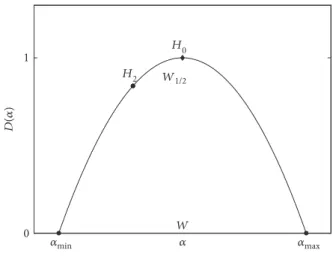
Figure 3 represents the main features of the
multifrac-tal spectrum estimated by the MFDFA method. Here, H0
is the height of the spectrum and represents the most
probable fluctuations in the investigated time scale
boundary of the signal; H2 is the generalized Hurst
expo-nent (also known as correlation degree); αmin represents
behavior of the smallest fluctuations in the spectrum;
αmax represents behavior of the greatest fluctuations in
the spectrum; and W=αmax−αmin is the width of
multi-fractal spectrum that shows the variability of fluctuations
in the spectrum. Multifractal characteristics are quantita-tive measures of the self-similarity and may characterize functional changes in the regulatory processes of the organism. In addition, we also tested the so-called
1/2-width measure of the spectrum, which is defined as
W1/2=∣H2−H0∣ [25]. Table 1 presents summary of all
features used in this study.
2.3. Machine Learning Approaches.For the machine learning
evaluation, the respective functions of the sklearn library
were used [26]. The current paper describes supervised
machine learning methods used. At first, the classifiers are
trained using a training dataset. For that dataset, the class
labels are known. After that, the efficacy of the classification
is evaluated using test set of data. The efficacy is evaluated
by comparing true labels of test set with those predicted by the model.
2.3.1. Discriminant Analysis (DA).In this work, two variants
of the discriminant analysis were tested—linear and
qua-dratic discriminant analyses (LDA and QDA). The LDA aims
to find the best linear combination of the input features to
properly separate studied classes. In the case of the QDA, the studied classes are separated by a quadratic function [27].
2.3.2. k-Nearest Neighbors (kNN).Thek-nearest neighbors is one of the nonparametric machine learning approaches. In order to predict the class of the object, method chose the
class, which is the most common among k“neighbors” of
the object. Examples of the“neighbors”are picked from the
training dataset. In the present study, different values of the
kare tested—3, 4, and 5 [28].
2.3.3. Support Vector Machine (SVM).The base idea of the support vector machine methods is creation of the
deci-sion hyperplane which would separate different classes.
In that case, the margin between two nearest points on
the different sides of the hyperplane is maximal. In present
study, the radial basis function (RBF) is used. For
imple-mentation in python, one have to specify the following:
SVC gamma = 2, C = 1 [29].
2.3.4. Decision Trees (DT).The decision trees classification model is built around a sequence of the Boolean queries.
The sequence of such queries forms the “trees” structure.
In the present work, variations of the classifier were
analyzed—with fixed value of the maximal tree depth
H
2
H
0
0 1
훼
D
(
훼
)
W
1/2
W
훼min 훼
max
(max_depth= 5). The maximal depth feature points the maximal number of queries that is allowed to use before
reaching leaf. The leaf node is the node that has no“
chil-dren” [30].
2.3.5. Naive Bayes (NB).This method is based on the
applica-tion of the Bayes’ theorem with assumptions that data has
strong (or naive) independence. In current study, the Gaussian distribution of data is assumed [31].
2.4. Semioptimal Search of the Noncorrelated Feature Space
2.4.1. Feature Set Selection. In the current investigation, all possible combinations of all features were analyzed. How-ever, it is well known that using combined correlated features
Table1: List of studied features.
Feature Description Equation
M Mean value of the R-R (1)
HR Heart rate (2)
SDNN Standard deviation of the R-R (3)
CV Coefficient of the variation (4)
RMSSD Square root of mean of squares of differences between successive R-R (5)
NN50 Variation higher than 50 ms in R-R signal —
M0 Mode of the R-R signal —
VR Variation range of the R-R signal —
AM0 Amplitude of the mode —
SI Stress index (6)
IAB Index of autonomic balance (7)
ARI Autonomic rhythm index (8)
IARP Index of adequate regulation processes (9)
HF(Fr) High frequency Fourier spectral power —
LF(Fr) Low frequency Fourier spectral power —
VLF(Fr) Very low frequency Fourier spectral power —
TP(Fr) Total power of the Fourier spectrum —
LF/HF(Fr) Autonomic balance exponent of the Fourier spectrum —
HFmax(Fr) Maximum power of the HF —
HFn(Fr), LFn(Fr), and VLFn(Fr) Normalized power of the HF, LF, and VLF Fourier spectrum (10)
IC Index of centralization (11)
IAS Index of the subcortical nervous center’s activation (12)
RF Respiration frequency —
HF(wt) High frequency wavelet spectral power —
LF(wt) Low frequency wavelet spectral power —
VLF(wt) Very low frequency wavelet spectral power —
HFn(wt), LFn(wt), and VLFn(wt) Normalized power of the HF, LF, and VLF wavelet spectrum —
SDHF(wt), SDLF(wt), and SDVLF(wt) Standard deviations of the HF(t), LF(t), and VLF(t) wavelet time series —
TP(wt) Total power of the wavelet spectrum —
LF/HF(wt) Autonomic balance exponent of the wavelet spectrum —
(LF/HF)max Maximal value of dysfunctions —
(LF/HF)int Intensity of dysfunctions —
Nd Number of dysfunctions —
H Hurst exponent (13)
αminLF,αminVLF Smallestfluctuations of the LF and VLF spectral band —
αmaxLF,αmaxVLF Greatestfluctuations of the LF and VLF spectral band —
WLF, WVLF Spectrum width of the LF and VLF spectral band —
H2LF,H2VLF Correlation degree of the LF and VLF spectral band —
H0LF,H0VLF Spectrum height of the LF and VLF spectral band —
in machine learning may lead to misleading results.
There-fore, thefirst step in this investigation is to sort uncorrelated
combinations. For this task, we compute the correlation
coef-ficient. The wholeflowchart of the script for noncorrelated
feature combination selection is presented in Figure 4. The threshold correlation value was set to 0.25. Usually, correlation more than 0.75 is considered to be high. There-fore, a value lower than 0.25 is a good benchmark for low
correlation. In the current work, two tofive feature
tions were made. In case of more than two feature combina-tions, the correlation was checked pairwise. When all
calculation was finished, the noncorrelated features were
saved to afile for future purposes.
Table 2 presents the total number ofn-combinations for
53 features in case ofn= [2, 3, 4, 5] and number of selected
noncorrelated combinations. Table 2 shows that application of such selection leads to both, more appropriate results
and significant reduction of the analyzed combinations set.
2.4.2. Cross-Validation. Figure 5 presents a complete fl
ow-chart of the implemented algorithm for classifier efficacy
evaluation.
Cross-validation implies division of the original datasets
intomsubsets, whenm-1 subsets are used for the classifier
training. The remaining part is used for the classifier test.
The procedure is repeated m times. Such approach allows
one to use dataset evenly [32].
In the current investigation, the number of random folds l was set to be 5. For the implementation of 5-fold cross-validation, we randomly divide the original dataset into 5 subsets. The division is implemented for both groups simultaneously. As the result, each subset included 6 healthy volunteers and 8 patients diagnosed with hypertension.
Many machine learning methods are sensitive to train
set selection, so, in order to remove such influence, the
cross-validation procedure was repeated 100 times with
different folds. The repeated cross-validation allows to
increase number of classification accuracy estimates [33].
Table 3 presents calculation times spent for each
machine learning approach for different number of
features in combinations. Calculation times are presented for all noncorrelated combinations. In accordance with
Table 3, the fastest approach is the decision trees. The k
-nearest neighbors approach is the slowest one.
3. Results
The classifier performance was averaged over 5
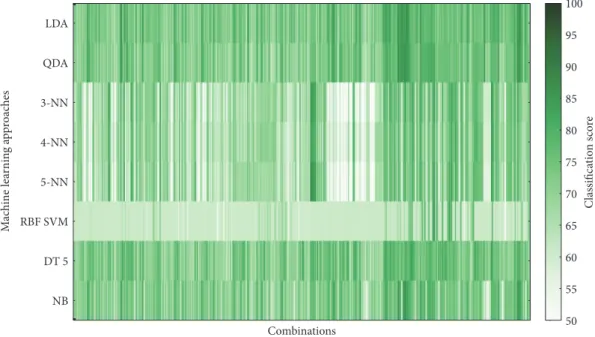
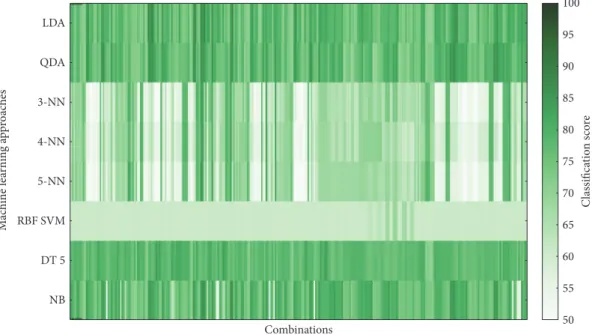
cross-validations and over 100 implementations. Figures 6–9 show
overview of the classifier performance for all combinations
for different numbers of features in combination. All color
bars on Figures 5–8 have the same range—from 50 to 100%.
Figure 10 presents maximal accuracy achieved by each
classifier for different number of features in set.
According to the data presented in Figures 5–9, the
highest classification is achieved by the discriminant
Start Correlation
evaluation
For each combination
Correlation < 0.25?
End
Save combination Import
dataset
Yes No
All combination studied? Next combination
No
Yes
Figure4: Flowchart of the noncorrelated combination selection.
Table2: Noncorrelated combination selection data.
n
Total
n-combination
number
Selected
n-combinations
Calculation time, sec
2 1378 586 0.027
3 23,426 1669 0.477
4 292,825 1339 11.559
Start
Import dataset and non-correlated features combinations
For each machine learning approach
For each combination
End
Next machine learning approach Next combination
All combinations studied?
All approaches studied? No
No
Yes
Yes 100 repeated
5-fold cross-validation
Figure5: Flowchart of classifier efficacy evaluation algorithm.
Table3: Calculation times of classifier efficacy evaluation, sec.
Features in combinations LDA QDA NN3 NN4 NN5 RBF SVM DT Naive Bayes
2 165 113 281 281 281 139 89 130
3 482 346 917 860 806 403 269 375
4 397 288 640 643 642 325 222 300
5 88 64 141 140 140 71 50 66
LDA
QDA
3-NN
4-NN
5-NN
RBF SVM
DT 5
NB
M
ac
hine le
ar
nin
g a
p
p
roac
h
es
Combinations
100
95
90
85
80
75
70
65
60
55
50
C
lassifica
tio
n s
co
re
analysis. Moreover, in Figures 5–8, it can be clearly seen that approaches of discriminant analysis have more com-binations with relatively high score than any other approach. Furthermore, for the support vector machine
approach, only few combinations have acceptable classifi
-cation score level.
It is worthy to mention that generally classification
accuracy rises as the number of features in the feature set increases. For 4-feature sets, the maximum is
achieve-d—accuracy for 5-feature sets is lower for all machine
learning approaches. It drops significantly in case of
sup-port vector machine approach.
Table 4 presents best results achieved by all machine learning approaches for 4-feature set.
Data in Table 4 shows that linear and quadratic DA not
only achieve higher classification score but also have better
stability of the results. Naïve Bayes classifier also has
rela-tively high classification score and low deviation.
Among 53 studied features, 36 form combinations that
have the classification score higher than 85. Table 5 presents
LDA
QDA
3-NN
4-NN
5-NN
RBF SVM
DT 5
NB
M
ac
hine le
ar
nin
g a
p
p
roac
h
es
Combinations
100
95
90
85
80
75
70
65
60
55
50
C
lassifica
tio
n s
co
re
Figure7: Classifier score for 3-feature combinations.
LDA
QDA
3-NN
4-NN
5-NN
RBF SVM
DT 5
NB
M
ac
hine le
ar
nin
g a
p
p
roac
h
es
Combinations
100
95
90
85
80
75
70
65
60
55
50
C
lassifica
tio
n s
co
re
occurrences of the features among the combinations. The
highest occurrences are noted for different spectral features,
associated with VLF spectral band, LF/HF ratio, and statisti-cal feature heart rate.
Table 6 presents 7 features that form combinations with accuracy higher than 90%. All these combinations consist of heart rate, one feature associated with LF/HF ratio, and two features associated with VLF spectral band.
4. Discussion
For discussion purposes, a comparison of the results of the current study with results of one of the commonly used pro-cedure, principal components analysis (PCA), was executed.
The PCA is a statistical procedure used to reveal the internal
structure of the dataset [34]. In our case, features of different
amplitude are used; PCA is known to be sensitive to the rel-ative scaling of the feature dataset. Therefore, prior to the PCA application, the standardization procedure was
imple-mented for each of 53 different features—subtraction of the
mean value and after that division by the standard deviation. Table 7 presents explained variance as well as the
cumu-lative variance for thefirst 15 principal components. First 10
principal components explain 93% of the variance. Conse-quent principal components add 1% of the variance or less.
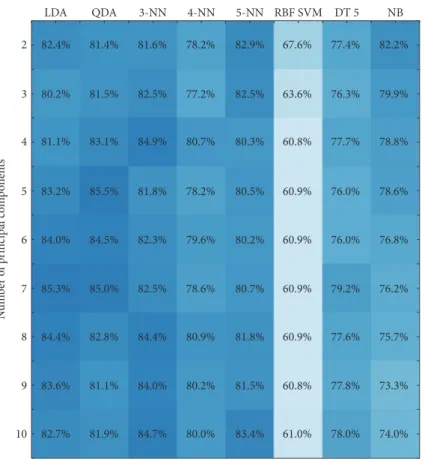
In order to compare results of the semioptimal search of the noncorrelated feature space with PCA, combinations of
the first 10 components were consequently tested for all
LDA
QDA
3-NN
4-NN
5-NN
RBF SVM
DT 5
NB
M
ac
hine le
ar
nin
g a
p
p
roac
h
es
Combinations
100
95
90
85
80
75
70
65
60
55
50
C
lassifica
tio
n s
co
re
Figure9: Classifier score for 5-feature combinations.
85.1% 85.6% 85.9% 85.6% 87.6% 87.8% 84.3% 83.8%
88.7% 88.6% 87.5% 85.5% 87.1% 87.5% 85.0% 88.2%
91.3% 90.3% 87.1% 85.6% 86.6% 86.7% 87.1% 88.2%
89.1% 87.4% 85.1% 84.2% 86.5% 69.3% 84.4% 86.1% 2
3
4
5
N
um
b
er o
f f
ea
tur
es in s
et
LDA QDA 3-NN 4-NN 5-NN RBF SVM DT 5 NB
Classifier
machine learning approaches using 100 repeated 5-fold cross-validation. Figure 11 presents the maximal results of
classification accuracy achieved by each machine learning
approach using combinations of the principal components. Comparing the results of Figures 10 and 11, one can note that features found by the semioptimal search of
the noncorrelated feature space reach higher classification
accuracies than combinations of the principal components for all tested machine learning approaches.
5. Conclusions
In this work, various machine learning approaches were tested in task of the arterial hypertension diagnostics. In earlier works, the same datasets were used for investigation of the linear and quadratic DA methods [11]. The present work implies comparison of the DA methods with other machine learning approaches, like support vector machine,
k-nearest neighbors, Naive Bayes, and decision trees.
The results of the current investigation showed that for the studied task, the application of the discriminant
Table4: Best classification scores.
Score, % Features
Linear discriminant analysis
91.33±1.75 HR VLFn(Fr) LF/HF(Fr) VLF(wt)
90.30±1.37 HR VLFn(Fr) VLF(wt) (LF/HF)int
90.04±1.85 HR LF/HF(Fr) VLF(wt) VLFn(wt)
90.44±1.60 HR VLFn(Fr) LF/HF(Fr) SDVLF
90.11±1.80 HR LF/HF(Fr) SDVLF VLFn(wt)
90.16±1.61 HR SDVLF VLFn(wt) (LF/HF)int
Quadratic discriminant analysis
90.31±1.71 HR VLFn(Fr) LF/HF(Fr) VLF(wt)
3-nearest neighbors
87.14±2.12 LF/HF(Fr) SDVLF VLFn(wt) W1/2VLF
4-nearest neighbors
85.56±2.40 SDVLF VLFn(wt) LF/HF(wt) W1/2VLF
5-nearest neighbors
86.63±1.30 HR HF(Fr) LFn(Fr) W1/2VLF
Support vector machine, radial base function
86.73±2.24 IAS RF a2LF WVLF
Decision trees, max depth 5
87.10±3.40 IARP LF/HF(Fr) IAS WLF
Decision trees, no max depth
87.34±3.08 IARP LF/HF(Fr) IAS WLF
Naïve Bayes classifier
88.17±1.07 VLF(Fr) VLFn(Fr) LF/HF(Fr) W1/2LF
Table 5: Features occurrences for classification score higher
than 85%.
Features Occurrences, % Features Occurrences, %
VLFn(Fr) 50.89 Nd 4.73
VLF(Fr) 50.89 M0 4.73
VLFn(wt) 47.93 WLF 4.73
W1/2VLF 34.91 IARP 3.55
LF/HF(Fr) 34.32 IC 2.96
HR 33.73 HF(Fr) 2.96
SDVLF 30.18 α2LF 2.96
(LF/HF)max 24.26 LFn(wt) 2.37
LF/HF(wt) 18.34 SI 2.37
(LF/HF)int 18.34 LFn(Fr) 1.78
W1/2LF 17.75 αminLF 1.78
H 13.61 ARI 1.78
WVLF 13.02 HFn(Fr) 1.78
IAS 10.65 SDHF 1.18
VLF(wt) 7.69 IAB 0.59
RF 6.51 NN50 0.59
αmaxLF 5.92 α0LF 0.59
M 5.33 αmaxVLF 0.59
Table 6: Feature occurrences for classification score higher
than 90%.
Features Occurrences, %
HR 100.00
LF/HF(Fr) 62.50
VLF(wt) 62.50
VLFn(wt) 50.00
VLFn(Fr) 50.00
SDVLF 37.50
(LF/HF)int 37.50
Table7: Dataset analysis by PCA.
Principal component
Explained variance, %
Cumulative variance, %
1 34.88 34.88
2 17.65 52.54
3 13.03 65.57
4 8.87 74.45
5 5.38 79.83
6 4.10 83.93
7 3.55 87.47
8 2.42 89.89
9 1.78 91.67
10 1.36 93.03
11 1.01 94.04
12 0.95 94.98
13 0.84 95.82
14 0.74 96.56
analysis (linear and quadratic) revealed to be the most
appropriate classifiers. These approaches have high classifi
-cation score and low deviations over different realizations.
A set of four features in combination seems to be the
opti-mal number, as the classification accuracy score is higher
and more consistent than those for two, three, and five
features in combination.
Prevalence of the VLF and LF/HF spectral features among best combinations might indicate that sympathetic nervous system takes an important part in the initialization of the arterial hypertension and maintenance of the increased vascular tone as well as increased cardiac output. These
results are in accordance with scientists’ interpretation of
the arterial hypertension development [35, 36].
The results of the suggested approach were compared with data set prepared by the commonly used procedure of
principal component analysis. Results of the n-feature
noncorrelated sets have achieved higher classification
accu-racies than ones based on the dataset of the selected prin-cipal components.
In future works, our research group will continue to improve results on this problem. One of the investiga-tions that are planned is to analyze robustness of the
classifiers based on multiple signals recorded
simulta-neously. Among the other perspective directions of future investigation is usage of the advanced neural net-works [37] and genetic algorithms [38] for feature
extraction and classification.
Conflicts of Interest
The authors declare that there are no conflicts of interest
regarding the publication of this paper.
Acknowledgments
The work was supported by the Act 211 Government of the Russian Federation, Contract no. 02.A03.21.0006, and by the FCT project AHA CMUP-ERI/HCI/0046/2013.
References
[1] T. Rosenthal and A. Alter,“Occupational stress and
hyperten-sion,”Journal of the American Society of Hypertension, vol. 6,
no. 1, pp. 2–22, 2012.
[2] X. L. Feng, M. Pang, and J. Beard,“Health system
strengthen-ing and hypertension awareness, treatment and control: data
from the China health and retirement longitudinal study,”
Bulletin of the World Health Organization, vol. 92, no. 1,
pp. 29–41, 2014.
[3] M. V. Kamath, M. Watanabe, and A. Upton, Heart Rate
Variability (HRV) Signal Analysis: Clinical Applications, CRC Press, New York, 2012.
[4] I. B. Ushakov, O. I. Orlov, R. M. Baevskii, E. Y. Bersenev, and
A. G. Chernikova, “Conception of health: space-earth,”
Human Physiology, vol. 39, no. 2, pp. 115–118, 2013.
[5] P. Melillo, M. Bracale, and L. Pecchia,“Nonlinear heart rate
variability features for real-life stress detection. Case study:
82.4% 81.4% 81.6% 78.2% 82.9% 67.6% 77.4% 82.2%
80.2% 81.5% 82.5% 77.2% 82.5% 63.6% 76.3% 79.9%
81.1% 83.1% 84.9% 80.7% 80.3% 60.8% 77.7% 78.8%
83.2% 85.5% 81.8% 78.2% 80.5% 60.9% 76.0% 78.6%
84.0% 84.5% 82.3% 79.6% 80.2% 60.9% 76.0% 76.8%
85.3% 85.0% 82.5% 78.6% 80.7% 60.9% 79.2% 76.2%
84.4% 82.8% 84.4% 80.9% 81.8% 60.9% 77.6% 75.7%
83.6% 81.1% 84.0% 80.2% 81.5% 60.8% 77.8% 73.3%
82.7% 81.9% 84.7% 80.0% 83.4% 61.0% 78.0% 74.0% 2
3
4
5
6
7
8
9
10
N
um
b
er o
f p
rinci
pal co
m
p
o
n
en
ts
LDA QDA 3-NN 4-NN 5-NN RBF SVM DT 5 NB
students under stress due to university examination,” Biomed-ical Engineering Online, vol. 10, no. 96, pp. 1–13, 2011. [6] F. Ebrahimi, S. K. Setarehdan, J. Ayala-Moyeda, and H.
Nazeran, “Automatic sleep staging using empirical mode
decomposition, discrete wavelet transform, time-domain, and
nonlinear dynamics features of heart rate variability signals,”
Computer Methods and Programs in Biomedicine, vol. 112,
no. 1, pp. 47–57, 2013.
[7] A. H. Khandoker, M. Palaniswami, and C. K. Karmakar,
“Support vector machines for automated recognition of
obstructive sleep apnea syndrome from ECG recordings,”
IEEE Transactions on Information Technology in Biomedicine,
vol. 13, no. 1, pp. 37–48, 2009.
[8] U. Parlitz, S. Berg, S. Luther, A. Schirdewan, J. Kurths, and N.
Wessel,“Classifying cardiac biosignals using ordinal pattern
statistics and symbolic dynamics,”Computers in Biology and
Medicine, vol. 42, no. 3, pp. 319–327, 2012.
[9] M. O. Mendez, J. Corthout, S. Van Huffel et al.,“Automatic
screening of obstructive sleep apnea from the ECG based on
empirical mode decomposition and wavelet analysis,”
Physio-logical Measurement, vol. 31, no. 3, pp. 273–289, 2010.
[10] V. Kublanov, A. Dolganov, and V. Borisov,“Application of
the discriminant analysis for diagnostics of the arterial hypertension - analysis of short-term heart rate variability
signals,” in presented at the 4th International Congress on
Neurotechnology, Electronics and Informatics, pp. 45–52, 2016.
[11] V. Kublanov, A. Dolganov, and Y. Kazakov,“Diagnostics of
the arterial hypertension by means of the discriminant analysis - analysis of the heart rate variability signals features
combina-tions,”inpresented at the BIOSTEC 2017 - Special Session on
Neuro-electrostimulation in Neurorehabilitation Tasks,
pp. 291–298, 2017.
[12] M. Malik,“Heart rate variability: standards of measurement,
physiological interpretation, and clinical use,” Circulation,
vol. 93, no. 5, pp. 1043–1065, 1996.
[13] R. M. Baevskiy,“Аnaliz variabelnosti serdechnogo ritma pri
ispolzovanii razlichnykh ehlektrokardiograficheskikh sistem
(metodicheskie rekomendatsii) [Analysis of heart rate
variabil-ity using different electrocardiographic systems (guidelines)],”
Vestnik aritmologii [Herald Arhythmology], no. 24, pp. 65–87, 2001.
[14] F. A. Jain, I. A. Cook, A. F. Leuchter et al.,“Heart rate
variabil-ity and treatment outcome in major depression: a pilot study,”
International Journal of Psychophysiology, vol. 93, no. 2,
pp. 204–210, 2014.
[15] N. B. Haspekova, “Diagnosticheskaya informativnost
monitorirovaniya variabelnosti serdechnogo ritma serdca [Diagnostic Informativeness of the heart rate variability
monitoring],” Vestnik aritmologii [Herald Arhythmology],
vol. 32, pp. 15–23, 2003.
[16] M. Adnane, Z. Jiang, and Z. Yan,“Sleep–wake stages
classi-fication and sleep efficiency estimation using single-lead
electrocardiogram,”Expert Systems with Applications, vol. 39,
no. 1, pp. 1401–1413, 2012.
[17] P. S. Addison,“Wavelet transforms and the ECG: a review,”
Physiological Measurement, vol. 26, no. 5, pp. R155–R199, 2005.
[18] S. Mallat,A Wavelet Tour of Signal Processing, 2009.
[19] V. S. Kublanov,“A hardware-software system for diagnosis
and correction of autonomic dysfunctions,” Biomedical
Engineering, vol. 42, no. 4, pp. 206–212, 2008.
[20] D. Rubin, T. Fekete, and L. R. Mujica-Parodi, “Optimizing
complexity measures for fMRI data: algorithm, artifact, and
sensitivity,”PloS One, vol. 8, no. 5, 2013.
[21] B. B. Mandelbrot,“Multifractal power law distributions:
nega-tive and critical dimensions and other“anomalies,”explained
by a simple example,”Journal of Statistical Physics, vol. 110,
no. 3–6, pp. 739–774, 2003.
[22] H. E. Stanley, L. A. N. Amaral, A. L. Goldberger, S. Havlin, P.
C. Ivanov, and C.-K. Peng,“Statistical physics and physiology:
monofractal and multifractal approaches,”Physica A:
Statisti-cal Mechanics and its Applications, vol. 270, no. 1-2, pp. 309– 324, 1999.
[23] E. A. F. Ihlen, “Introduction to multifractal detrended
fluctuation analysis in Matlab,” Frontiers in Physiology,
vol. 3, pp. 141–150, 2012.
[24] D. Makowiec, A. Rynkiewicz, J. Wdowczyk-Szulc, and M.
Zarczynska-Buchowiecka, “On reading multifractal spectra.
Multifractal age for healthy aging humans by analysis of
cardiac interbeat time intervals,” Acta Physica Polonica B
Proceedings Supplement, vol. 5, no. 1, pp. 159–170, 2012.
[25] D. Makowiec, A. Rynkiewicz, R. Gałaska, J. Wdowczyk-Szulc,
and M. Żarczyńska-Buchowiecka, “Reading multifractal
spectra: aging by multifractal analysis of heart rate,” EPL
Europhysics Letters, vol. 94, no. 6, p. 68005, 2011.
[26] F. Pedregosa, G. Varoquaux, A. Gramfort et al.,“Scikit-learn:
machine learning in python,” Journal of Machine Learning
Research, vol. 12, pp. 2825–2830, 2011.
[27] G. McLachlan,Discriminant Analysis and Statistical Pattern
Recognition, vol. 544, John Wiley & Sons, 2004.
[28] L. E. Peterson, “K-nearest neighbor,” Scholarpedia, vol. 4,
no. 2, p. 1883, 2009.
[29] J. A. Suykens and J. Vandewalle,“Least squares support vector
machine classifiers,”Neural Processing Letters, vol. 9, no. 3,
pp. 293–300, 1999.
[30] P. H. Swain and H. Hauska, “The decision tree classifier:
design and potential,” IEEE Transactions on Geoscience
Electronics, vol. 15, no. 3, pp. 142–147, 1977.
[31] K. P. Murphy, Naive Bayes Classifiers, Univ. Br, Columbia,
2006.
[32] R. Kohavi,“A study of cross-validation and bootstrap for
accu-racy estimation and model selection,”Ijcai, vol. 14, pp. 1137–
1145, 1995.
[33] P. Refaeilzadeh, L. Tang, and H. Liu, “Cross-validation,” in
Encyclopedia of Database Systems, pp. 532–538, Springer, 2009.
[34] I. Jolliffe,Principal Component Analysis, Wiley Online Library,
2002.
[35] G. Parati and M. Esler,“The human sympathetic nervous
sys-tem: its relevance in hypertension and heart failure,”European
Heart Journal, vol. 33, no. 9, pp. 1058–1066, 2012.
[36] G. Mancia, R. Fagard, K. Narkiewicz et al.,“2013 ESH/ESC
guidelines for the management of arterial hypertension,”
Euro-pean Heart Journal, vol. 34, no. 28, pp. 2159–2219, 2013. [37] H. B. Demuth, M. H. Beale, O. De Jess, and M. T. Hagan,
Neural network design, Martin Hagan, 2014.
[38] A. Fraser and D. Burnell, Computer Models in Genetics,
,QWHUQDWLRQDO-RXUQDORI
$HURVSDFH
(QJLQHHULQJ
+LQGDZL3XEOLVKLQJ&RUSRUDWLRQKWWSZZZKLQGDZLFRP 9ROXPH
Robotics
Journal ofHindawi Publishing Corporation
http://www.hindawi.com Volume 2014
Hindawi Publishing Corporation
http://www.hindawi.com Volume 2014
Active and Passive Electronic Components
Control Science and Engineering Journal of
Hindawi Publishing Corporation
http://www.hindawi.com Volume 2014
Machinery
Hindawi Publishing Corporation
http://www.hindawi.com Volume 2014
Hindawi Publishing Corporation http://www.hindawi.com
Journal of
(QJLQHHULQJ
Volume 201
Submit your manuscripts at
https://www.hindawi.com
VLSI Design
Hindawi Publishing Corporation
http://www.hindawi.com Volume 201
-Hindawi Publishing Corporation
http://www.hindawi.com Volume 2014
Shock and Vibration
Hindawi Publishing Corporation
http://www.hindawi.com Volume 2014
Civil Engineering
Advances inAcoustics and VibrationAdvances in
Hindawi Publishing Corporation
http://www.hindawi.com Volume 2014 Hindawi Publishing Corporation
http://www.hindawi.com Volume 2014
Electrical and Computer Engineering
Journal of
Advances in OptoElectronics
Hindawi Publishing Corporation
http://www.hindawi.com Volume 2014
The Scientific
World Journal
Hindawi Publishing Corporation
http://www.hindawi.com Volume 2014
Sensors
Journal ofHindawi Publishing Corporation
http://www.hindawi.com Volume 2014
Modelling & Simulation in Engineering
Hindawi Publishing Corporation
http://www.hindawi.com Volume 2014
Hindawi Publishing Corporation
http://www.hindawi.com Volume 2014
Chemical Engineering
International Journal of Antennas and
Propagation International Journal of
Hindawi Publishing Corporation
http://www.hindawi.com Volume 2014
Hindawi Publishing Corporation
http://www.hindawi.com Volume 2014
Navigation and Observation International Journal of
Hindawi Publishing Corporation
http://www.hindawi.com Volume 2014
Distributed Sensor Networks

![Table 2 presents the total number of n-combinations for 53 features in case of n = [2, 3, 4, 5] and number of selected noncorrelated combinations](https://thumb-eu.123doks.com/thumbv2/123dok_br/16704904.744230/7.899.242.657.106.458/table-presents-number-combinations-features-selected-noncorrelated-combinations.webp)