Ana Sofia Rações da Cruz
Dual-phase Inkjet Printed Electrochromic
Layers based on PTA and WO
X
/TiO
2
Nanoparticles for Electrochromic
Applications
Universidade Nova de Lisboa
Faculdade de Ciências e Tecnologia
Departamento de Ciências dos Materiais
Dual-phase Inkjet Printed Electrochromic
Layers based on PTA and WO
X
/TiO
2
Nanoparticles for Electrochromic
Applications
By:
Ana Sofia Rações da Cruz
Thesis submitted in Faculdade de Ciências e Tecnologia da Universidade Nova de Lisboa for the degree of Master in Materials Engineering
Supervisor: Prof. Elvira Fortunato
Co-Supervisor: Eng. Pawel Wojcik
i
Acknowledgments
This work was only possible thanks to several people, who during the whole semester helped me with their knowledge, kindness, support and friendship.
To Professor Elvira Fortunato, thank you for the availability to help and guide during this thesis. For the opportunity of doing my master thesis in such an interesting subject and for the interest shown in my work during the whole semester.
To Professor Rodrigo Martins and once more, to Professor Elvira Fortunato, thank you for giving me the possibility to make this work in facilities of excellence.
To Pawel Wojcik, without him this work was certainly not as interesting, challenging and fun as it was. Thank you for all your help and orientation during the whole work, for your patience, for being so available to all my questions, some of them really silly. Thank you for making the work of my master thesis very enjoyable and pleasant.
To Lidia Santos, thanks for all the availability to help, to discuss, to be bored and to laugh with me, during all those longs hours of measurements. This work would have been much harder without you.
To the entire MEO group, your kindness and availability allowed this work to be a very pleasant one, it almost didn’t seem like work at all. A special thanks to Elamurugu Elangovan and Joana Vaz Pinto for the XRD measurements and to Tito Busani for the SEM images.
To my college colleagues and friends Adriana Nogueira, Joana Pereira and Ana Baptista for all the support, patient and friendship. You dealt with all my “pains” during this semester and it was your support which helped me to finish this important step of my academic life. I want to also thank to Gonçalo Pereira, for his constant and contagious good mood.
To all my friends, Ana Valério, André Duarte, Dalila Forte, Frederico Braga, Joana Viera, Sérgio Lopes, Ana Luz e Bruno Brás. Without you I can assure that I was not going to be the person that I am today. From this group I want to add a more special thanks to Dalila, for being so available in helping me with my English even though she was miles and miles away.
ii
To all my family, for always believing in me and for always being present in my live.
To my parents, if I reached this achievement, it’s owned to you both. Thank you for everything you did for me, for always being there with me and for making me the very happy girl that I am.
Thank you!
iii
Abstract
The aim of the work was to develop flexible electrochromic windows via Inkjet Printing Technique based on amorphous Peroxotungstic Acid (PTA) and metal oxide nanocrystals. A unique selection of materials allows for a solution processed deposition of low temperature electrochromic layer which is compatible with flexible substrates such as PET, PEN and paper.
The use of Inkjet Printing Technique was motivated by the fact that it is a cost efficient method (mass production) which has a reduced consumption of materials and energy. It is also a non-contact, digital, no mask and no vacuum patterning method which greatly simplifies the technological process.
Developed devices were tested using optical, electrochemical, and structural characterization techniques, in order to find the optimum electrochromic layer composition which would guarantee desirable electrochromic behavior of the material.
Laboratory studies were supported by statistical techniques such as Design of Experiment (DOE) and Multiple Regression which leads to a fitting of mathematical model of the optical and electrical responses.
v
Resumo
O objectivo deste trabalho consistiu no desenvolvimento de janelas electrocrómicas flexíveis com ácido peroxotungsténico amorfo (PTA) e nanocristais de óxidos metálicos. A tecnologia utilizada para a deposição destes materiais electrocrómicos foi a impressão a jacto de tinta, permitindo a deposição de soluções à temperatura ambiente, compatível com substratos flexíveis tais como PET, PEN e papel.
O baixo custo e o reduzido consumo de materiais e energia foi a motivação para a selecção da tecnologia de impressão por jacto de tinta como método de deposição. Aliado a estes factores, trata-se também de um método digital, sem contacto físico e sem necessidade da utilização de máscaras e vácuo, o que simplifica significativamente o processo.
Os dispositivos desenvolvidos foram testados recorrendo a técnicas de caracterização óptica, electroquímica e estructural, por forma a encontrar a composição óptima da camada electrocrómica que garanta o desempenho electrocrómico adequado do material.
Os estudos laboratoriais foram suportados por técnicas estatísticas, Desenho de Experiências (DOE) e Regressão Múltipla, que conduziram à adaptação das respostas ópticas e eléctricas obtidas a um modelo matemático.
vii
List of Frequently Used Acronyms and Symbols
[BMIM][BF4] 1-butyl-3-methylimidazolium tetrafluoroborate
[EtNH3][NO3] Ethyl ammonium nitrate
A Absorptance
CA Chronoabsorptometry
CE Coloration Efficiency
CQ Chronocoulometry
CV Cyclic Voltammetry
CVD Chemical Vapor Deposition
d Film Thickness
DOE Design Of Experiments
EC Electrochromic
FIB Focuses Ion Beam
H2O2 Hydrogen Peroxide
In2O3:Sn Indium Tin Oxide
iOX Oxidation peak max.
iRED Reduction peak max.
IrO2 Iridium Dioxide
ITO Indium Tin Oxide
IZO Indium Zinc Oxide
LED Light emitting diode LiClO4 Lithium perchlorate
LiyWO3 Tungsten Bronze
viii
MoO3 Molybdenum Trioxide
NaClO4 Sodium perchlorate
NbO5 Niobium Pentoxide
OAD Oxalic Acid
PANI Polyaniline
PEDOT Poly(3,4-ethylenedioxythiophene)
PEO-PPO Binary mixture of ethylene poly(oxide) and propylene poly(oxide)
PEN Polyethylene naphthalate PET Polyethylene terephthalate
PC Propylene carbonate
PMMA Polymethacrylsauremethylester
PTA Peroxotungstic Acid
Qins Charge inserted to the device during coloration process
R Reflection
RF Radio Frequency
Rq Film Roughness
SEM Scanning Electron Microscopy SrTiO3 Strontium Titanium Trioxide
Tbl Transmittance in bleaching state
Tcol Transmittance in coloration state
TCO Transparent Conductor Oxide
THF Tetrahydrofuran
TiO2 Titanium Dioxide
ix
W Tungsten
WO3 Tungsten Trioxide (yellow)
WOX Stoichiometry of tungsten oxide nanoparticles
WO2.9 Tungsten Trioxide (blue)
XRD X-Ray Diffraction
ΔOD Change in Optical density
α Optical absorption coefficient
θ Contact angle
λ Wavelength
τcol Coloration time
τbl Bleaching time
ν Ink viscosity
γ Ink surface tension
xi
Contents
Acknowledgments………...….i
Abstract………..……iii
Resumo………...………...…..v
List of Frequently Used Acronyms and Symbols……….……vii
Contents……….…xi
List of Figures………..xiii
List of Tables……….………..xix
1. Introduction and Objective………..…….………..….1
2. Fundamental……….……….…..………3
2.1 Electrochromism……….………..3
2.2 Inkjet Printing Technique………..………..12
2.3 Sol-Gel Processing for Electrochromic Materials………...……19
3.Methods and Procedures………....……….……….………..23
3.1 Experimental Design………...…………23
3.2 Electrochromic ink formulation……….……….31
3.3 Electrolyte Preparation……….……….…………..36
3.4 Processes……….……….……….………..36
3.5 Device structure and encapsulation………..……….…………..39
3.6 Device characterization………...………42
4.Results and Discussion……….……….……….49
4.1 Selection of relevant deposition parameters………49
4.2 Statistical Analysis of Significance……….53
4.3 Analysis of electrochromic performance – surface response estimation………71
4.4 Impact of deposition method on electrochromic properties………94
5. Conclusion and Future Prospects……….……….99
xiii
List of Figures
Figure 2.1 Chromism application examples: a) electrochromism for electrochromic window application, b) termochromism for ring application, c) photocromism for glasses application, d) the same organic compound dissolved in solvents
with different polarity ……….………...3
Figure 2.2 Electrochromic car rear view mirror……….……….…....6
Figure 2.3 Electrochromic window...7
Figure 2.4 Motorcycle helmet with electrochromic visor………...7
Figure 2.5 Basic design of an electrochromic window……….………..8
Figure 2.6 Thin Film Deposition Techniques for EC applications………….………..13
Figure 2.7 Typical construction of an office inkjet printer……….………..15
Figure 2.8 Inkjet Printing Technology map……….……….16
Figure 2.9 Thermal inkjet printing: drop formation……….….………....17
Figure 2.10 Typical inkjet ink formulation……….………..17
Figure 2.11 Sol-gel processes………...20
Figure 3.1 WO3yellow nanopowder SEM micrograph………25
Figure 3.2 WO2.9blue nanopowder SEM micrograph……….….………...….25
Figure 3.3 TiO2 nanopowder SEM image...26
Figure 3.4 Design of Experiment phases...28
Figure 3.5 The principle of custom made viscometer based on laminar flow..……..……..34
Figure 3.6 Laminar flow representation………....……34
Figure 3.7 Inkjet Canon PIXMA iP4500 printer...38
Figure 3.8 Modified Canon cartridges………...….…..39
Figure 3.9 Lab-test device encapsulation method……….…...….41
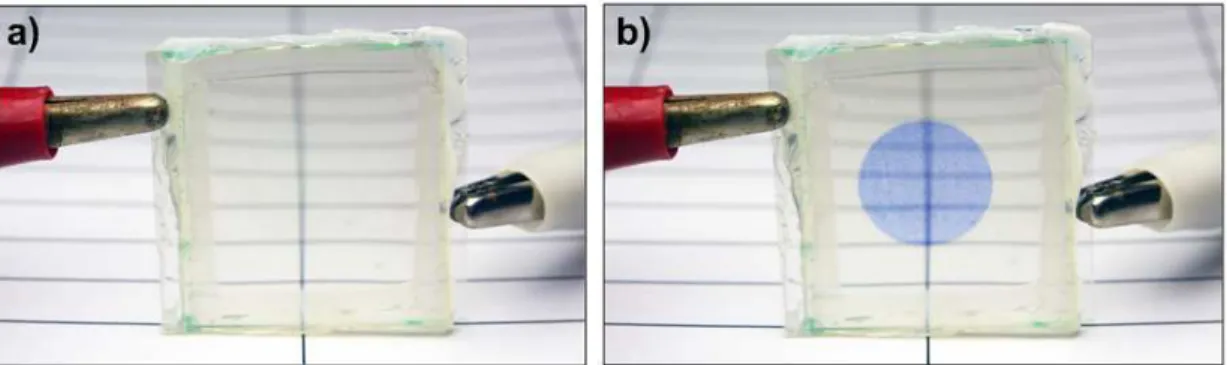
Figure 3.10 Prototype of inkjet printed lab-test EC window in a) bleached and b) colored state………..………42
xiv
Figure 4.1 The thickness of printed test layers vs. number of passes……….…..49 Figure 4.2 The change in optical density (bottom and left axis) for layers printed
with different number of passes and spectral transmittance (top and
right axis)………...…....50
Figure 4.3 The coloring and bleaching time responses (bottom and left axis) of
printed layers vs. number of passes and coloration-bleaching characteristic (top
and right axis) ………...50
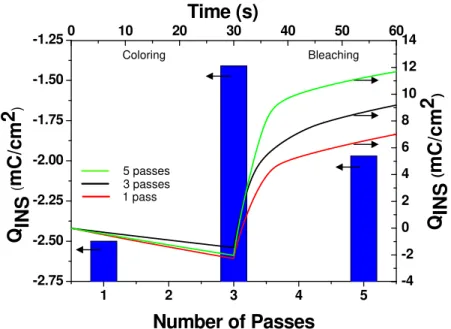
Figure 4.4 The charge inserted densityfor printed layers vs. number of passes (bottom and left axis); chronocoulometric curves for printed layers (top and
right axis)………...51
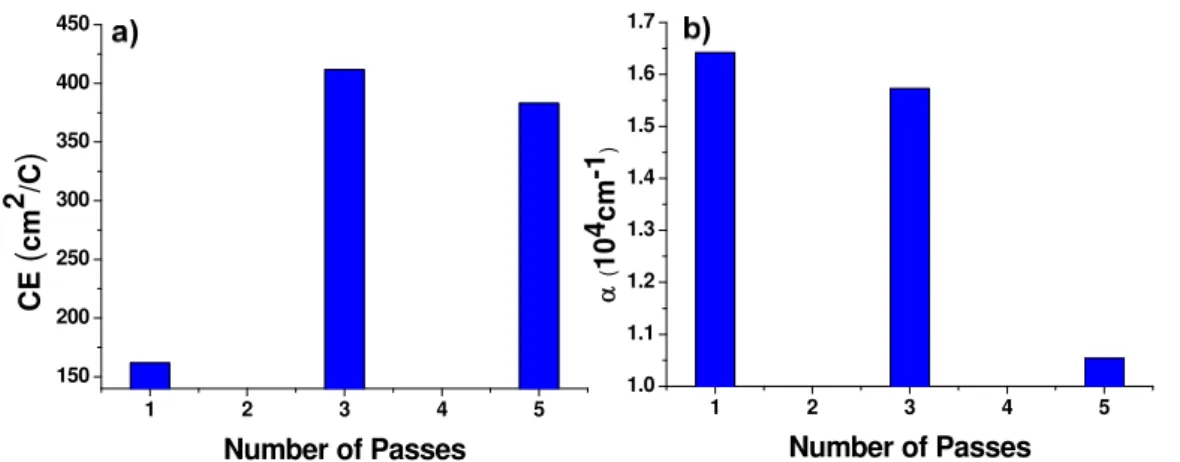
Figure 4.5 The a) coloration efficiency and b) optical absorption coefficient of
printed layers vs. number of passes………...52 Figure 4.6 The reduction (blue) and oxidation (green) peak maximum for printed
layers vs. number of passes (bottom and left axis); cyclic voltammograms
of printed layers (top and right axis)……….53 Figure 4.7 Initial whole multiple regression model with the numeric summaries
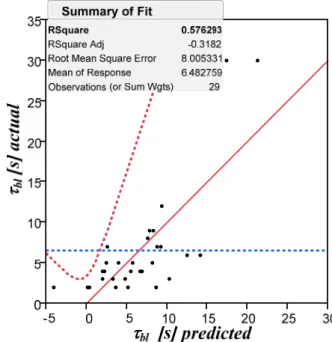
for coloration time responses………...57 Figure 4.8 Initial whole multiple regression model with the numeric summaries for
bleaching time responses……….……..57 Figure 4.9 Initial whole multiple regression model with the numeric summaries for
optical modulation responses………...58 Figure 1.10 Initial whole multiple regression model with the numeric summaries
for coloration efficiency responses………58 Figure 4.11 Final whole multiple regression model with the numeric summaries
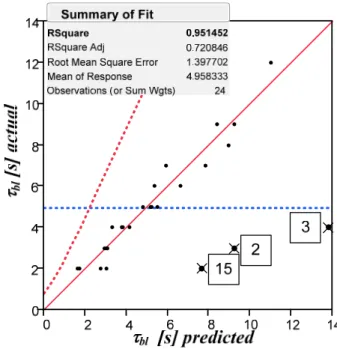
for coloration time responses after excluding the most distant observations………60 Figure 4.12 Final whole multiple regression model with the numeric summaries
xv
Figure 4.13 Final whole multiple regression model with the numeric summaries for change in optical density after excluding the most distant
observations………...…60 Figure 4.14 Final whole multiple regression model with the numeric summaries
for coloration efficiency responses after excluding the most
distant observations………...60
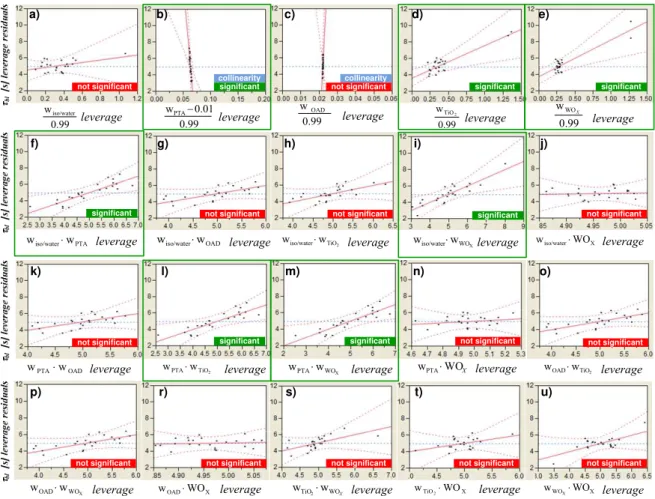
Figure 4.15 Leverage plots of main effects and factors correlations for τcol response…….62 Figure 4.16 Leverage plots of main effects and factors correlations for τbl responses…….63 Figure 4.17 Leverage plots of main effects and factors correlations for ΔOD responses….64 Figure 4.18 Leverage plots of main effects and factors correlations for CE responses……65 Figure 4.19 Sorted Parameter Estimates plot for a) τcoland b)τblresponse……….69 Figure 4.20 Sorted Parameter Estimates plot for a) ΔOD and b) CE response………70 Figure 4.21 Profiles of several a-WO3/TiO2/WOX samples for different compositions…...71
Figure 4.22 SEM picture of a printed a-WO3 film (Device no. 25); Inset: Magnified
area showing layer cross-section………..72 Figure 4.23 SEM picture of a printed a-WO3/TiO2/WOX (Device no. 19); Inset:
Magnified area showing chocolate with nuts like structure………..73 Figure 4.24 SEM picture of a-WO3/TiO2/WOX printed film (Device no. 19).
Visible islands of different sizes indicate that the layer is not continuous.………...74 Figure 4.25 SEM picture of a-WO3/TiO2/WOX printed film (Device no. 21) with
addition of Oxalic Acid; Inset: Magnified area shows grooves formed on the
surface due to acid crystallization. ……….…..75 Figure 4.26 XRD patterns of a) WO2.9blue nanopowder, b) WO3yellow
nanopowder, c) ink 9 (wPTA=0.01;wTiO2=0.5;wWO2.9=0.49), d) ink 21
(wPTA=0.08; wOAD=0.02;wTiO2=0.45; wWO3=0.45), e) ink 19 (wiso/water=0.87;
xvi
Figure 4.27 Transmission modulation ofEC windows based on printed films containing a) a-WO3 with TiO2 and WO2.9 nanoparticles, b) a-WO3 with
WO3 nanoparticles, c) a-WO3 with WO2.9 nanoparticles, d) a-WO3 with
TiO2 nanoparticles and e) pure a-WO3. Annealing: 120 deg C, 1h.………....78
Figure 4.28 Surface response prediction of ΔOD for a) a-WO3/TiO2/WO3 and b)
a-WO3/TiO2/WO2.9 printed layers……….79
Figure 4.29 Surface response prediction of Tbl for a) a-WO3/TiO2/WO3 and
b) a-WO3/TiO2/WO2.9 printed layers……….79
Figure 4.30 Surface response prediction of Tcol for a) a-WO3/TiO2/WO3 and b)
a-WO3/TiO2/WO2.9 printed layers……….80
Figure 4.31 Color-bleached characteristics for a-WO3/TiO2/WOX printed films
recorded at 900 nm under a square wave potential of ±4V at a frequency
of 0.016 Hz in a first 5 cycles………81 Figure 4.32 Surface response prediction of τcol for a) a-WO3/TiO2/WO3 and b)
a-WO3/TiO2/WO2.9 printed layers………...…..82
Figure 4.33 Surface response prediction of τbl for a) a-WO3/TiO2/WO3 and b)
a-WO3/TiO2/WO2.9 printed layers……….82
Figure 4.34 Step wave voltage transmittance for 900 nm……….83 Figure 4.35 Surface response prediction of Vopt for a) a-WO3/TiO2/WO3 and
b) a-WO3/TiO2/WO2.9 printed layers………...……….84
Figure 4.36 Change in transmittance due to site saturation effect (ΔTSS) as a function
of applied voltage (U) for different a-WO3/TiO2/WOX film composition…………85
Figure 4.37 Change in transmittance (ΔT=Tbl-Tcol) as a function of applied voltage
(U) for different a-WO3/TiO2/WOX film composition………..86
Figure 4.38 Surface response prediction of αfor a) a-WO3/TiO2/WO3 and b)
xvii
Figure 4.39 Cyclic voltammograms of EC windows based on printed films containing a) a-WO3 with TiO2 and WO2.9 nanoparticles, b) a-WO3 with WO3 nanoparticles, c) a-WO3 with WO2.9 nanoparticles, d) a-WO3 with TiO2 nanoparticles and
e) pure a-WO3. The scan rate is 50 mV/s. Annealing: 120 deg C, 1h………...87
Figure 4.40 Surface response prediction of iREDfor a) a-WO3/TiO2/WO3 and
b) a-WO3/TiO2/WO2.9 printed layers………...……….88
Figure 4.41 Surface response prediction of iOXfor a) a-WO3/TiO2/WO3 and
b) a-WO3/TiO2/WO2.9 printed layers………...……….89
Figure 4.42 Chronocoulometric curves for films………..89 Figure 4.43 Surface response prediction of QISNfor a) a-WO3/TiO2/WO3 and
b) a-WO3/TiO2/WO2.9 printed layers………...………90
Figure 4.44 Surface response prediction of CE for a) a-WO3/TiO2/WO3 and
b) a-WO3/TiO2/WO2.9 printed layers………...……….91
Figure 4.45 Surface response prediction of viscosity (ν)for precursor solution based on PTA, OAD, TiO2 nanocrystals and a) WO3 or b) WO2.9 nanoparticles…………92
Figure 4.46 Surface response prediction of surface tension (γ)for precursor solution
based on PTA, OAD, TiO2 nanocrystals and a) WO3 or b) WO2.9 nanoparticles…..93
Figure 4.47 Surface response prediction of density (ρ)for precursor solution based
on PTA, OAD, TiO2 nanocrystals and a) WO3 or b) WO2.9 nanoparticles…………93
Figure 4.48 Surface response of contact angle (θ)for precursor solution based on
PTA, OAD, TiO2 nanocrystals and a) WO3 or b) WO2.9 nanoparticles……….93
Figure 4.49 Cyclic voltammograms recorded at scan speed of 5 mV/s for spin-coated and inkjet printed a-WO3/TiO2/WOX films………...……96
Figure 4.50 Charge density vs. time for spin-coated and inkjet printed
a-WO3/TiO2/WOX films………97
Figure 4.51 Coloration-bleaching characteristic of spin-coated and inkjet printed
xix
List of Tables
Table 2.1 Examples of electrochromic metal oxides, their properties and
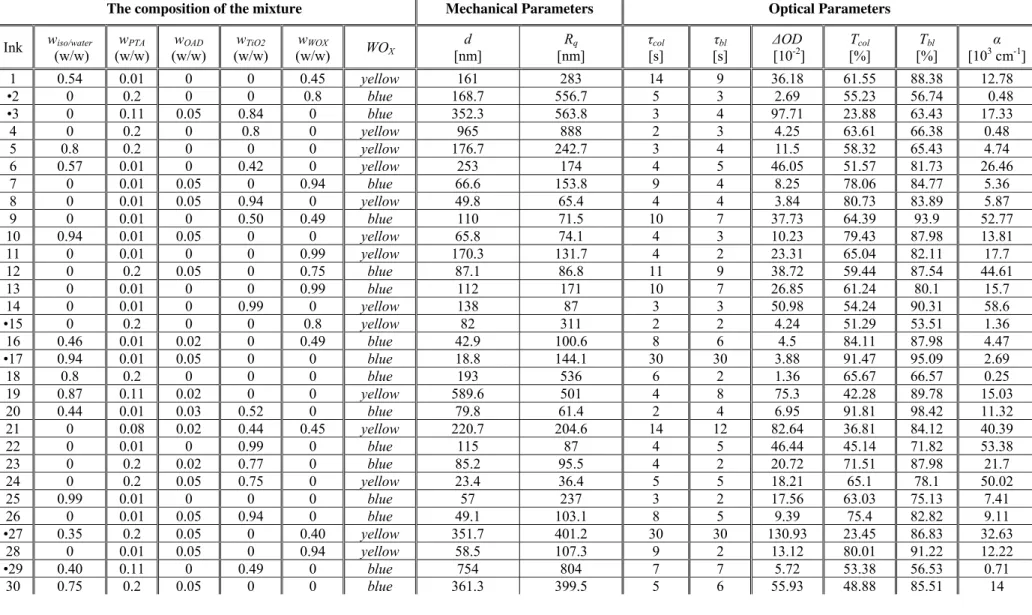
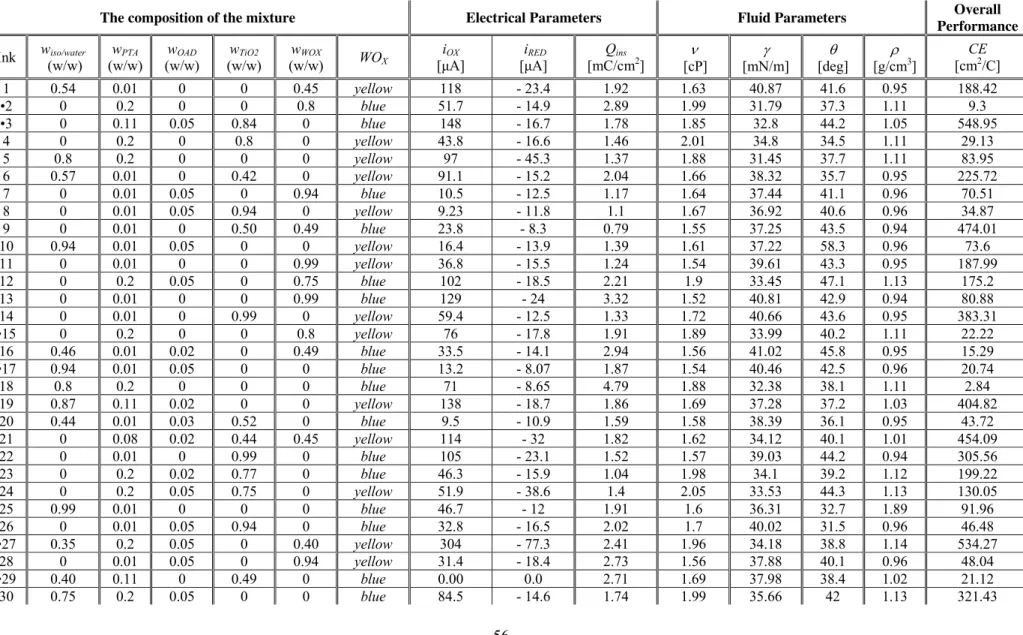
typical deposition techniques………..9 Table 3.1 Factors to be examined, its role and range...29 Table 3.2 Defined responses and their goals………...30 Table 3.3 Ink Recipes...32 Table 3.4 Profilometry parameters………...….43 Table 3.5 CQ parameters………...…44 Table 3.6 CV parameters………...45 Table 4.1 A tabular summary of factors and responses for all tested devices (part1)……..55 Table 4.2 A tabular summary of the factors and responses for all tested devices (part2)….56 Table 4.3 The Parameter Estimates and Effect Test table for τcolparameter………66 Table 4.4 The Parameter Estimates and Effect Test table for τblparameter……….67 Table 4.5 The Parameter Estimates and Effect Test table for ΔOD parameter………68 Table 4.6 The Parameter Estimates and Effect Test table for CE parameter………68 Table 4.7 Comparison of EC films parameters deposited via spin-coating and inkjet
printing (device no. 21) for wiso/water=0; wPTA=0.08 wOAD=0.025;
1. Introduction and objective
1
1. Introduction and objective
The overall objective of this work is to develop a complete solution processed and low temperature dual-phase electrochromic system based on PTA (Peroxotunstic Acid) precursor deposited via Inkjet Printing Technology. Whereby, the processability of precursors with nanocrystalline solid content via Inkjet Printing for smart windows applications is to be demonstrated. Applications related aims to include the optimization of the properties of the coating materials (composition, rheology, crystallinity, etc.) and the mechanical, optical and electrochemical characterization of the printed devices. In detail, developed electrochromic system which includes materials and deposition technique should satisfy the following conditions:
low-temperature process compatible with flexible substrates, such as PET (Polyethylene terephthalate), PEN (Polyethylene naphthalate) or paper;
non-contact, digital, additive, no mask and no vacuum patterning method;
eco-friendly;
coexistence of amorphous and nanocrystalline phases for better electrochromic performance;
cost efficient in mass production;
solution processed deposition;
widely available materials;
application of inorganic material, which provides a higher device stability;
reduced consumption of materials and energy.
Although many research reports about the PTA precursor based depositions methods (dip-coating, spin-coating) for WO3 (Tungsten Trioxide) thin film coating have
been published, no attempt has yet been reported to prepare WO3 coatings by Inkjet
Printing. This study aims to synthesize amorphous WO3 thin films containing TiO2/WOX
nanocrystals (a-WO3/TiO2/WOX) in a low temperature Inkjet Printing process.
As it is well known, fully crystalline WO3 coating is not the best candidate for EC
2
greater number of cycles. Several studies [1,2] have been made also on the TiO2-doped
WO3 thin films using solution processed deposition techniques. The use of TiO2 (Titanium
Dioxide) as a doping material always resulted in improved electrochromic performance. It is shown that reversibility can be improved by adding TiO2 to the WO3 precursor and the
lifetime of TiO2/WO3 thin films can be much longer that of pure WO3 material [2]. As TiO2
is hydrophilic it adsorbs water from air and this small amount of water accelerates the H+ ion insertion/removal in to or from the TiO2/WOX thin films. In the present work TiO2
doped a-WO3/WOX thin films were prepared by a simple and inexpensive way. The WO3
sol was mixed with aqueous-alcohol TiO2 nanoparticle dispersion resulting in a stable and
printable ink.
2. Fundamental
3
2. Fundamental
2.1 Electrochromism
Electrochromism is one of the several types of chromism. The word chromism stands for the ability of a substance to change its color in a reversible way in result of a process caused by some form of stimulus. Some types of chromism existing in a practical applications are listed bellow [3,4]:
electrochromism – voltage application (Figure 2.1a);
termochromism – temperature change (Figure 2.1b)
photocromism – exposure to light radiation (Figure 2.1c);
halochromism – change in pH of a solution;
piezochromism – color change caused by mechanical grinding;
solvatochromism – change of solvent polarity (Figure 2.1d);
ionochromism – addition of ions.
Figure 2.1 Chromism application examples: a) electrochromism for electrochromic window application [5], b) termochromism for ring application [6], c) photocromism for glasses application [7], d) the same organic compound dissolved in solvents with different
4
This thesis contains only a detailed exposure of one of the types of chromism which is electrochromism, since this is the scope of the conducted research. Electrochromism could be briefly defined as a persistent but reversible optical change produced electrochemically in selected thin films compounds, designated as electrochromic materials [9].
The Equation 2.1 represents the electrochromism phenomenon for amorphous WO3
(the most typical and widely studied electrochromic material).
2.1
Amourphous WO3 film in bleach state (transparent) can be switched reversibly to a
colored state (dark blue) by both insertion of ions and electrons to form tungsten bronze (LiyWO3). The y value in LiyWO3 is the fractional number of sites of which are filled in the
WO3 lattice. For low y values the films have an intense blue [10,11]. The electrochromism
history started in 1704, when Diesbach discovered the Prussian blue, an excellent dye which had also electrochromic properties. This material changes its state from dark blue to transparent when a voltage is applied. In 1815 the electrochromism of WO3 was
discovered, by Berzelius [12]. In fact, it was showed that pure WO3 changed color on
reduction when warmed under a flow of dry hydrogen gas. Later in 1824 Wohler effected a similar chemical reduction with sodium metal. Kobosew and Nekrasso in 1830, recorded that WO3 powders could acquire the color blue by electrochemical reduction in an acid
2. Fundamental
5
(Strontium Titanium Trioxide) and observed an electrochromic color move into de crystal from the two electrodes. In 1972, Beegle developed a display having identical counter and working electrodes as the one from Blanc and Staebler, but made of WO3 [12,13].
Nowadays, Deb’s paper form 1973 is quoted as the work responsible for the true birth of electrochromic technology.
Nevertheless, electrochromism has remained an active area for basic and applied research, with large possibilities for applications in emerging technologies. The interest was boosted in the mid- 1980s with the awareness that electrochromism was of much interest as a mean to achieve energy efficiency in buildings, using smart windows. [14]
The smart windows and other electrochromic systems consist of two electrodes and an electrolyte. When applied voltage with appropriate polarity, charge in the cell drives in and out of the electrochromic material and an electrochemical redox reaction causes a corresponding color change. Therefore electrochromic materials are currently attracting much interest in industry for their commercial applications. [15]
Possible applications of electrochromic materials include, among others, electrochromic displays, cathode ray tubes, thermal-exposure indicator for frozen foodstuffs, electrochromic mirrors and windows. Electrochromic displays are an application where significant advances were made in the 1970s and 1980s with the development of watch and clock displays. However some of their biggest limitations were speed and lifetime. But for this kind of applications these limitations weren’t critical because these areas do not require very rapid updating of display information. [16]
Electrochromic materials can also be used in cathode ray tubes with variable transmittance. An electrochromically darkening cathode ray tube screen employing oxides it’s an alternative to the common brilliance adjustments of TV tubes, when room illumination alters. Electrochromic darkening is preferable to direct electrical control as color values are thereby better preserved. [17]
6
allows electrochromism to set in, thus warning of the thermal deterioration of the goods. The higher the temperature and/or the longer the exposure, the more intense could the color become and show the deterioration level. It’s also important to refer that after thermal exposure, re-freezing does not dispel the coloration. [17]
For the case of the electrochromic mirrors, the most common device is the car rear view mirror (Figure 2.2). This mirror changes its color to a dark blue-green color that allows only the outline of the usual dazzling headlights to appear. Here an optically absorbing electrochromic color is evoked over the reflecting surface, reducing reflection intensity and thereby alleviating driver discomfort. The back electrode is a reflective material allowing customary mirror reflection in the bleached state. [13,17]
Figure 2.2 Electrochromic car rear view mirror[18]
For electrochromic windows applications there’s a coating of a transparent electrode, with electrochromic materials that allow the use of color change as shading of the substrate. This means that it is possible electronically to alter a window’s transmission and reflection properties by use of electrochromic thin films. The electrochromic windows are commercially applied at present. Controlling the absorbance or reflectance properties of the glass using electrochromic cell is the core element of this application. [15]
2. Fundamental
7
leading to a big energy saving. It is important to note that the window maintains its primary function, which is allowing a constant visual contact between indoors and outdoors. [5,17]
Figure 2.3 Electrochromic window [19]
Besides the use of smart windows in energy efficient buildings, this device can also be used in automobiles and even aircrafts, with the same energy saving purpose. There are also other applications as well, for example motorcycle helmets (Figure 2.4) where the visors can be colored, during day and bleached at night, or before entering tunnels or other dark places. [5,13]
Figure 2.4 Motorcycle helmet with electrochromic visor[5]
8
Figure 2.5 Basic design of an electrochromic window
There are basically three types of electrochromic materials that can be potentially used in application described above [12,20]:
type I – Soluble in both the reduced and oxidized sates. A good example is aqueous methyl viologen (1,1´-dimethyl-4,4’-bipyridilium-II);
type II – Soluble in one redox state but following electron transfer forms a solid film on one of the electrode surfaces. Organic examples of this type of electrochromic material are aqueous viologens systems such as heptyl or benzyl viologens, and inorganic example is the bismuth;
type III – In this type of materials both redox states are solids. Most inorganic electrochromes are type III, like metal oxides.
For types II and III, once the redox state has been switched, no further charge injection is needed to retain the new electrochromic state and such systems are said to have
optical memory. In contrast, for type I electrochromic materials, it is necessary to keep current flowing until the whole solution has been electrolyzed. The PTA precursor and WOX nanoparticles used in studies described in this thesis belong to the type III group of
2. Fundamental
9
The electrochromic film is responsible for the change of the optical properties of the device, by switching between the oxidized and reduced form and by conducting electrons as well as ions. Darkening under ion insertion is referred as cathodic coloration, whereas darkening under ion extraction is referred as anodic coloration. The ion insertion and extraction are usually named as ion intercalation and deintercalation. Working electrode can be either organic, with conducting polymers such as PEDOT (Poly(3,4-ethylenedioxythiophene)), PANI (Polyaniline), viologens like salts of 4.4’-bipiridinum, or inorganic as it is in case of metal oxides. [13,14,21]
Table 2.1 contains examples of most popular electrochromic metal oxides, their coloration properties and typical deposition techniques.
Table 2.1 Examples of electrochromic metal oxides, their properties and typical deposition techniques [12,13]
Oxide Coloration
mechanism Color
Full
transparency
Deposition
methods
WO3 Cathodic Intense Blue Yes
Thermal
Evaporation/RF
Sputtering / Sol-gel
TiO2 Cathodic Blue Yes
Thermal Evaporation/
RF Sputtering
IrO2 Anodic Blue/ Grey Yes
Sputtering RF/Anodic
Deposition
Nb2O5 Cathodic Blue Yes Sol-gel/RF Sputtering
MnO2 Anodic Brown No Electrodeposition
V2O5 Cathodic/Anodic Brown-Yellow No RF Sputtering
MoO3 Cathodic Intense Blue Yes Thermal Evaporation
10
imperative that the electrochromic film has a structure that is permeable enough to permit easy intercalation and deintercalation of charges.
As it is shown in Figure 2.5, the electrochromic device is composed by two electrodes, separated with electrolyte, which can be any substance containing free ions that make the substance electrically conductive. The charge flow takes place from electrolyte to working electrode as well as from working electrode to electrolyte. The electrolyte, as a pure ion conductor must be ionically conductive, but electronically insulating. It must allow ions to be shuttled between an electrochromic film and an ion storage film (counter electrode) [13,14]. Typically, the electrolytes used in EC windows, as in any other electrochemical cell, belong to four main classes: aqueous electrolytes, organic liquid electrolytes, ionic liquids electrolytes and solid polymer electrolytes. [22]
The most common electrolytes are liquid (aqueous and organic), because they are easy to reproduce and very durable. On the other hand the probability of leakage and low chemical stability of the liquid electrolytes are inevitable drawbacks for electrochromic display applications. The aqueous liquids electrolytes encompass both acids and bases, while the group of organic liquid electrolytes include for example propylene carbonate (PC) or ethylene carbonate, with addition of lithium salts, such as lithium perchlorate (LiClO4)
or sodium perchlorate (NaClO4)) in order to achieve improved electrochemical properties.
The group of ionic liquid electrolytes is represented for example by ethyl ammonium nitrate ([EtNH3][NO3]) or 1-butyl-3-methylimidazolium tetrafluoroborate ([BMIM][BF4]).
Those room-temperature fluid salts consist of organic cations and inorganic anions, what results in improved lifetime and response speed of diverse types of electrochemical devices.
[17,22,23]
Solid polymer electrolytes are usually a polymer or gel matrixes swollen with liquid electrolyte solutions, a single ion systems in which only one ionic species is mobile within a polymer matrix. Another common possibility is a solvent-free ion-coupled system consisting of ion-solvating polymers mixed with salts, so that cations and ions become mobile within the polymer network.
2. Fundamental
11
in this thesis were performed using encapsulated EC windows filled with lithium perchlorate polymeric gel electrolyte.
Another layer of the EC device is the ion storage film, named also as counter electrode. This layer has the same demands on electronic and ionic conductivity as the working electrode. It should provide the same stability and durability to the device. If the ion storage film has electrochromic properties, it should be complementary to this of the electrochromic film. It means that when the electrochromic films darken upon ion intercalation the ion storage should darken upon ion deintercalation and vice versa. [13,14]
Finally the electrochomic device needs to have substrates to be built on. For windows applications, the electrochromic layer is deposited on a transparent substrate, typically glass or flexible polyester (PET) foil [3]. On the other hand, for display or mirrors applications, there’s no need for both substrates to be transparent. For example, the substrates of an electrochromic watch can be glass and Graphite [16].
Both the targets are coated with electrically conducting transparent films, named Transparent Conductor Oxides (TCO). The TCO should have low electrical resistivity and high optical transparency. The best material in terms of optical and electrical properties are In2O3:Sn (Indium Tin Oxide, or ITO), IZO (Indium Zinc Oxide), PEDOT and more
recently also carbon nanotubes. [3,14,21]
When a voltage is applied between the two electrodes, in the electrochromic film occurs a reaction of reduction that leads to the consumption of the electron, while in the counter electrode occurs reaction of oxidation that provides the departure of an ion that goes to the electrochromic layer. Consequently there’s a drift of electrons through the external circuit from the counter electrode to the electrochromic layer, and to compensate this charge flow there’s a passage of ions thought the electrolyte, which is located between the electrodes.
The Equation 2.2 represents the reaction mentioned above, where there’s the need to provide electrons and ions to the WO3 electrochromic layer.
2.2
12
intermediate level, and the device exhibits open-circuit memory so that the optical changes take place only when charge is in movement. [13,14]
2.2 Inkjet Printing Technique
Recently the thin films technology has grown world-wide. The importance of coatings and synthesis of new materials for the industry have also resulted in a tremendous increase of innovative thin films processing. Thin films consist of two dimensional materials created by the process of condensation and growth of atoms, molecules or ions. Regarding to its thickness there isn’t any well defined value for it, but it should be much smaller regarding the other two directions.
2. Fu altern photo low-c mate with depo expe will a vacu Print consu T T undamental Fig The Inkj native fabr ovoltaic dev cost and roo erials.
Research sol-gel me osition techn cted that co also improv The Inkj uum pattern ting techni umption of Thin Film Dep Techniques f
Applicatio
gure 2.6 Th
et Printing rication me vices, using om tempera
h presented ethod for e nique is inn ombination ve the overa jet Printing ning method
que, not o f materials a
position for EC
ons
hin Film De
technique h ethod of t g organic as ature techno
in this the electrochrom
novative an of those tw all EC devic g technique d, ideal for only simpl and energy. Solution Processe Techniqu Vacuum Processe Techniqu 13 eposition Te
has been us thin film s well as in ology that a
esis is based mic window nd hasn’t b
o methods w ce performa
is a non-c r cost effic lifies a pa
[27] n ed ues E S m ed ues echniques fo sed successf technology organic com allows the d
d on Inkjet w developm been reporte will not onl ance. ontact, digi cient mass atterning pr Sol-Gel Electrodepositi Spray Pyrolise Sputtering Evaporation CVD
or EC applic
fully in the y for build mponents, b depositions o
Printed Te ment. The u
ed before b ly make the
ital, additiv production. rocess, but Sp D
I
ion es M n El cationslast few ye ding electr because it’s of different
echnology c use of this by any auth
process sim
ve, no mask . The use o t also redu
pin Coating ip Coating
Inkjet
Magnetron RF Reactive Thermal ectron Beamears as an ical and an easy, t kinds of
combined specific hor. It is mpler but
14
In the other hand, the Inkjet Printing process is also very complicated, and the ink used must meet certain chemical and physicochemical requirements including those related to jetting performance, wetting and adhesion on various substrates. Furthermore, the ink must be formulated as a stable fluid and upon solidification on the substrate, the printed element must provide the properties required to the application. [28,29]
In terms of applications, the Inkjet Printing technique has been widely used in several laboratories as a way to develop alternative deposition methods. It has already been widely used for printing polymers, metal nanoparticles, carbon nanotubes, molten silver etc. The possibilities of this technique are vast since the printing can be done in all kinds of substrates including flexible ones. This allow to use of the Inkjet technology in electronics, to print on circuit boards, for flat panel displays printing light emitting polymers, producing organic thin film transistors, organic LEDs (Light emitting diode), sensors, organic solar cells, electrochromic and thermochromic devices. [28,29]
2. Fundamental
15
Figure 2.7 Typical construction of an office Inkjet printer [30]
16
Figure 2.8 Inkjet Printing Technology map [30]
The continuous Inkjet printing is achieved using a device that applies an electric field to the droplets, charging them electrically. Those same droplets are diverted as they pass through the deflection plates, due to the applied magnetic field and are deposited on the substrate. Unused droplets are collected out of the printing area.
2. Fundamental
17
Figure 2.9 Thermal Inkjet printing: drop formation [30]
The most critical component of Inkjet printing is probably the ink. Ink chemistry and formulations not only dictate the quality of the printed image but they also determine the drop ejection characteristics and the reliability of the printing system. There are many different types of inks that have been developed and used for Inkjet Printing applications. The typical composition of Inkjet inks is presented on Figure 2.10.
18
As it is shown in Figure 2.10 the main components are the liquid carriers, which are materials responsible for the dissolution or suspension of the functional material (57%). Around 33% of the ink is filled with additives. Generally around 30% of the additives placed on inks are humectants used to prevent drying and clogging. The rest of additives consist of surfactants, buffering agents and adhesive agents, used in much less quantity than humectants and their quantities are variable or even dispensable for some inks. Finally there’s the functional material (10%), which is the one with less quantity but with more importance. [27,28]
The density, viscosity and surface tension are three the most important parameters, which characterize the inks. For a quality printing it is necessary to ensure that these parameters are in a certain range of values. The density of a substance is defined as its mass per unit volume. As known, different substances have different densities and the density is strongly dependent of the solid content. To have a quality printing, the printing suspension must be stable, implying that the solid content is low enough. The density also influences the drive force in the printing process, if the density is too high it will be the drive force in the process, contrarily to the correct way, where the process is driven by viscosity or capillary forces.
Viscosity is a measure of the resistance of a fluid which is being deformed by either shear or tensile stress. Basically the viscosity describes a fluid’s internal resistance to flow. That is extremely important for the Inkjet printing because if an ink is too viscous it would clog the nozzles of the print head and if it’s slightly viscous the ink will drip. Viscosity of water based Inkjet thermal inks vary from 1.7 to 2.0 cps.
The surface tension is a property of the surface of a liquid caused by cohesion of molecules. Since molecules on the surface of a liquid are not surrounded by molecules on all sides, they are more attracted to their neighbors on the surface. The surface tension for the thermal Inkjet printing is between 28 and 40 dyne/cm.
2. Fundamental
19
tension is relevant for the spot shape and size control, preventing a non-uniform spreading and low viscosity/surface tension will provide a rapid spreading.
In a field of electrochromic devices the Inkjet Printing Technology is extremely promising because it allows the production in series, at low-cost and at room temperature. The fact of operations and deposition in room temperature allows the production on flexible substrates.
The performance of printed electrochromic devices is expected to be different, and probably much better than the conventional ones. This difference it’s due to the fact that deposited layers can have high porosities, the layer thickness can controlled much easier and the deposition process is much faster since the drying time is extremely low (the calcinations process is different than in other techniques). Briefly, when compare to the vacuum techniques, this is a simpler, cheaper, faster and probably a technique that can improve the electrochromic behavior of the printed devices. [31]
2.3 Sol-Gel Processing for Electrochromic Materials
Sols and gels are two forms of matter that have been known to exist naturally for a long time. They include various materials such as ink, clays and a number of other substances such as the blood and milk. A sol is a stable suspension of colloidal solid particles within a liquid. For a sol to exist, the solid particles, denser than the surrounding liquid, must be small enough for the forces responsible of dispersion to be greater than those of gravity. A gel is a porous 3-dimensionally interconnected solid network that expands in a stable fashion throughout a liquid medium and is only limited by the size of the container. If the solid network is made of colloidal sol particles the gel is said to be colloidal. If the solid network is made of sub-colloidal chemical units then the gel is polymeric.
20
going through what is called a gel point. This is the point where the sol abruptly changes from a viscous liquid state to a solid phase called the gel. [32,33]
Sol-gel processing does not only designate a unique technique but a very broad type of procedures that centralizes around a single scheme as it is presented in Figure 2.11.
Figure 2.11 Sol-gel processes [32]
2. Fundamental
21
temperature owing to the clean burn out properties of organic additives (with low carbon content) and other volatiles from the as-deposited film. [32,33]
The sol-gel processing has been widely used for deposition of WO3 films. Besides
of being cost-effective, this method has also good control over the microstructure and homogeneity of the coatings. Therefore this technique has also been used for development of electrochromic coating starting with the materials, either tungsten alkoxides W(OR)6,
tungsten oxyalkoxide WO(OR)4 or WO2(OR)2. However, these precursors are not stable
towards hydrolysis or condensation and consequently need some stabilizers. [34-36]
The best way to stabilize aqueous solutions of tungsten precursors is to use complexing reagents such as hydrogen peroxide (H2O2). With a proper concentration of
H2O2, the product that appear at the end of the reaction is soluble in water Peroxotungstic
Acid (PTA). The experimental formula of this crystal is:
· · 2.3
To obtain PTA, according to equation 2.3, the maximum value of x has to be 0.97 and y must be at least 1.1. When 1>x>0.53 PTA is soluble in water and when 0.53>x>0 is insoluble. Can be concluded that mixing W (tungsten) metallic powder and H2O2 gives
crystalline PTA when x=1 or x=0, while for 1>x>0 the result is amorphous PTA. In either case the acid suffers polymerization and dehydration during a heat treatment of the film at temperature between 100 and 200°C [37].
For the proposed objective, which is a large scale and low cost devices, the sol-gel method combined with Inkjet technology appears to be a versatile technology to deposit electrochromic tungsten oxide films. Due to the fact that is a non-contact, digital, room temperature and no vacuum patterning method, with the possibility to control the deposited layer thickness and porosity makes it ideal for cost efficient mass production.
To allow a correct quality analysis of the developed devices, it’s necessary to compare the results with another technique. The deposition technique chosen as a reference is spin-coating, because it is a solution processed method with some similarities to the Inkjet technology.
22
that is held by some rotatable fixture and then spinning the substrate at high speed. Centripetal acceleration cause the fluid to spread to, and eventually off, the edge of the substrate leaving a uniform coating of the chosen material on the surface. Final film thickness and other properties will depend on the nature of the fluid (viscosity, drying rate, percent solids, surface tension, and so on) and the parameters chosen for the spin process. Factors such as final rotational speed and acceleration contribute to how the properties of coated films are defined. One of the most important factors in spin coating is repeatability. Subtle variations in the parameters that define the spin process can result in drastic variations in the coated film. [38]
3. Methods and Procedures
23
3. Methods and Procedures
3.1 Experimental Design for Inkjet Electrochromic Devices
As described in Chapter 2, Inkjet Printing is a solution based technique in which the formulation of the inks is of great importance to the performance of printer and the final device performance as well.
The mixture components were selected based on literature review (sol-gel method for WO3 films), Inkjet technique principles and using an experience of researchers in our
group. Therefore, the chosen constituents are as follow:
1. The base solution (liquid carrier) is a simple mixture of water and isopropyl alcohol with a weight fraction of 0.7 and 0.3 respectively.
2. The functional materials are:
PTA;
WOX nanoparticle dispersion;
TiO2 nanoparticle dispersion;
3. The additive used as a dispersant is, the oxalic acid (OAD).
The PTA as a WO3 precursor has been obtained by a sol-gel method in which 6g of
tungsten monocrystalline powder, (99.9%, Aldrich, Japan) was carefully added to 50ml mixture (50:50) of distilled water (Milipore S.A, France) and hydrogen peroxide (30% by weight, Sigma-Aldrich, Germany). Since the reaction is strongly exothermic, as icy ambient was employed and the solution was kept slowly stirring for 24 hours. The excess of tungsten powder was then removed by filtration (0.45 μm syringe filter, Roth, Germany) leading to a transparent solution. In order to remove the excess of hydrogen peroxide the solution was dried at 65º C and washed several times with distilled water. After drying the final result is a water soluble orange crystal powder (PTA). The formation of PTA mainly depends on the degree of excess decomposed H2O2 in the solution, the atmospheric
24
should be removed by subsequent washing with distilled water and drying at the same temperature till the yellow crystals are obtained.
The solution processed PTA is the functional material which as-deposited forms amorphous phase causing high optical modulation of the layer when electrical potential is applied. Considering the fluid properties of aqueous-alcohol PTA solution, the use of this material for printing seems to be reasonable. The quantity of PTA used in experiments is in the range from 0.01 to 0.2 w/w because that’s the standard PTA concentration used in other sol-gel deposition techniques, like dip coating. [39]
According to C.M. White et al [40], the crystalline structure of the material influences the diffusion coefficient inside the electrochromic layer and the length of the diffusion path. It is therefore obvious that the varied, dual-phase microstructure would significantly improve the electrochromic performance. The creation of the crystalline phase in a low temperature, deposition process has so far been possible only using electrodeposition [41]. Here it’s proposed a new approach which allows for the incorporation of the crystalline phase into the layer using Inkjet Printing. This innovative method is based on dispersions of nanocrystals used as components of the printable ink. It’s expected that this will allow for simultaneous use of the advantages of both phases without necessity of using high energetic depositions methods or annealing.
The two types of commercially available WOX nanoparticles were used as a source
of crystalline phase, WO3 hereinafter called yellow (Sigma Aldrich Chemistry, USA) and
WO2.9 hereinafter called blue (99.99% pure WO3 ceramic oxide target, Super Conductor
Materials, USA). The suggested designation of those materials is thin film deposition using PVD techniques. Here, however it serves as a solid content in liquid dispersions. These liquid dispersions are aqueous alcohol dispersions with a solid content of around 0.01% and base solution of isopropyl alcohol and water in a constant proportion 0.3/0.7. The different colors of the WOX nanoparticles are due to their stoichiometry.
Figure 3.1 and 3.2 shows the SEM (Scanning Electron Microscopy) micrographs of the yellow and blue WOX nanoparticles, respectively. The yellow tungsten oxide exhibits
3. Methods and Procedures
25
Figure 3.1 WO3yellow nanopowder SEM
micrograph
Figure 3.2 WO2.9blue nanopowder SEM
micrograph
The TiO2 nanopowder in aqueous alcohol dispersion has a solid content of
nanoparticles of around 0.01% and the same proportion of isopropyl alcohol and water, as the WOX dispersions. The presence of titanium dioxide has the objective of increasing the
electrochromic behavior, because this material tends to increase the contact surface area of the electrochromic material. According to P.S. Patil et al the presence of TiO2
nanoparticlesmodifies the electrochromic layer structure leading to greater electrochromic reversibility, stability and coloration efficiency of the devices. The presence of titanium dioxide also helps the intercalation and deintercalation process due to formation of open channels resulting in an increase of the surface area of the layer [1]. In this research, was decided to examine the impact of this factor using TiO2 nanopowder (T20/SC, 3% by
weight, Solaronix). A TiO2 nanopowder SEM micrograph represented in Figure 3.3
26
Figure 3.3 TiO2 nanopowder SEM image
The Oxalic Acid (OAD dihydrate, Merck, Germany) with chemical formula (COOH)2*2H2O is a white powder working as a drying control and a dispersant for the
inks. The addition of this material is known to prevent coagulation of particles in dispersion [42]. According to Deepa et al [43] the presence of OAD in the precursor controls also the microstructure of WO3 annealed in elevated temperature and consequently affects the
electrochromic performance. In present studies OAD serves as a dispersant in the ink and potential impact of this component on electrochromic performance is going to be exanimate.
Resuming, the ink components described above were used in appropriate concentrations in order to study their impact on mechanical, electrical and optical performance of Inkjet Printed electrochromic layers. All nanoparticles have been incorporated to the ink as aqueous alcohol dispersion with a solid content of around 0.01% of total dispersion mass.
The scope of research is to find the best combination of factors (components of the mixture) to obtain the EC window with the best performance. The optimum electrochromic device is characterized by high coloration efficiency, short response time, high transparency in a bleach state, and high optical modulation.
3. Methods and Procedures
27
allows several factors to be analyzed at the same time in order to know which one has the greatest impact on the final result.
Design of experiment is the design of any information gathering exercises where variation is present, whether under the full control of the experiment or not. The purpose of this method is to characterize, predict, and then cost-effectively improve the behavior of any system or process [44]. Basically it’s a method to increase productivity and improve quality of a process.
There are several kinds of Design of Experiments, such as the Factorial Design (full or fractionated), Taguchi Design, Optimal Design for Regression Models, among others.
For this work was used the Optimal Design for Regression Models. The fact that, Optimal Designs reduce the costs of experimentations by allowing statistical models to be estimated with fewer experimental runs and the fact that, it can accommodate multiple types of factors, such as process, mixture and discrete factors is an advantage of this kind of design. Specifically, was used the D-Optimal Design, which is most appropriate for screening experiments because the optimality criterion focuses on precise estimates of the coefficients.[44]
The software used in this work is JMP® Statistical Discovery Software, which is a statistical tool that allows the interaction with data, the creation of relations between important factors and it provides more specific information about the areas that interest the most in a certain study.
This software allows the choice of several designs. After choosing a specific design it’s imperative to introduce the responses and factors of the experiment. Afterwards, with the collected information the program will create a design, which provides the recipes for the formulation of the sufficient inks to obtain a reliable study. In order to evaluate the created design, the program will make a table with the ink formulation values and where the results of measurements and calculations performed to obtain the responses values must be insert.
28
statistical information. On the other hand if the effect screening is chosen the program will provide some similar information to the effect leverage, with the addition of the sorted parameters estimates plot, and some other statistical information. In the effect screening is also possible to obtain mixture profiles where, with the data inserted in the table, is possible to create surface response prediction plots of every response. These plots are important for this study because they allow the observer to see the behavior of the devices when the quantity of nanoparticles changes.
With all the information obtained from the program it is possible to analyze if the model created is or isn’t reliable, it is also possible to know the significance of the effects and it’s possible to obtain a prediction study of the behavior of the devices.
More detailed information about the JMP® Statistical Discovery Software is available in [44].
Figure 3.4 presents step by step all the important phases of the design of experiments process for this experiment.
3. Methods and Procedures
29
The description step is where the factors and responses are identified. Factors can be either continuous concentrations of mixture components and categorical types of components. The responses are all the results of measurements and calculations that can be helpful in analysis of electrochromic device performance. Table 3.1 contains all factors for this specific design of experiments. All factors except WOX stoichiometry are continuous in
defined range, while the exception has only two categorical values yellow and blue which stand for WOX nanoparticle stoichiometry.
All factors were coded using abbreviations in order to simplify the nomenclature, and from now on will be referred as following:
wiso/water- base solution content;
wPTA - Peroxotungstic Acid content;
wOAD - Oxalic Acid content;
wTiO2- amount of TiO2 nanoparticle dispersion;
wWOX - amount of WOX nanoparticle dispersion;
WOX- stoichiometry of tungsten oxide nanoparticles.
Table 3.1 Factors to be examined, its role and range
Factor Role Value
Base solution (aqueous alcohol) Mixture component 0 to 0.99
PTA Mixture component 0.01 to 0.2
OAD Mixture component 0 to 0.5
TiO2 nanopowder in aqueous
alcohol dispersion Mixture component 0 to 0.99 WOX nanopowder in aqueous
30
Table 3.2 Defined responses and their goals
Response Name Goal
Roughness None
Coloration Time Minimize
Bleaching Time Minimize
Change in Optical Density Maximize Coloration Efficiency Maximize
Oxidation Peak Max None
Reduction Peak Max None
Transmittance (bleaching) None Transmittance (coloring) None Inserted Charge Density None Optical Absorption Coefficient None
Density None Viscosity None
Surface Tension None
Contact Angle None
The responses shown in Table 3.2 concern the measurements performed on printed electrochromic devices developed according to the DOE recipes. The results of the measurements were divided in five groups, and coded as following:
1. Mechanical parameters
d - film thickness;
Rq - film roughness;
2. Optical parameters defined for λ=900nm
τcol - coloration time;
τbl- bleaching time;
ΔOD - change in optical density;
Tcol - transmittance in coloration state;
Tbl - transmittance in bleaching state;
α – optical absorption coefficient; 3. Electrical parameters
iRED-reduction peak max.
iOX- oxidation peak max.
Qins - Charge inserted to the device during coloration process
4. Fluid parameters of the ink
3. Methods and Procedures
31
γ - ink surface tension;
θ- ink contact angle on ITO PET substrate;
ρ - ink density;
5. Overall performance defined for λ=900nm
CE- coloration efficiency
In design step the determination of mixture formulations is performed, using the
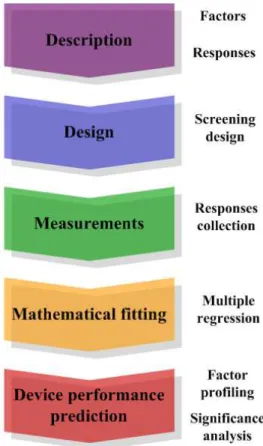
screening design method. The choice of the screening design occurs because it has the ability of examine many factors, with fewer experimental runs, to see which have the greatest effect on examined responses.In addition to the influence of the main components of the mixture, the screening design allows also to indicate the relevant correlations between factors. In measurements step all the responses defined in Table 3.2 are physically collected for all printed devices. The mathematical fitting is a mathematical procedure for finding the best fitting curve of a given set of points, in order to analyze the data collected during measurements step. Finally in device performance prediction phase the performance of any possible device can be predicted based on mathematical model. This phase allow also to perform analysis of significance in order to classify the factors and extract information about their interactions.
3.2 Electrochromic ink formulation
32
The Inkjet inks applied to non-absorbing substrates should have a surface tension in the range of about 20 dynes/cm to about 40 dynes/cm and, more preferably, in the range 25 dynes/cm to about 35 dynes/cm. Control of surface tensions in aqueous inks is usually accomplished by additions of small amounts of surfactants or low viscosity alcohols. Using the screening design, the program provides a set of recipes for formulation of 30 inks, which are sufficient for obtain the good statistical study. Table 3.3 shows the formulation of each ink with total weight of 5g.
Table 3.3 Ink Recipes
Ink
Base solution (aqueous
alcohol)
PTA OAD TiO2
dispersion
WOX
dispersion
WOX
Stoichiometry
No. w/w [g] w/w [g] w/w [g] w/w [g] w/w [g] Code name
1 0.54 2.69 0.01 0.05 0 0 0 0 0.45 2.25 yellow
2 0 0 0.2 1 0 0 0 0 0.8 4 blue
3 0 0 0.11 0.56 0.05 0.25 0.84 4.19 0 0 blue
4 0 0 0.2 1 0 0 0.8 4 0 0 yellow
5 0.8 4 0.2 1 0 0 0 0 0 0 yellow
6 0.57 2.87 0.01 0.05 0 0 0.42 2.08 0 0 yellow
7 0 0 0.01 0.05 0.05 0.25 0 0 0.94 4.7 blue
8 0 0 0.01 0.05 0.05 0.25 0.94 4.7 0 0 yellow
9 0 0 0.01 0.05 0 0 0.50 2.49 0.49 2.46 blue
10 0.94 4.7 0.01 0.05 0.05 0.25 0 0 0 0 yellow
11 0 0 0.01 0.05 0 0 0 0 0.99 4.95 yellow
12 0 0 0.2 1 0.05 0.25 0 0 0.75 3.75 blue
13 0 0 0.01 0.05 0 0 0 0 0.99 4.95 blue
14 0 0 0.01 0.05 0 0 0.99 4.95 0 0 yellow
15 0 0 0.2 1 0 0 0 0 0.8 4 yellow
16 0.46 2.33 0.01 0.05 0.02 0.13 0 0 0.49 2.49 blue
17 0.94 4.7 0.01 0.05 0.05 0.25 0 0 0 0 blue
18 0.8 4 0.2 1 0 0 0 0 0 0 blue
19 0.87 4.33 0.11 0.54 0.02 0.12 0 0 0 0 yellow
20 0.44 2.20 0.01 0.05 0.03 0.13 0.52 2.61 0 0 blue
21 0 0 0.08 0.40 0.02 0.12 0.44 2.22 0.45 2.25 yellow
22 0 0 0.01 0.05 0 0 0.99 4.95 0 0 blue
23 0 0 0.2 1 0.02 0.12 0.77 3.88 0 0 blue
24 0 0 0.2 1 0.05 0.25 0.75 3.75 0 0 yellow
25 0.99 4.95 0.01 0.05 0 0 0 0 0 0 blue
26 0 0 0.01 0.05 0.05 0.25 0.94 4.7 0 0 blue
27 0.35 1.75 0.2 1 0.05 0.25 0 0 0.40 2.00 yellow
28 0 0 0.01 0.05 0.05 0.25 0 0 0.94 4.7 yellow
29 0.40 2.00 0.11 0.54 0 0 0.49 2.46 0 0 blue
3. Methods and Procedures
33
The ink preparation is followed by magnet stirring for a few minutes till all the soluble components are completely dissolved. The obtained mixtures are ready to use as an electrochromic ink in a printer and they are stable for couple of hours.
The surface tension of poor water is higher than acceptable value for Inkjet while the viscosity is under the lower limit. Rheological parameters of the base solution can be adjusted by appropriate amount of alcohol. Taking under account rheological properties of common alcohols, the best candidate seems to be isopropyl alcohol. It is a good choice also due to the low boiling point which promotes solvent evaporation form the layer. In order to study the influence of isopropyl alcohol content in aqueous solution on surface tension and viscosity parameters, series of tests were performed.
The presence of isopropyl alcohol in aqueous solution decreases the value of surface tension of the mixture. Isopropyl weight fractions higher than 0.2 keep the surface tension value on the same level below 30 dyne/cm which is acceptable for Inkjet.
The value of viscosity of isopropyl alcohol aqueous solution increase with the alcohol concentration reaching 2.6 cP in 50:50 mixture. Further increasing in alcohol concentration leads the viscosity value to decrease.
Concluding, the most suitable concentration of isopropyl alcohol in water is 0.3/0.7 which keeps the surface tension below 30 dyne/cm and viscosity on level of 2 cP.
In order to develop a printable ink which satisfies all rheological conditions, series of measurement have been performed. The most important parameters from the ink formulation point of view are density, surface tension, viscosity and contact angle.
The density of the ink was calculated by measuring the weight of the ink (2ml in volume) using a digital balance (OHAUS, ANALYTICAL Plus) and using following equation:
3.1
where, m is weight in [g] and V the volume in [ml].
The viscosity of inks and their individual liquid components were measured using simple custom made viscometer based on laminar flow in a capillary.
34
the flow is a laminar viscous and incompressible and is through a constant circular cross section that is considerably longer than its diameter.
(3.2) Where, V is the volume between levels a and b from Figure 3.5, r is the capillary radius, the average speed of laminar flow and t is the flow time.
Figure 3.5 The principle of custom made viscometer based on laminar flow
Equation 3.2 adapted to the viscometer has the following form:
∆
8 3.3
where, d is the capillary length, Δp is the difference of pressures, Δp = p1-p2, shown in
Figure 3.6, and η is the viscosity.
![Figure 2.1 Chromism application examples: a) electrochromism for electrochromic window application [5], b) termochromism for ring application [6], c) photocromism for glasses application [7], d) the same organic compound dissolved in solvents with differ](https://thumb-eu.123doks.com/thumbv2/123dok_br/16697625.743878/27.892.167.726.403.967/application-electrochromism-electrochromic-application-termochromism-application-photocromism-application.webp)